Many aspects of an individual's behaviors and health outcomes across the life span can be traced back to the in utero period, when rapid changes occur in the structure and function of the fetus's brain and body (Barker, Reference Barker2002; Glover, Reference Gee, Humphreys, Flannery, Goff, Telzer, Shapiro and Tottenham2011; Zhang et al., Reference Yong, Laplante, Elgbeili, Hillerer, Brunet, O'Hara and King2018). There is growing evidence of critical periods during pregnancy when a fetus is particularly vulnerable to adverse maternal experiences such as stress (DiPietro, Hodgson, Costigan, & Johnson, Reference De Brito, Viding, Sebastian, Kelly, Mechelli, Maris and McCrory1996; Wadhwa, Sandman, & Garite, Reference Wadhwa, Sandman and Garite2001). Prenatal maternal stress induces changes in the fetal immune and inflammatory responses and alters the hypothalamic–pituitary–adrenal (HPA) axis functioning. The biological impact of prenatal stress can include: dysregulation of the HPA axis; broad alterations in brain growth, size, or density; alterations within specific brain regions or white matter abnormalities; and hypomyelination in multiple brain regions (Buss, Davis, Muftuler, Head, & Sandman, Reference Buss, Davis, Muftuler, Head and Sandman2010; Li et al., Reference Li, Wang, Chen, Dong, Shuai and Xiao2012; Lou et al., Reference Lorah1994; Lupien, McEwen, Gunnar, & Heim, Reference Lou, Hansen, Nordentoft, Pryds, Jensen, Nim and Hemmingsen2009; Qiu et al., Reference Qiu, Rifkin-Graboi, Chen, Chong, Kwek, Gluckman and Meaney2013). These alterations can also be associated with long-term neurodevelopmental, health, and behavioral consequences (Buitelaar, Huizink, Mulder, de Medina, & Visser, Reference Buitelaar, Huizink, Mulder, de Medina and Visser2003; Talge, Neal, & Glover, Reference Suzuki, Kawagoe, Nishiguchi, Abe, Otsuka, Nakai and Sekiyama2007; van den Bergh, van Calster, Smits, van Huffel, & Lagae, Reference Tottenham, Hare, Quinn, McCarry, Nurse, Gilhooly and Casey2008).
Prior preclinical research has demonstrated that the impact of prenatal stress on neuromotor, behavioral, and hormonal development (Hamada & Matthews, Reference Gold, Sheridan, Peverill, Busso, Lambert, Alves and McLaughlin2019; Jafari, Mehla, Kolb, & Mohajerani, Reference Huizink, Dick, Sihvola, Pulkkinen, Rose and Kaprio2017) is a function of the intensity, duration, and frequency of the exposure (Fujioka et al., Reference Finik and Nomura2001). Human studies have replicated some of the associations between prenatal stress and cognitive neurobehavioral functioning deficits observed in animal models (Gartstein, Putnam, & Rothbart, Reference Fujioka, Fujioka, Tan, Chowdhury, Mouri, Sakata and Nakamura2012; Lin et al., Reference Li, Wang, Chen, Dong, Shuai and Xiao2017; Neumann et al., Reference Murray and Cox2019). However, notable limitations of these human studies, as compared to more intensive events such as exposure to natural disasters, are that the measures of prenatal stress are typically broad, lack negative valence, and draw on general stressful events from everyday life (Li et al., Reference Li, Wang, Chen, Dong, Shuai and Xiao2012). Consistent with prior research from the 2008 Ice storm (Cao, Laplante, Brunet, Ciampi, & King, Reference Cao, Laplante, Brunet, Ciampi and King2012), we observed that prenatal exposure to a natural disaster results in protracted stress related to infant temperament indicative of internalizing problems (Nomura et al., Reference Nolvi, Karlsson, Bridgett, Korja, Huizink, Kataja and Karlsson2019; Zhang et al., Reference Yong, Laplante, Elgbeili, Hillerer, Brunet, O'Hara and King2018). Thus, in utero perturbations can persist to affect the phenotype of the offspring, resulting in a long-lasting risk for dysregulation and illness across the life cycle (Barker, Reference Barker2002). To date, several studies, including our own, have documented significant associations between maternal prenatal stress and temperament characteristics, including irritability, crying, fearfulness, distractibility, and poor adaptation in early childhood (Bergman et al., Reference Bergman, Sarkar, O'Connor, Modi, Glover and Connor2007; Brand, Engel, Canfield, & Yehuda, Reference Brand, Engel, Canfield and Yehuda2006; Davis, Snidman, Wadhwa, Glynn, Schetter, et al., Reference Davis, Snidman, Wadhwa, Glynn, Schetter and Sandman2004; Milgrom, Westley, & McCloud, Reference Mesman and Koot1995; Nolvi et al., Reference Neumann, Herbert, Peterson, Underwood, Morton and Waldie2016; Nomura et al., Reference Nolvi, Karlsson, Bridgett, Korja, Huizink, Kataja and Karlsson2019; van der Wal, van Eijsden, & Bonsel, Reference van der Wal, van Eijsden and Bonsel2007; Zhang et al., Reference Yong, Laplante, Elgbeili, Hillerer, Brunet, O'Hara and King2018).
While the adverse effect of prenatal stress on programming for the postnatal environment is clear, a more nuanced concept – the stress inoculation theory (Edge et al., Reference Dixon, Thiruchselvam, Todd and Christoff2009) – has proposed that exposure to manageable and moderate stress can enhance the offspring's ability to manage subsequent stress and increase adaptive skills. Studies, including our own, on whether temperament alterations occur in response to prenatal stress have suggested adaptability of certain temperament characteristics in infancy (Zhang et al., Reference Yong, Laplante, Elgbeili, Hillerer, Brunet, O'Hara and King2018). As such, to understand the role of prenatal stress on child neurobehavioral development, it is important to examine both clinical and adaptative aspects in relation to the exposure.
Utilizing a quasi-experiment such a natural disaster provides the possibility for a longitudinal examination of the extent to which a specific prenatal stress influences subsequent child behavioral and developmental trajectories that can help to enhance understanding of the long-term impact of prenatal stress (Blake, Kimberlain, Berg, Cangialosi, & Beven, Reference Blake, Kimberlain, Berg, Cangialosi and Beven2013). To do that, we leveraged Superstorm Sandy (“Sandy”), a horrendous natural disaster in the northeast United States, which resulted in severe financial and personal damage to the affected area, including 117 deaths (CDCP, Reference Milgrom, Westley and McCloud2013). We examined the longitudinal connections between Sandy exposure in utero and child behaviors (clinical and adaptive) during early childhood. We hypothesized that children who were exposed to Sandy in utero, as compared to unexposed children, would have higher levels of clinical behaviors (especially anxiety). We also hypothesized that prenatally-exposed children would have greater levels of adaptive behaviors (daily living functioning, functional communication, and social skills) than unexposed children.
Method
Participants
The current study included mothers and their offspring from a longitudinal project (the Stress in Pregnancy (SIP) study) investigating the effects of Sandy exposure during pregnancy (Finik & Nomura, Reference Faraone, Perlis, Doyle, Smoller, Goralnick, Holmgren and Sklar2017). Pregnant women were recruited from the prenatal obstetrics and gynecological clinics at Mount Sinai Medical Center and NewYork-Presbyterian/Queens in New York City during their second trimester. They were followed throughout their pregnancy in the first phase of the study (SIP Study Phase I). During the second phase of the study (SIP Study Phase II), they completed questionnaires about their child's development annually, at 2, 3, 4, 5, and 6 years of age. Children rejoined the second phase of the study at different times (N = 358). Children who had at least two assessments of behavior outcomes were included, giving a subsample of 322 mother–child dyads. Of those 322, an additional 18 were excluded from the analysis due to their prenatal exposure to cocaine, leaving a final sample of 304 children. Exclusion criteria for participation included HIV infection, maternal psychosis, maternal age <15 years, life-threatening maternal medical complications, and congenital or chromosomal abnormalities in the fetus. Further details of the study can be found elsewhere (Finik & Nomura, Reference Faraone, Perlis, Doyle, Smoller, Goralnick, Holmgren and Sklar2017). All participants provided written consent, according to the protocol approved by the Institutional Review Boards at the City University of New York, NewYork-Presbyterian/Queens, and the Icahn School of Medicine at Mount Sinai.
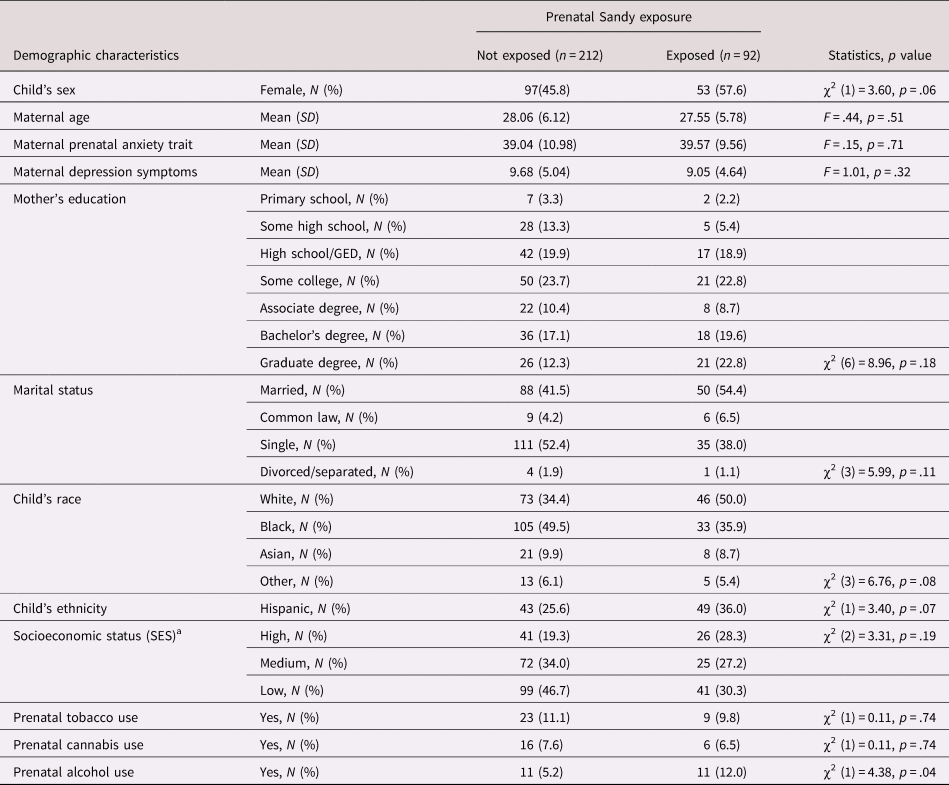
Among the 304 participants, child behavioral (clinical and adaptive scores) data were collected for 184 children at 2 years of age, 164 at 3 years, 195 at 4 years, 172 at 5 years, and 170 at 6 years. Participants had three assessments on average. Major demographic characteristics between those who were included (N = 304) and those who were excluded (N = 54) in this study did not differ significantly; that is, child sex (p = .68), race (p = .52), ethnicity (p = .09), marital status (p = .52), and maternal age (p = .99). Demographic information, including maternal education, marital status, race, and age reported by participants during the second trimester is presented in Table 1. There were no major demographic differences between those who were exposed and unexposed to Sandy in utero, including sex of child (p = .17), race of the child (p = .08), ethnicity of the child (p = .07), maternal age (p = .51), marital status (p = .11), and maternal education (p = .18). In addition, maternal psychological states (depression and anxiety) were measured by self-report questionnaires and substance use was ascertained through a face-to-face interview by clinical social workers during the second trimester. There were no differences in reported maternal anxiety (p = .71), depression (p = .32), cannabis use (p = .74) or tobacco use (p = .74) during pregnancy between those who were exposed and unexposed to Sandy in utero. Mothers who experienced Sandy during pregnancy, as compared to mothers who did not, consumed alcoholic beverages more often (p = .04, 12.0% vs. 5.2%).
Characteristics of participants by status of prenatal exposure to Superstorm Sandy (N = 304)

NB: Demographics information was ascertained based on self-reports and prenatal substance use status was ascertained based on face-to-face interview with a clinical social worker during pregnancy.
a SES was extracted based on education, work status (full-time, part-time, and not working), work prestige index for the pre-pregnancy job, and welfare status, using a latent class analysis.
Measures
Prenatal Sandy exposure
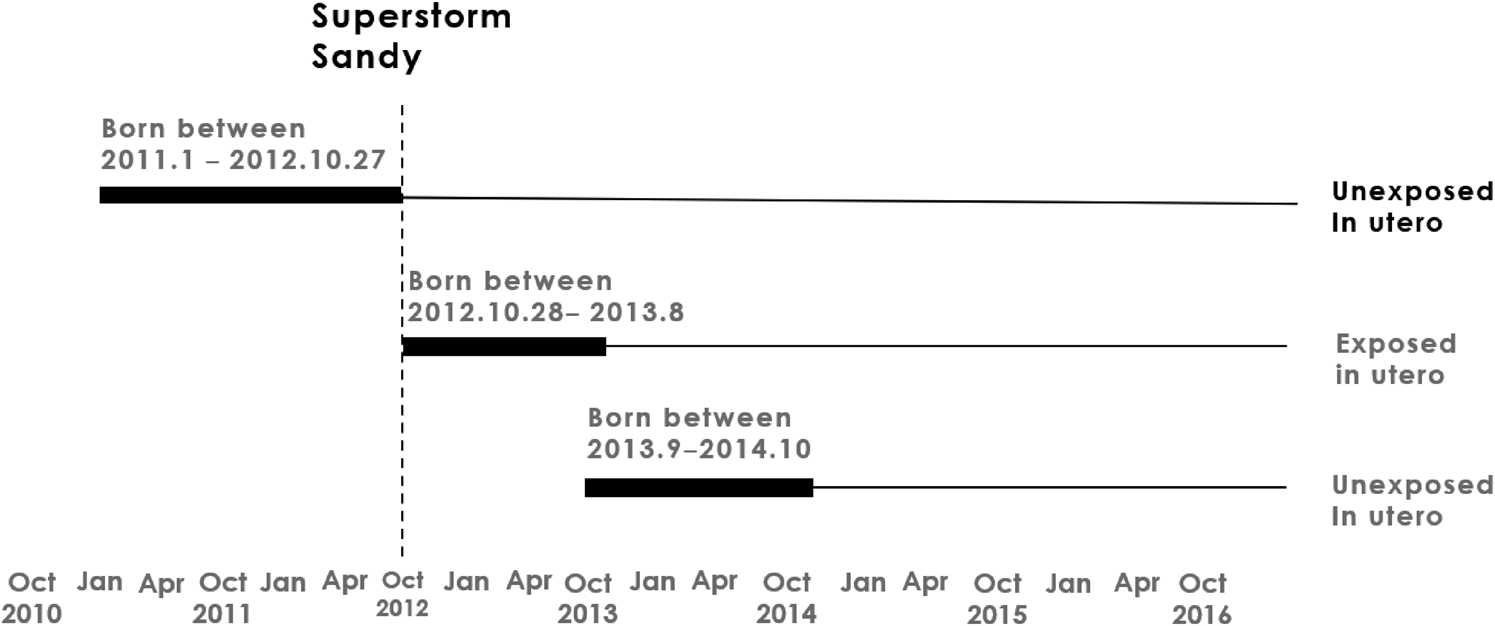
Sandy exposure status was defined as whether mothers were pregnant (N = 92, or 30.3%) or not pregnant (N = 212, or 69.7%) during Sandy. Children in this study, categorized in two groups (Figure 1), were born between January 2011 and October 2014. Mothers of exposed children were pregnant at the time when Sandy made landfall, whereas unexposed children were either born prior to or after the storm (Finik & Nomura, Reference Faraone, Perlis, Doyle, Smoller, Goralnick, Holmgren and Sklar2017).
SIP study – exposure to Superstorm Sandy in utero.

Child behaviors
The Behavior Assessment System for Children – Second Edition, Parent Rating (BASC2-P) (Reynolds & Kamphaus, Reference Reynolds and Kamphaus2004), a well-standardized, multidimensional evaluation of the behavior of young children, was used to measure clinical and adaptive dimensions of behaviors. Clinical scales used included measures of hyperactivity, aggression, anxiety, depression, somatization, atypical behaviors, withdrawn behaviors, and attention problems. Adaptive scales included adaptive skills, social skills, activity of daily living, and functional communication. In this study, we used standardized t-scores, with 50 being the mean and 10 being the standard deviation (SD) that the BASC2-P system produces, which was normalized for sex and age for the category. A score of 60 or above on clinical scales and a score of 40 or less on adaptative scales are considered “at-risk” (Reynolds & Kamphaus, Reference Reynolds and Kamphaus2004).
Covariates
Severity of objective stress exposures to Sandy
Objective stress exposures specific to Sandy were assessed using Storm32 (Yong et al., Reference Yehuda, Engel, Brand, Seckl, Marcus and Berkowitz2015). Storm32 comprises 20 questions that encompass salient aspects of the disaster exposure objectively with four scales (scope of trauma, loss, threat, and change). The total score was used as a severity scale. The mean (SD) was 2.90 (2.98) with a range of 17. Cronbach's alpha was .899.
Prenatal maternal anxiety and depression symptomatology
Maternal anxiety and depression symptomatology were ascertained using the State–Trait Anxiety Inventory (Spielberger, Reference Schafer and Graham1989) and the Edinburgh Postnatal Depression Scale (Murray & Cox, Reference Milgrom, Westley and McCloud1990) during pregnancy based on mothers’ self-reports. Trait anxiety, a long-standing quality of anxiety level, was used as a measure of prenatal maternal anxiety. Internal consistency, as measured by Cronbach's alpha, for anxiety traits and depression symptomatology in this study was .89 and .84, respectively. The mean (SD) and range for anxiety traits were 39.34 (10.50) and 50, while those for depression symptomatology were 9.25 (4.87) and 24, respectively.
Mother's drug abuse
The absence or presence of tobacco, cannabis, and alcohol use were ascertained during pregnancy via face-to-face clinical interview.
Child's and mother's demographic variables
An a priori confounder selection included child sex and race, as well as maternal age and education. Maternal age at the birth of the child was calculated based on the mother's and child's dates of birth. The socioeconomic status (SES) indicator was extracted using four factors – maternal education, pre-pregnancy occupation prestige (Evans & Mills, Reference Edge, Ramel, Drabant, Kuo, Parker and Gross1998), work status (full-time, part-time, and not working), and welfare status. Using latent class analysis, the optimal class solution (two-, three-, and four-class solutions) was tested for the SES index. The Lo–Mendell–Rubin (LMR) test for the three-class solution demonstrated significant model improvement (LMR = 84.58, p < .0001) with an entropy score of .914 showing it was a great model. Consequently, a three-category solution was chosen to be the best solution and used as an SES index (for details, see Supplementary Table 1).
Statistical analyses
Hierarchical linear modeling (HLM) was used to estimate both within-person longitudinal effects and between-person effects (Raudenbush & Bryk, Reference Raudenbush and Bryk2002). The within-person model mapped the developmental trajectory of child behaviors (adaptive and clinical) at five data points from 2 to 6 years of age. The between-person model estimated how prenatal Sandy status influenced changes in child behavior. All models in the analysis were corrected for non-normal distributions of level 2 residuals by applying the full maximum likelihood estimation with robust standard errors to incorporate the missing data imputation (Maas & Hox, Reference Lupien, McEwen, Gunnar and Heim2004).
Specifically, to compensate for missing data, common in many longitudinal cohort studies, HLM was used to yield parameter estimates for the missing time points for dependent variable data (i.e., child behaviors) at level 1 (i.e., within subject variability), but not for predictor variables at level 2 (i.e., between subject variability) (Raudenbush & Bryk, Reference Raudenbush and Bryk2002). Given that there was a considerable follow-up time (2–6 years of age) and the majority of the children were missing behavior data for at least one time point during the follow-up period, this approach was optimal for examining differences in developmental trajectories. In the current sample, there was 1.2% missing data for the severity of Sandy at level 2. Following Schafer and Graham (Reference Rubonis and Bickman2002), HLM computed average estimates that reflected the uncertainty of the missing level 2 data.
Change in child behaviors over time without a predictor (Model 1)
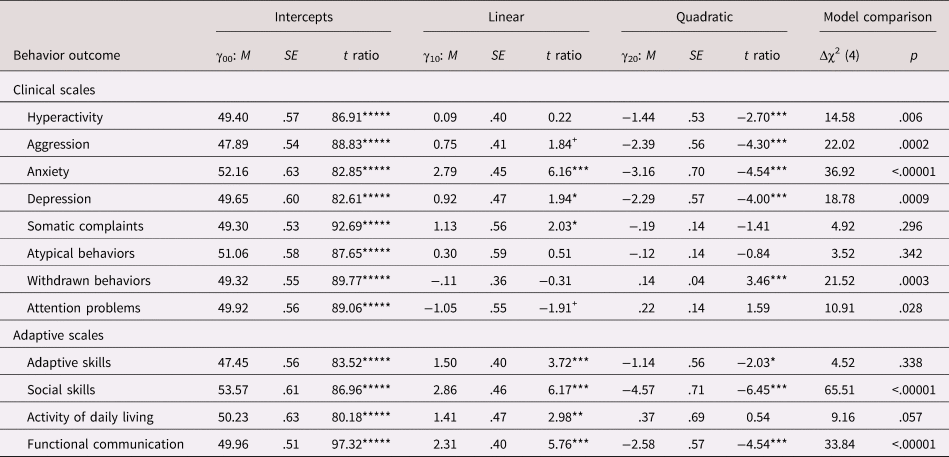
Model 1 was designed to characterize trajectories of child behaviors across five points in time from 2 to 6 years of age, free of a predictor and covariates. For each outcome, we first tested the model for linear change (Model 1a). As behaviors may not display linear change, especially in early development, we also tested for curvilinearity in each outcome model by adding a quadratic term for age (Model 1b). If a significant or marginally significant quadratic effect was not observed, the quadratic term was removed from the model. This was followed by tests of relative model fit by comparing the deviance statistics between the quadratic and linear models. If the chi-square test of difference demonstrated a significant reduction in deviance scores, the quadratic model was kept. The indices are presented in Table 2. In all models, random effects were included in the intercept and change coefficients (all linear terms and the quadratic were retained). Finally, age was centered at 2 years; that is, the intercept represented the average behavior score when children were 2 years of age.
Linear and quadratic change in child behaviors (clinical and adaptive dimensions) between ages 2 and 6

Note: γ values (M) represent the average, or fixed effects. SE = standard error. The chi-square difference test (Δχ2) yielded comparison between linear and quadratic models. + p <.10; *.05 > p >.01; **.01 > p >.001; ***.001 > p >.0001; ****p <.0001.
Model 1a – linear model
In the linear model, child behavior was taken as a function of an intercept plus a linear effect for time (i.e., assessment wave). The equation is:
Level 1

Behavior ij: is behavior (outcome) at time i for participant j. β0j, and β1j/β2j: are the intercept, and slopes (linear / curvilinear) respectively. γij: is the Level 1 regression residual term. γ00 and γ10/ γ20: indicate the average intercept and average slopes (linear /curvilinear), respectively. u0j, and u1j/ u2j : they are residual terms.
Level 2


Model 1b – quadratic model
In the quadratic model, child behavior is a function of an intercept, and linear and quadratic effects for time (i.e., assessment wave). The equation is:
Level 1

Behaviorij: is behavior (outcome) at time i for participant j. β0j, and β1j/ β2j: are the intercept, and slopes (linear / curvilinear) respectively. γij: is the Level 1 regression residual term. γ00 and γ10/ γ20: indicate the average intercept and average slopes (linear/ curvilinear), respectively. u0j, and u1j/ u2j : they are residual terms.
Level 2


Models with a predictor of intercepts, slopes and covariates (Model 2)
After choosing the linear or quadratic model, where appropriate, we explored whether Sandy status explained significant variance in the mean intercept or slope of child behavior. Covariates were added in the adjusted models, including child's sex, child's race, SES, maternal age, prenatal maternal substance use (tobacco, cannabis, and alcohol), prenatal maternal anxiety, prenatal maternal depression, and severity of Sandy exposure. If any aspect of child behavior displayed neither linear nor quadratic change over time, predictors were added to calculate the intercept only.
Model 2a – linear models with a predictor and covariates
Level 1

Level 2


Model 2b – quadratic models with a predictor and covariates
Level 1

Level 2


Effect size
Cohen's ƒ 2 for sequential multiple regression, such as HLM, was used to determine the magnitude of effects when significant, with ƒ 2 defined as:

where $R_A^2$ is the variance accounted for by our predictor (exposure to Sandy) and $R_{AB}^2$
 is the combined variance accounted for by all variables included in the model. Guidelines for interpretation of ƒ 2 indicate that 0.02 is a small effect, 0.15 is a medium effect, and 0.35 is a large effect (Cohen, Reference Cohen1992; Lorah, Reference Lin, Xu, Huang, Jia, Zhang, Yan and Zhang2018).
Results
Model 1: Change in behavior scores over time without a predictor
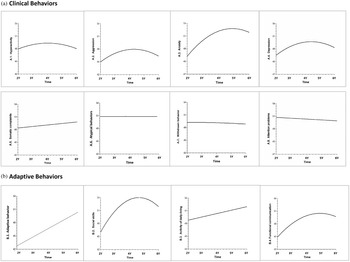
We modeled child behavior as a function of the intercept plus the linear/quadratic effect of time (i.e., child's age). Figure 2 depicts the developmental trajectories of each behavior in two domains (clinical and adaptive). In the clinical domain, somatization increased linearly with age. Hyperactivity, aggression, anxiety, and depression increased in the earlier age range (2–4/5 years of age), but then decreased gradually till age 6. Withdrawn behavior slightly increased with age and peaked around 4 years of age, but the degree of change was nominal. Attention problems decreased linearly and marginally with age. There was no notable change in atypical behavior and an intercept-only model was selected. In the adaptive domain, adaptive skills and activity of daily living increased linearly with age. Social skills and functional communication increased between 2 and 4.5 years of age and then plateaued.
Developmental trajectories of child behaviors between ages 2 and 6 for the overall sample. A. Clinical behaviors. B. Adaptive behaviors. Linear models were selected for somatic complaints (A5), adaptive behaviors (B1), and activity of daily living (B3). Curvilinear models were selected for hyperactivity (A1), aggression (A2), anxiety (A3), depression (A4), social skills (B2), and functional communication (B4). Neither linear nor quadratic models were selected for atypical behaviors (A6), withdrawal behavior (A7), and attention problems (A8).

Model 2: A predictor of intercepts and slopes
A model incorporating curvilinear change over time was selected for hyperactivity, aggression, anxiety, depression, and withdrawn behavior in the clinical domain, and social skills and functional communication in the adaptive domain. A model evaluating linear change over time was selected for somatization and attention problems in the clinical domain, and adaptive skills and activity of daily living in the adaptative domain. An intercept-only model was selected for atypical behavior in the clinical domain. After retaining the best-fitting model without a predictor, we examined whether Sandy exposure predicted mean intercepts (i.e., behaviors at 2 years) or slopes (i.e., rate/direction of change over time). In the interest of brevity, only significant results related to Sandy exposure are reported in the following. Adjusted models included all covariates.
Sandy exposure status during pregnancy
Intercept
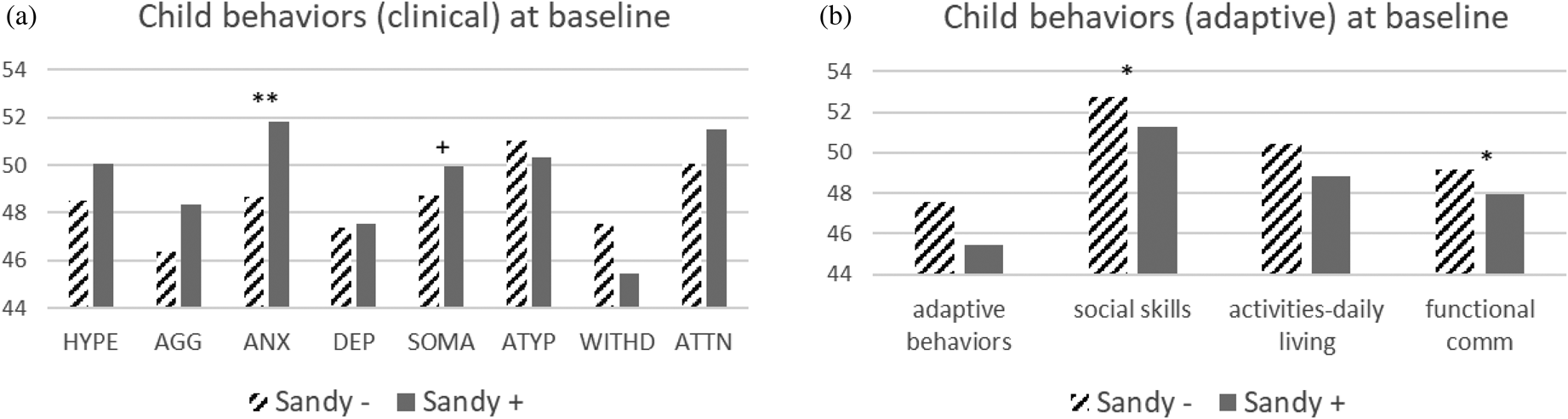
There was a significant or marginally significant main effect of Sandy exposure status in predicting intercepts for anxiety (t ratio = 2.71, p = .01), social skills (t ratio = −1.98, p = .05) and functional communication (t ratio = −2.26, p = .04), indicating that children exposed to Sandy in utero had higher anxiety and lower social skills and functional communication than the unexposed control at 2 years of age (Figure 3).
Comparisons of child behavior scores at 2 years (intercept) between children exposed and unexposed to Superstorm Sandy in utero. There were significant or marginally significant differences in anxiety (ANX, p = .009) and somatic complaints (SOMA, p = .08) in (A. Clinical behavior) and social skills (SS, p = .04) and functional communication (FC, p = .02) in (B. Adaptive behavior). The differences at the baseline were not significant in hyperactivity (HYPE), depression (DEP), atypical behaviors (ATYP), withdrawn behaviors (WITHD), atypical behaviors (ATYP), and attention problems (ATTN) in (A), adaptive behavior (ADAP) and activities in daily living in (B). **p < .01; *p < .05; + p < .10.

Slopes
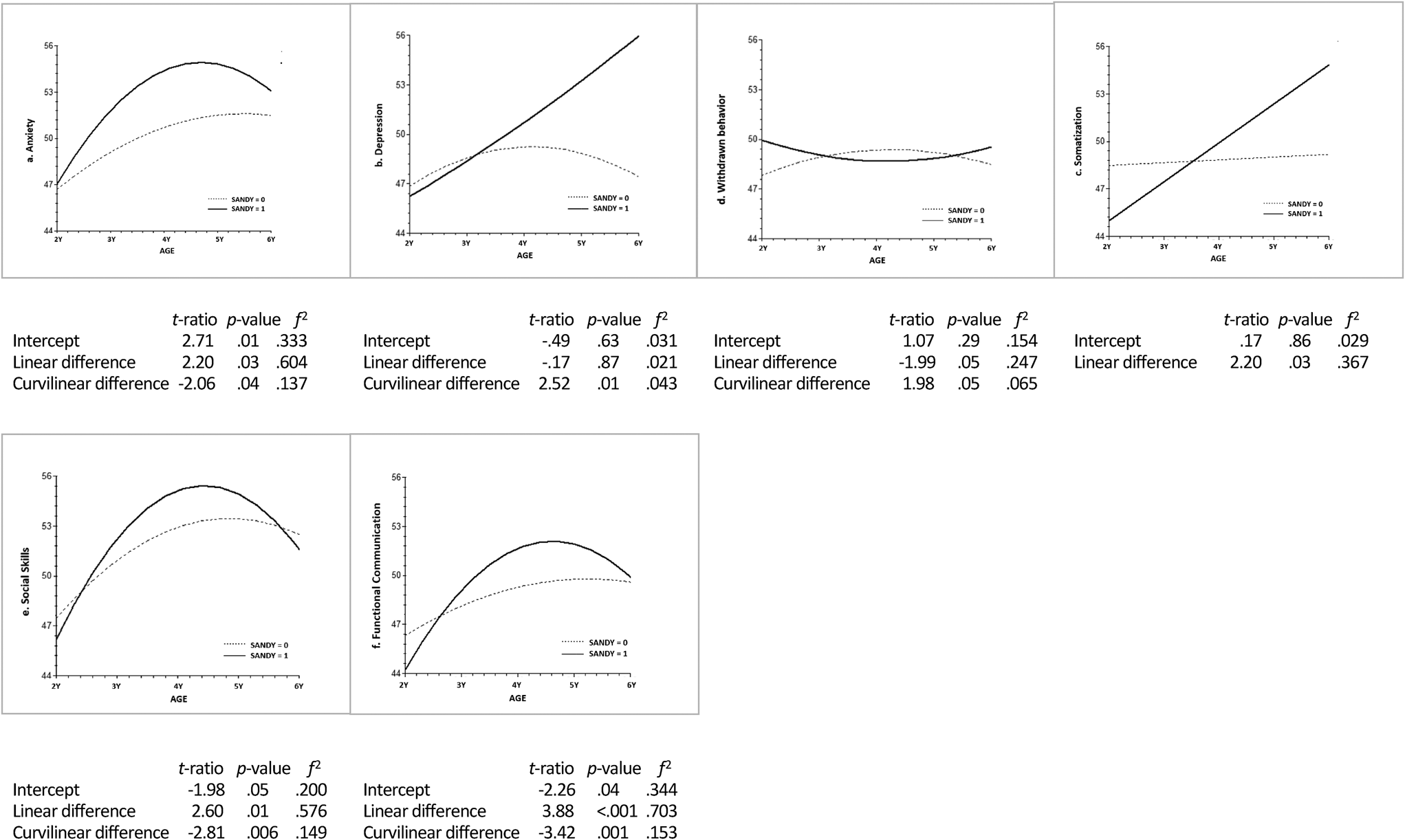
There was a significant main effect of Sandy exposure in predicting the linear slope for anxiety (t ratio = 2.20, p = .03), withdrawn behavior (t ratio = −1.99, p = .05), somatization (t ratio = 2.20, p = .03), social skills (t ratio = 2.60, p = .01) and functional communication (t ratio = 3.88, p < .001). Specifically, between ages 2 and 5, children exposed to Sandy in utero had a significantly greater increase in reported anxiety, social skills, and functional communication than those unexposed. Somatization rapidly increased with age in children exposed to Sandy in utero and mildly increased in children unexposed. Withdrawn behavior decreased in children exposed to Sandy in utero and increased in those unexposed to Sandy between ages 2 and 4. Of note, social skills and functional communication were lower at age 2 in children exposed to Sandy than in the unexposed group, but those exposed to Sandy caught up around age 2.5 with skill levels and continued to exceed the capacity for such skills compared to those unexposed over time.
We also observed significant curvilinear slope differences in children exposed to Sandy, compared to those unexposed, for anxiety (quadratic: t ratio = −2.06, p = .04), withdrawn behavior (quadratic: t ratio = 1.98, p = .05), social skills (quadratic: t ratio = −2.81, p = .006), and functional communication (quadratic: t ratio = −3.42, p = .001) (Figure 4). Specifically, the findings with quadratic trajectories demonstrated that children exposed to Sandy showed a continuous and more rapid increase in anxiety between 2 and 4 years of age followed by a slight decrease, although they remained at a higher level of anxiety, whereas those unexposed showed a slower increase in anxiety from 2 to 6 years of age.
Developmental trajectories of child behaviors (clinical and adaptive) between ages 2 and 6 among children who were exposed and not exposed to Superstorm Sandy in utero. Solid line = Sandy exposure; dotted line = control. Linear/quadratic slopes were significantly predicted by Sandy status for anxiety (a), depression (b), somatic behaviors (c) withdrawn behaviors (d), social skills (e), and functional communication (f).

Regarding withdrawn behaviors trajectories, there was a significant contrast between exposed and unexposed. The exposed had a greater level of withdrawn behaviors at age 2, which decreased as they grew older, with the lowest rate around age 4, and then increasing again. For unexposed children, lower withdrawn behaviors were evident at age 2, followed by an increase, peaking at around age 4, before decreasing again at age 6.
Regarding adaptive behaviors, both exposed and unexposed children had a curvilinear increase in their social skills and functional communication as they grew older, peaking at around 4/5 years of age. However, the rate of increase was significantly greater among the exposed group, compared to the unexposed. Of note, while unexposed children had significantly greater social skills and functional communication at age 2 than the exposed children, the exposed caught up by age 2.5 and thereafter exceeded the capacity, relative to unexposed. There were also differences in the patterns of growth in the skills between the two groups: the exposed children reached their peak slightly earlier (around age 4.5) than the unexposed (around age 5).
Discussion
This study investigated the effects of prenatal exposure to Superstorm Sandy on the trajectory of childhood behaviors from 2 to 6 years of age. The results suggest that an index of exposure to Sandy in utero would be a robust predictor of clinical behavioral problems, especially for anxiety, depression, and somatization in childhood. Such an index of in utero exposure could also be used to demonstrate greater adaptive functioning, especially social skills and functional communication among exposed, compared to unexposed, children over time. The current findings are consistent with our previous research, which showed that prenatal exposure to Sandy was associated with both an increase in positive emotionality (resilience) and in negative affect (risk) in exposed children (Zhang et al., Reference Yong, Laplante, Elgbeili, Hillerer, Brunet, O'Hara and King2018). Our findings on this continuous upward trajectory of anxiety, depression, and somatization, as well as the accelerated acquisition of social skills and functional communication among exposed relative to unexposed children, suggest that the stress a child experiences in utero has detrimental effects on their mood and anxiety problems, but it may also influence their ability to acquire adaptative skills in the postnatal environment.
In the current study we aimed to investigate whether both clinical phenotypes around anxiety and adaptive skills would be influenced by distal exposure to Sandy in utero. While we hypothesized that children exposed to Sandy in utero would have a distinctive trajectory of clinical behaviors and adaptive behaviors, our HLM analyses were based on groups (exposed vs. unexposed) rather than individuals. As such, it cannot be assumed that the same individuals exhibited both elevated clinical and adaptive phenotypes – having greater scores on clinical and adaptive domains are not mutually exclusive. It is important that future studies examine what it means for children to function with both elevated anxiety and adaptive scores, especially during adolescence – a period of the highest risks for affective disorders.
Our findings are consistent with the growing literature regarding the effects of high stress levels on brain development, including alterations of both structure (De Brito et al., Reference Davis, Snidman, Wadhwa, Glynn, Schetter and Sandman2013; Gold et al., Reference Gold, Sheridan, Peverill, Busso, Lambert, Alves and McLaughlin2016; Lee, Kang, Chang, & Cho, Reference LeDoux2019; Tottenham et al., Reference Thompson, Kline, Ellman, Mittal, Reeves and Schiffman2010) and function (Gee et al., Reference Gartstein, Putnam and Rothbart2013; Posner et al., Reference Posner, Cha, Roy, Peterson, Bansal, Gustafsson and Monk2016; Suzuki et al., Reference Spielberger2018). Neural circuits relevant to our findings relate to the prefrontal cortex and the limbic system, which includes the amygdala, hippocampus, and hypothalamus, involved in the generation and regulation of emotion (Dixon, Thiruchselvam, Todd, & Christoff, Reference DiPietro, Hodgson, Costigan and Johnson2017; LeDoux, Reference Laplante, Brunet, Schmitz, Ciampi and King2000). The amygdala, in particular, is a critical center for threat detection and fear behavior (Levy & Schiller, Reference Lee, Kang, Chang and Cho2021). While the current study did not include in vivo neural assessments of the brains of our participants, it is notable that our clinical and behavioral findings are consistent with neuroimaging studies that identify brain structure and functional alterations of the mesocorticolimbic structures in relation to the effects of stress.
There are several strengths of this study. First, the choice of analytical strategy (HLM) enabled us to estimate missing data and optimize the longitudinal data, thus allowing the potential to detect changes in child behaviors, both clinical and adaptive, as a function of in utero Sandy exposure. Second, unlike most studies, where prenatal stress has been largely addressed as a normative stress in everyday life (Rubonis & Bickman, Reference Reynolds and Kamphaus1991), as maternal psychopathology, or as a result of low SES during pregnancy, our study examined the effects of a large-scale disaster first hand (i.e., Superstorm Sandy) on developmental programming (Brand et al., Reference Brand, Engel, Canfield and Yehuda2006; Huizink et al., Reference Hofstra, Van Der Ende and Verhulst2007; King & Laplante, Reference King and Laplante2005; Kuvacic, Skrablin, Hodzic, & Milkovic, Reference Kuvacic, Skrablin, Hodzic and Milkovic1996; Laplante, Brunet, & King, Reference Kuvacic, Skrablin, Hodzic and Milkovic2016, Reference Laplante, Brunet and King2008; Meijer, Reference Maas and Hox1985; Nomura et al., Reference Nolvi, Karlsson, Bridgett, Korja, Huizink, Kataja and Karlsson2019; Tees et al., Reference Talge, Neal and Glover2010; Yehuda et al., Reference Yehuda, Engel, Brand, Seckl, Marcus and Berkowitz2005; Zhang et al., Reference Yong, Laplante, Elgbeili, Hillerer, Brunet, O'Hara and King2018). Third, we were in the rare position of being able to conduct a quasi-experiment using a profound natural disaster (Sandy). All our participants were exposed to Sandy at different times during their index pregnancy. As stress is an intangible concept, much of the interpretation is subjective. The use of objective natural disaster stress allowed us to eliminate some subjective perceptions of stress. Moreover, the severity of exposure, leveraging existing objective measures of natural disaster (i.e., Storm32), was measured and the difference in the severity that each participant experienced was adjusted in the models. Another important aspect of this study is the use of BASC2-P to assess behavioral and emotional phenotypes in children over 4 years. Similar to the broadband Child Behavior Checklist (CBCL) scales, one of the strengths of the BASC2-P scale is its cost-effective approach in identifying offspring at higher risk for psychopathology. BASC2-P scales have several items that provide information correlated to diagnostic criteria for various clinical categories listed in DSM-IV-TR (the text revision of the Diagnostic and Statistical Manual of Mental Disorders, fourth edition), for example, ADHD, conduct disorder, oppositional defiant disorder, generalized anxiety disorders, and depression (Kamphaus, VanDeventer, Brueggemann, & Barry, Reference Kamphaus, Vandeventer, Brueggemann, Barry, Smith and Handler2007; Papazoglou & Ferrari, Reference Nomura, Davey, Pehme, Finik, Glover, Zhang and Ham2013). Using self-report screeners such as BASC or CBCL for the assessment of childhood behavioral/emotional problems, various longitudinal studies have documented a link between early problems and later psychopathology in youth (Bradstreet, Juechter, Kamphaus, Kerns, & Robins, Reference Bradstreet, Juechter, Kamphaus, Kerns and Robins2017; Thompson et al., Reference Tees, Harville, Xiong, Buekens, Pridjian and Elkind-Hirsch2015; Volker et al., Reference van der Wal, van Eijsden and Bonsel2010) and in adults (Faraone et al., Reference Evans and Mills2005; Mesman & Koot, Reference Meijer2001). For example, in a longitudinal study, Hofstra, Van Der Ende, and Verhulst (Reference Hamada and Matthews2002) showed that persistent self-reported emotional and behavioral problems were linked to a higher lifetime prevalence of DSM-IV disorders. Self-report screener instruments, such as BASC2-P scales, are suitable tools for investigating trajectory and different psychiatric disorders risks later in life.
This study also has several limitations. First, the severity of the experience of Sandy was ascertained by maternal self-report. While this information is also a strength, the measure was designed to assess the number of objective challenges due to the disaster and could have been influenced by maternal psychological functioning. Second, the index for in utero Sandy exposure was a simple index pregnancy based on when Sandy made landfall. While we recognize the possible simplicity of the index, the overall focus of the study was to understand the implication of fetal programming, and objective severity of exposure was controlled for in all analyses. Third, child clinical and adaptive behavior measures were based on maternal report, using screening instruments for child clinical problems. It is well-known that maternal characteristics (i.e., depression and stress) can influence the way of reporting child developmental and behavioral patterns. However, at the baseline, our participants were relatively young (2 years of age) and during the time of early development, mothers are considered to be the best informants. Fourth, while a well-validated instrument of child behavior (clinical and adaptative) was used in this study (BASC2-P), diagnostic outcomes ascertained by clinical interviews could have increased the validity of the clinical measures. Fifth, although we included various sociodemographic confounders determined a priori, we might have overlooked some important confounders.
Despite these limitations, our research suggests that stress from Sandy, experienced in utero, was associated with a greater level of clinical behaviors (anxiety, depression, and somatization), but induced an elevation in adaptive functioning (social skills and functional communication) over time, which supports the fetal programming and evolutionary perspective. Our study also has clinical significance as maternal exposure to disaster-related stress may produce alterations in child behavioral development, with implications for developmental psychopathology. Our findings underscore the benefits of mental health intervention and stress management during prenatal care to reduce later developmental health burdens. Our findings also reaffirm the need to invest in pediatric practices to increase the effectiveness and capacity of services for national disaster preparedness. In particular, our results highlight how pregnant mothers are an especially vulnerable population, and there is an urgent need for vigorous post-disaster outreach to this population during their gestation and postnatal periods. The frequency of natural disasters may be increasing due to climate change, but we can counsel policymakers, educators, and health care providers on the importance of early intervention to ameliorate possible adverse effects on child neurobehavioral outcomes and foster further improvements in the adaptability of future generations that will help bend the trajectory curves for better child outcomes.
Supplementary Material
The supplementary material for this article can be found at https://doi.org/10.1017/S0954579421000304
Acknowledgment
We would like to thank the children and parents who consented to participate in this study. We also thank current and former research staff and assistants at Queens College, CUNY for their contributions to this study.
Funding Statement
This research work was supported by grant R01MH102729 from the National Institute of Mental Health (NIMH), a PSC-CUNY, Queens College Research Enhancement Grant to Nomura, and grant R01DA030359 from the National Institutes of Drug Abuse (NIDA) to Hurd.
Conflicts of Interest
None.