Introduction
The Grade ‘A’ Pasteurized Milk Ordinance (PMO) is a set of minimum standards and requirements that are established by the Food and Drug Administration (FDA) for regulating the production, processing and packaging of Grade A milk. For individual states, regulation of Grade A milk is usually under the jurisdiction of either the State Department of Agriculture or the State Health Department. States often adopt the PMO standards as a minimum, and in many cases, enforce more stringent standards.
In accordance with the PMO, prior to processing, all raw milk supplies are sampled and tested for drug residues. Detection of drug residues in bulk milk (BM) tankers demonstrates that the tanker contains milk that is undesirable for two reasons, it comes from an unhealthy lactating animal and the milk is adulterated. Such milk is not suitable for human consumption, leaving a very large volume of milk that must be diverted from the food chain. Options at this point include BM diversion to a non-human food supply or disposal.
It is undesirable to waste such a valuable commodity, however, if the adulterated BM is diverted to a non-human food supply, such as to pre-ruminating calf ranches, further consideration must be given to the drug contamination of the milk. Pre-ruminating calves consuming such milk would be exposed to the drug, which could result in residue violations if their meat is harvested too soon after exposure, resulting in tissue concentration above tolerance (TOL). Tolerances are defined in 21CFR556 as a finite maximum allowable concentration of a particular drug that is established as safe for consumption by the USDA. When a TOL is not set for a specific use class, the target becomes zero or effectively the level of quantification (LOQ) of the analytical assay.
As such, the objective of this review is to provide a quantitative assessment of the tetracycline (TTC) and sulfonamide classes of antimicrobials, based on contamination level in the milk, milk dilution recommendations, and estimated time to target calf tissue concentrations defined as TOL. To address this objective, several aspects need to be discussed: (1) a review of the literature pertaining to the pharmacokinetic (PK) properties of each drug in the relevant diverted milk consuming calf population; and a description of each of the following, (2) the level of detection (LOD) for drug residues in milk of commercially available tests; (3) the LOQ of analytical methods for drug residues in bovine tissue; and (4) bovine tissue tolerances for each drug.
To the authors’ knowledge, neither such PK review exists in this class of calves, nor does any attempt to assess the time to TOL resulting from veal calves consuming milk normally discarded due to the presence of violative residues of the TTC or sulfonamide antimicrobial class of drugs.
Methods for structured PK literature review
Study inclusion criteria
The objective of this study was to detail the time to tissue TOL in veal calves, therefore the implemented study inclusion criteria were plasma or tissue PK studies in dairy breed calves, with a reported body weight <330 kg or a reported age <6 months. As data were limited, all publications that could be translated from any region of the world were included in this review, given they met the previously outlined inclusion criteria.
Information sources and search methods
In February 2013, electronic data sources including PubMed, Web of Knowledge, Freedom of Information (FOI) New Animal Drug Approvals (NADA) summaries on the FDA website, and the internal Food Animal Residue Avoidance and Depletion Program (FARAD) database were searched for literature relevant for the objectives of this review. All searches were repeated in December 2015, prior to submission of this review. No additional publications were added since the initial search. No authors were contacted at any point in the literature search process.
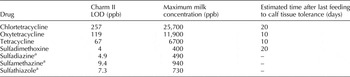
Search terms included in the PubMed and Web of Knowledge database queries were as follows: each drug listed in Table 1 combined with veal or calf was searched with each of the following key terms: PK, residue, and tissue distribution. An example would be as follows: ((chlortetracycline (CTC)) and veal and PK). There were no limits on study dates or geographic regions. Studies were manually extracted from the FARAD database and FDA website as described below.
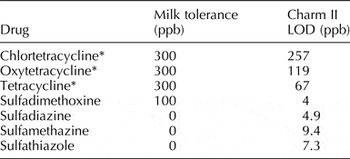
Acceptable milk tolerance concentrations and Charm II testing level of detection (LOD) by each analyte of the tetracycline and sulfonamide class of antimicrobials. Data reported from United States Food and Drug Administration, (2012)

* Tolerances are established for the sum of residues of the tetracycline's including chlortetracycline, oxytetracycline, and tetracycline.
Charm II LOD is the maximum concentration, which can be detected 90% of the time with 95% confidence.
The data files in the FARAD database include data collated from decades of searching conference proceedings, abstracts, and scientific journals for data where authors have monitored the depletion of a specific drug or chemical from tissues, fluids of animals or both; proprietary information on pharmaceutical products approved for use in food animals in the USA and in other countries throughout the world; physicochemical information on chemicals commonly used in food animals; PK rate and volume constants pertinent to residue depletion modeling in a variety of species. The data are maintained in a readily accessible and searchable format designed to allow call responders to quickly access and determine pertinence to the question at hand (Sundlof et al., Reference Sundlof, Craigmill and Riviere1991). The FARAD database query process was performed for each drug and sorted by relevance (age, species) thus making the selection of relevant studies more expeditious.
The FDA website was searched by purposive means, utilizing a cross reference with the FARAD VetGRAM and searching for compounds known to be approved. VetGRAM is an online tool (http://www.farad.org/vetgram/search.asp) that allows one to query drugs by active ingredient, species/class of animal, etc.
Study selection
Abstracts were read in their entirety during the search process as the articles pertinent to the search were limited in number. As abstracts were deemed broadly relevant to the topic they were requested from library sources and electronic versions downloaded. Full articles were organized, duplicate results across search engines removed, and indexed into folders by drug in an electronic filing system. Next, full articles were read and determined to meet the inclusion criteria or not. Articles not meeting the criteria were retained in folders and marked as not relevant. All searches and primary study selections were carried out by the lead author (K. D. D.) and articles meeting the inclusion criteria were later verified by the three co-authors.
Data from PK literature review
Extraction of PK data
All articles meeting inclusion criteria were reviewed and pertinent PK data extracted by the lead author independently and later verified for content by the co-authors. The most pertinent parameters were determined to be plasma, liver, kidney and muscle elimination half-lives, and systemic bioavailability. When available, data were retrieved from tables within the text and converted to similar units across publications. Publications only reporting PK data in graphical form were imported into free online software (WebPlotDigitizer; http://arohatgi.info/WebPlotDigitizer/) to extract time-concentration data, which were then analyzed using WinNonlin® (Certara, NC) to calculate the relevant PK parameters by a standard non-compartmental analysis. Publications, which were analyzed in this way are as follows: (Francis, Reference Francis1949; Rolinski and Halina, Reference Rolinski and Halina1964; Lapka et al., Reference Lapka, Urbanova, Kobylka, Raskova, Vanecek and Polak1978; Lapka, Reference Lapka1980; Woolley et al., Reference Woolley, Sigel and Wels1980; Woolley and Sigel, Reference Woolley and Sigel1982; Luthman and Jacobsson, Reference Luthman and Jacobsson1983; Palmer et al., Reference Palmer, Bywater and Stanton1983; Luthman and Jacobsson, Reference Luthman and Jacobsson1985; Murphy et al., Reference Murphy, Wong and Ray1986; Sepp, Reference Sepp1986; Shoaf et al., Reference Shoaf, Schwark and Guard1987; Chiesa et al., Reference Chiesa, Li, Kijak, Li, Lancaster, Smith, Heller, Thomas and Von Bredow2012). All data were considered equal; in other words, there was no weighting of data due to differences in sample size or methodology between studies. No investigators were contacted at any point during the data collection.
Areas of discussion
Milk assay levels of detection
Another aspect of this review is the integration of the commercially available tests to determine the concentrations of the residues present in the discarded milk samples. The LOD of the Charm II Sulfa Drug Test and Charm II TTC Drug Test (Charm Sciences Inc., Lawrence, MA, USA) is that concentration which can be detected 90% of the time with 95% confidence (United States Food and Drug Administration, 2012). The LOD for each test, as reported in the Federal document M-a-85, can be found in Table 1.
Level of quantification in bovine tissue
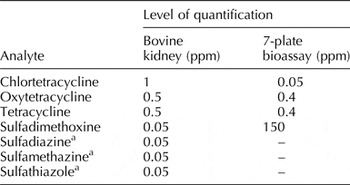
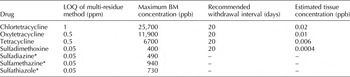
Further consideration in addressing the objective of this review is the LOQ of each drug in bovine tissue. In 2012, Food Safety and Inspection Service (FSIS) announced a restructuring of the United States National Residue Program (United States Department of Agriculture and Food Safety and Inspection Service, 2012). In addition to a new approach to sampling and scheduling, the Agency implemented multi-residue methods for analyzing samples of meat, poultry, and egg products for animal drug residues, pesticides, and environmental contaminants in its inspector-generated testing program. The level of quantification for each antimicrobial reviewed herein under the new assay utilized by FSIS can be found in Table 2.
Analyte level of quantification for the bovine kidney assay and 7-plate bioassay used by USDA FSIS for each of the tetracycline and sulfonamide class drugs reported herein. Data reported from United States Department of Agriculture and Food Safety and Inspection Service (2012)

a This analyte is not applicable for bovine kidney in the multi-residue method.
Bovine tissue tolerances
The final point of consideration in determination of withdrawal intervals (WDI) for calves fed residue contaminated milk is the concentration that must be targeted for the tissue to be residue free. Residue TOL for new animal drugs are established by the United States FDA and reported in Title 21 Code of Federal Regulations Part 556, Tolerance for Residues of New Animal Drugs in Food (United States Department of Agriculture and Food and Drug Administration, 2012). The TOL for the TTC class of antimicrobials are collectively analyzed for as a sum of each drug, including CTC, oxytetracycline (OTC), and TTC. Tolerances for OTC, CTC, and TTC in calf tissue are as follows (ppm): Fat (12.0), Kidney (12.0), Liver (6.0), and Muscle (2.0). A TOL of 0.1 ppm is established for negligible residues of sulfadimethoxine (SDM) and sulfamethazine (SMZ) in uncooked edible tissues of cattle. There are no TOLs established in calf tissue for sulfadiazine (SDZ) and sulfathiazole (STZ).
Estimating drug concentration and time to TOL
As stated in the objective, the desired outcome of this review is a determination of the time required for the calf tissues to fall below TOL after ingesting milk from a BM testing positive to either class of drug. In order to accomplish this, the quantity of the contamination in the BM must be standardized. Therefore, to standardize the amount of residue in test positive milk, a maximum residue concentration when undiluted and then test negative after a 1:100 dilution with confirmed test-negative milk sample was calculated. A BM sample that tests positive shall be cleared for such use by a negative test obtained from a dilution of 1:100 of the tanker milk sample, as an additional test step by the M-a-85 screening test used for the Screening Test Positive (Load Confirmation) procedure (United States Food and Drug Administration, 2012). The sample shall be diluted with milk previously confirmed as negative for TTC and sulfonamide residues, in this way it is possible to estimate the amount of contaminant (drug) in the BM. The BM can inherently be assumed to contain a maximum contaminant concentration of (100 * Charm II LOD). Using the standardized concentration of the milk from the BM and the individual drug's oral bioavailability data, it would be possible to determine the drug exposure to the calf at each feeding.
Next, a conservative approximation of the time required for calf tissues to fall below TOL (i.e. WDI) for each drug was calculated with the use of available tissue elimination half-life data when available if fed the residue contaminated milk. The basis of this WDI is following the mantra of FARAD's stance that the most conservative recommendations are made allowing for a large safety factor. The two primary factors in the selection of these levels are (1) demonstrating to state and federal regulatory authorities that a large safety factor exists inherent in the recommendation and (2) the recommendations make sense, relative to the most common milk assays used commercially. In fact, the concentrations of antibiotics which could be fed to calves in all cases, are many-fold higher than the recommendations.
Justification and calculation of WDI
Tolerances are established by regulatory authorities and are based on many factors; however, the ultimate determining factor for a TOL level is the food safety factor. The process in determining these TOLs are covered elsewhere and not covered in further detail here. The issue pertinent to this discussion is the calculation of the time needed for the drug to be withdrawn from the calves’ diet in order that the tissues will fall below the target concentration (or TOL). This process is rooted in both PK and statistical processes (Riviere et al., Reference Riviere, Webb and Craigmill1998; Riviere, Reference Riviere2011).
In NADAs, a pharmaceutical sponsor is required to submit data from a repeated slaughter experiment in which groups of a minimum of five animals per sex are slaughtered at four different time points in the terminal part of the tissue-depletion curve closet to the established TOL. However, a level of variability is to be expected between an animal's ability to clear the drug from its tissues. Therefore, log-linear regression analysis is utilized to predict, with a 95% level of confidence, the upper bound of the 99th percentile of the population that will be the slowest to clear drug from the given tissue.
In the absence of such data, PK models must be used to estimate the WDI needed to fall below tissue TOL. The PK parameter most closely related to this is the rate of elimination, and thus the half-life of the drug's depletion from the tissue of interest is the most reliable indicator of a drug's depletion to TOL (half-life = 0.693 per elimination rate). One such example of utilizing the basics of PK principles to estimate WDIs was demonstrated by Gehring et al. (Reference Gehring, Baynes, Craigmill and Riviere2004) in the application of half-life multipliers (HLM) (Gehring et al., Reference Gehring, Baynes, Craigmill and Riviere2004). This approach to estimate elimination half-life was based on the assumption that the tissue elimination half-life would be unchanged at higher doses (first order kinetics). They found that labeled withdrawal times could be used to estimate the time to TOL with extra-label doses by use of the HLM.
Determining the appropriate amount of time needed to fall below TOL using data from published literature requires piecing together smaller amounts of incongruent data, and, as such, certain safety assurance steps must be taken to cover the uncertainty in these calculations. In this review, the added safety factors were performed at two steps. First, the reported elimination time half-life was significantly rounded up from those reported in the literature and multiplied by 10 (to ensure 99.9% elimination). This preliminary number was next multiplied by 2, effectively ensuring that an excess of 20 elimination half-lives had passed since the final ingestion of active drug. In theory, this equates to a remaining maximum tissue concentration <0.0001% of the initial concentration. An example calculation is found below using SDM. The longest elimination half-life for SDM was found to be 19 h in the liver and therefore was rounded up to 24 h (1 day).
 $$\eqalign{{\rm WDI} & = \left( {t_{1 \over 2}} \times 10 \right) \times 2 \cr (1\;{\rm day} \times 10) \times 2 & = 20\;{\rm day}\;{\rm WDI}}$$
Calculating the WDI in this way is inherently conservative and effectively eliminates any potential for residues to be present at a violative concentration, even with the administration of large doses, successfully reducing the risk of human exposure to harmful drug residues to nearly nonexistent.
Results
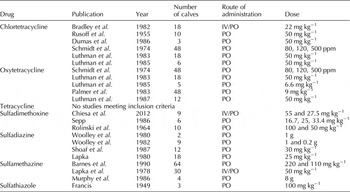
Seven hundred seventy-nine articles were returned from primary searches on PubMed and Web of Knowledge. After screening articles by abstract reading and removal of duplicates, 39 articles remained. After the application of inclusion criteria, only 15 articles remained from the PubMed and Web of Knowledge search. Four published manuscripts were manually retrieved from the FARAD database (Rusoff et al., Reference Rusoff, Hester and Landagora1954–1955; Rolinski and Halina, Reference Rolinski and Halina1964; Dumas et al., Reference Dumas, Goutalier, Quillon, Rapin and Legoy1986; Sepp, Reference Sepp1986). Five FOIs were obtained and screened and all five failed to meet inclusion criteria. In summary, 19 articles met inclusion criteria and are the focus of this review. Several of the publications contained data (referred to as studies in the next sentence) for more than one drug within the same manuscript. There were six studies found for CTC, five for OTC, zero for TTC, three for SDM, four for SDZ, three for SMZ and one for STZ that met the criteria to be included in this review. Studies inconsistently reported their methods of analysis, LOD and level of quantification. However, given the paucity of data available, no data were removed given they met the previously described inclusion criteria and no attempts were made to critically evaluate the robustness of the data, given that they met the inclusion criteria laid forth above. The studies discussed below can be found summarized as to the route and dose for each drug administered as well as the study sample size in Table 3.
Number of calves, dose and route of administration for each of the studies included in the pharmacokinetic portion of this review

Individual drug PK findings
CTC
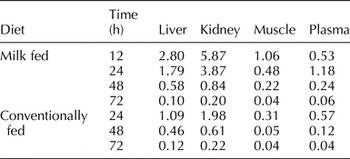
A series of intravenous (IV) and orally dosed CTC experiments were performed on 18 pure-bred, Holstein calves, utilizing a 2 period cross-over design (Bradley et al., Reference Bradley, Allen, Showalter and Colaianne1982). The experiment consisted of eight milk-fed and six conventionally fed Holstein calves, at approximately 14 weeks of age (76.0–118.0 kg) that were administered a single dose of 22 mg CTC kg−1 by rumen intubation and slaughtered in pairs at 12, 24, 48, and 72 h. Bioavailability was reported to be 24.1 ± 6.1% (±SEM) for milk fed and 4.9 ± 0.9% for conventionally fed calves in this study. Results from cylinder plate assay (LOD 0.1 µg g−1) determination of tissue residue concentrations can be found in Table 4.
Tissue concentrations at serial slaughter time points for 8 milk-fed and 6 conventionally fed Holstein calves, at approximately 14 weeks of age (76.0–118.0 kg), that were administered a single dose of 22 mg CTC kg−1 by rumen intubation. Concentrations were analyzed by cylinder plate assay with a reported sensitivity of 0.1 µg g−1 (100 ppb). Data comes from Bradley et al. (Reference Bradley, Allen, Showalter and Colaianne1982)

Ten Holstein and Jersey calves, 3 days of age, were administered 50 mg CTC daily PO SID (divided and fed in milk and calf starter ration) (Rusoff et al., Reference Rusoff, Hester and Landagora1954–1955). Three calves were slaughtered at 16 weeks of age, with no mention of withdrawal of medication prior to slaughter. There were no quantifiable residues in tissue (liver, kidney, muscle) or plasma at slaughter. Reported LOD for methodology used was 0.1 µg g−1.
Three Francaise Frisonne (French Holstein) calves, 3 weeks of age (35 kg), were orally administered 50 mg CTC kg−1 (with 50 mg chloramphenicol kg−1) PO daily for 5 doses (Dumas et al., Reference Dumas, Goutalier, Quillon, Rapin and Legoy1986). No CTC residues were detected at 20 days following the last administration of drug with a reported sensitivity of methodology at 0.01 µg ml−1.
Forty-eight calves weighing approximately 90 kg were treated with 80, 120 or 500 ppm CTC in milk substitute feeds until they were slaughtered at ~150 kg (Schmidt et al., Reference Schmidt, Woltersdorf, Linke and Leistner1974). No residues were detected in tissue following a 3 day WDI by three different testing procedures with a reported sensitivity of methodology at 0.001 µg ml−1.
Six calves, 4–6 weeks of age were fed 50 mg CTC kg−1 with 2 g citric acid in milk replacer (Luthman and Jacobsson, Reference Luthman and Jacobsson1985). Serum half-life was reported (graphically) at 6.2 h. In a similar experiment performed 2 years earlier, they varied carriers of active ingredient (Luthman and Jacobsson, Reference Luthman and Jacobsson1983). Eighteen 3–4 week old calves (43–54 kg) on a milk diet, were administered 50 mg CTC kg−1 in water, milk replacer, or cow's milk (n = 6 per treatment). They utilized a cross-over design with 4 days washout between the three treatments. Serum half-life in this study was similar to that found in their 1985 study referenced above, but ranged from 2.7 to 8.9 h (graphically) depending on the vehicle used to deliver the drug per os.
OTC
In 1974, Schmidt et al., utilized 48 calves (90 kg) with varying concentrations (80, 120 or 500 ppm) of OTC in milk substitute feeds until they were slaughtered at ~150 kg (Schmidt et al., Reference Schmidt, Woltersdorf, Linke and Leistner1974). They detected no residues in tissues following a 3 day WDI by three different testing procedures each with a reported sensitivity of methodology at 0.01 µg ml−1.
Replicating the work performed with CTC above, Luthman and Jacobson performed duplicate trials in both 1983 and 1985 with OTC. Using five calves, 5–7 weeks old, fed 6.6 mg OTC kg−1 with and without 2 g citric acid in milk they reported (graphically) serum half-lives that varied from 0.14 to 3.13 h across treatments (Luthman and Jacobsson, Reference Luthman and Jacobsson1985). Additionally, they performed another trial with the eighteen 3–4 week old calves referenced above, by administering 50 mg OTC kg−1 in either water, milk replacer, or cow's milk (n = 6 per treatment) utilizing a cross-over design with 4 days washout between the three treatments (Luthman and Jacobsson, Reference Luthman and Jacobsson1983). Serum half-lives in this study varied (graphically) from 2.7 to 8.7 h across the three treatments which was quite similar to the half-life displayed for CTC (2.7–8.9 h) as referenced above. Both of these studies showed that the greatest variability introduced by the carrier was in the absorption of the drug, with milk and milk replacer markedly reducing the maximum serum concentration as compared with administration with water alone.
However, Palmer et al., found similar serum half-lives in 48 calves, 5–10 days old that were fed 9 mg OTC kg−1 in milk replacer (n = 24), water (n = 12), or electrolyte solution (GGES, n = 12) (Palmer et al., Reference Palmer, Bywater and Stanton1983). They reported (graphically) serum half-lives of 8.5 (milk replacer), 8.5 (water), and 6.6 h (GGES), respectively.
Building on previous work, Luthman and Jacobsson used 12 calves of Swedish Red and White (dairy) breed aged 5–6 weeks old (~50 kg) to investigate the effects of drug carrier on OTC bioavailability (Luthman and Jacobsson, Reference Luthman and Jacobsson1987). Calves were administered 50 mg OTC kg−1 (cross-over design with 2 week washout) per os in either milk, water, or electrolyte solution. Compared with water, the relative bioavailability was significantly reduced (53.5%) when OTC was mixed in the milk replacer. The results from this study show that the bioavailability of OTC is significantly reduced when mixed in milk.
TTC
No PK data meeting inclusion criteria were identified, however, work from Luthman and Jacobsson showed that OTC and CTC were very similar in the same calves (Luthman and Jacobsson, Reference Luthman and Jacobsson1983, Reference Luthman and Jacobsson1985). TTC has very similar physiochemical properties to CTC and OTC and would therefore be expected to behave similarly in regard to PK and tissue elimination.
SDM
In 2012, Chiesa et al., used nine Holstein calves aged 4–6 months (193–330 kg) to determine the tissue elimination kinetics of SDM (Chiesa et al., Reference Chiesa, Li, Kijak, Li, Lancaster, Smith, Heller, Thomas and Von Bredow2012). The calves were administered 55 mg SDM kg−1 initially followed by 27.5 mg SDM kg−1 at 24 h and again at 48 h. Residues in the kidney had fallen below the 0.1 ppm (100 ppb) TOL for all claves (n = 4) slaughtered at 114 h post-last dose. The tissue elimination half-life was calculated to be 16.8 h in the kidney and 19.0 h in the liver. Elimination half-life of SDM was reported to be 15.2 h in plasma. The LOQ reported for the parent drug and metabolite was 10 ng g−1 (ppb) in kidney and liver and 2 ng ml−1 (ppb) in plasma.
In another study of elimination half-lives, six calves weighing 106–114 kg were divided into three groups of two and administered 16.7, 25.0, and 33.4 mg SDM kg−1 PO (Sepp, Reference Sepp1986). The plasma elimination half-life was reported (graphically) to be 13.8, 15.6, and 15.5 h for the low, middle, and high dosages, respectively. These half-lives demonstrate that SDM behaves with linear kinetics at the doses administered in this study.
Ten calves of the Polish Red Breed weighing between 54 and 83 kg were administered SDM per os in a suspension at doses of 100 and 150 mg kg−1 in single doses, and in another experiment with an initial loading dose of 100 mg SDM kg−1 followed by 50 mg SDM kg−1 in sustaining doses for the following 2 days (Rolinski and Halina, Reference Rolinski and Halina1964). The calves receiving the 100 mg kg−1 of SDM had a blood elimination half-life of 16.4 h after a single administration and the calves receiving the 150 mg kg−1 of SDM had a blood elimination half-life of 13.9 h after a single administration.
SDZ
Woolley et al., investigated the elimination half-lives in nine Holstein-Friesian of average age of 9 days at dosing (39–46 kg) that were administered 1 g SDZ and 0.2 g trimethoprim (TMP) PO for 5 consecutive days(Woolley and Sigel, Reference Woolley and Sigel1982). Three calves were sacrificed on days 1, 3, and 7 days after last dosing and plasma, liver, kidney, and muscle samples were analyzed with quantitative thin-layer chromatography using fluorescamine derivatization specific for SDA with a LOD to 0.01 mg kg−1. They reported tissue elimination half-lives of 14.7, 15.6, and 16.1 h in the kidney, liver and muscle, respectively.
In another study of elimination half-lives of SDZ, Woolley et al., used two calves approximately 2 weeks of age (Woolley et al., Reference Woolley, Sigel and Wels1980). The calves received radioactive SDZ (14C-SDZ) at 1 g + 0.2 g TMP PO for 5 consecutive days, were slaughtered at 14 days after the last treatment and radioactivity was measured. Day 14 residues were 0.11, 0.05, 0.32, and 0.35 ppm in plasma, muscle, liver, and kidney, respectively.
In a study of two groups of 6 Holstein calves each, Shoaf investigated serum elimination half-life of SDZ (Shoaf et al., Reference Shoaf, Schwark and Guard1987). One group was fed milk-replacer throughout the experiment and one was weaned from milk at 5 weeks of age and fed a chopped grain-fiber mixture. Each group was dosed with a 30 mg kg−1 1:5 mixture w/w of TMP/SDZ at weeks 1 (only milk fed calves dosed), 6, and 12 weeks of age. Serum elimination half-life ranged from 4.3 to 15.5 h in this study (LOQ, 2.5 µg ml−1).
Similarly, Lapka et al., used six calves aged 6–10 days and 5 calves aged 11–15 days and 7 calves aged over 15 days to investigate the differences in serum elimination half-lives in calves by age group (Lapka, Reference Lapka1980). All calves were administered 25 mg SDZ + 5 mg TMP PO once. Serum elimination half-life for calves 6–10 days of age were 22.0 ± 7.1 h, 11–15 days of age were 9.1 ± 1.2 h, and calves aged over 15 days of age displayed serum elimination half-lives of 11.1 ± 2.2 h.
SMZ
Bob veal 3–5 days old (39–59 kg, n = 20), fancy veal 12–13 weeks old (109–173 kg, n = 24), and replacement calves 12–13 weeks old (75–114 kg, n = 20) were dosed with 220 mg kg−1 SMZ boluses the first day and 110 mg kg−1 for 4 additional days and then slaughtered at various withdrawal periods from 0 to 14 days after the last dose (Barnes et al., Reference Barnes, Guyer, Geleta, Matusik, Weber, Frank and Morris1990). Liver concentrations fell below TOL at 5, 10, and 10 days in replacement calves, bob veal and fancy veal calves, respectively. The authors also reported the concentration of SMZ in the diaphragm graphically falling below the 0.1 TOL at 3 days in replacement calves, and 9 days in both bob and fancy veal calves. Finally, the authors also reported (data not shown in their publication) that tissue concentrations in muscle collected from the thigh, loin, and shoulder on a few animals did not differ significantly from diaphragm concentration data.
Thirty Friesian and Czech Red cross-bred calves from 2 to 22 days old (30–60 kg) received 50 mg SMZ kg−1 as either a 20% solution SMZ IV (n = 6) or PO 4 h after morning feeding (n = 18 healthy, n = 6 diarrheic)(Lapka et al., Reference Lapka, Urbanova, Kobylka, Raskova, Vanecek and Polak1978). The healthy calf (PO administration) PK parameters reported were an elimination half-life of 26 ± 1.0 h and a bioavailability of 0.76 ± 0.06%. Those calves with diarrhea (PO administration) displayed PK parameters for elimination half-life of 17.7 ± 0.5 h and a bioavailability of 0.59 ± 0.06%.
In 1986, Murphy et al., reported a plasma half-life of 23.3 h in four, 3–5 day old Holstein calves administered 396 mg kg−1 of a 8 g SMZ bolus composed of a 3 g outer shell for rapid disintegration and 5 g core for gradual disintegration (Murphy et al., Reference Murphy, Wong and Ray1986).
STZ
The only publication found for STZ was a study by Francis et al., using three calves weighing from 34 to 111.5 kg that were dosed with 100 mg kg−1 STZ PO once (Francis, Reference Francis1949). A serum elimination half-life of 3.9 h was found in this study.
PK summary
There were no data available for TTC. All studies reported that CTC and OTC are eliminated quickly from the serum with the reported half-life ranging from 2.7 to 8.9 h across all studies. Further, bioavailability was shown to be decreased when administered in milk, likely due to binding with calcium and thus being unavailable for absorption. Tissue elimination data suitable to calculate tissue elimination half-life was not available for any of the TTC drugs. However, those studies with serial slaughter demonstrate that the drug is also quickly eliminated from tissues.
A comparison of plasma, liver, kidney, and muscle elimination half-lives found in the literature for the sulfonamide drugs can be found in Table 5. Data are limited to plasma elimination half-lives alone for both SMZ and STZ. Liver and kidney elimination half-lives are comparable between SDM and SDZ, however the literature yielded far more variation for reported plasma half-life of SDZ (4.3–22.0 h).
Comparison of published plasma, liver, kidney, and muscle elimination half-lives for the sulfonamide class of drugs. Published data on sulfamethazine and sulfathiazole was limited to plasma elimination half-lives

Recommended WDI
It is recognized that Charm II TTC Drug Test and Charm II Sulfa Drug Test are limited in the ability to differentiate between compounds when presented with a test-positive sample. In light of this, the recommendation for a withdrawal interval is made from the compound within each drug class with the longest WDI (Table 6). More specifically, CTC's WDI is 20 days and therefore any test-positive milk for TTC will have a 20 day WDI. The recommended WDI for any test-positive milk for sulfonamides is also 20 days, based on SDM. Sulfadimethoxine has the longest tissue elimination half-life, and the most consistent plasma elimination half-life, and the greatest amount of applicable data of all sulfonamides in this document.
The Charm II level of detection (LOD) and maximum concentration of each analyte that would result from a sample that was test positive from bulk tank milk assay and then test negative after a 1:100 dilution with confirmed negative milk. The final column is the recommended withdrawal intervals necessary for tissue to fall below tolerance if calves were fed milk containing the maximum concentration

Charm II LOD is the maximum concentration, which can be detected 90% of the time with 95% confidence
a No label exists for treatment of lactating dairy cattle.
Table 7 displays the maximum BM concentration, given the dilution and subsequent BM testing recommendations are followed, the testing LOQ, and the estimated tissue concentration calculated following the observed recommended WDI for each drug. It can be seen that the tissue concentrations predicted, assuming 100% bioavailability and complete distribution to the tissues, is well below the LOQ for each analyte.
Estimated tissue concentrations for each analyte given the recommended withdrawal interval is followed. Estimations are based on 100% bioavailability of the dose (maximum BM concentration) and complete distribution of drug to the tissue analyzed

* Tolerances are established for the sum of residues of the tetracycline's including chlortetracycline, oxytetracycline, and tetracycline.
It must be stated that there are no licensed SDZ, SMZ, or STZ products approved for use in lactating dairy cattle in the USA, and extra-label use of sulfonamide-class antibiotics in lactating dairy cattle is strictly prohibited. Any milk samples that are found to be positive for SDZ, SMZ, or STZ by more specific analytical procedures would constitute evidence of illegal drug use by the producer and should be dealt with by the appropriate agency. Therefore, BM tankers that test positive for one of these sulfonamides are not to be diverted to calf ranches.
Proposed protocol for diverted milk tankers
The protocol proposed as a result of this review was determined utilizing previous experience in similar matters within FARAD and previous publications using similar approaches (Gehring et al., Reference Gehring, Baynes, Craigmill and Riviere2004, Reference Gehring, Baynes and Riviere2006). These WDIs were also derived in consultation with the Department of Agriculture of a state with a large focus on dairy production. It is our suggestion that BM tankers confirmed positive for TTC or sulfonamides and intended for diversion to calf feed shall be cleared for such use by a negative test obtained from a dilution of 1:100 of the tanker milk sample as an additional test step by the M-a-85 screening test used for the Screening Test Positive (Load Confirmation) procedure (United States Food and Drug Administration, 2012). The sample shall be diluted with milk confirmed negative for TTC and sulfonamide antimicrobials, in this way it is possible to estimate the maximal amount of contaminant in the BM possibly present using the 1:100 dilution cutoff criteria.
Loads testing negative after dilution may be diverted to animal feed provided the shipping invoice includes: the negative test result, dilution used, test used, the recorded test reading, certified laboratory identification, signature of certified analyst, and load identification verification plus a clear statement ‘MEDICATED ANIMAL FEED – WITHDRAW 20 DAYS BEFORE SLAUGHTER’.
Loads testing positive following dilution must be disposed of in an approved manner other than animal feed use, as the concentration in the initial sample would be beyond the scope of this quantitative assessment and require further extrapolation of data.
Discussion
The TTC and sulfonamides are among the most common residues found in BM testing (National Milk Drug Residue Data Base, 2013). Discarding whole tankers of residue contaminated milk is a waste of a very valuable commodity and a repurposing for consumption at calf ranches is a logical way to recapture some of that value. However, calves consuming milk containing residues of drugs are then at risk for having tissues containing residues of drug as well. Therefore the objective of this review was to combine data from PK studies of the TTC and sulfonamide antimicrobial drugs in veal-age calves with the analytic sensitivity of the milk assays and multi-residue method used by the FSIS.
A relative wealth of data was available for both CTC and OTC. No studies meeting inclusion criteria were available for TTC, however, given the physiochemical similarities between the TTC and OTC and similarities of PK data in older calves (data not shown), a 10 day WDI is recommended for both OTC and TTC. However, as previously discussed, Charm II tests do not have the ability to differentiate between chemical entities and if differentiation is desired, further testing is warranted. As the recommended WDI for CTC is 20 days, if chemical differentiation is not performed, then any positive Charm II TTC test results in a recommended 20 day calf WDI.
Sulfonamide drugs are prohibited from extra-label use in lactating dairy cattle. The use of SDM, sulfabromomethazine and sulfaethoxypyridazine are allowed according to their label directions only, and those sulfonamide drugs that do not possess a label cannot be used extra-label in lactating dairy cattle. Given a positive Charm II Sulfa Drug Test, it is not known which drug is responsible for the residual contamination. If, upon further testing, the drug residue is found to be SDZ, SMZ, or STZ then it is recommended that this BM should not be used for calf consumption. BM testing positive would constitute illegal use of an unlicensed antimicrobial at the farm of origin, and should be dealt with by the responsible agency.
The overwhelming majority of publications referenced in this review are significantly dated, and the reporting standards are much more robust today than they were in previous decades. In several instances neither the LOQ nor the analytical testing methods used were included in the reports making it difficult to rely heavily on the published data. Further, there are much more sophisticated methods of analysis that are commonly used today. However, the recommended WDIs in this article are rooted in the principles of PK (elimination half-life) and represent very conservative estimates on the time required for drug concentrations in the tissues to fall below established TOLs. Even if the data necessary to model full PK profiles for these drugs in veal calves had been available in the literature, the approach utilized here (effectively allowing for the passage of 20 half-lives) is even more conservative and still represents a reasonable WDI for veal production systems. In fact, the use of such a large HLM, based on reported drug-specific PK parameters in calves, guarantees that violative residues after administration of almost any dose would not yield violative residues.
For instance, the longest elimination half-life for SDM was 19 h in the liver. This was rounded up to a 24 h half-life and multiplied by 10 (10 half-lives represent 99.9% elimination) and again by 2 for an added safety factor to come up with a 20 day meat WDI. In further evidence of the ultra-conservative nature of these estimates, the bioavailability of the TTCs were found to vary from as low as 5% to as high as 53.5%. However, these data were highly variable and potentially did not represent drug exposure dissolved in milk as a vehicle. Because of this data deficiency, we assumed 100% bioavailability in our calculations. Such conservatism is needed because these estimates are being made from studies not specifically designed for this purpose.
Conclusions
Diverting BM testing positive for TTC and sulfonamide drugs for consumption at calf ranches is a safe and viable option as a means to recapture value on a commodity not fit for human consumption. Loads in which the drug concentration in the BM can be estimated, as discussed earlier in this report, can be confidently used as a source of feed with a withdrawal interval of 20 days.
Future research in the area of veal residues following consumption of milk positive for antimicrobial residues (whether it be from contaminated bulk tanks or hospital treated cows) is needed to refine these recommendations and extend them to other drug classes. Taken further, there may be a potential effect of low levels of antimicrobial drugs being fed to calves in regard to antimicrobial resistance in the calf and the possibility of resistant organisms reaching the food chain. These potential drawbacks were not the focus of this publication but would deserve further consideration and research.
Funding/Conflict of Interest
FARAD is a USDA NIFA-funded, university-based consortium that is overseen and operated by faculty and staff within the colleges of veterinary medicine at the University of California-Davis, the University of Florida, Kansas State University, and North Carolina State University. The authors have no conflict of interest to report.