Atrial fibrillation (AF) is a common arrhythmia that is associated with significant mortality and morbidity (Reference Benjamin, Wolf, D'Agostino, Silbershatz, Kannel and Levy7). Principal adverse clinical outcomes include stroke, congestive heart failure (Reference Wierup, Liden, Johansson, Nilsson, Edvardsson and Berglin45), as well as bleeding complications from long-term anticoagulation. The economic burden of atrial fibrillation is also significant, with a United Kingdom (UK) study estimating its annual direct cost at almost 1 percent of total National Health Service budget (Reference Stewart, Murphy, Walker, McGuire and McMurray37).
At least 40 percent of patients undergoing mitral valve surgery have chronic or persistent AF and the majority will remain in AF after their operation (Reference Handa, Schaff, Morris, Anderson, Kopecky and Enriquez-Sarano20). Although AF is usually managed medically by either rate or rhythm control, surgical options do exist. The traditional surgical cut and sew Maze procedure involved cutting incisions in the atria and then sewing them back together. This process results in strips of healed tissue that do not easily conduct cardiac electrical signals, thereby interrupting the micro entry circuits of AF. Newer ablation techniques have recently been introduced with similar success rates in maintaining sinus rhythm as the classic surgical Maze procedure (Reference Khargi, Hutten, Lemke and Deneke24;Reference Prasad, Maniar and Camillo32) but with reduced surgical complexity and an improved safety profile (Reference Hebeler22).
Whether the potential long-term health benefits of avoiding AF by a Maze procedure using ablation techniques at the time of mitral valve surgery (surgical ablation) are sufficient to offset the additional upfront costs associated with the procedure is unknown. We, therefore, performed a long-term cost-effectiveness study from a third party payer perspective to compare the inclusion or not of a Maze procedure, using either cryo- or radiofrequency ablation devices, at the time of mitral valve surgery.
METHODS
Systematic Review and Meta-analysis
We first conducted a systemic literature search using electronic databases (MEDLINE, PubMed) to identify the most reliable input estimates for our economic model. To determine the efficacy (i.e., avoiding AF) and safety (operation mortality, pacemaker placement, and bleeding) of the additional ablation Maze procedure at the time of mitral valve surgery, we pooled all randomized controlled trials (RCTs) using a random effect model (DerSimonian and Laird method). The key words used and literature search process are fully described in Figure 1.
Flow diagram of literature search and study selection

The Markov Decision Analytic Model
A Markov decision analysis model (Reference Sonnenberg and Beck35) was constructed to evaluate two different treatment strategies in patients with chronic AF who are undergoing mitral valve surgery; mitral valve surgery alone or with a concomitant modified Maze procedure using these new cryo- or radiofrequency ablation techniques. Considering that the effectiveness of the classic cut and sew Maze procedures can last more than 10 years (Reference Prasad, Maniar and Camillo32), a 15-years life-time horizon was applied in our analyses. Our Markov model includes four mutually exclusive health states: free of AF, AF, stroke, and death. Other health states including immediate postoperative survival, were shown to be equal in both treatment options. Patients that survive surgery are assumed to be instantaneously free from AF at time 0 and then proceed through health states until they reach an absorbing state (death) or until they are censored after 15 years of follow-up. It was assumed that patients can move only from higher to lower quality states of life and not in the reverse direction. As patients cycle through the model, they accumulate different costs and survival times, which are adjusted by associated utilities to produce quality-adjusted life-years (QALYs).
Treatment Efficacy and Adverse Events. The efficacy and adverse events of surgical ablation were based on meta-analyses of all identified RCTs. To simplify our model, we chose a limited number of highly relevant clinical events strongly linked with surgery, including death, stroke, postoperative bleeding, permanent pacemaker placement after surgery, and hospitalization for AF. We estimated postoperative mitral valve mortality rates by multiplying age-specific mortality rates in the general Canadian population by the specific hazard ratios (free from AF, AF, and stroke) of each transition state as derived from published literatures (Reference Benjamin, Wolf, D'Agostino, Silbershatz, Kannel and Levy7;Reference Bronnum-Hansen, Davidsen and Thorvaldsen11;Reference Ford17;Reference Miyasaka, Barnes and Gersh31;33).
Costs of Healthcare Resources. Costs including healthcare costs and physician fees were evaluated from a third party perspective. Because complication rates of the two strategies were shown to be similar, the direct cost of coronary bypass surgery plus concomitant modified Maze was approximated by simply adding the costs of using ablation techniques (both equipment and physician costs) to the cost of surgery (Reference Finlayson, Reimer, Dahl, Stargardter and McGowan16;19). Acute care and recovery costs of stroke were obtained from the McGill University Health Center (Reference Teng, Mayo and Latimer41). To obtain the overall cost of AF, we added the annual costs of rate and rhythm control medications, the costs of clinical tests, of scheduled and unscheduled patient visits, and of hospitalizations (Reference Khaykin, Morillo, Skanes, McCracken, Humphries and Kerr25). We assumed that patients in AF would be on at least one rhythm control and one rate control medication. Given that the evidence regarding anticoagulation cessation post Maze procedure is controversial, we assumed that both groups would continue anticoagulation therapy. The costs for AF control were also assigned to stroke state as well because patients in this state were assumed to be in AF.
Quality of Life. Quality of life (QoL) measurements were derived from preference-based EQ-5D index scores for chronic conditions in the United States by Sullivan and Ghushchyan (Reference Sullivan and Ghushchyan40). This study pooled 38,678 adults, and used regression methods to estimate marginal disutility for each chronic condition. We assumed the QoL for patients free from AF is the same as the average QoL in the age group of 60–69, 0.82 (Reference Sullivan and Ghushchyan40). The utilities for patients in AF state and after stoke were assigned score of 0.77 and 0.65, respectively (Reference Sullivan and Ghushchyan40).
Cost-effectiveness Analysis
Because the average age of patients undergoing mitral valve repair or replacement surgery at our institution is 65, this was used for our base case age. Additional life expectancies of 65-year-old Canadians are 16.98 and 20.52 years for men and women, respectively (36). Compared with general population, AF patients will have at least a 20 percent lower life expectancy (Reference Sullivan, Arant, Ellis and Ulrich39). Consequently 15 years was chosen as the life-time for both sexes of our target population, evaluated in 3-month cycles. Annual discount rates of 3 percent for both utilities and costs were applied in the base case analysis (Reference Drummond, Sclpher, Torrance, O'Brien and Stoddart14). The main outcomes included incremental cost-effectiveness ratio (ICER), incremental cost, life-years and QALYs gained, as well as expected costs and effectiveness of two strategies. Currently, there is no universally accepted maximum willingness to pay (WTP) for a QALY gained. Therefore, we used two different thresholds in our analyses, less than $20,000CAD (generally considered acceptable), and more than $100,000CAD (generally considered not acceptable) (Reference Laupacis, Feeny, Detsky and Tugwell28).
Sensitivity Analyses
Univariate sensitivity analyses were performed to determine the main factors influencing outcomes. Ranges for sensitivity analyses were based on variations reported from the different studies, generally the 95 percent confidence intervals. If the literature did not report confidence intervals, we used ±25 percent of the mean reported values (Reference Miners, Cairns, Fox-Rushby and Cairns30).
Probabilistic sensitivity analysis (PSA) deals with parameter uncertainty by assigning specific distribution rather than point estimates, to parameters (Reference Miners, Cairns, Fox-Rushby and Cairns30). PSA were performed using a second-order Monte Carlo Simulation, and the number of iterations was chosen at 10,000 (Reference Hunink, Glasziou, Siegel, Weeks, Pliskin and Elstein23). Transition probabilities and utilities were assigned to Beta distributions (Reference Briggs10;Reference Miners, Cairns, Fox-Rushby and Cairns30). Costs and hazard ratios were assigned to Gamma and normal distributions, respectively (Reference Briggs10). Data were analyzed using Treeage pro Suite 2009, Excel 2003, MIX 1.7 and SAS 9.1.3.
RESULTS
Systematic Review and Meta-analysis
The literature selection flowchart can be found in Figure 1. We identified six RCTs comparing mitral valve surgery alone to additional modified Maze procedure (radiofrequency ablation or cryoablation) (Reference Abreu Filho, Lisboa and Dallan1;Reference Akpinar, Guden and Sagbas2;Reference Blomstrom-Lundqvist, Johansson and Berglin8;Reference Deneke, Khargi and Grewe12;Reference Doukas, Samani and Alexiou13;Reference von Oppell, Masani, O'Callaghan, Wheeler, Dimitrakakis and Schiffelers43). The pooled AF rate in the mitral valve surgery alone strategy at 1 year follow-up is 71 percent (95 percent confidence interval [CI], 64 percent to 78 percent) (Reference Abreu Filho, Lisboa and Dallan1;Reference Akpinar, Guden and Sagbas2;Reference Blomstrom-Lundqvist, Johansson and Berglin8;Reference Deneke, Khargi and Grewe12;Reference Doukas, Samani and Alexiou13;Reference von Oppell, Masani, O'Callaghan, Wheeler, Dimitrakakis and Schiffelers43). Compared with surgery alone, the pooled AF risk ratio (RR) with the ablation Maze procedure is 0.33 (95 percent CI, 0.19 to 0.55) at 1-year (Reference Abreu Filho, Lisboa and Dallan1;Reference Akpinar, Guden and Sagbas2;Reference Blomstrom-Lundqvist, Johansson and Berglin8;Reference Deneke, Khargi and Grewe12;Reference Doukas, Samani and Alexiou13;Reference von Oppell, Masani, O'Callaghan, Wheeler, Dimitrakakis and Schiffelers43) (see Figure 2). Furthermore, meta-analyses showed that there are no statistical differences in operation mortality (RR, 1.08; 95 percent CI, 0.36 to 3.26) (see Figure 3), pacemaker implantation (RR, 1.25; 95 percent CI, 0.58 to 2.71) and postoperative bleeding (RR, 1.36; 95 percent CI, 0.34 to 5.5) (Reference Abreu Filho, Lisboa and Dallan1;Reference Akpinar, Guden and Sagbas2;Reference Blomstrom-Lundqvist, Johansson and Berglin8;Reference Deneke, Khargi and Grewe12;Reference Doukas, Samani and Alexiou13;Reference von Oppell, Masani, O'Callaghan, Wheeler, Dimitrakakis and Schiffelers43) between two approaches (surgical ablation versus surgery alone).Therefore, we equated operative mortality rates, pacemaker implantation rates, and postoperative bleeding rates in both strategies. Because most RCTs only followed up patients for 1 year (Reference Abreu Filho, Lisboa and Dallan1;Reference Akpinar, Guden and Sagbas2;Reference Blomstrom-Lundqvist, Johansson and Berglin8;Reference Deneke, Khargi and Grewe12;Reference Doukas, Samani and Alexiou13;Reference von Oppell, Masani, O'Callaghan, Wheeler, Dimitrakakis and Schiffelers43), the long-term efficacy data (from the 2nd year to the 15th year) of ablation Maze were derived from observational studies (Reference Bando, Kasegawa and Okada3;Reference Stulak, Sundt, Dearani, Daly, Orsulak and Schaff38). AF conversion rate after the second year were very low and similar for both strategies (Reference Bando, Kasegawa and Okada3).
Meta-analysis of risk ratio of AF conversion by modified Maze procedure using ablation (exposed), relative to surgery alone (control) at the time of mitral valve surgery in 1 year (DerSimonian and Laird random effect model.)

Meta-analysis of risk ratio of operative mortality by modified Maze procedure using ablation (exposed), relative to surgery alone(control) at the time of mitral valve surgery (DerSimonian and Laird random effect model.) Operative mortality: death in hospitalizations or within 28 days after operations.

Economic Base Case Study
Model inputs including point estimates, ranges, and references are fully described in Table 1. Data input were obtained whenever possible from meta-analysis of RCTs, from high quality observational studies with longer follow-up and/or larger sample size, or official Canadian statistics. Parameters selected for base case analyses were tested for robustness, using reported variances if available, or if not, and arbitrarily using variations of ± 25 percent of means. Due to decreased accuracy in the variances of some variables, estimated parameters in PSA may not be exactly in accordance with their true distributions.
Inputs for Markov Model

a The formula of converting rates into probabilities is P = 1 – e−rt (P, transition probabilities; r, event rate; t, time) (Reference Benjamin, Wolf, D'Agostino, Silbershatz, Kannel and Levy7).
b Rates of conversation to AF and pacemaker placement are pooled by weighted rates of sample size. The confidence intervals of them are calculated using the F distribution method for the binomial proportion (Reference Leemis and Trivedi29).
c We estimated mortality rates of our target population by multiplying age specific mortality rates in the general Canadian by the specific hazard ratios.
d Thus the cost of mitral valve surgery with a Maze procedure equals $45,298CAD (40,416 + 4,882).
AF, atrial fibrillation; m, month/months; y, year/years; MV, mitral valve.
Based on the model proposed in Figure 4 and using the parameter estimates given in Table 1, the cost and effectiveness of ablation Maze procedure at the time of mitral valve surgery (surgical ablation) versus surgery alone over 15 years are $54,700CAD and 7.52 QALYs (9.51 life-years), and $53,800CAD and 7.32 QALYs (9.41 life-years), respectively. At the end of our follow-up period, the Maze strategy resulted in an incremental effectiveness of 0.10 life-years gained or 0.20 QALYs as well as extra costs of $900CAD compared with non-use strategy. The ICER of including an ablation Maze procedure at the time of mitral valve surgery is $4,446CAD ($3,850US) per QALY gained (4), and the ICER of Maze strategy is $8,652CAD ($7,491US) per life-year gained.
The outline of the decision analytic model. Square nodes represent the decisions, either mitral valve (MV) surgery plus ablation Maze or MV surgery alone. Round nodes represent a chance node, which is the patients’ probability of the outcome. A round node with an “M” depicts Markov process with square text boxes representing different heath states. The arrows indicate pathways between states. When patients are in a Markov process, they can stay in one state (see curved arrows in right panel) or move from one state to another according to defined probabilities at each cycle. The triangle nodes are terminal nodes. AF, atrial fibrillation; Maze, modified Maze using ablation procedure at the time of mitral valve surgery; MV, mitral valve.

Basic Sensitivity Analyses
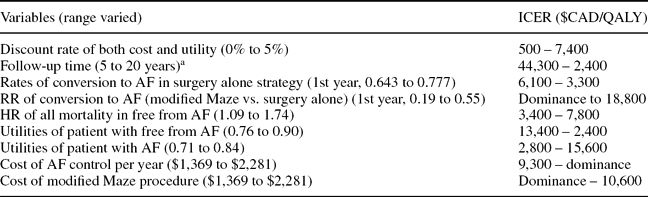
All variables were tested in univariate sensitivity analyses. Important variables impacting ICER are shown in Table 2. In most scenarios, ICERs are lower than $20,000. Important factors influencing incremental effectiveness include the follow-up time, RR of conversion to AF (ablation Maze vs. surgery alone), patient utilities, and costs of the ablation Maze procedure, and AF control. The ICER decreases dramatically with longer follow-up time (Figure 5) with a value around $100,000 at 3 years, and less than $20,000 after 8 years of follow-up.
Main Results of Sensitivity Analysis

a Variables from 16th to 20th years were assumed the same as those in the 15th year in sensitivity analyses.
ICER, incremental cost-effectiveness ratio; QALY, quality-adjusted life-year (QALY); Dominance, modified Maze strategy dominates surgery alone with increasing QALYs and less costs; AF, atrial fibrillation.
Sensitivity analysis examining incremental cost-effectiveness ratio (ICER) by different follow-up time, mitral valve surgery plus ablation Maze versus mitral valve surgery alone

Probabilistic Sensitivity Analyses
Multivariate probabilistic sensitivity analyses were conducted using 10,000 second-order Monte Carlo Simulations. The ICER was $5,900CAD (95 percent CI, 2,600 to 9,000) per QALY in 15 years. The most important factors influencing the variance of ICER of this model were the cost of heart surgery, which contributes 46.0 percent of the total variance. The other important factors impacting the ICER variance were the RR of conversion to AF in the modified Maze strategy relative to the surgery alone (5.7 percent of overall variance), utilities in AF state, free from AF state. and stroke state (6.5 percent, 7.0 percent, and 5.7 percent, respectively, of the overall variance).
The cost-effectiveness acceptance curve (CEAC) is shown in Figure 6. The probability of cost-effectiveness is acutely sensitive to changing WTP thresholds for a QALY. The probability of the surgical ablation being cost-effective is 58.1 percent, 73.9 percent and 89.3 percent, at $20,000, $50,000, and $100,000 WTP thresholds per QALY gained, respectively.
Probabilistic sensitivity analysis, cost-effectiveness acceptability curve. QALY, quality-adjusted life-years; MV, mitral valve.

DISCUSSION
The six RCTs (Reference Abreu Filho, Lisboa and Dallan1;Reference Akpinar, Guden and Sagbas2;Reference Blomstrom-Lundqvist, Johansson and Berglin8;Reference Deneke, Khargi and Grewe12;Reference Doukas, Samani and Alexiou13;Reference von Oppell, Masani, O'Callaghan, Wheeler, Dimitrakakis and Schiffelers43) identified by our systematic review showed consistent efficacy results in reducing AF rates after surgical ablation therapy. The pooled RR estimate of AF conversion was 0.33 (95 percent CI, 0.19 to 0.55) with mitral valve surgery plus ablation Maze compared with valve surgery alone. Our meta-analyses showed no statistical differences in operative mortality, permanent pacemaker implantation and postoperative bleeding with the additional ablation Maze procedures at the time of mitral valve surgery. Furthermore, the economic analyses demonstrates that, despite additional upfront costs of ablation techniques ($4,882), the surgical ablation procedure is cost-effective in the long-term, when performed on patients with either chronic or paroxysmal atrial fibrillation. The decreased AF risk translates into a net benefit in both life expectancy (0.10 life-years) as well as quality of life (0.20 QALYs) (Reference Lane and Lip27). The sensitivity analysis showed that ICER was sensitive to patient utilities, but our conclusions appeared robust to most reasonable scenarios. However, the ICER is extremely sensitive to survival time (Figure 5). Results suggest that, if the survival of an individual after MV surgery is expected to exceed 8 years, ablation Maze procedure should be considered, because it likely to be cost-effective (ICER < $20,000CAD /QALY). Additionally, the results indicate that if the life-expectancy of an individual is less than 3 years, the ablation Maze procedure is unlikely to be of cost-effectiveness for these patients (ICER > $100,000CAD/QALY) and should probably not be performed. The cost-effectiveness acceptance curve (Figure 6) demonstrates that the surgical ablation approach is probably be cost-effective (58.1 percent probability) even at the modest WTP threshold of $20,000CAD and of course becomes more likely to cost-effective at higher WTP thresholds.
Although the classic cut and sew Maze procedure has been the gold standard for surgical treatment of AF (Reference Gillinov and Saltman18), our meta-analysis is consistent with narrative reviews that could not identify any significant differences in the efficacy of AF conversion of the newer cryo- and radiofrequency ablation devices compared with the classic cut and sew procedure (Reference Khargi, Hutten, Lemke and Deneke24). Others have also assessed that the new techniques seem to be just as safe if not safer than the traditional cut and sew Maze procedure (Reference Hebeler22) given their decreased risk of bleeding complications intra- and postoperatively. Probably more importantly is that these newer techniques are less complex than the classic cut and sew methods, and should increase the adoptability of these procedures.
AF represents a large economic burden for our society. While this is the first formal cost-effectiveness study assessing the performance of an ablation Maze procedure during cardiac mitral valve, our results are compatible with a Swedish study that found a significant decrease in postoperative hospitalization resources in patients who underwent Maze surgery primarily for AF (Reference Wierup, Liden, Johansson, Nilsson, Edvardsson and Berglin45).
In interpreting the results of this study correctly, one should stress that our conclusions are applicable only to patients with chronic or paroxysmal AF who are already undergoing mitral valve surgery. Although the efficacy and the safety of the isolated Maze procedure for AF have been validated in the past, we cannot assume that the surgical procedure would maintain its cost efficiency when performed in isolation of mitral valve surgery or as part of a stand alone noninvasive percutaneous strategy.
The main limitation of this study is the lack of long-term follow-up data, and the large variability associated with some parameters. For example, the RCT efficacy for AF prevention had a short 1-year follow-up requiring that estimates had to be complimented by results from observational studies. Extrapolation of data over a longer time horizon obviously introduces further uncertainties into our model. Furthermore, disutilities with aging are difficult to reliably estimate and we have simplified our model by using time independent utilities estimates in three health states in 15 years. Additional studies to refine the precision of the parameter estimates would increase the strength of our conclusion. Despite these limitations, our model does provide an economic signal supporting this technology (Reference Weinstein, Toy and Sandberg44) that was robust over several different sensitivity analyses.
Therefore, based on the best available current evidence, we conclude that performing a concomitant modified MAZE procedure using radiofrequency or cryoablation technologies at the time of scheduled mitral valve surgery in patients with atrial fibrillation is likely to be cost-effective, provided the long-term prognosis is favorable.
CONTACT INFORMATION
Stéphane P. Quenneville, MD-MBA (stephane.quenneville@mail.mcgill.ca), Cardiology Fellow, Department of Cardiology, Royal Victoria Hospital, McGill University Health Centre, 687 Pine Avenue West, Medical 4.76, Montreal, Quebec H3A 1A1, Canada
Xuanqian Xie, MSc (shawn.xie@muhc.mcgill.ca), Biostatistician, Technology Assessment Unit, Royal Victoria Hospital, McGill University Health Center, 687 Pine Avenue West, R4.14, Montreal, Quebec H3A 1A1, Canada
James M. Brophy, MD, PhD (james.brophy@mcgill.ca), Professor of Medicine & Epidemiology (McGill), McGill University; Royal Victoria Hospital, McGill University Health Centre, 687 Pine Avenue West, Ross 4.12, Montreal, Quebec H3A 1A1, Canada