INTRODUCTION
Self-esteem is defined as a person's positive or negative attitude toward himself or herself (Rosenberg, Reference Rosenberg1965), and it is closely associated with personality functioning. High self-esteem is manifest in enhanced initiative, happiness and life satisfaction (Buhrmester et al. Reference Buhrmester, Furman, Wittenberg and Reis1988; Diener & Diener, Reference Diener and Diener1995; LePine & Van Dyne, Reference LePine and Van Dyne1998; Furnham & Cheng, Reference Furnham and Cheng2000). Self-esteem is positively associated with better self-rated health (Glendinning, Reference Glendinning1998), and low self-esteem has been related to poor physical health outcomes (Nirkko et al. Reference Nirkko, Lauroma, Siltanen, Tuominen and Vanhala1982). Under some circumstances, low self-esteem predisposes to depression and disordered eating (Whisman & Kwon, Reference Whisman and Kwon1993; Button et al. Reference Button, Sonuga-Barke, Davies and Thompson1996; Kendler et al. Reference Kendler, Gardner and Prescott2002, Reference Kendler, Gardner and Prescott2006). However, high self-esteem seems to be a heterogeneous concept that may promote initiative and confident action in either constructive or destructive ways (Salmivalli et al. Reference Salmivalli, Kaukiainen, Kaistaniemi and Lagerspetz1999).
It has been suggested that instability of self-esteem may be more strongly associated with negative outcomes than simply having low self-esteem (Kernis et al. Reference Kernis, Cornell, Sun, Berry and Harlow1993). Self-esteem does not remain unchanged across the lifespan: its stability increases throughout adolescence and young adulthood until mid-life (Pulkkinen et al. Reference Pulkkinen, Feldt, Kokko, Willis and Martin2005) and starts to decline thereafter (Trzesniewski et al. Reference Trzesniewski, Donnellan and Robins2003). Stability does not differ by gender (Trzesniewski et al. Reference Trzesniewski, Donnellan and Robins2003). Over time, self-esteem has shown substantial continuity, with test–retest correlations being on average 0·40–0·65 across the lifespan and 0·46–0·63 during adolescence.
There are some gender-specific differences in average self-esteem scores: boys have ubiquitously higher baseline scores and experience continuous linear growth throughout adolescence, whereas girls have more variable trajectories and may experience an increase or decrease of self-esteem during teenage years (Stein et al. Reference Stein, Newcomb and Bentler1986; Block & Robins, Reference Block and Robins1993).
Interactions in the family environment were previously considered the primary source in the development of self-esteem (Robson, Reference Robson1988). Recently, several studies have challenged this traditional view, demonstrating that genetic factors play a significant role in the etiology of self-esteem (Kendler et al. Reference Kendler, Gardner and Prescott1998; Kamakura et al. Reference Kamakura, Ando and Ono2001; Neiss et al. Reference Neiss, Sedikes and Stevenson2002), with heritability estimates varying from 0·29 to 0·40. Roy et al. (Reference Roy, Neale and Kendler1995) assessed heritability of self-esteem within time in adult female twins. They found moderate heritability for self-esteem (52% in the repeated measurement model), which was higher than the heritability estimates at two separate time points; the rest of the liability was explained by environmental influences unshared by a twin pair. In addition to genetic effects, non-shared environmental influences play a significant role in variance in self-esteem, whereas the influence of shared environment has been minimal. No sex-specific differences in genetic influences have been found in adults (Kendler et al. Reference Kendler, Gardner and Prescott1998).
To our knowledge, there are only a few previous genetically informative studies of factors that influence self-esteem or its stability/change in adolescents. McGuire et al. (Reference McGuire, Manke, Saudino, Reiss, Hetherington and Plomin1999) studied self-worth in a longitudinal genetic study among 10- to 18-year-old adolescents. They found significant heritability in mid- but not in early adolescence. Genetic factors explained 40% and non-shared environmental factors 60% of the correlation in general self-worth between two time points from age 10 to 18. Neiss et al. (Reference Neiss, Sedkides and Stevenson2006) assessed genetics of self-esteem level and its self-assessed stability in 10- to 19-year-old adolescent twins. In addition, they examined whether the two self-esteem components were subject to different genetic influences: genetic and non-shared environmental influences were found to best explain the variance in level and perceived stability as well as the covariance between the two components. Importantly, self-esteem level and stability appeared to share common antecedents through genetic and non-shared influences.
Because longitudinal studies have suggested both continuity and change in patterns of self-esteem across adolescence, it is particularly important to understand the factors contributing to self-esteem at this age and to examine potential gender differences in stability and change. The aim of this study was to investigate changes in self-esteem during adolescence and the contribution of genetic and environmental influences to these changes using a longitudinal design in Finnish adolescent twins.
METHOD
Participants
The data were derived from the FinnTwin12 Study, a longitudinal population-based study of five consecutive and complete nationwide birth cohorts of Finnish twins born between 1983 and 1987. Data collection was approved by local ethic committees. Baseline data collection took place when the twins were 11–12 years of age, but did not include a self-esteem measure. Follow-up questionnaires were mailed in the month the twins turned 14 for those who had responded at baseline. They were completed at mean age of 14·1 years for both genders [standard deviation (s.d.) in boys and in girls=0·08]. At age 17, the questionnaires were mailed to each birth cohort four times a year, with a mean age at response of 17·6 years for both genders (s.d. in boys=0·24, s.d. in girls=0·27). The participation rates were 87% in boys and 91% in girls at the age-14 assessment and 89% and 95% respectively at the age-17 assessment.
Twin zygosity was determined by a questionnaire using questions on physical similarity, a method that has shown high reliability in Finnish twin data (Sarna et al. Reference Sarna, Kaprio, Sistonen and Koskenvuo1978). In some ambiguous cases, questionnaire information was supplemented with additional information from photographs, fingerprints and DNA marker studies as described previously (Sarna et al. Reference Sarna, Kaprio, Sistonen and Koskenvuo1978; Kaprio et al. Reference Kaprio, Pulkkinen and Rose2002). The number of participating twin individuals with known zygosity was 2070 boys and 2062 girls at age 14 and 1857 and 1984 twin individuals at age 17 respectively. For twin analyses at 14 years, data from the Rosenberg Self-Esteem Scale were available from 683 male–male pairs [317 monozygotic (MZ) and 366 dizygotic (DZ) male pairs], 671 female–female pairs (346 MZ and 325 DZ), 670 opposite-sex dizygotic (OSDZ) pairs, and 84 twin individuals whose co-twin did not answer. At 17 years, data were available for 619 male–male pairs (290 MZ and 329 DZ), 667 female–female pairs (346 MZ and 321 DZ), 630 OSDZ pairs, and nine twin individuals from pairs in which only one co-twin answered.
Measures: Rosenberg global self-esteem
Self-esteem was assessed by the 10-item Rosenberg Self-Esteem Scale (Rosenberg, Reference Rosenberg1965), a brief, unidimensional measure of global self-esteem originally designed for adolescents, consisting of 10 statements relating to overall feelings of self-worth and self-acceptance. Half of the items are worded in a positive direction and half in the opposite direction, which requires reverse scoring. The measurement used the original four-point Likert scale with response options ranging from strongly agree (4) to strongly disagree (1) for each item. These were summed to generate the standard score ranging from a minimum of 10 to a maximum of 40. Cronbach's α for the internal consistency of the Rosenberg self-esteem scores at 14 years was 0·84 for girls and 0·80 for boys, and at 17 years 0·88 for girls and 0·85 for boys. In the text that follows, we refer to this measure as the self-esteem score.
Statistical analysis
We used quantitative genetic methods for twin data based on linear structural equation modeling (Neale & Cardon, Reference Neale and Cardon1992). MZ twins are genetically identical, whereas DZ twins share, on average, 50% of their segregating genes. Two sources of genetic influence can be estimated: additive genetic variation, which is the sum of the effects of all alleles affecting the phenotype, and dominance, the part of the genetic variation due to interaction between alleles at the same locus. Epistatic genetic effect, that is interaction of alleles between different loci, is assumed to be absent. Additive and dominance genetic effects have a correlation of 1 within MZ pairs and 0·5 and 0·25 within DZ pairs respectively (Neale & Cardon, Reference Neale and Cardon1992). Both MZ and DZ twins are assumed to share the same amount of environmental variation, which is partly shared by a twin pair (common environment) and partly unique to each twin individual (unique environment), the latter including any random measurement error. The relative magnitude of same-sex dizygote (SSDZ) and OSDZ twin correlations offers an opportunity to test whether sex-specific genetic or shared environmental factors exist, that is whether the genes or shared environmental factors that influence the liability to self-esteem are the same in boys and girls. If there is a different set of genes affecting self-esteem in men and women, this is seen as lower OSDZ correlations compared to SSDZ correlations.
Based on these assumptions, the model allows decomposition of the phenotypic variation into additive (A) and dominance (D) genetic variation as well as common (C) and unique (E) environmental variation. As we only had information on MZ and DZ twin pairs reared together, dominance genetic and common environmental effects cannot be modeled simultaneously. Decisions about fitting ACE models versus ADE models were made based on the pattern of the twin correlations. As we did not have information on parental self-esteem, we could not determine the possible effects of assortative mating. If phenotypic assortment by self-esteem existed, this would inflate DZ correlations and consequently cause overestimation of the common environmental variance and underestimation of heritability. The presence of gene–environment interaction (i.e. genetic-based susceptibility to environmental conditions) is confounded with the additive genetic component or in some cases with the unique environment depending on whether the environmental factors interacting with genetic factors are shared or unshared by a twin pair (Neale & Cordon, Reference Neale and Cardon1992). The raw data input option of the Mx software was used (Neale et al. Reference Neale, Boker, Xie and Maes2002).
Genetic modeling was started by fitting univariate models to self-esteem at each age separately. First, we tested the assumptions of twin models by comparing the fit of the twin models to saturated models, which do not make these assumptions. Second, we compared nested twin models to find the best model, which guided our choice of bivariate models for final estimate of variance components and decomposition of the longitudinal phenotypic correlation. The fit of the nested models was analyzed by log-likelihood (LL) tests. The difference in the −2 LL values and corresponding degrees of freedom is distributed as χ2. If the difference in the log-likelihoods between two nested models associated with the difference in degrees of freedom (Δχ2df) is statistically significant, the more parsimonious model fits significantly worse and lacks important parameters. In subsequent bivariate models, a Cholesky decomposition of covariance and variance was used, with model testing following the same principles as for univariate models. In the bivariate model, A, C and E influences can be estimated on both variables (self-esteem at each age). In addition, it is possible to estimate to which extent the correlation between the variables is due to correlations between the genetic, shared or unique environmental factors affecting self-esteem scores at these two ages. Under the bivariate model, the square of additive genetic correlation (r A) indicates the percentual extent of genetic factors common (or of closely linked loci) to self-esteem at 14 years and self-esteem at 17 years. The corresponding computation applies to common and unique environmental correlations (r C and r E respectively). The proportion of phenotypic correlation explained by genetic and environmental factors indicates the percentual extent of the correlation between self-esteem at 14 years and self-esteem at 17 years explained by shared genetic (A), common (C) or unique (E) environmental factors.
Descriptive statistics were derived using Stata Statistical Software release 9.1 (Stata Corporation, College Station, TX, USA). All individual-level analyses on means were controlled for clustered sampling (Williams, Reference Williams2000) within the twin pair.
RESULTS
In both sexes, self-esteem scores were reasonably normally distributed, although in boys skewing towards higher scores (median 32 at 14 years and 33 at 17 years) was evident compared to girls (median 29 at 14 and 17 years) in both age groups.
Mean values of self-esteem scores of twin individuals from different zygosity groups are presented in Table 1. The overall mean of self-esteem scores in boys was significantly higher than that of girls in both age groups (14 and 17 years: p<0·001): 31·8 (95% CI 31·6–32·0) among boys and 29·0 (95% CI 28·7–29·2) among girls at age 14, and 32·4 (95% CI 32·2–32·6) and 29·1 (95% CI 28·8–29·3) at age 17 respectively. In boys, the self-esteem scores were higher at age 17 than at age 14 in all zygosity groups.
Mean values (and standard deviations) of Rosenberg self-esteem score within MZ, same-sex DZ and opposite-sex DZ twin individuals for self-esteem at ages 14 and 17

MZ, Monozygotic; DZ, dizygotic.
We compared the mean self-esteem scores of each individual at 14 and 17 years: in DZ opposite-sex males, the increase in self-esteem scores from age 14 to 17 was statistically significant but of little clinical relevance (mean self-esteem scores of 31·3 to 32·0). Mean values of self-esteem scores were statistically significantly higher in MZ twin individuals compared to that of DZ twins in both age groups for boys. In girls at 17 years, self-esteem scores in both MZ females and DZ same-sex females were statistically significantly higher than those of DZ opposite-sex females (Table 1). The trait correlation (i.e. Pearson's correlation of self-esteem scores between ages 14 and 17) was 0·44 in boys and 0·46 in girls.
Those who dropped out of the study after the 14-year assessment and did not answer at 17 years had significantly lower self-esteem [mean 29·9 (95% CI 29·4–30·3) versus mean 30·5 (95% CI 30·3–30·7)]. Subjects whose co-twin had not answered at 14 years were more likely to drop out (χ2=55·2, p<0·001) and not answer at 17 years. There was no statistically significant difference in self-esteem scores between those individuals whose co-twin did and did not answer in either age group (data not shown).
The intra-pair intra-class correlations within each five zygosity groups for self-esteem scores are presented in Table 2. Among same-sex pairs in both age groups, with the exception of male pairs at age 17, MZ correlations were significantly greater but not more than double the DZ same-sex correlations, implying the effect of additive genetic influences with no dominance effects. In 17-year-old DZ same-sex males, the intra-pair correlation (r=0·15) was only a third of the MZ male correlation (r=0·47), implying a possible genetic effect due to dominance. In all zygosity groups, the intra-pair correlations were lower at 17 than at 14 years.
Number of complete twin pairs, intra-class correlations and 95% confidence intervals of Rosenberg self-esteem score within MZ, same-sex DZ and opposite-sex DZ twin pairs for self-esteem at ages 14 and 17

MZ, Monozygotic; DZ, dizygotic; CI, confidence interval.
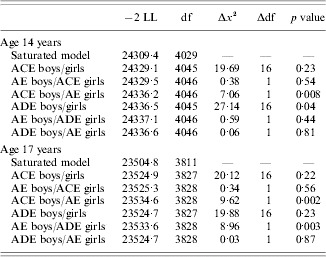
We performed univariate modeling for self-esteem scores at ages 14 and 17 for both sexes using sex-limitation models to test the assumptions of the twin modeling and find the best model to be used in subsequent bivariate modeling. The detailed model fit statistics for univariate modeling are presented in Table 3. At 14 years of age, the ACE model offered the best fit compared to the saturated model (Δχ216=19·7, p=0·234) with constrained means and variances. Fixing the common environmental effect to zero worsened the fit statistically significantly in girls (Δχ12=7·06, p=0·008) but not in boys (Δχ12=0·38, p=0·537), suggesting the ACE model in girls and the AE model in boys at this age. At 17 years of age, both ACE (Δχ216=20·1, p=0·215) and ADE models (Δχ216=19·88, p=0·226) had a good fit compared to the saturated model. However, at this age, we found evidence for some possible sex differences. Fixing the common environmental effect as zero in girls decreased the model fit compared to the full ACE model (Δχ21=9·62, p=0·002). Because of the inability of the basic twin model to simultaneously model C and D, we decided to use the ACE model in girls and the AE model in boys in order to fit models examining the stability of self-esteem. In a sex-limitation model using all five sex-zygosity groups, the sex-specific genetic effects were found to be statistically non-significant (Δχ12=0·09, p=0·764 at age 14; Δχ12=0·15, p=0·70 at age 17), indicating that the same genes were accounting for genetic effects on self-esteem in boys and girls, but their relative magnitude might nonetheless differ.
Model fit statistics for univariate models for Rosenberg self-esteem scores at ages 14 and 17

LL, Log-likelihood; df, degrees of freedom.
Phenotypic variation was decomposed into additive (A) and dominance (D) genetic variation, common (C) and unique (E) environmental variation.
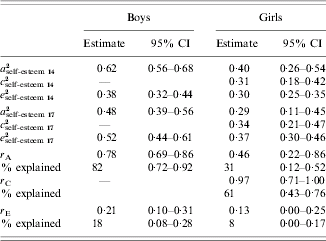
Table 4 presents the results for the final bivariate modeling. In boys, additive genetic factors accounted for 0·62 (95% CI 0·56–0·68) and unique environmental factors 0·38 (95% CI 0·32–0·44) at age 14 under the AE model; the corresponding estimates at age 17 were 0·48 (95% CI 0·39–0·56) and 0·52 (95% CI 0·44–0·61) respectively. In girls, for whom the ACE model was used, the additive genetic factors (A) accounted for 0·40 (95% CI 0·26–0·54), common environmental factors 0·31 (95% CI 0·18–0·42), and unique environment 30 (95% CI 0·25–0·35) of the variance in self-esteem scores at age 14 whereas the corresponding estimates at age 17 were 0·29 (95% CI 0·11–0·45), 0·34 (95% CI 0·21–0·47) and 0·37 (95% CI 0·30–0·46) respectively. In boys, genetic factors explained 82% (r A=0·78 95% CI 0·69–0·86) and unique environmental factors 18% of the correlation in self-esteem between these two ages. In girls, 31% of the correlation was explained by the genetic factors (r A=0·46, 95% CI 0·22–0·86), 61% by the common environmental factors and 8% by the unique environmental factors.
Proportion of trait variance explained by genetic and environmental factors, correlations between these variance components and proportion of phenotypic correlation explained by these correlations in the bivariate model for self-esteem at 14 and 17 years of age
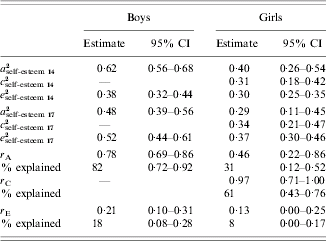
CI, Confidence interval; a 2, proportion of trait variation explained by additive genetic factors; c 2, proportion of trait variation explained by common environmental factors; e 2, proportion of trait variation explained by unique environmental factors; r A, additive genetic correlation; r C, common environmental correlation, r E, unique environmental correlation.
DISCUSSION
In our study, the genetic and environmental determinants of age-to-age correlation in self-esteem differed by gender: in boys, it was largely due to genetic influences, which suggests a substantial biological basis to the development of self-esteem in adolescent males. In girls, genetic and those environmental factors shared by a twin pair explained most of the correlation between self-esteem assessed 3 years apart; the contribution of unique environment was almost the same as in boys. This suggests that earlier theories of the salience of shared environment (Robson, Reference Robson1988) on self-esteem development would only apply to females. In addition, we found no evidence that the genetic factors affecting self-esteem were different in boys and girls.
In line with a previous meta-analysis (Trzesniewski et al. Reference Trzesniewski, Donnellan and Robins2003), where the test–retest correlation of self-esteem from 12 to 17 years was 0·48 and did not differ significantly by sex, we found no sex differences in the correlation of self-esteem scores between ages 14 and 17. However, as suggested previously (Block & Robins, Reference Block and Robins1993), regardless of equivalent stability levels in both sexes, the change in self-esteem may be regulated by different factors: it is possible that in males, self-focused, action-oriented characteristics dominate, whereas in females, interpersonal qualities such as warmth and nurturance may be more important.
Using our significantly larger sample size of adolescent twins we replicated the results of Neiss et al. (Reference Neiss, Sedkides and Stevenson2006), where genetic and non-shared variances in self-esteem level at two time points between 10 and 19 years were significant. Inconsistent with our results, McGuire et al. (Reference McGuire, Manke, Saudino, Reiss, Hetherington and Plomin1999) found significant heritability of general self-worth in mid- but not in early adolescence: at average age 13 the genetic variance of general self-worth was 0·16, shared environmental variance was 0·01 and non-shared environmental variance 0·83. At the second time point (average age 16), genetic variance was 0·60 and non-shared variance 0·40. In our study, proportions of genetic variances were significant in both genders and at both ages, yet larger at the first time point at 14 years. The intra-pair correlations of self-esteem scores in our study decreased from 14 to 17 years in all zygosity groups, which suggests that unshared environmental events increasingly influence self-esteem over the course of adolescence.
We further replicated the previous findings for gender difference in self-esteem levels: compared to girls, boys’ scores were initially significantly higher at 14 years, then exhibited a slight growth pattern, whereas girls’ scores did not follow any consistent pattern. In addition, the mean self-esteem scores were significantly higher in male MZ twins compared to male DZ twins, although the effect size was small. However, Kendler et al. (Reference Kendler, Gardner and Prescott1998), who found the corresponding zygosity difference controlling for sex, suggested that this effect might be present in the population, perhaps reflecting the greater sense of specialness experienced by MZ twins or the unusually close emotional bond between MZ twins. Supporting this, Pulkkinen et al. (Reference Pulkkinen, Vaalamo, Hietala, Kaprio and Rose2003) showed in the same FinnTwin12 sample as used in this study that being a twin may have a positive effect on early adolescent development: twins were more popular than non-twins in peer nominations and scored higher on positive sociality, in particular twins from opposite-sex pairs.
From genetic studies in adult twins we have learned that, although genetic influences are substantial, unique environmental influences explain the largest amount of variance in self-esteem in both genders. In this study, one of the main findings was the large influence of genetic effects in boys' self-esteem development, which may reflect an association between self-esteem and physical maturation. Different timing of puberty, which we know to be under genetic influence, may also have acted as a confounding factor. Mean age for voice break, a commonly used sign for termination of physical puberty in boys, was in our sample at age 14·0 (95% CI 13·9–14·0). It is possible that mental changes following the physical puberty ongoing especially among boys at the age of 17 would manifest in DZ boys’ relative dissimilarity, because timing of the development within a DZ twin pair is not synchronic as in genetically identical MZ twin pairs. This would be manifest as a relatively low intra-pair correlation in 17 years compared to that of 14-year-old DZ same-sex boys. The assumption of boys’ malleable personal views throughout teenage years is supported by Block & Robins (Reference Block and Robins1993), who studied consistency and change of self-esteem in a longitudinal study in adolescents from age 14 to 17 and to 23 and stated that a significantly greater longitudinal ordering consistency within their sample of girls implies that, unlike for boys, for many girls levels of self-esteem are relatively well established by adolescence. Finally, it is worth noting that even if shared environmental factors did not influence boys' self-esteem at either time point, or the correlation of self-esteem, this does not necessarily imply that shared environment (e.g. home, peer interactions) has no influence on boys’ self-esteem. Individuals within a family or a peer group can hold very different internal representations. If, for example, parents treated siblings differently or siblings interpreted parental behavior differently, these individual differences within a family would fall under unique environment. However, lack of evidence for shared environmental effect suggests only that its influence is less powerful than the dominant genetic influences, not that shared environmental effect would be non-existent.
Girls tend to internalize whereas boys tend to externalize behaviors resulting from psychological problems. Adolescent girls more often than boys suffer from conditions such as depression and eating disorders, where low self-esteem evidently plays a role (Button et al. Reference Button, Sonuga-Barke, Davies and Thompson1996; Kendler et al Reference Kendler, Gardner and Prescott2002). In childhood, self-worth is equal between sexes. In early adolescence, girls' self-esteem begins to decline and becomes vulnerable, for example to appearance and weight-related issues (Biro et al. Reference Biro, Striegel-Moore, Franko, Padgett and Bean2006). The crucial question is which specific factors in shared environment (social interactions, rearing, home) contribute to girls' self-esteem development. Once uncovered, interventions to support girls' self-esteem could be planned. Compared to boys, it appears that there is a definitive need to support girls' self-esteem: Salmivalli et al. (Reference Salmivalli, Kaukiainen, Kaistaniemi and Lagerspetz1999) showed that girls tend to under-evaluate themselves compared to peer evaluation, while over-evaluation of self is typical of boys. Of interest, self-esteem scores were also slightly lower in 17-year-old girls who grew up with a male versus female co-twin; a finding also observed in adult twins (Kendler et al. Reference Kendler, Gardner and Prescott1998). Boys from the DZ opposite-sex pairs were, on the contrary, the only zygosity group whose increase in self-esteem from 14 to 17 years was statistically significant. This suggests that a male co-twin, whose own self-esteem development is largely genetically driven, may have an adverse effect on self-esteem of his female co-twin, whose self-esteem development in turn is more sensitive to shared environmental influences, such as relationships with one's siblings or shared friends.
Antisocial and violent behavior is more prevalent in boys (van Lier et al. Reference van Lier, Vitaro, Wanner, Vuijk and Crijnen2005). Attempts to link self-esteem to externalizing behavior have produced mixed results. Donellan et al. (Reference Donnellan, Trzesniewski, Robins, Moffitt and Caspi2004) recently found a fairly robust and independent correlation between low self-esteem and delinquent aggressive behavior. However, individuals with good self-esteem have been shown to be over-represented among both antisocial and psychologically healthy adolescents (Salmivalli et al. Reference Salmivalli, Kaukiainen, Kaistaniemi and Lagerspetz1999).
Strengths and limitations
This study is the first attempt to explore the genetic and environmental influences on adolescent global self-esteem and its stability over time. Additional strengths include the longitudinal population-based cohort design, inclusion of OSDZ pairs, high response rate, and large sample size.
Our study also has some limitations. Although self-esteem is by definition a person's global positive or negative attitude toward him/herself (Rosenberg, Reference Rosenberg1965) and thus self-reported better than most other traits, multiple sources of information (e.g. evaluation by peers or parents) might be less affected by self-presentational motives (Salmivalli et al. Reference Salmivalli, Kaukiainen, Kaistaniemi and Lagerspetz1999; Baumeister et al. Reference Baumeister, Campbell, Krueger and Vohs2003).
Limitations also include the necessary assumptions of random mating and equal environments, and the failure to directly model gene–environment interaction in the quantitative genetic models. Previous twin studies suggest that mating is selective for individual qualities such as intelligence and height, but relatively non-selective for personality traits (Eaves et al. Reference Eaves, Heath, Martin, Maes, Neale, Kendler, Kirk and Corey1999). The assumption that the shared environmental correlation between MZs is the same as DZs with respect to personality dimensions also appears tenable: adoption studies of twins reared apart have typically found comparable levels of MZ–DZ differences as have traditional twin analyses (Bouchard et al. Reference Bouchard, Lykken, McGue, Segal and Tellegen1990). Furthermore, it is possible that gene–environment interactions affect self-esteem in the same manner that they influence depression (Caspi et al. Reference Caspi, Sugden, Moffitt, Taylor, Craig, Harrington, McClay, Mill, Martin, Braithwaite and Poulton2003). We did not model gene–environment interaction: in our study, it would be subsumed as a part of the additive genetic effect.
CONCLUSION
In our study, stability in self-esteem was differently regulated in adolescent boys compared to girls. In boys, genetic factors contributed to a large degree. In girls, significant shared environmental influences suggest that interventions intended to strengthen girls' self-esteem could be more feasible than among boys: this challenges future research to explore the core factors in family or social environment. In both sexes, an important remaining challenge is the identification of specific environmental factors contributing self-esteem during adolescence. These factors can act independently or in interaction with genes.
ACKNOWLEDGMENTS
This study was funded by NIH grants AA12502 and AA08315, the Academy of Finland (44069 and 201461), the Academy of Finland Center of Excellence for Complex Disease Genetics, and the European Union (QLG2-CT-2002-01254), with additional NIH support to D.M.D. (AA015416). A.R. received funding from the Finnish Medical Association Duodecim. K.S. was supported by the Academy of Finland (grant no. 108297). Esko Levälahti provided statistical assistance. Eila Voipio, Kauko Heikkilä, Pia Ruokolinna and Pirkko Särkijärvi provided technical assistance.
DECLARATION OF INTEREST
None.