Common pokeweed is a simple, perennial broadleaf weed that infests wooded margins, pond edges, waterways, roadsides, fencerows, farm fields, and other disturbed areas. In agriculture, tillage has historically been used to manage common pokeweed; however, the widespread adoption of no-till practices, along with the reduced diversity of crop rotations and a decline in the use of soil-residual herbicides, has allowed pokeweed populations to expand (Nolte et al. Reference Nolte, Young and Roskamp2002). Over the last five years, questions about pokeweed control have become commonplace at extension meetings in Pennsylvania (D Lingenfelter, personal communication).
Over the last decade, farmers in the northeastern United States have increasingly adopted no-till practices. The percentage of no-till corn planted in Pennsylvania has doubled from 30% in 2001 (Horowitz et al. Reference Horowitz, Ebel and Ueda2010) to 60% in 2013 (NASS 2014). The percentage of no-till soybean planted in Pennsylvania has increased from 64% in 2007 (NASS 2008) to 74% in 2013 (NASS 2014). The adoption of no-till has resulted primarily from concerns about soil loss and water quality. In the Chesapeake Bay watershed, soil conservation has been emphasized over the last two decades in an effort to increase water quality in the Bay and its tributaries. In addition to soil conservation, no-till allows for fewer passes through each field with cultivation equipment, reducing labor and fuel costs and decreasing the possibility of soil compaction (Duiker Reference Duiker2013; Duiker and Myers Reference Duiker and Myers2002). However, no-till establishment of annual crops can allow for the establishment of perennial weeds, including pokeweed (Bernstein et al. Reference Bernstein, Stoltenberg, Posner and Hedtcke2014; Buhler et al. Reference Buhler, Stoltenberg, Becker and Gunsolus1994; Murphy et al. Reference Murphy, Clements, Belaoussoff, Kevan and Swanton2006; Owen Reference Owen2008).
In addition to increasingly adopting no-till practices, many farmers in the region have shifted to an annual rotation of corn and soybean, decreasing the diversity of crop rotations. Although wheat (Triticum aestivum L.) hectares have remained about the same, oat (Avena sativa L.), barley (Hordeum vulgare L.), rye (Secale cereale L.), and hay crops have decreased by 75%, 37%, 45%, and 28%, respectively, in Pennsylvania over the last 20 yr (NASS [date unknown]). The decrease in winter and spring cereal and hay production reduces potential crop competition with emerging pokeweed in the spring, as well as providing the ability to mow or apply herbicides in late summer or fall after harvest. Starting in 1996, with the introduction and adoption of glyphosate-resistant soybean, residual herbicide use has declined in the region. Additionally, atrazine use in corn has decreased since the early 1990s (NASS [date unknown]) due to water quality concerns in certain geographic areas. Residual herbicides may be important for controlling pokeweed seedlings, which can emerge throughout the summer (Patches Reference Patches2014; VanGessel Reference VanGessel1999).
Corn and soybean are two important crops in Pennsylvania, especially for the numerous dairy farms across the state. In Pennsylvania, over 500,000 ha of corn grain and silage are harvested annually, yielding an average of 3.3 million Mg of grain and 6.8 million Mg of silage (NASS [date unknown]). Soybean adoption in Pennsylvania is increasing, with about 200,000 ha planted each year (NASS [date unknown]; Pennsylvania Soybean Promotion Board 2013).
Much of the recent scientific literature on pokeweed has focused on the plant’s medicinal and antiviral properties, and not its management as a weed in field crops (Baldwin et al. Reference Baldwin, Khan, Tumer, Goss and Friedland2009; Domashevskiy et al. Reference Domashevskiy, Miyoshi and Goss2012; Maness et al. Reference Maness, Goktepe, Hardy, Yu and Ahmedna2012; Mansouri et al. Reference Mansouri, Kutky and Hudak2012). Most of the available literature on pokeweed as a weed is in non–peer-reviewed research reports and conference proceedings. Research on pokeweed control in corn is slightly more abundant than research on pokeweed control in soybean, but both are limited. The Penn State Agronomy Guide lists several POST-applied herbicides as having some activity against pokeweed, but only glyphosate has a control rating as high as 90% (Curran et al. Reference Curran, Lingenfelter, Collins, Tooker and Bohnenblust2015a, Reference Curran, Lingenfelter, Tooker, Collins and Bohnenblust2015b).
Previous research in corn shows that foliar-applied herbicides provide between 60% and 90% control of perennial pokeweed during the season of application (Glenn and Phillips Reference Glenn and Phillips1994; Marcelli and Glenn Reference Marcelli and Glenn1993; Nolte et al. Reference Nolte, Young and Roskamp2002; Young and Nolte Reference Young and Nolte2002). Glyphosate tank-mixed with 2,4-D, dicamba, or other herbicides results in better pokeweed control than do the same herbicides used alone (Glenn and Phillips Reference Glenn and Phillips1994; Marcelli and Glenn Reference Marcelli and Glenn1993; Nolte et al. Reference Nolte, Young and Roskamp2002). In an application timing study in Maryland, pokeweed control reached 93% when herbicides were applied to 30 cm tall pokeweed, but declined to 85% when applied to pokeweed that was up to 60 cm tall (Marcelli and Glenn Reference Marcelli and Glenn1993). However, control with some treatments was only 50% after 11 mo (Glenn and Phillips Reference Glenn and Phillips1994). Annual seed production is critical to sustain or increase populations of simple perennials like pokeweed. A study investigating the effect of residual herbicides on control of pokeweed seedlings showed that 8 of 11 commonly used soil-applied herbicides provided greater than 85% control in both corn and soybean (VanGessel Reference VanGessel1999). This suggests that soil-applied residual herbicides could play an important role in preventing the establishment and spread of pokeweed.
Previous research on pokeweed control in soybean has mostly focused on glyphosate, and has shown that pokeweed control was high (88% to 100% control) at various glyphosate application rates and timings (Glenn and Kalnay Reference Glenn and Kalnay2000; Nolte et al. Reference Nolte, Young and Roskamp2002). However, weed–crop competition was found to be impacted by application timing: soybean yield was reduced when glyphosate was not applied until the V8 stage of soybean growth (Glenn and Kalnay Reference Glenn and Kalnay2000). Although glyphosate-resistant soybean has been in the marketplace since 1996, numerous inquiries from private applicators and farmers suggest that pokeweed control is variable and pokeweed remains an important weed of concern, especially in soybean. Glyphosate may not provide complete control of pokeweed, and incomplete control might allow regrowth and seed production. Application timing likely plays an important role in the effectiveness of glyphosate. Preventing seed production is critical, given that pokeweed relies heavily on successful seed production and dispersal for spread.
Specific guidelines for managing pokeweed in no-till corn and soybean are not currently available for the mid-Atlantic region. The objective of this research was to characterize the effectiveness of some common POST herbicides for control of pokeweed in no-till corn and soybean.
Materials and Methods
All trials except the 2012 corn experiment were located at Penn State University’s Russell E. Larson Agricultural Research and Education Center, Rock Springs, Centre County, PA (40°44′N, 77°57′W). The 2012 corn experiment was conducted on a private farm near Mt. Joy, Lancaster County, PA (40°7′N, 76°27′W). The 2012 location is approximately 140 km south of the 2011 and 2013 locations, and is approximately 10 d ahead relative to growing degree days. All field locations had historically been farmed using a no-till system and had a history of pokeweed infestation. The predominant soil series were Hagerstown silt loam (fine, mixed, semiactive, mesic Typic Hapludalf) and Andover channery silt loam (fine-loamy, mixed, active, mesic Typic Fragiaquult). The soil pH and organic matter ranged from 5.4 to 7.1 and 2.2% to 4.1%, respectively. The phosphorus and potassium fertility was amended each year based on analyses performed by the Penn State Agricultural Analytical Services Lab (Tower Road, University Park, PA 16802) for the Rock Springs sites or Spectrum Analytic, Inc. (Washington Court House, OH 43160-8748) for the Mt. Joy site. Slightly different fertility programs were used each year depending on the location. The corn fertility program typically included either broadcast application of nitrogen as urea just prior to planting or a sidedress application of urea ammonium nitrate, as well as starter fertilizer banded at planting.
Corn was no-till planted between late April and early May, and soybean was no-till planted at the end of May. The Rock Springs sites were established using a John Deere 1780 6-row no-till planter (John Deere, Moline, IL 61265-8098), while the Mt. Joy location was planted with a John Deere 1760 8-row no-till planter. Glyphosate-resistant corn was used all three years: ‘DKC 58-83’ (Monsanto Company, St. Louis, MO 631670) in 2011, ‘Pioneer P1184AM1’ in 2012, and ‘Pioneer PO891AM1’ in 2013 (both from DuPont, Johnston, IA 50131-0184). Corn was planted in rows 76 cm apart at approximately 78,300 seeds ha−1. In the corn experiments in 2011 and 2013, and in both years of soybean experiments, 0.82 kg ae ha−1 glyphosate plus 1.87 kg ai ha−1 S-metolachlor were broadcast-applied at planting to aid in the control of emerged weeds and to provide some residual control of summer annual weed species. In the 2012 corn experiment, 0.82 kg ha−1 glyphosate, 1.87 kg ha−1 S-metolachlor, 0.84 kg ai ha−1 atrazine, and 0.188 kg ai ha−1 mesotrione were broadcast-applied for the same purpose. Glyphosate-resistant soybean ‘Asgrow 3833’ (Monsanto Company, St. Louis, MO 63167) in 2012 and ‘FS HS31A03’ (Growmark FS, Milford, DE 19963) in 2013 were planted in 76-cm rows at 370,500 seeds ha−1. Asgrow 3833 is sulfonylurea tolerant as well as glyphosate resistant.
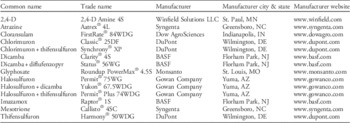
Treatments were arranged as a randomized complete block design with three replications in 2011 and four replications in 2012 and 2013. Individual plots in the corn experiments measured 3 by 35 m in 2011, 3 by 23 m in 2012, and 4.5 by 23 m in 2013. Individual plots in the soybean experiments measured 4.5 by 18 m. Herbicides were applied using a recreational utility vehicle (RTV)-mounted CO2 boom sprayer (Ranger® HD 700 EFI, Polaris Industries, Medina, MN 55340) equipped with TeeJet® AIXR11002 nozzles (Spraying Systems Co., Wheaton, IL 60187) calibrated to deliver 140 L ha−1 in 2011 and 187 L ha−1 in 2012 and 2013 at 275 kPa. Herbicide treatments were applied at the rates recommended on the labels and included appropriate adjuvants (Table 1). Corn herbicides were applied POST at the V4 to V6 corn growth stage on June 17, 2011; May 25, 2012; and June 12, 2013. Soybean herbicides were applied POST at the V2 soybean growth stage on June 28, 2012 and June 19, 2013. To investigate the effect of sequential applications, some plots received a second application of glyphosate at the V3 to V4 stage of soybean growth on July 12, 2012 or July 3, 2013. At both the first POST and second POST application dates in all years, the treated pokeweed ranged from seedlings to plants 122 cm tall, with perennial plants averaging 91 cm tall and in the vegetative to early reproductive stages of growth. Pokeweed plant density at the time of herbicide application ranged from three to a dozen or more perennial plants per plot, depending on the location and year. The number of herbicide treatments varied somewhat each year based on available land area, ranging from 7 treatments in corn in 2011 to 10 treatments in corn in 2013, and from 11 to 13 treatments in soybean. Non-treated control plots were included for each crop and year.
Herbicides used in corn and soybean trials targeting common pokeweed at Rock Springs in 2011 to 2013 and at Mt. Joy in 2012.

Three perennial pokeweed plants of similar size were tagged with plastic ribbon in each plot at the time of the first POST application in order to track herbicide efficacy over time. Pokeweed control was visually assessed based on control of all perennial plants in each plot 8 or 12 wk after application (WAA), depending on the year, on a scale of 0 to 100 (with 0 meaning no control and 100 meaning complete control). The tagged plants were harvested by hand by cutting at ground level in late summer (around Sept 1), and plant material was removed. Plants were oven-dried for a minimum of 96 h at 60 C to measure the dry weight of their aboveground biomass. Soybean in both years was harvested by removing all six rows in each plot with a Massey Ferguson® 550 combine (AGCO, Duluth, GA 30096). Corn grain yield was not assessed. For all the experiments except corn in 2012, regrowth was assessed the following spring in mid-May (approximately 48 WAA) by recording a score for control of all perennial plants in each plot as described previously.
Statistical analyses were performed in SAS® 9.3 (SAS Institute Inc., Cary, NC 27513) using the Mixed procedure. Analysis of variance was used to test for statistically significant differences in pokeweed control with the different herbicide treatments. Means were separated using Fisher’s protected LSD with significance set at P<0.05. The data from the corn study in 2011 were analyzed separately because of the multiple changes made in the treatments in 2012 and 2013. For both the corn and soybean trials in 2012 and 2013, each year was analyzed separately, and if error terms were homogenous, then the common treatment data were pooled over the two years using the F max test (Hartley Reference Hartley1950). For the corn and soybean experiments in 2012 and 2013, control ratings, biomass, and yield (soybean only) were pooled across years because the error terms were homogenous. Treatments only included in one of the two years were not included in the pooled analysis. Treatment was treated as a fixed variable, and replicate and year were treated as random variables. Pokeweed biomass data were log transformed in order to normalize the variance and meet the assumptions of homogeneity. The transformation did not affect the results. The visual control scores of the non-treated control plots were not included in the analysis.
Results and Discussion
Corn
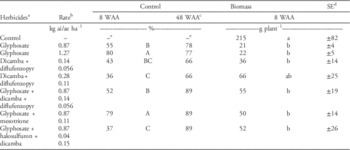
Pokeweed control in corn varied in 2011 depending on treatment; by 8 WAA, the herbicides provided 36% to 80% control (Table 2). The highest level of control was provided by glyphosate+mesotrione and the higher rate of glyphosate (1.26 kg ha−1), which achieved 79% and 80% control, respectively. All other herbicides provided less than 55% control. Pokeweed biomass 8 WAA was reduced by all herbicides except the high rate of dicamba+diflufenzopyr. The spring after application (48 WAA), herbicide treatments provided 66% to 89% control of pokeweed. Although not statistically different from other treatments, the glyphosate tank mixes averaged 89% control.
Effect of corn herbicides on common pokeweed control 8 and 48 weeks after application (WAA) in 2011. Numbers in columns followed by different letters are significantly different as determined by Fisher’s LSD at P<0.05.

a All treatments included liquid ammonium sulfate (N-Pak® AMS Liquid, Winfield Solutions, LLC, St. Paul, MN 55164) at 2.5% v/v. Dicamba+diflufenzopyr treatments also included a nonionic surfactant at 0.25% v/v.
b The rates of 2,4-D, dicamba, and glyphosate are in kg ae ha–1.
c At 48 weeks, there were no significant differences in control between the treatments (P=0.78).
d Abbreviation: SE, standard error of the mean.
e The non-treated controls were not included in the analysis.
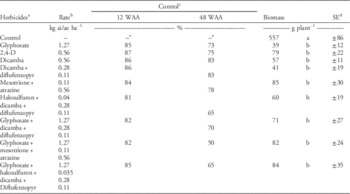
In 2012 and 2013, each treatment provided at least 80% control and reduced late summer biomass 12 WAA (Table 3). The non-treated check plots had higher biomass (557g plant−1) compared to the herbicide treatments (Table 3). All of the treatments provided pokeweed suppression in corn, but some green or living tissue remained at the end of the season, indicating incomplete control and potential survival of the pokeweed. Year-after-application evaluations were not collected for the 2012 trial due to field management issues on the private farm (farmer tilled the field). Control ratings 48 WAA for the 2013 trial were variable, ranging from 50% to 83%, and tended to be equal to or lower than the 12 WAA ratings (Table 3). Fall estimates made the year of application may be a better metric for pokeweed control due to issues with pokeweed winterkill and variability in the timing of spring regrowth. Delaying the year-after-application evaluation for an additional four weeks (i.e., mid-June or about 52 WAA) may have provided a more accurate long-term control assessment.
Effect of corn herbicides on pokeweed control 12 and 48 weeks after application (WAA) in 2012 and 2013. The 12 week after application data were pooled over the two years, while the 48 WAA data were only available for the 2013 trial. Numbers in columns followed by different letters are significantly different as determined by Fisher’s LSD at P<0.05.

a All treatments except 2,4-D and dicamba included liquid ammonium sulfate (N-Pak® AMS Liquid, Winfield Solutions, LLC, St. Paul, MN 55164) at 2.5% v/v. Mesotrione+atrazine also included crop oil concentrate at 1% v/v. All other non-glyphosate treatments except 2,4-D and dicamba also included a nonionic surfactant at 0.25% v/v.
b The rates of 2,4-D, dicamba, and glyphosate are in kg ae ha−1.
c Differences in control between the treatments were not significant (P=0.87 and 0.29 for 12 and 48 WAA, respectively).
d SE, standard error of the mean.
e The non-treated controls were not included in the analysis.
The results from this corn research support previous work showing that several herbicides can achieve 80% or greater seasonal control. Glyphosate, 2,4-D, and dicamba are all active on pokeweed, and in previous research these herbicides have provided 67% to 95% control (Glenn and Phillips Reference Glenn and Phillips1994; Marcelli and Glenn Reference Marcelli and Glenn1993; Young and Nolte Reference Young and Nolte2002). Tank mixes of 2,4-D or dicamba with other herbicides provided between 75% and 85% control (Marcelli and Glenn Reference Marcelli and Glenn1993), which is similar to the levels observed in our study. One study reported 94% control with mesotrione alone 56 d after application (Young and Nolte Reference Young and Nolte2002). Our research showed that mesotrione+atrazine alone or in combination with glyphosate provides about 80% control and is similar to other effective herbicides.
Soybean
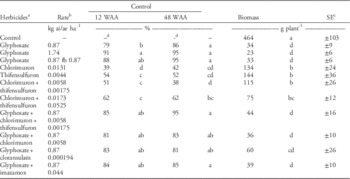
In general, treatments that included glyphosate provided 79% control or better, while those that excluded glyphosate ranged from 39% to 62% control (Table 4). Biomass was reduced by some herbicide treatments; the non-treated control plots had the most biomass (464 g plant−1) 12 WAA, while glyphosate-containing treatments had the least biomass. Non-glyphosate herbicides also reduced biomass compared to the non-treated check, but not as much as did the glyphosate-containing treatments (Table 4). Thifensulfuron proved to be similarly or slightly more effective than chlorimuron, but even the highest rate of the combination (the suggested rate for sulfonylurea-tolerant soybean) provided only 62% control. In 2013, cloransulam and imazamox were also included in the experiment, and each was less effective than glyphosate: imazamox provided 61% control and cloransulam only 21% control (data not presented).
Effect of soybean herbicides on pokeweed control 12 and 48 weeks after application (WAA) in 2012 and 2013. The data are pooled over the two years. Numbers in columns followed by different letters are significantly different as determined by Fisher’s LSD at P<0.05.

a All glyphosate-containing treatments included liquid ammonium sulfate (N-Pak® AMS Liquid, Winfield Solutions, LLC, St. Paul, MN 55164) at 2.5% v/v. All other treatments also included a nonionic surfactant at 0.25% v/v.
b The rates of glyphosate are kg ae ha −1.
c SE, standard error of the mean.
d The non-treated controls were not included in the analysis.
Year-after-application spring regrowth was assessed for both the 2012 and 2013 trials; and the results showed that glyphosate-containing treatments generally provided better control than non-glyphosate treatments (Table 4). Glyphosate applied alone or in combination provided the greatest control at 81% to 95%. All non-glyphosate treatments ranged from 38% to 62% control (Table 4).
Soybean grain was mechanically harvested from each plot both years, but because of variable pokeweed and annual weed populations, yields did not always correlate with pokeweed control (data not presented). The 2012 yield data were less variable than the 2013 data, and showed that pokeweed in the non-treated control reduced soybean yield by about 47% compared to the highest yielding glyphosate treatment (2,990 vs. 1,453 kg ha−1).
These results indicate that glyphosate is a key herbicide for controlling pokeweed in soybean, which is consistent with previous research (Glenn and Kalnay Reference Glenn and Kalnay2000). Tank-mixes with glyphosate provided greater than 80% pokeweed control, while the group 2 herbicides applied alone achieved 62% control or less (Table 4). Previous research showed at least a 29% increase in control when glyphosate was tank mixed with a group 2 herbicide compared to group 2 (cloransulam or chlorimuron+thifensulfuron) herbicides alone (Nolte et al. Reference Nolte, Young and Roskamp2002). Glyphosate does not have residual activity in soil, which may be important for control of seedlings that emerge after POST herbicide application. Seedlings were present in our study; however, populations varied, making it difficult to assess herbicide residual control. A Delaware study reported that 8 of 11 corn or soybean herbicides provided at least 85% control of pokeweed seedlings, indicating that there are effective herbicide options for controlling seedlings (VanGessel Reference VanGessel1999). Other research by the first author showed that pokeweed seedlings emerge all summer long (Patches Reference Patches2014), so tank mixing glyphosate with an effective residual herbicide could be important for controlling both perennial pokeweed and pokeweed seedlings that may emerge mid and late summer.
This research showed that several corn herbicides provide at least 80% control of pokeweed in the year of application, suggesting that there are multiple effective herbicide choices for pokeweed management in corn, and reliance on glyphosate is not necessary. In soybean, only treatments that included glyphosate provided 80% control or more, indicating that glyphosate is important for the management of pokeweed in soybean. In both corn and soybean, none of the treatments provided complete control of pokeweed, indicating some potential for survival and regrowth, and the assessments collected the spring after application showed similar or slightly less control than was observed during the year of application.
Acknowledgments
Thank you to the Penn State College of Agricultural Sciences and the Pennsylvania Soybean Board for financial support of this research.