One of the most long-standing and generative tensions in the fields of developmental psychology and developmental psychopathology concerns the role of individual-level factors (e.g., temperament) versus socialization agents (e.g., caregivers and peers) in organizing child development. Socialization researchers have historically emphasized the role of parents, teachers, and friends in shaping the way in which children develop across a broad number of domains (e.g., Roisman & Fraley, Reference Roisman and Fraley2012; Sroufe, Egeland, Carlson, & Collins, Reference Sroufe, Egeland, Carlson and Collins2005). In contrast, researchers focusing on individual-level factors have highlighted the way in which children evoke from others behavior that is consistent with their preexisting dispositions (e.g., Scarr & McCartney, Reference Scarr and McCartney1983).
The transactional model of development (Sameroff & Chandler, Reference Sameroff, Chandler, Horowitz, Hetherington, Scarr-Salapatek and Siegel1975; Sameroff & MacKenzie, Reference Sameroff and MacKenzie2003) was introduced in part to harmonize these perspectives, emphasizing that bidirectional feedback loops often exist between the quality of children's interpersonal experiences and characteristics of the child that actually serve to sustain continuity in both adaptive functioning and the nature and quality of children's experiences across time. Over the last four decades, transactional models have emerged as central fixtures in modern developmental science (e.g., Cicchetti & Toth, Reference Cicchetti, Toth, Luthar, Burack, Cicchetti and Weisz1997; Lynch & Cicchetti, Reference Lynch and Cicchetti1998), so much so that such bidirectional processes are often assumed to be ubiquitous. Indeed, a transactional perspective is so ingrained in our scholarship that it often serves as the cornerstone for meta-theoretical claims about the very nature of development itself (e.g., Gottlieb, Reference Gottlieb2007).
Researchers have long had tools available for examining transactional processes, including variants of the autoregressive cross-lagged model (ARCL; Campbell, Reference Campbell and Harris1963; Kenny, Reference Kenny, Goldberger and Duncan1973, Reference Kenny1975; Kenny & Harackiewicz, Reference Kenny and Harackiewicz1979). The ARCL and its variants (e.g., cascade models; Masten et al., Reference Masten, Roisman, Long, Burt, Obradović and Riley2005) estimate the degree to which two measured domains of adaptation predict subsequent functioning in the other domain over time, accounting both for rank-order stability in each domain and the initial covariation between the two constructs (but see Berry & Willoughby, Reference Berry and Willoughby2016). By focusing on two constructs theoretically in transaction over time, ARCL models have been used to claim support for a wide variety of transactional hypotheses relevant to the development of psychopathology, including that spanking by caregivers and child externalizing problems mutually reinforce one another over time (Maguire-Jack, Gromoske, & Berger, Reference Maguire-Jack, Gromoske and Berger2012).
Nonetheless, two fundamental questions have gone unaddressed in most studies that fit the ARCL to longitudinal data. First, to what extent are transactional processes actually needed to explain empirical patterns in longitudinal data? Without knowing the answer to this question, researchers could expend needless time, money, and other limited resources hunting for transactional processes in domains where they either do not exist or are not particularly salient. Second, assuming researchers have measured a conjectured transactional process, to what extent does that specific mechanism (or mechanisms) account for or explain the full range of transactional processes operative in a given domain? Without knowing the answer to this question, developmental researchers run the risk of not knowing the degree to which they identified the set of transactional processes that are relevant for understanding a particular aspect of adaptive functioning.
Here we propose relatively simple methods for answering these two questions. Our methods build on those that are commonly used in the path analysis literature on mediation and the decomposition of indirect effects (Bollen, Reference Bollen1987; Cole & Maxwell, Reference Cole and Maxwell2003; Preacher & Hayes, Reference Preacher and Hayes2008). Thus, we begin by briefly reviewing those methods. Next, we show how classic mediational methods provide the foundation for identifying and accounting for transactional processes. Finally, we illustrate the use of our method by drawing on data from the NICHD Study of Early Child Care and Youth Development (SECCYD; Booth-LaForce & Roisman, Reference Booth-LaForce and Roisman2014; NICHD Early Child Care Research Network, 2005) cohort on mother- and teacher-reported externalizing problems and social competence along with teacher-reported and objective assessments of academic skills acquired over three measurement occasions in grade school. Our aim is to advance understanding of when and how transactional processes contribute to human development.
Classic Mediational Analysis: Decomposing Total Effects Into Direct and Indirect Effects
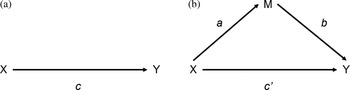
The goal in classic mediational analysis is to determine what portion of the total association between two variables, X and Y, is due to the direct effects of X on Y (c′) and the indirect effects of X on Y (ab). In Figure 1a, the total effect, c, is computed as the simple association between X and Y. In a situation in which that association is due to the mediating effect of variable M, the total association can be decomposed as follows: c = c′ + ab, where a is the effect of X on M, b is the effect of M on Y, and c′ is the estimate of the direct effect of X on Y controlling for M (Figure 1b). Simple algebraic manipulation of this equation reveals that ab is an estimate of how much the total effect is reduced or carried by the mediator. That is, c – c′ = ab. Moreover, if one wanted to quantify the extent to which a measured mediator explains or accounts for the total effect, one can do so by expressing the mediational effect (ab) relative to the total effect (c). That is, the proportion of the total effect explained by the mediational process is ab/c (see also Mackinnon & Dwyer, Reference MacKinnon and Dwyer1993). Thus, when ab = c, the mediational process (i.e., the indirect effect or ab) fully explains the total effect: c = c′ + ab = ab/c = 1.
Schematic of the decomposition of total effects into direct and indirect effects: classic mediation analysis.

Traditional mediational analysis has been a valuable tool for understanding psychological processes (Baron & Kenny, Reference Baron and Kenny1986, Cole & Maxwell, Reference Cole and Maxwell2003; Holmbeck, Reference Holmbeck1997; MacKinnon, Fairchild, & Fritz, Reference MacKinnon, Fairchild and Fritz2007). For example, there is accumulating evidence from a developmental psychopathology perspective that one of the key mediators of links between early adversity and the development of subsequent antisocial behavior is dysregulation of the hypothalamus–pituitary–adrenal axis (e.g., Van Goozen, Fairchild, Snoek, & Harold, Reference Van Goozen, Fairchild, Snoek and Harold2007). Although one must always exercise caution when working with causal models using correlational data, when the model is correctly specified, these tools can be used to calculate the extent to which a measured mediating process explains the association of interest. One can determine whether the mediator fully or only partly accounts for the observation in question. Prior to the widespread use of these methods, researchers had no agreed-upon way to determine whether a conjectured mediator was necessary to explain associations or the extent to which it was able to do so.
An Extension to Transactional Models
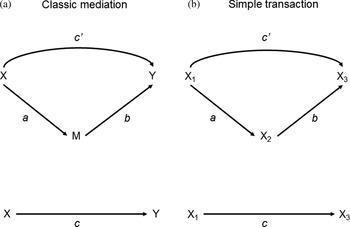
The mathematical formalism of basic meditational analysis provides a foundation for quantifying transactional processes. To see how, we begin by redrawing the traditional mediation diagram in Figure 1b by placing the mediator on the bottom of the diagram (see Figure 2a). The algebraic relations remain intact. For example, c′ is still equivalent to ab + c. In the situation in which we wish to understand transactional processes, we begin by recognizing that, to the extent to which transactional processes exist, they serve to enhance or magnify the association between any two measures of the same variable across time (for simulation evidence see Fraley & Roberts, Reference Fraley and Roberts2005). For example, let us assume we are interested in the stability of externalizing problems over time. Let us also assume that a measure of externalizing problems at one point in time (X 1) will correlate with another developmentally appropriate assessment of antisocial behavior measured at a later point in time (e.g., X 3), such that r X1, X3 > 0. In the absence of any transactional dynamics, we would decompose r X1,X3 as ab, assuming that, at the very least, an autoregressive process explains stability. Stated differently, an autoregressive model assumes that X 1 has its effects on X 3 indirectly via X 2. Thus, the most basic, nontransactional model is identical to a full mediational model in which c′ = 0.
An extension of the classic mediational model to transactional model.

However, what if something more than mere autoregression was needed to explain r X1,X3? Perhaps X 1 influences X 3 not only via X 2 but also via some unknown or as yet unidentified process. This can be formalized by allowing a direct path between X 1 and X 3 (see Figure 2b). Thus, the total effect of X 1 on X 3 is due not only to autoregressive stability (ab) but also to “carryover” effects (c′) that are not (necessarily) measured. These carryover effects capture the kinds of effects that are entailed by transactional models. For example, if we assume that children with externalizing problems elicit the kinds of coercive parenting behaviors that further canalize antisocial behavior (Patterson, Reference Patterson, Mash, Hamerlynck and Handy1976, Reference Patterson1982; Patterson, Reid, & Dishion, Reference Patterson, Reid and Dishion1992), then this indirect transactional process could be represented as path c′ in Figure 2b. Moreover, this path would be needed to fully account for r X1,X3 in such a scenario.
This particular insight provides the foundation for quantifying the extent to which transactional processes are necessary for explaining the empirical patterns in longitudinal data. That is, by estimating a, b, and c′ via traditional path/regression analysis, one can index the extent to which transactional processes are necessary to explain observed associations across time. In this case, c′ represents the extent to which X 1 is related to X 3 above and beyond what is expected on the basis of its indirect effect through X 2. As a result, c′/c, which we refer to as residual carry forward (RCF), indexes the proportion of the total X 1, X 3 correlation that is due to unmeasured transactional/carryover effects. When RCF is zero or close to zero, there may be little utility in searching for transactional processes. When RCF is positive, however, that suggests that there are unobserved transactional processes present.
One reason the RCF index can be especially informative is that it can be calculated even when specific transactional mechanisms are unknown or have not been measured. In short, it can be used as an omnibus method for detecting transactional signals and, as such, provides an important starting point in any developmental investigation. Although the formalism is similar to that used in classic mediational analysis, the method is actually of greater potential use. In mediation analysis one cannot test for the presence of mediation in the absence of measuring a potential mediator. However, in the present case, transactional processes can be inferred from test–retest associations across three or more assessments in the absence of measuring the specific transactional mechanisms that give rise to excess stability in the outcomes above and beyond simple autoregressive processes.
Accounting for Transactional Contributions to Development
After having established the extent to which transactional processes are needed to explain a developmental process, one may wish to evaluate whether a specific measured variable or variables can do so. We begin by redrawing our simple path diagram from Figure 2b (now Figure 3a), along with one that includes a hypothesized transactional process (see Figure 3b). In this revised diagram, the transactional process (ef) represents the influence of externalizing behaviors (X 1) on specific experiences (E), such as observed caregiving that in turn influences externalizing problems at a later point in time (X 3). That is, this specific transactional pathway is included as an explanation for the carryover effect previously represented by c′ (Figure 3a). As such, c′ should equal ef when the measured transactional process fully accounts for the carryover.
An extension of the classic mediational model to transactional models: accounting for measured transactions.

Formally, the total association between X 1 and X 3 in Figure 3b can be decomposed as ab + ef. Thus, one can express the extent to which the measured transactional process (ef) accounts for the “full” carryover effect (c′) as ef/c′. Stated differently, this ratio expresses the extent to which the measured transactional process accounts for the observed transactional effects. For the purposes of this paper we refer to this as proportion of transaction explained (PTE).
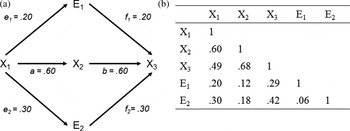
To illustrate these ideas numerically, consider the model depicted in Figure 4a. According to this model, X 1 (externalizing behavior) influences two additional variables, E 1 and E 2, which in turn shape externalizing behavior at a later point in time (X 3). Let us begin by assuming that, as researchers, we do not know the true values of the model parameters, but we have measures of X 1, X 2, and X 3. The correlations among those variables, as implied by the true (but unknown) structure of the model are r X 1,X2 = .60, r X1,X3 = .49, and r X2,X 3 = .68 (see Figure 4b). Our first goal would be to determine the extent to which there are carryover effects in our X variable. To do so, we could estimate a, b, and c′ in the model shown in Figure 3a. Given the observed correlation matrix, the estimates in this example are a = .60, b = .60, and c′ = .13. Given that c (i.e., r X1,X3) = .49, this implies that c′/c (i.e., RCF) = .13/.49 = .27. That is, 27% of the total association between X 1 and X 3 can be explained as carryover effects or transactional processes not yet measured.
An extension of the classic mediational model to transactional models: schematic of a hypothetical transactional model across three waves of measurement involving two transactional mechanisms (E 1 and E 2).

Given the presence of carryover effects, we might then proceed to examine whether certain measured processes are capable of explaining those effects. Let us assume that we measured at least one potential transactional pathway, such as the effect of X 1 on E 1 that in turn affects X 3. For example, E 1 might reflect variation in the kinds of caregiving experiences (e.g., maltreatment) that are so commonly featured in transactional models discussed in the field of developmental psychopathology (Cicchetti & Toth, Reference Cicchetti, Toth, Luthar, Burack, Cicchetti and Weisz1997). We can now estimate the parameters for the model illustrated in Figure 3b. That is, by estimating the indirect effect of X 1 on X 3 through the measured transactional mechanism, it is possible to determine to what extent that transactional pathway is capable of explaining the observed carryover effect. Given the observed correlation matrix, the estimates of e 1 and f 1 are both .20 (and the indirect effect, .20 × .20, is .04). We can now compute PTE (i.e., ef/c′) that quantifies the proportion of a transactional effect explained by measured transactional process. In the present case, PTE is 31% (i.e., ef = .04 and c′ = .13), which indicates that approximately one-third of the total carryover effect can be accounted for by E 1.
Notice that this particular specification of the model does not fully represent the processes that gave rise to the data. If we were to also include a measure of the second transactional mechanism illustrated in Figure 4a, E 2, and estimate the parameters of the full model, we would find that the transactional pathway for the first factor is .04 and that the transactional pathway for the second pathway is .09 (e 2 = .30 and f 2 = .30). The first transactional process continues to explain 31% of the total carryover effect. The second transactional process explains 69% of the total carryover effect (.09/.13 = .69). In addition, because this particular model is correctly and fully specified, these two transactional pathways, when considered in combination, explain 100% of the observed carryover (.69 + .31 = 1.00).
Summary and Overview
One of the challenges in developmental science is to explain the processes that give rise to the stability of individual differences. A common way of doing so is to conjecture transactional processes, that is, to assume that certain effects are perpetuated or sustained by shaping other processes that in turn feed back to shape individuals. What has been missing from the developmental literature, however, is a way to gauge the extent to which transactional processes exist in aggregate; there has been no means for detecting the transactional signal in developmental information. RCF is designed to solve this problem. Specifically, it quantifies the magnitude of unmeasured carryover effects. This index has the potential to advance research on development by identifying the domains in which positing transactional processes is necessary and those in which it is not. In addition, we have proposed a method for quantifying the extent to which measured transactional processes account for the degree of carryover that exists. This PTE index, like methods for explaining meditation, can be helpful for determining whether a measured transactional process explains all, none, or a portion of the observed carryover effect. Taken together, these tools have the potential to assist developmental scientists in studying transactional processes in a strategic and principled manner. Prior to even conjecturing transactional processes, let alone committing the kinds of resources to the intensive longitudinal studies necessary to directly measure such processes, researchers might examine existing test–retest data meta-analytically to determine whether it is necessary to invoke transactional processes. If excess stability over autoregression is detected in a given developmental domain, our PTE index can provide useful information to the researcher regarding the extent they have fully accounted for the total transactional effect observed in their data.
An Empirical Example Based on the SECCYD
To aid the researcher interested in using the approach described above for studying transactional processes, the remainder of this article involves the application of our proposed metrics to publically available data from the SECCYD. The SECCYD is well suited for this purpose for several reasons. First, it is a large prospective, longitudinal study. A large sample size is crucial in the current context because it allows for reasonably precise estimates of the focal associations, a prerequisite to using the methods described here if the goal is to produce a cumulative developmental science. Second, guided by an ecological perspective and informed by other studies that assessed developmentally salient aspects of adaptive functioning, the SECCYD investigators measured key aspects of adaptive functioning repeatedly, including conduct (i.e., externalizing behavior), social competence, and academic skills. Third, the SECCYD is a multiple-method and multiple-informant study of development in which the cohort was assessed using virtually identical measures many times from infancy through late adolescence. In the current context, this allowed us to leverage standard operational definitions of each aspect of adaptive functioning in our analyses and to examine the extent to which informant and/or method of assessment moderated key findings. Fourth and finally, the SECCYD data set contains high-quality measurement of theoretically powerful transactional mechanisms by way of its assessment of observed sensitive responsiveness by primary caregivers and reports from participants about the quality of their best friendships. These potential transactional mechanisms are especially relevant from a developmental psychopathology perspective because they reflect variation in some of the key interpersonal resources (i.e., relationships with friends and family members) that are not only claimed to help organize social behavior over time but also to be affected by, and thereby create continuities in, problem behavior over time (e.g., Patterson, Reference Patterson, Mash, Hamerlynck and Handy1976, Reference Patterson1982).
All of this said, the examples we offer here were intentionally simplified by limiting them to just three assessments during grade school (even though many more were available in the SECCYD) and by focusing on just two well-researched potential transactional mechanisms reflecting key contexts of socialization (i.e., the observed quality of maternal caregiving and self-reported friendship quality). Our primary rationale for doing so was to provide a relatively easy to follow set of examples. Moreover, by focusing only on assessments in Grades 1, 3, and 5, it was possible to select variables for this analysis that were measured at exactly the same times, thus allowing for direct comparison of results across domains of adaptive functioning (e.g., the temporal lag across the various assessments was identical). In short, the goal of these examples was not necessarily to produce highly generalizable knowledge about the specific transactional processes operative in the domains of adaptive functioning we studied, but to set in motion an approach to the study of transactional processes that is likely to yield such a literature.
Methods
Participants
Families were recruited for the SECCYD in 1991 from hospitals located in or near Little Rock, Arkansas; Orange County, California; Lawrence, Kansas; Boston, Massachusetts; Pittsburgh, Pennsylvania; Philadelphia, Pennsylvania; Charlottesville, Virginia; Seattle, Washington; Morganton, North Carolina; and Madison, Wisconsin. During selected 24-hr sampling periods, 8,986 women who gave birth were screened, 5,416 of whom met the eligibility criteria for the study. Families were excluded if (a) the mother was younger than 18 years of age, (b) the family planned to move, (c) there was a multiple birth, (d) the infant had a known disability or remained in the hospital more than 7 days, (e) the mother acknowledged substance abuse, (f) the mother did not speak English, or (g) the mother lived more than an hour from the laboratory site or in an extremely unsafe neighborhood, as determined by local police. From that group, 1,364 families became study participants upon completing a home interview when their infants were 1 month old. Additional details about recruitment and selection procedures are available in prior publications from the study (see NICHD Early Child Care Research Network, 2005) and at https://www.nichd.nih.gov/research/supported/Pages/seccyd.aspx. Data were collected longitudinally on the SECCYD sample through age 15 years; a follow-up study provided age 18 data (see Booth-LaForce & Roisman, Reference Booth-LaForce and Roisman2014). Note that, although large, demographically diverse, and methodologically rich, the SECCYD was not designed to be a nationally representative study.
Overview of assessments
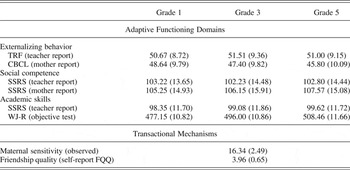
Measures are presented in two sets corresponding to their function in the empirical examples presented below (see Table 1 for an overview and descriptive data for all variables used in analyses): (a) measures of adaptive functioning assessed in Grades 1, 3, and 5; and (b) variables measured at Grade 3 and conceptualized as transactional mechanisms, serving to enhance the stability of measures of adaptive functioning over autoregressive contributions. In all cases, we selected variables that were measured by multiple reporters using standard assessment tools.
Timing of assessments and descriptive statistics for focal measures

Note: TRF, Teacher Report Form; CBCL, Child Behavior Checklist; SSRS, Social Skills Rating System; WJ-R, Woodcock–Johnson Revised; FQQ, Friendship Quality Questionnaire. Means (standard deviations) are in the original metric of the focal measure and are based on all valid SECCYD cases for that assessment point.
Measures of adaptive functioning
Teacher-reported externalizing behavior
Teacher-reported externalizing problems were assessed with the externalizing scales of the teacher-report version of the Child Behavior Checklist (Achenbach & Edelbrock, Reference Achenbach and Edelbrock1986), and T scores were used. The externalizing scale showed adequate reliability across time, with the coefficient α averaging 0.95 for teacher reports across all three assessments.
Mother-reported externalizing behavior
Mother-reported externalizing problems were assessed with the externalizing scale of the mother-report version of the Child Behavior Checklist (Achenbach, Reference Achenbach1991). We again used T scores. The externalizing scale showed adequate reliability across time, with the coefficient α averaging 0.89 for mother reports across all three assessments.
Teacher-reported social competence
Teacher-reported social competence was measured using the 30-item school version of the Social Skills Questionnaire from the Social Skills Rating System (SSRS; Gresham & Elliott, Reference Gresham and Elliott1990). A standardized total social skills scale was created in Grades 1, 3, and 5 by summing items indexing social competence. The reliabilities of the social competence scale scores at each time point were good (α = 0.93, 0.93, and 0.94 at Grades 1, 3, and 5, respectively).
Mother-reported social competence
Mothers completed the 38-item Social Skills Questionnaire from the SSRS (Gresham & Elliott, Reference Gresham and Elliott1990) when children were in Grades 1, 3, and 5, indexing general social competence with adults and other children. As with teacher reports, to obtain a standardized measure of total social skills, an a priori scale at each time point was created by summing all items that index social competence with other children, with higher scores indicating more socially skilled children. Reliabilities of the social competence scales at each time point were good (α = 0.88, 0.90, and 0.88 at Grades 1, 3, and 5, respectively).
Teacher-reported academic skills
Teachers also used the SSRS to rate participants’ academic skills. For use in this study, an a priori, standardized academic competence scale at each time point was created by summing items indexing academic success. Reliabilities of the academic competence scales at each time point were excellent (α = 0.94, 0.94, and 0.95 at Grades 1, 3, and 5, respectively).
Objective assessments of academic skills
In order to examine a relatively objective assessment of academic skills we used Woodcock–Johnson Psycho-Educational Battery—Revised (Woodcock, Reference Woodcock1990; Woodcock & Johnson, Reference Woodcock and Johnson1989) scores. Note that a slightly different subset of scales was used at each assessment point. For purposes of this analysis, we averaged the W (standard) scores for all available subscales at each time point (composite α = 0.83, 0.91, and 0.88 at Grades 1, 3, and 5, respectively).
Measures of transactional mechanisms
Maternal sensitivity
Observed maternal sensitivity was assessed in the context of mother–child interactions that were videotaped during 15-min semistructured situations at Grade 3. Children were videotaped while engaging in developmentally appropriate tasks at the zone of proximal development while primary caregivers provided aid. The mother–child interaction at Grade 3 was composed of two tasks, a discussion task and a shared problem-solving activity. Sensitivity at Grade 3 was operationalized using scales measuring supportive presence, respect for autonomy, and hostility (reversed), which were composited (α = 0.80). Interrater reliability at Grade 3 (intraclass correlation = 0.84) was satisfactory (for more information on this measure, see Fraley, Roisman, & Haltigan, Reference Fraley, Roisman and Haltigan2013).
Friendship quality
Study children completed a modified version of the Friendship Quality Questionnaire (Parker & Asher, Reference Parker and Asher1993) at Grade 3 designed to assess their perceptions of their friendship with their very best friend. Children rated how true 20 statements were of their relationship with their best friend on a 5-point scale, from 1 = not at all true to 5 = really true. These statements are grouped into six subscales including companionship and recreation, validating and caring, help and guidance, intimate disclosure, conflict and betrayal, and conflict resolution. In the current report, a friendship quality total score was computed as a weighted average of the 20 items (α = 0.87), yielding a total friendship quality composite with higher scores reflecting higher levels of friendship quality.
Results
General analytic considerations
All of the empirical examples described in this report were modeled in Mplus version 7.11 (Muthén & Muthén, Reference Múthen and Múthen2012) using full information maximum likelihood estimation. Under full information maximum likelihood, all missing data are treated as ignorable (missing at random), and as such, cases with valid data on any of the variables are included in the model estimation. For all empirical examples presented below, the working sample comprised between 1,110 and 1,129 participants with valid data for at least one of the core indicators used in either the base or transactional models. We used the model indirect command with 5,000 bootstrap samples to evaluate all indirect (i.e., mediational) effects and their corresponding 95% confidence intervals (bootstrap technique; Preacher & Hayes, Reference Preacher and Hayes2008).
To what extent did transactional mechanisms contribute to stability in adaptive functioning from Grade 1 through Grade 5?
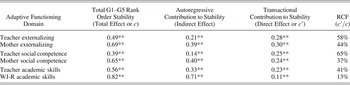
In order to address this question, we fit data from the SECCYD to the model depicted as Figure 2b. Our primary goal in these analyses was to estimate c (the total association between Grade 1 and Grade 5 adaptive functioning), ab (the indirect path reflecting autoregressive contributions to stability from Grade 1 and Grade 5 via Grade 3), and c′ (the direct path reflecting “carryover” or transactional contributions to stability in adaptive functioning from Grade 1 to Grade 5). For each outcome domain, we report in Table 1 standardized estimates of c (total association), ab (autoregressive contributions to stability), and c′ (transactional contributions to stability). We also report our RCF metric (i.e., c′/c), which reflects the percentage of the total stability that is attributable to transactional mechanisms.
As detailed in Table 2, transactional contributions to overall stability in adaptive functioning from Grade 1 to Grade 5 (i.e., RCF) were strongest for teacher-reported outcomes (externalizing = 58%, social competence = 65%, and academic skills = 41%), next strongest for mother-reported outcomes (externalizing = 44% and social skills = 37%), and relatively weak for objective assessments of academic skills (13%). In addition to fairly clear evidence that teachers produced data suggesting somewhat less overall stability in children's adaptive functioning than did either mothers or objective assessments of academic skills (see total rank order stability column of Table 2), it also seems clear that social behaviors (i.e., externalizing behaviors and social competence) showed less overall stability and were more driven by transactional contributions to stability than were academic outcomes. In short, the domains of adaptive functioning we studied varied in the extent to which they reflected the presence of transactional processes.
Decomposition of total rank order stability in assessments of adaptive functioning into autoregressive versus transactional contributions.

Note: RCF, Residual carry forward (c′/c) indexes the proportion of total observed stability accounted for by unmeasured transactional processes. For ease of interpretation, RCF values are expressed as percentages.
**p < .01.
To what extent were omnibus estimates of transactional contributions to stability from Grade 1 through Grade 5 accounted for by observed maternal sensitivity and reported friendship quality during Grade 3?
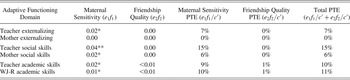
In order to address this question, we fit data from the SECCYD to models similar to the hypothetical model depicted in Figure 4. Our primary goal in these analyses was to estimate the ef paths; that is, the indirect paths reflecting the extent to which transactionally mediated effects of Grade 1 adaptive functioning on Grade 5 functioning were accounted for by observed maternal sensitivity and child-reported friendship quality in Grade 3. For each outcome domain, we report in Table 3 standardized estimates of the e 1 f 1 (i.e., maternal sensitivity) indirect path and the e 2 f 2 (i.e., friendship quality) indirect path. (Note that, if the 95% confidence interval of a significant indirect point estimate did not contain zero, mediation was considered present.) We also report our PTE (i.e., ef/c′) metric for each measured transactional mechanism, which (when multiplied by 100) reflects the percentage of the total transactional effect accounted for by a given measured transactional mechanism (i.e., sensitivity and friendship quality in Grade 3, estimated separately). We also include in Table 3 a column that sums these percentages (in the ideal scenario, an investigator would seek to identify the set of measured transactional mechanisms that summed to 100% of the total transactional effect operative in a given domain of functioning).
Maternal sensitivity and friendship quality as transactional mechanisms

Note: For ease of interpretation, PTE, proportion transaction explained (ef/c′) values are expressed as percentages.
*p < .05. **p < .001.
As is reported in detail in Table 3, during this phase of development, observed maternal sensitivity but not child-reported friendship quality accounted for a modest proportion of the total transactional effects operative in most of the domains of adaptive functioning we studied. More specifically, with the exception of mother-reported externalizing behavior, observed maternal sensitivity during Grade 3 explained between 6% and 15% of the total transactional effects estimated in our initial models across the domains of adaptive functioning we studied. In contrast, child-reported friendship quality did not significantly explain any of the observed transactional processes operative in any domain of adaptive functioning we studied.
Discussion
The primary objective of the current work was to introduce two novel metrics for interrogating transactional processes. Our first metric, RCF, takes advantage of the fact that, when an aspect of adaptive functioning is measured over three or more assessment points, it is possible to use the basic logic of mediational analysis to decompose contributions to stability from Time 1 to Time 3 into autoregressive (i.e., X 1 → X 2 → X 3) versus carryover or transactional processes (i.e., indirect effects of X 1 on X 3). Thus, even in the absence of actually having measured the specific transactional mechanisms (e.g., maternal sensitivity) that might serve to enhance stability in adaptive functioning over simple autoregression, it is possible to estimate the impact of transactional processes in aggregate. Our second metric, PTE, builds on this logic by asking what proportion of the total transactional effect observed is attributable to a specific, measured domain with which a feature of adaptive functioning is purported to be in transaction. Together, we believe these metrics represent a principled and strategic means of determining which aspects of developmental adaptation are strongly versus weakly driven by transactional processes and, in those domains that merit closer inspection, beginning to identify a fuller range of the specific transactional mechanisms at play.
Using data from the SECCYD to illustrate this approach, we found that, between Grades 1 and 5, social behaviors (including externalizing problems and social skills) exhibited considerably more evidence for transactional contributions to stability than did academic skills, and that teacher-reported outcomes also demonstrated more evidence for transactional contributions to stability than did either mother-reported social behaviors or objective assessments of academic skills. Moreover, we went on to demonstrate that observed maternal sensitivity (but not child-reported friendship quality) during Grade 3 accounted for a modest proportion of the total transactional effects operative in all but one of the domains of adaptive functioning we studied. Although child-reported friendship quality explained effectively none of the total transactional processes contributing to stability in any of the measures of adaptive functioning we considered, maternal sensitivity during Grade 3 explained between 6% and 15% of the total transactional effects estimated in our initial models across most of the domains of adaptive functioning. (The only exception to this pattern was mother-reported externalizing problems.) Taken together, our example analysis suggests that patterns of stability in adaptive functioning show variable evidence for transactional processes and that the small set of “usual suspect” transactional mechanisms we measured were inadequate for explaining the full range of transactional processes evident in these domains. Our multiple-method and multiple-informant data also suggest an underlying challenge for empirical work seeking to identify and decompose transactional contributions to stability in adaptive functioning: that certain informants (e.g., teachers, who unlike most other participants change identity over waves of assessments) might produce very different answers to basic questions about transactional processes than other informants (e.g., mothers). We are aware of no simple solutions here, especially given that different informants, on average, generally show only modest convergence in their ratings of individual children (De Los Reyes et al., Reference De Los Reyes, Augenstein, Wang, Thomas, Drabick and Burgers2015).
As noted in the introductory section, our goal here was not to present a complete account of the specific transactional mechanisms that contribute to stability in children's social and academic outcomes over time. Rather, in the interest of keeping our empirical examples relatively simple and directly comparable (e.g., using variables acquired at the same assessments), we focused on several illustrative domains of adaptive functioning, a common set of two potential transactional mechanisms, and a rather narrow age range (i.e., early to late grade school). As such, it is entirely possible that total transactional contributions to stability, even in the very domains we studied, might well differ in magnitude at another point in development (e.g., the preschool years). Likewise, although observed maternal sensitivity (but not reported friendship quality) served as a generic transactional mechanism for most of the aspects of adaptive functioning we studied here, it is possible, for example, that aspects of peer experiences (perhaps measured differently than in our empirical examples) might serve as important transactional mechanisms in relation to these very same domains of adaptive functioning later in development (e.g., in adolescence). The primary strength of the approach for which we are advocating is that it is well positioned to determine both (a) whether total transactional contributions to stability in a given domain and (b) whether specific transactional mediators operative in relation to that domain are invariant over development.
The primary limitation of the examples we present in this paper therefore is that they are focused on only three assessment points. However, the methods we introduced are in no way inherently limited to use over three assessment points and can be extended to more complex models. We have shown elsewhere (Fraley et al., Reference Fraley, Roisman and Haltigan2013; Haltigan, Roisman, & Fraley, Reference Haltigan, Roisman and Fraley2013) how to build transactional processes into multiple-wave structural models of adaptive functioning by representing them as a set of second-order stability paths for the outcome of interest. For example, if a researcher were to study social competence across four assessment points (e.g., Grade 1, 2, 3, and 4), transactional paths (and our RCF metric) could be estimated from Grade 1 to Grade 3 and Grade 2 to Grade 4. Furthermore, using nested structural model comparisons, it would be possible to examine whether fixing those transactional paths to be the same value (i.e., transactional contributions in aggregate are invariant over development) or to allow them to vary (i.e., transactional contributions in aggregate change over development) better explains the patterns of observed stability.
Similarly, provided measured transactional mechanisms are assessed contemporaneously and repeatedly in a developmentally appropriate manner, it is also possible to examine whether such transactional mechanisms vary in their degree of importance over different phases of development. In order to evaluate variability in the contribution of these transactional mechanisms over time, however, the ongoing stability in the transactional mechanism (e.g., the caregiving environment) and its effects on the outcome of interest would need to be modeled by including repeated assessments of the caregiving environment, allowing those to have autoregressive paths to capture their stability, and assuming paths from the transactional mechanism to the outcome of interest. It is also worth noting that although all of the examples in this paper focused on stability of children's adaptive functioning, the additional model specifications noted above demonstrate that the same logic described throughout this report can be applied to studying transactional processes contributing to stability in the interpersonal environment over time (e.g., via child-driven effects on parenting quality over time).
We envision that the methods introduced in this paper will have value in particular in the field of developmental psychopathology. Whereas the first few waves of research using transactional models have provided important evidence focused on (typically two) domains theoretically in transaction over time, the methods we introduce here will help to integrate these models into more complete and comprehensive accounts. Eventually, we anticipate such integrative models will have additional utility for developmental psychopathology intervention efforts as they identify behaviors more or less amenable to prevention and intervention efforts, as well as the key transactional mechanisms that might be targeted. In addition, the approach we advocate might serve as a means of incrementally taming some of the complexity in developmental processes while also curbing the temptation to use the transactional model as a mere metaphor rather than as an empirical tool.
The transactional model of development is a good deal more than a metatheoretical set of assumptions about the ubiquitously coactive nature of development. Much more important for scientific progress, it reflects a testable prediction that bidirectional feedback loops often exist between the quality of children's interpersonal experiences and characteristics of the child over development. Building on the fact that transactional mechanisms contribute additional stability in an outcome domain above and beyond autoregressive processes, along with the basic logic of mediational analysis, we believe that the novel indexes introduced here have the potential to enhance scholarship on transactional mechanisms in both the larger enterprise of human developmental science and, in particular, within the domain of developmental psychopathology.