Introduction
Many possible reasons as to why extraterrestrial intelligences might avoid communications with our civilization have been proposed, the simplest explanation being that there are no, and never have been, space faring civilizations in the Galaxy (Ward & Brownlee Reference Ward and Brownlee2000). However, if humanity is not alone in the Galaxy and the greater Universe, then other, often more complex, explanations must be examined for what Paul Davies terms as The Eerie Silence (Hart Reference Hart1975; Davies Reference Davies2010).
They might, for example, choose to allow contact once the human race has passed certain technological, political, or ethical standards. They may not want to interfere with our natural independent progress, or the Earth may have been set aside as an explicit experiment that contact would ruin (Ball Reference Ball1973). It has been additionally proposed that these ideas are perhaps most plausible if there is a single extraterrestrial civilization within contact range, or that there is a relatively universal cultural or legal policy among a plurality of extraterrestrial civilizations necessitating isolation with respect to civilizations at Earth-like stages of development (Soter Reference Soter2005).
If there is a plurality of alien cultures, however, this theory may break down under the uniformity of motive concept because it would take just a single extraterrestrial civilization to decide to act contrary to the imperative within our range of detection for it to be abrogated, and the probability of such a violation increases with the number of civilizations (Crawford Reference Crawford2000). This last idea, however, becomes more plausible if all civilizations tend to evolve similar cultural standards and values with regard to contact, or for the purposes of this paper, all civilizations follow the lead of some particularly distinguished civilization … the first civilization (Bracewell Reference Bracewell1982). Monte Carlo simulation is used in an attempt to measure the temporal head start the Galaxy's first intelligence could have had on all other civilizations that followed.
In order to do this an estimate of when the Universe became capable of supporting complex life is required. According to Lineweaver's estimates, planets started forming approximately 9.3 billion years ago (Lineweaver Reference Lineweaver2001). Using the Earth as a self-sample and assuming that circumstances here are typical of how life emerges and evolves a rough measure of first emergence can be calculated. Life on Earth first emerged about 600 millions years after its formation (Lineweaver et al. Reference Lineweaver, Fenner and Gibson2004). Using Lineweaver's estimate this would imply that life could not have arisen any earlier than 8.7 billion years ago in both the Milky Way and the greater Universe. On Earth it took an additional 3.7 billion years for life to evolve complex land-dwelling organisms when the first air-breathing vertebrates emerged (Clark Reference Clark2002). This great span of time would also allow for the deposition and decay of a biomass sufficient to provide the fossil fuels necessary for an industrial revolution. Therefore, the conditions necessary to support intelligent life in the Universe could have been present for at least 5.0 billion years.
Significantly, this transition to a life-friendly universe ripe for the emergence of intelligence was probably not something that happened in the cosmological blink of an eye, but more likely occurred slowly over a substantial period of time measured in hundreds of millions or possibly a billion years just as the rate of star formation itself was a gradually accelerating process during the period leading up to our present life-friendly Universe (Lanzetta et al. Reference Lanzetta2002). Given this great expanse of time, and assuming that our civilization is not the first to appear in the Milky Way (Ward & Brownlee Reference Ward and Brownlee2000), then some other civilization, either extant or extinct, was the first. How long did this first civilization have the Galaxy to themselves? What could they have accomplished given this head start?
Monte Carlo simulation has recently been applied to several questions within astrobiology (Forgan Reference Forgan2009; Forgan & Rice Reference Forgan and Rice2010) and it is proposed that the time between this first civilization and the next such civilization can be approximated using Monte Carlo simulation given appropriate input. Additionally, the time between any pair of subsequent civilizations can also be approximated. So, even if this first grand civilization is long gone … could their initial legacy live on in the form of a passed down tradition? Beyond this, it does not even have to be the first civilization, but simply the first to spread its doctrine and control over a large volume of the galaxy. If just one civilization gained this hegemony in the distant past, it could form an unbroken chain of taboo against rapacious colonization in favour of non-interference in those civilizations that follow. The uniformity of motive concept previously mentioned would become moot in such a situation.
The Zoo Hypothesis then becomes more plausible if each subsequent civilization emerges into an environment controlled or monitored by an omnipresent predecessor who has already set some basic ground rules that it passes on to each emerging group in much the same way humans pass on societal norms to their children. This extreme outlier at the front end of the probability distribution, or one not too far down the data line, could be the civilization that set in motion the selective observational effect we call the Fermi Paradox.
Temporal model
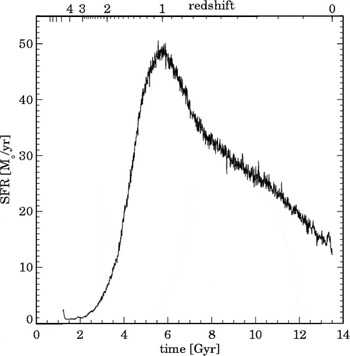
Using the assumption that the transition from an inert Universe to one capable of supporting intelligence was a gradual one, and not merely an instantaneous phase shift, quantification of this transition requires fitting a statistical distribution to the emergence of intelligence with special emphasis accorded to the temporal gap between the first civilization and those that follow. It is proposed that this transition to a life-bearing Universe should shadow and mimic the gradual rise in star formation, and by extension planet formation, that would precede it. Given that star formation rates (SFR) possess a positively skewed normal distribution (Samland & Gerhard Reference Samland and Gerhard2002; Lanzetta et al. Reference Lanzetta2002), (Fig. 1), it is reasonable to assume that the emergence of life-bearing planets and the emergence of intelligence should follow a similar, but delayed, path that accounts for the build-up in metallicity necessary for planet formation (Lineweaver Reference Lineweaver2001).
Historical Star Formation Rate (in billions of years).

For the Monte Carlo simulation, a normal distribution is used to model the emergence of intelligent civilizations within the Galaxy. The inputs for the simulation are the number of civilizations that will evolve over the lifetime of the Galaxy (N civ) along with the mean (μe) and standard deviation (σe) for their time of emergence. The choice of where to place the mean time of emergence is largely symbolic in the sense that it has no effect on the width of inter-arrival times, but μe=13 000 million years (Myr) is used throughout and is in line with the previous discussion that the conditions necessary to support intelligent life in the Universe could have been present for at least 5.0 billion years. The initial value of σe=1500 Myr is chosen so that the likelihood a simulated civilization emerges before this time is very small.
For each iteration of the simulation, a sequence of N civ normal random variables is generated. These random variables are then used to generate a time of emergence for each civilization based on μe and σe. The inter-arrival time between the first and second civilizations to emerge (IAT1) is then measured and iterations of the simulation run repeatedly to generate more IAT1 data points. Finally, the IAT1 data are compiled into a histogram and an average and standard deviation are computed.
Results
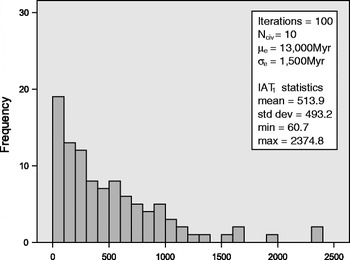
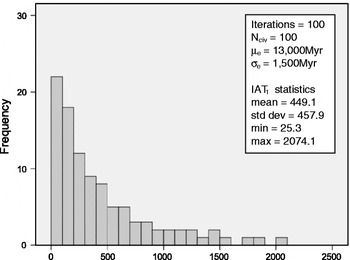
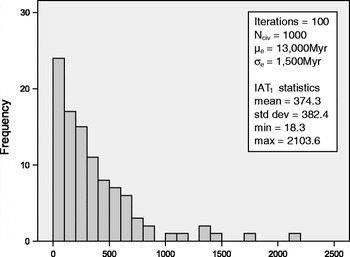
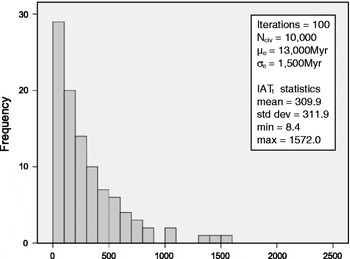
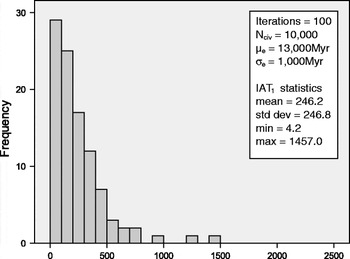
The simulated inter-arrival times show an inverse exponential distribution in all cases as would be expected from a Poisson process derived from a set of normally distributed random variables (Snyder & Miller Reference Snyder and Miller1991). Additionally, Figs 2–5 show, not unexpectedly, that as N civ increases from 10 to 10 000, while μe and σe are held constant, the first inter-arrival time (IAT1) decreases because the Galaxy is simply getting more crowded. What is most interesting, however, is that the inter-arrival time between the emergence of the first and second intelligences in all four cases averages well over 100 Myr for the 100 iterations run under each scenario. IAT1 still averages 309.9 Myr with a minimum bound of 8.4 Myr even when N civ is 10 000. This implies that even in a crowded galaxy the first civilization to emerge could have considerable time to itself.
Temporal Dispersion of the First Inter-arrival Time (in millions of years).

Temporal Dispersion of the First Inter-arrival Time (in millions of years).

Temporal Dispersion of the First Inter-arrival Time (in millions of years).

Temporal Dispersion of the First Inter-arrival Time (in millions of years).

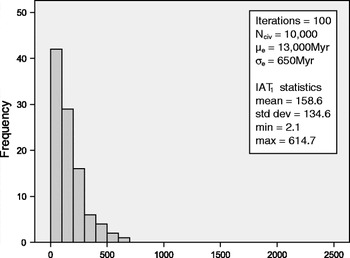
Pushing this crowded galaxy idea even further, what happens when N civ is held at 10 000 and this large number of emerging civilizations is pushed even closer together by reducing the temporal standard deviation σe between them? Using σe of 1000 Myr and 650 Myr Figs 6 and 7 show, respectively, that the mean IAT1 drops further to 158.6 Myr with a minimum bound of 2.1 Myr. Again, while smaller than before, this even more restrictive assumption still allows the first civilization to enjoy a healthy head start.
Temporal Dispersion of the First Inter-arrival Time (in millions of years).

Temporal Dispersion of the First Inter-arrival Time (in millions of years).

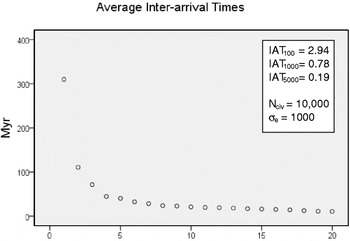
What about subsequent inter-arrival times? If the probability that any given civilization lasts of the order of 100 Myr is extremely low, then it becomes important to measure later inter-arrival times to find the first one that does. Using N civ=10 000 and σe=1000 Fig. 8 shows the first 20 inter-arrival times graphically in addition to IAT100, IAT1000 and IAT5000. If the first successful long-lived civilization is the 100th to emerge it still has an impressive 3 Myr average before the next civilization comes along. And looking at IAT5000, if our civilization is in the middle of the pack it is still separated from its immediate predecessor by almost 200 Kyr on average.
First 20 Average Inter-arrival Times (in millions of years).

Conclusions
The time between the emergence of the first civilization within the Milky Way and all subsequent civilizations could be enormous. The Monte Carlo data show that even using a crowded galaxy scenario the first few inter-arrival times are similar in length to geologic epochs on Earth. Just what could a civilization do with a ten million, one hundred million, or half billion year head start (Kardashev Reference Kardashev1964)? If, for example, civilizations uniformly arise within the Galactic Habitable Zone, then on these timescales the first civilization would be able to reach the solar system of the second civilization long before it evolved even travelling at a very modest fraction of light speed (Bracewell Reference Bracewell1974, Reference Bracewell1982; Freitas Reference Freitas1980). What impact would the arrival of the first civilization have on the future evolution of the second civilization? Would the second civilization even be allowed to evolve? Attempting to answer these questions leads to one of two basic conclusions, the first is that we are alone in the Galaxy and thus no one has passed this way, and the second is that we are not alone in the Galaxy and someone has passed this way and then deliberately left us alone.
On these timescales speculation about the motivation and achievements of this first civilization are likely to be way off the mark, but if we are not alone, the question then becomes how does one maintain a galactic cultural norm of non-interference across thousands of light years given light speed limitations? For a modified version of the Zoo Hypothesis to hold, wherein the Galaxy's first long-lived civilization holds sway over all others that follow, this is a necessary question that requires a satisfactory answer and deserves further investigation.
The amount of diversity that has evolved on just this planet in only a few thousand years is itself quite large and suggests that on the galactic scale this diversity would be enormously larger and thus argue against a galactic cultural norm of non-interference. However, much of what some would call diversity is actually surface-level stuff such as language, skin colour, food choice, or political affiliation. On other things, humanity appears to be on a convergent path concerning the acceptance of certain universally held ideas because of their extreme utility to our civilization. According to Diffusion of Innovation Theory the decision to adopt an innovation can be made collectively by all individuals of a loosely defined social system, even if the social system is fragmented, because the innovation is too profound to give up (Rogers Reference Rogers2003). Things such as the wheel, mathematics, the Internet and the formation of an organized society (i.e. civilization) come to mind. They are ubiquitous. Maybe given a few more million years humanity will have discovered/invented ways of interacting that are as profound to culture as the wheel is to ground transportation and that may be enough to allow for a limited galactic culture even without timely communications or transits between its vast parts.
With all of this in mind, a modified Zoo Hypothesis becomes a more appealing answer to the Fermi Paradox. If the oldest civilization still present in the Milky Way has a 100 Myr time advantage over the next oldest civilization, then it is conceivable that they could be in the singular position of being able to control, monitor, influence or isolate the emergence of every civilization that follows within their sphere of influence. This is analogous to what happens on Earth within our own civilization on a daily basis … in that everyone born on this planet is born into a pre-existing system of familial associations, customs, traditions and laws that were already long established before our birth and which we have little or no control over.