Coronal stop deletion (CSD), also called /t,d/-deletion, is the variable absence of word-final coronal stops in consonant clusters. This English variable has featured prominently in quantitative sociolinguistic theorizing from its earliest days (Labov, Cohen, Robins, & Lewis, Reference Labov, Cohen, Robins and Lewis1968; Wolfram, Reference Wolfram1969). A central phenomenon of interest for sociolinguists is that the rate of CSD is sensitive to the morphological structure of the words in which it occurs. In its most basic version, the generalization is that there is more deletion in monomorphemes like mist than in regular past tense forms like missed. This robust pattern, which we refer to as the morphological effect, has been found repeatedly across many speech communities (Baranowski & Turton, Reference Baranowski and Turton2020; Bayley, Reference Bayley1994; Hazen, Reference Hazen2011; Labov et al., Reference Labov, Cohen, Robins and Lewis1968; Mallinson & Childs, Reference Mallinson and Childs2007; Patrick, Reference Patrick1991; Santa Ana, Reference Santa Ana1996; Schreier, Reference Schreier2005; Walker, Reference Walker2012; Wolfram, Reference Wolfram1969; Wolfram & Christian, Reference Wolfram and Christian1976).Footnote 1 The question of why this effect arises has been at the center of debates about the nature of CSD. Analyses that have been considered include functional pressures (Guy, Reference Guy, Guy, Feagin, Schiffrin and Baugh1996; Kiparsky, Reference Kiparsky and Peters1972), architectural properties of the lexicon and morphophonology (Baranowski & Turton, Reference Baranowski and Turton2020; Guy, Reference Guy1991), accrued contextual biases in episodic representations (Bybee, Reference Bybee2002), and the confounding effect of the surrounding phonetic environment in fast speech reduction (Temple, Reference Temple2009, Reference Temple, Celata and Calamai2014).
Because so much theoretical weight has been attached to the morphological conditioning of CSD, it is important to make sure that we have correctly identified its definition and scope. In this paper, we take a step back from the goal of explaining the morphological effect to revisit the more basic question of whether the generalization itself is on solid empirical footing. We observe that there are, in principle, additional morphological distinctions that could be made within both the “regular past tense” and “monomorpheme” categories. For example, the “regular past” category typically includes not only the canonical preterites but also adjectival passive participles (the striped skirt), and the “monomorpheme” category typically includes compounds (seatbelt), superlatives (longest), and other suffixed forms (artist). While some of these distinctions have been made sporadically, most have not previously appeared in the CSD literature. Our primary goal in this paper is to investigate whether any of these possible distinctions influence CSD rates. In other words, is the monomorpheme versus regular past tense division an oversimplification that masks more detailed morphological conditioning of CSD?
We will show that, indeed, in some cases these newly introduced distinctions do have a significant impact on CSD rates. This is not to say that the basic morphological effect is an illusion: the subcategories that correspond most directly to the intended distinction in its cleanest form (regular past forms in preterite contexts; truly monomorphemic words) remain robustly differentiated in the expected direction. Rather, in combining other word types into these categories, we have previously overlooked additional detail regarding the influence of morphological structure and morphosyntactic context on CSD. Our secondary goal, then, is to argue that these additional details are worth attending to because they can have consequences for existing analyses of the basic morphological effect. To show what such consequences look like, we situate our unpacking of the regular past and monomorpheme categories in terms of the predictions made by certain existing models of the morphological effect. First, we examine how complexity internal to the regular past category can be brought to bear on predictions from the functional account, according to which deletion will be disfavored in contexts where it may interfere with communication. Second, we tease out a variety of morphologically complex words from the usual putative-monomorpheme category and reanalyze them according to the Exponential Model of Guy (Reference Guy1991). In both cases, we show that the existing accounts do not straightforwardly capture the additional significant distinctions we identify, calling the explanatory power of those accounts into question. We conclude by discussing promising avenues for future inquiry.
Our study is based on 10,481 tokens of coronal stop cluster-final words uttered by white adult speakers of English from the Philadelphia Neighborhood Corpus (Labov & Rosenfelder, Reference Labov and Rosenfelder2011). Tokens were coded for a number of control predictors as well as the critical predictor of morphological class. Detailed information about our methodological decisions concerning data collection, coding, and statistical analysis can be found in Appendix A. Complete model results are in Appendix F.
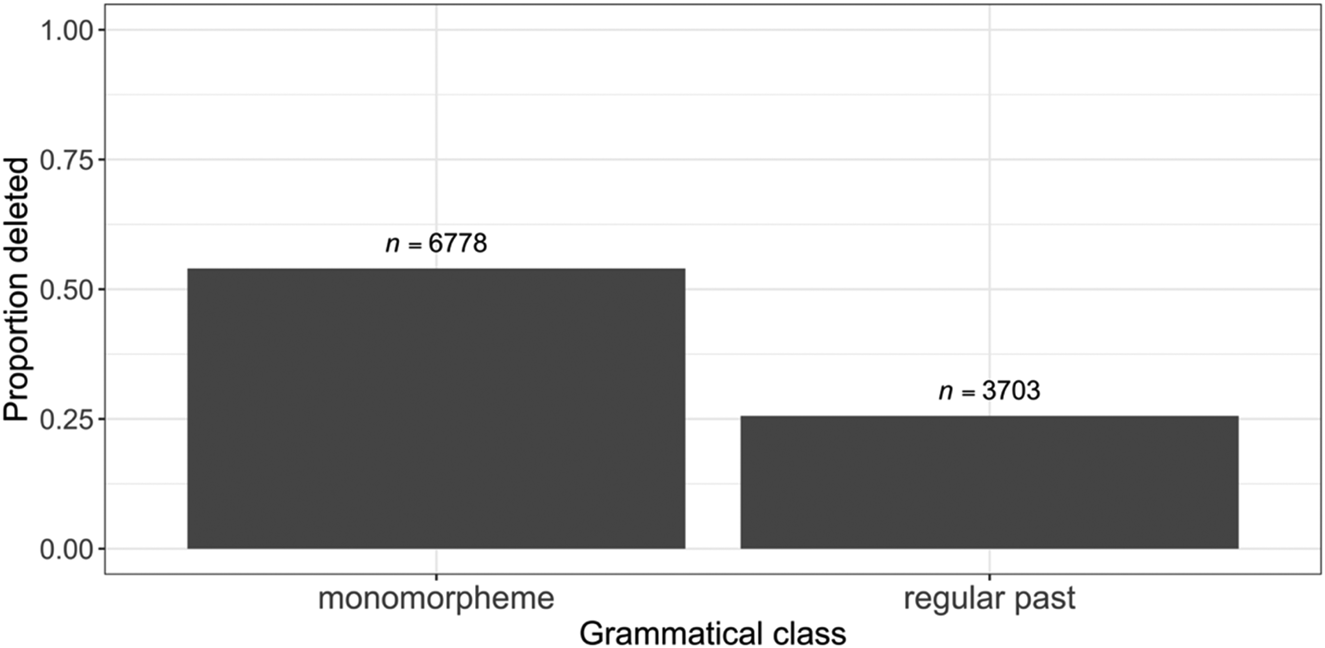
Figure 1 plots CSD by morphological class, using the traditional “monomorpheme” versus “regular past” distinction. It confirms the presence of a strong morphological effect in our data, with significantly less CSD of “regular pasts” than “monomorphemes” (β = −0.68, p < 0.001). Readers who are interested in the effects of our control predictors, including a novel effect of syllable count on CSD, are referred to Appendix B.
CSD by morphological class.

As indicated earlier, the presence of polymorphemic items in the “monomorpheme” class renders the term “monomorpheme” inaccurate. Similarly, the term “regular past” is problematic for a category that contains not only past tense verbs but also adjectival forms. Accordingly, we revise both categories’ terminology. Henceforth, the class of words traditionally called “regular past” will be called “-ed forms,” to foreground their -ed suffix without making claims about its grammatical function. The class of words traditionally called “monomorphemes” will be called “non-ed forms.” We use the traditional terminology only when referring to previous work.
In the next two sections, we identify previously unexplored morphological complexity within the -ed forms and the non-ed forms, respectively. In each section, we test the implications of this newly recognized complexity for an influential account of the morphological effect: respectively, the functional hypothesis and the Exponential Model.
UNPACKING COMPLEXITY IN THE -ED FORMS
Background
We begin our discussion of complexity within the standard CSD grammatical categories with the -ed forms. The question we are interested in is how CSD rates within this category might be influenced by the morphosyntactic environments where they occur. The -ed forms are most commonly found in preterite contexts, as in “He walked the dog yesterday.” However, they also appear as participles in a variety of contexts: in the present perfect construction with the auxiliary verb to have (“I've already walked the dog”), in passive constructions with the auxiliary verbs to be and to get (“The dog was/got walked once yesterday”), and as noun modifiers (“the striped skirt”). These nonpreterite contexts are of interest because of their possible consequences for one intuitive and influential account for the morphological effect: that coronal stop deletion is less likely in contexts where deletion might interfere with communication. We refer to this as the functional account.
The basic premise of the functional account is that speakers may avoid deleting a coronal stop when doing so would lead to the loss of grammatical information or give rise to ambiguity—what Kiparsky described as “a blocking of rules in environments in which their free application would wipe out morphological distinctions on the surface” (Reference Kiparsky and Peters1972:197). Kiparsky cited the relatively higher rate of CSD in past tense forms with stem vowel changes (the semiweaks, such as keep-kept) compared to regular past tense forms as an example of this kind of blocking, echoing Labov et al.'s early explanation that “the loss of information after a # boundary is greater than after a + boundary” (Reference Labov, Cohen, Robins and Lewis1968:136). Guy gave a clear formulation for how the logic of the functional account would extend to the monomorpheme/regular past tense distinction: in regular past tense forms, “the final stops bear a functional load: deleting them creates surface homophony with the present tense and obliterates a tense distinction. Hence the DC [distinctness condition] predicts that past tense /t, d/ should resist deletion, showing a lower rate of deletion than comparable monomorphemic words: for example, missed < mist” (Reference Guy, Guy, Feagin, Schiffrin and Baugh1996:227). The functional account, then, offers a possible explanation for the basic morphological effect we are concerned with in this paper. Labov (Reference Labov1994) surveyed both the history of broadly construed functionalist explanation in linguistics and a range of similar case studies in quantitative sociolinguistics.
The role that the perfect and passive constructions have played in this line of work is as a testing ground for finer-grained predictions about CSD rates that can be further derived from functional thinking. Labov credited Guy with the suggestion that “a functional explanation would predict that -ed in the present perfect have walked would be deleted much more often than -ed in the regular past tense, since the present perfect is marked primarily by the auxiliary have, and the /t/ or /d/ is redundant” (Reference Labov1994:555). Verbal passive constructions similarly have an auxiliary verb that could cue the intended grammatical structure on its own, making the inflection on the verb redundant. Following this logic, the functional prediction is that -ed forms in passive and perfect contexts should be more susceptible to CSD than those in the more canonical preterite context.
Guy (Reference Guy and Labov1980) reported that in a “preliminary study we did investigate the -ed's that occur in past participles accompanied by auxiliaries separately from those that occur in simple past tense forms, but we found no significant difference between the effects of the two types” (Reference Guy and Labov1980:7). It seems likely that this reported null effect influenced subsequent studies to omit this predictor; for the most part, quantitative analyses of CSD have accounted for the distinctions we make in this section only when they are expressly testing the functional account. Guy (Reference Guy, Guy, Feagin, Schiffrin and Baugh1996), and Labov (Reference Labov1994, Reference Labov, Hinskens, van Hout and Wetzels1997) reported the same lack of effect as Guy (Reference Guy and Labov1980) did, although Labov (Reference Labov, Hinskens, van Hout and Wetzels1997) did find more deletion in participles than preterites for one speaker (Celeste) with a particularly large volume of data. Throughout this series of papers, the authors combined passive and present perfect constructions into a single participle category (G. Guy, personal communication, Sept. 25, 2020; W. Labov, personal communication, Sept. 28, 2020). This lack of significant differences between deletion rates in preterites and passives/perfects was interpreted in this line of work as failing to support the functional account.
The most fine-grained set of grammatical distinctions between -ed forms that we are aware of in previous research is that of Hazen (Reference Hazen2011). In his analysis, the categories most closely corresponding to the usual “regular past” category are the preterites, regular past participles, and bimorphemic adjectives. As in the Guy and Labov papers, he combined perfect and passive contexts into the participle category (K. Hazen, personal communication, Sept. 30, 2020). However, he also separated out a bimorphemic adjective category that is not discussed in any of the Guy or Labov papers above. These are participial adjectival forms like “the trapped miners.” Notably, Hazen found more deletion in bimorphemic adjectives than in preterites or past participles (with the latter two categories getting further combined in the analysis due to similar deletion rates). He suggested that the apparent syntactic differences may actually reflect differences in phrasal prominence that correlate with syntax and that are not typically controlled in quantitative studies of CSD.
Although Hazen did not discuss his results in terms of the functional account, it is worth considering whether these adjectival contexts provide an additional testing ground for the functional account—or at least complicate our understanding of its predictions. Participial adjectives, at least in attributive position as in Hazen's example of “the trapped miners,” would seem to have an intermediate status with respect to ambiguity avoidance. On the one hand, the word order is probably sufficient to convey the basic modification relationship: in an example like “the striped skirt” being pronounced as “the stripe skirt,” it is still clear that skirt is the head of the noun phrase and stripe modifies skirt. The most natural interpretation of how stripe could modify skirt is probably that the skirt is striped, but it also gives rise to other possibilities. For example, we could consider a possible interpretation as a noun-noun compound that could take on a distinct meaning (perhaps a certain cut of skirt becomes known as a “stripe skirt” regardless of whether the fabric is striped).Footnote 2 Notice that in the predicative version of this example, the same possibility does not systematically arise from CSD (*this skirt is stripe—compare to *this skirt is pencil). Since deletion of the suffix in the attributive context might give rise to subtly different possibilities for the structure and interpretation of the modification relationship, that suffix is not fully redundant. Following Guy's (Reference Guy, Guy, Feagin, Schiffrin and Baugh1996) suggestion that functional effects might be gradient in proportion to functional load, the fact that the suffix still carries some unique grammatical information in these attributive adjectival cases suggests that they might be expected to resist deletion more than the passive and perfect cases do, if not to the level of the preterites (where tense information fundamental to sentence interpretation is at stake).Footnote 3 Note that this prediction goes in the opposite direction of Hazen's results, in which the adjectives delete more than the perfects/passives.
We have highlighted the attributive position of Hazen's bimorphemic adjective category because his analysis suggests a further distinction that could be explored in this area. Consider “the miners were trapped” in relationship to “the trapped miners.” The former is ambiguous between two readings: “the miners were suddenly trapped by the explosion” (an eventive meaning) and “the miners were trapped for hours” (a stative meaning). The former sentence is an example of what is traditionally called the verbal passive, while the latter is an example of what is traditionally called the adjectival passive (Wasow, Reference Wasow, Culicover, Wasow and Akmajian1977). We will call these the eventive passive and stative passive, respectively. As the older term “adjectival passive” might suggest, the “trapped for hours” example has something in common with attributive trapped (Hazen's bimorphemic adjective context), namely a stative interpretation.Footnote 4 However, the “trapped for hours” example would, as far as we have been able to find out, be treated as containing a passive participle (and moreover combined with perfect participles) by the previous quantitative CSD studies we have discussed. Since Hazen found his bimorphemic adjective category to exhibit a high rate of deletion, we might ask whether stative passives with the participle in predicative position would show similarly elevated rates of CSD (that is, higher than the eventive passives that have the same surface word order). As far as we are aware, this question has not been investigated by any previous study.
To summarize, previous work has not found evidence for the distinction that the functional account predicts between preterites and perfect/passive participles, but it has also not distinguished between perfects and passives within the participle category, nor has it distinguished between adjectival and verbal passives. Hazen additionally split out the attributive adjectives from this generic participle category and found that they delete at a higher rate than the more verbal participles. We have suggested that this result from Hazen might motivate deeper inquiry into different types of passives, because it raises the question of whether the stative passive participles in predicative position might actually be more like the stative passive participles in attributive position (with which they share an interpretation) than like eventive passives (with which they share surface word order). Therefore, in this section we investigate a five-way distinction within the category of -ed forms: preterites, perfect participles, eventive passive participles, stative passive participles in predicative position, and stative passive participles in attributive position (the latter being equivalent to Hazen's bimorphemic adjectives). For brevity, we will refer to these as preterites, perfects, eventives, predicative statives, and attributive statives, respectively. We describe how these distinctions between morphosyntactic categories were diagnosed and give additional examples in the next subsection.
In our discussion here, we have suggested that the functional account, at least Guy's (Reference Guy, Guy, Feagin, Schiffrin and Baugh1996) gradient interpretation of it, predicts the following ordering relationships between these categories. The perfects, eventive passives, and predicative statives should exhibit higher deletion rates than the preterites, because the grammatical information carried by the suffix is redundant with the auxiliary verb in these constructions. We do not see any obvious functional reasons to expect these categories to differ from each other. However, the attributive statives might be expected to exhibit intermediate rates of deletion as a result of what we have suggested is their intermediate degree of interpretational redundancy.
Method
The first round of morphosyntactic category coding for -ed forms was done based on the recordings and aligned transcripts of the interviews at the same time as the dependent variable was coded. At that time, -ed tokens were coded as preterite, perfect, or passive. The presence of the auxiliary verb to have was used as the diagnostic of the present perfect construction (“I've already walked the dog”), while “passive” was used as a catch-all category for all other participles. A subsequent round of coding to distinguish between eventives, predicative statives, and attributive statives within the passive category was done based only on the transcripts at a later date.
Distinguishing between stative and eventive participles requires reference to the discourse context and meaning of an utterance. This coding required a wider range of possible diagnostics as well as many more judgment calls; accordingly, this round of coding involved both authors discussing and agreeing on the coding. Eventive passive participles refer to an event, which is punctuated in time. They allow (but do not require) a by-phrase referring to the agent of the event (“He was robbed [by a man with a gun]”). Stative passive participles refer to a state, which can continue over some period of time and, therefore, allow adverbs referring to the duration of the state (“On Tuesdays we're closed [all day]”). While these constructions often involve the auxiliary verbs to be or to get, they do not always; for example, we included participles in reduced relatives, as in “She had a son named Bozo,” in the predicative stative category. We omitted cases where the context did not provide reasonable grounds for disambiguation between stative and eventive readings. When passive participles occur in attributive position, however, they can only have a stative reading, and are therefore automatically coded as attributive statives (e.g., “The girls wore striped black skirts”). Token and type counts for the five subsets of our -ed form data are provided in Appendix C (Table A1).
Results
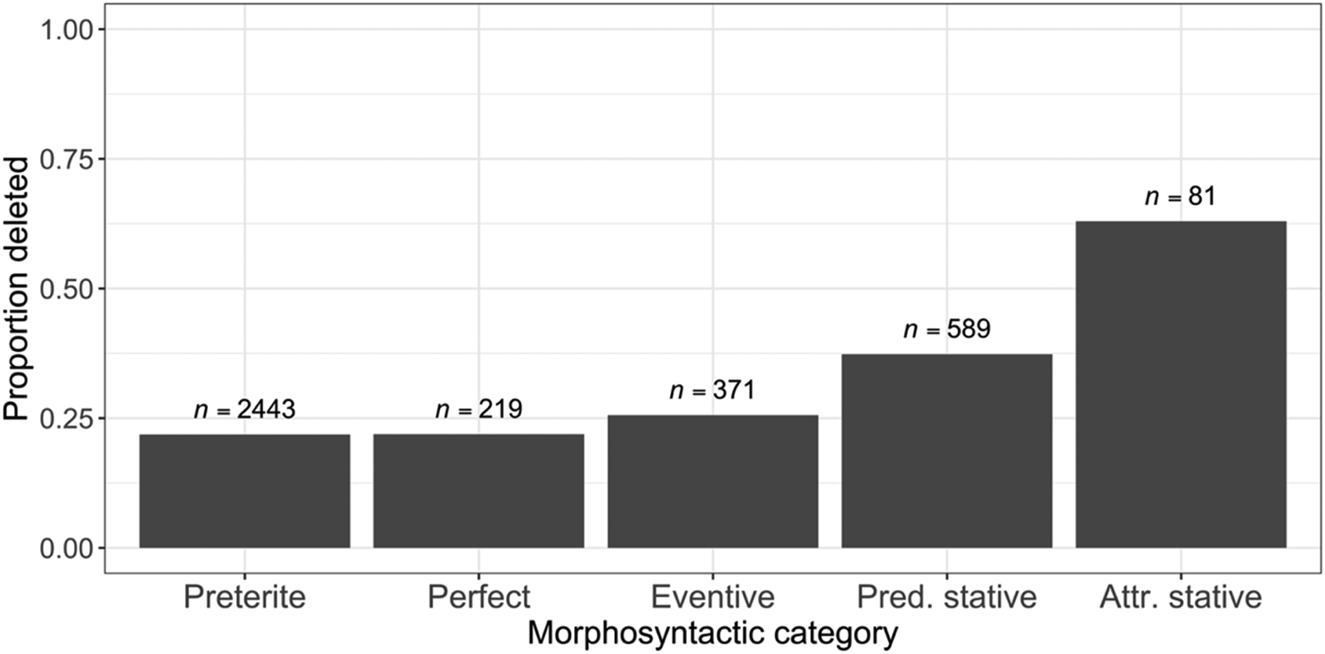
The observed rates of CSD across the five morphosyntactic categories we distinguish here are shown in Figure 2. It appears that the perfects and preterites have the low rate of deletion we normally expect from the category of -ed forms, as do eventives. Attributive statives, however, have a markedly higher rate of deletion, with predicative statives in between.
Rates of CSD by morphosyntactic category for -ed forms.

We fit a logistic regression with control predictors as described in Appendix A. The critical predictor of morphosyntactic category is treatment coded with preterite as the reference level. In this model, the preterite is not significantly different from either the perfect (β = −0.12, p = 0.57) or the eventive passive (β = 0.25, p = 0.18). There is a significantly higher rate of deletion in predicative statives than in preterites (β = 0.61, p < 0.001). There is also a significantly higher rate of deletion in attributive statives than in preterites (β = 1.59, p < 0.001). We might additionally ask whether the different passive types differ from one another, which this model does not test. Therefore, we refit the model with predicative stative as the reference level for the treatment-coded morphosyntactic category predictor. The second model indicates that the deletion rate in attributive statives is significantly higher than in predicative statives (β = 0.97, p = 0.004) and that the deletion rate in perfects is significantly lower than in predicative statives (β = −0.72, p = 0.004). However, the eventives do not quite differ significantly in deletion rate from the predicative statives, although the p-value approaches significance (β = −0.37, p = 0.07). The status of the eventive passives is thus unclear: we are not confident that it differs significantly from the preterite or from the predicative stative, even though those categories do differ significantly from each other. Additional data would be needed to determine whether the eventives behave more like the preterites/perfects, more like the predicative statives, or have a unique intermediate deletion rate.
Summary
As in the few previous studies that have reported distinctions within the category of -ed forms, we do not find evidence for a difference in deletion rate between preterites and perfect participles. This is similar to the null effect first reported by Guy (Reference Guy and Labov1980) and interpreted by Labov (Reference Labov1994) and Guy (Reference Guy, Guy, Feagin, Schiffrin and Baugh1996) as evidence against the functional account, although in those cases passive participles were combined with the perfect participles. Our results show that this pooling of categories could be motivated by comparable deletion rates in the case of the eventive passive but masks unexpectedly higher deletion rates in both attributive and predicative stative passives. In the case of the attributive stative passives, this result is comparable to the finding from Hazen (Reference Hazen2011) that bimorphemic adjectives have an elevated deletion rate, which we have suggested may also be seen as counterfunctional. We add the novel observation that the predicative statives exhibit a deletion rate intermediate between attributive statives and preterites.
UNPACKING COMPLEXITY IN THE NON-ED FORMS
Background
In the previous section, we discussed one explanation of the robust difference between -ed and non–ed CSD items, which attributes the difference to functional factors. Here, we describe an alternative explanation, Guy's (Reference Guy1991) Exponential Model.
The Exponential Model is based on lexical phonology, a model of word formation under which morphological and phonological processes are interleaved. Words are derived by passing through a series of levels, and a variable phonological process may apply multiple times throughout the derivation, once after each level of morphological attachment. Guy observed that the different morphological subclasses of CSD words—what he called monomorphemes (our non-ed forms), semiweaks (irregular past tenses not analyzed here), and regular pasts (our -ed forms)—have their coronal stop cluster derived at different levels under a lexical phonology approach. Namely, so–called monomorphemes, which are taken to be unsuffixed, have their coronal stop cluster present from the beginning of the derivation; semiweak past tenses have their coronal stop cluster introduced at level 1, where irregular stem-changing morphology is localized; and regular past tenses have their coronal stop cluster introduced at level 2, where regular stem-changing morphology is localized.
Guy additionally proposed that a variable rule of CSD can apply, at a consistent rate, three times across the course of a derivation: before level 1, after level 1, and after level 2. This naturally derives the hierarchy of deletion rates Guy observed in his data, by which monomorphemes show the most CSD, semiweaks show an intermediate rate, and regular pasts the lowest rate of all. The coronal stop cluster in monomorphemes, present from the earliest stage of the derivation, passes through all three instances of the deletion rule. This gives it three chances to apply, resulting in a high rate of deletion for these items. The coronal stop cluster in semiweak pasts, being derived at level 1, passes through two instances of the deletion rule (the one localized after level 1 and the one localized after level 2). This gives it two chances to apply. Finally, the coronal stop cluster in regular past tenses, which is derived at level 2, misses the first two instances of the deletion rule, and only gets the chance to undergo the final one, which follows level 2. As a result, regular past tenses show the lowest rates of deletion of the three categories.
The Exponential Model explains more than just the ordering relationship between the three morphological categories: it additionally makes precise quantitative predictions, which Guy found to be borne out in his data. Under Guy's assumption that the variable rule of CSD applies at the same rate each of the three times it operates, the rate of coronal stop retention among semiweak pasts should be equal to the rate of coronal stop retention among regular pasts, squared (because the deletion rule applies twice, each time at the same rate, to semiweak pasts). And the rate of coronal stop retention among monomorphemes should be equal to the rate of coronal stop retention among regular pasts, cubed (because the deletion rule applies three times to monomorphemes). Guy and Cutler (Reference Guy and Cutler2011:141) listed a number of studies where this exponential relationship is found to hold.
Empirical support notwithstanding, there are some conceptual issues with the Exponential Model. One concerns the number of morphological levels assumed. Guy (Reference Guy1991) assumed two levels of word formation, following Harris (Reference Harris1989). Two levels of word formation allow for three applications of the CSD rule to monomorphemic items, which matches the quantitative patterns in Guy's data. But other models of English word formation have argued for there being at least three levels (e.g. Kiparsky, Reference Kiparsky and Yang1982; Mohanan, Reference Mohanan1986). The more levels of word formation there are, it would seem, the more times the deletion rule should apply. Under a theory with three levels, monomorphemic forms should undergo the deletion rule four times—once before level 1 and once more after each level—and hence their retention rate should equal that of regular past tenses to the fourth power. This does not hold of Guy's data.
An additional concern is Guy's assumption that the deletion rule applies at the same rate each time. As Turton (Reference Turton2016) argued, this is not what would be expected given what we know about the life cycle of phonological processes (Bermúdez-Otero, Reference Bermúdez-Otero, Honeybone and Salmons2013). Phonological processes like CSD tend to start out applying to the widest possible phonological domain and then gradually work their way inward over time. Turton (Reference Turton2016:137–139) showed for the similar phenomenon of /l/-darkening that higher levels—where the process has been active longer—show higher application rates. In the case of CSD, this would lead us to expect the outermost deletion process to apply at the highest rate, and the innermost deletion process at the lowest. If the different CSD rules apply at different rates, as in the /l/-darkening case, the exponential relationship will not necessarily hold. However, this alternative model would still be compatible with the observed ordering relationship between morphological categories, because it still has monomorphemic forms undergoing deletion several times, and regular pasts undergoing it once. Indeed, other studies have found nonexponential quantitative patterns. McPherson and Hayes’ (Reference McPherson and Hayes2016) application of the Exponential Model to a vowel harmony process in Tommo So did find lower rates the farther the triggering suffix was from the root, but the specific pattern was not exponential. Fruehwald (Reference Fruehwald2011, Reference Fruehwald2012) similarly found the expected ordering for CSD in the Buckeye corpus but demonstrated that the precise exponential relationship is only a good fit for CSD when a random effect of word is excluded from modeling, suggesting that the apparent fit of the Exponential Model in previous work is driven by the disproportionate influence of frequent words.
All in all, the precise quantitative predictions generated by the Exponential Model of CSD have not consistently held up, but the ordering relationship–more deletion in monomorphemes than regular pasts–has (though see Footnote note 1). We take the spirit of the Exponential Model to be about generally decreasing deletion rates with increased levels of morphological structure rather than about deletion rates that fit a particular quantitative pattern, though we continue to refer to it as the “Exponential Model” for consistency with previous work.
What has not been acknowledged in previous research on CSD is that the so-called monomorpheme class in fact contains a number of polymorphemic items. And, as we will describe in the next subsection, many of these polymorphemic words involve suffixes added at different levels of lexical phonology, just like the past tense suffixes that derive the Exponential Model. This recognition of morphological complexity within the non-ed class forces us to reconsider the Exponential Model. Do suffixed forms derived at different levels of lexical phonology obey the expected ordering relationship? We explore this question in the rest of this section.
Method
A close inspection of the non-ed category reveals that it contains a number of items that are or may be morphologically complex. Some forms are clearly polymorphemic: they are suffixed (e.g., appointment, artist, complaint, longest), prefixed (e.g., befriend, react), or compound (e.g., airlift, playground, seatbelt). Other forms are ambiguously polymorphemic, in that they could be subject to different possible morphological analyses: suppletive superlatives (e.g., best, first, least), etymologically compound proper nouns (e.g., Maryland, Richmond, Roosevelt), forms that look suffixed but are not obviously decomposable (e.g., lenient, opponent, permanent), and forms that look prefixed but are not obviously decomposable (e.g., almost, amount, exact). Finally, a number of items remain that appear to be truly monomorphemic (e.g., blind, connect, frost).
To our knowledge, the polymorphemicity of many items in the non-ed category has only been recognized once before. Fruehwald (Reference Fruehwald2011), in an unpublished study of CSD in the Buckeye Corpus, compared CSD among -est-suffixed forms (e.g., smallest), -ist-suffixed forms (e.g., linguist), and truly monomorphemic forms ending in /st/ (e.g., last), controlling for final syllable stress. Though he found slightly more deletion among -ist forms than monomorphemes, and even more deletion among -est forms than monomorphemes, these differences did not come out as significant, leading him to conclude that the only morphological factor CSD is sensitive to is “whether or not the /t, d/ is an exponent of verbal morphology” (10).
To investigate the effects of this newly recognized morphological complexity among non–ed items on the Exponential Model of CSD, we have to identify the level of lexical phonology at which each item's CSD-susceptible cluster is derived. We did this by consulting Kiparsky (Reference Kiparsky and Yang1982), Halle and Mohanan (Reference Halle and Mohanan1985), and Mohanan (Reference Mohanan1986). We assume here that clusters can be derived either by affixing a coronal stop to a consonant-final stem (e.g., complain + t) or by affixing a cluster–containing suffix (e.g., art + ist). In other words, we assume that, in a word like artist, the -ist suffix is added at a certain point in the derivation, and from that point onward, the CSD rule may apply to it. A suffix like -ist does not go through the phonological levels on its own before being affixed; it is only subject to deletion once it is added to a stem. This follows what Borowsky (Reference Borowsky, Hargus and Kaisse1993:215) called “the usual assumption about the phonological behavior of bound morphemes.”
Unsuffixed forms, including compounds, have their cluster present underlyingly, from the beginning of the derivation. Accordingly, we assign them the level “pre-L1.” In order to classify the level of affixation of the suffixed forms in our data, we differentiated three levels of affixation. Level 1 (L1) affixation is associated with stem-changing morphology, such as the emergence of the [ɡ] in a form like strongest (cf., strong with no [ɡ]). Level 2 (L2) is the level of affixation of regular derivational suffixes, such as -ist and -ment. Finally, level 3 (L3) affixation is associated with regular inflectional morphology that triggers no corresponding phonological changes internal to the stem. Note that this is a departure from Guy (Reference Guy1991), who had only two levels, one corresponding to Kiparsky's (and others’) level 1 and the other (Guy's “level 2”) corresponding to Kiparsky's (and others’) level 3. Identifying more morphologically complex forms requires us to make more level distinctions. Appendix D provides details on how we categorized the different types of non-ed items into the four loci of consonant cluster introduction (pre-L1, L1, L2, and L3). Appendix E provides a table schematizing the derivation of seven lexical items and calculating the predicted rates of CSD application for each under the Exponential Model.
The Exponential Model makes two types of predictions about how the different subcategories of non-ed items should pattern:
1. Forms that differ in morphological makeup but whose consonant clusters are derived at the same level of lexical phonology should not differ in CSD rates. For instance, we should see no difference in deletion rates between -ant-suffixed words and -ent-suffixed words (both are added at L1), or between truly monomorphemic forms and compound forms (both have their consonant cluster present from the beginning of the derivation).
2. Forms whose consonant clusters are derived at different levels of lexical phonology should show CSD rates that obey the ordering relationship of the Exponential Model. For instance, the deletion rate of pre-L1 items should be higher than the deletion rate of words suffixed with the L3 regular superlative -est suffix, because the deletion rule will have had several chances to apply to unsuffixed forms, and only one chance to apply to L3-suffixed forms.
In the rest of this section, we test these two predictions. Token and type counts for the different subcategories of non-ed items are provided in Appendix C (Table A2). As is evident from this table, some categories are not well represented. Going forward, we combine two members of the pre-L1 category—compound and prefixed—into a single category, “complex,” to reflect their unambiguous morphological complexity.
Token counts for the different individual suffixes are also not high enough to test our first prediction (that forms that differ in morphological makeup but whose consonant clusters are derived at the same level will not differ in CSD rate). We can test this hypothesis with pre-L1 items, but not with suffixed items. Accordingly, we group suffixes within levels. This will still allow us to test our second prediction (that forms whose consonant clusters are derived at different levels will obey the ordering relationship of the Exponential Model). Postgrouping token and type counts can be found in Appendix C (Table A3).
Results
First, we address Prediction 1: Forms that differ in morphological makeup but whose consonant clusters are derived at the same level will not differ in CSD rate. To test this, we compare CSD among the four different subclasses of pre-L1 items: true monomorphemes, ambiguously prefixed forms, complex (prefixed and compound) forms, and etymologically compound proper nouns.
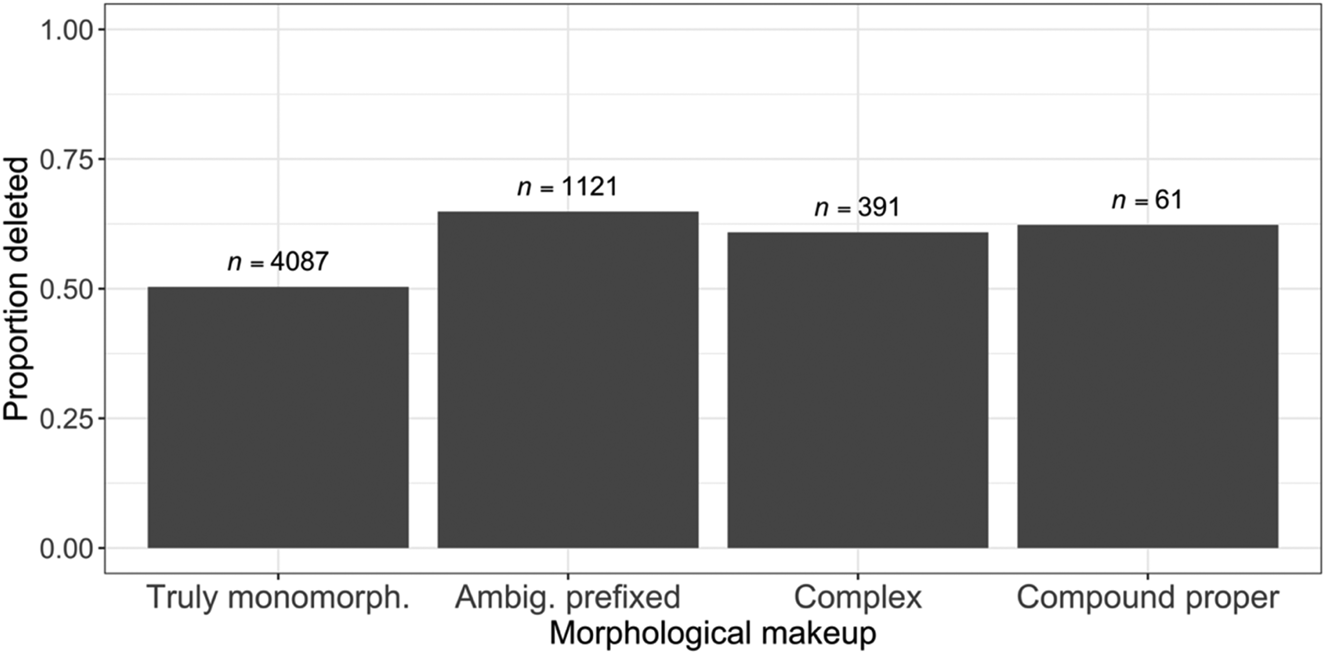
Figure 3 appears to show less deletion among truly monomorphemic items than among items that are or may be morphologically complex. To verify this impression, we fit a logistic regression on this subset of pre-L1 items, with control predictors as enumerated in Appendix A. The critical predictor of morphological makeup was treatment coded, with truly monomorphemic items as the reference level. This allows us to directly compare truly monomorphemic items to each of the other three groups.
Rates of CSD by morphological makeup for items whose coronal stop cluster is present prior to L1.

The regression does not find a significant difference between truly monomorphemic items and ambiguously prefixed forms, despite the apparently higher deletion rate of the latter (β = 0.03, p = 0.92). Going forward, we group the two together to reduce model complexity.
However, the regression does find a significant difference between truly monomorphemic forms and complex forms, such that complex forms show more deletion than true monomorphemes (β = 0.75, p = 0.01). Likewise, etymologically compound proper names also show more deletion than true monomorphemes (β = 1.57, p = 0.002). This is a novel finding that bears repeating: prefixed and compound forms show more coronal stop deletion than truly monomorphemic forms.Footnote 5
This difference between truly monomorphemic and morphologically complex but unsuffixed forms is not what would be predicted by the Exponential Model. Prefixed and compound forms, like true monomorphemes, have their consonant cluster in place from the beginning of the derivation, and should undergo the deletion rule the same number of times. That morphologically complex forms would show more deletion is surprising.
Now, we address Prediction 2: Forms whose consonant clusters are derived at different levels of lexical phonology should show CSD rates that obey the ordering relationship of the Exponential Model. Specifically, we should find the highest rates of deletion among pre-L1 items, and then increasingly lower deletion rates as we go up the levels.
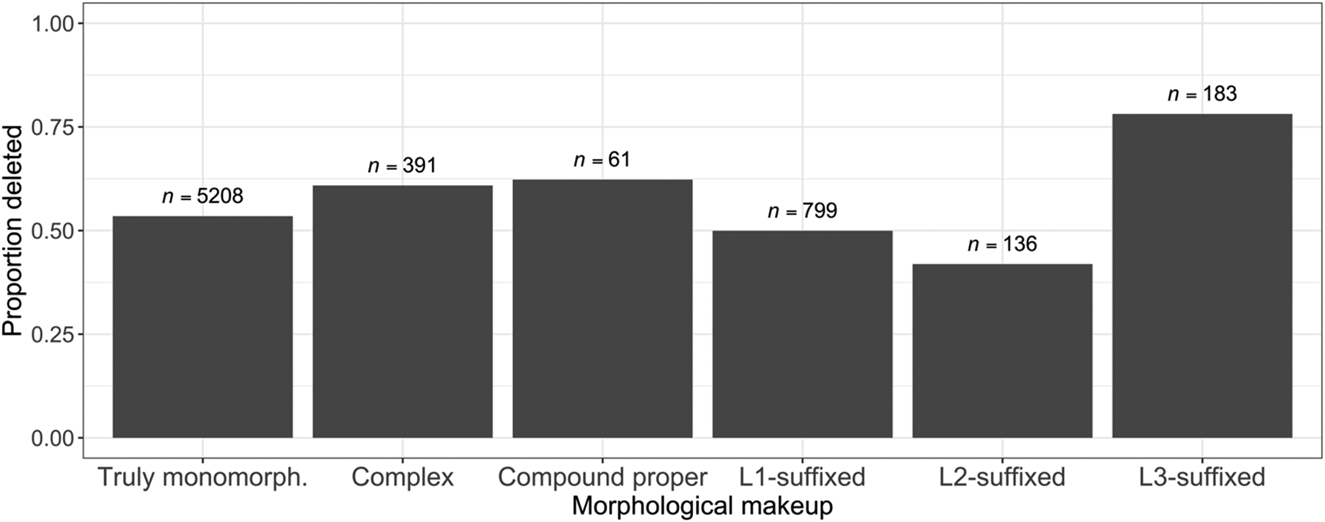
Abstracting over the differences between the three subsets of pre-L1 forms found above, it initially looks like there may be some support for the Exponential Model. In Figure 4, L1-suffixed items appear to show less deletion than pre-L1 items, and L2-suffixed items show less deletion still. But the lone L3 suffix, the superlative -est, has an exceedingly high rate of deletion: fully 78% of L3 -est superlative items are deleted. This is a higher rate than even the true monomorphemes.
Rates of CSD by morphological makeup, all non-ed items.

Making matters worse for the Exponential Model, the apparently lower deletion rates of L1-suffixed and L2-suffixed items as compared to true monomorphemes turn out not to be significant. A logistic regression model, set up the same way as the earlier one, finds no significant difference between L1-suffixed forms and true monomorphemes (β = −0.09, p = 0.69), nor between L2-suffixed forms and true monomorphemes (β = −0.03, p = 0.91). The differences between pre-L1 complex forms and true monomorphemes, and between compound proper names and true monomorphemes, remain significant. And the striking difference between the lone L3 suffix and the true-mono forms is highly significant (β = 1.43, p < 0.001). Such a high rate of deletion for an L3 suffix goes in exactly the opposite direction of what the Exponential Model predicts.Footnote 6
Summary
This section has found that neither of the two predictions generated by the Exponential Model hold up when the morphological complexity of many non-ed items is recognized. Items whose consonant cluster is derived at the same level of lexical phonology may nonetheless show significant differences in deletion rate: prefixed and compound items show more deletion than truly monomorphemic items, despite the fact that all have their consonant cluster present from the beginning of a derivation. Moreover, items that are derived at different levels of lexical phonology either fail to show significant differences in deletion rate—as is the case for L1-suffixed and L2-suffixed items, as compared to true monomorphemes—or show a significant difference in the opposite direction of what is predicted—as is the case for items suffixed with the L3 superlative suffix -est, which show the highest deletion rate of the non-ed forms.
GENERAL DISCUSSION
Our analyses in this paper have identified four novel or under-investigated findings where the morphological conditioning of CSD is concerned. Within the category of -ed forms,
1. We find more deletion in passive participles than in preterites or perfects.
2. We find more deletion for stative passives in attributive position than in predicative position, which in turn exhibits still higher deletion than the perfects.
Within the category of non-ed forms,
3. We find more deletion of prefixed and compound words (including etymologically compound proper names) than of truly monomorphemic items.
4. We find more deletion of regular -est-suffixed superlative adjectives than of truly monomorphemic items.
This being said, we want to emphasize that these findings of intracategory heterogeneity do not undermine the classical morphological effect. In our data, preterites—the most canonical -ed forms—delete at a rate of only 22% (n = 2443), while truly monomorphemic words delete at a rate of 50% (n = 4087).
Thus, we are left with one old and several new puzzles, as follows. The old puzzle is the continued lack of clarity on the source of the morphological effect. We have shown that neither the functional account nor the Exponential Model can serve as a bulletproof explanation of the effect, because each account makes additional predictions that the data do not support. The new puzzles concern the sources of the four findings in the list above, several of which are previously undocumented and all of which are unexplained. Ultimately, resolving these puzzles will be a task for new research. Below, we enumerate four promising directions that we anticipate may go some way toward helping us better understand both the original morphological effect and the new effects that we have uncovered here.
Prosodic phrasing
Absent from our coding here—and from the coding of the large majority of studies on CSD—is any attempt to take into account the prosodic phrasing of the CSD word. One exception to this is Amos, Kasstan, and Johnson (Reference Amos, Jonathan R. and Johnson2020), who coded CSD items for whether they were medial or final in an Intonational Phrase, and found that phrase-medial position favors deletion, while phrase-final position disfavors it. A tendency toward phrase-final retention could be understood as a type of phrase-final lengthening effect, in the sense of Klatt (Reference Klatt1975) and Cooper and Paccia-Cooper (Reference Cooper and Paccia-Cooper1980).
Several of the findings we document here are suggestive of having such prosodic phrasing effects as their source. For example, while there could, in principle, be some morphological difference between stative participles in attributive (high-CSD) and predicative (low-CSD) positions, this is not the standard analysis for English participles (see, e.g., Embick, Reference Embick2003). We think it is more likely that the CSD rate difference between attributive and predicative passive participles has a prosodic source. Perhaps, given Amos et al.'s results, stative passives in predicative position are more likely to occur at the end of an Intonational Phrase and hence disfavor deletion.
This is not the first time that morphological differences in CSD have been suggested to have a prosodic source. As described in the section on -ed forms, Hazen (Reference Hazen2011) found more CSD among adjectives than preterites or past participles, an effect that he suggested might be attributable to differences in phrasal prominence that correlate with differences in how these types of items are distributed syntactically. If the majority of Hazen's adjectives were themselves in a phrasal position that promoted deletion, this could account for that effect.
In fact, we also note that, within the set of non-ed items in our data, the highest deleting word class is itself adjectival (-est superlatives). As a first attempt to understand this finding, we suggest that the -est superlatives should be coded for syntactic position, since as adjectives they can be attributive or predicative. We may again find that superlative adjectives in attributive position show more CSD than those in predicative position, and that the high rate of CSD among superlatives is being carried by those in attributive position. Another natural next step is to separate out those truly monomorphemic items which are themselves adjectives (e.g., vast, blind), to see whether they exhibit a high rate of deletion, like the superlatives, and to determine whether they also show the same effect of syntactic position.
But we suggest that future research should also go beyond using syntactic position as a simple proxy for prosodic prominence and should carry out careful coding of the actual prosodic phrasing of CSD items. This could conceivably even end up explaining the original morphological effect that we started out with. If -ed forms tend to occur more often in prosodic positions that disfavor CSD than non-ed forms do, the morphological effect could turn out to be partly or even entirely epiphenomenal of prosody.
Frequency and contextual frequency
While our models have controlled for a simple effect of whole word frequency, there is almost certainly more to be said about the influence of different aspects of frequency on CSD. While whole word frequency is typically found to be positively related to deletion rate overall (Bybee, Reference Bybee2002; Jurafsky, Bell, Gregory, & Raymond, Reference Jurafsky, Bell, Gregory, Raymond, Bybee and Hopper2001; Tamminga, Reference Tamminga2016; cf., Walker, Reference Walker2012), it has been suggested that the effect is driven by the monomorphemic category (Baranowski & Turton, Reference Baranowski and Turton2020; Guy, Reference Guy, Lightfoot and Havenhill2019; Meyers & Guy, Reference Meyers and Guy1997). Here we do find a significant effect of frequency in the expected direction in -ed words, but that effect appears to be weaker in the -ed word model than in most of the non-ed word models, consistent with previous findings (to be clear, we do not directly test this comparison). If real, this interaction might be likened to the “amplification effect” found by Erker and Guy (Reference Erker and Guy2012) for null subjects in Spanish, in which morphological conditioning is stronger for higher-frequency words. Extending this investigation by asking how frequency interacts with the finer-grained morphological categories we have distinguished here is worth doing but will pose some challenges. In addition to the strain that it will put on the statistical modeling simply to interact frequency with a larger number of predictors each represented by fewer tokens, many of those categories are also severely limited in lexical types, making it difficult to estimate a within-category lexical frequency effect. Moreover, the fact that morphology and frequency interact at all draws our attention to the possibility that morphologically informed frequency measures (such as lemma frequency or suffix frequency; see, e.g., Tomaschek, Tucker, Ramscar, & Baayen, Reference Tomaschek, Tucker, Ramscar and Baayen2021) could be relevant in addition to, or instead of, whole word frequency.
Going beyond simple lexical frequency measures, the investigation of cumulative context effects (Brown, Reference Brown2004; Raymond, Brown, & Healy, Reference Raymond, Brown and Healy2016; Sóskuthy & Hay, Reference Sóskuthy and Hay2017, inter alia) could also be pursued in combination with the morphological questions at hand. Cumulative context effects capture the influence of the frequency with which a word or word type appears in a particular syntagmatic context, independent of any particular token's actual context. While basic lexical frequency effects can be attributed to online speech processing, the demonstrated influence of cumulative context is usually argued to reflect the accumulation of word-level episodic traces in memory, as in various usage-based models; Bybee (Reference Bybee2002), for example, gave an influential usage-based analysis of CSD which took cumulative context effects as evidence for episodic lexical representations. Following this example, Guy, Hay, and Walker (Reference Guy, Hay and Walker2008) found a significant effect on CSD of a word's most common following segment, while Raymond et al. (Reference Raymond, Brown and Healy2016) found that the proportion of a word's corpus occurrences with a following consonant has a significant influence on deletion of word-final /t/s and /d/s in read speech (across a wider range of contexts than our CSD envelope of variation). There are a number of possible cumulative context effects that could be investigated, some of them newly suggested by our results here, such as the probability with which an -ed word occurs across the different morphosyntactic contexts identified here. We leave for future work the question of whether our more fine-grained morphological conditioning results can be explained by some combination of various cumulative context and frequency effects.
Refining the functional account
In the section on -ed forms, we demonstrated counterfunctional effects on CSD among -ed items, leading us to conclude that the functional account is not incontrovertibly the source of the morphological effect. Nevertheless, we contend that the functional account should not be dismissed out of hand, because we have presented the functional hypothesis in a coarse way, treating entire morphosyntactic structures like “eventive passives” as decontextualized units over which functional factors might operate. A more nuanced version of the functional hypothesis would ask whether word pairs would actually be confusable given syntactic and/or discourse context (à la Labov et al. [Reference Labov, Cohen, Robins and Lewis1968:136] and Poplack [Reference Poplack1980]). For instance, CSD of a preterite form like walked risks confusion with the present tense only when the verb's subject is not third person; with a third person subject, the expected present tense -s on the verb disambiguates. Discourse context can also disambiguate homophonous forms: for instance, the sentence I walked there yesterday preserves a past tense meaning irrespective of any CSD on the preterite. The effects predicted by the functional account could still materialize when we restrict the data to only those instances in which losing the coronal stop on the preterite would truly result in homophony between forms.
Another open question is whether functional effects surface among the non-ed forms. At its core, the functional account of CSD hypothesizes that deletion will be less likely where it will give rise to ambiguity; accordingly, we might expect that CSD will apply less often to non-ed forms that would be homophonous with another word when losing their coronal stop. This broader homophony-avoidance interpretation of functionalism is familiar from the sound change literature, where the potential influence of homophony avoidance has been under consideration since the Neogrammarians (see Mondon [Reference Mondon2009] and Ceolin [Reference Ceolin2020] for more recent dissertation-length treatments). On this account, a word such as fund, which could be confusable with fun in its deleted form, would be expected to exhibit less deletion than a word like grind, which has no potentially confusable *grine to inhibit deletion.
This consideration could in principle go some way toward explaining the subclass effects that we find within the non-ed items. Superlatives ending in -est are highly unlikely to be confusable with other words when they have lost their final coronal stop: consider the lack of words that sound like cleanes’, highes’, pretties’. This could explain their high rates of deletion. Similarly, CSD in compound words would seem to be less likely to create an existing lexical item than it would for noncompounds: consider again the lack of words that sound like, for example, backgroun’, househol’, seatbel’. We suggest that it is worth subsetting the truly monomorphemic items into those that are confusable with an existing word after CSD and those that are not, to see if rates differ as the functional hypothesis would predict (again taking into account effects of context, including part of speech, where necessary).
We conclude this subsection by noting that our consideration of the functional hypothesis has hinged on the assumption that a form that has undergone CSD (e.g., fun’ for fund) will be acoustically indistinguishable from its noncoronal stop-final minimal pair counterpart (e.g., fun). As far as we know, this is an open empirical question. CSD may instead create incomplete neutralization, for instance, if the sound preceding the deleted coronal stop is shorter than it would be if it were the true end of the word. Perception studies of words that have undergone CSD may shed light on this.
Alternative formal approaches
As we have said, the unexpected results of the section on non-ed forms pose a challenge for the Exponential Model of Guy (Reference Guy1991), even setting aside the expectation that the model could make precise deletion rate predictions based on the assumption that CSD applies at a consistent rate across lexical phonological levels. The model offers no structural basis on which to predict a difference in CSD rates between true monomorphemes and prefixed/compound words, because in all of these cases the relevant cluster is already present in the stem's lexical entry and, therefore, is vulnerable to CSD from the start. The high rate of deletion in est-suffixed superlative adjectives presents something like the converse problem, with the model incorrectly predicting lower deletion rates in the highly deletion-prone -est suffix.
Some of the adjustments to this approach that we can think of do not resolve the issues. Even if we adopted the (obscure) assumption that affixes travel through all of the levels of Lexical Phonology on their own, it would only predict that -est tokens should be subject to deletion at the same rate as monomorphemes, not the higher rate that we actually see. Efforts to recast the basic premise of the Exponential Model in more modern phonological frameworks such as Stratal Optimality Theory (Bermúdez-Otero, Reference Bermúdez-Otero2010) will also, we think, suffer from the same problems: it is not that Guy's technical implementation of the idea cannot accommodate these new facts, but rather that the facts challenge the central generalization of deletion rates being a decreasing function of distance from the stem.
However, just because the Exponential Model is a particularly prominent formal analysis of CSD does not mean that it is the only one available. On the contrary, the CSD literature has explored a wide range of different formal approaches to capturing the morphological effect throughout the decades. A simple and familiar example is that a variable rule for CSD can be specified to be sensitive to a following morphological boundary that is directly represented in the rule's context as a + or #, as in the formulation of Labov et al. (Reference Labov, Cohen, Robins and Lewis1968). The appeal of the Exponential Model is that the morphological conditioning facts fall out of the structure of the grammar, so that the formal analysis provides a less stipulative explanation for that conditioning. But even the Exponential Model abstracts away from additional facts about phonological conditioning, lexical exceptions, word frequency, and more marginal morphological structures like -n't-contraction, not to mention social and stylistic influences—in other words, a full accounting for the CSD facts has always demanded more detail. We should not, then, make the mistake of thinking that formal explanations of CSD are closed off just because we have failed to support a particular formal explanation for a subset of the CSD facts. The tools of modern formal linguistics offer many other possibilities that could still be pursued.
For example, in seeking a formal account for the behavior of the -est suffix, we might look to Guy's (Reference Guy2007) treatment of and in CSD. Following Neu (Reference Neu and Labov1980), Guy argued that the word and has two distinct lexical entries, one of which lacks an underlying final /d/. Beyond the high rate of apparent deletion, the evidence for treating and as exceptional is that it shows markedly weaker following segment conditioning than other words ending in the string /ænd/. If the same thing turned out to be true of -est, it would be possible to extend Guy's analysis to allow for the -est suffix to have two stored allomorphs, one with and one without a final /t/ (see similar proposals from Labov et al. [Reference Labov, Cohen, Robins and Lewis1968:131] and Tamminga [Reference Tamminga2016]).
This suggestion for a possible hypothesis about -est is merely one example of how the new puzzles we have identified might well be accountable for in formal terms. Pursuing viable formal analyses of the other puzzles we have identified, in addition to alternative formal analyses for the original morphological effect itself, are projects for future research.
CONCLUSION
This paper has demonstrated that the morphological classes traditionally called “regular past” and “monomorphemic” (here renamed “-ed” and “non-ed”) are more complex than has been consistently acknowledged by previous work. We have shown that a number of subcategories within these larger umbrella categories significantly differ from one another in CSD rates. And we have used these newfound morphological distinctions as a testing ground for two influential theories of the general morphological effect on CSD, finding that neither of them can fully account for the patterns found here.
We close by noting that the field's enduring interest in the question of why CSD is morphologically conditioned is tied to the more basic question of what kind of linguistic process generates coronal stop absence in the first place. We have deliberately not, in this paper, taken up many other important issues that arise around this more basic question: issues of gradience and categoricity, of phonetic lenition versus early phonology versus late phonology, of feed-forward modularity, of episodic versus abstract lexical representations, and so on. The various competing explanations for the morphological effect that we mentioned at the beginning of the paper not only differ in their assumptions on these fronts about the process generating CSD, but also are often taken as arguments in favor of those assumptions. In other words, our understanding of CSD itself is widely understood to hinge in part on a correct understanding of the morphological effect. For this reason, we expect that the new morphological puzzles we have introduced here may turn out to have consequences for broader debates about the source of this highly scrutinized variable and its attendant theoretical consequences.
SUPPLEMENTARY MATERIAL
To view supplementary material for this article, please visit: https://doi.org/10.1017/S0954394521000119
ACKNOWLEDGMENTS
Thanks to David Embick, Gregory Guy, Kirk Hazen, William Labov, Ruaridh Purse, and the members of Friday Morphology and Related Topics at the University of Pennsylvania.
APPENDIX A: METHODS
The data and dependent variable
The data for this study come from 115 sociolinguistic interviews from the Philadelphia Neighborhood Corpus (Labov & Rosenfelder, Reference Labov and Rosenfelder2011). The speakers in these interviews are white adult speakers of Philadelphia English who were interviewed by graduate students from the University of Pennsylvania. The interviews were (at least partly) orthographically transcribed by undergraduate research assistants, then forced-aligned using the FAVE suite (Rosenfelder, Fruehwald, Evanini, & Yuan, Reference Rosenfelder, Fruehwald, Evanini and Yuan2011). Only interviews with at least 15 minutes of transcribed speech are included in the data used here. The aligned TextGrids then supported auditory coding of CSD tokens using a supplementary Praat script. We thank Joe Fruehwald for his handCoder.praat script.
CSD tokens were coded auditorily by the second author alone. Each CSD token was coded as retained or deleted, with any audible reflex of a stop (such as a glottal stop) being counted as retention rather than deletion. The following environments were excluded by the Praat script:
• Tokens preceding coronal stops, affricates, and non-sibilant fricatives (neutralization contexts)
• Tokens with a preceding /n/ and following /s/ (neutralization context)
• Tokens in which a coronal stop follows /r/ (outside the envelope of variation in white Philadelphia English)
• The lexical items and and just (found to delete at near-categorical rates in previous work: Guy, Reference Guy2007; Walker, Reference Walker2012)
The Praat script automatically extracted various token properties that we include as control predictors, described below. Morphological coding was done in several rounds, detailed later in this appendix as well as in the sections on -ed and non-ed forms.
Statistical modeling and coding of control predictors
The statistical models used in this paper are mixed-effects logistic regressions fit using the lme4 package (v.1.1-23, Bates, Mächler, Bolker, & Walker, Reference Bates, Mächler, Bolker and Walker2015) with the bobyqa optimizer (200,000 iterations) in R (v.4.0.2, R Core Team, 2015). All models include by-speaker random intercepts (n = 115) as well as a by-word random intercept (n = 905).
We include all of the following control predictors in all of our models unless otherwise specified:
• Preceding segment: Following the results from Guy and Boberg (Reference Guy and Boberg1997), we code the preceding segment as obstruent (n = 4466), sonorant (n = 1355), or /n/ (n = 4660).
• Following segment: Following the suggestion from Labov (Reference Labov1994:553) that the possibility of resyllabifying the coronal stop as an onset matters for the effect of following segment, as well as the result from Guy (Reference Guy and Labov1980) that the relative effects of following pauses and following vowels are dialect-specific, we group following segments into vowel (n = 3719), pause (n = 2989), consonant that allows for coronal stop resyllabification (i.e., /w j r/, n = 969), or consonant that does not allow for resyllabification (n = 2804).
• Stress and syllable count: We take the lexical stress of the syllable containing the coronal stop from the CMU Pronouncing Dictionary (Weide, Reference Weide2008). Because monosyllabic words always have primary stress on the syllable containing the coronal stop, we combine syllable stress and syllable count information into three levels: stressed monosyllabic (n = 6308), stressed polysyllabic (n = 1686), and unstressed polysyllabic (n = 2487). “Unstressed” comprises syllables with secondary stress as well as syllables that are truly unstressed.
• Speech rate: Our basic speech rate measure is vowels per second in a 7-word window centered on the target word, excluding pauses. This measurement was then z-score normalized (centered around the mean and scaled by the standard deviation) within each individual speaker's data, so that a high value represents speech that is faster than average for the speaker.
• Lexical frequency: Our lexical frequency measure is the natural log of the whole-word frequency count from Subtlex-US (Brysbaert & New, Reference Brysbaert and New2009), centered around the mean and scaled by the standard deviation over the entire dataset, after exclusions.
In the subset models presented in the paper, all categorical control predictors are sum-coded, so that the model intercept and estimates for other predictors are evaluated with each control variable at its grand mean. We discuss the use of different contrast coding schemes to test specific hypotheses involving the critical predictors on a case-by-case basis in the analyses in those sections. Tables reporting the full parameters for each model are available in Appendix F.
Coding of the critical predictor of morphological class
In our first round of morphological coding, we followed previous research on CSD by coding words into two categories, “regular past” and “monomorpheme” (terminology which we later revised to -ed and non-ed, respectively). The “regular past” (-ed) category is the set of CSD environments consisting of a verb stem inflected with the -ed suffix (hence “past”), with the phonology of the stem unchanged from its base form and the phonology of the -ed suffix predictably arrived at via voicing agreement (hence “regular”). Word forms that were inflected for past in a morphologically and/or phonologically different way were excluded; (1) breaks these exclusions down by type. We also excluded negative contractions such as can't, won't (n = 3,937). This left “monomorpheme” (non-ed) as the residual category.
(1) Word forms irregularly inflected for past, excluded from the present study
a. Verb stems inflected for past with a stem vowel change and -d affix: told, sold (n = 288)
b. Verb stems inflected for past with a stem vowel change and -t affix: dealt, dreamt, felt, kept, left, lent, lost, meant, slept, swept (n = 383)
c. Verb stems inflected for past with a stem vowel change only: found, held, wound (n = 100)
d. Verb stems inflected for past by changing the stem-final /d/ to /t/: bent, built, rebuilt, sent, spent (n = 128)
e. The words burnt and spilt, which have a final coronal stop that does not follow the voicing agreement rule (n = 7)
f. Verbs whose past and present are homophonous: burst, cast, cost, forecast (n = 29)
g. The suppletive form went (n = 629)
Of the excluded types in (1), (1a), and (1b) correspond to the class of “semiweak past tenses” identified by Guy and Boyd (Reference Guy and Boyd1990) and others. The other types, when they are discussed at all, have been treated inconsistently across several decades of CSD research: for instance, Guy and Boyd (Reference Guy and Boyd1990) included (1d) among the semiweaks, but treated (1c) and (1g) as monomorphemic; Guy (Reference Guy1991) restricted the semiweaks to only (1a) and (b), treating (1d) as monomorphemic; Walker (Reference Walker2012) put (1c), (1d), and (1g) into their own category, distinct from both semiweak and monomorphemic. None of these researchers mentioned how they treated forms of type (1e) or (1f).
We suggest that the CSD patterning of the different subcategories of “irregular pasts” identified in (1) is an interesting direction for future research, all the more so because these items mirror the “regular pasts” in functioning as preterites, participles, and passives. However, the token counts in our data set as it stands preclude studying both of these factors in tandem. Complicating matters further, the representation and production of forms of types (1a) and (b) has been found to show considerable inter- and intra-speaker variation. This has been interpreted as some speakers treating them as non-pasts or as zero-affixed past tenses (Fruehwald, Reference Fruehwald2012; Guy & Boyd, Reference Guy and Boyd1990), as opposed to past tenses with an overt coronal stop affix that is subject to deletion. This alternative morphological analysis may in principle be present at different rates for different speakers and in different communities on a word-specific basis, making it very difficult to detect the hypothesized subpopulations quantitatively or to delimit a morphologically homogeneous set of forms. For these reasons, we exclude all of the items in (1).
Negative contractions, the other category of word we excluded, are not entirely absent from the CSD literature (Labov, Reference Labov1989), but their exclusion (explicit or silent) is far more common than not (e.g., Guy, Reference Guy and Labov1980; Hazen, Reference Hazen2011; Labov et al., Reference Labov, Cohen, Robins and Lewis1968; Tagliamonte & Temple, Reference Tagliamonte and Temple2005; Walker, Reference Walker2012; Wolfram, Reference Wolfram1969). They could not be said to have played a role in the development of theoretical accounts of CSD, probably because they do not neatly exemplify the familiar morphological distinctions that have been central to such accounts. While the study of CSD in negative contractions could potentially be brought to bear on questions we raise in this paper, doing so would require first, an analysis of the syntactic, morphological, and phonological components of negative contraction tout court, and second, consideration of how the deletion process might intersect with other variables in this context (such as non-contraction)–both of which would need to be connected to the theoretical frameworks we discuss here. In the absence of a hypothesis to motivate this undertaking, we leave the treatment of negative contractions for future work.
Following this round of coding, the -ed and non-ed categories were subdivided to capture the complexity within them. Explanations of how these categories were subdivided can be found in their respective sections, as well as in Appendix D (on non-ed forms).