Implication
The experiment was conducted to evaluate the effects of dietary threonine (Thr) supplement on reproductive performance and immune function of the male mice challenged with pseudorabies virus (PRV). Data suggest that high levels of Thr may be required in order to counteract the deleterious effects of virus invasion, possibly through the downregulated expression of TLRs, and thus to improve immunity and reproduction performance of male mice challenged with PRV. Meanwhile, these data implicate that nutrition requirement in a disease state may be higher than that in normal condition.
Introduction
Semen and sperm cells are rich in threonine (Thr; Hood et al., Reference Hood, Witters, Foley and Erb1967; Smith and Graham, Reference Smith and Graham1972). Thr, one of the most abundant amino acids in immunoglobulin (Kim et al., Reference Kim, Mateo, Yin and Wu2007), could prevent apoptosis and promote antibody production in lymphocytes (Duval et al., Reference Duval, Demangel, Munierjolain, Miossec and Geahel1991). The immune system is sensitive to dietary Thr intake in animals (Li et al., Reference Li, Xiao, Qiao, Zhang, Johnson and Thacker1999). Indeed, serum antibody titers increased with increasing Thr intake in chickens infected with the Newcastle disease virus (Bhargava et al., Reference Bhargava, Hanson and Sunde1971). In addition, dietary Thr supplementation increased serum IgG level in sows (Cuaron et al.,Reference Cuaron, Chapple and Easter1984), and enhanced antibody production, serum IgG level and jejunal mucosal interleukin (IL)-6 concentration of young pigs challenged with Escherichia coli (Wang et al., Reference Wang, Qiao, Liu and Ma2006).
Pseudorabies virus (PRV) is a contagious herpesvirus causing reproductive problems such as abortions, stillbirths, mummies and infertility. Hall et al. (Reference Hall, Kluge, Evans, Clark and Hill1984) found testicular degeneration and transient elevation in sperm abnormalities after PRV infection by the intratesticular route. The virus can be irregularly isolated either from urine, preputial membranes or semen (Medveczky and Szabo, Reference Medveczky and Szabo1981). Sows inseminated with PRV-contaminated semen show seroconversion, and may suffer from vaginitis, endometritis and embryonic mortality (Maes et al., Reference Maes, Nauwynck, Rijsselaere, Mateusen, Vyt, de Kruif and Van Soom2008). Upon pathogen infection, toll-like receptors (TLRs), a highly conserved protein family, are innate pathogen recognition sensors. Activation of TLRs by antigens is a critical antecedent for the development of adaptive acquired immunity and is important to control the infection.
As mentioned above, we hypothesize that adequate Thr intake for animals challenged with pathogens might improve reproduction performance by promoting immunity. Therefore, our aims were to determine whether Thr dietary supplements could improve reproductive performance of PRV-challenged male mice and attenuate the initial inflammatory response immunity.
Material and methods
Experiment 1: effects of Thr on immunity and sperm quality in male mice challenged with PRV
Animal and diet
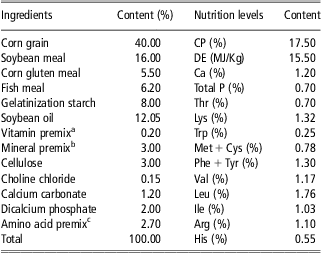
One hundred and sixty specific pathogen-free Kun-Ming male mice weighing 24.5 ± 2.3 g were obtained from Sichuan Academy of Medical Sciences – Sichuan Provincial People's Hospital Experimental Animal Research Institute (license: SCXK (Chuan) 2005-16). The mice were randomly divided into four groups. The mice were individually housed in polycarbonate cages at 22°C with 12-h light–dark cycle, and were given free access to double-distilled water. The procedures followed the actual law of animal protection and were approved by the Animal Care and Use committee of the Sichuan Agricultural University, and were performed in accordance with the National Research Council's Guide for the Care and Use of Laboratory Animals. Four Thr levels of 0.70%, 0.88% (Liu et al., Reference Liu, Wei, Liu, Zhang, Zhou, Zhen and Liu2002), 1.10% and 1.30% were supplemented to the basal diet to feed four groups of mice. The ingredients of the basal diet and the addition of appropriate amounts of synthetic amino acids are summarized in Table 1. Daily feed intake was measured among treatments. Pair-feeding was carried out so as to insure the same calorie intake for all groups during the experiment (Faure et al., Reference Faure, Moënnoz, Montigon, Mettraux, Breuillé and Ballèvre2005).
Composition and nutrient level of basal diet (air-dry basis, %)
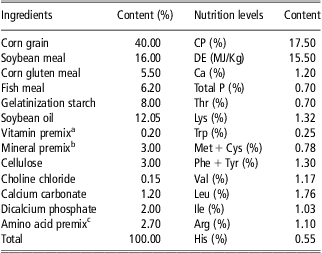
DE = digestible energy.
aProvided per kg of diet: vitamin A 4000 IU; vitamin D3 1000 IU; vitamin K3 0.75 mg; vitamin B1 6.0 mg; vitamin B2 7.0 mg; vitamin B6 6.0 mg; vitamin B12 0.02 mg; nicotinic acid 30.0 mg; d-calcium pantothenate 15.3 mg; folic acid 2.0 mg; biotin 0.2 mg.
bProvided per kg of diet: Ca 5000 mg; P 1561 mg; K 3600 mg; Na 1019 mg; Cl 1517 mg; Mg 510 mg; Fe 35 mg; Zn 30 mg; Mn 10 mg; Cu 6 mg; I 0.2 mg; Se 0.15 mg. Antioxidant (tert-butyl hydroperoxide) 20 mg.
cProvided per kg of diet: lysine 3.80 g; tryptophan 0.50 g; methionine + cystinic acid 3.30 g; valine 3.02 g; leucine 0.50 g; isoleucine 3.30 g; arginine 0.70 g; histidine 0.90 g.
PRV challenge
The PRV (SA 215 attenuated strain) used in this study was deficient in glycoprotein (g)E/gI/TK (thymidine kinase) and was constructed by the Biotechnology Center of Sichuan Agricultural University. At 5 weeks of feeding, half of the mice in different Thr level groups were injected with PRV intraperitoneally with 3.5 × 10³ PFU/g, which was based on a preliminary study (data not shown) in which it was shown that this dosage would affect the brain and testicle function but without being lethal for the injected mice, whereas the other half were injected with phosphate buffered saline (PBS) as control. All mice continuously consumed their respective diets after being challenged with PRV or PBS. The clinical symptoms of PRV infection (e.g. pruritus, dehydration, somnolence) or toxicity were recorded daily.
Sample collection
On the 9th day post PRV challenge, mice in each group were fasted for 12 h and blood was collected via globe vein after Aerrane anesthesia. Serum was separated by centrifugation (3000 r.p.m. for 15 min at 4°C) and stored at −20°C. Brain, testis and epididymis were colleted, and all samples were immediately frozen in liquid nitrogen and stored at −80°C until analysis.
Sperm density and deformity ratio
Immediately after mice were sacrificed, sperm was collected from the caudal epididymedis in a sperm buffer pre-warmed at 37% (Ringers solution containing 1 mM sodium pyruvate, 5.5 mM d-glucose, 10 mM sodium bicarbonate, 25 mM N-[2-hydroxyethyl] piperazine-N′-[2-ethanesulfonic acid] and 2% bovine serum albumin. Sperm density was determined by using a haematocytometer count according to the method described previously (Egbunike and Elemo, Reference Egbunike and Elemo1978). Morphological abnormalities of the sperm head were assessed essentially according to the criteria of Wyrobek and Bruce (Reference Wyrobek and Bruce1975) and results were presented as percentages.
Determination of immunoglobulin concentration and PRV-specific antibody
Serum total immunoglobulin G (Ig)G, IgA and IgM concentrations were determined using MaiKe Technology Corporation (Sichuan, China) on nucleic acid/protein analyzer (Beckman DU-800; Beckman Coulter Inc., Fullerton, CA, USA) according to the manufacturer's protocol. Absorbance was measured at 340 nm and the concentration of IgA, IgG and IgM was expressed as gram per liter. The thresholds for IgA, IgG and IgM are 0.00 to 6.20 g/l, 0.00 to 40.00 g/l and 0.00 to 5.00 g/l, respectively.
Serum PRV-specific antibodies against the gB protein of the PRV were determined using murine commercial enzyme-linked immunosorbent assay (ELISA) kit according to the manufacturers’ instructions. Optical density values for serum PRV-specific antibody were determined by using the Model 680 Microplate Reader (Bio-Rad Laboratories, Hercules, CA, USA) with 450 nm interference filters installed on the filter wheel. The results are presented as the percentage of inhibition.
Determination of tumor necrosis factor (TNF)-α and IL-1β concentration in testis
One testis from each mouse was used to determine IL-1β and TNF-α concentration. The tunica albuginea was removed from the testis and the remaining testicular tissue was homogenized and centrifuged at 12000 r.p.m. for 15 min. The supernatant was collected to determine the TNF-α and IL-1β levels by using murine enzyme-linked ELISA kits (R&D System Inc., Minneapolis, MN, USA). Absorbance was read at 450 nm. Total protein was measured using Bradford kits (Nanjing Jiancheng Bioengineering Institute, Jiangsu, China). The levels of TNF-α and IL-1β were determined from the standard curve and were expressed as picogram per milligram protein.
Determination of testosterone concentration in testis
Testosterone concentration in testis was measured according to D'Aniello et al. (Reference D'Aniello, Di Cosmo, Di Cristo, Annunziato, Petrucelli and Fisher1996), using the ELISA kit (R&D) according to the manufacture's protocol. All assays were performed in 96-well plates and absorbance was measured at 450 nm by using an enzyme-labeled meter (Thermo Electron Corporation, Varioskan™, Waltham, MA, USA). The levels of testosterone were determined from the standard curve and were expressed as picogram per milligram protein.
Detection of PRV in brain and testicle
Total cellular DNA was extracted from brain and testis samples using a conventional phenol/chloroform method. The forward primer for PRV detection was 5′-ACCCGTACACCGAGTCGTGGCA-3′ and the reverse primer was 5′-CGGCGTCAGGAATCGCATCA-3′. PCR amplification was performed on the PTC-100 Thermal Cycler (MJ Research, Waltham, MA, USA) for 30 cycles using the following cycling conditions: 95% for 5 min, followed by 30 cycles of 95% for 1 min, 62% for 1 min and 72% for 90 s, and then a final extension of 72% for 10 min. PCR products were analyzed by 1% (wt/vol) agarose gel electrophoresis.
RNA extraction and real-time PCR
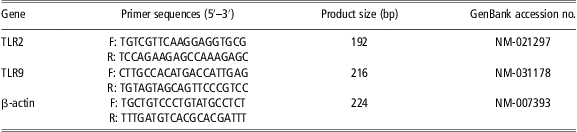
Total RNA was extracted from the left testicle of each mouse using TRIzol Reagent (Invitrogen, Carlsbad, CA, USA) according to the manufacturer's instructions. The quantity and quality of the RNA was verified by spectrophotometry and 1% agarose gel electrophoresis, respectively. The RNA was reverse transcribed using the Superscript First-strand Synthesis System for RT-PCR (Takara, Shuzo, Shiga, Japan) following the manufacturer's instruction. Real-time PCR was performed to analyze TLR2 and TLR9 mRNA expression in the testicle using SYBR Green PCR Mix (TaKaRa, Bio Inc., Shiga, Japan). Forty cycles of PCR amplification were performed on the CHRMO4-TM Thermal Cycler (BIO-RAD Inc., Hercules, CA, USA) as follows: 95°C for 10 s, followed by 30 cycles of 95°C for 5 s, 60°C for 25 s, melt curve conditions were 95°C for 0 s, 65°C for 30 s and 95°C for 0 s (temperature change velocity: 0.5°C/s). A total volume of 15 μl reaction system contained 7.5 μl SYBR Premix Ex Taq (2×), 0.3 μl of each primers (10 μM), 2 μl cDNA and 5 μl ddH2O. Primer pairs of TLR2, TLR9 and β-actin are shown in Table 2.
The primer sequences of target genes and housekeeping gene
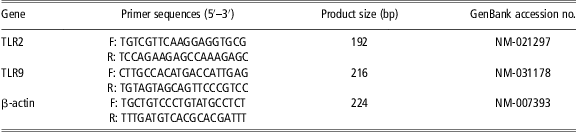
TLR = toll-like receptor.
Experiment 2: effect of Thr on reproductive capacity of male mice challenged with PRV
Eighty specific pathogen-free Kun-Ming male mice with similar BW (22.7 ± 0.6 g) were allocated to four dietary Thr levels of 0.70%, 0.88%, 1.10% and 1.30%. Half of the mice in each group were injected with PRV or PBS after 5 weeks’ adaptation to their respective diets. On the 9th day post infection, the male mice were mated with adult female mice in a ratio of (1 : 1). The pregnancy rate and litter size in the female mice were observed and the male mouse copulation rate in each group was calculated.
Statistical analysis
Data were analyzed by least significant difference multiple comparison for the 4 × 2 factorial using the GLM procedure of SAS statistical package (V8.1, SAS Institute Inc., Cary, NC, USA) to determine the significance of the main effects (PRV challenge, Thr level, PRV challenge × Thr level interaction), and expressed as mean ± s.e.m. Multiple comparison by DUNCAN analysis was performed to determine statistical differences among groups. Results were considered significant at P < 0.05 for all tests.
Results
Detection of PRV in brain and testicle
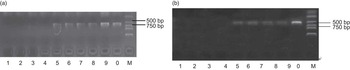
The result of the PCR for PRV sequence is presented in Figure 1a and b. After intraperitoneal injection of PRV, the virus could be detected in the brain tissue because of the brain-specific location of this virus. PRV virus was detected in the brain and testicle tissues of mice challenged with PRV on the 9th day post infection, whereas the mice treated with PBS did not show any PRV infection of the virus.
PCR analysis for the virus sequence in brain (a) and testis (b) tissue post PRV challenge. M denotes DNA mark; 0 denotes virus DNA positive control; 1 to 4 denote Thr levels of 0.70%, 0.88%, 1.10%, 1.30%; 5 to 8 denote PRV infection groups of 0.70%, 0.88%, 1.10%, 1.30%; 9 denotes brain tissue of dead mice post challenge. These data confirmed that mice were infected on the 9th day post infection. PRV = pseudorabies virus.

Effects of Thr supplements on feed intake, sperm quality and reproduction performance
As presented in Table 3, average daily feed intake was not affected by the Thr level (P = 0.34) and the interaction between Thr level and PRV challenge (P = 0.28). PRV infection had the tendency to decrease feed intake (P = 0.06).
Effect of Thr on ADFI in male mice

Thr = threonine; ADFI = average daily feed intake; L = level; V = virus; PBS = phosphate buffered saline; PRV = pseudorabies virus.
Data are presented as means ± s.e.m. Means with different superscripts are significantly different (P < 0.05). n = 20 mice per group.
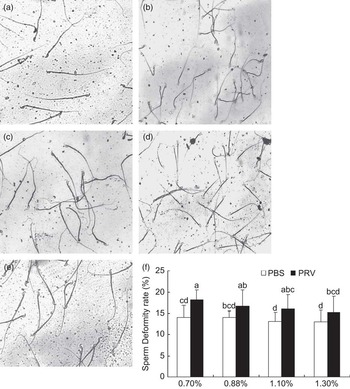
All of the sperm head, midpiece and tail anomalies are considered sperm deformation. Sperm deformity ratio was significantly influenced by PRV infection (Figure 2a to f), and was not affected by the Thr level (P = 0.16) and the interaction between Thr level and PRV (P = 0.79). The sperm deformity rate in 0.70%, 0.88% and 1.10% PRV groups was significantly higher than PBS groups at the same Thr level (P < 0.05).
Effects of threonine on sperm deformity ratio in male mice. A denotes sperm morphology of PBS group; B, C, D, E denotes sperm morphology in PRV group of 0.70%, 0.88%, 1.10%, 1.30% Thr; F denotes sperm deformity ratio in PBS and PRV groups of 0.70%, 0.88%, 1.10%, 1.30% Thr. Data are presented as means ± s.e.m. Means with no same superscripts differ significantly (P < 0.05). n = 20 mice per group. PBS = phosphate-buffered saline; PBV = pseudorabies virus.

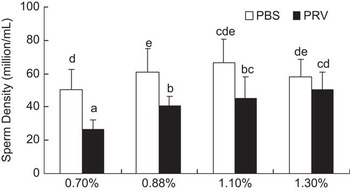
The effect of Thr supplemental levels on the sperm density on the 9th day post PRV challenge is shown in Figure 3. The sperm density was significantly affected by Thr level and virus (P < 0.05), but was not influenced by the interaction between Thr level and virus (P = 0.08). PRV challenge induced a significant (P < 0.05) effect on lower sperm density compared with the control groups on the 9th day post infection. However, it was attenuated by the increasing Thr intake in a dose-dependent manner, with the 1.10% and 1.30% Thr groups having higher sperm density than the 0.70% and 0.88% Thr groups (P < 0.05). The sperm density of mice challenged with PRV was significantly lower than PBS mice in the 0.70%, 0.88% and 1.10% Thr groups (P < 0.05), whereas no difference was observed in the 1.30% Thr group (P > 0.05).
Effects of threonine on sperm density of male mice. Data are presented as means ± s.e.m.; means with no same superscripts differ significantly (P < 0.05). n = 20 mice per group. PBS = phosphate-buffered saline; PBV = pseudorabies virus.

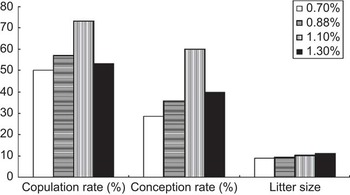
The effect of Thr supplemental levels on the reproductive capacity on the 9th day post PRV challenge is shown in Figure 4. Copulation and conception rates were numerically higher as increasing Thr levels and the highest level was achieved in the 1.10% Thr group. The litter size was showing a tendency to increase with increasing Thr level (P > 0.05), indicating the importance of Thr for normal reproductive function.
Effect of threonine supplemental levels on the reproductive capacity on the 9th day post PRV challenge. Data are presented as means. n = 20 mice per group. Copulation rate means the total number of female mice with vaginal plug/the total number of female mice mated with male mice after male and female mice are caged together for 8 days. Conception rate means the total number of female mice giving birth/the total number of female mice mated with male mice.

Thr supplements affected serum immunoglobulin profiles and PRV-specific antibody titers
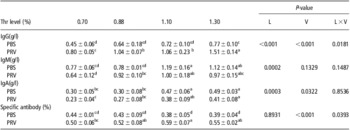
The serum IgG, IgA and IgM concentrations were significantly affected by Thr level (P < 0.05; Table 4), whereas IgG and IgM concentrations were significantly affected by PRV challenge (P < 0.05); only IgG concentration was significantly affected by the interaction between Thr level and virus (P < 0.05). The serum IgG concentration was significantly higher in mice challenged with PRV than in PBS control mice. Although serum IgA and IgM concentrations appeared to have a declining trend after PRV infection, there was no significant difference for serum IgA and IgM concentrations between PBS and PRV groups under the same Thr level (P > 0.05). PRV challenge resulted in an increase in serum PRV-specific antibody titer concentrations compared with PBS groups fed the same Thr level in the 0.88%, 1.10% and 1.30% groups (P < 0.05). No difference was observed for the PRV-specific antibody titers in PBS groups (P > 0.05).
Effect of Thr on immunoglobulin concentration in serum male mice

Thr = threonine; L = level; V = virus; Ig = immunoglobulin; PBS = phosphate buffered saline; PRV = pseudorabies virus.
Data are presented as means ± s.e.m. Means with different superscripts are significantly different (P < 0.05). n = 6 mice per group.
Thr supplements influenced testosterone levels in testis
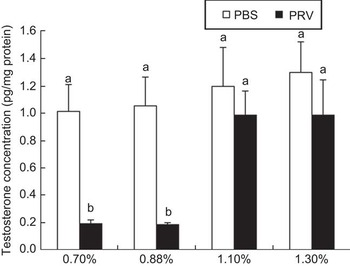
The testosterone concentrations in mice are shown in Figure 5 and significantly affected by the Thr level, virus and the interaction between Thr level and virus (P < 0.05). The testosterone concentrations in mice challenged with PRV were significantly lower than PBS groups in the 0.70% and 0.88% Thr groups (P < 0.05), and was attenuated by increased Thr supplements in the 1.10% and 1.30% Thr groups (P > 0.05). No difference was observed in the 1.10% and 1.30% Thr groups (P > 0.05).
Effect of threonine supplemental levels on the testosterone concentration in the mice 9 days post PRV challenge. Data are presented as means ± s.e.m. Means with no same superscripts differ significantly (P < 0.05). n = 20 mice per group. PBS = phosphate-buffered saline; PRV = pseudorabies virus.

Effects of Thr on cytokine secretion and mRNA expression of TLR2 and TLR9 in testis
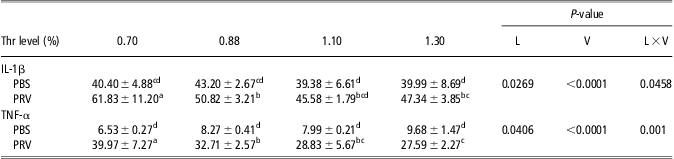
Immunity-related cytokines were altered by Thr supplement and PRV challenge (Table 5). IL-1β and TNF-α concentrations in testis were significantly affected by the Thr level, virus and the interaction between Thr level and virus (P < 0.05). PRV challenge resulted in increased IL-1β and TNF-α concentrations in testis compared with control groups given the same Thr level (P < 0.05). IL-1β and TNF-α concentrations in testis were not altered with increasing Thr level after PBS treatment (P > 0.05), but were reduced by increased Thr consumption in PRV-treated groups. IL-1β and TNF-α concentrations of testis in the 0.70% Thr groups were significantly lower than higher Thr groups in either PRV- or PBS-treated groups (P < 0.05).
Effect of Thr on cytokines concentration in testis of male mice (pg/mg protein)
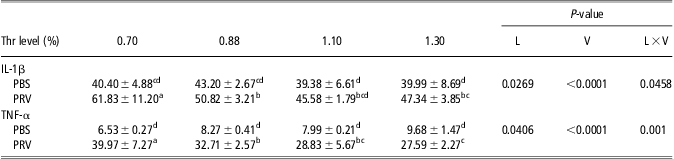
Thr = threonine; L = level; V = virus; IL = interleukin; PBS = phosphate buffered saline; PRV = pseudorabies virus; TNF = tumor necrosis factor.
Data are presented as means ± s.e.m. Means with different superscripts are significantly different (P < 0.05). n = 6 mice per group.
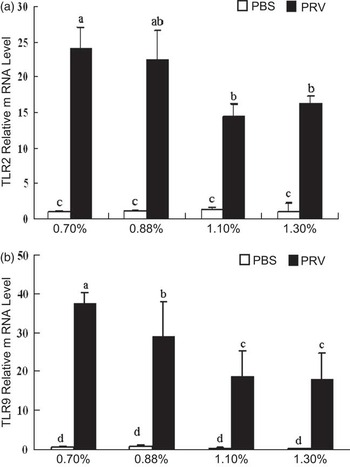
TLRs have a crucial role in regulating viral infection and disease. As shown in Figure 6, mRNA abundance of TLR2 and TLR9 was significantly increased by PRV challenge compared with PBS groups, but was downregulated after feeding higher levels of Thr supplement, whereas there was no significant difference between PBS and PRV groups fed the same Thr level (P > 0.05).
TLR2 and TLR9 expressions in the testis of the mice injected with PRV or PBS in response to Thr supplemental levels (n = 4). White bar means PBS injection, and black bar means PRV injection. Different small letters denote statistical differences (P < 0.05) between groups. TLR = toll-like receptor; PBS = phosphate-buffered saline; PRV = pseudorabies virus.

Discussion
In the present study, results showed that semen quality declined in male mice infected with PRV, which was similar to the results of previous studies by Kapranos et al. (Reference Kapranos, Petrakou, Anastasiadou and Kotronias2003) and Bezold et al. (Reference Bezold, Politch, Kiviat, Kuypers, Wolff and Anderson2007). The process of spermatogenesis is regulated by a complex interplay of endocrine and paracrine signals. Intratesticular testosterone is believed to stimulate spermatogenesis directly in rats (Zirkin et al., Reference Zirkin, Santulli, Awoniyi and Ewing1989) and men (Matsumoto and Bremner, Reference Matsumoto and Bremner1985). This notion was supported by the finding that higher dietary Thr increased testosterone concentration of male mice after being infected with PRV. Therefore, the present study suggests that higher dietary Thr supply is very important to maintain hormone secretion and reproduction of PRV-challenged male mice.
Many studies have substantiated that Thr is essential for normal immunity and for the development of specific humoral and cellular immunity in response to pathogen infection (Li et al., Reference Li, Xiao, Qiao, Zhang, Johnson and Thacker1999; Wang et al., Reference Wang, Qiao, Liu and Ma200). In the present study, the immunoglobulin concentrations and PRV-specific antibody in serum were increased after higher Thr diet intake, which was consistent with the study conducted by Li et al. (Reference Li, Xiao, Qiao, Zhang, Johnson and Thacker1999) in growing pigs and Wang et al. (Reference Wang, Qiao, Liu and Ma2006). They demonstrated that a higher Thr level was needed to maximize humoral antibody and IgG production in 17 to 31 and 10 to 25 kg pigs. Bhargava et al. (Reference Bhargava, Hanson and Sunde1971) reported that Leghorns infected with Newcastle disease needed more Thr for optimum antibody production than that for maximum growth. Burgos et al. (Reference Burgos, Ramirez, Brachet, Alfaro, Sastre and Valdivieso2007) demonstrated that virus load in pregnant mice was decreased along with an increase in immunoglobulin concentration. Earlier study also found the immunoglobulin plays an important role in recovering from disease and secondary infection through assisting destroying cells infected PRV and limited virus diffusion (Chinsakchai and Molitor, Reference Chinsakchai and Molitor1994). However, our results indicated that higher Thr could attenuate the deleterious effects of PRV infection on sperm quality, possibly because of the increased synthesis of immunoglobulin and PRV-specific antibody and the subsequent enhanced ability of clearing virus.
IL-1β is one of the elements of immune privilege in the testis and a well-known pro-inflammatory cytokine that is especially important for testicular physiology (Huleihel et al., Reference Huleihel, Lunenfeld, Horowitz, Levy, Potashnik and Glezerman2000). TNF-α is another pro-inflammatory cytokine in the initiation and orchestration of the inflammatory response against invading microorganisms (Hales et al., Reference Hales, Diemer and Hales1999). The results from the present study indicated that the concentrations of IL-1β and TNF-α in the testes of male mice infected with PRV were increased, which were similar to other studies (Sanocka et al., Reference Sanocka, Jedrzejczak, Szumała-Kaekol, Fraczek and Kurpisz2003). Sanocka et al. (Reference Sanocka, Jedrzejczak, Szumała-Kaekol, Fraczek and Kurpisz2003) found that seminal plasma IL-1β concentration from normozoospermic infertile men with genital tract inflammation was significantly higher than that of controls. Other studies have shown that TNF-α concentration in the seminal plasma of patients with bacterial or mycoplasmal infections was higher than in normal controls (Gruschwitz et al., Reference Gruschwitz, Brezinschek and Brezinschek1996). In addition, it has been shown that leukocytospermia (Sikorski et al., Reference Sikorski, Kapec, Krzeminski and Zaleska2001) and/or bacteriospermia (Omu et al., Reference Omu, Al-Qattan, Al-Abdul-Hadi, Fatinikun and Fernandes1999) in men were associated with a higher release of TNF-α. The increase of IL-1β expression in the testis during local infection or inflammation is associated with decreased testosterone production and intensity of spermatogenesis (Huleihel and Lunenfeld, Reference Huleihel and Lunenfeld2004), and higher IL-1 concentration have an detrimental effect on sperm motility and fertilization (Anderson and Hill, Reference Anderson and Hill1988). Moreover, the sperm count was negatively related to IL-1 level (Bezold et al., Reference Bezold, Politch, Kiviat, Kuypers, Wolff and Anderson2007), and sperm motility and morphology was negatively related to TNF-α levels (Kocak et al., Reference Kocak, Yenisey, Dundar, Okyay and Serter2002). In the present research, the concentrations of IL-1β and TNF-α in testis decreased as Thr levels increased. To our knowledge, there is no direct relationship between Thr and the concentrations of IL-1β and TNF-α. As we know, Thr can be degraded to glycine (Dale, Reference Dale1978; Edgar, Reference Edgar2005). Diet supplemented with 5% glycine prevented experimental colitis in rat models induced by an intracolonic injection of 2, 4, 6-trinitrobenzene sulfonic acid or oral administration of dextran sulfate sodium by abolishing increases in colonic expression of IL-1β and TNF-α, cytokine-induced neutrophil chemoattractant and macrophage inflammatory protein (Tsune et al., Reference Tsune, Ikejima, Hirose, Yoshikawa, Enomoto, Takei and Sato2003). Collectively, our results indicated that higher Thr level could attenuate the deleterious inflammation effects after PRV infection, which could lower the risk of infection in mice testis, thus ensuring sperm quality.
TLR family plays a critical role in immune responses against pathogen invasion. TLRs 1 to 10 and their respective ligands were expressed in the testis, epididymis, vas deferens and accessory glands of the man and male mice (Nishimura and Naito, Reference Nishimura and Naito2005). The stimulation of TLR by virus leads to expression and release of pro-inflammatory cytokines (Zhang et al., Reference Zhang, Wei, Wu and Tian2007) and ultimately results in inflammation (Unterholzner and Bowie, Reference Unterholzner and Bowie2008). TLR2 and TLR9 have been described as recognition molecules for members of the Herpesviridae (Krug et al., Reference Krug, Luker, Barchet, Leib, Akira and Colonna2004; Kurt-Jones et al., Reference Kurt-Jones, Chan, Zhou, Wang, Reed, Bronson, Arnold, Knipe and Finberg2004). In the present research, the relative expressions of TLR2 and TLR9 in the testes of male mice infected with PRV were increased, and decreased after higher Thr consumption. Meanwhile, IL-1β and TNF-α concentrations in the testis also decreased. It appears that higher Thr intake may downregulate PRV-induced TLR expression by decreasing pro-inflammation cytokine secretion. Matsuguchi et al. (Reference Matsuguchi, Musikacharoen, Ogawa and Yoshikai2000) found that expression of the TLR2 gene in macrophages is induced by lipopolysaccharide (LPS) and inflammatory cytokines such as IL-2, IL-1β and TNF-α. Wolfs et al. (Reference Wolfs, Buurman, van Schadewijk, de Vries, Daemen, Hiemstra and van't Veer2002) reported that blocking of either interferon (IFN)-γ or TNF-α reduced the TLR2 mRNA expression at day 5 to below the constitutive level. Ueno et al. (Reference Ueno, Koga, Kato, Golenbock, Gendler, Kai and Kim2008) demonstrated that the expression of TLR2 and TLR9 was suppressed by MUC1 in a dose-dependent manner. MUC1 was detected in the human male urogenital tract epithelia (Russo et al., Reference Russo, Spurr-Michaud, Tisdale, Pudney, Anderson and Gipson200), and de novo synthesis of mucosal and mucin proteins is acutely sensitive to luminal Thr concentration (Nichols and Bertolo, Reference Nichols and Bertolo2008). Increasing dietary Thr, serine, proline and cysteine can promote mucin synthesis under inflammatory situations (Faure et al., Reference Faure, Mettraux, Moennoz, Godin, Vuichoud, Rochat, Breuillé, Obled and Corthésy-Theulaz2006). Thus, PRV-induced activation of TLR signaling may provide an explanation for increased IL-1β and TNF-α. The downregulated expression of TLR2 and TLR9 after administering higher Thr supplement could protect the mice testis from the harmful effects on the sperm quality, and higher Thr supplemental levels are beneficial for higher sperm quality and lower sperm deformity ratio after PRV infection.
In conclusion, the current results demonstrated that Thr could attenuate the effects of PRV in male mice. Appropriate higher levels of Thr supplement may improve reproductive performance of PRV-challenged male mice, which might be due to the downregulation of TLR2 and TLR9 expression, and thus regulate the immunoglobulin production, PRV-specific antibody synthesis and cellular cytokine secretion.
Acknowledgments
This work was supported by the fund for ‘Innovative Research Team in Universities of China (IRT0555)’. The authors would like to thank the staff at our laboratory for their assistance.