Introduction
Free-electron devices are ubiquitous. They enable high-power, high-speed, radiation-resistant electronics; x-ray imaging; high-resolution microscopy and patterning; various types of spectroscopy; and materials processing. Electron accelerators have numerous scientific and technological applications, and free-electron lasers provide unique characterization capabilities. Perhaps even more intriguing is the prospect of vacuum micro-/nanoelectronic devices, which may combine high-density integration and scalable manufacturability with the high-speed and low-loss nature of electron travel in vacuum, or that of tabletop accelerators and free-electron lasers. In addition to its fundamental scientific appeal, in this broad context of applications, rooted in a century-old history and extending far into the future, research on electron emitters represents an exciting quest.
The electron affinity or work function of common materials are several electron volts—hundreds of times larger than the average thermal energy of electrons at room temperature. To release electrons into a vacuum thus requires an external excitation. This can be accomplished by applying an electric field, light, heat, or through electron/ion bombardment—or combinations of some of these Reference Jensen1 —and may be mediated by quasi-particles such as phonons and plasmons. Photocathodes enable control of the emission spot size, shape, and position, through control of the optical excitation beam. Given the maturity of laser/optics technologies, this is highly appealing. While metallic photocathodes typically have low quantum efficiencies, semiconducting photocathodes with quantum efficiencies greater than 50% at reasonably low photon energies have been reported. Reference Uchiyama, Takagi, Niigaki, Kan and Kondoh2 Nonetheless, sensitive surfaces and associated ultrahigh vacuum requirements often limit applicability. Light-induced heating of a material for thermionic emission (or, more accurately, thermal electron emission) thus represents an appealing alternative.
When a beam of light strikes a conductive surface, the heat produced spreads to a far wider area than the illuminated spot; temperature rises throughout the cathode. In order to compensate for this heat loss and achieve thermionic emission temperatures, optical intensities as high as hundreds of kW/cm2 may be necessary, warranting a complex optical system. Further, to prevent the detrimental spread of heat throughout the device, strong thermal insulation of the cathode is required, leading to additional complexity and limiting miniaturizability. More fundamentally, the spread of heat results in an electron emission spot much larger than the illumination spot, where information about the shape of the optical beam is lost, undermining its control over the ensuing electron beam. Recent research has shown that carbon nanotubes (CNTs) can address these challenges and thus enable a new class of optically excited thermionic electron emitters.
Heat trap: Localized light-induced heating of CNT forests
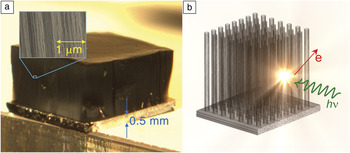
Consider a forest of vertically aligned multiwalled CNTs with macroscopic dimensions ( Figure 1a). It absorbs more than 99.9% of incident light over a broad spectral range Reference Yang, Ci, Bur, Lin and Ajayan3 and optically appears black. Scanning electron microscopy reveals the internal, mostly hollow structure of the CNT forest, where neighboring CNTs are tens of nanometers apart, although they come into contact regularly since they are not perfectly straight. The structure is highly anisotropic in terms of electrical and thermal conductivities and optical absorption; Reference Jakubinek, White, Li, Jayasinghe, Cho, Schulz and Shanov4,Reference Vahdani Moghaddam, Yaghoobi and Nojeh5 its properties are primarily determined by intra-CNT characteristics along the vertical direction and by inter-CNT contacts in the two transverse directions.
(a) Photograph of a millimeters-tall multiwalled carbon nanotube (CNT) forest, with the scanning electron micrograph (inset) revealing its nanostructure. Reprinted with permission from Reference Reference Vahdani Moghaddam, Yaghoobi, Sawatzky and Nojeh42. © 2015 American Chemical Society. (b) Schematic (not to scale) of a heat trap experiment, where incident light locally heats the CNT forest, leading to localized incandescence and thermionic emission. Note: h, Planck’s constant; ν, frequency.

Upon illumination by a focused beam of light, absorption by the nanotubes creates local heating (Figure 1b). Intuition tells us that a rise in temperature should rapidly propagate along the high-conductivity direction of the CNT forest; however, quite surprisingly, the heat has been observed to remain highly localized. Reference Yaghoobi, Vahdani Moghaddam and Nojeh6 (Please see the section “Physics of heat trap and related developments” for possible explanations of this effect.) The result of this “heat trap” effect is that relatively little energy is wasted in the form of conduction, and the temperature rises significantly at the point of illumination. Consequently, this conductive material can reach a few thousand degrees with modest amounts of optical power. At such temperatures, a significant part of the input power leaves the material in the form of incandescence and thermionic emission.
The input intensity required for this localized thermionic emission is only a few tens of W/cm2—orders of magnitude lower than what traditional metallic photothermionic cathodes require. This leads to a dramatic relaxation of the requirements of the optical source. It removes the need for high-intensity pulsed lasers and makes it possible to use much simpler, low-intensity continuous-wave lasers. For instance, a thermionic emission current of 100 nA was obtained using only 4 mW from a battery-operated handheld laser; even lower powers are needed for smaller emission spots. Thermionic cathodes thus enter the realm of laser-pointer operation. By exploiting plasmon resonance to intensify the local optical field and the heating (for instance, via decorating the CNTs with silver nanoparticles) or adding an electric field, the absorption and emission properties can be enhanced even further. Reference Monshipouri, Abdi and Darbari7,Reference Li, Bai, Li and Dai8 Comparable results have also been observed from CNT sheets. Reference Hendrix, Deibel, Fairchild, Maruyama, Urbas, Walker and Brown9
Applications of heat trap-based photothermionic emitters
A laser may not be needed altogether for heating the CNTs, and more readily available sources of light may be used, especially given that heat trap in CNTs has been observed using a variety of wavelengths ranging from ultraviolet to infrared. Considering the average sunlight intensity of 0.1 W/cm2 on Earth, a few hundred times magnification will bring the intensity above the ∼10 W/cm2 heat trap threshold for CNTs. One can achieve this with a primitive optical system such as a handheld glass lens (reminiscent of using a magnifying glass to burn paper with sunlight). A solar thermionic electron source in fact has been demonstrated based on CNT forests. Reference Yaghoobi, Vahdani Moghaddam and Nojeh10 What additionally simplifies these devices is the suppressed heat conduction itself, which prevents the heating of the cathode assembly and contacts, eliminating thermal management requirements.
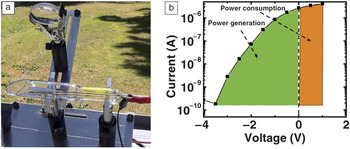
With the remarkable simplicity offered by these photothermionic cathodes, new application opportunities emerge. A direction of great interest is thermionic energy conversion. Reference Abdul Khalid, Leong and Mohamed11 (For a detailed description, refer to the article by Mannhart et al. in this issue.) Briefly, this mechanism, more appropriately called thermoelectronic energy conversion, especially in the case of purely vacuum-based devices, consists of the circulation of electrons from a hot cathode to a cold anode, and then back to the cathode through an external load. The energy used to heat the cathode is thus converted to electricity. The CNT forest, with facile solar heating, has enabled the creation of compact and simple solar thermionic converters Reference Yaghoobi, Vahdani Moghaddam and Nojeh10,Reference Dridi, Khoshaman, Nojeh, Sawatzky, Nojeh, Dridi, Voon and Chowdhury12 ( Figure 2 ). These stand in contrast to past devices that required large-scale optics and complex heat-capture systems for the solar heating of conventional thermionic cathodes. The fact that a large temperature difference is established between two regions of the CNT forest, which is a conductor, has also been used to demonstrate thermoelectric energy conversion. Reference Fan13 On another front, the strong optical absorption of CNT forests has been employed in thermophotovoltaics. Reference Lenert, Bierman, Nam, Chan, Celanović, Soljačić and Wang14
(a) A simple solar thermionic device based on a carbon nanotube (CNT) forest in a small glass vacuum tube. (b) Current–voltage characteristics of a CNT forest thermionic converter (not the device in [a]) under illumination by sunlight, showing power delivery to the external circuit. Reference Yaghoobi, Vahdani Moghaddam and Nojeh10

Based on the localization of heat and thus the electron emission spot, shaped and multibeam electron sources can be created simply by shaping the input optical excitation. Reference Vahdani Moghaddam, Nojeh and Cheung15 Such sources are desirable in electron-beam lithography in order to increase throughput. Low-power laser excitation of CNT-based sources may also enable simple and inexpensive electron microscopes, where a compact cathode would be a critical component. Reference Chang, Dridi, Nojeh, Pease, Nojeh, Dridi, Voon and Chowdhury16 Such microscopes may make high-resolution imaging broadly accessible and find applications in point-of-care medical diagnostics.
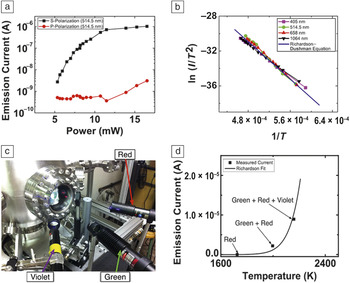
Heat trap cathodes also have other appealing properties for applications. Much higher thermionic emission currents are measured when the input beam is polarized along the CNT axis, but the current is relatively insensitive to the excitation color for multiple wavelengths from visible to infrared ( Figure 3 ). Compared to conventional thermionic cathodes, the ON/OFF response of the CNT forest is practically instantaneous as seen by the naked eye. Reference Chang, Vahdani Moghaddam, Nojeh, Tsujino, Gobrecht, Paraliev, Braun, Groening and Feurer17 These cathodes can also operate under poor vacuum conditions—up to about 10–3 Torr (∼0.13 Pa) Reference Chang, Dahmardeh, Vahdani Moghaddam, Mirvakili, Madden, Takahata, Nojeh and Berggren18 —although lifetime and stability may be affected.
(a) The thermionic emission current from the carbon nanotube forest is higher for S-polarization (where the electric-field vector of the incident light is along the axis of the nanotubes) than P-polarization (electric-field vector perpendicular to the axis of the nanotubes). (b) The emission current is relatively insensitive to the illumination wavelength and follows the Richardson–Dushman equation, confirming the thermionic nature of the emission. (c–d) Combining beams of light with different wavelengths acts as though the powers have been added. Reprinted with permission from Reference Reference Vahdani Moghaddam, Yaghoobi and Nojeh5. © 2012 AIP Publishing. Note: I, emission current; T, temperature.

Physics of heat trap and related developments
Given that single CNTs are good thermal conductors, the heat trap phenomenon is surprising. A possible explanation for the effect is that the inter-nanotube entanglements and defects in a CNT forest may reduce its thermal conductivity substantially compared to that of pristine, individual CNTs. CNT forests with low thermal conductivity have been reported. Reference Jakubinek, White, Li, Jayasinghe, Cho, Schulz and Shanov4
However, there may be other effects at play. We can consider a hypothetical forest of defect-free, perfectly aligned CNTs. The thermal conductivity of a crystal typically decreases at high temperatures; a particularly steep decrease with temperature has been observed in CNTs. Reference Pop, Mann, Wang, Goodson and Dai19 This effect, combined with the highly anisotropic heat transport in the forest, may lead to strong heat localization, even if thermal conductivity is high at room temperature. Reference Yaghoobi, Vahdani Moghaddam and Nojeh10 This may be thought of as a self-reinforcing cycle, whereby an increase in local temperature results in a decrease in thermal conductivity, which in turn, leads to further temperature increase. This model predicts highly nonlinear behavior with a sharp temperature increase beyond a threshold intensity of the input beam. This threshold intensity, which is a few tens of W/cm2 for a beam spot diameter of hundreds of micrometers (typical in heat trap experiments), increases with a decrease in the spot diameter. Reference Yaghoobi20 This is an important point as it may help bridge the heat trap phenomenon to experiments on laser heating of individual nanotubes or thin bundles. Reference Hsu, Kumar, Bushmaker, Cronin, Pettes, Shi, Brintlinger, Fuhrer and Cumings21–Reference Rossouw, Bugnet and Botton24 In those experiments, which typically involved micrometer-scale optical spot sizes, incident light intensities of hundreds of kW/cm2 or greater led to temperature rises of only a few hundred degrees.
The heat trap effect is also related to other phenomena. Light-induced heat localization has also been observed in CNT sheets, although only for temperatures of tens of degrees Celsius. Reference Aliev, Lima, Silverman and Baughman25 A nonlinear decrease in thermal conductivity in densely packed CNT thin films has been reported from room temperature to 450 K, Reference Duzynska, Taube, Korona, Judek and Zdrojek26 similar to that of individual nanotubes, Reference Pop, Mann, Wang, Goodson and Dai19 and attributed to multiphonon scattering. This supports the notion that similar behavior may also be expected in CNT forests. Laser-induced incandescence and destruction, especially in the presence of oxygen, of CNTs has been seen in forests illuminated with intensities on the order of 10 kW/cm2. Reference Lim, Lee, Lim, Zhu and Sow27 The applicability of Planck’s Law of blackbody radiation to incandescence from an individual CNT has been explored, and single-color pyrometry has been used to measure its temperature. Reference Fan, Singer, Bergstrom and Regan28,Reference Singer, Mecklenburg, White and Regan29 Electron energy-loss spectroscopy has enabled temperature mapping with high spatial resolution based on plasmon shift in metallic nanowires. Reference Mecklenburg, Hubbard, White, Dhall, Cronin, Aloni and Regan30 Joule heating of the apex of a field-emitting nanotube to 2000 K and incandescence have been reported. Reference Purcell, Vincent, Journet and Binh31 Thermionic emission due to resistive heating has been demonstrated from CNTs in various forms. Reference Cox, Forrest, Smith and Silva32–Reference Wei, Jiang, Feng, Liu, Liu and Fan34 Thermally assisted field emission has been observed from CNT films irradiated by 10-ns laser pulses. Reference Wong, Gupta and Hernandez-Garcia35 The Schottky effect has also been reported in thermionic emission from CNT arrays. Reference Kolekar, Patole, Alegaonkar, Yoo and Dharmadhikari36 Almost a century after the development of the Richardson–Dushman model of thermionic emission, new materials such as graphene are showing a fundamentally different temperature dependence Reference Liang and Ang37 (see the article by Ang et al. in this issue).
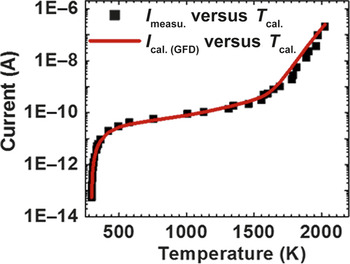
Optical heating and thermionic emission have received increased interest recently, not only in CNTs, but also in other carbon-based systems. Fast photothermionic emission from graphene-based heterostructures has been observed. Reference Massicotte, Schmidt, Vialla, Watanabe, Taniguchi, Tielrooij and Koppens38 Multiphoton-induced thermionic emission from graphite has been demonstrated, where ultrafast (∼25 fs) thermalization of the photoexcited electrons was observed within the electron gas. Reference Tan, Argondizzo, Wang, Cui and Petek39 Photon-enhanced thermionic emission (PETE) from semiconductors has been proposed as a mechanism for creating high-efficiency solar converters. Reference Schwede, Bargatin, Riley, Hardin, Rosenthal, Sun, Schmitt, Pianetta, Howe, Shen and Melosh40,Reference Girolami, Criante, Di Fonzo, Lo Turco, Mezzetti, Notargiacomo, Pea, Bellucci, Calvani, Valentini and Trucchi41 In CNT forests, localized heating has enabled multiphoton thermal photoemission using a low-intensity ultraviolet laser, Reference Vahdani Moghaddam, Yaghoobi, Sawatzky and Nojeh42 showing PETE-like behavior ( Figure 4 ) and fitting the generalized Fowler–DuBridge (GFD) theory of thermal photoemission, which describes the combined effects of light and heat on electron emission. Reference Bechtel, Smith and Bloembergen43 Comparison against the GFD theory has revealed an unusually high two-photon photoemission coefficient for the CNT forest.
The multiphoton thermal photoemission current as a result of irradiation by low-intensity 266-nm light. The beam of light is responsible for both heating and photoemission. At low temperatures, linear photoemission dominates. This is followed by two-photon thermal photoemission at intermediate temperatures and is overtaken by thermionic emission at high temperatures. Reprinted with permission from Reference Reference Vahdani Moghaddam, Yaghoobi, Sawatzky and Nojeh42. © 2015 American Chemical Society. Note: I measu., measured emission current; T cal., calculated temperature; I cal. (GFD), calculated emission current using the GFD theory; Reference Bechtel, Smith and Bloembergen43 GFD, generalized Fowler–DuBridge.

The explanation given previously for the heat trap is not specific to carbon; other one-dimensional (1D) systems might behave similarly—an example has been seen in niobium nanowire yarns. Reference Chang, Dahmardeh, Vahdani Moghaddam, Mirvakili, Madden, Takahata, Nojeh and Berggren18 Reducing the work function of CNT forests (e.g., through potassium intercalation) Reference Westover, Franklin, Cola, Fisher and Reifenberger44 can enhance the electron emission, but it is important to also explore light-induced localized heating in low-work function 1D systems such as nanowires of hafnium carbide Reference Yuan, Zhang, Tang, Shinya, Nakajima and Qin45 or various hexaborides. Reference Xu, Zhao and Zou46–Reference Zou, Zhao and Xu48 The study of the temperature dependence of the work function also becomes important in such material systems. Reference De, Olawole and Solomon49,Reference Olawole, De, Campo, Dobisz and Eldada50
Electron–electron scattering leading to rapid thermalization of electrons among themselves, but staying at higher temperatures than the lattice, has been suggested in van der Waals heterostructures Reference Ma, Andersen, Nair, Gabor, Massicotte, Lui, Young, Fang, Watanabe, Taniguchi, Kong, Gedik, Koppens and Jarillo-Herrero51 (structures made of two-dimensional [2D] atomic layers) and in the photothermionic emission examples previously described. Reference Massicotte, Schmidt, Vialla, Watanabe, Taniguchi, Tielrooij and Koppens38,Reference Tan, Argondizzo, Wang, Cui and Petek39 Similarly, optical phonons in nonequilibrium with the lattice have been observed in CNTs. Reference Pop, Mann, Cao, Wang, Goodson and Dai52 Such situations may well be the case also under heat trap. Further exploration of these effects in CNT forests or arrays of low-work function materials represents an interesting direction of research.
Clearly, with progress in 1D and 2D material systems, there are new opportunities in the future for investigating the physics of optically induced heating and thermal electron emission, and for developing new applications in vacuum electronics and beyond.
Acknowledgments
The author acknowledges financial support from the Natural Sciences and Engineering Research Council of Canada (RGPIN-2017-04608, RGPAS-2017-507958, SPG-P 478867), BCFRST/the British Columbia Innovation Council, the Canada Foundation for Innovation, the British Columbia Knowledge Development Fund, and the Peter Wall Institute for Advanced Studies. This research was conducted, in part, by funding from the Canada First Research Excellence Fund, Quantum Materials and Future Technologies Program. The author also acknowledges CMC Microsystems for the provision of products and services that facilitated this research.

Alireza Nojeh is a professor of electrical and computer engineering at The University of British Columbia (UBC), Canada, and a member of UBC’s Stewart Blusson Quantum Matter Institute. He received his BS and MS degrees from Sharif University of Technology, Iran, a DEA degree from the University of Paris, France, and a PhD degree in 2006 from Stanford University, all in electrical engineering. He was a Wall Scholar in residence at UBC’s Peter Wall Institute for Advanced Studies from 2014 to 2016, and chaired the 29th International Vacuum Nanoelectronics Conference. His research interests include carbon nanotubes, solid-state and vacuum electronics, electron emission, interactions of electrons and photons with nanostructures, and thermionic conversion. Nojeh can be reached by phone at 604-827-4346 or by email at anojeh@ece.ubc.ca.