1 IntroductionFootnote 1
One of the major changes that mark the traditional distinction between Old and Middle English is the loss of grammatical gender. The change, which took place between the tenth and thirteenth centuries, is generally seen as forming part of a larger development, viz. the syncretism of nominal categories. This development was connected with a phonological change that entailed a weakening and loss of unstressed syllables and thus a loss of inflexional endings. Perhaps because of the dramatic formal developments that accompany the change, little attention has so far been devoted to its semantic aspects. No continuity is generally assumed between the Old English system of ‘grammatical’ gender and the ‘natural’ or ‘semantic’ gender of postmedieval English; studies of the intermediate stages in Early and Late Middle English have tended to report a ‘general confusion’ (Markus Reference Markus, Kastovsky and Bauer1988: 248; cf. also Ausbüttel Reference Ausbüttel1904; Curzan Reference Curzan2003). In the present article, it is suggested that this confusion, to a considerable extent, is a product of the wide geographical and diachronic range of texts considered in most empirical studies.
The aim of the present article is to trace the process of gender change within one text community, defined in terms of geography and time: the thirteenth-century Southwest Midlands. For most geographical areas, such a study would not be feasible because of the lack of surviving texts from the period of change. However, the Southwest Midland area provides plentiful material for a study of the gender change, due to a happy combination of circumstances: the late survival of grammatical gender in this area and a relatively large concentration of surviving Early Middle English texts. The material on which the present study is based consists of a group of twenty texts dated to the thirteenth century.
It is here assumed that, within a single speech or text community, the gender of individual lexemes tends to be stable once established (cf. Poplack, Pousada & Sankoff Reference Poplack, Pousada and Sankoff1982: 25–7). Further, it is taken as axiomatic that linguistic variation is, on the whole, orderly rather than chaotic. Any linguistic usage within a reasonably well-defined variety should thus conform to systematic patterns that are in principle describable, even though they may be very complex. Accordingly, it should be feasible to try to define at least some of the criteria involved in Early Middle English gender assignment, as a step towards charting the process of evolution from the Old English system to the postmedieval one.
This paper focuses on the gender of personal pronouns in anaphoric use,Footnote 2 the only category in which gender survives in Modern English. The formal process of gender loss in the determiner system is dealt with in a separate study based on the same material (Stenroos, in preparation), the findings of which will be drawn upon as appropriate.
It will be argued that a semantically based reorganization of gender assignment in anaphoric usage took place during this period. It is suggested that the main semantic patterns involved in this process are best described using the model of a ‘hierarchy of individuation’, recently used by Siemund (Reference Siemund2008) to describe the gender systems of several modern varieties of English. According to this model, the assignment of gender to a noun reflects the extent to which it refers to something conceived of as individual and potentially active. Within this general framework, specific semantic categories may become strongly associated with particular genders. In Early Middle English, for example, it seems that the masculine gender becomes increasingly associated with human referents. It is further suggested that the patterns of Early Middle English gender assignment might form part of a direct line of continuation between the Old English system of grammatical gender and the postmedieval usage, with no need to assume an intervening period of confusion.
2 Grammatical gender in English: some preliminaries
The most often-quoted definition of grammatical gender is arguably that by Hockett (Reference Hockett1958: 231): ‘classes of nouns reflected in the behavior of associated words’. Grammatical genders are not defined on the basis of formal characteristics of the nouns themselves, but on the basis of agreement patterns shown by associated words, such as determiners or adjectives. While grammatical gender is often considered to have been ‘lost’ from English, some recent writers (e.g. Curzan Reference Curzan, Unterbeck and Rissanen1999, Reference Curzan2003) have preferred to speak of ‘gender change’ rather than loss, reflecting the view that Present-day English, rather than being devoid of grammatical gender altogether, has ‘pronominal gender’ (Corbett Reference Corbett1991: 169–70).
The Present-day English use of pronominal gender is at first sight based on natural gender: he and she are used for human beings and for ‘higher’ animals of respective sex, while it is used for everything else. However, it is well known that pronominal usage in Present-day English is not as clear-cut as this. Higher animals and small children may be referred to as it, and it may also be used as a derogatory reference to an adult (Wales Reference Wales1996: 160). Conversely, he/she may be used to refer to inanimates: as is well known, ships and cities are usually she. Such usages are more common in nonstandard than standard speech. It may also be noted that gendered pronouns are in some cases used to refer to animate nouns regardless of sex: generic he for humans has persisted through centuries, while traditional usage at least in some varieties has generalized she for cats of both sexes.
The use of gendered pronouns to refer to inanimates in Present-day English may be considered a marginal phenomenon in that it involves (in Standard English) a very small fraction of the vocabulary. It has, however, been a relatively much studied subject. Recent studies such as Wales (Reference Wales1996) and Curzan (Reference Curzan2003), as well as older ones like Ausbüttel (Reference Ausbüttel1904), treat it largely in terms of speaker attitudes and conceptions about human gender. Thus, the stereotypical use of the feminine pronoun (seemingly by males) when referring to cars, motors, machines and the like has been interpreted in terms of sexual power relations. To some extent, such explanations follow a similar line of reasoning as earlier (and perhaps not always entirely serious) suggestions that a ship is referred to as she because it is a container, like a womb, and that cities are feminine because they need to be conquered.
Such suggestions reflect a general assumption that she in Present-day English is used either in its primary function (referring to humans and higher animates of the female sex) or in a transferred sense based directly on the former: to refer to inanimate objects that share some of the characteristics of female humans. Curzan (Reference Curzan, Unterbeck and Rissanen1999: 572–3) thus suggests that all postmedieval gendered references to inanimates may be interpreted directly in terms of the speakers' attitudes with regard to human gender.Footnote 3 She bases her argument on a study of the (often heavily sexist) explanations of gender usage in English by sixteenth- and seventeenth-century grammarians. While acknowledging their general tendency to follow Latin categories, she suggests that they ‘can contribute to a new understanding of the relationship between cultural definitions of gender for speakers and semantic categories of gender in their language’. The argument seems to presuppose that native speakers' own interpretations are reliable evidence of semantic categories (cf. Lakoff Reference Lakoff1987: 98–102). However, as Comrie and Polinsky (Reference Comrie, Polinsky, Justus and Polomé1999: 575–6, 585–6) have shown, this is not necessarily the case. Rather, semantically based categories exist as part of a historical process, and are not necessarily readily explicable by synchronic logic.
Curzan is, of course, well aware of the diachronic perspective, even though she tends to stress change rather than continuity: ‘gender categories will alter through time with shifts in cultural values and beliefs’ (Curzan Reference Curzan, Unterbeck and Rissanen1999: 562). However, it should perhaps not be taken for granted that the shifts reflected by changes in gender assignment necessarily, or mainly, have to do with attitudes towards the human sexes/genders.
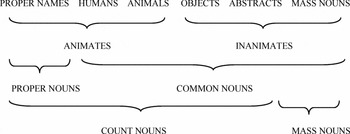
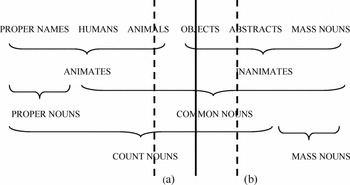
It is now widely accepted that the core principle of gender assignment in human languages has to do with an ‘animacy hierarchy’ (Dahl Reference Dahl, Unterbeck and Rissanen1999a: 99, Reference Dahl, Unterbeck and Rissanen1999b: 577) or ‘hierarchy or continuum of individuation’ (Siemund Reference Siemund2008: 140), that is, the extent to which the referent of a noun is conceived of as an individual entity. Definitions of the precise characteristics on which the hierarchy is based vary somewhat between scholars. Siemund's classification, based on Sasse (Reference Sasse, Kastovsky, Kaltenböck and Reichl1993: 659), focuses on well-definedness or individuality: at the one end of the continuum are proper nouns, which denote a particular, defined human individual, and at the other end are nouns denoting fuzzy, uncountable substances (see figure 1). Other scholars have focused on animacy, activity or agency. Irrespective of the terms used, the continuum is essentially the same, involving the following order of categories: humans – higher animals – lower animals – inanimate countables – mass nouns.
The ‘scale of individuation’ (cf. Siemund Reference Siemund2008: 140, based on Sasse Reference Sasse, Kastovsky, Kaltenböck and Reichl1993: 659)

Sex-based classifications, while very widespread in languages that have gender, will only apply on the ‘human side’ of a certain cut-off point (for example, between humans and nonhumans, ‘higher’ and ‘lower’ animals, or animates and inanimates). Gender distinctions beyond this point, at the ‘inanimate’ end of the continuum, may or may not have a semantic basis (Dahl Reference Dahl, Unterbeck and Rissanen1999a: 100). When they do, such distinctions may involve various kinds of categories, including so-called ‘crazy rules’ (Enger, forthcoming); these semantic rules tend to be less ‘strong’ than those operating at the animate end, in that they are much less likely to override formal rules (e.g. the association of particular suffixes with a gender).Footnote 4 Bearing this in mind, an empirical study dealing with the semantics of gender in English historical texts must surely begin by asking what categories might be implied by the use of gendered personal pronouns, rather than assuming a priori that these categories will reflect prevalent conceptions of maleness and femaleness.
3 Grammatical gender in Old English and the process of gender change
Old English retained the three Indo-European genders, viz. masculine, feminine and neuter. They were reflected mainly, but not exclusively, as formal choices within the following categories: determiners, adjectives, some numerals, possessives and personal pronouns (anaphora).
Like most languages with gender, Old English combined semantically and formally based gender assignment rules. Words denoting humans were most often assigned gender in accordance with biological sex. This rule worked more regularly for males than females. Thus, all 32 noncompound words denoting males listed under the heading ‘Humankind’ in the Historical Thesaurus of Old English are masculine, while 23 out of 26 words denoting females are feminine.Footnote 5 A relatively large proportion of nouns could be assigned gender on formal grounds: so, nouns ending in -a would always be masculine (guma ‘man’, assa ‘donkey’, wela ‘wealth’), while nouns ending in -u were often (although not always) feminine (giefu ‘gift’, lufu ‘love’ but not sunu ‘son’). A recent study by Platzer (Reference Platzer, Ritt and Schendl2005: 250–1), based on random samples of dictionary entries, shows feminine as the majority gender of nonanimate nouns, making up around 46 per cent of the total, with masculine making up around 32 per cent and neuter around 22 per cent.
From the tenth century onwards, the formal system of gender marking began to break down. This change was much earlier in East Midland varieties than in western or southern ones, gendered forms being retained longest in two particularly conservative areas, the Southwest Midlands and Kent.Footnote 6 As the forms marking gender were case markers as well, the loss of case and gender formally makes up a single process. The direction of causal relationship between the loss of grammatical categories and the phonological development that led to a syncretism of inflexional endings is a controversial question that must fall outside the present article. For the present purpose, it is enough to note that, in the Southwest Midland area, formal distinctions were gradually lost over the thirteenth century; a crucial part of this process was the generalization of an indeclinable the as the definite article. By the fourteenth century, the only formal category that retained distinctive gendered forms was the third singular personal pronoun.Footnote 7
The formal loss of gender distinctions outside the personal pronouns was accompanied by major changes in the principles of gender assignment, often referred to as a change from ‘grammatical’ to ‘natural’ gender. Such a shift might be seen as an inevitable one: Howe (Reference Howe1996: 63) has suggested that pronouns are incapable of maintaining on their own, for any length of time, distinctions that are purely grammatical, i.e. that are not based on ‘real-world entities’ (Howe Reference Howe1996: 61). As will be clear from the present material, the gender patterns in anaphoric reference were in fact changing alongside the loss of distinctions within the noun phrase, although the development within the two categories was far from identical. The assumption here is that the changes reflect a reorganization of the gender assignment system on a mainly semantic basis.Footnote 8
It has frequently been suggested that the influence of French and Latin gender contributed to the change (and particularly to the ‘confusion’; cf. Markus Reference Markus, Kastovsky and Bauer1988: 248). Most plausibly, given that our evidence consists of written texts, it may be envisaged that the gender of anaphoric pronouns might be carried over in direct translation. Of the present material, most texts were, as far as we know, originally composed in English (see further section 5 below); such an effect should thus not be prominent here.
Some writers have envisaged a more general effect of French or Latin gender; Markus (Reference Markus, Kastovsky and Bauer1988: 248) suggests that ‘French native speakers must often have used the wrong gender in English because of interference’ (cf. also Ausbüttel Reference Ausbüttel1904: 11). While such direct interference is debatable, and certainly difficult to trace, it is quite plausible that the gender of a Latin word such as anima, frequently used in devotional literature, might have reinforced the retention of feminine reference to English sawol. Such explanations will mainly involve individual items only. However, the literary convention of feminine personification of abstract nouns, derived from Latin and French literature, must be assumed to play a certain role in the retention of feminine reference to nouns such as rihtwisnesse ‘righteousness’ or eadmodnesse ‘modesty’ in the present material (cf. section 7 below).
4 Some recent studies of the gender change
The gender change has been the subject of several studies, most of which have aimed at covering a wide geographical range. A thorough study of Old and Early Middle English materials was recently carried out by Curzan (Reference Curzan, Unterbeck and Rissanen1999, Reference Curzan2003), based on the Helsinki Corpus material. Curzan's study included several different areas and periods, as well as different types of texts; as the author herself suggests, however, it is precisely this broadness of coverage that makes the material difficult to systematize and interpret (Curzan Reference Curzan2003: 55).
Curzan's statistics show the overall increase over time of it reference in all areas. Her material also suggests that, in the Early Middle English period, the feminine gender survives significantly better than the masculine when it comes to reference to inanimate nouns. In this respect, her study goes against the suggestion of ‘masculinisation’ put forward by Clark (Reference Clark1957: 113), who found that, in the twelfth-century Peterborough Chronicle, the feminine gender was ‘most affected by weakening and withdrawal’; it also seems at odds with the description of later medieval and early modern usage by Ausbüttel (Reference Ausbüttel1904: 130), who concludes that he is much more common than she.
The somewhat earlier studies by Jones (Reference Jones1967a, Reference Jones1967b, Reference Jones1988) focused on a detailed study of only a few texts, representing different areas and periods; they thus form a series of case studies rather than a survey. Jones focused solely on the development within the noun phrase. On the basis of the variation he found, he suggested an incipient reorganization where the earlier gender and case markers were reinterpreted as discourse markers or pure case markers. The present material, with the possible exception of Layamon's Brut, one of the texts studied by Jones, shows no traces of such a system (see further Stenroos, in preparation).
The main problem with broad-scale studies such as that carried out by Curzan has to do with the regional differences in Middle English, and in particular the varying rate at which the gender change took place in different dialects. The Helsinki Corpus material that was used by Curzan is divided into fairly narrow chronological periods; as the gender change takes place at markedly different dates in different parts of the country, each time slice is likely to include texts at different stages of the process, making it difficult to trace coherent patterns. There is also no particular reason to assume that the details of the change were alike in all parts of the country; the different systems of gender assignment in varieties of Modern English (cf. Siemund Reference Siemund2008) may well go back to divergent developments at an early stage.
Accordingly, it is also difficult to make generalizations out of individual studies such as those by Clark and Jones. It is fair to say that, with regard to the gender change, different studies have tended to produce remarkably contradictory results, showing evidence for both an overall neutralization (Ross Reference Ross1936: 324–5) and masculinization (Clark Reference Clark1957: 115) of the English noun, as well as the ‘anaphoric feminization’ suggested by Curzan (Reference Curzan2003: 110). In his seminal study, which, again, involved a large corpus of texts representing different areas and periods, Ausbüttel (Reference Ausbüttel1904: 2) despaired of seeing any clear patterns:
Fast überall Verschiedenheit und Doppelgeschlechtigkeit, die sich zuweilen sogar in ein und demselben Satze findet, fast nirgends Einheit, die grösste Verwirrung der Genera, das ist das Charakteristikum der me. persönlichen Genera, und der Versuch, einheitliche Prinzipien für sie aufzustellen, scheint fast unmöglich. [Nearly everywhere variation and double gender, even at times within the same sentence, hardly anywhere unity; Middle English personal genders are characterized by the greatest confusion, and the attempt to establish unified principles for them seems nearly impossible. – My translation]
It is likely, however, that the confusion found by Ausbüttel was to a considerable extent a result of the wide geographical and diachronic range of his material. It is, perhaps, all the more remarkable that no study to date, as far as the present writer is aware, has attempted to trace the change within a more restricted area and period.
5 The present study: materials and methodology
The Southwest Midland area provides particularly promising material for a regional study of the English gender change. Compared with most other parts of England, the surviving texts from the period of change provide a fairly large corpus of texts. For the present purpose, the area is defined as consisting of Herefordshire and Worcestershire, as well as North Gloucestershire and South Shropshire.Footnote 9 This area shows both a certain dialectal cohesion and a concentration of localized texts, many of which are interconnected, either textually, by manuscript association, or, less tangibly, by what seems like a shared audience or reference group. The last kind of interconnectedness is particularly notable in the case of the texts of the Ancrene Riwle/Wisse, the ‘Katherine Group’ and the ‘Wooing Group’.
The corpus compiled for the present study consists of twenty texts dated to the period 1175–1300. They have all been localized in the area, on dialectal grounds, by Margaret Laing as part of her work on the Linguistic Atlas of Early Middle English (Laing & Lass Reference Laing and Lass2007–).Footnote 10 A full list of the texts, indicating the samples used, is given in the Appendix. The list also provides short name tags used to identify the texts in the examples below.
The corpus does not provide a range of text types of the kind possible to compile from later Middle English materials; it does, however, provide a good spread with regard to literary form, consisting of eleven verse texts and nine prose texts. The former include two verse miscellanies (Jesus 29 and Digby 86), a verse chronicle (the two scribal stints in the Caligula MS of Layamon's Brut), a romance fragment (Floris and Blancheflur), four versions of the Poema Morale (apart from one in Jesus 29), the biblical story of Iacob and Iosep and the so-called ‘Worcester Fragments’ written by the ‘Tremulous Hand of Worcester’. The latter include four versions of the Ancrene Riwle/Wisse, the Royal MS of the ‘Katherine Group’, the Nero text of the ‘Wooing Group’, the two main hands of the Lambeth Homilies and an early sermon connected with Worcester.Footnote 11 Most of the texts are assumed to have been originally composed in English. While several have French parallels, only Floris and Blancheflur is known to be a reasonably faithful translation of a French original. Layamon's Brut, also a translation, represents a very free rendering indeed.
Shorter texts are analysed in their entirety, while longer ones are analysed in samples of approximately 10,000 words. All instances of anaphoric pronouns referring to nonhumans have been collected (humans here including human-like beings such as the devil). Reference to humans is much more frequent than that to nonhumans, and the usage is predictable and regular over the entire material.Footnote 12 Because of this, pronouns referring to humans have not been collected systematically. For nonhumans, the total number of instances of anaphoric reference collected is 786, involving 178 different nouns as antecedents. Of these, inanimates make up 679 tokens involving 151 different antecedents. The remaining group (107 tokens; 27 antecedents) consists of nonhuman-like animates, that is, animals.
The great majority of the nouns referring to nonhumans are of Old English origin. There are only fifteen French loanwords, making up 8 per cent of the total of lexemes; in addition, there is one Latin word (credo) and two words of uncertain origin (basket, cray). There are at least twelve instances where the antecedent is uncertain or consists of more than one noun, and numerous instances where it is unexpressed or consists of a grammatical structure above word-level. The statistics presented below include only such examples as may be considered relatively unambiguous.Footnote 13
Not all instances of anaphoric reference are informative with regard to gender. Already in Old English, the forms his, him were ambiguous, signalling either masculine and neuter. In Early Middle English, the unrounding of the reflex of Old English eo(:) is assumed to have led, in the spoken mode, to a loss of distinction between he ‘he’ and heo ‘she’. Written systems that lack the distinction are, however, rare in Middle English: for the most part, either the innovative form she was adopted, or the form heo was retained in writing (Black Reference Black1999: 76). All the texts here considered distinguish between he and heo, even though the distinction is likely to have been a purely orthographic one for several of the scribes. Occasional back spellings of <eo> for <e> in some part of the vocabulary occur in most texts; however, only two of the texts, the Lambeth Homilies and Layamon's Brut, show a large number of spellings of heo for he. The opposite, he spellings for heo, is extremely rare. With regard to these two texts, it must therefore be borne in mind that the nominative forms of the masculine and feminine pronouns are not, in practice, fully distinguished formally. However, the distinction is quite regular in all the other texts; here, the frequently occurring references to humans provide a reliable test. Accordingly, he and heo are throughout taken at face value, as masculine and feminine pronouns respectively, in the statistics presented below, without entering into speculations about the precise function of <eo> in each text.
Some words of caution are needed concerning the interpretation of the statistics. Firstly, every word has its own history, and comparatively high figures may to some extent reflect the frequent occurrence of individual words that regularly retain their etymological gender. Thus, in the three earliest texts of the Ancrene Riwle/Wisse, each sample contained a high number of occurrences of the word heorte ‘heart’, which is throughout referred to using the feminine pronoun; in the Corpus text, the references to ‘heart’ account for 15 out of the overall 42 occurrences of etymological gendered reference. However, such frequent words do not account for the majority of tokens in any text here considered.
It should also be kept in mind that the texts generally do not represent the active, unconstrained usage of their writers. All the texts included in the present study (with the partial exception, it is assumed, of the Worcester Fragments) are scribal copies. Some were certainly copied long after the original composition of the text; in the case of the F text of the Poema Morale, the interval may have been as long as two centuries. While it is often possible to recognize a scribe's general copying strategy (translating, literatim or something in between),Footnote 14 it is seldom possible to establish with certainty his active practice with regard to any given linguistic feature. However, in a localized, dialectally consistent text, any regularly occurring feature is assumed to have been acceptable to the scribe whose usage is reflected in the text: it forms part of the ‘text language’ (Fleischman Reference Fleischman, Herring, van Reenen and Schøsler2000: 34), which is the only direct informant available to us.
6 The data
6.1 Animates
As far as is known, gender distribution in the animate category is at least partially semantically based in all languages that include gender as a category. A distinction based on male and female sex is very widespread when it comes to human referents, even though nouns referring to humans may have a grammatical gender that conflicts with the biological sex of the referent. Even in such cases, however, anaphoric reference often agrees with the latter. According to the ‘agreement hierarchy’ postulated by Corbett (Reference Corbett1979, Reference Corbett1991: 226), personal pronouns are more likely than attributive elements to show semantic rather than syntactic agreement. This reflects what Curzan (Reference Curzan2003) has called the ‘slippery’ nature of anaphora – anaphoric pronouns do not simply refer to a particular word but also to things outside the text; in other words, there is no strict dividing-line between anaphoric and exophoric reference.
In the present material, anaphoric reference to nouns referring to grown-up humans and human-like beings consistently follows biological sex (or, in the case of mythological or spiritual beings, culturally conventionalized gender). In cases of a conflict between grammatical and biological gender, Old English, like Present-day German, could show either syntactic or semantic agreement; however, as shown by Curzan (Reference Curzan2003: 62), semantic agreement seems to have been preferred in the vast majority of cases. In the present material, anaphoric reference to grown-up humans is throughout semantically based, even when the pronoun follows very closely upon its antecedent:
(1) Heo slepeþ so faste þt mayde suete þat heo ne may nouʒt come ʒete
‘she is so fast asleep, that sweet girl (neut.), that she cannot come yet’ (FB)
(2) Make bitere man as wif ded for hire child
‘make a bitter lamentation as a woman (neut.) does for her child’ (Caius)
(3) Ouer soh seiden þat ʒunge [vif]mon; hire folweð mochel wisdom
‘That young woman (masc.) spoke very true [words]; great wisdom follows her’ (LayAb)
The antecedent child, like bearn (both etymologically neuter), is referred to by it when it signifies a baby: as wif ded for hire child. . . þe naued buten him ane & sið hitbiuoren hire ferliche a-sterwen ‘as a woman does for her child . . . who has none but it/him and suddenly sees it die before her’ (Caius). The switch to gendered reference generally takes place as the child reaches a point where it is viewed as an active individual; this may take place abruptly within the same sentence: þis childweox . . . & al folk hitwes leof; þa hecuðe gan & speken . . . ‘this child grew and it was dear to all the people; when he could walk and speak . . .’ (LayAa)
Generic he is used commonly: muche fol were þe mahte to his bihoue hweðer-se hewalde grinden ‘it would be a great fool, who could grind for his need wherever he wished’ (AW). However, the three oldest texts of Ancrene Riwle/Wisse commonly use generic she, reflecting their specific female text universe: euch schal halden þe uttre efter-þ at hamei best ‘everyone must keep the outer (rule) as best she can’ (AW).
Virtually all human-like mythological or spiritual beings referred to, including feond, deofel, engel and drake, are referred to by he: lucifer . . .þurh-þet heiseih ‘Lucifer . . . through what he saw’ (NeroA). Most words for such beings were masculine in Old English; however, masculine reference is used also for words such as wiht (‘being’, OE neut.), when it refers to the devil: þat foule wiʒt . . . hene loueþ þe nout ‘that foul being . . . he does not love you’ (D86). The OE feminine nædre ‘snake, serpent’ may be taken to illustrate the fuzzy boundary of the category ‘human-like beings’, as it may be interpreted as referring to the Devil either as a ‘superhuman’ (he) or in the shape of a serpent (she), and thus appears both with a masculine/neuter and feminine pronoun:
(4) Eue heold i parais long tale wið þe neddre; talde him al þe lecun (Cleo)
(5) Eue heold ine parais longe tale mid te neddre & tolde hire al þat lescun
‘Eve had a long conversation with the serpent in paradise . . . and told him/it/her the entire lesson.’ (NeroA)
When referring to the animal only, nædre retains its Old English gender: Nedreattreð . . . al þx heopriked ‘The serpent/snake poisons . . . everything that she stings’ (Lam2).
The category of animals is on the whole the most regular one in retaining Old English gender. Most nouns referring to animals are of Old English origin, and they virtually always retain their Old English gender. Thus, cat, dogge, hund, ile and hare are referred to using the masculine pronoun, while culure, hen and ule are referred to as feminine. As with the reported present-day use of she for tomcats, biological sex seems to be unimportant in reference to animals. Thus, the falcon is masculine (following both its Old French gender and, it seems, a semantic association of large birds of prey with the masculine gender) even when engaged in emphatically nonmale activities: þo hit bycom þat hehayhte & of hiseyre briddes wrauhte ‘then it happened that he hatched and brought out chicks from his eggs’ (J29).
Finally, like humans, very young animals tend to be referred to as it, irrespective of the gender of the antecedent: þat fule brid . . . . þat pie and crowe hitto-drowe ‘the foul chick (OE masc.) . . . so that the magpie and crow tore it to pieces’ (J29).
6.2 Inanimates: the survival of grammatical gender in the individual texts
When it comes to inanimate nouns, the first point to note is that much of the Old English gender system is retained in anaphoric reference. Approximately half of all native nouns that were masculine or feminine in Old English retain their gender in the majority of occurrences; this is true of 49 per cent of the masculine nouns and 52 per cent of the feminine nouns. At the same time, the spread of neuter (h)it is well under way: approximately one-third of the OE masculine or feminine nouns (38 per cent and 29 per cent respectively) are referred to by (h)it only.
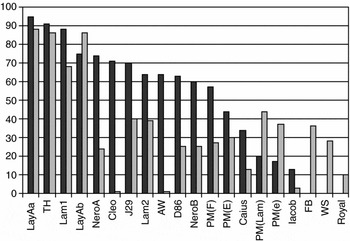
The extent to which Old English grammatical gender is retained varies, at first sight, greatly from text to text. Figure 2 shows the proportions of historically ‘correct’ anaphoric pronouns referring to etymologically masculine and feminine nouns, arranged from the most conservative to the most advanced texts. For the sake of comparison, the proportions of historically correct definite articles (not including the unmarked masculine nominative singular forms) in the same texts are shown in a lighter shade.
Comparison of percentages of (a) historically expected anaphoric pronouns for masculine/feminine inanimates, and (b) historically expected forms of the definite article (except masc. nom. sg). The former are shown in a darker shade. Descending order according to the retention of gender in anaphoric usage

It may first of all be noted that the most conservative texts (Layamon's Brut, the Tremulous Hand and Hand 1 of the Lambeth Homilies) show very high proportions (around 80–90 per cent) of explicitly marked gender forms in anaphoric reference; the first two also show very high proportions of gender marking in the definite article. For most texts, however, the figures for anaphoric usage in the diagram are higher than those for the determiners, sometimes considerably so.Footnote 15 The difference is particularly dramatic in the three earliest texts of the Ancrene Riwle/Wisse, all of which retain a high proportion of masculine and feminine anaphoric pronouns, but show few or virtually no remnants of gender marking within the noun phrase.
Three texts, Floris and Blancheflur, the Royal MS of the Katherine Group and the Worcester Sermon, show no gendered anaphoric usage at all. However, none of these texts shows many occurrences of anaphoric reference overall. Most texts that contain a reasonable number of occurrences do retain gendered usage: in fact, with the single exception of the Caius text of Ancrene Riwle, all those texts that contain more than fifteen occurrences of anaphoric reference to etymologically masculine or feminine nouns also show the OE gender being retained in more than 60 per cent of the occurrences.
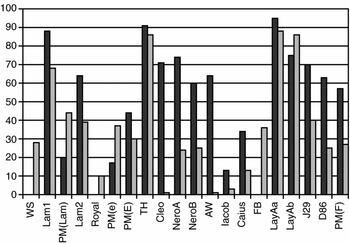
The differences between the texts do not appear to have any direct correlation with chronology. Figure 3 shows the data from figure 2 rearranged chronologically. There seems to be no discernible pattern; on the contrary, some of the most conservative texts (most notably the Layamon texts and Jesus 29) belong to the end of the period. This is true both of anaphoric reference and of gender distinctions within the noun phrase. It is suggested in Stenroos (in preparation) that this lack of correlation indicates a period of variable usage, during which formal gender marking within the noun phrase was optional or may have survived in local pockets. Around 1300, however, a critical threshold seems to have been reached with regard to gender within the noun phrase: as far as the present writer is aware, there are very few traces of it left in fourteenth-century texts.
Comparison of percentages of (a) historically expected anaphoric pronouns for masculine/feminine inanimates, and (b) historically expected forms of the definite article (except masc.nom.sg). The former are shown in a darker shade. Approximate chronological order

In Stenroos (in preparation), three possible governing factors are suggested for the varying degrees of syncretism in the determiner system. Firstly, the six most conservative texts (Lambeth A and B, Layamon A and B, the Tremulous Hand of Worcester and the Jesus 29 miscellany) are localized within a fairly small area, suggesting a regional or local centre of very conservative usage. Secondly, with the exception of the Lambeth Homilies (some of which are translations from Old English), prose texts in general show fewer gendered determiner forms. Thirdly, there may be a significant correlation between the use of French loanwords and an advanced stage of gender loss within the noun phrase.
With regard to anaphoric reference, these governing factors do not seem equally pertinent. There is no clear geographical pattern: texts with a relatively high percentage of historical gender in anaphoric usage (over 50 per cent) include ones localized both in the far northwest (the Corpus and Cleopatra texts of Ancrene Wisse) and the south (the Digby 86 miscellany and the Fitzwilliam Poema Morale). The differences in anaphoric gender usage between texts with high and low frequencies of French loanwords (such as the Ancrene Riwle/Wisse texts and Layamon's Brut) are also relatively minor.
Finally, anaphoric pronouns that retain Old English gender are common in prose as well as verse. Leaving out the archaic Hand A of the Lambeth Homilies and the short Worcester Sermon, the remaining six prose texts (NeroA and B, Cleo, Lam2, AW and Caius) show a marked difference between the retention of gendered forms in determiners and anaphoric pronouns. In all, there seems to be no particular difference between prose and verse texts when it comes to the retention of grammatical gender in anaphoric use.
It may be concluded that the extent to which anaphoric pronouns retain etymological gender is comparatively high in the present material and shows far less variation between the texts than the retention of gender-marked determiners. The fact that most prose texts show a low proportion of gender-marked determiners suggests that these were already nearly or completely obsolete in speech. Anaphoric pronouns thus seem to retain the Old English gender system at least for some time after the loss of gender within the noun phrase.
6.3 Inanimates: the distribution of genders
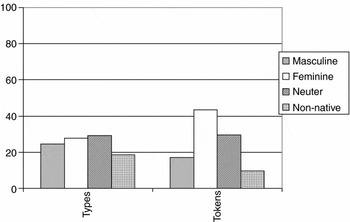
In order to discuss the distribution of genders in the present material, it will make sense to begin by looking at the gender distribution of the Old English reflexes of the inanimate nouns. Using the Anglo-Saxon Dictionary by Clark Hall as the reference point for Old English genders, it seems that the nouns divide fairly evenly into masculine, feminine and neuter (see figure 4). Compared with Platzer's figures, given in section 3 above, the neuter is much more strongly represented in the present material, while the feminine is less common. There is no particular need to assume that this reflects an overall change in the English vocabulary between the Old and Early Middle English periods: the vocabulary of the present material is not a random dictionary sample, such as the one used in Platzer's study. At the same time, Old English feminine nouns occur more frequently than others in the present material, so that a count of tokens shows the feminine as the best-represented Old English gender.
The Old English gender of antecedent nouns in the present material (percentage)

Figures 2 and 3 show clearly that the gender change in anaphora does not proceed in direct parallel with the development within the noun phrase. This is hardly surprising, as the two processes involved are different in detail (although, of course, ultimately related). The distribution of genders may, accordingly, be expected to differ depending on which grammatical category is considered.
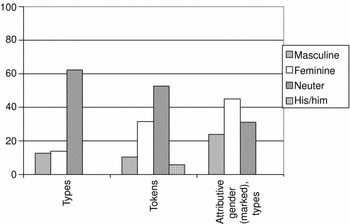
Within the noun phrase, the change is towards a complete loss of gender marking: the gender-marked determiner forms are gradually replaced by unmarked ones.Footnote 16 In the present material, the gender distribution of nouns, based on determiner usage, will thus only show the gender distribution of the residue that do not show generalized forms. A full discussion of the material is given in Stenroos (in preparation); here it may be noted that, of all lexemes appearing with gender-marked determiners, feminine ones are in a clear majority with 45 per cent (see figure 5). It may also be noted that, with the exception of the Layamon B-scribe, gender-marked determiners showing unhistorical gender are relatively rare.
The distribution of pronominal gender in the present material, compared with the distribution of marked attributive gender (percentage)

When it comes to anaphoric reference, however, gender is not lost but reorganized. The distinction between the three genders is retained, even though the patterns of distribution change as OE neuter (h)it is extended to originally non-neuter nouns, eventually taking over most of the inanimates. Old English neuter nouns retain their gender in virtually all cases, with two exceptions that will be discussed in section 7 below.
Of all the nouns that occur with anaphoric reference, neuter nouns make up 62.2 per cent of the total, while feminine and masculine make up 13.9 per cent and 12.6 per cent respectively (see figure 5). The remaining 11.3 per cent consists of nouns that show variable gender.
Curzan's (Reference Curzan2003: 110) study suggested that, for inanimate nouns, the masculine gender was the one to show most weakening in the Early Middle English period: nouns that were feminine in Old English were more likely to be referred to by the etymologically ‘correct’ pronouns. The present study shows no significant difference between masculine and feminine nouns at the level of lexemes. However, it may be noted that, in terms of the total number of tokens, feminine anaphoric pronouns for inanimate nouns are about three times as common in the material as masculine ones. This is due to the extreme frequency of references to some of the feminine nouns, notably heorte ‘heart’, sawol ‘soul’ and synn ‘sin’. Most of the texts are devotional ones and deal with the individual's spiritual life; the core vocabulary in such texts simply contains many feminine words. Another selection of text types, should that have been available, might have shown a less marked skewing towards the feminine; however, it is unlikely that the picture would have been dramatically different. As a control, the fully secular text of Layamon's Brut may be considered on its own: in the Brut sample, Old English feminine nouns that retain gendered reference outnumber masculine ones with 7 to 2 types and 20 to 2 tokens. As token frequency has been associated with resistance to morphological change (Bybee and Hopper Reference Bybee, Hopper, Bybee and Hopper1984: 17), the much greater frequency of feminine nouns in the present material may well relate to the ‘anaphoric feminization’ found by Curzan.
A few of the nouns in the present material had variable gender in Old English; these generally appear as neuter nouns: so boc ‘book’, lieg ‘flame’, gærsum ‘treasure’.
Of the eighteen non-native nouns with inanimate referents, all except two are referred to as (h)it; the exceptions are riwle (AF reule fem.) ‘rule’ and figer (AF figer masc.) ‘fig tree’, both of which appear as feminine nouns. Corbett (Reference Corbett1991: 71, 81) has shown that loanwords are generally assigned gender by the normal assignment rules of the receiver language; they can thus provide interesting evidence for these rules. Presumably, the present material reflects the productivity of the neuter gender in Early Middle English; however, because of the small number of loanwords, it would be unwise to generalize further from them.
Where the antecedent consists of a structure above word level, or there is no definable antecedent, (h)it is always used; the same is true of double antecedents where different genders are involved:
(6) A wummon þat haued ilosed hire nelde o-þer a sutere his eal seched hit anan-richt & tewent euch strea aþet hit beo ifunden
‘A woman who has lost her needle (fem.) or a cobbler his awl (masc.) will search for it straight away and turn every straw until it is found’ (Caius)
The neuter here appears as an ‘exceptional case default’ gender (Corbett & Fraser Reference Corbett, Fraser, Unterbeck and Rissanen1999: 71), being used in cases where the antecedent cannot be related to any single definable gender; this usage was already established in Old English.
On the whole, the gender assignment of individual nouns is remarkably regular from text to text. Altogether, 96 nouns occur more than once in the material. Of these, as many as 80, or 83 per cent, show consistent gender.Footnote 17 The following sixteen nouns show variation in the gender of the anaphoric pronoun (here given in their Old English dictionary spelling):
Masculine/neuter:sang ‘song’, tear.
Feminine/neuter:bræde ‘meat’, æht ‘possessions’, eorðe ‘earth’, hand ‘hand’, hyd ‘hide, skin’, myrgð ‘mirth’, pin ‘pain’, rest, synn ‘sin’.
Masculine/feminine:dream ‘joy’, mona ‘moon’, deað ‘death’.
Masculine/feminine/neuter:lufu ‘love’, woruld ‘world’.
By far the majority of these nouns show variation between their Old English gender (masculine or feminine) and neuter; this presumably shows the spread of it in progress. It may be noted that, of the feminine nouns, all except one (hand) refer to mass or abstract nouns. Only five nouns appear with both masculine and feminine gender.
Finally, sixteen nouns overall show different genders in attributive and anaphoric usage; these are cyrtel ‘tunic’, nama ‘name’, pytt ‘well’, sang, scrift ‘confession’ (masc.); æht, bliss ‘joy’, dæd ‘deed’, lufu, milts ‘mercy’, pin, spræc ‘speech’, sihð ‘sight’, synn, tid ‘time’, woruld ‘world’ (fem.). In fourteen cases, the attributive usage shows only historical masculine or feminine forms, whereas (h)it appears for anaphoric reference; two nouns (pytt and scrift) show variation between masculine and neuter in attributive usage and are referred to by (h)it only.
To summarize, while the material does show some variation in the use of gendered forms, most of this variation simply shows the regular direction of change. There is no indication of the confusion suggested by scholars dealing with wide regional and chronological ranges.
7 Semantic reorganization
It now remains to ask whether the material simply shows a random spread of it, or whether any patterns may be discerned that would reflect a semantically based reorganization of gender assignment during this period. First of all, it will be worth asking whether those nouns that have shifted from masculine/feminine to neuter show any particular patterning. Such nouns, which appear wholly or almost wholly as neuter,Footnote 18 are listed as follows:
Old English masculine:bigyrdel ‘purse’, bog ‘branch’, cnif ‘knife’, cyrtel, gar ‘spear’, hungor, leap ‘basket’, nama, pyff ‘puff’, pytt, scrift, stocc ‘stump’, swicdom ‘deception’, wa ‘woe’, wela ‘possessions’.
Old English feminine:behæs ‘vow’, betacnung ‘significance’, bliss, cuppe ‘cup’, dæd, fylð ‘filth’, higð ‘effort’, milts, rinde ‘bark, rind’, scamu ‘shame’, spræc, sihð, tidung ‘tiding’.
As in the list of nouns that show variable gender, given in section 6.3 above, a considerable proportion (eight out of twelve lexemes) of the etymologically feminine nouns that appear with a neuter pronoun are uncountable, either concrete (fylð, rinde) or abstract nouns (bliss, higð, milts, scamu, spræc, sihð). In addition, there are four abstract countable nouns (behæs, betacnung, dæd, tidung). Only one is a concrete countable noun (cuppe). The etymologically masculine nouns include a higher proportion of countable ones.
There seem to be certain semantic areas where nouns are particularly attracted to neuterness. Most nouns for property, something owned or won, were already neuter in Old English. A search under the category ‘wealth’ in the Historical Thesaurus of Old English (Roberts and Kay Reference Roberts and Kay1995) produces 34 simple or complex wordsFootnote 19 that can be used to convey the meaning ‘property, goods’, including specialized senses:
Neuter:āgen, ēad, feoh, gesteald, gestrēon, gōd, sceatt, þing; (landed property) lond; (inherited) ierfe; (household goods) inēddisc, yddisc, inorf; (cattle) orf; (treasure) sinc, gold, seolfor; (equipment) geþræc; (worth) (ge)weorþ.
Feminine:āge, ār, faru, feorm, hæfen, wynn, æht. Masculine:begeat, wela; (common property) gemāna; (treasure) māþm. Feminine plural:frætwe. Variable: (treasure) gærsum mn, gærsuma f, hord nm.
Of these nouns, well over half are neuter or variably neuter. Not surprisingly, all the originally neuter words found in the present material are referred to by hit: so feoh, goldhord, lond, ðing, wurð. It seems, however, that the neuter gender at an early stage becomes prototypical for this lexical set, so that nouns that earlier were masculine or feminine come to be referred to with neuter pronouns. In the present material this is evident even in the most conservative texts, which otherwise quite regularly retain Old English masculine and feminine genders for inanimate antecedents. Thus, weole, ehte and world-winne are referred to as (h)it throughout the material,Footnote 20 including several occurrences in such conservative texts as the Tremulous Hand and Hand 1 of the Lambeth Homilies:
(7) þus is iwitan þin weole; wendest þet hit þin were
‘thus your wealth has departed; you thought that it was your own’ (TH)
(8) þe ʒitsere þe biset his iþonc on his ehte; he bið þes deofles bern buten he hit iswike
‘the greedy man who places his thought on his wealth; he is the devil's child unless he gives it up’ (Lam1)
In addition, the noun gærsum(e), of variable gender in Old English, is also neuter in the present material. Similarly, the French loanwords tresor (OF masc.) and marchaundise (OF fem.) appear as neuter; this is, of course, not unexpected considering that most French loanwords in the present material are referred to with neuter pronouns. Conversely, there are virtually no examples of masculine or feminine reference to words within this lexical set.Footnote 21
In general, most of the 28 nouns that in the present material appear to have lost their masculine or feminine gender seem to be either uncountable or denote things with a low degree of individuation. It might be held that the lexical set ‘wealth’, which seems to have become associated with neuterness at a very early stage, involves nouns with a particularly passive and unindividuated meaning. If this reflects a genuine tendency to assign gender on semantic grounds, it should then be expected that words that retain their masculine or feminine genders would have highly individuated referents. Leaving aside such nouns as retain their masculine/feminine gender only or mainly in the more conservative texts, this seems indeed to be the case. There are 21 nouns that regularly retain masculine/feminine reference even in the least conservative texts; these may be grouped into categories such as the following:
Abstract nouns, uncountable:
(9) þurh eie-þurles deað haueð hire inʒong
‘Through the eyes death (masc.) makes her entrance’ (NeroA)
(10) to long[e] [þo]lede deaþ þe . . . þx he nolde nimen þe
‘too long death (masc.) left you alone . . . that he did not wish to take you’ (TH)
(11) þe upere stan bitacneð hope . . . þat eorned and stured hire
‘the outer stone signifies hope (masc.) . . . which runs and stirs herself’ (Caius)
(12) tilunge of rihtwisnesse . . . Silence tileð hire & heo . . . bringeð forð sawles eche fode
‘the cultivation of righteousness (fem.) . . . silence cultivates her and she . . . brings forth the soul's eternal nourishment’ (AW)
(13) eadmodnesse eadiliche bi-giled ure lauerd . . . huded eauer hire god; schaweð ford hire pouerte
‘modesty (fem.) cheats our Lord in a blessed way . . . always hides her wealth; shows forth her poverty’ (Caius)
(14) Sunne let þe & þu naht hire
‘Sin (fem.) leaves you and you don't [leave] her’ (PM E)
Abstract nouns, countable:
(15) þeo oðer [riwle] . . . Heo teacheð . . . þeos is alse þuften
‘the other [rule] (AF fem.) . . . she teaches . . . this one (fem.) is like a handmaid’ (Cleo)
The human body and its parts:
(16) Iblesced beo eauer þos hond, for ha haued ytimbrid me þeo blissen of heuene
‘blessed be always this hand (fem.), for she has built for me the joys of Heaven’ (Caius)
(17) þe tunge is slubbri for ha wadeð i wete
‘the tongue (fem.) is slippery because she wades in moisture’ (AW)
(18) ase nech as ure muð is to world i speche, as feor he is god hwenne he spekeð toward him
‘as close as our mouth (masc.) is to the world in speech, as far is he from God when he speaks towards him’ (Cleo)
More abstract parts of man:
(19) þin owene fles . . . He þat sholde ben þi frend, He doþ þe raþest falle
‘your own flesh (neut.) . . . He who should be your friend, He is the first to bring you down’ (D86)
(20) his owune heorte . . . heo was etstert him . . . heo was ikumen hom
‘his own heart (fem.) . . . she had escaped from him . . . she had come home’ (NeroA)
(21) Wonder þencheþ þe soule . . . wen hoe is faren hout, Isiiþ hire licom
‘the soul (fem.) is appalled . . . when she has gone out (and) sees her body’ (D86)
(22) ure stefne, ne nule he nout i-heren hire vor heo stinckeð
‘our voice (fem.), he does not wish to hear her because she stinks’ (NeroA)
The world:
(23) of þe worldes meaðelunge . . . of hire chafle
‘of the world's (fem.) speech . . . of her chattering’ (AW)
(24) ðeos woruld . . . Mest ealle men he ʒiueð drinche
‘this world . . . offers almost all men drink’ (PMe)
The sun and the moon:
(25) þe mone bledeþ . . . and geþ out of hire riʒte lawe
‘the moon (masc.) bleeds . . . and leaves her normal track’ (D86)
(26) þe sunne schineð þer-þurh & ho nimeð al swuch hou al-se ho þer-on uint
‘the sun (fem.) shines through it (= glass) & she takes on precisely the colour that she finds upon it’ (Lam2)
Plants or fruits, viewed as individuals:
(27) þe lilie myd hire fayre wlite . . . Bid me myd hire fayre bleo þat ich schulle to hire fleo
‘the lily (fem.) with her beautiful face . . . Begs me with her fair countenance that I should fly to her’ (J29)
(28) þe rose also myd hire rude
‘Also the rose (fem.) with her blushing complexion’ (J29)
(29) ha hauet bi-piled mi figer . . . despoled hire stert-naked
‘they have peeled my fig-tree (AF masc.) . . . . stripped her quite naked’ (Caius)
(30) þeyh appel trendli from þe treo þar he and oþer myde grewe, þeyh he beo þar-from bicume, he cuþ hwenene he is icume
‘even though an apple (masc.) fell from the tree where he grew with others, even though he would end up far from there, he shows where he comes from’ (J29)
Objects:
(31) þe harde rode heue him . . . luueliche bi-cluppede hire
‘the hard cross (fem.) carried him . . . lovingly (he) embraced her’ (Caius)
Many of the nouns and categories included in the list are cited by Ausbüttel, and seem to appear with non-neuter pronouns in much later texts, at least occasionally. Most are here referred to by the feminine pronoun; the only examples of masculine gender are appel ‘apple’, deð ‘death’, flesc ‘flesh’, muð ‘mouth’ and woruld ‘world’. In most cases (16 out of 21), the nouns retain their Old English gender; however, the following appear with a different gender: deað, hope, flesh, mone and world. In some of these cases, the gender may be influenced by a well-known and often personified Latin equivalent, suggesting a feminine personification of death and of the moon, and a masculine one of the world; similarly, the Latin gender may have reinforced the Old English gender of some words (sawol, rode). However, such an explanation, if feasible, could still not account for all the cases either of gender change or gender retention: the masculine gender of flesh and the retention of feminine reference to heart, sin and sun certainly cannot be explained in such a way.
There does, however, seem to be a semantic pattern. All antecedents involved seem to be viewed as clearly defined individuals, often (if not always) actively involved in an action. Some of the examples could, indeed, be defined as instances of personification on the grounds that the inanimate nouns are given human attributes of some kind; in most cases, however, the personification involved is at the level of everyday metaphors such as ‘the moon sailed across the sky’.
It would appear that the nouns that retain masculine or feminine gender even in the less conservative texts all relate to concepts that are seen as highly individualized. The two neuter words that appear with non-neuter reference in the material, bold and flesh (19), also seem to relate to such highly individualized concepts:
(32) þis bold mayde þe is bihote . . . Hit stont vppon a treowe mote . . . þar hit neuer truke ne schal . . . Ne may no Mynur hire vnderwrote
‘this castle is promised to you, maiden . . . it stands on a true motte . . . where it will never fail . . . nor will any miner undermine her’ (J29)
The flesh is referred to as an individual who should be a ‘friend’ but is not; the castle, while standing passive, is a highly specific, well-defined concept. Conversely, the neuter pronoun seems to have spread most fully to nouns that have referents with a low degree of individuation, typically mass and uncountable nouns, such as the ‘wealth’ set.
This pattern would seem to be usefully illustrated with reference to a hierarchy of individuation, such as that used by Siemund (Reference Siemund2008: 140). According to this model, as applied to different varieties of Germanic languages, the more individualized a concept the noun refers to, the more likely it is to be referred to with a non-neuter pronoun. Different varieties will vary with regard to the cut-off points between non-neuter and neuter:
The proposal made here is that animate pronouns like he and she encroach upon this hierarchy from the left extending their domain of usage to the right while neuter it proceeds in the opposite direction, i.e. from right to left. It is claimed that pronominal usage in different varieties of English mainly differs with respect to the cut-off points defined on the scale of individuation. Some varieties effect a split between humans and animals, others between animates and inanimates while yet other varieties define the cut-off point between count nouns and mass nouns. (Siemund Reference Siemund2008: 4)
The main variety studied by Siemund is the modern Southwestern dialect of British English, as described in nineteenth- and twentieth-century dialect surveys. A comparison with Siemund's study is of particular interest, as his work concerns a later variety in an area adjacent to that involved in the present study. In short, Siemund finds that the cut-off point in the Southwestern dialect lies very far to the right: the masculine pronoun may be used of all nonabstract count nouns, while mass nouns and abstract nouns are almost invariably referred to as it.
In the present material, however, numerous count nouns are referred to with the neuter pronoun. This is unlikely to simply reflect the inherent variability during a period of change, as the converse is extremely rare. It appears that the ‘cut-off point’ between he/she and it is to be placed somewhat further to the left than it seems to lie in the later Southwestern dialects. This cut-off point may be envisaged to lie somewhere between the later Southwestern dialects and the system of standard Present-day English, in which he/she is almost (if not quite) exclusively reserved for higher animates. That the thirteenth-century material would suggest a system intermediate between the two later systems would seem to make potential good sense, whether it might be assumed to reflect later divergent developments or geographical patterns, or both. Figure 6 shows an attempt to illustrate the three cut-off points.
Approximate cut-off points along the scale of individuation. The continuous line marks the suggested cut-off point between masculine/feminine and neuter gender in the emerging Southwest Midland system here analysed; the stippled lines mark the same cut-off point in (a) Present-day Standard English and (b) traditional Southwestern varieties (cf. Siemund Reference Siemund2008: 140, based on Sasse Reference Sasse, Kastovsky, Kaltenböck and Reichl1993: 659)

This interpretation of the data would seem to accord well with the findings of Nevalainen and Raumolin-Brunberg (Reference Nevalainen, Raumolin-Brunberg, Stein and van Ostade1994: 183), who have identified ‘notional shifts . . . within the concept of animacy during the Early Modern English period’. They show that a wider range of animates and things that could be viewed as animate were referred to as he or she in the Early Modern period than is the case in Present-day English, also suggesting a shift in ‘cut-off point’. The Early Modern English cut-off point might perhaps be placed somewhere between the stippled line (a) and the continuous line in figure 6.
It remains to consider the distinction between he and she in the present material. Very few nouns denoting things that cannot be interpreted as human or superhuman retain masculine reference in the present material, here excluding the very conservative Layamon texts; the only examples seem to be appel, muð and flesh. It would seem that the pronoun he is becoming very strongly identified with humans, and ceases to be acceptable in reference to nonhumans. It is suggested by Curzan (Reference Curzan2003: 112) that such a development was beginning to affect the use of his/him during this period, making them increasingly rare in reference to nonhumans: the masculine–neuter ambiguity ‘crosses . . . [the] animacy line’ which is in the process of being strengthened; this presumably comes to be felt as problematic.
Conversely, the feminine pronoun seems to be freely used for reference to both human and nonhuman antecedents. In the case of the latter, feminine gender seems to be retained mainly by nouns that denote things that are seen as active or highly individualized; as shown above, feminine mass and abstract nouns tend to go over to neuter reference.
To summarize, it would seem that approximately the following prototypical system of semantically based gender assignment is emerging in the thirteenth-century Southwest Midland material:
Masculine: human males (post-babies), human generic,Footnote 22 ‘superhuman’ beings, some animals (post-babies)
Feminine: human females (post-babies), some animals (post-babies), inanimate objects and abstract nouns (perceived as individual)
Neuter: human and animal babies, inanimate objects and abstract nouns (not perceived as individual), mass nouns
The intention is, of course, not to suggest that such a semantically based system suddenly appeared out of nowhere to replace the more formally based Old English system. Rather, tendencies for semantically based gender assignment that were already there in Old English would have been strengthened, as potentially conflicting formal markers were lost. Thus, lexical sets denoting concepts with a low degree of individuation (such as ‘wealth’) tended to include many neutral words already in Old English. Similarly, the specific association of the masculine gender with humans would be bolstered by the sheer weight of numbers: most anaphoric pronouns in Old and Early Middle English texts refer to human males, something that seems to be true of most texts produced in most English-speaking communities (see e.g. Wales Reference Wales1996: 114).
Perhaps the most interesting pattern in the present material, if the present interpretation is to be considered plausible, is the association of the feminine gender with ‘nonhuman-like individuals’, that is, things and abstract nouns that are perceived as highly individualized. If such an association did indeed develop, the obvious question is what happened to it. It is notable that Ausbüttel's data show a strong ‘masculinization’ of reference during the Middle English period; while many of the above-listed words appear with personal gender in his material, they are most often referred to as he. The pronoun she is also emphatically absent from the modern Southwestern dialect records studied by Siemund, something perhaps not unrelated to the fact that the he/she distinction has, at least partially, been absent from these dialects for centuries (cf. Black Reference Black1999). Two other varieties of English studied by Siemund, viz. Tasmanian and Newfoundland, show what seem to be similar systems but which, like the present material, use both he and she for countable inanimates; more data would be needed, however, before the varieties can be usefully compared. It might be noted that some of the traditional uses of she for inanimates surviving to the present day would perhaps make better sense if viewed in terms of nonhuman individuality rather than resemblance to human females: ships, engines and cities might thus be referred to as she because they are active or conduct their own politics. However, much further work needs to be done, both in the intervening periods and in other varieties.
8 Conclusions
The main results of the present study may, finally, be summarized. It has been suggested that the material shows a semantically based reorganization of pronominal gender assignment during the period of gender loss within the noun phrase. The gender assignment of individual nouns is remarkably regular, both within and between texts; the variation shows, for the most part, the regular direction of change. There is no evidence of the confusion described by scholars dealing with corpora of a wide chronological and/or geographical range. Rather, the material suggests that the development of gender assignment from Old to postmedieval English is one of continuous evolution, and that there is no need to assume a period of confusion between unrelated ‘grammatical’ and ‘natural’ systems.
LIST OF PRIMARY SOURCES
All texts were studied in diplomatic transcriptions made by Dr Margaret Laing for A Linguistic Atlas of Early Middle English (see Laing & Lass Reference Laing and Lass2007–).
Gloucestershire
D86 Oxford, Bodleian Library Digby 86 (Miscellany). Sample: fols. 119r–27v, 136v–40r, 197v–200r.
FB London, BL, Cotton Vitellius D.iii, fols. 6r–8v (Floris and Blauncheflur).
Iacob Oxford, Bodleian Library, Bodley 652, fols. 1r–10v (Iacob and Iosep).
PM (F) Cambridge, Fitzwilliam Museum, McClean 123, fols. 115r–20r (Poema Morale).
Worcestershire
Caius Cambridge, Gonville and Caius College 234/120 (extracts from Ancrene Riwle). Sample: pp. 1–54.
LayAa London, BL Cotton Caligula A ix, Hand A (Layamon's Brut). Sample: fols. 9r–17r.
LayAb London, BL Cotton Caligula A ix, Hand B (Layamon's Brut). Sample: fols. 19va–31vb.
NeroA London, BL, Cotton Nero A xiv, Hand A (Ancrene Riwle). Sample: 1r–26r.
Nero B London, BL, Cotton Nero A xiv, Hand B (Wooing Group texts).
PM (E) London, BL, Egerton 613, fols. 64r–70v (Poema Morale).
PM (e) London, BL, Egerton 613, fols. 7r–12v (Poema Morale).
PM (Lam) London, Lambeth Palace Library 487, Hand A, fols. 59v–65r (Poema Morale).
Lam1 London, Lambeth Palace Library 487, Hand A Language 1 (Lambeth Homilies). Sample: fols. 18v–21v, 30v–47r.
Lam2 London, Lambeth Palace Library 487, Hand A Language 2 (Lambeth Homilies). Sample: fols. 21v–30v, 51v–9v.
TH Oxford, Bodleian Junius 121, fol. vi (Nicene Creed); Worcester Cathedral, Dean and Chapter Library F 174, fols. 63r–6v (Worcester Fragments).
WS Worcester Cathedral, Dean and Chapter Library Q 29, fols. 130v–1r (Worcester Sermon).
Herefordshire
Cleo London, BL Cotton Cleopatra C.vi, Hand A (Ancrene Riwle). Sample: fols. 4r–38v.
J29 Oxford, Jesus College 29 (Miscellany). Sample: fols. 156r–60v, 169r–74v, 179v–80v, 182r–5v, 187r–8v, 217–28.
Shropshire
AW Cambridge, Corpus Christi College 402 (Ancrene Wisse). Sample: fols. 1r–28r.
Royal London, BL Royal 17.A.xxvii, Hand C (Katherine Group). Sample: fols. 45v–58r.