We respectfully disagree with Stürz & Günther's (Reference Stürz and Günther2013) remark that 'the authors assume that meta-cognitions, such as self-efficacy, might explain social and role functioning improvements of the group treated with cognitive remediation’. We direct the reader to our discussion (Lee et al. Reference Lee, Redoblado-Hodge, Naismith, Hermens, Porter and Hickie2013), where we state that self-efficacy ‘may moderate functional change over and above cognition’ [italics added]. We were merely canvassing potential factors that may additionally explain the functional improvements observed in our patients following cognitive remediation treatment. We did not intend to imply, as a statement of fact, that improved self-efficacy was responsible for the observed psychosocial functioning improvement.
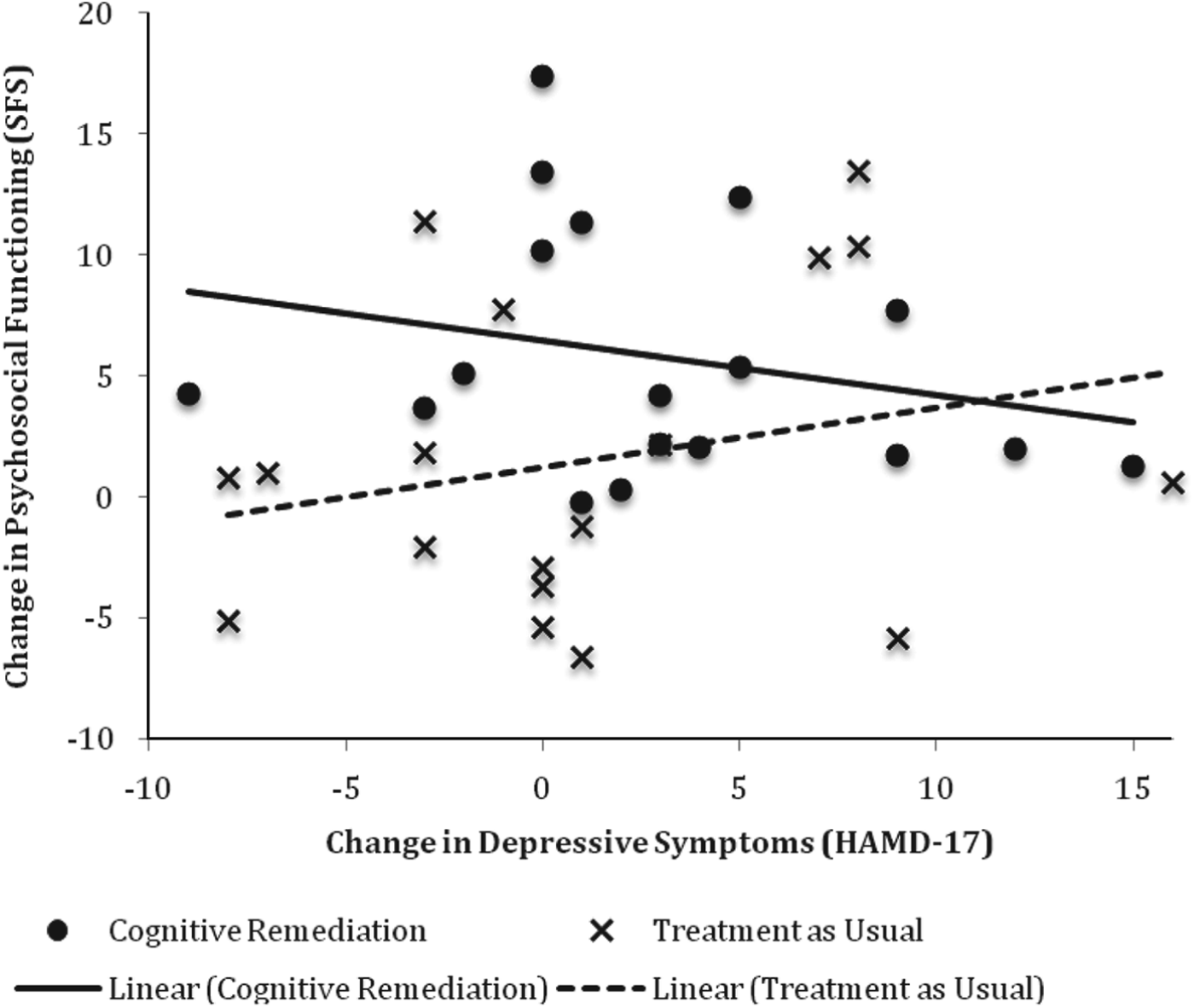
With regard to depressive symptoms, further post-hoc analyses (not reported in the original report) revealed that depression was significantly reduced across both cognitive remediation and treatment as usual groups (mean change = 2.08, s.d. = 6.047, F 1,34 = 4.23, p < 0.05). However, as stated in the original paper, neither group demonstrated significantly greater reductions in mood symptoms (i.e. there was no differential change in depression, or a statistical interaction, between groups; F 1,34 = 0.92, p = 0.34). Thus, the most logical explanation for an overall improvement in mood is likely to be their continuing engagement with their 'treatment as usual’ clinicians, which both groups continued to receive. Separately, we also investigated whether the psychosocial improvements observed in our study were linked to improved mood. As shown in Fig. 1, the trends are in the opposite direction of what would be expected if cognitive remediation elicited functional improvement through the alleviation of mood symptomatology. For cognitive remediation, improved mood was associated with decreased psychosocial gains, whereas in treatment as usual, improved mood was associated with improved psychosocial functioning. However, neither correlation was statistically significant (r = − 0.25, p = 0.32, and r = 0.25, p = 0.33, respectively), which further highlights the independence of mood and functional change in our study. Thus, due to the above findings, we argue that there is no evidence that the observed functional improvements following cognitive remediation were mediated by an improvement in mild depression.
Scatter diagram plotting changes in mood against changes in psychosocial functioning (a higher score indicates an improvement).

Declaration of Interest
None.