1. Introduction
The first stage in Smith & Bailey's (Reference Smith and Bailey1968) classic model for the evolution of resurgent caldera volcanoes is a large-magnitude uplift of country rocks, which occurs upon initial intrusion of a large pre-caldera magma body. Evidence for such pre-collapse tumescence is limited or absent at most calderas, however, even in deeply eroded ancient examples (cf. Lipman, Reference Lipman1984; Branney & Kokelaar, Reference Branney and Kokelaar1994; Moore & Kokelaar, Reference Moore and Kokelaar1998). Such evidence may be difficult to recognize, because of: (1) regionally complicated stratigraphy, structure and tectonics; (2) complex volcano-tectonic movements in subsequent stages of caldera evolution; and/or (3) deep volcanic, pyroclastic and sedimentary infill (especially at less-eroded modern calderas). Whatever its cause, apparent scarcity of field evidence has sown doubt as to whether pre-caldera tumescence is important or even occurs at all (Lipman, Reference Lipman1984).
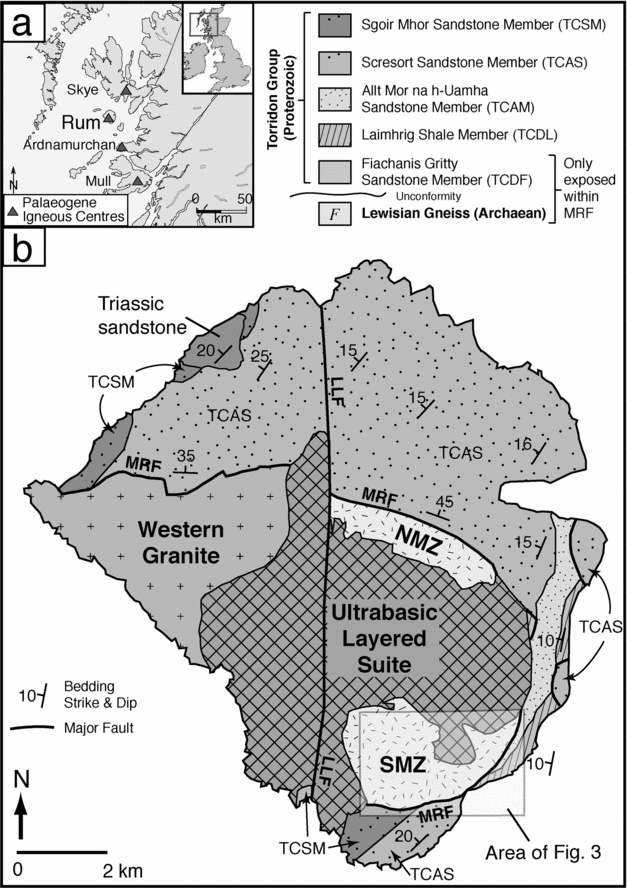
The Rum Central Complex, Scotland (Fig. 1a), preserves evidence, largely gleaned from rocks within the Northern Marginal Zone (Fig. 1b), for intrusion-induced uplift prior to caldera collapse (cf. Emeleus, Reference Emeleus1997; Troll, Emeleus, & Donaldson, Reference Troll, Emeleus and Donaldson2000). We have further investigated the lithological characteristics and field relationships of equivalent rocks within the more extensive and more deeply dissected Southern Mountains Zone (Fig. 1b). In terms of local geology, we provide detailed evidence to underpin reinterpretation of intrusive rhyodacite sills and subterranean explosion breccias (Hughes, Reference Hughes1960) as extrusive ignimbrites and sedimentary mass-movement deposits, respectively. In terms of geological processes, this new evidence refines our understanding of a rarely preserved sequence of rocks that records volcano-sedimentary responses to intrusion-induced uplift and subsequent caldera collapse.
(a) Location map and (b) outline geological map for the Isle of Rum (after Emeleus, Reference Emeleus1997). NMZ – Northern Marginal Zone; SMZ – Southern Mountains Zone; MRF – Main Ring Fault zone; LLF – Long Loch Fault. A colour version of this figure can be viewed online at http://journals.cambridge.org/geo.

2. Previous work
2.a. Geological overview of the Isle of Rum
The Isle of Rum hosts a deeply eroded Palaeogene igneous centre surrounded by country rocks of relatively simple regional structure. Most of the igneous rocks lie inside a Main Ring Fault system that can be traced through a 270° arc from the northwest to the south of the island (Bailey, Reference Bailey1945; Fig. 1b). Inside the Main Ring Fault are three peripheral remnants of early silicic magmatism: the Western Granite, the Northern Marginal Zone and the Southern Mountains Zone (Fig. 1b). The later basic–ultrabasic Layered Suite of Rum forms the island's core, and in several places truncates the Main Ring Fault.
Apart from some Triassic sedimentary rocks in the island's NW corner (Bailey, Reference Bailey1945; Emeleus, Reference Emeleus1997), country rocks outside the Main Ring Fault belong to the Proterozoic Torridon Group, which is subdivided into successive Diabaig, Applecross and Aultbea formations (Emeleus, Reference Emeleus1994, Reference Emeleus1997; Fig. 1b). The underlying Archaean Lewisian Gneiss and the basal Diabaig Fiachanis Gritty Sandstone Member only crop out within the Main Ring Fault. The latter comprises grey, coarse-grained, thinly bedded sandstones and intercalated dark-grey siltstones. The overlying Diabaig Laimhrig Shale Member contains dark-grey laminae of mudstone, siltstone and very fine-grained sandstone, with intercalated thin beds of light-grey, fine-grained sandstone. The Applecross Allt Mór na h-Uamha Member consists of orange-pink to red-brown weathering, thinly to thickly bedded, fine- to coarse-grained sandstones, interbedded in the lower parts with subordinate laminated mudstones, siltstones and fine grey sandstones. The overlying Applecross Scresort Member is a ~2 km thick sequence of thickly bedded, medium-grained to pebbly, arkosic sandstones. The Aultbea Sgorr Mhór Member caps the preserved Torridonian succession and comprises thickly bedded, fine- to medium-grained arkoses with ample amounts of detrital muscovite and heavy minerals, the latter of which commonly form discrete dark bands. The Torridon Group's gentle regional NW dip causes the younger members to dominate the island's northwestern and northern areas, while the older members appear along the island's SE flank (Fig. 1b).
The reasonably distinct Torridon Group members can thus act as suitable structural marker horizons. From a juxtaposition of Lewisian Gneiss and Diabaig Formation rocks against the Applecross Scresort Member in the Northern Marginal Zone, Bailey (Reference Bailey1945) demonstrated uplift within the Main Ring Fault's northern section of ~300 m in the east and ~2 km in the west. He calculated a similar uplift gradient in the Southern Mountains Zone (Fig. 2) from occurrences of Lewisian Gneiss west of Ainshval and at Dibidil Cove (Fig. 3). Bailey (Reference Bailey1945) also noted folding of Torridonian strata adjacent to the Main Ring Fault, and concluded that this deformation and the structural ‘upheaval’ of the basement were related to early events in the emplacement of the Rum Central Complex.
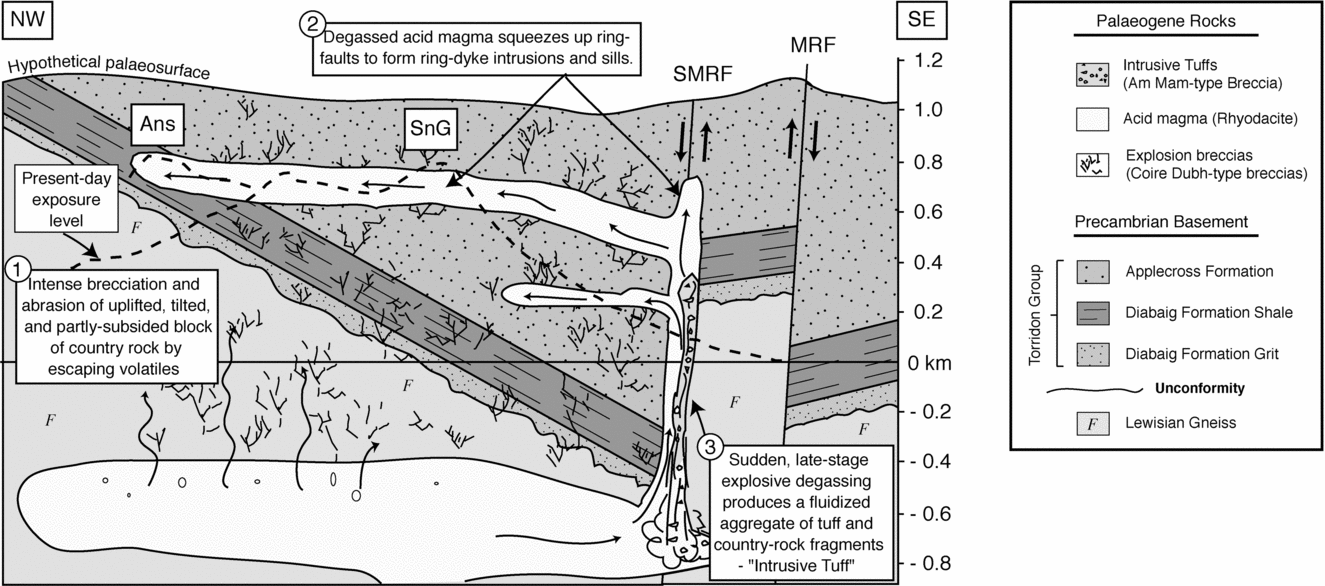
Schematic representation of Hughes’ (Reference Hughes1960) model for the subterranean formation and emplacement of the Southern Mountains Zone breccias and rhyodacites. SMRF – Southern Mountains Ring Fracture of Hughes (Reference Hughes1960); MRF – Main Ring Fault of Bailey (Reference Bailey1945); SnG – Sgùrr nan Gillean Peak; Ans – Ainshval Peak. A colour version of this figure can be viewed online at http://journals.cambridge.org/geo.

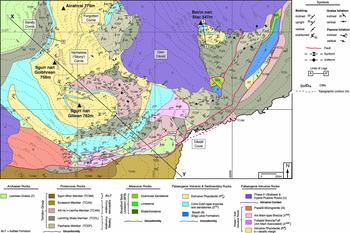
Geological map of the Southern Mountains Zone, Isle of Rum. The map is based on those presented by Emeleus (Reference Emeleus1994, Reference Emeleus1997), with several revisions from the present study. See Figure 9 for cross-section along line X–Y.

2.b. Breccias and rhyodacites on Rum: changing views
An intricate association of country-rock breccias, porphyritic rhyodacite (‘felsite’) and intrusion breccias (‘tuffisites’ and ‘intrusive tuffs’) occurs in the Northern Marginal Zone and Southern Mountains Zone. The country-rock breccias contain little or no igneous material, while their clast make-up often matches that of adjacent coherent country rock. Such breccias, lying deep within the now exhumed Rum volcano, were interpreted to result from in situ subterranean fracturing and abrasion of country rock by explosive through-passage of gas from a crystallizing rhyodacitic magma (Bailey, Reference Bailey1945; Hughes, Reference Hughes1960; Dunham, Reference Dunham1968) (Fig. 2). Zones of undisrupted country rock, some apparently surrounded by ‘explosion breccia’, were regarded as ‘islands’ that escaped intense gas drilling (Bailey, Reference Bailey1945; Hughes, Reference Hughes1960). Batches of rhyodacite later intruded as sills and dykes into the brecciated country rocks. In the Southern Mountains Zone, ‘intrusive tuffs’ were emplaced along the ring fracture system toward the end of rhyodacite intrusion, as a result of explosive degassing of silicic magma at depth (Hughes, Reference Hughes1960; Fig. 2).
Three contributions to a 1985 Geological Magazine special issue on Rum initiated major revision of this subterranean paradigm. In the Northern Marginal Zone, an extrusive pyroclastic origin was proposed for the Cnapan Breaca rhyodacite sheet because of strong similarities to densely welded ignimbrites (Williams, Reference Williams1985). In the Southern Mountains Zone, a sliver of Mesozoic to Tertiary strata found inside uplifted Lewisian gneiss on Beinn nan Stac was interpreted as new structural evidence for subsidence along the Main Ring Fault (Smith, Reference Smith1985). A collapse caldera was thus proposed as the likely volcanic setting in which the rhyodacites and breccias had formed (Emeleus, Wadsworth & Smith, Reference Emeleus, Wadsworth and Smith1985), a view supported by recognition of sedimentary characteristics in the Northern Marginal Zone country-rock breccias (Coire Dubh breccias) and rhyodacites (cf. Bell & Emeleus, Reference Bell, Emeleus, Morton and Parson1988; Emeleus, Reference Emeleus1997; Troll, Emeleus & Donaldson, Reference Troll, Emeleus and Donaldson2000; Donaldson, Troll & Emeleus, Reference Donaldson, Troll and Emeleus2001). Emeleus (Reference Emeleus1997) also proposed a volcano-sedimentary origin for much of the rhyodacite and country rock breccias (‘Coire Dubh-type breccias’) in the Southern Mountains Zone, but hinted at a far more complex sequence of events than evidenced in the Northern Marginal Zone. These events included several ignimbrite-forming rhyodacite eruptions, as well as catastrophic landslips resulting in chaotic megabreccias of Torridonian country rock. Detailed field evidence underpinning these re-interpretations remained unpublished, however.
2.c. Contribution of this paper
This paper contains new observations from detailed remapping of parts of the Southern Mountains Zone. Areas re-examined include: (1) the peak of Beinn nan Stac, (2) the ring-fault system from SW of Beinn nan Stac to the Papadil Microgranite, (3) the eastern flank of the Sgùrr nan Gillean to Ainshval ridge, including Nameless and Forgotten corries and (4) Sandy Corrie (Fig. 3). We provide detailed field evidence to confirm the proposed reinterpretation of the Southern Mountains Zone breccias and rhyodacites as mainly sedimentary and extrusive pyroclastic deposits, respectively, rather than subterranean ‘explosion breccias’ and intrusions. We also present the first logs of the volcano-sedimentary succession(s) in the Southern Mountains Zone. A broad lithostratigraphic correlation exists between some Southern Mountains Zone sections, but cross-cutting intrusions and structural or stratigraphic uncertainties hinder extrapolation to others and to those in the Northern Marginal Zone. Our observations none the less confirm at least two major ignimbrite-forming eruptions in the Southern Mountains Zone, in contrast to the single major event inferred thus far in the Northern Marginal Zone. Remapping of the ‘megabreccias’ reveals them to be less chaotic than initially thought, however. We re-interpret them as complexly deformed, but broadly coherent, segments of Torridonian country rock (caldera floor).
3. Country-rock breccias & rhyodacites: evidence for volcano-sedimentary successions
3.a. Overview of sedimentary successions
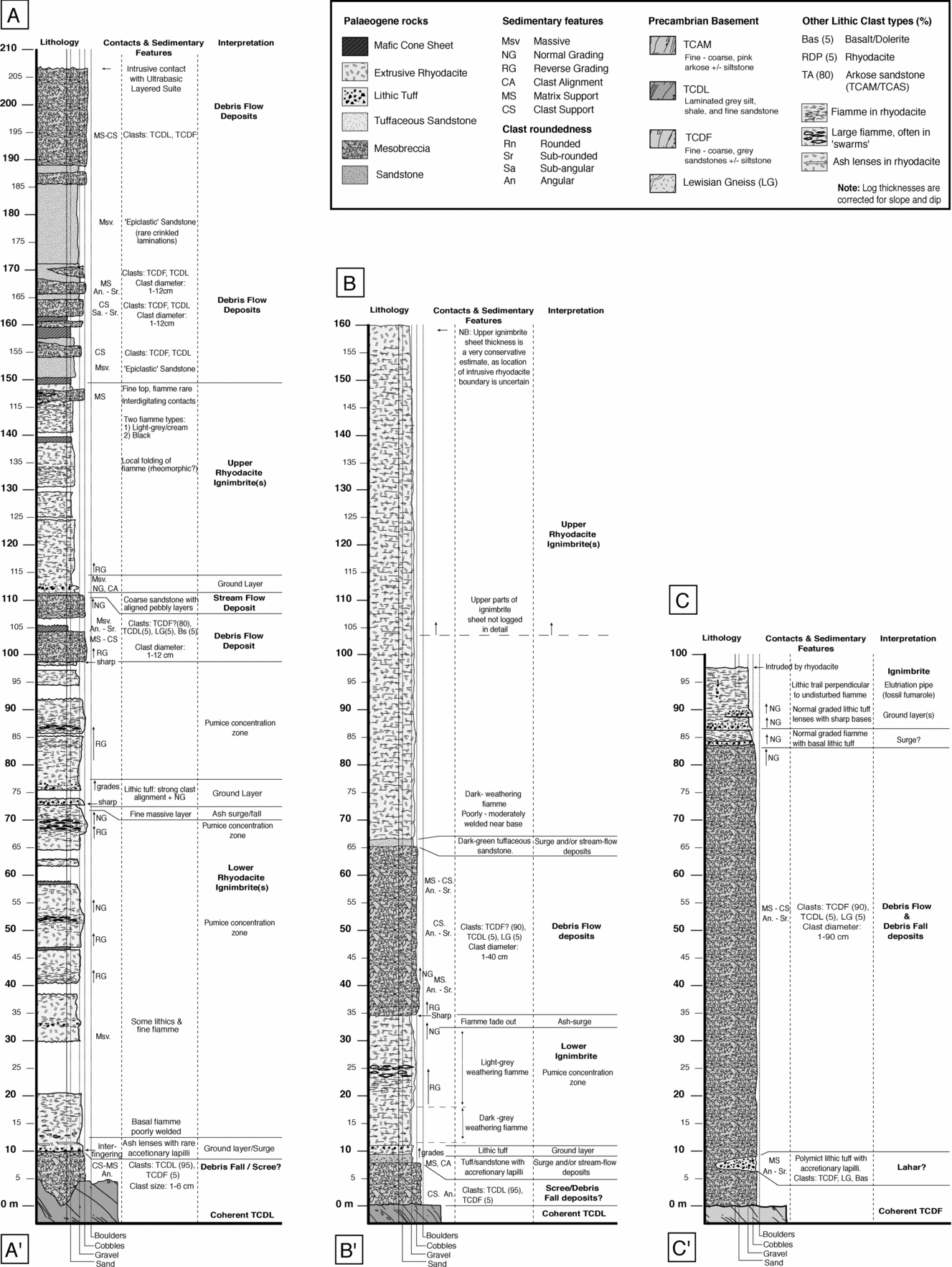
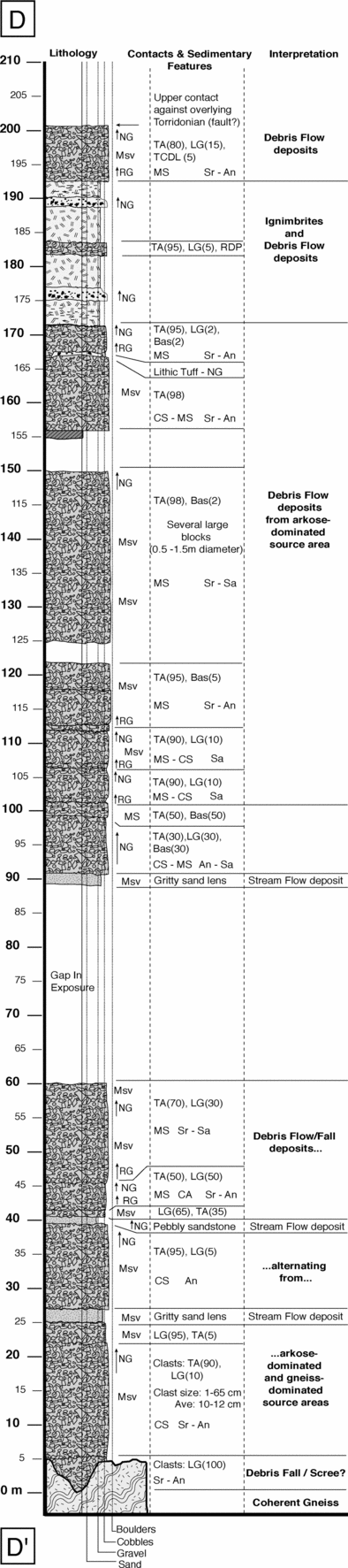
The Coire Dubh-type breccias display several distinct lithofacies. Most common is a mesobreccia (most clasts <1 m diameter; cf. Lipman, Reference Lipman1976) of mainly country rock fragments in a sandy or silty matrix that lacks any obvious silicic igneous component. Other, much less abundant lithofacies include: coarse lithic tuffs, tuffaceous sandstones, pebbly or gravelly sandstones, massive gritty sandstone lenses and thin, laterally discontinuous, white or light-grey tuff lenses. These lithofacies interleave with each other to define a locally consistent sense of bedding, which in addition to features such as clast alignment, grading and channellization, indicates a sedimentary origin for the Coire Dubh-type breccias. Moreover, several rhyodacite sheets that are broadly concordant with the breccias display strong evidence for extrusive emplacement, such as transitional base contacts, graded lithic tuffs, elutriation pipes and graded fiamme swarms. Logs of the volcano-sedimentary succession(s) are presented in Figures 4 and 5. Since the Torridonian outcrops of Sgùrr nan Gillean may be coherent country rock rather than megabreccia (see Section 7), we consider separate Base of Sgùrr nan Gillean and Peak of Sgùrr nan Gillean successions. The latter was not fully logged because of hazardous accessibility, but observations from its lower parts are reported.
Measured logs of the volcano-sedimentary successions preserved: (A–Aʹ) on Beinn nan Stac; (B–Bʹ) in Sandy Corrie; (C–Cʹ) in Forgotten Corrie. See Figure 3 for lines of logs. A colour version of this figure can be viewed online at http://journals.cambridge.org/geo.

Measured log of the Base of Sgùrr nan Gillean volcano-sedimentary succession. See Figure 3 for lines of logs. See Figure 4 for key. A colour version of this figure can be viewed online at http://journals.cambridge.org/geo.

3.b. Basal relationships and clast compositions of Coire Dubh breccias
In basal parts of the logged successions, the dominant mesobreccia clast types usually reflect the adjacent coherent country rocks, which the breccias sharply overlie along contacts that are locally cut down into the underlying country rock by several metres, such as at [NM 3991 9288] and [NM 3877 9272] (Figs 3–5). In the Beinn nan Stac and Sandy Corrie successions (Fig. 4 logs A–Aʹ and B–Bʹ), massive, clast-supported mesobreccia overlies folded and locally highly brecciated Laimhrig Shale Member. In both cases, the basal mesobreccia is more angular than usual, and is clast-supported and siltstone-dominated, although pieces of grey sandstone are present. The Forgotten Corrie succession sharply overlies locally N- or NE-inclined Fiachanis Gritty Sandstone. Mesobreccia here mainly contains clasts of coarse grey sandstone, which are angular to very angular, although some are sub-rounded. Rare gneiss clasts are also present (Fig. 4 log C–Cʹ). The later Am Màm-type intrusive breccia (see Section 5 and Nicoll et al. Reference Nicoll, Holness, Troll, Donaldson, Holohan, Emeleus and Chew2009, this issue) largely obscures the lower contact of the Base of Sgùrr nan Gillean succession, but mesobreccia of predominantly gneiss clasts sharply overlies and cross-cuts banding in coherent gneiss in the SSE (Figs 3, 5). The lower contact of the Peak of Sgùrr nan Gillean succession with the underlying Torridonian is also sharply discordant, and mesobreccia and/or lithic tuffs locally infill depressions several metres deep (e.g. [NM 3851, 9309]; Figs 3, 5). Again the mesobreccia clasts are arkose sandstone and laminated siltstone, like the Torridonian below, with subordinate gneiss clasts. An unconformity (that is, palaeotopographic surface) carved into uplifted coherent country rock thus seems to mark the base of all successions.
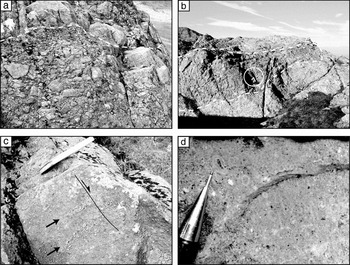
Except for the Forgotten Corrie breccias (Fig. 4 log C–Cʹ), clast compositions change up-section. On Beinn nan Stac, a 5–10 m thick, concordant mesobreccia body forms a discrete layer between two rhyodacite sheets and sharply overlies the lower sheet (Figs 3, 4 log A–Aʹ). The base of the mesobreccia body displays reverse grading and clast alignment, and the central part is massive, while the upper part fines upward into gravelly sandstone with strong pebble alignment (Figs 4 log A–Aʹ, 6a) and then into coarse sandstone (e.g. [NM 3977 9400]). Clasts are mainly grey, coarse to fine sandstone and laminated sandstone, but siltstone and gneiss clasts, as well as some rhyodacite pumices and crystals (reworking of lower rhyodacite sheet?), are visible in the upper part. In Sandy Corrie, a 30 m thick, generally matrix-supported mesobreccia layer between two rhyodacite sheets is similarly dominated by grey sandstone clasts (Fiachanis Gritty Sandstone Member?). In the Beinn nan Stac and Sandy Corrie sections, mesobreccia above the lower rhyodacite sheets is thus very different to the Laimhrig Shale-dominated breccia below (Fig. 4).
Further up the Base of Sgùrr nan Gillean succession, coarse-grained, sometimes-laminated arkose sandstone (Applecross Formation) becomes the main clast type, with subordinate gneiss, basalt and devitrified basaltic glass, as well as rare, laminated, dark siltstone (Laimhrig Shale Member). No clasts were unambiguously identified as from the Sgorr Mhór Member (Aultbea Formation). Although more usually present in minor amounts, basaltic material is locally abundant (Fig. 5) and occurs both as clasts (some scoriaceous or amygdaloidal) and as patches of matrix. Some rhyodacite-like clasts were noted at one locality [NM 3806 9246] (cf. Hughes, Reference Hughes1960), but these are overall extremely rare.
3.c. Facies and bedding in the Coire Dubh-type breccias and relationships to rhyodacite sheets
The mesobeccia is generally poorly to very poorly sorted, with a clast size range of 1–250 cm, but with fairly consistent modes of 5–20 cm. Mesobreccia can be either clast- or matrix-supported, with gradual or sharp transitions between. An exposure will typically show a mixture of angular to sub-rounded clasts. Clasts are generally loose fitting and, apart from very rare jigsaw fracturing of some larger blocks, there is little internal deformation of either clasts or matrix (e.g. fracturing, veins, slickensides, etc.).
Although often massive in appearance, the mesobreccia is well organized in places and displays marked clast alignment and/or grading (Fig. 6a). Locally, abrupt variations in matrix/clast support, grain-size, grading and clast-type proportions delimit discrete bodies within what otherwise might seem to be a structureless breccia. These discrete bodies can be traced laterally for several metres along a consistent strike, and so define a crude, metre-scale bedding (Fig. 5). Some bodies have reverse-graded bases and normal-graded tops (e.g. Figs 4, 5, 6a); some outsize blocks occur toward the top of a body (Fig. 5). In the transition from gneiss to arkose clast domination at the Base of Sgùrr nan Gilean, such metre-scale interbedding is visible where pinkish beds dominated by arkosic sandstone clasts alternate with grey beds dominated by gneiss clasts (Figs 5, 6b). One bed seen in 3D appears lenticular or tongue-like (Fig. 6b), while further west, a strongly clast-aligned unit has an erosive base that truncates underlying tuffaceous sandstones [NM 3791 9240].
Sedimentary features in Coire Dubh-type breccias. (a) Normally graded top of middle mesobreccia unit on Beinn nan Stac [NM 3977 9400]. Breccia passes up into coarse sandstone that is in turn overlain by lithic-rich rhyodacite. Note the variously sub-rounded to sub-angular clast shapes. Maximum clast diameter is ~20 cm. Clasts are predominantly coarse to fine, often laminated, grey sandstone (Fiachanis Gritty Sandstone Member?). (b) Contacts between a metre-thick, lens-shaped, arkose-rich mesobreccia bed (dashed white outline) and gneiss-rich beds (above and below) in the Base of Sgùrr nan Gillean succession [NM 3810 9246]. Note 35 cm long hammer (circled) for scale. Beds dip to NW. (c) Gritty/pebbly lenses (offset by small fault) in coarse, poorly sorted sandstone in the Base of Sgùrr nan Gillean succession [NM 3781 9255]. The notebook is 15 cm in length. The sandstone dips NW and lies just below a concordant rhyodacite sheet and above arkose-dominated mesobreccias. (d) Accretionary lapilli in coarse tuffaceous sandstone just below the Peak of Sgùrr nan Gillean rhyodacite sheet [NM 3819 9276]. The pen-top points to a ~8 mm diameter lapillus with multiple concentric zones. A colour version of this figure can be viewed online at http://journals.cambridge.org/geo.

Bedding in the Sgùrr nan Gillean and Forgotten Corrie sections is also locally defined by lithic tuffs and thin tuff lenses. The lithic tuffs have angular to sub-rounded, occasionally aligned clasts set in a yellowish-green or dark-grey, tuffaceous matrix (euhedral feldspars visible in hand specimen). Some 6 m from the base of the Forgotten Corrie section, for example, is a matrix-supported lithic tuff, bearing 1–12 cm diameter clasts of sandstone, gneiss, basaltic material and accretionary lapilli (Fig. 4 log C–Cʹ). The tuff lenses, as at [NM 3851 9302] and [NM 3822 9245], are typically 2–5 cm thick and 1–2 m in lateral extent. They sometimes appear slightly folded or boudinaged, which may reflect disruption during emplacement of overlying breccias units.
A fourth, but rare, facies type consists of massive, coarse, gritty sandstone lenses, only two examples of which were found in the Base of Sgùrr nan Gilean succession, for example, at [NM 3871 9279] (Fig. 5). Both lenses comprise gneiss-derived material with transitional upper contacts to mesobreccia of predominantly arkose–sandstone clasts. A more common facies delineating bedding comprises coarse or gravelly tuffaceous sandstones. These are typically graded, locally contain thin layers or lenses of aligned gravel-sized clasts (Fig. 6c), and often bear accretionary lapilli (Fig. 6d). This facies type is most commonly found just beneath the rhyodacite sheets (Fig. 4).
Where underlying rhyodacite, mesobreccia bodies may grade up into such sandstones, or else fine up to a sharpish contact with lithic tuff (often clast-aligned), that in turn passes into rhyodacite (Figs 4 log C–Cʹ, 5). Where overlying rhyodacite, breccia bodies have generally sharp, but sometimes slightly interfingering (reworking of rhyodacite or coeval deposition?), basal contacts (Figs 4 log C–Cʹ, 5).
The Beinn nan Stac succession is unusual in that it is capped by ~40 m of mesobreccia interbedded with metre-scale packages of pale-grey sandstone (Fig. 4 log A–Aʹ). The mesobreccia is locally rich in basaltic material, but overall is dominated by clasts of laminated siltstone and coarse to fine, grey sandstone (Laimhrig Shale and Fiachanis Gritty Sandstone members?). The pale-grey sandstone is well sorted, quartzose and generally massive (apart from rare crinkled lamination [NM 3963 9409]). This sandstone strongly resembles the ‘epiclastic sandstone’ underlying the Cnapan Breaca rhyodacite sheet in the Northern Marginal Zone and is similarly brecciated in places (cf. Emeleus Reference Emeleus1997).
3.d. Rhyodacite (Felsite) sheets: basal relationships and lithofacies
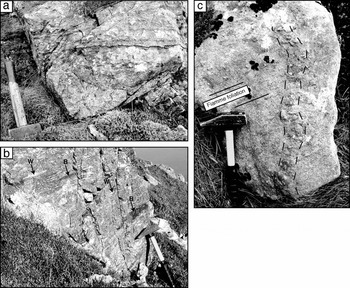
Distinction between extrusive and intrusive rhyodacite can locally be very difficult. Before an interpretation of either origin can be made with any confidence, a careful evaluation of contact phenomena, lithological features, structure and gross field relations of individual bodies is necessary at each locality. Rhyodacite bodies interpreted as extrusive are sheet-like, have a well-developed eutaxitic fabric defined by fiamme (Fig. 7; cf. Bell & Emeleus, Reference Bell, Emeleus, Morton and Parson1988), and are concordant or nearly concordant with bedding in adjacent Coire Dubh-type breccias. Contacts with underlying breccias and sandstones vary from sharp to locally interfingering to transitional via graded lithic tuffs at the base of the rhyodacite sheet. Intrusive contact phenomena, such as basaltic margins and/or chilled margins, are lacking. Internally, the sheets contain graded lithic tuffs and fiamme swarms, and rarely, accretionary lapilli-bearing ash lenses. Large (>3 cm) lobate or fluid-like mafic inclusions are absent. Intrusive rhyodacite is described more fully in Section 4.
Ignimbritic features in rhyodacite sheets. (a) Planar and wavy bed-forms in ash and crystal tuffs (surge deposits?) below the Peak of Sgùrr nan Gillean ignimbrite sheet [NM 3783 9330]. Hammer shaft is 25 cm long. (b) Streaky (moderately welded) fiamme in the upper Beinn nan Stac rhyodacite sheet [NM 3966 9403]. Note white-weathering (W) and black-weathering (B) fiamme types. Note 35 cm long hammer for scale. (c) Discordant ‘lithic lapilli’ band in bedded rhyodacite, Forgotten Corrie [NM 3840 9429]. Little or no deflection of fiamme at the band implies it is pre- or syn-compaction. It is thus interpreted as a ‘fossil fumarole’, characteristic of high-temperature ignimbrites. A colour version of this figure can be viewed online at http://journals.cambridge.org/geo.

The base of the lower Beinn nan Stac rhyodacite sheet is not obviously chilled against the underlying mesobreccia. The contact is instead transitional through lithic tuff [NM 3994 9298]. Two discontinuous, concordant, accretionary-lapilli-bearing ash lenses occur in the rhyodacite within 1 m of the base (Fig. 4 log A–Aʹ). The base of the upper Beinn nan Stac rhyodacite sheet is also unchilled, but sharply overlies the coarse sandstone capping the middle mesobreccia unit. The lowermost metre of rhyodacite is lithic-rich, clast-aligned, normally graded, and passes upward into fiamme-rich rhyodacite. Both Sandy Corrie rhyodacite sheets sharply overlie sandstones that locally bear accretionary lapilli, and the lower sheet again displays a normally graded lithic tuff at its base (Fig. 4 log B–Bʹ). In Forgotten Corrie, the base of the rhyodacite sheet exhibits normally graded fiamme and contains two concordant, sharp-based and normally graded lithic tuff lenses (Fig. 4 log C–Cʹ). Such layers of lithic-rich rhyodacite at the base and within the rhyodacite sheets are interpreted as co-ignimbrite lag breccias or ground layer deposits (cf. Williams, Reference Williams1985; Cas & Wright, Reference Cas and Wright1987).
In the Base of Sgùrr nan Gillean succession, discontinuous lithic tuffs appear a few metres below a concordant 10–15 m thick sheet of rhyodacite that is traceable from the Papadil granophyre in the south–southwest to the mouth of Nameless Corrie in the east (Figs 3, 5). Evidence for formation of this sheet by extrusive pyroclastic processes is seen at three localities [NM 3775 9255; NM 3850 9270; NM 3888 9319]. The sheet is underlain by mesobreccia or pebbly sandstones (Fig. 6c), which pass either sharply or somewhat gradationally into lithic tuff that in turn grades into rhyodacite. The rhyodacite is in some places overlain by several metres of mesobreccia, but elsewhere it apparently abuts against the overlying Torridonian strata. At all three localities, concordant, normally graded lithic tuffs occur within the sheet.
The Peak of Sgùrr nan Gillean rhyodacite sheet also overlies mesobreccia, normally graded pebbly sandstones, and accretionary-lapilli-bearing tuffaceous sandstones along its southern and eastern margins. Along its northern margin in Nameless Corrie [NM 3783 9330], the lower metre or so of the rhyodacite sheet displays alternating layers of dark ash and light-coloured rhyodacite with wavy and planar bed forms (Fig. 7a). These bedded tuffs overlie a thin veneer of mesobreccia and grade up into concordant, fiamme-rich rhyodacite. These tuffs and the accretionary-lapilli-bearing tuffaceous sandstones are probably surge deposits (cf. Cas & Wright, Reference Cas and Wright1987; McPhie, Doyle & Allen, Reference McPhie, Doyle and Allen1993).
3.e. Rhyodacite sheets: internal characteristics and lithofacies
Within the rhyodacite sheets, other features characteristic of ignimbrites can be found. Less flattened, chunky fiamme often occur near the base (length/thickness ratios of 5:1–10:1), while more flattened, streaked-out fiamme (length/thickness of 10:1–20:1; Fig. 7b) appear a little further up-section, where the eutaxitic fabric is sometimes folded, presumably due to rheomorphism. Such change may reflect an upward-increasing welding intensity typical of the lower parts of many ignimbrites (Cas & Wright, Reference Cas and Wright1987). The extrusive rhyodacite sheets also display concordant, reversely and/or normally graded concentrations (‘swarms’) of fiamme, which in places show a weak imbrication.
In several places, fiamme swarms or rhyodacite with normally graded fiamme grade up into discrete layers of massive, fiamme-poor rhyodacite. For example, fiamme are up to 1 m long and 15 cm thick toward the top of the lower rhyodacite sheet in Sandy Corrie, but fade out just below the sharp contact with the overlying mesobreccia (Fig. 4 log B–Bʹ). At one locality in the Base of Sgùrr nan Gillean sheet [NM 3888 9319], a fiamme-rich zone with some imbrication grades up into a massive, fiamme- and lithic-poor ashy layer. Similarly, some 60 m above the base of the lower rhyodacite sheet on Beinn nan Stac, a fiamme swarm grades normally upward into a 15 cm thick, massive, fiamme-free layer (Fig. 4 A–Aʹ). Such relationships are interpreted as the upward transition from a pumice concentration zone to a co-ignimbrite ash cloud deposit within a standard ignimbrite flow unit (cf. Cas & Wright, Reference Cas and Wright1987; Freundt, Wilson & Carey, Reference Freundt, Wilson, Carey, Sigurdsson, Houghton, McNutt, Rymer and Stix2000). Such ash layers are in places overlain by the lithic-rich ground layer of a second, upper flow unit (e.g. Fig. 4 log A–Aʹ). This indicates that individual sheets assembled incrementally.
Lithics are commonly confined to ~1 m thick concordant layers or lenses in the rhyodacite sheets. Lithic types are mainly Torridonian sandstone (arkosic around Sgùrr nan Gillean; gritty and shaley in Forgotten Corrie and on Beinn nan Stac), with some Lewisian gneiss fragments and pumice-like rhyodacite clasts. Some lithic tuffs have matrices of tuff and comminuted country rock material, as in the Beinn nan Stac and Base of Sgùrr nan Gillean successions (Figs 4, 5). These units may have formed by intermingling of coeval pyroclastic flows and debris flows (Branney & Kokelaar, Reference Branney and Kokelaar1994) or by remobilization (reworking) of earlier ash deposits into later syn-eruptive debris flows. Lithics otherwise occur as scattered, isolated clasts (max. 10 cm diameter). In Forgotten Corrie, however, a rhyodacite outcrop with fiamme concordant to underlying lithic tuffs preserves a thin, half-metre long lithic trail that is orientated near-perpendicular to the fiamme, but does not cleanly cross-cut or disrupt them [NM 3840 9429] (Fig. 7c). This feature is interpreted as a post-emplacement, but pre-compaction, degassing pipe (‘fossil fumarole’; cf. Fisher & Schminke, Reference Fisher and Schmincke1984; Cas & Wright, Reference Cas and Wright1987; Freundt, Wilson & Carey, Reference Freundt, Wilson, Carey, Sigurdsson, Houghton, McNutt, Rymer and Stix2000) and, together with the interbedded, graded lithic tuffs below (Fig. 4 log C–Cʹ), is strong evidence for emplacement of the rhyodacite as a high-temperature ignimbrite.
Fiamme in the rhyodacite sheets display a variety of shapes and weathering colours. Fiamme morphologies range from thin, crinkled, wispy streaks, to pancake-like types, to thicker, cigar-shaped types. In thin-section, the fiamme commonly display a spherulitic recrystallization that is absent in the fine-grained matrix. Fiamme in the Beinn nan Stac sheets are cream-weathering and have phenocrysts of quartz and plagioclase. Toward the top of the sheet, a rare, black-weathering, quartz-phenocryst-free fiamme type also occurs (Fig. 7b). Fiamme in the Base of Sgùrr nan Gillean, Peak of Sgùrr nan Gillean and Forgotten Corrie sheets weather cream, light grey and/or dark grey. In Sandy Corrie, the lower rhyodacite sheet exhibits a zoned distribution of light- and dark-weathering fiamme; dark fiamme are concentrated near the sheet's base (Fig. 4 log B–Bʹ). Fiamme in the upper rhyodacite sheet are dark weathering. Such variation in fiamme type within the ignimbrites, although not yet resolved in detail, may reflect some compositional heterogeneity in the pre-caldera rhyodacite reservoir (cf. Troll, Donaldson & Emeleus, Reference Troll, Donaldson and Emeleus2004).
3.f. Structure and thickness of the volcano-sedimentary successions
On Beinn nan Stac, bedding in the breccias and the eutaxitic fabric in the rhyodacite generally dips at 30–45° to the N or W (Fig. 3). Along the NE flank of Beinn nan Stac, eutaxitic fabric dips mainly to the W or NW, and it gradually swings to a more northerly dip along the SW flank. This pattern may reflect accumulation of sedimentary and pyroclastic material in a palaeovalley trending roughly NW–SE (that is, radially). Such an interpretation was proposed for a very similar pattern of fiamme fabric, bedding and basal contacts at the southern end of Meall Breac in the Northern Marginal Zone (Troll, Emeleus & Donaldson, Reference Troll, Emeleus and Donaldson2000). Bedding, contacts and eutaxitic fabrics within the Sandy Corrie succession dip at 20–40° to the ESE, while those in the Forgotten Corrie succession dip at 40–60° to the NW (Fig. 3). It is tempting to view these opposing senses of dip as also reflecting a near-radial palaeovalley, but intrusion and faulting complicate relationships here (see Section 4). Dips in the Base of Sgùrr nan Gillean succession are also mainly 30–60° to the NW (Fig. 3). Some outward dips were noticed in the middle to upper parts of the succession south of Sgùrr nan Gillean peak, such as at [NM 3806 9252], but whether such outward dips represent local primary variation in the bedding or secondary deformation is presently unclear. Fiamme and bedding in the Peak of Sgùrr nan Gillean succession dip N along the southern contact, W along the eastern contact and E along the northern contact (Fig. 3). This may reflect a palaeovalley trending E–W.
The preserved thickness of the volcano-sedimentary successions of the Southern Mountains Zone varies from over 205 m on Beinn nan Stac, to at least 160 m in Sandy Corrie, 100 m in Forgotten Corrie, and up to 200 m at the Base of Sgùrr nan Gillean (Figs 4, 5). The estimated minimum thickness of the Peak of Sgùrr nan Gilean rhyodacite sheet is over 175 m (Fig. 3). These values are close to the ~180 m thickness estimated for the Cnapan Breaca succession of the Northern Marginal Zone (Troll, Emeleus & Donaldson, Reference Troll, Emeleus and Donaldson2000).
4. Intrusive rhyodacite
On the basis of internal facies associations and structural setting, rhyodacite of intrusive character falls into three subdivisions: (1) a steeply dipping body of fragmented rhyodacite with composite rhyodacite/dolerite marginal facies, (2) composite sills of non-fragmented rhyodacite and dolerite and (3) rhyodacite marginal to the Am Màm-type intrusive breccia (Section 5).
4.a. Fragmented rhyodacite with non-fragmented intrusive margins
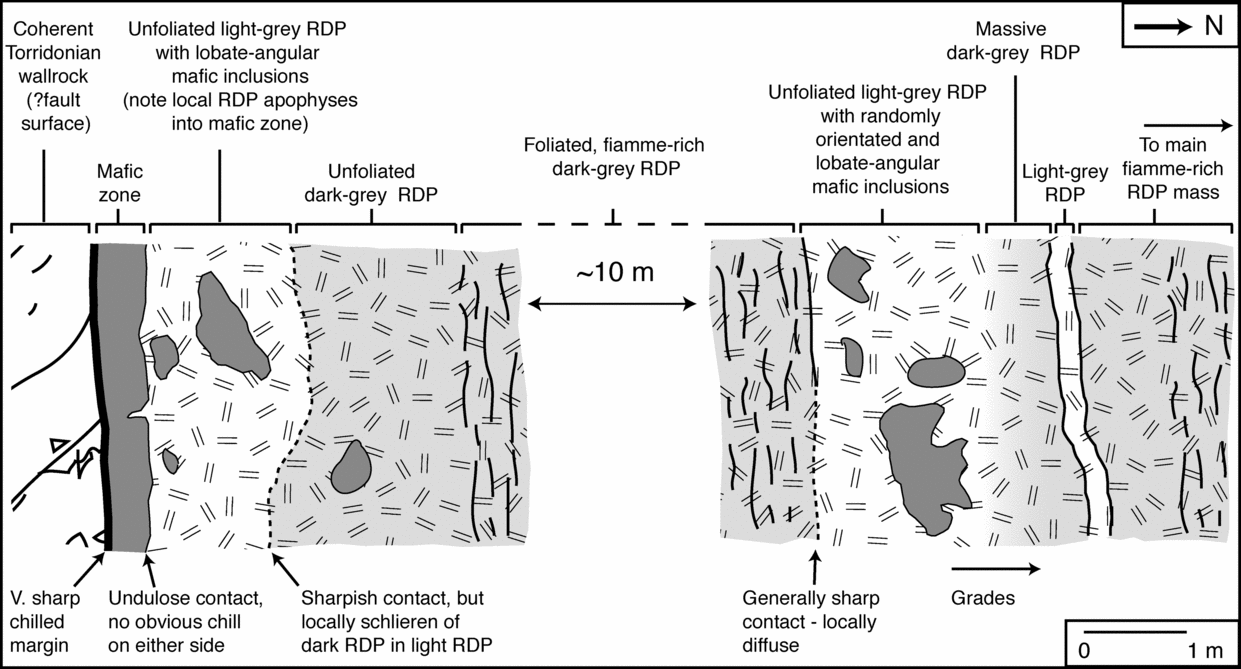
In Nameless and Forgotten corries, a body of fiamme-bearing rhyodacite with a sharp contact displaying intrusive phenomena and dipping at 50–80°E or SE (that is, outward) truncates bedding in the Torridonian rocks and overlying volcano-sedimentary successions (Fig. 3). The body's intrusive nature is most clearly visible against the Torridonian rocks in Nameless Corrie. Here, a 10–35 cm thick, fine-grained mafic zone usually marks the intrusive rhyodacite's southern margin (Fig. 8). The mafic zone chills sharply against the Torridonian, but not against the rhyodacite. The latter contact is in places gently sinusoidal, with thin fluidal-looking rhyodacite protrusions into the mafic zone (for example, at [NM 3869 9335]), and is intricate and lobate on a millimetre-scale in thin-section. A dyke-like projection from the main contact into the Torridonian displays mafic zones on both sides of the rhyodacite (Fig. 3). The mafic zones again chill sharply against the Torridonian, but not against the rhyodacite in the centre. We therefore infer that the mafic zone and adjacent rhyodacite were emplaced very closely in time as a composite dyke-like intrusion, only one side of which is preserved against the Torridonian in Nameless Corrie. Torridonian rocks locally display a crush fabric at the contact, which may indicate some fault control on the emplacement of the intrusion.
Schematic sketch of facies variations within intrusive rhyodacite (RDP) in Nameless Corrie, as one moves north from the southern contact with Torridonian rocks. Intrusion of non-fragmented basalt-rhyodacite followed by fragmented rhyodacite is inferred to have occurred twice.

Several facies of rhyodacite occur inside the basaltic margin. In immediate contact with the margin is light-grey-weathering rhyodacite containing numerous mafic inclusions up to several tens of centimetres in diameter (Fig. 8). The mafic inclusions are generally aphyric, but some are amygdaloidal and contain euhedal ‘blocky’ feldspars similar to those in the rhyodacite. The inclusions’ margins are mainly lobate, although some are angular and chilled (Fig. 8). Although often elongate, the mafic inclusions have no obvious alignment. Complex mingling, mixing and hybridization between rhyodacite and basalt magmas occur locally. Fiamme are absent in this rhyodacite facies, which resembles that in a plug north of Cnapan Breaca in the Northern Marginal Zone (see Troll, Emeleus & Donaldson, Reference Troll, Emeleus and Donaldson2000).
About a metre from the mafic margin, the light-grey-weathering rhyodacite is in contact with darker-weathering rhyodacite that also bears mafic inclusions (Fig. 8). The transition from light to dark rhyodacite varies from sharp to streaky (schlieren of light rhyodacite in dark rhyodacite) and locally occurs with complex mingling relationships. A few metres further north (that is, inward), the dark rhyodacite displays a parataxitic fabric of strongly attenuated fiamme (length/thickness ratios commonly >100:1) that dips parallel to the steep contact with the Torridonian (Fig. 8). Further north of this parataxitic dark rhyodacite, there is locally a second zone of the light-grey-weathering and mafic inclusion-bearing rhyodacite facies [NM 3815 9344], which again grades northward into non-foliated dark rhyodacite and then into fiamme-bearing dark rhyodacite. These relationships reflect multiple episodes of intrusive emplacement of coherent, non-fragmented rhyodacite followed by fiamme-bearing, fragmented rhyodacite.
Toward its centre, the intrusive rhyodacite body displays some characteristics of the extrusive sheets. Fiamme still define a steeply dipping to near-vertical fabric, but many have low length/thickness ratios (are chunky in shape), for example, at [NM 3829 9371]. Also, concordant, 50–90 cm thick lithic layers occur within the sub-vertically foliated rhyodacite, with contacts ranging from sharply defined to somewhat diffuse. The layers comprise 0.1–8 cm diameter clasts of Lewisian gneiss, Torridonian sandstone and rhyodacite set in a rhyodacite matrix. Some layers are graded (as at [NM 3886 9338]). Both lithic layers and fiamme fabric are tightly to isoclinally folded in places; abrupt swings of over 90° are seen in their strike directions (as at [NM 3846 9363]). As the exact position of any contact is unclear, the SE-dipping intrusive rhyodacite may grade into the SE-dipping extrusive sheets between Sandy Corrie and Ainshval (Fig. 3), as is inferred for a similar relationship at Meall Breac in the Northern Marginal Zone (Emeleus, Reference Emeleus1997).
4.b. Composite rhyodacite/basalt sheets
Several rhyodacite sheets intrude the volcano-sedimentary succession and Torridonian of Sgùrr nan Gillean (Fig. 3). These sheets are typically concordant with bedding in the Coire Dubh-type breccias and so can be difficult to differentiate from extrusive rhyodacite. Those classified as intrusive lack fiamme and often have 2–6 cm thick, upper and lower margins of amygdaloidal (chlorite/epidote) basalt, which has an undulose, but usually sharp, contact with the rhyodacite. These dark margins also display subtle crystal size coarsening, usually unidirectionally away from contacts with mesobreccia, but sometimes also away from the rhyodacite. In places, rhyodacite protrudes into the dolerite, where rare feldspar phenocrysts similar to those in the rhyodacite can be found. Contact-perpendicular joints penetrate both outer basaltic margin and rhyodacite core, but usually not the overlying mesobreccia (as at [NM 3895 9291]). The sheets are typically 1–3 m thick and 2–20 m in lateral extent.
The Base of Sgùrr nan Gillian rhyodacite was previously interpreted as solely intrusive (Hughes, Reference Hughes1960) or solely extrusive (Emeleus, Reference Emeleus1997). Our observations indicate at least one early extrusive body, with several composite sills later injected into the breccia/ignimbrite mass (Fig. 3).
5. Intrusive tuffs and tuffisites (Am Màm-type intrusion breccias)
The enigmatic ‘intrusive tuffs and tuffisites’ of Hughes (Reference Hughes1960) are renamed the Am Màm-type breccia in this account, because their structural, lithological and temporal characteristics are very similar to those of the Am Màm intrusion breccia in the Northern Marginal Zone (see Nicoll et al. Reference Nicoll, Holness, Troll, Donaldson, Holohan, Emeleus and Chew2009, this issue). The Am Màm-type breccia contains sub-angular to rounded clasts of basalt, gabbro, sandstone and gneiss. These are set in a resistant, grey- or buff-weathering, coarse-grained matrix that characteristically contains numerous rounded or lobate fine-grained mafic inclusions. Clast diameters range from 1 cm to several metres (possibly several tens of metres).
The Am Màm-type breccia veins extensively into Lewisian gneiss by Dibidil River (see Hughes, Reference Hughes1960, pl. xxi, fig. 1) [NM 3940 9295]. At several points S and SE of Sgùrr nan Gillean, such as [NM 3899 9294; NM 3826 9245], intrusion of the Am Màm-type breccia into the Coire Dubh-type breccias is indicated by: (1) chilled margins, (2) contact-parallel alignment of otherwise randomly orientated mafic inclusions in the Am Màm-type breccia, (3) apophyses and salients of Am Màm-type matrix cutting into mesobreccia and (4) rare inclusions of mesobreccia in the Am Màm-type breccia near the contact. At many localities, the Am Màm-type breccia is margined by basalt and/or rhyodacite (Fig. 3), which chill against adjacent rock types, but locally show intricate, fluid-like contacts with the Am Màm-type breccia matrix (such as at [NM 3807 9242]). These relationships show that the Am Màm-type breccia was emplaced as a composite intrusion with rhyodacitic and basaltic magmas after deposition of the Coire Dubh-type breccias (but probably during caldera subsidence; see Nicoll et al. Reference Nicoll, Holness, Troll, Donaldson, Holohan, Emeleus and Chew2009, this issue).
6. Other breccias of potentially intrusive or explosive origin
Several examples of unusual country-rock breccias were noted, for which origins through an intrusive or explosive mechanism may still be plausible. One such breccia cross-cuts fiamme in the Peak of Sgùrr nan Gillean rhyodacite [NM 3781 9270], and consists of basaltic and sandstone meso-scale clasts that are enveloped in a strongly foliated, fluidal-looking matrix. The breccia has very sharp and chilled margins, and is similar to the tuffisite dykes described in Northern Marginal Zone (Emeleus, Reference Emeleus1997).
Other country-rock breccias previously mapped as explosion breccias occur in the ring fault zone (Smith, Reference Smith1985). One example with a dyke-like geometry crops out on the foreshore next to Dibidil Bothy and cuts across highly contorted Laimhraig Shale beds (Emeleus, Reference Emeleus1997). The breccia consists of 2–3 cm diameter, highly angular and densely packed Laimhrig Shale Member clasts set in a fine sand or silt groundmass. No obvious bedding or organization to the clasts was noted.
Near-vertical zones of mesobreccia with a sinusoidal, clast-wrapping matrix fabric are found adjacent to the contact with intrusive rhyodacite in Forgotten Corrie. These zones trend roughly perpendicular to the contact, and the matrix differs from unaffected mesobreccia only in the fabric. We interpret this fabric as a gas escape-induced ‘streaming’ texture, produced either by degassing of the intrusive rhyodacite upon contact with cool mesobreccia or by rapid heating of water-saturated zones within the mesobreccia. This texture may also indicate that the mesobreccia here was not fully consolidated prior to rhyodacite intrusion (cf. Donaldson, Troll & Emeleus, Reference Donaldson, Troll and Emeleus2001).
7. Enigmatic Torridonian outcrops: landslip megabreccias?
Three enigmatic Torridonian outcrops appear along the SW flank of Glen Dibidil: (1) between Nameless and Forgotten corries, (2) in the mid- to upper slopes of Sgùrr nan Gillean and (3) in the lower SE slopes of Sgùrr nan Gillean, WNW of Dibidil Cove (Fig. 3). Hughes (Reference Hughes1960) attributed the first mass to the Diabaig Formation and the others to the Applecross Formation only, in line with his SE-tilted block structure for the basement (Fig. 2). By the 1980s, however, all outcrops were labelled ‘undifferentiated Torridonian’ (Emeleus, Reference Emeleus1980). The outcrop WNW of Dibidil cove was later reclassified as Diabaig Formation, while the others were described as megabreccias of disorientated, but closely packed, Torridonian sandstone blocks up to 100 m in diameter and separated by a matrix of Coire Dubh-type breccia (Emeleus, Reference Emeleus1994, Reference Emeleus1997). Our detailed remapping shows that the structure of these Torridonian outcrops is neither as simple (Hughes, Reference Hughes1960) nor as chaotic (Emeleus, Reference Emeleus1997) as suggested in previous reports.
The Torridonian rocks of the Forgotten Corrie and Sgùrr nan Gillean outcrops are locally broken up on a centimetre- to decimetre-scale and might at first glance be regarded as Coire Dubh-type breccias. Such meso-size brecciation is usually distinctive from the Coire Dubh-type breccas described above, however. In many cases, the brecciation consists of an in situ shattering of original Torridonian bedding, whereby fragments of one type (coarse sand or silt) are arranged in parallel bands of thicknesses similar to unbrecciated Torridonian beds. Laminations within clasts often remain parallel to the bands. Transitions from unbrecciated Torridonian beds to completely disarticulated ‘mesobreccia’ can be directly observed in places, such as [NM 3850 9294]. Where this shattering occurs in association with metre-scale folding and/or faulting, breccia ‘bands’ discordant to the overall bedding orientation are formed, as for example, at [NM 3834 9407]. No ‘exotic’ or ‘out-of-sequence’ clasts (e.g. gneiss or basalt) were noted within the Torridonian outcrops. Apart from mafic dykes and rare rhyodacite sills, no igneous material was seen. It is thus unclear if igneous material or ‘mesobreccia’ forms a pervasive sedimentary matrix to the Torridonian outcrops.
Fluctuation of bedding orientations in single exposures, or over several closely spaced exposures, has been interpreted to indicate distinct disorientated blocks (Emeleus, Reference Emeleus1997). Boundaries between areas of sandstone with different bedding orientations are rarely exposed, but some observed are marked by thin, sharp zones of highly deformed or pulverized Torridonian clasts (faults), as at [NM 3854 9289]. We have also observed numerous centimetre- to metre-scale brittle/ductile folds throughout the Torridonian rocks of the Southern Mountains Zone (Fig. 3; Bailey, Reference Bailey1945; Smith, Reference Smith1985). Such pervasive deformation may account for a lot of the local fluctuation in bedding orientations. Indeed, much of the ‘explosion breccia’ (Hughes, Reference Hughes1960) or mesobreccia/megabreccia (Emeleus, Reference Emeleus1994) previously mapped around Sgùrr nan Gillean and in Forgotten Corrie has been remapped here as coherent Torridonian outcrops that display a large-scale structural and stratigraphic consistency (Fig. 3).
In the Forgotten Corrie outcrop, the strike of beds is locally highly variable, but overall swings gradually from NNE to SSE, while dips are predominantly eastward. In the north, grey, coarse quartzose (gritty) sandstones and interbedded parallel-laminated fine sandstones and siltstones generally dip and young to the E or SE, where laminated siltstones and shales gradually predominate (Fig. 3). This represents an up-section traverse through the Diabaig Formation, and so signifies the preservation of a largely undisrupted, ESE-tilted Torridonian succession.
Torridonian rocks of the Sgùrr nan Gillean mass also show a similarly consistent, if slightly more complex, structure (Fig. 3). The upper contact of the Sgùrr nan Gillean outcrop is a mostly gently inclined angular unconformity (Section 3). The outcrop's basal contact, toward which there is particularly intense deformation, is steeply inward-inclined and locally seems to cut across the underlying volcano-sedimentary succession. The S and SE parts comprise generally NE-striking, thinly bedded or laminated, dark mudstone and siltstone, which are intercalated with thin, light-grey, fine sandstone layers. Further north, and across a narrow zone of greenish-grey sandstones and siltstones, the Torridonian consists of thin- to medium-bedded, orange-weathering, pink arkosic sandstones and siltstones. This transition is consistent with an up-section change from the Diabaig Laimhrig Shale Member to the Applecross Allt Mór na h-Uamha Member. In Nameless Corrie, the strike of the Torridonian beds swings to a NW–SE or N–S orientation like that in Forgotten and Sandy corries. Eastward-inclined pink arkosic sandstones lie adjacent to similarly orientated, laminated dark silts and muds (Fig. 3); a narrow intervening zone of greenish-grey sandstones and siltstones is again present. Thus, the Torridonian here comprises intact and mirrored successions of Laimhrig Shale Member to Allt Mór na h-Uamha Member, both of which young toward the centre of Sgurr nan Gillean and the northern one of which is apparently overturned.
In the third Torridonian outcrop just west of Dibidil Cove, small, scattered exposures of pink arkosic sandstone occur about 100 m upslope of the Bothy (Fig. 3). Further up-slope, there are several exposures of grey, laminated siltstone. Bedding in these outcrops consistently strikes NE–SW and dips very steeply NW, but demonstrably youngs SW (e.g. cross-laminations at [NM 3886 9264]). These exposures thus also represent a transition from Diabaig Formation to lowermost Applecross Formation (Allt Mór na h-Uamha Member) rocks, which have not only been apparently down-faulted against the uplifted gneiss just to the south (cf. Hughes Reference Hughes1960), but also rotated outward and overturned.
8. Discussion
8.a. Structure of the Southern Mountains Zone: mega-breccias v. coherent country rocks
Intracaldera mega-breccias are typically interpreted as deposits of syn-collapse rockslide (debris) avalanches from over-steepened caldera faults. These deposits commonly have a wedge-shape geometry that thickens toward the inferred source area (e.g. Lipman, Reference Lipman1976, Reference Lipman1997; Moore & Kokelaar, Reference Moore and Kokelaar1998), usually a ring fault scarp (or ‘caldera wall’). Block diameters may range from 1 m to >500 m, and blocks mainly stem from pre-collapse units that occur in the adjacent caldera wall (e.g. Lake City caldera: Lipman, Reference Lipman1976). Mega-breccia matrix is commonly syn-collapse ignimbrite, but this may be very subtle and comprise only discontinuous films, veins and irregular masses of tuff (Lipman, Reference Lipman1976). A pyroclastic matrix may indeed be absent; a zone of inward-intensifying deformation, chaotic disaggregation and comminution of local material may instead lie between relatively undeformed blocks (e.g. Scafell caldera, England: Branney & Kokelaar, Reference Branney and Kokelaar1994). Lipman (Reference Lipman1976) thus noted that, in the absence of a tuff matrix, distinguishing large landslide blocks from coherent caldera floor could be very difficult. This is because pre-collapse stratigraphy may be preserved within individual large blocks and, in some cases, ‘en-gross’ across an otherwise disrupted, locally jumbled, granular deposit (e.g. Glicken, Reference Glicken1996). With good exposure and distinctive rock types, however, megabreccias may be recognized by an overall lack of structural and lithological coherence, potentially with ‘exotic’ blocks, such that a consistent lithostratigraphic sequence is indecipherable (Lipman, Reference Lipman1976; Branney & Kokelaar, Reference Branney and Kokelaar1994).
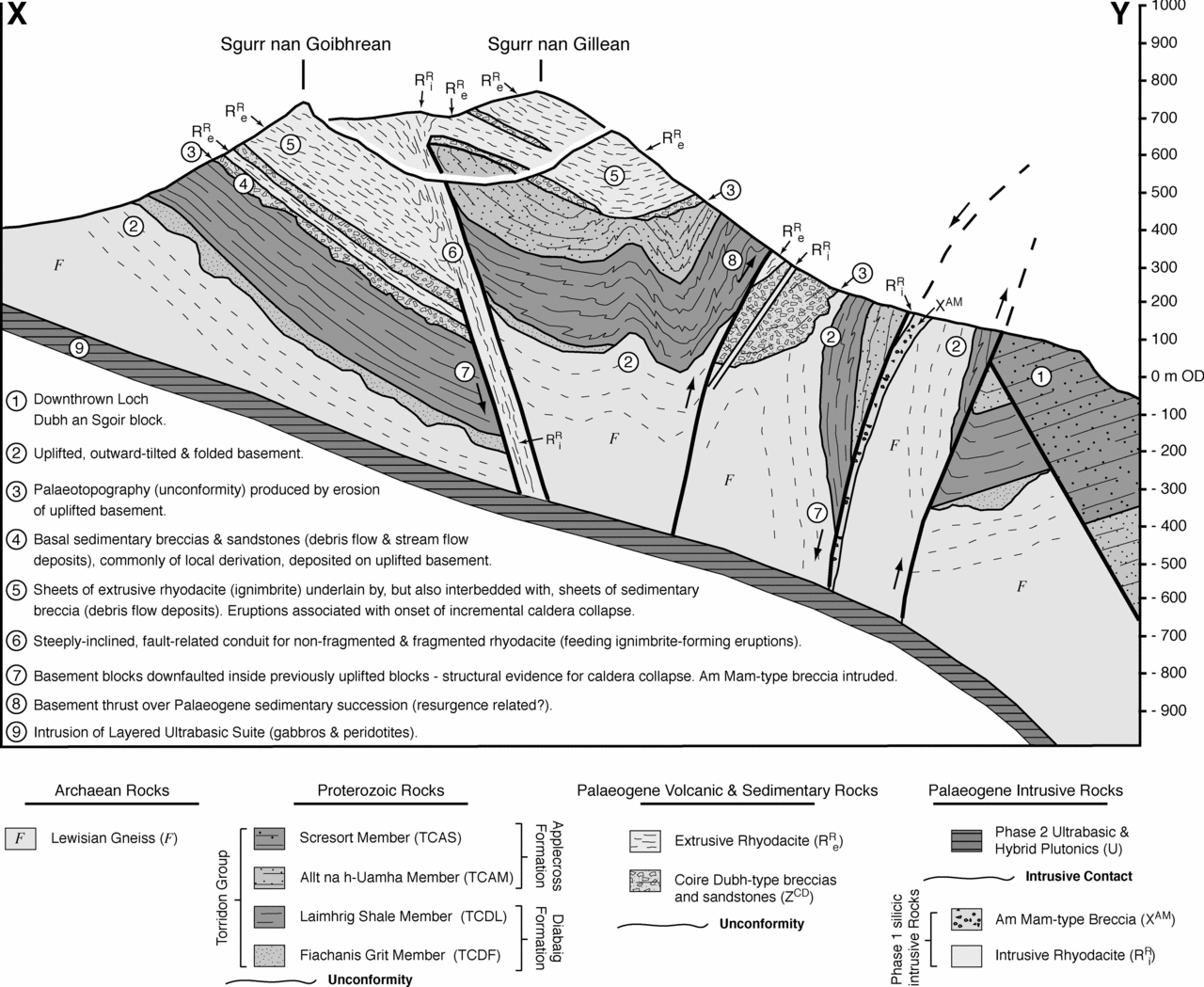
In this light, the gross structural and stratigraphic coherence of the Torridonian outcrops seems, on balance, more likely to reflect an uplifted, deformed and segmented country rock basement (caldera floor), rather than chaotic landslide megabreccias (Fig. 9). The Torridonian outcrop of Sgùrr nan Gillian has an apparent wedge-shape, but one that thickens away from, rather than toward, any potential source area along the Main Ring Fault. No ‘exotic’ fragments or ‘out-of-sequence’ jumbling of material was noted within the Torridonian outcrops. Moreover, that mesobreccia encloses and forms a matrix to the Torridonian outcrops, as depicted on previous maps, is not clear. Indeed, the boundary between mesobreccia and the Torridonian outcrops is generally sharply defined. Most importantly, our detailed remapping reveals strong structural and stratigraphic consistency within, and also between, all three Torridonian outcrops along the SW flank of Glen Dibidil and the unequivocally coherent country rocks west of Ainshval (Figs 3, 9). From the latter, there is a systematic shift in bedding strike and a general, progressive, NNW to SSE younging of strata through each of the enigmatic Torridonian outcrops. The older Diabaig Formation appears west of Ainshval and in Forgotten Corrie, while the younger Applecross Formation appears in Sgùrr nan Gillean and WNW of Dibidil Cove (Fig. 3). As in the Northern Marginal Zone, this pattern reflects the overall tapered uplift and eastward tilt of the pre-Palaeogene basement within the Main Ring Fault (Bailey, Reference Bailey1945; Hughes, Reference Hughes1960) (Fig. 2).
Interpretative cross-section through the Southern Mountains Zone. There is no vertical exaggeration. See Figure 3 for line of section (X–Y). Relationships around Sgùrr nan Gillean Peak are projected from the SW onto the plane of section. Numbers 1 to 9 list in approximate chronological order the main geological features/events, as reconstructed from this study. A colour version of this figure can be viewed online at http://journals.cambridge.org/geo.

In detail, folds and faults interrupt this overall SSE-younging pattern (Fig. 9). The gross structure of the Forgotten Corrie outcrop is an ESE-plunging syncline. The stratigraphic younging directions toward the centre of the Sgùrr nan Gillean outcrop indicate that the overall structure here is also a syncline, but with an overturned northern limb. The mass WNW of Dibidil Cove may represent the overturned limb of an adjacent anticline. Putative fold axial traces trend roughly parallel to the ring-fault, like those of folds on Beinn nan Stac and in the Northern Marginal Zone (Bailey, Reference Bailey1945; Dunham, Reference Dunham1968).
In addition to uplift, the basement rocks also provide structural evidence for subsidence. Since they lie inside and young toward uplifted Lewisian Gneiss, the arkoses WNW of Dibidil Cove have subsided along an inner strand of the Main Ring Fault system (Figs 3, 9). Hughes (Reference Hughes1960) originally noted this faulted relationship, and estimated a throw of some 350 m. The similarly inclined boundary between the Fiachanis Gritty Sandstone and Laimhrig Shale members (Figs 3, 9) seems vertically offset by several hundred metres between Forgotten and Sandy corries. This offset may also be fault related; a candidate fault surface is the sharp, E- to SE-inclined intrusive rhyodacite contact in Nameless and Forgotten corries (Fig. 3). If so, this fault trends near-parallel to the Main Ring Fault system, with downthrow to the west and a reverse sense of displacement (Fig. 9). Rarely seen in the field, such reverse faults have long been invoked to solve the ‘space problem’ of caldera subsidence (cf. Anderson, Reference Anderson1936; Roche, Druitt & Merle, Reference Roche, Druitt and Merle2000) and to act as conduits for syn-collapse magma transport and eruption (cf. Richey & Thomas, Reference Richey and Thomas1932; Kokelaar & Moore, Reference Kokelaar and Moore2006, p. 83; see Section 8.d).
Lastly, if interpreted as coherent, the Torridonian strata of Sgùrr nan Gillean must have been reverse-faulted over the underlying breccia/rhyodacite succession (Fig. 9). This may have resulted from later ‘resurgence’, as suggested for other fault relationships along strike at Beinn nan Stac (cf. Emeleus, Wadsworth & Smith, Reference Emeleus, Wadsworth and Smith1985; Emeleus, Reference Emeleus1997).
8.b. Coire Dubh-type breccias: explosion v. sedimentation
An origin for the Coire Dubh–type breccias through subterranean in situ gas shattering is hard to reconcile with their often polymict and graded nature, their relatively constrained clast size range, and the inter-layering of their constituent facies (e.g. of gneiss-rich and arkose-rich breccias, and of mesobreccia with lithic tuffs and accretionary-lapilli-bearing sandstones). Also, polymict mesobreccia sometimes occurs close to the contact with coherent country rocks of a different lithological unit to the clasts in the breccia; for example, gneiss clasts are common in the Peak of Sgùrr nan Gillean succession, which overlies Diabaig siltstones and Applecross arkoses. For formation of these characteristics, one must invoke transport, mixing, grading, sorting and layering of coarse material on a broad scale; this seems an unlikely outcome of underground gas streaming and explosion.
In addition, as noted by Williams (Reference Williams1985) in Northern Marginal Zone exposures, country rocks adjacent to the Coire Dubh-type breccias lack a zone of crackle-breccia, such as is usually associated with hydrothermal explosion breccias (Cas & Wright, Reference Cas and Wright1987). In some places, the Torridonian (especially the fissile Laimhrig Shale Member) may show an increased intensity of brecciation next to the contact with Coire Dubh-type breccia (e.g. at Beinn nan Stac and Sandy Corrie), but in others the contact is sharp and there is little or no brecciation of the adjacent country rock (e.g. around Sgùrr nan Gillean). Moreover, the Coire Dubh-type breccia clasts rarely display internal fracturing or other deformation. Thus the Coire Dubh-type breccias’ gross characteristics and field relationships preclude their formation by subterranean explosion or faulting. We instead argue they formed as sediments upon a landscape generated by intrusion-related uplift and erosion (Fig. 9).
8.c. Coire Dubh-type breccias: sedimentary processes and depositional setting
Sedimentary processes inferred to have formed the facies in the Coire Dubh-type breccias include scree accumulation, debris fall, debris-flow, hyperconcentrated-flow and stream-flow. Scree accumulation, perhaps leading to localized debris fall and debris flow, seems most apt to explain the local sub-facies of massive and quite angular mesobreccia with a near-monolithological clast composition reflecting the underlying basement. This sub-facies occurs in the lowermost parts of Beinn nan Stac, Sandy Corrie and Forgotten Corrie (Fig. 4), and may represent a veneer of debris upon the depositional surface (unconformity) generated during the intrusion-related uplift.
The main mesobreccia sub-facies is a more polymict country-rock breccia, matrix- to clast-supported with sub-angular to sub-rounded clast shapes and a sandy to silty matrix. The reverse-graded bases and normal-graded tops, clast alignment, metre-scale bedding and lens-like bed forms (indicating channellization) displayed by individual units of this sub-facies are consistent with formation by debris flow (cf. Nemec & Steele, Reference Nemec, Steel, Koster and Steel1984; Vallance, Reference Vallance, Sigurdsson, Houghton, McNutt, Rymer and Stix2000; Collinson, Mountney & Thompson, Reference Collinson, Mountney and Thompson2006). Strongly clast-aligned breccias may reflect hyper-concentrated flow (Vallance, Reference Vallance, Sigurdsson, Houghton, McNutt, Rymer and Stix2000), while coarse pebbly sandstones probably reflect stream flow (Nemec & Steele, Reference Nemec, Steel, Koster and Steel1984). Upwards transitions from normal-graded mesobreccia to the above two facies in some individual units (e.g. middle mesobreccias unit on Beinn nan Stac; Figs 4, 6a) are interpreted to represent deposition from hyperconcentrated- to stream-flows in the more dilute tail of a waning debris flow (cf. Nemec & Steele Reference Nemec, Steel, Koster and Steel1984; Vallance, Reference Vallance, Sigurdsson, Houghton, McNutt, Rymer and Stix2000).
The rare gritty sandstone lenses in the Sgùrr nan Gillean succession are interpreted as channel fills, while the discontinuous tuff lenses and lithic tuffs may reflect localized reworking of volcanic material by stream flow and debris flow (lahars), respectively. The accretionary lapilli-bearing tuffaceous sandstones, which most commonly lie just below the rhyodacite sheets, may well be base surge deposits (cf. McPhie, Doyle & Allen, Reference McPhie, Doyle and Allen1993). If so, these units record hitherto unrecognized phreato-magmatic activity acting as a pre-cursor to silicic eruptions on Rum.
The above findings echo recent re-evaluations of similar rock types in the Northern Marginal Zone and other British Palaeogene igneous centres, and reinforce the importance of volcano-sedimentary and volcano-tectonic processes in the evolution of these complex magmatic systems (see Brown, Holohan & Bell, Reference Brown, Holohan and Bell2009, this issue). Unlike many other breccia/conglomerate successions in the British Palaeogene Igneous Province, the Coire Dubh-type breccias noticeably lack lower-energy, potentially fossiliferous horizons of mud-silt grade. The Canna Lava Formation on Rum (Emeleus, Reference Emeleus1985, Reference Emeleus1997) and the Achateny and Ben Hiant formations of Ardnamurchan (Brown & Bell, Reference Brown and Bell2007) comprise a more bimodal suite of deposits, whereby coarse breccias are interbedded with finer, fossiliferous, siltstones and mudstones. These successions seem compatible with a medial, alluvial to fluvial fan depositional setting, in agreement with their slightly more distal positions with respect to the igneous centres. The Southern Mountains Zone successions seem compatible with a more proximal, alluvial fan-type depositional setting (cf. Collinson, Mountney & Thompson, Reference Collinson, Mountney and Thompson2006, p. 158).
8.d. Rhyodacite: extrusive ignimbrite sheets and an intrusive ignimbrite vent
An initial reinterpretation of several rhyodacite sheets as ignimbrites and a suggestion of a multi-phase eruptive history (Emeleus, Reference Emeleus1997) are confirmed by our more detailed observations (Section 3). The breccias between ignimbrites in Beinn nan Stac and Sandy Corrie sections (Fig. 4) have little by way of rhyodacite material, and so seem unlikely to be large syn-eruptive breccia lenses within one ash flow deposit. Moreover, the preservation of sandstones and tuffs on top of these breccia units implies at least two discrete phases of ignimbrite formation. Given the potentially rapid deposition of the breccias and sandstones, the pause in ignimbrite eruption may none the less have been short.
Our study also confirms locally intrusive emplacement of rhyodacite. The most dramatic example is that in Nameless and Forgotten corries, with its striking combination of non-fragmented, intrusive, rhyodacite–basalt marginal facies and fragmented (possibly extrusive?) interior facies, both of which dip steeply and discordantly to surrounding rocks (Fig. 3). These facies relationships may reflect initial intrusion into the basement of a composite basalt–rhyodacite body (dyke or fault intrusion) that subsequently breached the surface and permitted fragmented magmas to erupt as pyroclastic density currents, which in turn deposited as ignimbrite sheets along the Sgùrr nan Gillean–Ainshval ridge. Continuous and/or subsequent through-flow and eruptions of rhyodacite could have produced the apparently discordant relationship to the lower parts of the volcano-sedimentary succession (Figs 3, 9). In this regard, it is also noteworthy that evidence for multiple phases of intrusion of fragmented and non-fragmented magma is matched by evidence for multiple phases of ignimbrite formation.
The geometry and facies architecture of this ignimbrite feeder and vent system are similar to an ignimbrite vent in the Northern Marginal Zone (Emeleus, Reference Emeleus1997) and examples described elsewhere (cf. Almond, Reference Almond1977; Freundt, Wilson & Carey, Reference Freundt, Wilson, Carey, Sigurdsson, Houghton, McNutt, Rymer and Stix2000). Differences from examples elsewhere include the composite basalt–rhyodacite marginal facies and the strongly folded fiamme fabric. The latter may have formed upon collapse back into the vent, although syn-eruptive faulting (Section 8.a) may also have had an influence.
8.e. Potential correlations between successions
Structural uncertainties hamper correlation between successions in the Southern Mountains Zone. Broadly, however, the Beinn nan Stac and Sandy Corrie sections show lithostratigraphic similarity, with clast-supported siltstone-dominated basal mesobreccia, and two ignimbrite sheets sandwiching a more matrix-supported, grey sandstone-dominated mesobreccia sheet. A laterally continuous breccia layer noted roughly in the middle of the Peak of Sgùrr nan Gillean sheet (Emeleus Reference Emeleus1994, Reference Emeleus1997; Figs 3, 9) may define a two-fold subdivision similar to, and perhaps correlatable with, that seen in the Beinn nan Stac and Sandy Corrie successions. Exactly how these successions link to the Base of Sgùrr nan Gillean succession is presently unclear.
Correlation to the Northern Marginal Zone is similarly uncertain. The ‘epiclastic-like’ sandstone near the peak of Beinn nan Stac may correlate with a similar horizon between Coire Dubh breccias and the Cnapan Breaca ignimbrite sheet in the Northern Marginal Zone. If so, major ignimbrites formed in the south while breccias and tuffs accumulated in the north.
8.f. Interaction of volcano-tectonics and volcano-sedimentary processes
The Coire Dubh-type breccias represent episodes of high-energy mass movement. They may well have accumulated in a geologically short time frame, and their formation was contemporaneous with large ignimbrite-forming eruptions of rhyodacite. In the Northern Marginal Zone, Coire Dubh breccias are thought to result from ‘collapse of unstable caldera walls and inward slumping and sliding of debris’ (Troll, Emeleus & Donaldson, Reference Troll, Emeleus and Donaldson2000). Clasts in breccias forming from inward collapse of an over-steepened caldera ring fault scarp should ideally reflect lithologies outside the ring fault (see Lipman, Reference Lipman1976; Geshi et al. Reference Geshi, Shimano, Chiba and Nakada2002). The arkose-dominated breccias of the middle to upper Base of Sgùrr nan Gillean succession are, at least on first glance, consistent with derivation from outside the inner strand of the Main Ring Fault (Figs 3, 9) and so may be collapse related.
In several instances, mesobreccia clast compositions are not obviously compatible with generation from inward-collapse of the ring fault scarp, however. Some of the breccias, particularly those in the lower parts of the logged successions, seem more likely to be remnants of erosion and sedimentation resulting from the rapid phase of uplift prior to caldera collapse. Indeed, the preservation of pre-collapse sedimentary successions in calderas is well established (e.g. at Glencoe caldera: Moore & Kokelaar, Reference Moore and Kokelaar1998).
Interpretation of the apparently Laimhrig Shale/Fiachanis Gritty Sandstone-dominated breccias higher up in the Sandy Corrie and Beinn nan Stac successions as derived from collapses along the Main Ring Fault system is also problematic. The clasts in these units seem to stem from somewhere within the caldera, since a derivation from outside without including Applecross fragments seems difficult to achieve. Their position sandwiched between thick ignimbrites none the less suggests that these units formed after the onset of caldera formation. One solution is that these units stemmed from slopes within the ring fault that were topographically elevated during uplift and later destabilized during collapse.
The presence of channels and graded sandstones at various levels within the successions, the scarcity of blocks >1 m in diameter (only a handful were noted in this study), plus the generally well-organized nature of the deposits, namely, bedding and sorting of clasts, is not immediately compatible with their generation in a major catastrophic collapse event from the ring fault system, given their proximity to it. Incremental subsidence with the multi-eruption history inferred above (Section 8.d) may account for this, however. Many clasts, from small pebbles to large blocks, are sub-rounded. This suggests that, in many cases, debris flows reworked already eroded material, rather than material freshly derived from a destabilized fault scarp. A further possibility may be that material eroded from the uplifted basement and deposited on the flanks of a presumed topographic dome was reworked back into the caldera during subsidence. Flow direction indicators in the Coire Dubh-type breccias (e.g. imbrication) were too rarely observed, and even then too ambiguous, to provide a firm picture of drainage directions that might resolve between a predominant origin either through uplift (outward flow) or caldera collapse (inward flow).
Despite uncertainties in the detail, the Southern Mountains Zone volcano-sedimentary succession clearly reflects influences of both intrusion-related uplift and caldera collapse. A working geological history, based primarily on the Beinn nan Stac and Sandy Corrie successions (Fig. 4), is as follows. (1) A growing pre-caldera intrusion deforms Diabaig Formation and Lewisian basement rocks within the Main Ring Fault and uplifts them to the palaeosurface (Fig. 9). Alluvial deposits from this initial phase of uplift and erosion are preserved in the basal Coire Dubh-type breccias. (2) Onset of incremental caldera collapse occurs with a first major eruption of rhyodacite. (3) During a pause in eruptive activity, slopes destabilize to yield the overlying middle mesobreccia unit. (4) A second major rhyodacite eruption occurs with a further caldera collapse increment. (5) Further subsidence and slope destabilization formed overlying mesobreccias on Beinn nan Stac, perhaps with quiescent periods to form ‘epiclastic sandstone’.
Further insight into the relative roles of uplift and caldera collapse in forming the volcano-sedimentary successions of Rum will require more detailed analysis of the sedimentology and clast provenance of the breccias, a refined correlation between ignimbrites in the successions of the Northern Marginal Zone and Southern Mountains Zone, and better constraints on the island's complex structural history.
9. Conclusions
Detailed re-examination of Torridonian outcrops within the Southern Mountains Zone previously described as ‘chaotic megabreccias’ has revealed a stratigraphic and structural consistency both within and between them. Their outcrop pattern reflects an uplifted, outward-tilted, but also complexly folded and faulted country-rock basement. The basement rocks also display evidence for later fault-controlled subsidence (and perhaps resurgence). The ‘megabreccias’ are therefore reinterpreted as broadly coherent pieces of caldera floor. Our study thus shows the value of detailed structural mapping in distinguishing caldera floor from collapse-related mega-breccia deposits, a recurrent problem especially in systems with substantial pre-collapse and post-collapse deformation.
Our observations demonstrate a sedimentary, rather than a subterranean explosive, origin for country-rock breccias (Coire Dubh-type) of the Southern Mountains Zone. These breccias unconformably overlie the deformed and uplifted basement rocks, fragments of which are abundant in the immediately adjacent breccia. The major facies type is a frequently polymict, matrix- to clast-supported, country-rock breccia with sub-angular to sub-rounded clast shapes. It displays sedimentary features such as metre-scale bedding, reverse and normal grading, clast alignment and channellization. Moreover, these country-rock breccias are interbedded with, and locally show gradational transitions into, coarse pebbly sandstones, accretionary lapilli-bearing tuffaceous sandstones, discontinuous thin tuff lenses and graded lithic tuffs. Depositional processes inferred for the Coire Dubh-type breccias include scree accumulation (massive, angular and clast-supported breccias, dominated by clasts from adjacent country rock), debris flow (more polymict, crudely graded, matrix- to clast-supported and thickly bedded breccias), hyper-concentrated flow (strongly clast-aligned breccias), and stream flow (coarse pebbly sandstones) within a proximal alluvial fan depositional setting.
Our observations confirm an extrusive emplacement for several Southern Mountains Zone rhyodacite sheets as pyroclastic density current deposits (ignimbrites). These sheets are concordant with the Coire Dubh-type breccia beds, and at their bases, locally display wavy and planar-bedded ash horizons or ash lenses bearing accretionary lapilli. We interpret the latter as deposits of more dilute flows related to precursory phreato-magmatic activity (base surges). Internally, the rhyodacite sheets display a strong eutaxitic fabric, defined by fiamme (demonstrating explosive fragmentation) and a stratification of graded basal lithic tuffs (ground layer deposits), graded fiamme swarms (pumice concentration zones), and massive fine-grained fiamme-free horizons (co-ignimbrite ash surge/fall horizons), that characterizes idealized ignimbrite flow units. Evidence for post-depositional degassing and elutriation (fossil fumaroles) is also locally present. Individual rhyodacite sheets comprise multiple flow units and so were incrementally emplaced. Our logs confirm that at least two major rhyodacite eruptions occurred in the Southern Mountains Zone.
Some rhyodacite in the Southern Mountains Zone was emplaced intrusively. Inclined composite sheets of non-fragmented basalt and rhyodacite intrude Coire Dubh-type breccias on Sgùrr nan Gillean. A steeply dipping and possibly fault-controlled body of rhyodacite with non-fragmented composite basalt/rhyodacite margins and a fragmented parataxitic to eutaxitic rhyodacite core intrudes Torridonian rocks, Coire Dubh-type breccias and ignimbrite bases in Nameless and Forgotten corries. This body, which also displays evidence for episodic emplacement, is interpreted as an ignimbrite feeder system.
The volcano-sedimentary successions of the Southern Mountains Zone thus record rarely preserved sedimentary and eruptive responses to a complex history of intrusion-related uplift and incremental caldera subsidence.
Acknowledgements
Constructive discussions with J. R. Graham, and official reviewers D. J. Brown and B. van Wyk de Vries, aided the evolution of this work. E. Donoghue, L. McCourt and B. O'Driscoll shared in the experience of the Southern Mountains and provided valuable input over the years. We thank Scottish Natural Heritage and Ed Hawan (Rum Reserve Manager) for sampling permissions and logistical assistance, and the Scottish Mountain Bothies Association for refurbishment and upkeep of Dibidil bothy. EPH acknowledges financial assistance from the Department of Geology (Dave Johnston and Julian Boldy Awards), the Trinity Trust, and the Graduate Studies Office, Trinity College Dublin. A Postdoctoral Fellowship from the Irish Research Council for Science, Engineering and Technology to EPH also helped bring this work to fruition. VRT thanks the Royal Irish Academy and Science Foundation Ireland for financial support.