Implications
The increasing availability of automated milk dispensers on dairy farms facilitates ad libitum milk supply. However, greater milk allowances depress starter intake and therefore weaning becomes challenging. Adopting a weaning method defined by individual calf based on information recorded by automated feeder improves growth performance. The considerable decrease in energy intake around weaning and improved rumen function of calves weaned using a linear compared with a step-down method, suggest that the transition from a liquid to a solid feed diet should be as gradual as possible. These results can improve weaning methods to enhance animal growth and welfare.
Introduction
Calf-rearing programs have traditionally focused on decreasing rearing costs of replacements by restricting milk supply to encourage starter intake and reduce the length of the milk-feeding period. However, it has become evident that providing calves with a high level of milk in the 1st weeks of life increases growth rates (Jasper and Weary, Reference Jasper and Weary2002) and influences the expression of the milking potential of the animal (Bach, Reference Bach2012; Soberon et al., Reference Soberon, Raffrenato, Everett and Van Amburgh2012).
In recent years, the industry has increasingly provided greater milk allowances to young calves in an attempt to improve pre-weaning growth performance, and to foster full milk potential of dairy heifers (Soberon et al., Reference Soberon, Raffrenato, Everett and Van Amburgh2012). However, greater milk allowance delays starter intake and therefore maintaining the same weaning objectives becomes challenging. Current weaning strategies comprise abrupt or gradual weaning (Steele et al., Reference Steele, Doelman, Leal, Soberon, Carson and Metcalf2017), in a linear or step-down reduction of the milk volume, at the age of 5 to 12 weeks (Khan et al., Reference Khan, Lee, Lee, Kim, Ki, Hur, Suh, Kang and Choi2007; Sweeney et al., Reference Sweeney, Rushen, Weary and De Passillé2010; Meale et al., Reference Meale, Leal, Martín-Tereso and Steele2015) or based on starter intake (de Passillé and Rushen, Reference de Passillé and Rushen2016). The other weaning approaches include reducing the number of daily portions of milk fed to calves or diluting milk with water (Jensen, Reference Jensen2006; Weary et al., Reference Weary, Jasper and Hötzel2008). Milk allowance should be gradually reduced before weaning to ensure sufficient amounts of solid feed are consumed by calves when milk is withdrawn, in order to sustain growth after weaning (Khan et al., Reference Khan, Weary and Von Keyserlingk2011). Different management (Costa et al., Reference Costa, von Keyserlingk and Weary2016) and feeding strategies (Khan et al., Reference Khan, Bach, Weary and Von Keyserlingk2016) are proposed to stimulate solid feed intake, and therefore growth around weaning in calves fed different milk allowance, however, little information exists on weaning calves fed milk ad libitum. Some weaning methods that promote solid feed intake in calves during pre-weaning period are difficult to implement on farm, especially there where a large number of calves are fed manually. However, automatic milk feeders allow for weaning methods in calves fed high milk quantities with milk withdrawal strategies that mimic the natural weaning process in cattle (i.e. gradual reduction over several days).
The objective of this study was to evaluate the effect of different gradual weaning methods on solid feed intake, growth and selected blood metabolites in calves during the weaning and early post-weaning periods. Furthermore, hair cortisol concentration is a reliable marker for chronic stress in cattle (Burnett et al., Reference Burnett, Madureira, Silper, Tahmasbi, Nadalin, Veira and Cerri2015), and we measured the concentration of hair cortisol to compare stress in calves in response to different weaning methods. We hypothesized that ad libitum fed calves would perform better at weaning and post-weaning when weaned using a step-down method compared with a linear drop method. Moreover, a weaning program based on individual milk intake would lead to a smoother transition to improve solid feed intake around weaning compared to a fixed weaning program.
Material and methods
The experiment was conducted from September 2016 to April 2017 at the Calf and Beef Research Facility of Trouw Nutrition Research and Development (Sint Anthonis, the Netherlands). Animal procedures complied with the Dutch Law on Experimental Animals and Directive 2010/63/EU and were approved by the Animal Care and Use Committee from Utrecht University.
Animals, housing and treatments
Thirty-six Holstein Friesian (n = 30) or crossbred (obtained from the three-way rotational system with Holstein Friesian, Montbeliarde and Swedish, Danish or Norwegian Red, n = 6) bull calves were collected from local dairy farms at an age of 1 to 3 days. A blood sample was taken via jugular venipuncture to measure IgG content (DVM Rapid Test II Multi Analyzer; MAI Animal Health, Elwood, IL, USA) between 48 and 72 h of age. All calves included in the experiment had a minimal IgG content of 800 mg/dl. At the farm of origin, calves were offered at least 3.0 l of colostrum within 2 h after birth and 4.0 l from 2 to 24 h after birth. Until the calves were collected from the farm, they received 3.0 l milk replacer (MR) (150 g/l: Sprayfo Excellent; Sloten B.V., Deventer, the Netherlands) twice daily. After arrival at the research facility, calves were housed in individual pens (1.22×2.13 m) bedded with flax straw until ±14 days of age. Semi-acidified (0.2% citric acid; pH 6.2) MR (150 g/l: 22.5% CP, 18.0% crude fat and 43.0% lactose; Sloten B.V., Deventer, the Netherlands) was prepared twice daily and offered ad libitum using teat buckets. The MR was refreshed at around 0700 and 1500 h and refusals were recorded. To prevent sedimentation, the MR was stirred at least twice in between meals using a whisk. Water was offered ad libitum using plastic buckets. Calves were excluded from the trial if consumption of MR was less than 4 l/day for 3 consecutive days. On day 15±2, the calves were transferred to 5.0×5.9 m group pens (six calves per pen) with a flax straw-bedded resting area (5.0×2.8 m) and slatted floors in front of the feeders. In these group pens, the calves continued to receive ad libitum semi-acidified MR and starter (18.2% CP, 20.3% starch, 11.2% crude fiber, 2.2% crude fat; 5-mm pellet; ForFarmers, Helmond, the Netherlands) via automated feeders (CF 1000; DeLaval, Tumba, Sweden). The drinking speed was set at 30% ascending to 50% during the first 21 days and at 50% thereafter. The maximum meal size for MR was set at 2 l with a minimum time interval of 30 min. Wheat straw (5 cm chop length; Ruwvoer Distributiecentrum Gassel, Gassel, the Netherlands) was available ad libitum from an automated feeder (CRFI; Biocontrol, Rakkestad, Norway). Water was available ad libitum from an automated feeder (Förster-Technik, Engen, Germany). The minimum temperature in the calf facility was kept at 15°C and the calves were exposed to daylight and artificial light from 0600 to 2200 h. At day 35 of age, the calves were blocked by age and breed and were randomly assigned to one of three weaning strategies: (1) Linear fixed (LIN; n = 12), the calves were allowed ad libitum access to MR until 36 days of age, then MR volume was reduced to 6 l/day, and thereafter MR allowance was linearly reduced by 2.5% of intake daily to achieve a MR intake of 2 l/day. (2) Step-down fixed (STEP; n = 12), the calves were allowed ad libitum access to MR until 36 days of age, then MR volume was reduced to 6 l/day for days 36 to 48 of age, 4 l/day for days 49 to 56 of age and 2 l/day for days 57 to 63 of age. (3) Step-down dynamic (DYN; n = 12), the calves were allowed ad libitum access to MR until 36 days of age, then MR intake (average volume consumed from days 29 to 35) was reduced to 75% and maintained for 9 days, then reduced to 50% of the volume for the next 10 days, and then reduced to 25% for the next 9 days. Calves on all treatments were fully weaned by day 64 of age and then post-weaning performance was monitored until 84 days of age.
Sampling, measurements and analysis
Calves were monitored daily for general health, including feed intake, disease symptoms and activity. Body weights were recorded at arrival and thereafter once per week between 0800 and 1100 h. Wither height, heart girth and body barrel were measured at arrival and once per week from days 35 to 84. The wither height was measured as the distance from the floor to the top of the withers directly above the center of the shoulder; heart girth and body barrel were, respectively, the minimal and maximal circumference around the body. Quantities of MR, starter and straw eaten daily by each calf were recorded manually from days 0 until 14 of age and with the automated feeders from 15 to 84 days of age.
Blood was sampled via jugular venipuncture on days 35, 42, 49, 63, 70 and 84 of age between 0800 and 1100 h using 10 ml serum vacutainers (GD, Deventer, the Netherlands). After collection, blood was centrifuged at 2942 rpm for 15 min at 4°C, and 1.0 ml of serum was transferred into 2 ml cryotubes and stored at −20°C. Serum samples were analyzed at University Veterinary Diagnostic Laboratory (Utrecht, the Netherlands) for β-hydroxybutyric acid (BHBA), urea, total protein, non-esterified fatty acids (NEFA), growth hormone (GH) and IGF-1. Commercial kits were used to analyze BHBA (Ranbut RB1007) and NEFA (Randox FA115). Urea was measured using a urease and glutamate dehydrogenase method and total protein was measured using the Biuret method. Reagents for the urea and total protein assay were obtained from Beckman Coulter and readings for all aforementioned assays were performed in a microplate reader (Olympus AU680, Beckman Coulter, Brea, CA, USA). The IGF-1 was analyzed with a solid-phase, enzyme-labeled chemiluminescent immunometric assay using monoclonal murine anti-IGF-1 and rabbit anti-IGF-1 antibodies. Readings were performed with the Immulite 2000 (Siemens, Erlangen, Germany). The intra- and interassay coeffcients of variation of this assay were 2.5% and 7.4%, respectively. Growth hormone was estimated by a double antibody radioimmunoassay using a highly purified bovine GH preparation for radioiodination and a rabbit anti-bovine antibody (Taverne et al., Reference Taverne, Bevers, Van der Weyden, Dieleman and Fontijne1988). The intra- and interassay coefficients of variation of this assay were 1.8% and 9.7%, respectively.
At day 36, the entire tail was clipped to enable collecting regrowth hair from weaning onwards. For the analysis of cortisol, white (n = 33) or black (n = 3) regrowth hair from the tail switch was carefully collected with clippers (blade size 10, GT 330; Aesculap, Hessen, Germany) at days 49, 63 and 84 of age between 0800 and 1100 h. The hair was clipped as close to the skin as possible. The clipper blade was cleaned after each hair collection with a brush to keep cross-contamination at a minimum. The hair was stored in plastic zip lock bags in a dark place at 4°C until processed. Preparation of the samples was based on the method suggested by Davenport et al. (Reference Davenport, Tiefenbacher, Lutz, Novak and Meyer2006), with modifications. Samples of 0.50±0.05 g were cleaned of dirt, washed in 5 ml warm water for 3 min and washed twice in 10 ml isopropanol for 3 min. The samples were dried at 55°C using a heating vacuum dryer and cut into <5 mm length fragments using scissors. Then, trimmed hair samples were placed in 2 ml tubes prefilled with 12 metal 2.4-mm diameter beads, and processed on a bead-beater (MagnaLyser; Roche, Almere, the Netherlands) for six 99 s cycles at 7000 rpm. In between cycles, samples were chilled in an ice bath for 3 min. Extraction of hair cortisol was performed following the procedure of Koren et al. (Reference Koren, Mokady, Karaskov, Klein, Koren and Geffen2002), with modifications. A subsample of 100±10 mg of powdered hair was weighed into a 20 ml glass tube. Then, 10 ml of HPLC-grade methanol (VWR, Amsterdam, the Netherlands) was added. Moreover, 500 µl of internal standard solution (cortisol-d4; 2 µg/l; Sigma-Aldrich, St. Louis, MO, USA) was added in order to correct for sample preparation variations and to compensate for variability in MS detection. The tubes were capped and vortexed to ensure the hair came into contact with the methanol. The samples were sonicated for 10 min at 45°C (Elmasonic TI-H-20; Elma, Singen, Germany) and incubated for 16 h (IKA KS 4000i control; Staufen, Germany) at 100 rpm and 50°C for cortisol extraction. Following extraction, samples were vortexed and sonicated for 10 min at 45°C. Then, the samples were centrifuged (Rotina 420R; Hettich, Tuttlingen, Germany) for 3 min at 2000 rpm, and 4 ml of the supernatant was transferred in duplicate into 15 ml glass tubes. The liquid was evaporated to dryness in 30 min at 55°C under a stream of ultrapure nitrogen gas. The samples were reconstituted in 250 µl of methanol by vortexing and sonicating for 10 min at room temperature. To prevent evaporation of the sample, 250 µl of 0.2% formic acid was added. The samples were centrifuged for 3 min at 12 700 rpm. A 300 µl aliquot of the supernatant was transferred into a glass crimp top vial. The cortisol concentration of the samples was analyzed at MasterLab (Boxmeer, the Netherlands) using HPLC-MSMS. Measured cortisol concentrations were corrected for the amount of hair weighed into the tube.
Statistical analysis
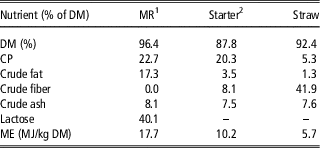
For each calf, daily metabolizable energy (ME) and CP intake was calculated by multiplying ME and CP concentration with intake of MR and starter (Table 1; MasterLab, Boxmeer, the Netherlands). Average daily gain of each calf for the pre-weaning (days 0 to 35), weaning (days 36 to 63) and post-weaning (days 64 to 84) phase was calculated. All data were normally distributed according to the UNIVARIATE procedure of SAS 9.3 (SAS Institute Inc., 2011). The individual calf was used as the experimental unit. As treatments were applied on day 36, values measured on day 35 for growth, intake, blood and hair parameters were considered covariates for analysis. Data were subjected to ANOVA using the MIXED procedure of SAS, with time as repeated measure for growth, blood and hair parameters. The model included the fixed effects of treatment, week, interactions of treatment by week and block. Subsequent Tukey’s multiple comparison tests were performed to evaluate differences between subgroups. Weekly values for intake were analyzed separately for each phase. An autoregressive type 1 covariance structure was used as determined by the lowest Akaike’s information criterion. Values reported are least squares means and standard error of the mean.
Ingredient composition and analyzed nutrient composition of milk replacer (MR), starter and wheat straw fed to dairy calves during the 12-week experimental period

DM = dry matter; ME = metabolizable energy.
1 MR composition: 30.0% skimmed milk powder, 27.0% sweet whey powder, 15.6% delactosed whey powder, 9.6% palm oil refined, 5.3% coconut oil refined, 4.5% maltodextrin, 3.0% premix, 2.0% wheat flower extruded, 2.0% dextrose, 0.2% citric acid, 0.8% potassium sorbate.
2 Starter composition: 25.0% soybean meal, 21.0% maize, 15% soya hulls, 10.5% alfalfa, 10.0% beet pulp, 10.0% barley, 5.0% sugar cane molasses, 1.0% limestone, 1.0% monocalcium phosphate, 1.5% premix.
Results
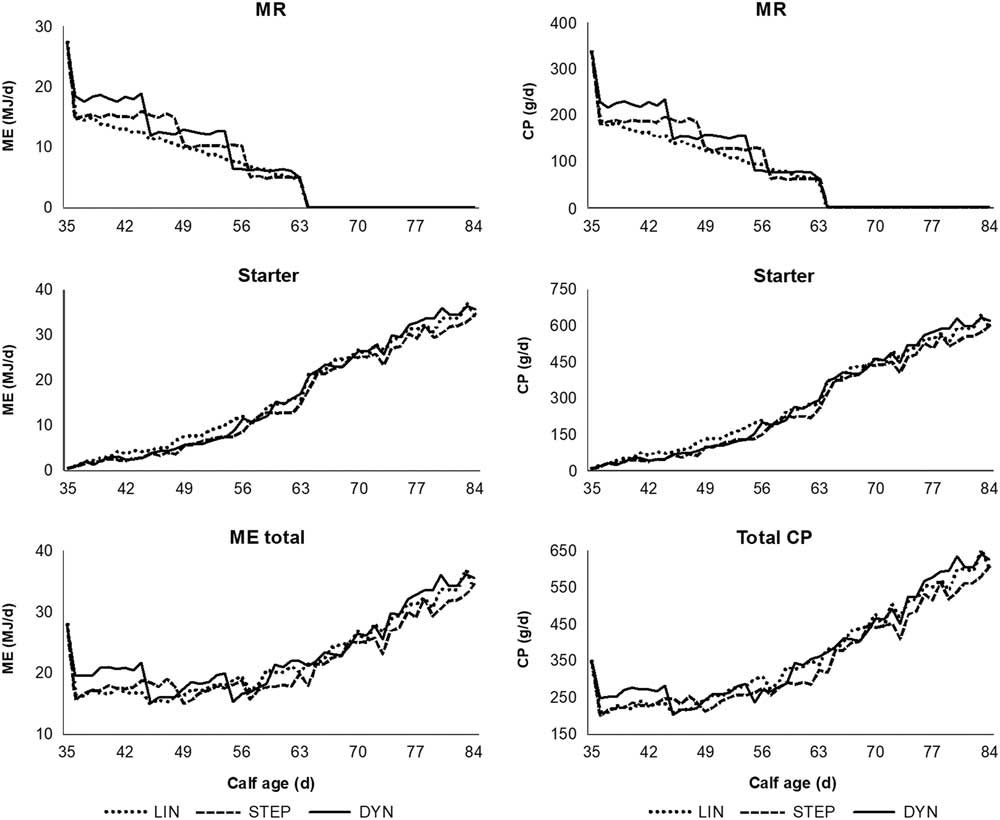
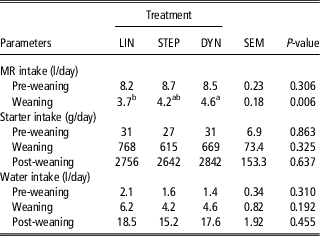
During the experiment, one calf in the LIN treatment died at weeks 10. There appeared to be no clear cause of death as determined by postmortem analysis (Gezondheidsdienst, Deventer, the Netherlands). As expected, during pre-weaning (from days 1 to 35) no differences (P > 0.05) were observed among weaning methods in intake, growth and concentrations of blood parameters and hair cortisol. Milk replacer consumption by all the calves was similar with 10.4±0.2 l/day a week before the start of weaning process (days 29 to 35). Milk replacer allowance for calves on the DYN treatment was reduced to 7.3, 4.8 and 2.4 l/day at day 36, 45 and 55 of age, respectively. Therefore, DYN calves drank more (P < 0.006) MR during weaning than LIN calves but not than STEP calves (P > 0.05) (Table 2). We did not observe differences in starter and water intake among treatments during weaning and post-weaning phases (P > 0.05; Table 2). Daily averages of MR, starter and total ME and CP intake are shown in Figure 1.
Daily averages of milk replacer (MR), starter and total metabolizable energy (ME) and CP intake in ad libitum fed dairy calves weaned according to a linear fixed (LIN), step down fixed (STEP) or step down dynamic (DYN) program (n = 12) from days 36 to 63.

Daily milk replacer (MR) and starter intake in pre-weaning (days 1 to 35), weaning (days 36 to 63) and post-weaning (days 64 to 84) phase for ad libitum fed dairy calves weaned according to a linear fixed (LIN), step down fixed (STEP) or step down dynamic (DYN) program from days 36 to 63

a,bWithin row, means without common superscript differ (P < 0.05).
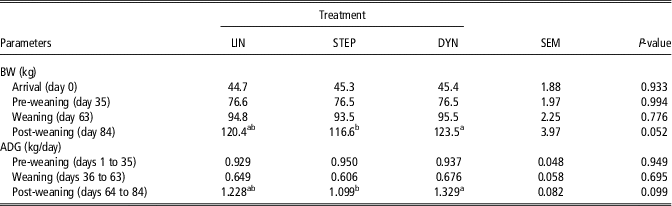
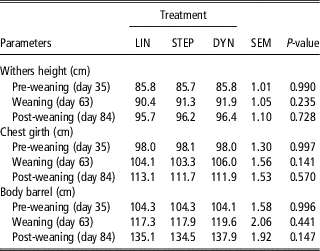
Arrival BW of the calves was 45.3±2.4 kg and they grew in average up to 76.6±2.4 kg by day 36 of the experiment (Table 3). By day 84 of age, DYN calves were heavier than STEP calves (P = 0.015). Average daily gain did not differ among treatments during weaning (P > 0.05; Table 3). However, post-weaning calf growth was greater (P = 0.038) in DYN calves compared to STEP calves but not to LIN calves (P > 0.05). In general, body measurements were not different (P > 0.05) among treatments (Table 4), with the exception of body barrel at day 77, which was greater (P < 0.05) in DYN calves than LIN and STEP calves (data not shown).
Body weights and average daily gain (ADG) in pre-weaning, weaning and post-weaning phase for ad libitum fed dairy calves weaned according to a linear fixed (LIN), step down fixed (STEP) or step down dynamic (DYN) program from days 36 to 63

a,bWithin row, means without common superscript differ (P < 0.05).
Pre-weaning, weaning and post-weaning body dimensions of ad libitum fed dairy calves weaned according to a linear fixed (LIN), step down fixed (STEP) or step down dynamic (DYN) program from days 36 to 63

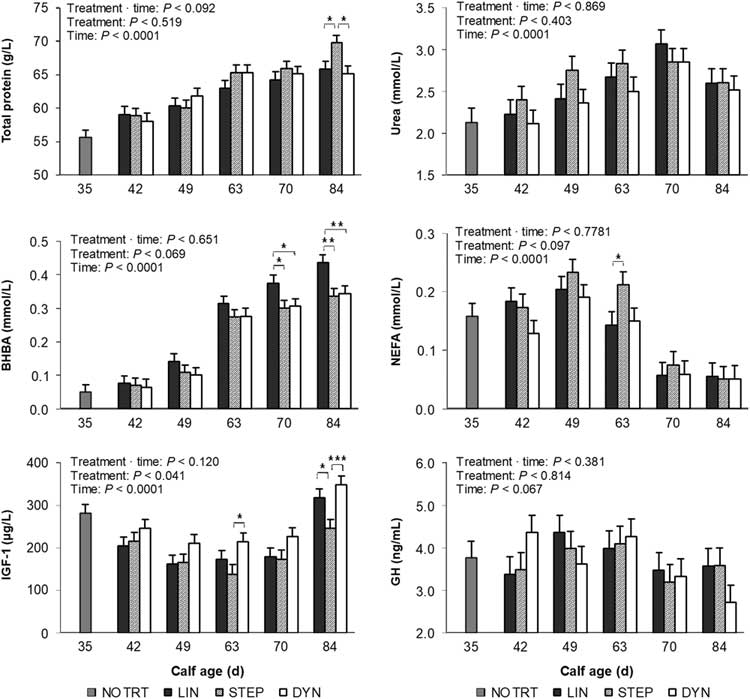
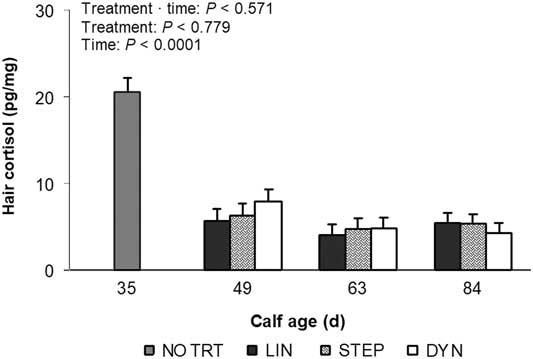
We observed a higher concentration of total protein in serum for calves weaned using the STEP method compared to the LIN and DYN methods (P < 0.05) at day 84 of age (Figure 2). Plasma concentrations of BHBA were greater (P < 0.05) in calves weaned using the LIN compared to the STEP or DYN method at days 70 and 84 of age. At day 63 of age, NEFA concentrations were greater in STEP calves than LIN calves (P = 0.03). Furthermore, plasma concentrations of IGF-1 increased (P < 0.05) at days 63 and 84 of age in DYN compared to STEP calves. At day 84 of age, LIN calves had greater (P = 0.02) concentrations of IGF-1 in the plasma than STEP calves. Urea and GH concentrations were not affected by weaning method (P > 0.05). We did not observe differences in hair cortisol concentration among weaning methods (P > 0.05; Figure 3). Average concentrations of hair cortisol were greater (P<0.05) at day 35 compared to days 49, 63 and 84.
Blood serum concentrations of total protein, urea, β-hydroxybutyric acid (BHBA), non-esterified fatty acids (NEFA), IGF-1 and growth hormone (GH) in ad libitum fed dairy calves before treatments were applied (NO TRT) and when amounts of milk replacer fed were reduced at day 36 of age according to a linear fixed (LIN), step down fixed (STEP) or step down dynamic (DYN) program. Calves were fully weaned at day 63 of age. Data are reported as least squares means ±SEM. Symbols indicate differences between treatment means: *P < 0.05, **P < 0.01, ***P < 0.001.

Hair cortisol concentration in ad libitum fed dairy calves before treatments were applied (NO TRT) and when amounts of milk replacer fed were reduced at day 36 of age according to a linear fixed (LIN), step down fixed (STEP) or step down dynamic (DYN) program. Calves were fully weaned at day 63 of age. Data are reported as least squares means ±SEM.

Discussion
This study evaluated solid feed intake, growth, selected blood parameters and hair cortisol concentrations in ad libitum fed calves weaned using a linear, a fixed or dynamic step-down method. Our hypothesis was that the ad libitum fed calves would perform better when weaned according to more abrupt reductions (STEP) in milk supply when compared with gradual reductions (linear program). In addition, a weaning method based on individual milk intakes would lead to a smoother transition to solid feed.
Milk quality, age, sex and breed of the calves, feeding methods and climatic conditions could potentially affect the milk consumption in ad libitum milk fed calves (Khan et al., Reference Khan, Weary and Von Keyserlingk2011 and Reference Khan, Bach, Weary and Von Keyserlingk2016). In the current study, the average consumption of 10.4 l/day during the week before weaning is lower than the ~13.0 l/day found in an earlier study that offered an unlimited milk supply (Frieten et al., Reference Frieten, Gerbert, Koch, Dusel, Eder, Kanitz, Weitzel and Hammon2017). The lower consumption measured during this study could be related to the delayed introduction of the ad libitum feeding scheme, as a reduced milk intake was found to decrease milk consumption during the subsequent weeks (Fujiwara et al., Reference Fujiwara, Rushen and de Passillé2014). The average intake of ME from MR on day 36 were, respectively, for LIN, STEP and DYN, 59%, 56% and 70% of the average ME intake of MR consumed by calves between days 29 and 35 (Figure 1). Total ME intake recovered to the same level recorded between days 29 and 35 by day 74, whereas CP intake recovered earlier around day 63; thus indicating that ME rather than CP may be the first limiting factor for calf growth around weaning when calves are transitioned from ad libitum milk feeding to a solid feed diet. To our knowledge, calf growth during weaning potentially being limited by ME rather than CP intake has not been described before.
Greater post-weaning growth in DYN calves compared with STEP calves, could be explained by higher MR intake along with a higher circulating IGF-1 (Figure 2). The increase in body barrel is in line with the results of growth rates and BWs in Table 3. However, unlike BW the difference in body barrel during the weaning phase was not maintained in the post-weaning period. The greater concentrations of IGF-1 and the higher growth rates for DYN calves found in the current study are in agreement with Bartlett et al. (Reference Bartlett, McKeith, VandeHaar, Dahl and Drackley2006), who has suggested that IGF-1 is indirectly related to stimulation of growth by a greater nutrient supply. The greater IGF-1 concentrations post-weaning in LIN v. STEP calves further suggest that higher supply of nutrients through a better developed rumen (i.e. as indicated by a greater BHBA concentration) might have contributed to the higher IGF-1 concentration (Blanco et al., Reference Blanco, Casasús and Villalba2010). Growth hormone levels are inversely related to energy balance and feeding intensity (Blum et al., Reference Blum, Schnyder, Kunz, Blom, Bickel and Schürch1985). Differences in feeding intensity among treatments were not large enough to cause differences in GH concentrations throughout the trial. Serum BHBA is an indicator of rumen epithelium maturation (Quigley et al., Reference Quigley, Caldwell, Sinks and Heitmann1991). The increasing BHBA concentrations with advancing age in all calves could be attributed to start of rumen fermentation with a shift from liquid to solid diet (Khan et al., Reference Khan, Bach, Weary and Von Keyserlingk2016). In the current study no difference in starter intake was found due to a high variation in starter intake and a small sample size. However, the greater BHBA concentrations in LIN v. STEP and DYN calves indicate a greater volatile fatty acid production and absorption by the rumen (Nemati et al., Reference Nemati, Amanlou, Khorvash, Moshiri, Mirzaei, Khan and Ghaffari2015; Deelen et al., Reference Deelen, Leslie, Steele, Eckert, Brown and DeVries2016). Serum concentrations of NEFA reflect fat mobilization with higher levels as a consequence of an energy deficiency. A post-weaning decrease in NEFA concentrations was also found by Hugi and Blum (Reference Hugi and Blum1997) when calves were allowed 7 kg/day of whole milk until stepped down to 6, 4 and 2 kg/day from 8 to 16 weeks of age. The greater concentrations during the weaning phase found in the current study suggests that the calves were mobilizing more fat during the step-down phase compared to the animals in the study from Hugi and Blum (Reference Hugi and Blum1997). The calves in the current study were younger when weaned, indicating that the transition to a solid feed diet was more challenging for these animals compared to the older animals in the study from Hugi and Blum (Reference Hugi and Blum1997). At day 63, STEP calves were mobilizing more fat compared to LIN and DYN calves indicating that these animals experienced more difficulties in adjusting to a solid feed diet. Urea concentrations mirror ruminal fermentable protein intake as protein is degraded into ammonia, which is absorbed and converted to urea. An increase in urea during weaning was also found by Hugi and Blum (Reference Hugi and Blum1997) and explained as the result of increased degradation of protein by microbes in the rumen. Lower concentrations of total protein in serum mirror intestinal protein supply being more limiting than energy availability (Bartlett et al., Reference Bartlett, McKeith, VandeHaar, Dahl and Drackley2006). Therefore, the increase in total protein concentration of STEP calves compared to LIN and DYN calves at day 84 indicates that these calves were less able to use protein for growth due to lower energy availability.
Our results suggest that a DYN weaning method leads to better growth performance of ad libitum milk fed calves post-weaning. Gradual weaning schemes have been compared to abrupt weaning schemes before (Khan et al., Reference Khan, Lee, Lee, Kim, Ki, Hur, Suh, Kang and Choi2007; Sweeney et al., Reference Sweeney, Rushen, Weary and De Passillé2010; Steele et al., Reference Steele, Doelman, Leal, Soberon, Carson and Metcalf2017). The current study compared a gradual to a step-down scheme and found that a LIN weaning is even better than STEP weaning. The former method used less MR and resulted in improved rumen function as indicated by increased concentrations of BHBA and IGF-1 in serum and did not differ in post-weaning average daily gain compared to calves weaned through the DYN method. Important to note is that the current weaning methods showed a strong MR reduction for LIN and STEP calves on day 36, as reflected by the increase in NEFA concentrations in LIN and STEP calves from days 35 to 42. The weaning methods were designed based on current commercial recommendations to dairy farmers. However, more abrupt weaning steps could cause a growth depression in calves around weaning due to a severe loss and longer lag in fulfiling the gap between ME loss from milk to ME supply from solid feed intake (Khan et al., Reference Khan, Weary and Von Keyserlingk2011; Khan et al., Reference Khan, Bach, Weary and Von Keyserlingk2016), suggesting that the ad libitum milk fed calves can better cope a small and continuous shift toward solid feed than abrupt or drastic changes being used for weaning.
Hair cortisol concentrations are measured for the assessment of long-term or chronic stress in dairy cows and calves (Burnett et al., Reference Burnett, Madureira, Silper, Tahmasbi, Nadalin, Veira and Cerri2015; Tallo-Parra et al., Reference Tallo-Parra, Lopez-Bejar, Carbajal, Monclús, Manteca and Devant2017). Hair incorporates hormones and other circulating substances mainly through passive diffusion from blood when growing (Cone, Reference Cone1996). To our knowledge, the effect of weaning on hair cortisol concentrations in calves has not been evaluated before. The concentrations observed in the current study align with the studies of Burnett et al. (Reference Burnett, Madureira, Silper, Nadalin, Tahmasbi, Veira and Cerri2014) and del Rosario et al. (Reference del Rosario, Valdez, Lemus-Ramirez, Vázquez-Chagoyán, Villa-Godoy and Romano2011) who found average values of 5.7±1.7 and 12.15±1.85 pg/mg hair in dairy cows. Tallo-Parra et al. (Reference Tallo-Parra, Lopez-Bejar, Carbajal, Monclús, Manteca and Devant2017) found ten-fold lower hair cortisol concentrations in calves, which could be explained by different extraction techniques. The higher concentrations evaluated by del Rosario et al. (Reference del Rosario, Valdez, Lemus-Ramirez, Vázquez-Chagoyán, Villa-Godoy and Romano2011) of 114.5±14.43 pg/mg might be an age effect as calves were 15 days of age compared with 35 days of age in our study. The lower concentration may be explained by dilution of cortisol content of old with new hair. Parturition in cows is initiated by high fetal cortisol concentrations present in late pregnancy (Mastorakos and Ilias, Reference Mastorakos and Ilias2003). The higher hair cortisol concentrations at day 35 compared to other days observed in the current study, can be explained by the fact that hair from this sample includes incorporation of cortisol originating from the fetal period. Therefore, we recommend that future studies consider regrowth hair only when analyzing hair cortisol concentrations. Cortisol concentrations in hair were not affected by weaning phase or method, suggesting that calves on all treatments experienced little and similar distress around weaning. Therefore, from readings of hair cortisol, no preference for one of the tested weaning methods can be concluded.
In this study we demonstrated the benefits with respect to performance of a weaning method defined by individual calf based on information recorded by automated feeders. The firm decrease in ME intake around weaning and increased performance of LIN compared to STEP calves, suggest that the transition from a liquid to a solid feed diet should be as gradual as possible. Furthermore, the earlier recovery in CP compared to ME intake indicates the importance of the energy supply compared to protein from the weaning and early post-weaning diet. These results reinforce the importance of a smooth transition from liquid to solid feed when feeding calves elevated planes of nutrition and can lead to improved weaning strategies to enhance post-weaning growth, health and welfare.
Acknowledgements
The authors gratefully acknowledge the support of Natasja Boots and the farm personnel at the Trouw Nutrition Calf and Beef Research Facility. The authors also appreciate the technical assistance provided by Orhan Daud and Gert Klaassen (Trouw Nutrition, the Netherlands). Preliminary results have been published in abstract form and presented on a poster at the ASAS-CSAS Annual Meeting and Trade Show (Welboren et al., Reference Welboren, Leal, Steele, Khan and Martín-Tereso2018).
Declaration of interests
A.C.W., M.A.S. and M.A.K. have no conflicts of interests. L.N.L. and J.M.-T. are employed by Trouw Nutrition, an animal nutrition company.
Ethics statement
Animal procedures complied with the Dutch Law on Experimental Animals and Directive 2010/63/EU and were approved by the Animal Care and Use Committee from Utrecht University.
Software and data repository resources
None of the data were deposited in an official repository.