1. Introduction
Infant sensitivity to speech prosody begins developing before birth (DeCasper & Spence, Reference DeCasper and Spence1986). Newborns discriminate non-native languages of different rhythmic classes (Mehler, Jusczyk, Lambertz, Halsted, Bertoncini & Amiel-Tison, Reference Mehler, Jusczyk, Lambertz, Halsted, Bertoncini and Amiel-Tison1988; Nazzi, Bertoncini & Mehler, Reference Nazzi, Bertoncini and Mehler1998a), and between words with different patterns of lexical stress (Sansavini, Bertoncini & Giovanelli, Reference Sansavini, Bertoncini and Giovanelli1997) and pitch contours (Nazzi, Floccia & Bertoncini, Reference Nazzi, Floccia and Bertoncini1998). During the first year after birth, infants shift their attention from a wide range of native and non-native contrasts to a heavier focus on contrasts within their native language(s). This process is often referred as perceptual attunement or “perceptual reorganization” (Werker & Tees, Reference Werker and Tees1984).
The question as to whether infant perceptual patterns differ across infants learning one or more languages has received significant attention in the past few decades. Developmental studies comparing monolingual and bilingual infants reveal both general trajectories in infant development, independent of specific language input, and specific differences induced by language environment. Generally speaking, similarities in performance between monolingual and bilingual infants reflect maturational factors independent of the influence of (dual) language exposure along the developmental time line, and differences indicate the influence of a bilingual environment.
Monolingual and bilingual infants pass through the major linguistic milestones approximately at the same points in their developmental time lines (Pearson, Fernández & Oller, Reference Pearson, Fernández and Oller1993; Paradis & Genesee, Reference Paradis and Genesee1996; Nicoladis & Genesee, Reference Nicoladis and Genesee1997; Genesee, Reference Genesee and McGroarty2001; Meisel, Reference Meisel, Cenoz and Genesee2001; Werker, Maurer & Yoshida, Reference Werker, Byers-Heinlein and Fennell2009; Werker, Reference Werker2012). In the domain of speech perception, no delay is observed in bilingual infants’ perception of salient native stop contrasts compared to that of monolingual infants (Burns, Yoshida, Hill & Werker, Reference Burns, Yoshida, Hill and Werker2007; Sundara, Polka & Molnar, Reference Sundara, Polka and Molnar2008; Liu & Kager, Reference Liu and Kager2015a). Catalan–Spanish bilingual infants can, from 8 months, discriminate the Catalan-specific /e/-/ε/ contrast and the /e/-/u/ contrast in Catalan and Spanish just as well as their monolingual peers (Sebastián-Gallés & Bosch, Reference Sebastián-Gallés and Bosch2009; Albareda-Castellot, Pons & Sebastián-Gallés, Reference Albareda-Castellot, Pons and Sebastián-Gallés2011). Overall, bilingual learners reach the same language proficiency at the same pace as monolinguals at least in the dominant language.
Nevertheless, receiving reduced exposure to each language and spending their formative years in a more complex learning environment, bilingual infants demonstrate linguistic and cognitive differences along the developmental trajectory compared to their monolingual peers. We provide three types of distinct bilingual developmental patterns in the domain of infant speech perception from previous literature.
First, a temporarily delayed, or ‘U-shaped’, perceptual pattern has been reported in bilinguals in the first year after birth to native contrasts. Compared to monolinguals of the same age, Catalan–Spanish bilingual infants demonstrate delayed discrimination of the native /s/-/z/ contrast at 12 months (Bosch & Sebastián-Gallés, Reference Bosch and Sebastián-Gallés2003), and of the native /o/-/u/ contrast at 8 months (Sebastián-Gallés & Bosch, Reference Sebastián-Gallés and Bosch2009). This U-shaped pattern, not found in monolingual infants, has been attributed to various causes such as contrast salience and acoustic properties, input frequency and distributional properties, rhythmic similarity or segmental variation (cognate words) between languages, phonetic space (category density), task effects and social-indexical factors (Bosch & Sebastián-Gallés, Reference Bosch and Sebastián-Gallés2003; Sebastián-Gallés & Bosch, Reference Sebastián-Gallés and Bosch2009; Albareda-Castellot et al., Reference Albareda-Castellot, Pons and Sebastián-Gallés2011; Sundara & Scutellaro, Reference Sundara and Scutellaro2011).
Second, a pattern of delayed sensitivity to native contrasts is found in bilingual infants. For instance, an ERP study reveals that English–Spanish bilingual infants discriminate English and Spanish VOT contrasts approximately 3 months later than monolinguals (Garcia-Sierra, Rivera-Gaxiola, Percaccio, Conboy, Romo, Klarman, Ortiz & Kuhl, Reference Garcia-Sierra, Rivera-Gaxiola, Percaccio, Conboy, Romo, Klarman, Ortiz and Kuhl2011). Such delays have been argued to reflect a relatively late perceptual tuning time-frame at the end of the first year of life in bilingual populations, indicating that bilingual infants are less neurally committed (experience more plastic establishment of neural pathways) compared to monolinguals (Kuhl, Conboy, Coffey-Corina, Padden, Rivera-Gaxiola & Nelson, Reference Kuhl, Conboy, Coffey-Corina, Padden, Rivera-Gaxiola and Nelson2008; Petitto, Berens, Kovelman, Dubins, Jasinska & Shalinsky, Reference Petitto, Berens, Kovelman, Dubins, Jasinska and Shalinsky2012).
Third, an earlier or enhanced perceptual sensitivity pattern to some native and non-native contrasts was found in bilingual infants. When perceiving a native /I/-/i/ vowel contrast, bilingual Dutch infants show robust sensitivity at 8 months, 3 months ahead of monolinguals (Liu & Kager, Reference Liu and Kager2015b). With respect to non-native perception, Catalan–Spanish bilingual infants of 4 months are more sensitive to a non-native language than Catalan or Spanish monolingual infants (Bosch & Sebastián-Gallés, Reference Bosch and Sebastián-Gallés1997). At 12 months, bilingual infants still discriminate a non-native Hindi dental-retroflex contrast while monolinguals are no longer able to make such a distinction (Petitto et al., Reference Petitto, Berens, Kovelman, Dubins, Jasinska and Shalinsky2012). Such a pattern has been attributed to potential bilingual perceptual transfer/facilitation effects, heightened acoustic perception, and language-induced cognitive advantages (Liu & Kager, Reference Liu and Kager2015b). Alternatively, the perceptual pattern of young bilingual infants may be due to the maintenance of initial sensitivity relating to a slower perceptual attunement.
What causes these seemingly contradictory differences between monolingual and bilingual infants? Apart from experimental-induced factors like task difficulty and the acoustic property of the stimuli, the infant's language background must play a leading role. Infants growing up bilingually face a more complex language environment and a higher density of phonological spaces, which may lead to linguistic and cognitive differences such as L1 transfer effects and perceptual plasticity. This perceptual plasticity can demonstrate itself in many ways: quick adaptation to novel contrasts, increased sensitivity to audio and visual information, and lessened neural commitment, etc. In short, the above-mentioned linguistic and cognitive traits, stemming from a bilingual environment, form the mixed findings across studies.
To investigate the relative perceptual plasticity of bilingual infants with as little L1 interference as possible, we explored their perception of non-native tones in the current study, and compared the results with those of monolingual infants. A body of recent studies in infant speech perception has focused on the supra-segmental domain, and specifically on tones. More than 70% of the world's languages are tone languages (Yip, Reference Yip2002). In tone languages like Mandarin Chinese, lexical tones are pitch variations used to distinguish meaning at the word level, a linguistic function which is lacking in non-tone languages like Dutch. Different developmental patterns have been observed between tone-learning and non-tone-learning infants during perceptual reorganization which occurs at around 4 to 9 months of age. On one hand, sensitivity to native and even non-native lexical tonal contrasts is maintained in (tone-learning) Cantonese infants between 4 and 9 months, Yorùbá infants at 6 months, and Mandarin Chinese infants from 4 to 9 months (Harrison, Reference Harrison2000; Mattock & Burnham, Reference Mattock and Burnham2006; Yeung, Chen & Werker, Reference Yeung, Chen and Werker2013), whereas on the other, reduced sensitivity to lexical tones in Thai, Cantonese and Mandarin Chinese has been found in non-tone-learning Dutch, English and French infants at 9 months (Mattock & Burnham, Reference Mattock and Burnham2006; Mattock, Molnar, Polka & Burnham, Reference Mattock, Molnar, Polka and Burnham2008; Yeung et al., Reference Yeung, Chen and Werker2013; Liu & Kager, Reference Liu and Kager2014).
In a cross-sectional study, a U-shaped perceptual pattern is reported for Dutch infants between 5 and 18 months, with a rebound in tonal sensitivity at 17–18 months, arguably reflecting a transition from a deterioration of universal sensitivity to tonal contrasts to a rebound of acoustic sensitivity (Liu & Kager, Reference Liu and Kager2014). During the rebound stage (17–18 months), tones are assumed to be perceived by Dutch infants in a psycho-acoustic rather than a linguistic manner, reflecting the level of sensitivity observed in non-tone-language adult listeners (behavioural: Hallé, Chang & Best, Reference Hallé, Chang and Best2004; Xu, Gandour & Francis, Reference Xu, Gandour and Francis2006; ERP: Gandour, Wong, Hsieh, Weinzapfel, Lancker & Hutchins, Reference Gandour, Wong, Hsieh, Weinzapfel, Lancker and Hutchins2000; Kaan, Barkley, Bao & Wayland, Reference Kaan, Barkley, Bao and Wayland2008). Taken together, the U-shaped perceptual pattern of non-tone-learning infants consists of three components: an initial sensitivity, a deterioration of sensitivity during perceptual reorganization, and a sensitivity rebound in the second year of life.
Although there exists an abundance of research investigating tone perception in monolingual infants, mainly focusing on word recognition and learning ability, research on their bilingual peers has been limited. One previous study observes bilingual infants acquisition of one tone and one non-tone language using a word spotting task: 9-month-old English–Chinese bilingual infants are discovered to recognize Chinese words even when they are mismatched in tone, a finding which is not in line with the functional usage of tones in Chinese and contrasts with the results for Chinese monolinguals. At 11 months, these bilingual infants show correct word recognition according to word prosody in each of their native languages (Singh & Foong, Reference Singh and Foong2012). At 18 months, only bilingual but not monolingual infants keep the ability to associate non-native tonal contrasts with novel objects (Graf Estes & Hay, Reference Graf Estes and Hay2015). In this study we extend these findings by testing the perception of tonal contrasts by non-tone-learning bilingual infants in order to investigate the influence of bilingualism without the interference of native word prosody across the same age groups. In previous work, we demonstrate that non-tone-learning infants’ sensitivity to a tonal contrast is dependent on the acoustic properties of the contrast. The acoustic salience of a contrast, varying as a function of the distance in perceptual space between the two members of the contrast, influences the perceptual reorganization effect (Sebastián-Gallés & Bosch, Reference Sebastián-Gallés and Bosch2009; Narayan, Werker & Beddor, Reference Narayan, Werker and Beddor2010; Liu & Kager, Reference Liu and Kager2015c), evidenced as the maintenance of sensitivity to some salient non-native contrasts, such as Zulu clicks, English /ε/-/æ/, and German /u/-/y/, (Best, McRoberts & Sithole, Reference Best, McRoberts and Sithole1988; Best, McRoberts, LaFleur & Silver-Isenstadt, Reference Best, McRoberts, LaFleur and Silver-Isenstadt1995; Polka & Bohn, Reference Polka and Bohn1996). Our previous research shows that sensitivity to a flat versus falling tonal contrast in Mandarin Chinese (Tone 1 versus Tone 4, T1-T4) is retained throughout infancy by Dutch infants from 5 to 18 months, whereas a U-shaped pattern is found when the tonal contrast becomes less salient (Liu & Kager, Reference Liu and Kager2014). These findings support the claim that the process of perceptual reorganization should be viewed as an “optimal period” instead of a clear-cut “critical period” as “both the onset and offset of openness to experience is variable rather than absolute” (Werker & Tees, Reference Werker and Tees2005: 233), and because acoustic salience is one of the key factors affecting infant perception along the developmental trajectory.
The present experiment studies the development of non-tone-learning bilingual infants’ perception of lexical tones. The research questions are: What is the developmental pattern of tone perception in non-tone-learning bilingual infants across ages? Does the acoustic salience of a tonal contrast influence non-tone-learning bilingual infants’ tone perception? Subsequently, what are the similarities and differences between monolingual and bilingual infants when perceiving non-native tones? To answer these questions, we conducted a cross-sectional investigation of five age groups of bilingual infants and their perception of non-native tonal contrasts, in order to compare the results with those of monolinguals. We aimed to explore the bilingual perceptual pattern, the specific time window of sensitivity deterioration and rebound, and the influence of acoustic salience. We predicted that the salience of a contrast would influence the robustness of discrimination. Furthermore, based on the aforementioned findings and theories, we expected that bilingual infants would demonstrate perceptual plasticity to non-native contrasts, surfacing as one of the following patterns:
-
1. Bilingual infants showed a temporary delay in the development of perception of native contrasts in the first year of life in a number of previous studies. If this pattern is driven by maturational factors, a similar pattern may be observed in the discrimination of some non-native contrasts as well, surfacing as reduced sensitivity compared to monolinguals during the perceptual reorganization period.
-
2. Some studies demonstrate that bilingual infants are less neurally committed than their monolingual peers. This predicts a later tonal perceptual reorganization time window in non-tone-learning bilingual infants than that of monolinguals at approximately 9 months of age, and subsequently a better perception in bilingual infants at around 8 to 12 months of age.
-
3. Findings illustrating earlier or enhanced perceptual sensitivity of bilingual infants to native and non-native contrasts predict a facilitation effect in the perception of non-native tones at some stages along the developmental time line, although it is hard to provide the exact time point of such effect at this moment.
-
4. Since non-tone-learning bilingual infants have not been pre-exposed to lexical tonal input, they may present with the exact same developmental pattern as their monolingual peers, showing the power of the input factor in speech perception.
2. Experiment 1
2.1 Participants
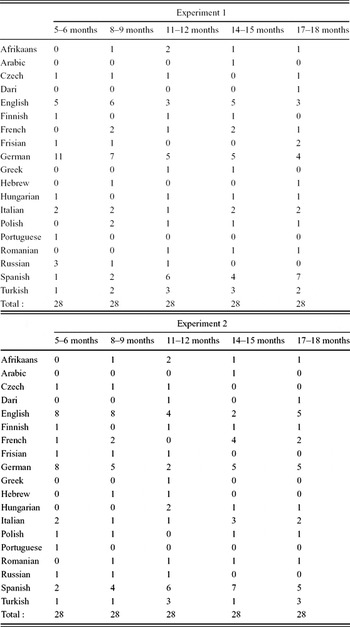
A total of 170 typically-developing 5–6, 8–9, 11–12, 14–15 and 17–18-month-old Dutch bilingual infants from comparable socio-economic backgrounds participated in Experiment 1. All bilingual infants had Dutch as one of their native languages. The other languages varied across participants but were not tone or pitch-accent languages (e.g., English). Given that less than a 20% degree of exposure to a language will not lead to an active use of that language (Pearson, Fernández, Lewedge & Oller, Reference Pearson, Fernández, Lewedge and Oller1997), the degree of exposure to the non-dominant language was higher than 20% as established via a Multilingual Infant Questionnaire designed by the authors (mean exposure to Dutch: 55%, SD 17%). Data from 140 infants were incorporated into the analysis (77 male). Data from 30 infants were excluded for the following reasons: fussing (4) or crying (1); parental interference during the experiment (1); failure to habituate after 25 trials in the habituation phase (10); experiment error (2); too short looking time (< 2s) in both trials in the change phase (3); and a looking time difference exceeding 2 standard deviations (SD) from the mean (9). In the final sample, each age group consisted of 28 infants (see Appendix for participants’ language backgrounds).
2.2 Stimuli
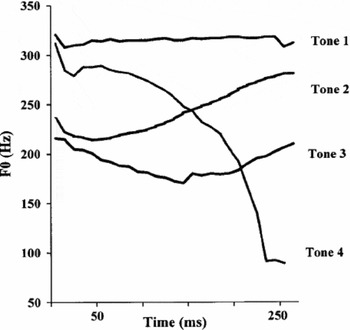
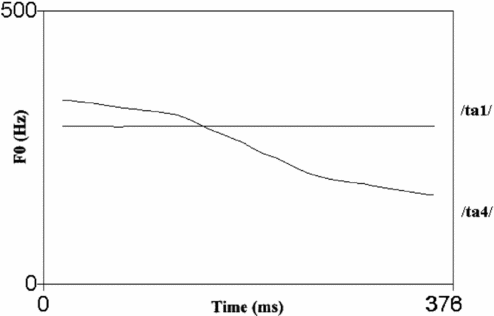
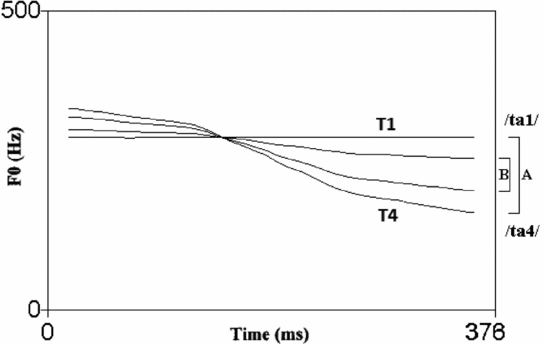
Four lexical tones exist in Mandarin Chinese (Figure 1): high-level (T1), middle-rising (T2), low-dipping (T3) and high-falling (T4). The tonal contrast of T1-T4 was selected to create the stimuli. The tone-bearing syllable was /ta/. Both /ta1/ ‘build’ and /ta4/ ‘big’ are legal words in Mandarin Chinese. The vocalisations of a Chinese female speaker were recorded using the computer program AudacityFootnote 1 via a Genelec 1029A Active Speaker system in a sound-proof booth in the phonetics lab of Utrecht University. Four natural T1-T4 pairs were recorded for each sound to account for within-speaker variation. Figure 2 represents the pitch contour of a T1-T4 pair of stimuli.
Tones in Mandarin Chinese

Pitch contours of the T1-T4 contrast

2.3 Procedure
Infants sat on their caretakers’ laps in the test booth, facing the screen and the hidden camera during the experiment. No visual or auditory distractions were presented in the booth. An experimenter observed the infants through a closed-circuit TV in a room adjacent to the test booth. The infants went through three phases during the experiment: habituation, test, and post-test. Repeated tokens of one tone were provided in the habituation phase. The test phase began when the mean looking time of the last three trials in the habituation phase fell below 65% of the mean looking time of the first three trials. Two trials of tokens of the other tone were presented in the test phase. In the post-test phase, a novel stimulus was presented to verify infants’ general attention, followed by a children's song at the end. During the experiment, the dependent variable was infant looking time. The length of each trial was controlled by infant gazing: one trial ended when the infant looked away for more than 2 seconds, and then the next trial began. The inter-stimulus interval was set at 1 second in all phases. Discrimination was indicated by looking time rebound upon hearing the new stimulus during the phase change (from habituation to test phase). Within each age group, half of the infants were habituated on T1 and tested on T4, and the other half were habituated on T4 and tested on T1. The effect of habituation order did not yield a significant difference and hence all data were aggregated for analyses. Infant looking time was recorded using a button box. The entire test was run via a computer program (ZEP, Veenker, Reference Veenker2007). The visual stimulus was a static target mark throughout the test phase for the infants of 5–6, 8–9, 11–12 and 14–15 months, and static female faces for infants of 17–18 months to better maintain their attention.
2.4 Results
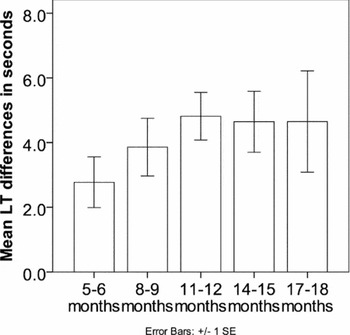
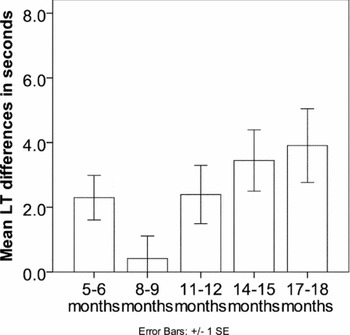
A repeated measures analysis of variance (RM ANOVA) was conducted with participant age (5-level) as the between-subject factor and the log10 transformed looking times (to ensure normal distribution of the dataset to fit the analysis below) of the mean of the last two habituation trials and the mean of the two test trials as the within-subject factor (Figure 3). The main effect of the phase change (the difference between the two last trials in the habituation phase and the two trials in the test phase) was significant (F (1, 135) = 134.485, p < .001). The interaction between age and the phase change was not significant (F (4, 135) = 2.071, p = .088). Given that there might be a trend, the individual age groups were further investigated. The paired samples t-test results showed significant differences in the phase change at each age (5–6 months: t (27) = −3.707, p = .001, 8–9 months: t (27) = −5.800, p < .001, 11–12 months: t (27) = −7.946, p < .001, 14–15 months: t (27) = −5.900, p < .001, 17–18 months: t (27) = −3.330, p = .003). Hence, infants in all age groups successfully discriminated the contrast.
Mean looking time differences during the phase change.

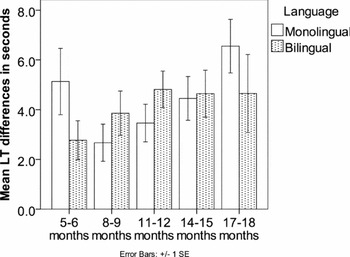
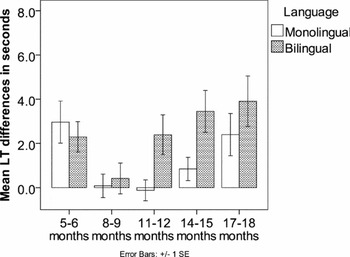
We compared these results with the results found in monolingual Dutch infants tested in a previous study (Liu & Kager, Reference Liu and Kager2014). An RMANOVA was conducted with age (5-level, 5–6 months, 8–9 months, 11–12 months, 14–15 months, 17–18 months) and language background (2-level, monolingual versus bilingual) as between-subjects factors and the mean looking times of the last two habituation trials and the two test trials as the within-subject factor (Figure 4). The main effect of the phase change was significant (F (1, 270) = 257.795, p < .001). The interaction between age and phase change was not significant (F (4, 270) = 1.109, p = .353), neither was the interaction between language condition and phase change (F (1, 270) = 0.004, p = .950). The 3-way interaction between the phase change, age and language background was significant (F (4, 270) = 2.559, p = .039). Splitting the age groups, the interaction between language condition and phase change was not significant at 5–6 (F (1, 54) = 0.886, p = .351), 8–9 (F (1, 54) = 2.003, p = .163), 11–12 (F (1, 54) = 2.713, p = .105), or 14–15 months (F (1, 54) = 0.249, p = .620), but it was significant at 17–18 months (F (1, 54) = 4.577, p = .037). The significance was contributed by a comparatively higher end-of-habituation looking time in the bilingual group (t (54) = −2.088, p = .042), resulting in a smaller looking time difference. Curve estimate analysis shows that the overall pattern across age is neither linear (F (1, 278) = 2.292, p = .131) or quadratic (F (1, 277) = 1.485, p = .228). In brief, all infants discriminated the contrast.
Mean looking time difference during the phase change

2.5 Discussion
Just as their monolingual peers, bilingual infants show successful discrimination of the Mandarin Chinese T1-T4 contrast. Experiment 1 thus provides evidence for a tonal contrast to which non-tone-learning infants retain sensitivity during and after perceptual reorganization. Although tonal sensitivity is evidenced in all 5 age groups, bilingual infants’ strength of discrimination shows an upward tendency in the first year of life (Figure 3). At 17–18 months, bilingual infants show higher end-of-habituation looking time than monolingual infants, even though their performance is similar to monolinguals during the phase change. The difference may be due to a bilingual higher attentiveness at 17–18 months or by random.
The current pattern of perceptual sensitivity being maintained across age groups is in line with previous findings on non-native contrast perception in monolingual infants (Best et al., Reference Best, McRoberts and Sithole1988; Polka & Bohn, Reference Polka and Bohn1996; Liu & Kager, Reference Liu and Kager2014). We argue that infants’ perception is contrast-dependent, with deterioration of perceptual sensitivity varying as a function of tonal contrast. Experiment 2 further investigates the influence of acoustic salience on tone perception and perceptual reorganization in bilingual infants by testing a contrast with reduced acoustic salience.
3. Experiment 2
3.1 Participants
A total of 164 typically-developing Dutch bilingual infants participated in the study, in the same five age groups as in Experiment 1: from 5–6 months to 17–18 months. The same bilingual criteria as in Experiment 1 were adopted (mean exposure to Dutch: 54%, SD 17%). Data from 140 infants were incorporated into the analysis (69 male). The data for 24 infants were excluded for: fussing (4) or inattention (1); experimental error (1); failure to habituate after 25 trials in the habituation phase (2); too short looking time (< 2s) on both change trials (5); and looking time differences exceeding 2 SD from the mean (11). In the final sample, each age group consisted of 28 infants (see Appendix for participants’ language backgrounds).
3.2 Stimuli
An acoustically contracted contrast was created from the tonal contrast in Experiment 1 by manipulating the fundamental frequency (F0) direction. The four natural Mandarin T1-T4 pairs tested in Experiment 1 were manipulated via the software PRAAT (Boersma & Weenink, Reference Boersma and Weenink2009). Four interpolation points along the pitch contours (at 0%, 33%, 67% and 100%) were introduced. The F0 values occurring at 3/8 and 3/4 of the pitch distance of the original T1-T4 contrast were calculated at these interpolation points. Linking these points, two new pitch contours were generated (Figure 5). The new contrast shares similar acoustic properties with the T1-T4 contrast as was seen in Experiment 1, except for featuring a narrower distance between the pitch contours, thus shrinking the perceptual distance between the two tokens. In other words, the acoustic salience of this phonetic contrast is weakened solely by manipulation of F0. Four pairs of the contracted contrast were generated to account for within-speaker variation. Five native speakers of Mandarin Chinese listened to the stimuli in the environmental settings and judged that the stimuli sounded natural.
Pitch contours of T1-T4 [A] and contracted T1-T4 [B] contrasts

3.3 Procedure
Infants were tested using the same procedure as in Experiment 1.
3.4 Results
An RM ANOVA was conducted with participant age (5-level) as the between-subject factor and the log10 transformed mean looking times of the last two habituation trials and the two test trials as the within-subject factor (Figure 6). The main effect of the phase change was significant (F (1, 135) = 44.750, p < .001). The interaction of age and phase change was marginally significant (F (4, 135) = 2.375, p = .055). Looking into the individual age groups, the paired samples t-test results showed significant differences in the phase change at 5–6 (t (27) = −3.767, p = .001), 11–12 (t (27) = −2.421, p = .022), 14–15 (t (27) = −4.858, p < .001), and 17–18 (t (27) = −3.766, p = .001) months. However, it was not significant at 8–9 (t (27) = −0.602, p = .552) months. This indicated that infants in all age groups except for 8–9 months discriminated the contrast. Similar to Experiment 1, the current results indicate a general perceptual pattern across non-tone-learning bilingual infants.
Mean looking time differences during the phase change.

Our previous study (Liu & Kager, Reference Liu and Kager2014) tested monolingual Dutch infants’ perception of the same contrast with the same method. We compared the results with monolingual infants to the current results with bilinguals. An RM ANOVA was conducted with age (5-level, 5–6 months, 8–9 months, 11–12 months, 14–15 months, 17–18 months) and language background (2-level, monolingual versus bilingual) as between-subjects factors and the mean looking times of the last two habituation trials and the two test trials as the within-subject factor (Figure 7). Results showed that the main effect of phase change was significant (F (1, 270) = 46.506, p < .001). The interaction of age and phase change (F (4, 270) = 3.871, p = .004), and that of language background and the phase change (F (1, 270) = 7.157, p = .008) were both significant. The three-way interaction between the phase change, age, and language background was not significant (F (4, 270) = 1.188, p = .317), indicating that the general effect of language background did not differ across ages. Curve estimation analysis revealed that the overall data fit a quadratic curve (F (1, 277) = 3.989, p = .020) rather than a linear progression (F (1, 278) = 0.897, p = .344). Looking in detail at the individual age groups, results showed that the effect of language background was significant at 11–12 (F (1, 54) = 5.326, p = .025) and 14–15 (F (1, 54) = 6.150, p = .016) months, but not at 5–6 (F (1, 54) = 0.051, p = .822), 8–9 (F (1, 54) = 0.252, p = .618), or 17–18 (F (1, 54) = 0.231, p = .633) months. Discrimination across ages was not always the same for monolingual and bilingual infants. At 11–12 and 14–15 months, only bilingual but not monolingual infants discriminated the contrast.
Mean looking time difference during the phase change.

3.5 Discussion
Results for bilingual infants suggest a U-shaped pattern of sensitivity in the first year of life. In general, the pattern of initial sensitivity followed by a perceptual decline and further a perceptual rebound replicates the results of our previous study testing monolingual infants. Dutch infants show an early tonal sensitivity at around 5–6 months, and their sensitivity greatly deteriorates at approximately 8–9 months, compatible with previous findings using various tonal contrasts in non-tone-learning monolingual infants from various language backgrounds (Mattock & Burnham, Reference Mattock and Burnham2006; Liu & Kager, Reference Liu and Kager2014). From 11–12 months onwards, non-tone-learning bilingual infants show a sensitivity rebound to tonal contrasts. An early recovery time window was found for bilinguals, 6 months ahead of their monolingual peers.
4. General Discussion
The current study explores the developmental pattern of tone perception of non-tone-learning bilingual infants and yields several major findings: the tonal sensitivity of non-tone-learning bilingual infants is contrast-dependent and U-shaped, rebounding at the end of the first year after birth, earlier than their monolingual peers.
The U-shaped pattern of sensitivity
Non-tone-learning bilingual infants show initial sensitivity to a tonal contrast at 5–6 months, followed by a decrease at around 8–9 months during perceptual reorganization (Mattock & Burnham, Reference Mattock and Burnham2006; Mattock et al., Reference Mattock, Molnar, Polka and Burnham2008; Yeung et al., Reference Yeung, Chen and Werker2013) and a sensitivity rebound afterwards (Liu & Kager, Reference Liu and Kager2014).
The decline in sensitivity at 8–9 months is likely to be the result of a lack of systematic exposure to word-level pitch contrasts in a non-tone-language environment. The sensitivity rebound by the end of the first year of life is not unexpected, given non-tone-language infant (Liu & Kager, Reference Liu and Kager2014) and adult listeners’ sensitivity to tonal contrasts (Gandour et al., Reference Gandour, Wong, Hsieh, Weinzapfel, Lancker and Hutchins2000; Hallé et al., Reference Hallé, Chang and Best2004; Xu et al., Reference Xu, Gandour and Francis2006; Kaan et al., Reference Kaan, Barkley, Bao and Wayland2008). In earlier work, we hypothesized that this rebound might be related to the ongoing acquisition of knowledge of native intonation. Specifically, intonation is realized to a large extent by means of pitch variation at an utterance level. Previous studies have established that infants are sensitive to certain prosodic cues at utterance level (Nazzi, Nelson, Jusczyk & Jusczyk, Reference Nazzi, Nelson, Jusczyk and Jusczyk2000; Pannekamp, Weber & Friederici, Reference Pannekamp, Weber and Friederici2006; Seidl & Cristià, Reference Seidl and Cristià2008; Männel & Friederici, Reference Männel and Friederici2009; Frota, Butler & Vigário, Reference Frota, Butler and Vigário2014), and that knowledge of some core features of the native intonation system is already being acquired in the first year of life, but is not yet stable in the second year due to its complex linguistic use (Snow & Balog, Reference Snow and Balog2002; Chen & Fikkert, Reference Chen, Fikkert, Trouvain and Barry2007; Vanrell, Prieto, Astruc, Payne & Post, Reference Vanrell, Prieto, Astruc, Payne and Post2010; Fikkert & Chen, Reference Fikkert, Chen, Danis, Mesh and Sung2011). Acquisition of intonation is likely to be a cumulative process, requiring integration of knowledge about pitch contours, grammatical structure, and pragmatic meaning. Non-tone-learning infants may benefit from the accumulated exposure to the native intonation system, assuming that they have already started analysing pitch variation in relation to their native language by the end of the first year.
In general, we interpret our findings as an indication that non-tone-learning infants start to perceive lexical tones in an acoustic fashion, resembling non-native adult listeners. Once again, this trend is likely to be language-general based on the fact that no tonal (or pitch accent) language is included in the native language(s).
On the similarities between monolingual and bilingual infants
Both monolingual and bilingual infants maintain their sensitivity to an acoustically salient non-native tonal contrast throughout infancy. As for the less salient contrast, all infants show similar developmental trajectories, starting from an initial sensitivity to tones followed by a perceptual decline during tonal perceptual reorganization. It seems that, due to a common lack of tonal exposure, perceptual reorganization presents itself in both monolingual and bilingual infants. One of the previous hypotheses in the introduction is that the enhanced sensitivity of young bilingual infants may be due to the maintenance of initial sensitivity relating to a slower perceptual attunement. This hypothesis faces challenges given the current finding. In addition, all infants recover their sensitivity to tones. Their recovered sensitivity to the tonal contrasts is arguably acoustic in nature, in the same way as non-tone language adult perception is (Hallé et al., Reference Hallé, Chang and Best2004). In other words, adult-like levels of non-native tone perception may emerge at an early age.
On the differences between monolingual and bilingual infants
The key differences between monolingual and bilingual infants are shown by comparing the age of 11–12 and 14–15 months, during which bilingual but not monolingual infants show enhanced sensitivity to non-native tones. The pattern is somewhat in line with our third prediction that a bilingual facilitation effect may occur with earlier or enhanced perceptual sensitivity of bilingual infants. We attributed this perceptual difference to bilingual infants’ complex environment, and specifically to several non-mutually exclusive explanations:
-
1. Increased linguistic sensitivity, including general sensitivity, sensitivity to lexical pitch, and possible L1 facilitation effects
-
2. Cognitive advantages, such as information encoding, recognition memory, and novelty detection
-
3. Enhanced acoustic sensitivity, possibly crossing linguistic and cognitive domains
First and foremost, bilingual infants may benefit from their complex linguistic environment and acquire increased linguistic sensitivity. In comparison to their monolingual peers, bilingual infants of 4.5 months orient faster to a non-native language than to their native languages, irrespective of whether the unknown language is rhythmically similar or not (Bosch & Sebastián-Gallés, Reference Bosch and Sebastián-Gallés1997). Bilingual but not monolingual infants of 8–9 months are sensitive to a native vowel contrast that is initially indiscriminable to both groups at 5–6 months (Liu & Kager, Reference Liu and Kager2015b). Specifically, bilingual infants may have developed greater sensitivity to linguistic pitch in response to the demands of disentangling intonation from two languages, and may use their rich knowledge and experience with pitch variation in intonation when faced with the task of processing tonal information. Compared to other linguistic features, the difference in F0 is arguably a more salient feature. The abundant prosodic experience in a bilingual environment may lead to a better disentanglement of the contrasts. Alternatively, but arguably less likely, the patterns might be explained by an L1 transfer effect, though this was the opposite of our initial intentions when selecting the contrast. It is possible that with more categories and denser phonological space in place in a bilingual environment, there is more chance to map a non-native sound contrast onto existing/developing native intonation categories.
Second, bilingual infants may present cognitive advantages over monolinguals that facilitate perception. A substantial body of empirical research has reported the advantages bilingual speakers have in executive function and specifically inhibitory control resulting mainly from the suppression of the non-target language during production (Guttentag, Haith, Goodman & Hauch, Reference Guttentag, Haith, Goodman and Hauch1984; Bialystok, Reference Bialystok1999; Reference Bialystok2001; Reference Bialystok2009; Carlson & Meltzoff, Reference Carlson and Meltzoff2008). Recent studies report cognitive advantages in bilingual infants, including in executive function (Kovács & Mehler, Reference Kovács and Mehler2009a; Reference Kovács and Mehler2009b), visual language discrimination (Sebastián-Gallés, Albareda-Castellot, Weikum & Werker, Reference Sebastián-Gallés, Albareda-Castellot, Weikum and Werker2012), memory for non-linguistic events (Brito & Barr, Reference Brito and Barr2012; Reference Baum and Titone2014), grammatical acquisition using prosodic cues (Gervain & Werker, Reference Gervain and Werker2013), and basic processing of non-linguistic visual information and recognition memory (Singh, Fu, Rahman, Hameed, Sanmugam, Agarwal, Jiang, Chong, Meaney & Rifkin-Graboi, Reference Singh, Fu, Rahman, Hameed, Sanmugam, Agarwal, Jiang, Chong, Meaney and Rifkin-Graboi2014). In Singh et al. (Reference Singh, Fu, Rahman, Hameed, Sanmugam, Agarwal, Jiang, Chong, Meaney and Rifkin-Graboi2014a), bilingual infants display greater efficiency in stimuli encoding and recognition memory under a visual habituation paradigm as early as 6 months, showing enhanced visual information processing efficiency. We argue that this advantage may not be restricted to the visual domain and may facilitate non-native acoustic perception. Another plausible explanation is that the increased linguistic diversity may enhance bilingual infants’ detection of novel information in general (Singh et al., Reference Singh, Fu, Rahman, Hameed, Sanmugam, Agarwal, Jiang, Chong, Meaney and Rifkin-Graboi2014a), surfacing as the early perceptual sensitivity to non-native tones in the current experiment. Taken together, the observed perceptual difference at 11–15 months may be attributed to some bilingual advantages in the cognitive domain that are rooted in the need to master two language systemsFootnote 2 .
Last but not least, we hypothesize that bilingual infants may present heightened acoustic sensitivity across linguistic and cognitive domains. Specifically, bilingual infants need to pay more attention to acoustic details in the input to disentangle the potentially small yet crucial differences in order to facilitate acquisition by separation of the two languages. Bilingual infants of 3.5 months are more sensitive to speech prosody than monolinguals (Molnar, Gervain & Carreiras, Reference Molnar, Gervain and Carreiras2014). Bilingual but not monolingual infants of 4 months discriminate between phonologically similar languages (Bosch & Sebastián-Gallés, Reference Bosch and Sebastián-Gallés2001). At 9–12 months, bilingual infants present better perceptual and neural plasticity to non-native contrasts (Petitto et al., Reference Petitto, Berens, Kovelman, Dubins, Jasinska and Shalinsky2012). The aforementioned bilingual sensitivity may be phonological in nature, but could also be acoustically driven. The heightened acoustic sensitivity in bilingual infants may originate from, or interact with: a) the complex language environment bilingual infants are exposed to; b) better neural plasticity and less neural commitment, avoiding the formation of false categories; c) the ‘crowded’ phonetic space of two languages, forcing a sharper perception between native categories; d) the detection of novelty from a cognitive perspective, etc. The enhanced acoustic sensitivity hypothesis may be constrained by other factors like maturation and/or acoustic salience. For example, when acoustic salience is too high (e.g., the contrast tested in Experiment 1) or too low (e.g., consonant contrasts tested in previous studies such as Sundara et al., Reference Sundara, Polka and Molnar2008), the enhanced acoustic sensitivity of bilingual infants does not surface. Since non-tone-learning infants lose their sensitivity at 8–9 months and their rebounded tone perception becomes acoustic-like at 17–18 months (Mattock & Burnham, Reference Mattock and Burnham2006; Liu & Kager, Reference Liu and Kager2014), the potential effect of enhanced acoustic sensitivity should occur somewhere between the end of perceptual reorganization and the perceptual rebound. Our findings appear to match this predicted age range.
In summary, acquiring two languages at the same time, bilingual infants may develop both linguistic and cognitive processing differences compared to monolinguals, pushing them further along the developmental trajectory. The observed perceptual difference at 11–15 months may be taken as evidence of another bilingual advantage in infancy. Their perceptual flexibility, constrained by factors like acoustic salience, results in various patterns reported in previous and current literature on bilingual infant perception. The domain specificity and scope of the infant bilingual advantage should be disentangled in future studies.
On a two-edged view of a bilingual ‘advantage’
One of our hypotheses to account for the perceptual difference is the heightened acoustic sensitivity hypothesis (Liu, Reference Liu2013; Liu & Kager, Reference Liu and Kager2015b). This hypothesis points to differences between monolingual and bilingual infants in linguistic and cognitive domains. Bilingual infants differ from monolinguals in linguistic (Bosch & Sebastián-Gallés, Reference Bosch and Sebastián-Gallés1997; Graf Estes & Hay, Reference Graf Estes and Hay2015), neural (Garcia-Sierra et al., Reference Garcia-Sierra, Rivera-Gaxiola, Percaccio, Conboy, Romo, Klarman, Ortiz and Kuhl2011; Petitto et al., Reference Petitto, Berens, Kovelman, Dubins, Jasinska and Shalinsky2012) and cognitive development (Kovács & Miller, Reference Kovács and Mehler2009a; Reference Kovács and Mehler2009b; Kuipers & Thierry, Reference Kuipers and Thierry2012; Reference Kuipers and Thierry2013; Brito & Barr, Reference Brito and Barr2012; Reference Brito and Barr2014; Sebastián-Gallés et al., Reference Sebastián-Gallés, Albareda-Castellot, Weikum and Werker2012; Gervain & Werker, Reference Gervain and Werker2013; Singh et al., Reference Singh, Fu, Rahman, Hameed, Sanmugam, Agarwal, Jiang, Chong, Meaney and Rifkin-Graboi2014a). They also adopt learning strategies different from their monolingual peers (Byers-Heinlein, Burns & Werker, Reference Byers-Heinlein, Burns and Werker2010; Curtin, Byers-Heinlein & Werker, Reference Curtin, Byers-Heinlein and Werker2011). Many of these developmental stages show enhanced performance in bilingual populations and are considered ‘bilingual advantages’.
Nevertheless, the notion of advantage often faces challenge if a more comprehensive picture is taken into consideration. For example, the heightened acoustic sensitivity in bilingual infants may lead to some similar effects as those resulting from enhanced neural plasticity: a later stabilization of native categories. Since paying attention to subtle details does not necessarily facilitate speech sound normalization, heightened acoustic sensitivity may cause an extended period of sound category formation, which may arguably lead to delayed vocabulary acquisition compared to monolinguals. Previous studies have found temporary confusion stages in bilingual infants when discriminating native consonants (Bosch & Sebastián-Gallés, Reference Bosch and Sebastián-Gallés2003; Sebastián-Gallés, Bosch & Pons, Reference Sebastián-Gallés, Bosch and Pons2008; Garcia-Sierra et al., Reference Garcia-Sierra, Rivera-Gaxiola, Percaccio, Conboy, Romo, Klarman, Ortiz and Kuhl2011), vowels (Bosch & Sebastián-Gallés, Reference Bosch and Sebastián-Gallés2001; Sebastián-Gallés & Bosch, Reference Sebastián-Gallés and Bosch2009) and tones (Singh & Foong, Reference Singh and Foong2012). Although bilingual confusion is more likely to be input-driven (e.g., related to absolute/relative frequency of speech sounds in the input, a ‘crowded’ phonetic space, etc.), acoustic sensitivity may actually contribute to this confusion: once again, over-awareness of phonetic details does not facilitate sound category formation. The negative aspects of such crowdedness, though failing to apply to certain cases (e.g., non-native contrasts that lack close counterparts in the native inventory), have been found to lead to confusions in some others (Sebastián-Gallés & Bosch, Reference Sebastián-Gallés and Bosch2009; Havy, Bouchon & Nazzi, Reference Havy, Bouchon and Nazzi2015).
Perceptual reorganization and acoustic salience
Similarly to previous results for monolingual infants (Liu & Kager, Reference Liu and Kager2014), the two experiments demonstrate that acoustic salience plays a role in perceptual reorganization. Throughout their development, Dutch monolingual and bilingual infants have little or no difficulty discriminating an acoustically salient tonal contrast of Mandarin, yet they fail to succeed on a more subtle contrast in which the difference between pitch contours has been made less extreme. Hence, perceptual reorganization affects the perception of an acoustically salient non-native contrast more strongly than a less salient one. A physical bias has been argued to exist regarding infant sensitivity to F0 direction (Krishnan, Gandour, & Bidelman, Reference Krishnan, Gandour and Bidelman2010). Burnham, Kasisopa, Reid, Luksaneeyanawin, Lacerda, Attina, Xu Rattanasone, Schwarz, & Webster, Reference Burnham, Kasisopa, Reid, Luksaneeyanawin, Lacerda, Attina, Xu Rattanasone, Schwarz and Webster2014) demonstrate that, across Thai tone pairs, those involving rising tones are more easily discriminated than others by adult listeners across contexts and language backgrounds. Hence, the perception of tones involves not only language-specific, linguistic aspects, but also language-general, acoustic factors. Our data reinforce the claims that acoustic salience plays a significant role in perceptual reorganization and infant phonological development (Yeung et al., Reference Yeung, Chen and Werker2013; Liu & Kager, Reference Liu and Kager2014), and that this language-general factor is shared between monolinguals and bilinguals (Burnham et al., Reference Burnham, Kasisopa, Reid, Luksaneeyanawin, Lacerda, Attina, Xu Rattanasone, Schwarz and Webster2014).
Relevant issues for future research
The nature of tone perception/processing (acoustic or linguistic) in non-tone-learning infants across ages needs to be studied with respect to two key questions. The general question is how infants’ acoustic sensitivity interacts with their word learning ability, and the specific question is whether bilingual infants’ enhanced sensitivity in non-native tones will contribute to their tonal word learning ability when facing a tonal language later in life.
It is worth mentioning that given the relatively high salience of speech prosody, non-tone-learning infants are still able to use tones lexically until a relatively later stage. Previous studies generally present a trend of decreased tonal word learning ability in non-tone-learning infants, with potential temporarily enhanced performance for bilinguals. Between 14 and 19 months, non-tone-learning monolingual infants show interpretive narrowing of lexical tones in word learning, whereas bilinguals appear to maintain flexibility for a prolonged period of time, and continue to show the ability to map words that contrast minimally in pitch contour (but are segmentally identical) to novel objects at 19 months (Hay, Graf Estes, Wang & Saffran, Reference Hay, Graf Estes, Wang and Saffran2014). From 18 to 24 months, monolingual and bilingual infants ascribe lexical relevance to tone in a language-specific manner (Singh, Hui, Chan & Golinkoff, Reference Singh, Hui, Chan and Golinkoff2014). At 29 months, non-tone-learning children do not treat pitch change as relevant when learning words (Quam & Swingley, Reference Quam and Swingley2010). We assume that non-tone-learning infants' perception has become adult-like at the stage of rebound, but leave the nature of perception before that period open to discussion.
Moreover, the potential influence of intonation on lexical tone perception needs to be studied through cross-linguistic comparisons between languages with relatively rich (e.g., English, Dutch) and poor (e.g., French, Korean) intonation systems (see Jun & Fougeron, Reference Jun, Fougeron and Botinis2000). At 4, 6, and 9 months, no difference was observed between English and French infants’ perception of tones (Mattock et al., Reference Mattock, Molnar, Polka and Burnham2008). Future studies should focus on older infants and provide us with a detailed map of infant lexical tone perception, and subsequently the language acquisition process in the beginning of life from a supra-segmental perspective.
Last but not least, the domain specificity and scope of one of our explanations to account for the findings, the enhanced acoustic sensitivity hypothesis, need to be studied. Domain-wise, we are currently testing infant musical tone perceptual patterns across language backgrounds. Scope-wise, we are testing adult monolingual and bilingual listeners on linguistic and musical tasks. Preliminary data show indication for an enhanced acoustic sensitivity across domains and ages.
5. Conclusion
Comparisons of tone perception patterns between monolingual and bilingual infants yield similarities and differences along the developmental trajectory. Non-tone-learning bilingual infants’ tone perception is contrast-dependent, similar to their monolingual peers. The salient tonal contrast is well discriminated across ages and language backgrounds. When bilingual infants discriminate a contracted (less salient) tonal contrast, they present an initial sensitivity at 5–6 months, which deteriorates at 8–9 months, and rebounds at around 11–12 months. The time window of the decrease in sensitivity is in line with that of monolingual infants, suggesting maturation factors in the process of perceptual reorganization. The rebound in sensitivity is argued to be more acoustic than linguistic, and may be related to native intonation acquisition. In addition, the age of rebound is 6 months earlier for bilingual than for monolingual infants. This perceptual difference is argued to be caused by the early bilingual exposure and the linguistic and cognitive factors it brings. The exploration of these factors helps us understand how bilingual infants successfully command their languages, as well as the differences between monolingual and bilingual infants along the developmental trajectory in the first two years after birth.
Appendix Bilingual language background (apart from Dutch)