In the pantheon of international political economy (IPE), Karl Polanyi's Great Transformation occupies a central position. His famed conjecture that financiers were responsible for the “Hundred Years Peace” between the Congress of Vienna (1815) and the Austrian Archduke Franz-Ferdinand's assassination in Sarajevo (1914) provides an early recognition of the interrelations between economics and politics. Polanyi claimed that peace was the result of conscious actions by a subgroup of financiers, which he called “Haute Finance” and within which the House of Rothschild reigned supreme, “embodying the principle of abstract internationalism” (whatever is meant by that beautiful phrase). As he argued:
The nineteenth century produced a phenomenon unheard of in the annals of Western civilization, namely a hundred years' peace—1815–1914. Apart from the Crimean War—a more or less colonial event—England, France, Prussia, Austria and Italy were engaged in war among each other for altogether only eighteen months…. This triumph of a pragmatic pacifism was certainly not the result of an absence of grave causes for conflict … The entirely new factor, we submit, was the emergence of an acute peace interest. Traditionally, such an interest was regarded as outside the scope of the state system…. For an explanation of this amazing feat, we must seek for some undisclosed powerful social instrumentality at work in the new setting, which could play the role of dynasties and episcopacies under the old and make the peace interest effective. This anonymous factor was Haute Finance.Footnote 1
In Polanyi's account, Haute Finance's desire and ability to use market power to influence policies toward peace did the trick: Haute Finance secured peace through a mechanism that anticipated what is known today as “political conditionality.” But Polanyi's bottom line was postulated rather than demonstrated: he provided neither empirical nor theoretical foundations to explain how Haute Finance became the “anonymous factor” of a successful attempt at preventing wars. Nor did he document the actual success or track record. He recognized that “no all-around inquiry of the nature of international banking in the nineteenth century has yet been undertaken” and directed readers to the work of historians Corti, Jenks, and Feis, from which he said he had gleaned insights—although the first book is a largely hagiographic account of the House of Rothschild, and the last two quite a distance from Polanyi's theme.Footnote 2 The precise reason why Haute Finance could be enlisted in the interest of peace remains obscure except when Polanyi features as a functionalist, briefly alluding to the notion that providing peace (an international public good) would have legitimized the power of Haute Finance.Footnote 3
Do we know that the marketplace discriminated against wars during the nineteenth century? Could it actually lead governments to be discouraged from military undertakings? Why should financiers want peace? Tilly has argued that, in early modern Europe, states made war and wars made states and financiers benefited.Footnote 4 Historians have shown that Ouvrard (Napoleon's financier) and Bleichröder (Bismarck's) enriched themselves from funding conflicts.Footnote 5 Polanyi certainly did not argue that an amorphous financial interest acted in an uncoordinated way to discourage war. Rather, he emphasized that a highly cohesive grouping, whose epicenter he identifies with the House of Rothschild, was in charge of implementing political conditionality. But is such a description adequate? Was Haute Finance actually behaving in a cartel-like manner, and why? We provide new data and new theoretical foundations to Polanyi's conjecture, and thereby also provide some important qualifications and insights into the relation between financial market power and international relations.
It is a widespread notion that financiers have “dictatorial” powers. Think for instance of Friedman's claim that there are two superpowers: “the United States and Moody's Investors Services.”Footnote 6 This view has deep historical roots. When Polanyi wrote his book, he could rely on a long tradition that emphasized the existence of a “capital market conspiracy.” The late nineteenth century saw the rise of a literature that personified (and vilified) the capital market. An overarching theme was that global finance acted as a cartel and reference to the Rothschilds' centrality in the “plot” abound.Footnote 7 Denouncing the existence of “money trusts” became popular.Footnote 8 Such accounts, generally associated with Hobson's Reference Hobson1902 theory of imperialism,Footnote 9 eventually found their way into the works of Marxist students, such as Rudolf Hilferding and Vladimir Lenin. They argued that, given the power of Haute Finance, the occurrence of World War I was proof that Finance had wanted war (in a sin of omission, it did not work to prevent war).Footnote 10 The notion and language of bankers' influence was resurrected by post–World War I historians and then back into Polanyi—although unlike the case for Hobson and his followers, the Rothschilds were now praised as friends of peace.Footnote 11 With the revival of global markets and market management of reputation, this tradition is currently making a comeback. Modern IPE scholars working on investment banks, sovereign funds, or rating agencies, recognize that such players, because they “control” the reputation of borrowers, wield considerable power, motivating study of their ideologies, beliefs, and policies.Footnote 12
Yet Polanyi's and others' personification of financial markets is not methodologically straightforward. To be valid, personification requires proof that a certain group of agents is willing and able to act in a cartel or at least in a group-like manner so that it can be represented by a collective (rational) self. However, following Olson, modern scholars have been skeptical of such collusion's capacity to survive. Schultz and Weingast extend this skepticism to capital markets and cast doubt on the likelihood of successful credit embargoes in the wake of rampant free riding.Footnote 13 Theoretical economists point out that lending to sovereigns is plagued by a “common agency” problem (several lenders deal with one borrower, which creates an externality in both contracting and collective action).Footnote 14
Two books, published respectively by Kirshner and Tomz, have managed to do away with the role of special intermediaries that was central in Polanyi and his Marxist and populist predecessors. While Kirshner and Tomz provide different perspectives, both share the notion that lenders in the capital market are best described as atomized, uncoordinated entities, leaving no room for the powerful banking lobby of the Hundred Years Peace.Footnote 15 Kirshner contends that finance wants macroeconomic stability and therefore might inhibit some conflict. Focusing on domestic financiers' attitudes and preferences regarding wars, he finds an appeasing factor in bankers' love for low inflation and policies designed to sustain it, their taste for an economy's ability to produce robust and predictable real interest rates, and so on. An appeasing bias thus appears because wars (by making nominal and real interest rates unpredictable) threaten to disrupt this favored environment. This peaceful disposition, he concludes, is an important influence in contemporary international relations and “will remain so, especially for as long as financial globalization endures.”Footnote 16 There is a seeming parallel between this argument and Polanyi's (as Kirshner does recognize).Footnote 17 But Kirshner accounts for the appeasing tendencies of bankers in a manner that rules out the instrumental role of certain actors—as incarnated in Polanyi's claim about particular bankers' peacekeeping action. Thus, Kirshner's view of a powerful and diffuse market antipathy against war can be seen as a post-Olsonian version of the Polanyi intuition, one where the Rothschilds and Haute Finance are missing.Footnote 18
Another important recent contribution that dwells on markets' atomicity and rules out large actors and intermediaries is Tomz's study of reputation and market access. Using a historical perspective, he argues that lack of information about countries' types does align competitive and atomistic lenders' behavior and incentives. While this setting is vulnerable to free riding, it nonetheless facilitates the emergence of a certain form of discipline and permits government debt to emerge. Countries with no credit history face bad terms because they scare lenders away. They must then work hard and be patient and faithful so as to (slowly) accumulate reputational capital. Tomz provides compelling nineteenth-century evidence that new sovereign borrowers in foreign markets were penalized by high interest rates. Seasoned ones (with a good history and track record) were rewarded by lower rates. In this account there is no room for intermediaries. Tomz's very careful study does not mention Polanyi (either in the text, in the reference list, or in the index)—a suggestion that modern rational choice theory might do away with Polanyi's view that market structure (the “monopoly” of Haute Finance) mattered.
In contrast to these works, our article reconstructs Polanyi's idea, highlighting the role of intermediaries in the market for government debt. Our study is one of quality certification. Polanyi's conjecture amalgamates two complementary arguments: a monopoly power argument and a political conditionality/peacekeeping argument. We give foundations to both by introducing insights from finance and industrial organization theory, which hearken back to Michael Spence's seminal paper on the economics of signaling.Footnote 19 The supply of certification services is noncompetitive. Owing to credibility issues, certification tends to exhibit features of a natural monopoly: because it earns revenues from issuing a label, a certifier can benefit from misrepresenting the true condition of the government it assesses—unless such misrepresentation leads to forgoing future revenue because of reputation loss. For veracity to prevail in equilibrium, the costs of cheating (as captured by permanently diminished market share) therefore must exceed the benefits (the one-shot sale of misleading advice) obtained when certifiers own a large market share to begin with, making deviation from truthful behavior painful.
For certification to be credible there must be a critical level of monopoly power—this explains why Polanyi could portray the global capital market as noncompetitive. As we find, the Rothschilds (Polanyi's main characters and core of the Haute Finance “conspiracy”) had a very large market share and were thus concerned with retaining prestige. We give both an explicit rational foundation and supporting data for this interpretation.
Next we explain why brand concerns lead prestigious bankers to distribute their seal of approval with prudence and as a result, obstruct war. Because the ability to certify rests on reputation, a prestigious certifier tailors support to countries in a way that maximizes its own prestige. Since wars increase risks and ultimately make default more likely, prestigious intermediaries seek to discourage conflict. This concern led prestigious bankers to set their face against those wars that were destructive of their future ability to certify. This is why they sought to discourage countries from military entanglements—not because prestigious bankers were some precursors of the UN or because this would look good on their vitae, but because war would have meant forgoing future revenues. We found evidence in the fact that global financing for wars was not ruled out altogether but limited to conflicts that did not threaten certifiers' brands. This new interpretation of pro-peace virtues of banking elites provides a meaningful qualification to Polanyi.
The old trinity for culpability—means, motive, opportunity—provides a detection method. Since Polanyi accused Haute Finance of having “killed” wars, we must provide evidence that prestigious bankers had the means, the motive, and the opportunity. This would be enough for most judges and juries but some may prefer a confession. Using both archival and secondary sources, we have identified cases where the relation between war and finance was explicitly discussed and, digging deeper, even found evidence of military conditionality in original underwriting contracts (which committed banks to provide funding in a stated form and time). All this is new and powerful material in support of the prestige-protection/war-prevention nexus that we argue was at the heart of the Pax Britannica.
Because detailed studies seeking to unpack the links between IPE and security issues are rare, our new perspective on Polanyi makes three contributions. First, we make an innovative theoretical advance by showing how insights from industrial organization theory can be used in mainstream theory in international relations and IPE. Our argument explaining why political power can accrue spontaneously to private entities in situations of serious information asymmetries and enforcement problems breaks new ground. It shows that Olsonian skepticism regarding cartels' ability to survive may not be relevant when information is scant and enforcement difficult—situations that are very relevant in the real world. Likewise, our recognition of market structures' role is a challenge to institutionalist views on the role of constitutions and commitments (a view currently associated with the “democratic advantage”).Footnote 20 In other words, the import of insights from diverse fields yields suggestive results and should provoke new interdisciplinary research.
Second, our study provides both a critique and broadening of Tomz's analysis of government policy's role in securing reputation through repeat play. We show conditions under which it is profitable for the government not to wait until it has a reputation of its own but instead, to use a private agent as an intermediary to secure this reputation by proxy. Although Tomz does not consider this possibility, we show that it has empirical relevance. The result is that the intermediary acquires a form of “ownership” of government policies and can use it to secure certain policies (thus the connection with war and peace, but obviously the issue has relevance for government policies at large). Thinking of conditional lending resulting from monopolistic lenders' ownership of “property rights” over government reputation provides a theoretical foundation for why government policy may be “captured” by market actors. It also provides a theoretical explanation for why certain policy beliefs, held by private actors, are important and deserve study.
Last, our study provides new insight and reliable data to discuss Polanyi's claims. For all the popularity Polanyi's ideas have enjoyed, no such attempt has ever been made. The combination of this original data and theory also contributes to a better understanding of the nineteenth century's systems. This is useful for political scientists genuinely interested in the study of past regimes and makes historical comparisons more relevant. While today's world is no longer run by Haute Finance, we still get the insight that alternative “credibility acquiring mechanisms” are for borrowing governments like outside options for one another, suggesting that a theory of imperfect competition in conditional lending has broad empirical relevance.
Was Polanyi Right? Stylized Facts About War and Market Access
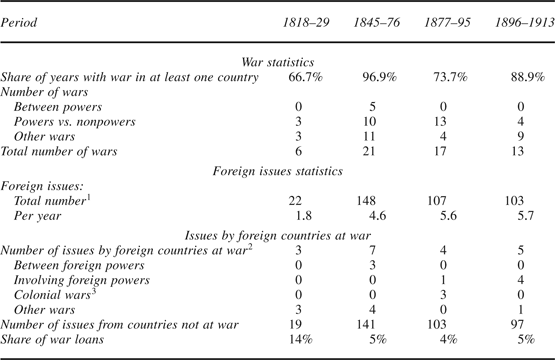
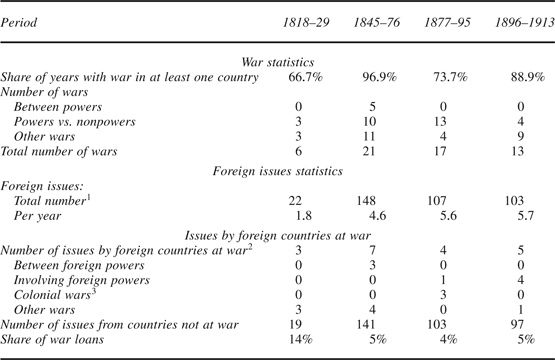
Significant anecdotal evidence has long been recognized to be on Polanyi's side. For instance, in 1859, a frustrated Italian leader Camillo Cavour reported on his difficulty in raising external capital before waging a campaign against Austria: “bankers of all countries,” he lamented, “have organized a kind of conspiracy in favor of peace.”Footnote 21 But to go beyond the level of anecdote, new data is relevant to the question of whether capital markets discriminated against wars. We rely on a new, extensive data set of London security issues during the Hundred Years' Peace (1815–1913) that we hand-collected and matched against war data sets constructed by others.Footnote 22 Our main source for conflicts is Gleditsch, who provides an update of the Correlates of War database; we rely on Reiter and Stam for information on warring nations.Footnote 23 The war data we employ coincides with what the Correlates of War database defines as “Inter-States Wars” (we added the U.S. Civil War, considering the Secessionist Confederacy as a sovereign entity). We are interested in foreign countries that managed to secure funding during wartime in the London capital market.Footnote 24 That is, to assess Polanyi's claim that Haute Finance was biased against war, we produce a statistical summary of foreign countries' market access in London, and then cluster it with evidence on their being at war. The statistics have been organized to correspond to the four boom-to-bust phases in foreign debt lending in London: 1818–29, 1845–76, 1877–95, and 1896–1913.Footnote 25
Table 1 reports the results that the Hundred Years' Peace is a Western European, developed-countries phenomenon. The exception is the period between 1845 and 1876, which displayed a number of “unification wars” (wars between Germany's and Italy's predecessor states on the one hand and Austria on the other, and the Franco-Prussian War—the political prelude to German unification). Apart from that, war was limited to the confines of Europe (the Crimean War) or to the rest of the world (Latin America, Asia, and North America).
War and capital during the Hundred Years' Peace
Notes:
1. Outright foreign issues on the London market (no conversions). Foreign powers include Austria, France, Germany/Prussia, Italy, and Russia; Japan is not treated as a power. See text for description of sources for loans.
2. From Gleditsch 2004, who revises the Correlates of War database. We focus on so-called interstate wars (ibid., Tab. A, 248–49). Loans from “war countries” are those issued during wartime. We exclude issues that are issued before or after wars as well as indemnity loans (that is, French 1871–72 loans).
3. Colonial wars are those involving foreign powers or countries in a colonial conquest.
Source: Author calculations from a variety of sources.
When we combine this information with market access data, we obtain results that are partly consistent with Polanyi. For the entire period (1818–1913), we have nineteen instances of capital market access by foreign countries that occurred during wars, which is equivalent to 5 percent of 380 loans. For the period 1845–1913, which encompassed ten different wars, we find only sixteen market access events in wartime; this is only 4.5 percent of the total number of loans. Controlling for the fact that some wars received multi-access, we compute (but do not report in the table) that lending did occur during 19.6 percent of all wars.Footnote 26 In other words, war lending was not a big business in London (which is consistent with Polanyi's notion of a market-place peacekeeping channel), but securing war finance was not altogether impossible, and references to automatic embargoes require further scrutiny.
Polanyi reflected that not all wars were equivalent and dismissed the Crimean war as a “more or less colonial event.” Without taking a stand on specific wars, we agree that different wars had different significance depending on the belligerents' standing. In the bottom panel of Table 1, we organize London wartime loans in four categories. We distinguish: (1)“wars between powers”—wars between members of the “Concert of Europe”: Austria, Britain, France, Prussia/Germany, the Russian Empire, to which we add the Kingdom of Sardinia/Italy;Footnote 27 (2) “wars involving powers” (where at least one power was involved but they did not fight one another); (3) “colonial wars” (all that the name implies); and (4) “others” (a residual category that includes the few wars between countries outside the nations mentioned, such as conflicts between Latin American nations).
The category “wars between powers” is expected to have more significance in terms of geopolitical stability and should be more rationed than the other types of war. To see whether this pattern obtains, Table 1 clusters market-access events according to war types.Footnote 28 With only three exceptions (the 1854 and 1855 Crimean War loans to Turkey and a 1870 Franco-Prussian War loan to France), wars between powers never led to international loans in London. International finance abstained from funding the German and Italian unification wars, justifying Cavour's concern that his political efforts were obstructed by bankers.
As Table 1 shows, the bulk of war loans concentrated on other types of conflicts. There were only two “wars involving powers” during which the London capital market was used: the Russo-Turkish War of 1877–78 (for one loan) and the Russo-Japanese War of 1904 (for a total of five loans). There were also two colonial wars during which the “colonized” country received funding from London (China against France in 1885 and China against Japan in 1894–95) for a total of three loans. Four other wars involved five loans from London: the Argentina-Brazil-Uruguay skirmish of 1852, the Triple Alliance War against Paraguay of 1865–70, the U.S. Civil War, and the second Balkan War. Our findings thus both vindicate Polanyi's hypothesis and qualify it. That certain types of wars were penalized is not consistent with Polanyi's interpretation of financiers providing a public good. Had they been a peacekeeping body they ought to have been willing to prevent all wars. They did not.
The Argument: Prestige as Gatekeeping
Economics of Prestige
Our explanation of how and why markets discriminated against certain wars is an argument about the role of prestige in certification. It has roots in industrial organization and financial economics research that has explored conditions under which markets can solve problems involving incentives to report truthfully. For simplicity, consider a world in which there are two types of investors (informed and uninformed) and two types of governments (good and bad). As in the respective works of Kirshner and Tomz, ordinary investors suffer from information asymmetries. Assume, for example, that such investors—unlike informed intermediaries (underwriting banks)—cannot distinguish the relative merits of borrowing governments. Intermediaries have incentives to cheat investors because they earn fees, but investors understand that.
As we argued in earlier, related work, one possible solution of such a setting is an arrangement where bankers are sorted into a pyramid of prestige (the less numerous, more prestigious bankers are at the top) and association of a given loan with prestigious bankers sends a quality signal.Footnote 29 The reason is that security underwriters' reputation for veracity helps them secure a large market share. This mitigates the moral hazard problem in the production of information. Prestigious intermediaries who might otherwise be tempted to overprice securities (to generate short-term gains) are held back by their very prestige: if they lose it, they will damage future revenues.Footnote 30 An important theme in economic models resting on such ideas is that market share emerges as the endogenous solution to problems involving precommitment or credibility. A few prestigious bankers have monopoly power and specialize in high-grade securities, while the many ordinary underwriters are competitive and deal mostly with low-grade securities (they have a narrower market, plagued with rampant quality problems).
While the recent “subprime” crisis (a major gatekeeping failure) has cast doubt on the validity of related arguments in modern markets, our earlier work on foreign debt found substantial support. During the first foreign debt boom of the nineteenth century, when the London market for foreign debt was started, the House of Rothschild surpassed all other underwriters in terms of market share, capital stock, and performance. This is consistent with our notion that prestige was used for the successful origination and distribution of high-quality (“investment grade”) government securities.
Prestige Meets International Relations
The Rothschilds' large market provided them with incentives for being reliable.Footnote 31 The House of Rothschild consistently held the top position in the “league tables” of foreign government debt. And to retain this leadership, a prestigious originator ought to issue successful securities. Flandreau, Flores, Gaillard, and Nieto-Parrà show that the Rothschilds did outperform competitors on this score throughout the entire Hundred Years' Peace.Footnote 32
The only other bank that featured in the top three (in three subperiods out of four) is the House of Baring, which historians reckon was the other prestigious house.Footnote 33 Unsurprisingly, during the entire period, the market remained concentrated—market shares for the top three loan originators were always above 50 percent. Computation of so-called Herfindhal-Hirschmann Indices (HHI) (which capture the degree of concentration) support this: indices range from concentrated to very concentrated according to conventionally accepted thresholds.Footnote 34 Therefore, the degree of concentration and persistence was remarkable and confirms our view of an equilibrium outcome with market leadership reinforcing, and being reinforced by, prestige.
In short, prestige was a strategic investment (sunk cost) that created a barrier to entry against other banks. The sunk cost provided a kind of monopoly power that did not rest on standard cartelization (that is, a mere agreement between market participants) and was thus not subject to free riding, contrary to the conventional concern of Olson and others. For instance, our characterization differs from the Marxist interpretation of Polanyi's Haute Finance as some kind of “gang.” The Rothschilds were special not because they were the “boss” of a cartel but because they differentiated themselves from all the other issuers through quality signals. The bankers' name was a prestige good—something which Polanyi (as a precursor of economic anthropology) might have appreciated—but he did not articulate it.
Our interpretation of monopoly power stemming not from cartelization but from prestige is novel.Footnote 35 In standard models, bondholders' attempts to coerce defaulters are hampered by the bondholders having their money tied with the defaulters (thus creating a conflict of interest and time inconsistency). But delegation of enforcement to a prestigious underwriter does not present this flaw. Once a loan has been issued, the investors rather than the prestigious bankers bear the cost of default. Since bankers have already disposed of the loan, they mostly worry about their ability to certify future loans which rests in part on wise ex ante choices but even more so on successful ex post trouble-shooting. For this, they do not hesitate to use credit embargoes. In other words, prestigious bankers can credibly precommit to punish defaulters in the future (because punishing defaulters is really polishing the bankers' shield).Footnote 36
For this reason the prestigious bank has a valuable role to play. When a borrower's reputation can rise and fall, certification by prestigious houses (whose market share and prestige is stable) provides a dependable anchor. One obvious situation when a country lacks credibility is when it is new in the market. At a broader level, however, the need for a reputable underwriter can arise each time a country undergoes some “information crisis.” A fiscal crisis is one possibility. The prospect or outbreak of a war (with its dire fiscal, political, and diplomatic complications) is another. Economists have shown abundantly that wars were historically a major source of deficit.Footnote 37 This means that the certification power of prestigious intermediaries becomes extremely valuable during diplomatic crises and military conflicts.
That wars increase information asymmetries and thus increase the value of prestige is one thing. But what prevents prestige from sponsoring a war? The invisible hand at work here is the underwriter's concern about retaining its good name.Footnote 38 Wars were hazards. They increased reputational risks. Thus war was seen by prestigious banks as a direct threat to their charters. Reflecting this, in the late 1830s when the Rothschilds were asked to lend to Belgium, which refused to make peace with Holland, private correspondence shows precisely this motive for the Rothschilds' decision to turn down the loan application: “our good will does not go as far as giving them a stick for them to kick us with [by funding them when they want to wage a war], that is to say giving money to make a war and destroy the credit which we support with all our forces and resources.”Footnote 39
Banker Prestige Versus Country Reputation
Tomz considers a Polanyi-free world where desire to borrow cheaply provides incentives for borrowers' cooperation with lenders.Footnote 40 Countries make efforts to repay their debts to accumulate reputational capital. While they cannot directly observe government characteristics, investors do observe whether governments discontinue interest service and collect data about the circumstances they face. Because investors try to infer countries' types from behavior, the debt of “new” borrowers is discounted (they have no track record). But as borrowers become “seasoned” (conditional on their paying), they gradually secure better terms because investors update prior beliefs. The process through which upgrades or downgrades occur also takes into account current circumstances and is thus known as “contextual inference”: servicing one's debt in an unfavorable environment has more value for investors than the same decision undertaken in a favorable environment.
The world we consider is one in which investors use the signals from certain prestigious brands to make inferences about countries' types. Investors cannot tell which countries' debt would be a good investment, but they know that credible delegated monitors have that knowledge and the capacity to enforce; hence investors react not to news about a country's behavior but rather to the presence (or absence) of a prestigious underwriter. In practice, we predict that investors' market power is an increasing function of the extent of information asymmetries. The less that agents know about the borrowing country, the more that prestigious bankers add value. At the extreme, if investors know close to nothing then a prestigious bank's market power is maximal. Unlike Tomz we recognize that, in situations of severe information asymmetries, countries have strategies other than patience (waiting to build a reputation “by hand”). They can use the certification services of market gatekeepers. But we saw that wars increase risks, information asymmetries, and thus the need for certification. To paraphrase Ford, countries facing a war cannot build a reputation on the fact that they are going to win: this is the highway along which prestigious financial gatekeepers become gatekeepers of war, too.
The Value of Bankers' Certification
Evidence from a Case Study
Prestigious banks could inflict penalties on countries that adopted policies they disliked. Because prestige added substantial value, refusing support entailed costs. One way to see how much value could be added or withdrawn is to consider the example of an upgrade, such as when a government was lucky to move from an ordinary to a prestigious underwriter. The resulting variation in “interest rate spreads” (that is, returns required by investors to hold the bonds minus returns on risk-free British bonds) is a measure of prestige's effect. The experience of Brazil in 1825 provides a suggestive entry. An initial public offering in the London market had been managed by a consortium of houses led by Wilson, an “ordinary” merchant bank.Footnote 41 The Wilson issue (at 75£ per security, on 18 August 1824) turned out to be a failure.Footnote 42
A few months later however, the London Times revealed that the Rothschilds would underwrite the balance of the loan at £85 per bond. A careful examination of the press shows there had been no “news” regarding Brazil during the period: the only innovation was the House of Rothschild getting involved. The Times explained that this event had caused bond prices to start rising in the last few weeks in the “belief that the contract for the remainder would fall to the eminent capitalist who is now understood to have taken it…. [Rothschild's] remarkable success in raising the credit of some of the European Governments by his contracts for loans in England is the best guarantee to a similar result on the other side of the Atlantic, and there seems little cause to doubt that the Government securities of Brazil will, under his auspices, bear as high quotations in the money market as any of the continental States.”Footnote 43
Figure 1 organizes evidence on Brazilian securities by showing weekly data for their yield spreads. As controls, we show like data for securities of other Latin American securities (Colombia and Buenos Aires, that is, Argentina). The figure also indicates the period during which rumors were reported to be lifting the price of Brazilian securities.Footnote 44 The signal sent by the news of association with the Rothschilds was worth a 50–100 basis points reduction in Brazilian yield spreads.Footnote 45 In other words, the name of prestigious houses was a very valuable collateral. It is not that countries could not issue without them (although we remark that the Wilson issue failed) but they would issue less and/or at more expensive costs. Prestigious banks have something to give to (and thus withhold from) policymakers.
Weekly yield spreads on Latin American securities for three states
Source: “Foreign Funds” section of The Times; Rothschild Archive 000/401.

Countries' Reputation Versus Certifiers' Prestige: Cross-Section
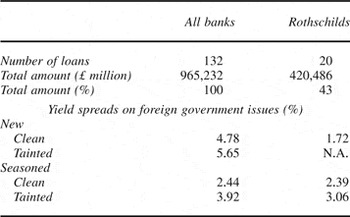
To further investigate the value of prestige, we now compare the effect of prestige (use of prestigious bank as signal) and that of patience (time on the market). Table 2 organizes the evidence, focusing on the period 1845–77.Footnote 46 We compare the yield premia at issue (a measure of risk) for “new” and “seasoned” borrowers and then control for prestige. “New” issues refer to countries borrowing for the first time in the London Stock Exchange during the period.Footnote 47 To capture the quality of the seasoning process, we distinguish “clean” issues—those without a record of default or renegotiation—from “tainted” ones (the others).Footnote 48 New issues can be tainted if the issuing country inherits a default record from a previous entity to which it is related.Footnote 49 The table is intended to address whether prestige enables the securing of good terms independent of seasoning.
Seasoning versus signaling, 1845–77

Notes: Prices of U.K. consols are from The Times. Yields calculated via the standard coupon/price formula. Database for loans described in Flandreau, Flores, Gaillard, and Nieto-Parra 2010. Underwriters (that is, lead managers of the issues) were identified by using contracts found in archives, the press, and prospectuses. Spreads computed using date of issue and yield on consols at the end of the month of issue. In the few cases when the month of issue is not known, we used year-end consol yields.We exclude conversions of loans. Because France's loan of 1871 was unusually large, we have also computed results without it. Results give 2.43 (new clean) and 2.36 (of which: Rothschilds), thus not significantly affecting results. N.A. = not applicable. See text for sources.
We first look at the “pure effect” of seasoning and government honesty (“All banks” column). Results are fully consistent with Tomz's forbearance hypothesis.Footnote 50 We find that within each category, new borrowers were discounted. New clean issues exhibited spreads that were about 200 basis points higher than their seasoned counterparts, and the gap between new tainted issues and seasoned tainted ones is larger still (about 260 basis points). There is also a 160 basis-points reward from having been seasoned without experiencing a default.
Consider now the marginal effect of prestige. We add a Rothschilds column that replicates the same exercise but for Rothschilds' loans only. As seen, the involvement of the Rothschilds creates value in several critical groups. For new clean bonds, the Rothschilds' yield premia are about 300 basis points lower than average for the category. This is an enormous effect: the Rothschilds could bring new borrowers to the market at very attractive terms.
Seasoned tainted issues when they were taken in by the Rothschilds also enjoy a reduction of 100 basis points, meaning that prestige could restore credit.Footnote 51 We conclude that, consistent with our intermediary-based certification hypothesis, prestige made a considerable difference. Countries had other ways—beyond patience and effort—of addressing the problem of asymmetric information.
Finally, the Rothschild effect is not substantial for seasoned clean issues. This result is unsurprising but important. The marginal gain from association with prestige is smallest for countries that already have a good track record: these are the ones facing the smallest information asymmetries. The inference is that the greater the asymmetry of information, the more valuable the prestige.
Countries' Reputation Versus Certifiers' Prestige: Time Series
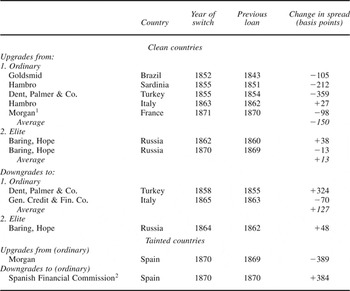
The previous section discussed how the effect of prestige on clean seasoned countries is reduced. However, because such countries with loans underwritten by the Rothschilds were not the same as those underwritten by the rest, it is not possible to make strict pairwise comparisons.Footnote 52 A useful complement to Table 2 is Table 3, which organizes a test of differences in bond spreads following a switch in underwriters. This approach has the advantage of controlling for country characteristics. According to our theory, when a country switches from the Rothschilds to an ordinary underwriter, spreads ought to rise (for this is a downgrade). Conversely, if it switches from a lesser firm to Rothschilds, then spreads ought to decline (upgrade). Not all switches are equivalent. A changeover from the Rothschilds to another house with a good standing is less significant than a changeover to a very “ordinary” one. There is no clear consensus on the precise ranking of all firms but previous work emphasizes the difference between the Rothschilds and the Barings on the one hand, and “the rest” on the other.Footnote 53 As a result, Table 3 distinguishes between switches depending on their being with the Barings or with another “ordinary” house.
From and to Rothschilds: Underwriters' upgrades and downgrades for seasoned countries, 1850–73

Notes:
1. Rothschilds issued the next loan (upgrade) jointly with Barings.
2. The Spanish Financial Commission was a representative body of the Spanish Ministry of Finance. The issue referred to was distributed directly on the market.
Source: Authors' computations; see text for details.
Table 3 (which distinguishes among clean and tainted issues) shows that when there is a switch between the Rothschilds and an ordinary underwriter, big gains or losses are observed regardless. This obtains for both the clean and tainted group. For clean countries, the variation is 150 or 127 basis points, either way. The effect of prestige is naturally greater for tainted countries as illustrated by the case of Spain (about 400 basis points either way).Footnote 54 This is in contrast to transition between elite underwriters (Baring and Rothschild), which does not seem to have caused big changes. Thus, clean countries could, at the margin, leave the best underwriter in favor of the other reputable one. This is where and how a country's self-certification—namely, establishing itself as a good (clean) borrower—could compete against a banker's seal of approval: the Barings' entry threat to the Rothschilds coerced the Rothchilds into providing good countries with good terms.
In the end, the prestige of bankers was a bandage on information asymmetries. This helps explain how, when wars occurred, the uncompetitive nature of the market for government debt became even more marked. Countries desperately needed prestigious bankers' seal of approval because in wars, countries came probably closer to the tainted benchmark. The conclusion is that the Rothschilds' political leverage was particularly large before and during wars.
Unpacking Polanyi: The Microeconomics of Peace and War
The War that Was Not: Belgium 1830–39
Having found the weapon (or means), a motive, and an opportunity, we are close to indicting Haute Finance on the charge that they willingly interfered with wars. But the problem is that we have failed so far to “catch them red-handed.” Indeed, since there was no body—like the dog that did not bark (Sherlock Holmes: “That was the curious incident”)—we are grappling with the curious incident of wars that did not happen. Fortunately, there are cases where the nonoccurrence of a war can be traced to the banker's action. We focus on the international crisis that developed between the 1830 independence of Belgium to the peace treaty with Holland in 1839, during which policymakers feared that a war was imminent.
The proximate cause of the crisis was the Belgian Revolution of 1830, which led to the new state's proclaimed independence from Holland on 4 October 1830. The Belgian uprising signaled a resurgence of French influence and renewed political tensions between France and the other powers. It challenged the borders established by the Congress of Vienna in 1815. An international parlay group (the London Conference) was created in November 1830 and led to the recognition of Belgium's independence from Holland by “foreign powers” (Austria, Britain, France, Prussia, and Russia) in January 1831. Belgium secured a constitution on 7 February 1831, and a king (Leopold I) on 21 July 1831. In August 1831, however, King William of Holland rejected Belgium's claim of independence and marched toward Brussels. French intervention (not under the London Conference's mandate and thus a threat to peace) compelled the Dutch to evacuate Belgium late in 1831, leading to an international treaty (15 November 1831) to be ratified by the five powers. Belgian claims for further territorial expansion, and the resistance of the Dutch king delayed ratification by Austria, Prussia, and Russia (they would not recognize Belgium's independence as long as the Dutch did not recognize it either). In fact, in late 1831, contemporary observers did not rule out Prussia's intervention to support Holland.Footnote 55 Russian and Austrian policy-makers were managing situations with subject or neighboring countries and hated the notion of Belgian self-determination. The stalemate extended until May 1833 (when the Dutch king and his allies recognized Belgium's existence). But it was not until April 1839 that the final Dutch-Belgian separation treaty was signed.
Haute Finance did play a role in preventing the conflict from erupting. Before the Dutch intervention, the provisional Belgian government started negotiations with the House of Rothschild to issue a loan. But the Rothschilds were reluctant to lend before a diplomatic solution was found.Footnote 56 Their response was to include explicit war conditionality in the international loans made during that period. That is, they introduced clauses subjecting the loans to peaceful policies. The most commented-upon condition was Article 9 of the first international loan issued by Belgium, signed on 19 December 1831. The press and subsequent scholars have referred to it as intending to prevent war between Belgium and Holland. We retrieved the actual contract in the Archive of the House of Rothschild and discovered that the condition (reproduced in Figure 2) was not about war between Belgium and Holland.Footnote 57 Since Belgium and Netherlands were formally already at war, the contract could not forbid war. And since the Rothschilds did not have any leverage on Holland, which did not borrow, the contract could not require Belgium to make peace since this would also depend on Dutch behavior. Instead, Article 9 of the contract (which contained the conditionality clause) gave underwriters the right to reduce or suspend lending in case of military intervention by one power outside of the mandate of the London Conference.Footnote 58 Politically, the clause achieved two things. It automatically deterred Belgium's efforts to involve France in the conflict and aligned its incentives with peace. It can also be thought of as a monitoring device designed to keep the London Conference together.
Military conditionality: Article 9 in the Rothschild-Belgium contract of 19 December 1831
Notes: Text reads: “Article 9. Il est expressément convenu que les maisons contractantes suspendraient leurs paiements au gouvernement belge et seraient libres de réduire l'importance du présent emprunt à la somme dont la valeur au prix fixé aurait déjà été payé par elles, dans le cas où la guerre existant entre la Belgique et la Hollande, l'une des cinq grandes puissances interviendraient dans cette guerre autrement qu'au nom ou avec l'autorisation de la conférence de Londres.” Translation: “It is unreservedly agreed that contracting houses would suspend transfers to the Belgian government and would be free to reduce the importance of the stated loan to an amount corresponding to payments already made at the agreed upon price, in the event where, there being war between Belgium and Holland, one of the five great powers would intervene in this war in another way than in the name or with the authorization of the London Conference.”
Source: Rothschild Archive, Roubaix, 132 AQ 38–39.

The reduction or suspension of actual lending was both an effective and credible deterrent because installments from loans were spread over time (they could extend over several months) and thus permitted close monitoring.Footnote 59 Belgium also was not the only nation on watch. During the Belgian insurgency, the London press contained repeated discussions of the Rothschilds implementing war conditionality. As markets grew nervous, the value of the Rothschilds' seal of approval increased, which they took advantage of to lobby all interested parties into a peaceful resolution of the crisis. In March 1831, a loan to Austria included an explicit no-war condition.Footnote 60 A loan to France in April 1831 required its finance minister to publicly announce France had no war purposes.Footnote 61 As the situation deteriorated, a loan request by Russia in late 1832 was turned down because of concern it would serve to fund a war and skepticism about Russia's ability to precommit. Discussion in the Times provides important insight into the motives that deterred prestigious banks from lending to a country considering war, namely that the prestigious house would harm itself through the increased risk on the other loans it had previously sponsored: it would be to the “houses of the first class in the city of London, those of Rothschild and Baring … probably more injurious to assist in such a project, by the consequences it would have on their other investments, than any gain by the contract itself could compensate for.”Footnote 62 The discussion went on to argue that if the prestigious houses were to lend, they would do it conditionally: “[The lending house] would require explicit assurances, or pledges, from the Russian Government that war was not in the most distant contemplated.”Footnote 63 There was skepticism that Russia's pledge to peaceful attitudes would be credible. In a subsequent article the newspaper added that only “houses of less note appear to be wavering about … acceptance” of issuing the loan, since they did not face a reputational risk. But the writer argued that it was unlikely these houses could issue the loan on account of their being too ordinary to convey valuable signals in a difficult market.Footnote 64 Taken between the rock of prestigious banks' rebuttal and the hard place of the harsh terms and uncertainties of a loan with a lesser house, the Russian “Ambassador [had] no alternative but to wait till it is made apparent to the dullest capacity that his government means honestly, and that the danger of a continental war is removed by the settlement of the Belgian question.”Footnote 65 The Times thus predicted that “the Russian Government, if really requiring such loan for pacific purpose, would find it so much for its interest to wait till the affair of Holland and Belgium is disposed of, that the very pressing it now would carry with it the suspicion of bad faith in that respect, etc.”Footnote 66 Obviously, if Russia really needed money, it was encouraged to put its political weight into supporting a swift and pacific resolution of the Belgian crisis.
The Rothschilds continued to apply pressure on the Belgians afterward: while war had been avoided, peace was not yet signed and the Belgians fiercely refused giving up territorial claims. To escape the conditions imposed by the Rothschilds, the Belgians tried to issue a loan in their own market, without the Rothschilds, but failed.Footnote 67 Mounting financial needs in the late 1830s provided the Rothschilds with an opportunity to resolve the matter. In 1838 the Belgians needed to access markets again and a new loan had the peace conditionality clause in the same language as in 1831.Footnote 68 Faced with continued Belgian resistance to signing a peace treaty however, the Rothschilds openly refused to lend in 1839. Pressure mounted until the government was coerced into signing the final settlement of the peace treaty. The signature was tied to the provision of two short-term “treasury note” loans (both concluded in March and April 1839). The short maturity ensured Belgiums would not have second thoughts. According to Gille, the issue of the treasury notes had a clause that again conditioned the supply of funds on the pursuit of peace.Footnote 69 Insider sources from the Rothschild house show that one Belgian representative had (not too adroitly) boasted that if only the “Rothschilds were to agree to give us 30 millions, then we shall not care for France and Britain and will obstruct [peace].”Footnote 70 This is evidence that conditionality was a factor in securing peaceful outcomes. Reporting upon the episode to Chancellor Metternich, the Austrian ambassador concluded that “the House of Rothschilds has rendered a new distinguished service to the cause of order and peace.”Footnote 71 This makes of the Rothschilds a delegated monitor of the Vienna Peace, and we have explained why they would and could play that role.
The Wars that Were: A Study of Military Funding 1845–1913
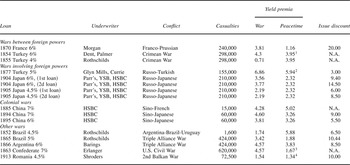
Table 4 organizes relevant evidence on war loans to assess who received funding from whom and at what price. We provide information on the fifteen wartime capital-market access events identified for the period 1845–1913. The table distinguishes between types of wars in the same way as Table 1 (wars between powers, wars involving powers, colonial wars, and others). For each loan, we identify the underwriting bank, the yield spread at issue, and a benchmark yield spread for average or typical previous peacetime issues. We report information on estimated casualties, an indicator of violence. Finally, we report an estimate of the market “discount,” the price difference between the loan's issue price and the secondary market price of a comparable one, a measure of information asymmetries.Footnote 72
Cost of war loans, 1845–1913

Notes: We excluded one loan for lack of relevant information. Romania's loan issued in 1913 (during the second Balkan War) had no reasonably recent peacetime counterpart. YSB = Yokohama Specie Bank; HSBC = Hong Kong and Shanghai Bank. N.A. = not applicable—which means that we found no meaningful way to compute a reliable issue discount. Entries under “Peacetime” are based on the last spread at issue in peacetime except when otherwise stated.
1. Peacetime loan is the loan issued in 1858 by Dent, Palmer.
2. Peacetime loan is average of the five Turkish loans made between 1865 and 1870.
3. Peacetime loan is U.S. 5 percent loan of 1871.
4. Peacetime loan is Romania 4 percent loan of 1898, issued in Paris.
Source: Authors' calculations; see text for details.
A first striking result is that with only a single exception, prestigious banks never funded wars involving any power. It is consistent with the view that all wars involving powers were dangerous for prestigious banks' charters. The exception is the 1855 loan to fund the war effort by the Ottoman Empire in the Crimean War. Polanyi brushed the episode aside as “a more or less colonial event”Footnote 73 but this Crimean loan was guaranteed by Britain and France permitting a different interpretation: an Ottoman default was not a reputational risk for the Rothschilds because it would have led to the French and English governments footing the bill.
The other cases of prestigious banks' involvement are found in the “other wars” group: the Rothschilds' funding of Brazil (in 1852 and 1865) and Barings' funding of Argentina (in 1866). Why prestigious bankers became involved in these conflicts is again understood in terms of liability risk: there was little doubt about either war's outcome (the countries supported by the prestigious bankers would win) and the conflicts raised no geopolitical issue. The Argentina-Brazil-Uruguay War of 1852 was a miniconflict. During the Triple Alliance War against Paraguay (1865–66), Brazil and Argentina (helped by Uruguay) entered Paraguay and slaughtered its population.Footnote 74 In other words, Haute Finance was not the Red Cross. Nor did prestigious banks dislike wars—they disliked only losers, or more precisely the risk of being found in losers' company. Consistently, prestigious banks could make an exception and promote a murderous war provided it would be a “winning” one and posed no geopolitical threat. Otherwise the war was discriminated against. Confirming this, Table 4 shows that all other conflicts were funded by ordinary houses.
Another feature worth mentioning is that war-time loans were penalized through higher spreads and also big-issue discounts. In several cases, this reflected the fact that countries at war were forced to go to a lesser underwriter. When prestigious banks got involved, wartime borrowing terms could actually be better than peacetime terms. For instance, the Crimean War loan to the Ottoman Empire by the Rothschilds had a lower spread than the peacetime benchmark: markets preferred to lend to the Turks-at-war certified by the House of Rothschild, than to the Turks-at-peace, underwritten by the House of Nobody. This is also true of the 1852 Brazilian loan which was made on better terms than the peacetime benchmark. This shows that bankers' reputation could outweigh the effect of war in determining spreads, and reinforces our notion of the control they had over war and peace.
France in 1870 (at war with Prussia) provides an example of the costs of a downgrade. Whereas the Rothschilds had brought out French international loans in previous decades, they now turned down this application. France's new government, adamantly wanting to fight the war, found itself going to Morgans, then a second-order London shop. Compared to the peacetime benchmark, the yield spread for this loan was huge (260 basis points) and so was the issue discount, the highest of all in the group (20 percent). French officials painfully resented it, joking about “morganatic” financial terms. The joke rested on the consonance between the name of “Morgans” and “morganatic marriages” (marriages between one of royal birth and one of lower rank): the match “below France's kind” ran the risk of reflecting poorly on France's credit.Footnote 75 Obviously, the penalty did not prove sufficient to prevent the war (and cautions against naïve views of “markets' dictatorship”), but the fact that there are not many other wartime issues in the table shows that in many cases, prestige did orient policies toward peace.
Table 4 finally shows that wartime market access through ordinary banks (all types of wars) was generally more costly than peacetime access with the same or other ordinary banks, but not systematically so.Footnote 76 This is understandable because countries not sponsored by a serious bank in peacetime were considered risky and thus the advent of conflict was not always big news. A lot depended on war and country specifics, market expectations regarding the likely duration of war, as well as countries' own “reputation” (à la Tomz). Pushing the argument further, we predict that for a country lacking a reputation, a war might even have turned out to be a good thing. A country that won a war could, for example, “self-certify” by exhibiting its military (and thus industrial) prowess. Of course, this was a gamble.
An example is the evolution of the spreads paid by Japan during its war against Russia (1904–05). When Japan attacked Russia by surprise, markets were anxious. Neither peacetime nor wartime Japan had been underwritten by a top-notch house. Accordingly, the first two loans had large spreads (130 and 150 basis points) and large-issue discounts (about 10 percent and 15 percent). The penalty however was less than France's, which is natural because Japan was not losing the support of prestigious banks. To facilitate market access, Japan tried, but failed (unsurprisingly), to secure the help of a prestigious house (Barings).Footnote 77 But Japan soon wiped out Russia's Baltic fleet in Tsushima—the world got to know there was a new power in the Far East. Japan then returned to the markets and made two further loans, at lower spreads than peacetime benchmarks.Footnote 78 It is a perfect illustration of our argument about the competition between private authorities and national governments in certification. Japan managed to establish its credit despite Haute Finance's lack of support.
Conclusion
This study provides a new, industrial economics-based interpretation for Polanyi's idea that certain leading financial actors can control lending and successfully implement pro-peace policies. This interpretation rests on prestige, an asset that can help address asymmetries of information, and which is proprietary. We argue that Haute Finance's allergy to wars reflected its concern with protecting its own property rights over global financial certification. This runs counter to Polanyi's suggestion that Haute Finance found legitimacy by providing a public good (international peace). Had Polanyi been right, the Rothschilds would never have funded any war—but they did. The Rothschilds' logic should not be mixed up with broad humanitarian goals.
The “weapon” controlled by prestigious houses was the cost of the loans. Their refusal to underwrite a given loan could make it substantially more costly. When prestigious banks declined lending, ordinary banking houses could try and get involved: we found that about 20 percent of wars received London funding during the period 1845–1913, mostly from nonprestigious houses (European wars were never sponsored by prestigious banks). But going to the market through a lesser house was akin to a downgrade and in some cases, prestigious banks' walking away was enough to ensure that the loan would fail. Other things being equal, prestigious banks' refusal to fund European wars increased the costs of wars. This deterrent could tilt the balance in favor of peace. Our analysis and data suggest war borrowing was not “impossible” but rather, that it was severely penalized. Likewise, not all financiers were appeasing—only those with a name/brand to protect.
These findings provide a foundation for different attitudes toward war finance within the politically amorphous group of “financiers.” The split operated according to an industrial organization divide. We explained why, during the Pax Britannica, prestigious banks were involved in diplomacy when ordinary ones were not. Having less or no reputation, ordinary houses had less to lose from underwriting a war loan. This shows how industrial organization can have an effect on international relations and IPE outcomes. We conclude that a better theory of the relation between banking and war should give more consideration to organization within the financial industry.
The theoretical contribution of this study is perhaps best understood in light of recent work. While our findings need not be exclusive of Kirshner's, they nonetheless represent a significant departure. In our model, Kirshner's financiers-at-large and their weariness of war are replaced by a more precise market structure with attitudes and policies toward war-mongering explained by standing in the market. Likewise, we argued that Tomz's theory of self-certification through repeat play and investment in reputational capital should be extended and improved. We uncovered the existence of other players in the reputation game—players whose role Polanyi emphasized but failed to explain, and players whom Tomz simply ignored. Our analysis led us to recognize that governments' attempts at asserting their credibility can be supported or contradicted by the efforts of prestigious bankers who act as their competitors in the reputation game.
The competition between public and private certification authorities is a neglected but key dimension of international relations and should be the topic of future research. Theory could achieve significant mileage by looking at the interplay between reputation-providing intermediaries (rating agencies, the media, nongovernmental organizations, etc.) and states in the certification game, rather than focusing narrowly on reputation acquisition by “stand-alone” governments facing a continuum of investors. As a result, countries' own attempts at signaling their worth can be seen as competing against other certification providers. As the Japanese experience in the early twentieth century showed, a military victory provided this kind of self-certification. Japan signaled its worth itself by waging and winning a war against Russia. Therefore, preventing conflicts was essentially a way to fight new competitors. We can thus provide a rigorous interpretation of why prestigious bankers hated conflicts—they were, like the incumbent firm in the industrial economist's model, leery of competitors entering their market. War and peace were for them the continuation of business by other means.
To conclude, students of IPE should give up the earlier model of perfect competition and reputation acquisition through good behavior and start instead from the imperfect competition world we portray in this article. While the Rothschilds are ancient history, the theoretical issue they help identify and that Polanyi was the first to point his finger at (the importance of competition between private and public reputation signals and their ownership) is alive and well. Look at the world today.