Introduction
Advanced malignant neoplasms of the larynx and hypopharynx pose many therapeutic challenges.Reference Sharaf, Xue, Solari, Boa, Liu and Hanasono1–Reference Yu, Lewin, Reece and Robb3 The efficacy of radiotherapy (RT) and chemoradiotherapy has increased the indications for organ preservation treatments, explaining the declining role of total laryngectomy and pharyngolaryngectomy.Reference Bonomi, Blakaj and Blakaj4,Reference Patel, Qureshi, Dyer, Jalisi, Grillone and Truong5 The precise surgical management of these cancers is influenced by diverse clinical and pathological factors.Reference Clark, Gilbert, Irish, Brown, Neligan and Gullane6 Current indications for primary total laryngectomy or total pharyngolaryngectomy include locally advanced disease (including transcartilage involvement or extralaryngeal extension), a non-functioning larynx with a fixed cord, and contraindications to neoadjuvant chemotherapy.Reference Nouraei, Dias, Kanona, Vokes, O'Flynn and Clarke7,Reference Moradi, Glass, Atherton, Eccles, Coffey and Majithia8 In contrast, salvage total laryngectomy and total pharyngolaryngectomy may be favoured, even in cases of small recurrent tumours, if the field has previously been exposed to RT.Reference Karri, Yang, Chung, Chen, Mardini and Chen9,10 The extent of the surgical resection is influenced by the site of the primary tumour. For advanced hypopharyngeal primary tumours, pharyngolaryngectomy is an appropriate treatment modality. It comprises a total laryngectomy combined with removal of a portion (partial pharyngolaryngectomy) or circumferential segment of the pharynx (total pharyngolaryngectomy).Reference Deleyiannis, Weymuller, Coltrera and Futran11,Reference Clark, de Almeida, Gilbert, Irish, Brown and Neligan12
The larynx and pharynx represent complex structures positioned at the junction of the respiratory and digestive tracts, and are vital in maintaining and protecting the airway during swallowing and speech.Reference Moradi, Glass, Atherton, Eccles, Coffey and Majithia8,Reference Denewer, Khater, Hafez, Hussein, Roshdy and Shahatto13,Reference Broome, Juilland, Litzistorf, Monnier, Sandu and Pasche14 Removing these organs therefore carries significant morbidity.Reference Broome, Juilland, Litzistorf, Monnier, Sandu and Pasche14 Key surgical outcomes following resection include pharyngocutaneous fistula, anastomosis leak and pharyngeal stricture, with each having a profound influence on subsequent quality of life, in particular speech and swallowing.Reference Lewin, Barringer, May, Gillenwater, Arnold and Roberts15–Reference Ward, Bishop, Frisby and Stevens17 Pharyngocutaneous fistula is potentially associated with increased morbidity and mortality, an elongated length of hospital stay, and delayed enteral feeding.Reference Denewer, Khater, Hafez, Hussein, Roshdy and Shahatto13,Reference Siddiq and Paleri18,Reference van Brederode, Halmos and Stenekes19 Furthermore, the development of a pharyngeal stricture, most commonly at the level of the anastomosis, often heralds recalcitrant dysphagia and an ultimately poor nutritional status.Reference Clark, Gilbert, Irish, Brown, Neligan and Gullane6 Accordingly, post-surgical outcomes are an important metric to evaluate and compare the success of surgery and facilitate comparisons between techniques.
Reconstruction of the pharyngeal defect following total pharyngolaryngectomy demands careful considerationReference Zelken, Kang, Huang, Liao and Tsao20 and remains an area of debate within surgical discussions.Reference Nouraei, Dias, Kanona, Vokes, O'Flynn and Clarke7,Reference Karri, Yang, Chung, Chen, Mardini and Chen9,Reference Sagar, Marres and Hartman21–Reference Hanasono23 While its primary aim is to seal the neopharynx and prevent a salivary fistula, a secondary aim is to maximise the long-term function of speech and swallowing.Reference Lewin, Barringer, May, Gillenwater, Arnold and Roberts15 Currently, a wide array of reconstructive techniques are available.Reference Broome, Juilland, Litzistorf, Monnier, Sandu and Pasche14,Reference Hanasono23–Reference Kao, Abdelrahman, Chang, Wu, Hung and Shyu25 These can be stratified into primary closure, visceral interposition, regional flaps (e.g. pectoralis major) and free tissue transfer, encompassing musculocutaneous, fascio-cutaneous or gastro-intestinal flaps.Reference Sagar, Marres and Hartman21 Free tissue transfer has been proposed by some as providing better outcomes, which is attributed to the recruitment of a vascularised tissue composite to the anastomosis site, with examples including the anterolateral thigh flap and radial forearm free flap.Reference Lewin, Barringer, May, Gillenwater, Arnold and Roberts15,Reference Murray, Gilbert, Vesely, Novak, Zaitlin-Gencher and Clark16,Reference Murray, Novak and Neligan22,Reference Scharpf and Esclamado26 However, others have supported regional flaps and have demonstrated a reduced risk of several post-operative complications with these techniques. Further research is required on post-operative outcomes and their association with distinct reconstructive techniques, to help guide surgical management strategies.
High-level evidence is limited for the optimal reconstruction method for the hypopharynx, and there remains no consensus. Contributing factors are the rarity of these tumours, ethical barriers to randomised, controlled trials, and the evolution of surgical practice. Indeed, the growing repertoire of reconstructive options underlines the reliance on small retrospective case series to compare techniques. We performed a systemic analysis of patients undergoing total laryngectomy, partial pharyngolaryngectomy and total pharyngolaryngectomy across a 20-year period in a single institute. Leveraging the evolution of surgical practice at this institute, we highlight strengths of distinct reconstructive methods. Our results support established factors associated with poorer surgical outcomes, such as previous RT and more extensive pharyngeal resections, as well as suggesting that free tissue transfer may have an important role in the reconstruction of larger pharyngeal defects.
Materials and methods
In this retrospective study, electronic clinical records of all patients undergoing laryngeal and hypopharyngeal resection with or without reconstruction, for carcinoma of the hypopharynx, larynx or upper oesophagus, between 1999 and 2020, at a single institute, were identified. Inclusion criteria included all patients free of distant or metastatic disease at the time of surgery and at six months post-operatively. Exclusion criteria were: patients with synchronous or metachronous tumours, those with incomplete documentation, and patients lost to follow up.
Patients were stratified into primary versus salvage surgical intervention. Salvage procedures were defined as including any patient who had received RT with a curative intent. The tumour–node–metastasis (TNM) classification was defined at the time of initial histological diagnosis using the contemporary American Joint Committee on Cancer edition. Surgical procedures were classified as total laryngectomy, total pharyngolaryngectomy or partial pharyngolaryngectomy. Partial pharyngolaryngectomy was defined as a subtotal pharyngeal resection with a remaining section of native mucosa between resection margins. Total pharyngolaryngectomy was defined as a complete circumferential pharyngeal defect between resection margins. Reconstruction methods were classified as direct closure, pedicled flap, free tissue transfer (free flaps) and intestinal pull up. Pedicled flaps were the pectoralis major, supraclavicular, facial artery musculomucosal and temporalis flaps. Free flaps were the anterolateral thigh flap, free latissimus dorsi and radial forearm free flap.
Clinicopathological data were collected, including patient age, gender, World Health Organization (WHO) performance status, tumour laterality and location. For primary tumours invading multiple subsites, the nidus was determined by the operating surgeon and used for subsite classification. Histology examination was carried out by a specialist head and neck pathologist. Post-operative complications were assessed; these included: the need for revision and repeat procedures, fistula, anastomosis leak, and other post-operative complications such as flap necrosis and failure. In our institute, it is standard of care for all patients to undergo a water-soluble contrast study 7–14 days post-operatively. We used a strict criterion to define post-operative leaks, which included any leak demonstrated on a contrast swallow study regardless of the size or presence of symptoms. In contrast, a fistula was defined as any fistula tract between the pharynx and skin (pharyngocutaneous fistula), the majority of which evolved from a previously demonstrated anastomosis leak. The rate of stricture was defined as any stricture requiring balloon dilatation. Finally, we recorded the time to the first oral intake, for all patients.
Ethical approval
Ethical approval for this study was obtained from the local audit authority committee (clinical improvement module number: 6748).
Statistics
All statistical analysis was performed using R software (RStudio, version 3.5). For comparisons of statistical significance between two variables, a paired t-test was used, and for multiple groups a one-way analysis of variance test was used, with an alpha of 0.05. For binary comparisons of categorical variables, a chi-square test was used. An F test was applied to each sample to compare the variance implemented in the ‘var.test’ R function. In order to test normality assumptions, we analysed the residuals of covariate linear models, in addition to applying a Shapiro–Wilk test of normality. When normality assumptions were not met, a Kruskal–Wallis test or Mann–Whitney U test was used. All tests were two-tailed, and a value of p < 0.05 was considered statistically significant.
Results
Patient demographics and treatment overview
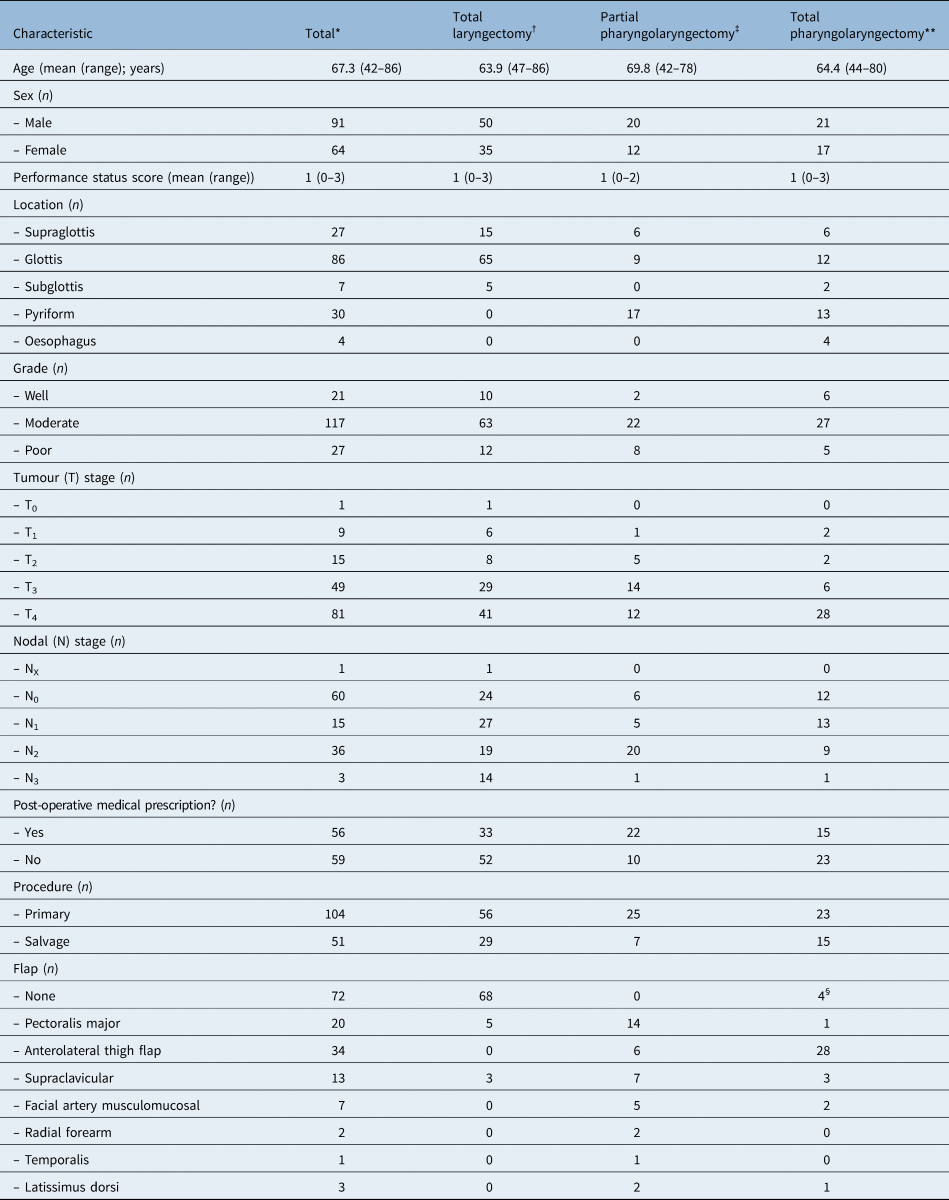
A total of 155 patients met the inclusion criteria. During the study, 85 patients underwent total laryngectomy, 32 patients underwent partial pharyngolaryngectomy and 38 patients underwent total pharyngolaryngectomy. One patient with locally advanced chondrosarcoma was included, but all other tumours were squamous cell carcinomas. Patient characteristics and reconstruction data are shown in Table 1. The study included 91 (58 per cent) males and 64 (42 per cent) females, with a mean age of 64.3 years (range, 42–86 years). Stratifying patients based on WHO performance status score demonstrated a mean score of 1; 38 patients had a score of 0, 54 had a score of 1, 40 had a score of 2 and 23 patients had a score of 3.
Demographic characteristics and reconstruction data

*n = 155; †n = 85; ‡n = 32; **n = 38. §Pull-up surgery only.
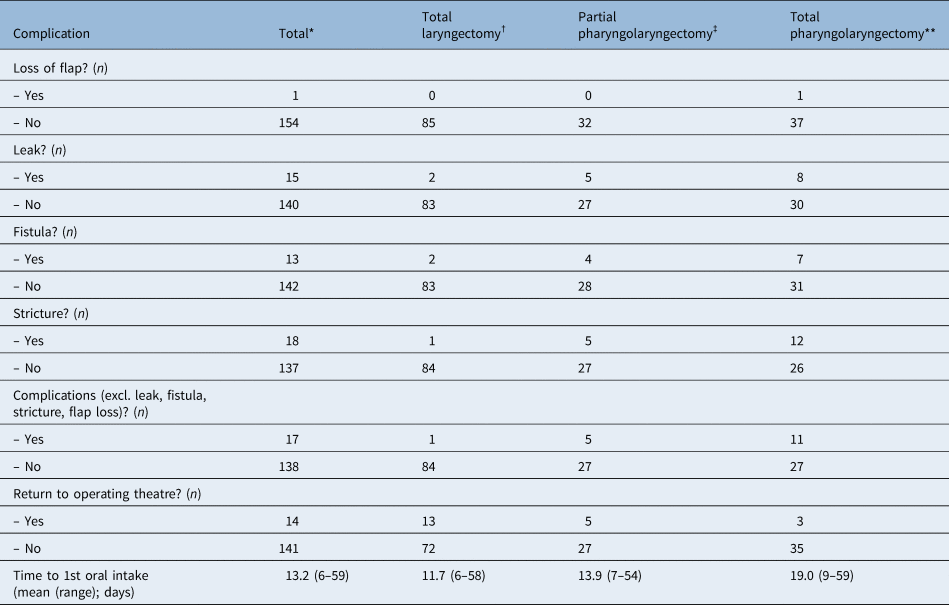
The overall complication rate was 46.4 per cent (72 out of 155 patients), and all patients were alive six months post-operatively as per the inclusion criteria. Using the Clavien–Dindo classification,Reference Dindo, Demartines and Clavien27 post-operative complications were categorised as grade 1 in 7 cases, grade 2 in 20 cases, grade 3 in 41 cases and grade 4 in 4 cases. In all patients, 8.3 per cent (13 out of 155) developed a fistula, 9.6 per cent (15 out of 155) suffered a salivary leak and 11.6 per cent (18 out of 155) developed a stricture requiring dilatation. Eight of the 10 patients (80 per cent) who developed a fistula had a previously demonstrated anastomosis leak on a contrast swallow study. In addition, 9.0 per cent of patients (14 out of 155) required a revision procedure following the tumour resection. The indications for these revision procedures were: haematoma evacuation, fistula repair, incision and drainage of a neck collection, and debridement of the flap. There was one loss of flap (1 out of 155, 0.64 per cent), which was an anterolateral thigh flap; this was excised and revised with a supraclavicular flap that survived. The mean time to first oral intake was 13.2 days (range, 6–59 days).
Tumour subsite analysis
Localisation of the primary tumour was as follows: supraglottis (n = 27), glottis (n = 86), subglottis (n = 7), pyriform fossa (n = 30) and oesophagus (n = 4). Analysis of histological grade of lesions identified 21 (13.4 per cent) well-differentiated, 117 (75.5 per cent) moderately differentiated and 27 (17.4 per cent) poorly differentiated tumours.
The TNM classifications of tumours based on post-operative histology are listed in Table 1. The most common T stage was T4 (n = 81), followed by T3 (n = 49), T2 (n = 15), T1 (n = 9) and T0 (n = 1). Together, 83.9 per cent of patients (130 out of 155) had advanced tumours (T3–T4). With regard to nodal status, N0 (n = 60) was the most common N stage, followed by N2 (n = 36), N1 (n = 15) N3 (n = 3) and Nx (n = 1). For primary tumours, 1 was T1, 3 were T2, 36 were T3 and 64 were T4. Prior to surgery, an initial tumour stage was determined based on endoscopy findings and imaging. Of note, all primary T1–T2 tumours were down-staged following surgery and represented historically old cases (1999–2004), suggesting improved accuracy of contemporary staging imaging. For salvage resections, 1 was Tx, 8 were T1, 12 were T2, 13 were T3 and 17 were T4. No patient had distant metastasis at the time of surgery (M0, n = 155), and all patients were alive six months after their surgery.
Outcomes and type of resection
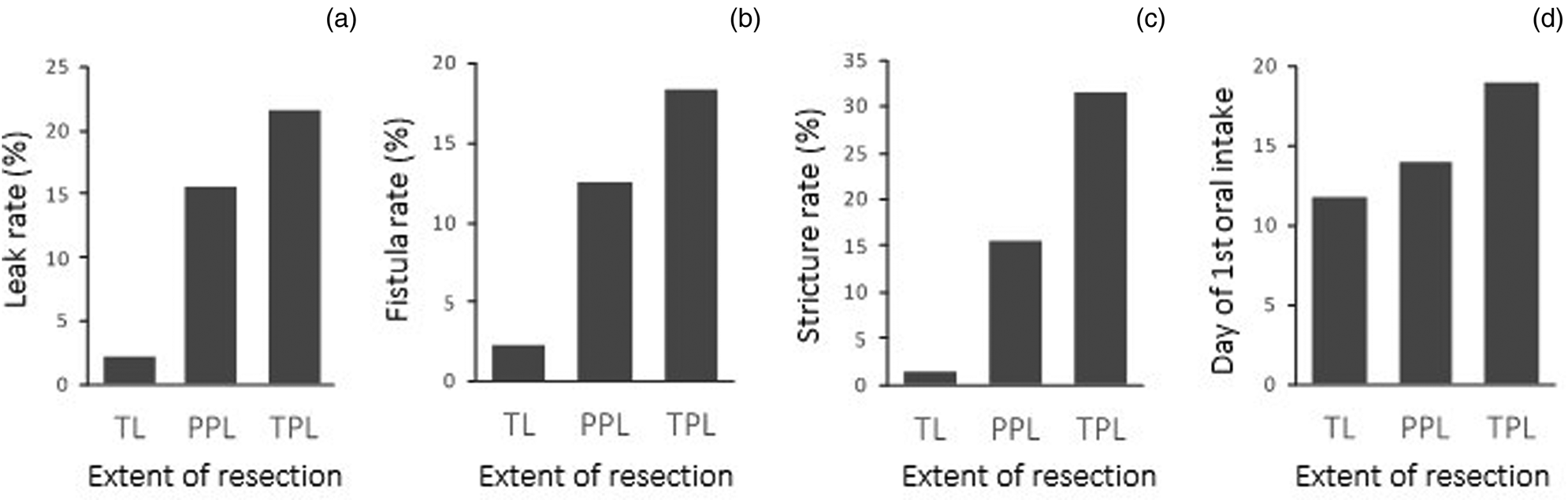
Tables 2 and 3 illustrate post-operative complications. Post-operative complications occurred in 41.1 per cent (35 out of 85) of total laryngectomies, 46.8 per cent (15 out of 32) of partial pharyngectomies and 65.7 per cent (25 out of 38) of total pharyngolaryngectomies. The overall fistula formation rate was highest after total pharyngolaryngectomy, at 18.4 per cent (7 out of 38), followed by 12.5 per cent (4 out of 32) for partial pharyngolaryngectomy, and 2.4 per cent (2 out of 85) for total laryngectomy (p = 0.09) (Figure 1b). Post-operative leaks occurred in 21.4 per cent (8 out of 38) of total pharyngolaryngectomy patients, 15.6 per cent (5 out of 32) of partial pharyngolaryngectomy patients and 2.3 per cent (2 out of 85) of total laryngectomy patients (p = 0.47) (Figure 1a). Return to the operating theatre was necessary in 15.3 per cent (13 out of 85) of total laryngectomy patients, 15.6 per cent (5 out of 32) of partial pharyngolaryngectomy patients and 7.9 per cent (3 out of 38) of total pharyngolaryngectomy patients. The percentage of strictures was 1.2 per cent (1 out of 85) for total laryngectomy, 15.6 per cent (5 out of 32) for partial pharyngolaryngectomy and 31.6 per cent (12 out of 38) for total pharyngolaryngectomy (p = 0.01) (Figure 1c). Finally, there was a significant difference (p = 0.02) between the resection groups in terms of the time to first oral intake, at 11.7 days (range, 6–58 days) for total laryngectomy, 13.9 days (range, 7–54 days) for partial pharyngolaryngectomy and 19.0 days (range, 9–59 days) for total pharyngolaryngectomy (Figure 1d).
Bar plots showing the complications by extent of resection, namely: (a) anastomosis leak rate; (b) fistula rate; (c) stricture rate; and (d) day of first oral intake. TL = total laryngectomy; PPL = partial pharyngolaryngectomy; TPL = total pharyngolaryngectomy

Post-operative complications

*n = 155; †n = 85; ‡n = 32; **n = 38. Excl. = excluding
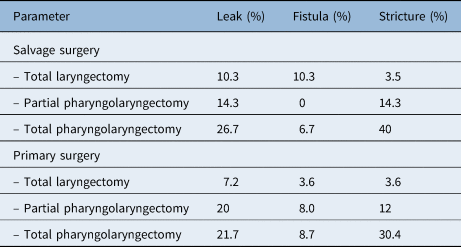
Post-operative complications by salvage status and nature of resection

Complications after surgery
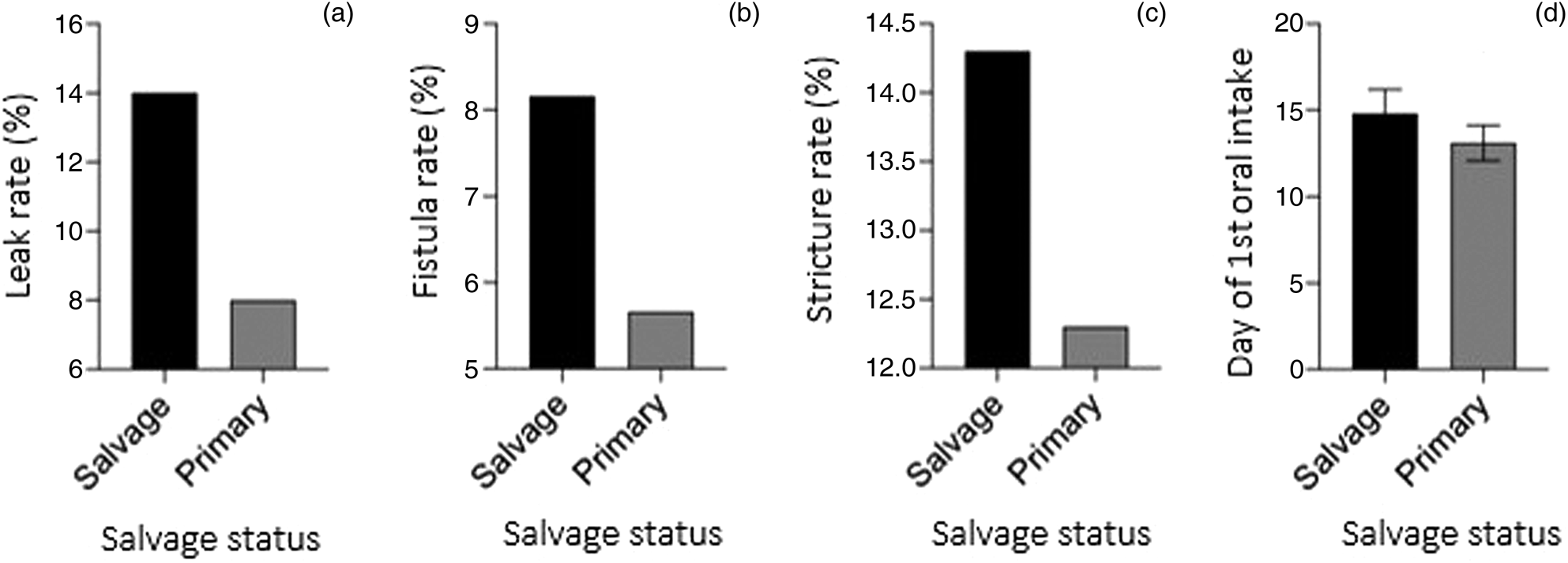
Tumour resection was performed as a primary procedure in 68.4 per cent of patients (106 out of 155) and as a salvage procedure in 31.6 per cent of patients (49 out of 155). All patients who underwent salvage procedures had received prior RT or chemoradiotherapy with curative intent. Post-operative RT was given to all patients, 44.2 per cent of whom (70 out of 155) were RT naïve. There was a higher rate of fistula in patients undergoing salvage procedures as compared with primary procedures (8.1 per cent vs 5.7 per cent, p = 0.33; Figure 2b). Patients undergoing surgical salvage were at an increased risk of an anastomosis leak compared with those undergoing primary surgical procedures (16.3 per cent and 13.3 per cent, p = 0.24; Figure 2a). Patients undergoing salvage procedures did not exhibit differences in terms of post-operative complications (14.3 per cent and 15.0 per cent, p = 0.22) or rate of return to the operating theatre (14.1 per cent vs 12.3 per cent, p = 0.21). There was a longer time to first oral intake in salvage compared with primary procedures (mean 14.8 vs 13.1 days, p = 0.32; Figure 2d). Finally, there was a difference in stricture rate between salvage and primary procedures (14.8 per cent vs 12.2 per cent, respectively, p = 0.24; Figure 2c).
Bar plots showing the complications by salvage status (primary or salvage), namely: (a) anastomosis leak rate; (b) fistula rate; (c) stricture rate; and (d) day of first oral intake.

Outcomes by reconstructive method
Seventy-eight patients (48.5 per cent) received no form of reconstruction primarily involving closure of the defect. Of the 155 patients, a pectoralis major flap was used for 20 (12.9 per cent), an anterolateral thigh flap was used for 34 (21.9 per cent), a supraclavicular flap was used for 13 (8.39 per cent) and a facial artery musculomucosal flap was used for 7 (4.5 per cent). In addition, two patients received a radial forearm free flap (1.29 per cent), three received a latissimus dorsi flap (0.65 per cent), one received a temporalis flap (0.65 per cent) and one underwent synchronous facial artery musculomucosal and supraclavicular flaps (0.65 per cent). Four patients (2.58 per cent) underwent gastric pull-up surgery.
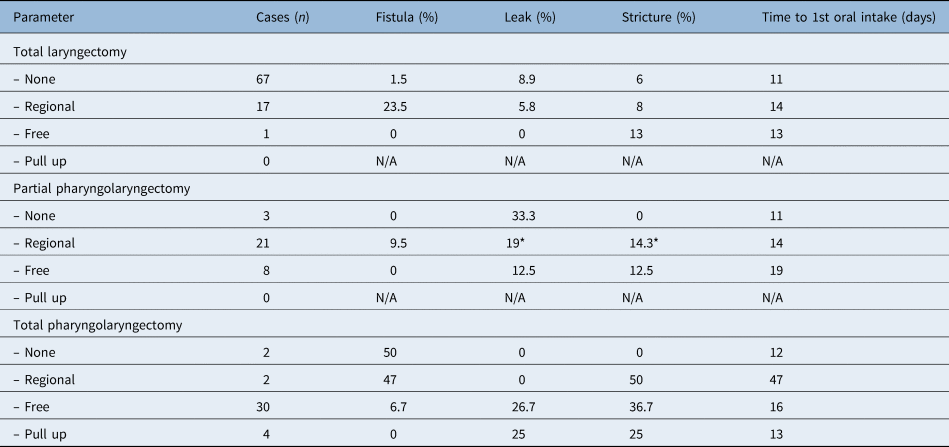
The percentages of all post-operative complications varied across reconstruction groups, with 33 per cent (24 out of 72) for direct closure, 52.5 per cent (21 out of 40) for regional flaps, 61 per cent (24 out of 39) for free flaps and 75 per cent (3 out of 4) for gastric pull ups. Table 4 depicts the post-operative complications by reconstructive method and nature of resection. The overall rate of fistula formation was 1.4 per cent (1 out of 72) for direct closure, 17.5 per cent (7 out of 40) for regional flaps, 5.1 per cent (2 out of 39) for free tissue transfer and 0 per cent (1 out of 4) for gastric pull up (p = 0.08). Anastomosis leak rates were 9.7 per cent (7 out of 72) for direct closure, 12.5 per cent (5 out of 40) for regional flaps, 23 per cent (9 out of 39) for free flaps and 25 per cent (1 out of 4) for gastric pull ups (p = 0.4). The rate of stricture formation was 4.2 per cent (3 out of 72) for direct closure, 10 per cent (4 out of 40) for regional flaps, 30.8 per cent (12 out of 39) for free flaps and 25 per cent (1 out of 4) for gastric pull-up flaps (p = 0.02). Furthermore, the rates for return to the operating theatre were 12.5 per cent (9 out of 72) for direct closure, 20 per cent (8 out of 40) for regional flaps, 10.3 per cent (4 out of 39) for free flaps and 0 per cent (0 out of 4) for gastric pull ups. Finally, the mean time for oral first intake was 10.9 days (range, 6–58 days) for direct closure, 15.8 days (range, 7–59 days) for regional flaps, 16.5 days (range, 7–56 days) for free flaps and 13.8 days (range, 9–21 days) for gastric pull ups (p = 0.7).
Post-operative complications by resection status and method of reconstruction

*p < 0.05. N/A = not applicable
Discussion
While total laryngectomy and primary closure is an operation that has been performed since 1873,Reference Schwartz28 there remains no consensus on the surgical management of advanced laryngeal and hypopharyngeal tumours that require reconstruction. This study involved a systemic analysis of covariates associated with post-operative outcomes, including the extent of pharyngeal resection, salvage status and method of reconstruction. Overall, our data correspond to the lower end of reported rates for these complications, despite broad inclusion criteria for each. In the literature, the incidence of complications varies from 4.6 per cent to 48.8 per centReference Carsuzaa, Capitaine, Ferrié, Apert, Tonnerre and Frasca29 for fistula, and from 11 per cent to 60 per cent for strictures.Reference Mahalingam, Srinivasan and Spielmann30,Reference Terlingen, Pilz, Kuijer, Kremer and Baijens31 In addition, pharyngeal resection is associated with a variety of complications and significant overall morbidity. Previous research has demonstrated that circumferential defects have worse outcomes and more frequent complications when compared with partial defects.Reference Mahalingam, Srinivasan and Spielmann30 The results presented here align with these observations and show that the rates of post-operative fistula (18.4 per cent vs 12.5 per cent), anastomosis leak (21.4 per cent vs 15.6 per cent) and stricture (31.6 per cent vs 15.6 per cent) were higher in total pharyngolaryngectomy than in partial pharyngolaryngectomy.
Prior RT to the operative field is proposed as a key determinant in head and neck surgery outcomes,Reference Esteller, Vega, López, Quer and León32–Reference Taguchi, Nishimura, Takahashi, Shiono, Komatsu and Sano34 but few studies have directly examined its impact following pharyngolaryngeal resection.Reference Perdoni, Santarelli, Koo, Karakla and Bak35 One example demonstrated that salvage total laryngectomy, total pharyngolaryngectomy or partial pharyngolaryngectomy were associated with delayed onset of oral intake as compared with primary procedures.Reference Perdoni, Santarelli, Koo, Karakla and Bak35 In another study, previous RT was shown to have a negative impact on swallowing function but not speech outcomes.Reference de Casso, Slevin and Homer36 Distinct surgical complications such as pharyngocutaneous fistula have also been reported as being increased in patients undergoing salvage partial pharyngolaryngectomy or total pharyngolaryngectomy, but others have found no difference when these were compared with primary procedures.Reference Clarke, Radford, Coffey and Stewart37 Collectively, our data showed an increased rate of surgical complications following salvage procedures, with higher rates of anastomosis leak, pharyngocutaneous fistula and stricture. Despite this clear trend, we lacked the resolution to show statistical significance between rates of complications. One factor driving this non-significance may be the relatively small number of salvage procedures and post-operative complications compared across subgroups. Future comparisons should build on our findings and include functional outcomes across primary and salvage procedures, to help delineate differences in longer-term complications.
Defect characteristics have a profound influence on the success of reconstructionReference Kao, Abdelrahman, Chang, Wu, Hung and Shyu25 in addition to helping to inform which method will be used. For example, cases of circumferential pharyngeal defects requiring a tubed flap have been shown to be at a higher risk of stricture formation.Reference Moradi, Glass, Atherton, Eccles, Coffey and Majithia8,Reference Lewin, Barringer, May, Gillenwater, Arnold and Roberts15,Reference Clarke, Radford, Coffey and Stewart37 Given this, we performed a subgroup analysis of post-operative complications by method of reconstruction stratified by the extent of pharyngeal defect (Table 4). Interestingly, this revealed that free tissue transfer had lower rates of anastomosis leak, fistula and strictures for partial pharyngeal defects. In addition, free tissue transfer showed lower rates of fistula and stricture, but a higher rate of anastomosis leak, for total pharyngolaryngectomy. These findings support the use of free tissue transfer for partial pharyngeal defects and possibly for circumferential defects too. Moreover, as our results demonstrated that circumferential defects were associated with worse surgical outcomes, including increased rates of anastomosis leak and fistula, the benefit of free tissue transfer may be more important than previously indicated, and may act to reduce the incidence of complications in higher-risk patients.
Several limitations must be considered when interpreting the findings of this study. Firstly, as is common in large clinical studies, the data are subject to omissions and collection bias. One value of our data is that it represents a single-institute cohort over a 20-year period, but this may introduce a selection bias into those patients entered in the study. Second, the exact nature of the pharyngeal resection exhibits great variability, and our data points are limited to the primary defect site, size and grade, without much detail on the types of resection performed. Third, we used the American Society of Anesthesiologists grade as a crude metric to determine pre-operative healthy status, but there are numerous factors that may affect the success of the reconstruction, including smoking status, diabetes and peripheral vascular disease, which are not present in our dataset. The retrospective nature of this study also imposes limits on the interpretation of the results. Finally, there is a surgeon and case selection bias, in that larger tumours are more likely to be selected for more aggressive surgical resection and therefore reconstruction.
• This study investigated clinical outcomes following pharyngolaryngectomy reconstruction
• Salvage procedure is associated with more post-operative complications
• Circumferential pharyngeal defects lead to increased post-operative complications
• This study describes varied reconstructive methods and discusses how these relate to post-operative outcomes
• It provides further evidence suggesting free tissue transfer may be more appropriate to reconstruct larger circumferential pharyngeal defects
Conclusion
Pharyngeal resection carries a substantial risk of post-operative complications. Our results show that circumferential pharyngeal defects and prior RT have a significant impact on complications. Crucially, across a spectrum of reconstructive methods, and leveraging data collected along an evolution of surgical practice, we provide valuable information to support the use of free tissue transfer for larger pharyngeal defects. Building on these retrospective findings, moving forward, prospective data will be valuable to further our understanding of patient and surgical factors that influence outcomes in advanced head and neck malignancies. In addition, including longer-term functional outcomes will provide a complete perspective of outcomes that complements our findings on complications.
Competing interests
None declared