Definitions
Freedom
Human freedom has been on the philosophical agenda since at least the time of Plato.Footnote 1 Freedom is a foundational human value and is recognized as such by most codes of human rights.Footnote 2 There are, however, multiple dictionary definitions. A word as slippery as “freedom” has been gainfully employed by libertarians and totalitarians, by radicals and conservatives, and by all sides of the political spectrum.
In conflict with the enlightenment project of individual liberty, we are seeing advances in neuroscience that suggest we may have no “true” freedom at all. Propelled by Benjamin Libet’s famous 1983 experiments, neuroscience is converging on the idea that our sense of agency and our volition seem to originate from separate cerebral processes.Footnote 3,Footnote 4,Footnote 5 Some form of soft determinism or other compatibilism currently appears to be the most likely candidate theory to help us account for free will.Footnote 6,Footnote 7
Debate continues on the meaning of freedom.Footnote 8,Footnote 9 Henceforth I will assume freedom to be: “The wide availability of volitional options, and the unconstrained ability to act on those options.”
There are, therefore, two domains where freedom may be restricted: freedom of will and freedom of action. A restriction on the former is usually the result of internal constraints such as mood states, or psychological or cognitive makeup. The latter are usually restricted by external constraints that may be social, legal, or political.Footnote 10
Enhancement
Traditional enhancement definitions do not readily lend themselves to moral enhancement. Morality is not an easy property to quantify, and is usually considered in a normative framework. In terms of species functioning, we can readily imagine strength or cognition being enhanced above normal species functioning, but it is unclear how this applies to morality.
As Frances Kamm has pointed out, there are two extents of enhancement.Footnote 11 We can enhance people so that they are above the norm or average in that particular category: a regular couch potato might be enhanced to the strength of a high-level athlete. Or we can go further and enhance people beyond what is currently considered humanly possible, taking the same couch potato to levels of physical prowess that have never before been seen. This latter level of enhancement is not conceptually compatible with morality. It is meaningful and comprehensible to speak of superhuman strength, incredible resistance to injury, or startling intelligence. But what could we possibly mean by superhuman morality?
Julian Savulescu has proposed a welfarist definition of enhancement: “Any change in the biology or psychology of a person which increases the chances of leading a good life in the relevant set of circumstances” Footnote 12
This understanding of enhancement is not equally applicable to morality, as it is by no means clear that an individual with enhanced morality will be more likely to live a good life.
I will adopt John Harris’s simple definition of enhancement as “anything that makes a change, a difference for the better.”Footnote 13
Morality and Moral Enhancement
The possibility of moral enhancement requires a naturalistic understanding of ethics. Emotivism, prescriptivism, intuitionism, and even Kantian ethics do not readily lend themselves to an enhancement project.
Moral enhancement relies on some sort of change in the central nervous system. This may be endogenous/personal, such as the use of devices and medications, or exogenous/impersonal, as in education or “nudges” to encourage more ethical behavior.Footnote 14,Footnote 15
Within a naturalistic framework, consequentialism and virtue ethics are the two approaches that seem to offer the greatest scope for moral enhancement. Consequentialism, however, is an exercise in calculation.Footnote 16 Regardless of the good that is desired and regardless of whether an act- or a rule-utilitarian model is embraced, each and every decision relies on calculus. A utilitarian should consider all the options, weigh them, and select that which leads to the greatest good.
This is undoubtedly a challenge. What is needed to be a good utilitarian is the ability to gather, retain, integrate, and judge as much information as possible. This ability to calculate and compare the inputs and the outputs is what allows a utilitarian thinker to choose the best option. And such abilities are primarily cognitive rather than primarily moral. It is cognitive enhancement—not direct moral enhancement—that would allow someone to do better at the information gathering and decision modelling that produces the most good. Primary moral enhancement will make no difference to the calculus-based approach required for good utilitarian thinking.
This leaves virtue ethics as the prime target for enhancement of a strictly moral dimension of human behavior.
Virtue ethics sits in contrast to currently more popular ethical theories rooted in consequentialism or deontology. Virtue ethics seeks neither to answer questions about what would be the best outcome, nor to describe what rules an agent ought to follow. One way to describe virtue ethics is that it asks not “What should I do?” but rather “What sort of person should I be?” and “How should I live my life?” Whereas Aristotle thought that the virtues served to help humans fulfill their telos, or purpose, modern naturalistic virtue ethicists have moved away from metaphysical teleology.Footnote 17,Footnote 18
Some of the virtues include courage, mildness of temper, generosity, moderation, justice, and truthfulness. Such qualities have a prima facie appeal as candidates for enhancement. Aristotle suggested that true virtue in each of these domains sat at a point between two extremes, which some call the “golden mean.” Courage, for example, sits at the appropriate point between cowardice and rashness.
Two further features of virtue ethics strengthen its claim as the most appropriate way to approach moral enhancement.
First, virtue ethics is deeply prosocial. From Aristotle through to modern virtue ethicists, there has been a focus on the two-way interaction between the virtuous person and the good society: virtuous people lead to a better society, and a better society is one that more effectively inculcates the virtues. Rosalind Hursthouse has proposed a naturalistic account virtue ethics that serves for complex social animals such as humans. She suggests that a good social animal is one that is “well fitted” and for which certain aspects well serve (1) its individual survival, (2) the continuance of its species, (3) its characteristic freedom from pain and characteristic enjoyment, and (4) the good functioning of its social group.Footnote 19
Second, the concept of virtue appears to be cross-cultural. Martha Nussbaum has made a strong case for the non-relativity of virtues, and it seems that cross-cultural understanding of virtues is considerable.Footnote 20 Each virtue relates to a sphere of activity that is unavoidable in human experience, regardless of the society in which one lives. This argument is strengthened by suggestions from philosophers such as John ShookFootnote 21, and psychologists such as Jonathan Haidt and Craig Joseph that virtues are the most biologically innate of ethical frameworks:
As Aristotle pointed out…what it means for a personality characteristic to be a virtue, and not simply a behavioral regularity, is largely that it consists in functioning well in a specific “sphere of existence.” And what Aristotle and Nussbaum mean by “spheres of existence” is similar to what evolutionary biologists would recognize as persistent adaptive challenges and other types of environmental constraint. Virtues are therefore quite at home in a scientific theory of moral functioning based on evolutionary psychology and cultural psychology.Footnote 22
Threats to Freedom. How a Moral Enhancement Project Could Reduce Our Personal Freedom
Much of the concern around moral enhancement is on account of threats to individual freedom.Footnote 23 Curtailment of individual choices is the clearest threat to freedom. Moral enhancement through the elimination of negative mood states or desires is eo ipso an example of a freedom-attenuating approach.Footnote 24
A moral enhancement project offers other threats to freedom, and here I will discuss threats related to the implementation method of the project, the creation of new externalities, disproportionate enhancement of certain virtues, and the elimination of immoral choices.
Implementation Method
The method of implementation may restrict freedom.Footnote 25 Post-birth, it seems plausible to have an intervention at a young age, perhaps an injection of a drug when an infant is 3 months of age to ensure correct moral development, or the introduction of a neuroimplant for all children when they reach the age of 10 years. If these are enforced, then we could well consider it a restriction of freedom both on the grounds of the autonomy of the child, and of the parents’ right to choose. If such interventions are for the public good, however, then they seem little different than current programs of vaccination and education. In the United Kingdom, these are also compulsory, but are widely accepted because of their rationale and perceived net benefit.
Such a mandatory intervention would raise eyebrows, hackles, fears, and the sales of conservative tabloid newspapers. Lest we forget amid the furor, we in the United Kingdom have in fact broadly accepted such interventions since at least the childhood vaccination programs of the 1950s. Moral enhancement can sit happily under the umbrella of public health ethics. Public health introduces a tension between individual autonomy and the well-being of a community. As Jeffrey Kahn and Anna Mastroianni point out in their discussion of different frameworks for public health ethics, “What they all have in common is the focus on community- and society-level values rather than the individual values found in much of the bioethics literature.”Footnote 26 This seems especially apposite to moral enhancement, as morality is founded so heavily on the relationships among people in a society. Viewing moral enhancement through a public health lens points again toward the virtues as ideal targets for enhancement, because of the profoundly prosocial (and conservative) nature of virtue ethics.
There are valid arguments that the government should not interfere in public services, but I do not think it rational to say that being on the receiving end of clean water, effective vaccines, and a foundational education is an infringement of human freedom.Footnote 27
More recent work has looked at the philosophy of libertarian paternalism.Footnote 28 This is an approach to helping people make the choice that their “best self” would make, and is a form of soft paternalism. The most common intervention is the remodeling of choice architecture: the way that our everyday world is ordered to encourage or discourage us from making certain choices. Moral enhancement could certainly fall within the scope of this approach. We are constantly making moral choices; therefore, all that soft paternalism suggests is that our array of choices could legitimately be altered (not reduced).
New Externalities
Freedom of action often depends on other people. We rely on others not to interfere with our projects and enterprises, but just as often our endeavors require the active assistance of other people. If a majority are morally enhanced, then the social landscape for the unenhanced is altered. The unenhanced may thus experience a reduced freedom to pursue their goals. I can see three project areas in which freedom might be limited for the morally normal.
Immoral ends.
Widespread moral enhancement will limit opportunities for nefarious activities. Students who wish to collude with classmates in cheating on a test will find themselves struggling if all of their colleagues are very honest. Criminals who need a getaway driver for a bank robbery will find their plans similarly thwarted. This is likely to affect only a tiny minority.
Moral ends but immoral means.
If they travel sufficiently, people will eventually find themselves offering a bribe to a law enforcement official instead of facing a prolonged visit to the local police station. Some such bribes are for moral ends.
Hamza Menel gestures out to the sea from the Bourbon Argos, the Médecins Sans Frontières (MSF) rescue ship carrying him and almost 900 other refugees and migrants to Italy. The 26-year-old was a police officer during the Libyan revolution, being swiftly jailed by rebels following the death of Muammar Gaddafi in 2011. After two years his father bribed officials to allow his only son to escape, but they continued hunting him and after attempting to get a visa to France from Tunisia, he paid people smugglers €1,400 (£1,250) for a place in a boat packed with more than 100 other migrants.Footnote 29
Were the majority to be morally enhanced, one could argue that Hamza Menel would never have needed to engage in bribery. Were he himself to have been morally enhanced then it is possible that he would never have endorsed bribery to free himself, leading directly to a continued deprivation of his freedom. Furthermore, in a majority-enhanced world there would be fewer people willing to accept a bribe to illegally smuggle people. This would entail a lack of freedom for those who need illicit services to escape from immoral regimes.
Trivial immoralities.
The majority-enhanced world will offer fewer collaborators in the small deceptions of everyday life. Such trivial requests of others such as, “Tell my boss I’ve gone to a meeting,” “Please don’t mention this to her, but….,” and other “white lies” will become more difficult. This does not place undue restrictions on individual freedom.
Disproportionate Enhancement of Virtues
The law of unintended consequences applies just as much to moral enhancement as to other noble projects. It is easy to imagine a society in which enhancement of particular social virtues leads to deep problems. The virtues of civic duty or respect for authority, if enhanced disproportionately compared with other virtues, could have a double impact on freedom. Not only will individuals find themselves acting at the commands of others, but a caucus of people with this enhancement could open the door for a totalitarian society.
Overenhancement of virtues such as generosity and kindness could lead to self-sacrifice. People who are unable to ever put their own interests first have constrained options and limited freedom. Such people would willingly sacrifice themselves for others, and a group of these “self-sacrificers” could serve a useful civic function at the cost of their own freedom and interests. Their freedom would be compromised by the exploitation—both individual and systematic—of their asymmetric virtue enhancement.
After the Chernobyl explosion, the cleanup operation employed 50,000 people to work as “bio-robots.”Footnote 30 The conditions in which they worked were so extreme that electronic robots could not function. It is not clear how much information these people were given, or how voluntary their participation was. Had there been a group of enhanced “self-sacrificers,” then society would have needed no coercion, but could simply have taken advantage of these people’s enhanced morality to engage them in a similar operation.Footnote 31 This seems perilously close to what John Shook and James Giordano describe as “single-use humans.”Footnote 32
Virtue ethics would not justify such perverse enhancement, and the defense it offers cannot be found in consequentialist or deontological enhancement projects. The “golden mean” is the ideally virtuous point between two extremes: between miserliness and profligacy lies a golden mean of generosity. In terms of virtue ethics it would not constitute an enhancement for a person to be blindly obedient or profoundly self-sacrificing; in fact it would suggest a moral deficiency. On the axis of obedience, lying between “blind obedience” and “reflexive rebelliousness,” would sit the virtue of “considered respect for authority.”
Virtue ethics thus provides a bulwark against extreme or perverse enhancements of a single moral attribute.
Eliminating Immoral Choices
Imagine that just ahead of you on the pavement sits a homeless man. He looks scruffy but unthreatening. It’s the middle of a spring day, and a little sun sneaks past the gray cloud. In no rush, with some small change in your pocket and a coffee in your hand, you are enjoying a discussion with your friend on the philosophical question of “What is a woman?”
For simplicity, let us conceive of our range of volitional choices as a decision tree model. Each decision ranges along a moral spectrum. Not only can they be qualitatively moral or immoral, but they can also be quantitatively different. Giving a 20 p coin to the man, and stopping to offer him food or drink, are both morally positive actions, but the latter is more virtuous than the former. Likewise, making a joke to your friend at the expense of the homeless man is immoral. But how much more immoral it would be if you were to laughingly kick his meager cup of coins out of his hands!
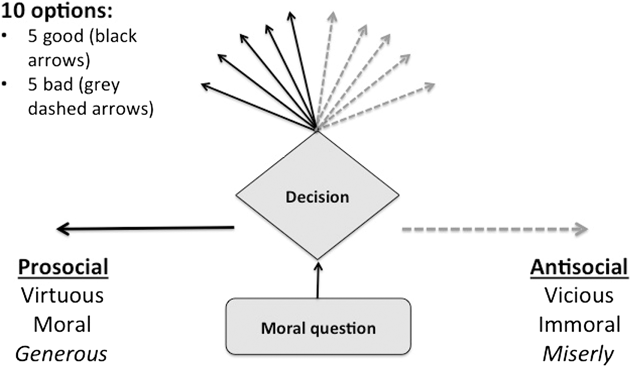
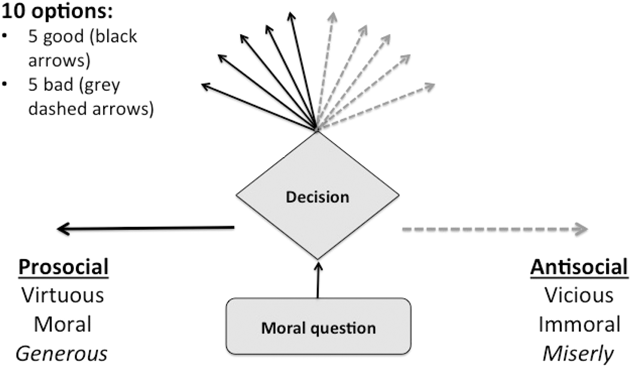
A simplified base case is shown in Figure 1.
Base case scenario.

There are 10 options available to you. The axis at the bottom represents the spectrum from virtuous to vicious, moral to immoral, and/or prosocial to antisocial. Of these 10, half are good and half bad. The option that you select will depend on factors both internal and external; for example, the company you are in, how well-rested you are, your state of nutrition and hydration, and myriad other intangible factors that affect mood.
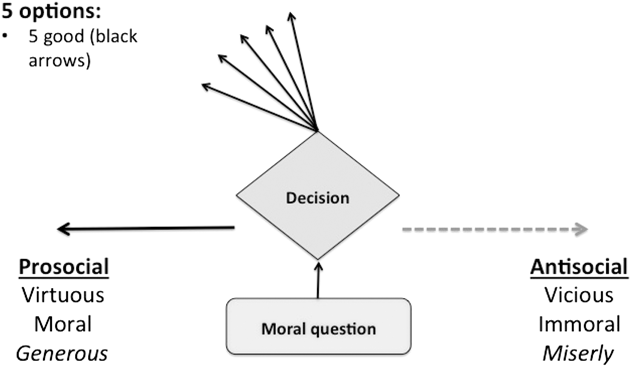
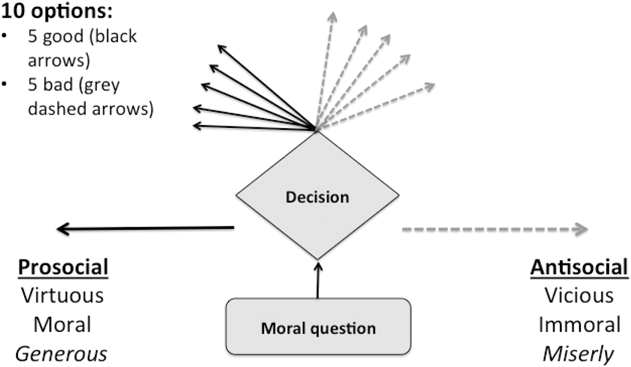
If moral enhancement meant nothing more than eliminating immoral actions then the actual range of possibilities open to you would diminsh. Let us imagine Anna (see Figure 2), who has undergone such a method of moral enhancement. Her freedom would be reduced.
Anna enhanced. Bad options eliminated; reduced freedom.

Here, the bad options have been eliminated, leaving Anna fewer options, albeit only positive ones. Thomas Douglas seems to endorse such an approach.
My thought is that there are some emotions…whose attenuation would sometimes count as a moral enhancement regardless of which plausible moral and psychological theories one accepted. I have in mind those emotions which may interfere with all of the putative good motives (moral emotions, reasoning processes, and combinations thereof) and/or which are themselves uncontroversially bad motives. Attenuating such emotions would plausibly leave a person with better future motives, taken in sum.Footnote 33
Douglas conflates emotion with motive, and uses the two interchangeably. He also argues that direct emotional modulation does not restrict freedom.Footnote 34 It seems unclear—at best—that attenuating specific emotional responses to reduce our bad motives will permit the retention of freedom. John HarrisFootnote 35 and Peter Frederick StrawsonFootnote 36 have argued persuasively against restricting human emotional responses, and I believe it possible to go a step further: we can maintain or even increase our freedom while still becoming more moral actors.
Moral Enhancement with Retained or Enhanced Freedom
I offer three scenarios in which morality can be enhanced, yet freedom retained or enhanced. For clarity I have focused on a single virtue and, where necessary, a single situation.
Fran
People’s moral center can change over their lifetime. Fran was miserly as a young woman and is now increasingly generous. George, once an even-tempered young man, is nowadays much more irascible. Such general statements about disposition allow for the fact that Fran is not always generous, and George cannot always be angry. Their acts are simply more likely to be skewed to a particular direction.
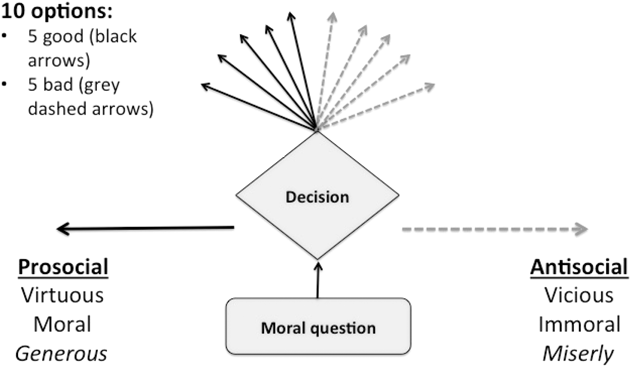
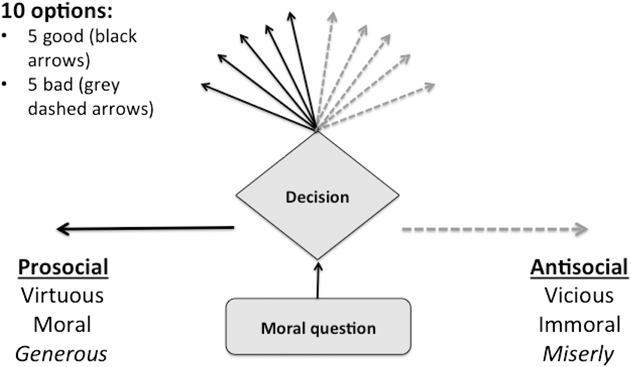
It matters little what might have made Fran more generous—life experience, a pill, or an implant—but there is no doubt that she is morally enhanced. Let us look at how this moral enhancement may have worked with Fran (Figure 3).
Fran, age 20, unenhanced. Equal number of good and bad options.

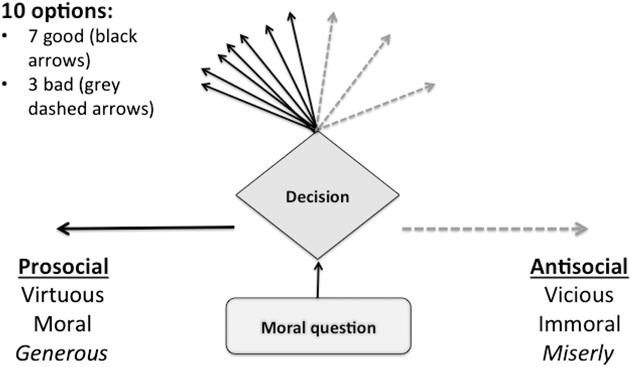
What Fran became following enhancement is shown in Figure 4.
Fran, age 40, enhanced. More good options than bad ones.

Here we have an equal number of volitional options, 10 in each scenario. However after enhancement there are seven options that are good and only three that are bad, as opposed to the prior 50:50 split, so in a similar circumstance, Fran is more likely to find herself acting generously than she was when younger.
Harriett
It is possible to imagine moral enhancement neither as the extinction of immoral desires, nor as the preferential choice for a moral action, but as the greater magnitude of good performed by an agent who has already committed to a moral course of action.
Harriett passes the homeless man on the street and commits to performing a moral (prosocial) act. Unenhanced, she would have given him 50 p, but now enhanced, she stops to talk briefly to him and gives him £1. In an alternate world that differs in just one respect,Footnote 37 unenhanced Harriett would have stopped to talk briefly to the homeless man and given him £1, but now enhanced, she sits with him and invites him to share her lunch.
The scenario before enhancement is shown in Figure 5 and the scenario after enhancement is shown in Figure 6.
Harriett, unenhanced. Equal number of good and bad options.

Harriett, enhanced. Equal number of good and bad options; good options are better than previously.

The number of total options and the probability of choosing a virtuous or a vicious act remain unchanged. The difference is that, when a virtuous act is chosen, it is of a greater magnitude than it would otherwise have been. This option retains freedom while still offering moral enhancement.
Morality and Freedom
We can conceive an intervention—be it chemical, physical, or social—that allows people to access additional good options. Those further options could all be prosocial. A decision tree model would show that both morality and freedom are enhanced.
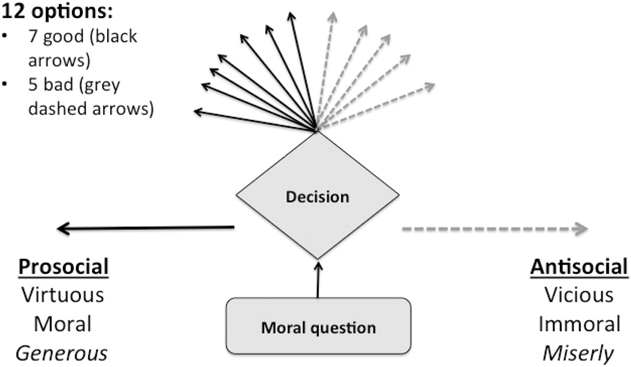
The scenario before enhancement is shown in Figure 7 and the scenario after enhancement is shown in Figure 8.
Base case scenario revisited.

Enhanced. More total options (freedom); more good options (morality).

We have increased the total number of available options from 10 to 12. Furthermore, the number of good options has increased while the number of bad options has remained the same. Here we have increased both freedom—more volitional options—and morality.
Conclusion
The debate about moral enhancement has, to date, not considered how decision models can be amended to either retain or enhance freedom. Some loss of freedom is a possibility if a moral enhancement program is bluntly and crudely implemented, or in minority cases in which immoral collusion is required for a project. These concerns can easily be mitigated. Manipulation of choice architecture in a libertarian paternalistic model might be a good option for a moral enhancement program.
The virtues seem to be an excellent target for improvement. An exploration of various decision trees has shown at least three ways in which virtue-based morality can be enhanced while freedom is retained or, in one case, enhanced. Our cognitive architecture cannot be simplified to the basic diagrams with which I have illustrated this article. Nonetheless, I believe I have shown one conceptual way in which moral enhancement does not constitute a threat to individual freedom.