


We need full and truthful information. And the truth should not depend upon whom it has to serve. We can accept only the division between the unofficial information (for the Comintern Executive only) and official information (for everybody).
—Vladimir Lenin, (Reference Lenin1921)
Free media are an anathema for any dictator. Still, there is substantial variation in the degree of the media freedom even controlling for the level of democracy. Why would some nondemocratic regimes allow free or partially free media? What are the circumstances under which it might be beneficial to a dictator to allow some degree of media freedom? A possible answer is suggested by a situation we might call “Gorbachev's dilemma.”Footnote 1 In 1985, Mikhail Gorbachev, the new leader of the Soviet Union, faced an array of problems. A surge in the budget deficit following a sharp drop in oil prices was the latest sign that the command economy, which had already underperformed relative to the West for more than a decade, required significant restructuring. Without allowing a certain amount of media freedom, reforms of the highly inefficient bureaucratic system seemed all but impossible. In a small meeting with leading Soviet intellectuals, Gorbachev acknowledged: “The restructuring is progressing with great difficulty. We have no opposition party. How then can we control ourselves? Only through criticism and self-criticism. Most important: through glasnost .”Footnote 2 However, free flow of information could undermine the very foundations of the Communist Party's dictatorship. In the very same meeting, Gorbachev warned that “Democratism without glasnost does not exist. At the same time, democracy without limits is anarchy. That's why it will be difficult.”
Gorbachev's dilemma was by no means unique: every nondemocratic regime has to provide an incentive system for low-tier officials, and most such regimes fear the free flow of information as a threat to their political survival. In this article, we study the trade-off between allowing for free or partially free media in order to provide proper incentives to subordinates and censorship that limits citizens' ability to overcome coordination problems in organizing a revolt. In particular, we focus on the role of resource abundance, which affects this trade-off. In resource-rich countries, a dictator has larger rents to lose from a revolt and has less interest in providing incentives to his bureaucrats; therefore, even partial media freedom is less likely. We use a panel with country fixed effects to demonstrate that this is indeed the case: in nondemocratic countries, resource abundance results in less free media. Also, we provide evidence that an alternative explanation for this relationship—namely, that resource wealth allows dictators to consolidate power—cannot fully account for the observed empirical regularities.
The trade-off between political control and bureaucratic incentives is also well illustrated by the slow response of Chinese state officials to the recent outbreak of severe acute respiratory syndrome (SARS). In the absence of free media, incentives for lower-tier bureaucrats to provide sufficient effort and transmit necessary information to higher levels proved inadequate (Saich Reference Saich, Kleinman and Watson2005). Although the first information on SARS was received by local political authorities in November 2002, there was no real action until at least the end of March 2003. When on March 15 the World Health Organization (WHO) issued a global warning on SARS, the Chinese Propaganda Department prohibited Chinese media from reporting it (Pomfret Reference Pomfret2003). Beijing public hospitals were trying to conceal the extent of the disease by hiding or transferring patients during visits of WHO officials (Jakes Reference Jakes2003).Footnote 3 Four years later, Chinese authorities responded in a similar way to an AIDS outbreak (Economist 2007).
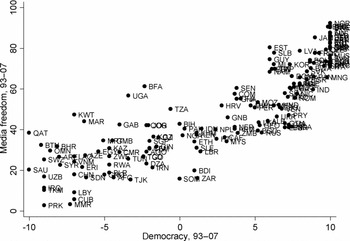
Dictators' fear of free media is well justified. As the recent “color revolutions” in Serbia, Georgia, Ukraine, and Kyrgyzstan have shown, even partly independent media are crucial in replacing nondemocratic rulers (Hill Reference Hill2005; McFaul Reference McFaul2005). Yet, there is much variation in media freedom even among dictatorial regimes. As shown in Figure 1, many dictatorships have partially free media; there are also some dictatorial regimes where media freedom is at the level of new European Union (EU) members. Why do dictators tolerate or even allow media freedom? We suggest that even partially free media might be a part of the incentive scheme for the state bureaucracy. The lack of such incentives undermines the state's capacity to handle major challenges such as war, large-scale natural disasters, or macroeconomic crises. In these cases, even the censored media may fail to cover up the dictator's incompetence, which might eventually bring the regime down. For example, an inability to cope with the Chernobyl disaster exposed the need for change in the Soviet Union. As one observer noted (Methvin 1987), “There surely must be days—maybe the morning after Chernobyl—when Gorbachev wishes he could buy a Kremlin equivalent of the Washington Post and find out what is going on in his socialist wonderland.”Footnote 4
Democracy and Media Freedom Across Countries (Both Averaged for 1993–2007)

“Gorbachev's dilemma” suggests that the need for control over the bureaucracy endogenously constrains dictators' suppression of media freedom. To provide a basis for empirical investigation, we consider a simple model that captures this trade-off. A dictator chooses a policy that affects both his own and his citizens' interests. A policy succeeds only if it is properly implemented, which requires hiring bureaucrats who may either work or shirk. To induce high effort, the dictator needs some verifiable information on the bureaucrats' performance. The dictator can rely on special monitoring agencies, but these are vulnerable to collusion with the bureaucrats they monitor; preventing such collusion is costly. In the case of uncensored media, this collusion is ruled out by the free-rider problem and competition between decentralized media.Footnote 5 However, the media also make the policy outcome known to the public, which may threaten the dictator's position in power. If the media report that the policy has failed, the public infers that the dictator is likely to be inept; therefore, the citizens would be better off replacing the dictator. More important, a negative media report not only makes individual citizens aware of the dictator's incompetence, but it also makes the dictator's incompetence common knowledge, which is critical for a successful revolution. Revolutions involve a coordination problem: a citizen takes part in a revolt against an incumbent only if he knows that others will join a revolt (e.g., Chwe Reference Chwe2003; Persson and Tabellini 2006; Tilly Reference Tilly1978).Footnote 6 In equilibrium, the dictator is replaced whenever there is a public report of the policy failure; then each citizen knows that his or her misery is shared by others, and everyone is sufficiently unhappy to make an uprising against the incumbent worthwhile.
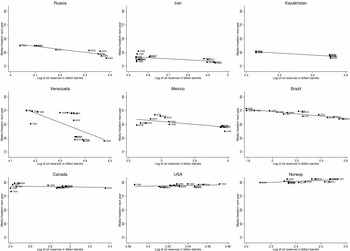
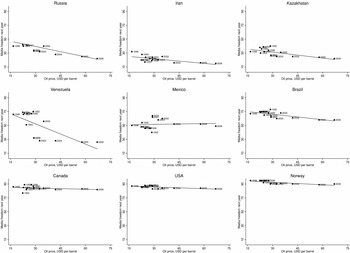
To check the empirical relevance of this trade-off, we examine the consequences of variation in natural resource abundance. In a resource-rich country, the dictator is more interested in remaining in office (as rents are higher); moreover, he cares less for bureaucratic incentives because the resource rents can compensate for poor economic policies. Our theory therefore implies that oil-rich countries are likely to have less free media. Moreover, this relationship should be especially strong in less democratic countries, where other feedback channels do not function properly. We use both cross-country and panel data to test these predictions. We take media freedom indices from the Freedom House and Reporters Sans Frontières; a democracy index from Polity IV and from the Freedom House; and oil reserves, oil price, and oil production figures from BP. Figure 2 shows pairwise correlations between oil reserves and media freedom within selected countries over time.Footnote 7 The graphs demonstrate that the slope is negative in nondemocratic countries, but positive or flat in democratic ones; this relationship is present even within a very short time span. In the evidence section, we show that this result is not limited to a few countries but holds in a comprehensive panel of countries, controlling for country fixed effects, the level of economic development, democracy, and other relevant variables. On average, the media are indeed less free in oil-rich countries. The effect of natural resources on media freedom is especially strong in less democratic countries; in mature democracies, there is no relationship between oil reserves and media freedom.Footnote 8 These results also hold in cross-sectional analysis. As Figure 3 demonstrates, there is a similar relationship between oil price and media freedom (in Figure 3, we use the same scale for each graph; notice that in democracies, the effect is almost negligible). There, oil-rich countries exhibit a sharper negative slope; the positive slope in the case of Mexico is driven by both democratization in the 1990s and, even more so, by a sharp drop in its proven oil reserves.
Pairwise Correlations Between Oil Reserves and Media Freedom in Select Oil-rich Countries, 1993–2006

Pairwise Correlations Between Oil Price and Media Freedom in Select Oil-rich Countries, 1993–2006

The previous results are statistically significant and robust to adding a variety of controls, including levels of development, democracy, country size, government size, and others. (The Evidence section describes robustness checks, including splitting the sample into smaller subsamples and running a jackknife test that leaves out one country at a time.) Interestingly, the effect's magnitude is the same whether we run panel or cross-sectional regressions and whether we choose the logarithm of oil reserves or the logarithm of oil production as an independent variable. According to our estimates, increasing oil reserves by 10% would reduce media freedom by 0.3 points on a scale from 0 to 100. In other words, if Brazil's reserves were at Venezuela's level, Brazil's media freedom would have developed likewise.
Our empirical strategy is based on the fact that both oil reserves (as well as oil production) and media freedom change substantially within a country in the course of just one or two decades. First, oil reserves and oil production are responsive to mostly exogenous and highly volatile oil prices. Proven oil reserves are estimated as those that are economically viable under prevailing market prices for oil; production responds to the oil price to earn the maximum possible rents. Also, because there is substantial randomness in discovering new oil fields, oil reserves may change by tens of percents just within a year (we discuss the issue of endogeneity of exploration efforts later)—this is the case of Brazil and Kazakhstan. Second, unlike other political institutions, media freedom can change very quickly.
While we focus on testing the prediction that natural resource abundance undermines media freedom in nondemocratic societies, we also control for alternative explanations. First, there is a positive correlation (and, potentially, two-way causality) between media freedom and the level of democracy per se. It is well known that there is a correlation between natural resource abundance and the probability of having a dictatorial regime (see, e.g., Ross, Reference Ross2001, and Tsui, Reference Tsui2005). Our empirical tests show that natural resources are a significant determinant of media freedom, even when controlling for the level of democracy, either current or lagged. We also run a two-stage specification: in the first stage, we estimate a relationship between media freedom, democracy, and other determinants of media freedom except oil wealth. In the second stage, we use the deviation of media freedom from the predicted value to show that media freedom is likely to be lower in oil-rich countries. In yet another test, we show that, as predicted by our theory our results hold for nondemocratic and partially democratic countries, but not for democracies. However, the correlation between natural resources and lower democracy holds for all subsamples; in this sense, media freedom and democracy are certainly not the same thing. We also provide other empirical tests (see Evidence section).
Second, media freedom may be negatively correlated with resource abundance, because the latter provides dictators with the means to compensate citizens for censorship. For example, Ross (Reference Ross2001) observes that a dictator might simply use resource rents to buy off political challengers. In our framework, this argument requires that citizens value media freedom per se while dictators do not, for the standard reason that media may help in overcoming the coordination problem in revolts. Yet, dictators with no available resources are forced to allow free media, because otherwise citizens would revolt anyway. This “buy-off” argument treats resource rents as extra revenues available to a dictator. From this point of view, natural resources are equivalent to foreign aid or any other sources of income that he can use to pay off his citizens. We control for the total amount of resources that dictator can redistribute (gross domestic product [GDP] per capita, share of government expenditures in GDP) and for social structure/inequality (via country fixed effects); we find that our results are robust. To provide one more test of our theory against alternative explanations, we rerun our main regressions, including both oil reserves and oil production in the regression. Our theory puts more weight on oil reserves, whereas alternative explanations predict a relationship between media freedom and current resource rents. Because oil output and oil resources are highly correlated, the only meaningful way to compare their effects is to include them in the regression equation simultaneously. It appears that the effect of oil reserves is—as predicted by our theory—negative and significant; thus, our theory wins the “horse race.” Finally, we provide additional evidence that media freedom does improve the quality of bureaucracy, even when controlling for country fixed effects and other variables.
Thus, our theory demonstrates that in the presence of resource abundance, dictators are less willing to allow free media. Consistent with our theory, nondemocratic countries such as Nigeria, Zambia, Sierra Leone, Angola, and Saudi Arabia have vast resources and poor growth performance, whereas the Asian tigers (South Korea, Taiwan, Hong Kong, and Singapore), although predominantly nondemocratic in 1970s and 1980s, have had both high growth rates and scarce natural resources. These East Asian countries have managed to establish an effective meritocratic bureaucracy (Evans and Rauch Reference Evans and Rauch1999, Reference Evans and Rauch2000; see also Gehlbach and Keefer Reference Gehlbach and Keefer2006 on the role of institutionalized parties in autocracies). Again, it is perhaps not coincidental that Gorbachev chose glasnost as the Soviet Union faced a substantial decline in the price of oil,Footnote 9 its major commodity export. In contrast, with oil prices rising, Putin's Russia has experienced a significant decline in media freedom (Figure 3).
Instead of free media, dictators might create monitoring/control agencies, often including secret services, to spy on the bureaucrats. Unlike decentralized free media, such agencies can commit to producing information for the dictator without leaking it to the public. However, they could potentially also collude with bureaucrats in concealing information about their dismal performance. In some countries, dictators prevent collusion by creating multiple monitoring agencies (secret services) to spy on each other. By making these security services compete, a dictator not only reduces the danger of collusion between them and bureaucrats, but also incurs a risk of information leakage to the public, not to mention substantial technical costs and delays. This has been especially visible in “sultanistic regimes” (Chehabi and Linz Reference Chehabi and Linz1998; Egorov and Sonin n.d.)—examples include Idi Amin in Uganda, Francisco Machas Nguema in Equatorial Guinea, Claude Duvalier in Haiti, Fulgencio Batista in Cuba, Rafael Trujillo in the Dominican Republic, Reza Shah Pahlavi in Iran, Mobutu in Zaire, and Ferdinand Marcos in the Philippines, who combined dictatorial oppression with dismal economic performance. Introducing a collection of case studies, Chehabi and Linz (Reference Chehabi and Linz1998) specifically point out that such regimes were especially likely to occur in resource-rich countries; under these regimes, the media were tightly controlled, and quality of government was very low.
The rest of the chapter is organized as follows. The next section discusses related literature, and the theory section introduces the theoretical model and derives empirical predictions. In the Evidence section, we present empirical support for our theory and describe robustness checks. The final Section concludes.
RELATED LITERATURE
Both political scientists and economists have been long aware that countries that have abundant natural resources and are not mature democracies perform, on average, less successfully than resource-poor countries (see, e.g., Auty Reference Auty2001; Gylfason, Herbertsson, and Zoega Reference Gylfason, Herbertsson and Zoega1999; Mehlum, Moene, and Torvik Reference Mehlum, Moene and Torvik2006; Sachs and Warner Reference Sachs and Warner1996, Reference Sachs and Warner1997a, Reference Sachs and Warner1997b). The early economics literature on the “resource curse” attributed the failure of growth-oriented strategies in resource-rich countries to the “Dutch disease”: the inflow of oil revenues leads to appreciation of the domestic currency, which makes domestic tradable sectors less competitive (see Krugman Reference Krugman1987 and Sachs and Warner Reference Sachs and Warner1996). Yet, in the recent “resource curse” literature, there is an emerging consensus that the major source of slow growth in resource-rich countries is the deterioration of institutions rather than currency appreciation. (There is also a large recent empirical literature linking resource wealth to violent conflicts, see Ross Reference Ross, Bannon and Collier2003.) The general mechanism of such deterioration was described by North (Reference North1981, Reference North1991) and, most recently, by Acemoglu and Robinson (Reference Acemoglu and Robinson2005); the crucial role of institutions in generating the “resource curse” is analyzed in Boschini Pettersson, and Roine (Reference Boschini, Pettersson and Roine2006); Caselli (Reference Caselli2006); Hodler (Reference Hodler2006); Lane and Tornell (Reference Lane and Tornell1996); Mehlum, Moene, and Torvik (Reference Mehlum, Moene and Torvik2006). We attempt to go beyond these general insights to explain the microeconomics of decision making in nondemocracies that leads to inefficient economic policy choices.
In political science, there is an emerging literature that relates economic performance and regime stability to the presence of natural resources. In a now classic early study, Karl (Reference Karl1997) explained the failure of oil producers to fully employ the development potential of natural resources by adding political considerations to the standard “Dutch disease” explanation (see also Chaudhry Reference Chaudhry1997; Gelb Reference Gelb1988; Shafer Reference Shafer1994). Oil windfalls allow the state to develop a rent-oriented bureaucracy that does not need to encourage taxable domestic production and thus escapes political accountability. Ross (Reference Ross2001) notes that critical empirical contributions to the modernization debate by Przeworski and Limongi (Reference Przeworski and Limongi1993) and Przeworski, et al. (Reference Przeworski, Alvarez, Cheibub and Limongi2000) did not consider oil-rich Middle East states; in his own regressions, the Middle East dummy is significant and has a negative impact on democracy. However, Herb (Reference Herb2005) argues that rentierism (i.e., the government's reliance on oil taxes to provide public goods), has no significant negative effect on democracy. Morrison (Reference Morrison2009) finds that the particular source of nontax revenue has no specific impact on regime stability; an increase in any of them (e.g., foreign aid or windfall oil profits) leads to more social spending in dictatorships and more stability for both democratic and dictatorial regimes. Gandhi and Przeworski (Reference Gandhi and Przeworski2006) model and then test empirically whether governments in resource-rich countries use their resource rents in order to “thwart threats emanating from the opposition.” The authors assume that the presence of mineral resources decreases the need for the dictator to engage opposition in cooperation; empirically, such a presence indeed leads to a smaller number of legislative parties (the authors' proxy for actual cooperation).
Wantchekon (Reference Wantchekon2002) argues that resource wealth helps dictators stay in power by sharing rents with the would-be opposition. Dunning (Reference Dunning2005) considers a model where the elites weigh the costs and benefits of diversification: both the structure of the resource sector in and outside the country and the extent of potential political opposition affect the trade-off. Snyder (Reference Snyder2006) proposes an alternative model in which the stability of the political regime rests on its ability to build institutions of extraction of lootable resources. Benjamin Smith (Reference Smith2004) uses panel data on 107 developing states covering the period from 1960 to 1999 to argue that the presence of oil is associated with increased regime durability (see also Ulfelder Reference Ulfelder2007); in individual countries, there is no robust impact of changes in oil prices on regime stability. Alastair Smith (Reference Smith2008) tests empirical implications from the selectorate model of Bueno de Mesquita et al. (Reference Bueno de Mesquita, Smith, Silverson and Morrow2003), which relate the survival of dictatorial regimes to the presence of natural resources. The existing evidence does suggest that the trade-off between incentives for bureaucracy and the need to “divide-and-rule” (see Debs Reference Debs2007) by suppressing information flows is especially visible in developing countries abundant with natural resources.
For our formal model, we use recent advances in political economics, with its emphasis on dynamic models of strategic interaction between politicians and their citizenry (e.g., Acemoglu Reference Acemoglu2003, Reference Acemoglu, Blundell, Newey and Persson2006; Acemoglu and Robinson Reference Acemoglu and Robinson2005; Acemoglu, Robinson, and Verdier Reference Acemoglu, Robinson and Verdier2004; Lagunoff Reference Lagunoff2006; Bueno de Mesquita et al. Reference Bueno de Mesquita, Smith, Silverson and Morrow2003). The literature on optimal sequencing between economic and political liberalization is discussed in Persson and Tabellini (2006), who were also among the first to consider revolution as a global game (our model might be considered an alternative approach to modeling a solution to the coordination problem in revolutions; see also Boix and Svolik Reference Boix and Svolik2007). Edmond (Reference Edmond2005) models a global game among citizens, who need to coordinate to overthrow a regime, and studies the regime's incentives to use propaganda to exploit heterogeneity in individual beliefs. Bueno de Mesquita and Downs (Reference Bueno de Mesquita and Downs2005) introduce the concept of a coordination good and argue that media freedom is actually such a good because it helps citizens overcome the free-rider problem.
Finally, there is the fast-growing literature on the political economy of the media (see Gentzkow and Shapiro Reference Gentzkow and Shapiro2008). Sen (Reference Sen1999) and Besley and Prat (Reference Besley and Prat2006) emphasize the role of independent media in enhancing citizens' ability to choose the right politicians and policies, whereas our model emphasizes the role media might play in providing incentives to bureaucrats. Reinikka and Svensson (Reference Reinikka and Svensson2005) and Kaufman (Reference Kaufmann2006) show empirically that media freedom helps reduce corruption. Dyck and Zingales (Reference Dyck, Zingales and Islam2002) consider a situation where business reporting is endogenously biased; free competitive media is the only way to commit not to collude with the sources of exclusive information. Svaleryd and Vlachos (Reference Svaleryd and Vlachos2006) demonstrate that increased political competition and extensive media coverage in a mature democracy reduce political rents. Our work contributes to this literature by analyzing the determinants the media freedom outside the democratic world.
THEORY
Political decisions that citizens and politicians make are inherently dynamic: citizens decide whether to reelect the incumbent or revolt against him by comparing the expected performance of the incumbent and of the contender; similarly, the politician's desire to stay in office depends on the rents of being in power in the future. However, the important trade-offs that we emphasize in this article are easier to demonstrate in a reduced-form, one-period model, where we take the citizens' decisions to overthrow the ruler as fixed. We thus start with the simple model, and then provide a sketch of a fully dynamic model, where citizens' decisions are endogenized.
Setup
There is a dictator, a bureaucrat, and a continuum of ex ante identical citizens. Following a standard theoretical framework (e.g., Acemoglu and Robinson Reference Acemoglu and Robinson2005), the economy includes two sectors: the resource sector and the modern sector. The resource sector produces a globally traded good, which yields YR = R; the cost of production is normalized to zero. The total output in the modern sector depends on the provision of a public good such as property rights and contract enforcement, infrastructure, and education. The amount of public good provided, A ∈ {AH, AL}, depends both on the policy chosen by the dictator and the effort exerted by the bureaucrat.
The dictator's ability to chose a right policy from the policy space is imperfect: the probability of picking a right policy is v ∈ (0, 1). The bureaucrat does not observe whether the policy picked by the dictator is right or wrong, but may choose either high or low effort e ∈ {eH, eL}. The cost of high effort is c > 0, whereas low effort is costless. We assume a perfect complementarity between the dictator's policy choice and the bureaucrat's effort. If bureaucrat exerts high effort eH, and the policy choice is right, then A = AH. If either effort is low (e = eL) or the policy is wrong, then A = AL < AH.
The output of the modern sector is normalized to YM = A; thus, the total output in the economy equals

The dictator, if he stays in power, gets the proceeds from the resource sector and taxes the modern sector at an exogenous rate τ. However, if the dictator is replaced, he gets nothing (and the resources and taxes are consumed by the new dictator, who is not a player in the one-period model). The incumbent's utility is therefore
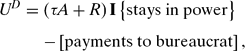
where  {X} is the indicator function, which takes the value of 1 if event X happens, and 0 otherwise. We assume that

(i.e., the cost of high effort is sufficiently low), so that the dictator, if he were certain to stay in power, would choose high effort.
Citizen i gets pretax income yi ∈ {yL, yH}, which is a noisy signal about the output of the modern sector. Thus, the probability of getting high income yH is  when YM = AH and 1 − γ if YM = AL:

(both yL and yH are positive if γ is not too close to  ). The aftertax income of citizen i is thus (1 − τ)yi.
Apart from the income yi, the citizens get a public signal spub about the policy outcome A, which is generated by mass media. This signal may take one of two values, AH and AL. We assume that without censorship, free media are able to generate truthful signal (or, equivalently, are unable to conceal the true evidence), so then spub = A. However, if the media are censored, they always generate a high signal spub = AH. The dictator chooses an incentive scheme to the bureaucrat in order to maximize his utility UD, but he can only condition his payments to bureaucrat on the media report st ∈ {AL, AH} that he gets about this bureaucrat's performance.Footnote 10 Consequently, censorship prevents the dictator from providing proper incentives to bureaucrats.
The incumbent dictator may be ousted in two ways. First, there are elections, where citizens can replace the dictator by the challenger. We assume that citizen i votes for the incumbent if and only if yi = yH and spub = AH; otherwise, she votes for the challenger. If the incumbent obtains the majority of votes, he retains power. However, he may stay in power even if he loses: to capture the nature of nondemocratic politics, we assume that if the majority votes in favor of the challenger, the incumbent is ousted with probability α ∈ (0, 1). Parameter α captures the democratic constraints on the dictator: in a perfect democracy (α = 1), the majority vote decides who is in power, whereas in a perfect dictatorship α = 0, elections do not matter at all. If the incumbent wins the elections, the citizens decide whether to revolt. Again, we assume that citizen i participates in the revolt if spub = AL only (in the dynamic game, this happens endogenously), and the revolt succeeds if a majority of citizens participate in it. Taking part in an unsuccessful revolt costs each participant r > 0; this assumption will be important in the dynamic game.Footnote 11
The timing of the one-period game is as follows:
1. The incumbent dictator picks a policy (which turns out to be right with probability ν), chooses the degree of media freedom, and makes contracts with the bureaucracy (payments wL and wH, depending on spub ∈ {AL, AH})
2. The bureaucrat chooses the effort level et ∈ {eL, eH}.
3. The policy outcome A is realized; each citizen i learns his or her individual payoff yi.
4. The dictator pays the bureaucrat according to the contract.
5. Media report the true outcome: spub = A if they are free, and spub = AH, otherwise.
6. Elections take place.
7. If the incumbent wins the elections, each citizen decides whether to revolt. If the revolt is successful, the dictator is replaced; otherwise, he stays in power.
Analysis
We start the analysis by finding the optimal contract for the bureaucrat for the cases of free and censored media. Let wH denote the payment that the dictator makes to the bureaucrat if spub = AH, and let wL be the payment if spub = AL. When media are free, the bureaucrat compares the expected payoff of low efforts, wL, and that of high efforts, νwH + (1 − ν)wL − c. Thus, the bureaucrat exerts high efforts if and only if

If the dictator chooses to induce a low effort level, then wL = wH = 0. To induce the high effort level, the dictator chooses free media and sets (wL, wH) = (0, c/ν). A more competent dictator (one with higher ν) is more interested in providing good incentives to the bureaucrat. Indeed, the expected cost of paying for high efforts does not vary with ν, but the benefits of high-powered incentives are greater for a more competent dictator. If an absolutely competent dictator (ν = 1) chooses high-powered incentive schemes for the bureaucrats with the help of free media, then his policy results in the optimal level of public good, AH. Because good incentives are more important for a more competent dictator, he is more interested in free media.
Essentially, the dictator has three regimes to choose from: censored media and low bureaucratic effort, free media and low effort, and free media and high effort. The dictator never chooses the combination of free press and low effort, because this option is dominated by censored press and low effort. Given our assumptions about the citizens' preferences (they replace the incumbent if spub = AL), the probabilities of staying in power in the case of free and censored media are ν and αν + (1 − α), respectively. Thus, free media and high incentives give the dictator utility UM = ν(R + τAH) − c, whereas censored media give him UL = (αν + (1 − α)) (R + τAL). Now let us introduce

The following proposition summarizes the previous discussion.
Proposition 1.Under assumption (2), the following statements hold:
(i) In a subgame perfect equilibrium, the dictator chooses free media if the amount of resource rent does not exceed the threshold R = R(α); the dictator chooses censorship otherwise.
(ii) In a more democratic country, the media freedom threshold is higher: R(α) is increasing in α. In a perfect democracy (α = 1), the dictator always prefers media freedom.
Thus, the model generates a number of testable predictions about the determinants of media freedom. The foremost prediction is that in a nondemocratic country, resource abundance (a high R) results in a lower media freedom. In a democracy, the dictator and his bureaucracy are bound to cope with free media. As shown previously, if α = 1, media freedom prevails in equilibrium under any level of resource richness R. If α is slightly below 1 (and α > 1 − ν), then media freedom is suppressed only if resource abundance is very high. Thus, we do not expect to find significant effects of natural resources on media freedom in democratic countries, where monitoring of bureaucracy is carried out via the division of powers, opposition parties, etc.
Dynamic Extension
In the dynamic model, the incumbent dictator and citizens are long lived; if citizens opt to replace the incumbent, there is a new player. Each period, the stage game is as in the previous one-period game: the dictator picks a policy, chooses the degree of media freedom, and provides a contract to the short-lived bureaucrat. Then the bureaucrat chooses the effort level, and each citizen receives two signals: one about her individual payoff, and a media report. At the end of each period, each citizen decides whether to participate in a revolt against the dictator. In the dynamic game, citizen i maximizes her expected lifetime welfare
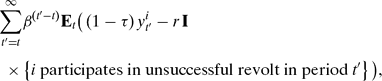
whereas the incumbent dictator maximizes
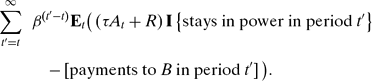
Because payoff-relevant variables may include all private signals that individuals got during the rule of the incumbent dictator, the widely used concept of the Markov perfect equilibrium (Maskin and Tirole Reference Maskin and Tirole2001) is not directly applicable. However, the set of all subgame perfect equilibria is too large, thus necessitating a refinement that combines the main features of the two concepts. We impose the following intuitive assumptions.
In the dynamic setting, we modify the citizens preferences so that they rationally update their estimate of the dictator's competence; now, the dictator and any of his potential replacements might be of one of two types, either competent or incompetent. First, we assume that citizen i revolts if and only if (1) she knows that the probability of the incumbent dictator being competent is below μ, the probability that a random draw from the pool of challengers is competent; and (2) she is certain that the share of those who want to replace the incumbent exceeds the revolution threshold γ. Second, we assume that the distribution of idiosyncratic noise F(·), the revolution threshold γ, and parameters that reflect the dictator's abilities are such that under a high-powered system for bureaucracts, a competent dictator can keep, if she chooses to, the share of potential revolutionaries below γ. Finally, we focus on stationary equilibria, in which the dictator's strategy may depend only on the dictator's type, but not on time.
If the dictator is incompetent, there is a nontrivial probability that the policy chosen in period t is a wrong one. In this case, the probability that media report the truth (st = AL) is equal to 1 if media is free and to α > 0, if not. Therefore, every rational citizen that receives public signal st = AL is bound to believe, regardless of her private information, that the incumbent is incompetent; the information that the dictator is incompetent becomes common knowledge. As a result, all citizens revolt, and the incumbent is replaced.
Now consider a dictator who has had only positive media reports s 1pub, . . .,npub for n periods since coming to power. By the Bayes' formula, citizen i attributes a nontrivial probability to the event that the incumbent dictator is competent, even if i's personal income is consistently low. The problem is that a citizen who has received a stream of positive public signals cannot be sure that the number of citizens who believe that the probability of the dictator being inept is above 1 − μ is sufficient for a revolt to succeed. Indeed, when a citizen becomes just ready to revolt, she believes that most other citizens lag behind her in their confidence that the dictator is inept, because otherwise the revolt would have already occurred. If media report failure, it becomes common knowledge that the dictator is inept, allowing the citizens to coordinate. Summing up, a dictator stays in power as long as the citizens get a positive public report spub = AH. If citizens get a negative public report spub = AL, they revolt, and the dictator is replaced by a new one.
Similarly to the one-period model, we can now check that if a competent dictator chooses a high-powered incentive scheme, there is no revolt. By providing no incentives, the dictator saves c on the bureaucrat's wage, but loses τ(AH − AL) because there is a chance of policy failure. Assumption (2) implies that this outcome is strictly dominated by that of the high-powered incentives. The Bellman equation allows us to calculate the competent dictator's expected lifetime utility:

An inept dictator faces a similar choice between high incentives and free media (we denote this choice M) and low incentives (L).
Then the dictator's expected utility at the beginning of a period when he is in power, U, is found as a solution to
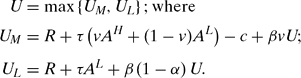
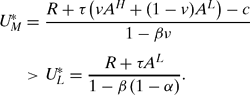
In an equilibrium, the dictator prefers free media to censorship as long as
Denote

the threshold level of resource abundance. When 0 < α < 1 − ν, (5) is equivalent to R ≤ R. If 1 − ν ≤ α ≤ 1, (5) is equivalent to R ≥ R, but R < 0 in this case, so (5) holds for any R > 0. The following proposition summarizes the previous discussion.
Proposition 2.At any period of his tenure, a competent dictator is strictly better off allowing free media and choosing a high-powered incentive scheme. The incompetent dictator's equilibrium choice of the regime depends on the level of democracy α and the resource abundance R as follows:
(i) If the democratic institutions are weak, 0 < α < 1 − ν, media freedom is chosen if and only if the resource abundance is low, R ≤ R. If the resource abundance is high R > R, the dictator chooses low incentives and no media freedom.
(ii) If the democratic institutions are sufficiently strong, 1 − ν ≤ α ≤ 1, the dictator always prefers to provide high incentives and allow for free media.
EVIDENCE
In this section, we use panel data to explore empirical evidence about the relationship between oil and media freedom. To check the main testable prediction that oil abundance has an adverse effect on media freedom in nondemocracies, we use data on natural resources, levels of democracy, media freedom, and economic performance.
Data
We employ several sources of data. We use the Press Freedom index available from Freedom House as a proxy for media freedom. Although certain information on media freedom is available for years as early as 1979, the detailed data started only in 1993, so we use the media freedom data for years 1993–2008. Press Freedom is constructed by Freedom House as an integer between 0 (perfectly free media) and 100 (no media freedom). To facilitate interpretation, we use (100—Freedom House Index) as a measure of media freedom, so in this section, a greater media freedom index corresponds to freer media. Note that the Freedom House data cover both printed and broadcast media.
We use the Polity2 variable from the Polity IV data set as a proxy for the degree of democracy. This variable is essentially computed by subtracting Polity IV's institutionalized autocracy score (AUTOC) from the institutionalized democracy score (DEMOC); the resulting Polity2 score ranges from +10 (strongly democratic) to −10 (strongly autocratic). This score measures the competitiveness and openness of executive recruitment, the competitiveness of political participation, and constraints on the executive, as well as other features of the political regime. The variable does not measure directly media freedom or freedom of speech. Therefore, it is the best available (albeit imperfect) proxy for α because it captures the effectiveness of removing an inept dictator from office through the political process rather than through revolt. We also try other variables from Polity IV and other sources as a proxy for democracy, and the results are similar.
We proxy resource endowment by proven oil reserves, which are presumably exogenous. Although investment in geological exploration affects this variable, these investments need not depend on the level of economic development. Even if investment in exploration depends on a country's level of development, it is more plausible that developed countries have had more time and resources to invest. Thus, ceteris paribus, proven reserves should be higher in Organisation for Economic Co-operation and Development (OECD) countries; hence, this effect would only bias our estimates toward zero.
We focus on oil because (1) it is by far the most important natural resource (see Tsui Reference Tsui2005, who argues that the global market for oil is larger than the market for all other natural resources combined), (2) reliable data on oil reserves and production are easily available, and (3) oil is globally traded (unlike, e.g., natural gas).Footnote 12 The existence of the world market price allows us to explore differential reactions to worldwide shocks. Certainly, countries differ in terms of oil quality and extraction costs, but the data on the latter are less reliable. Also, these differences are much less important once we control for country fixed effects. We use data from the Statistical Review of World Energy, available from BP's Web site (www.bp.com). The Statistical Review only contains data for countries that have positive oil reserves or produce a positive amount of oil; therefore, we assume trivial oil reserves and production for other countries, unless clearly stated that the data are not available. We use reserves in billion barrels rather than in dollar terms; our results are robust to this choice. Also, we control for oil price changes by including time dummies in our panel regressions. Note that proven reserves include reserves that are economically relevant given the prevailing oil price; this also makes this variable a proxy for the expected value of future resource rents.
A number of important contributions to the study of the resource curse (e.g., Jensen and Wantchekon Reference Jensen and Wantchekon2004; Mehlum, Moene, and Torvik Reference Mehlum, Moene and Torvik2006; Ross Reference Ross2001) proxy resource endowments by using the share of natural resources in GDP or exports. Unfortunately (as discussed in, e.g., Ross Reference Ross2006), these variables may be highly endogenous with respect to both growth (or growth opportunities) and institutions. In fact, because the mining industry does not usually require much human capital—and if it does, it may be very well provided by foreign firms—the share of mining industry in GDP is actually a proxy for underdevelopment. For instance, the U.S. is well endowed with natural resources, including oil; yet, extraction and drilling comprise a small part of GDP, because other industries are also highly developed. Moreover, high resource exports may also be, for any given resource endowment, a proxy for the lack of growth opportunities: the lack of internal demand for fuels makes producers export them.
Using reserves rather than other measures of resource richness is consistent with our model's logic. Indeed, the dictator's incentives to censor the media are driven by the future resource rents he expects to get while in office. It is therefore more important that oil rents will be appropriated in the future. Although using oil reserves facilitates interpretation of our findings, we also employed oil production and share of oil production or exports in GDP as alternative measures of resource richness and obtain the same results. Our results are also robust to using the dollar value of either reserves or production at current prices.
To measure the effect of media freedom on the quality of bureaucracy, we use the World Bank's data on government effectiveness and regulatory quality (from the Governance and Anti-Corruption Project of the World Bank Institute, www.worldbank.org/wbi/governance, or Kaufman Reference Kaufmann2006). Finally, we use data on GDP per capita (purchasing power parity), population, government expenditure, and other relevant controls from the World Development Indicators.
Empirical Methodology and Alternative Explanations
To test whether oil endowment affects media freedom in nondemocratic countries, we estimate the following specification:

Where i indexes countries, t indexes years, Oil is the proxy for oil abundance (log oil reserves or log oil production), MF is media freedom, Democracy is the proxy for democracy (Polity2 or alternative measures), X is a vector of controls (including log GDP per capita, log population, log share of government expenditures in GDP etc.), δi are country fixed effects, and λt are year dummies.
Our theory predicts that a 1 < 0, especially if the regression is run on a subsample of nondemocratic countries, and a 1 is not significantly different from zero for democratic countries. The other way to show that the relationship between resources and media freedom is stronger for nondemocratic countries is to add an interaction term a 4Oili,tDemocracyi,t. Our theory implies a 4 > 0.
Notice that as our vector of controls X includes log GDP per capita, log population, and log share of government expenditure in GDP, our specification (6) automatically controls for oil reserves per capita, oil production per capita, or ratio of oil reserves or oil production to GDP, as well as total GDP, or government expenditures per capita, etc. These variables are linear combinations of the variables that are already included in (6). Similarly, time dummies automatically account for the world oil prices, and country dummies include all time-invariant, country-specific variables such as legal origin, culture, religion, and ethnic and linguistic characteristics.
Our theory is not the only explanation of the relationship between the natural resource endowment and media freedom in nondemocratic societies. For example, a benevolent dictator might want to reform his bureaucracy and be willing to do so via paying high efficiency wages to the bureaucrats. Resource rents allow him to finance strong incentives without distortionary taxation; the greater the rents and the higher the efficiency wages, the less independent journalists the dictator needs. The bureaucrats are punished very rarely, but the punishment is large: the dictator takes away the high efficiency wage. This explanation is not very likely. It would imply that resource endowments would be correlated with lower corruption and better governance. We test this prediction directly and find that it is not consistent with the evidence: resource-rich countries are less well governed and more corrupt.
A more realistic alternative explanation is a very simple one: nondemocratic regimes do not like free media. However, citizens value media freedom per se; hence, a dictator has to compensate them for censorship. Similarly, if foreign partners or international organizations exert pressure in favor of media freedom, a dictator has to be economically strong either to withstand this pressure or to buy off the citizens' or foreign partners' tacit acceptance of censorship. In both cases, resource rents provide a source of revenue that helps silence the media. However, this argument assumes that resource rents come as an additional revenue source. To control for this alternative explanation, we include aggregate income (GDP) and total government spending, the dictator with a greater share of oil in GDP and in the government budget has an easier time buying off citizens or foreigners. Why are citizens happier to exchange media freedom for a dollar just because it is a petrodollar? The argument that oil rents are less distortionary than taxes and therefore easier to use for comforting the citizens is not consistent. If taxes are distortionary, the dictator should pay off the voters by lowering taxes rather than by giving out petrodollars (actually, many dictators do exactly this, granting voters “no taxation” in exchange for “no representation”).
The other distinction between our theory and this alternative explanation is whether media freedom depends on the value of the future revenues (i.e., the value of oil reserves) or the present resource rents (i.e., this year's oil production). These two variables are certainly highly correlated; hence, to see which explanation is supported by the data, one needs to run a “horse race” via adding both oil reserves and oil production in one regression.
The second major alternative explanation suggests that the relationship between oil and media freedom is driven by a third variable, regime type. Oil-rich countries tend to be less democratic, and less democratic countries also tend to have lower media freedom. To control for this explanation, we include democracy scores into regressions for media freedom. We also run regressions for subsamples of democracies and nondemocracies (using different thresholds for democracy scores). We also use a two-stage procedure, running media freedom on democracy first, and then estimating the relationship between oil and media freedom residuals. Because the latter are not correlated with democracy scores, we obtain the effect of oil on media freedom.
Yet another argument is that media freedom is a normal good, so it is more likely to occur in more affluent societies. Coincidentally, rich countries are also the ones that are oil poor. However, as we control for GDP per capita, this argument does not invalidate our results.
Finally, media freedom as well as democracy can be driven by a long history of development of political and economic institutions, due to colonial history, legal origin, religion, culture, etc. We show that our results hold even when we control for country fixed effects; therefore, all long-term and slowly changing factors are accounted for. As an additional check, we also estimate cross-sectional specifications, and find that the cross-sectional and panel estimation produce similar magnitudes of the effect.
Results
The results are consistent with the model's predictions, and are robust to the choice of specification, econometric methodology, and sample selection. In particular, the results hold in panel regressions with country fixed effects, in cross-country ordinary least squares (OLS) regressions, in regressions with oil reserves and oil production, etc.
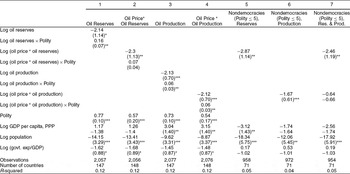
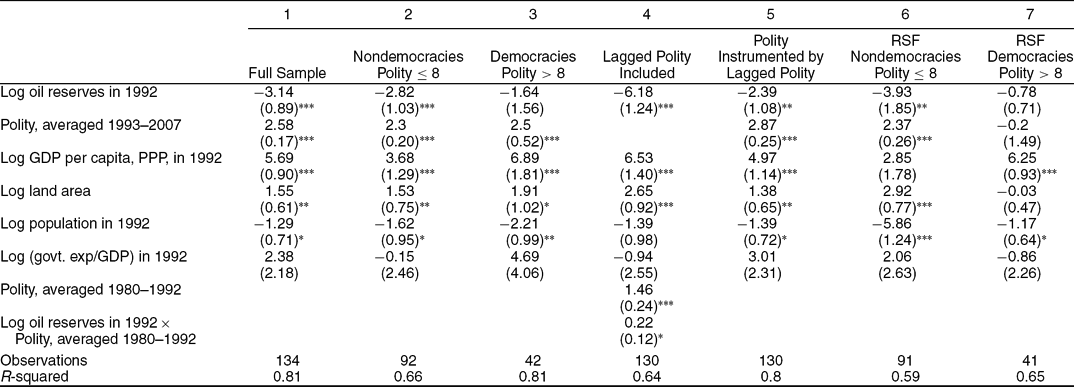
Main Results. In Table 1, we report the results from the fixed effects regressions. Controlling for the level of development (proxied by GDP per capita in purchasing power parity) and democracy level, media freedom is negatively correlated with oil reserves. This correlation is stronger in the less democratic countries. In the regressions in column (1), we control for the interaction term between democracy and oil abundance. The coefficient on oil reserves is negative and significant, and the coefficient on the interaction term is positive and significant. The less developed the democracy, the stronger the negative effect of oil reserves on media freedom.
Fixed Effects Regressions for Media Freedom

Robust standard errors in parentheses. *Significant at 10%; **significant at 5%; ***significant at 1%. Country fixed effects and time dummies are included but not reported.
Notes: Regressions (1)–(4) differ in terms of the measure of oil abundance (oil reserves in (1), oil price* oil reserves in (2), oil production in (3), oil price* oil production in (4)). These regressions are run for the full sample and include an interaction of oil with democracy (proxied by Polity). In regressions (5)–(7), there is no interaction term, but the sample only includes nondemocratic countries (with Polity value in 1992 not exceeding (5). In regression (5), we use oil reserves as proxy for resource abundance, in (6) we use oil production, and in (7) we include both. In all regressions, Polity is Polity IV's POLITY2 variable. All variables are for the current year; media freedom is for the next year. Dependent variable is (100—media freedom, Freedom House).
In Table 1, we also report the results with alternative measures of oil abundance. In regression (2), we use oil reserves valued at the current global oil price. The results provide strong evidence that oil prices negatively affect media freedom in oil-rich countries. In regression (3), we replace oil reserves with current oil production in barrels, and in regression (4), with oil production in dollar terms. We control for country size in terms of population (land area is captured by the fixed effects). The effect of population may reflect the importance of media as a coordination device. The sign of the coefficient is consistent with our model. The more populous the country, the harder it is for people to coordinate without media; thus, the media is vital for overthrowing the dictator, so the dictator prefers censorship. Including the country's population in the regression also helps assure that we control for oil reserves per capita as well as total oil reserves. We also control for GDP per capita and for the size of the government (log share of government expenditures in GDP). Controlling for the size of the government allows to take into account the amount of resources under direct government's control.
To provide a direct test for the prediction that resource abundance affects media freedom in nondemocratic countries, we estimate the specification (6) for a subsample of nondemocratic countries. In columns (5) and (6), we present the results for the subsample of countries where the Polity2 score of democracy in 1992 was less than or equal to 5 (the median democracy score in our sample is between 5 and 6). The results are consistent with our theory: oil affects media freedom negatively and significantly. In column (5), the oil abundance is proxied by oil reserves, and in column (6), we use oil production. Notice that as long as we estimate the original specification (6) without the interaction term, there is no difference between using barrels or dollar values of oil: current oil price is captured by time dummies.
In column (7), we include both oil reserves and oil production in the regression. Such a “horse race” allows us to distinguish between our theory and the alternative explanations described previously. Our theory implies that dictators take into account oil reserves when making a decision on censorship. The alternative explanations predict relationships between media freedom and current resource rents (to silence the opposition/citizens or to share with bureaucrats). Current oil production is the best proxy for current oil rents available (as we assume that country fixed effects control for cost differentials between countries). Because oil output and oil resources are highly correlated, one can only compare their effects, including them into regression simultaneously. Column (7) shows that the effect of oil reserves is—as predicted by our theory—negative and significant. Once we control for the oil reserves, the oil production is not significant; in a sense, our theory “wins the horse race”.
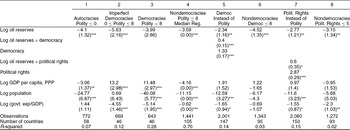
In Table 2, we provide further evidence. First, we split the sample into smaller subsamples. In columns (1) to (3) we present the evidence for three roughly equal subsamples of autocracies (Polity2 ≤ 0 in 1992, 58 countries), imperfect democracies (Polity2 ∈ (0, 8], 46 countries), and democracies (Polity2 > 8, 46 countries). We find that the effect of oil abundance on media freedom is negative and significant in autocracies and imperfect democracies, and that there is no relationship for democracies. These results are robust to choosing different cutting points for autocracies and imperfect democracies.
Additional Fixed Effects Regressions for Media Freedom

Robust standard errors in parentheses. *Significant at 10%; **significant at 5%; ***significant at 1%. Country fixed effects and time dummies are included but not reported.
Notes: In regressions (1)–(4), Polity is POLITY2 variable from Polity IV; in regressions (5) and (6), Democracy is proxied by DEMOC from POLITY IV; and in regressions (7) and (8), by Political rights from Freedom House. In columns (1)–(3), three different subsamples of countries are taken. Column (4) is a median regression on the sample of imperfect democracies. Columns (5) and (7) replicate regression (1) from Table 1 with a different measure for democracy. Columns (6) and (8) do the same for a subsample of imperfect democracies and without the interaction term. All variables are for the current year; media freedom is for the next year. Dependent variable is (100—media freedom, Freedom House).
To check whether our results are driven by outliers, we have run a jackknife test leaving out one country at a time. The results (not reported here; available on request) are the same as with the full sample. (In fact, there is an influential observation that weakens our results: the results would be even stronger if we leave out Sudan. We discuss this case in more detail later in this section.)
We have also estimated a median regression for the sample of nondemocracies (Polity2 ≤ 8) and found that the results do not change (column (4) in Table 2). These estimates suggest that our results are not determined by outliers.
In columns (5) to (8), we replace the Polity2 score with the other proxies of democracies. First, we use DEMOC variable from the Polity IV data set and find similar results: for the specifications with interaction term (column (5)) and without interaction term for the subsample of nondemocracies (Column (6)). Then, columns (7) and (8) report the evidence with the Political Rights variable from the Freedom House. The results are again consistent with our model's predictions.
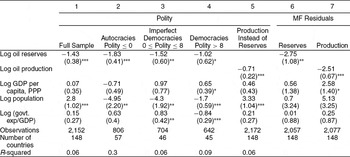
Natural Resources, Democracy, and Media Freedom. One of the main alternative explanations of the relationship between the natural resource endowment and media freedom is the fact that both variables are correlated with the level of democracy. Indeed, as shown in Tables 1 and 2, democracy (proxied by Polity2 score) always has a positive and significant effect on media freedom, even controlling for country fixed effects, time dummies, level of development, oil, etc. Table 3 shows that democracy is also correlated with oil abundance. Whether we use oil reserves (regressions (1)–(4)) or oil production (regression (5)) or whether we use the full sample (regressions (1) and (5)) or split it into autocracies (regression (2), Polity2 is not positive in 1992), imperfect democracies (regression (3), Polity2 positive but not higher than 8), or democracies (regression (4), Polity2 above 8 in 1992), oil abundance has a negative and significant effect on democracy. Table 3 therefore reproduces the results from Ross (Reference Ross2001), using the panel data and different proxies for oil abundance.
Relationship Among Oil, Regime Type, and Media Freedom

Robust standard errors in parentheses. *Significant at 10%; **significant at 5%; ***significant at 1%. Country fixed effects and time dummies are included but not reported.
Notes: In regressions (1)–(5),dependent variable is POLITY2 from Polity IV; in regressions (6) and (7), dependent variable is residuals from regression of media freedom (100—media freedom, Freedom House) on POLITY2, country fixed effects, and other control variables except for oil. In columns (1)–(4), we take different samples of countries and oil reserves, and in regression (5), production instead of reserves and the full sample. Regressions (6) and (7) have reserves and production as proxies for oil, respectively. All variables are for the current year; media freedom is for the next year.
However, these results do not reject our theory. First, in Tables 1 and 2, the effect of oil on media freedom is negative and significant in controlling for democracy. Second, the effect of oil on democracy is negative and significant at all levels of democracy, whereas the effect of oil on media freedom is significant only for autocracies and imperfect democracies, as predicted by our theory. Finally, in columns (6) and (7) of Table 3, we disentangle the effect of oil on democracy from the effect of oil on media freedom through the following two-stage procedure. In the first stage, we run media freedom on democracy, country fixed effects, and other control variables except for oil. Then we take the residuals, and estimate a regression for the residuals on oil, country fixed effects, and its other determinants and controls except for democracy. These results are different from those in Tables 1 and 2 precisely because of the correlation between democracy and oil (and other regressors). Because this correlation is controlled for in the first stage, the second-stage regressions for the media freedom residuals capture the relationship between oil and media freedom. The results are also consistent with our theoretical predictions: both oil reserves (regression (6)) and oil production (regression (7)) affect media freedom residuals negatively and significantly.
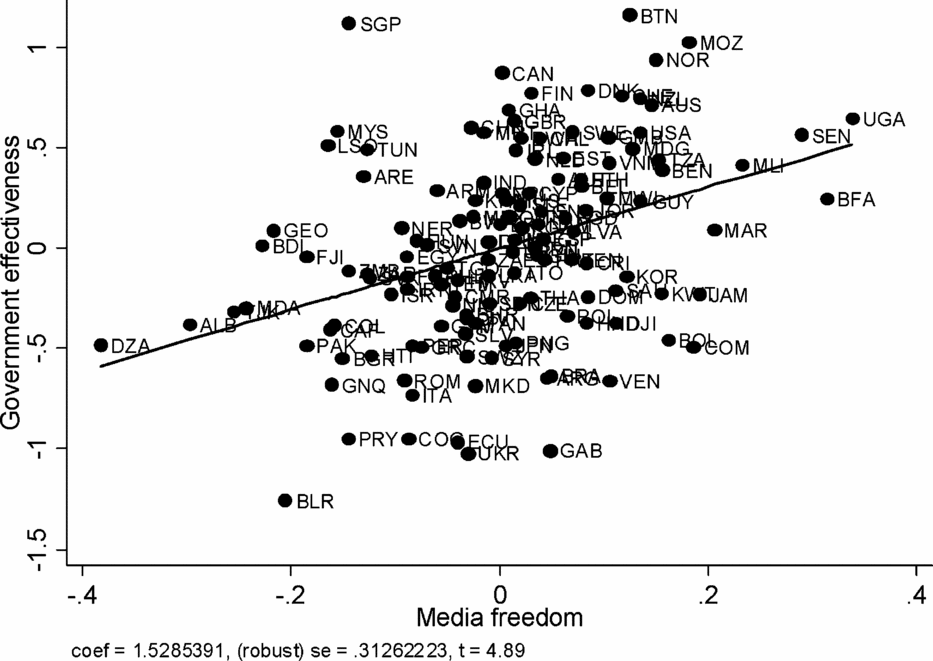
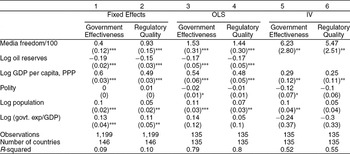
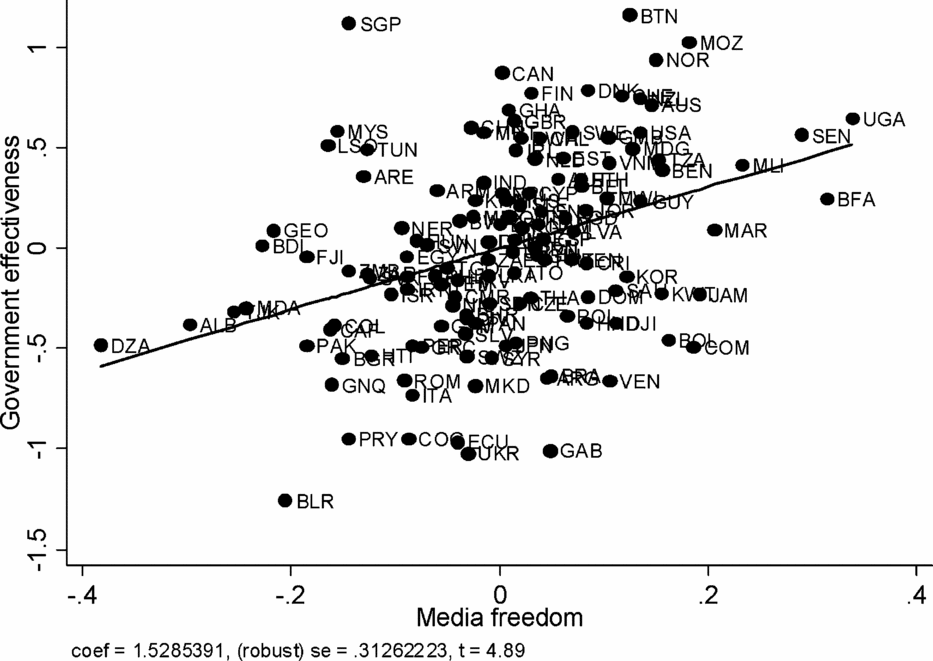
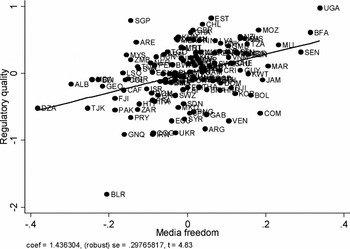
Media Freedom and the Quality of Government.Table 4 reports the estimates of the effect of media freedom on the quality of bureaucracy. We use two dependent variables: government effectiveness and regulatory quality (both from the World Bank Institute's Governance Project). Columns (1) and (2) report the fixed effect regressions for these two indices for 1996–2007. These regressions show that media freedom positively and significantly affects the quality of bureaucracy, controlling for country and time fixed effects, levels of development and democracy, and natural resources. Columns (3) and (4) present similar results of cross-country OLS regressions; the dependent variables are averages for the period of 1996–1907, and the independent variables are taken at 1995. Figure 4 presents the partial residual plot for media freedom and the government effectiveness as measured by Kaufmann et al. (Reference Kaufmann2006), whereas Figure 5 presents the partial residual plot for media freedom and the regulatory quality (also from Kaufmann et al. Reference Kaufmann2006).
Regressions for Quality of Governance.

Robust standard errors in parentheses. *Significant at 10%; **significant at 5%; ***significant at 1%. Country fixed effects and time dummies are included (in columns (1) and (2) but not reported.
Notes: In regressions (1), (3), and (5), the dependent variable is Government Effectiveness, and in regressions (2), (4), and (6), the dependent variable is Regulatory Quality (both from World Bank Institute's Governance Project). Columns (1) and (2) report fixed effects regressions. Columns (3) and (4) are OLS regressions for variables averaged over time. Columns (5) and (6) report IV regression, with Media Freedom instrumented by Log oil reserves and other covariates. In Columns (1) and (2), all variables are for the current year; media freedom is for the next year. In all regressions, Media Freedom is divided by 100 to scale the coefficients.
Media Freedom and Government Effectiveness, Residuals
Media Freedom and Regulatory Quality, Residuals

Finally, in regressions (5) and (6), we instrument media freedom by natural resources, democracy, interaction of oil and democracy, log GDP per capita, etc. Again, the results are consistent with our theory.
Notice that in all specifications, the direct effect of democracy on the quality of the governance (controlling for media freedom) is not robust and usually not significant. Once again, it suggests that media freedom and democracy are not the same.
Another interesting effect to study is the interaction among resource abundance, media freedom, and bureaucratic incentives on long-run economic growth. A major obstacle is that there are no systematic media freedom data prior to 1993.
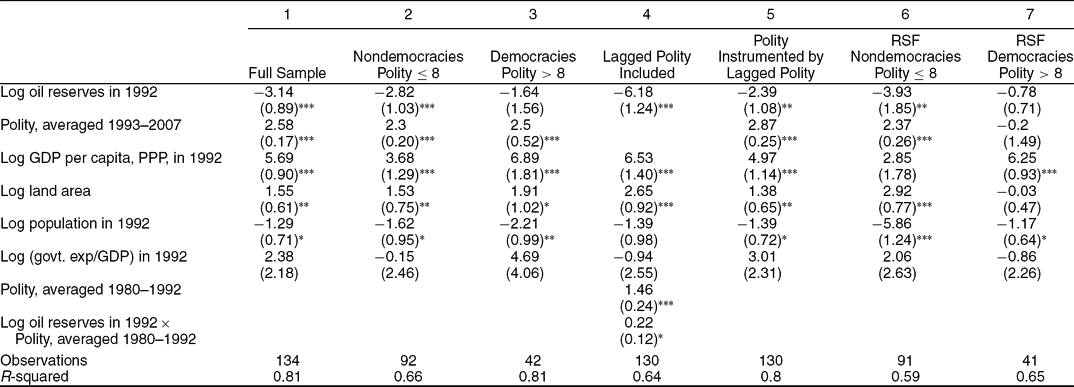
Cross-Sectional Evidence. In Table 5, we run OLS regressions for the media freedom averaged for 1993–2007 for each country on country characteristics. In column (1), we present the results for the whole sample, column (2) reports the results for the sample of nondemocracies (Polity2 ≤ 8), and column (3) reports the results for democracies (Polity2 > 8). We find that the oil abundance affects media freedom negatively and significantly in the whole sample, but this result is driven by nondemocracies; there is no effect in democracies.
Cross-Sectional Regressions
Robust standard errors in parentheses. *Significant at 10%; **significant at 5%; ***significant at 1%.
Notes: All regressions except column (5) are OLS. In regressions (1)–(5), the dependent variable is Media Freedom, averaged for 1993–2007. In (6) and (7), the dependent variable is Reporters Sans Frontières, averaged for 2002–2007. Regressions (1)–(3) include different sample of countries. In regression (4), lagged Polity (POLITY2 variable averaged for 1980–1992) is included. In regression (5), Polity is instrumented by lagged Polity. Regressions (6) and (7) contain the samples of democratic and nondemocratic countries, respectively. All variables are averaged 1993–2007 unless stated otherwise.
We also estimate a specification (4), where we replace contemporaneous measures of democracy with its average level in 1980–1992. In column (5), we instrument democracy with a lagged democracy score, and the results remain the same.
Columns (6) and (7) present the evidence on an alternative measure of media freedom. We use the media freedom index from Reporters Sans Frontières rather than the more conventional one from Freedom House (unfortunately, RSF data are only available for a few years and cannot be used in fixed effects regressions). Again, as we run the estimates for both nondemocracies (6) and democracies (7), we find that oil affects media freedom in nondemocratic countries.
Alternative Explanations and Robustness Checks. To check the robustness of our results, we have also run a number of additional tests. We have estimated all regressions in Tables 1 to 5 for the subsamples of countries with large oil reserves. For all specifications, we used both oil reserves and oil production. We controlled for inequality, Internet penetration, adult literacy, and other relevant variables. We tried all splits of the sample by democracy scores. These tests (available on request) have shown that our results are robust and consistent with our predictions.
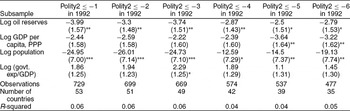
The results in Table 2 are also robust to a different choice of thresholds for autocracies. In Table 6, we reproduce the regression from Table 2, column (1), for thresholds varying from −1 to −6. In all cases, the coefficient at oil reserves is negative and statistically significant (for thresholds −5 and −6, the coefficient is significant at 10% but not at 5% level, which is due to smaller samples). Note that if the sample is restricted to more autocratic countries (for thresholds −4, −5, and −6), the estimated effect of oil is lower in magnitude. This is most likely explained by smaller sample size and by the attenuation bias. Because the data quality in autocracies is lower than in imperfect democracies, the measurement error is therefore higher. This pushes the estimates for the coefficient to zero for the subsample of the most autocratic countries.
Robustness of Relationship Between Oil Reserves and Media Freedom in Autocratic Countries with Regard to Choice of Autocracy Threshold

Robust standard errors in parentheses. *Significant at 10%; **significant at 5%; ***significant at 1%.
Notes: The table contains panel regression estimates for media freedom with country fixed effects and time dummies. Dependent variable is (100—media freedom, Freedom House). All variables are for the current year; media freedom is for the next year. Each column reproduces the results from column (1), Table 2, with a different threshold for autocracy; instead of Polity2 = 0 (Table 2), we use the thresholds from Polity2 = −1 to Polity2 = −6 in 1992.
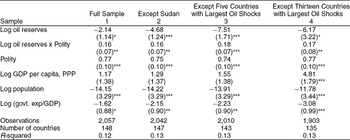
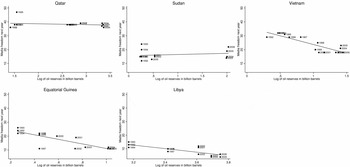
We have also verified that our results are not driven by outliers: excluding any single country or any region does not change the results qualitatively. Similarly, the results are not driven by countries that had very large shocks in oil reserves. In fact, there is one country that weakens our results in several specifications: Sudan. If we exclude Sudan, the estimated effect of oil on media freedom is even stronger. The reason is that in the 1990s, Sudan had a huge increase in measured oil reserves, perhaps explained by the change in territory controlled by the central government, which was not accompanied by a decrease in media freedom. The latter was not surprising as Sudan's media freedom was among the bottom ten in the world to start with. This episode does not contradict our theory; however, the empirical estimates of the relationship are weakened. In Table 7 (columns (1) and (2)), we replicate the main regression with and without Sudan and show that exclusion of Sudan sharply increases the magnitude of the coefficient. We emphasize, however, that even among the countries that experienced a very large oil shock, Sudan is not a typical case. The five nondemocratic countries with the largest shock in oil reserves during the period are Qatar, Sudan, Vietnam, Equatorial Guinea, and Libya. These countries, except Sudan, exhibit a negative relation between oil and media freedom, and for Vietnam, Equatorial Guinea, and Libya, this relation is particularly strong, as shown in Figure 6. Thus, Sudan is an outlier that would weaken our estimates, and even with it our results are significant and consistent with the theory.
Relationship Among Oil, Regime Type, and Media Freedom in Subsamples Excluding Countries with Largest Oil Shocks

Robust standard errors in parentheses. *Significant at 10%; **significant at 5%; ***significant at 1%. Country fixed effects and time dummies are included but not reported.
Notes: Dependent variable is (100—media freedom, Freedom House). Regression (1) replicates regression (1) from Table 1. Regression (2) excludes Sudan. Regression (3) excludes Qatar, Sudan, Angola, Mexico, and Azerbaijan (five countries with the largest oil shocks in 1993–2007, with the ratio of maximum to minimum oil reserves during the period above 3.5). Regression (4) excludes, in addition, Vietnam, Canada, Gabon, Brazil, Equatorial Guinea, Libya, Congo Republic, and Colombia (countries with the ratio of maximum to minimum oil reserves during the period above 1.65).
Pairwise Correlations Between Oil Reserves and Media Freedom in Autocracies that Experienced the Largest Changes in Oil Reserves, 1993–2007

Our results are not driven by countries that experienced very large changes in oil reserves. We identified thirteen countries for which the difference between the maximum and the minimum of log oil reserves in the period of 1992–2006 exceeded 0.5. These are (in decreasing order): Qatar, Sudan, Angola, Mexico, Azerbaijan, Vietnam, Canada, Gabon, Brazil, Equatorial Guinea, Libya, Congo Republic, and Colombia. These changes correspond to a ratio of maximum and minimum oil reserves of at least 1.65, and for the first five countries in the list, this ratio exceeds 3.5. In Table 7, we also provide the results for the subsamples excluding these five countries in column (3) and excluding the thirteen countries in column (4).
Let us now return to the discussion of the alternative explanations we introduced previously. The tests imply the following. First, the evidence is consistent with our theory, even controlling for the alternative explanations. Second, the alternative explanations are not robust to the choice of specification: (1) the coefficients at the GDP per capita and government spending are often not significant, (2) the coefficient at oil production is not significant once we control for the effect of oil reserves, and (3) democracy's effect on the quality of governance is not significant. Finally, we show that, in line with our theory and contrary to the predictions of the alternative explanations, the relationship between oil and media freedom holds only for nondemocracies.
CONCLUSION
We study determinants of media freedom in nondemocratic countries. In such societies, a dictator needs an independent source of information on the outcomes of his policies. Otherwise, he cannot provide incentives for his bureaucracy, which may result in poor economic performance and eventually cost him his job. The independent and competitive media do provide this information, but cannot commit not to leak it to the citizens. Such leakage undermines the very basis of the nondemocratic regime: the collective action problem in organizing a revolution. If the citizens receive a public signal about the poor outcomes of the dictator's policies (e.g., with the help of mass media), they solve the coordination problem and overthrow the dictator. To understand the dictator's choice of the extent of media freedom, we use the variation in resource endowments. In resource-rich countries, the value of remaining in office is relatively high, and the need to provide incentives to bureaucracy is less important. Therefore, our theory predicts a negative relationship between resource abundance and media freedom; this relationship should be especially strong in less democratic countries.
Our analysis of panel data for 1993–2007 is consistent with the model's predictions. It is striking that the relationship between oil and media shows up in such a short time period as 14 years. This distinguishes our article from the other literature on the so-called resource curse. This literature considers the effect of resource abundance on economic and political institutions (property rights, political competition, party system, constraints on the executive) that change very slowly. Therefore, studies of these relationships can only be based on cross-sections. However, media freedom is affected almost immediately (Figure 2), which allows us to run fixed effects regressions. We find that the estimates of the magnitude of the effect on media in panel regressions and in cross-sectional regressions are similar.
More recently, two authoritarian regimes have seemingly defied this article's logic: Belarus and China. Both are (relatively) resource poor and have tightly controlled media, while being apparently successful in terms of economic growth. Our model helps us understand these cases. Belarus has been receiving substantial support from Russia, mostly in terms of heavily subsidized prices for oil and natural gas. BRATT (2006) estimates the direct benefits due to these subsidies in terms of oil and gas prices alone to be around 15% of the Belarussian GDP. Essentially, Alexander Lukashenko, the Belarussian president, can afford censorship and heavy reliance on secret service; support from Russia provides sufficient rents as if Belarus were a resource-rich country.Footnote 13
In China, the ruling party is facing exactly the same “Gorbachev's dilemma” that is the focus of our article. On the one hand, the tight control over the media stands in the way of attempts to improve the bureaucratic performance, as the SARS epidemic vividly demonstrated. On the other hand, free media would have produced a challenge to the rule of the Chinese Communist Party. One way to deal with the information problem, which has been adopted by the Chinese leadership, is to decentralize economic decision making and even to introduce elections at the municipal and provincial levels. China has also recently passed a law requiring a major opening up of government information to the citizens, somewhat along the lines of the U.S. Freedom of Information Act (Yardley Reference Yardley2007). Both government openness and local elections (as well as local riots, see Lorentzen Reference Lorentzen2007)Footnote 14 provide the central government with relatively reliable information on the performance of provincial bosses. In principle, such mechanisms might prevent nationwide information aggregation, but for the very same reason they only partially mitigate the incentive costs of censorship.



Comments
No Comments have been published for this article.