Introduction
Legionellosis is an acute respiratory illness caused by infection with Legionella species and may manifest as Legionnaires’ disease or Pontiac fever. Reference Fields, Benson and Besser1 The global incidence of legionellosis has increased steadily in recent years, with surveillance data indicating rising trends in the United States and the European Union/European Economic Area 2,3 and a similar year-to-year increase in South Korea. 4 Legionella species persist in aquatic environments, and legionellosis can occur through the inhalation of aerosols containing contaminated water or through aspiration of contaminated water. Reference Phin, Parry-Ford and Harrison5 The disease may also be acquired in healthcare settings, where it is associated with higher mortality rates among hospitalized patients. Reference Dominguez, Alvarez and Sabria6
Hospitals have several facility-related risk factors for Legionella proliferation, including complex water distribution systems, long pipe networks, suboptimal water temperature control, and reduced water flow. 7 In addition, hospitalized patients often have host-related risk factors, such as immunosuppression, underlying malignancies, chronic lung disease, or recent surgery. 7 For these reasons, effective water system management is essential to prevent legionellosis in healthcare facilities, 7–9 with continuous chlorine treatment commonly implemented as a preventive measure. Numerous previous studies have reported that chlorine (hypochlorite), chlorine dioxide, monochloramine, or hydrogen peroxide reduces the isolation rate of Legionella species in hospital water systems. Reference Marchesi, Ferranti and Mansi10–Reference Xi, Ross, Hinds, Molino and Whiley20 However, evidence demonstrating a reduction in the actual incidence of nosocomial legionellosis following chlorine treatment is limited, with long-term prepost comparisons of disease incidence remaining particularly scarce.
To prevent nosocomial cases of legionellosis, we sequentially installed an automatic chlorine concentration control system in the water distribution networks of our hospital’s buildings between 2019 and 2020. In this study, we aimed to evaluate the effectiveness of this intervention by comparing the incidence of nosocomial legionellosis before and after the system implementation.
Methods
Setting
This study was conducted at a 2,700-bed tertiary care hospital complex in Seoul, South Korea, which consisted of three main buildings as follows: the West Wing, originally constructed in 1989 and remodeled in 2009 (encompassing 16 floors, with 3 below-ground levels and 13 above-ground stories); the East Wing, constructed in 1994 (encompassing 20 floors, with 2 below-ground levels and 18 above-ground stories); and the New Wing, constructed in 2008 (encompassing 17 floors, with 2 below-ground levels and 15 above-ground stories).
When a positive Legionella case was identified through the infection control offices’ routine Legionella surveillance program, an immediate epidemiologic investigation was initiated. For each confirmed nosocomial legionellosis, environmental investigations were performed, including obtaining water cultures from the patient’s room and associated water systems, measuring hot and cold water temperatures, assessing residual chlorine concentrations, and implementing superheating and flushing procedures. Since 2013, point-of-use (POU) water filters have been installed in the bathrooms or shower rooms of rooms occupied by patients diagnosed with nosocomial Legionella infection. Furthermore, from 2016 to 2022, POU filters were implemented in high-risk units, including hematologic malignancy, oncology, and liver transplant units.
During the study period, diagnostic tests for Legionella species—including cultures for Legionella spp., Legionella urinary antigen testing (BinaxNOW Legionella Urinary Antigen Card; Abbott Diagnostics, Scarborough, ME, USA), and Legionella polymerase chain reaction testing (AmpliSens Legionella pneumophila-FEP; InterLabService Ltd, Moscow, Russia) using respiratory specimens (sputum or bronchoalveolar lavage fluid)—were continuously available. In 2023, multiplex polymerase chain reaction testing with the FilmArray respiratory panel (BioFire Diagnostics, Salt Lake City, UT, USA) was introduced. Patients with clinically suspected pneumonia underwent active diagnostic testing for Legionella species according to institutional protocols.
To control nosocomial legionellosis, the hospital installed an automatic chlorine concentration control system (SRLB system, CQM, Israel) in the hot water distribution networks of the East Wing in April 2019 and subsequently expanded it to the West and New Wings in February 2020. This system allowed for the continuous monitoring of the chlorine concentration in the return water, thereby automatically injecting chlorine to maintain a terminal chlorine concentration of 0.1–4.0 mg/L at distal outlets. Chlorine was generated on-site through the electrolysis of sodium chloride and released into the water distribution system.
This study was reviewed and approved by the Asan Medical Center Institutional Review Board (IRB No. 2026-0074). The requirement for informed consent was waived by the same Institutional Review Board.
Definition
A presumptive case of nosocomial legionellosis was defined as a patient with a continuous hospital stay of ≥10 days during the 14-day exposure period before symptom onset. A possible case of nosocomial legionellosis was defined as a patient who stayed in the hospital for 1–9 days during the 14-day period before symptom onset, according to the Centers for Disease Control and Prevention criteria. 21 Both presumptive and possible cases were classified as nosocomial, and cases with Legionella identified from clinical specimens—including respiratory specimens (sputum or bronchoalveolar lavage fluid) by culture or PCR testing, and urine specimens by Legionella urine antigen testing—were included in the study even in the absence of clinically apparent pneumonia. Considering the timing of installation of the automatic chlorine concentration control system, April 2019 through April 2020 was defined as the intervention window period. The preintervention period was defined as January 2011 through March 2019, and the postintervention period as May 2020 through November 2025.
Statistical analysis
Monthly counts of nosocomial legionellosis cases and corresponding patient-days were analyzed over the study period. Because the outcome was extremely rare, resulting in a high proportion of zero counts, the primary analysis was prespecified as a comparison of overall incidence rates between the pre and postintervention periods using exact Poisson methods. Incidence rates were calculated as the number of events divided by patient-days and expressed per 100,000 patient-days. Incidence rate ratios (IRRs) with exact 95% confidence intervals (CIs) and two-sided P-values were estimated using an exact Poisson test based on aggregated event counts and patient-days during the pre and postintervention periods. Interrupted time series analyses were performed solely to assess the presence of underlying temporal trends before the intervention, rather than to estimate formal level or slope changes. For this purpose, preintervention monthly data were fitted using Poisson regression models with a log link and an offset for patient-days. To assess the robustness of the primary findings against potential year-specific clustering of events, we performed sensitivity analyses by repeating the exact Poisson comparison after excluding one calendar year at a time. All statistical analyses were conducted using R software (R Foundation for Statistical Computing, Vienna, Austria). A two-sided P value <.05 was considered statistically significant.
Results
Patient characteristics
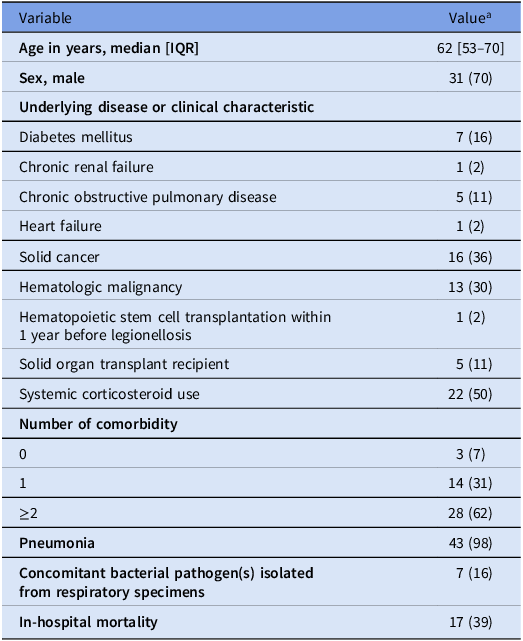
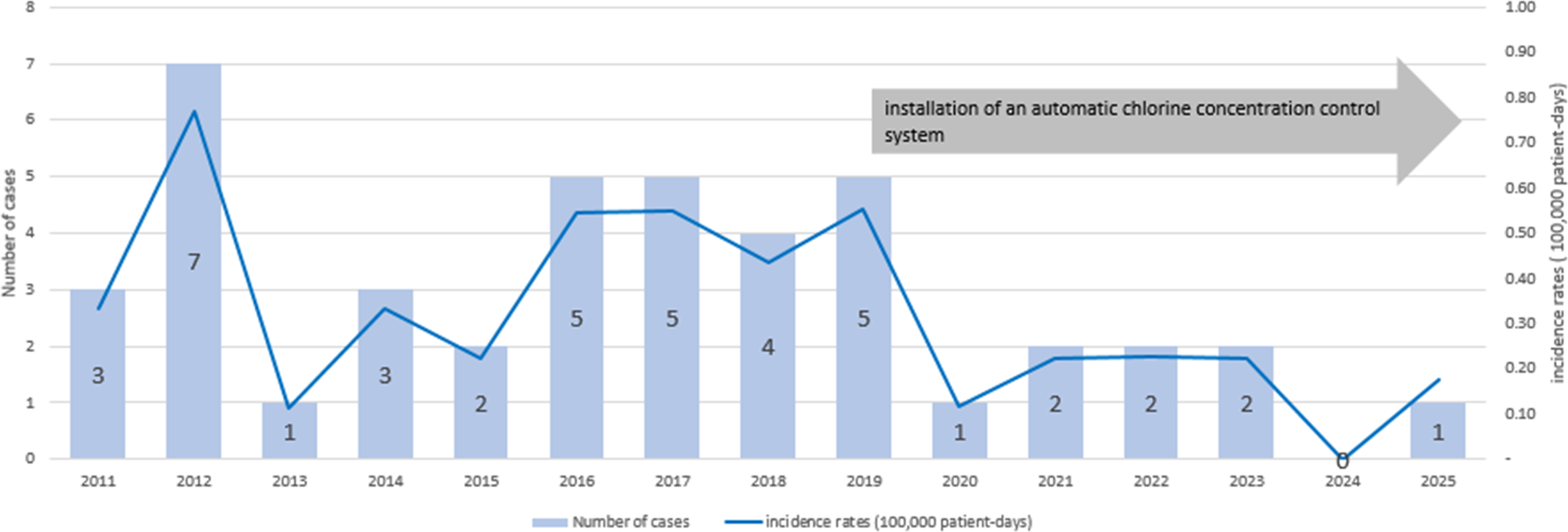
During the study period, a total of 44 patients with nosocomial legionellosis were identified, whose characteristics are summarized in Table 1. They were predominantly male (70%) and had a median age of 62 years. Systemic corticosteroid use was documented in 50% of them, and 43 patients (98%) presented with pneumonia. The remaining patient did not show definite radiographic evidence of pneumonia; however, at the time of testing, the patient presented with fever and increased sputum production, which prompted Legionella PCR testing. Therefore, this case was considered clinically compatible with acute infection rather than past exposure or incidental test positivity. Seventeen patients (39%) died during hospitalization. Among them, 12 (71%) were diagnosed with legionellosis during preintervention period, two during the window period, and three during postintervention period. The most common underlying conditions were solid cancer (53%), systemic corticosteroid use (53%), hematologic malignancy (12%), and solid organ transplantation (12%). Eleven patients (65%) died due to Legionella pneumonia. The annual number of cases and rate of incidence for nosocomial legionellosis are shown in Figure 1.
Characteristics of patients with nosocomial legionellosis

Table 1 Long description
A table summarizing characteristics of patients with nosocomial legionellosis. The table has 16 rows and 2 columns. The columns are labeled 'Variable' and 'Value'. The rows are as follows: Row 1: Variable, Age in years, median [IQR]; Value, 62 [53-70]. Row 2: Variable, Sex, male; Value, 31 (70). Row 3: Variable, Underlying disease or clinical characteristic; Value, empty. Row 4: Variable, Diabetes mellitus; Value, 7 (16). Row 5: Variable, Chronic renal failure; Value, 1 (2). Row 6: Variable, Chronic obstructive pulmonary disease; Value, 5 (11). Row 7: Variable, Heart failure; Value, 1 (2). Row 8: Variable, Solid cancer; Value, 16 (36). Row 9: Variable, Hematologic malignancy; Value, 13 (30). Row 10: Variable, Hematopoietic stem cell transplantation within 1 year before legionellosis; Value, 1 (2). Row 11: Variable, Solid organ transplant recipient; Value, 5 (11). Row 12: Variable, Systemic corticosteroid use; Value, 22 (50). Row 13: Variable, Number of comorbidity; Value, empty. Row 14: Variable, 0; Value, 3 (7). Row 15: Variable, 1; Value, 14 (31). Row 16: Variable, ≥2; Value, 28 (62). Row 17: Variable, Pneumonia; Value, 43 (98). Row 18: Variable, Concomitant bacterial pathogen(s) isolated from respiratory specimens; Value, 7 (16). Row 19: Variable, In-hospital mortality; Value, 17 (39).
IQR, interquartile range.
a Data are presented as frequency (%) unless otherwise indicated.
Annual number of cases and rate of incidence for nosocomial legionellosis.

Chlorine concentration and incidence of nosocomial legionellosis before and after the intervention
Mean (± standard deviation) distal (outlet) chlorine concentrations in the hot water distribution system were 0.10 ± 0.04 mg/L before and 0.35 ± 0.21 mg/L after installation of the automatic chlorine concentration control system (P < .001) (Supplemental Table 1). During the preintervention period, 30 cases of nosocomial legionellosis were identified over 7,454,558 patient-days across 99 months, corresponding to an incidence of 0.402 per 100,000 patient-days (Table 2). During the postintervention period, 8 cases occurred over 4,432,011 patient-days across 67 months, yielding an incidence of 0.181 per 100,000 patient-days. The mean ± SD monthly number of Legionella tests was 4,447 ± 653 during the preintervention period, and 4,789 ± 512 during the postintervention period, with no significant difference between periods (P = .265). An exact Poisson comparison based on aggregated event counts and patient-days showed that the IRR for legionellosis during the postintervention period compared with the preintervention period was 0.45 (95% CI, 0.18–1.01; P =.043) (Table 2). To assess for baseline temporal trends, we fitted the preintervention monthly data to a Poisson regression model with an offset for patient-days, which yielded an estimated IRR of 1.00 per 12 months (95% CI, 0.86–1.17; P =.989).
Incidence of nosocomial legionellosis before and after the installation of an automatic chlorine concentration control system

Table 2 Long description
A table comparing the incidence of nosocomial legionellosis before and after the installation of an automatic chlorine concentration control system. The table has two main sections: Preintervention and Postintervention, each with several columns. Preintervention: Observation time (months), Events (n), Patient-days, Incidence. Postintervention: Observation time (months), Events (n), Patient-days, Incidence. Exact IRR (Post vs Pre). Row 1: Preintervention: 99 months, 30 events, 7,454,558 patient-days, 0.402 incidence. Postintervention: 67 months, 8 events, 4,432,011 patient-days, 0.181 incidence. Exact IRR (Post vs Pre): 0.45 (95% CI, 0.18-1.01; P = .043).
IRR, incidence rate ratio, CI, confidence interval.
a Incidence per 100,000 patient-days.
Sensitivity analyses
In leave-one-year-out sensitivity analyses, the exact Poisson comparison was repeated after each calendar year was excluded in turn. Across all iterations, postintervention incidence rates remained lower than preintervention rates, with IRRs ranging from 0.41 to 0.52 (Supplementary Table 2). The corresponding exact 95% CIs and P-values are presented in Supplementary Table 2.
Discussion
Using a 15-year quasi-experimental design, this study demonstrated that a hospitalwide chlorine concentration control intervention was associated with a significant reduction in the incidence of nosocomial legionellosis. Although nosocomial legionellosis was a rare outcome in our institution, its occurrence was associated with a high in-hospital mortality rate (nearly 40%). Taken together, these finding underscore the clinical importance of maintaining appropriate chlorine concentrations within hospital water systems.
Previous studies have primarily focused on environmental outcomes, demonstrating that chlorine (hypochlorite), chlorine dioxide, monochloramine, or hydrogen peroxide treatment reduces the isolation rate of Legionella species from hospital water systems. Reference Marchesi, Ferranti and Mansi10–Reference Xi, Ross, Hinds, Molino and Whiley20 However, from a clinical perspective, improving patient outcomes—namely legionellosis, including Legionella pneumonia—is of greater relevance. Accordingly, our study specifically aimed to assess whether the intervention was associated with a decrease in the incidence of legionellosis rather than improvements in microbiological surveillance outcomes alone.
Although the exact Poisson comparison showed a statistically significant reduction in incidence after the intervention, the upper bound of the exact 95% CI marginally exceeded unity. This reflects a well-known characteristic of exact inference for rare, discrete event data, whereby conservative exact CIs may slightly include the null value despite statistically significant two-sided P-values. This phenomenon has been previously documented for Poisson rate comparisons and does not indicate analytical inconsistency. Reference Fay22,Reference Agresti and Gottard23 In this context, the point estimate and lower confidence bound in our study consistently indicated a reduction in postintervention incidence, with the CI exceeding unity only minimally. Collectively, these findings support interpreting the obtained IRR as statistically significant based on the exact test, while appropriately acknowledging the inherent imprecision associated with inference for extremely rare outcomes.
The small number of observed events precluded the use of formal time series analyses; therefore, we relied on Poisson comparison methods to estimate IRRs, which represents an important limitation of this study. Nevertheless, the robustness of our findings was supported by multiple sensitivity analyses, all of which consistently demonstrated a significant reduction in legionellosis cases following the intervention. Additionally, Poisson regression analysis of the preintervention monthly data yielded an IRR of 1.00 (95% CI, 0.86–1.17; P =.989), indicating that the observed reduction was not attributable to a declining baseline trend during the preintervention period. Notably, this decrease was observed despite the increased use of diagnostic tools, such as multiplex pneumonia FilmArray assays, and in contrast to the nationally increasing incidence of legionellosis. 4 Furthermore, although older building infrastructure is generally associated with an increased risk of Legionella proliferation due to factors such as pipe corrosion and biofilm accumulation, Reference Borella, Montagna and Romano-Spica24 the incidence of legionellosis at our hospital continued to decline after 2020. Together, these findings further support the effectiveness of chlorine concentration control in hospital water distribution systems as a preventive strategy against nosocomial legionellosis. Nevertheless, the potential adverse effects of prolonged chlorine exposure, particularly infrastructure-related issues such as pipe corrosion, should be carefully weighed when long-term water disinfection strategies are implemented.
This study has several limitations. First, it was conducted at a single center, which may limit the external validity and generalizability of the findings. Second, as noted above, the extremely low incidence of nosocomial legionellosis precluded the use of formal time series analytical approaches (e.g., level and trend change analyses). Third, we were unable to provide longitudinal data on the rates of Legionella spp. isolation from the hospital water system. Finally, although chlorine concentration maintenance was the primary intervention of interest, the influence of other unmeasured or concurrent infection control measures cannot be entirely excluded, and residual confounding may therefore have influenced the observed associations.
In conclusion, sustained maintenance of appropriate chlorine concentrations in our hospital’s water distribution system was associated with a significant reduction in nosocomial legionellosis over an extended observation period. These findings support the integration of chlorine concentration control into comprehensive hospital water safety programs, while highlighting the need to balance its preventive benefits against potential infrastructure-related risks.
Supplementary material
The supplementary material for this article can be found at https://doi.org/10.1017/ice.2026.10475.
Financial support
This study was supported by a grant (grant number: 2026IL0024) from the Asan Institute for Life Sciences, Asan Medical Center, Seoul, Korea.
Competing interests
All authors report no conflicts of interest relevant to this article.
Ethical standard
This study was reviewed and approved by the Asan Medical Center Institutional Review Board (IRB No. 2026-0074). The requirement for informed consent was waived by the same Institutional Review Board.