Congenital Heart Disease (CHD) is the most common birth defect, affecting 1% of all live births across the globe. Reference Virani, Alonso and Benjamin1 Infants with critical CHD require urgent intervention or cardiac surgery, as well as care in the paediatric cardiac intensive care unit (ICU). Although survival rates have increased with advancements in science and technology, morbidities are numerous and can include long-term neurodevelopmental delay. Reference Best and Rankin2,Reference Marino, Lipkin and Newburger3 Parents of infants with critical CHD experience profound stress which can impact the quality of their relationships and interactions with the infant and with other family members. Reference Colville and Gracey4–Reference Rempel, Ravindran, Rogers and Magill-Evans7 The potential negative influences of parental stress and mental health on neurodevelopmental outcomes in high risk infants is an area of emerging interest, Reference Wernovsky and Licht8–Reference Lisanti10 and a growing body of research suggests that long-term maternal distress can have a greater influence on neurodevelopmental and behavioural outcomes than the child’s severity of illness in CHD. Reference Landolt, Ystrom, Stene-Larsen, Holmstrom and Vollrath11,Reference McCusker, Doherty and Molloy12
One of the most extreme periods of stress for parents is during the infant’s hospital course in the ICU, which often occurs immediately after the infant’s birth. Reference Franck, Mcquillen and Wray13,Reference Lisanti, Allen, Kelly and Medoff-Cooper14 The Paediatric Cardiac ICU Parental Stress Model posits that parental stress in the critical care setting originates from three sources – infant (e.g., appearance, behaviour, perceived or actual severity of illness), parent (e.g., parental role alteration, personal factors), and environment (e.g., sights and sounds of the ICU, having other children, quality of partner relationship). Reference Lisanti, Golfenshtein and Medoff-Cooper15 Parents can react to these stressors with stress responses, often exhibited by psychological distress or mental health symptoms such as anxiety and depression. Reference Segre, McCabe, Chuffo-Siewert and O’Hara16,Reference Franich-Ray, Bright and Anderson17 Parents also experience time points of heightened stress such as the day of their infants’ cardiac surgery. Reference Lisanti, Golfenshtein and Medoff-Cooper15 The first week after their infants’ cardiac surgery is especially stressful, as this time period is when infants are often the most critically ill during postoperative recovery. Reference Franck, Mcquillen and Wray13 Parents who perceive more stress during their infant’s critical illness and exhibit mental health symptoms are at risk for poor mental health outcomes in the long-term. Reference Helfricht, Latal, Fischer, Tomaske and Landolt18,Reference Shaw, Bernard and Deblois19
Perceptions of stress have been shown to be influenced by a variety of personal factors such as an individual’s sex, trait anxiety, and socioeconomic status. Reference Lisanti10 But an important limitation exists in the literature, as most studies of parental stress in the hospitalised paediatric population have focussed exclusively on women who have given birth to infants with CHD. Results from two recent studies suggest that women and men perceive CHD-related stressors and supports differently. Reference Sood, Karpyn and Demianczyk20,Reference Hoffman, Karpyn and Christofferson21 Research indicates that mothers often have an elevated stress response compared to fathers, including increased risk for anxiety, depression, and post-traumatic stress. Reference Franich-Ray, Bright and Anderson17,Reference Vrijmoet-Wiersma, Ottenkamp, van Roozendaal, Grootenhuis and Koopman22–Reference Utens, Versluis-Den Bieman and Verhulst28 Fathers face unique stressors, including a lack of father-specific support services, societal expectations related to fatherhood, and often feeling overlooked as partners in their infant’s care. Reference Sood, Karpyn and Demianczyk20,Reference Hoffman, Karpyn and Christofferson21
The primary objective of this pilot study was to describe the stress experience of parents in the paediatric cardiac ICU in the first week after their infant’s cardiac surgery. It was hypothesised that differences in perceived stressors and mental health symptoms would exist between women and men across mother–father dyads. Pilot study design was used so that effect sizes could be calculated to inform the design of a larger, multisite study. The specific aims of this study were to: 1) describe the perceived stressors and mental health symptoms of anxiety and depression in mothers and fathers; 2) compare differences in perceived stressors and mental health symptoms of anxiety and depression between mother–father dyads; and 3) examine the relationship between perceived stressors and personal factors on mental health symptoms of anxiety and depression for parents of infants with critical CHD.
Materials and methods
Design and sample
This pilot study screened and enrolled subjects from August 2018 to October 2019, under the approval and oversight of the hospital’s institutional review board. A convenience sample of 56 parents, 28 biological mother–father dyads, was enrolled from among all families admitted for cardiac surgery to the paediatric cardiac ICU from one free-standing children’s hospital in the Northeast region. This represents an adequate sample size for a pilot study. Reference Hertzog29 While these dyads excluded single parents, same sex couples, or adoptive parents, the eligibility criteria was chosen to minimize heterogeneity within the small pilot sample and allow for comparisons of mothers and fathers across pairs and account for differences in the stress experience based on sex. Parents 18 years of age or older who could read and speak English were approached at least 24 hours after the infants’ cardiac surgery if their infants met the following inclusion criteria: a) <30 days of age b) >36 weeks gestational age c) birth weight >2500 grams. Parents were excluded if their infants were: a) listed for a cardiac transplant, or b) receiving end of life care. Infants were also included as participants so that demographic, medical, and surgical data could be gathered. The infants’ cardiac surgeries were categorised using the Society of Thoracic Surgery–European Association for CardioThoracic Surgery Congenital Heart Surgery Mortality scoring system. Reference O’Brien, Clarke and Jacobs30 Key variables of measurement were identified based on elements of the Paediatric Cardiac ICU Parental Stress Model. Reference Lisanti, Golfenshtein and Medoff-Cooper15 These included stressors arising from the infant (infant appearance and behaviour, perceived severity of illness), from the parent (parental role alteration, personal factors), and from the environment (sights and sounds of the ICU, number of children, quality of partner relationship). Personal factors influencing stress included sex, trait anxiety, and financial strain as a proxy for socioeconomic status. Parent dyads were instructed to complete questionnaires independently from each other.
Measures
Parental perception of stressors
The Parental Stressor Scale: Infant Hospitalisation is a 22-item instrument with excellent validity and reliability that measures parental perception of stressors, including the infant’s appearance and behaviour, parental role alteration, and the sights and sounds of the hospital environment. Reference Miles and Brunssen31
Perception of infant severity of illness
Parental perception of their infants’ severity of illness has been shown to be an important variable in parents’ stress experience. Reference Lisanti, Golfenshtein and Medoff-Cooper32 Parents reported on how sick or fragile they believed their baby was that day utilizing a visual analog scale ranging from “Not at all” to “Very much so.” A numerical value ranging from 0 to 100 was assigned based on where parents placed the indicator along the visual annual scale.
Quality of partner relationship
The Dyadic Adjustment Scale is a self-report instrument that measures the quality of the relationship between partners. Reference Spanier33 The scale consists of 32 items that make up the total score; the range of total scores is from 0 to 151, with scores below 107 suggestive of dyad adjustment that is mildly distressed. Reference Wood, Crane, Schaalje and Law34 The scale also includes four subscales that measure the degree to which the respondent 1) agrees with their partner (Consensus), 2) feels satisfaction with partner (Satisfaction), 3) participates in activities with partner (Cohesion), and 4) agrees with partner regarding emotional affection (Affectional Expression). The Dyadic Adjustment Scale has yielded a test–retest reliability above 0.90 and has been shown to successfully discriminate between distressed and non-distressed couples in general and clinical samples. Reference Eddy, Carter and Kronenberger35
Financial strain
Financial strain was assessed using three items that assess how difficult it is to live on their total household income currently; anticipated hardships such as inadequate housing, food, or medical attention over the next 2 months; and anticipated reduction of standard of living over the next 2 months. In past research, the Cronbach’s alpha coefficients for this financial strain assessment ranged from 0.86 to 0.88. Reference Vinokur, Price and Caplan36
Parental anxiety
The State Trait Anxiety Inventory is a well-established, valid, and reliable research instrument that has been used by researchers for more than 30 years. The tool is comprised of two, 20-item subscales: the State-Anxiety scale and the Trait-Anxiety scale. Reference Spielberger, Gorsuch, Lushene, Vagg and Jacobs37 The State-Anxiety scale measures how subjects are feeling at this current moment and has been frequently used to measure the amount of reported anxiety symptoms as an indicator of parental stress response in the critical care environment. Reference Lisanti, Allen, Kelly and Medoff-Cooper14,Reference Rychik, Donaghue and Levy38–Reference Turan, Basbakkal and Ozbek41 Trait-Anxiety measures an individual’s tendency towards developing anxiety symptoms and was included in this study as one of the personal factors influencing stress.
Parental depression
The Center for Epidemiological Studies-Depression is a 20-item instrument that asks subjects to rate on a 4-point Likert scale how often they have experienced symptoms associated with depression in the past week. Scores are summed to generate total score with a possible range of 0–60, with scores greater than or equal to 16 indicating risk for likely clinical depression. The instrument also has established validity and reliability and has been used across a range of populations. Reference Radloff42
Analysis
Summary statistics were computed for participants’ demographic and clinical characteristics and presented as means and standard deviations for continuous measures, and as frequency and percentage for categorical measures. Distributions of continuous outcome variables were assessed using histograms and normality plots. Participant characteristics were compared between mothers and fathers using Chi-squared tests and t-tests for categorical and continuous measures, respectively.
Perceived stress survey items were ranked by mean response value among the full sample, and separately for mothers and fathers. Perceived stress and mental health symptom measures were compared between mothers and fathers using paired t-tests. The percentage of clinically significant symptoms of depression, as indicated by a Centre for Epidemiological Studies-Depression score ≥16, was compared between mothers and fathers using generalised estimating equation modelling, utilising a binomial distribution and logit link function, which accounted for repeated measures within dyads using an unstructured covariance matrix.
Associations between each perceived stressor and each mental health symptom measure were assessed using linear mixed effects models which accounted for anticipated correlation between parents of the same infant using an unstructured covariance matrix. Stressors which exhibited significant association (p < 0.05) with each mental health symptom were included for consideration in the variable selection process for each mental health outcome. Separate linear mixed effects models were constructed for each mental health symptom using a backward selection method. Final models for each mental health symptom outcome, depressive and anxiety symptoms were presented. Statistical analyses were conducted using SAS 9.4 for windows.
Results
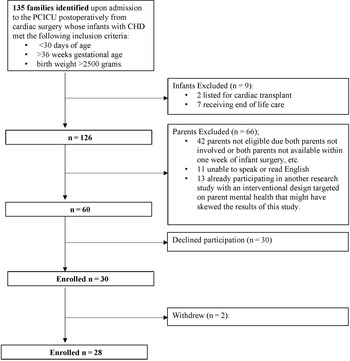
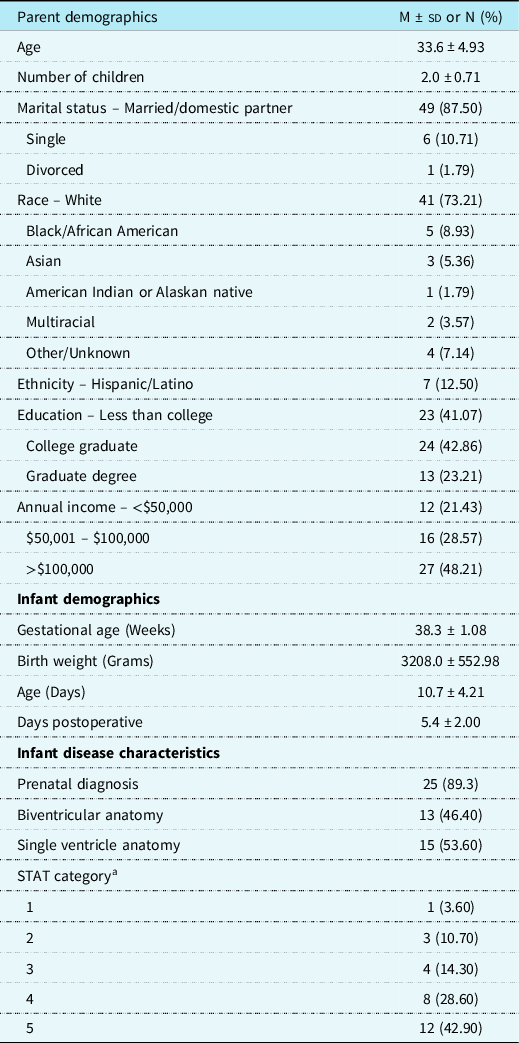
In total, 135 families were consecutively screened following their infants’ cardiothoracic surgery for CHD. Sixty families met inclusion criteria and were approached for informed consent (Fig 1). Parent consent rate was 50%, with the majority of parents declining for reasons of feeling too stressed or busy to participate or because they were already enrolled in other research studies. After initially consenting to participate, two mother–father dyads chose to withdraw from the study because they felt too busy, leaving a final sample of 28 mother–father dyads. Sample characteristics are provided in Table 1. A vast majority of the mother–father dyads were married, White, and non-Hispanic, with a minimum of a college education. There were no significant differences between mothers and fathers on any of the collected demographic characteristics.
Screening and Enrollment.

Sample characteristics

a STAT Category = Society of Thoracic Surgery–European Association for CardioThoracic Surgery Congenital Heart Surgery Mortality scoring system; M = Mean; SD = Standard Deviation; %age = percentage.
The infants of the dyads in this sample were an average of 10 days old and were approximately 5 days postoperative from their neonatal cardiac surgery at time of enrollment. They had a wide variety of defects which were relatively split between single and two ventricle physiology and most were prenatally diagnosed (89.3%). Over two-thirds of the surgeries classified into the most complex categories of 4 and 5.
Aim 1
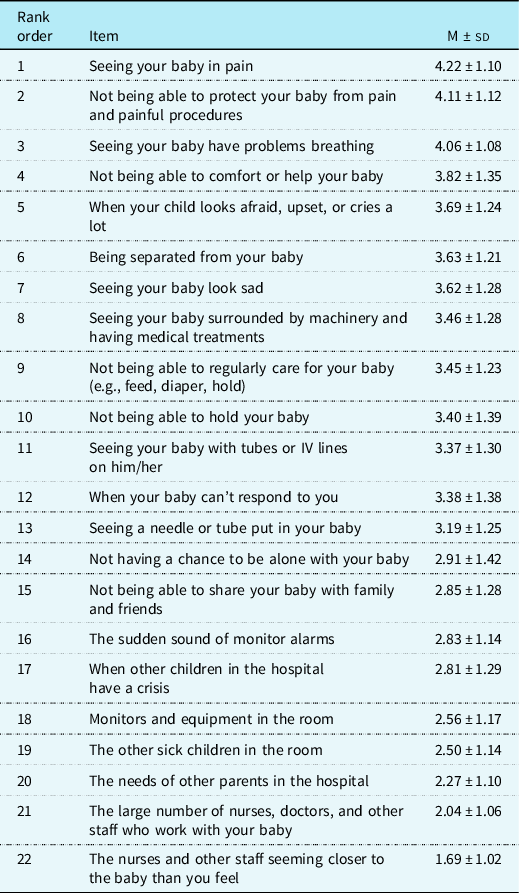
Parents’ perceived stressors according to the Parental Stressor Scale: Infant Hospitalisation were rank-ordered from most to least stressful based on average score (Table 2). Both mothers and fathers, respectively, rated the same 4 items in their top five greatest sources of stress: seeing their baby in pain (M = 4.39, sd = 1.03; M = 4.04, sd = 1.16), not being able to protect their baby from painful procedures (M = 4.31, sd = 1.07; M = 3.89, sd = 1.15), seeing their baby have breathing problems (M = 4.19, sd = 1.02; M = 3.93, sd = 1.14), not being able to comfort or help their baby (M = 4.10, sd = 1.23; M = 3.48, sd = 1.41). Parental perception of infant illness and fragility was on average 59.00 (sd = 23.40), indicating that infants tended to appear sick and/or fragile. On the Dyadic Adjustment Scale, parents rated an overall adjustment score of 126.50 (sd = 15.86) suggesting no dyad adjustment difficulties. Financial strain in the current sample was limited (M = 5.90, sd = 2.52).
Parental mean scores and rank order for parent stress scale: infant hospitalisation

M = Mean; SD = Standard deviation.
Trait-Anxiety scores were on average 35.10 (sd = 7.91), while State-Anxiety scores were higher on average at 44.80 (sd = 13.18), suggesting that parents were experiencing heightened stress related to their current situation. Parents’ symptoms of depression over the past week were 14.30 (sd = 9.36), with 48.2% of parents reporting symptom scores at or above the cutoff score, suggesting clinically significant symptoms of depression.
Aim 2
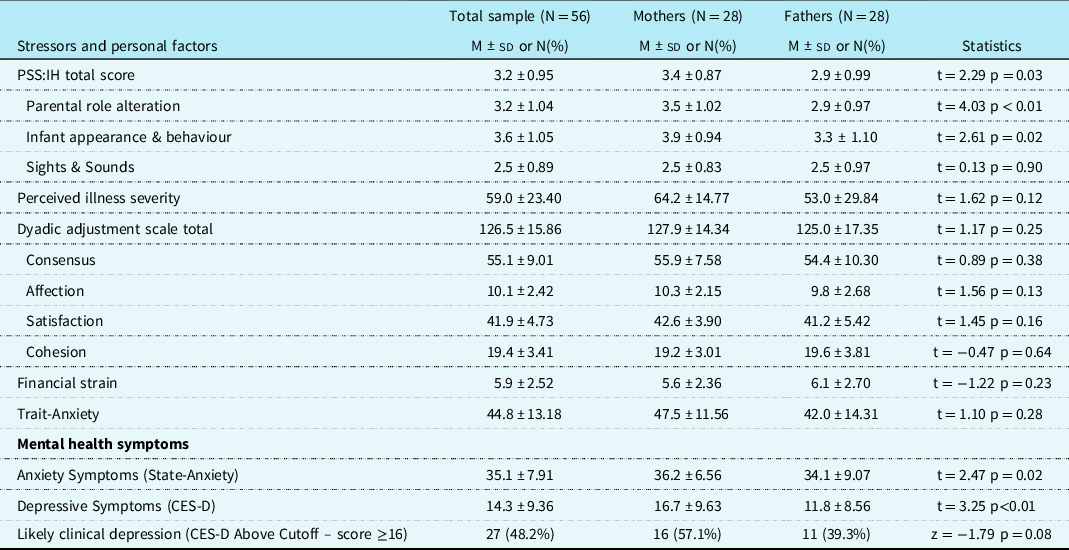
Significant differences were found between mothers and fathers in perceived stressors and mental health symptoms with average scores reported in Table 3. Compared to fathers, mothers reported higher perceived stress scores on Parental Role Alteration (t = 4.03, p < 0.01) and Infant Appearance and Behaviour (t = 2.61, p = 0.02) subscales, as well as higher total scores (t = 2.29, p = 0.03). There were no significant differences between mothers and fathers on the Sights and Sound subscale (t = 0.13, p = 0.90), perceived severity of illness (t = 1.62, p = 0.12), dyadic adjustment (t = 1.17, p = 0.25), or financial strain (t = 1.22, p = 0.23).
Perceived stressors and mental health symptoms for mothers and fathers

M = Mean; SD = Standard deviation; PSS:IH = Parent stress scale: Infant Hospitalisation; CES-D = Centre for Epidemiological Studies – Depression scale.
Anxiety symptoms as measured by State-Anxiety scores were found to be significantly higher in mothers (t = 2.47, p = 0.02), despite no significant differences between Trait-Anxiety scores (t = 1.10, p = 0.28). Mothers reported significantly more depressive symptoms than fathers (t = 3.25, p < 0.01). No significant differences were found on rates of likely clinical depression (scores≧16) between mothers and fathers (z = 1.79, p = 0.08).
Aim 3
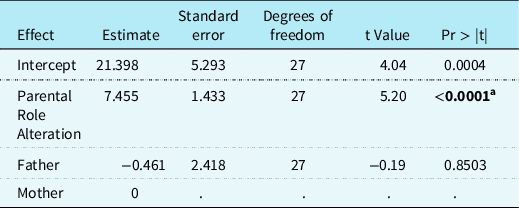
Significant associations were found between state-anxiety scores and parental role alteration, infant appearance and behaviour, and sights and sounds, perceived severity of illness, and the satisfaction subscale of the Dyadic Adjustment Scale. In the multivariable analysis, only parental role alteration significantly predicted anxiety symptoms (t = 5.20, p < 0.01, d = 0.77) such that each unit increase in parental role alteration was associated with a 7.45 unit increase in state-anxiety scores (Table 4). Sex was not a significant predictor of State-Anxiety in the multivariable analysis.
Final linear effects model of predictors of anxiety symptoms

a Effect size (Cohen’s D) Parental Role Alteration = 0.7700.
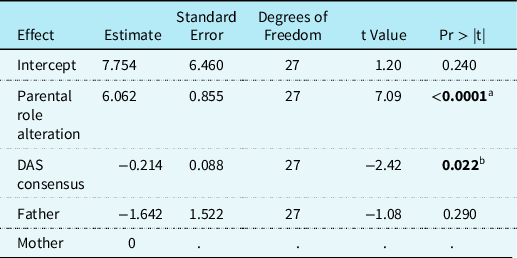
For symptoms of depression, significant associations were found with parental role alteration, infant appearance and behaviour, sights and sounds, perceived severity of illness, and the consensus subscale of the Dyadic Adjustment Scale. In multivariable analysis, parental role alteration significantly predicted depressive symptoms (t = 7.09, p < 0.01, d = 1.05), such that each unit increase in parental role alteration was associated with a 6.06 unit increase in depressive symptom scores (Table 5). The level of agreement between parents, as measured by the consensus subscale of the Dyadic Adjustment Scale, also significantly predicted depressive symptoms (t = −2.42, p = 0.02, d = 0.04), such that each unit increase in consensus was associated with a 0.21 unit decrease in CES-D score. Sex was not a significant predictor of depressive symptoms in the multivariable analysis.
Final linear effects model of predictors of depressive symptoms.

a Effect size (Cohen’s D) Parental Role Alteration = 1.0537.
b Effect size (Cohen’s D) DAS consensus = 0.037.
Discussion
This study adds to the growing body of literature documenting the extreme stress and mental health symptoms experienced by parents of infants with CHD. Mothers and fathers in this sample reported similar rankings of top stressors during the first week after their infant’s cardiac surgery for CHD. Mothers scored significantly higher on stress and mental health measures of anxiety and depressive symptoms. Additionally, the analysis comparing perceived stress and reported mental health symptoms of anxiety and depression across mother–father dyads provides the first quantitative examination between parents of the same infant. Parental role alteration significantly predicted anxiety symptoms and depressive symptoms reported by parents, regardless of sex, in the first week after their infant’s cardiac surgery with large effect sizes. These findings are consistent with research by Lisanti et al Reference Lisanti, Allen, Kelly and Medoff-Cooper14 which also found a significant relationship between parental role alteration and maternal state anxiety scores in the postoperative period in the ICU.
In addition to stress related to parental role alteration, parents described experiencing stress related to the appearance and behaviour of their infant, particularly seeing their infant have breathing problems or when their infant seems in distress or in pain. Mothers reported being more stressed than fathers by the experience of parental role alteration and the appearance and behaviour of their infants in the ICU. These findings are consistent with previous research by Franck and colleagues Reference Franck, Mcquillen and Wray13 who found that child appearance and behaviour was the highest source of stress for both mothers and fathers across several time points throughout the hospitalisation and that mothers scores were generally higher than fathers. Reference Franck, Mcquillen and Wray13 The quality of the partner relationship was also found to be predictive of mental health symptoms in parents. Specifically, lower agreement between parents was associated with increased depressive symptoms in parents, regardless of sex. These results build upon previous findings by Rychik and colleagues Reference Rychik, Donaghue and Levy38 that demonstrated that lower partner satisfaction was significantly associated with higher depression and anxiety scores in pregnant women who had received prenatal fetal CHD diagnoses. Dyadic adjustment scores in the current sample were consistent with other studies of parents who have children with life-threatening illness. Reference Lavi, Fladeboe and King43
As expected, parents in the current sample did report considerable mental health symptoms, including elevated anxiety scores, and nearly half of parents with depressive symptom scores suggestive of likely clinically depression. The results of this current study are consistent with numerous other studies that have found parents of children with CHD experience significant mental health symptoms in the form of anxiety, depression, and acute or posttraumatic stress in the weeks, months, and years after their child’s admission for surgical intervention. Reference Woolf-King, Anger, Arnold, Weiss and Teitel44 While mothers in this sample reported significantly more symptoms of anxiety and depression than fathers in this current sample, it is important to note both groups reported clinically significant symptoms of depression, including 57% of mothers and 39% of fathers. These findings are consistent with work by Bevilacqua and colleagues Reference Bevilacqua, Palatta and Mirante45 that showed that almost 50% of mothers and 20% of fathers experienced clinically significant depressive symptoms during their infant’s hospitalisation after cardiac surgery. Past research has demonstrated that mothers of infants with critical CHD are twice as likely to experience persistent depressive symptoms when compared to mothers of infants with mild to moderate CHD, from 6 to 36 months post-hospitalisation. Reference Solberg, Dale and Holmstrom46,Reference Solberg, Gronning Dale and Holmstrom47 Understanding and addressing the mental health outcomes of parents of children with critical CHD is critical as mental health symptoms can impact parent–child attachment, parents’ care seeking behaviours, and child social-emotional, developmental, and psychological well-being in the first 10 years of life. Reference O’Connor, Monk and Fitelson48 Mental health screening of parents needs to be incorporated into the standard of care in all paediatric cardiac ICUs to identify parents who are exhibiting elevated symptoms who could benefit from additional psychosocial support services. Reference Woolf-King, Anger, Arnold, Weiss and Teitel44
These results support the need for ICU practice changes aimed at ameliorating modifiable stressors faced by parents of infants admitted for cardiac surgery. Decreasing mental health symptoms in parents has the potential to improve the infant–parent relationship and developmental outcomes for the infant. Reference McCusker, Doherty and Molloy12,Reference Doherty, McCusker and Molloy49 While certain sources of stress identified by the Paediatric Cardiac ICU Parental Stress Model are not modifiable (e.g., parent sex, trait anxiety) or not easily modifiable (e.g., infant appearance/behaviour, sights and sounds of the ICU), other stressors like the experience of parental role alteration is something that can be changed. Interventions that focus on the promotion of the parental role by reducing separation of parents and their infant; advocating for holding, skin-to-skin care, and private family time; and teaching parents how to provide care within the context of a critical care environment may be key in preventing the mental health symptoms associated with the stress of having an infant with critical CHD.
While intervention-based research targeting parental stress and mental health symptoms in the paediatric cardiac ICU is limited, a recent pilot study has demonstrated the benefits of skin-to-skin holding as an intervention that is safe for infants and beneficial for mothers’ mental health. Reference Lisanti, Demianczyk and Costarino50,Reference Lisanti, Demianczyk and Costarino51 Results of that pilot indicated that mothers experienced a reduction in reported stress, anxiety symptoms, and salivary cortisol levels while engaged in skin-to-skin holding both pre- and post-operatively of their infants’ cardiac surgery. One mother-nurse partnership programme implemented in a Korean ICU that incorporated information sharing, negotiation, and participation in care demonstrated mental health benefits for mothers, including decreased anxiety. Reference Uhm and Kim52 Though a different population, evidence from the neonatal intensive care setting suggests that family-based interventions that support parental mental health, encourage sensitive and responsive parenting behaviours, and enhance coping with medical interventions can be effective and may be worth implementing in the paediatric cardiac ICU. Reference Puthussery, Chutiyami, Tseng, Kilby and Kapadia53,Reference Vanderveen, Bassler, Robertson and Kirpalani54 The findings from this study demonstrating parental role alteration as a significant contributor to both anxiety and depressive symptoms in fathers suggest that future interventional research should not limit to only mothers for a targeted study population. Psychosocial interventions aimed at relationship adjustment, especially agreement between partners may be another way to protect against mental health symptoms reported by parents. Reference Misri, Kostaras, Fox and Kostaras55
A number of limitations related to the current study warrant discussion. First, the study was a pilot and therefore only included 28 dyads from one large children’s hospital in the Northeast. Half of all dyads approached did not agree to participate and 2 dyads withdrew from the study, due to competing demands of other research studies or feeling too overwhelmed to participate within the context of their infant’s admission. As such, the results presented may not include the most distressed parents who are at greatest risk for experiencing mental health symptoms. Future research should employ study design which accommodates for potential bias in results that may occur due to the most stressed families refusing to participate. Furthermore, due to interest in the experience of mother-father dyads, the current sample did not include any single parents, adoptive parents, non-cisgender or same-sex couples. These factors limit the generalizability to all parents of infants with critical CHD. Larger sample sizes will improve generalizability of the results. Due to the nature of this pilot study and the lack of existing research pertaining to the present hypotheses, no power analysis was computed. The goal of the present study was to obtain reliable effect size estimates which will be used to inform future power calculations. According to Cohen, the effect sizes for the influence of parental role alteration on both depressive and anxiety symptoms were large. Reference Cohen56 The effect size of consensus with the dyadic adjustment scale was small, but significant. Additional research with a larger sample size that is more representative of the population of interest is warranted. Finally, this study included a visual analogue scale of parental perception of infant severity of illness due to a lack of validated measure available for this construct. Use of a validated measure would strengthen future research.
Conclusions
This study described and compared the stress experience of mothers and fathers in the paediatric cardiac ICU immediately following their infant’s cardiac surgery. Mothers and fathers reported similar stressors, but mothers reported higher perceived stress, specifically parental role alteration and infant appearance and behaviour. Mothers also reported greater anxiety and depressive symptoms, but there were no significant differences in rates of likely clinical depression among mothers and fathers. Parental role alteration was associated with both anxiety and depressive symptoms, regardless of sex. Parental relationship quality was also significantly associated with depressive symptoms. These symptoms have the potential to impact infant–parent relationship, parental coping, and outcomes post-discharge. Thus, this study provides further support for hospital-based mental health screening and targeted interventions for both mothers and fathers in order to improve outcomes for families who have an infant with CHD.
Acknowledgements
We are incredibly grateful to the families who participated in this study.
Financial support
This work was supported by a grant from the Cardiac Center at Children’s Hospital of Philadelphia. Dr. Lisanti was also supported by NINR T32NR007100.
Conflicts of interest
None.
Ethical standards
The authors assert that all procedures contributing to this work comply with the ethical standards of the relevant national guidelines on human experimentation in the United States of America and with the Helsinki Declaration of 1975, as revised in 2008, and has been approved by the Institutional Review Board at Children’s Hospital of Philadelphia.