1 Introduction
Let K be a field, and let R be a Noetherian local ring or a standard graded K-algebra with (graded) maximal ideal
 ${\mathfrak m}$
. We always assume that R is Cohen–Macaulay and admits a canonical module
 $\omega _R$
. The trace of an R-module M is defined to be the ideal
 $$\begin{align*}\operatorname{tr}_R(M)=\sum_{\varphi\in\operatorname{Hom}_R(M,R)}\varphi(M)\subseteq R. \end{align*}$$
We are interested in the trace of
 $\omega _R$
, which is called the canonical trace of R. The canonical trace determines the non-Gorenstein locus of R. Indeed,
 $R_P$
is not Gorenstein if and only if
 $\operatorname {tr}(\omega _R)\subseteq P$
.
The ring R is called nearly Gorenstein, if
 ${\mathfrak m}\subseteq \operatorname {tr}_R(\omega _R)$
. This class of rings has first been considered in [Reference Huneke and Vraciu8]. The name “nearly Gorenstein” was introduced in [Reference Herzog, Hibi and Stamate6]. A zero-dimensional local ring R is called a Teter ring, if there exists a local Gorenstein ring G such that
 $R\cong G/(0:{\mathfrak m}_G)$
. This class of rings has been introduced in 1974 by Teter [Reference Teter11]. It has been shown (see [Reference Elias and Takatuji4], [Reference Huneke and Vraciu8], [Reference Teter11]) that R is a Teter ring if and only if there exists an epimorphism
 $\varphi \colon \omega _R\rightarrow {\mathfrak m}$
. This result shows that a Teter ring is nearly Gorenstein.
On the other hand, a zero-dimensional local ring which is nearly Gorenstein need not be a Teter ring (see Theorem 6.2). Indeed, if R is nearly Gorenstein but not Gorenstein, then in general several R-module homomorphisms
 $\varphi \colon \omega _R\rightarrow R$
are required to cover
 ${\mathfrak m}$
. More generally, we define the Teter number of R to be the smallest number s for which there exist R-module homomorphisms
 $\varphi _i\colon \omega _R\rightarrow R$
such that
 $\operatorname {tr}(\omega _R)=\sum _{i=1}^s\varphi _i(\omega _R)$
. Thus, if R is not Gorenstein, then R is a Teter ring if and only if R is nearly Gorenstein with Teter number
 $1$
. This fact leads us to call a non-Gorenstein ring R to be of Teter type if its Teter number is
 $1$
.
In §2, we show that if R is generically Gorenstein, then R is not of Teter type. Therefore, since we are interested in rings of Teter type, we assume throughout the rest of the paper that
 $\dim R=0$
. Actually, we are more specific and always assume that R is a zero-dimensional local K-algebra, where K is a field.
In §3, we introduce
 $\tau $
-ideals and their companions. We call an ideal
 $I\subset R$
a
 $\tau $
-ideal (
 $\tau $
stands for Teter), if there exists an epimorphism
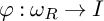 $\varphi :\omega _R\rightarrow I$
. Let
 $I\subset R$
be an ideal. A companion of I is an ideal
 $J\subset R$
such that
 $J\cong I^\vee $
. Here, for an R-module M, we set
 $M^\vee =\operatorname {Hom}_R(M,\omega _R)$
. In Theorem 3.2, it is shown that I is a
 $\tau $
-ideal if and only if I has a companion J, in which case J is also a
 $\tau $
-ideal. An ideal I is called symmetric if there exists an isomorphism
 $I\cong I^\vee $
. In Theorem 3.3, it is noted that any symmetric ideal is a
 $\tau $
-ideal. The converse is not true in general. Theorem 3.4 provides a natural
 $\tau $
-ideal of R in the case that
 $R=G/J$
, where G is a zero-dimensional Gorenstein K-algebra and
 $J\subset G$
is a nonzero ideal. A condition is given when this
 $\tau $
-ideal is symmetric. This condition is used in the proof of Theorem 3.12, which is one of the main results of this section. In Theorem 3.5, it is shown that R is of Teter type if and only if
 $\operatorname {tr}(\omega _R)$
is symmetric. From a computational point of view, this condition is not so easy to check. However, if R is a zero-dimensional standard graded or a monomial K-algebra, more tools are available. The basic observation is formulated in Theorem 3.7. It is stated that if R is a zero-dimensional standard (multi)graded K-algebra, then
 $\operatorname {tr}(\omega _R)=\sum _{\varphi \in {\mathcal S}}\varphi (\omega _R)$
, where
 ${\mathcal S}$
is the set of (multi)graded R-module homomorphisms
 $\varphi \colon \omega _R\rightarrow R$
of any (multi)degree. This result is very important for the remaining sections which are devoted to the study of monomial K-algebras. It allows us to study ideals of Teter type in terms of the underlying divisor posets, and it suggests to call a (multi)graded ring to be of Teter type in the (multi)graded sense if there exists a (multi)graded epimorphism
 $\varphi \colon \omega _R\rightarrow \operatorname {tr}(\omega _R)$
. It is clear that Teter type in the multigraded sense implies Teter type in the graded sense and this implies Teter type in the local sense. Examples show that these implications are strict. An observation of Vasconcelos [Reference Vasconcelos12] implies that if
 ${\mathbb F}$
is a free S-resolution of R and C is the kernel of
 $F_n\otimes _SR\rightarrow F_{n-1}\otimes _SR$
, then its generators can be identified with column vectors, and the entries of these column vectors generate the trace of
 $\omega _R$
. In the multigraded case, this fact can be used to describe an algorithm which allows to decide whether the ring is of Teter type (see Theorem 3.9). We conclude §3 with Theorem 3.12, in which we show that if R is a zero-dimensional graded complete intersection of embedding dimension
 $2$
with graded maximal ideal
 ${\mathfrak m}_R$
, then
 $R/{\mathfrak m}_R^k$
is of Teter type for all
 $k\geq 2 $
for which
 ${\mathfrak m}_R^k\neq 0$
.
In §§4–6, we focus especially on a zero-dimensional monomial K-algebra
 $R = S/I$
, where
 $S = K[x_1, \ldots , x_n]$
is the polynomial ring and I is a monomial ideal of S. We demonstrate various classes of zero-dimensional monomial K-algebras of Teter type. A zero-dimensional monomial K-algebra
 $R = S/I$
has a canonical monomial basis
 ${\mathcal P}$
, which consists of those monomials
 $u \in S$
with
 $u \not \in I$
. Then
 ${\mathcal P}$
is endowed with a structure of a poset (partially ordered set), ordered by divisibility. The poset
 ${\mathcal P}$
is called the divisor poset of R. The dual basis
 ${\mathcal P}^*$
is the monomial basis of
 $\omega _R$
. This basis can be endowed with a poset structure which is exactly the dual of the poset structure of
 ${\mathcal P}$
. In §4, the fundamental material presented in §§2 and 3 is discussed in the category of multigraded K-algebras in terms of poset language. One of the crucial facts in the category of multigraded K-algebras is that the union of a
 $\tau $
-ideal and any of its companions is always symmetric (see Theorem 4.4). Let
 $R = S/(x_1^{a_1+1}, \ldots , x_n^{a_n+1})$
be a monomial complete intersection, where
 $1 \leq a_1 \leq \cdots \leq a_n$
, and
 ${\mathfrak m}_R$
is the graded maximal ideal of R. One of the main results of §4 is that the quotient ring
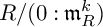 $R/(0:{\mathfrak m}_R^k)$
is of Teter type if
 $k \leq a_1$
(see Theorem 4.11). Furthermore, when
 $a_1 = \cdots = a_n = 1$
, it is shown that
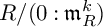 $R/(0:{\mathfrak m}_R^k)$
is of Teter type if and only if
 $k \leq n - k$
(see Theorem 4.13).
Almost complete intersections of Teter type are studied in §5. Let
 $S = K[x_1, \ldots , x_n]$
and
 $I = (x_1^{a_1}, \ldots , x_n^{a_n}, x_1^{b_1}\cdots x_n^{b_n})$
, where
 $b_i < a_i$
for all i and
 $b_i> 0$
for at least two integers i. In Theorem 5.1, it is shown that
 $\operatorname {tr}(\omega _R)$
of
 $R = S/I$
is generated by those monomials
 $x_i^{a_i - b_i}$
for which
 $b_i> 0$
and by
 $w/x_i^{b_i}$
, where
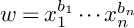 $w = x_1^{b_1}\cdots x_n^{b_n}$
. Our proof heavily depends on algebraic techniques. It would be of interest to find a simple combinatorial proof of Theorem 5.1. By virtue of Theorem 5.1, one can classify almost complete intersection monomial algebras of Teter type. In fact, Theorem 5.2 says that
 $R = S/I$
is of Teter type if and only if there exist
 $j \neq j'$
for which
 $2b_j \geq a_j$
and
 $2b_{j'} \geq a_{j'}$
.
Finally, §6 is devoted to the study of the divisor posets of simplicial complexes. Let
 $\Delta $
be a simplicial complex on
 $[n] = \{1,2,\ldots ,n\}$
. Let
 $S = K[x_1, \ldots , x_n]$
, and let
 $I_\Delta $
be the Stanley–Reisner ideal of
 $\Delta $
[Reference Herzog and Hibi5, p. 16]. We study the zero-dimensional monomial K-algebra
 $K\{\Delta \} = S/(I_\Delta , x_1^{2}, \ldots , x_n^{2})$
. We associate each
 $F \subset [n]$
with the square-free monomial
 $u_F = \prod _{i \in F} x_i$
. The divisor poset
 ${\mathcal P}_\Delta $
of
 $K\{\Delta \}$
is the finite set
 $\{ u_F : F \in \Delta \}$
with the partial order
 $\preceq $
defined by
 $u_F \preceq u_{F'}$
if
 $F' \subseteq F$
. A face F of
 $\Delta $
is called free if there is a unique facet
 $F'$
of
 $\Delta $
with
 $F \subset F'$
. A simplicial complex
 $\Delta $
is called flag if any minimal non-face of
 $\Delta $
is of cardinality
 $2$
. When
 $\Delta $
is flag, it is shown that
 $\operatorname {tr}(\omega _{K\{\Delta \}})$
is generated by the monomials
 $u_F$
for which F is a free face (see Theorem 6.1). As a special case of flag complexes, we consider the order complex
 $\Delta (L)$
of a finite distributive lattice L. It is proved that each facet F of
 $\Delta (L)$
admits a face
 $F^\sharp \in \Delta $
with the property that F is a unique facet containing
 $F^\sharp $
. It also has the property that if F is a unique facet containing a face
 $F' \in \Delta $
, then
 $F^\sharp \subset F'$
(see Theorem 6.6). Thus, in particular, the K-algebra
 $K\{\Delta (L)\}$
is of Teter type in the category of zero-dimensional local K-algebras. Furthermore, we discuss independence complexes of path graphs and cycle graphs.
2 Local rings of Teter type and Teter numbers
In this section, we show that domains of Teter type do not exist. Indeed, more generally, we have the following theorem.
Theorem 2.1. If R is generically Gorenstein, then R is not of Teter type.
Proof. If
 $\dim R=0$
, then by assumption R is Gorenstein and hence not of Teter type. Suppose now
 $\dim R>0$
. Then
 $\operatorname {height}(\operatorname {tr}(\omega _R))>0$
, since R is generically Gorenstein. On the contrary, assume R is of Teter type. Let P be a minimal prime ideal of
 $\operatorname {tr}(\omega _R)$
. Then
 $\dim R_P>0$
. Since
 $\omega _R$
as well as
 $\operatorname {tr}(\omega _R)$
localize, we may replace R by
 $R_P$
, and hence we may assume that R is a ring of Teter type with
 $\dim R>0$
and that
 $\operatorname {tr}(\omega _R)$
is
 ${\mathfrak m}$
-primary. In particular, there exists an epimorphism
 $\varphi \colon \omega _R\rightarrow \operatorname {tr}(\omega _R)$
. Since
 $\operatorname {tr}(\omega _R)$
is
 ${\mathfrak m}$
-primary, it follows that
 $R_P$
is Gorenstein for all
 $P\neq {\mathfrak m}$
. This implies that
 $\varphi _P$
is an isomorphism for all
 $P\neq {\mathfrak m}$
. Thus, if C is the kernel of
 $\varphi $
, then
 $C=0$
or
 $\operatorname {Supp}(C)=\{{\mathfrak m}\}$
. Suppose
 $C\neq 0$
, Then
 $\operatorname {depth} C=0$
, and hence also
 $\operatorname {depth} \omega _R=0$
. Since
 $\omega _R$
is a maximal Cohen–Macaulay module, it follows that
 $\dim R=0$
, a contradiction. Thus, we have shown that
 $C=0$
, which implies that
 $\varphi $
is an isomorphism.
As noticed in [Reference Herzog, Hibi and Stamate6],
 $\omega _R$
can be identified with an ideal in R, since R is generically Gorenstein and
 $\operatorname {tr}(\omega _R)=\omega _R\cdot \omega _R^{-1}$
, where
 $\omega _R^{-1}=\{x\in Q(R)\colon x\omega _R\subset R\}$
. Here,
 $Q(R)$
denotes the full ring of fractions of R. Thus, we have
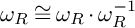 $\omega _R\cong \omega _R\cdot \omega _R^{-1}$
. This gives us
 $$\begin{align*}R=\omega_R: \omega_R\cong \omega_R :(\omega_R\cdot \omega_R^{-1})=(\omega_R :\omega_R):\omega_R^{-1}=R:\omega_R^{-1}=(\omega_R^{-1})^{-1}. \end{align*}$$
Since R is not Gorenstein, [Reference Herzog and Kunz7, korollar 7.29] implies that
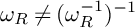 $\omega _R\neq (\omega _R^{-1})^{-1}$
, and we obtain an exact sequence
 $0\rightarrow \omega _R\rightarrow (\omega _R^{-1})^{-1}\rightarrow D\rightarrow 0$
with
 $D\neq 0$
. Since R is Gorenstein on the punctured spectrum, the inclusion map
 $\omega _R\rightarrow (\omega _R^{-1})^{-1}$
becomes an isomorphism after localization with
 $P\in \operatorname {Spec}(R)\setminus {\mathfrak m}$
. This implies that
 $\operatorname {Supp}(D)=\{{\mathfrak m}\}$
. Hence,
 $\operatorname {depth} D=0$
. Since
 $(\omega _R^{-1})^{-1}\cong R$
, it follows then that
 $\operatorname {depth} \omega _R=1$
. Thus,
 $\dim R=1$
.
Since
 $\omega _R\subset (\omega _R^{-1})^{-1}\cong R$
, we deduce that
 $(\omega _R^{-1})^{-1} =(x)$
for some
 $x\in R$
and that
 $\omega _R\subset (x)$
. Hence,
 $\omega _R=xL$
for some ideal L. Since
 $\operatorname {Ann}(\omega _R)=(0)$
, the element x must be a nonzero divisor. Therefore, L is also a canonical ideal of R. Moreover,
 $(x)=R:(R:xL) =x(R:(R:L))$
. This shows that
 $R:(R:L)=R$
. Hence, replacing
 $\omega _R$
by L, we may assume that
 $R=(\omega _R^{-1})^{-1}$
. Then
 $\omega _R^{-1} =((\omega _R^{-1})^{-1})^{-1}=R^{-1}=R$
.
The exact sequence
 $0\rightarrow \omega _R\rightarrow R \rightarrow R/\omega _R\rightarrow 0$
induces the exact sequence
 $$\begin{align*}0\rightarrow R\rightarrow \omega_R^{-1} \rightarrow \operatorname{Ext}_R^1(R/\omega_R, R)\rightarrow 0. \end{align*}$$
The map
 $R\rightarrow \omega _R^{-1}$
is the identity, since
 $\omega _R^{-1}=R$
. Therefore,
 $\operatorname {Ext}_R^1(R/\omega _R, R)=0$
. Let
 $y\in \omega _R$
be a nonzero divisor. Set
 $\overline {R}=R/(y)$
. The exact sequence
 $$\begin{align*}0\rightarrow R\stackrel{y}{\rightarrow} R\rightarrow \overline{R}\rightarrow 0 \end{align*}$$
induces the exact sequence
 $$\begin{align*}0\rightarrow \operatorname{Hom}_R(R/\omega_R, \overline{R})\rightarrow \operatorname{Ext}_R^1(R/\omega_R, R)\rightarrow \cdots, \end{align*}$$
since
 $\operatorname {Hom}_R(R/\omega _R,R)=0$
. It follows that
 $\operatorname {Hom}_R(R/\omega _R, \overline {R})=0$
. Notice that
 $R/\omega _R$
is an
 $\overline {R}$
-module, which implies that
 $\operatorname {Hom}_R(R/\omega _R, \overline {R})\cong \operatorname {Hom}_{\overline {R}}(R/\omega _R, \overline {R})$
. Thus,
 ${\operatorname {Hom}_{\overline {R}}(R/\omega _R, \overline {R})=0}$
. Since
 $\dim \overline {R}=0$
, there exists
 $c\in \overline {R}$
with
 $c\neq 0$
and
 $c\overline {{\mathfrak m}}=0$
. Here,
 $\overline {{\mathfrak m}}$
denotes the maximal ideal of
 $\overline {R}$
. The nonzero
 $\overline {R}$
-module homomorphism
 $\overline {R}\rightarrow \overline {R}$
,
 $1\mapsto c$
factorizes over
 $R/\omega _R$
. Thus,
 $\operatorname {Hom}_{\overline {R}}(R/\omega _R, \overline {R})\neq 0$
, a contradiction.
Corollary 2.2. Suppose that R is generically Gorenstein but not Gorenstein. Then the Teter number of R is
 $\geq 2$
.
For an ideal
 $I\subset R$
, we denote by
 $\mu (I)$
the minimal number of generators of I. We have the following lemma.
Lemma 2.3. The Teter number of R is
 $\leq \mu (\operatorname {tr}(\omega _R))$
.
Proof. Let
 ${\mathcal A}=\operatorname {Hom}_R(\omega _R,R)$
. Let
 $\varphi \in {\mathcal A}$
. We denote by
 $V_\varphi $
the K-subspace
 $(\varphi (\omega _R)+{\mathfrak m}\operatorname {tr}(\omega _R))/{\mathfrak m}\operatorname {tr}(\omega _R)$
of the K-vector space
 $\operatorname {tr}(\omega _R)/{\mathfrak m}\operatorname {tr}(\omega _R)$
.
We first prove by induction on n the following elementary fact: if V is any K-vector space of dimension n and
 $V=\sum _{\lambda \in \Lambda }V_\lambda $
, then there exist
 $\lambda _1,\ldots ,\lambda _n\in \Lambda $
such that
 $V=\sum _{i=1}^nV_{\lambda _i}$
. The assertion is trivial for
 $n=1$
. Now, let us assume that
 $n>1$
. There exists
 $\lambda _1\in \Lambda $
such that
 $V_{\lambda _1}\neq 0$
. Let
 $W=V/V_{\varphi _1}$
. Then W is a K-vector space of dimension
 $< n$
, and
 $\sum _{\lambda \in \Lambda , \lambda \neq \lambda _1}(V_\lambda +V_{\lambda _1})/V_{\lambda _1}=W$
. By the induction hypothesis, there exist
 $\lambda _2,\ldots ,\lambda _n$
such that
 $\sum _{i=2}^n(V_{\lambda _i}+V_{\lambda _1})/V_{\lambda _1}=W$
. It follows that
 $V=\sum _{i=1}^nV_{\lambda _i}$
.
Applying this result to our particular case, we see that there exist
 $\varphi _1,\ldots ,\varphi _n$
such that
 $(\sum _{i=1}^n\varphi _i(\omega _R))+{\mathfrak m}\operatorname {tr}(\omega _R)=\operatorname {tr}(\omega _R)$
. Nakayama’s lemma implies that
 $\sum _{i=1}^n\varphi _i(\omega _R)= \operatorname {tr}(\omega _R)$
.
One may expect a relationship between the Teter number and the Gorenstein colength
 $\operatorname {gcl}(R)$
of a ring R. Recall that any Artinian local K-algebra R is quotient of an Artinian local Gorenstein K-algebra G. Such G is called a Gorenstein cover of R. In order to measure how close is the K-algebra R to a Gorenstein ring, Ananthnarayan [Reference Ananthnarayan1] introduced the Gorenstein colength
 $\operatorname {gcl}(R)$
, which by definition is the smallest integer
 $\operatorname {\ell }(G)-\operatorname {\ell }(R)$
, where G is a Gorenstein cover of R. It is clear that R is Teter if and only if
 $\operatorname {gcl}(R) = 1$
if and only if the Teter number of R is 1.
Ananthnarayan [Reference Ananthnarayan1, Cor. 3.8] showed that
 $\operatorname {\ell }(R/\operatorname {tr}(\omega _R))\leq \operatorname {gcl}(R)$
. The rings in Theorem 3.12 all have Teter number
 $1$
, while
 $\operatorname {tr}(\omega _R)$
in all cases if a suitable power of the maximal ideal. Therefore, for these K-algebras,
 $\operatorname {gcl}(R)$
can be as big as we want.
So far, we could not find an Artinian local K-algebra for which
 $\operatorname {gcl}(R)$
is less than the Teter number of R.
In higher dimensions, one may compare the Teter number with the so-called birational Gorenstein colength. Let
 $(R, {\mathfrak m})$
be a one-dimensional local domain admitting the canonical module
 $\omega _R$
. An extension
 $S\subseteq R$
of rings is called birational if S and R have the same quotient field, and R is finitely generated as an S-module. Kobayashi [Reference Kobayashi9, Def. 1.3] introduced the birational Gorenstein colength, denoted
 $\operatorname {bg}(R)$
, as the smallest integer
 $\operatorname {\ell }_G(R/G)$
, where G is a Gorenstein ring such that
 $G\subseteq R$
is a birational extension. In contrast to the Gorenstein colength, one easily finds a ring whose birational Gorenstein colength is smaller than its Teter number. For example, let K be a field and consider the subring
 $R=K[|t^3,t^4,t^5|]$
of the formal power series ring
 $K[|t|]$
over K in the variable t. By Corollary 2.2, the Teter number of R is
 $\geq 2$
, since R is not Gorenstein. The subring
 $G=K[|t^3,t^4|]$
of R is Gorenstein, the extension
 $G\subseteq R$
is birational, and
 $\operatorname {\ell }(R/G)=1$
. This implies that
 $\operatorname {bg}(R)=1$
.
3
 $\tau $
-ideals and their companions for zero-dimensional local K-algebras

Let K be a field, and let R be a zero-dimensional local K-algebra. Then R admits a canonical module
 $\omega _R$
. In fact,
 $\omega _R=R^\vee $
, where
 $R^\vee =\operatorname {Hom}_K(R,K)$
. Let M be a finitely generated R-module. Then we set
 $M^\vee =\operatorname {Hom}_K(M,K)$
. One has
 $$\begin{align*}M^\vee =\operatorname{Hom}_R(M,\omega_R) \quad \text{and} \quad (M^\vee)^\vee =M. \end{align*}$$
Remark 3.1. It is well known (see, e.g., [Reference Herzog and Kunz7, satz 6.10]) that the minimal number of generators
 $\mu (M)$
of M is equal to the socle dimension
 $\sigma (M^{\vee })$
of
 $M^{\vee }$
.
Let
 $I\subset R$
be an ideal. A companion of I is an ideal
 $J\subset R$
such that
 $J\cong I^\vee $
. An ideal I is called a
 $\tau $
-ideal, if there exists an R-module homomorphism
 $\varphi \colon \; \omega _R\rightarrow R$
with
 $\varphi (\omega _R)=I$
.
Lemma 3.2. Let
 $I\subset R$
be an ideal. Then I is a
 $\tau $
-ideal if and only if I has a companion J. In that case, J is also a
 $\tau $
-ideal.
Proof. Suppose I is a
 $\tau $
-ideal. Then there exists an epimorphism
 $\varphi :\omega _R\rightarrow I$
. This epimorphism induces a monomorphism
 $\varphi ^\vee \colon I^\vee \rightarrow R$
. Let J be the image of
 $I^\vee \subseteq R$
. Then J is an ideal in R and J is isomorphic to
 $I^\vee $
. Hence, J is a companion of I.
Let J be a companion of I. Then there exists an isomorphism
 $\alpha : I^\vee \rightarrow J$
. The inclusion map
 $I\rightarrow R$
induces an epimorphism
 $\psi \colon \omega _R\rightarrow I^\vee $
. Then
 $\varphi =\alpha \circ \psi : \omega _R \rightarrow J$
is an epimorphism. Hence, J is a
 $\tau $
-ideal.
Moreover, if I has a companion
 $J'$
, then
 $J'\cong I^\vee $
, and so
 $I\cong (J')^\vee $
. Therefore, I is a companion of
 $J'$
. Hence, I is a
 $\tau $
-ideal.
An ideal
 $I\subset R$
is called symmetric, if there exists an isomorphism
 $\gamma \colon \; I\rightarrow I^\vee $
. In other words, I is symmetric if I is a companion of I.
Corollary 3.3. Let
 $I\subseteq R$
be a symmetric ideal. Then I is a
 $\tau $
-ideal.
Not all
 $\tau $
-ideals are symmetric (see Example 4.3).
Proposition 3.4. Let G be a zero-dimensional local Gorenstein K-algebra, let
 $J\subset G$
be a nonzero ideal, and let
 $R=G/J$
. Then
 $I=((0:J)+J)/J\subset R$
is a
 $\tau $
-ideal. Moreover, I is symmetric if
 $J\subset 0:J$
.
Proof. Note that
 $\omega _R=\operatorname {Hom}_G(R,G)\cong 0:J$
. The composition of the inclusion map
 $0:J\subset G$
with the canonical epimorphism
 $G\rightarrow R$
yields an R-module homomorphism
 $\omega _R\rightarrow R$
whose image is
 $I=((0:J)+J)/J$
. Thus, I is a
 $\tau $
-ideal.
Assume now that
 $J\subset 0:J$
. Then
 $I=(0:J)/J$
, and we have the exact sequence
 $$\begin{align*}0\rightarrow (0:J)/J\rightarrow G/J\rightarrow G/(0:J)\rightarrow 0. \end{align*}$$
Since G is Gorenstein, the functor
 $\operatorname {Hom}_G(-, G)$
is exact. Applying this functor to the above exact sequence, we obtain the exact sequence
 $$\begin{align*}0\rightarrow\operatorname{Hom}_G(G/(0:J), G) \rightarrow \operatorname{Hom}_G(G/J, G)\rightarrow\operatorname{Hom}_G((0:J)/J, G)\rightarrow 0. \end{align*}$$
Observe that
 $\operatorname {Hom}_G(G/(0:J), G)\cong 0:(0:J)=J$
, since G is Gorenstein. Furthermore,
 $\operatorname {Hom}_G(G/J, G)\cong 0:J$
and
 $\operatorname {Hom}_G((0:J)/J, G)= ((0:J)/J)^\vee $
. This shows that
 $(0:J)/J\cong ((0:J)/J)^\vee $
, as desired.
Recall that R is of Teter type, if there exists an epimorphism
 $\varphi \colon \omega _R\rightarrow \operatorname {tr}(\omega _R)$
.
The following proposition generalizes [Reference Huneke and Vraciu8, Th. 2.1], where it is shown that the maximal ideal
 ${\mathfrak m}$
is symmetric if and only if R is a Teter ring. Note that in a Teter ring R, the maximal ideal is the trace of
 $\omega _R$
.
Proposition 3.5. The following conditions are equivalent:
-
(a) R is of Teter type.
-
(b)
$\operatorname {tr}(\omega _R)$
is symmetric.

Proof. (a)
 $\Rightarrow $
(b): If R is of Teter type, then
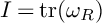 $I=\operatorname {tr}(\omega _R)$
is a
 $\tau $
-ideal, and so I has a companion J. By Theorem 3.2, J is also a
 $\tau $
-ideal, which implies that
 $J\subseteq \operatorname {tr}(\omega _R)=I$
. Since
 $J\cong I^\vee $
, it follows that
 $\dim _KJ=\dim _KI$
. Thus, we conclude that
 $J=I$
. This means that I is symmetric.
(b)
 $\Rightarrow $
(a):
 $\operatorname {tr}(\omega _R)$
is symmetric, then
 $\operatorname {tr}(\omega _R)$
is a
 $\tau $
-ideal (see Theorem 3.3). This means that R is of Teter type.
We assume for a moment that R is a local ring and that M is a finitely generated R-module. As observed by Vasconcelos [Reference Vasconcelos12], the trace of a module M can be computed as follows: we choose a free presentation
 $$\begin{align*}G\stackrel{A}{\rightarrow}F\rightarrow M\rightarrow 0 \end{align*}$$
with finitely generated free R-modules F and G, where A is the matrix describing the R-module homomorphism
 $G\rightarrow F$
with respect to the basis
 $f_1,\ldots , f_n$
of F and the basis
 $g_1,\ldots , g_m$
of G. Note that A is an
 $n\times m$
matrix. Let
 ${\mathbf b}=(b_1,\ldots ,b_n)$
be a vector with entries in R. Then
 ${\mathbf b}$
defines an R-module homomorphism
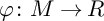 $\varphi \colon M\rightarrow R$
if and only if
 ${\mathbf b} A=0$
. Thus,
 $\operatorname {tr}(M)$
is generated by the entries of all the vectors
 ${\mathbf b}$
with
 ${\mathbf b} A=0$
, equivalently, by all column vectors
 ${\mathbf b}^{\mathsf {T}}$
such that
 $A^{\mathsf {T}}{\mathbf b}^{\mathsf {T}}=0$
. The corresponding statements hold for graded rings and graded modules.
Assume now that
 $R=S/I$
is a zero-dimensional standard graded K-algebra with
 $S=K[x_1,\ldots ,x_n]$
the polynomial ring. Let
 $$\begin{align*}0\rightarrow F_n \rightarrow F_{n-1} \rightarrow \cdots \rightarrow F_1\rightarrow F_0\rightarrow R\rightarrow 0 \end{align*}$$
be a graded free S-resolution of R. We do not insist that this resolution is minimal, but only require that the length of this resolution coincides with the projective dimension of R (which is equal to n). We denote by
 $N^*$
the S-dual of an S-module N. It is well known (see [Reference Bruns and Herzog2]) that the S-dual of
 $F_n \rightarrow F_{n-1}$
provides a graded free presentation of the S-module
 $\omega _R$
. That is, we have an exact sequence
 $ F_{n-1}^*\rightarrow F_{n}^*\rightarrow \omega _R. $
Tensorizing this sequence of S-modules with R, we obtain a free R-module presentation of
 $\omega _R$
, and we may apply the above mentioned observation of Vasconcelos. Let
 $e_1,\ldots ,e_m$
be a basis of
 $F_n$
, which is also a basis of
 $F_n\otimes _SR$
. Then, for
 $F_n^*\otimes _SR$
, we have the dual basis
 $e_1^*,\ldots ,e_m^*$
and an epimorphism
 $\epsilon : F_n^*\otimes _SR\rightarrow \omega _R$
. Let
 $\omega _i=\epsilon (e_i^*)$
. Then an element
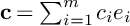 ${\mathbf c}=\sum _{i=1}^m c_ie_i$
belongs to
 $C=\operatorname {Ker}(F_n\otimes _SR\rightarrow F_{n-1}\otimes _SR)$
if and only if the assignment
 $\varphi (\omega _i)=c_i$
for
 $1\leq i\leq m$
defines an R-module homomorphism
 $\varphi : \omega _R\rightarrow R$
.
Let
 ${\mathbf c}_1,\ldots ,{\mathbf c}_r$
be a generating set of C with
 ${\mathbf c}_j=(c_{1j},\ldots ,c_{mj})^{\mathsf {T}}$
. Consider the
 $m\times r$
matrix
 $E=(c_{ij})$
which we denote again by C. The discussion above shows that each of the column vectors
 ${\mathbf c}_j$
of E defines an R-module homomorphism
 $\varphi _j:\omega _R\rightarrow R$
and any other R-module homomorphism
 $\varphi :\omega _R\rightarrow R$
is an R-linear combination of
 $\varphi _1,\ldots ,\varphi _r$
. Hence, we conclude the following proposition.
Proposition 3.6. Let E be a matrix representing the kernel of
 $F_n\otimes _SR\rightarrow F_{n-1}\otimes _SR$
. Then the entries of E generate
 $\operatorname {tr}(\omega _R)$
.
Assume now that
 $R=S/I$
is a zero-dimensional standard (multi)graded K-algebra. Then R admits a (multi)graded free S-resolution
 ${\mathbb F}$
of length n. Moreover,
 $\omega _R$
admits a (multi)graded free S-resolution
 ${\mathbb F}^*$
. Let
 $e_1,\ldots ,e_r$
be a homogeneous basis of
 $F_n$
. A column vector
 ${\mathbf c}=(c_1,\ldots ,c_r)^{\mathsf {T}}\in C$
is homogenous if
 $\deg (c_i)+\deg (e_i)$
does not depend on i for all i with
 $c_i\neq 0$
. This common value is called the degree of
 ${\mathbf c}$
. The homogeneous column vectors generate C. The map
 $\varphi :\omega _R\rightarrow R$
corresponding to a given homogeneous column vector
 ${\mathbf c}$
has (multi)degree
 $\deg ({\mathbf c})$
. Resuming what we discussed so far, we have the following corollary.
Corollary 3.7. Let R be a zero-dimensional standard (multi)graded K-algebra. Then
 $\operatorname {tr}(\omega _R)=\sum _{\varphi \in {\mathcal S}}\varphi (\omega _R)$
, where
 ${\mathcal S}$
is the set of graded, respectively, multigraded R-module homomorphisms
 $\varphi \colon \omega _R\rightarrow R$
(not necessarily of degree zero).
Suppose again that R is graded. Then we say that
 $I\subset R$
is a
 $\tau $
-ideal if there exists a graded R-module homomorphism
 $\varphi \colon \omega _R\rightarrow R$
with
 $I=\varphi (\omega _R)$
. Similarly, if M is a finitely generated graded R-module, then
 $M^\vee $
is defined to be the module of graded R-module homomorphisms
 $\operatorname {Hom}_K(M,K)$
. In particular, there is a graded version for all the concepts and the results introduced before. Similar statements apply when R is a monomial K-algebra.
Note that any zero-dimensional monomial K-algebra is graded, and any graded K-algebra is local. Thus, we have
 $$\begin{align*}\text{Teter type in the}\ {\mathbb Z}^n\text{-graded sense}\Rightarrow \text{Teter type in the graded sense}\Rightarrow \text{Teter type}. \end{align*}$$
These implications are strict, as is shown in Theorem 5.3.
With the assumptions and notation of Theorem 3.7, we have the following corollary.
Corollary 3.8. The K-algebra R is of Teter type, if and only if there exists a homogeneous column vector
 ${\mathbf c}\in C$
such that the entries of
 ${\mathbf c}$
and the entries of C generate the same ideal.
A stronger statement as the one given in Theorem 3.8 can be made when R is a zero-dimensional monomial K-algebra.
Corollary 3.9. Assume that K is an infinite field, and let R be a zero-dimensional monomial K-algebra. Let
 ${\mathbf c}_1,\ldots ,{\mathbf c}_m$
be a system of generators of C, and let E be the matrix whose column vectors are
 ${\mathbf c}_1,\ldots ,{\mathbf c}_m$
. For each
 ${\mathbf a}\in {\mathbb Z}^n$
, let
 $E_{\mathbf a}$
be the submatrix of E consisting of the column vectors
 ${\mathbf c}_i$
with
 $\deg ({\mathbf c}_i)={\mathbf a}$
. Then R is of Teter type if and only if for some
 ${\mathbf a}\in {\mathbb Z}^n$
, the entries of
 $E_{\mathbf a}$
and the entries of E generate the same ideal.
Proof. For given
 ${\mathbf a}\in {\mathbb Z}^n$
, let
 ${\mathbf c}_{i_1},\ldots ,{\mathbf c}_{i_k}$
be the column vectors of
 $E_{\mathbf a}$
. Since these column vectors are homogeneous, it follows that
 ${\mathbf c}_{i_j}=(\lambda _{1j}u_1,\ldots ,\lambda _{rj}u_r)^{\mathsf {T}}$
for
 $j=1,\ldots ,k$
with
 $\lambda _{sj}\in K$
for
 $s=1,\ldots , r$
. Since K is infinite, we may choose
 $\mu _1,\ldots , \mu _k\in K$
such that
 $\sum _{j=1}^k\mu _j\lambda _{sj}\neq 0$
for those s for which there exists j with
 $\lambda _{sj}\neq 0$
. Then the ideal generated by the entries of the column vector
 ${\mathbf c}=\sum _{j=1}^k\mu _j{\mathbf c}_{i_j}$
is the same as the ideal generated by the entries of
 $E_{\mathbf a}$
, and the desired conclusion follows from Theorem 3.8.
Let
 ${\mathbb F}$
is a minimal (multi)graded free resolution of R of length n, as before. Then, in the graded case,
 $\operatorname {Soc}(R)$
is generated by polynomials
 $f_1,\ldots ,f_r$
with
 $\deg (f_i)=\deg (e_i)-n$
, and, in the multigraded case,
 $\operatorname {Soc}(R)$
is generated by the monomials
 $x^{{\mathbf a}_i}/(x_1\cdots x_n)$
, where
 ${\mathbf a}_i=\deg (e_i)$
.
Note that Theorem 3.9, compared with Theorem 3.8, has the advantage that we do not have to search for a suitable column vector to check whether R is of Teter type, but only need to look at the finitely many graded components of C. The following examples demonstrate the method.
Example 3.10. Consider
 $R=K[x,y]/(x^4,y^4,x^2y^2)$
. Computations in Macaulay2 show that the corresponding matrix is
 $ E= \begin {pmatrix} y^2 & 0 & 0 & x^2\\ 0 & x^2 & y^2 & 0 \end {pmatrix} $
. Let
 ${\mathbb F}$
be the multigraded minimal free resolution of R. Since
 $\operatorname {Soc}(R)=(x^3y,xy^3)$
,
 $F_2$
has a homogeneous basis
 $e_1$
and
 $e_2$
with
 $\deg (e_1)=(4,2)$
and
 $\deg (e_2)=(2,4)$
.
 $$ \begin{align*}\begin{pmatrix} x^4y^2 & x^2y^4\\ \end{pmatrix} \cdot \begin{pmatrix} y^2 & 0 & 0 & x^2\\ 0 & x^2 & y^2 & 0 \end{pmatrix} = \begin{pmatrix} x^4y^4 & x^4y^4 & x^2y^6 & x^6y^2\\ \end{pmatrix} ,\end{align*} $$
which means that the maps given by the first and second columns of E both have multidegree
 $x^4y^4$
, the map given by the third column of M has multidegree
 $x^2y^6$
, and the map given by the fourth column of E has multidegree
 $x^6y^2$
. From E, we also know that
 $\operatorname {tr}(\omega _R)=(x^2,y^2)$
. Note that the ideal generated by monomials from the first and second columns of E is exactly
 $(x^2,y^2)$
, which proves that R is of Teter type.
Example 3.11. Consider
 $R=K[x,y]/(x^3,y^3,xy)$
. Computations in Macaulay2 show that the corresponding matrix is
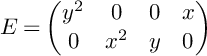 $ E= \begin {pmatrix} y^2 & 0 & 0 & x\\ 0 & x^2 & y & 0 \end {pmatrix} $
. Let
 ${\mathbb F}$
be the multigraded minimal free resolution of R. Since
 $\operatorname {Soc}(R)=(x^2,y^2)$
,
 $F_2$
has a homogeneous basis
 $e_1$
and
 $e_2$
with
 $\deg (e_1)=(3,1)$
and
 $\deg (e_2)=(1,3)$
.
 $$ \begin{align*}\begin{pmatrix} x^3y & xy^3\\ \end{pmatrix} \cdot \begin{pmatrix} y^2 & 0 & 0 & x\\ 0 & x^2 & y & 0 \end{pmatrix} = \begin{pmatrix} x^3y^3 & x^3y^3 & xy^4 & x^4y\\ \end{pmatrix} ,\end{align*} $$
which means that the maps given by the first and second columns of E both have multidegree
 $x^3y^3$
, the map given by the third column of E has multidegree
 $xy^4$
, and the map given by the fourth column of E has multidegree
 $x^4y$
. From E, we also know that
 $\operatorname {tr}(\omega _R)=(x,y)$
. Note that the ideal generated by monomials from the first and second columns of E is
 $(x^2,y^2)$
, the ideal generated by monomials in the third column of E is
 $(y)$
, and the ideal generated by monomials in the fourth column of E is
 $(x)$
. This proves that R is not of Teter type.
We apply the theory, as developed so far, to show the following theorem.
Theorem 3.12. Let
 $f, g\in S=K[x,y]$
be a regular sequence of homogeneous polynomials with
 $\deg (f)=a$
and
 $\deg (g)=b$
, and let
 $G=S/(f,g)$
be the complete intersection ring with graded maximal ideal
 ${\mathfrak n}$
. Assume further that K is infinite or that f and g are monomials. Then, for each integer
 $1\leq k \leq a+b-2$
, the K-algebra
 $R=G/{\mathfrak n}^k$
is of Teter type.
Proof. We may assume that
 $a\leq b$
. Let
 ${\mathfrak m}_R$
be the maximal ideal of R. We claim that
 $$\begin{align*}\operatorname{tr}(\omega_R)= \begin{cases} {\mathfrak m}_R^{k-1}, & \text{if } k\leq a,\\[3pt] {\mathfrak m}_R^{a-1}, & \text{if } a<k\leq b,\\[3pt] {\mathfrak m}_R^{a+b-1-k}, & \text{if } k>b, \end{cases} \end{align*}$$
and that
 $\operatorname {tr}(\omega _R)$
is symmetric in all these cases. This then shows that R is of Teter type.
Assume first that
 $k\leq a$
. Then
 $R=S/(x,y)^k$
, and
 $$\begin{align*}0\rightarrow S(-k-1)^k\stackrel{A}{\longrightarrow}S(-k)^{k+1}\rightarrow (x,y)^k\rightarrow 0 \end{align*}$$
is the resolution of
 $(x,y)^k$
. Here, A is the
 $(k+1)\times k$
-matrix
 $$\begin{align*}\begin{pmatrix} y & 0& \cdots&\cdots & 0\\ -x & y& \cdots & \cdots & 0\\ 0 & -x &\ddots &\cdots& 0\\ \vdots& \vdots& \ddots &\ddots &\vdots\\ 0& 0& \cdots&\ddots & y\\ 0& 0& \cdots&\cdots & -x\\ \end{pmatrix}. \end{align*}$$
By Theorem 3.6, the entries of the kernel of
 $R^k\stackrel {A}{\longrightarrow }R^{k+1}$
generate
 $\operatorname {tr}(\omega _R)$
. Let
 $(f_1,\ldots ,f_k)^{\mathsf {T}}$
be in the kernel of this map. We may assume that all
 $f_i$
are homogeneous. Since
 $yf_1=0$
, it follows that
 $\deg (f_1)\geq k-1$
, and hence
 $f_1\in {\mathfrak m}_R^{k-1}$
. Next, we have
 $-xf_1+yf_2=0$
. Since
 $xf_1=0$
, it follows that
 $yf_2=0$
. As before, we deduce that
 $f_2\in {\mathfrak m}_R^{k-1}$
. Proceeding in the way, we see that
 $f_i\in {\mathfrak m}_R^{k-1}$
for all i. This shows that
 $\operatorname {tr}(\omega _R)={\mathfrak m}_R^{k-1}$
. Note that
 ${\mathfrak m}_R^{k-1}=\operatorname {Soc}(R)$
. It is obvious that
 $\operatorname {Soc}(R)$
is a symmetric ideal.
In the next steps, we show that
 ${\mathfrak m}_R^{a-1}$
is a symmetric
 $\tau $
-ideal of R if
 $a<k\leq b$
, and that
 ${\mathfrak m}_R^{a+b-k-1}$
is a symmetric
 $\tau $
-ideal of R if
 $k>b$
. Indeed, if
 $a<k\leq b$
, then
 $R=S/(f, (x,y)^k)$
. Hence, we may write
 $R =\widetilde {G}/\tilde {{\mathfrak n}}^k$
, where
 $\widetilde {G}=S/(f,p)$
is a complete intersection and p is a minimal generator of
 $(x,y)^k$
and
 $\tilde {{\mathfrak n}}$
is the maximal ideal of
 $\tilde {G}$
. Indeed, if K is infinite, then a nonzero divisor p modulo f can be found among the generators of
 $(x,y)^k$
. On the other hand, if f and g are monomials, then each of them is a pure power, say
 $f=x^a$
. In this case, we may choose
 $p=y^k$
. The socle degree of this complete intersection is
 $a+k-2$
. It follows that
 $0: \tilde {{\mathfrak n}}^k=\tilde {{\mathfrak n}}^{a-1}$
. Since
 $\tilde {{\mathfrak n}}^k\subset 0: \tilde {{\mathfrak n}}^k$
, the desired conclusion follows from Theorem 3.4. Next, assume
 $k>b$
. Then, in the ring G, we have
 $0:{\mathfrak n}^k={\mathfrak n}^{a+b-1-k}$
, because the socle degree of G is
 $a+b-2$
. Since
 ${\mathfrak n}^k\subset {\mathfrak n}^{a+b-1-k}$
, the desired conclusion follows again from Theorem 3.4.
It remains to be shown that any
 $\tau $
-ideal is contained in
 ${\mathfrak m}_R^{a-1}$
if
 $a<k\leq b$
, and is contained in
 ${\mathfrak m}_R^{a+b-1-k}$
if
 $k>b$
.
Let us first treat the case in which
 $a<k\leq b$
. Then
 $R=S/(f,{\mathfrak m}^k)$
, and since
 ${\mathfrak m}^k:(f)={\mathfrak m}^{k-a}$
, we obtain the exact sequence
 $$\begin{align*}0\rightarrow (S/({\mathfrak m}^{k-a}))(-a)\rightarrow S/{\mathfrak m}^k\rightarrow R\rightarrow 0. \end{align*}$$
Let
 ${\mathbb F}$
be the minimal graded resolution of
 ${\mathfrak m}^k$
, and let
 ${\mathbb G}$
be the minimal graded free resolution of
 $(S/({\mathfrak m}^{k-a}))(-a)$
. The multiplication map given by f can be lifted to a graded complex homomorphism
 ${\mathbb G}\rightarrow {\mathbb F}$
, so that we obtain a commutative diagram

Since the multiplication map
 $S(-a)\stackrel {f}{\longrightarrow } S$
is injective, it follows that, for any element
 $g\in (G_1)_k$
, we have that
 $\alpha (g)\neq 0$
. From this, it can be seen that
 $\alpha $
is injective. Similarly,
 $\beta $
is injective. In fact,
 $\alpha $
and
 $\beta $
are split injective, because by degree reasons, their image is a direct summand of
 $S(-k)^{k+1}$
and
 $S(-k-1)^{k}$
, respectively.
Let
 ${\mathbb D}$
be the mapping cone of
 ${\mathbb G}\rightarrow {\mathbb F}$
. Then we obtain the short exact sequence of complexes
 $$\begin{align*}0\longrightarrow {\mathbb F}\otimes_SR\longrightarrow {\mathbb D}\otimes_SR\longrightarrow {\mathbb G}[-1]\otimes_SR\longrightarrow 0, \end{align*}$$
where
 ${\mathbb G}[-1]$
is the complex
 ${\mathbb G}$
with the homological shift
 $-1$
. In other words,
 ${\mathbb G}[-1]_i=G_{i-1}$
for all i. This short exact sequence gives rise to the long exact sequence
 $$\begin{align*}\cdots \rightarrow H_2({\mathbb F}\otimes_SR)\longrightarrow H_2({\mathbb D}\otimes_SR)\longrightarrow H_1({\mathbb G}\otimes_SR)\rightarrow H_1({\mathbb F}\otimes_SR)\rightarrow \cdots. \end{align*}$$
The map
 $H_1({\mathbb G}\otimes _SR)\rightarrow H_1({\mathbb F}\otimes _SR)$
is a connecting homomorphism in the long exact sequence and is induced by
 $\alpha \otimes _S R$
. Since
 $\alpha $
is split injective, it follows that
 $\alpha \otimes _S R$
is split exact as well. Therefore,
 $H_1({\mathbb G}\otimes _SR)\rightarrow H_1({\mathbb F}\otimes _SR)$
is injective. This implies that
 $H_2({\mathbb F}\otimes _SR)\rightarrow H_2({\mathbb D}\otimes _S R)$
is surjective. Since
 ${\mathbb D}$
is a graded free S-resolution of R, it follows that
 $H_2({\mathbb D}\otimes _S R)\cong \operatorname {Tor}^S_2(R,R)$
as graded R-modules. Hence, we have a graded epimorphism
 $H_2({\mathbb F}\otimes _SR)\rightarrow \operatorname {Tor}^S_2(R,R)$
.
The graded minimal free S-resolution of R is given as
 $0\rightarrow F_2/G_2\rightarrow F_1/G_1\oplus S(-a)\rightarrow S\rightarrow 0$
, and hence it has the form
 $$\begin{align*}\overline{{\mathbb D}}\colon 0\rightarrow S(-k-1)^a\rightarrow S(-k)^a\oplus S(-a)\rightarrow S\rightarrow 0. \end{align*}$$
This yields the exact sequence
 $0\rightarrow \operatorname {Tor}^S_2(R,R)\rightarrow R(-k-1)^a\rightarrow R(-k)^a\oplus R(-a)$
, and by using the result of Vasconcelos, we need to show that
 $\operatorname {Tor}^S_2(R,R)_{d+k+1}=0$
for
 $d<a-1$
. For this, it suffices to show that
 $H_2({\mathbb F}\otimes _SR)_{d+k+1}=0$
for
 $d<a-1$
.
Note that
 $H_2({\mathbb F}\otimes _S R)$
is the kernel of
 $R(-k-1)^k\rightarrow R(-k)^{k+1}$
. Hence, we get the exact sequence
 $ H_2({\mathbb F}\otimes _S R)_{d+k+1}\rightarrow R_d^k\rightarrow R_{d+1}^k. $
Since
 $d<a-1$
, it follows that
 $R_d=S_d$
and
 $R_{d+1}=S_{d+1}$
, so that
 $0\rightarrow H_2({\mathbb F}\otimes _S R)_{d+k+1}\rightarrow S_d^k\rightarrow S_{d+1}^k$
is exact. Since
 $S(-k-1)^k\rightarrow S(-k)^{k+1}$
is injective, we deduce that
 $H_2({\mathbb F}\otimes _S R)_{d+k+1}=0$
, as desired.
Now, we deal with the case
 $k>b$
. If
 $k=a+b-2$
, then R is even a Teter ring, and we are done. Thus, we may now assume that
 $b<k\leq a+b-1$
. Then we have the following exact sequence:
 $$\begin{align*}0\rightarrow (S/(f,{\mathfrak m}^k):(g))(-b)\rightarrow S/(f,{\mathfrak m}^k)\rightarrow R\rightarrow 0. \end{align*}$$
Let
 $h\in (f,{\mathfrak m}^k):(g)$
be a homogeneous polynomial with
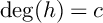 $\deg (h)=c$
. Then
 $hg\in (f,{\mathfrak m}^k)$
. If
 $c+b<k$
, then
 $hg=h'f$
for some
 $h'\in S$
. Since
 $f,g$
is a regular sequence, it follows then that f divides h, and this implies that
 $h\in (f,{\mathfrak m}^k)$
. On the other hand, if
 $c+b\geq k$
, then
 $hg\in {\mathfrak m}^k$
. Therefore,
 $h\in {\mathfrak m}^{k-b}$
, and hence
 $(f,{\mathfrak m}^k):(g)=(f,{\mathfrak m}^{k-b})$
. Since
 $k\leq a+b-1$
, it follows that
 $(f,{\mathfrak m}^k):(g)=(f,{\mathfrak m}^{k-b})={\mathfrak m}^{k-b}$
, and we obtain the exact sequence
 $$\begin{align*}0\rightarrow (S/({\mathfrak m}^{{k-b}}))(-b)\rightarrow S/(f,{\mathfrak m}^k)\rightarrow R\rightarrow 0. \end{align*}$$
The map
 $(S/({\mathfrak m}^{k-b}))(-b)\stackrel {g}{\rightarrow } S/(f,{\mathfrak m}^k)$
can be extended to a complex homomorphism
 ${\mathbb H}\rightarrow {\mathbb D}$
with
 $\alpha \colon H_1\rightarrow D_1$
and
 $\beta \colon H_2\rightarrow D_2$
split injective. Here,
 $$ \begin{align*}{\mathbb H}: 0\rightarrow (-k-1)^{k-b} \rightarrow S(-k)^{k-b+1}\rightarrow S(-1)\rightarrow 0\end{align*} $$
is the free S-resolution of
 $(S/({\mathfrak m}^{k-b}))(-b)$
and
 ${\mathbb D}$
is the mapping cone from before. Composing
 ${\mathbb H}\rightarrow {\mathbb D}$
with the complex homomorphism
 ${\mathbb D}\rightarrow \overline {{\mathbb D}}$
onto the graded minimal free S-resolution of
 $S/(f,{\mathfrak m}^k)$
, we obtain a commutative diagram

with
 $\alpha '$
and
 $\beta '$
split injective. This yields a minimal free S-resolution of R which is of the form
 $$\begin{align*}0\rightarrow S(-k-1)^{a+b-k}\rightarrow S(-k)^{a+b-1-k}\oplus S(-b)\oplus S(-a)\rightarrow S\rightarrow 0. \end{align*}$$
Let
 ${\mathbb E}$
be the mapping cone of the complex homomorphism
 ${\mathbb H}\rightarrow {\mathbb D}$
. Then we obtain the short exact sequence of complexes
 $$\begin{align*}0\rightarrow {\mathbb D}\otimes_SR\rightarrow {\mathbb E}\otimes_SR\rightarrow {\mathbb H}[-1]\otimes_SR\rightarrow 0, \end{align*}$$
which gives rise to the long exact sequence
 $$\begin{align*}\cdots \rightarrow H_2({\mathbb D}\otimes_SR)\longrightarrow H_2({\mathbb E}\otimes_SR)\longrightarrow H_1({\mathbb H}\otimes_SR)\rightarrow H_1({\mathbb D}\otimes_SR)\rightarrow \cdots. \end{align*}$$
The map
 $H_1({\mathbb H}\otimes _SR)\rightarrow H_1({\mathbb D}\otimes _SR)$
is a connecting homomorphism in the long exact sequence which is induced by
 $\alpha \otimes _S R$
. Since
 $\alpha $
is split injective, it follows that
 $\alpha \otimes _S R$
is split exact as well. Therefore,
 $H_1({\mathbb H}\otimes _SR)\rightarrow H_1({\mathbb D}\otimes _S R)$
is injective. This implies that
 $H_2({\mathbb D}\otimes _SR)\rightarrow H_2({\mathbb E}\otimes _S R)$
is surjective. Since
 ${\mathbb E}\otimes _SR\cong R(-k-1)^{a+b-k}$
, we need to show that
 $H_2({\mathbb E}\otimes _SR)_{d+k+1}=0$
for
 $d<a+b-1-k$
. We have the graded epimorphisms
 $H_2({\mathbb D}\otimes _SR)\rightarrow H_2({\mathbb E}\otimes _S R)$
and
 $H_2({\mathbb F}\otimes _SR)\rightarrow H_2({\mathbb D}\otimes _S R)$
. Thus, it suffices to show that
 $H_2({\mathbb F}\otimes _SR)_{d+k+1}=0$
for
 $d<a+b-1-k$
. Note that
 $R(-k-1)_{d+k+1}=R_d=S_d$
and that
 $R(-k)_{d+k+1}=R_d=S_{d+1}$
, since
 $d<a+b-k-1<a-1$
. The last equation follows since
 $k>b$
. Thus, we have an exact sequence
 $0\rightarrow H_2({\mathbb F}\otimes _SR)_{d+k+1}\rightarrow S^k_d\rightarrow S^{k+1}_{d+1}$
. It follows that
 $ H_2({\mathbb F}\otimes _SR)_{d+k+1}=0$
, because
 $S(-k-1)^k\rightarrow S(-k)^{k+1}$
is exact.
Because of Theorem 3.12, one may expect that if G is a zero-dimensional local Gorenstein K-algebra with the maximal ideal
 ${\mathfrak m}$
, then
 $G/{\mathfrak m}^k$
is of Teter type for all
 $k>1$
for which
 ${{\mathfrak m}^k\neq 0}$
. However, in general, this is not the case, not even for monomial complete intersections (see Theorem 4.13). The converse is not true in general as well. Indeed, there is a K-algebra R (see Theorem 4.10) which is of Teter type whose Hilbert function is given by the sequence
 $(1,2,3,4,2)$
. Suppose R is of the form
 $G/{\mathfrak m}^k$
, where G is a Gorenstein ring. Then
 $\operatorname {emb\,dim}(G)=2$
and hence G is a complete intersection. This implies that any two consecutive integers in the sequence describing the Hilbert function of G differ at most by 1. Hence, if R of the form
 $G/{\mathfrak m}^k$
, then a similar property should hold for the Hilbert function of R, which is not the case in our example.
4 Monomial K-algebras of Teter type
Let K be a field, and let R be a zero-dimensional standard graded K-algebra with graded maximal ideal
 ${\mathfrak m}$
. The R-module structure of
 $\omega _R=\operatorname {Hom}_K(R,K)$
is given as follows: for
 $a\in R$
and for
 $\varphi \in \operatorname {Hom}_K(R,K)$
, one defines
 $a\varphi \in \operatorname {Hom}_K(R,K)$
by setting
 $(a\varphi )(b)=\varphi (ab)$
for
 $b\in R$
. The K-algebra R admits a monomial K-basis
 ${\mathcal B}$
. The dual basis
 ${\mathcal B}^*$
of
 ${\mathcal B}$
consists of those elements
 $u^*$
with
 $u\in {\mathcal B}$
, where for
 $v\in {\mathcal B}$
,
 $$\begin{align*}u^*(v)= \begin{cases} 1, & \text{if}\ v=u, \\ 0, & \text{if}\ v\neq u. \end{cases} \end{align*}$$
A K-algebra
 $R=S/I$
, where
 $S = K[x_1, \ldots , x_n]$
is the polynomial ring, is called a monomial K-algebra if
 $I \subseteq S$
is a monomial ideal. A monomial K-algebra has a canonical monomial K-basis, namely
 ${\mathcal P}=\{u+I\colon u\in S\setminus I \, \, \text {is a monomial}\}$
. One denotes the residue class modulo I of a monomial
 $u\not \in I$
again by u. Then the canonical monomial K-basis
 ${\mathcal P}$
of R consists of those monomials
 $u\in S$
which do not belong to I. For the rest of this section R denotes a zero-dimensional monomial K-algebra.
It is noted that R and
 $\omega _R$
are
 ${\mathbb Z}^n$
-graded R-modules. Let
 ${\mathbf a}\in {\mathbb Z}^n$
. Then
 $$\begin{align*}R_{\mathbf a}= \begin{cases} K{\mathbf x}^{{\mathbf a}}, &\text{if}\ {\mathbf x}^{{\mathbf a}}\in {\mathcal P}, \\ 0, & \text{otherwise}, \end{cases} \end{align*}$$
and
 $$\begin{align*}(\omega_R)_{\mathbf a}= \begin{cases} K({\mathbf x}^{-{\mathbf a}})^*, & \text{if}\ {\mathbf x}^{-{\mathbf a}}\in {\mathcal P}, \\ 0, & \text{otherwise}. \end{cases} \end{align*}$$
One then defines
 $\deg ({\mathbf x}^{{\mathbf a}}) = {\mathbf a}$
for
 ${\mathbf x}^{{\mathbf a}}\in {\mathcal P}$
and
 $\deg (({\mathbf x}^{{\mathbf a}})^*) = -{\mathbf a}$
for
 $({\mathbf x}^{{\mathbf a}})^*\in {\mathcal P}^*$
.
In [Reference Eisenbud3, Th. 21.6], Eisenbud describes the canonical module
 $\omega _{S/I}$
of a zero-dimensional local K-algebra
 $S/I$
by Macaulay’s method of inverse systems as an S-submodule M of
 $T=K[x_1^{-1},\ldots , x_n^{-1}]$
, whose annihilator in S is I. The S-module structure of T is given as follows: for
 ${\mathbf a}, {\mathbf b}\in {\mathbb Z}_{\geq 0}$
, one has
 $$\begin{align*}{\mathbf x}^{{\mathbf a}}({\mathbf x}^{-{\mathbf b}})= \begin{cases} {\mathbf x}^{-{\mathbf b}+{\mathbf a}}, & \text{if}\ {\mathbf x}^{\mathbf a}\ \text{divides}\ {\mathbf x}^{{\mathbf b}}, \\ 0, & \text{otherwise}. \end{cases} \end{align*}$$
Identifying a monomial
 ${\mathbf x}^{-{\mathbf b}}\in T$
with
 $({\mathbf x}^{{\mathbf b}})^*$
, we see that the S-module structure of T coincides with the natural S-module structure of
 $\operatorname {Hom}_K(S,K)$
, and the canonical module
 $\omega _{S/I}=\operatorname {Hom}_K(S/I,K)\subset T= \operatorname {Hom}_K(S,K)$
identifies with M. In this language, the poset
 ${\mathcal P}$
is the divisor poset of the monomial K-basis of
 $S/\operatorname {Ann}(M)$
.
In this section, we are interested in zero-dimensional multigraded K-algebras. Unless otherwise stated, the concepts like
 $\tau $
-ideals, symmetric ideals, and rings of Teter type are always understood to be in the multigraded sense. Precise definitions are given below.
The above introduced concepts and the related statements can be also expressed in terms of poset language. A poset
 $({\mathcal X}, \preceq )$
is a set
 ${\mathcal X}$
together with a relation
 $\preceq $
, which is reflexive, antisymmetric, and transitive. The canonical monomial K-basis
 ${\mathcal P}$
of a monomial K-algebra R has the structure of a poset:
 $u_1\preceq _{{\mathcal P}} u_2$
if
 $u_2|u_1$
, or, equivalently,
 $\deg (u_2)\le \deg (u_1)$
. The dual basis
 ${\mathcal P}^*$
, which is the monomial basis of
 $\omega _R$
, has a dual poset structure:
 $u_2^*\preceq _{{\mathcal P}^*} u_1^*$
if and only if
 $\deg (u_1^*)\le \deg (u_2^*)$
. Note that
 $$ \begin{align*}u_1\preceq_{{\mathcal P}} u_2\Leftrightarrow \deg(u_2)\le \deg(u_1)\Leftrightarrow \deg(u_1^*)\le \deg(u_2^*)\Leftrightarrow u_2^*\preceq_{{\mathcal P}^*} u_1^*. \end{align*} $$
The poset
 $({\mathcal P},\preceq _{{\mathcal P}})$
is called the divisor poset of R. The poset
 $({\mathcal P}^*,\preceq _{{\mathcal P}^*})$
is called the divisor poset of
 $\omega _R$
. By abuse of notation, we denote these posets simply by
 ${\mathcal P}$
and
 ${\mathcal P}^*$
, respectively. We also write
 $\preceq $
for both
 $\preceq _{{\mathcal P}}$
and
 $\preceq _{{\mathcal P}^*}$
since there is no risk of confusion. Note that since R is zero-dimensional, both
 ${\mathcal P}$
and
 ${\mathcal P}^*$
are finite posets.
Recall that a poset ideal of
 $({\mathcal X},\preceq )$
is a subset
 ${\mathcal U} \subseteq {\mathcal X}$
such that, if
 $u \in {\mathcal U}, v \in {\mathcal X}$
together with
 $v \preceq u$
, then
 $v \in {\mathcal U}$
. In other words, a poset ideal of
 $({\mathcal X},\preceq )$
is a downward closed subset of
 ${\mathcal X}$
. Dually, an order ideal of
 $({\mathcal X},\preceq )$
is an upward closed subset of
 ${\mathcal X}$
. Note that if
 ${\mathcal I}$
is a poset (resp. order) ideal of
 ${\mathcal P}$
, then
 ${\mathcal I}^*$
is an order (resp. poset) ideal of
 ${\mathcal P}^*$
. Conversely, every order (resp. poset) ideal of
 ${\mathcal P}^*$
is of the form
 ${\mathcal I}^*$
, where
 ${\mathcal I}$
is a poset (resp. order) ideal of
 ${\mathcal P}$
. Note that monomial ideals of R are in bijection with poset ideals of
 ${\mathcal P}$
and therefore we are only interested in poset ideals of
 ${\mathcal P}$
and order ideals of
 ${\mathcal P}^*$
.
For a poset ideal
 ${\mathcal I}$
of
 ${\mathcal P}$
, the set of maximal (resp. minimal) elements of
 ${\mathcal I}$
are denoted by
 $\operatorname {Gen} ({\mathcal I})$
(resp.
 $\operatorname {Soc}({\mathcal I})$
). The same notations are used for order ideals of
 ${\mathcal P}^*$
. Note that
 $\operatorname {Gen}({\mathcal I}^*)=(\operatorname {Soc}({\mathcal I}))^*$
and
 $\operatorname {Soc}({\mathcal I}^*)=(\operatorname {Gen}({\mathcal I}))^*$
.
Let
 $({\mathcal X},\preceq )$
be a poset. Then
 $u_1$
is called a lower neighbor of
 $u_2$
, denoted by
 $u_1\prec \mathrel {\mkern -3mu}\mathrel {\cdot } u_2$
(and
 $u_2$
is called an upper neighbor of
 $u_1$
) if
 $u_1\prec u_2$
(i.e.,
 $u_1\preceq u_2$
and
 $u_1\neq u_2$
), and there is no
 $v\in {\mathcal X}$
such that
 $u_1\prec v\prec u_2$
. In this case, one sometimes says that
 $u_2$
covers
 $u_1$
. Note that
 $u_1\prec \mathrel {\mkern -3mu}\mathrel {\cdot } u_2$
in
 ${\mathcal P}$
if and only if
 $u_2^*\prec \mathrel {\mkern -3mu}\mathrel {\cdot } u_1^*$
in
 ${\mathcal P}^*$
if and only if
 $u_1/u_2=x_i$
for some i.
Let
 ${\mathcal I}$
be a poset ideal of
 ${\mathcal P}$
, and let
 ${\mathcal J}^*$
be an order ideal of
 ${\mathcal P}^*$
. A bijection
 $\varphi : {\mathcal J}^* \rightarrow {\mathcal I}$
is called a multigraded isomorphism if, for all
 $v_1^*,v_2^* \in {\mathcal J}^*$
, we have
 $$ \begin{align*}\deg(\varphi(v_1^*)) - \deg(v_1^*) = \deg(\varphi(v_2^*)) - \deg(v_2^*).\end{align*} $$
The equation above can be rewritten as
 $\varphi (v_1^*)v_1=\varphi (v_2^*)v_2$
. In this case, we write
 ${\mathcal J}^*\cong {\mathcal I}$
. We define the multidegree of a multigraded isomorphism
 $\varphi $
to be
 $\deg (\varphi ):=\deg (\varphi (v_1^*)) - \deg (v_1^*)$
. In this section, we say isomorphism to mean multigraded isomorphism.”
Remark 4.1. Clearly, if
 $\varphi : {\mathcal J}^* \rightarrow {\mathcal I}$
defines an isomorphism, then
 $\varphi ^*: {\mathcal I}^* \rightarrow {\mathcal J}$
given by
 $\varphi ^*(u^*)=(\varphi ^{-1}(u))^*$
also defines an isomorphism. In other words,
 $\varphi ^*(u^*)=v^*$
if and only if
 $\varphi (v)=u$
. Moreover,
 $\deg (\varphi )=\deg (\varphi ^*)$
. Indeed, if
 $u=\varphi (v)$
, we get
 $$ \begin{align*} \deg(\varphi^*(u^*))-\deg(u^*)&=\deg((\varphi^{-1}(u))^*)-\deg(u^*)\\ &=\deg(v^*)-\deg(u^*)=\deg(u)-\deg(v)=\deg(\varphi(v))-\deg(v). \end{align*} $$
Note that any isomorphism
 $\varphi $
preserves and reflects covering relations. Indeed,
 $$ \begin{align*} v_1^* \prec\mathrel{\mkern-3mu}\mathrel{\cdot} v_2^* \Leftrightarrow\ \exists i: v_2=v_1x_i \Leftrightarrow \exists i:\varphi(v_1^*)=\varphi(v_2^*)x_i \Leftrightarrow \varphi(v_1^*) \prec\mathrel{\mkern-3mu}\mathrel{\cdot} \varphi(v_2^*). \end{align*} $$
A poset ideal
 ${\mathcal I}$
of
 ${\mathcal P}$
is called symmetric if
 ${\mathcal I}\cong {\mathcal I}^*$
.
We say that a poset ideal
 ${\mathcal J}\subseteq {\mathcal P}$
is a companion of a poset ideal
 ${\mathcal I}\subseteq {\mathcal P}$
if
 ${\mathcal I}\cong {\mathcal J}^*$
. In this case, we also have
 ${\mathcal J}\cong {\mathcal I}^*$
, and thus
 ${\mathcal I}$
is a companion of
 ${\mathcal J}$
. We say that a poset ideal
 ${\mathcal I} \subseteq {\mathcal P}$
is a
 $\tau $
-ideal if it has a companion. Note that a poset ideal
 ${\mathcal I}\subseteq {\mathcal P}$
is symmetric if and only if it is a companion of itself. If these equivalent conditions hold, then
 ${\mathcal I}$
is clearly a
 $\tau $
-ideal, but the converse is not true in general.
We remark that the notions of a companion, a
 $\tau $
-ideal, and a symmetric ideal defined here are the multigraded versions of those defined in §3, translated into the poset language.
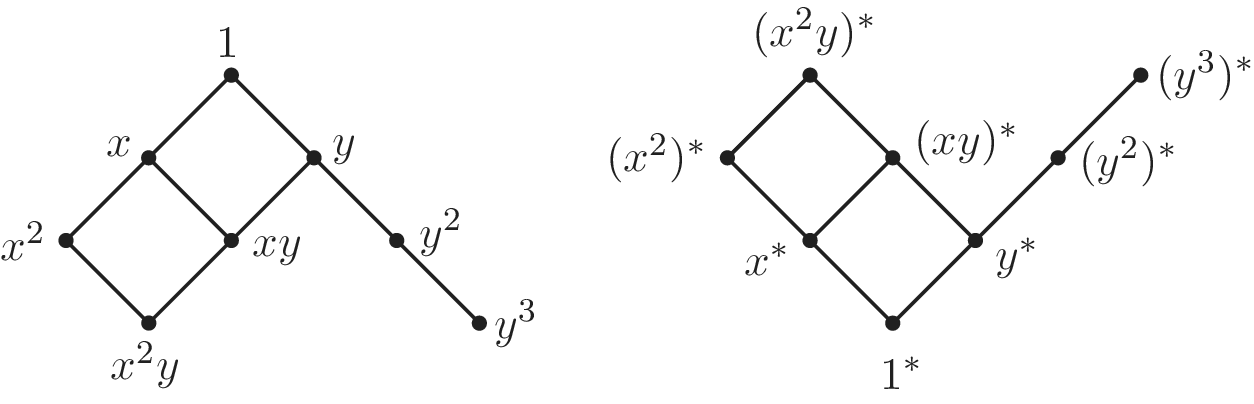
Example 4.2. Let
 $R = K[x, y]/(x^3, y^4, xy^2)$
. The divisor posets
 ${\mathcal P}$
of R and
 ${\mathcal P}^*$
of
 $\omega _R$
are shown in Figure 1.
The divisor posets
 ${\mathcal P}$
and
 ${\mathcal P}^*$

Let
 ${\mathcal I} = \{x, x^2, xy, x^2y\}$
. Then
 ${\mathcal I}^* = \{(x^2y)^*, (x^2)^*, (xy)^*, x^*\}$
. Note that
 ${\mathcal I}$
is a poset ideal of
 ${\mathcal P}$
and thus
 ${\mathcal I}^*$
is an order ideal of
 ${\mathcal P}^*$
. The bijection
 $\varphi : {\mathcal I}^* \rightarrow {\mathcal I}$
defined by setting
 $$\begin{align*}\varphi((x^2y)^*) = x, \, \varphi((x^2)^*) = xy, \, \varphi((xy)^*) = x^2, \, \varphi(x^*) = x^2y \end{align*}$$
is an isomorphism. Shortly put, the isomorphism is given by
 $\varphi (v^*)=x^3y/v$
and the multidegree of this map is
 $(3,1)$
. Therefore,
 ${\mathcal I}$
is a companion of itself, or, in other words,
 ${\mathcal I}$
is symmetric.
Let
 ${\mathcal J} = \{y^2, y^3\}$
. Then
 ${\mathcal J}^*= \{(y^3)^*, (y^2)^*\}$
. The bijection
 $\psi : {\mathcal J}^* \rightarrow {\mathcal J}$
defined by setting
 $$\begin{align*}\psi((y^3)^*) = y^2, \, \psi((y^2)^*) = y^3 \end{align*}$$
is an isomorphism. Shortly put, the isomorphism is given by
 $\psi (v^*)=y^5/v$
and the multidegree of this map is
 $(0,5)$
. Therefore,
 ${\mathcal J}$
is a companion of itself, or, in other words,
 ${\mathcal J}$
is symmetric.
Furthermore, the bijection
 $\mu : {\mathcal I}^*\cup {\mathcal J}^* \rightarrow {\mathcal I} \cup {\mathcal J}$
defined by setting
 $$\begin{align*}\mu(u^*) = \begin{cases} \varphi(u^*), & \text{if}\ u^* \in {\mathcal I}^* \\ \psi(u^*), & \text{if}\ u^* \in {\mathcal J}^* \end{cases} \end{align*}$$
is not an isomorphism. Moreover, it can be shown that there exists no isomorphism
 ${\mathcal I}^*\cup {\mathcal J}^*\rightarrow {\mathcal I}\cup {\mathcal J}$
, even though the corresponding posets are isomorphic in the classical sense.
In Theorem 4.2, both
 ${\mathcal I}$
and
 ${\mathcal J}$
are
 $\tau $
-ideals. However, it can be shown that the poset ideal
 ${\mathcal I} \cup {\mathcal J}$
is not a
 $\tau $
-ideal.
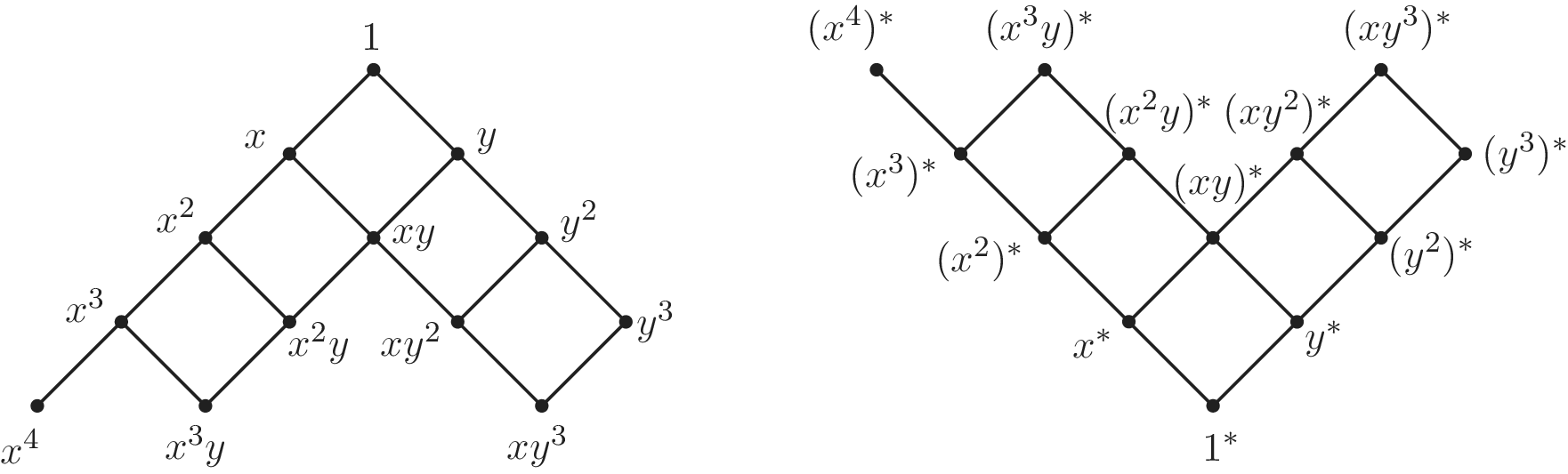
Example 4.3. Let
 $R = K[x,y]/(x^5, y^4, x^2y^2, x^4y)$
. The divisor posets
 ${\mathcal P}$
of R and
 ${\mathcal P}^*$
of
 $\omega _R$
are shown in Figure 2.
The divisor posets
 ${\mathcal P}$
and
 ${\mathcal P}^*$

Let
 ${\mathcal I} = \{x^3, x^4, x^3y\}$
and
 ${\mathcal J} = \{y^3, xy^2, xy^3\}$
be poset ideals of
 ${\mathcal P}$
. Then
 ${\mathcal I}^* = \{(x^4)^*, (x^3y)^*, (x^3)^*\}$
and
 ${\mathcal J}^* = \{(xy^3)^*, (y^3)^*, (xy^2)^*\}$
. Then the bijection
 $\varphi : {\mathcal I}^* \cup {\mathcal J}^* \rightarrow {\mathcal I} \cup {\mathcal J}$
defined by setting
 $$\begin{align*}\varphi((xy^3)^*) = x^3, \, \, \, \varphi((y^3)^*) = x^4, \, \, \, \varphi((xy^2)^*) = x^3y, \end{align*}$$
 $$\begin{align*}\varphi((x^4)^*) = y^3, \, \, \, \varphi((x^3y)^*) = xy^2, \, \, \, \varphi((x^3)^*) = xy^3 \end{align*}$$
is an isomorphism. Shortly put, the isomorphism is given by
 $\varphi (v^*)=x^4y^3/v$
and the multidegree of this map is
 $(4,3)$
. Thus, each of the poset ideals
 ${\mathcal I}, {\mathcal J}$
(by restricting the map accordingly) and
 ${\mathcal I} \cup {\mathcal J}$
is a
 $\tau $
-ideal. Note that
 ${\mathcal I}$
and
 ${\mathcal J}$
are companions via a restriction of this map. Furthermore,
 ${\mathcal I} \cup {\mathcal J}$
is symmetric via
 $\varphi $
.
Note that the
 $\tau $
-ideal
 ${\mathcal I}$
is not even symmetric in the local sense. Indeed, if
 ${\mathcal I}$
is symmetric, then by Remark 3.1, for the corresponding monomial ideal I, the number of generators
 $\mu (I)$
of I coincides with the socle dimension
 $\sigma (I)$
of I. This is not the case here, since
 $\mu (I)=|\operatorname {Gen}({\mathcal I})|=1$
and
 $\sigma (I)=|\operatorname {Soc}({\mathcal I})|=2$
.
Lemma 4.4. Let
 ${\mathcal I}$
and
 ${\mathcal J}$
be companions. Then
 ${\mathcal I} \cup {\mathcal J}$
is symmetric.
Proof. Let
 ${\mathcal I}$
and
 ${\mathcal J}$
be companions. Then there is an isomorphism
 $\varphi : {\mathcal J}^* \rightarrow {\mathcal I}$
. By Theorem 4.1, there is a dual map
 $\varphi ^*: {\mathcal I}^* \rightarrow {\mathcal J}$
with
 $\deg (\varphi )=\deg (\varphi ^*)$
. Then we define a map
 $\psi : {\mathcal I}^*\cup {\mathcal J}^* \rightarrow {\mathcal I}\cup {\mathcal J}$
by setting
 $$\begin{align*}\psi(u^*)= \begin{cases} \varphi(u^*), & \text{if}\ u^* \in {\mathcal J}^*, \\ \varphi^*(u^*), & \text{if}\ u^* \in {\mathcal I}^*. \end{cases} \end{align*}$$
Since
 $\deg (\varphi )=\deg (\varphi ^*)$
, these maps agree on
 $I^*\cap J^*$
and therefore
 $\psi $
is well defined. Moreover,
 $\psi $
is an isomorphism and
 $\deg (\psi )=\deg (\varphi )=\deg (\varphi ^*)$
.
The trace of
 ${\mathcal P}^*$
, denoted by
 $\operatorname {tr}({\mathcal P}^*)$
, is defined to be the union of all
 $\tau $
-ideals of
 ${\mathcal P}$
. We say that
 ${\mathcal P}$
is of Teter type if
 $\operatorname {tr}({\mathcal P}^*)$
is a
 $\tau $
-ideal. In other words,
 ${\mathcal P}$
is of Teter type if there is an order ideal
 ${\mathcal J}^*$
of
 ${\mathcal P}^*$
and an isomorphism
 $\varphi : {\mathcal J}^* \rightarrow \operatorname {tr}({\mathcal P}^*)$
.
As an immediate corollary of Lemma 4.4, we have the following corollary.
Corollary 4.5 (Compare with Theorem 3.5).
The trace of
 ${\mathcal P}^*$
is the union of the symmetric ideals of
 ${\mathcal P}$
. In particular,
 ${\mathcal P}$
is of Teter type if and only if
 $\operatorname {tr}({\mathcal P}^*)$
is a symmetric poset ideal of
 ${\mathcal P}$
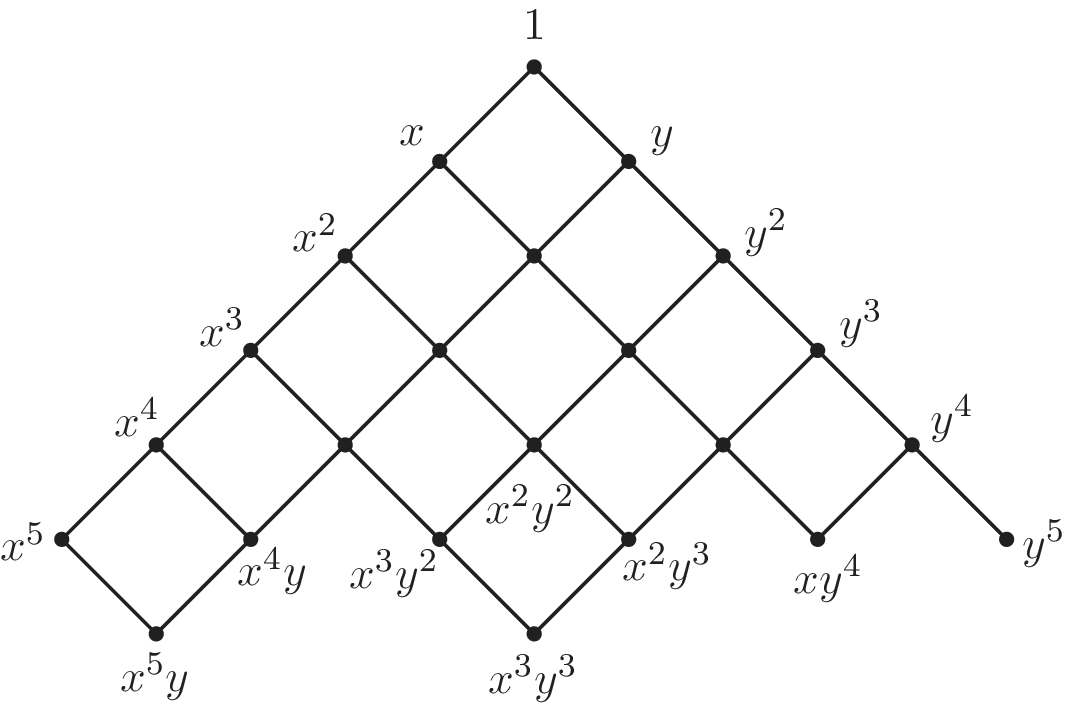
Example 4.6. Let
 $R = K[x,y]/(x^6, x^4y^2, x^2y^4, xy^5, y^6)$
. The divisor poset
 ${\mathcal P}$
is shown in Figure 3.
The divisor poset
 ${\mathcal P}$

Let
 ${\mathcal I}_1 = \{x^5, x^5y, x^4y\}, {\mathcal I}_2 = \{x^2y^2, x^3y^2, x^2y^3, x^3y^3\}, and {\mathcal I}_3 = \{y^4, xy^4, y^5\}$
be poset ideals of
 ${\mathcal P}$
. Let
 ${\mathcal I} = {\mathcal I}_1 \cup {\mathcal I}_2$
and
 ${\mathcal J} = {\mathcal I}_2 \cup {\mathcal I}_3$
. It then follows that
 ${\mathcal J}$
is a companion of
 ${\mathcal I}$
via the corresponding map
 ${\mathcal J}^*\rightarrow {\mathcal I}$
of multidegree
 $(5,5)$
. The poset ideal
 ${\mathcal I} \cup {\mathcal J}$
is symmetric.
We now address the following question: for given poset ideals
 ${\mathcal I}, {\mathcal J}\subseteq {\mathcal P}$
, how can one determine whether
 ${\mathcal I}$
and
 ${\mathcal J}$
are companions? The answer is given in the next lemma.
Lemma 4.7. Let
 ${\mathcal I}$
and
 ${\mathcal J}$
be poset ideals with
 $\operatorname {Gen}({\mathcal I})=\{a_1,\ldots , a_{k}\}$
,
 $\operatorname {Soc}({\mathcal I})=\{b_1,\ldots , b_{l}\}$
,
 $\operatorname {Gen}({\mathcal J})=\{c_1,\ldots , c_{l'}\}$
, and
 $\operatorname {Soc}({\mathcal J})=\{d_1,\ldots , d_{k'}\}$
. Then
 ${\mathcal I}$
and
 ${\mathcal J}$
are companions if and only if
 $k=k'$
,
 $l=l'$
, and after a relabeling of elements of
 $\operatorname {Gen}({\mathcal J})$
and
 $\operatorname {Soc}({\mathcal J})$
, we have
 $a_id_i=b_jc_j$
for all
 $1\le i\le k$
and
 $1\le j\le l$
.
Proof.
 $\Rightarrow :$
Let
 $\varphi : {\mathcal J}^* \rightarrow {\mathcal I}$
be an isomorphism, and let m be the monomial with
 $\deg (m)=\deg (\varphi )$
. Then
 $\varphi $
is given by
 $\varphi (v^*)=m/v$
for all
 $v\in {\mathcal J}$
. In particular, this map defines a bijection
 $\operatorname {Gen}({\mathcal J}^*)\rightarrow \operatorname {Gen} ({\mathcal I})$
. Note that
 $\operatorname {Gen}({\mathcal J}^*)=(\operatorname {Soc}({\mathcal J}))^*=\{d^*_{1},\ldots , d^*_{k'}\}$
. This implies
 $k=k'$
, and, after a suitable relabeling, for all
 $1\le i\le k$
, we have
 $\varphi (d^*_i)=m/d_i=a_i$
, that is to say,
 $a_id_i=m$
. A similar argument can be applied to the socles to conclude
 $l=l'$
and
 $b_jc_j=m$
for all
 $1\le j\le l$
.
 $\Leftarrow :$
Let
 $k=k'$
, let
 $l=l'$
, and let
 $a_id_i=b_jc_j=m$
for
 $1\le i\le k$
and
 $1\le j\le l$
. We show that the map
 $\varphi $
with
 $\deg (\varphi )=\deg (m)$
defines an isomorphism
 ${\mathcal J}^*\rightarrow {\mathcal I}$
. We have
 $v^*\in {\mathcal J}^*$
if and only if there exist a socle of
 $c^*_j$
of
 ${\mathcal J}^*$
and a generator
 $d^*_i$
of
 ${\mathcal J}^*$
such that
 $c^*_j\preceq v^*\preceq d^*_i$
, or, in other words,
 $c_j|v$
and
 $v|d_i$
. Then
 $v|m$
and
 $$ \begin{align*}(m/d_i)|(m/v) \text{ and } (m/v)|(m/c_j)\Leftrightarrow a_i|(m/v) \text{ and } (m/v)|b_j\Leftrightarrow b_j \preceq m/v\preceq a_i,\end{align*} $$
which is equivalent to saying that
 $m/v\in {\mathcal I}$
. This proves that the map is well defined on all of
 ${\mathcal J}^*$
. Clearly,
 $\varphi $
is injective. For surjectivity, one applies the argument above in the opposite direction: if
 $u\in {\mathcal I}$
, then
 $u|m$
and
 $v^*:=(m/u)^*\in {\mathcal J}^*$
with
 $\varphi (v^*)=m/v=u$
.
Corollary 4.8. Let
 ${\mathcal I}$
be a poset ideal with
 $\operatorname {Gen}({\mathcal I})=\{a_1,\ldots , a_k\}$
and
 $\operatorname {Soc}({\mathcal I})=\{b_1,\ldots , b_l\}$
. Then
 ${\mathcal I}$
is symmetric if and only if
 $k=l$
, and after a relabeling of elements of
 $\operatorname {Soc}({\mathcal I})$
, we have
 $a_ib_i=a_jb_j$
for all
 $1\le i,j\le k$
.
Remark 4.9. Assume that the equivalent conditions in Theorem 4.7 hold. Then there exists a unique m such that after a suitable relabeling,
 $a_id_i=b_jc_j=m$
for all
 $1\le i\le k$
and
 $1\le j\le l$
. Indeed, having such a relabeling in particular implies
 $a_1\cdots a_kd_1\cdots d_k=m^k$
and thus m, given that it exists, can be uniquely determined. Moreover, there is a unique isomorphism
 $\varphi : {\mathcal J}^*\rightarrow {\mathcal I}$
, namely, the one given by
 $\varphi (v^*)=m/v$
.
Example 4.10. Let
 $I=(x^4,y^4,x^2y^2)$
,
 $J\subseteq I$
such that
 $G=K[x,y]/J$
is a zero-dimensional local K-algebra. Let
 $\epsilon : G\rightarrow R=K[x,y]/I$
be the canonical epimorphism. We claim that there is no k such that
 $\operatorname {Ker}(\epsilon )=0:{\mathfrak m}_G^k$
, where
 ${\mathfrak m}_G$
is the maximal ideal of G. Indeed, suppose
 $\operatorname {Ker}(\epsilon )=0:{\mathfrak m}_G^k$
. Then
 $I=J:{\mathfrak m}^k$
, where
 ${\mathfrak m}=(x,y)$
. Then
 $(x^4){\mathfrak m}^k\subseteq J$
and
 $(x^2y^2){\mathfrak m}^k\subseteq J$
. We show that
 $(x^3y){\mathfrak m}^k\subseteq J$
, giving a contradiction since
 $x^3y\not \in I$
. Take
 $x^{k_1}y^{k-k_1}\in {\mathfrak m}^k$
. Then:
-
• if
$k_1\ge 1$
, then
$x^3y\cdot x^{k_1}y^{k-k_1}=x^4(x^{k_1-1}y^{k-k_1+1})\in (x^4){\mathfrak m}^k\subseteq J$
; -
• if
$k_1=0$
, then
$x^3y\cdot y^{k}=x^2y^2(xy^{k-1})\in (x^4){\mathfrak m}^k\subseteq J$
.


On the other hand, we prove that R is of Teter type.
Let
 ${\mathcal I}$
denote the poset ideal consisting of
 $$\begin{align*}x^2, \, x^3, \, x^2y, \, x^3y, \, y^2, \, y^3, \, xy^2, \, xy^3. \end{align*}$$
From Theorem 5.1, we know that
 $\operatorname {tr}({\mathcal P}^*) = {\mathcal I}$
.
We have
 $\operatorname {Gen}({\mathcal I})=\{x^2,y^2\}$
and
 $\operatorname {Soc}({\mathcal I})=\{x^3y,xy^3\}$
. We have
 $x^2\cdot y^2\cdot x^3y\cdot xy^3=x^6y^6$
, and thus the isomorphism
 ${\mathcal I}^* \rightarrow {\mathcal I}$
, if it exists, should have multidegree
 $(3,3)$
. After a relabeling of
 $\operatorname {Soc} {\mathcal I}$
, we indeed have
 $x^2\cdot xy^3=y^2\cdot x^3y=x^3y^3$
. Hence,
 ${\mathcal I}$
is symmetric. Therefore,
 ${\mathcal P}$
is of Teter type.
We now turn to the study of zero-dimensional monomial K-algebras of Teter type. Let
 $S = K[x_1, \ldots , x_n]$
denote the polynomial ring and
 $$\begin{align*}R = S/(x_1^{a_1+1}, x_2^{a_2+1}, \ldots, x_n^{a_n+1}), \end{align*}$$
where
 $1 \leq a_1 \leq a_2 \leq \cdots \leq a_n$
, and
 ${\mathfrak n}$
is the graded maximal ideal of R.
Theorem 4.11. Let
 $1 \leq k \leq a_1$
. Then the divisor poset
 ${\mathcal P}$
of
 $R/(0:{\mathfrak n}^k)$
is of Teter type. Furthermore, the trace of the divisor poset
 ${\mathcal P}^*$
is
 ${\mathcal I}_k$
, where
 ${\mathcal I}_k$
is the poset ideal of
 ${\mathcal P}$
whose
 $\operatorname {Gen}({\mathcal I}_k)$
consists of those monomials
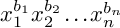 $x_1^{b_1}x_2^{b_2}\ldots x_n^{b_n}$
with each
 $0 \leq b_i \leq a_i$
and with
 $\sum _{i=1}^n b_i = k$
.
Proof. One claims that the ideal
 ${\mathcal I}_k \subseteq {\mathcal P}$
is symmetric. Since
 $\operatorname {Soc}({\mathcal I}_k)$
consists of those monomials
 $x_1^{a_1 - b_1}x_2^{a_2 - b_2}\ldots x_n^{a_n - b_n}$
with
 $\sum _{i=1}^n b_i = k$
, it follows from Theorem 4.8 that
 ${\mathcal I}_k \subseteq {\mathcal P}$
is symmetric. Hence,
 ${\mathcal I}_k \subseteq \operatorname {tr}({\mathcal P}^*)$
.
Now, it is shown that every
 $\tau $
-ideal of
 ${\mathcal P}$
is contained in
 ${\mathcal I}_k$
. Let
 ${\mathcal I}$
be a
 $\tau $
-ideal of
 ${\mathcal P}$
with
 ${\mathcal I} \nsubseteq {\mathcal I}_k$
. Let u be a monomial of
 $\operatorname {Gen}({\mathcal I})$
of the smallest degree. Then
 $d = \deg u < a_1$
. Let
 ${\mathcal J}$
be a companion of
 ${\mathcal I}$
. Since each monomial belonging to
 $\operatorname {Soc}({\mathcal J})$
is of degree
 $\sum _{i=1}^{n} a_i - k$
, it follows that each monomial of
 $\operatorname {Gen}({\mathcal I})$
is of degree d. Since
 $d < a_1$
, each monomial of
 $\operatorname {Gen}({\mathcal I})$
possesses exactly n lower neighbors. It then follows that each monomial belonging to
 $\operatorname {Soc}({\mathcal J})$
possesses exactly n upper neighbors in
 ${\mathcal J}$
. In other words, if
 $u = x_1^{c_1}x_2^{c_2}\ldots x_n^{c_n} \in \operatorname {Soc}({\mathcal J})$
, then
 $c_i> 0$
for all i and
 $u/x_i \in {\mathcal J}$
. Let
 $<_{\mathrm {lex}}$
denote the lexicographic order induced by
 $x_1 < x_2 < \cdots < x_n$
. Let
 $w = x_1^{c_1}x_2^{c_2}\ldots x_n^{c_n}$
be the monomial belonging to
 $\operatorname {Soc}({\mathcal J})$
, which is the largest with respect to
 $<_{\mathrm {lex}}$
. Let
 $1 \leq i_0 \leq n$
be the largest integer for which
 $c_{i_0} < a_{i_0}$
. If
 $i_0> 1$
and
 $w_0 = x_{i_0}(w/x_{i_0-1})$
, then
 $w <_{\mathrm {lex}} w_0$
and
 $w_0 \in {\mathcal J}$
, a contradiction. Hence,
 $i_0 = 1$
and
 $w = x_1^{a_1-k}x_2^{a_2}\ldots x_n^{a_n}$
. Then
 $x_1^{a_1 - k + \sum _{i=2}^{n} e_i}(w/x_2^{e_2} \cdots x_n^{e_n}) \in {\mathcal J}$
, where
 $\sum _{i=2}^{n} e_i \leq k$
. Hence,
 $\operatorname {Soc}({\mathcal J}) = \operatorname {Soc}({\mathcal I}_k)$
. However, since
 $|\operatorname {Gen}({\mathcal J})| < |\operatorname {Soc}({\mathcal I}_k)|$
, it follows that
 ${\mathcal J}$
cannot be a companion of
 ${\mathcal I}$
, as desired.
One can conjecture that, if an integer
 $k \geq 1$
satisfies
 $$\begin{align*}|\operatorname{Gen}({\mathcal I}_1)| < |\operatorname{Gen}({\mathcal I}_2)| < \cdots < |\operatorname{Gen}({\mathcal I}_{k})|, \end{align*}$$
then
 ${\mathcal P}$
is of Teter type and the trace of
 ${\mathcal P}^*$
is
 ${\mathcal I}_k$
.
Example 4.12. Let
 $n \geq 3$
and
 $a_1 = \cdots =a_n = a$
. Let
 $k = a + 1$
. In the divisor poset
 ${\mathcal P}$
of
 $R/(0:{\mathfrak n}^k)$
, the poset ideal
 ${\mathcal I}_k$
is symmetric. Hence,
 ${\mathcal I}_k \subset \operatorname {tr}({\mathcal P}^*)$
. One claims every
 $\tau $
-ideal of
 ${\mathcal P}$
is contained in
 ${\mathcal I}_k$
. Let
 ${\mathcal I}$
be a
 $\tau $
-ideal of
 ${\mathcal P}$
with
 ${\mathcal I} \nsubseteq {\mathcal I}_k$
and
 ${\mathcal J}$
a companion of
 ${\mathcal I}$
. Let u be a monomial of
 $\operatorname {Gen}({\mathcal I})$
of the smallest degree. Then
 $d = \deg u \leq a$
. When
 $d < a$
, the proof of Theorem 4.11 can be available. Let
 $d = a$
. Since each monomial belonging to
 $\operatorname {Soc}({\mathcal J})$
is of degree
 $(n - 1)a - 1$
, it follows that each monomial of
 $\operatorname {Gen}({\mathcal I})$
is of degree a. Thus, in particular, except for the monomials
 $x_1^a, \ldots , x_n^a$
, each monomial belonging to
 $\operatorname {Gen}({\mathcal I})$
possesses exactly n lower neighbors. Let
 $<_{\mathrm {lex}}$
denote the lexicographic order induced by
 $x_1 < x_2 < \cdots < x_n$
. Let
 $w = x_1^{c_1}x_2^{c_2}\ldots x_n^{c_n}$
be the monomial belonging to
 $\operatorname {Soc}({\mathcal J})$
which is the largest with respect to
 $<_{\mathrm { lex}}$
. Let
 $c_n < a$
. Since w possesses at least
 $n - 1$
upper neighbors, there is
 $1 \leq i < n$
for which
 $x_i$
divides w. Since
 ${\mathcal J}$
is a poset ideal, one has
 $w' = x_n(w/x_i) \in {\mathcal J}$
. However,
 $w <_{\mathrm {lex}} w'$
, a contradiction. Thus,
 $c_n = a$
. Similarly, one has
 $c_3 = \cdots = c_n = a$
. Let
 $w = x_1^{c_1} x_2^{c_2} x_3^a \cdots x_n^a$
. If
 $w/x_1 \in {\mathcal J}$
, then
 $w'' = x_2(w/x_1) \in {\mathcal J}$
and
 $w <_{\mathrm {lex}} w''$
, a contradiction. Hence, the monomial
 $w_0$
of
 ${\mathcal I}$
which is accompanied by
 $w \in {\mathcal J}$
is
 $x_1^a$
. Since
 $c_1 + c_2 = a - 1$
, the lower neighbors of
 $w/x_n$
are
 $x_1(w/x_n), x_2(w/x_n)$
and w. However, the upper neighbors of
 $x_n w_0 = x_1^a x_n$
are
 $x_1^a$
and
 $x_1^{a-1}x_n$
, a contradiction. Hence,
 ${\mathcal I}$
cannot be a
 $\tau $
-ideal, as desired. Thus,
 ${\mathcal I}_k = \operatorname {tr}({\mathcal P}^*)$
.
Theorem 4.13. Let
 $a_1 = a_2 = \cdots = a_n = 1$
and
 $1 \leq k \leq n - 1$
. Let
 ${\mathcal P}$
denote the divisor poset of
 $R/(0:{\mathfrak n}^k)$
. Then the trace of
 ${\mathcal P}^*$
is
 ${\mathcal I}_{k_0}$
, where
 $k_0 = \min \{k, n - k\}$
and where
 ${\mathcal I}_{k_0}$
is the poset ideal of
 ${\mathcal P}$
whose
 $\operatorname {Gen}({\mathcal I}_{k_0})$
consists of those monomials
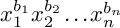 $x_1^{b_1}x_2^{b_2}\ldots x_n^{b_n}$
with each
 $0 \leq b_i \leq 1$
and with
 $\sum _{i=1}^n b_i = k_0$
. Furthermore,
 ${\mathcal P}$
is of Teter type if and only if
 $k \leq n - k$
.
Proof. If
 $k \leq n - k$
, then
 ${\mathcal I}_{k_0} \subseteq {\mathcal P}$
is symmetric. In fact, since
 $\operatorname {Gen}({\mathcal I}_{k_0})$
consists of square-free monomials in
 $x_1, \ldots , x_n$
of degree
 $k_0$
and
 $\operatorname {Soc}({\mathcal I}_{k_0})$
does of those of degree
 $n - k_0$
, Theorem 4.8 says that
 ${\mathcal I}_{k_0}$
is symmetric. If
 $k> n - k$
, then
 $\operatorname {Gen}({\mathcal I}_{k_0}) = \operatorname {Soc}({\mathcal I}_{k_0})$
. Thus, for each
 $1 \leq k \leq n - 1$
, one has
 ${\mathcal I}_{k_0} \subseteq \operatorname {tr}({\mathcal P}^*)$
.
Let
 ${\mathcal I}$
be a
 $\tau $
-ideal of
 ${\mathcal P}$
with
 ${\mathcal I} \nsubseteq {\mathcal I}_{k_0}$
. Let u be a monomial of
 $\operatorname {Gen}({\mathcal I})$
of the smallest degree. Then
 $d = \deg u < k_0$
. Let
 ${\mathcal J}$
be a companion of
 ${\mathcal I}$
. Since each monomial belonging to
 $\operatorname {Soc}({\mathcal J})$
is of degree
 $n - k$
, it follows that each monomial of
 $\operatorname {Gen}({\mathcal I})$
is of degree d. Hence, each monomial of
 $\operatorname {Gen}({\mathcal I})$
possesses exactly
 $n - d$
lower neighbors. It then follows that each monomial belonging to
 $\operatorname {Soc}({\mathcal J})$
possesses exactly
 $n - d$
upper neighbors in
 ${\mathcal J}$
. On the other hand, each monomial belonging to
 $\operatorname {Soc}({\mathcal I}_{k_0})$
possesses exactly
 $n - k$
upper neighbors. Hence,
 $n - k \geq n - d$
. Thus,
 $k \leq d < k_0$
, which contradicts
 $k_0 = \min \{k, n - k\}$
. Hence, every
 $\tau $
-ideal is contained in
 ${\mathcal I}_{k_0}$
. Thus,
 $\operatorname {tr}({{\mathcal P}^*}) = {\mathcal I}_{k_0}$
, as required. In particular,
 ${\mathcal P}$
is of Teter type if
 $k \leq n - k$
.
Now, suppose that
 $k> n - k$
. Then
 $\operatorname {tr}({\mathcal P}^*) = {\mathcal I}_{n-k}$
, where
 $\operatorname {Gen}({\mathcal I}_{n-k})$
consists of square-free monomials in
 $x_1, \dots , x_n$
of degree
 $n - k$
. One has
 $\operatorname {Gen}({\mathcal I}_{n-k}) = \operatorname {Soc}({\mathcal I}_{n-k})$
. If
 ${\mathcal P}$
is of Teter type, then one can find a bijection
 $\delta : \operatorname {Gen}({\mathcal I}_{n-k}) \rightarrow \operatorname {Gen}({\mathcal I}_{n-k})$
for which there is
 $c = (c_1, \ldots , c_n)\in {\mathbb Z}^n$
with
 $\deg (u) + \deg (\delta (u)) = c$
for all
 $u \in \operatorname {Gen}({\mathcal I}_{n-k})$
. In particular,
 $c_i \geq 1$
for all i. However, since
 $\sum _{i=1}^{n} c_i = 2(n - k) < n$
, it follows that
 $c_j = 0$
for some
 $1 \leq j \leq n$
. This contradiction shows that
 ${\mathcal P}$
cannot be of Teter type.
5 Monomial almost complete intersections of Teter type
In this section, we describe the trace of
 $\omega _R$
for an almost complete intersection monomial algebra R and determine when such rings are of Teter type. Note that almost complete intersection rings are never Gorenstein as was shown by Kunz [Reference Kunz10].
Theorem 5.1. Let
 $S=K[x_1,\ldots ,x_n]$
be the polynomial ring over the field K, and let
 $I=(x_1^{a_1},\ldots ,x_n^{a_n},x_1^{b_1}\cdots x_n^{b_n})\subseteq S$
such that
 $b_i<a_i$
for all i and
 $b_i>0$
for at least two integers i. Let
 $R=S/I$
. Then
 $$\begin{align*}\operatorname{tr}(\omega_R)=(x_i^{a_i-b_i}:\ b_i>0)+(w/x_i^{b_i}:\ b_i>0),\end{align*}$$
where
 $w=x_1^{b_1}\cdots x_n^{b_n}$
.
Proof. Let
 $J=(x_1^{a_1},\ldots ,x_n^{a_n})$
,
 $L=J:w=(x_1^{a_1-b_1},\ldots ,x_n^{a_n-b_n})$
, and
 ${\mathbf b}=(b_1,\ldots ,b_n)$
. Then we have the multigraded short exact sequence
 $$\begin{align*}0\rightarrow (S/L)(-{\mathbf b})\stackrel{\varphi}{\longrightarrow}S/J\rightarrow S/I\rightarrow 0, \end{align*}$$
where the map
 $\varphi $
is multiplication by w. Let
 ${\mathbb F}=K(x_1^{a_1},\ldots ,x_n^{a_n};S)$
be the Koszul complex attached to the regular sequence
 $x_1^{a_1},\ldots ,x_n^{a_n}$
, which is indeed a minimal graded free S-resolution of
 $S/J$
, and let
 ${\mathbb G}=K(x_1^{a_1-b_1},\ldots ,x_n^{a_n-b_n};S)$
, which is a minimal graded free S-resolution of
 $S/L$
. Then the map
 $\varphi $
can be lifted to a multigraded complex homomorphism
 $\{\varphi _i:{\mathbb G}(-{\mathbf b})\rightarrow {\mathbb F}\}$
, where
 $\varphi _i(e_{j_1\cdots j_i})=(w/x_{j_1}^{b_{j_1}}\cdots x_{j_i}^{b_{j_i}})e^{\prime }_{j_1 \cdots j_i}$
for any basis element
 $e_{j_1\cdots j_i}$
of
 $G_i(-{\mathbf b})$
. So we have the commutative diagram

Let
 ${\mathbb D}$
be the mapping cone of
 ${\mathbb G}(-{\mathbf b})\rightarrow {\mathbb F}$
. Then
 ${\mathbb D}$
is a graded free S-resolution of R with the differential maps
 $d_i:F_i\oplus G_{i-1}(-{\mathbf b})\rightarrow F_{i-1}\oplus G_{i-2}(-{\mathbf b})$
defined as
 $$ \begin{align*}d_i(f,g)=(\varphi_{i-1}(g)+\partial^{\prime}_i(f),-\partial_{i-1}(g))\end{align*} $$
for
 $1\leq i\leq n+1$
. For any set
 $B=\{i_1,\ldots ,i_s\}\subseteq [n]$
, let
 $e_B=e_{i_1\cdots i_s}$
and
 $e^{\prime }_B=e^{\prime }_{i_1\cdots i_s}$
. Then
 $\{e_{[n]\setminus i}:\ 1\leq i\leq n\}$
is a basis for
 $G_{n-1}(-{\mathbf b})$
. Let
 $$ \begin{align*}\overline{d}_n:G_{n-1}(-{\mathbf b})\rightarrow F_{n-1}\oplus G_{n-2}(-{\mathbf b})\end{align*} $$
be the S-module homomorphism with
 $\overline {d}_n(e_{[n]\setminus i})=d_n(e_{[n]\setminus i})=(x_i^{b_i}e^{\prime }_{[n]\setminus i},-\partial _{n-1}(e_{[n]\setminus i}))$
for any
 $1\leq i\leq n$
. Then, clearly,
 $\overline {d}_n$
is an injective map. Moreover, from the equalities
 $$ \begin{align*}d_n(e^{\prime}_{[n]})=\partial^{\prime}_n(e^{\prime}_{[n]})=\partial^{\prime}_n \varphi_n(e_{[n]})=\varphi_{n-1} \partial_n(e_{[n]})=d_n\partial_n(e_{[n]}),\end{align*} $$
we obtain
 $d_n(F_n)\subseteq d_n(G_{n-1}(-{\mathbf b}))=\overline {d}_n(G_{n-1}(-{\mathbf b}))$
. This implies that
 $\operatorname {Im} \overline {d}_n=\operatorname {Im} d_n$
. Therefore,

is a free S-resolution of
 $S/I$
.
Consider the complex
 $\overline {{\mathbb D}}\otimes _SR$
with the differential maps
 $\sigma _i$
. We have
 $\overline {D}_{n}=\bigoplus _{i=1}^n Se_{[n]\setminus i}$
. Hence,
 $\overline {D}_{n}\otimes _SR=\bigoplus _{i=1}^n Re_{[n]\setminus i}$
and
 $\sigma _n(e_{[n]\setminus i})=(x_{i}^{b_i}e^{\prime }_{[n]\setminus i},-\partial _{n-1}(e_{[n]\setminus i}))$
for
 $1 \leq i \leq n$
. Here, for simplicity, the residue class of the monomial
 $x_i^{b_i}$
in R is denoted again by
 $x_i^{b_i}$
. Let C be the kernel of
 $\sigma _n:\overline {D}_n\otimes _SR\rightarrow \overline {D}_{n-1}\otimes _SR$
. Then, by Theorem 3.6,
 $\operatorname {tr}(\omega _R)$
is the ideal in R generated by the entries of a generating set of C. For any
 $1\leq i\leq n$
, we have
 $\sigma _n((w/x_i^{b_i})e_{[n]\setminus i})=0$
. Indeed, for any
 $j\neq i$
, the coefficient of
 $e_{[n]\setminus \{i,j\}}$
in
 $\partial _{n-1}(e_{[n]\setminus i})$
is
 $\pm x_{j}^{a_j-b_j}$
and
 $(w/x_i^{b_i})x_{j}^{a_j-b_j}=0_R$
, since
 $(w/x_i^{b_i})x_{j}^{a_j-b_j}$
as a monomial in S is divisible by
 $x_j^{a_i}$
. So
 $(w/x_i^{b_i})e_{[n]\setminus i}\in C$
for any
 $1\leq i\leq n$
. Now, consider the element
 $z=\partial _n(e_{[n]})=\sum _{i=1}^n (-1)^i x_i^{a_i-b_i} e_{[n]\setminus i}\in \overline {D}_{n}\otimes _SR$
. We have
 $\sigma _n(z)=(\sum _{i=1}^n (-1)^i x_i^{a_i}e^{\prime }_{[n]\setminus i},-\partial _{n-1}\partial _n(z))=0$
, which implies that
 $z\in C$
. Without loss of generality, assume that
 $b_i>0$
for
 $1\leq i\leq r$
and
 $b_{r+1}=\cdots =b_n=0$
. Then, by Theorem 3.6,
 $$ \begin{align*}(x_i^{a_i-b_i}:\ 1\leq i\leq r)+(w/x_i^{b_i}:\ 1\leq i\leq r)\subseteq \operatorname{tr}(\omega_R).\end{align*} $$
Now, consider an arbitrary multigraded element
 $h=\sum _{i=1}^n s_i u_ie_{[n]\setminus i}\in C$
, where
 $u_i$
’s are monomials and
 $s_i\in K$
. Then
 $\sum _{i=1}^n s_i x_i^{b_i}u_ie_{[n]\setminus i}=0$
and so
 $x_i^{b_i}u_i\in I$
for any
 $1\leq i\leq n$
. This means either
 $x_i^{a_i-b_i}|u_i$
or
 $(w/x_i^{b_i})|u_i$
. Therefore,
 $$ \begin{align*}\operatorname{tr}(\omega_R)\subseteq (x_i^{a_i-b_i}:\ 1\leq i\leq r)+(w/x_i^{b_i}:\ 1\leq i\leq r).\end{align*} $$
Thus, the equality holds.
The next result characterizes monomial almost complete intersection rings of Teter type.
Theorem 5.2. Let
 $I=(x_1^{a_1},\ldots , x_n^{a_n}, x_1^{b_1}\cdots x_n^{b_n})\subseteq S$
be a monomial almost complete intersection. Then
 $R=S/I$
is of Teter type if and only if there exist
 $j\not =j'$
such that
 $2b_j\ge a_j$
and
 $2b_{j'}\ge a_{j'}$
.
Proof. Without loss of generality, we can assume that
 $a_i\ge 2$
for all
 $i=1,\ldots ,n$
. We can also assume that
 $b_1b_2\cdots b_r\not =0$
and
 $b_{r+1}=\cdots =b_n=0$
for some
 $2\le r\le n$
. Let
 $w=x_1^{b_1}\cdots x_n^{b_n}$
, and let
 ${\mathcal P}$
be the divisor poset of R. From Theorem 5.1, we know that
 $$ \begin{align*}\operatorname{tr}({\mathcal P}^*)=(x_1^{a_1-b_1},\ldots, x_n^{a_n-b_n},\frac{w}{x_1^{b_1}},\ldots,\frac{w}{x_n^{b_n}})=(x_1^{a_1-b_1},\ldots, x_n^{a_r-b_r},\frac{w}{x_1^{b_1}},\ldots,\frac{w}{x_r^{b_r}}).\end{align*} $$
Let
 $v=x_1^{a_1-1}x_2^{a_2-1}\cdots x_n^{a_n-1}$
. Then one can check that
 $\operatorname {Soc}({\mathcal P})=\{\frac {v}{x_1^{a_1-b_1}}, \ldots , \frac {v}{x_r^{a_r-b_r}}\}$
. We consider several cases:
(1) There exist
 $j\not =j'$
such that
 $2b_j\ge a_j$
and
 $2b_{j'}\ge a_{j'}$
. Without loss of generality, we may assume that
 $2b_1\ge a_1$
and
 $2b_2 \ge a_2$
. Then
 $\frac {w}{x_1^{b_1}}$
is divisible by
 $x_2^{b_2}$
and therefore by
 $x_2^{a_2-b_2}$
. Similarly,
 $\frac {w}{x_2^{b_2}}$
is divisible by
 $x_1^{b_1}$
, and therefore by
 $x_1^{a_1-b_1}$
. Each
 $\frac {w}{x_i^{b_i}}$
,
 $3\le i\le r$
, is divisible by
 $x_1^{b_1}x_2^{b_2}$
and thus by
 $x_1^{a_1-b_1}x_2^{a_2-b_2}$
. In other words,
 $\operatorname {tr}({\mathcal P}^*)=(x_1^{a_1-b_1},\ldots , x_r^{a_r-b_r})$
. We have
 $\operatorname {Gen}(\operatorname {tr}({\mathcal P}^*))=\{x_1^{a_1-b_1},\ldots , x_r^{a_r-b_r}\}$
and
 $\operatorname {Soc} (\operatorname {tr}({\mathcal P}^*))=\{\frac {v}{x_1^{a_1-b_1}}, \ldots , \frac {v}{x_r^{a_r-b_r}}\}$
. By Theorem 4.8, this is a symmetric ideal. In fact, the desired isomorphism has multidegree v. Therefore, R is of Teter type.
(2) There exists at most one j such that
 $2b_j\ge a_j$
. Without loss of generality, we assume that
 $2b_2<a_2, \ldots , 2b_r<a_r$
and no conditions on
 $b_1$
.
(a)
 $r>2$
. Then, among monomials
 $x_1^{a_1-b_1},\ldots , x_r^{a_r-b_r},\frac {w}{x_1^{b_1}}:=w_1$
, no pair of monomials divides each other. Indeed,
 $\operatorname {supp}(w_1)=\{x_2,x_3,\ldots , x_r\}$
, which contains at least two variables, which implies that
 $w_1$
does not divide any other monomial. On the other hand, the
 $x_i$
exponent of
 $w_1$
is
 $b_i<a_i-b_i$
for all
 $2\le i\le r$
, and thus no other monomial divides
 $w_1$
. Therefore,
 $|\operatorname {Gen}(\operatorname {tr}({\mathcal P}^*))|>|\operatorname {Soc}(\operatorname {tr}({\mathcal P}^*))|$
, which by Theorem 4.8 implies that
 $\operatorname {tr}({\mathcal P}^*)$
is not symmetric and thus R is not of Teter type.
(b)
 $r=2$
. In this case,
 $I=(x_1^{a_1},\ldots , x_n^{a_n}, x_1^{b_1}x_2^{b_2})$
with
 $2b_2<a_2$
. Let
 $e:=\min \{b_1,a_1-b_1\}$
. We have
 $$ \begin{align*}\operatorname{tr}({\mathcal P}^*)=(x_1^{a_1-b_1}, x_2^{a_2-b_2}, x_1^{b_1}, x_2^{b_2})=(x_1^e, x_2^{b_2})=:(t_1,t_2)\end{align*} $$
and
 $$ \begin{align*}\operatorname{Soc}(\operatorname{tr}({\mathcal P}^*))=\{x_1^{b_1-1}x_2^{a_2-1}, x_1^{a_1-1}x_2^{b_2-1}\}=:\{s_1,s_2\}.\end{align*} $$
The only possible isomorphisms can be given by
 $\varphi _1: s_1 \mapsto t_1, s_2 \mapsto t_2$
and
 $\varphi _2: s_1 \mapsto t_2, s_2 \mapsto t_1$
. In order for
 $\varphi _1$
to be an isomorphism, we need to have
 $(e+b_1-1, a_2-1)=(a_1-1,2b_2-1)$
, which is impossible since
 $2b_2<a_2$
. Similarly, in order for
 $\varphi _2$
to be an isomorphism, we need to have
 $(b_1-1, a_2+b_2-1)=(e+a_1-1,b_2-1)$
, which is also impossible since
 $a_2\not =0$
.
Example 5.3. (1) Let
 $R = K[x,y]/(x^3,y^3,xy)$
. By Theorem 5.1, we know that
 $\operatorname {tr}({\mathcal P}^*)=(x,y)$
. By Theorem 4.8, this is not a symmetric ideal and therefore R is not of Teter type in the multigraded sense. However, R is of Teter type in the graded sense (and thus in the general sense) since
 $\varphi : (x^2)^*\mapsto x, (y^2)^*\mapsto y$
gives a desired graded isomorphism of degree
 $3$
.
(2) Let
 $R = K[x,y]/(x^3,y^4,xy)$
. It is not hard to see that
 $R=G/(0:{\mathfrak m}_G)$
, where
 $G=K[x,y]/(xy, x^3+y^4)$
. Therefore, R is a Teter ring in the local sense. In particular, R is of Teter type in the local sense. However, R is not of Teter type in the graded sense. Indeed,
 $\operatorname {Gen}(\operatorname {tr}({\mathcal P}^*))=\{x,y\}$
consists of monomials of the same degree, whereas
 $\operatorname {Soc}(\operatorname {tr}({\mathcal P}^*))=\{x^2,y^3\}$
does not.
Finally, Theorem 5.4 is a special case of Theorem 5.2. However, its proof is simple and does not depend on Theorem 5.2.
Theorem 5.4. Let
 $S = K[x_1, \ldots , x_s]$
, and let
 $w_0 \in S$
a square-free monomial of degree
 ${> 1}$
. Let
 ${\mathcal P}$
denote the divisor poset of
 $R = S/(x_1^2, \ldots , x_n^2, w_0)$
and
 $\operatorname {tr}({\mathcal P}^*)$
the trace of the divisor poset
 ${\mathcal P}^*$
of
 $\omega _{R}$
. Then
 ${\mathcal P}$
is of Teter type. Furthermore,
 $\operatorname {Gen}(\operatorname {tr}({\mathcal P}^*))$
consists of those variables
 $x_i$
for which
 $x_i$
divides
 $w_0$
.
Proof. Let, say,
 $w_0 = x_1x_2 \cdots x_{i_0}$
, and set
 $v_0 = x_1x_2 \cdots x_n$
. Then
 $\operatorname {Soc}({\mathcal P}^*)$
consists of the monomials
 $v_0/x_1, v_0/x_2, \ldots , v_0/x_{i_0}$
. Theorem 4.8 guarantees that the poset ideal
 ${\mathcal I}_0$
with
 $\operatorname {Gen}({\mathcal I}_0) = \{x_1, x_2, \ldots , x_{i_0}\}$
is symmetric. Hence,
 ${\mathcal I}_0 \subset \operatorname {tr}({\mathcal P}^*)$
. Let
 ${\mathcal I}$
be a
 $\tau $
-ideal of
 ${\mathcal P}$
and suppose that
 ${\mathcal I} \nsubseteq {\mathcal I}_0$
. Let, say,
 $u = x_{i_0+1}x_{i_0+2} \cdots x_{i_0+d} \in \operatorname {Gen}({\mathcal I})$
. Let
 ${\mathcal J}$
be a companion of
 ${\mathcal I}$
, and
 $v \in {\mathcal J}$
is accompanied by u. Then there is
 $1 \leq j_0 \leq i_0$
with
 $v = v_0/x_{j_0}$
. Since u divides each of the monomials
 $v_0/x_1, v_0/x_2, \ldots , v_0/x_{i_0}$
, it follows that each of the monomials
 $v_0/x_1u, v_0/x_2u, \ldots , v_0/x_{i_0}u$
divides
 $v = v_0/x_{j_0}$
. Thus,
 $x_iu/x_{j_0} \in {\mathcal P}$
for each
 $1 \leq i \leq i_0$
. However,
 $x_iu/x_{j_0} \in {\mathcal P}$
only for
 $i = j_0$
. Hence,
 ${\mathcal I}$
cannot be a
 $\tau $
-ideal. Thus,
 ${\mathcal I}_0 = \operatorname {tr}({\mathcal P}^*)$
, as desired.
6 Divisor posets of simplicial complexes
Let
 $\Delta $
be a simplicial complex on the vertex set
 $[n]=\{1, \ldots , n\}$
. In other words,
 $\Delta $
is a collection of subsets of
 $[n]$
such that
 $\{i\} \in \Delta $
for
 $1 \leq i \leq n$
and that, if
 $F \in \Delta $
and
 $F' \subseteq F$
, then
 $F' \in \Delta $
. Each element
 $F \in \Delta $
is called a face of
 $\Delta $
. A facet of
 $\Delta $
is a face F of
 $\Delta $
for which
 $F \subsetneq F'$
for no
 $F' \in \Delta $
. A face F of
 $\Delta $
is called free if there is a unique facet
 $F'$
of
 $\Delta $
with
 $F \subseteq F'$
.
Let
 $S = K[x_1, \ldots , x_n]$
denote the polynomial ring in n variables over a field K. One associates each
 $F \subseteq [n]$
with the square-free monomial
 $u_F = \prod _{i \in F} x_i$
. Let
 $I_\Delta $
denote the ideal of S which is generated by the monomials
 $u_F$
with
 $F \not \in \Delta $
. Let
 $K\{\Delta \}$
denote the zero-dimensional monomial K-algebra
 $$\begin{align*}K\{\Delta\} = S/(I_\Delta, x_1^2, \ldots, x_n^2). \end{align*}$$
The divisor poset
 ${\mathcal P}_\Delta $
of
 $K\{\Delta \}$
is the finite set
 $\{ u_F : F \in \Delta \}$
with the partial order
 $\preceq $
defined by
 $u_F \preceq u_{F'}$
if
 $F' \subseteq F$
. In particular,
 $\operatorname {Soc}({\mathcal P}_\Delta )$
consists of the monomials
 $u_F$
for which F is a facet of
 $\Delta $
. The K-algebra
 $K\{\Delta \}$
is Gorenstein if and only if
 $\Delta $
is the simplex on
 $[n]$
, that is,
 $\Delta $
consists of all subsets of
 $[n]$
. The empty face
 $\emptyset $
of
 $\Delta $
is free if and only if
 $\Delta $
is the simplex on
 $[n]$
.
A simplicial complex
 $\Delta $
is called flag if
 $I_\Delta $
is generated by quadratic monomials. In other words,
 $\Delta $
is flag if, for any
 $F \subseteq [n]$
with
 $F \not \in \Delta $
, there is
 $1 \leq i < j \leq n$
with
 $\{i, j\} \subseteq F$
such that
 $\{i, j\} \not \in \Delta $
.
Theorem 6.1. Let
 $\Delta $
be a simplicial complex on
 $[n]$
, and suppose that
 $\Delta $
is flag. Let
 ${\mathcal P}_{\Delta }$
denote the divisor poset of
 $K\{\Delta \}$
. Then
 $\operatorname {tr}({\mathcal P}_\Delta ^*)$
is generated by the monomials
 $u_F$
for which F is a free face.
Proof. Let
 $F \in \Delta $
be a free face of
 $\Delta $
and G a unique facet of
 $\Delta $
with
 $F \subseteq G$
. In the divisor poset
 ${\mathcal P}_\Delta $
, write
 ${\mathcal I}$
for the poset ideal with
 $\operatorname {Gen}({\mathcal I}) = \{u_F\}$
. Then
 $\operatorname {Soc}({\mathcal I}) = \{u_G\}$
. Hence,
 ${\mathcal I}$
is symmetric, and then by Theorem 4.5,
 $u_F \in \operatorname {tr}({\mathcal P}_\Delta ^*)$
.
Conversely, let
 $F \in \Delta $
and suppose that
 $u_F \in \operatorname {tr}({\mathcal P}_\Delta ^*)$
. Then
 $u_F$
is divisible by a minimal generator, say
 $u_{F'}$
. Therefore, by Theorem 4.5, there is a symmetric ideal
 ${\mathcal J}$
for which
 $u_{F'} \in \operatorname {Gen}({\mathcal J})$
. Let
 $G_1, \ldots , G_s$
denote the facets of
 $\Delta $
containing
 $F'$
. Since
 ${\mathcal J}$
is symmetric, by Theorem 4.8, there is a facet
 $G_0$
with
 $u_{G_0} \in \operatorname {Soc}({\mathcal J})$
and a face
 $F_i$
for which
 $u_{F'}u_{G_0}=u_{F_i}u_{G_i}$
for all
 $1\leq i\leq s$
. This implies that
 $G_i \setminus F' \subseteq G_0$
and hence for
 $G = G_1 \cup \cdots \cup G_s$
we have
 $G \setminus F' \subseteq G_0$
. We show that G is a face of
 $\Delta $
. Since
 $\Delta $
is flag, it is enough to show that for any
 $1 \leq i_0 < j_0 \leq n$
with
 $\{i_0, j_0\}\subseteq G$
, we have
 $\{i_0, j_0\}\in \Delta $
. If
 $\{i_0, j_0\} \subseteq G \setminus F'\subseteq G_0$
or
 $\{i_0, j_0\} \subseteq F'$
, then we are done. Otherwise, we may assume that
 $i_0 \in G \setminus F'$
and
 $j_0 \in F'$
. Then
 $\{i_0, j_0\} \in G_i$
for some
 $1 \leq i \leq s$
. Hence,
 $\{i_0, j_0\} \in \Delta $
. Therefore, G is a face of
 $\Delta $
which implies
 $s = 1$
and then
 $G_1$
is a unique facet containing
 $F'$
. Since
 $F'\subseteq F $
, F is a free face as well.
Example 6.2. (a) Let
 $\Delta $
denote the simplicial complex on
 $[4]$
whose facets are
 $\{1,2,3\}$
and
 $\{3,4\}$
. Then
 $\operatorname {tr}({\mathcal P}_\Delta ^*) = (x_1, x_2, x_4)$
, and by Theorem 4.8,
 ${\mathcal P}_\Delta $
is not of Teter type.
(b) Let
 $\Delta $
denote the simplicial complex on
 $[4]$
whose facets are
 $\{1,2,3\}$
and
 $\{1,2,4\}$
. Then
 $\operatorname {tr}({\mathcal P}_\Delta ^*) = (x_3, x_4)$
. In the divisor poset
 ${\mathcal P}_\Delta $
, the poset ideal
 ${\mathcal I}$
with
 $\operatorname {Gen}({\mathcal I}) = \{x_3, x_4\}$
and
 $\operatorname {Soc}({\mathcal I}) = \{x_1x_2x_3, x_1x_2x_4\}$
is symmetric by Theorem 4.8. Thus,
 ${\mathcal P}_\Delta $
is of Teter type.
(c) Let
 $\Delta $
denote the simplicial complex on
 $[5]$
whose facets are
 $$ \begin{align*}\{1,2,3\}, \, \, \, \{1,2,4\}, \, \, \, \{1,2,5\}.\end{align*} $$
Then
 $\operatorname {tr}({\mathcal P}_\Delta ^*) = (x_3, x_4, x_5)$
and
 ${\mathcal P}_\Delta $
is not of Teter type.
(d) Let
 $\Delta $
denote the simplicial complex on
 $[6]$
whose facets are
 $$ \begin{align*}\{1,4,5\}, \, \, \, \{2,5,6\}, \, \, \, \{3,4,6\}, \, \, \, \{4,5,6\}.\end{align*} $$
Then
 $\operatorname {tr}({\mathcal P}_\Delta ^*) = (x_1, x_2, x_3, x_4x_5x_6)$
and
 ${\mathcal P}_\Delta $
is not of Teter type.
(e) Let
 $\Delta $
denote the simplicial complex on
 $[6]$
whose facets are
 $$ \begin{align*}\{1,4\}, \, \, \, \{2,5\}, \, \, \, \{3,6\}, \, \, \, \{4,5,6\}.\end{align*} $$
Then
 $\operatorname {tr}({\mathcal P}_\Delta ^*) = (x_1, x_2, x_3, x_4x_5, x_5x_6, x_4x_6)$
and
 ${\mathcal P}_\Delta $
is not of Teter type.
(f) Let
 $\Delta $
denote the simplicial complex on
 $[4]$
whose facets are
 $\{1,2\}$
and
 $\{3,4\}$
. Then
 $\operatorname {tr}({\mathcal P}_\Delta ^*) = (x_1, x_2, x_3, x_4)$
. Thus
 $K\{\Delta \}$
is nearly Gorenstein. However,
 ${\mathcal P}_{\Delta }$
is not of Teter type.
(g) Let
 $n \geq 3$
, and let
 $\Delta _n$
be the simplicial complex on
 $[n]$
whose facets are
 $$\begin{align*}\{1, 2\}, \{2, 3\}, \ldots, \{n-1,n\}, \{1,n\}. \end{align*}$$
If
 $n> 3$
, then
 $\Delta _n$
is flag and
 $\operatorname {tr}({\mathcal P}_\Delta ^*) = (x_1x_2, x_2x_3, \ldots , x_{n-1}x_n, x_1x_n)$
. On the other hand,
 $\Delta _3$
is not flag. The free faces of
 $\Delta _3$
are
 $\{1,2\}, \{2,3\}, \{1,3\}$
. However,
 $\operatorname {tr}({\mathcal P}_\Delta ^*) = (x_1, x_2, x_3)$
. This example shows that the assumption of being flag in Theorem 6.1 cannot be removed. Note that
 $\Delta _n$
is of Teter type if and only if
 $n\in \{3,4\}$
.
Example 6.3. Let
 $\Delta $
be the standard triangulation of the real projective plane shown in Figure 4.
Triangulation of real projective plane

Note that
 $\Delta $
is not flag. Computation in Macaulay2 shows that
 $\operatorname {tr}({\mathcal P}_\Delta ^*)$
is generated by
 $x_ix_j$
with
 $1 \leq i < j \leq 6$
. This example once again shows that the assumption of being flag in Theorem 6.1 cannot be removed.
Let, in general,
 $P = \{a_1, \ldots , a_n \}$
be a finite poset, and let
 $L = {\mathcal J}(P)$
be the distributive lattice [Reference Herzog and Hibi5, Th. 9.1.7] consisting of all poset ideals of P, ordered by inclusion. A chain of L is a totally ordered subset of L. A maximal chain of L is a chain C for which
 $C \subsetneq C'$
for no chain
 $C'$
of L. The order complex of P is the simplicial complex
 $\Delta (P)$
on
 $[n]$
whose faces are those
 $F \subseteq [n]$
such that
 $\{a_i : i \in F\}$
is a chain of P. A linear extension of P is a permutation
 $\pi : i_1 i_2 \cdots i_n$
of
 $[n]$
for which
 $a_{i_j} < a_{i_k}$
in P implies
 $j < k$
. If
 $\pi : i_1 i_2 \cdots i_n$
is a linear extension of P, then
 $$\begin{align*}C_\pi : \emptyset \subset \{a_{i_1}\} \subset \{a_{i_1}, a_{i_2}\} \subset \cdots \subset \{a_{i_1}, \cdots, a_{i_n}\} = P \end{align*}$$
is a maximal chain of L. Furthermore, it can be seen that each maximal chain of L is of the form
 $C_\pi $
for some linear extension
 $\pi $
of P.
Given a linear extension
 $\pi : i_1 i_2 \cdots i_n$
of P, let
 $j(1)$
denote the biggest integer for which
 $a_{i_1} < a_{i_2} < \cdots < a_{i_{j(1)}}$
, and let
 $j(2)$
denote the biggest integer for which
 $a_{i_{j(1)+1}} < a_{i_{j(1)+2}} < \cdots < a_{i_{j(2)}}$
. Continuing these procedure yields a sequence
 $1 \leq j(1) < j(2) < \cdots < j(s-1) < j(s) = n$
of integers. One defines the chain
 $$\begin{align*}C_\pi^{\sharp}: \alpha_1 \subset \alpha_2 \subset \cdots \subset \alpha_{s-1}, \end{align*}$$
of L, where
 $$\begin{align*}\alpha_q = \{ a_{i_1}, a_{i_2}, \ldots, a_{i_{j(q)}}\}. \end{align*}$$
In particular, if P is a chain, then
 $j(1) = n$
and
 $C_\pi ^{\sharp } = \emptyset $
.
Example 6.4. Let
 $P = \{a_1, a_2, a_3, a_4\}$
be the finite poset, and let
 $L = {\mathcal J}(P)$
be the distributive lattice shown in Figure 5.
The poset P and the lattice
 ${\mathcal J}(P)$

Then the linear extensions of P are
 $$\begin{align*}\pi_1:1234, \, \, \, \, \pi_2:1243, \, \, \, \, \pi_3:2134, \, \, \, \, \pi_4:2143, \, \, \, \, \pi_5:2413 \end{align*}$$
and
 $$ \begin{align*} C_{\pi_1}^{\sharp} & : \{a_1\} \subset \{a_1,a_2,a_3\}, \\ C_{\pi_2}^{\sharp} & : \{a_1\} \subset \{a_1,a_2,a_4\}, \\ C_{\pi_3}^{\sharp} & : \{a_2\} \subset \{a_1,a_2,a_3\}, \\ C_{\pi_4}^{\sharp} & : \{a_2\} \subset \{a_1,a_2\} \subset \{a_1,a_2,a_4\}, \\ C_{\pi_5}^{\sharp} & : \{a_2,a_4\}. \end{align*} $$
We see that in Theorem 6.4,
 $C_\pi $
is a unique maximal chain which contains
 $C_\pi ^{\sharp }$
. One can easily check that this is true in general. Conversely, we have the following lemma.
Lemma 6.5. Let
 $C_\pi $
be a maximal chain of L, and let C be a chain of L for which
 $C_\pi $
is a unique maximal chain which contains C. Then
 $C_\pi ^{\sharp } \subset C$
.
Proof. Following the notation
 $\pi , j(q)$
and
 $C_\pi ^{\sharp }$
as above, let
 $ C: \beta _1 \subset \beta _2 \subset \cdots \subset \beta _r. $
We proceed by induction on r. Clearly,
 $\beta _1 \subset \alpha _1$
. If
 $\beta _1 = \alpha _1$
, then considering the interval
 $$\begin{align*}[\alpha_1, P] = \{\alpha \in {\mathcal J}(P) : \alpha_1 \subset \alpha \}, \end{align*}$$
which is a distributive lattice, shows that
 $C_\pi ^{\sharp } \setminus \alpha _1 \subset C \setminus \beta _1$
. Thus,
 $C_\pi ^{\sharp } \subset C$
. Suppose that
 $\beta _1 \subsetneq \alpha _1$
. If
 $\beta _2 \subset \alpha _1$
, then
 $C_\pi $
is a unique maximal chain containing
 $C \setminus \beta _1$
. Thus,
 $C_\pi ^{\sharp } \subset C \setminus \beta _1$
. In particular,
 $C_\pi ^{\sharp } \subset C$
. Let
 $\beta _1 \subsetneq \alpha _1 \subsetneq \beta _2$
. It then follows that
 $\beta _2 \setminus \beta _1$
is a chain of P. Since
 $\alpha _1$
is a chain of P, it follows that
 $$\begin{align*}a_{i_1} < a_{i_2} < \cdots < a_{i_{j(1)}} < a_{i_{j(1)+1}}. \end{align*}$$
This contradicts the definition of
 $j(1)$
. Thus,
 $\beta _1 \subsetneq \alpha _1 \subsetneq \beta _2$
cannot occur.
Theorem 6.6. Let
 $L = {\mathcal J}(P)$
, and let
 $\Delta (L)$
be its order complex. Then
 $\operatorname {Gen}(\operatorname {tr}({\mathcal P}_{\Delta (L)}^*))$
consists of the monomials
 $u_{C_\pi ^{\sharp }}$
, where
 $\pi $
is a linear extension of P.
Proof. Since
 $\Delta (L)$
is flag, the desired result follows from Theorem 6.1 together with Theorem 6.5.
Corollary 6.7. Let
 $L = {\mathcal J}(P)$
, and let
 $\Delta (L)$
be its order complex. Then
 ${\mathcal P}_{\Delta (L)}$
is of Teter type in the category of zero-dimensional local K-algebras.
Proof. Let
 ${\mathcal I}_\pi $
denote the interval
 $[u_{C_\pi ^\sharp }, u_{C_\pi }]$
of
 ${\mathcal P}_{\Delta (L)}$
, where
 $\pi $
is a linear extension of P. It follows from Corollary
 $2.3$
that
 ${\mathcal I}_\pi $
is a (multigraded) symmetric poset ideal. Furthermore, if
 $\pi \neq \pi '$
, then
 ${\mathcal I}_\pi \cap {\mathcal I}_{\pi '} = \emptyset $
. It then follows that
 $\operatorname {tr}({\mathcal P}_{\Delta (L)}^*) = \sqcup _\pi {\mathcal I}_\pi $
, where
 $\pi $
ranges over the linear extensions of P. This implies that
 $\operatorname {tr}({\mathcal P}_{\Delta (L)}^*)$
is a symmetric poset ideal in the local sense. Hence,
 $K\{\Delta (L)\}$
is of Teter type in the local sense.
We now turn to the study of the independence complex of a finite simple graph. Let G be a finite simple graph on the vertex set
 $[n]$
, and let
 $E(G)$
be the set of edges of G. We say that a subset
 $F \subset [n]$
is independent in G if, for each
 $i \in F$
and
 $j \in F$
with
 $i \neq j$
, one has
 $\{i, j \} \not \in E(G)$
. Thus, in particular,
 $\{i\}$
is independent for each
 $i \in [n]$
. Let
 $\Delta (G)$
denote the simplicial complex on
 $[n]$
whose faces are the independent subsets of G. The simplicial complex
 $\Delta (G)$
is called the independence complex of G. The independence complex
 $\Delta (G)$
is flag. In fact,
 $$\begin{align*}I_{\Delta(G)} = (x_i x_j : \{i,j\} \in E(G)). \end{align*}$$
Conversely, given a flag complex
 $\Delta $
on
 $[n]$
, there is a unique finite simple graph G on
 $[n]$
with
 $\Delta = \Delta (G)$
. It would be of interest to describe the trace of
 ${\mathcal P}^*_{\Delta (G)}$
in terms of the combinatorics of G.
A path graph of length
 $n - 1$
is the finite simple graph
 $P_{n}$
whose edges are
 $$\begin{align*}\{1,2\}, \, \, \{2,3\}, \, \, \ldots, \{n-1,n\}. \end{align*}$$
Our job is to find an explicit combinatorial description of
 $\operatorname {Gen}(\operatorname {tr}({\mathcal P}^*_{\Delta (P_{n})}))$
.
Let
 $(a_1, a_2, \ldots , a_s)$
be a sequence of integers with
 $1 \leq a_1 < a_2 < \cdots < a_s \leq n$
. We say that
 $(a_1, a_2, \ldots , a_s)$
is permissible if
 $$\begin{align*}a_{i+1} - a_i \in \{2, 3\}, \, \, \, \, \, 0 \leq i \leq s, \end{align*}$$
with setting
 $a_{0} = -1$
and
 $a_{s+1} = n + 2$
. Furthermore, we say that
 $(a_1, a_2, \ldots , a_s)$
is
 $\tau $
-permissible if
 $(a_{i-1}, a_i, a_{i+1}) = (a_i-2, a_i, a_i+2)$
for no
 $1 \leq i \leq s$
and if
 $$\begin{align*}a_{i+1} - a_i \in \{2,3,4\}, \, \, \, \, \, 1 \leq i \leq s. \end{align*}$$
Example 6.8. Let
 $n = 7$
. Then the permissible sequences are
 $$\begin{align*}(1,3,5,7), (1,3,6), (1,4,6), (1,4,7), (2,4,6), (2,4,7), (2,5,7). \end{align*}$$
The
 $\tau $
-permissible sequences are
 $$\begin{align*}(1,5), (3,5), (3,7), (3,6), (1,4,6), (1,4,7), (2,6), (2,4,7), (2,5). \end{align*}$$
Theorem 6.9. Let
 $n \geq 2$
, and let
 $\Delta (P_{n})$
be the independence complex of
 $P_{n}$
. Let
 $F = \{a_1, a_2, \ldots , a_s\}$
, where
 $1 \leq a_1 < a_2 < \cdots < a_s \leq n$
, be a subset of
 $[n]$
. Then:
-
(a)
$u_F$
belongs to
$\operatorname {Soc}({\mathcal P}_{\Delta (P_{n})})$
if and only if
$(a_1, a_2, \ldots , a_s)$
is permissible; -
(b)
$u_F$
belongs to
$\operatorname {Gen}(\operatorname {tr}({\mathcal P}^*_{\Delta (P_{n})}))$
if and only if
$(a_1, a_2, \ldots , a_s)$
is
$\tau $
-permissible.


Proof. (a) It follows that
 $F = \{a_1, \ldots , a_s\}$
is a maximal independent subset of
 $P_{n}$
if and only if
 $(a_1, \ldots , a_s)$
is permissible. Since
 $u_F$
belongs to
 $\operatorname {Soc}({\mathcal P}_{\Delta (P_{n})})$
if and only if F is a facet of
 $\Delta (P_{n})$
, the desired result follows.
(b) Let
 $u_F\in \operatorname {Gen}(\operatorname {tr}({\mathcal P}^*_{\Delta (P_{n})}))$
. Then, by Theorem 6.1, F is a minimal free face of
 $\Delta $
. On the contrary, assume that
 $(a_1, a_2, \ldots , a_s)$
is not
 $\tau $
-permissible. Then there exists an integer i such that either
 $a_{i+2}-a_i=a_i-a_{i-2}=2$
or
 $a_{i+1}-a_i\geq 5$
. In the former case,
 $F\setminus \{a_i\}$
is a free face as well which contradicts the minimality of F. In the latter case, F is not a free face. Indeed, if by contradiction G is the unique facet containing F, then
 $F_1=F\cup \{a_i+2\}$
and
 $F_2=F\cup \{a_i+3\}$
are also contained in G which is impossible. Hence, F is not a free face, and we get a contradiction.
Conversely, let
 $(a_1, \ldots , a_s)$
be
 $\tau $
-permissible. Let W denote the set of integers i for which
 $a_{i+1} - a_i = 4$
, where
 $0 \leq i \leq s$
. It then follows that
 $$\begin{align*}G = \{a_1, \ldots, a_s\} \cup \{ a_i + 2 : i \in W \} \end{align*}$$
is a maximal independent subset of
 $P_{n}$
and that
 $F = \{a_1, \ldots , a_s\}$
is a free face of
 $\Delta (P_{n})$
with
 $F \subseteq G$
. From the definition of a
 $\tau $
-permissible sequence, one can see that F is minimal among the free faces contained in G. Hence, the desired result follows from Theorem 6.1.
Example 6.10. Let
 $n = 9$
. Then
 $(1,3,5,7,9)$
is permissible. Following the proof of Theorem 6.9 with
 $G = \{1,3,5,7,9\}$
and removing
 $5, 1, 9$
in this order, one has
 $F_0 = \{1,3,7,9\}, F_1 = \{3,7,9\}, F_2 = \{3,7\}$
and
 $(3,7)$
is
 $\tau $
-permissible. On the other hand, removing
 $3, 7$
in this order, one has
 $F_0 = \{1,5,7,9\}, F_1 = \{1,5,9\}$
and
 $(1,5,9)$
is
 $\tau $
-permissible. Furthermore,
 $(1,5,7)$
and
 $(3,5,9)$
are also
 $\tau $
-permissible, each of which is a subsequence of
 $(1,3,5,7,9)$
.
A cycle of length n is the finite simple graph
 $C_n$
on
 $[n]$
whose edges are
 $$\begin{align*}\{1,2\}, \, \, \{2,3\}, \, \, \ldots, \{n-1,n\}, \, \, \, \{1, n\}. \end{align*}$$
Let
 $i \in [n]$
and
 $j \in [n]$
. The distance between i and j in
 $C_n$
is
 $$\begin{align*}\mathrm{dist}(i,j) = \min\{|j - i|, n - |j - i|\}. \end{align*}$$
Let
 $F \subset [n]$
. We say that
 $i \in F$
and
 $j \in F$
are adjacent in F if there is a sequence of edges
 $$\begin{align*}(i_0, i_1), (i_1, i_2), (i_2, i_3), \ldots, (i_{s-2}, i_{s-1}), (i_{s-1}, i_s) \end{align*}$$
for which
 $i_0 = i, \, i_s = j$
and none of
 $i_1, \ldots , i_{s-1}$
belongs to F.
Let
 $n \geq 3$
and
 $F \subset [n]$
with
 $|F| \geq 3$
. We say that F is permissible if, for
 $i \in F$
and
 $j \in F$
which are adjacent in F, one has
 $\mathrm {dist}(i,j) \in \{2,3\}$
. Furthermore, we say that F is
 $\tau $
-permissible if the following conditions are satisfied:
-
(i) If
$i \in F$
and
$j \in F$
are adjacent in F, then
$\mathrm {dist}(i,j) \in \{2,3,4\}$
; -
(ii) There is no
$i_0 \in F$
for which
$\mathrm {dist}(i_0,i) = 2$
if
$i \in F$
and
$i_0$
are adjacent in F.


For example, in
 $C_9$
,
 $\{1, 3, 5, 7\}$
is permissible and
 $\{1, 5, 7\}$
is
 $\tau $
-permissible. In
 $C_8$
,
 $\{1, 4, 6\}$
is permissible and
 $\{1, 5\}$
is
 $\tau $
-permissible. In
 $C_5$
,
 $\{1, 3\}$
is permissible as well as
 $\tau $
-permissible. In
 $C_4$
,
 $\{1,3\}, \, \{2,4\}$
are permissible and
 $\{1\}, \{2\}, \{3\}, \{4\}$
are
 $\tau $
-permissible.
We now come to an explicit combinatorial description of
 $\mathrm {Gen}(\operatorname {tr}({\mathcal P}^*_{\Delta (C_n)}))$
. A proof of Theorem 6.11 is similar to that of Theorem 6.9 and is omitted.
Theorem 6.11. Let
 $n \geq 3$
, and let
 $\Delta (C_n)$
be the independence complex of
 $C_n$
. Let
 $F \subset [n]$
. Then:
-
(a)
$u_F$
belongs to
$\operatorname {Soc}({\mathcal P}_{\Delta (C_n)})$
if and only if one of the following conditions is satisfied:(i)
$|F| \geq 3$
and F is permissible;(ii)
$|F| = 2$
, say,
$F = \{i, j\}$
, and
$$ \begin{align*}\mathrm{dist}(i,j) \in \{2, 3\}, \, \, \, n - \mathrm{dist}(i,j) \in \{2, 3\};\end{align*} $$
(iii)
$|F| = 1$
and
$n = 3$
. -
(b)
$u_F$
belongs to
$\mathrm {Gen}(\operatorname {tr}({\mathcal P}^*_{\Delta (C_n)}))$
if and only if the following conditions are satisfied:(i)
$|F| \geq 3$
and F is
$\tau $
-permissible;(ii)
$|F| = 2$
, say,
$F = \{i, j\}$
, and
$$ \begin{align*}\mathrm{dist}(i,j) \in \{2, 3, 4\}, \, \, \, n - \mathrm{dist}(i,j) \in \{2, 3, 4\};\end{align*} $$
(iii)
$|F| = 1$
and
$n = 3$
.

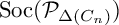


Acknowledgments
This paper was written during the visit of Oleksandra Gasanova, Takayuki Hibi, and Somayeh Moradi to the Department of Mathematics, University of Duisburg-Essen, Germany. They would like to thank Professor Jürgen Herzog for his support and hospitality. The authors are grateful to the referee for careful reading of the paper and his/her useful comments.