Introduction
Early childhood is a critical developmental window during which parenting shapes children’s emerging emotional and behavioral regulation. The preschool period is a particularly formative time, as children begin to develop regulatory skills in areas such as autonomy, self-control, and following directions (Kopp, Reference Kopp1982). Parental responsiveness and effective discipline during the preschool period are associated with improved emotional regulation, behavioral regulation, and cognitive development (Denham et al., Reference Denham, Mitchell-Copeland, Strandberg, Auerbach and Blair1997; Duncombe et al., Reference Duncombe, Havighurst, Holland and Frankling2012; Guajardo et al., Reference Guajardo, Snyder and Petersen2009; Kerr et al., Reference Kerr, Lopez, Olson and Sameroff2004; Parent et al., Reference Parent, Forehand, Merchant, Edwards, Conners-Burrow, Long and Jones2011). Unfortunately, parents involved with child protective services (CPS) often face significant external stressors (e.g., financial hardship; Lery et al., Reference Lery, Tucker, Norwitt, Stattelman-Scanlan, Wulczyn, Zhou, Huhr and Brooks2024), which can compromise their ability to provide sensitive and responsive care and use effective and constructive discipline strategies (see Masarik & Conger, Reference Masarik and Conger2017 for a review). Thus, it is essential to understand factors that support responsive and effective parenting during the preschool years among parents with histories of CPS involvement.
Guided by ecological frameworks (Belsky, Reference Belsky1984; Bronfenbrenner, Reference Bronfenbrenner1979; Conger et al., Reference Conger, Conger, Elder, Lorenz, Simons and Whitbeck1992; Spencer, Reference Spencer2007), researchers have increasingly studied factors across multiple levels — within the parent or family, as well as outside of the immediate household environment — that influence parenting (see Cuellar et al., Reference Cuellar, Jones and Sterrett2015; Im & Witherspoon, Reference Im, Witherspoon, Overall, Simpson and Lavner2025 for reviews). Neighborhood resource availability, which reflects the presence of educational, health and environmental, and social and economic resources in a given area (Acevedo-Garcia et al., Reference Acevedo-Garcia, McArdle, Hardy, Crisan, Romano, Norris, Baek and Reece2014), may be a key factor at the neighborhood level that impacts parenting behaviors (Hyde et al., Reference Hyde, Gard, Tomlinson, Suarez and Westerman2022; Shuey & Leventhal, Reference Shuey and Leventhal2017). However, relatively few studies have examined associations between neighborhood resource availability and parenting behaviors during early childhood and within a sample of families with caregiving risk. Furthermore, few studies have considered neighborhood-level variables alongside parent-level variables, such as parental attachment, that may interact to support parenting. To fill these gaps, the current study aimed to examine whether neighborhood resource availability, parental attachment, and their interaction were associated with observationally coded parental responsive involvement, constructive discipline, and problematic discipline in a sample of families with histories of CPS involvement.
Parenting among child protective services-involved families
Families typically become involved with CPS due to concerns about a child’s safety or well-being following suspected neglect or abuse. Importantly, families referred to CPS are often affected by heightened contextual risk rooted in conditions of poverty and systemic inequity, such as living in under-resourced neighborhoods (Lery et al., Reference Lery, Tucker, Norwitt, Stattelman-Scanlan, Wulczyn, Zhou, Huhr and Brooks2024; Littleton & Freisthler, Reference Littleton and Freisthler2024; Maguire-Jack & Font, Reference Maguire-Jack and Font2017), exposure to intergenerational trauma (Janczewski et al., Reference Janczewski, Mersky and Lee2023), experiences of discrimination (Thomas et al., Reference Thomas, Waldfogel and Williams2023), and household-level adversity (e.g., domestic violence, parental mental health problems; O’Leary, Reference O’Leary2001; Westad & McConnell, Reference Westad and McConnell2012). Although a referral to CPS may not necessarily reflect deficits in parenting, CPS-involved parents can struggle to provide the warm, responsive, and consistent parenting that supports young children’s development (Greene et al., Reference Greene, Haisley, Wallace and Ford2020; Kohl et al., Reference Kohl, Kagotho and Dixon2011; Wilson et al., Reference Wilson, Rack, Shi and Norris2008) likely due to exposure to many contextual stressors. Furthermore, CPS involvement itself may introduce stressors, such as fear of child removal and surveillance (Burrow et al., Reference Burrow, Wood, Fisher, Usher, Gayde and O’Donnell2024; Dettlaff & Boyd, Reference Dettlaff and Boyd2020; Yoo & Abiera, Reference Yoo and Abiera2020), that compound parenting challenges – especially for families of color (Merritt, Reference Merritt2020). Despite these risks, parents with CPS involvement are a heterogenous group, with many demonstrating resilience and strengths in parenting (Davies et al., Reference Davies, Ross, Cocks and Foote2023; Williams-Butler et al., Reference Williams-Butler, Boyd and Slack2023; Yoo & Abiera, Reference Yoo and Abiera2019). Understanding factors associated with responsive and effective parenting within this population can inform interventions and policies that promote family well-being and healthy child development.
Neighborhood resource availability and parenting: early childhood as a critical period
As proposed by the Family Stress Model (Conger et al., Reference Conger, Wallace, Sun, Simons, McLoyd and Brody2002), resource-related hardship may interfere with sensitive parenting and increase harsh parenting through its effect on parents’ stress. Of relevance to the early childhood window, studies of preschool-aged children have found associations between elevated household or family socioeconomic stress and reduced responsive involvement (e.g., parental warmth and responsiveness; Booth et al., Reference Booth, Macdonald and Youssef2018; Burt et al., Reference Burt, Thaler, Shewark, Pearson, Anaya, Tomlinson, Neiderhiser, Klump and Lonstein2023; Gard et al., Reference Gard, McLoyd, Mitchell and Hyde2020; Kalil & Ryan, Reference Kalil and Ryan2020; Leventhal & Brooks-Gunn, Reference Leventhal and Brooks-Gunn2000), and increased harsh discipline (Bradley, Reference Bradley and Bornstein2019; Furstenberg, Reference Furstenberg and Wilson1993; Jocson & McLoyd, Reference Jocson and McLoyd2015). Additionally, Kim et al. (Reference Kim, Cho and Kim2021) found that neighborhood resource availability (i.e., sufficient childcare facilities and convenient access to recreational facilities) predicted less parenting stress in mothers of preschool-aged children. There is evidence that elevated parental stress (e.g., depression) mediates associations between socioeconomic strain and parenting quality (Kohen et al., Reference Kohen, Leventhal, Dahinten and McIntosh2008; Lee et al., Reference Lee, Lee, Yoon, Kirsch, Pace and Schoppe-Sullivan2024; Saasa et al., Reference Saasa, Ward, Sandberg and Jacobson2021). Bronfenbrenner’s Ecological Systems Theory (Reference Bronfenbrenner1979) underscores the importance of multiple environmental layers in shaping familial outcomes. Accordingly, socioeconomic stressors within the household/microsystem (e.g., low parent income, low parent education) and within the neighborhood/exosystem (e.g., concentrated poverty, limited access to high-quality education) may individually relate to child and family well-being.
Low levels of neighborhood resource availability — sometimes described as neighborhood disadvantage or deprivation (Burt et al., Reference Burt, Thaler, Shewark, Pearson, Anaya, Tomlinson, Neiderhiser, Klump and Lonstein2023; Cuellar et al., Reference Cuellar, Jones and Sterrett2015) — represent structural limitations that may undermine parenting by increasing stress on parents. In contrast to household- or family-level socioeconomic hardship, neighborhood disadvantage reflects the broader socioeconomic conditions and institutional policies/practices at the community level. Specifically, neighborhood disadvantage can reflect the absence of or limited access to essential resources, such as educational services, healthcare, and social and economic opportunities (Cuellar et al., Reference Cuellar, Jones and Sterrett2015; Massey, Reference Massey1996; McLoyd, Reference McLoyd1998; Riley, Reference Riley2018). Although resource-related conditions at the family-level and neighborhood-level tend to be interrelated (i.e., low-income families tend to live in low-resourced communities; Green et al., Reference Green, Bovell-Ammon and Sandel2021; Hughes et al., Reference Hughes, Matsui, Tschudy, Pollack and Keet2017), it is important to consider how conditions outside of the household may uniquely influence parenting, as evidence of such community-level associations have implications for policy and intervention.
Studies examining associations between neighborhood conditions and parenting behaviors have typically framed their questions with a focus on disadvantage — such as living in an under-resourced community or a neighborhood characterized by concentrated poverty. Overall, findings linking neighborhood disadvantage to parenting behaviors have been mixed. Whereas some studies find no association between neighborhood disadvantage and parenting behaviors (e.g., Chuang et al., Reference Chuang, Ennett, Bauman and Foshee2005; Gonzales et al., Reference Gonzales, Coxe, Roosa, White, Knight, Zeiders and Saenz2011; Rankin & Quane, Reference Rankin and Quane2002; Tendulkar et al., Reference Tendulkar, Buka, Dunn, Subramanian and Koenen2010), other studies find that greater neighborhood disadvantage is associated with less parental warmth (Jocson & McLoyd, Reference Jocson and McLoyd2015; Liu et al., Reference Liu, Lau, Chen, Dinh and Kim2009; Taylor, Reference Taylor2000), particularly for low-income families (Klebanov et al., Reference Klebanov, Brooks-Gunn and Duncan1994; Leventhal & Brooks-Gunn, Reference Leventhal and Brooks-Gunn2000; Pinderhughes et al., Reference Pinderhughes, Nix, Foster and Jones2004). Building on these findings, in a large sample of 1030 predominantly non-Hispanic White families with elementary school age children (8 years old, on average), Burt et al. (Reference Burt, Thaler, Shewark, Pearson, Anaya, Tomlinson, Neiderhiser, Klump and Lonstein2023) found that greater neighborhood socioeconomic deprivation (operationalized as limited institutional and economic structural resources measured using the Child Opportunity Index, Area Deprivation Index, and Extent of Neighborhood Problems scale) was associated with less parental nurturance (based on parent and child report), less frequent use of praise (observationally coded), and more maternal control/directiveness (observationally coded); neighborhood socioeconomic deprivation was not significantly related to other dimensions of parenting (e.g., warmth, conflict, criticism).
Notably, few studies have examined associations between neighborhood conditions and parenting in early childhood (i.e., under age 5). In a sample of mothers of 3-year-old children, Klebanov et al. (Reference Klebanov, Brooks-Gunn and Duncan1994) found that neighborhood poverty was associated with less maternal warmth, accounting for family-level socioeconomic conditions. Additionally, in a sample of families with 4- to 5-year-old children, Kohen et al. (Reference Kohen, Leventhal, Dahinten and McIntosh2008) found indirect associations between neighborhood disadvantage (a latent factor indicated by income, education, family structure, and unemployment) and parenting behaviors. Specifically, greater neighborhood disadvantage was associated with reduced neighborhood cohesion, which, in turn, was associated with elevated maternal depression and family dysfunction. These family-level processes then predicted less consistent and more punitive parenting behaviors. In a mixed methods dissertation study, Thorpe (Reference Thorpe2024) found the opposite direction of effects among parents of preschool-aged children living in an urban city. Specifically, greater neighborhood disadvantage (a latent factor indicated by limited resource availability, physical disorder, social danger, and lack of social cohesion) was associated with higher levels of parent-reported authoritative parenting and supportive emotional socialization, and lower levels of authoritarian parenting. The qualitative component of this study revealed that concern about neighborhood disadvantage prompted some parents to engage in more protective parenting strategies (Thorpe, Reference Thorpe2024), highlighting the capacity of parents to be resilient in the face of neighborhood disadvantage.
Taken together, these studies offer initial support that neighborhood resource availability may be linked to various dimensions of parenting in early childhood, such as responsive involvement and problematic discipline; however, more research is needed. The Child Opportunity Index (COI; Acevedo-Garcia et al., Reference Acevedo-Garcia, McArdle, Hardy, Crisan, Romano, Norris, Baek and Reece2014) may be a useful tool to further understand how neighborhood conditions relate to parenting. The COI is a publicly available composite measure that captures the quality of resources and conditions in a child’s neighborhood that are known to support healthy development. It includes indicators across three domains — education, health and environment, and social and economic — with higher scores meant to reflect more “opportunity” due to greater resource availability. In numerous studies, COI scores have been found to predict children’s outcomes in domains of cognitive development (e.g., Cubides-Mateus et al., Reference Cubides-Mateus, LoCasale-Crouch and Turnbull2023; Gornik et al., Reference Gornik, Jacobson, Kalb and Pritchard2024), physical health (e.g., Ertel et al., Reference Ertel, Okuzono, Beyer, Pintro, Cuevas and Slopen2024), and socioemotional well-being (e.g., Davis et al., Reference Davis, Jawad, Feygin, Stevenson, Wattles, Jones, Porter, Lohr and Le2024). Two studies have used the COI to examine links between neighborhood conditions and parenting. In a study of mother-infant dyads, Kitagawa et al. (2023) found that higher COI scores were linked with greater observed maternal nurturance to infant distress and lower maladaptive beliefs about infant crying, although these patterns were no longer significant when accounting for household-level socioeconomic strain. As reported above, Burt et al. (Reference Burt, Thaler, Shewark, Pearson, Anaya, Tomlinson, Neiderhiser, Klump and Lonstein2023) used the COI in combination with other indices of socioeconomic deprivation and found small negative associations with positive parenting behaviors and maternal control but not with negative parenting behaviors among parents with school-aged children. Thus, more research is needed to understand how neighborhood resource availability may relate to parenting in an early childhood sample with elevated caregiving risk.
Attachment and parenting in early childhood: discipline contexts, CPS-involved parents, and neighborhood conditions
In accordance with Bronfenbrenner’s Ecological Systems Theory, individual-level factors, such as parental attachment, may interact with neighborhood-level factors to impact parenting behaviors. Parental attachment state of mind, reflecting an individual’s internal working model or mental representation of attachment, is shaped in part by early caregiving experiences (O’Connor et al., Reference O’Connor, Woolgar, Humayun, Briskman and Scott2019; Raby et al., Reference Raby, Labella, Martin, Carlson and Roisman2017; Roisman et al., Reference Roisman, Rogosch, Cicchetti, Groh, Haltigan, Haydon, Holland and Steele2017). According to attachment theory, children who experience sensitive and nurturing care are more likely to develop expectations of others as available and supportive (Dagan et al., Reference Dagan, Buisman, Nivison, Waters, Vaughn, Bost, Bleil, Vandell, Booth-LaForce and Roisman2021; Nivison et al., Reference Nivison, Dagan, Booth, Roisman and Waters2024; Waters & Waters, Reference Waters and Waters2006), shaping how they later perceive, interpret, and respond in attachment-relevant situations (Main et al., Reference Main, Kaplan and Cassidy1985; Waters et al., Reference Waters, Raby, Ruiz, Martin and Roisman2018). Assessed using the Adult Attachment Interview (AAI; George et al., Reference George, Main and Kaplan1985), individuals who openly reflect on their positive and negative memories in a balanced and coherent way are classified as having a secure-autonomous state of mind with regard to attachment. In contrast, individuals classified as having a non-autonomous state of mind may either idealize their childhood experiences, minimize the impact of relational experiences, and claim to lack specific memories (classified as a dismissing state of mind), or become emotionally overwhelmed when talking about early experiences with parents (classified as a preoccupied state of mind). Individuals may also be classified as unresolved with regard to attachment if they demonstrate disoriented speech when describing experiences of loss or abuse.
Parents’ attachment state of mind is associated with caregiving behavior. In a meta-analysis, Verhage et al. (Reference Verhage, Schuengel, Madigan, Fearon, Oosterman, Cassibba, Bakermans-Kranenburg and van IJzendoorn2016) found that parents with secure-autonomous attachment representations demonstrated higher parental sensitivity (e.g., emotional availability, contingent responsiveness, nurturance to distress) than parents with non-autonomous attachment representations. Some researchers have theorized that parental attachment may also relate to parenting behavior in discipline contexts, given that these situations tend to involve heightened stress for parents and more displays of negative emotion in children (Hill et al., Reference Hill, Fonagy, Safier and Sargent2003; Verschueren et al., Reference Verschueren, Dossche, Marcoen, Mahieu and Bakermans-Kranenburg2006; van IJzendoorn et al., Reference van IJzendoorn, Schuengel, Wang and Bakermans-Kranenburg2022). However, links between parental attachment and parental discipline have rarely been studied. One exception was a small study of mothers and early school-age children, which found that autonomous mothers showed greater warmth, less over-reactivity, less psychological control, and more adaptive discipline strategies than non-autonomous mothers (Verschueren et al., Reference Verschueren, Dossche, Marcoen, Mahieu and Bakermans-Kranenburg2006).
Autonomous parental attachment state of mind may be an important family-level predictor of parenting among CPS-involved parents. Parents facing significant adversity (e.g., history of maltreatment, CPS involvement, poverty, psychopathology) are less likely to be classified as autonomous than their low-risk counterparts (Bakermans-Kranenburg et al., Reference Bakermans-Kranenburg, Dagan, Cárcamo and van IJzendoorn2024; Raby et al., Reference Raby, Labella, Martin, Carlson and Roisman2017). However, even within high-risk samples, secure-autonomous parental attachment has been linked with more sensitive parenting behavior (Lindhiem et al., Reference Lindhiem, Bernard and Dozier2011; Schoppe-Sullivan et al., Reference Schoppe-Sullivan, Mangelsdorf, Haight, Black, Sokolowski, Giorgio and Tata2007; Zajac et al., Reference Zajac, Raby and Dozier2019). Examining attachment state of mind in CPS-involved parents may provide insight into variability in parenting behavior and inform intervention efforts aimed at promoting responsive caregiving under stress.
Taken together, existing research highlights both ecological and individual-level factors that are associated with parenting behaviors during early childhood. However, few studies have simultaneously examined neighborhood resource availability and parental attachment state of mind, particularly among CPS-involved families, who may face compounded structural and relational stressors.
The present study
The present study examined associations between neighborhood resource availability (i.e., a composite reflecting educational, health/environmental, and social/economic resources based on census tract), parental secure-autonomous attachment state of mind, and observationally coded parenting behaviors (i.e., responsive involvement, constructive discipline, and problematic discipline) in parents of 4-year-old children with histories of CPS involvement. We hypothesized that higher neighborhood resource availability would be associated with higher levels of parental responsive involvement and constructive discipline and lower levels of problematic discipline, accounting for household-level socioeconomic stress. We also expected that parents with secure-autonomous attachment would demonstrate higher responsive involvement than parents with non-autonomous attachment representations. Given the limited evidence of links between parental attachment and discipline behaviors, we did not formulate hypotheses about associations between attachment and constructive or problematic discipline. Finally, we explored whether neighborhood resource availability and parental attachment interacted to predict dimensions of parenting. Given that we did not pre-register our study plan or hypotheses, there is limited work on these associations in early childhood, and our sample was relatively small in size, findings from our study should be considered exploratory in nature and interpreted as hypothesis-generating for future research.
Method
Participants
The sample included 129 parent-child dyads with histories of involvement with CPS, drawn from a randomized controlled trial with longitudinal follow-up. Parents from the original sample were included in this study if they (1) participated in a follow-up visit when children were around 4 years old, from which interactions were coded for parenting behavior, and (2) were still residing in the mid-Atlantic metropolitan city from which all families were initially recruited; for comparability of neighborhood-level data, participants were excluded if they had moved outside of this city. At the time of the follow-up assessment used in this study, children were approximately 4 years old (M = 4.19 years, SD = 0.34) and parents ranged in age from 18.42 to 59.50 years old (M = 31.63, SD = 8.87). Although only biological parents were enrolled in the original study, some children changed placements throughout the follow-up period and were re-enrolled with a subsequent caregiver; at the time of the current study, five caregivers were not biological parents (e.g., foster parent, relative caregiver). The majority of parents (71.3%) identified as Black or African American; 15.5% identified as Hispanic, 10.9% as White, and 2.3% as “other.” Most of the parents (97.7%) and almost half of the children (45.7%) were female. A substantial proportion of the sample reported low socioeconomic status; of those who provided information about financial status, 75.7% reported receiving public assistance (e.g., TANF or welfare) and 93.9% reported an income of less than $30,000; 14 participants did not report financial information. The majority of parents did not complete high school; specifically, 57.4% completed some high school, 33.3% completed high school or earned their GED, 5.4% completed some college, 0.8% completed college, and 3.1% of the sample was missing information on educational attainment. Regarding marital status, 62.8% of parents reported being single parents, 10.1% were married, 3.1% were separated, 2.3% were divorced, and 16.3% were living together with a partner; 5.4% did not provide information about their marital status.
Procedure
Recruitment was conducted in partnership with the child welfare system in a mid-Atlantic city, within the scope of a city-wide effort to divert children from foster care. Parents were referred to the research team following involvement with the child welfare system. Eligibility criteria included the child being under 24 months of age and living with their biological parent. After providing consent, parents were randomly assigned to receive either Attachment and Biobehavioral Catch-up (ABC, experimental intervention; Dozier & Bernard, Reference Dozier and Bernard2019) or Developmental Education for Families (DEF, comparison intervention; Brooks-Gunn et al., Reference Brooks-Gunn, Klebanov, Liaw and Spiker1993; Ramey et al., Reference Ramey, Yeates and Short1984); both interventions were 10 sessions and delivered in parents’ homes. Whereas the ABC intervention focused on increasing sensitive parenting (e.g., responding in nurturing ways to infant distress, following the infant’s lead, avoiding responding in frightening ways), the DEF intervention focused on educating parents about infants’ cognitive, language, and motor development. Intervention effectiveness was not the focus of the current study, but group assignment was explored as a predictor of parenting outcomes in preliminary analyses.
Data for the current study were drawn from a pre-intervention visit (during which parental attachment was assessed) and a post-intervention follow-up laboratory visit when children were approximately 4 years old (during which parenting behaviors were assessed). Participants’ addresses at the time of the follow-up visit were used to link parenting data to publicly available data about neighborhood resource availability. All procedures were approved by the Institutional Review Board at the University of Delaware.
At a pre-intervention home visit, the AAI (George et al., Reference George, Main and Kaplan1985) was administered by a research assistant. The interview was audio-recorded and later transcribed for coding of parental attachment state of mind. During a laboratory follow-up visit conducted when children were approximately 4 years old, dyads participated in the Disruptive Behavior Diagnostic Observation Schedule (DB-DOS; Wakschlag et al., Reference Wakschlag, Briggs-Gowan, Hill, Danis, Leventhal, Keenan, Egger, Cicchetti, Burns and Carter2008). This structured observational assessment is designed to identify behavior and emotion dysregulation difficulties in preschool-age children. The DB-DOS consists of a series of challenging tasks that approximate situations that children may experience every day that elicit disappointment, frustration, and noncompliance. There are three contexts during the DB-DOS, one with the parent and child and two with the researcher and child. For the current study, only the parent context was used given the focus on parenting behaviors. The parent was given instructions for a series of four tasks to complete with their child: (1) coloring with their child for 2 minutes and then asking the child to clean up, (2) putting together puzzles, (3) completing a questionnaire while the child waited with a book, and (4) playing together with toys. Except for during the final free play task, parents were instructed to prevent their child from touching a set of attractive toys on a table in the room. The DB-DOS was video-recorded for later coding.
Measures
Parenting behavior
Parenting behavior was coded from the parent context of the DB-DOS utilizing the Parenting Clinical Observation Schedule (P-COS) rating scales (Hill et al., Reference Hill, Maskowitz, Danis and Wakschlag2008). The P-COS consists of 18 items that are used to create three subscales: (1) responsive involvement (i.e., 8 items: scaffolding, responsivity to positive behaviors, warm affection, positive engagement, labeling, intensity of positive affect, pervasiveness of positive affect), (2) constructive discipline (i.e., 4 items: firmness, positive behavior strategies, flexibility of behavior management strategies, response to misbehavior), and (3) problematic discipline (i.e., 7 items: hostile behaviors, verbally aggressive discipline, physical discipline, power struggles, emotional misattunement, intensity of angry/irritable affect, pervasiveness of angry/irritable affect) (Hill et al., Reference Hill, Maskowitz, Danis and Wakschlag2008). Items were coded on a 4-point scale ranging from 0 (none) to 3 (high). Scoring considered the appropriateness (e.g., whether the parent’s response was well-matched to the child’s behavior) and effectiveness (e.g., to what extent the parent’s response helped support child compliance and emotion regulation) of parental behavior. For clinical purposes, scores of “none” and “low” are intended to indicate potential concern (i.e., lack of positive parenting behavior) for responsive involvement and constructive discipline scales; scores of “moderate” and “high” are intended to indicate potential concern (i.e., engagement in problematic parenting behavior) for the problematic discipline scale. We selected this observational measure of parenting that broadly captures several key parenting constructs within a dynamic dyadic context, given our aim to capture both how a parent is managing/disciplining in response to child misbehavior, as well as their provision of a warm and supportive environment.
For primary analyses, items were averaged to create a composite score for each dimension. Following guidelines provided by the creators of the P-COS, the “labeling” item was not included in the responsive involvement composite, and the items for “irritable/angry affect intensity” and “irritable/angry affect pervasiveness” were averaged and included in the problematic discipline composite (Hill et al., Reference Hill, Maskowitz, Danis and Wakschlag2008). The internal consistency (measured as Cronbach’s alpha) of the responsive involvement dimension (7 items) was .85, the constructive discipline dimension (4 items) was .82, and the problematic discipline dimension (6 items) was .63. Approximately 20% of the recordings were double-coded to calculate reliability, which was adequate for all three dimensions (i.e., responsive involvement ICC [one-way random, single measure] = .96; constructive discipline ICC = .74; problematic discipline ICC = .81). For double-coded videos, scores were averaged across coders for analyses.
Neighborhood resource availability
To assess neighborhood resource availability, we used the Child Opportunity Index 2.0 (COI; Acevedo-Garcia et al., Reference Acevedo-Garcia, McArdle, Hardy, Crisan, Romano, Norris, Baek and Reece2014), a publicly available measure enumerating educational, health/environmental, and social/economic opportunities in a given neighborhood based on census tract data. Participants’ addresses were geocoded into spatial coordinates, mapped in ArcMap 10.3, and matched to COI data for each census tract using the spatial join tool in ArcMap 10.3. The COI (Acevedo-Garcia et al., Reference Acevedo-Garcia, McArdle, Hardy, Crisan, Romano, Norris, Baek and Reece2014) includes 29 indicators of neighborhood resources across three domains: (1) education (e.g., number of early childcare centers within a 5-mile radius, third-grade reading proficiency, high school graduation rate), (2) health and environment (e.g., access to healthy food, proximity to hazardous waste dump sites, percentage of individuals with health insurance coverage), (3) social and economic (e.g., percentage of employed adults, poverty rate, median household income). Indicators were drawn from large-scale, nationally representative surveys, such as the U.S. Census Bureau American Community Survey, the U.S. Environmental Protection Agency Toxic Release Inventory, and the National Assessment of Educational Progress (Noelke et al., Reference Noelke, McArdle, Baek, Huntington, Huber, Hardy and Acevedo-Garcia2020). For each domain, the developers weighted each individual indicator (following z-score standardization) based on its strength of association with health and socioeconomic outcomes (Noelke et al., Reference Noelke, McArdle, Baek, Huntington, Huber, Hardy and Acevedo-Garcia2020). The COI developers also created an overall COI score for each census tract using a similar weighting approach of the three domain scores (Noelke et al., Reference Noelke, McArdle, Baek, Huntington, Huber, Hardy and Acevedo-Garcia2020). The scores for overall COI can range from 1 to 100, with 1 representing the lowest opportunity and 100 representing the highest opportunity (Noelke et al., Reference Noelke, McArdle, Baek, Huntington, Huber, Hardy and Acevedo-Garcia2020). The COI offers nationally normed, state normed, or metropolitan normed overall and specific COI indices. For this study, metropolitan normed overall COI scores were utilized to capture variability relative to the city. Though COI indices were published in 2010 and 2015, this study utilized the indices from 2010 to align with the median date of parenting behavior data collection, May 2011.
Participants were distributed across 87 census tracts. Sixty-one census tracts had one participant; 16 had two participants; eight had three participants; one had five participants; and one had seven participants. COI scores ranged from 1 to 46 (M = 11.33, SD = 8.91). The majority of parents had a COI score that fell in the lowest (“very low”) quintile (88.4%), with 9.3% in the second lowest (“low”) quintile, and 2.3% in the middle (“moderate”) quintile.
Parental attachment state of mind
Parental attachment state of mind was coded from transcripts of the AAI (George et al., Reference George, Main and Kaplan1985). The AAI is a 20-question, semi-structured interview, which asks individuals to describe: their early relationships with their and provide specific memories to support those descriptions, how they reacted and their parents responded when they experienced distress during childhood, experiences of abuse and loss, and ways that their childhood upbringing may influence them as an adult. A primary certified coder scored all interviews using the coding system developed by Main and Goldwyn (Reference Main and Goldwyn1998). Transcripts were first rated using scales to assess inferred experiences of caregiving (e.g., rejecting, involving, neglecting, loving), state of mind (e.g., idealizing, involving anger, insistence of lack of recall), and unresolved loss/trauma. Additionally, transcripts were assigned an overall score for coherence of mind, reflecting the extent to which the narrative was internally consistent, collaborative, and emotionally balanced when describing and reflecting on early attachment experiences. These scale scores were then used to classify parents as secure-autonomous, dismissing, or preoccupied. Transcripts were also coded as resolved or unresolved with respect to trauma or loss. A second certified coder coded approximately 15% (n = 20) of the transcripts. Agreement for the four-way classification was 90%, κ = .88, p < .001. Primary coder classifications were used in analyses. Four parents were missing AAI data. Of the 125 parents with AAI data, 30.5% were assigned a primary classification of secure-autonomous, 36.2% dismissing, 4.8% preoccupied, and 28.6% unresolved. For primary analyses, classifications were collapsed into a binary variable reflecting secure-autonomous versus non-autonomous (dismissing, preoccupied, or unresolved).
Household-level socioeconomic stress
To account for indicators of socioeconomic disparities at the household level, we created a composite score of 4 binary indicators: financial strain (scored 1 if the parent reported an annual income level less than $30,000 or reported receiving public assistance), low parent education level (scored 1 if the parent reported less than a high school education), young parent age (scored 1 if the parent was less than 21 years old at the time of the child’s birth), and single parent status (scored 1 if the parent reported that they were a single parent, divorced, or separated). Composite household-level socioeconomic stress scores ranged from 0 to 4 (M = 2.58, SD = .97).
Data analytic plan
In preliminary analyses conducted in SPSS (Version 26.0), patterns of missing data were examined. Additionally, bivariate associations were examined among primary variables (i.e., household-level socioeconomic stress, neighborhood resource availability, parenting dimensions) and demographic variables to assess for potential covariates. Although testing intervention effectiveness was not the focus of the present study, we examined whether the intervention condition (ABC vs. DEF) was associated with the parenting dimensions, and planned to control for the intervention condition if it was.
For primary analyses examining main effects of neighborhood resource availability and parental attachment, we conducted multilevel modeling in Mplus 8.2 (Muthén & Muthén, Reference Muthén and Muthén1998– Reference Muthén and Muthén2017) due to the hierarchical structure of data with individuals (level 1) nested within census tracts (level 2). We first examined intraclass correlation coefficients (ICCs) to assess the proportion of variance in parenting dimensions that could be attributed to clustering within census tracts. Even small ICC values can result in biased results when dependence is not accounted for (Cohen et al., Reference Cohen, Cohen, West and Aiken2013; Geiser, Reference Geiser2012), motivating the use of multilevel modeling for the current study. At level one, we specified regression pathways to examine the association between household-level socioeconomic stress and parental attachment (a binary variable reflecting parental autonomous [1] versus non-autonomous [0] attachment classification) and all three parenting dimensions. At level two, we specified regression pathways between neighborhood resource availability and all three parenting dimensions. We then explored whether parental attachment classification moderated the association between neighborhood resource availability (mean-centered) and parenting dimensions by adding an interaction term to the model, and estimating simple slopes for significant interaction terms. Missing data were handled using full information maximum likelihood (FIML) estimation. FIML uses all available data points to estimate model parameters, under the assumption that data are missing at random, which allows for the inclusion of cases with partially missing data without imputing values.
Results
Preliminary analyses
Missing data for primary variables was relatively low, in part because the sample selected for the present study all had parenting data at age 4 (as an inclusion criteria). To assess the pattern of missingness, we conducted Little’s MCAR test in SPSS 29.0 on the primary study variables (i.e., household-level socioeconomic stress [n = 12, 9.3% missing], parental attachment [n = 4, 3.1% missing], neighborhood resource availability [0% missing], and parenting dimensions [0% missing]). Results indicated that the data met criteria for being considered missing completely at random (MCAR), χ2(4) = 3.51, p = .477, suggesting that the likelihood of missingness was unrelated to the values of the variables included in the analysis.
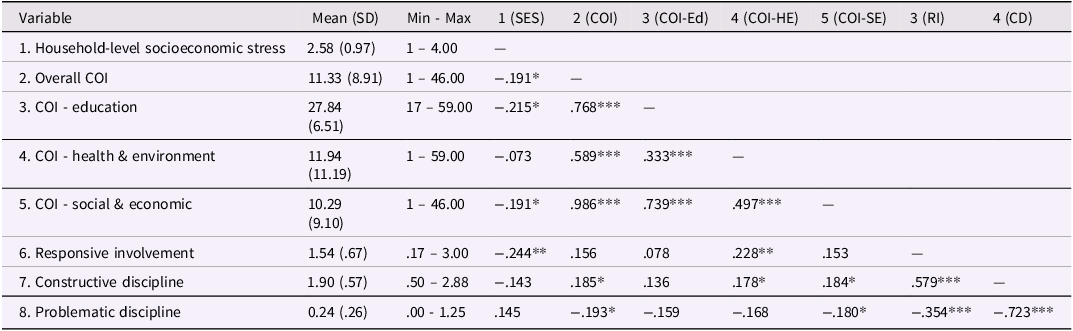
Table 1 contains descriptive statistics and bivariate correlations of all primary study variables. Household-level socioeconomic stress was inversely correlated with overall neighborhood resource availability, educational resource availability, and social/economic resource availability, but not health/environmental resource availability. Greater household-level socioeconomic stress was associated with lower parental responsive involvement, but neither dimension of parental discipline. Greater overall neighborhood resource availability was associated with higher constructive discipline and lower problematic discipline, but not responsive involvement. Regarding the subdomains of the COI, educational resource availability was not significantly associated with parenting dimensions; health/environmental resource availability was positively correlated with responsive involvement and constructive discipline, but not significantly associated with problematic discipline; social/economic resource availability was positively correlated with constructive discipline and negative correlated with problematic discipline, but was not associated with responsive involvement. Given that bivariate correlations did not account for nesting of participants within census tracts, these results should be interpreted with caution.
Descriptive statistics and bivariate correlations of primary variables

Note. *p < .05. **p < .01 ***p < .001; COI = Child Opportunity Index Score.
In bivariate correlations (for continuous variables) and independent sample t-tests (for dichotomous variables), parenting dimensions were not significantly associated with child age, parent minority (vs. non-Hispanic White) race/ethnicity, parent Hispanic (vs. non-Hispanic) ethnicity, child or parent sex, or intervention condition (ABC vs. DEF). Thus, none of these variables were included in primary analyses as covariates.
Primary analyses
Main effects of neighborhood resource availability and parental attachment
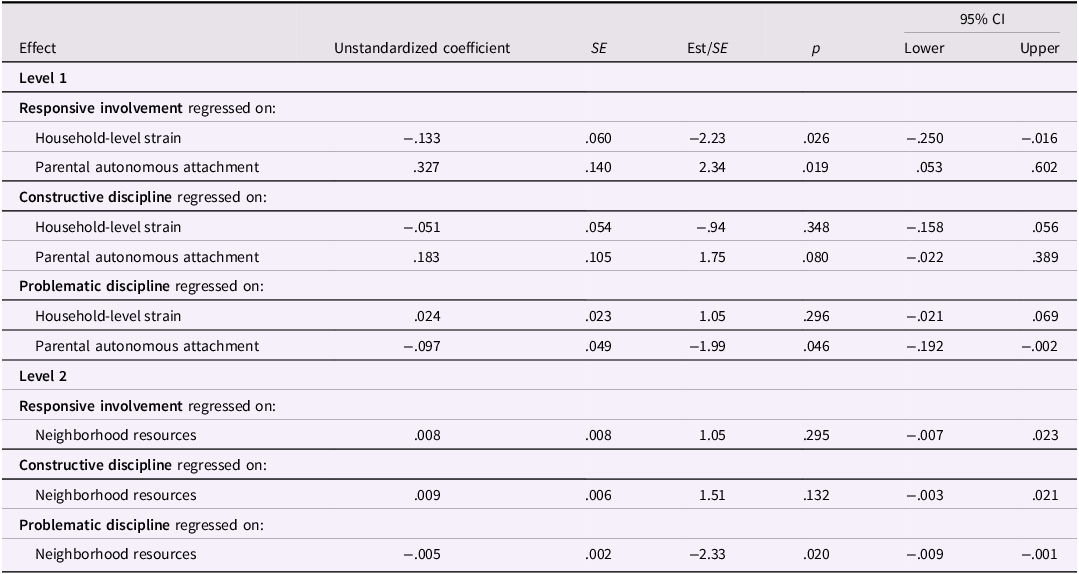
The ICCs (i.e., ratio of variance between the clusters to the total variance for each parenting dimension) suggested that a non-trivial proportion of variability in each parenting dimension can be explained by clustering at the census tract level (responsive involvement ICC = 0.215, constructive discipline ICC = 0.347, problematic discipline ICC = 0.116). In the multilevel model, when simultaneously accounting for household- and neighborhood-level predictors, higher neighborhood resource availability was significantly associated with lower levels of problematic discipline; there was no association between neighborhood resource availability and responsive involvement nor constructive discipline. Parental autonomous attachment was significantly associated with higher responsive involvement and lower problematic discipline, but was not associated with constructive discipline. Additionally, lower household-level socioeconomic stress was significantly associated with higher levels of responsive involvement, but was not associated with constructive discipline nor problematic discipline. See Table 2 for full model results.
Unstandardized model parameters for multi-level model predicting parenting dimensions

Interactive effects of neighborhood resource availability and parental attachment
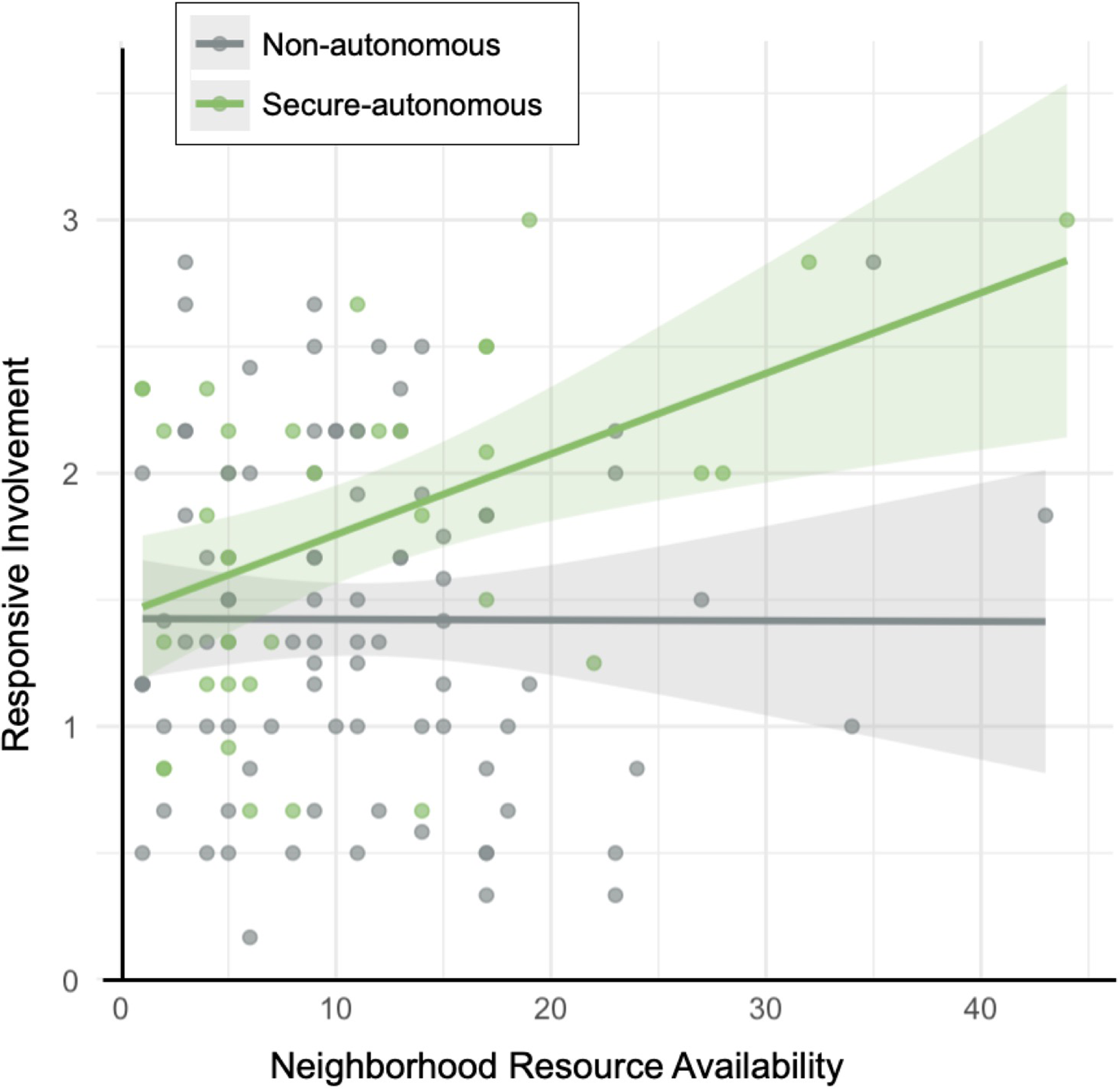
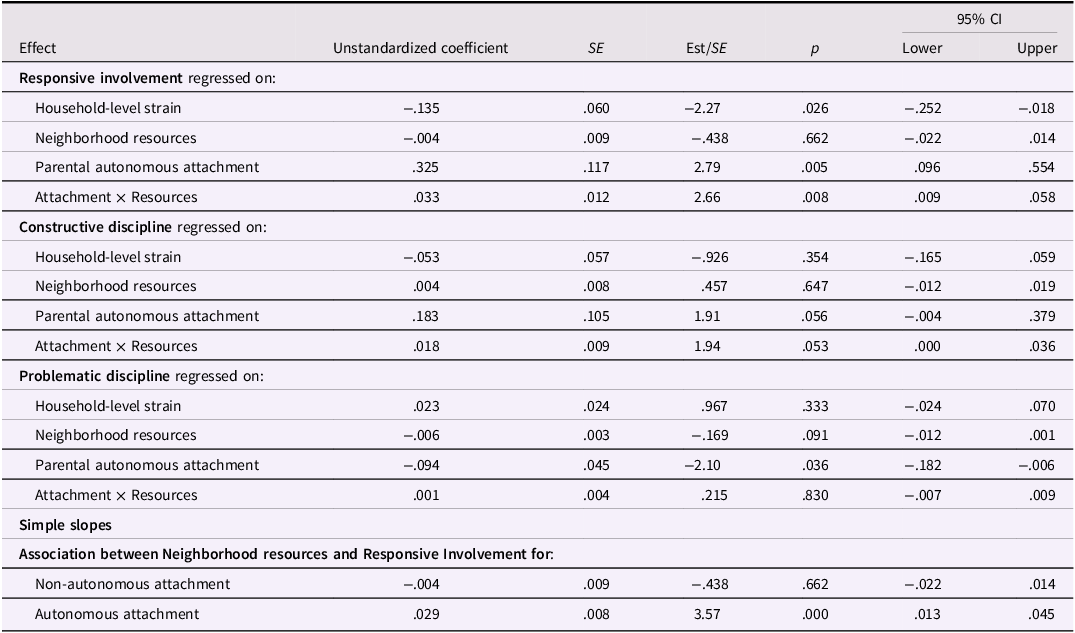
A multilevel model with a cross-level interaction term (parental attachment at level 1 by neighborhood resource availability [mean-centered] at level 2) resulted in model estimation problems, likely due to limited variability in parental attachment within clusters. Specifically, of the 27 census tracts with more than one participant, over half (15; 55.6%) had no variability in parental attachment. Thus, we ran a simpler model without accounting for clustering, followed by a sensitivity analysis (reported below) to examine whether results held with a sample reduced to one participant per census tract. In this model, parental autonomous attachment significantly moderated the association between neighborhood resource availability and responsive involvement (See Table 3). Simple slopes analyses demonstrated that, for parents with a non-autonomous attachment state of mind, the association between neighborhood resource availability and responsive involvement was non-significant. In contrast, for parents with an autonomous attachment state of mind, higher neighborhood resource availability was associated with higher responsive involvement (See Figure 1). The interaction term was not significantly associated with constructive discipline or problematic discipline.
Interaction effect between parental attachment state of mind and neighborhood resource availability predicting responsive involvement.

Moderation model examining interaction between parental attachment and neighborhood resource availability predicting parenting dimensions

Follow-up sensitivity analyses
Given that the moderation model did not account for clustering within census tracts, we conducted a follow-up sensitivity analysis to determine if the interaction effect held with a reduced sample. Specifically, we re-ran the analysis with only one participant per census tract (randomly selected). With the reduced sample of 87 participants, the interaction between parental attachment and neighborhood resource availability was significantly associated with responsive involvement, b = .035, p = .010. For parents with a non-autonomous attachment state of mind, the association between neighborhood resource availability was non-significant, b = −.004, p = .738, whereas for parents with an autonomous attachment state of mind, higher resource availability was associated with higher responsive involvement, b = .031, p < .001.
Participants in the sample had a restricted range of COI scores (1 – 46, out of 100), with few falling towards the upper end of this limited range (See Figure 1). In order to test whether effects were driven by outliers, we re-ran primary analyses excluding six participants with COI scores over 2 standard deviations above the mean. In the multi-level model, the level 2 effect showing an association between higher neighborhood resource availability and reduced problematic discipline remained significant, b = −.005, p < .001. In a moderation model excluding these participants, the interaction term between parental autonomous attachment and neighborhood resource availability continued to significantly predict responsive involvement, b = .034, p = .036.
Due to concerns regarding the relatively low internal consistency of the problematic discipline composite (α = .63), we explored whether primary findings would hold if items contributing to its reduced reliability were removed. In an exploratory factor analysis, verbally aggressive discipline, emotional misattunement, and power struggles demonstrated weaker loadings relative to hostile behavior, physical discipline, intensity of angry/irritable affect, and pervasiveness of angry/irritable affect. When a composite was created with only the latter four items, Chronbach’s alpha fell in the acceptable range, α = .71. In a multi-level model using this revised composite for problematic discipline, neighborhood resource availability continued to predict problematic discipline at level 2, b = −.007, p = .037, and autonomous parental attachment continued to predict problematic discipline at level 1, b = −.184, p = .017.
Discussion
Among a sample of CPS-involved families, this study examined neighborhood-level (resource availability) and parent-level (household socioeconomic stress, parental attachment) predictors of key dimensions of parenting behavior in early childhood. Our findings suggest that greater availability of socioeconomic, health-related, and educational resources at the neighborhood level was associated with reduced harsh, problematic disciplinary behaviors; this association was robust to controlling for indicators of socioeconomic stress at the household level. This finding aligns with prior work showing that limited neighborhood resource availability is associated with harsh parenting behaviors (Jocson & McLoyd, Reference Jocson and McLoyd2015; Kohen et al., Reference Kohen, Leventhal, Dahinten and McIntosh2008). Although we were unable to test mechanistic pathways that could explain the association between neighborhood resource availability and harsh parenting, prior research suggests that limited availability of resources in a community may increase parental stress (Franco et al., Reference Franco, Pottick and Huang2010; Kim et al., Reference Kim, Cho and Kim2021; Zhang et al., Reference Zhang, Eamon and Zhan2015), making it harder for parents to regulate their emotions (Bonds et al., Reference Bonds, Gondoli, Sturge-Apple and Salem2002; Gard et al., Reference Gard, McLoyd, Mitchell and Hyde2020; Guterman et al., Reference Guterman, Lee, Taylor and Rathouz2009; Kohen et al., Reference Kohen, Leventhal, Dahinten and McIntosh2008). In response, parents’ emotional dysregulation may lead them to engage in more reactive, harsh, and insensitive behaviors, such as verbal aggression, physical discipline, or hostile behaviors.
Additionally, secure-autonomous parental attachment state of mind significantly predicted higher responsive involvement and lower problematic discipline. Although links between autonomous parental attachment and sensitive and responsive parenting are well-established (Verhage et al., Reference Verhage, Schuengel, Madigan, Fearon, Oosterman, Cassibba, Bakermans-Kranenburg and van IJzendoorn2016), few studies have examined how parental attachment influences discipline-related behavior. Thus, our finding demonstrating that having a secure-autonomous attachment may be a parent-level factor that promotes less harsh discipline is novel, particularly among parents who may struggle to discipline in safe and effective ways (Baker & Brooks-Gunn, Reference Baker and Brooks-Gunn2020; Ma et al., Reference Ma, Grogan-Kaylor and Klein2018).
Although there was not a significant association between overall neighborhood resource availability and responsive involvement, findings suggested that the strength of this association was moderated by parental attachment. Specifically, for parents with an autonomous attachment state of mind, greater neighborhood resource availability was associated with higher levels of responsive involvement. In contrast, no such association emerged for parents with non-autonomous attachment representations. This pattern suggests that a combination of resilience factors across ecological levels may support CPS-involved parents’ engagement in warm and responsive interactions. In contrast, non-autonomous parents may be less able to benefit from available resources in the community, perhaps due to emotional dysregulation (Bakermans-Kranenburg et al., Reference Bakermans-Kranenburg, Dagan, Cárcamo and van IJzendoorn2024; Kobak et al., Reference Kobak, Cole, Ferenz-Gillies, Fleming and Gamble1993; Riva Crugnola et al., Reference Riva Crugnola, Ierardi, Bottini, Verganti and Albizzati2019) or negative expectations of support (Loeb et al., Reference Loeb, Stern, Costello and Allen2021; Waters et al., Reference Waters, Brockmeyer and Crowell2013).
Neighborhood resource availability and parental attachment were not associated with constructive discipline independently nor in an interactive way, although the interaction term approached our criteria for statistical significance (p = .053). Given that this study is one of only a few that have examined neighborhood resource availability and parenting during the early childhood period, more research is needed to make sense of these null findings, which stand in contrast to other studies that have demonstrated associations between neighborhood disadvantage and consistent parenting (Kohen et al., Reference Kohen, Leventhal, Dahinten and McIntosh2008). It is possible that limitations of the current study described below (e.g., relatively small sample size, limited variability in neighborhood resource availability) interfered with our ability to detect these associations. Additionally, it is possible that subdomains of resource availability (e.g., educational vs. health/environmental vs. social/economic) may relate in different ways to different parenting constructs as suggested in preliminary bivariate correlations, and our use of the overall COI score obscured these nuances. Notably, we found that greater household-level socioeconomic stress was associated with less responsive involvement, consistent with a large body of previous literature (e.g., Booth et al., Reference Booth, Macdonald and Youssef2018, Furstenberg, Reference Furstenberg and Wilson1993; Klebanov et al., Reference Klebanov, Brooks-Gunn and Duncan1994; Leventhal & Brooks-Gunn, Reference Leventhal and Brooks-Gunn2000; Pinderhughes et al., Reference Pinderhughes, Nix, Foster and Jones2004). Given this preliminary evidence for some unique effects of neighborhood versus household socioeconomic deprivation (on problematic discipline and responsive parenting, respectively), future research should continue to explore the extent to which socioeconomic conditions at different ecological levels may differentially relate to specific parenting behaviors.
Importantly, our sample was predominantly composed of parents of color living in under-resourced communities. Our findings should thus be considered within a historical context that has resulted in systemic racism and perpetuated structural disadvantage for families of color. For example, as a result of redlining, families of color have been prohibited from “establishing roots” (i.e., home ownership) in well-resourced communities and excluded from neighborhoods considered desirable for further development, thereby limiting their access to communities that were characterized by better quality education, healthy food access, and quality health care facilities (Lavery, Reference Lavery2024). Consequently, families of color disproportionately reside in under-resourced neighborhoods that seem to be linked to more harsh disciplinary behaviors, potentially due to stress associated with hardship (e.g., Saasa et al., Reference Saasa, Ward, Sandberg and Jacobson2021).
Supporting healthy parenting among CPS-involved families
Although structural disadvantage may create a barrier to effective parenting, research indicates that parents experiencing adversity can still demonstrate resilience and adaptability in these contexts (e.g., Thorpe, Reference Thorpe2024). For example, Williams-Butler et al. (Reference Williams-Butler, Boyd and Slack2023) found that supportive social networks were associated with higher parental resilience, better emotional competence, and lower levels of parental distress in a sample of Black CPS-involved mothers. These findings challenge deficit-oriented assumptions that parents in distressing environments inevitably adopt harmful parenting behaviors, and instead highlight the ways in which parents can adapt and thrive in the face of adversity.
Legislative and policy-level actions may be one way to support healthy parenting for families with caregiving risk in under-resourced neighborhoods. Specifically, attention should be given to actions that enhance neighborhood conditions, such as increased affordable housing options, increased educational programs, economic development, health program improvement, and community enrichment (Sandel et al., Reference Sandel, Faugno, Mingo, Cannon, Byrd, Garcia, Collier, McClure and Jarrett2016). As noted in previous literature, systemic practices have perpetuated resource disparities (Lavery, Reference Lavery2024), necessitating equally corrective measures to undo generations of systemic disadvantage. That said, it is crucial to acknowledge that neighborhood resource improvement can coincide with gentrification, leading to the displacement of marginalized communities during neighborhood revitalization (Thurber & Krings, Reference Thurber and Krings2021). Policies aimed at supporting parenting through enhanced resource availability should also consider ways to mitigate rising costs to ensure families can reap the benefits of local improvements and avoid displacement (Thurber & Krings, Reference Thurber and Krings2021).
In addition to structural improvements, individual and community-level interventions may help support under-resourced families with caregiving risk. Parenting interventions such as Parent-Child Interaction Therapy (Funderburk & Eyberg, Reference Funderburk, Eyberg, Norcross, VandenBos and Freedheim2011) and Family Check-up (Dishion & Stormshak, Reference Dishion and Stormshak2007) have demonstrated efficacy in enhancing parenting responsiveness and constructive discipline, (O’Leary, Reference O’Leary2001; Sitnick et al., Reference Sitnick, Shaw, Gill, Dishion, Winter, Waller, Gardner and Wilson2015; Thomas et al., Reference Thomas, Abell, Webb, Avdagic and Zimmer-Gembeck2017), including among families facing external stressors, such as financial strain (e.g., Abrahamse et al., Reference Abrahamse, Junger, van Wouwe, Boer and Lindauer2016; Dishion et al., Reference Dishion, Shaw, Connell, Gardner, Weaver and Wilson2008) or CPS involvement (see Batzer et al., Reference Batzer, Berg, Godinet and Stotzer2018 for review of PCIT studies). Community-based interventions, such as the Strong Communities for Children program, can offer a complementary approach by promoting social cohesion and strengthening social support networks, with evidence for effectiveness in reducing maltreatment and improving child and family well-being in under-resourced communities (McDonell et al., Reference McDonell, Ben-Arieh and Melton2015; McLeigh et al., Reference McLeigh, McDonell and Melton2015; Melton & McLeigh, Reference Melton and McLeigh2020).
Limitations & future directions
This study had several limitations related to the sampling approach and sample composition that should be considered when interpreting the findings. First, the relatively small sample size may have resulted in underpowered analyses, potentially undermining our ability to detect some effects. Additionally, our sample wholly consisted of parent-child dyads with histories of CPS involvement in a single urban city. Notably, some families were clustered in particular census tracts, which may reflect the distribution of CPS investigations and/or residential structure in the Mid-Atlantic metropolitan city where data were collected. The area of data collection contained multiple high-rise apartment buildings that housed multiple participants. Although this work provides insight into the unique experience of this underrepresented population, the generalizability of the findings to other contexts and geographic settings is limited. The vast majority of our sample also resided in communities in the lowest quintile of COI scores and the majority (69.5%) had non-autonomous attachment representations; this limited variability could have made it hard to detect associations between neighborhood resource availability, parental attachment, and parenting constructs. Given the small sample size, we also did not examine differences in parenting behavior between non-autonomous classifications (e.g., dismissing vs. preoccupied vs. unresolved) or how these classifications may specifically interact with neighborhood conditions to predict parenting.
In addition to these sample-related limitations, aspects of our study design and measurement approach carry limitations that warrant consideration. Given that data for the current study were drawn from a larger RCT, all parent-child dyads were enrolled in one of two intervention groups during data collection. Although analyses indicated that there was no effect of intervention condition (ABC vs. DEF) on parenting outcomes, it is unclear whether associations between neighborhood resource availability and parenting constructs were affected by participation in an intervention or whether intervention participation affected unmeasured variables that were linked to constructs of interest. Thus, findings should be replicated outside of an intervention study. Additionally, although we consider the use of a well-validated observational assessment of parenting to be a strength of our design, is it possible that parents behaved differently while being observed in a lab-based setting than they would in a home setting, potentially limiting ecological validity.
Furthermore, address data were not systematically collected and tracked across the study period, limiting our approach to cross-sectional analyses at the study timepoint when address data were available. Including factors such as household mobility and changes in neighborhood conditions in future research may help more accurately capture associations between neighborhood resource availability and parenting behaviors. Additionally, although the Child Opportunity Index offers a valuable measure of neighborhood-level resource availability, we were unable to measure whether families actually accessed available resources. Future research should explore interrelationships between the presence of neighborhood resources, parents’ perception of resources, and patterns of resource utilization.
Finally, the correlational and cross-sectional nature of the study design prevents us from drawing causal conclusions regarding the association between neighborhood resource availability and parenting behaviors or assessing whether this association evolves across development. Future research would benefit from a longitudinal examination of associations between neighborhood and parenting behaviors across sensitive developmental windows when environment may be particularly important, such as adolescence (e.g., Hyde et al., Reference Hyde, Gard, Tomlinson, Suarez and Westerman2022). Such work would also allow for an examination of how parenting behaviors may be influenced by neighborhood changes.
Besides addressing these limitations, future research would benefit from a qualitative or mixed-methods approach to better understand how and why neighborhood conditions are associated with parenting behaviors. Incorporating parent voices into such research efforts may inform novel prevention and intervention that are well-aligned with parents’ values and lived experiences. Additionally, our study focused specifically on overall neighborhood resource availability, rather than individual domains that make up the overall COI score (i.e., education, health and environment, social and economic). Future research with well-powered and diverse samples would benefit from a more detailed examination of individual aspects of neighborhood resource availability that predict parenting behaviors. In addition to sub-components of neighborhood resource availability, future research can simultaneously assess multiple dimensions of neighborhood conditions, such as neighborhood danger, disadvantage, and disengagement. Recent models in the developmental psychopathology literature (e.g., Dimensional Model of Adversity and Psychopathology, Sheridan & McLaughlin, Reference Sheridan and McLaughlin2014) argue for considering the unique effects of different dimensions of adversity, such as deprivation versus threat, on developmental outcomes.
Conclusion
This study adds to a growing body of research on the associations between neighborhood conditions, attachment representations, and parenting during the preschool period. Within a CPS-involved sample, greater neighborhood resource availability and secure-autonomous parental attachment were associated with reduced problematic discipline, even after accounting for socioeconomic strain within the household. Secure-autonomous parental attachment moderated the association between neighborhood resource availability and responsive involvement, with autonomous parents showing strengths in parenting in the context of more resourced communities. Although more research is needed, our findings offer preliminary evidence that community-based initiatives and policy-related efforts that improve neighborhood conditions may have implications for family well-being.
Data availability
Data are available at osf.io/pq5uz.
Acknowledgements
In alignment with the Level 2 TOP Guidelines, the study registration, data, analytic code, materials, and reporting guideline checklist are available at osf.io/pq5uz. The study protocol and the data analytic plan are detailed in the manuscript and study registration.
Funding statement
This research was supported by the National Institute of Mental Health to M. Dozier (grant number R01 MH074374).
Competing interests
The authors declare no competing interests.