

Introduction
Artefacts and ecofacts not only allow us to reconstruct past environments, subsistence strategies, and manufacturing skills, they also facilitate an understanding of how the material remains of everyday lives were used to create, maintain, and dissolve social relations. Settlement sites, as the arenas of everyday life, were similarly invested with social meaning, their lifecycle being intimately intertwined with that of their inhabitants (Barrett, Reference Barrett1994; Brück, Reference Brück1999, Reference Brück and Brück2001; Bradley, Reference Bradley2005). Patterning in the placement and condition of artefacts within such sites has been examined by several scholars and seen as ritualized practice in the domestic arena (Hill, Reference Hill1995; Brück, Reference Brück1999, Reference Brück and Brück2001, Reference Brück2006; Chapman, Reference Chapman2000; Bradley, Reference Bradley2005; Arnoldussen, Reference Arnoldussen2008). At the Iron Age settlement of Crick Covert Farm, Northamptonshire in England, for example, Woodward and Hughes (Reference Woodward, Hughes, Haselgrove and Pope2007) critically examined the patterning of deposits within roundhouse gullies to determine that some represent deliberate placements at the time of abandonment and a preference for right-hand locations relative to doorways. Similarly, the use of ‘odd deposits’ on Middle–Late Bronze Age settlements in southern Britain were just one way the occupants could ‘rationalise the passing of time and attempt to influence the outcome of those central events that shaped their lives’ (Brück, Reference Brück1999: 160; see also Reference Brück and Brück2001). Within these deposits, deliberate fragmentation has become a sub-set; although the purpose and meaning behind it continues to be debated (Chapman, Reference Chapman2000; Fowler, Reference Fowler2004, Reference Fowler, Borić and Robb2008; Jones, Reference Jones2005; Chapman & Gaydarska, Reference Chapman and Gaydarska2007; Brudenell & Cooper, Reference Brudenell and Cooper2008; Brittain & Harris, Reference Brittain and Harris2010; Garrow, Reference Garrow2012; Larsson, Reference Larsson, Brink, Hydén, Jennbert, Larsson and Olausson2015). This article explores the evidence for such fragmentation in Middle–Late Bronze Age settlements in Ireland, focusing on similarities between the treatment of the dead and of quern stones.
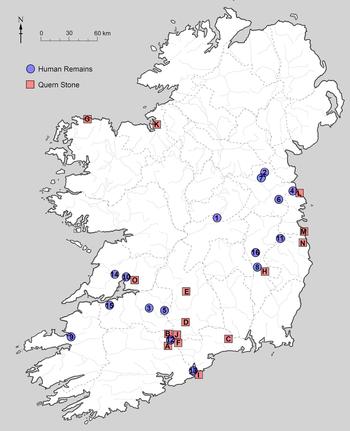
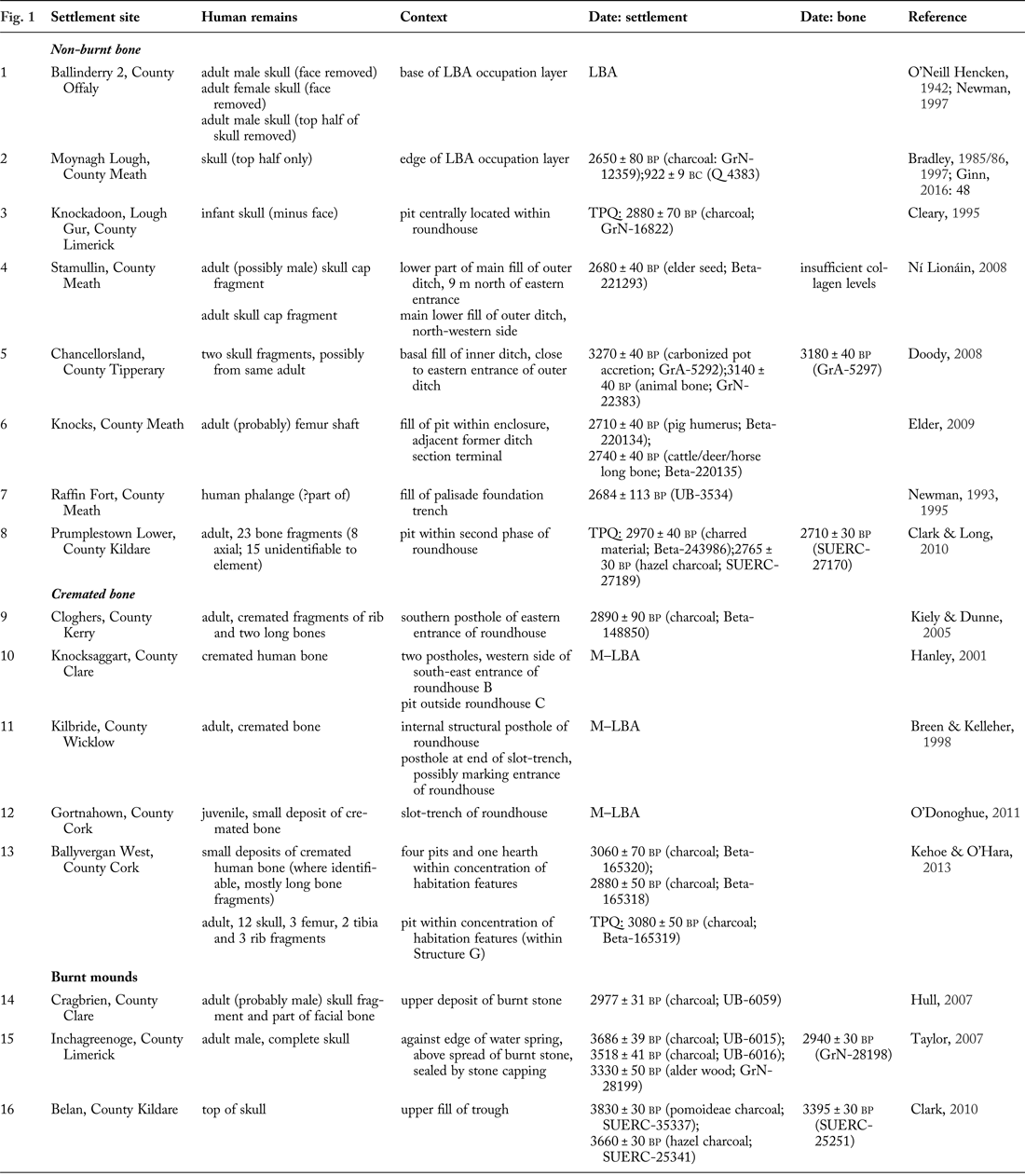
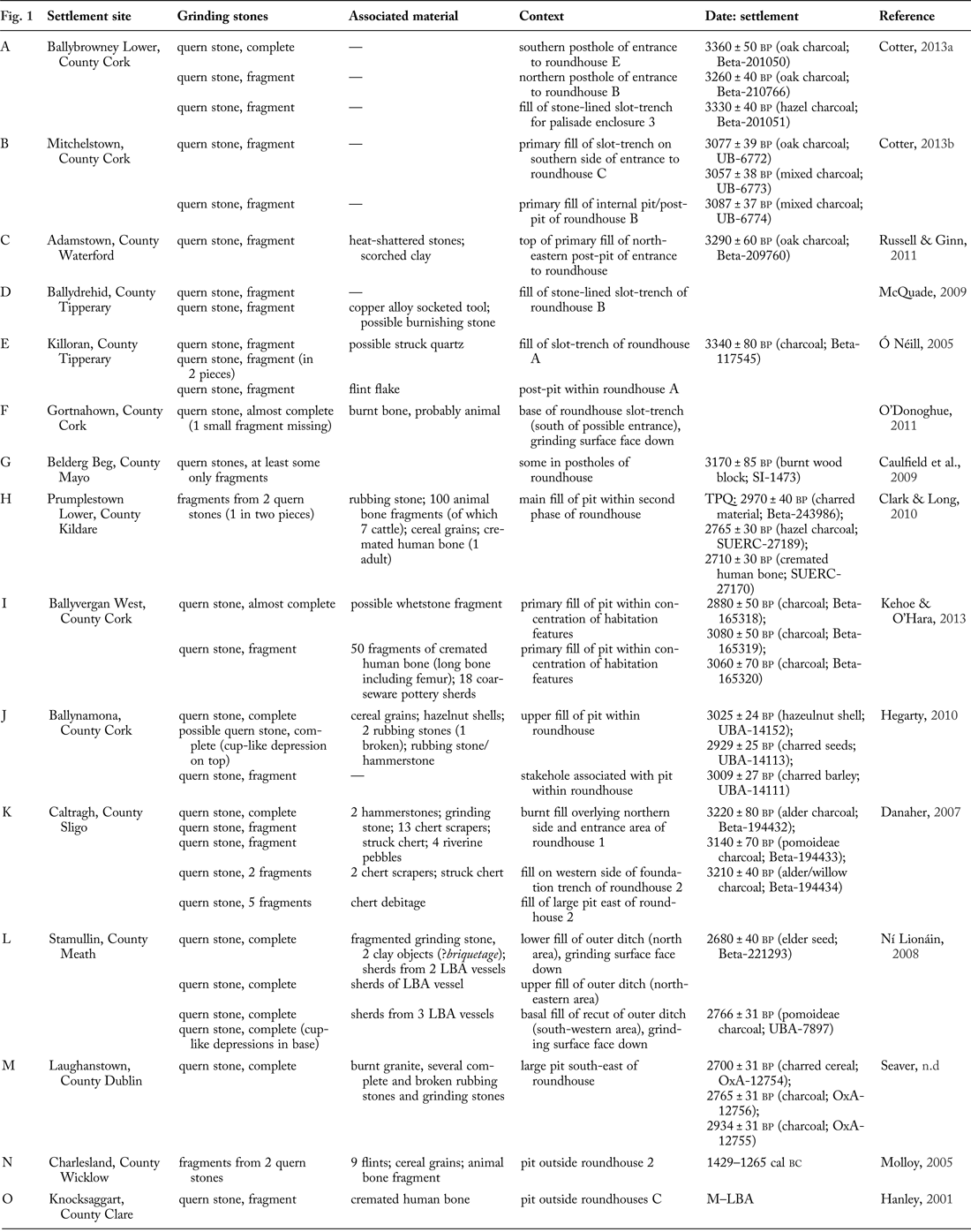
The discovery of human remains within occupation levels on prehistoric domestic sites is a well-documented phenomenon (e.g. Brück, Reference Brück1995; Hill, Reference Hill1995; Chapman, Reference Chapman2000; Eriksson, Reference Eriksson, Artelius and Svanberg2005; Cleary, Reference Cleary2006, Reference Cleary, Ginn, Enlander and Crozier2014; Armit & Ginn, Reference Armit and Ginn2007; Arnoldussen, Reference Arnoldussen2008: 271; Brudenell & Cooper, Reference Brudenell and Cooper2008; Booth et al., Reference Booth, Chamberlain and Parker Pearson2015). Most deposits are only fragments of the whole body: a select few bone types, namely the cranium and long bones, ‘token’ deposits of cremated bone, or parts of several individuals reconstructed and mummified. They are frequently incorporated into contexts that are liminal in character, such as ditches and entranceways. Similarly, quern stones, both whole and fragmented, alongside animal burials, pots, and other artefacts, have been recovered from the pits, ditches, and postholes of settlement sites, where they are argued to have been deliberately placed, often in association with both the building and abandonment of roundhouses and settlements (Barrett, Reference Barrett, Nordström and Knape1989; Brück, Reference Brück1999, Reference Brück2006; Seager Thomas, Reference Seager Thomas1999; Watts, Reference Watts2014). On Middle Bronze Age settlements in southern Britain, Joanna Brück noted that ‘like their owners, querns (essential for the production of food and thus a potent symbol of life, fertility, and productivity) were burnt, broken, and buried upon death’ (Brück, Reference Brück1999: 155). Through a series of site-specific case studies (Figure 1; Tables 1 and 2), I examine the evidence for such practices in Ireland and how these might be interpreted in the context of ideology and symbolic behaviour in settlement contexts.Footnote 1

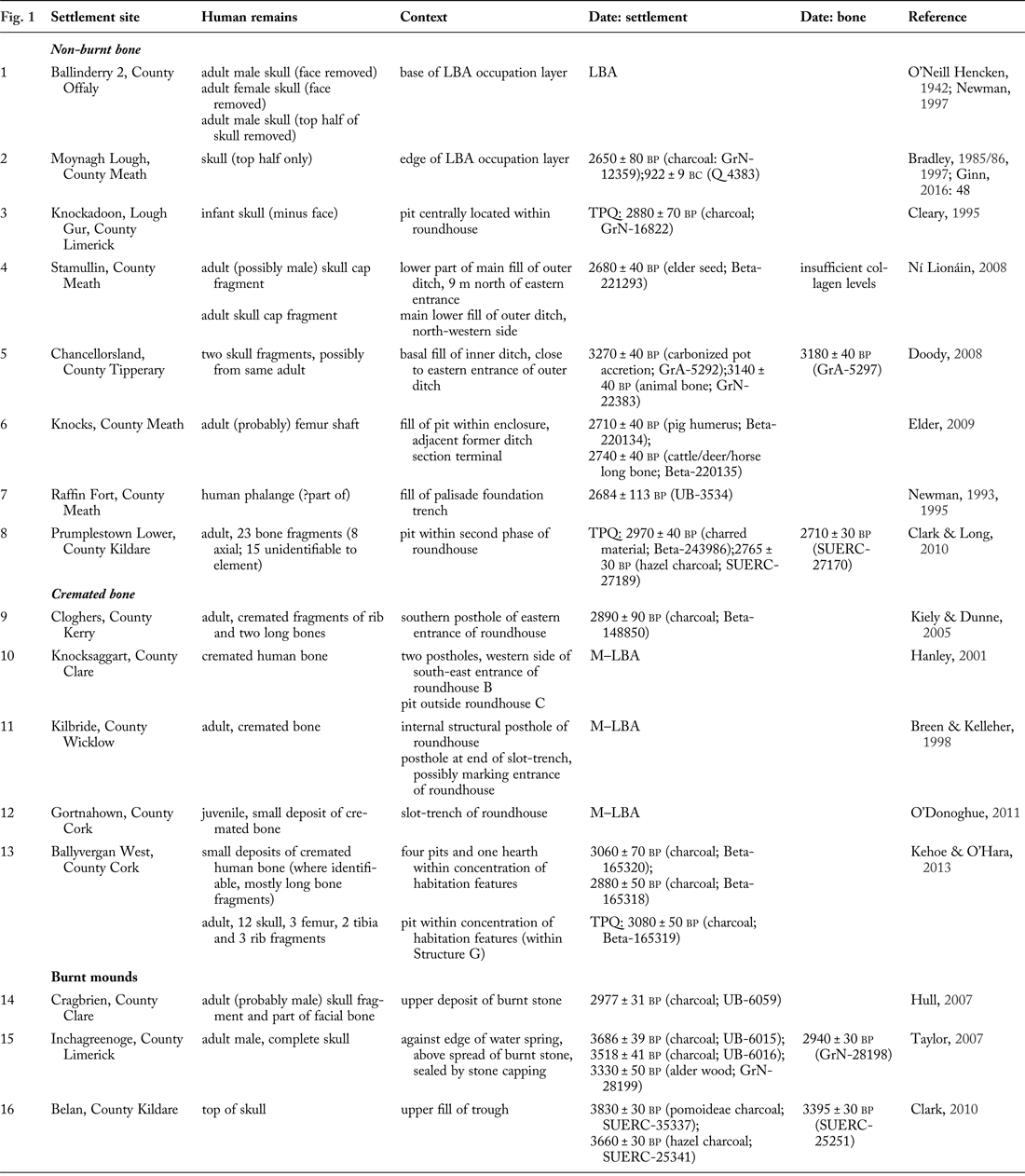
Human remains on settlement sites discussed in text.
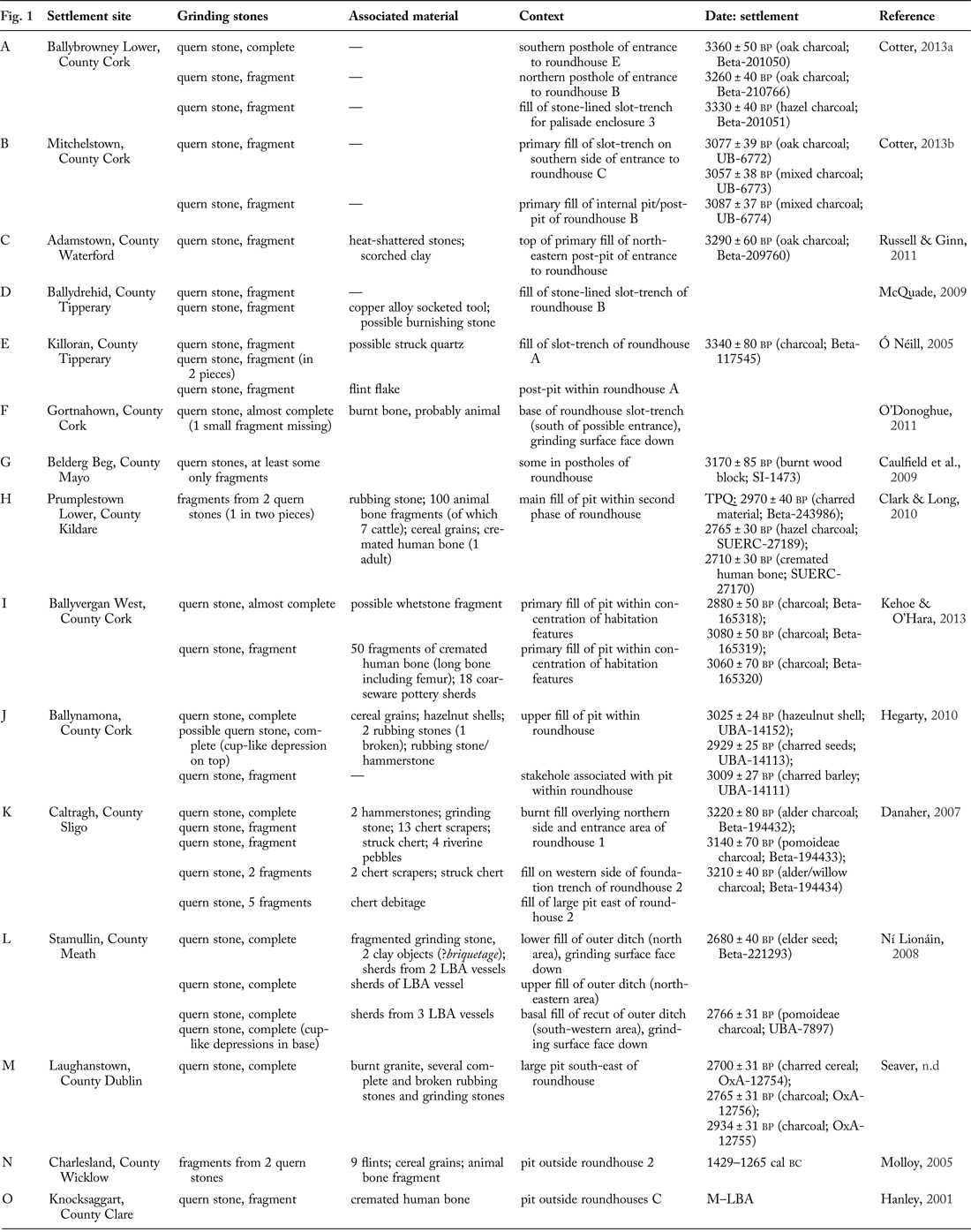
Quern stones on settlement sites discussed in text.
Bronze Age Ireland (c. 2200–700 bc)
Settlement
In Ireland, distinctive house structures become archaeologically more visible from c. 1600 bc onwards and it is this Middle–Late Bronze Age period that I shall focus on here. Over 680 Bronze Age structures, spread throughout the island, are now known; most are circular or sub-circular, although some rectangular examples are recorded (Ginn, Reference Ginn2016). The principal forms of construction encompass various combinations of slot-trenches, postholes and stone wall footings, and the only regional patterns evident appear to be in response to raw material availability, although the use of locally specific elaborate entranceways has been identified (Ginn, Reference Ginn, Ginn, Enlander and Crozier2014). Most are unenclosed settlements, although wooden palisades and ditches demarcated others. These represent farmsteads engaged in small-scale food production and craftworking, dispersed across the landscape, with familial connections forming the basis of social interactions resulting in local community identities. Many of the wetland sites aside, the range of artefacts found on these settlements is limited or even non-existent; although, where pottery and worked stone has been recovered, they are generally in a fragmentary condition, as is to be expected (Cleary, Reference Cleary2007). By examining potential taphonomic processes alongside recurring patterns of deposition, we can, however, begin to theorize about what these artefacts might tell us about past behaviour. Among the expected patterns resulting from natural formation processes and the management of ‘rubbish’ accumulation, there is also some evidence for repetitions in context and conditions that suggest treatment in a specific way before final deposition (Cleary, Reference Cleary2007, Reference Cleary2015: 60–61).
Burial
Since here I take human remains as a type of material culture suitable for deposition at settlement sites, it is also necessary to briefly outline what is known about formal funerary practices in Ireland during this period. Funerary architecture in the earlier Bronze Age took the form of pits or stone-lined cists, sometimes monumentalized by the addition of stone cairns, earthen mounds, encircling ditches, or standing stones.Footnote 2 Individuals were interred both singly and in cemeteries (see Waddell, Reference Waddell2010: 150–72). From approximately 1900 bc onwards, cremation dominates the burial record, and a succession of funerary pottery styles that had developed during the Early Bronze Age cease by around 1500 bc (Brindley, Reference Brindley2007). While some funerary customs continued into the later Bronze Age, such as the use of pits and cremation, there were also some notable differences. Where pottery accompanied the dead, it now comprised coarse flat-bottomed vessels comparable to those from contemporary settlement sites and often consisted of only a small number of sherds, likely representing a single complete vessel (Grogan, Reference Grogan, Roche, Grogan, Bradley, Coles and Raftery2004: 62; McGarry, Reference McGarry2008: 116–22). Not only do these vessels resemble those from settlement sites, but many have sooting or blackened accretions, suggesting they were previously used in cooking, perhaps in domestic contexts (Grogan & Roche, Reference Grogan, Roche, Stanley, Danaher and Eogan2010: 43). If this can be seen as another way in which the sacred and the secular became increasingly intertwined from the Middle Bronze Age onwards, then perhaps the fragmentation of both people and objects played a role in this readjustment of the cosmological structure.
‘Off with their heads’… Legs and Arms: Human Remains on Settlement Sites
The discovery of both burnt and non-burnt human remains on prehistoric settlement sites in contexts that could be considered non-funerary, informal, or unceremonious has been well-documented across Europe, for example in Late Bronze Age and Iron Age Britain (Brück, Reference Brück1995; Hill, Reference Hill1995; Armit & Ginn, Reference Armit and Ginn2007; Brudenell & Cooper, Reference Brudenell and Cooper2008), the Balkan Neolithic and Copper Age (Chapman, Reference Chapman2000), Bronze Age Sweden (Eriksson, Reference Eriksson, Artelius and Svanberg2005) and the Middle Bronze Age of the Netherlands (Arnoldussen, Reference Arnoldussen2008: 271).
Where non-burnt human remains considered contemporary with occupation have been uncovered in Ireland, they are mainly represented by fragments of the whole body via a select few bone types, namely the cranium and long bones. This over-representation is unlikely to be due to taphonomic processes, such as mode of burial and post-depositional disturbance, given the survival of complete Early Bronze Age skeletons and the recurring patterns across large geographical areas with diverse preservation conditions. Where deposits of cremated bone have been incorporated into settlement contexts, the selection of particular body parts may be less obvious because of constraints in the identification. The fragmenting of bodies or bones prior to burning is generally not detectable in the archaeological record, and the selection of only specific body parts for cremation is also difficult to prove. For example, where bones are exhumed and cremated some time after death, the elements most likely to be recovered are the skull, hip bones, and long bones (Garrido-Varas & Intriago-Leiva, Reference Garrido-Varas, Intriago-Leiva and Thompson2015: 237). An over-representation of the cranium and long bones has, however, been observed in the later Bronze Age and Early Iron Age cremations of Uppland in Sweden (Eriksson, Reference Eriksson, Artelius and Svanberg2005: 247). In Ireland, similar deliberate selection of skeletal elements has been proposed for cremation pits at Early–Middle Bronze Age burial sites at Rath, County Meath (Lynch & O'Donnell, Reference Lynch, O'Donnell, Grogan, O'Donnell and Johnston2007: 120), Killoran, County Tipperary (Buckley, Reference Buckley, Gowen, Néill and Phillips2005: 328), and Mitchelstowndown North, County Limerick (Ó Donnabháin, Reference Ó Donnabháin and Gowen1988: 193–94). More recently, Geber (Reference Geber, McQuade, Molloy and Moriarty2009: 218) argued against the meaningfulness or intention of skull selection in an Early–Middle Bronze Age flat cemetery at Templenoe, County Tipperary, despite a higher number of skulls represented. He suggested that, after incineration at high temperatures, the ‘missing’ bones become very fragile and easily pulverized to tiny unidentifiable fragments, while the skull fragments remain the largest and densest and thereby more extractable from the pyre. Observations by others somewhat counter this argument. Lynch and O'Donnell (Reference Lynch, O'Donnell, Grogan, O'Donnell and Johnston2007: 107) suggest that, although the level of cremation differs due to the type of pyre structure, fuel, weather conditions, and difficulty of controlling time, temperature, and oxygen, a recognizable skeleton is still preserved, though fragmented, directly after cremation and would, therefore, facilitate bone selection (see also McKinley, Reference McKinley, Gowland and Knüsel2006: 85). In comparing cremations dating to the Early and Middle Bronze Age in Ireland, Laureen Buckley has also emphasized that the earlier burials were represented by larger deposits of cremated bone that was not deliberately crushed and ‘contained every possible skeletal element including vertebrae, ribs, metacarpals, metatarsals and phalanges’ (Buckley, Reference Buckley, Gowen, Néill and Phillips2005: 328), while the later burials contained very little or none of the axial skeleton and only a few fragments of metatarsals and phalanges. There is now a growing body of evidence that this practice of interring ‘token’ burials at funerary sites may have started as early as the nineteenth century bc (Eogan, Reference Eogan, Eogan and Twohigh2011: 276; Troy Reference Troy, Bolger, Moloney and Shiels2015: 136–38). Thus, at minimum, alongside the obviously natural fragmenting of the body through cremation, if we assume that the whole body was burnt shortly after death, the selection of only a portion of a cremated body for burial may suggest another form of fragmentation.
The possibility of deliberate fragmentation through the reduction of bone size by ‘pounding or rolling into tiny (≤5 mm) fragments’ as a post-cremation, pre-burial treatment has also been postulated (Grogan, Reference Grogan, Roche, Grogan, Bradley, Coles and Raftery2004: 69), but is much debated and the arguments surrounding fragment size as the only indicator remain unsatisfactory (see McKinley, Reference McKinley1994, Reference McKinley1997; Buckley, Reference Buckley, Gowen, Néill and Phillips2005: 328; Lynch & O'Donnell, Reference Lynch, O'Donnell, Grogan, O'Donnell and Johnston2007: 112; Geber, Reference Geber, McQuade, Molloy and Moriarty2009: 227–30; Harvig, Reference Harvig and Thompson2015: 56). Perhaps future analytical methods will be able to address this, and residue analysis on artefacts discovered with cremated bone may also offer some insights. It has been suggested, for example, that basin stones in Neolithic passage tombs could represent ‘funerary querns’ if used in conjunction with maceheads and hammerstones to fragment cremated bone (McQuillan & Logue, Reference McQuillan and Logue2008; see also Geber, Reference Geber, McQuade, Molloy and Moriarty2009: 228).Footnote 3 This debate aside, it is certainly worth considering this trend towards increasingly fragmented or ‘token’ deposits of human bone in funerary contexts from the end of the earlier Bronze Age in relation to the deposition of human remains in settlement contexts from the Middle Bronze Age onwards.
It has been suggested that, when deposited together, there was no distinction between the human bone and other settlement remains (Brück, Reference Brück2006; Brudenell & Cooper, Reference Brudenell and Cooper2008). While some could be interpreted as casual inclusions of accumulated occupation debris, others are more structured and we must question why prehistoric people would have been concerned with burying ‘rubbish’ in such a manner, in what must have essentially been open environments. It is, therefore, likely that the process of depositing was important, perhaps as events marking acts linked to the lifecycle of the settlement and its inhabitants. In this case, it is possible that the origin of the bone may have been less significant than the overall contents and act of deposition, including fragmentation.
Non-burnt bone
As detailed elsewhere (Cleary, Reference Cleary2006, Reference Cleary, Ginn, Enlander and Crozier2014), in deposits of non-burnt human bone on Irish Middle–Late Bronze Age settlements there was a clear preference for skull fragments and long bones, including the pelvic region; and they are mainly recovered from pits, ditches, and foundation layers (Table 1). The particularly poignant symbolism of skulls has been addressed in many publications (e.g. Bonogofsky, Reference Bonogofsky2011), while the significance of the other bones has perhaps received less attention but is equally likely to have had representational connotations. This is also comparable with data from Late Bronze settlements in Britain, where analysis of the depositional contexts (mainly pits and ditches) highlighted the role human remains played in emphasizing critical points in space, such as liminal areas, and time, such as foundation and abandonment events (Brück, Reference Brück1995, Reference Brück1999, Reference Brück and Brück2001).
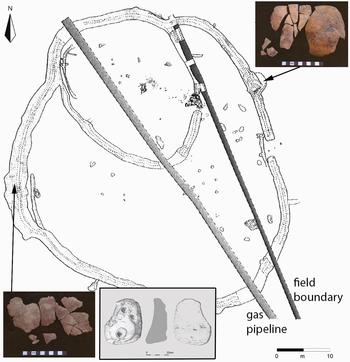
Returning specifically to the question of fragmentation, it is notable that all three adult skulls beneath the wooden structures at Ballinderry were deliberately fragmented or ‘de-faced’: the frontal bone was cut from at least two of the skulls and only the top half of the skull and brow ridges remained on the third (O'Neill Hencken, Reference O'Neill Hencken1942; Newman, Reference Newman1997). Comparable practices were recorded at Moynagh Lough, where the upper part of a cranium was recovered from the edge of an occupation layer (Bradley, Reference Bradley1997) and at Knockadoon, where an infant cranium, minus the face, was placed in a pit centrally located within a roundhouse (Cleary, Reference Cleary1995). Similarly, at Stamullin (Figure 2), two partial skull cap fragments, probably from two different adults, were recovered from the fill of the outer ditch (Ní Lionáin, Reference Ní Lionáin2008) and at Chancellorsland, two skull fragments, possibly from the same adult, came from the basal fill of the inner ditch (Doody, Reference Doody2008). Fragmented human remains have also been recorded from some Bronze Age burnt mounds or fulachtaí fia (see Table 1), which can be interpreted as more temporary or seasonal loci of occupation, perhaps even outliers to the houses and defined settlements referred to above (Cleary, Reference Cleary2015: 64, 81). Two such sites dated to the Middle Bronze Age are associated with skulls. At Cragbrien, a skull fragment and part of the facial bone were incorporated into an upper deposit of burnt stone (Hull, Reference Hull, Grogan, O'Donnell and Johnston2007) and at Inchagreenoge, a complete skull was deposited against the edge of a spring directly above a spread of burnt stone associated with a trough (Taylor, Reference Taylor, Grogan, O'Donnell and Johnston2007). An Early–Middle Bronze Age example is known from Belan, where the top of a skull was recovered from the upper fill of a trough (Clark, Reference Clark2010), perhaps relating to the final use of the site.
Deposits of skull fragments and cup-marked quern stone in enclosing ditch at Stamullin, County Meath.

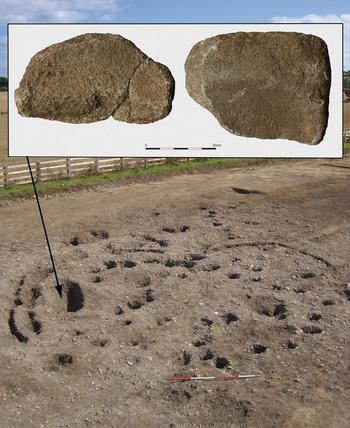
Other human skeletal elements have also been recorded from settlement sites. At Knocks, a Late Bronze Age ditch delimited an area of domestic activities including cooking, the working of bone and antler, and possibly the tanning of hides (Elder, Reference Elder2009). The shaft of a human femur was recovered from a pit that also contained a charcoal-rich fill with burnt stones and two unidentifiable heat-affected animal bones. The Middle–Late Bronze Age palisaded enclosure at the multi-period site of Raffin Fort contained part of a human finger bone, pottery, and a polished stone disc (Newman, Reference Newman1993, Reference Newman, Grogan and Mount1995), while at Prumplestown Lower (Figure 3), a pit within the second phase of a Late Bronze Age structure contained fragments of human bone, some identifiable as from the axial skeleton, and animal bone fragments, including cattle (Clark & Long, Reference Clark and Long2010). This pit also contained several items of worked stone, including fragments of two quern stones (see below). While it is possible that these examples may represent sub-samples of rubbish that originally accumulated in a midden-like deposit at settlements where human burials also occurred, it does not exclude the possibility that the process of depositing the fragmented material remains had symbolic significance, during both the formation of the midden and its subsequent redeposition (see Needham & Spence, Reference Needham and Spence1997; Brudenell & Cooper, Reference Brudenell and Cooper2008). Although it could be argued that some of the bone may not have been recognizable as human by all the Bronze Age inhabitants, particularly if not taken directly from a body or funeral context, and the identity of the individuals may have been forgotten, it is unlikely that the memory of the ‘rubbish’ pile as a location where human remains were incorporated was lost, be they non-burnt, charred, or cremated.
Quern stone fragments from pit in roundhouse at Prumplestown Lower, County Kildare.

Cremated bone
The natural fragmenting of human bone through the process of cremation is frequently discussed in archaeological literature, as is the potential loss of bone during recovery from the pyre, and indeed the possibility of deliberate selection and subsequent additional fragmentation through intentional manual crushing and pounding (see above). In Ireland, it has been suggested that from the later Early Bronze Age onwards formal cremation burials contain fewer quantities of bone per person, some of which may have been deliberately reduced further into fragments of fragments (see Grogan, Reference Grogan, Roche, Grogan, Bradley, Coles and Raftery2004; Eogan, Reference Eogan, Eogan and Twohigh2011; Troy, Reference Troy, Bolger, Moloney and Shiels2015). In many cases, these are interpreted as ‘residual’ or ‘token’ burials, particularly when recovered from settlement sites, where cremated bone, like non-burnt human bone, is sometimes deposited in pits and ditches, but also with a recurring focus on the structural elements of roundhouses, particularly entrances or thresholds, as well as temporal transitions, such as foundations and abandonments (Table 1). In many instances, this bone is so heavily fragmented that it is not possible to definitively identify it as human. As outlined above, this may sometimes also have been the case in the Bronze Age; but perhaps this was not relevant as the bone was imbued with human values and used to fulfil a representative role within these acts of deposition (Brück, Reference Brück1999; Sofaer, Reference Sofaer2006; Brudenell & Cooper, Reference Brudenell and Cooper2008). Although exploring the comparative evidence for the treatment of non-human bone at these sites is beyond the scope of this article, it has been suggested, for example, that there was no human-animal dichotomy; dead materials such as pieces of human bone, animal burials, and deposits of broken artefacts were deliberately deposited and evoked ideas of regeneration or rebirth (Brück, Reference Brück2000, Reference Brück2006: 86).
At Cloghers, fragments of cremated bone, including elements from a rib, two long bones, and a scapula from at least two individuals, were recovered from a structural posthole at the entrance to one roundhouse (Kiely & Dunne, Reference Kiely, Dunne and Connolly2005). At Knocksaggart, cremated bone was found in two postholes defining the entrance porch of one roundhouse and in an external pit, which also contained a quern stone fragment (see below; Hanley, Reference Hanley2001). At Kilbride, cremated bone came from an internal posthole and further fragments from a posthole at the end of the slot-trench, possibly marking one side of a truncated entranceway (Breen & Kelleher, Reference Breen and Kelleher1998). At Gortnahown, a small deposit of cremated bone was recovered from a slot-trench associated with a roundhouse;Footnote 4 the smooth edges of the fragments could indicate bone that was retained for some time before final deposition or was residual (O'Donoghue, Reference O'Donoghue2011). Small deposits of cremated human bone were also identified in six pits within a myriad of pits, postholes and stakeholes at Ballyvergan West, with most of the identifiable fragments representing long bones and cranium, the majority of the latter recovered from a single pit (Kehoe & O'Hara, Reference Kehoe, O'Hara, Hanley and Hurley2013).
Human remains on settlements
As these examples demonstrate, human remains in a fragmented or partial condition, be it small quantities of cremated bone or selected non-burnt bones, were incorporated into some roundhouses, enclosing ditches, associated pits, and other settlement-related sites during the Middle–Late Bronze Age in Ireland, marking significant points in both the lifecycle and the spatial layout of the settlements. While the deliberate fragmentation of some non-burnt bone is irrefutable, such as the de-faced skulls discussed above, whether others were intentionally fragmented before deposition is less tangible; it could certainly be argued that those left to be excarnated, be it in tombs, cenotaphs, or midden-like deposits, may have been purposefully ‘broken’ from the whole body before secondary use at settlement sites. Similarly, it is difficult to determine archaeologically the question of intent in relation to fragmentation of cremated remains; however, alongside the fundamental process of transformation or fragmentation by fire, the characteristically ‘token’ nature of these deposits is noticeable. It is difficult to interpret whether the inclusion of non-burnt bone versus cremated bone was an important distinction, but either way these deposits appear to mark both the foundation and abandonment of sites, often in liminal areas such as thresholds and enclosing features (see Table 1). Perhaps the deposits represent localized expressions of identity that could have reinforced a sense of belonging and ownership. In these fragmented states, human bones are also an easily portable material that could be cut up, divided, and shared if required. What, for example, became of the facial bone fragments cut from the skulls at Ballinderry or the remaining bone from the juvenile represented at Gortnahown? What survives in the archaeological record is clearly just one stage in complex mortuary practices that saw the human body manipulated and probably utilized for a variety of social practices. One line of argument is that from the end of the Early Bronze Age onwards the increased fragmentation of both human bone and pottery in funerary contexts, the incorporation of ‘domestic’ pottery into burials, the inclusion of human bone in settlement contexts, and the building of substantial roundhouses rather than monumental funerary architecture suggest changes in ritual behaviour. If what we interpret as the ritual arena was becoming more domestic and everyday life was becoming more ritualized, then the archaeological distinction between the sacred and the secular becomes increasingly blurred. With this in mind, it is also worth examining another type of material culture often uncovered on these settlement sites: quern stones.
Breaking Stone: Condition and Context of Grinding Stones on Settlement Sites
Quern and rubbing stones are often found on the later prehistoric settlements of agricultural communities; based on the locations selected for their final deposition and the condition in which they are disposed, archaeologists have argued both for and against them representing ‘votive deposits’ (Barrett, Reference Barrett, Nordström and Knape1989; Brück, Reference Brück1999, Reference Brück2000, Reference Brück and Brück2001; Seager Thomas, Reference Seager Thomas1999; Watts, Reference Watts2014). For example, one interpretation of the quern stones recorded from several Middle–Late Bronze Age settlement sites in Britain is that they formed part of offerings used to ‘maintain the household subsistence cycle’ in a society where there was ‘a more mutualistic relationship between people and environment’ (Brück, Reference Brück2000: 280). Some were included whole, often at significant spatial locations, and it is suggested that ‘they were the “anvil” on which other bodies were broken, reworked and recycled’ (Fowler, Reference Fowler2004: 41), while others were deliberately broken and burnt for incorporation into ritualized acts of commensality before abandonment (Seager Thomas, Reference Seager Thomas1999; Nowakowski, Reference Nowakowski and Brück2001: 141; Brück, Reference Brück2006; Watts, Reference Watts2014). It has been suggested that they were also ‘broken’ by the separation of the upper (rubber) and lower (quern) stones, which renders them inoperable (Pryor, Reference Pryor2001: 428; Watts, Reference Watts2014: 43, 54), although it is recognized that almost all undergo this form of fragmentation (Heslop, Reference Heslop2008: 69). The grinding stones recovered from Middle–Late Bronze Age settlements in Ireland have generally been separated in this way, but many are also broken further, be it in half or with a range of fragment sizes missing, from large sections to small pieces knocked off the sides (see Figure 3).
The re-use of grinding stones has also been interpreted as functional; for example, when recovered from the structural components of a roundhouse, such as post-pits and slot-trenches, it has been argued that these artefacts were broken along weak points and opportunistically re-used as stone packing during construction. An example is provided by the Bronze Age settlement in Scarcewater, Cornwall, where a lack of impact marks on fourteen quern stone fragments was interpreted as simply representing breakage along lines of weakness while in use (Quinnell, Reference Quinnell, Jones and Taylor2010: 113). What about such re-use on sites where there is no evidence for previous occupation, as in most Irish examples? It seems unlikely that a disused or broken quern would be conveniently located nearby or intentionally brought to a new location to be inserted as stone packing. In other depositional contexts, however, particularly with unknown temporal relations to the occupation, the possibility of quern fragments originating in midden-like accumulations of refuse that leave no archaeological trace should be considered (Brudenell & Cooper, Reference Brudenell and Cooper2008), as well as the possibility that some were inconvenient to move and therefore left behind after a site was abandoned. Such casual discard should be archaeologically evident as there would be little need to bury a grinding stone that was no longer functional rather than just leave it above ground, particularly if a settlement was being abandoned. Even if one takes the view that this simply represents ‘rubbish’ management, it still implies that there was significance in the means of disposal, often involving the manipulation and selective mixing of artefacts, most probably because objects created in the domestic sphere do not easily lose their meaning, even in ‘death’ (Brück, Reference Brück1999, Reference Brück2000; Chapman, Reference Chapman2000: 4–5). Ultimately, consistencies in the depositional contexts of many of these objects (Table 2) suggest that their placement goes beyond the merely functional to a particular set of meanings.
What, then, of the condition of these objects? When fragmented, accidental breakage from heavy work or through dropping is assumed, but never really questioned. John Chapman, however, while accepting the possibility of breakage through use as heavy hammers, queried this assumption, stating that ‘breakage of what are, by definition, substantial stone artefacts is not necessarily to be expected during the normal working life of a set of grinding stones!’ (Chapman, Reference Chapman2000: 94), particularly the ‘transverse or, more rarely, longitudinal fracture of querns and rubbers’, suggesting that deliberate fragmentation cannot be excluded. Similarly, Heslop (Reference Heslop2008: 68–72) has argued that beehive querns from northern Yorkshire and southern Durham were intentionally broken into fractions of the whole, usually either into half or quarter pieces, or specific parts were removed for use elsewhere. To test the hypothesis that fragmentation was a deliberate, intentional, and probably dramatic act, it is necessary to determine the intrinsic molecular strength (IMS) of the stones used (mainly sandstone and granite in Ireland), in order to measure the various forces, both man-made and natural, that could result in the patterns of fragmentation we see in the archaeological samples. This should allow us to compare the IMS results from non-archaeological samples tested to the point of destruction to archaeological samples tested in a non-destructive way. Although this research is in its infancy, the results to date are promising: preliminary tests indicate that the complete breakage of a sandstone quern stone via accidental dropping, from friction through use, or through natural freeze thaw, is highly unlikely. This, then, reaffirms the idea that these objects are not readily or easily broken, supporting interpretations of deliberate human agency. This is not to suggest that fragmentation must be difficult for it to be meaningful, but to further challenge the notion that these objects are simply fortuitously re-used.
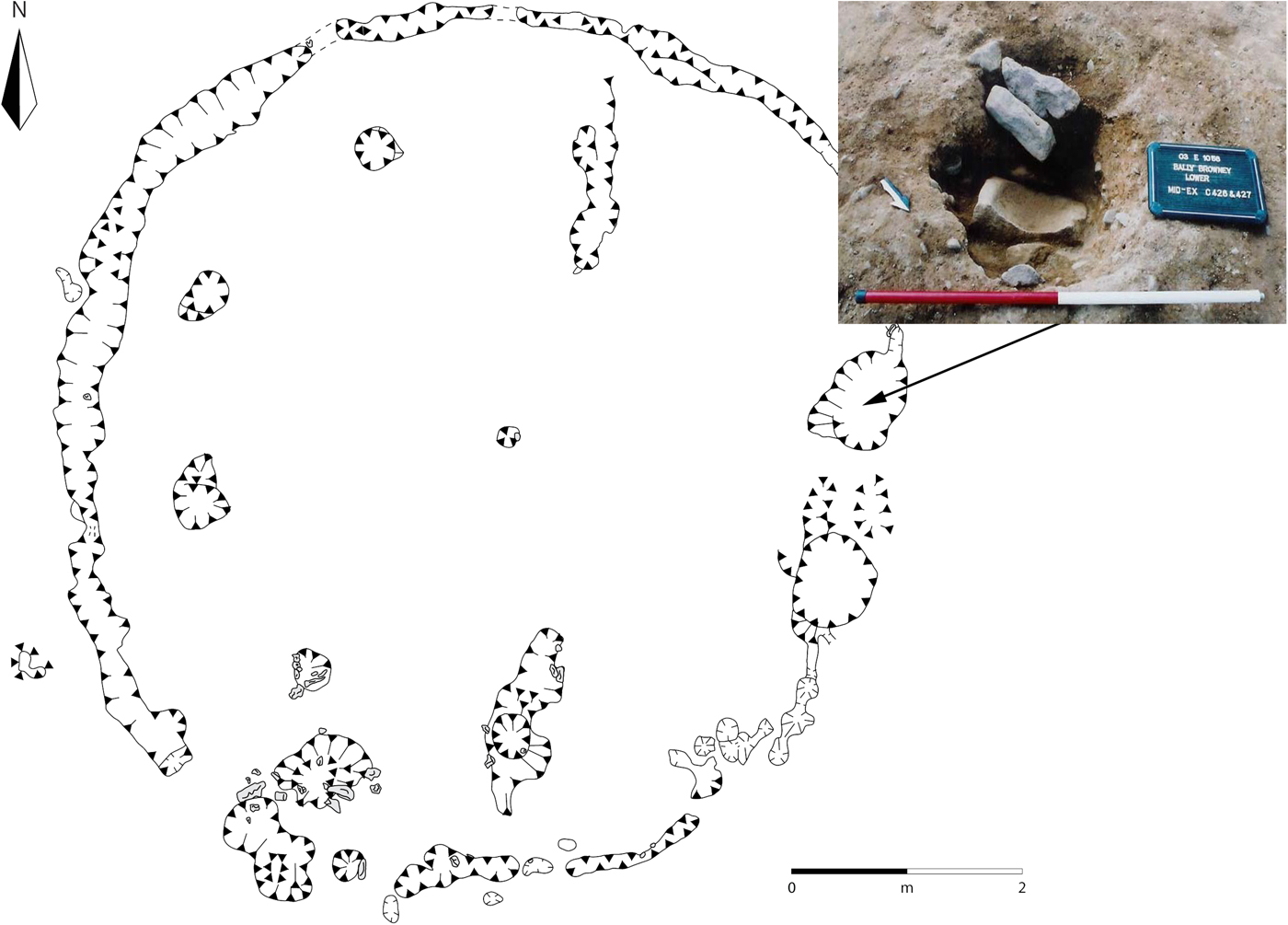
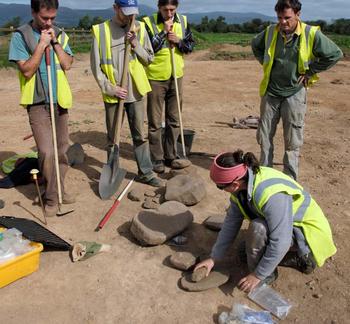
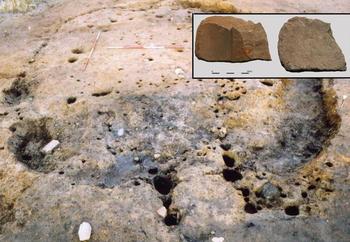
On Middle–Late Bronze Age settlements in Ireland, both whole and fragmented quern stones have been recovered from a variety of foundation and abandoning contexts (Table 2). They were incorporated into the structural elements of roundhouse entrances at Ballybrowney Lower (Figure 4; Cotter, Reference Cotter, Hanley and Hurley2013a), Mitchelstown (Cotter, Reference Cotter, Hanley and Hurley2013b), and at Adamstown, where accompanying heat-shattered stones and scorched clay may indicate that a fire had been lit in the post-pit prior to the post being inserted (Russell & Ginn, Reference Russell, Ginn, Eogan and E. Shee Twohig2011). Similarly, quern stone fragments also came from slot-trenches defining roundhouses at Ballydrehid (McQuade, Reference McQuade, McQuade, Molloy and Moriarty2009) and Killoran; at the latter site one such fragment was further broken into two pieces (Ó Néill, Reference Ó Néill, Gowen, Néill and Phillips2005). At Gortnahown, a quern stone with a small fragment missing from one side, was placed at the base of the slot-trench with its grinding surface face-down (O'Donoghue, Reference O'Donoghue2011). Quern stones, at least some of which were probably fragments, were also identified in the packing of postholes of the roundhouse excavated at Belderg Beg (Caulfield et al., Reference Caulfield, Byrne, Downes, Dunne, Warren and Rathbone2009: 35, 156). More came from internal pits/post-pits, such as at Mitchelstown (Cotter, Reference Cotter, Hanley and Hurley2013b), Prumplestown Lower (where one fragment was further broken into two pieces; Clark & Long, Reference Clark and Long2010; see Figure 3), Ballyvergan West (Kehoe & O'Hara, Reference Kehoe, O'Hara, Hanley and Hurley2013), and Ballynamona (Figure 5; Hegarty, Reference Hegarty2010). At the latter site, two quern stones and two rubbing stones, one of which was broken, a burnt hammerstone/rubbing stone, and large quantities of charred cereal grains were all found together in a large pit. At Caltragh (Figure 6), one roundhouse appears to have been deliberately burnt down and a ‘closing deposit’ placed across the entrance area incorporated one complete quern stone and fragments from two others (Danaher, Reference Danaher2007: 82). Quern stones have also been recovered from enclosing ditches at Ballybrowney Lower (Cotter, Reference Cotter, Hanley and Hurley2013a) and Stamullin (see Figure 2; Ní Lionáin, Reference Ní Lionáin2008). At Stamullin, the excavator noted that at least three of the four complete quern stones, one of which had cup-like depressions in its base, had been deposited with their grinding surfaces placed downwards, akin to that at Gortnahown. Pits located outside houses have also been used, such as at Charlesland (Molloy, Reference Molloy2005), Knocksaggart (Hanley, Reference Hanley2001), and at Laughanstown, where a large pit was backfilled with burnt blocks of granite and a number of both intact and broken rubbing stones and grinding stones, all ‘capped’ with a very large quern stone (Seaver, Reference Seavern.d). The recurring ways in which these objects were deposited, frequently broken, fragmented, or chipped, sometimes face downwards, often at key spatial locations (particularly liminal contexts such as entranceways and enclosing boundaries), suggests deliberate actions, including formal decommissioning processes.
Quern stone in entrance posthole of House B at Ballybrowney Lower, County Cork.

Rubbing and quern stones from the vicinity of a roundhouse at Ballynamona, County Cork.

Quern stone fragments from closing deposit over northern side and entrance area of roundhouse at Caltragh, County Sligo.

As illustrated in relation to human remains, the recurring placement of these querns into structural features and their deposition during episodes of deliberate backfilling suggest that they could equally have played a role in the increased ritualization of the domestic sphere, with the offerings deposited as a reflection of the household's history as well as a mark of the passing of time (Bradley, Reference Bradley2005: 78–79). Like the human remains, the condition in which these objects were buried is also significant. A surface examination of these stones lends weight to the suggestion that many were ‘broken down upon death’ (Brück, Reference Brück and Brück2001: 153); however, others were certainly deposited complete and may have been ‘decommissioned’ in other ways, such as by being placed grinding surface down or without accompanying rubbing stones.
Conclusion
Exploring the interrelationships between settlements, burials, and deposition locations has been successfully used to demonstrate important connections between ancestors, agricultural land, and those living in farming communities (see Fokkens & Arnoldussen, Reference Fokkens, Arnoldussen, Arnoldussen and Fokkens2008). This association provides a fundamental background for understanding the cosmological structure occupied by these Middle–Late Bronze Age societies and, by using case studies such as those employed here, we can explore why some material remains appear to have been deposited in ways that intimate a symbolic significance, perhaps alongside a practical one. The suggestion of a decreasing distinction between the funerary and domestic arenas during this period can be demonstrated by the changing treatment of human remains, the mixing of ‘funerary’ and ‘domestic’ artefacts, and the fragmentation of people and objects. This article has attempted to emphasize the latter by presenting discoveries of human bone and quern stones on a selection of settlement sites in Ireland, which give the opportunity to debate both the taphonomic processes and social practices that potentially influenced these deposits.
Middle–Late Bronze Age funerary sites in Ireland, such as pits and ring-ditches/barrows, are frequently associated with minute or ‘token’ deposits of bone, whereby the remnants of a full cremation was not removed from the pyre for burial, was spread across multiple contexts, or even dispersed in the landscape (Grogan, Reference Grogan, Roche, Grogan, Bradley, Coles and Raftery2004; Becker, Reference Becker2014). This is echoed in some contemporary domestic sites where it seems that, like mortuary rituals, ‘the focus was on the destruction of flesh and the fragmentation of the bodies of the dead: whether through fire or defleshing by some other means (through human agency or natural processes)’ (Larsson & Nilsson Stutz, Reference Larsson, Nilsson Stutz, Kuijt, Quinn and Cooney2014: 48). While the recognition of these fragmented or burnt bones as human by the inhabitants can be debated, where the context of deposition is recurring (e.g. the entranceways of roundhouses), it is likely that they represent deliberate acts, particularly when viewed in conjunction with the condition and context of other material remains, such as the quern stones.
The increasingly close connection between funerary and domestic sites during this period also resonates in the use at both kind of sites of stylistically comparable plain, flat-based, bucket-shaped ceramic vessels and perhaps even the use of pots previously used for cooking at some funerary sites. Furthermore, while fragmented pottery sherds are to be expected in a settlement context, it represented a new fashion in the burial arena, where, Beaker pottery aside, complete vessels dominated in the earlier Bronze Age (see Grogan & Roche, Reference Grogan, Roche, Stanley, Danaher and Eogan2010; Waddell, Reference Waddell2010: 150–72). Finally, if we consider the suggestion by Becker (Reference Becker2014, 15) that the minute or even absent bone deposits in many ring-ditches indicates that they are not burial sites at all but ‘define ritual areas within which the act of cremation took place’, then the comparisons drawn between the size and defining ditches of some roundhouses and those of ring-ditches, which cannot always be differentiated (Clarke & Carlin, Reference Clarke, Carlin, Deevy and Murphy2009: 7), may be significant. This may be another way in which the funerary and settlement spheres were becoming increasingly intertwined.
Returning to the question of deliberate fragmentation, the ‘de-faced’ remains from some sites show that the practice of manipulating human bone existed, while preliminary testing indicates that the breaking of quern stones required considerable force. This, in conjunction with the theory that simply cremating bone and separating the upper and lower stones of a quern were also forms of fragmenting, must encourage us to reflect on what role these ‘broken’ remains played in society. While there is so far no evidence to suggest that these ‘fragments’ automatically infer enchainment or partible exchange relations, they may indicate a desire to reinforce notions of identity, belonging, and ownership through the deposition of material representing the ancestors, the community, and subsistence agriculture. While some of the material remains may be interpreted as the re-deposition of midden-like deposits (cf. Brudenell & Cooper, Reference Brudenell and Cooper2008), others, as demonstrated, can be stratigraphically linked to episodes of abandonment when such practical management seems unnecessary. The question of why it was sometimes deemed necessary to return such material to the ground still needs to be considered. We remain at the mercy of the fragmentary archaeological record, but questioning what happened to both the present and the missing parts will strengthen our understanding of deliberate fragmentation within the social practices of the Irish Middle–Late Bronze Age.
Acknowledgements
I would like to thank all those who provided me with information and access to unpublished data, especially Dr Alan Hawkes, Patricia Long, and Dr Tiernan McGarry, and to materials scientist, Dr Liam Ryan, for his contribution on the IMS of querns. I also acknowledge the osteoarchaeological analysis undertaken by Laureen Buckley (Ballyvergan West), Dr Linda Fibiger (Stamullin), Hayley Foster (Knocks), Prof. W.W. Howells (Ballinderry), Dr Linda Lynch (Kilbride and Gortnahown), Dr Barra Ó Donnabháin (Knockadoon), Catryn Power (Chancellorsland and Cloghers), and Carmelita Troy (Belan and Prumplestown Lower), on whose work I was heavily dependent. In addition, I thank my PhD supervisor, Dr Elizabeth Shee Twohig, and am grateful for the continued assistance of Rose M. Cleary. Thanks also go to Prof. John Chapman, Dr Antonio Blanco-González, and Dr Jasna Vuković, who organized the EAA 2013 session ‘Deliberate Fragmentation Revisited: Assessing Social and Material Agency in the Archaeological Record’, from which this article was developed. Final appreciation goes to Dr Catriona Gibson who read an early draft and offered invaluable insights and discussion. I am also grateful to the anonymous reviewers for providing helpful comments and suggestions. Errors of fact and interpretation remain entirely mine.