Introduction
Cyclamen mite, Phytonemus pallidus (Banks) (Acari: Tarsonemidae), is a widely distributed pest of cultivated strawberry, Fragaria × ananassa Duchesne (Rosaceae), feeding on young leaf and flower tissue. Injured leaves are distorted or wrinkled, discoloured, and stunted, and fruit is bronzed, does not ripen, and is unmarketable. All life stages of cyclamen mite occur on strawberry plants, primarily within young, folded leaves, flower buds, and crowns (Fitzgerald et al. Reference Fitzgerald, Xu, Pepper, Easterbrook and Solomon2008). Eggs (1 mm) laid near the bases of new leaves hatch in about four days, followed by a larval stage of 4–5 days and an adult stage of 10–12 days for females and 5–6 days for males (Easterbrook et al. Reference Easterbrook, Fitzgerald, Pinch, Tooley and Xu2003; Rostami et al. Reference Rostami, Maroufpoor, Sadeghi, Ghazi and Atlıhan2018). Adult females (2–3 mm) are oval, clear, and yellow–brown, and eggs, larvae, and males are opaque white (Denmark Reference Denmark2017). Development times are temperature-dependent (Easterbrook et al. Reference Easterbrook, Fitzgerald, Pinch, Tooley and Xu2003), but cyclamen mite numbers increased from 50 eggs to 300–600 individuals, depending on strawberry cultivar, in 30 days at 20 °C (Rostami et al. Reference Rostami, Maroufpoor, Sadeghi, Ghazi and Atlıhan2018). In the field, populations increased steadily from early spring to late summer and then gradually decreased until late fall (Patenaude et al. Reference Patenaude, Tellier and Fournier2020). Control decisions can be difficult due to the small size and cryptic lifestyle of cyclamen mite but also because factors affecting its distribution and spread in strawberry fields are not well known.
Before its phase-out, which began in 2016 in Canada and the United States of America, endosulfan was relied on in strawberry nurseries for cyclamen mite control and production of clean planting material. In recent years, cyclamen mite has become common in Ontario and Québec, Canada (Erica Pate, personal communication; Patenaude et al. Reference Patenaude, Tellier and Fournier2020), and abamectin (Agri-Mek® SC) is the only registered acaricide for cyclamen mite in strawberry in Canada (Ontario Ministry of Agriculture, Food and Rural Affairs 2021). Abamectin is usually applied once in mid-summer after field renovation in perennial short-day strawberry cultivars grown in matted-row, open-field systems. If a second abamectin application is needed, whether it is more effective to apply it in the spring, late summer, or early fall is not known. More knowledge on cyclamen mite phenology and distribution in strawberry fields would aid in decision-making, such as knowing when to apply horticultural oils (e.g., Vegol Crop Oil), predator mites (Easterbrook et al. Reference Easterbrook, Fitzgerald and Solomon2001; Patenaude et al. Reference Patenaude, Tellier and Fournier2020), or any control tool.
In matted-row, perennial strawberry production, fields are typically renovated 1–2 weeks after harvest is completed by mowing foliage just above the crown, narrowing the rows, controlling weeds, fertilising, and irrigating (Zhang et al. Reference Zhang, Strik and Martin1992). Cultural practices may impact pest populations. Garth and Shanks Jr. (Reference Garth and Shanks1978) found that strawberry mowing reduced black vine weevil, Otiorhynchus sulcatus Fabricius (Coleoptera: Curculionidae), adults by 50–60%. However, Loughner et al. (Reference Loughner, Loeb, Schloemann and Demchak2008) found that altering mowing timing did not have a consistent effect on sap beetle (Coleoptera: Nitidulidae) adults. Because less than 5% of cyclamen mites occur on unfolded leaves (Fitzgerald et al. Reference Fitzgerald, Xu, Pepper, Easterbrook and Solomon2008), mowing may not significantly reduce populations, unless young, folded leaves are mowed off. Mowing also has potential to spread cyclamen mite in a field if mowed, infested leaf fragments land on previously uninfested plants.
Cyclamen mite is commonly sampled by removing young, folded strawberry leaves, holding them open under a stereomicroscope, and counting all life stages on the adaxial and abaxial surfaces (e.g., Fitzgerald et al. Reference Fitzgerald, Xu, Pepper, Easterbrook and Solomon2008; Fountain et al. Reference Fountain, Harris and Cross2010; Labonowska et al. Reference Labonowska, Piotrowski, Korzeniowski and Cuthbertson2015; Patenaude et al. Reference Patenaude, Tellier and Fournier2020). In some cases, motiles (adults and larvae) but not eggs have been counted (e.g., Berglund et al. Reference Berglund, Svensson and Nilsson2007). Extracting mites from plant material for preservation and counting in a fluid may be advantageous because leaves cannot be stored for long periods of time. In a few cases, leaf samples have been soaked in water and detergent before rinsing, sieving, and counting cyclamen mites (Tuovinen Reference Tuovinen2000; Tuovinen and Lindqvist Reference Tuovinen and Lindqvist2010). Berlese funnels have also been used to extract cyclamen mites from leaf and crown samples into ethanol, eliminating the need to mechanically separate mites from plant material (Fried and Schell Reference Fried and Schell2000; van Kruistum et al. Reference van Kruistum, Evenhuis, Hoek, Kastelein, van der Wolf and Verschoor2015). Other small mites have been sampled from plant material using various techniques, including Tullgren funnels and water and sucrose (LeFors et al. Reference LeFors, Johnson, Kirkpatrick, Woodruff and De Moraes2018), shaking in ethanol or water (Mechant et al. Reference Mechant, Luypaert, Van Delsen, Pauwels, Witters, Van Huylenbroeck and Gobin2015), or washing and sieving with detergent or ethanol (de Lillo Reference de Lillo2001; Rezende et al. Reference Rezende, Lofego, Navia and Roggia2012). Broad mite, Polyphagotarsonemus latus (Banks) (Acari: Tarsonemidae), recovery from experimentally infested rhododendron, Rhododendron simsii Planchon (Ericaceae), was greater using a method where shoot tips were shaken in ethanol or water compared to those placed in Berlese–Tullgren funnels (Mechant et al. Reference Mechant, Luypaert, Van Delsen, Pauwels, Witters, Van Huylenbroeck and Gobin2015). To our knowledge, sampling techniques for cyclamen mite from strawberry or other host plants have not been compared.
Our first objective was to determine the effects of field renovation (summer pre- and post-summer mowing) and time of sampling (fall and spring) on cyclamen mite populations in perennial, matted-row, short-day strawberry in southern Ontario. We also compared cyclamen mite counts between two extraction methods: leaf samples stored in ethanol with mites extracted by triple-washing versus mite extraction with Berlese funnels. Cyclamen mite is distributed throughout North America, Europe, and Asia (Denmark Reference Denmark2017), but its relative abundance in particular regions has not been well studied. Our third objective was to determine whether cyclamen mite is present in strawberry in Saskatchewan, Canada. Our overall goal was to characterise cyclamen mite phenology and population levels to provide new knowledge for monitoring and implementing management strategies. With continued research on cyclamen mite biology and new methods for control, strawberry growers will be better equipped to reduce the impact of this important pest on their crops.
Materials and methods
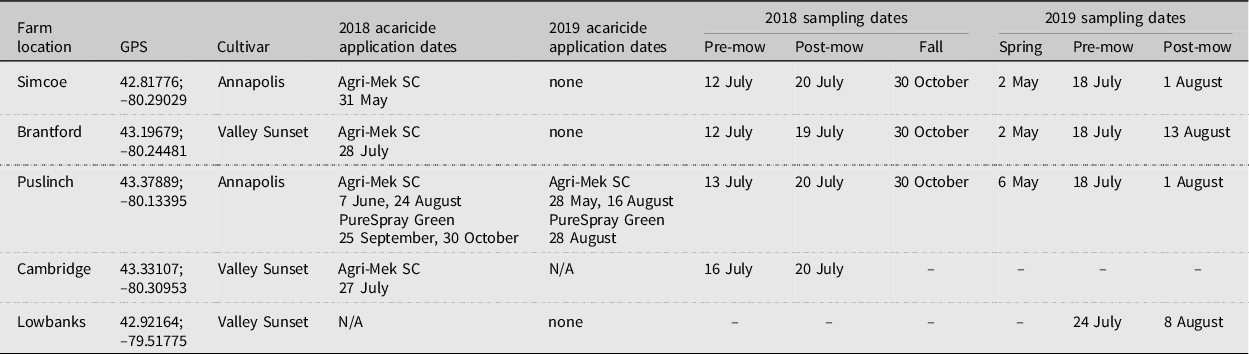
Four strawberry farms in southern Ontario were selected in spring 2018 for sampling (Table 1); however, most sampling locations at one farm were lost post-mowing and, therefore, were not sampled further. In 2019, another field was added and sampled pre- and post-mowing. In a block of one cultivar at each farm, 10 sampling locations were marked with a labelled, plastic tent peg. Five of the locations were selected where plant injury due to cyclamen mite was visible, and five matching locations were chosen at least 2 m but not more than 5 m from the injured plants, where there were no visible symptoms of cyclamen mite injury. At each farm on each sampling date, 10 new, unfolded trifoliates or plant crowns within a 30-cm radius of the tent peg were removed and placed in a centrifuge tube (50 mL) with ethanol (70%). For sampling post-mowing, crowns were cut with a pruner at the soil level when there were few new trifoliates. For the fall 2018 and 2019 sampling dates, 10 additional trifoliates or crowns were selected and placed in a sealed plastic bag and returned to the laboratory in a cooler.
Information for strawberry farms in southern Ontario, Canada where cyclamen mite (Phytonemus pallidus) was sampled. All fields were planted in spring 2016 and harvested mid-June to early July each year.

In the laboratory, samples in ethanol were processed to extract motile stages (adults and larvae) of cyclamen mite using a triple-wash-and-rinse method. Firstly, the centrifuge tube was shaken by hand for 1 minute, the leaves or crowns and ethanol were poured onto a gridded dish, and then the leaves or crowns were picked out with tweezers and placed on a second dish. Secondly, each trifoliate leaf or the parts of the crown were separated with tweezers, each leaflet or part of the crown was opened and rinsed with ethanol from a wash bottle onto the second dish, and plant parts were placed back into the centrifuge tube. Thirdly, ethanol was poured into the centrifuge tube with the leaflets or crown parts, it was shaken by hand for 1 minute, the leaflets or crown parts and ethanol were poured onto a third gridded dish, and then the plant parts were removed with tweezers and discarded. Motiles in the rinsate in all three dishes per sample were counted at 20–30× magnification using a stereomicroscope.
Samples in plastic bags were placed in Berlese funnels to extract motile stages of cyclamen mite. Leaves or crowns were placed in a single layer on a piece of hardware cloth (mesh size: 5 × 5 mm) at 5 cm from the bottom of a galvanised steel funnel (bottom diameter: 3.5 cm; top diameter: 28.5 cm). A plastic jar (250 mL) partially filled with 70% ethanol was placed below the funnel, and a light bulb (40 W LED) was placed 30 cm above the funnel. The light bulbs were turned on 24 hours after the samples were placed in the funnel and lowered by 10 cm daily. After five days, the contents of the plastic jars were poured onto a gridded dish, and motiles were counted at 30–40× magnification using a stereomicroscope.
In Saskatchewan, two fields (cultivars Kent and Cabot) at one strawberry farm (south of Melfort) were sampled on 15 August and 21 September 2019. Ten plants were randomly chosen in a W-pattern in each field. Three young leaves per plant were picked and placed in a plastic bag (one plant sample per bag). Sampling points were not labelled, meaning that sampled plants differed between sampling dates. Plastic bags were placed in a cooler for transport to the laboratory. No damage was observed on any of the plants. Samples were stored at –20 °C until they were placed in ethanol and processed to extract motile stages of cyclamen mite using the triple-wash-and-rinse method described above.
Cyclamen mite counts were compared among sampling dates using a mixed-model analysis of variance. Counts from samples in ethanol were logarithm (x + 1)-transformed and then averaged for each date per farm. Farm was entered as a random factor in the model. Transformed counts from samples in ethanol were also used to evaluate the relative distribution of cyclamen mite with pairwise correlations between all sample dates. Correlations were also used to compare numbers of cyclamen mite between extraction methods (stored in ethanol versus Berlese funnel) for four sample dates. JMP® 16.1.0 (SAS Institute Inc. 2021) was used for all statistical analyses at α = 0.05.
Results
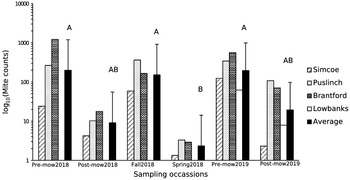
In Ontario, cyclamen mite counts varied, depending on when samples were collected (F = 6.54; df = 5,14; P = 0.003). Counts were higher pre-mowing in summers of 2018 and 2019 and in fall 2018 than in spring 2019 (Fig. 1). No cyclamen mites were recovered from strawberry in Saskatchewan.
Mean (± standard error mean) counts of cyclamen mite (Phytonemus pallidus) sampled from strawberry in southern Ontario, Canada 2018 and 2019. Each sample comprised 10 young, unfolded strawberry leaves, and 10 samples were collected from each field on each sampling occasion. Counts were averaged across fields, and averages with the same letter were not significantly different (Tukey’s honestly significant difference test; P > 0.05). The field near Lowbanks was sampled only during summer (pre- and post-mow) 2019.

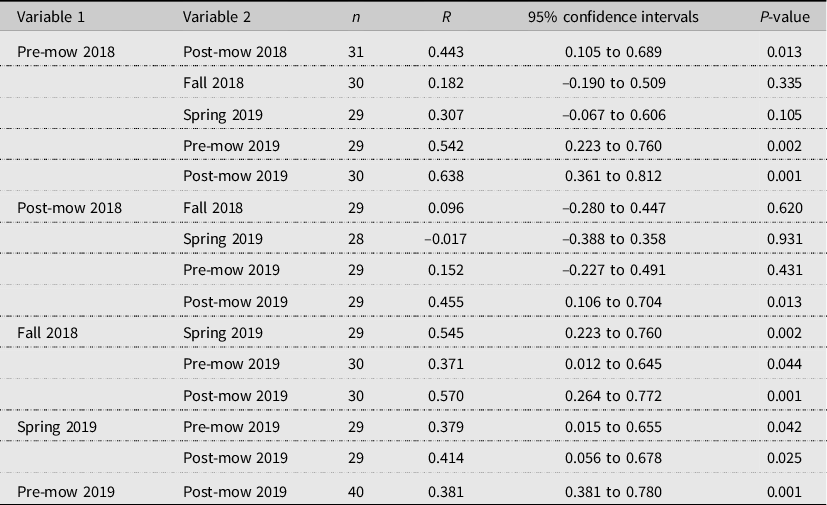
Overall, 10 of 15 pairwise correlations for cyclamen mite counts between sampling occasions were significant (P < 0.05). The nonsignificant correlations were primarily between 2018 summer pre- and post-mowing counts and fall 2018 and spring 2019 counts (Table 2).
Pairwise correlations for cyclamen mite (Phytonemus pallidus) counts from strawberry leaf and crown samples collected in spring, summer (pre- and post-mow), and fall 2018 and 2019 from three sites, and a fourth site in summer 2019, in southern Ontario, Canada. Samples were stored in ethanol and mites were counted after three leaf or crown washes.

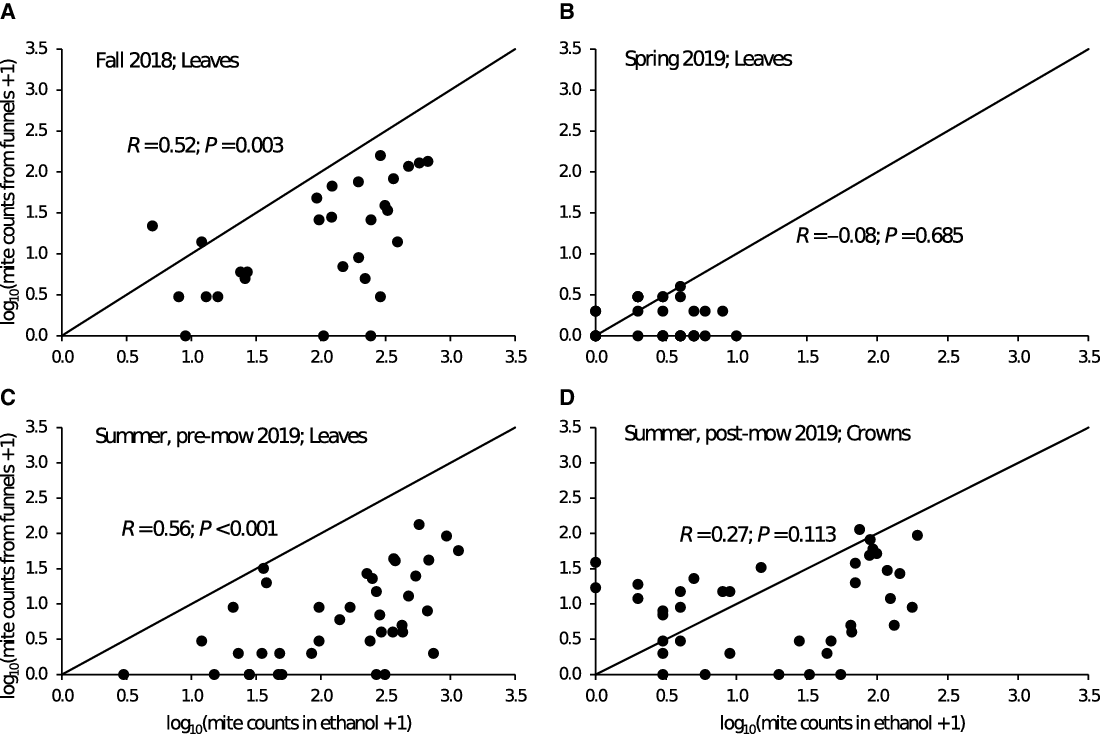
Cyclamen mite counts from samples in ethanol and Berlese funnel extractions were correlated for the fall 2018 and summer pre-mow leaf collections but not for the spring 2019 leaf or summer post-mow crown collections (Fig. 2). In fall 2018, an average of 194.80 ± 32.26 (± standard error mean) cyclamen mites were recovered from leaves in ethanol-stored samples, compared to an average of 37.18 ± 8.79 mites recovered from Berlese funnel extractions – a difference of 162 mites. In summer 2019 for pre-mow samples, an average of 270.60 ± 43.79 cyclamen mites were recovered from leaves in ethanol-stored samples, compared to an average of 18.85 ± 4.36 of mites recovered from Berlese funnel extractions – a difference of 248 mites.
Correlations between two methods of cyclamen mite (Phytonemus pallidus) extraction. Samples were either stored in ethanol and mites were counted after three leaf washes or placed in Berlese funnels and extracted mites were counted in ethanol. Samples were from leaves or crowns (n = 10 leaves or crowns per sample) collected in A, fall 2018, B, spring 2019, C, summer 2019 pre-mowing, and D, summer 2019 post-mowing from three (fall and spring) and four (summer) strawberry fields in southern Ontario, Canada.

Discussion
By repeatedly sampling from the same locations in southern Ontario strawberry fields, we showed that cyclamen mite population distribution was temporally stable. Sampled patches of plants with high cyclamen mite counts consistently had relatively more mites than patches with low numbers of mites. Overall, cyclamen mite populations did not increase during the sampling period due, at least in part, to overwintering mortality and the negative effects of mowing. Spring counts were about 100 times less than those in fall, and post-mowing counts were about 10 times less than pre-mowing counts in both years. Berlese funnel extractions were less effective than the ethanol-stored and triple-wash method for recovering cyclamen mites. Correlations between the two methods, at least with leaf samples when mite counts were high, indicated that Berlese funnel extractions may be an effective method for determining relative abundances. Because cyclamen mite is a small, movement-limited pest, a relatively stable spatio-temporal distribution was expected. The impact of our findings for improving cyclamen mite monitoring and management is discussed further.
It is not uncommon that pest population distributions are temporally stable in cropped fields (Fitzgerald et al. Reference Fitzgerald, Xu, Pepper, Easterbrook and Solomon2008; Reay-Jones Reference Reay-Jones2017; Ghahramani et al. Reference Ghahramani, Karimzadeh, Iranipour and Sciaratta2019; Panthi et al. Reference Panthi, Renkema, Lahiri and Liburd2021). Cyclamen mite is dispersed by plant trade, and the likely method of introduction into strawberry fields is from infested transplants (Dana and Oatman Reference Dana and Oatman1962). All of the Ontario strawberry fields were planted more than two years before we sampled, but small patches of plants with moderate to severe damage symptoms were still distinguishable from the large majority of plants with no damage symptoms. Therefore, most of the cyclamen mite population in a field appears to have developed on or adjacent to the plants with founding individuals. Within-field dispersal may be aided by factors such as attachment to worker clothing, harvesting crates, or farm machinery. Research on patch size expansion rates within and among years and whether new patches are detected over time will contribute to improved understanding of cyclamen mite dynamics in perennial strawberry systems, with important implications for management.
Even though the distribution of plants with varying numbers of cyclamen mite and amounts of damage remained relatively stable, cyclamen mite counts were not always correlated between sample dates. Pre- and post-mow counts in 2018 were not correlated to the fall 2018 and spring 2019 cyclamen mite counts. Abamectin (Agri-Mek® SC) was applied at two of the three farms after the post-mow sampling, and its efficaciousness, causing 100% mortality in the laboratory (Zalom et al. Reference Zalom, Thompson and Nicola2009; Fountain et al. Reference Fountain, Harris and Cross2010), may have decoupled counts between samples taken before and after application. Cyclamen mite counts were correlated between samples collected in fall 2018, spring 2019, and pre- and post-mow 2019, and just one of three farms sprayed abamectin in spring 2019, a few weeks after sampling when counts were low. Pre- and post-mow counts within years were correlated, suggesting mowing did not significantly affect cyclamen mite count distributions in fields. Similarly, fall and spring counts were correlated, even though winter conditions reduced cyclamen mite populations by 100 times on average. Interestingly, all pairs of summer counts (pre- and post-mowing) were correlated between years, suggesting that, despite acaricide applications, mowing, and winter conditions, patches of cyclamen mite established and re-established to similar populations levels from one year to the next.
Our direct comparison of extraction methods showed that storing in ethanol and triple-washing leaves or crowns resulted in recovery of 5 and 14 times more cyclamen mites, on average, than using Berlese funnels did. Similarly, broad mite recovery was about six times greater from samples shaken in ethanol than from those placed in Berlese–Tullgren funnels (Mechant et al. Reference Mechant, Luypaert, Van Delsen, Pauwels, Witters, Van Huylenbroeck and Gobin2015). Extracting mites with Berlese funnels required less processing time than triple-washing samples did, and funnels have been used successfully for evaluating controlled atmospheric temperature–treatment effects on cyclamen mite (van Kruistum et al. Reference van Kruistum, Evenhuis, Hoek, Kastelein, van der Wolf and Verschoor2015). Because numbers of cyclamen mites from leaves were correlated between extraction methods, Berlese funnels may be useful where relative rather than absolute numbers are needed. Lack of correlation between methods for numbers of mites from crowns may be due to the effect of the greater size and complexity of crowns, compared to leaves, on mite movement from crowns in funnels or our ability to rinse mites from crowns. Although we attempted to dry the plant material slowly by lowering the heat source over time, rapid drying is known to lead to poor recovery of small arthropods (e.g., Liu et al. Reference Liu, Zhang and Yue2011). Optimising Berlese funnel protocols may improve cyclamen mite recovery, but the advantages – long storage periods, no specialised equipment, and better mite recovery – mean that storing samples in ethanol and washing plant materials are preferred methods for assessing cyclamen mite populations.
In conclusion, cyclamen mite was commonly found in perennial, matted-row strawberry fields in southern Ontario, but cyclamen mite was not detected in the sampled field in Saskatchewan. Colder winters and hotter, drier summers in Saskatchewan, compared to those in Ontario, may have limited cyclamen mite population growth. Because population distributions in Ontario fields remained relatively stable in small patches, targeted management strategies may be effective. Patenaude et al. (Reference Patenaude, Tellier and Fournier2020) concluded that the high frequency and rate of release of the predator mite Neoseiulus cucumeris Oudemans (Acari: Phytoseiidae) were prohibitive in commercial strawberry production in Québec. However, predator releases may be more economical and effective if they occur on small patches of slightly damaged plants in the first or second year after planting rather than on entire strawberry fields in later years. Winter conditions and mowing reduced cyclamen mite populations, and therefore, controls may be best applied in spring and mid-summer to delay or prevent population resurgence. However, spatially targeted control applications based on finding plant damage may be difficult to implement when cyclamen mite populations are lower in spring and after mowing. Currently, a molecular detection method is being developed (J. Renkema, unpublished data) that may aid in the control decision process. Overall, cyclamen mite is a persistent pest in strawberry in Ontario, but as research progresses on management and monitoring, growers will have new tools to mitigate damage and reduce losses due to cyclamen mite.
Acknowledgements
The authors thank Agriculture and Agri-Food Canada and the Pest Management Centre of Canada for funding through the Pesticide Risk Reduction Program. They also thank Lori Bittner, Tara Preston, Kyle Maerz, Rebecca Plouffe, and Eva Thorpe for assistance counting mites in Ontario, Dave Kobylak for sampling in Saskatchewan, and participating strawberry growers for allowing access to their fields.
Competing interests
The authors declare none.