The historical role of European farming in Southern and Central Africa has received a great deal of attention among scholars over the years. The consensus is that the success or failure of European farming in Southern Africa was to a large extent dependent upon their access and control over cheap labour. Control over labour ultimately depended upon non-economic measures, which could only be upheld with the support of the colonial state. What is missing in the literature is a link between the overall performances of the European farming sector on the one hand, and the capacity of European farmers to access and control cheap labour by influencing state policies to increase the supply of labour on the other hand. A large body of scholarly work focuses primarily on the intention of state policies in granting European farmers access to cheap labour assuming that government intentions led to desired outcomes. This assumption can be questioned in light of the literature that emphasizes the relative weakness of the colonial state. The few attempts to measure the impact of policies in settler colonies deal mainly with indirect measures such as trends in rural real wages. Yet this tells us very little. How do we know that declining real wages signify the strength of the settler farmers to reduce labour costs (when keeping labour force constant) while they enjoyed stable or increasing profits? It could be equally true that the decline in wages is the result of a failing sector which faces shrinking profits and is hence unable to pay higher wages.
This article is an attempt to move beyond the state-centred analysis by directly relating labour cost with the overall performance of settler farmers. We do that by analysing changes in rural wage levels and the ‘wage-burden’ European settler farmers faced. The wage-burden is identified by measuring wage shares (the total amount paid in the form of wages as a share of total profits) on European farms in colonial Africa. The identified wage share is then used for a more qualitative-oriented analysis of the mechanisms behind tangible patterns, including the role of the state.
We use European tea and tobacco farming in Nyasaland as our empirical case. Nyasaland was not a settler colony. On the contrary, the number of European farmers was small. Largely following the consensus described above, previous research claims that Nyasaland did not develop into a settler colony because of the limited capacity of the European farms to access and control labour, which in turn was partly a consequence of a weak colonial state not able to give the settler sector the support it needed for survival. Consequently, the sector nearly collapsed in the aftermath of the Great Depression.
Our estimates challenge this story and hence the general consensus view described above in three important ways. First, the settlers' sector did not collapse in the 1930s. On the contrary, both the tobacco and tea sector made substantial profits well into the late colonial period, when we end our period of investigation. Second, while their capacity to access cheap labour was, as rightly pointed out in previous research, limited in the early colonial period, it increased considerably over time as reflected in a significant decline of the wage shares. Third, we are not able to find any strong correlation between colonial policies on the one hand and changes in wage levels and in the wage share on the other hand. Instead, both levels of wages and wage shares were determined by changes in the regional and global labour and commodity markets. The regional mobility of Africans – both entering and leaving the protectorate – had a significant impact on wages while prices on the world market determined the value of output. In short, market forces played a crucial role in shaping the development trajectory of settler farming in Nyasaland. Our analysis suggests that we need to rethink the history of settler colonialism and/or settler capitalism in Africa.
Our quantitative data are obtained from the colonial Blue Books held in the National Archives in London. From these reports, we have collected information on agricultural wages, acres under European cultivation, total amount of crops grown, total amount and value exported per cash crop, and some scattered information on employment in both the tea and the tobacco sector between 1898 and the mid-1950s. Qualitative information on labour relations and labour control is taken both from the archives in London and the National Archives in Malawi as well as published scholarly work. We have especially benefitted from the empirically- and analytically-rich papers by Robin Palmer, Bridglal Pachai, and Wiseman Chirwa.
SETTLER AGRICULTURE IN AFRICA
A distinctive feature of twentieth-century settler colonialism, as argued by Caroline Elkins and Susan Pedersen, is that the Europeans remained a minority in the colonies.Footnote 1 This has led Paul Mosley to define settler expansion in Africa as ‘colonisation of underdeveloped areas by European producers who became economically dependent on the indigenous population’.Footnote 2 Europeans settlers faced the challenge of securing access to labour. Relatively low population densities and a general reluctance among Africans to supply labour meant that the settlers had to either offer comparatively high wages or develop institutions (coercive or non-coercive) that secured adequate supplies of indigenous labour. The state is assumed to have played a crucial role in enabling settler farmers to access cheap labour and hence directly impacted the development of settler agriculture in Africa. Ralph Austen argues that ‘[t]he major weapon employed by Europeans in this context was … not their superior access to various forms of producer capital but rather their influence over the state’.Footnote 3 The Marxist literature of the 1970s and 1980s argued that the expropriation of land in Southern Africa not only gave the settlers access to the most fertile areas, but was also instrumental in Europeans' control of indigenous labour. Squeezing Africans' access to land together with taxation policies increased the supply of cheap indigenous labour and thus constituted a precondition for the development and growth of large-scale farming in Africa.Footnote 4
The Marxist interpretation is largely shared by the more liberal-oriented historians writing in the 1980s as well as more recent research in ‘new’ institutional economics and economic history. Mosley, for example, compares the developments in colonial Zimbabwe and Kenya to reach the conclusion that land expropriation had a negative effect on real wages for African workers.Footnote 5 Keith Griffin and colleagues conclude, from a global comparative view, that the main function of land concentration was for the large landholders to keep the cost of labour low without employing direct coercive measures.Footnote 6 In a recent publication, Daron Acemoglu and James Robinson argue that land concentration and the creation of ‘dual economies' in parts of Africa enabled European settlers to extract a surplus from indigenous labour.Footnote 7
There are two major problems with the state- and policy-centred analysis described above. The capacity of the colonial state to enforce policies and steer development towards an intended direction should not be exaggerated. On the contrary, there are good reasons to question whether any colonial state in Africa had the capacity to control economic and social developments within their territories. A number of prominent scholars have shown that the capacity of the state to direct development was severely limited.Footnote 8 Consequently, historians have shown that African agency played a crucial role in the shaping of colonial policies. To quote Frederick Cooper: ‘European [colonial] policies [are] as much as a response to African initiatives as African ‘resistance’ and ‘adaptation’ [are] a response to colonial intervention.’Footnote 9 Second, the assumed link between the performance of European settler farming and their access to cheap labour is not empirically investigated. The few attempts deal mainly with indirect measures such as trends in rural real wages.Footnote 10 Yet this tells us very little. How do we know that declining real wages signify the strength of the settler farmers to reduce labour costs (when keeping labour force constant) while they enjoyed stable or increasing profits? It could be equally true that the decline in wages is the result of a failing sector which faces shrinking profits and is hence unable to pay higher wages.
In this article, we introduce a method that allows us to move beyond a state-centred analysis and create a more direct link between the performance of the settler farming sector and its access and control of cheap labour that is independent of state policies. By measuring the value of output, nominal wages, and wage shares we create an empirical context that more directly links the development trajectory of settler farming to the access and cost of labour. The question is whether our method provides a different view of settler farming in Africa than the one summarized above. To deal with that question, we first need to ask what we should expect from settler farming in the case of Nyasaland based on previous research.
SETTLER AGRICULTURE IN NYASALAND
Nyasaland never developed into a settler colony despite the visions of the first governor, Sir Harry Johnston, to develop the protectorate into ‘another Brazil’.Footnote 11 The view taken by most historians is that settler agriculture, after four decades of fluctuating performance, largely collapsed in the aftermath of the Great Depression in the 1930s. Only a few large companies cultivating tea in the Thyolo and Mulanje districts in the southern region survived.Footnote 12
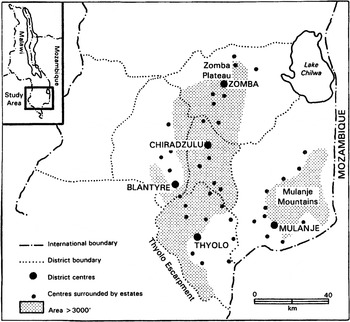
In the early colonial period, settler farmers concentrated their activities in the Shire Highlands partly because these areas were accessible by boat, the soils were relatively fertile, and, as argued by Tony Woods, they benefited from the protectorate's favourable land policies.Footnote 13 A number of Europeans, mainly missionaries and traders, had managed to claim access to land in the very fertile areas of the Shire Highlands in the southern part of Nyasaland (see Map 1) in the late precolonial period of the 1870s by signing treaties with local chiefs.Footnote 14 It was not uncommon for Europeans to expand the land frontier beyond the borders stipulated in the contracts. In 1915, Chief Kadewere of Chiradzulu in southern Nyasaland told a commission of enquiry that Europeans often asked for a small a plot of land upon which to build a house, but later took control over far larger amounts of land to establish farms.Footnote 15
Shire Highlands, Nyasaland. Source: W. C. Chirwa, ‘“The Garden of Eden”: sharecropping on the Shire Highlands Estates, 1920–1945’, in A. Jeeves and J. Crush (eds.), White Farms, Black Labor: The State and Agrarian Change in Southern Africa, 1910–1950 (Oxford, 1997), 266.

The colonial state supported the establishment of a European-controlled farming sector in different ways in the early colonial period. Land distribution in favour of the Europeans was initially the most important. Sir Harry Johnston was aware of the chiefs' complaints about the amount of land being allocated to Europeans. Nevertheless he decided not only to accept the presence of Europeans, but to grant companies such as the British South Africa Company, the Bruce Estates Ltd, and the African Lakes Corporation Ltd, freehold rights to large tracts of arable land in the Shire Highlands. By the turn of the century, approximately half of all land in the fertile Shire Highlands was owned by Europeans. Of this land, about two-thirds was under the control of five large companies.Footnote 16 This was, however, not the only way in which the colonial authorities gave support to European farmers. In 1901, a differential tax rate was introduced. Africans who worked on estates paid three shillings per month, while others had to pay six shillings per month, with the obvious intention of increasing the supply of labour, and hence reduce wages.Footnote 17 European farmers in the Shire Highlands further benefitted from comparatively high population densities. The population density was estimated at 300–350 people per square kilometre in the late 1920s, making it possible to keep wages comparatively low.Footnote 18
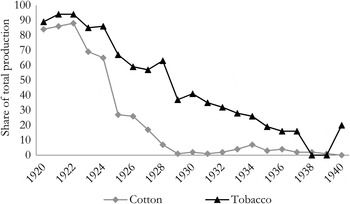
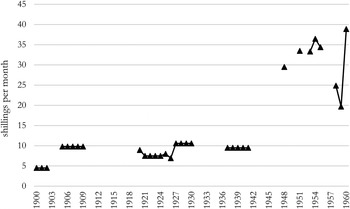
Despite the favourable circumstances, the number of European settler farmers remained low. In 1921, there were 399 settler farmers in the protectorate (with a total population of approximately 1,200,000). By 1931, the number had declined to 290 and in 1945 there were only 171 European farmers left in Nyasaland.Footnote 19 The modest and declining performance of the white farming community in the interwar period was noticed in both absolute and relative terms. A significant feature of the developments in Nyasaland was Africans' capacity to increase their market shares. Figure 1 shows how Africans contributed more than 50 per cent of the total cotton production by the mid-1920s and more than 50 per cent of the total tobacco production by the late 1920s.Footnote 20
Percentage of total cotton and tobacco production in Nyasaland 1915–41 produced by white farmers. Source: E. Green, ‘Modern agricultural history in Malawi: perspectives on policy choices’, African Studies Review, 50:3 (2007), 115–33

High transportation costs and access to and control of cheap labour have been identified as key factors explaining the relatively poor performance of European farming. In 1933, it was calculated that the cost of sending tea to the nearest port – Beira in Portuguese East Africa – was four times higher than in India and seven times as high as in Southern Rhodesia.Footnote 21 Both the ‘poorer’ European tobacco growers and the tea companies continuously raised the issue of high transportation costs.Footnote 22
The power of European settlers to influence transportation costs were, however, limited. This meant that they had to keep the cost of labour as low as possible to remain competitive. Consequently, settler farmers expressed grievance over a lack of labour.Footnote 23 A number of historians have emphasized European farmers' limited capacity to control labour. Wiseman Chirwa, for example, emphasizes the role of African agency in determining European farmers' capacity to control and access labour to argue that European farmers were ‘severely limited in [their] ability to employ coercive methods'.Footnote 24 Erik Green (one of the co-authors of this article) takes Chirwa's conclusion one step further and claims that African workers and tenants were in a position to renegotiate labour contracts in their favour from the mid-1920s.Footnote 25 In 1941, the Labour Department concluded that the African worker ‘comes and goes as he likes'.Footnote 26 The difficulties European farmers faced in accessing and controlling labour are partly explained by a shift in state policies. The colonial authorities, who in the early colonial period had actively supported the establishment and expansion of a European farming sector, now held the European farmers responsible for the failure and accused them of lacking knowledge of proper farming practices. These farmers were blamed for preparing their fields in marginal areas, which often led to large amounts of low quality leaves.Footnote 27 Instead of intensifying the support for the European farming sector in the 1920s, the colonial authorities began to reform previous policies against the interests of the Europeans. One of the most important changes was the abolition of the differential taxation system in 1921 when a flat tax rate of six shillings was introduced. It is also worth noting the Land Ordinance of 1928, which facilitated the transition away from labour tenancy by stating that ‘resident natives' had to be offered work at the usual market rate or be given facilities to grow cash crops.Footnote 28 These policies changed African production of cotton and dark-fired tobacco expanded.Footnote 29 In 1934, the government concluded that it ‘must make it clear for the Native Authorities that they want to see the acreage under economic crops increase’.Footnote 30 The gradual abandonment of settler-oriented policies weakened the power of European farmers to access and control labour, and consequently explains the decline of settler farming in the 1930s.
MEASURING WAGES AND WAGE SHARES
How much was this relative decline of settler farming the result of limited access to cheap labour? In order to discuss this we need to know how much the sector as a whole received from growing and exporting cash crops and how wages for labour developed between 1898 and 1960. We therefore collected information on the total amount of crops grown by Europeans (for both the tobacco and the tea sectors), the total amount and value exported per cash crop, and acres under European cultivation from the colonial Blue Books, as they were consistently recorded during the colonial period. Furthermore we collected agricultural wages, and the total value of imports of agricultural machinery and fertilizer also from the colonial Blue Books. Finally, we obtained some scattered information on employment and transport costs in the tea and tobacco sectors from both the colonial Blue Books and secondary sources.Footnote 31
We have faced a number of challenges in creating reliable time series. Finding good estimates for the number employed posed the most difficult problem. From 1951 onward, we have for a few years the number of employed per sector and, from 1955, overall agricultural employment in Nyasaland. Before 1950 and only in a few cases, employment figures were given for a number of farms but no overall estimates or per sector estimates were recorded. So we decided to extrapolate employment figures based on the ratio of workers per acre calculated for the 1950s, combined with qualitative evidence about the labour-to-land ratio. For the tobacco sector we find that on average 1.78 workers per acre under cultivation were employed on European farms in the early 1950s. Steven Rupert argued that in Southern Rhodesia, the minimum a farmer needed in terms of labour was one labourer per acre under cultivation.Footnote 32 As Rupert referred to the absolute minimum, we believe our finding of 1.78 labourers per acre is not too far off. As the technology to grow tobacco was labour intensive and did not require very much capital (at least until the Second World War), we have no evidence to suggest that technology changed drastically in the years before these observations. Hence, we use the labour-to-land ratio and the number of acres under cultivation to estimate employment. For the tea sector, we apply the same method and find a labour-to-land ratio of 1.59 in the early 1950s. Again we have no evidence to suggest important technological change in the tea sector in the years before these observations and thus we use this labour to land ratio and the number of acres under cultivation to estimate employment figures for the tea sector.
The second challenge concerns the creation of reliable estimates for total wage labour cost. To approximate total labour costs we need both agricultural wages and information on the terms of employment. To obtain wage series we have used all recorded agricultural wages from the colonial Blue Books. Sometimes wages per sector were included (especially for the later period), sometimes a distinction between the wet and the dry season was made, and sometimes only one single ‘agricultural’ wage was recorded.Footnote 33 We have combined all these sources into one single observation per year until 1942. From 1942 to 1960, we use a different wage series for the tea and tobacco sectors. However, the difference in wages between the two sectors is very limited – the ratio of tea to tobacco wages is on average 0.98 and ranges between 1.19 and 0.83. Concerning the terms of employment we had more difficulties. The main problem was that for most of the period, we did not know whether people were employed the whole year or only specific parts of the year. For a few years in the mid-1950s, the records roughly indicate total length of contract (temporary, semi-temporary, or permanent), yet little information is given about how many months labourers worked per year. Based on past historical research on labour relations on European farms in Nyasaland, we assume that wage labourers were, on average, employed for three months per year.Footnote 34 Total wage costs per year per sector are then calculated by multiplying the monthly wage rate by three to account for the whole employment period, and multiplying that by the total number of people employed.
The third challenge is to account for the non-wage labour. Both the production of tobacco and tea were labour intensive at least until after the Second World War. If settler farmers could use non-wage labour on their farms, they needed less wage labourers. When wage labourers were not the most important part of the labourers employed, the total wage sum might have been a less binding constraint to running a farm. Originally, the European farmers depended both on indigenous wage labour and tenants. The tenancy system was locally known as Thangatha and implied that tenants had to work for the landlord for one month to pay off their tax and another to pay their rent – both during the crucial rainy season.Footnote 35 Tenants presumably played a more prominent role as labourers on the tobacco farms, at least in the early colonial period.Footnote 36 Over time, tenants were gradually replaced by day labourers and wage workers.Footnote 37 Indeed, the only estimate we have of the proportion of tenants shows that in 1947 only 3 per cent of the workers on tea estates were tenants.Footnote 38
Further, we lack data to create a reliable time series for transportation costs. No records of any form of transportation costs are found in any of the colonial documents that we have scrutinized. Yet, Elias Mandala argues that in the first half of the colonial period transportation costs were high in Nyasaland.Footnote 39 Robin Palmer provides an estimate for the 1930s of 0.97 pence per pound transported.Footnote 40 We have used this estimate to extrapolate transportation costs for the tea and tobacco sectors throughout the colonial period by multiplying this with the total amount of both tea and tobacco exported respectively. We believe that these extrapolations probably underestimate the transportation costs for the early colonial period, while they most likely overestimate the cost for the latter part of the period. Finally, we also account for investments in machinery and fertilizer by using the total value of agricultural machinery and fertilizer imports. We only have figures up to 1941, so after that we keep investment constant at the 1941 level. This implies that we underestimate investments in the postwar period. At the same time, we had no guidelines on what share of investments to assign to either the tobacco or the tea sector. So we use the total amount spent on imports of agricultural machinery and fertilizer to represent the total amount spent on investments in the tobacco and tea sectors. This is obviously (much) more than either sector in reality spent on these imports. Hence, this counterbalances to some extent the underestimations of investments made after 1941 discussed above. Keeping these limitations in mind we start by looking only at farmers who were in business, so we abstain from analysing start-up costs.
THE DEVELOPMENT OF EUROPEAN AGRICULTURE REVISITED
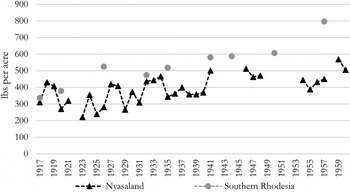
We begin by looking at European tobacco production. Our estimates do not support the view held by historians and colonial authorities that the tobacco growers were largely inefficient. If we compare land productivity of tobacco farmers in Nyasaland to land productivity on European tobacco farms in Southern Rhodesia (at the time, the largest tobacco producer in the region), we find that European farmers in Nyasaland were almost as productive until the mid-1940s. Figure 2 shows the tobacco yields per acre for both settler farmers in Nyasaland and settler farmers in Southern Rhodesia. The latter were in a more favourable position, with better access to capital through the Land Bank and access to cheap labour through the establishment of Native Reserves.Footnote 41 Even so, the difference in land productivity is not great between the two countries until yields increase strongly in Southern Rhodesia during the 1950s, mainly due to significant increases in investment in machinery and fertilizers.Footnote 42
Tobacco yields on European farms in Nyasaland and Southern Rhodesia, 1916–60. Sources: Nyasaland: CO 452/19–44, CO 626/22–35 Colonial Blue Books 1917–60; section on European agriculture. Southern Rhodesia: Moseley, The Settler Economies (1983).

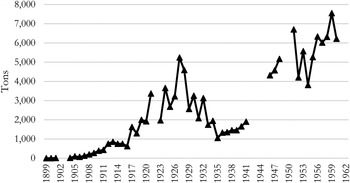
Furthermore, and equally important, our data shows that the European tobacco sector did not collapse in the 1930s as is often assumed. Figure 3 shows that European tobacco production in Nyasaland (after an initial rapid expansion) decreased between 1927 and 1935, after which the sector revived again and experienced a second boom in the postwar period. It is true that a large number of individual farmers went bankrupt during the Depression and had to sell, or simply abandoned, their land. Meanwhile, the wealthier tobacco farmers (and in a few cases also companies) took over the control of the land and continued to grow tobacco. The legacy of the Great Depression was not the collapse of a European-controlled tobacco sector but an increase in land concentration within the sector.Footnote 43
Total amount of European tobacco produced in Nyasaland, 1899–1960. Sources: CO 452/2–44, CO 626/22–27 Colonial Blue Books, 1899–1962; section on European agriculture.

In terms of total output, the tea sector seems to have been even less affected by the Great Depression. Figure 4 shows that exports of tea expanded continuously from the mid-1920s, which is in line with previous research.Footnote 44 The value of exported tea increased eightfold during the 1930s and, by 1938, the colonial authorities regarded it as the most valuable cash crop in the protectorate.Footnote 45 The different developments for tea and tobacco farming intuitively makes sense as the tea sector was controlled by relatively large companies, while the tobacco estates were mainly owned by individual Europeans.Footnote 46 The former had better access to capital, which enabled them to survive the Depression. In 1932, the district commissioner in the Mulanje district, one of the most prominent tea-growing areas in Nyasaland, reported that the tea sector had enough resources to ‘enable it to expand even in times of deepest depression’.Footnote 47 They were also helped by international tea restrictions, which did not prevent further decline in world prices for tea but managed to slow down the decline compared with other export crops like cotton, coffee, and tobacco.Footnote 48
Total amount of European tea produced in Nyasaland, 1899–1960. Sources: CO 452/6–44, CO 626/22–35, Colonial Blue Books, 1904–60; section on European agriculture.

How does the overall performance of the tobacco and tea sectors relate to access to and cost of labour, and to what extent were labour shortages a real problem for the European settlers? One way of looking into these questions is to look at how agricultural wages developed over time. Before we look at the trends, we must keep in mind that rural wages in Nyasaland throughout the period remained comparatively low. Differently from settler economies such as Southern Rhodesia and South Africa, Nyasaland lacked a dynamic domestic market that could absorb large-scale estate production. Low wages were therefore a major incentive for settlers to invest in the colony.Footnote 49
After being particularly low in the early 1900s, wages paid to agricultural workers increased slightly until the early 1920s (see Figure 5). Does this increase in wages signify a shortage in supply? We believe so – at least to some extent, and such an interpretation is in line with previous research and with what we find in the colonial reports.Footnote 50 But what caused these shortages? As we shall see below, emigration of Africans from Nyasaland played an important role in limiting the supplies of labour in the very early colonial period.
Nominal average agricultural wages over timea. aThe average wage paid to labourers in the tea and tobacco sector. Sources: CO 452/1–44, CO 626/22–37 Colonial Blue Books 1899–1969; section on wages.

After the early years, however, wages decreased again and remained low until the mid-1940s. This either suggests that labour was not in very short supply, at least to the extent that it did not push up wages, or that settler farmers made no profits, and hence could not afford higher wages. Previous research tells us that settlers suffered from a serious shortage of labour. Moreover, in 1927, the Nyasaland Planters' Association, whose members consisted of both individual European farmers and companies, argued that African farmers' engagement in cash crop production led to ‘acute’ labour shortages on the European farms.Footnote 51
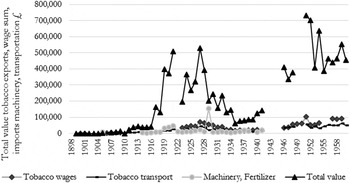
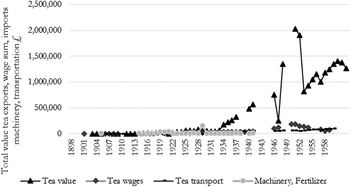
Considering the labour shortages indicated by previous research, there must have been decreasing profits in the tobacco and tea sectors, making it difficult for settlers to pay higher wages to attract labourers. Figures 6 and 7 show the share of profits paid in wages in both sectors.
Export earnings, total amount paid in wages and imports of machinery in the tobacco sector. Sources: CO 452/1–44, CO 626/22–37 Colonial Blue Books, 1899–1962.

Export earnings, total amount paid in wages and imports of machinery in the tea sector until 1960.Footnote 79 Sources: CO 452/3–44, CO 626/22–37 Colonial Blue Books, 1901–62.

The total amount paid in wages by both the tea and tobacco farmers, and the total wage sum, was indeed very close to the total profits from exports until the mid-1910s in tobacco and until the mid-1930s in tea. Yet, the total value of tobacco exports starts to increase drastically after 1915. This means that the drop in agricultural wages in the early 1920s, as described above, actually occurred at the same time as the value of tobacco exports increased. This means that European farmers were able to capture a larger part of the profits over time. Hence, it was not the tobacco farmers' inability to afford higher wages that led to stagnating wages.
By contrast, in the tea sector, wages were a heavy burden until the mid-1930s when the sector took off in terms of value and quantity exported (see also Figure 3). Given the time gap between just planted and mature tea plants, it is no surprise the tea sector took longer to develop. In Nyasaland, it took four years before tea bushes were ready to be plucked and twelve years before they came to full maturity.Footnote 52 Furthermore, tea cultivation demanded skilled manufacturing and processing on the spot, which meant that Europeans had to make significant capital investments and find skilled African labourers. Building a tea factory in Nyasaland in the 1920s was calculated to cost £18,000 and Palmer calculates (assuming a value of production of £50 to £60 per acre) that it would take a tea estate at least seven years to show returns on initial capital investments.Footnote 53 Until 1952, there was a continued increase in the value of tea exported with the exception of 1947. The continued increase in value of production for tea was accompanied by a significant decrease in the wage share.Footnote 54
Parallel to these developments the value of production of tobacco sharply decreased during the 1930s especially in the second half of that decade, during which the sector appeared to struggle to make a profit. Yet, even when export earnings were at the lowest point, the value of total export earnings were still nearly twice the amount that was spent on the sum of total wages, total costs of import of machinery and fertilizer, and total transportation costs. Obviously, the hard times did not mean that the sector was running a deficit. From the 1940s onward, the tobacco sector largely recovered which is indicated by a substantial decline in the wage share.
Even though wages also sharply increased in the 1940s, the value exported increased faster in both sectors, although more so the tea sector than in the tobacco sector. Over time, farmers in both sectors were clearly able to capture an increasing share of the profits.
EXPLAINING CHANGES IN WAGES AND WAGE SHARES
Let us now relate these findings to colonial policies and examine the role of these in determining the development trajectory of settler farming in Nyasaland. As shown above, Europeans initially struggled to gain access to indigenous labour and our data confirm that the total amount spent on wages posed a heavy burden for European farms in the early colonial period. The indigenous populations were, for various reasons, not prepared to supply their labour to European farms. One of the more obvious reasons for this reluctance was the similar agricultural cycles on the European and African farms – meaning that European demands for labour coincided with the need for Africans to stay and work on their own farms. Relying on local labour was therefore associated with structural problems, not necessarily leading to chronic labour shortages as stated by a number of historians as well as in the colonial reports but, instead, seasonal variability in labour supplies.Footnote 55 In the early twentieth century, European farmers who predominantly engaged in tobacco production tried to extract as much labour as possible from their tenants as a strategy to keep labour costs as low as possible. However, the number of tenants was not enough and had to be supplemented with various forms of wage labour.
In the early years of the Nyasaland Protectorate, wage labourers consisted of both Africans in the southern region and migrant labourers in the northern part of the protectorate. We have no reliable estimates of the number of migrants employed, but as early as 1894, it was reported that 2,000 people from the north had been contracted by European farmers in the south.Footnote 56 This source of labour was, however, rapidly declining as people in the north shifted from going south to going abroad in search of employment. A number of historians have analysed labour emigration from Nyasaland and its effect on the local economies that the migrants came from. In 1942, Margaret Read bluntly stated that: ‘The chief export of Nyasaland in the past fifty years has been men.’Footnote 57 Previously, it was common to highlight the negative effects of emigration.Footnote 58 Recently a more nuanced perspective has emerged.Footnote 59 Still, it is obvious that emigration negatively affected the European planters in the south, who now had to compete over labour with farmers in Southern Rhodesia and the mining complex in South Africa. They lost the competition as they could not afford to offer wages that equalled those abroad.Footnote 60 The number of Africans officially leaving the protectorate increased from 3,000 in 1902 to 10,000 in 1904. By 1935 it was estimated that about 120,000 Africans (including both people originating from north and south) were working abroad.Footnote 61
The colonial authorities' position on European farming and their ‘right’ to cheap labour was, from the very beginning, ambiguous. They were officially criticizing the European settlers already in the early twentieth century for exploiting labour, although their complaints mainly dealt with tenancy contracts.Footnote 62 Meanwhile, colonial authorities did implement policies aimed at facilitating Europeans' access to indigenous labour in the early colonial period, such as granting Europeans rights to vast tracks of land and introducing a differential tax system (see above). The taxation system may have increased the supply of local labour but it was still not enough to attract the northerners to go to southern Nyasaland instead of abroad. The introduction of the differential tax system was a necessary but insufficient condition for Europeans to attract Africans to work on the farms as temporary labourers.
As noted above, the colonial authorities gradually began to abandon settler-oriented policies in the 1920s. A number of measures were taken in the 1920s and 1930s to facilitate African commercial production at the expense of European farming, notably the abolition of the differential tax system and the implementation of the Land Ordinance of 1928.
Following the changes in colonial policy, one would expect that supplies of labour declined and wages increased. Yet, Figure 5 shows stagnating wages from 1920 to 1940, which contradicts the view taken by historians that European farmers found it increasingly difficult to access labour. But why did wages stagnate at times when the colonial authorities shifted its focus and began implementing policies to stimulate increased African cash crop production rather than making Africans sell their labour cheaply? The reason is that the supplies of labour increased significantly, not as a direct effect of domestic colonial policies, but rather because of changing regional mobility patterns. People were not only leaving Nyasaland. A large number also migrated to the protectorate. The Lomwe people had emigrated from Portuguese East Africa to Nyasaland from the early twentieth century. Initially, most of them settled on African lands where they were often welcomed as long as they were prepared to provide labour services to the chiefs in exchange for land.Footnote 63 However, by the 1920s, the population densities on African lands in the southern region had reached such levels that it became difficult to accommodate more immigrants. Meanwhile, the inflow of people from Portuguese East Africa to southern Nyasaland continued. It is estimated that the number of Lomwe people in Nyasaland increased from 100,000 in 1920 to 380,000 in 1945, most of them settling in the Shire Highlands.Footnote 64 In 1926 it was reported that the inflow of Lomwe people to the southern region of Nyasaland was so great that it ‘depleted the area available for the needs of the indigenous population’.Footnote 65 Consequently, the immigrating Lomwe people were left with few options beyond providing labour services on the European estates, something they had earlier been reluctant to do. Initially they settled on the estates as tenants but, by the 1920s, an increasing number were employed as migrant labourers.Footnote 66 The colonial authorities' role in this was limited. They tried neither to discourage nor to facilitate immigration of Lomwe.Footnote 67 Meanwhile, the constant inflow of immigrants was welcomed by the white settlers who saw this as an opportunity to access cheap labour. In 1924, the East Africa Commission reported that: ‘In many parts of the Southern Province, the chief source of labour is Portuguese East Africa whence thousands of natives immigrate yearly to work on the … plantations in Nyasaland’.Footnote 68 In the labour census report of 1925, the importance of immigrant labour for the European settler farms in the Shire Highlands was emphasized even further. It was stated that if immigration from Portuguese East Africa was cut off, the effect would be such that ‘half of the plantations in the Mlanje, Cholo and Lower Shire districts would have to be closed [due to lack of labour]’.Footnote 69
That the continued inflow of Lomwe people was crucial for Europeans is obvious when one looks at the scattered estimates available. In 1933, the provincial commissioner of the southern province reported that the Lomwe people played a very important role taking on the heavy manual work on the tea estates. He concluded that about 80 per cent of the labourers on heavy manual work were Lomwe people.Footnote 70 In 1935, the district officer of Mlanje district in the southern province reported that about 6,000 Lomwe people were employed by the tea estates in the district and that the European farmers were not experiencing any labour shortages. In 1938, the provincial commissioner of the southern province estimated that about 60 per cent of the labour employed on the tea estates in Cholo district in the south were immigrants. In 1941, the Labour Department estimated that immigrants from Portuguese East Africa amounted to approximately 50 per cent of the people employed on European farms.Footnote 71
The situation changed again in the mid-1940s as rural nominal wages sharply increased. The increase in wages signified labour shortages, which can be explained by two independent factors. First, in 1935, South Africa lifted the ban imposed in 1913 on the recruitment of ‘tropical workers'. In practice, it meant that the Witwatersrand Native Labour Association was granted the right to actively recruit labour in Nyasaland. A year later, a Tripartite Labour Agreement was signed with Southern and Northern Rhodesia, which, to quote Chirwa, gave ‘recruiters from these countries almost unlimited access to Nyasaland labor’.Footnote 72 As shown above, people in Nyasaland, especially from the northern regions, had migrated to South Africa and Southern Rhodesia for decades. In contrast to earlier periods, we now witness a significant increase of people emigrating from the southern part of Nyasaland. In 1921, estimates of Africans officially leaving the protectorate reveal that 1,874 originated from the southern province, which equalled about 9 per cent of the total number of emigrants. In 1945, the number had increased to 53,452, implying that the Africans originating from the southern province now constituted 41 per cent of the total number of emigrants.Footnote 73 In 1937, the European farmers in the Shire Highlands managed to persuade the colonial authorities to set up a committee to investigate the effects of emigration for the European farms. The committee's report stated that recruiters from South Africa and Southern Rhodesia were active in the region and that they were so successful in recruiting local labourers to the extent that in the future, it would have an impact on the output of European farms.Footnote 74 The European farmers who in the early twentieth century lost the competition over migrant labour to farmers and miners in Southern Rhodesia and South Africa now lost again in the battle for labour in southern Nyasaland.
The continued increase in the number of Africans engaged in cash crop production also affected supplies of indigenous labour. The postwar period was marked by colonial authorities actively transferring public resources to African agriculture, by investing in agricultural extension services and market infrastructure, making it even more profitable for Africans to engage in commercial agriculture instead of supplying labour to the Europeans.Footnote 75 Chirwa estimates that an African farmer growing tobacco on fertile land could earn around £10–12 annually, while farmers with access to less fertile land could earn between £1–4 annually.Footnote 76 The former was more than twice the annual wage of an ordinary estate labourer while the latter was just above the average wage. Thus there were limited incentives for Africans to choose farm labour before cash cropping. This was not only a phenomenon in Nyasaland. In most of British Africa, European settlers experienced a decline in local labour supplies as Africans seized the opportunity of the global postwar boom and expanded their production of cash crops.Footnote 77
In contrast to the early colonial period, wage increases from the 1940s did not, however, pose a serious threat to the profitability of the tea and tobacco sectors. The significant fluctuations in world market prices and recurrent overproduction crises in the African colonies in the postwar period were over as the world entered three decades of sustained growth. Profits increased faster than wages, which meant that the wage shares declined. In other words, the settler farmers managed to capture a larger part of the capital rent over time. The main determinant for these developments was the international price of tea and tobacco. In both cases, prices increased significantly in the 1940s and the first half of the 1950s.Footnote 78 The favourable conditions in the world markets enabled the European farmers to capture a larger part of the rent despite decreasing supplies of local labourers and a colonial state that actively took measures to prevent the further expansion of the settler economy. In 1965, the former director of agriculture in Nyasaland confirmed that both the tea and tobacco estates had benefitted from postwar economic developments and that the expansion of European agriculture in the 1940s and 1950s could not be explained by colonial policies.
CONCLUSION
The historiographical consensus is that control over labour ultimately depended upon non-economic measures which could only be upheld by the support of the colonial state. What is missing in the literature to support these arguments is a link between the overall performances of the European farming sector and average labour costs for the sector. In this article, we have aimed to fill this gap by measuring wage shares on European farms in colonial Nyasaland. We have shown that the wage shares for European tobacco and tea farms were high in the early colonial period but then declined significantly from the 1930s to the late 1950s. Our findings suggest that domestic colonial policies like land distribution and taxation played only a minor role in shaping institutions, demonstrating that Europeans farmers must be understood in the context of regional and global markets. The latter determined the value of output, while regional mobility of Africans had a significant impact on labour supplies and hence upon wages.
These findings are not surprising. Nyasaland was one of the poorest colonies in Africa. To assume that the colonial authorities had the capacity to direct developments in a desired direction given these circumstances makes little sense. For colonial Africa in general and settler colonies in particular, we believe that both current and past research exaggerates the role of politics. Colonies were not isolated units but had to adapt to regional and global circumstances. In some cases, the adaption was more successful than others depending on local circumstances, such as the political strength of the colonial authority, ecological conditions, and socio-political developments. However, we believe that it is reasonable to conclude that any analysis of long-term economic development in colonial Africa must begin with an understanding of the regional and global contexts in which specific cases are situated.
APPENDIX
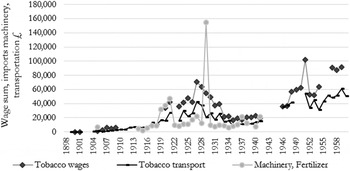
Figures 6 and 7 in the main text display the difference between the total value of both tobacco and tea exported and the amount of money respectively spent on wages, imports of fertilizer and machinery, and transportation. Because the difference between the value of exports and the three cost components, especially for the latter half of the colonial period, is quite substantial, all variation in the total amount spent on wages, fertilizer, and machinery, and transportation is compressed. To show the variation over time in these three components (the wage sum, the total value of imports of machinery and fertilizer, and transportation costs), we here present Figure 6 (tobacco) and Figure 7 (tea) without the total export value.
From Figure A1 it is clear that except for 1929, wages were the biggest cost for tobacco farmers.
Total amount paid in imports of machinery and transportation in the tobacco sector until 1960. Sources: see main text.

In the tea sector, wages are often the most important cost category for farmers, but clearly not always as Figure A2 shows. Fertilizer and machinery expenditure were larger than wage expenditure for most of the 1910s and 1920s. Transportation costs were larger than wage costs in the early 1940s and at the end of the 1950s.
Total amount paid in imports of machinery and transportation in the tea sector until 1960. Sources: see main text.