Introduction
The Archean world was much different from today. The atmosphere is considered to have been reducing in nature with a low atmospheric oxygen concentration (<10−5 PAL – present atmospheric level; cf. Pavlov & Kasting Reference Pavlov and Kasting2002), but abundant carbon dioxide and methane. Low atmospheric oxygen concentrations are believed to have prevailed until the Great Oxidation Event at 2.4–2.3 Ga, when a significant rise in the atmospheric oxygen abundance occurred (Pufahl & Hiatt Reference Pufahl and Hiatt2012), either as a singular event or in a more stepwise function between 2.7 and 2.4 Ga ago (Kurzweil et al. Reference Kurzweil, Claire, Thomazo, Peters, Hannington and Strauss2013). The Archean ocean was anoxic and ferruginous, containing abundant dissolved Fe2+ in excess of sulphide. This is reflected by the presence of banded iron formation and the presence of Archean shales enriched in Fe2+ (Kump & Holland Reference Kump and Holland1992; Reinhard et al. Reference Reinhard, Raiswell, Scott, Anbar and Lyons2009; Kendall et al. Reference Kendall, Gordon, Poulton and Anbar2011; Scott et al. Reference Scott, Bekker, Reinhard, Schnetger, Krapez, Rumble and Lyons2011). In the absence of oxidative continental weathering, the concentration of dissolved sulphate in the Archean ocean was rather low, possibly less than 2.5 µM as recently estimated by Crowe et al. (Reference Crowe, Paris, Katsev, Jones, Kim, Zerkle and Canfield2014). In the Paleoarchean, life was entirely microbial in nature and is believed to have exclusively inhabited the marine realm (Holland et al. Reference Holland, Turekian and Schlesinger2004 and references therein). At present, the oldest evidences for terrestrial life, including chemical and isotopic evidences in organic matter and ancient stromatolites, were proposed for 2.9–2.7 Ga rocks (Rye & Holland Reference Rye and Holland2000; Watanabe et al. Reference Watanabe, Martini and Ohmoto2000; Zhao et al. Reference Zhao, Robb, Harris, Jordaan, Reimold and Gibson2006; Mossman et al. Reference Mossman, Minter, Dutkiewicz, Hallbauer, George, Hennigh, Reimer and Horscroft2008), although the colonization of the terrestrial realm could have happened before this time. Crucial aspects for this include physical and chemical boundary conditions that would altogether characterize a habitable earth (for a recent review, see Beraldi-Campesi Reference Beraldi-Campesi2013).
Reconstructing environmental conditions, but also tracing ancient metabolic pathways have substantially benefited from the application of stable isotopes. With respect to reconstructing the Archean sulphur cycle, sources and processes have been archived through characteristic sulphur isotopic signatures in the rock record. Here, we review prominent observations of this record and summarize our current understanding of Earth's early sulphur cycle.
Sulphur isotope systematics
Sulphur has four stable isotopes (32S, 33S, 34S and 36S), and sulphur isotope results are usually reported in the standard delta notation
 $${\rm \delta} ^{3i} {S} ({\permil}) = ((^{3i} S/^{32} S)_{{\rm Sample}} /(^{3i} S/^{32} S)_{{\rm Standard}} -1)\; \times \;1000$$
(where i is either 3, 4 or 6) as per mil difference to the Vienna Canon Diablo Standard. Terrestrial sulphur cycling, including microbially mediated processes, are associated solely with mass-dependent fractionation (MDF) of the sulphur isotopes, resulting in clearly defined dependencies for δ33S≈0.515 × δ34S and δ36S≈1.90 × δ34S.
In contrast, mass-independent fractionation (MIF) of stable sulphur isotopes results in non-zero Δ33S and Δ36S values following the definition of Hulston & Thode (Reference Hulston and Thode1965) and Johnston et al. (Reference Johnston, Farquhar, Habicht and Canfield2008):
 $$\eqalign{& \Delta ^{33} S = {\rm \delta} ^{33} S-1000\; \times \;[(1 + ({\rm \delta} ^{34} S/1000)^{0.515} )-1] \cr & \Delta ^{36} S{\rm} = {\rm \delta} ^{36} S-1000\; \times \;[(1{\rm} + {\rm} ({\rm \delta} ^{34} S/1000)^{1.90} )-1]} $$
Sulphur isotope measurements of Archean rocks date back into the 1970s (e.g. Schidlowski Reference Schidlowski, Ponnamperuma, Margulis, Ponnamperuma and Margulis1980), applying stable sulphur isotopes (δ34S) as a chemofossil for tracing microbial sulphur cycling back in time.
Different analytical approaches have been pursued through more than 50 years of sulphur isotope geochemistry. Most commonly, sulphur isotope analyses were (and still are) based on wet chemically extracted sulphur from bulk rock sample powders. Alternatively, hand-picked or micro-drilled concentrates of sulphide or sulphate minerals were subjected to sulphur isotope measurements. For decades, research concentrated on the δ34S value that became a well-established analytical tool for reconstructing sulphur cycling through time. For the past 15 years, sulphur isotope research has expanded to include the two minor sulphur isotopes 33S and 36S, particularly following the observation of mass-independently fractionated sulphur isotope (MIF-S) signatures in pre-2.4 Ga sedimentary rocks (e.g. Farquhar et al. Reference Farquhar, Bao and Thiemens2000; for a recent review, see Johnston Reference Johnston2011).
In addition to the bulk rock approach, in-situ measurements at high spatial resolution have been performed. Among the early reports, Ohmoto et al. (Reference Ohmoto, Kakegawa and Lowe1993) studied Paleoarchean sedimentary rocks from the Barberton Greenstone Belt by using laser-ablation sulphur isotope analyses. More recently, a sizeable body of data has emerged from deep-time sulphur isotope research using ion microprobe measurements of multiple sulphur isotopes (e.g. Hu et al. Reference Hu, Rumble and Wang2003; Mojzsis et al. Reference Mojzsis, Coath, Greenwood, McKeegan and Harrison2003; Whitehouse et al. Reference Whitehouse, Kamber, Fedo and Lepland2005; Cates & Mojzsis Reference Cates and Mojzsis2006; Philippot et al. Reference Philippot, Van Zuilen, Lepot, Thomazo, Farquhar and Van Kranendonk2007; Philippot et al. Reference Philippot, van Zuilen and Rollion-Bard2012; Roerdink et al. Reference Roerdink, Mason, Farquhar and Reimer2012; Roerdink et al. Reference Roerdink, Mason, Whitehouse and Reimer2013). Finally, few applications have so far explored the potential of nano-SIMS analyses in sulphur isotope research (e.g. Fike et al. Reference Fike, Gammon, Ziebis and Orphan2008; Wacey et al. Reference Wacey, Kilburn, Saunders, Cliff and Brasier2011a, Reference Wacey, Saunders, Brasier and Kilburnb; Fischer et al. Reference Fischer, Fike, Johnson, Raub, Guan, Kirschvink and Eiler2014).
As a final note it can be firmly stated, that the inclusion of all four stable sulphur isotopes and the observation of MDF and MIF-S in pre-2.4 Ga old sedimentary rocks has substantially expanded the challenges and also our possibilities for unravelling sulphur cycling on the early Earth.
The Archean sulphur cycle – a general model
Farquhar et al. (Reference Farquhar, Bao and Thiemens2000) reported multiple sulphur isotope results (32S, 33S, 34S, 36S) for sedimentary sulphides and sulphates from a variety of Precambrian sedimentary rock units. The intriguing discovery of that study was the existence of MIF-S (generally expressed as non-zero Δ33S values) in sediments older than 2.4 Ga and its absence in younger rocks. In addition, a difference in Δ33S was apparent with positive values for sulphides and negative values for sulphates. Moreover, samples defined a characteristic relationship between Δ33S and Δ36S, expressed by a negative slope of the respective regression line. The latter was considered as evidence that one or more gas-phase chemical reactions were responsible for the observed mass-independent isotope fractionation and that these occurred in the atmosphere. From this discovery emerged a completely new picture of the global sulphur cycle on the early Earth, notably that it was influenced by atmospheric processes with reaction products being delivered and archived in Earth surface environments.
The observation that MIF-S appeared to be ubiquitous in sedimentary rocks older than 2.4 Ga and absent thereafter called for some specific conditions on the early Earth favouring the formation, transfer and archiving of this signature in the sedimentary rock record. Subsequent experimental and modelling results suggested that the existence of MIF-S in Earth surface environments was possible only in an atmosphere that lacked substantial amounts of oxygen. Pavlov & Kasting (Reference Pavlov and Kasting2002) finally examined a suite of possible photochemical reactions of volcanogenic sulphurous compounds in the atmosphere and associated sulphur isotopic fractionation. As a conclusion, they proposed that the threshold for the formation of MIF-S in the atmosphere and the transfer of this signature to the Earth's surface was the atmospheric oxygen abundance below 10−5 of the PAL.
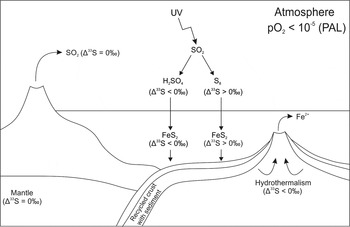
From empirical, experimental and modelling results, a conceptual model of the pre-2.4 Ga sulphur cycle was developed (Fig. 1). In the pre-2.4 Ga world, sulphur cycling commenced with the injection of volcanogenic sulphur dioxide into an anoxic atmosphere lacking an ozone shield. This volcanogenic sulphur dioxide (SO2) (and by inference the pre-2.4 Ga mantle) is thought to exhibit isotopically unfractionated sulphur. Subsequent ultraviolet (UV)-driven photochemical dissociation of this volcanogenic SO2 has been suggested to result in the formation of a sulphate pool, carrying a negative Δ33S signal and a pool of elemental sulphur, carrying a positive Δ33S signal (e.g. Ono et al. Reference Ono, Eigenbrode, Pavlov, Kharecha, Rumble, Kasting and Freeman2003). An atmosphere devoid of free atmospheric oxygen prevented subsequent homogenization of these isotopically, distinctly different photolytic sulphur pools.
Conceptual model of pre-2.4 Ga sulphur cycling.

These photolytic sulphur compounds were transferred to Earth surface environments, where they entered the realm of terrestrial sulphur cycling. Here, inorganic and/or microbially driven redox processes were associated exclusively with mass-dependent sulphur isotopic fractionation, thereby preserving the initial atmospheric source signature (i.e. a negative or positive Δ33S signature). Consequently, pre-2.4 Ga sedimentary sulphide and sulphate exhibits distinctly different combinations of MDF and MIF-S (for a recent review see, e.g. Johnston Reference Johnston2011) that reflect different sulphur sources (and mixtures thereof) and different (bio) geochemical processes.
A clear negative correlation of Δ33S and Δ36S values with a slope of −1, termed the ‘Archean array,’ is utilized to uniquely identify the photolytic nature of sulphide and sulphate sulphur in sedimentary rocks of pre-2.4 Ga age (see Johnston Reference Johnston2011).
It should be noted, however, that the view, that MIF-S is the unique result of photochemical reactions of volcanogenic sulphurous compounds and that this signal has a strong bearing on the composition of the atmosphere, most notably with respect to oxygen, has been questioned (e.g. Ohmoto et al. Reference Ohmoto, Watanabe, Ikemi, Poulson and Taylor2006; Watanabe et al. Reference Watanabe, Farquhar and Ohmoto2009; Ohmoto et al. Reference Ohmoto, Watanabe, Lasaga, Naraoka, Johnson, Brainard and Chorney2014).
Mantle sulphur – the juvenile unfractionated sulphur source
Considering the commonly accepted model for the Archean sulphur cycle (Fig. 1), it appears most appropriate to commence this review by analysing the multiple sulphur isotopic composition of magmatic rocks as the designated archive of isotopically unfractionated juvenile sulphur (i.e. mantle sulphur – δ34S, Δ33S and Δ36S = 0 ‰; cf. Farquhar et al. Reference Farquhar, Wing, McKeegan, Harris, Cartigny and Thiemens2002; Ono et al. Reference Ono, Eigenbrode, Pavlov, Kharecha, Rumble, Kasting and Freeman2003). Modern mid ocean ridge basalts are characterized by a δ34S value of −0.89 ± 0.11 ‰ and Δ33S and Δ36S within error of the Canyon Diablo standard, i.e. at 0 ‰, as recently defined for Pacific–Antarctic basalts by Labidi et al. (Reference Labidi, Cartigny, Hamelin, Moreira and Dosso2014).
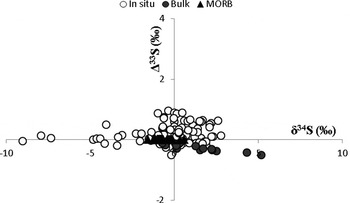
Despite the common acceptance for the injection of isotopically unfractionated sulphur into the anoxic Archean atmosphere as the starting point for the atmospheric/photochemical sulphur cycling, hence an isotopically unfractionated mantle sulphur source, the database for this assertion is rather limited (Fig. 2).
Magmatic rocks and sulphide inclusions in diamonds, showing an isotopically unfractionated mantle sulphur source, compared with modern MORB values. An additional contribution of photolytic sulphur is discernible through non-zero Δ33S values. MORB: Middle Ocean Ridge Basalt. (Source of data: Farquhar et al. Reference Farquhar, Wing, McKeegan, Harris, Cartigny and Thiemens2002; Mojzsis et al. Reference Mojzsis, Coath, Greenwood, McKeegan and Harrison2003; Thomassot et al. Reference Thomassot, Cartigny, Harris, Lorand, Rollion-Bard and Chaussidon2009; Labidi et al. Reference Labidi, Cartigny, Hamelin, Moreira and Dosso2014; Montinaro et al. Reference Montinaro, Strauss, Mason, Roerdink, Münker, Schwarz-Schampera, Arndt, Farquhar, Beukes, Gutzmer and Peters2015).

Mojzsis et al. (Reference Mojzsis, Coath, Greenwood, McKeegan and Harrison2003) analysed the multiple sulphur isotopic composition of a sample from the >3.1 Ga old Ameralik dykes, in addition to sulphides from different sedimentary rock types within the ca. 3.8 Ga old Isua Supracrustal Belt, Southwestern Greenland. Three in-situ ion-probe measurements of a single sulphide grain yielded δ34S values between −4.8 and −4.4 ‰ and Δ33S values between 0.01 and 0.03 ‰ that are consistent with the presumed non-fractionated nature of mantle rocks.
Sulphides in a dolerite and a basalt from the Dresser Formation yielded near zero ‰ multiple sulphur isotope values with δ34S values between 0.1 and 0.5 ‰, Δ33S values between −0.1 and −0.04 ‰ and Δ36S values between 0.17 and 0.21 ‰ (Ueno et al. Reference Ueno, Ono, Rumble and Maruyama2008). These results also confirm the assumption of a non-fractionated nature of Archean upper mantle sulphur.
In contrast to previous studies, komatiites and tholeiites from the ca. 3.5 Ga old Komati and Weltevreden formations, Barberton Greenstone Belt (Montinaro et al. Reference Montinaro, Strauss, Mason, Roerdink, Münker, Schwarz-Schampera, Arndt, Farquhar, Beukes, Gutzmer and Peters2015) yielded a significantly larger range in multiple sulphur isotope values. δ34S values between −0.7 and +5.2 ‰, Δ33S values between −0.50 and −0.09 ‰ and Δ36S values between +0.67 and +1.90 ‰ are clearly outside the expected range of unfractionated mantle sulphur. Moreover, Δ33S and Δ36S values exhibit a negative correlation with a slope of −1, comparable with the Archean reference array (e.g. Johnston Reference Johnston2011).
Apart from Archean igneous rocks, sulphide inclusions in Archean diamonds were studied by Farquhar et al. (Reference Farquhar, Wing, McKeegan, Harris, Cartigny and Thiemens2002) and Thomassot et al. (Reference Thomassot, Cartigny, Harris, Lorand, Rollion-Bard and Chaussidon2009). Both studies revealed the presence of MIF sulphur, with Δ33S values between −0.11 and +0.61 ‰ for 2.9 Ga old diamonds from the Orapa kimberlite pipe, Eastern Botswana and Δ33S values between −0.5 and +0.9 ‰ for diamonds hosted in eclogites in the Jwaneng kimberlite pipe in Southeastern Botswana, where age constraints (Re-Os) are not well-established with at least two ages at 2.9 and 1.5 Ga for diamond formation. Corresponding δ34S values vary between −1.4 and +2.6 ‰ at Orapa (Farquhar et al. Reference Farquhar, Wing, McKeegan, Harris, Cartigny and Thiemens2002) and between −9.0 and +3.4 ‰ at Jwaneng (Thomassot et al. Reference Thomassot, Cartigny, Harris, Lorand, Rollion-Bard and Chaussidon2009). These values lie within the range of δ34S values that was previously reported for diamonds from eight South African mines (δ34S values between −11 and +9.5 ‰; Eldridge et al. Reference Eldridge, Compston, Williams, Harris and Bristow1991).
Important conclusions can be drawn from the observations made in early Archean igneous rocks and sulphide inclusions in diamonds. First, the presumed unfractionated nature of sulphur in mantle rocks, representing the presumed starting point for the Archean atmospheric/photochemical cycling of sulphur, has indeed been verified, albeit a rather slim database. Second, several data sets exist that exhibit MIF sulphur in igneous rocks (plus sulphide inclusions in diamonds) that require the transfer of the respective signature from Earth's surface into the mantle.
Based on our understanding of sulphur cycling in the modern oceanic realm, the incorporation of a MIF signal into oceanic crustal rocks could have been achieved via two main mechanisms. The subduction of oceanic crustal rocks and their sedimentary cover is one mechanism that causes the subsequent incorporation of volatile phases into the deep mantle. A respective recycling of sedimentary sulphides exhibiting non-zero values for δ34S and Δ33S would provide a means for the presence of mass-independently fractionated sulphur in igneous rocks. Alternatively, the hydrothermal circulation of seawater and interaction with oceanic crustal rocks results in the loss of sulphate to oceanic crustal rocks and initiate the high-temperature reduction of seawater sulphate followed by the formation and deposition of hydrothermal sulphides. This mechanism involves the oceanic sulphate pool and would, thus, transfer a negative Δ33S signal into the mantle. In general, the seawater alteration of oceanic crustal rocks is a well-known feature from the modern world as well as the ancient oceanic crust, and that cause changes in δ34S (e.g. Alt et al. Reference Alt, Anderson and Bonnell1989; Alt Reference Alt1995; Alt & Shanks Reference Alt and Shanks2003; Peters et al. Reference Peters, Strauss, Farquhar, Ockert, Eickmann and Jost2010) and Δ33S (e.g. Ono et al. Reference Ono, Shanks, Rouxel and Rumble2007; Rouxel et al. Reference Rouxel, Shank, Bach and Edwards2008; Peters et al., Reference Peters, Strauss, Farquhar, Ockert, Eickmann and Jost2010; Oeser et al. Reference Oeser, Strauss, Wolff, Koepke, Peters, Garbe-Schönberg and Dietrich2012).
Consequently, the observation of MIF-S in Archean magmatic rocks and sulphide inclusions in Archean diamonds would be most consistent with the operation of modern-style tectonic processes, including subduction and hydrothermalism.
Archean seawater sulphate: its atmospheric source and microbial modifications
The modern ocean contains 28 mM of sulphate (Böttcher et al. Reference Böttcher, Schale, Schnetger, Wallmann and Brumsack2000) and it is the second most abundant anion in seawater (Millero Reference Millero2005). Oxidative continental weathering and subsequent riverine delivery is the prime input of dissolved sulphate to the ocean. The abundance of dissolved sulphate in the modern ocean is homogenously distributed throughout the water column as a consequence of a long residence time (Claypool et al. Reference Claypool, Holser, Kaplan, Sakai and Zak1980; Walker Reference Walker1986; Paytan et al. Reference Paytan, Kastner, Campbell and Thiemens2004) that greatly exceeds the ocean mixing time of ca. 1000 years (e.g. Holland,Reference Holland and Elderfield2004). Modern oceanic sulphate exhibits a multiple sulphur isotopic composition of +21 ‰ for δ34S (Böttcher et al. Reference Böttcher, Schale, Schnetger, Wallmann and Brumsack2000; Reference Böttcher, Brumsack and Dürselen2007; Ono et al. Reference Ono, Keller, Rouxel and Alt2012), 0.050 ‰ for Δ33S (Ono et al. Reference Ono, Keller, Rouxel and Alt2012; Tostevin et al. Reference Tostevin, Turchyn, Farquhar, Johnston, Eldridge, Bishop and McIlvin2014) and −0.33 ‰ for Δ36S (Ono et al. Reference Ono, Keller, Rouxel and Alt2012) that is also homogenous throughout the entire water column. Differences in concentration and isotopic composition exist in marginal seas and/or in large estuaries, both times reflecting the in-mixture of riverine sulphate.
Previous accounts of the evolution of the global sulphur cycle through time (e.g. Strauss Reference Strauss2004) highlight the paucity of Precambrian and in particular Archean sulphate deposits. In fact, the Paleoarchean barite deposits in Southern Africa, Western Australia and India with ages between 3.5 and 3.3 Ga represent the only massive sulphate occurrences of Archean age. Their presumed sedimentary (evaporitic) origin was thought to be associated with local oases of oxygen that could have oxidized sulphidic sulphur. Following these sulphate occurrences between 3.5 and 3.3 Ga, the next younger occurrences of preserved massive evaporitic sulphate are several hundred meter thick gypsum/anhydrite layers associated with rock salt contained within the ca. 2.1 Ga old sedimentary succession of the Onega Basin, Northwest Russia (Melezhik et al. Reference Melezhik, Fallick, Rychanchik and Kuznetsov2005). The paucity of sulphate deposits throughout the first half of Earth history has sparked the notion of a low sulphate Archean ocean. A greatly attenuated isotopic fractionation between a (poorly constrained) barite-based seawater sulphate and plenty of bulk rock sedimentary pyrite δ34S data has been considered as supporting evidence, and Habicht et al. (Reference Habicht, Gade, Thamdrup, Berg and Canfield2002) proposed a sulphate concentration of <200 µM for the Archean ocean. More recently, Crowe et al. (Reference Crowe, Paris, Katsev, Jones, Kim, Zerkle and Canfield2014) proposed a level of 2.5 µM for Archean oceanic sulphate abundance. A low sulphate ocean would be highly consistent with an atmosphere devoid of free oxygen as this would suppress oxidative continental weathering of sulphides and riverine delivery of dissolved sulphate to the ocean.
Our understanding of the origin of Archean (and Paleoproterozoic) oceanic sulphate (and sedimentary sulphide) changed substantially through the discovery of MIF sulphate sulphur (and sulphide sulphur) in sedimentary rocks older than 2.4 Ga (Farquhar et al. Reference Farquhar, Bao and Thiemens2000). The discovery of MIF-S and their formation via UV-driven photochemical reactions of volcanogenic sulphur dioxide in an anoxic atmosphere revealed that the Archean sulphur cycle was strongly affected by atmospheric processes. Characteristic non-zero per mil Δ33S values for the Archean barite deposits (e.g. Roerdink et al. Reference Roerdink, Mason, Farquhar and Reimer2012) provide unequivocal evidence for a photolytic origin of the barite sulphate.
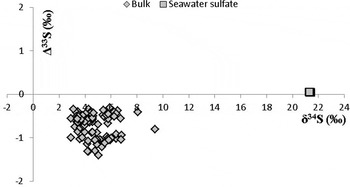
The individual Archean barite deposits exhibit rather narrow ranges for their multiple sulphur isotope signatures (Fig. 3), yet different hypotheses about the isotopic composition of early Archean oceanic sulphate have been advocated. Philippot et al. (Reference Philippot, Van Zuilen, Lepot, Thomazo, Farquhar and Van Kranendonk2007) suggested that the barite essentially reflects the isotopic composition of the original atmospheric (photolytic) sulphate (δ34S ≈ +5‰, Δ33S ≈ −1‰). Ueno et al. (Reference Ueno, Ono, Rumble and Maruyama2008) suggested an isotopic composition of atmospheric sulphate with δ34S ≈ −5 ± 2‰ and Δ33S ≈ −3 ± 1‰, in order to obtain a residual seawater sulphate with δ34S ≈ 5‰ and a sulphide, resulting from bacterial sulphate reduction, with a δ34S value ≈ −5‰. Bao et al. (Reference Bao, Rumble and Lowe2007) and Philippot et al. (Reference Philippot, van Zuilen and Rollion-Bard2012) proposed that the Paleoarchean barite reflects a photolytic sulphate source where the original sulphur isotopic composition might have been modified by bacterial sulphate reduction. Philippot et al. (Reference Philippot, van Zuilen and Rollion-Bard2012) proposed the mixing of photolytic sulphate (subsequently modified by bacterial sulphate reduction) and photolytic elemental sulphur (resulting from a specific MIF-S source reaction), defining a series of different arrays in a δ34S-Δ33S diagram (their felsic volcanic array, respectively, felsic volcanic wedge), mostly with a negative slope. Finally, Roerdink et al. (Reference Roerdink, Mason, Farquhar and Reimer2012) considered a δ34S value of ≈−2‰ and a Δ33S value around −1‰ for photolytic sulphate (acknowledging the trend reported by Ueno et al. Reference Ueno, Ono, Rumble and Maruyama2008), and a δ34S ≈ + 2‰ for residual sulphate, that is enriched in 34S due to microbial sulphate reduction. Thus, the Archean barite exhibits an enrichment in 34S relative to the isotopic composition of photolytic sulphate that Roerdink et al. (Reference Roerdink, Mason, Farquhar and Reimer2012) attribute to global scale microbial sulphate reduction of a limited oceanic sulphate reservoir. Presumably, basin-scale alteration (e.g. further microbial 34S enrichment) cannot be completely ruled out.
Multiple sulphur isotopic composition of early Archean barite deposits compared with modern oceanic sulphate. (Source of data: Farquhar et al. Reference Farquhar, Bao and Thiemens2000; Bao et al. Reference Bao, Rumble and Lowe2007; Shen et al. Reference Shen, Farquhar, Masterson, Kaufman and Buick2009; Ono et al. Reference Ono, Keller, Rouxel and Alt2012; Roerdink et al. Reference Roerdink, Mason, Farquhar and Reimer2012; Montinaro et al. Reference Montinaro, Strauss, Mason, Roerdink, Münker, Schwarz-Schampera, Arndt, Farquhar, Beukes, Gutzmer and Peters2015).

Sedimentary pyrite: a record of microbial sulphur cycling
Our quest for unravelling the emergence and evolution of life on Earth is heavily based on the application of geochemical tools, i.e. identifying chemical and stable isotopic signatures that can be related unequivocally to biological processes in general and individual metabolic pathways in particular. Here, we focus on the stable isotopes of sulphur that clearly indicate that sulphur was fundamental for the emergence and evolution of microbial life in the Paleoarchean (Shen & Buick Reference Shen and Buick2004).
At temperatures below 100°C, microbially mediated reactions are the most important processes in sulphur cycling. These metabolic processes are associated with a fractionation of the stable sulphur isotopes, as bacteria use the lighter isotope for their metabolism (Ohmoto & Goldhaber Reference Ohmoto and Goldhaber1997). Consequently, reaction products are depleted in 34S. The largest shifts in δ34S occur during microbial sulphate reduction (production of sulphide from sulphate) and elemental sulphur disproportionation (production of sulphide from elemental sulphur), while fractionations of much smaller magnitude have been reported for the biological reduction of elemental sulphur and microbial sulphide oxidation (Canfield Reference Canfield1998; Johnston et al. Reference Johnston, Farquhar, Wing, Kaufman, Canfield and Habicht2005; Johnston Reference Johnston2011; Surkov et al. Reference Surkov, Böttcher and Kuever2012). Fractionation for bacterial sulphate reduction was measured in modern sediments and laboratory cultures ranging from −3 and +70 (Harrison & Thode Reference Harrison and Thode1958; Kemp & Thode Reference Kemp and Thode1968; Habicht & Canfield Reference Habicht and Canfield1997, Reference Canfield2001, Reference Canfield, Olesen and Cox2006, Reference Canfield, Farquhar and Zerkle2010; Brüchert et al. Reference Brüchert, Knoblauch and Jørgensen2001; Detmers et al. Reference Detmers, Brüchert, Habicht and Kuever2001; Farquhar et al. Reference Farquhar, Canfield, Masterson, Bao and Johnston2008; Stam et al. Reference Stam, Mason, Pallud and Van Cappellen2010, Reference Stam, Mason, Laverman, Pallud and Cappellen2011; Sim et al. Reference Sim, Bosak and Ono2011). In the modern realm, the magnitude of isotopic fractionation may be as high as 60–70‰ (Canfield et al. Reference Canfield, Farquhar and Zerkle2010; Sim et al. Reference Sim, Bosak and Ono2011; Leavitt et al. Reference Leavitt, Halevy, Bradley and Johnston2013) when compared with ambient seawater sulphate. Elemental sulphur disproportionation results in the formation of sulphide and sulphate, and this process is associated with the fractionation of the sulphur isotope: 34S depletion of 4–7‰ in the sulphide and 34S enrichment in sulphate of up to 18‰ (Canfield Reference Canfield1998; Habicht et al. Reference Habicht, Canfield and Rethmeier1998; Böttcher et al. Reference Böttcher, Thamdrup and Vennemann2001; Böttcher et al. Reference Böttcher, Thamdrup, Gehre and Theune2005; Johnston et al. Reference Johnston, Farquhar, Wing, Kaufman, Canfield and Habicht2005). On the other hand, elemental sulphur reduction and sulphide oxidation were related with a lower fractionation signal, ranging between 1 and 5‰ between sulphur and sulphide for elemental sulphur reduction (Surkov et al. Reference Surkov, Böttcher and Kuever2012) and similar small isotopic effects for sulphide oxidation (Zerkle et al. Reference Zerkle, Farquhar, Johnston, Cox and Canfield2009). Experimental work revealed a minor change in the minor sulphur isotopes related to elemental sulphur disproportionation with an increase in Δ36S and a decrease in Δ33S compared with the reactant sulphur (Farquhar et al. Reference Farquhar, Johnston, Wing, Habicht, Canfield, Airieau and Thiemens2003; Johnston et al. Reference Johnston, Farquhar, Wing, Kaufman, Canfield and Habicht2005, Reference Johnston, Farquhar and Canfield2007), while for bacterial sulphate reduction a slight increase in Δ33S and decrease in Δ36S were observed (Farquhar et al. Reference Farquhar, Johnston, Wing, Habicht, Canfield, Airieau and Thiemens2003; Johnston et al. Reference Johnston, Farquhar, Wing, Kaufman, Canfield and Habicht2005, Reference Johnston, Farquhar and Canfield2007).
However, the magnitude in sulphur isotopic fractionation is not only controlled through the principal metabolic pathway but further affected by environmental factors, such as the availability of sulphate and organic substrate (e.g. Leavitt et al. Reference Leavitt, Halevy, Bradley and Johnston2013). Thus, a narrow range in δ34S of sedimentary sulphide does not necessarily indicate the absence of biological sulphur cycling, because the magnitude in isotopic fractionation is also related to oceanic sulphate concentration. Thus, if oceanic sulphate abundance would be(come) limited, either in the ocean or through limited replenishment from the overlying water column during progressive microbial sulphate reduction with the associated preferential turnover of the light 32S isotope, the sulphur isotopic composition (δ34S) of sedimentary sulphide as the reaction product would approach the sulphur isotopic composition of seawater. In general, however, the notion that microbial sulphur cycling is associated with sometimes substantial isotopic fractionation has been considered as a prime analytical approach for identifying traces of life and for reconstructing the antiquity of metabolic pathways back into Earth's early evolution (e.g. Canfield Reference Canfield2001; Johnston Reference Johnston2011).
Three different pathways of microbial sulphur metabolism have been proposed for the Paleoarchean, based on geochemical and sulphur isotopic grounds: sulphate reduction (Shen et al. Reference Shen, Buick and Canfield2001, Reference Shen, Farquhar, Masterson, Kaufman and Buick2009; Ueno et al. Reference Ueno, Ono, Rumble and Maruyama2008; Wacey et al. Reference Wacey, McLoughlin, Whitehouse and Kilburn2010, Reference Wacey, Kilburn, Saunders, Cliff and Brasier2011a), elemental sulphur disproportionation (Philippot et al. Reference Philippot, Van Zuilen, Lepot, Thomazo, Farquhar and Van Kranendonk2007; Wacey et al. Reference Wacey, McLoughlin, Whitehouse and Kilburn2010, Reference Wacey, Kilburn, Saunders, Cliff and Brasier2011a) and sulphide oxidation (Wacey et al. Reference Wacey, Saunders, Brasier and Kilburn2011b). Thus, a highly diverse suite of microbially driven sulphur metabolism might have been established already very early in Earth history.
Individual reports of highly 34S-depleted pyrite (e.g. Ohmoto et al. Reference Ohmoto, Kakegawa and Lowe1993; Shen et al. Reference Shen, Buick and Canfield2001; Philippot et al. Reference Philippot, Van Zuilen, Lepot, Thomazo, Farquhar and Van Kranendonk2007; Ueno et al. Reference Ueno, Ono, Rumble and Maruyama2008; Shen et al. Reference Shen, Farquhar, Masterson, Kaufman and Buick2009; Wacey et al. Reference Wacey, Kilburn, Saunders, Cliff and Brasier2011a, Reference Wacey, Saunders, Brasier and Kilburnb; Roerdink et al. Reference Roerdink, Mason, Whitehouse and Reimer2013) and the notion from molecular biology that bacterial sulphate reduction represents an ancient metabolic pathway (Shen & Buick Reference Shen and Buick2004; Ueno et al. Reference Ueno, Ono, Rumble and Maruyama2008; Johnston Reference Johnston2011) indicates that microbial sulphate reduction was operative in Paleoarchean sedimentary environments. The lack of a continuous record of sizeable fractionations in 34S in the Paleoarchean, however, might suggest that microbial sulphate reduction was of limited importance for biological sulphur cycling in Archean sedimentary surface environments (Strauss Reference Strauss2003), much in contrast to the modern marine realm, where microbial sulphate reduction represents the prime process of anaerobic remineralization of organic matter and the transfer of sulphur from the oceanic reservoir into the sediment (e.g. Jørgensen et al. Reference Jørgensen, Isaksen and Jannasch1992). The record of continuously high fractionations of stable sulphur isotopes, i.e. a temporal record of δ34S values comparable with the modern world, does not commence until the late Archean (Canfield & Raiswell Reference Canfield and Raiswell1999; Strauss Reference Strauss1999).
Fifteen years ago, Farquhar et al. (Reference Farquhar, Bao and Thiemens2000) discovered the presence of MIF-S in sedimentary pyrite and barite hosted in pre-2.4 Ga old sedimentary rocks. This discovery identified a clear atmospheric component of the Archean and early Paleoproterozoic global sulphur cycle. Moreover, based on distinctly different Δ33S values the ultimate speciation of photolytic sulphur can be identified, i.e. photolytic sulphate carrying a negative Δ33S value or photolytically derived elemental sulphur exhibiting a positive Δ33S value. As biological sulphur cycling is associated solely with mass-dependent sulphur isotopic fractionation, i.e. change in δ34S, respective processes do not obliterate non-zero Δ33S or Δ36S values, at least as long as the degree of MDF is low (Farquhar et al. Reference Farquhar, Johnston, Wing, Habicht, Canfield, Airieau and Thiemens2003; Johnston et al. Reference Johnston, Farquhar, Wing, Kaufman, Canfield and Habicht2005, Reference Johnston, Farquhar and Canfield2007). Consequently, microbial turnover of sulphate can be distinguished from the microbial turnover of elemental sulphur, based on a combination of δ34S and Δ33S values.
A somewhat different conclusion was reached by Philippot et al. (Reference Philippot, Van Zuilen, Lepot, Thomazo, Farquhar and Van Kranendonk2007) and Philippot et al. (Reference Philippot, van Zuilen and Rollion-Bard2012). Both studies reported a substantial number of multiple sulphur isotope results for pyrite from Paleoarchean sedimentary successions in Western Australia (Dresser Formation) and South Africa (Mapepe Formation) exhibiting a negative correlation between δ34S and Δ33S with a set of arrays going through the origin. It was proposed that the entire range of multiple sulphur isotope values measured for Paleoarchean sulphides and sulphates, including strongly negative δ34S and positive Δ33S values (the felsic volcanic array of Philippot et al. Reference Philippot, van Zuilen and Rollion-Bard2012) can be satisfactorily explained by a mixing of sulphide sulphur derived from a photolytic elemental sulphur source and sulphide sulphur derived from sulphate reduction of photolytic oceanic sulphate. A specific MIF-S source reaction associated with pulses of felsic volcanism is advocated as the principal cause for observed extreme sulphur isotope signatures, but the involvement of different processes of microbially driven sulphur cycling is acknowledged.
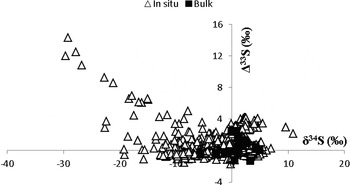
Over the past decades, a temporal record of multiple sulphur isotopes has been established through the study of sedimentary pyrite from all major Paleoarchean sedimentary successions, either through wet chemical ex-situ analyses of bulk rock samples or the in-situ analyses using laser-ablation and/or ion microprobe (Fig. 4; Ohmoto et al. Reference Ohmoto, Kakegawa and Lowe1993; Farquhar et al. Reference Farquhar, Bao and Thiemens2000; Shen et al. Reference Shen, Buick and Canfield2001; Hu et al. Reference Hu, Rumble and Wang2003; Mojzsis et al. Reference Mojzsis, Coath, Greenwood, McKeegan and Harrison2003; Whitehouse et al. Reference Whitehouse, Kamber, Fedo and Lepland2005; Cates & Mojzsis Reference Cates and Mojzsis2006; Farquhar et al. Reference Farquhar, Peters, Johnston, Strauss, Masterson, Wiechert and Kaufman2007; Philippot et al. Reference Philippot, Van Zuilen, Lepot, Thomazo, Farquhar and Van Kranendonk2007; Ueno et al. Reference Ueno, Ono, Rumble and Maruyama2008; Shen et al. Reference Shen, Farquhar, Masterson, Kaufman and Buick2009; Wacey et al. Reference Wacey, Kilburn, Saunders, Cliff and Brasier2011a, Reference Wacey, Saunders, Brasier and Kilburnb; Philippot et al. Reference Philippot, van Zuilen and Rollion-Bard2012; Roerdink et al. Reference Roerdink, Mason, Whitehouse and Reimer2013; Montinaro et al. Reference Montinaro, Strauss, Mason, Roerdink, Münker, Schwarz-Schampera, Arndt, Farquhar, Beukes, Gutzmer and Peters2015). As a result of these studies, ample evidence exists for the atmospheric influence on the Paleoarchean global sulphur cycle. But more so, through the combination of different sulphur isotopic signatures, the antiquity of different metabolic pathways within the sulphur cycle has been firmly established in Paleoarchean sedimentary rocks. Their importance in respect to quantifying sulphur cycling in Paleoarchean sedimentary environments, however, remains elusive.
Multiple sulphur isotopic composition of early Archean sedimentary pyrite. (Source of data: Farquhar et al. Reference Farquhar, Bao and Thiemens2000; Hu et al. Reference Hu, Rumble and Wang2003; Mojzsis et al. Reference Mojzsis, Coath, Greenwood, McKeegan and Harrison2003; Whitehouse et al. Reference Whitehouse, Kamber, Fedo and Lepland2005; Cates & Mojzsis Reference Cates and Mojzsis2006; Farquhar et al. Reference Farquhar, Peters, Johnston, Strauss, Masterson, Wiechert and Kaufman2007; Philippot et al. Reference Philippot, Van Zuilen, Lepot, Thomazo, Farquhar and Van Kranendonk2007; Ueno et al. Reference Ueno, Ono, Rumble and Maruyama2008; Philippot et al. Reference Philippot, van Zuilen and Rollion-Bard2012; Roerdink et al. Reference Roerdink, Mason, Whitehouse and Reimer2013; Montinaro et al. Reference Montinaro, Strauss, Mason, Roerdink, Münker, Schwarz-Schampera, Arndt, Farquhar, Beukes, Gutzmer and Peters2015).

Conclusions
Sulphur isotopes are a strong analytical tool for reconstructing the source(s) and pathway(s) of sulphur in the geological past, based on a firm (and constantly growing) understanding of modern day sulphur cycling. In particular, multiple sulphur isotope research of early Archean rocks during the past 15 years has substantially advanced our understanding of the early sulphur cycle, allowing to draw the following conclusions:
-
1. The ubiquitous presence of MIF-S in pre-2.4 Ga old sedimentary sulphide and sulphate indicates a dominant atmospheric influence on Earth's early global sulphur cycle. Thereby, photochemical reactions of volcanogenic sulphur dioxide result in two distinctly different sulphur pools: photolytic sulphate carrying a negative Δ33S value and photolytic elemental sulphur carrying a positive Δ33S value.
-
2. The presence of MIF-S in magmatic rocks and sulphide inclusions in diamonds indicates the incorporation of an atmospherically derived surface signature into deep crustal and/or mantle rocks. This requires a respective transport mechanism, and tectonic processes and/or hydrothermal circulation of seawater are two possible scenarios.
-
3. The combination of MDF and MIF-S signatures in sedimentary rocks has been utilized to identify at least three different microbially mediated pathways of sulphur metabolism: sulphate reduction, elemental sulphur disproportionation and sulphur oxidation.
-
4. An apparent isotopic fractionation between sulphate and sulphide that is generally lower than observed in modern marine sediments suggest a low oceanic sulphate abundance.
-
5. Different photolytic arrays have been recorded in early Archean sedimentary rocks, but their significance is not fully constrained yet.
-
6. Despite substantial advancements in our understanding of early Archean sulphur cycling over the past decades, numerous questions remain for future studies.
Acknowledgements
We appreciate the invitation to write a review of early Archean sulphur cycling. H. S. gratefully acknowledges the financial support for his deep-time sulphur isotope research through the Deutsche Forschungsgemeinschaft (Str 281).