
Introduction
Machinable mica glass ceramics are composite materials of crystalline phase set in a glassy matrix. The machinability of mica glass ceramics originates in the cleavage of mica crystals and the interlocking structure formed by the flake-like mica crystals. The interconnected crystal network blunts fracture paths and thus prevents catastrophic failure of mica glass ceramics during machining. Phlogopite-type (K1 −x Mg3Al1−x Si3+x O10F2) is one of the representative commercial mica-type glass ceramics, and its interlayer cation is K+ ion.[ Reference Holand and Beall 1 ] As excellent electrical insulating materials, machinable mica glass ceramics have been widely used in many aspects, such as the edge guard of space shuttle, ion accelerator, field ion microscopy, vacuum lead wires columns, and so on.[ Reference Grossman 2 ]
The operating temperature of machinable mica glass ceramics is 3–373 K. Therefore, they can be widely used from high to ultra-low temperature areas. The compositions and mechanical properties of machinable mica glass ceramics have received detailed attention at room temperature. Hoda and Beall[ Reference Hoda and Beall 3 ] have investigated the relationship between compositions and crystallization. Uno et al.[ Reference Uno, Kasuga and Nakajima 4 ] have shown that the fracture toughness and bending strength were improved when machinable mica glass ceramics contained barium. Henry and Hill[ Reference Henry and Hill 5 , Reference Henry and Hill 6 ] have found that hardness and machinability of machinable mica glass ceramics were highly influenced by the microstructure.
However, to the best of our knowledge, no direct experimental evidence has been advanced to study the cryogenic mechanical properties; and it greatly limited the application of machinable mica glass ceramics in the cryogenic field. Rigorous research and development are needed to find out the temperature dependence of mechanical properties and their potential applications in the cryogenic field. Therefore, we have presented the mechanical and thermal properties of machinable mica glass ceramics at different temperatures in this work.
Experimental procedures
Based on the chemical composition of fluorophlogopite (KMg3AlSi3O10F2) and the constitute of glass phase, the raw materials used in this study were: SiO2 (with a purity of 99.9%), K2CO3, Al2O3, B2O3, TiO2, CaHPO3 (analytically pure), MgO (analytically pure), and MgF2 (analytically pure). The mixed reagents were put into a V-type batch mixer for 30 min. Then put into a quartz crucible and melted at 1500 °C in a high-temperature liquation furnace. After 4 h, the melted liquid was water quenched by deionized water. The yielded fragments of glass were put into a high-alumina jar mill for 8 h. After ball milling, the powders were passed through a sieve with the granularity of 300, and then milled with plasticizer (3% polyvinyl alcohol). At last, the glass powders were put into a plastic mold, and pressed into blocks by cold isostatic pressing with pressure 200 MPa and holding time 20 min. The green bodies were buried in alumina powders, and sintered at 1050 °C for 6 h.
The phase composition was determined by x-ray diffraction (XRD, D8 advance, Bruker, Germany). The mechanical properties were tested in a universal testing machine (SUNS UTM4000, China). Bending strength was measured by three-point bending technique with specimen dimensions 3 mm × 4 mm × 30 mm. Fracture toughness was tested using SENB (single-edge notched beam) and three-point bending technique. The specimen sizes for fracture toughness were 5 mm × 2.5 mm × 20 mm, the width of notch was <0.2 mm, and the depth was 2.5 mm. Compression strength was also measured with specimen dimensions 10 mm × 10 mm × 10 mm. Because of the low mechanical strength of machinable mica glass ceramics, about ten specimens were tested for the three mechanical properties at each testing temperature (77, 195, and 300 K). The microstructure of fracture surface was confirmed by scanning electron microscope (SEM, Leo 1530, Zeiss, Germany) under secondary electron imaging. All specimens were ultrasonically cleaned and gold coated before SEM examination. The thermal expansion was characterized by thermal expansion measuring instrument (L75VS500C, LINSEIS, Germany).
Results and discussion
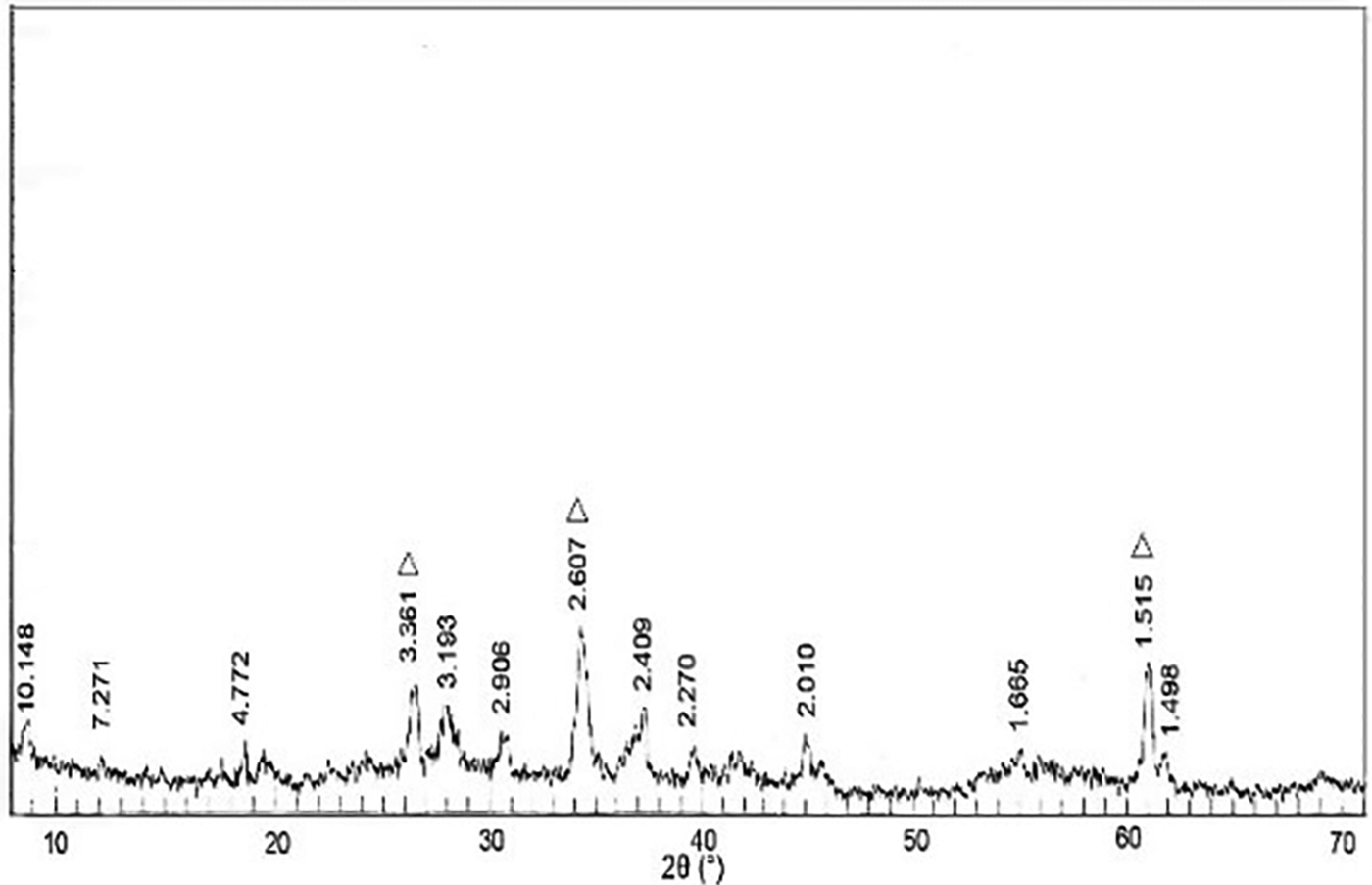
Machinable mica glass ceramics used in this study was prepared by crystallization from B2O3–Al2O3–MgO–K2O-based glass. The XRD patterns for sintered sample were shown in Fig. 1. The existence of amorphous glass phase in machinable mica glass ceramics may decrease the intensity of diffraction peaks. Obviously, the main crystal phase of the sample was fluorophlogopite with chemical formula KMg3AlSi3O10F2. The three strong XRD peaks of fluorophlogopite were marked by Δ.
XRD patterns for sintered sample. The three strong peaks of fluorophlogopite were marked by Δ.

The fluorophlogopite phase has a low surface energy face along the (001) cleavage plane, for the [SiO4] and [AlO4] tetrahedra in the interlayer are connected by K+ ion. When a crack is produced by external force, it may take a lower-energy path along (001) cleavage plane or at the interface of mica and glass phase.[ Reference Grossman 2 , Reference Grossman 7 ] Due to the random orientation and interlocking nature of the mica platelets, crack propagation follows a tortuous path along the cleavage plane. The interlocking nature of the randomly orientated mica platelets can lead to the multiple crack propagation. This process may suppress the free propagation of cracks, resulting in the machinability of mica glass ceramics.
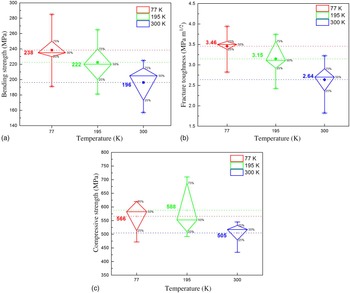
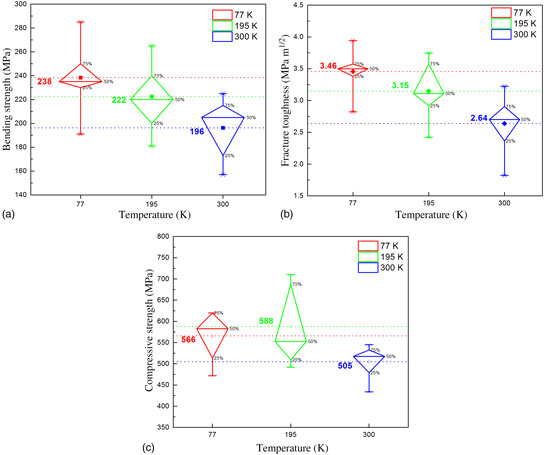
The mechanical properties of machinable mica glass ceramics at different temperatures (77, 195, and 300 K) are shown in Fig. 2. The data were plotted in a Box Chart, which can clearly and directly display the distribution characteristics of all the test results. The bending strength [Fig. 2(a)] increased from 196 ± 23 to 238 ± 27 MPa when temperature decreased from 300 to 77 K, increased by 28%. It can be seen that the mean bending strength was very close to the median in the Box Chart, indicating that the discreteness of bending strength was small at 300 and 195 K. As shown in Fig. 2(b), the fracture toughness also increased obviously at cryogenic temperatures. The fracture toughness was 2.64 ± 0.39 MPa m1/2 at 300 K, but it increased to 3.46 ± 0.29 MPa m1/2 at 77 K, the increment was 24%. At all test temperatures, the difference between mean fracture toughness and the median in the Box Chart was imperceptible. Therefore, the deviation of fracture toughness was little, and the data distributions of ten samples were concentrated. The test of compressive strength [Fig. 2(c)] has shown that a larger value was obtained at 195 K. When temperature decreased to 77 K, the compressive strength was slightly reduced, but still higher than that of 300 K.
Mechanical properties of machinable mica glass ceramics at 300, 195, and 77 K. (a) Bending strength; (b) fracture toughness; (c) compressive strength.

The temperature dependence of mechanical properties in machinable mica glass ceramics could be explained by the following influence factors: the strength of mica phase, the behavior of glass phase, residual stresses caused by the different thermal expansion coefficients between mica and glass phase, and the crack deflection.
The fracture stress of crystal phase can be calculated qualitatively by Griffith equation:[ Reference Clarke and Faber 8 ]
 $$\sigma _{\rm c} = \displaystyle{1 \over Y}\left( {\displaystyle{{2E\gamma _{\rm S}} \over {c_0}}} \right)^{1/2},$$
where Y is the crack shape parameter, E is the Young's modulus associated with the bonding force between atoms, γ s is the fracture surface energy, and c 0 is the original crack size. For a certain material, Y and c 0 remain constant. At cryogenic temperatures, the Young's modulus E and fracture surface energy γ s increase because of the stronger of bonding force between atoms.[ Reference Zhang, Jin, Li, Tu, Zhao, Zhang and Zhao 9 ] Meanwhile, the atomic distance of mica crystals is reduced, and the lattice vibration slows down when temperature decreases. The distance between K+ ion and oxygen ion in the [SiO4] and [AlO4] tetrahedra is smaller, resulting that the interlayer bonding force and bonding strength of the cleavage plane increase at cryogenic temperatures. Therefore, crack propagation through the cleavage plane becomes difficult, resulting in the improvement of mechanical properties.
Murgatroyd[ Reference Murgatroyd 10 ] hypothesized that glass consisted of an elastic matrix, which contained small pockets of “quasi-viscous” material. Marsh[ Reference Marsh 11 ] reported that glass was an elastic–plastic solid, the strength of glass exhibited a “static fatigue” effect at room temperature, so the glass flow stress was a function of time of loading. Nevertheless, the flow stress became fatigue-free at 77 K. Yi et al.[ Reference Yi, Xue, Xie, Liu, Cheng, Chen, Cheng and Gao 12 ] simulated the drawing process of quartz glass at 293 and 77 K by molecular dynamics. Instead of fractured at the maximum stress like the conventional brittle materials, the quartz glass yielded like ductile materials as metals. The results showed that quartz glass could be treated as elastic–plastic solid. It was suggested that the “partial plastic” in glass phase might be reduced at cryogenic temperatures, resulting in a deterioration of the fracture toughness of glass phase. For this reason, the crack tip would prefer to propagate in the glass phase at grain boundary due to its reduced fracture resistance.[ Reference Xue, Yi, Xie, Liu and Chen 13 ]
In the present work, a widely used equation was introduced to analysis the residual stresses of mica crystals (σ m) and glass matrix (σ g):[ Reference Peterson and Tien 14 ]
 $$\eqalign{\sigma _{\rm m} = (\alpha _{\rm m} - \alpha _{\rm g} )\bigg[ {\displaystyle{{1 - 2\upsilon _{\rm m}} \over {E_{\rm m}}} + \displaystyle{{1 + f_{\rm m} + \upsilon _{\rm g} (1 - 4f_{\rm m} )} \over {2E_{\rm g} (1 - f_{\rm m} )}}} \bigg]^{{\rm -} 1} \Delta T,}$$
 $$\sigma _{\rm g} = - \displaystyle{{f_{\rm m}} \over {1 - f_{\rm m}}} \sigma _{\rm m},$$
where “m” and “g” represent mica crystals and glass matrix, respectively, α is the thermal expansion coefficient, ν is the Poisson's ratio, E is the Young's modulus, f is the volume fraction, ΔT is the difference in temperature over which the stresses are locked in.
The difference of thermal expansion coefficients and Young's modulus between mica crystals and glass matrix may result in residual stresses when temperature decreased from sintering temperature to room temperature, which dominate the crack path selection behavior and thus the fracture toughness.[ Reference van Weeren and Danforth 15 ] ΔT will become larger when temperature decreases to cryogenic temperature, leading to the improvement of mechanical properties at cryogenic temperatures. In addition, crack deflection occurs when a mismatch in Young's modulus exists between the mica phases and the glass matrix.[ Reference Faber and Evans 16 ]
Thermal property of a certain material is one of the most important properties when determining whether it can be used in cryogenic field. When subjected to large temperature changes, a larger thermal expansion may lead to the deterioration of thermal stability, and directly affect the service and lifetime of the material. Thus, the thermal property of machinable mica glass ceramics from 290 to 77 K was investigated in the present work, shown in Fig. 3. With temperature decreasing, the thermal expansion curve of machinable mica glass ceramics is nearly linear.
Thermal expansion of machinable mica glass ceramics.

The thermal expansion coefficient of mica is 90 × 10−7 K−1 reported by El-Meliegy,[ Reference El-Meliegy 17 ] while it is about 37.6 × 10⁻⁷ K−1 for glass (Corning Code 1737, a commercial boroaluminosilicate glass with flat panel display).[ Reference Lapp 18 ] In the current work, it was found that the machinable mica glass ceramics exhibited an average coefficient of thermal expansion, which was 44 × 10−7 K−1 (77–290 K). During heating or cooling, huge thermal stresses could be generated in composite materials between the neighboring phases with a large difference in thermal expansion coefficients. When testing at cryogenic temperatures, the boundary of mica phase and glass matrix may suffer a tensile stress because of the different shrinkage degree of the two phases. When a crack propagates into the grain boundary, it prefers to extend along the grain boundary. The lengthen of crack path and the extraction of mica phase may expend more energy, leading to the increment of mechanical properties at cryogenic temperatures.[ Reference Xue, Yi, Xie, Liu and Chen 13 , Reference Baik and Moon 19 ]
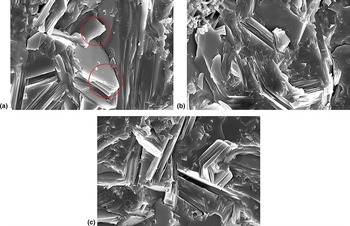
To further understanding the change of crack propagation path and fracture mode of machinable mica glass ceramics at cryogenic temperatures, the SEM micrographs of fractured surfaces after fracture toughness test are presented in Fig. 4. It can be seen that all the specimens exhibited a typical “house of cards” microstructure with randomly interlocked mica platelets. The interlocking nature of the randomly orientated mica crystals is an important characteristic in understanding the machinability of mica glass ceramics. The interlocking and plate-like microstructure of fluorophlogopite phase could play a significant role in deflection and branching of cracks.[ Reference Rad and Alizadeh 20 ] When fractured, the cracks are produced then take the lower-energy path along (001) cleavage planes or at the interfaces of mica glass ceramics.[ Reference Grossman 2 , Reference Grossman 7 , Reference Tanaka, Taira, Wakasa, Shintani and Yamaki 21 ] The extraction of mica platelets (noted by red circles in Fig. 4) may consume the energy of crack tip propagation, leading to high fracture energy dissipation. Since the mica crystals are in mutual contact, cracks propagating across the crystals are hindered by the aligned crystals, as a result of crack deflection toughening mechanism. Therefore, more energy is required to continue propagating, resulting a higher fracture toughness. This result can contribute to the improvement of the cryogenic mechanical properties of machinable mica glass ceramics. This phenomenon was only observed in the samples tested at 77 K. However, the fracture occurred along the thickness direction of mica crystals when samples were tested at 300 and 195 K.
SEM images of machinable mica glass ceramics after fracture toughness test. (a) 77 K; (b) 195 K; (c) 300 K.

Conclusions
In this paper, in order to provide a theoretical basis of potential applications for machinable mica glass ceramics at cryogenic field, the temperature dependence of mechanical and thermal properties was investigated. The main conclusions are as follows:
-
(1) XRD data have shown that the main crystal phase of the sintered sample is fluorophlogopite.
-
(2) It is found that machinable mica glass ceramics have shown increased mechanical properties when temperature decreases. Compared with room temperature, the bending strength and fracture toughness are increased by 28% and 24% at 77 K, respectively. The compressive strength also increases at cryogenic temperatures, but a higher value is obtained at 195 K. Therefore, machinable mica glass ceramics could be one of the candidates for cryogenic temperature applications.
-
(3) From 77 to 290 K, the thermal expansion coefficient of machinable mica glass ceramics is 44 × 10−7 K−1. Residual stresses and crack deflection may generate at the interfaces between fluorophlogopite and glass phase when temperature decreases. As a result, the main crack propagation becomes difficult, leading to better mechanical properties at cryogenic temperatures.
-
(4) SEM pictures of fracture surfaces have shown that the extraction of mica platelets occurred at 77 K. The crack deflection toughening mechanism was occurred, and dissipated the propagation energy of main crack tips. Therefore, the mechanical properties were increased at cryogenic temperatures.
Acknowledgment
This work was financially supported by the National Natural Science Foundation of China (Grant no. 51232004).