Why are some democracies better governed than others? Why are many plagued by corruption and ineptitude, whereas others manage to implement policies effectively and efficiently? Why are some borne down by inefficient markets and low standards of living, whereas others enjoy low transaction costs, high capital investment, and strong economic performance? Why are rates of morbidity, mortality, illiteracy, and other aspects of human deprivation so depressingly high in some democracies, and so impressively low in others? What can account, in short, for the immense variation we observe in the quality of governance across democratic polities in the world today?
In this paper, we focus on the role of democratic political institutions in the achievement of good governance. The survival of democracy is understood as a peripheral—albeit important—question (Linz 1994; Stepan and Skach 1993). Presumably, the quality of governance influences the propensity of a democracy to survive; however, we do not theorize this question. We understand a country to be democratic when multiparty competition, under reasonably fair conditions, is in place. We are specifically concerned with the role of political institutions in achieving good governance. Other factors—geographic, economic, historical, sociological, or cultural—lie in the background.
Two opposing perspectives on this question have predominated since the advent of representative government in the eighteenth century. We label these primordial theories centralism and decentralism. The centralist theory, closely associated with the Westminster system and the theory of Responsible Party Government, presumes that good governance flows from institutions that centralize power in a single locus of sovereignty. The decentralist theory, associated with the American polity and with a variety of theoretical frameworks, supposes that good governance arises from the diffusion of power among multiple independent bodies. Simply formulated, the governance debate over the past two centuries has been an argument between Hobbes and Montesquieu.
More recently, the Hobbesian model seems to have lost much of its vigor and appeal. Scholars today rarely appeal to the virtues of Westminster. Accordingly, there are few democratic centralists at the present time, either in the academy or in the world of policymaking and politics. Both the Left and the Right now apparently agree on the virtues of decentralized democratic institutions.
Our intention in this paper is to present a revived, and significantly modified, version of democratic centralism. We argue that democratic institutions work best when they are able to reconcile two goals: centralized authority and broad inclusion. Good governance should arise when political institutions preserve the authority of the sovereign while gathering together and effectively representing whatever ideas, interests, and identities are extant in a society. These twin goals are captured in the concept of centripetalism, which we employ as a label for this new theory of governance.1
The term centripetalism has been employed in the context of statebuilding (Bryce 1905) and party competition (Cox 1990; Sartori 1976), but not in the context of overall governance.
Empirically, we expect the theory of centripetalism to operate at multiple levels—local, regional, national, and international. In this paper, our vision is restricted to the national level and to three constitutional institutions that, we feel, best embody the centripretal ideal: unitarism, parliamentarism, and a closed-list PR electoral system. These are the building blocks of the centripetal polity (when that polity is democratic) and the centerpiece of our empirical investigation. To measure good governance outcomes, we employ a battery of indicators focused on various facets of political, economic, and human development. We regress these indicators against our principal theoretical variable—a composite measure of unitarism, parliamentarism, and list-PR—in a global sample of democratic polities. Such tests provide support for the hypothesis that political institutions fostering centralized authority and broad inclusion lead to better governance.
Although the precise causal mechanisms at work in the relationship between centripetal institutions and good governance are difficult to specify and to measure—and therefore virtually impossible to test— we speculate that centripetal institutions encourage strong political parties, corporatist-style interest representation, collegial decisionmaking, and authoritative public administration. Each of these intermediate factors should foster better governance in democratic polities. We therefore regard each one as an important causal pathway in our macrotheoretical argument.
DECENTRALISM
The decentralist model of governance that predominates among contemporary scholars and policymakers emerged from a centuries-long struggle for political accountability in the West. This history begins with the classical polities of Greece and Rome and continues through the British, Italian, Swiss, and Dutch polities of the early modern era (Gordon 1999; Vile 1967/1998). Thus, by the time of the American Revolution, the essential features of this model of democratic governance were already in place. Hereafter, the American polity came to be viewed as the paragon of decentralism, and the Federalist Papers as its interpretive catechism.
Among twentieth-century writers, decentralism takes a number of different forms, each with its own terminology, theoretical framework, and policy concerns. This far-ranging camp includes early group theorists (Bentley 1908/1967), British pluralists (Hirst 1989), American pluralists (Dahl 1956; Herring 1940; Truman 1951), Guillermo O'Donnell's (1999) conception of horizontal accountability, Arend Lijphart's (1999) consensus model of governance, and various writers in the public choice tradition, especially as oriented around the intertwined ideas of separate powers, fiscal federalism, veto points, and insulation (Buchanan and Tullock 1962; Henisz 2000; North and Weingast 1989; Oates 1972; Persson, Roland, and Tabellini 1997; Tiebout 1956). Decentralism is a broad church with many followers.
A central division among decentralists concerns attitudes toward popular rule. The dominant strand, beginning with Blackstone, Montesquieu, and Madison, sees in decentralization a mechanism to prevent direct popular rule, or at least to moderate its effects. A majoritarian system, it is feared, is prey to manipulation by unscrupulous leaders and envious masses bent on the redistribution of wealth (e.g., Riker 1982). An opposing strand, associated with Paine, Rousseau, and others of a radical or populist persuasion, perceives the decentralization of power as a mechanism to bring government closer to the people. Their assumption is that centralized power is generally controlled by leaders whose interests run contrary to the electorate; the only hope for popular control of government is therefore to decentralize the locus of decisionmaking. Thus, the wellsprings of decentralism lie in suspicions of elites and/or of the masses.
Despite their evident differences, all twentieth-century decentralists agree with several core precepts: diffusion of power, broad political participation, and limits on governmental action. Separate powers and federalism are the two key theoretical components; one implies divisions on a horizontal dimension; the other, on a vertical dimension. Institutional fragmentation at both levels is intended to set barriers against the abuse of power by minorities, against the overweening ambitions of individual leaders, against democratic tyrannies instituted by the majority, and against hasty and ill-considered public policies. Decentralist government is limited government. Each independent institution is intended to act as a check against the others, establishing a high level of interbranch accountability. Bad laws have little chance of enactment in a system biased heavily against change, where multiple groups possess an effective veto power over public policy. The existence of multiple veto points forces a consensual style of decisionmaking in which all organized groups are compelled to reach agreement on matters affecting the polity. Limitations on central state authority preserve the strength and autonomy of the market and of civil society, which are viewed as separate and independent spheres (as emphasized by those in the Madisonian camp). Decentralized authority structures may also lead to greater popular control of, and direct participation in, political decisionmaking (as emphasized by the Rousseauian camp). Efficiency is enhanced by political bodies that lie close to the constituents they serve, by a flexible apparatus that adjusts to local and regional differences, and through competition that is set into motion among semiautonomous governmental units.
How do these theoretical desiderata translate into specific political institutions? The principle of separate powers suggests two elective lawmaking authorities as well as a strong and independent judiciary. The principle of federalism presumes a shared sovereignty composed of national and subnational units. Both also suggest a bicameral legislature—to further divide power at the apex and to ensure regional representation. In addition, the decentralist model implies a written constitution, perhaps with enumerated individual rights and explicit restrictions on the authority of the central state, and strong local government. Most decentralists embrace the single-member district as a principle of electoral law that maximizes local-level accountability. There is disagreement over whether this should be supplemented by mechanisms to enhance intraparty democracy, for example, open primaries or preferential-vote options. If we take the principle of decentralism literally, we are led toward several additional institutional features: numerous elective offices, frequent elections (short terms), staggered terms of office, nonconcurrent elections, fixed-term elections (no possibility of premature dissolution), term limits, popular referenda, recall elections, decentralized party structures, agencies enjoying a high degree of independence, and small political units (micro-rather than macro states).
Although one might quibble over details, there is consensus on the basic institutional embodiments of a decentralist political order, where power is diffused among multiple independent actors and energy flows in a centrifugal direction toward the peripheries. This is the reigning paradigm of good governance in academic and policymaking circles at the turn of the twenty-first century.
CENTRIPETALISM
In contrast to the theory of decentralism, we propose that good government results when political energies are focused toward the center. Centripetal, rather than centrifugal, institutions create the conditions for good governance. This idea also has deep historical roots in the Anglo-European tradition. Progenitors include Bodin and Hobbes, who developed the modern concept of sovereignty. In the democratic era, the theory of centripetalism may be understood as a melding of two distinct theories of governance, the Responsible Party Government (RPG) model and the less clearly defined model of governance elaborated by early proportional representation (PR) reformers.
The RPG model, beginning with Walter Bagehot and Woodrow Wilson and extending to later work by E. E. Schattschneider and many others, is a model of democratic centralism (Ranney 1962). This vision of politics also informs work by defenders of the welfare state and of strong government in the contemporary era, who see multiple veto points as the source of special-interest pressures (e.g., Lowi 1969; McConnell 1966). For this diverse group, comprised mostly of social democrats, that system is best which focuses all power on a single locus of sovereignty: the prime minister and his cabinet. Party control of the legislature allows for a temporary dictatorship; mechanisms of electoral accountability ensure that this period of one-party rule will be in the public interest. The electoral roots of the system lie in a first-past-the-post electoral rule, which established itself early on in England and the United States as the dominant mode of electoral representation. The generally acknowledged exemplar is the British Westminster system, as discussed.
Early critics of this system objected to the localist tendencies of the British electoral system, centered as it was on small (one- to two-member) constituencies. A proper political system, they thought, should act in the general interest, not in the interests of particular constituencies. PR reformers such as Leonard Courtney, Thomas Hare, Sir John Lubbock, and John Stuart Mill in England, Victor d'Hondt in Belgium, Carl Andrae in Denmark, Eduard Hagenbach-Bischoff in Switzerland, and Victor Considerant and A. Sainte-Lague in France were also bothered by the vulnerability of such a political system to the vagaries of popular opinion (Carstairs 1980; Noiret 1990). Because elections in a Westminster system rested on the votes of a few electors in swing districts party leaders had to test the current of public opinion carefully before taking the initiative. This led, it was charged, to a populist style of leadership, one oriented more toward pleasing the electorate than advancing its long-run interests (Hart 1992; Mill 1865/1958). Third, and most important, PR reformers objected to a system of election that effectively represented only two groups in parliament, and only one group in government. “In a really equal democracy,” wrote J. S. Mill (1865/1958: 103–4), “every…section would be represented, not disproportionately, but proportionately…Man for man [the minority] would be as fully represented as the majority. Unless they are, there is not equal government, but a government of inequality and privilege: one part of the people rule over the rest.”
The theory of centripetalism combines elements of the RPG model and criticisms leveled by PR reformers. The key to good governance, we propose, is not monopolization of power at the center but rather a flow of power from diverse sources toward the center, where power is exercised collectively. Two desiderata must be reconciled in order for this process of gathering-together to result in successful policies and policy outcomes. Institutions must be inclusive—they must reach out to all interests, ideas, and identities (at least insofar as they are relevant to the issue at hand). And they must be authoritative—they must provide an effective mechanism for reaching agreement and implementing that agreement. The concept of centripetalism thus implies both (a) broad-based inclusion and (b) centralized authority.
This is a problematic claim on the face of it. These two principles seem so radically opposed to each other that it is difficult to envision how a single institution, or set of institutions, could satisfy one criterion without sacrificing the other. They evoke dichotomies—masses versus elites, the people versus the state, small government versus big government, democracy versus autocracy, and, of course, Rousseau versus Hobbes. Granted, if governance is conceptualized in the usual way, as an arena in which interests are fixed and politics a zero-sum competition, then the notion of reconciling inclusion and authority is polyannish. It seems fanciful to suggest that an institution could empower leaders without disempowering citizens.
We suppose, however, that interests are often constructed (endogenous), rather than primordial (exogenous). To be sure, the causal pathway between interests and institutions runs in both directions. But in the case of long-standing constitutional institutions such as those addressed here, the contemporary causal pathways are more likely to run from institutions to interests than vice-versa (Steinmo, Thelen, and Longstreth, 1992). Constitutional institutions condition the creation and reproduction of interests and identities. In particular, we expect that decentralist institutions establish a frame of reference in which identities and interests are conceptualized within a state/society dichotomy. Citizens are primed to see the state as a threat and civil society as an arena of liberty. Power is thus conceptualized in zero-sum terms: a stronger state means a weaker citizenry, a debilitated local community, or a “coopted” interest group. Centripetal institutions, by contrast, foster a positive-sum view of political power. Government is viewed as creating power, enhancing the ability of a political community through its chosen representatives to deliberate, reach decisions, and implement those decisions. Indeed, the authority of the centripetal state derives from its ability to bring together diverse groups and diverse perspectives under conditions of voluntary choice to a common meeting-ground, thus institutionalizing political conflict. Its power is persuasive, not coercive. Rather than a compromise position between inclusion and authority, we suggest that centripetal institutions actually reconcile these two principles, drawing the diverse strands of society together toward a single locus of sovereignty. The people rule, but they do so indirectly, through chosen representatives, and in a fashion that enhances rather than detracts from the authority of the state.
Centripetal institutions gather broadly; their roots are deep, that is, embedded. Through these institutions, diverse interests, ideas, and identities (“interests” for short) are aggregated. Particularistic interests are converted into ideologies; ideologies are converted into general-interest appeals; parochial perspectives are nationalized. Centripetal institutions thus encourage a search for common ground and culminate in an authoritative decision-making process, one not easily waylaid by minority objections. Institutions pull toward the center, offering incentives to participate and disincentives to defect. Voice, not vetoes is the motto of the centripetal theory of governance.
Visually, we may imagine the centripetal polity in a pyramidal shape—broad at the bottom and narrow at the top, with myriad connecting routes leading up, down, and across. Centripetal institutions thus establish an interlocked set of representative bodies stretching from the electorate at the base to the cabinet and prime minister at the apex. The electorate is represented in a legislature, which is in turn divided into committees, subcommittees, party caucuses, a cabinet, and perhaps various cabinet committees and commissions. At each stage of this process, a delegation of power—a representational act—occurs. Tying each of these horizontal levels together is the vertical structure of the political party, the paradigmatic linkage mechanism.
This pyramidal structure fulfills the mandate of centripetalism—it gathers widely at the base, channeling interests, ideas, and identities upward to a single, authoritative policymaking venue. At each level, some narrowing of perspectives necessarily occurs. However, the pyramid encompasses a diversity of political parties as well as a variety of informal channels of communication. Through these channels—for example, special commissions, corporatist-style consultations, constituent-MP communications, hearings, ombudspersons, and so forth—nonpartisan messages can be heard (i.e., interests, ideas, and identities that do not fit neatly into the parties' missions). The centripetal polity thus “pulls” vertically and horizontally.
What, then, are the specific institutional features of the centripetal polity? The twin desiderata of inclusion and authority point to four constitutional-level features: unitary (rather than federal) sovereignty, unicameralism or weak bicameralism (i.e., a bicameral system with asymmetrical powers or congruent representation between the two houses), parliamentarism (rather than presidentialism), and a party-list proportional electoral system (rather than single-member districts or preferential vote systems). In addition, the centripetal polity should be characterized by a strong cabinet, medium-strength legislative committees, strong party cohesion, the power to dissolve parliament (no fixed terms), no limits on tenure in office, few elective offices, congruent election cycles, closed procedures of candidate selection (limited to party members), voting decisions largely dependent on the party identification of the candidate, party-centered political campaigns, multiparty (rather than two-party) competition, centralized and well-bounded party organizations, centralized and party-aligned interest groups, popular referenda only at the instigation of the legislature (or not at all), a restrained (nonactivist) judiciary, and a neutral and relatively centralized bureaucracy. Each of these institutional features serves to maximize, and if possible to reconcile, the twin goals of inclusion and authority, thus focusing power toward the center and gathering together diverse elements into a single policy stream.
Institutional contrasts with the decentralist model are summarized in Table 1. Note that the two models are different along all 21 dimensions. Sometimes the contrast is a matter of degrees and sometimes it is categorical. In any case, it is clear that we are faced with two opposing views of how to achieve good governance within a democratic framework.
Although one hesitates to rest any general theory on the status of individual countries, it may be heuristically useful to observe that although the United States is the generally acknowledged avatar of decentralism, and the United Kingdom the avatar of centralism, Scandinavia offers perhaps the best exemplars of centripetalism among the world's long-standing democracies. Sweden, Norway, and Denmark are all centripetal polities, as are a number of new or recently reformed democracies in Europe. Thus, the identification of centripetalism with the pattern of politics normal to continental Europe is an appropriate theoretical and empirical point of departure. However, there is no reason to limit the purview of this study to the OECD. Indeed, the rest of the democratic world, which now vastly outnumbers the OECD democracies, offers essential fodder for any empirical investigation that purports to be general in application.
EMPIRICAL TESTS
It is not possible, nor would it be fruitful, to explore all 21 dimensions of centripetalism listed in Table 1. Of primary interest are those components of the centripetal theory that are measurable, exogenous (relative to other political institutions), and of presumed centrality to politics and policymaking. We refer to these factors as constitutional. They include the first four dimensions listed at the top of Table 1, demarcated by a dotted line: territorial sovereignty, the legislative branch, the executive, and the electoral system. Because the first two factors are closely related, both theoretically and empirically, we reduce this set to three: unitarism, parliamentarism, and list-PR.
We conceptualize unitarism along two dimensions: (a) the degree of separation (independence) between national and territorial units, and, if any separation at all, (b) the relative power of the two players (the more power the center possesses, the more unitary the system). Of the many institutional factors that determine variation along these dimensions, two predominate: federalism and bicameralism. A fully unitary polity should be both nonfederal and nonbicameral. Because these are matters of degree, however, we adopt a three-part coding scheme for each dimension. Nonfederalism is coded as 0 = federal (elective regional legislatures plus constitutional recognition of subnational authority), 1 = semifederal (where there are elective legislatures at the regional level but in which constitutional sovereignty is reserved to the national government), or 2 = nonfederal. Nonbicameralism is coded as 0 = strong bicameral (upper house has some effective veto power; the two houses are incongruent), 1 = weak bicameral (upper house has some effective veto power, though not necessarily a formal veto; the two houses are congruent), or 2 = unicameral (no upper house or weak upper house). The unitarism variable is constructed by averaging the scores of these two components together.2
The combination of these two dimensions is justified by the fact that they are linked empirically (constitutional federalism is a necessary condition for strong bicameralism) and conceptually (the purpose of a strong second chamber is usually to protect the powers and prerogatives of subnational units). In a fully unitary state, territorial units (if any) have no constitutional standing, no independently elected territorial legislature, no specific policy purviews reserved to them, and minimal revenue-raising authority.
Parliamentarism is understood as a system of government in which the executive is chosen by, and responsible to, an elective body (the legislature), thus creating a single locus of sovereignty at the national level. Presidentialism, its contrary, is a system where policymaking power is divided between two separately elected bodies, the legislature and the president. The president's selection is usually by direct popular election, though it may be filtered through an electoral college (as in the United States), and the rules pertaining to victory (i.e., by relative or absolute majority) vary from country to country. His or her tenure cannot be foreshortened by parliament except in cases of gross malfeasance. She or he is actively engaged in the making of public policy, and in this sense plays a political (i.e., partisan) role. In practice, between these two polar types we find many admixtures, known generically as semipresidential systems. Thus, we conceptualize the parliamentary/presidential distinction as a continuum with two dimensions: (a) the degree of separation (independence) between president and parliament (unity=parliamentary, separation = presidential), and, if there is any separation at all, (b) the relative power of the two players (the more power the president possesses, the more presidential is the resulting system). We capture this complex reality with a three-part coding scheme: 0 = presidential, 1 = semipresidential, 2 = parliamentary.
The centripetal theory of democratic governance suggests that electoral systems, like other constitutional elements of a polity, should maximize the twin desiderata of authority and inclusion. These twin goals are best achieved when an electoral system encourages strong national parties while also maintaining low barriers to entry for new parties, strong competition among existing parties, and demographically diverse party delegations. This, in turn, mandates an electoral system that privileges interparty choice and intraparty representation over intraparty electoral choice. Voters vote, and parties nominate. Further, the vote choice itself should be based on national, partisan principles rather than on preferences for individual candidates or district-level concerns. Insofar as “personality” matters, it should be the personality of the party leader, not the district-level candidate, that influences voter choices. Empirically, three features of an electoral system bear critically on these issues: (a) district magnitude (M), (b) seat allocation rules (majoritarian or proportional), and (c) candidate selection rules. The centripetal ideal type is defined by M > 1, proportional seat allocation rules, and party-controlled candidate selection. This is the familiar closed-list-PR electoral system—“list-PR” for short. Other systems are ranked lower in this coding according to their deviation from this ideal type. Thus, the coding for the list-PR variable is as follows: 0 = majoritarian or preferential-vote, 1 = mixed-member majority (MMM) or block vote, and 2 = closed-list PR.
Granted, it takes time for institutions to exert an appreciable effect on governance outcomes. A country switching from a presidential system to a parliamentary system (or establishing a parliamentary system in a newly democratic or independent setting) should not expect to see immediate, dramatic changes in the quality of governance. Instead, these effects are likely to cumulate over time as new institutional rules begin to condition actions and expectations. History matters, though recent history should matter more. To this end, we create a moving, weighted sum of each country's annual unitarism, parliamentarism, and list-PR scores, beginning in 1901 and ending in the observation year. The weights are constructed so as to capture long-term historical patterns while giving greater weight to more recent years. A country's weighted-sum unitarism (or parliamentarism or list-PR) score in 1980 is the weighted sum of its scores from 1901 to 1980. Its score in 1981 is the weighted sum of its scores from 1901 to 1981, and so on.3
The weights used change progressively by the observation year used in the analysis. For the observation year 1980, for example, a country's raw score in 1901 is weighted by 1/80, its score in 1902 by 2/80, its score in 1903 by 3/80, until finally reaching a weight of 1 (80/80) in 1980. Each of these weighted, annual scores is summed for a single country into a cumulative score for a given observation year. (For the observation year 1981, the weighting denominator would be 81, and so on.) The formula for the weighting schemes is as follows: Let S be the raw score, and W the weighted score, then
For the observation years 1980 and 2000, for example, the weighting schemes would be:
If a country is nondemocratic (receiving a Polity2 score of less than 0) in a given year, or if a country is not formally sovereign during that year, it receives a score of 0 for that year.
Because our theoretical interest is in the combined effect of unitarism, parliamentarism, and list-PR, we create a final composite variable, Centripetalism, by adding together the historical, weighted-sum scores for these three variables (equally weighted). Henceforth, when referring to the variable, we capitalize this term (Centripetalism); when referring to the theory or concept of centripetalism, we do not.
Country-years figure in this coding process, and in the empirical analyses to follow, so long as a country surpasses a minimum threshold of democracy during a given year. Recall that centripetalism is a theory of democratic governance; it has no application within authoritarian settings. We employ a relatively low threshold of democracy because we wish to include as many plausible cases as possible in our analysis and because we expect the logic of centripetalism to be operative so long as there is a modicum of multiparty competition. A country-year counts in our empirical analysis and in the weighted summation process so long as it obtains a score greater than zero (on a scale ranging from −10 to 10) on the Polity2 democracy indicator.4
Marshall and Jaggers (2005). Because the Polity2 democracy score does not contain data for several countries (mostly micro-states), we impute missing values using the following alternative measures of democracy: the Freedom House Political Rights indicator (Piano and Puddington 2004), Bollen's (1993) Liberal Democracy variable, Vanhanen's (1990) Competition measure, and Banks's (1994) Legislative Effectiveness I and II and Party Legitimacy variables. A complete list of country cases that meet our minimal definition of democracy, along with their weighted, historical Centripetalism scores, and their annual (raw) scores on all four component variables (unitarism, parliamentarism, list-PR, and Centripetalism), can be found at http://www.bu.edu/sthacker/data.html. For a more detailed explanation of coding procedures, see Gerring and Thacker N.d.
Operationalizing Good Governance
A general model of good governance applies (by definition) to any outcome that may be deemed, on the whole, good or bad for a society, that is, for or against the public interest. There is plenty of room for debate on these matters. Even so, we suppose that consensus can be reached on the normative valence of many policies and policy outcomes. It is on this tentative consensus—itself contingent on evidence and further normative reflection—that any empirical study of good governance rests.5
One may contrast the approach taken here with alternative approaches to governance focused on several closely related concepts: “public goods,” “rent,” “pareto optimality,” and “efficiency.” We find these approaches to be highly ambiguous, hence, resistant to operationalization. Moreover, although these approaches purport to be value-neutral, they often smuggle in some conception about what is, and is not, in the public interest. In this respect, the biggest difference between such approaches and our own is the degree of normative transparency. Finally, we argue that on those occasions where these concepts do not conform to common notions about the public interest, they are, by definition, not useful as policymaking guides. Thus, either (a) the notion of a public good is equivalent to the notion of a policy that advances the public interest, in which case our approach is equivalent to the conventional approach; or (b) these two notions diverge, and the concept of a public good becomes ambiguous, not to mention tenuous (how can a policy provide public goods and not also advance the public interest?). In sum, we believe that an explicitly normative theory of governance is not only possible but also unavoidable if political science is to be of any use to policymakers (see Gerring and Thacker N.d.).
In this paper, we limit ourselves to a consideration of three broad policy areas: political development, economic development, and human development. Within these three areas we explore eight specific measures of good/bad governance: (1) bureaucratic quality, (2) tax revenue, (3) investment rating, (4) trade openness, (5) gross domestic product (GDP) per capita, (6) infant mortality, (7) life expectancy, and (8) illiteracy. We choose these indicators over others because they offer evidence of broad patterns of governance and because they allow for longitudinal analysis across several decades and latitudinal analysis across most of the democracies in the world. They are ideal, in other words, for time-series cross-section analysis. We do not suppose that they exhaust the field of governance indicators, merely that they offer a useful collection of indicators of valued outcomes across an array of policy areas.
Bureaucratic quality, a measure of political development, is an indicator ranging from 0 to 6 (with higher scores indicating higher quality) developed by the Political Risk Services (PRS) group as part of its International Country Risk Guide (ICRG). It gauges the institutional strength and quality of the civil service, measured along six dimensions: adequate pay, independence from political pressures, professionalism (adequate training, recruitment by merit rather than by patronage), capacity (ability to respond to assigned tasks), appropriate staffing (neither over- nor understaffed), and freedom from corruption (Howell 1998, 194).
Tax revenue is a “hard” (objectively quantifiable) measure of political development. A government's capacity to extract resources from businesses and individuals should reflect its overall capacity to formulate and implement public policies (Cheibub 1998; Lieberman 2002). (We control for natural resource wealth in subsequent tests, so tax revenue does not reflect the existence of “easy money” in the form of oil or diamond receipts.) The variable employed here, drawn from the World Bank's World Development Indicators (World Bank 2003), measures aggregate tax revenues, considered as a share of GDP. More specifically, it counts compulsory, unrequited, nonrepayable receipts for public purposes collected by the central government, including interest collected on tax arrears and penalties collected on nonpayment or late payments of taxes.
Investment rating measures the safety to potential investors of acquiring a stake in a country's economy. Many academics regard it as a proxy for the quality of economic policy in a country; the higher the rating, the lower the risk and the better a government's economic policies are thought to be. In recent years, risk assessment has become a substantial business, a sideline for most consulting firms with international clients. Consequently, there are a variety of investment rating indicators to choose from. Among these, Euromoney's country risk index enjoys perhaps the most comprehensive coverage. (Reassuringly, it correlates strongly with other indices.) Euromoney ratings are based on polls of economists and political analysts and supplemented by quantitative data such as debt ratios and access to capital markets. The overall country rating derives from nine separate categories, each with an assigned weighting (in parentheses): (1) political risk (25%); (2) economic performance (25%); (3) debt indicators (10%); (4) debt in default or rescheduled (10%); (5) credit ratings (10%); (6) access to bank finance (5%); (7) access to short-term finance (5%); (8) access to capital markets (5%); and (9) discount on forfeiting (5%) (Euromoney 2004).
Trade openness is measured by the sum of total imports and exports, expressed as a share of GDP (logarithm, data source: World Bank 2003). This indicator reflects, in part, the degree to which a country opens its borders to trade; it is thus a policy measure, not simply a policy outcome. Indeed, a host of poor and inefficient economic policies, including high tariff and nontariff barriers, poorly managed exchange rates, and corruption in the customs bureau are likely to depress the growth of imports and exports. Although there is debate over the relative impact of trade on overall economic growth performance (see Krueger 1995; Rodrik 1995), few economists would argue that trade depresses growth rates. In addition, we have found in our own work that trade may have positive effects on human development, even when controlling for economic performance (Gerring, Thacker, and Moreno N.d., c). Thus, there are strong grounds for regarding trade as an indicator of good governance.
GDP per capita is a measure of average income levels, or the real value of total production within an economy during the course of a year divided by the total population (logarithm, data source: World Bank 2003). We measure economic performance as a level, rather than as a change (i.e., growth) variable because our interest lies in the level of prosperity attained in a given country, rather than in its short-run rate of change. This is also in keeping with our approach to other governance outcomes; for example, we measure the level of trade from year to year, not the change in trade from year to year.
Infant mortality is measured by the infant mortality rate (IMR), the number of deaths per one thousand lives births that occur in the first year of life (logarithm, data source: World Bank 2003). IMR, a primary measure of human development, is affected by many government policies (particularly social policies) and is thus an important outcome-based measure of good governance.
Life expectancy measures the expected tenure of life in a country at birth, extrapolating from mortality statistics available at that time (Bos, Vu, and Stephens 1992; Riley 2001; logarithm, data source: World Bank 2003). Like IMR, life expectancy is an overall measure of human development strongly influenced by government policies; hence, it provides a good indicator of the quality of governance in a country.
Illiteracy is measured as the percentage of people age 15 and older who cannot, with understanding, both read and write a short, simple statement on their everyday life (logarithm, data source: World Bank 2003). Literacy has become a standard feature of human development indices in recent decades and largely reflects the success of government-sponsored education policies.6
Descriptive statistics for the Centripetalism variable, all dependent variables, and the control variables can be found at http://www.bu.edu/sthacker/data.html, along with a correlation matrix for all variables. Note that missing data for variables measuring infant mortality and life expectancy are interpolated so as to reduce sample bias. Because these variables are all heavily trended, we do not anticipate that interpolation introduces new systematic biases in the data. For illiteracy, missing data from the WDI dataset—primarily for the OECD countries—are imputed using Banks 1994. Some missing data are also extrapolated, with the assumption that once a level of 0.01% illiteracy is attained it remains constant through time. For GDP per capita, small amounts of missing data are imputed using Penn World Tables 6.1 (Heston, Summers, and Aten 2002).
Research Design
Because the theory of centripetalism is applicable only within a democratic framework, we limit all regression analyses to country-years that are minimally democratic, as discussed earlier. Resulting samples vary from a minimum of 77 countries to a maximum of 126, and from a minimum of 14 years to a maximum of 4 decades (1960–2000).
The literature on the various topics captured in our eight dependent variables suggests the inclusion of 15 core controls in the following analyses. We include a time trend variable to control for spurious correlation between any pair of similarly trended dependent and independent variables; this should be signed in whatever direction a given dependent variable is trended, on average, over time. To capture a country's regime history, we employ a variable that measures democracy stock historically. We construct this variable by taking the logarithm of the sum of a country's Polity2 scores (Marshall and Jaggers 2005) from 1900 to the observation year (for further discussion see Gerring, Bond, and Barndt N.d). We anticipate this variable to have a positive association with good governance. GDP per capita (logarithm, World Bank 2003) should also be associated with better governance outcomes. Dummy variables for Africa and Latin America/Caribbean are expected to reflect lower levels of governance in those regions compared to others, whereas expectations for Asia are mixed (e.g., better bureaucratic quality, but lower tax revenues). We anticipate that a significant period of socialist rule (LaPorta et al. 1999) has negative effects on bureaucratic quality, investment rating, trade openness, and GDP per capita, and positive effects on the remaining governance indicators. Having an English legal origin is often thought to promote good governance (LaPorta et al.). To the extent that countries farther from the equator have better governance, latitude (absolute value, scaled to 0-1, logarithm, LaPorta et al.) should correlate with better outcomes. Expectations for ethnic (and linguistic) fractionalization (Alesina et al. 2002) are more tentative; however, heterogeneity is generally expected to hamper the quality of governance in a country. To the extent that having a large population (total population, logarithm, World Bank 2003) makes certain governmental tasks more difficult, population might be expected to diminish governance quality. Distance (in thousands of kilometers) from the nearest financial center (Tokyo, New York, or London) is intended to capture the negative impact of geographic distance from the “cores” of the international economy. Oil (millions of barrels per day per capita) and diamond (rescaled to billions of metric carats per year per capita) production levels capture the “resource curse” (Humphreys 2005). Yet, these resources also provide sources of revenue and wealth. As such, expectations are mixed.7
Some indicators measure the export value of these last two items as a percentage of all exports or of GDP. We believe that this confuses two issues—the extent of natural resources in a country and the degree of its economic development or export orientation, which is implicit in the denominator. Because it is the first, not the second, that we wish to measure we employ a “raw” measure of natural resources.
We also include a control variable that measures the average value of the dependent variable across all countries, weighted by the inverse of the geographic distance (in kilometers) of each country from the country in question. (In the case of GDP per capita, we weight the average value of the dependent variable by each country's share of trade with the observed country, rather than by the inverse of the geographic distance between the countries.) Countries lying close to one another may display similar values for extraneous reasons (culture, geography, diffusion, and so forth). Thus, we anticipate a positive sign for this variable. The inclusion of this variable in all regressions should help minimize possible spatial autocorrelation in the sample.
We employ additional variables in selective regressions, as appropriate. We include Protestants in the analysis of bureaucratic quality and Muslims in the estimations for various human development outcomes (both are measured as a percent of the total population). Prior research suggests that a Protestant heritage may improve state capacity (Gerring and Thacker 2004), whereas having a large Muslim population may impede human development (Moon 1991). Linguistic fractionalization (Alesina et al. 2002) substitutes for ethnic fractionalization in our analysis of illiteracy, for obvious reasons.
Because there exists no standard benchmark model for any of these regressions we conduct two tests for each dependent variable. The first is a full model, including all variables discussed above. The second is a reduced-form model that sequentially deletes variables that do not pass a minimal threshold of statistical significance (p<0.10 in two-tailed tests), in the expected direction. We retain several controls (the geography-weighted dependent variable, the time trend, democracy stock, and GDP per capita) in all models, regardless of statistical significance, because of our strong prior expectation that these variables capture important and otherwise unobserved effects. Reassuringly, the key variable, Centripetalism, remains quite stable across both full and reduced-form specifications.
To minimize possible endogeneity between left- and right-side variables (and among certain right side variables), we measure two indicators in the first year of our sample (1960), rather than on an annual basis. This applies to GDP per capita and population. Where we are less concerned about endogeneity we allow indicators to vary from year to year, but lag them by 1 year (except in the case of the geography-weighted dependent variable, which is contemporaneous). We treat other controls, such as region, socialism, legal origin, fractionalization, distance from the nearest financial center, Protestantism and Muslim, as constant through time.
Time-series cross-section (TSCS) regression calls forth two broad specification issues (among others). Datasets that employ both cross-national and time-series data are subject to potentially stubborn problems, spatially and temporally. Regrettably, we cannot employ a unit-based fixed-effect research design to address spatial issues, such as unobserved heterogeneity, because our causal variable, Centripetalism, does not vary sufficiently from year to year (Beck 2001, 285; Beck and Katz 2001, 492–93). We do, however, employ a set of regional “fixed effects” and a geographically weighted version of the dependent variable (see earlier) to help remedy spatial problems. With respect to temporal issues, we employ a statistical correction for first-order autocorrelation and a time-trend variable to control for possibly spurious correlations between a heavily trended dependent variable and a similarly trended independent variable.
All regressions employ Newey–West standard errors, which assume a heteroskedastic error distribution and apply a TSCS equivalent of Huber/White/sandwich, or “robust,” standard errors, along with a correction for first-order autocorrelation (Newey and West 1987). Although Newey–West is a common approach in economics, it is less frequently used in political science. We employ it here because it achieves the aforementioned goals and is somewhat less computationally expensive than the alternatives. In any event, results are equivalent in other formats, for example, with a Prais–Winsten feasible generalized least squares (FGLS) approach with panel corrected standard errors and an AR1 correction for autocorrelation.
Results
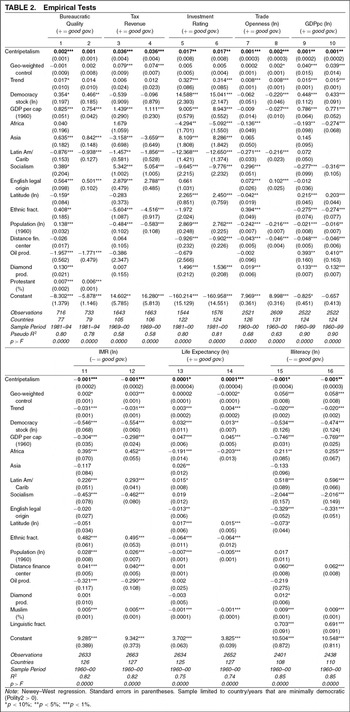
Table 2 shows estimation results for each of the eight governance indicators. The fit of the models is strong in each case, with F-values significant at better than 0.0001, and a pseudo-R2 that ranges from 0.58 to 0.90.8
R2 is an ordinary-least-sqaures concept and we are using a generalized least-squares estimator. In order to report a measure of fit, we calculate a pseudo-R2 equal to the square of the correlation between the dependent variable and its predicted values in each equation. Note that the use of the geography-weighted and time trend control variables likely inflates the pseudo-R2 values obtained here. We report them as a measure of fit for the interested reader, without placing much substantive emphasis on them.
Collectively, these models are highly significant and our predicted values fit the actual values well. Control variables generally behave as expected, though they are not always statistically significant. The geographically weighted dependent variable control is correctly signed and significant in most, but not all, specifications. Results for the time trend variable suggest that our measures of governance tend to improve over time on average, and most are statistically significant. Similarly, countries with a long democratic history (or stock) show better patterns of governance, with significant results in most cases. Findings for the GDP per capita baseline (1960) measure confirm that countries that start out wealthy tend to end up with higher quality governance. The results for the regional dummies are usually consistent with theoretical expectations. A period of socialist rule is generally associated with improved human development, poor economic performance, and high tax revenues. An English legal origin is associated with good governance across several indicators. Findings for fractionalization, baseline (1960) population size, and distance from the nearest financial center confirm expectations in most specifications, whereas those for latitude and oil and diamond production are less consistent. Protestantism is associated with more bureaucratic quality, whereas having a large Muslim population seems to hamper human development.
With respect to our theory, we find strong support for the centripetal model of governance. The coefficient for Centripetalism is correctly signed and significant at the 90% level of confidence or better in all estimations but one. Reassuringly, these results are robust to the inclusion of a wide variety of control variables, as evidenced by the similarities in coefficients and standard errors for Centripetalism across full and reduced-form models. Centripetalism is associated with more bureaucratic quality, higher tax revenues, better investment ratings, more trade openness, greater economic prosperity, fewer infant deaths, longer life expectancy, and lower rates of illiteracy, all else being equal.
A number of other possible variables might have been employed as controls in this wide-ranging series of regression tests. Indeed, we tested a much larger range of theoretically plausible control variables in the course of the analysis than could be included in the accompanying tables. These specification tests included income inequality (Gini coefficient), state history (the length of time a country has been independent), decade dummies (to further control for time effects), and additional measures of population heterogeneity and col- onial history (for a complete list see Gerring and Thacker N.d.). Our central results were robust in each of these tests, and none revealed any systematic patterns that warranted inclusion of additional controls in our benchmark equation. We have confidence in the specifications presented in Table 2, not because we imagine to have discovered the one “true” equation for each outcome, rather, because the inclusion (or exclusion) of a wide variety of plausible controls does not substantially alter the results with respect to our main hypothesis.
Of course, we realize that the “treatment” is not randomized. It is possible, for example, that centripetal institutions are more likely to be adopted where prospects for good governance are otherwise more propitious, in which case our key variable may be proxying for other, unmeasured factors. In order to gauge the robustness of our findings in the face of this identification problem, we employed a series of instruments for Centripetalism in two-stage least-squares estimations of the same set of governance outcomes as shown in Table 2.9
Chosen instruments for Centripetalism include democracy stock (logged), latitude, ethnic fractionalization, religious fractionalization (Alesina et al. 2002), Western Europe (dummy), state history, social conflict (a compilation of measures from Marshall 1999), instability (a compilation of measures from Banks 1994), and population size (1960, logged).
Results from these instrumental variables estimations are at least as strong as the findings presented in
Table 2—and in some cases stronger—thus providing some assurance that the effects reported here are not simply the product of nonequivalent treatment and control groups. Yet, we do not have a great deal of confidence in the two-stage models. All of the possible instruments available to us violate at least one of the assumptions of instrumental-variable analysis (Reiss
2003): they are either poorly correlated with Centripetalism, or they are correlated with the error term (i.e., they are probable causes in their own right of good/bad governance in the contemporary period). Thus, although the instrumental variable results provide support for the validity of our central findings, we do not regard this technique as an appropriate one for the present analysis (hence, we do not report the results here).
In any case, we think it unlikely that the choice of constitutional institutions reflects a country's future prospects for good (bad) governance. To be sure, whether a country becomes unitary or federal, parliamentary or presidential, list-PR or majoritarian depends partly on a country's colonial heritage, its size and heterogeneity, and on distinctive regional or historical patterns. However, these exogenous influences are relatively easy to model and appear as controls in all our regression tests. Other factors influencing constitutional choice are more or less stochastic and do not seem to accord with a country's proclivity to good or bad governance. In some instances, for example, federal institutions have been chosen because of their anticipated success in resolving conflict among heterogeneous groups (e.g., Canada, India, Switzerland, the United States). In other instances, unitarism has been viewed as the cure for precisely the same set of conflicts. This is the approach taken by all currently unitary states, whose populations were once—and in many cases remain—fractious and diverse (e.g., France, United Kingdom). In short, it all depends.10
This raises another possibility. Perhaps unitarism is a sign of successful state building, rather than a cause. Yet, this flies in the face of many countries' experiences. Federal constitutions have proven successful in establishing strong nation-states in Switzerland and the United States; unitary constitutions have proven less successful in Spain, Italy, and the United Kingdom, as witnessed by recent trends toward greater devolution and persistent regional dis-harmony.
It is not the case, therefore, that federalism is chosen only in instances of high conflict or great heterogeneity.
One must also consider the fact that constitution-makers generally have notoriously short time-horizons. They are usually interested in installing a system that will benefit them personally, their parties, or their constituencies. In this respect, the type of constitution a country arrives at is the product of a highly contingent political battle, with no bearing on a country's long-term governance potential. Finally, one must reckon with the dubious assumptions made by each contending group (or by voters, if the agreement is ratified by the populace). Presidential systems, for example, are commonly viewed as installing “strong” government; however, most political scientists believe that parliamentarism fosters energy and efficiency in the executive. Thus, even where calculations by constitution-makers extend to the long-term quality of governance in a polity, they are of dubious significance in achieving that result. Precisely because framers do not know which constitutional factors lead to good governance, whatever wisdom and far-sightedness they may possess is of little practical import. For all these reasons, we think it fair to regard a country's choices among constitutional institutions as a largely stochastic phenomenon with respect to the outcomes of interest in this study: long-term patterns of good or bad governance.
We must stress, finally, that the arguments presented in this short article are neither final nor incontrovertible. Many additional measures of good governance might be probed. Many additional specification tests might be conducted. A higher threshold of democracy (e.g., Polity2>4) might be employed, producing a somewhat smaller sample of “high-quality” democracies. Additional statistical formats, correcting for a variety of spatial and temporal problems, might be applied. The components of Centripetalism—unitarism, parliamentarism, and list-PR—might be individually assessed. Different weighting schemes might be employed to capture the historical effect of these political institutions. We pursue these and other issues elsewhere (Gerring and Thacker N.d.; Gerring, Thacker, and Moreno N.d., a and N.d., b).
Even so, the results in this paper indicate that centripetal institutions are associated with good governance across a wide range of indicators of political, economic, and human development. Moreover, it seems plausible to suppose that these results are indicative of a probabilistic causal relationship between centripetal constitutions and good governance.
In evaluating the practical impact of centripetal institutions, a few examples drawn from a hypothetical scenario may be useful. Employing the coefficients for Centripetalism from the full-form models in Table 2 (and keeping all control variables constant), we find that 50 years of fully centripetal institutions (1951–2000, in this example) are associated with an improvement (compared to the fully decentralist polity) of 0.54 points on the 7-point scale of bureaucratic quality, more than 8% of GDP in tax revenues, nearly 4 points higher investment rating (on a 100-point scale), a 32% increase in trade, 13% higher GDP per capita, 23% fewer infant deaths, 1.5% longer life expectancy, and 15% lower rates of illiteracy.11
The coefficients for the logged dependent variables (trade, GDP per capita, infant mortality, life expectancy, and illiteracy) reported in Table 2 measure the effect of a 1-unit change in the independent variable on those outcomes as a percentage change in the dependent variable. Thus, a 1-unit change in the independent variable results in a change in the dependent variable of 100*ß% (Wooldridge 2002).
Although these figures are only illustrative, they suggest that the relationship between Centripetalism and good governance has substantive importance. To be sure, the causal effect of Centripetalism on any single outcome may be relatively modest, and it is by no means inconsequential. Relative to the other independent variables explored in Table 2, Centripetalism has the most consistent and, judging by standardized coefficients (not reported), one of the stronger individual causal effects on the quality of governance.
The more important point is that Centripetalism affects a wide range of governance outcomes. Consequently, we must consider not simply the causal influence of this variable on a single outcome, but rather the cumulative effect of Centripetalism across all outcomes of substantive import, including, but not limited to, the eight outcomes explored in Table 2. We presume that constitutional institutions have moderate effects across an extraordinarily wide range of policies and policy outcomes. Unless one theorizes the full range of these causal effects, one misses the programmatic significance of constitutional factors on the quality of governance.
CAUSAL MECHANISMS
Although governance is a well-established topic of investigation, there are few integrative approaches to this time-honored subject, and even fewer that subject their hypotheses to systematic, global empirical testing.12
Lijphart (1999) conducts a series of tests of his “consensus” theory of democratic governance. However, these tests are limited to 36 countries, a cross-sectional empirical format, and few control variables. A final difficulty is that Lijphart's tests include only one component (“executive-parties”) of a two-dimensional theory; the other component (“federal-unitary”) falls by the wayside. Huber, Ragin, and Stephens (1993) examine all OECD countries, an even smaller subset of democracies around the world, and focus only on one dependent variable, social welfare spending. This particular outcome, although useful, is a controversial measure of good governance because many writers associate good governance with small government (thus, we exclude aggregate spending from our battery of tests). Henisz (2000) includes a much broader range of cases and variables (though a much smaller purview of governance outcomes). However, the main index variable employed to measure the number of veto points (“Political Constraints”) is opaque in its construction. Some of his choices seem to conflate institutional variables and policy outcomes: for example, the decision to measure judicial independence by the extent of “law and order” in a society.
This paper has been motivated by the need to build general theory from heretofore discrete empirical findings. We should clarify, however, that in adopting a “macro” approach to political economy we do not intend to denigrate the more finely grained analyses that now populate this field. These studies are well crafted and generally quite informative. Even so, we see a need for an occasional synthesis. Without such synthesis, we face the danger that, as this field grows, we shall know more and more about less and less.
The theory of centripetalism is an attempt to put the loose pieces of this vast puzzle together in a unified framework and to articulate an alternative to the reigning paradigm. Results reported here suggest that prevailing models of democratic governance—most of which reiterate the verities of the decentralist model—may be mistaken. Institutions that fragment power and decentralize sovereignty are likely to compromise, not to bolster, the quality of governance in a democratic polity.
In this final section, we provide a very brief account of the causal mechanisms that might plausibly connect constitutional institutions—unitarism, parliamentarism, and list-PR—with better governance outcomes. Given space limitations, we delineate, in skeletal form, only the most general and most salient features of this causal story, explored elsewhere in greater detail (Gerring and Thacker N.d.).
E. E. Schattschneider (1960) reminds us that every polity is biased in favor of some forms of popular participation, and against others. Political institutions can hardly play a neutral role in the organization of interests, ideas, and identities. Some activities will be “mobilized in,” and others will be “mobilized out.” The bias of a centripetal polity is toward highly institutionalized patterns of participation and decision making—specifically, strong political parties, corporatist-style interest representation, collegial decision making, and authoritative public administration.
First, centripetal institutions should encourage the formation of strong, centralized, and well-institutionalized political parties. Each of the three constitutional features of centripetalism helps to empower party leaders, disempower local leaders, and maintain the boundaries of each party's organization (Bowler, Farrell, and Katz 1999; Carey 2002; Carey and Shugart 1995).
Second, centripetal institutions should encourage a “corporatist” style of interest organization where interests are free from coercive state and party control but are (a) aligned with political parties, (b) coalesced into broad, “peak” associations, and (c) incorporated in a quasi-official capacity in the policymaking process. Preliminary research indicates that unitary, parliamentary, and list-PR institutions are likely to foster this distinctive style of interest representation, whereas decentralist arrangements should foster a more fragmented, free-floating, “pluralist,” set of interests (Gerring and Thacker N.d.).
Third, centripetal institutions should help to promote a “collegial” (i.e., cooperative, consensual) style of decision making, as contrasted with the adversarial or individualistic styles of decision making common in centralist and decentralist polities. Collegial decision making is the norm wherever political power is vested in appointive or elective bodies that are engaged in regular face-to-face meetings (Baylis 1989, 7–8, 144; Sartori 1975). These include cabinets, cabinet committees, legislatures, legislative committees, party caucuses, commissions, regulatory bodies, and so forth: precisely the sort of institutions that list-PR electoral systems and parliamentary executives foster (Finer 1975; Longley and Davidson 1998). Parliamentarism offers equally important inducements to collegiality by virtue of its fusion of executive and legislative functions in the same body, the cabinet. In these circumstances, it is simply not possible for a serious and enduring division to spring up among the major actors: the prime minister, the cabinet, and the backbenchers. In a presidential system, by contrast, two separate institutions with overlapping powers yet different constituencies, (usually) different electoral cycles, and (often) a different partisan and ideological composition vie for power. For the most part, they are not on collegial terms with one another. Parliamentarism has an additional effect: the executive office itself—and its relations with the civil service—operates in a more collegial fashion in parliamentary systems than in presidential systems. In the latter, the executive is embodied in the person of the president. He, like the monarch, is the sole constitutional authority within the executive branch. In such an environment, it is easy to see why presidential executives tend to embody either a “hierarchical” model or one in which there is little formal organization at all (an “individualistic” model; Blondel and Manning 2002; Manning et al. 1999).
Finally, centripetal institutions should help to create an “authoritative” mode of public administration. This constitutional framework establishes a single principal (the cabinet) in charge of multiple agents holding distinct, nonoverlapping mandates. Centripetal polities feature clear lines of authority; thus, they tend to establish greater accountability between elected and appointive officials. Divided authority, by contrast, leads to mixed messages, overlapping jurisdictions, and rigid and detailed rules of procedure (“red tape”). Bureaucratic malfeasance is easily buried in the chaos or, if discovered, can be disavowed (“blame-avoidance”). Parallel institutions cannot hold other institutions accountable precisely because each institution is formally independent. Decentralized power structures also introduce coordination problems among political units wherever the actors are (a) multiple, (b) organizationally independent, (c) instilled with different perspectives and different organizational missions, and (d) empowered with an effective policy veto (Moe and Caldwell 1994).
We anticipate that each of these four institutions—strong political parties, corporatist-style interest representation, collegial decision making, and authoritative public administration—serves as a causal pathway running from centripetal constitutional institutions to good governance outcomes. Granted, these intermediate variables are difficult to measure, thus virtually impossible to test in a rigorous manner. Even so, a large body of case studies, small-N comparative studies, and theoretical work may be cited in support of the foregoing arguments (for further discussion, see Gerring and Thacker N.d.).
Taken together, the empirical and theoretical claims of this study have important ramifications for the ways that policymakers and constitution-makers conceive the task of constitutional engineering. In particular, they suggest that unitary polities may offer better governance than do federal arrangements, that parliamentary systems are superior to presidential systems, and that list-proportional electoral systems are better than winner-take-all or preferential-vote electoral systems, all else being equal. And they suggest that political leaders might look to devise other political institutions (not tested here) that successfully combine centralized authority with a broad-based inclusion of diverse interests, ideas, and identities. Good governance, we surmise, arises from institutions that pull toward the center, offering incentives to participate and disincentives to defect—voice, not vetoes.
We are grateful for comments and suggestions received from participants in seminars at Brown University, Cornell University, Duke University, Princeton University, and the University of Leuven-la-Neuve (Belgium), where various versions of this paper were presented. For shared data, feedback, and good counsel we would like to acknowledge Victor Aguirregabiria, Pablo Beramendi, Tom Burke, John Carey, Lieven De Winter, Kent Eaton, Neil Englehart, Macartan Humphreys, Mark Jones, Herbert Kitschelt, Atul Kohli, Chappell Lawson, Evan Lieberman, Arend Lijphart, Branko Milanovic, Howard Reiter, Benoit Rihoux, David Samuels, Matthew Shugart, Nicolas van de Walle, David Waldner, Robert Weiner, Christopher Whytock, and Deborah Yashar. Joshua Yesnowitz provided critical research assistance at the final stages. We are also grateful to three anonymous reviewers who provided helpful comments and suggestions. The standard disclaimers apply. In addition, we would like to acknowledge the generous financial support that we have received from the Institute for Advanced Study (Gerring), the Hoover Institution (Thacker), and the Frederick S. Pardee Center for the Study of the Longer-Range Future at Boston University.






Comments
No Comments have been published for this article.