Introduction
The diversity of lichens in Antarctica is poorly known. This is especially true for crustose lichens that are often reduced to minute patches surrounding ascomata under the harsh climatic conditions typical of this ecosystem. The number of available collections is limited, which restricts the ability to assess variability within species. Lecideoid lichens are abundant and rich in species in Antarctica (Hertel Reference Hertel2007) and, because of the poor understanding of morphological and chemical variation, their taxonomy is currently in urgent need of revision. Most of the lecideoid taxa are confined to the sub-Antarctic and maritime Antarctic regions with only a few species known to occur in the more extreme environmental conditions of continental Antarctica. Lecideoid lichens often act as pioneers on rock and pebbles (Hertel Reference Hertel1987). At the more southern and very dry parts of continental Antarctica lecideoid lichens are among the few occurring lichen groups (Stevens et al. unpublished, Marshall et al. unpublished).
Saxicolous lecideoid lichens in Antarctica include species of the genera Carbonea, Lecanora, Lecidea, and Lecidella. Despite the ecological importance of these lichens in polar habitats, the taxonomy is only poorly known and the circumscription of taxa differs between authors. Only a few lecideoid lichens are recorded from continental Antarctica (Pickard & Seppelt Reference Pickard and Seppelt1984, Hale Reference Hale1987, Hertel Reference Hertel1987, Reference Hertel1988, Jacobsen & Kappen Reference Jacobsen and Kappen1988, Seppelt et al. Reference Seppelt, Broady, Pickard and Adamson1988, Reference Seppelt, Green and Schroeter1995, Andreev Reference Andreev1990, Kappen et al. Reference Kappen, Meyer and Bölter1990, Inoue Reference Inoue1991, Reference Inoue1995, Melick et al. Reference Melick, Hovenden and Seppelt1994, Upreti Reference Upreti1996, Broady & Weinstein Reference Broady and Weinstein1998, Øvstedal & Lewis Smith Reference Øvstedal and Lewis Smith2001, Castello Reference Castello2003).
The diversity of species in Antarctic lichens has been a matter of debate for a long time. While some authors claimed about 97% of the Antarctic lichen species to be endemic (Dodge Reference Dodge1973), others considered c. 20% as being more realistic (Hertel Reference Hertel1988, Seppelt et al. Reference Seppelt, Nimis and Castello1998). In most recent studies, many of the previously described endemic species, have been reinterpreted as variations due to extreme climatic conditions. One prominent example is the Antarctic endemic Lecidea cancriformis (Hertel Reference Hertel2007). Different morphotypes of this lichen have been interpreted as different species but recent morphological studies have suggested that they should be synonymised with L. cancriformis (Castello Reference Castello2003). These morphology-based studies (Castello Reference Castello2003, Hertel Reference Hertel2007) accept two Lecidea species (L. andersonii, L. cancriformis) in continental Antarctica. However, molecular data are largely absent for Antarctic lichens, with only a few exceptions (Dyer & Murtagh Reference Dyer and Murtagh2001, Ohmura & Kanda Reference Ohmura and Kanda2004, Ott et al. Reference Ott, Brinkmann, Wirtz and Lumbsch2004, Seymour et al. Reference Seymour, Crittenden, Wirtz, Ovstedal, Dyer and Lumbsch2007, Wirtz et al. Reference Wirtz, Printzen, Sancho and Lumbsch2006, Reference Wirtz, Printzen and Lumbsch2008, Lee et al. Reference Lee, Lee, Hur, Andreev and Hong2008). The evaluation of morphological characters and identification of crustose lecideoid lichens is hampered in polar regions, due to common occurrence of chasmolithic growth and ascomata lacking ascospores or with only sparsely developed ascospores (Hertel Reference Hertel2009).
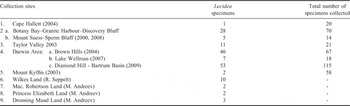
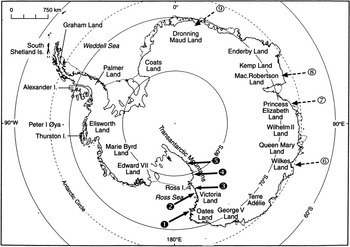
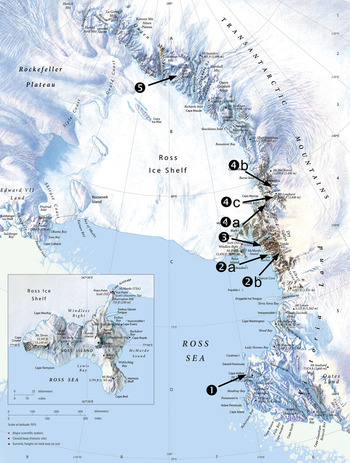
To overcome difficulties of assessing species diversity in Antarctic lecideoid lichens, we employed molecular data (nuclear ITS and mitochondrial SSU ribosomal DNA sequences) to test species boundaries. We used a phylogenetic species concept based on a two-gene dataset in this study to circumscribe species in these lichens (Grube & Kroken Reference Grube and Kroken2000). Based on our phylogenetic estimate we re-evaluated morphological and chemical characters to identify characters that can be used to identify these distinct lineages. Here we have focused on samples belonging to the genus Lecidea s. str. Collections were made from five different regions in continental Antarctica along a north–south coastal transect within the Ross Sea region (72–84°S). 153 specimens of the genus Lecidea were found in all habitats (Tables I & II, Figs 1 & 2). To complete the sampling we included samples from other regions of continental Antarctica (Tables I & II, Fig. 1), Arctic regions (Svalbard/Norway, Greenland), Austria, Sweden and the USA (Table II).
Investigation sites with the number of the collected Lecidea specimens and the total number of collected specimens from Ross Sea Region. The dates of the expeditions at the Ross Sea Region are in parenthesis. Specimens for collection sites 6–9 were provided as herbarium vouchers from R. Seppelt and M. Andreev for a broader taxon sampling across the entire continental Antarctica.

Investigation areas, general map from Øvstedal & Lewis Smith (Reference Øvstedal and Lewis Smith2001). 1–5 = Ross Sea area from 72°–84°S, the samples were collected by the authors and collaborators, 6 = Wilkes Land (R. Seppelt), 7 = Princess Elizabeth Land (M. Andreev), 8 = Mac Robertson Land (M. Andreev), and 9 = Dronning Maud Land (M. Andreev).

More detailed view on the snow free regions of the Ross Sea coast at the end of summer (McGonigal & Woodworth Reference McGonigal and Woodworth2001). 1 = Cape Hallett, 2a = Granite Harbour–Botany Bay–Discovery Bluff, 2b = Mount Suess–Sperm Bluff, 3 = Taylor Valley, 4a = Brown Hills, 4b = Lake Wellman, 4c = Diamond Hill–Bartrum Basin.

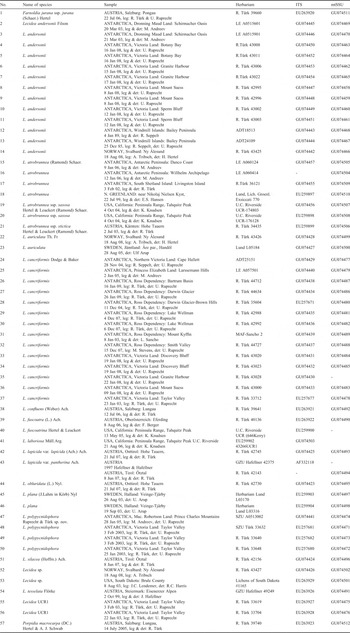
Specimen information - location, collector, date, herbarium number and Genbank-accession numbers of mtSSU, ITS.
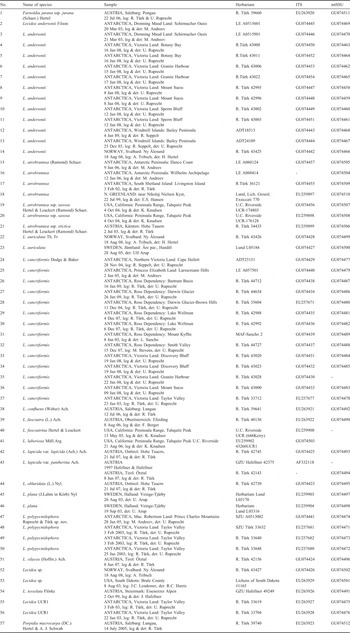
Material and methods
Investigation sites
The collection sites are located on the western coast of the Ross Sea (Table I, Figs 1 & 2). The Transantarctic Mountains are to the west and strongly affect the local climate. In particular, föhn-like winds contribute to the unusual dryness of the whole of southern Victoria Land and the McMurdo Dry Valleys in particular (Green et al. Reference Green, Seppelt and Schwarz1992). The saxicolous vegetation is extremely sparse. Lichens are only found where special microclimatic conditions occur and where they benefit from protection from abrasion of wind blown particles, from meltwater from melting snow and ice and by increased warmth (Green et al. Reference Green, Schroeter and Sancho2007).
1. Cape Hallett, northern Victoria Land (72°19′S, 170°16′E), 0–300 m alt., January 2004
The area is a low lying gravel spit with a steep slope to the south rising from sea level to about 300 m alt.; the scree on the slope protects the vegetation from the strong winds. The area is ice free during the late spring and summer, the melting water forms numerous small channels through the flatter vegetated areas and precipitation is low (Pannewitz et al. Reference Pannewitz, Green, Maysek, Schlensog, Seppelt, Sancho, Türk and Schröter2005). The level area is composed of beach gravels and cliff talus and a high nutrient input is guaranteed by a rich birdlife in the area (Green et al. Reference Green, Maseyk, Pannewitz and Schroeter2000).
2. a. Granite Harbour–Botany Bay–Discovery Bluff, Victoria Land, Ross Dependency (77°00′S, 162°27′–163°35′E), 0–435 m alt., January 2000, 2008
During the summer season the area is snow free and protected from high winds. Several small streamlets of melting water flow from the snowfields of the adjacent ridges (Pannewitz et al. Reference Pannewitz, Green, Maysek, Schlensog, Seppelt, Sancho, Türk and Schröter2005) and the area has an exceptional moss and lichen vegetation (Taylor Reference Taylor1913).
b. Mount Suess (77°02′S, 161°34′–161°43′E), 730–755 m alt. Sperm Bluff (77°03′–77°05′S, 161°43′E) 522 m alt., 2008
These two inland mountains are within a glacial ice sheet (south of Mackay Glacier). The region is snow free in summer and a well sheltered area with a pond at the bottom is located below the top of Mount Suess. Mount Suess consists of a complex of granodiorite, gneiss, dolerite and sandstone (Gunn & Warren Reference Gunn and Warren1962). Sperm Bluff is composed of big granite boulders, ephemeral streams appear not to be present.
3. Taylor Valley, Victoria Land (77°34′–77°41′S, 162°15′–163°05′E), 0–1143 m alt., January 2003
The collecting sites are located close to the Canada Glacier (40 m alt.), Mount Falconer north from Lake Fryxell (718 m alt.) and Aasgard Range at the Rhone Glacier (1143 m alt.). Taylor Valley is a classic dry valley and is a part of the McMurdo Dry Valleys, which are the largest ice free areas in continental Antarctica (Doran et al. Reference Doran, Priscu, Lyons, Walsch, Fountain, McKnight, Moorhead, Virginia, Wall, Clow, Fritsen, McKay and Parsons2002). The region is a cold desert with arid soils and exposed bedrocks. Possible sources of water in this region are perennially ice covered lakes, snow (falling and blowing), clouds and fog, ephemeral streams and alpine glaciers (Doran et al. Reference Doran, Priscu, Lyons, Walsch, Fountain, McKnight, Moorhead, Virginia, Wall, Clow, Fritsen, McKay and Parsons2002).
4. a. Brown Hills (79°46′–79°50′S 158°33′–195°25′E), 400–450 m alt., December 2004
The Brown Hills are located in the north of Darwin Glacier. The Carlyon granodiorite makes up most of the Brown Hills and includes a variably foliated, biotite-hornblende granodiorite and granite (Simpson & Cooper Reference Simpson and Cooper2002). This site appears to be a particularly dry part of the continental Transantarctic Range.
b. Lake Wellman (79°54′S, 156°32′–156°53′E) 935–1371 m alt., November 2007
The surroundings of Lake Wellman are characterized by a very dry climate, caused by a high evaporation rate due to low average air humidity and/or continuous winds originating from the cold glacier regions. The bedrock surrounding this area is sandstone from the Beacon Group and dolerite from the Ferrar dolerite sills.
c. Diamond Hill (79°51′–79°52′S, 159°16′–159°21′E), 371–550 m alt., January 2009
Diamond Hill is located at the eastern edge of the Transantarctic Mountains, close to the Ross Ice Shelf and north from the Darwin Glacier. Climate conditions are characterized by higher air humidity and precipitation that support a higher diversity and abundance of lichens.
d. Bartrum Basin (79°45′S, 158°30′–158°38′E) 370–430 m alt, January 2009
Located in the north-west of the Brown Hills, Bartrum Basin is apparently very dry. The dominant rock types are dolerite and granite.
5. Mount Kyffin and surroundings, Queen Maud Mountains (83°44′–83°45′S, 172°15′–172°46′E), 450–820 m alt., January 2003
The investigated area is located at the southern edge of Beardsmore Glacier. The mountains are formed by Goldie formation greywacke (Gunn & Walcott Reference Gunn and Walcott1962) and schist. The collecting sites at the ridges were snow free. The site is characterized by low precipitation rates and severe winters.
Morphological analyses
Light microscopic investigations were carried out with a LEITZ Laborlux S (Leitz, Vienna). Cross sections of apothecia (12 μm thick) were prepared using a Leitz Kryomat 1703 freezing microtome. The sections were stained with Lactophenol blue solution, KOH (10%) and Lugol’s iodine solution 50%. Thallus morphology, anatomical features of asci and the ascospores were documented with photographs, using a digital camera (Samsung-Digimax V50).
Chemical analyses
Samples were extracted for four hours in methanol and secondary compounds were characterized by high-performance liquid chromatography (HPLC) using benzoic acid and (E)-1-(9-Anthryl)-2-phenylethene as internal standards. HPLC analyses were performed according to Stocker-Wörgötter & Elix (Reference Stocker-Wörgötter and Elix2002) using a Hitachi /Merck Spectra System with a Beckman 5C18 column, 250 by 4.6 mm, with spectrometric detectors operating at 254 nm with a flow rate of 1 ml min-1. Two solvent systems, A and B with a flow rate of 1 ml min-1 were used as follows: The run started with 100% A (1% aqueous ortho-phosphoric acid and methanol in the ratio 7:3) and was raised to 58% B (pure methanol) over 15 min, then to 100% B over a further 15 min, followed by isocratic elution in 100% B for further 10 min.
Standardized TLC with atranorin and norstictic acid as reference substances and solvents A, B’ and C was used to identify the chemical profile of the lichens (Culberson & Johnson Reference Culberson and Johnson1982 and references therein).
DNA-amplification, purification, sequencing
Total DNA was extracted from thallus or apothecia by using the DNeasy Plant Mini Kit (Qiagen) according to the manufacturer’s instructions. The PCR mix contained 0.5 units of recombinant Taq polymerase (Fermentas), 0.2 nM of each of the four dNTPs, 0.3 μM of each primer and 1–10 ng genomic DNA. The PCR products were purified using Qiaquick PCR purification kit (Qiagen) and resolved in sterile distilled water. The purified and dried PCR-products were sent to Macrogen (Seoul, Korea) for sequencing using the PCR primers. The obtained sequences were aligned with homologous sequences from the NCBI-Database. In cases where the PCR did not produce bands in a first reaction, we took 1 μl of this reaction for a nested PCR with internal primers. Reactions that produced multiple bands were taken for TA cloning. Plasmids were isolated using the Wizard Plus SV Miniprep System (Promega) and inserts were sequenced.
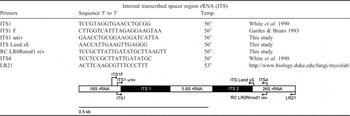
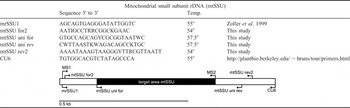
The internal transcribed spacer region (ITS) of the mycobionts’ nuclear ribosomal DNA and mitochondrial small subunit (mtSSU) were amplified and sequenced with the primers described in Tables III & IV. To reduce the costs for sequencing and to accelerate the identification of the large number of L. andersonii samples - often more than 20 years old, we designed ‘ITS–Land sS’ (Table III), a reverse primer to directly and specifically amplify the ITS region of L. andersonii, best used with ITS-1F. To be certain that this primer amplified only L. andersonii, we tested it on already confirmed L. andersonii specimens and on other Lecidea species throughout the phylogeny and sequenced the products.
Sequences, temperature and primer map of the used ITS-primers.

Sequences, temperature and primer map of the used mtSSU-primers.

Phylogenetic analysis
Mitochondrial SSU and nuclear ITS sequences were assembled with vector NTI Advance 9 (Invitrogen, Vienna, Austria) and then manually corrected. The alignment of sequences (including out-group taxon) was done using MacClade (Maddison & Maddison Reference Maddison and Maddison2003).
The alignment was unambiguous and included only a few gaps. For comparison, lecideoid species from other regions of Antarctica and other parts of the world were sequenced and included in the data matrix together with one sequence downloaded from Genbank as shown in Table II. To test for potential conflict, parsimony bootstrap analyses were performed on each individual dataset, and 75% bootstrap consensus trees were examined for conflict.
To choose a nucleotide substitution model we used Modeltest 3.7 (Posada & Crandall Reference Posada and Crandall1998); both tests (hierarchical likelihood ratio test and Akaike information criterion) selected the Tamura-Nei Model (TrNef) with equal base frequencies including estimation of invariant sites and assuming a discrete gamma distribution. A maximum likelihood analysis (ML) was performed using the program Garli 0.96 (http://www.nescent.org/wg_garli/Main_Page) with the estimated TrNef (0 1 0 0 2 0) + I + G model and default settings. Nonparametric bootstrap was used to assess robustness of clades, running 2000 pseudo replicates.
Maximum parsimony analyses (MP) were performed using the program PAUP* (Swofford Reference Swofford2003). Heuristic searches with 1000 random taxon addition replicates were conducted with TBR branch swapping and MulTrees option in operation, equally weighted characters and gaps treated as missing data. Bootstrapping was performed based on 2000 replicates with random sequence additions. Homoplasy levels were assessed by calculating consistency index (CI), retention index (RI), and rescaled consistency (RC) index from each parsimony search.
The B/MCMC analyses were conducted using the MrBayes 3.1. program (Huelsenbeck & Ronquist Reference Huelsenbeck and Ronquist2001). A run with 10 000 000 generations starting with a random tree and employing four simultaneous chains was executed. Every 100th tree was saved into a file. The first 1 000 000 generations (i.e. the first 10 000 trees) were deleted as the “burn in” of the chain. We plotted the log-likelihood scores of sample points against generation time using TRACER 1.0 (http://evolve.zoo.ox.ac.uk/software.html?id=tracer) to check whether stationarity was achieved after the first 1 000 000 generations by checking whether the log-likelihood values of the sample points reached a stable equilibrium value (Huelsenbeck & Ronquist Reference Huelsenbeck and Ronquist2001). Additionally, we used AWTY (Nylander et al. Reference Nylander, Wilgenbusch, Warren and Swofford2007) to compare splits frequencies in the different runs and to plot cumulative split frequencies to ensure that stationarity was reached. Of the remaining 180 000 trees (90 000 from each of the parallel runs) a majority rule consensus tree with average branch lengths was calculated using the sumt option of MrBayes. Posterior probabilities were obtained for each clade. Only clades that received bootstrap support equal, or above, 70% under parsimony, and likelihood and posterior probabilities equal, or above, 0.95 were considered as strongly supported.
Results
Phylogenetic analyses
In total four different Lecidea species could be identified in continental Antarctica and are confirmed by morphological, chemotaxonomic and molecular data including two novel Lecidea species. As well as our own material freshly collected at various sites in areas of continental Antarctica we could also use comparison material of Lecidea, most of which included originally described species treated in this study. The new sequences were aligned with one ITS sequence downloaded from Genbank (Table II).
After excluding excess sequences the final data matrix for the molecular phylogeny comprised 57 OTUs. The length of the combined alignment (mitochondrial SSU and nuclear ITS rDNA) was 877 unambiguously aligned nucleotide position characters. The MP 75% bootstrap support method for testing datasets for incongruence indicated no strongly supported conflict (data not shown) and hence a combined analysis was performed.
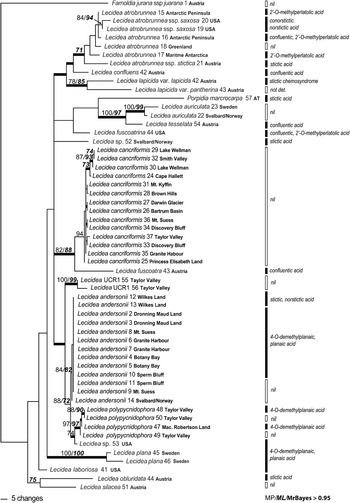
164 positions in the combined alignment were parsimony-informative. MP analyses yielded 298 most parsimonious trees 683 steps long (CI = 0.59, RI = 0.74, RC = 0.44). Tree topologies among maximum parsimony, maximum likelihood and Bayesian analyses were identical in all well-supported clades and so we only present here the Bayesian tree with support values of the other analyses (Fig. 3).
Phylogeny of Antarctic Lecidea spp. This Bayesian tree is based on a combined dataset of ITS and mtSSU with > 0.95 support and directly mapped bootstrap values with > 70 support of maximum parsimony - and maximum likelihood (Garli 0.96) analysis. Secondary metabolites of the specimens are plotted to the right of the tree. The four main clades are indicated in black.

The phylogenetic reconstruction indicates that the samples from continental Antarctica cluster in four well supported clades. Specimens identified as L. cancriformis form a monophyletic group that has an unsupported relationship to L. fuscoatra. The specimens of L. andersonii form one monophyletic group, which contains three chemotypes (stictic/norstictic acid, planaic/4-o-demethylplanaic acid, no secondary metabolites) and a sample from Svalbard (Norway). In addition to these two species, two currently unnamed clades were found and are described below. These are Lecidea UCR1 and L. polypycnidophora. The two samples of Lecidea sp. (L. UCR1) form a strongly supported monophyletic group and are sister to the two clades including specimens of L. andersonii, L. polypycnidophora and an unidentified Lecidea sp. from South Dakota (USA). Lecidea polypycnidophora with the sequence of the lichen sample LOSD1165 (South Dakota, USA) at the base, form a sister group to L. andersonii. The results of this phylogenetic analysis indicates that four distinct lineages of Lecidea spp. occur in continental Antarctica.
The backbone of the phylogeny is not supported and so this analysis does not allow further conclusions regarding the relationships of the species examined. However, the additional samples from Antarctica form strongly supported clades for each of the currently described species. Lecidea atrobrunnea, L. lapicida, L. plana, L. tesselata and L. auriculata each form clearly defined and well supported monophyletic groups. The currently accepted varieties - including different chemotypes - in two of the species (L. atrobrunnea, L. lapicida), however, are more distantly related and form different clades in our analyses as can be seen in the chemotypes plotted on the phylogenetic tree in Fig. 3. The species of the genus Porpidia are nested within Lecidea as shown in previous studies (Buschbom & Barker Reference Buschbom and Barker2006).
Morphological and chemical analyses
Based on the sequence data from 170 Lecidea samples (Table I), we re-examined the morphology and secondary chemistry to identify phenotypic characters that circumscribe the monophyletic clades found in the analysis. We got a complete dataset of molecular, chemical and morphological analyses from a total of 107 specimens. 57 accessions were chosen to build up the final phylogeny after excluding additional accessions of the same species from identical habitats.
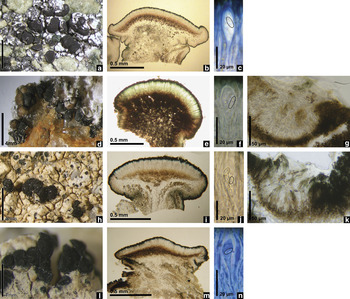
The localities of the studied specimens and herbarium information are given in Tables I & II. The most important diagnostic characters of the four Lecidea spp. in continental Antarctica are shown in Fig. 4. Descriptions of the species and discussion on variation and differences to similar species are given below.
Overview of the most important morphological attributes of the investigated Lecidea specimens. Lecidea andersonii: a. Sparse thallus with apothecia, b. cross-section of apothecium, c. ascus with narrowly ellipsoid ascospores. Lecidea cancriformis: d. brownish thallus with apothecia and a dense group pycnidia bottom left, e. cross-section of apothecium with characteristically dark brown hypothecium, f. ascus with narrow oblong ascospores, g. cross-section of pycnidium with bacilliform conidia. Lecidea polypycnidophora sp. nov.: h. thallus with apothecia and abundant pycnidia, i. cross-section of apothecium, j. ascus with ellipsoid ascospores, k. cross-section of pycnidium with bacilliform pycnospores. Lecidea UCR1: l. chasmolithic thallus with aggregated apothecia, m. cross-section of apothecium, n. ascus with narrowly ellipsoid ascospores.

Lecidea andersonii Filson 1974
Thallus: often poorly developed, rimose to areolate, up to 2 cm in diam., angular and usually adpressed along rock crevices; surface: whitish to grey and brownish; apothecia: frequent, scattered in groups, dense and partially grouped, sessile, constricted at the base, round to irregular, up to 2 mm in diam., disc black, flat to slightly convex, mostly epruinose, rarely with a thin whitish pruina, margin distinct, sometimes becoming flexuose; proper exciple: 80–150 μm high, hyaline, outer margin dark green to brownish green; hypothecium: brownish, 70–100 μm high; hymenium: hyaline, 50–80 μm high; paraphyses: simple, coherent, with swollen apices; epihymenium: dark green, 10–15 μm high; asci: amyloid, Lecidea-type, 8-spored; ascospores: narrowly ellipsoid (8-) 9–12 x 3–4, length-width index 2,1–2,3; spot tests: thallus K-, C-, I- and medulla: K-, C-, I+ ; secondary metabolites: chemotype I: 4-O-demethylplanaic and planaic acids; chemotype II: stictic and norsticic acids; chemotype III: nil.
Substrate: on siliceous rocks (granite).
Distribution: bipolar; known from maritime and continental Antarctica, Svalbard/Norway and Iceland. In continental Antarctica, L. andersonii occurs only in milder regions with coastal aspects. No specimens were found south of 77° (see Figs 1 & 3 and Tables I & II)
Notes: Our morpholpogical circumscription of Lecidea andersonii agrees with the current concept (Filson Reference Filson1974, Øvstedal & Lewis Smith Reference Øvstedal and Lewis Smith2001, Castello Reference Castello2003, Hertel Reference Hertel2007, Reference Hertel2009). Inoue (Reference Inoue1991) placed the species in the L. auriculata group where it is characterized by wide ascospores (Hertel Reference Hertel2007). Our phylogenetic analysis does not support this classification, but suggest a close relationship to Lecidea tesselata (Fig. 3). The results of our studies on the secondary chemistry of L. andersonii differ from that given in the literature. Previously, stictic acid (Hertel Reference Hertel2007) or confluentic and glomelliferic acids were reported for L. andersonii (Inoue Reference Inoue1991, Øvstedal & Lewis Smith Reference Øvstedal and Lewis Smith2001). We could not detect confluentic and glomelliferic acids in any L. andersonii specimen (Fig. 3). Instead we found three chemotypes (see above) the most common possesses 4-O-demethylplanaic acid and planaic acid. We also studied two specimens from Wilkes Land (type locality) which were confirmed as belonging to L. andersonii using molecular data, but contained stictic and norstictic acids. This chemistry agrees with the literature (Hertel Reference Hertel2007). Noteworthy, the long side chain depsides 4-O-demethylplanaic and planaic acids are not biosynthetically related to the beta-orcinol depsidones of the stictic acid chemosyndrome. We included also a sample from Svalbard/Norway (No. 14) in our calculations which could clearly be identified as L. andersonii by sequence and morphology. This specimen from Norway lacks secondary metabolites and hence represents a third chemotype together with two Antarctic specimens within this clade (Fig. 3).
Lecidea andersonii was long regarded as an Antarctic endemic (Øvstedal & Lewis Smith Reference Øvstedal and Lewis Smith2001, Castello Reference Castello2003) until Hertel (Reference Hertel2007) placed Lecidea pseudopromiscens Hertel & Rambold from Iceland into synonymy with L. andersonii. Our material from Svalbard/Norway confirms a bipolar distribution for this species.
Similar species in Antarctica include planaic and/or 4-O-demethylplanaic acid or lack secondary metabolites. L. andersonii is characterized by an I+ medulla, narrowly ellipsoid ascospores, mostly distinct margin and a sparsely developed thallus.
Lecidea cancriformis C.W. Dodge & G.E. Baker, Ann. Mo. Bot. Gard. 25: 539 (1938)
Thallus: well developed, delimited, rimose to areolated and often sub-bullate, up to 3 cm in diam., often along crevices; surface: whitish (when eroded) to grey and brown; pycnidia: when present, grouped, with a black ostiolum, containing bacilliform conidia, up to 150 μm in diam. Apothecia: scattered in groups, sessile, constricted at the base, up to 1.4 mm in diam., disc black, flat to moderately convex, round to irregular, margin thin, if present; proper exciple: up to 100 μm thick, pale, outer margin dark green to brownish green; hypothecium: brown to black, 70–100 μm high; hymenium: hyaline to pale green, 40–90 μm high; paraphyses: simple, septate, coherent, apices slightly swollen, 4–5 μm thick; epihymenium: dark green, 10–20 μm high; asci: amyloid, Lecidea-type, 8-spored; ascospores: narrowly oblong, (8-) 9–12 x (2-) 3–4 μm; Spot tests: thallus and medulla: K-, C-, I-; secondary metabolites: nil.
Substrate: on siliceous rock (granite).
Distribution: endemic to continental Antarctica (Øvstedal & Lewis Smith Reference Øvstedal and Lewis Smith2001, Castello Reference Castello2003, Hertel Reference Hertel2007).
Notes: This species has a whitish (necrotic), grey or brown thallus surface (Øvstedal & Lewis Smith Reference Øvstedal and Lewis Smith2001, Hertel Reference Hertel2007), including variable forms with endolithic growth to thick, brownish glossy thalli. Material seen by Castello (Reference Castello2003) included only brown to dark brown or black thalli with a smooth and shiny surface. The taxon is readily distinguished by a negative iodine reaction of the medulla and the absence of orcinol depsides. The size of the hymenium (40–90 μm high) is in our study sometimes higher than previously described. Inoue (Reference Inoue1991) indicated a height of 35–50 μm, Øvstedal & Lewis Smith (Reference Øvstedal and Lewis Smith2001) of 60–65 μm, Castello (Reference Castello2003) of 60–80 μm and Hertel (Reference Hertel2009) of 38–55 μm, which shows a high variability. Hertel (Reference Hertel2007) mentioned that numerous specimens contain norstictic acid but this was not found in our samples. Under the circumstance of extreme environmental factors (thallus eroded) the species is similar to L. polypycnidophora and L. UCR1, but readily distinguished by oblong ascospores, a dark brown hypothecium, an I- medulla and infrequent sub-bullate, brown areoles.
Lecidea cancriformis is a widespread species and occurs in every locality sampled in the Ross Sea region. It is especially dominant in dry parts, where it is accompanied by Acarospora gwynii and Lecanora fuscobrunnea (Stevens et al. unpublished, Marshall et al. unpublished)
Lecidea polypycnidophora Ruprecht & Türk sp. nov.
Thallus crustosus, areolatus, rotundus, albidus. Medulla I+ violacea. Pycnidia abundantes. Apothecia aggregata, ad basin constricta, nigra, plana usque ad convexa. Hypothecium 30–40 μm altum. Hymenium hyalinum, 50–70 μm altum. Paraphyses simplices, septatae, apices turgidos. Epihymenium virido-nigrum, 15–20 μm altum. Asci ad typum Lecidea pertinens. Ascosporae hyalinae, non-septatae, ellipsoidae, 6–8 x (3-) 4–5 μm.
Type: Antarctica, a) Holotypus: Victoria Land: Taylor Valley, 25 m alt, 77°36′48.6′′S, 163°04′18.4′′E, leg. Roman Türk 33632 (SZU), b) Paratypus: Mac. Robertson Land: Prince Charles Mountains, Field Base Radok, 160 m alt, 70°49′S, 68°05′E, leg. Mikhail Andreev 0513002 (SZU).
Thallus: well developed, areolated, rounded to angular and partly granular, up to 1.5 mm thick, along crevices; surface: whitish to cream-coloured; pycnidia: either in dense groups at fissures or evenly distributed over the thallus, ostiolum grey to black, conidia bacilliform, up to 300 μm in diam.; Apothecia: scattered in small groups, sessile, constricted at the base, round to irregular, up to 1.5 mm in diam., disc black, flat to convex, margin indistinct to distinct; proper exciple: broad, 150–250 μm thick, brownish, outer margin dark green to brownish green; hypothecium: mid-brown, 30–40 μm high; hymenium: hyaline, 50–70 μm high; paraphyses: simple, septate, coherent, apices slightly swollen, 5–6 x 4 μm; epihymenium: dark green, 15–20 μm high; asci: amyloid, Lecidea-type, 8-spored; ascospores: ellipsoid, 6–8 x (3-) 4–5 μm, length-width index: 1.4–1.9; spot tests: thallus K-, C-, I- and medulla: K-, C-, I+ faintly violet; secondary metabolites: 4-O-demethylplanaic acid or nil.
Substrate: on siliceous rocks (sandstone, granite).
Distribution: so far endemic to Continental Antarctica.
Notes: This new species has a well developed thallus with abundant pycnidia, a faintly violet I+ medulla and ellipsoid ascospores. It is similar to L. andersonii and Lecidea UCR1 but differs in having broader ascospores (length-width index 1.4–1.9 in comparison to 2.1–2.3 and ∼2), a well developed, visible thallus and pycnidia. Another similar species is L. soyaensis M. Inoue (Inoue Reference Inoue1991). However, this species has a sparsely developed thallus which is largely restricted to the surroundings of the apothecia, a violet-brown hypothecium, and a I+ intensively violet medulla. It further differs chemically in containing the stictic acid chemosyndrome (Hertel Reference Hertel2007) and is probably a synonym of L. andersonii.
Additional specimens examined: Antarctica, Victoria Land: Taylor Valley: Türk 33640 (No. 49), 33641, 33648 (No. 50), 33658, 33703.
“Incertae sedis” Lecidea sp.: Lecidea UCR1: Türk 33619 (No.54), Türk 33704 (N. 55)
Thallus: well developed, rimose to areolate, up to 1.5 mm high, along crevices; surface: whitish to grey and pale brown; apothecia: frequent, densely aggregated, sessile, constricted at the base, up to 1.2 mm in diam., disc black matt, flat, round to irregular, inconspicuous margin; proper exciple: broad, up to 200 μm thick, hyaline, outer margin dark green; hypothecium: brown, seldom hyaline, 40–50 μm high; hymenium: hyaline, often with brownish granules, 40–60 μm high; paraphyses: simple, septate, coherent, apices slightly swollen, 4 x 5–6 μm thick; epihymenium: dark green to dark brown, 10–15 μm high; asci: amyloid, Lecidea-type, 8-spored; ascospores: narrowly ellipsoid, (7-) 8–9 (-10) x (3-) 4 (-5) μm, length-width index: ∼2; spot tests: thallus and medulla: K-, C-, cortex I+, medulla I- (Türk 33704), rarely I+ (Türk 33619); secondary metabolites: nil.
Substrate: on siliceous rock (granite).
Distribution: so far only known from two collections in Taylor Valley (continental Antarctica).
Notes: although morphological and molecular evidence suggest that these two samples belong to a distinct lineage, we refrain from formally describing this as a new species, because of some variability in the sequenced markers and in the lichen chemistry (iodine reaction of the medulla), until further samples become available.
These chasmolithic growing specimens have a well-developed, whitish thallus, densely grouped, sessile, black apothecia with an inconspicuous margin, a broad exciple and narrowly ellipsoid ascospores. They differ from L. andersonii by a mostly I- medulla, a well developed thallus and apothecia without a distinct margin. The ascospores are smaller than those of L. cancriformis. Further, the hypothecium is lighter in comparison to the dark brown in L. cancriformis. In comparison to the new species L. polypycnidophora are there no pycnidia, the thallus is completely covered with apothecia, and the ascospores are more oblong.
Discussion
Our analyses demonstrate that the diversity of Lecidea spp. in continental Antarctica is higher than previously thought. Geographical data evaluation also shows a decreasing diversity of Lecidea species the more continental and drier the habitats are (see Table II and Investigation Sites). It clearly indicates that the species concept in Lecidea needs revision and that molecular data are helpful in interpreting subtle morphological differences that have been previously regarded as intraspecific variability. Our combined approach of molecular analyses and morphological and chemical re-examination on the background of the phylogenetic estimate has led to the description of two new species here.
One of these new species, Lecidea polypycnidophora, forms a distinct well supported clade as a sister group to L. andersonii. Lecidea polypycnidophora can clearly be distinguished from its sister groups by its abundant pycnidia, the shape of the spores and a well developed thallus. The other strongly supported clade is formed by two accessions of a Lecidea species of uncertain status (Lecidea UCR1). We refrain here from formally describing the lichens in this clade as a single novel species because a very important character for identification (iodine reaction of the medulla) brings up two different results. Therefore we cannot say if this is just some variation within a single species or if there are two sub-species in this clade. Additionally there is at least some sequence variation between the two accessions within the L. UCR1 clade but still it clearly forms a distinct strongly supported group.
These results agree with similar studies in other groups of lichenized fungi indicating that numerous distinct lineages are hidden under a single lichen-fungus name (Grube & Kroken Reference Grube and Kroken2000, Kroken & Taylor Reference Kroken and Taylor2001, Molina et al. Reference Molina, Crespo, Blanco, Lumbsch and Hawksworth2004, Arguello et al. Reference Arguello, Del Prado, Cubas and Crespo2007, Lücking et al. Reference Lücking, del Prado, Lumbsch, Will-Wolf, Aptroot, Sipman, Umaña and Chaves2008, Wirtz et al. Reference Wirtz, Printzen and Lumbsch2008). In these studies, morphological or chemical differences have been previously interpreted as intraspecific variability. Re-examination of morphology with the background of a molecular phylogenetic estimate then revealed, often subtle, morphological and/or chemical characters, supporting the distinction of these clades at species level. There is a growing body of evidence that the approach to current species recognition, which is largely based on morphology and chemistry, underestimates the number of species. Hence, there is a strong possibility that large numbers of undescribed fungal species will not only be found in poorly studied areas, such as tropical forests or in underexplored habitats, for example growing in insects, plants or lichens (Hawksworth & Rossman Reference Hawksworth and Rossman1997, Sipman & Aptroot Reference Sipman and Aptroot2001, Arnold & Lutzoni Reference Arnold and Lutzoni2007), but also hidden under known species names.
Acknowledgements
The first author is thankful to Armin Hager (Salzburg) for the introduction into the HPLC analytical method. Jack Elix (Canberra) and Elfie Stocker-Worgötter (Salzburg) were helpful with the interpretation of HPLC-data. Valuable comments to our manuscript were given by Hans-Peter Comes (Salzburg) and Hannes Hertel (Munich). Finally, we would like to thank the collectors and curators of herbaria for sending us specimens for comparative investigations. Antarctica New Zealand is thanked for logistics support. Waikato University is thanked for financial support and, in particular Vice Chancellor Bryan Gould for encouraging and financing the programme and Vice Chancellor Roy Crawford for continuing this. TGA Green held a Ramon y Cajal award at Universidad Complutense, Madrid, for part of this work.
This paper is an output of the FRST-funded IPY Research Programme Understanding, valuing and protecting Antarctica’s unique terrestrial ecosystems: Predicting biocomplexity in Dry Valley ecosystems located at Biological Sciences, Waikato University.