Introduction
On January 12, 2010, a magnitude 7.0 earthquake devastated the nation of Haiti. With a death toll over 230,000, it was the most lethal earthquake of its magnitude throughout history.Reference Bilham 1 The debilitating effects of the earthquake were pervasive and multifold, affecting lives on a societal level and on an individual level. On a broader scale, the earthquake impacted health in Haiti through the outbreak of infectious diseases such as cholera, and through the incapacitation of an already weak public health infrastructure.Reference Dowell, Tappero and Frieden 2 The earthquake also had a profound and intimate impact on individual Haitians, through its deleterious effects on both the medical and mental health of disaster victims.
The immediate humanitarian response to the disaster was swift, passionate, and multifaceted. In order to direct and inform the remarkable humanitarian response that was generated worldwide, researchers have worked to better delineate the medical and psychosocial needs of the Haitian people after the disaster. The Haitian Ministry of Public Health and Population enlisted the assistance of the Pan American Health Organization to organize and mobilize efforts to reconstruct a national surveillance system for infectious disease. These efforts were especially helpful in detecting and responding to a cholera outbreak that affected nearly 170,000 Haitians. Water-borne illnesses, such as cholera and typhus, were particularly problematic since Haiti rates the worst in the hemisphere with regard to water security.Reference Walton and Ivers 3 Malaria and HIV were prominent threats in Haiti prior to the earthquake, but with the collapse of public health infrastructure, they remained significant medical issues affecting the population as the nation began to rebuild after the disaster.
Although such tremendous response has been mounted with regard to the physical health of Haitians after the disaster, other efforts have focused on the significant toll of the earthquake on the mental health of Haiti's people. 4 According to a random survey of households in Port-au-Prince, Haiti, many Haitians were exposed to death, sexual assault, food insecurity, and destruction of property.Reference Kolbe, Hutson and Shannon 5 As a result of such profound exposure, a high prevalence of posttraumatic stress disorder (PTSD), anxiety, and depression is to be expected. This has been confirmed by accounts of mental health providers who have traveled to Haiti and have organized efforts to provide emergency mental health care to disaster victims.Reference McShane 6 , Reference Raviola, Eustache and Oswald 7 Although such conditions appear to be common among survivors of the earthquake, precise epidemiologic measurement of the prevalence of such conditions is lacking.
It is also unclear how the earthquake has affected particular subgroups of the population in Haiti, some of which potentially would be protected from its harmful effects. Through a unique collaboration with the Haitian Olympic Committee and the Pan American Games Committee, the Center for Disaster Resilience and the Disaster Medicine Section at Harvard Medical School have been given the opportunity through the Child in Hand program to care for elite athletes in Haiti who are training for the Pan American and Olympic games, as well as for children in the general population of Haiti. This has provided an opportunity to evaluate the effects of the earthquake on elite athletes in Haiti, relative to the general population.
Elite athletes comprise a privileged subgroup among the general population, so a protective effect would be expected against the medical and psychosocial effects of the disaster. Given the potential protective mechanisms surrounding elite athletes in Haiti, a decreased frequency of medical and psychosocial conditions was expected. This manuscript evaluates this hypothesis and provides preliminary epidemiologic data from this subgroup, relative to a normed sample from the general population, in order to evaluate the burden of medical and psychosocial distress after the 2010 earthquake of Haiti.
Methods
Study Population and Control Group
The study group consisted of 104 athletes (74 males and 30 females, aged 12-18 years) enrolled from the National Sports Center in Haiti a year after the 2010 earthquake. A control group (N = 104) was matched by age and gender. The control group was selected from a group of Haitian children evaluated one year after the earthquake at various orphanages and schools, in and around Port-au-Prince. All sites in the study, including the National Sports Center, were part of a multi-site humanitarian project supported by a nonprofit organization.
Medical and Psychosocial Screening and Assessment
Medical teams assessed subjects based on chief complaints, history of present illnesses, and physical examinations. Medical conditions were categorized according to symptoms (ie, musculoskeletal pain, abdominal pain, headache, fever, malnutrition, cardiac symptoms, dizziness, cough and shortness of breath, skin infection, nausea/vomiting, fungal infection, ocular, oral, and hygiene). Psychosocial teams screened for psychosocial distress based on a 7-item Child Psychosocial Distress Screener (CPDS), a multi-source instrument designed and validated cross-culturally to assess the need for psychosocial treatment. A cut-off score of eight was used as indication for treatment, according to previous validation studies.Reference Jordans, Komproe and Ventevogel 8 Informed consent was obtained on a community and individual level, and institutional review board approval was through Beth Israel Deaconess Medical Center (Boston, Massachusetts USA).
Statistical Analysis
A two-proportion z test was used to compare the proportions of each of the medical illnesses in the study and control groups. To compare the CPDS scores between the study and control groups, a two-sample t test was used to compare the mean scores. The proportion of scores indicating treatment (score greater than or equal to eight) was also compared between groups using a two-proportion z test. A P value less than .05 was considered statistically significant. All analyses were performed using an online, open-source statistical program (Version 2, StatTools, Allan Chang and Chinese University of Hong Kong, Shatin, Hong Kong SAR, China).
Results
The study and control groups were matched for age and gender. There was no significant difference in mean age between groups, with a mean age of 13.4 years in the athletic study group and 13.3 years in the control group. The groups were also matched for gender, with both groups containing 74 males and 30 females.
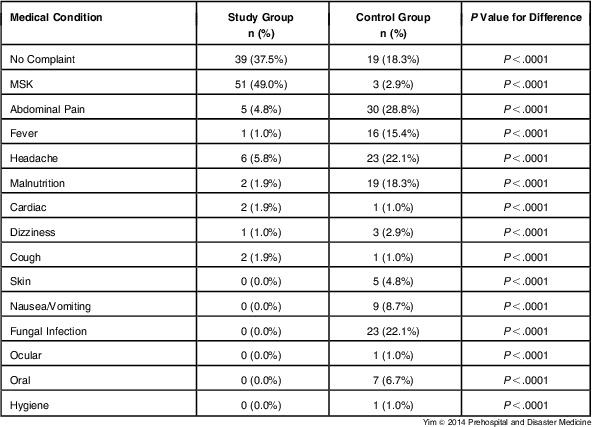
An array of medical conditions was seen in the athletic group and controls, but there were significant differences in the prevalence of particular conditions between the two groups (Table 1). The predominant medical condition in athletes was musculoskeletal pain, which was rare in controls: 51 (49.0%) versus 3 (2.9%), P < .05. In contrast, the most prevalent conditions in the control group were abdominal pain, headache, fungal infection, and malnutrition. The athletic population also had a significantly larger proportion of children without conditions compared with the controls: 39 (37.5%) versus 19 (18.3%), P < .05.
Proportions of Various Medical Conditions in the Study and Control Groups

Abbreviation: MSK, musculoskeletal pain.
In contrast to the medical concerns between groups, the degree of psychosocial distress was not significantly different between groups. The mean CPDS scores with standard deviation were 5.78 (SD = 1.83) for the study group and 5.89 (SD = 1.87) for the control group, with no significant difference between groups. There was also no significant difference in the proportion of subjects with CPDS scores indicating treatment, with 20 (19%) subjects in the study group and 22 (21%) subjects in the control group with CPDS scores greater than or equal to eight.
Discussion
This data demonstrates a significant burden of medical and psychosocial distress in athletes and the general population in Haiti after the earthquake. Athletes had a significantly higher prevalence of musculoskeletal conditions than subjects in the control population. The study group also had a higher proportion of musculoskeletal conditions than historic controls. Historically, the prevalence of such conditions post disaster in nonathletic populations has been between 11.6% and 21.5%.Reference Kim, Han and Kim 9 , Reference Nufer, Wilson-Ramirez and Shah 10
The high prevalence of musculoskeletal pain in the study group is expected, given the rigorous level of training these athletes were exposed to in preparation for Pan American and Olympic competition, in addition to the impact of physical exposure to the disaster itself. Pre-existing injuries may have contributed to the high prevalence of musculoskeletal conditions in elite athletes after the earthquake. This is consistent with historic precedence. With the collapse of a pedestrian bridge during the 1997 Maccabiah Games, for example, the majority of musculoskeletal injuries detected post disaster were related to sports participation rather than to the disaster itself.Reference Kolt, Wajswelner and Adonis 11
The type of disaster may have contributed to the high prevalence of musculoskeletal pain among athletes. Earthquakes result in a higher proportion of musculoskeletal injuries compared with other natural disasters as a result of entrapment and crush injuries.Reference Roy, Shah and Patel 12 , Reference Seaman 13 In addition to the direct physical trauma from the disaster itself, the indirect effects of displacement also may have added to the high rate of musculoskeletal conditions in the study population. Regardless of the cause, this data reveals a significant burden of musculoskeletal conditions among elite athletes in Haiti after the disaster, which presents the opportunity for sports medicine practitioners to provide targeted care in the context of humanitarian aid efforts and ongoing restoration in Haiti.
Aside from musculoskeletal pain, the study group had a significantly lower prevalence of nearly all other medical conditions compared with the control group. While conditions such as abdominal pain, headache, fungal infection, and malnutrition were relatively common in the control population, these conditions were rare in the study group. With housing, food, and water provided and secured for the elite athletes in Haiti, exposure to infectious agents may have been reduced in this subgroup, providing a protective effect against the otherwise prevalent medical conditions seen in the general population. Water security has been a particularly pressing concern for the general population, which has haphazard access to clean water. Such vulnerabilities are thought to increase the risk of exposure to infections, such as cholera and typhoid, and may explain the higher prevalence of medical conditions detected in the control population of this study.Reference Webster 14 Further investigation, including risk factor analysis, will help identify causative factors underlying the differences between groups.
Although athletes in this study were protected from medical conditions afflicting the general population, they were not protected from the psychosocial distress associated with the disaster. There was no significant difference between groups with regard to the average CPDS scores or the proportion of scores indicating psychosocial treatment. Thus, elite athletes in Haiti appear to have as significant a burden of psychosocial distress following the earthquake as the general population. Whatever protective factors had been afforded to the athletes may have been effective in mitigating the influence of particular medical exposures, but they were not protective with regard to mental health. Whatever stressors were responsible for imposing the significant burden of psychosocial distress after the earthquake seem to be common to the athletic population and the general population.
This preliminary data demonstrates a high prevalence of psychosocial distress, both in the study and control groups. Approximately one-fifth of both athletes and nonathletes had a CPDS score suggestive of psychosocial distress requiring treatment. Similar prevalence rates of psychiatric conditions have been detected with previous earthquakes. With the Sichuan, China earthquake of 2008, for example, survivors had comparable prevalence rates of psychiatric conditions: 22.7% with anxiety; 16.1% with depression; and 13.4% with PTSD.Reference Liu, Wang and Shi 15 Survivors of the 2005 earthquake that hit Kashmir India had similar rates: 22.6% with depression; 21.8% with anxiety; and 3.3% with PTSD.Reference Chadda, Malhotra and Kaw 16 A number of factors that are responsible for such high prevalence rates have been identified through these experiences: exposure to death; bereavement; loss of income; ethnicity; household damage; and displacement.
The high prevalence of psychosocial distress among athletes of Haiti is especially concerning given its repercussions on athletic performance, risk of future injury, and adverse health effects. Psychosocial distress is not only harmful in and of itself, but also impairs athletic performance through depression, fear of success, and competitive inhibition.Reference Rosenblum 17 Considering the high level of performance required of elite athletes in Haiti, addressing psychosocial distress will therefore not only be essential for optimizing mental health, but also athletic performance.
More importantly, psychosocial distress in elite athletes may lead to increased risk of future physical injury during sporting events. Stressful life events have been associated with increased risk of injury in sports.Reference Petrie 18 , Reference Meeuwisse and Fowler 19 In addition to the physical stressors discussed previously, this indirect psychosocial effect may also help explain the higher prevalence of musculoskeletal conditions detected in the athletic population of this study, compared with controls, since data collection occurred a year after exposure to the earthquake. The high levels of psychosocial distress, in combination with the subsequent exposure to physical harm during training and exercise, may have generated the high proportions of musculoskeletal conditions demonstrated in the study group.
In addition to increasing risk of future injury, psychosocial distress also poses an indirect threat to physical health by compounding the adverse health effects associated with high performance exercise. This is thought to be mediated through behavioral, cognitive, and biochemical pathways.Reference Williams and Anderson 20 – Reference Andersen and Williams 22 These considerations may be especially relevant in considering the long-term health effects of unaddressed psychosocial distress in athletes after the earthquake. For these reasons, psychosocial distress in elite athletes may have deleterious effects far greater than would be expected in the general population.
Given the significant negative effects of psychosocial distress on athletes, appropriate treatment and intervention is critical. Research in cognitive psychology has demonstrated that cognitive behavioral stress management is a particularly effective method to reduce the morbidity of injury and illness in competitive athletes by managing stress.Reference Perna, Antoni and Baum 23 Awareness of the need for such psychiatric interventions is growing in the disaster response community, as more proponents are calling for implementation of such programming in order to build resilience in affected communities.Reference Vymetal, Deistler and Bering 24 , Reference Cox and Perry 25
As the dust settled from the initial response to the disaster, the global community shifted its focus from humanitarian response disaster relief to the more challenging process of rebuilding and strengthening a crippled nation. Months after the immediate response in Haiti, key stakeholders began to deliberate over the long-term needs that would have to be addressed in subsequent phases of aid.Reference Bayard 26 The goal was for sustainable benefit from resources and support that were being poured into the country. To achieve that end, the concept of disaster resilience has been invoked in these efforts, harkening the need to restore the nation in a manner that will strengthen it in the face of future disasters and calamities. Disaster resilience encapsulates this agenda, with its focus on actions that augment the capacity of an affected community to withstand the shocks and stresses of a disaster.Reference Manyena 27
In addressing the needs of Haitian athletes, the concept of disaster resilience can be applied on an individual and community level. On an individualized level, such efforts strengthen the resilience of athletes by addressing medical and psychosocial needs in a holistic manner. There are also effects on a larger scale. Supporting elite athletes can maintain nationalism in the face of the divisive effect of disasters by strengthening national self-awareness and identity. Sociologic research has demonstrated how sports impact the development of national self-awareness and identity.Reference Horak and Spitaler 28 , Reference Borusiak 29 Olympic sports, in particular, strengthen a nation internally by enhancing human capital and also improving international relations externally.Reference Allison and Monnington 30 Olympic sports require the recruitment of competent personnel and the development of managerial and administrative skills among the local population, which enhances human capital and reduces a nation's dependency on external aid. High-level sports also serve as a platform for public diplomacy, whereby a nation can articulate national interests, shape foreign relations, and enhance cultural exchange and understanding.Reference Frey and Eitzen 31
Limitations
The data and conclusions presented in this study are preliminary given the limited nature of the initial data that was collected. One of the major limitations of the study is with regard to the categorization and description of the medical conditions. Categories were compiled using a number of collection methods, including chief complaints, history of present illness, and physical exam. The categories were thus a mixture of both subjective and objective measures of medical conditions. This produces a measure of uncertainty with categorization, and thereby limits validity of the study results.
The categorization of medical conditions into general groups also limits the precision of results. For example, musculoskeletal conditions represented one of the large groups, which could represent a variety of etiologies. From the way the data was categorized initially, it was not specified whether musculoskeletal injuries were a direct result of trauma from the disaster (such as from crush injuries) or from pre-existing injuries from athletic activity. Further specification of these medical conditions through subcategorization of data collection will help parse out what conditions were likely related to the disaster or to pre-existing conditions, and will help provide more precise epidemiologic data regarding the medical conditions afflicting the athletes and general population.
The lack of data on athletes in Haiti not exposed to the disaster also limits the conclusions of causality. Had such data been available, a comparison between the unexposed group and the athletes exposed to the disaster would help better delineate whether the high prevalence of musculoskeletal injuries was from the disaster or from pre-existing injuries. Access to such data on unexposed athletes also would help determine whether exposure to the disaster more likely led to the high prevalence of psychosocial distress in the athletes exposed. Further research on athletes in Haiti not exposed to the disaster will help better delineate these concerns and will substantiate the preliminary conclusions of this study.
Finally, the generalizability of the results of this study is also limited given the setting involved in the disaster. Given the sparse resources and weak public health infrastructure at a baseline in Haiti, it is difficult to generalize any conclusions to disasters that would occur in settings with more resources. Had a similar disaster occurred in a more developed country, the same effects on athletes and the general population may not have occurred. Comparative studies of similar natural disasters in other countries will help further elucidate the effects of disasters on medical and psychosocial health, both in athletes and the general population. Data from other types of disasters, such as manmade disasters or terrorism, also may provide for illustrative comparisons. The Boston Marathon bombing of 2013 (Boston, Massachusetts USA), for example, would serve as an intriguing juxtaposition, given it occurred in a developed, urban setting and was the result of a manmade rather than natural disaster.
Conclusion
Following the earthquake of 2010, both elite athletes and the general population of Haiti have experienced significant medical and psychosocial distress. Addressing the physical and psychosocial needs of athletes and the general population in Haiti is not only a critical aspect of acute response to the disaster, but also serves a role in supporting the longer-lasting recovery needed for rebuilding the nation of Haiti. The humanitarian efforts in Haiti, therefore, hold the promise for promoting ongoing recovery from disaster and will build resilience in the face of future challenges and calamities.
Acknowledgements
The authors would like to thank Svetlana Bivens for her help in the collection and maintenance of statistics/epidemiologic data for the study.