





Introduction
Military studies tend to explain military businesses in authoritarian societies through the concept of civil-military relations: the greater the political power the military controls, the greater the economic resources it acquires, and the more insulated it becomes from civilian control (Bunte Reference Bunte, Chambers and Waitoolkiat2017; Crouch Reference Crouch1988; Siddiqa Reference Siddiqa2007; Steinberg Reference Steinberg2005; Waitoolkiat and Chambers Reference Waitoolkiat and Chambers2017). Scholars also note the patrimonial characteristics of many ruling military regimes. Siddiqa (Reference Siddiqa2007) demonstrates how the Pakistani military exploits land, taps the unpaid services of soldiers, and manipulates the vulnerability of landless peasants for the benefit of the military fraternity, especially the officer cadre. The distribution of public land among individual officers transforms them into feudal landlords. In Myanmar, rule by the military (tatmadaw) since General Newin’s regime in 1962 has created an autocratic state sustained by institutional loyalty and economic incentives. The tatmadaw’s patrimonial culture shapes Myanmar’s politics and economy (McCarthy Reference McMarthy2019; Jones Reference Jones2014; Turnell Reference Turnell2009). The Thai military oligarchy, entrenched by the twelve successful coups d’état since the end of the absolute monarchy in 1932, shares these same characteristics. During the developmental period (1950s to 1980s), Thai military elites sat on the executive committees of numerous state enterprises. The Defense Ministry owned five state enterprises, all of which were dissolved because of financial losses (Thanapornpan Reference Thanapornpan1993). Research on this period is, nevertheless, limited, with little data available regarding the management and distribution of benefits.
Currently, there is an increase in research on Thai military businesses and land holdings. Kanda Naknoi (Reference Naknoi2020, Reference Naknoi and Montesano2021) reveals that for six decades, the Thai military has operated a wide range of enterprises unrelated to security, including financial services, television and radio broadcasting, banquet events, hotels, airports, and recreational facilities. It occupies a huge swathe of state land throughout the country and exploits conscripts for its business operations. Waitoolkiat and Chambers (Reference Waitoolkiat and Chambers2017) argue that with its symbiotic relationship with the monarchy since the counterinsurgency period, the Thai military has transformed political power into an economic empire and control of land, which in turn serves as the foundation for maximizing and perpetuating its political power. The military’s economic empire, in both formal and informal sectors, is more diverse and expansive than ever following the 2014 coup by the National Council for Peace and Order (NCPO). Nidhi Eoseewong (Reference Eoseewong2025, pp. 1–20) argues that behind its modern facade, the Thai state remains deeply patrimonial due to military rule. The armed forces operate as the personal property of their generals, managing business enterprises for the high command and basing career advancement on patronage rather than merit, while enforcing a feudal-like nationalist ideology centered on the monarch. Similarly, Waitoolkiat and Chambers (Reference Waitoolkiat and Chambers2017, pp. 56–83) contend that the military leverages its monopoly on force to act as a predatory capitalist entity. This allows the institution to intercept state revenue, control budgets, and distribute perks completely outside the oversight of weak civilian governments.
Moving beyond the military-monarchy nexus, this article illuminates the military’s business operations, an area often obscured by a lack of accessible data. This article analyzes these operations through the lens of the sakdina (feudal) system, where the monarchy remains the notional peak of the hierarchy. Under the decentralized sakdina structure, the military manages its commercial interests as autonomous fiefs. It argues that the Thai military exhibits feudal characteristics akin to those of pre-modern Siamese lords. Although King Chulalongkorn modernized the armed forces in the nineteenth century, feudal traits remain extensively evident in the military’s decentralized business operations, control over public lands, lack of civilian oversight, and poor treatment of conscripts. This analysis will provide a deeper understanding of the Thai military’s unique characteristics.
The article utilizes new evidence from military documents submitted to parliamentary committees, alongside published laws and executive orders. The Thai military’s businesses have attracted increased public attention in recent years. The progressive political party, Future Forward (now the People’s Party), first raised the issue in parliamentary debate in 2018. In late January 2024, the party successfully persuaded the lower house to set up an Ad-hoc House Committee to study the possibility of transferring military businesses to other, more appropriate state agencies. I was appointed as a committee member from January 2024 to August 2025.Footnote 1 The position provided me an excellent opportunity to access information previously unknown to the public. Though the information submitted by the armed forces is incomplete, it is substantial enough to provide an overview of the distinctive character of the Thai military’s business operations and a better understanding of the Thai military’s business culture. Officers have a distinct mindset and distinct use of language. In the modern liberal world, we are guided by concepts of civilian supremacy over the military, transparency, governance, accountability, and human rights. The House Committee began its work within this framework but I was stunned by the profound sense of entitlement, privilege, and impunity among military officers.
Thai military officers often claim that revenue from military-owned businesses is used to provide welfare and security for low-ranking soldiers and their families. They argue that their sacrifice to protect the nation is unparalleled, and that it justifies the greater benefits that they receive in comparison to other state servants. When criticized for operating commercial enterprises unrelated to military missions, they invoke “national security” as an all-purpose justification. This sense of entitlement translates into a refusal to comply with basic transparency measures. Oversight agencies, such as the State Auditor Office (SAO), the National Anti-Corruption Commission (NACC), and the parliament face problems accessing information about the military’s businesses. Military officers do not see this lack of financial transparency and accountability as being wrong.
Recently, neo-feudalism and sakdina are concepts that some scholars have drawn to illuminate key aspects of Thai politics. Thongchai Winichakul (Reference Winichakul2021) asserts that the Thai state is essentially a neo-feudal entity where elites claim entitlement based on a presumed moral superiority, resulting in a bureaucratic polity that mimics an absolutist state. Similarly, Nidhi Eoseewong (Reference Eoseewong2025, pp. 87–103) argues that traditional, rigid social hierarchies continue to condition modern political institutions. I contend that these concepts remain highly relevant today, especially given the resurgence of the monarchy and military over the past two decades. The military is able to evade law and oversight to a greater extent than other state agencies. As Ukrist and Connors (Reference Pathmanand and Connors2019) observe, during the liberalization era (mid-1990s to 2006), state officials and politicians faced intense public scrutiny, especially over corruption, while wealthy generals largely evaded such mechanisms. Following the 2014 coup, the junta institutionalized this immunity by co-opting independent agencies. By demonstrating its political power through a coup and subsequent intimidation of opponents, the military weakened oversight and fostered an environment of fear and complicity. I contend that such impunity extends beyond individual generals to the military business empire as an institution. Institutional impunity is further evidenced by the military leadership’s response to public scrutiny (BBC News 2024). When the People’s Party publicly challenged the exceptional status of military-owned businesses, the military leadership did not react, signaling a conviction that they are beyond the reach of external authority. This sense of impunity was bolstered by the Pheu Thai Party-led government, which, seeking to maintain a fragile political stability and avoid antagonizing the military, declined to intervene. Such a stance was most evident in the behavior of Defense Minister Phumtham Vejjayachai, whose silence and apparent indifference to the scrutiny signaled the civilian government’s profound reluctance to pursue meaningful reform.
The sakdina system
I argue that the sakdina system, the Thai version of feudalism, provides a lens for understanding the power relations and privileged social position of the Thai military today. The term “monarchised military,” coined by Chambers and Waitoolkiat (Reference Chambers and Waitoolkiat2016), captures how the military has a close, unique, and symbiotic relationship to the monarchy which echoes the traditional relations between the monarch and feudal lords. I argue that other aspects of feudal systems help to explain how the military manages its business interests in ways that avoid the laws and oversight applied to other business enterprises.
Feudalism in Europe was a social and military organization grounded in a land-based economy and characterized by a hierarchical structure of lords, vassals, and serfs. At each step in the hierarchy from the king downward, superiors granted land and protection to inferiors in exchange for loyalty, military service and upward flows of money and resources. While the king was at the apex, landowning lords wielded relatively independent power within their own fiefdoms. The majority of the population were serfs, bound to the land and subject to their lords without basic rights. The Thai sakdina system was not identical to European feudalism, although it shared some similarities. As Siam was people-scarce rather than land-scarce, the fiefdoms were allocations of people rather than land, but other aspects were similar. In theory, the king had absolute power over land and manpower, but in reality, royal power diminished as the distance from the center increased. Nobles were assigned sakdina ranks and had phrai (commoners) and slaves under their command. The phrai was not a citizen but a subject of the king and nobles, obligated to provide their superiors with free labor, taxes in the form of forest or agricultural products, and, less commonly, cash. In time of war, they were mobilized for military service (Rungswasdisab Reference Rungswasdisab1996). The sakdina system of Siam, although officially dismantled in the late nineteenth century, continues to influence modern Thai political institutions.
Another significant feature of the system was decentralization of power and fragmentation of the administrative apparatus. The territory was divided into three geographic regions (north/northeast, south, and east coast), each overseen by a powerful minister with almost absolute power over all affairs within their territories and over their subjects. They were not allowed to interact or interfere in one another’s territorial affairs to prevent conspiracies against the king, and any violation was deemed treason. The same principles applied in the central administration, which was fragmented into departments with their own revenue sources and means of coercion. Although these systems were abolished in the late nineteenth century, many of their features survive in the armed forces, especially the fragmentation of authority into an array of largely independent branches. A neo-feudal system is still in place.
To understand the resilience and autonomy of the Thai military’s commercial interests, this article argues that these operations are best analyzed through the lens of institutionalized neo-feudalism. Specifically, the military’s commercial interests are managed with two structural pillars that mirror feudal governance. The first pillar is the fiefdom structure, wherein military assets function as semi-autonomous “fiefs” controlled by specific units rather than a centralized bureaucracy. Because resources are tied to specific commands, the pursuit of commercial wealth inevitably sustains fragmentation and competing factions. As the most powerful branch of the military, the Army is able to command the lion’s share of these commercial resources, an arrangement where political primacy is inextricably linked to economic authority. This arrangement is a fundamental departure from the principles of a modern state: while a modern political office is defined by service, a feudal office is defined as a grant of revenue-generating assets. The second pillar is the absence of external oversight. These fiefs exist as a “state within a state.” Civilian auditing bodies are systematically denied access to internal accounts. This institutionalized opacity preserves a form of economic exceptionalism, ensuring the military remains beyond the reach of standard state accountability.
It is noteworthy that my framework adopts a “fiefdom” lens to look beyond formal corporate structures, focusing instead on how public resources are captured and carved up to sustain patrimonial networks. In contrast, Kanda Naknoi’s (Reference Naknoi2020) conceptualization of the Thai military as a “business group” emphasizes institutional ownership within the capitalist market, wherein the military operates primarily as an economic policymaker to protect its corporate interests.
Separate power, separate wealth
While centralization, specifically in doctrine, command structure, and resource allocation, is a defining hallmark of modern armed forces, the Thai military presents a profound paradox. Since the late nineteenth century, the institution has consistently adopted Western organizational structures, projecting an external image of a unified and formidable entity, particularly in its confrontations with civilian authority. However, beneath this modern veneer, the decentralized and factional characteristics of the sakdina military remain its defining essence. On paper, the military is organized into five major branches under the Ministry of Defense: 1. the Royal Thai Armed Forces Headquarters (RTAFH, previously known as the Supreme Command Headquarters); 2. the Army; 3. the Navy; 4. the Air Force; and 5. Office of the Permanent Secretary for Defense (OPSD). As Gregory Raymond (Reference Raymond2018, pp. 214–44) argues, these branches operate independently, devoid of a common doctrine. This breakdown is a byproduct of factionalism and an absence of civilian control, resulting in a force that functions less like a professional state instrument and more like a collection of autonomous military estates. This “inner weakness” results in many systemic inefficiencies, from disorganized arms procurement to a lack of centralized maintenance budgeting, all of which serves to protect localized interests and facilitate corruption.
The RTAFH is the prime illustration of this fragmented system. While many observers, including civilian politicians, mistakenly believe that the Supreme Commander sits at the apex of the military hierarchy to command all branches, the RTAFH chief holds no such overarching authority during peacetime. His actual jurisdiction is limited to seventeen units under his direct command, many of which overlap with other services, such as Intelligence and Training Commands.Footnote 2 The marginalization of central authority is equally evident in the realm of military procurement. The Supreme Commander’s role has been conspicuously absent during some of the controversial debates in recent history, including the Navy’s acquisition of Chinese submarines, the Air Force’s pursuit of advanced fighter jets, and the procurement of the fraudulent GT-200 detectors. Arms procurement is a “branch-specific” affair; the RTAFH lacks the institutional authority to impose a common strategy, leaving each service free to pursue its own interests. Even in high-stakes events, the central authority is routinely sidelined. For instance, during the 2025 territorial dispute between Thailand and Cambodia, the Supreme Commander”s role was largely invisible, while the Army acted with near-total operational autonomy.
This separation of power has a direct effect on the management of commercial assets. The House Committee initially requested information from the OPSD, assuming that this body had the main duty to coordinate and document logistic and financial information. But to the Committee’s surprise, the OPSD officers responded that they did not have any information on the other four branches at all. All five branches operate their businesses independently, not sharing details or profits. Even the Supreme Commander could not order other branches to submit data. The lack of centralized command resembles the territory-based administration under the sakdina system. Each armed force chief acts like a feudal lord in his own territory. Among them, the Army maintains control over the largest number of personnel and the most extensive commercial operations. It is also the most resistant to submitting financial reports. The fragmentation of the management of the military’s commercial assets presents a major obstacle to scrutiny and civilian oversight.
This lack of central coordination extends across the entire defense apparatus. Each branch functions as a distinct institutional “fief,” guarding its own budget, procurement pipelines, and commercial interests. This fragmentation obstructs the development of a unified oversight mechanism that could challenge their individual autonomy. In this neo-feudal arrangement, the services do not operate as integrated components of national defense, but as independent power centers that focus on the interests of their branch, including its potential to generate wealth.
The next section will describe the feudal governance of military business. There are three major categories of military enterprises: businesses for internal welfare, businesses with off-budget funds (type 1 and type 2), and investment in private companies. Each category possesses its own specific problems. This article will focus on the first two categories only, as the military provided no information about the third.
Businesses for internal welfare
The military claims that its businesses are managed for national security, to serve soldiers who are sacrificing their lives, and to provide additional support to low-ranking soldiers and their families. The profits go to internal welfare funds. Each branch has several welfare funds, thanks to the high number of their businesses. The military claims the funds pay for scholarships, life insurance, leisure activities, and so on. Businesses in this category are only subject to internal audit, thus providing easy opportunities for corruption.
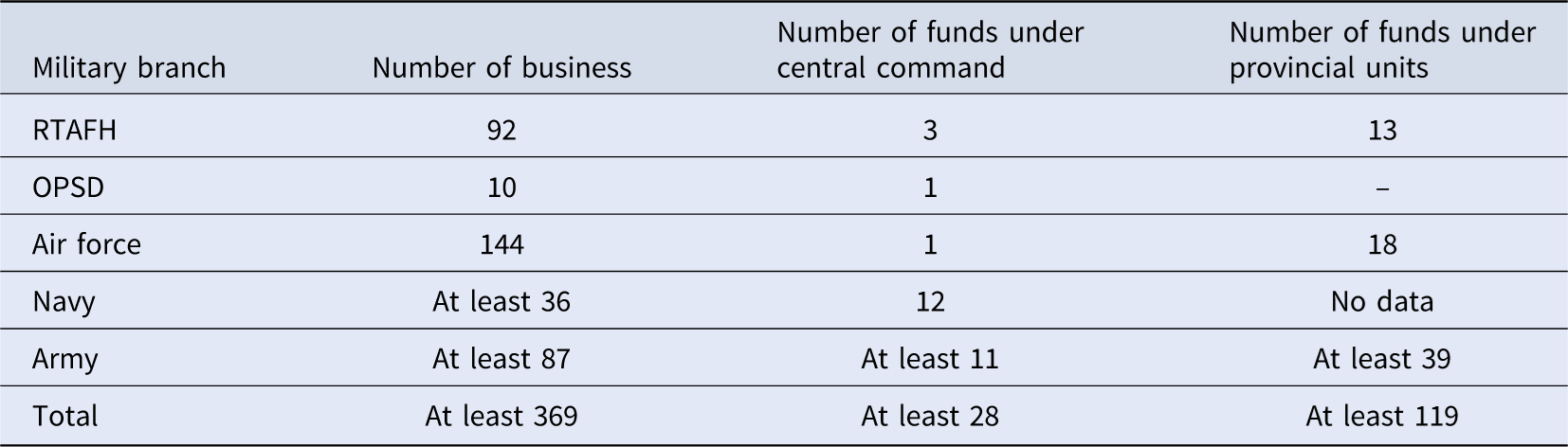
While other government agencies are also allowed to establish businesses for internal welfare, none has as many or as wide a variety as the military. Typically, civilian state agencies have only savings and loan cooperatives, funeral societies, convenience stores, and recreation facilities within their premises. The businesses of the military are far more diverse, including petrol stations, coffee shops, restaurants, golf courses, hotels and resorts, boxing stadiums, shooting ranges, oil refineries, markets, agricultural produce, mobile vegetable stalls, car care services, massage parlors, cold storage facilities, mines, event halls, boat service for scattering cremated ashes at sea, tourist attractions, pharmaceutical factory, and international airport. There is a total of at least 369 businesses for internal welfare under the five branches. The numbers for the Navy and the Army are incomplete because they refused to provide a comprehensive list.
Businesses for internal welfare are governed by the Prime Minister Office Regulation on Internal Welfare Management of State Agencies (Royal Thai Government 2004). Key provisions include the agency must establish an internal welfare committee to manage the business; the majority of customers must be its own staff; the business must be located within its premises; and the business is subject to internal audits. However, the military has violated these regulations for a long time. It has allowed private companies to rent and operate businesses on its premises, to operate beyond official hours, and to have outsiders as a majority of their customers. The Army admitted that 60 out of its 87 enterprises were commercially oriented, as were 43 out of the 123 businesses of the Air Force, 9 businesses of the RTAFH and at least 17 of the Navy (Royal Thai Air Force 2024, March 14; Royal Thai Armed Force Headquarters 2024, March 5; Royal Thai Army 2025, January 29; The Royal Thai Navy 2025, February 20)Footnote 3
Regulations mandate that, for any enterprise involving the use of the Treasury owned land (thi ratchapatsadu), the military must obtain prior permission from the Treasury Department and sign a revenue-sharing agreement with them because this department has authority over the land utilized by the military. However, this rule has been persistently ignored. The military began to apply for the Treasury’s permission only when the Future Forward/People’s Party had raised concerns in parliament. Then, in February 2020, Army Chief General Apirat Kongsompong signed an agreement with the Treasury, pledging to share revenue from commercial-like enterprises. Other branches followed suit, but as of mid-2025, the process has not been completed (Royal Thai Navy 2025, February 20)
The violations were hardly a secret. Most of these businesses had operated openly for years. Treasury officials must have been aware of the misuse of state land, yet they failed to act. Although this business category is only subject to internal audits, SAO has authority to investigate if it learns of misconduct. But the SAO did not launch an investigation until December 2022, when it found 40 army businesses misusing state land and violating regulations. Still, no disciplinary action was initiated (Royal Thai Army 2022, December 9).
Even though the Army chief agreed to share profits from 60 commercial-oriented operations, one highly lucrative venture was excluded: the Lumpinee Boxing Stadium. Since its creation in 1956, the Army has never shared the stadium’s profit with the government. It is categorized as a business for “internal welfare,” and so has no obligation to share the profits. Between 2013 and 2016 alone, the stadium reportedly generated over 463 million baht in profit for the Army’s welfare fund (Manager Online 2017).
In late 2022, the Army signed memorandums of understanding with three international combat sports companies, granting them rights to organize and broadcast fights worldwide. The Army refused to disclose the annual profits. The House Committee estimated that the stadium generates between 58.5 million and 97.2 million baht per year for the Army (Secretariat of the House of Representatives 2025, p. 96). Interestingly, the revenue from the international organizers is relatively low, despite worldwide advertising rates reportedly being around 350,000 baht per minute. Army officers explained that they did not seek a higher rate because they felt gratitude to the companies for reviving the stadium business after the COVID-19 pandemic and for promoting Thailand’s soft power.Footnote 4 This questionable deal raises legitimate concerns about hidden interests.
Despite the Army finally reclassifying the stadium as a commercial enterprise in October 2022, it has yet to sign a revenue-sharing agreement with the Treasury and it likely never will. As of 2026, the issue has faded into silence, as the Treasury itself appears either passive or too intimidated to compel the Army to finalize the agreement. This impasse underscores how the military’s dominant power effectively paralyzes civilian authority, deterring oversight. Consequently, the armed forces are permitted to carry on their business interests with total autonomy, enjoying private benefits from the blatant exploitation of state resources. Although the Treasury has the legal mandate to collect revenue, the military’s neo-feudal power places it above the law.
The number of internal welfare funds has increased, particularly those of the Army. These funds are managed either by the central command in Bangkok or by various provincial units. Unit commanders have significant autonomy, including over the appointment of the members of welfare fund committees. These committees hold authority over initiating or terminating business operations, staffing, financial management, and setting policies for external employment and service fees. Although the Army central command maintains oversight authority, the sheer volume of these funds often results in lax supervision, creating opportunities for mismanagement. A memorandum from the Army Service Support unit to the Army Commander-in-Chief, General Narongphan Chitkaewtae, revealed that several provincial units failed to submit annual financial reports to the central command, while others provided reports that did not meet standard requirements. The memo highlighted failures in revenue and expense management, non-compliance with tax regulations, and the unauthorized use of state land for commercial purposes (Royal Thai Army, 2022, August 29). Additionally, recent internal audits discovered that certain units processed salaries and special allowances in excess of authorized entitlements. Instances of fraud were also identified, specifically in the use of tax invoices to claim VAT credits for goods that do not qualify for the credits. Despite these findings, no disciplinary action was recommended (Army Internal Audit Office 2024). While loose management allows local commanders to mismanage wealth within their jurisdictions, profits are also strategically and asymmetrically distributed to lower ranks to foster and maintain loyalty networks.
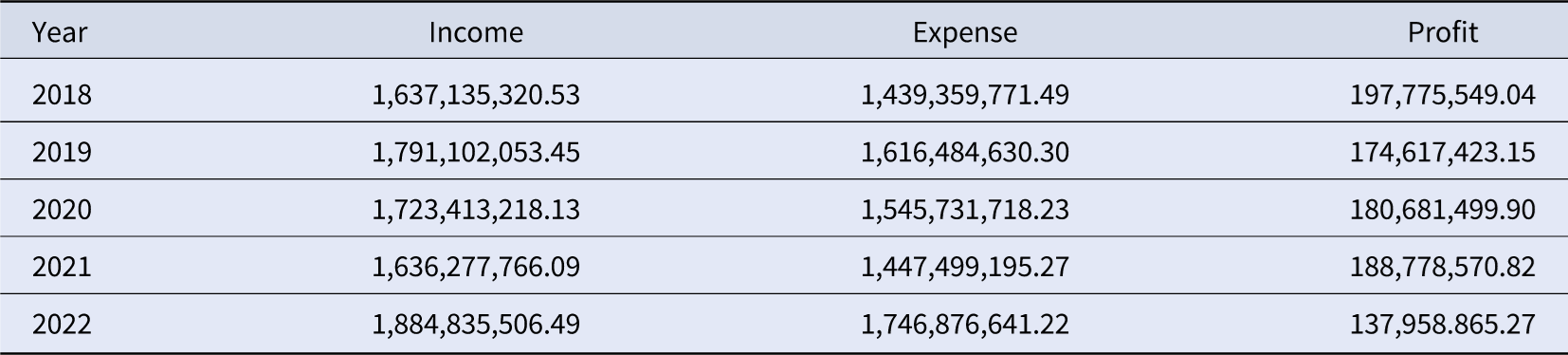
The claim that these ventures provide welfare for low-ranking personnel is questionable because the military leaders refuse to disclose their total revenue. The Navy reported that it had expenses for internal welfare of 209 million baht in 2023 (The Royal Thai Navy 2024, November 27), yet the House Committee found that its business selling tap water and electricity to the residents of Sattahip District alone generated more than half of that amount. Between 2018 and 2023, this business generated a profit of between 137.958 million and 197.775 million baht (Royal Thai Navy 2024, February 13), while the Navy has other sources of income from its numerous businesses.
While the military retains the profits from its commercial ventures for internal use, it paradoxically relies on the state to fund the expansion of these very enterprises. By framing business growth as a matter of “national security”, and presenting these ventures as contributing to that growth, the military successfully secures government budget allocations for business expansion. For example, the OPSD’s Defence Pharmaceutical Factory (2022) requested a budget of 938 million baht in 2024 to build a new factory. They argued that the Factory guarantees “drug security” for the country, yet most of the drugs produced are common household medicines and cosmetics already produced in abundance by the Government Pharmaceutical Organization and private companies and the Factory incurred a loss of 70 million baht in 2023, disguised by an allocation of 80 million baht from the state budget. This practice illustrates a core feature of military economic exceptionalism. While profits are funneled into internal patronage networks, the financial burden is offloaded onto the state budget under the guise of security requirements. This ensures the viability of military fiefs at the taxpayer’s expense, channeling tribute to the feudal lords, while remaining insulated from civilian oversight.
The high number of business ventures requires a high number of military officers to take care of the operations. Although there are no specific figures for the number of military officers working in various businesses, I estimate that possibly around 1,000 commissioned military officers are required for managing the internal welfare funds alone. The regulation requires that the business and the internal welfare funds be overseen by either a central committee or a provincial unit committee. As of 2025, there are at least 369 businesses for internal welfare, which are overseen by at least 28 central committees and at least 119 provincial unit committees (see Table 1). The maximum number of members is seventeen for a central committee and seven for a provincial unit committee, and they are usually drawn from ranks ranging from colonel to general. In total, the 28 central committees need around 476 military officers and the 119 provincial unit committees require another 833 military officers (Secretariat of the House of Representatives 2025, pp. 54–56). These officers are responsible only for managing the internal welfare funds. Beyond these committees, many commissioned and low-ranking officers are employed in managing the daily operations of various enterprises.
Number of business of military internal welfare funds as of August 2025

Table 1. Long description
A table comparing the number of businesses, funds under central command, and funds under provincial units across different military branches. The table has 6 rows and 4 columns. The columns are labeled ‘Military branch’, ‘Number of business’, ‘Number of funds under central command’, and ‘Number of funds under provincial units’. The rows are labeled with different military branches: RTAFH, OPSD, Air force, Navy, Army, and Total. Row 1: RTAFH, 92, 3, 13. Row 2: OPSD, 10, 1, -. Row 3: Air force, 144, 1, 18. Row 4: Navy, At least 36, 12, No data. Row 5: Army, At least 87, At least 11, At least 39. Row 6: Total, At least 369, At least 28, At least 119.
Regulations specify that the commander of each military branch serves as the ex officio chair of the central committee, while unit commanders serve as the ex officio heads of their respective provincial welfare funds, unless a subordinate is appointed to manage it. The curriculum of the military academy does not include business management, and there are no requirements for military business administrators to supplement their knowledge through specialized courses. The only role requiring specific professional qualifications is that of the treasurer, who must possess financial expertise (Royal Thai Army 2011). The lack of professionalism mirrors a feudal system, where status was hereditary or tied to rank, not skill. The “management” described here is a perk of power, not a professional job. These businesses serve as a “diversion of focus” that keeps the elite class busy and funded during peacetime, in much the same way that feudal lords focused on managing their estates when not at war.
In parallel to this diversion of focus, the Thai armed forces have an astonishingly high number of generals. As of 2024, the number was around 2,000, which is higher than that of the United States. Ironically, about 700 Thai generals hold no command role or key positions, serving instead in “specialist” or ceremonial posts (The Nation 2024). A bloated nobility suggests a system designed to provide patronage and status to a loyal elite class rather than to fulfill a functional defense need.
Businesses generating off-budget funds
Apart from the regular budget allocated by the government, all government agencies are allowed to have off-budget funds. The objective is to provide financial flexibility to state agencies. These funds may come from loans, donations, or profits from their own businesses. Some state agencies use part of these funds to complement their regular budget, but the military has never done so. Oversight is looser than that of the regular budget, as these funds are not scrutinized by parliament through the budget approval process. They are governed by the State Fiscal and Financial Disciplines Act, B.E. 2561 (Thai Government 2018), which allows a state agency to draw up its own regulations concerning the objective and usage of the funds. The funds can be used for office repairs, training courses, educational tools, social activities, and temporary hiring. State agencies are obliged to submit an annual financial report to the SAO for examination (Royal Thai Government 2018), but the military routinely fails to comply. Moreover, while all other state agencies have only one type of off-budget fund, the military is the only institution to possess two types. The Committee knew about the total sum of the type 1 funds only, simply from the Budget Bureau’s annual report. The military refused to disclose the total amount of type 2 funds and the Budget Bureau did not have them either. How these funds are used is kept in darkness. They refused to clarify to the Committee how these enormous funds were spent.
The following businesses contribute to type 1 funds: the Northern Petroleum Development Center in Fang District, Chiang Mai province; the Weapon Production Centre; the Defense Industry and Energy Center; the Military Battery Factory; the Defense Pharmaceutical Factory; Defense Industry and Energy Center; the Military Explosives Factory; at least 50 military hospitals and medical centers; and over 40 military education institutes. The House Committee did not receive any financial reports for these businesses.
The Budget Bureau’s reports for the 2022–2025 fiscal years indicate that the type-1 off-budget funds of all armed forces, including the Defense Technology Institute, amounted to over 40 billion baht per year. The Army’s share was over 50 percent of the total, about 23–29 billion baht each year (see Table 2). These off-budget funds are larger than the regular budget of many ministries. For example, the Ministry of Foreign Affairs received only 7,556 million baht and 8,869 million baht for fiscal years 2023 and 2024 respectively (Budget Bureau 2024b, p. 169). When the House Committee requested to see regulations governing the funds and annual reports, the military simply refused to disclose the information. A letter from the SAO (2024) to the Committee indicated that it was not even aware of the military’s type-2 funds (State Audit Office 2024).
Financial status and spending plans of the military’stype-1off-budget funds Value: in millions of baht

Table 2. Long description
A table showing financial status and spending plans of military’s off-budget funds in millions of baht. The table has 6 columns and 4 rows. Column headers are 2022, 2023, 2024, 2025, 2026, 2027. Row labels are 1. From previous year, 2. New revenue, Total 1 + 2, Spending plan. Row 1: 19,064.30, 19,462.17, 16,558.33, 114,665.47, 12,954.78, 11,525.03. Row 2: 23,734.53, 23,221.13, 24,995.16, 31,968.47, 32,598.43, 31,090.03. Row 3: 42,798.83, 42,683.31, 41,553.50, 46,633.94, 45,544.21, 42,342.06. Row 4: 23,336.66, 26,124.98, 26,227.82, 28,788.98, 29,324.55, 29,647.59.
Source: Budget Bureau (2024c, p. 21) “ฉบับรายงานสถานะและแผนการใช้จ่ายเงินนอกงบประมาณของหน่วยรับงบประมาณ” [Report on the Status and Expenditure Plan of Off-Budget Funds for Budgetary Agencies].
The type 2 off-budget funds come from the operation of television networks and radio stations. These are even murkier. The military is the only institution that possesses them, and it refused to disclose any financial reports and regulations governing type 2. The SAO did not have access to the information either.
The military has controlled major public communication channels since the 1950s, when the country was ruled by the military regime of Field Marshal Sarit Thanarat. Currently, there are 196 military radio channels, of which 122 belong to the Army, 36 to the Air Force, 21 to the Navy, and 14 to the RTAFH. National security has always been the rationale why the state must control major public communication channels. However, many of these radio channels are leased out to private companies for purely entertainment and commercial purposes, playing pop and country music all day long. The Army’s TV 5 has been the least popular channel in Thailand, ranking 18th out of 19 channels in 2025 (National Broadcasting and Telecommunication Commission et al. 2025, pp. 8–11). These stations, thus, ceased to be a major communication link between the state and the public long ago. In times of crisis, such as the COVID-19 pandemic and natural disasters, people turn to popular private channels and social media for information. Military radio and television channels are, however, still excellent sources of income for the military.
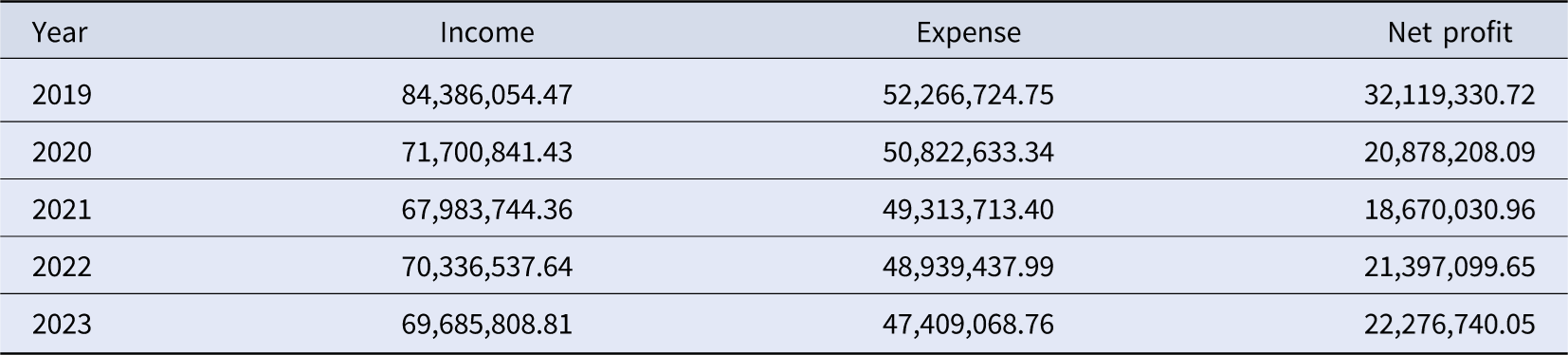
Between 2019 and 2023, the Navy’s 21 radio channels yielded an annual profit between 18 million and 32 million baht (see Table 3). Again, the Navy refused to disclose full financial reports, making it impossible to know if there were irregularities.
Revenue and expense of the Navy’s radio channels, 2019–2023 in baht

Table 3. Long description
The table presents the financial data of the Navy’s radio channels over five years, detailing income, expenses, and net profit. It has five rows and four columns. The columns are labeled Year, Income, Expense, and Net profit. The rows are labeled with the years 2019, 2020, 2021, 2022, and 2023. Row 1: Year, 2019; Income, 84,386,054.47; Expense, 52,266,724.75; Net profit, 32,119,330.72. Row 2: Year, 2020; Income, 71,700,841.43; Expense, 50,822,633.34; Net profit, 20,878,208.09. Row 3: Year, 2021; Income, 67,983,744.36; Expense, 49,313,713.40; Net profit, 18,670,030.96. Row 4: Year, 2022; Income, 70,336,537.64; Expense, 48,939,437.99; Net profit, 21,397,099.65. Row 5: Year, 2023; Income, 69,685,808.81; Expense, 47,409,068.76; Net profit, 22,276,740.05.
Source: Royal Thai Navy (2025, February 20). Document No. Ko.ho. 0505/353.
The RTAFH, which owns 14 radio channels, disclosed a financial statement for four channels, all of which are leased out to private operators. There, the House Committee found irregularities. The statement shows that in 2016, the RTAFH received rental fees and interest totaling 70,457,834.69 baht, and reported expenses of 70,489,500 baht, yielding a loss of 31,665.31 baht. This loss was a result of anomalous expenses, including payments to support the welfare of subordinate units (15,780,000 baht), charity and religious merit-making (630,000 baht), gifts and souvenirs (7,490,000 baht), the RTAFH housewife association (2,400,000 baht), the club of retired RTAFH military (1.8 million baht), military welfare (1,800,000 baht), domestic and international trips (7,900,000 baht), staff civic activities (3,190,000 baht), sport and recreation activities (2,754,500 baht), and a lump-sum vehicle allowance (19,644,000 baht). Similar issues appeared in 2017-2022 financial reports (Royal Thai Armed Forces 2016–2022). The RTAFH claimed that these expenses were operational costs of the radio business. In practice, the RTAFH leased out the channels to private operators, who bore the major operational costs. In fact, these payments were mostly donations and internal welfare activities. Perhaps such practices are one of the reasons why the armed forces are unwilling to disclose their financial reports.
The evidence amassed by the House Committee, though incomplete, revealed a neo-feudal power structure within which the branches of the military control vast “off-budget” funds that dwarf the budgets of civilian ministries, maintain monopolies over public infrastructure, and extract wealth from “fiefdoms” through rent-seeking. This feudal character is further cemented by their defiance of oversight authority. They shield these funds from proper scrutiny and routinely ignore the SAO, acting above the law. The conversion of these profits into patronage spending, funding social clubs, international trips, and gifts for generals mirrors a feudal system designed to maintain the loyalty of an elite warrior caste at the expense of the public interest.
The Army’s Television Channel 5
Among the various enterprises that contribute to the military’s off-budget funds, the Army’s Television Channel 5 stands as the most scandalous case. Despite being the subject of investigation and public disclosures, no individuals have ever been held accountable for the huge loss of state money by this enterprise. The regulatory bodies mandated to oversee such entities have consistently failed to pursue legal action. As the following section will demonstrate, this case involved exploitation of public assets, nepotism, violation of the rule of law, and impunity.
The Army’s Channel 5 was created in 1958 by Field Marshal Sarit and is now the only military television station. The Army Commander serves as the ex officio chairman of the board. It is the least popular channel in Thailand and has made little profit from television broadcasting in recent years. However, this enterprise holds the rights to two digital multiplexers, which allow the Army to collect revenue by leasing out network capacity to private companies. Although the Army refused to disclose its revenue, calculations based on regulations of the Office of the National Broadcasting and Telecommunication Commission (NBTC) suggest that the Army’s annual income from leasing its network infrastructure to private companies may be around 822 million baht (Secretariat of the House of Representatives 2025, p. 33).
The House Committee invited Channel 5’s managing director and deputy director on February 20, 2024, and March 12, 2024, respectively, to explain about the relationship between the Army, Channel 5, and the RTA company. Both of them claimed that Channel 5 has no connection whatsoever to the RTA and that they did not know anyone within the organization, despite evidence to the contrary (House of Representatives 2024, February 20, 2024 March 12).
In 1997, the Army established a private firm named RTA (stands for Royal Thai Army), funded with 250 million baht of its own capital and registered as a public company. The objective was for RTA to make profits from producing program content for Channel 5. The Army held a 50.04% stake, held under Channel 5’s managing director, and the remaining 49.96% was held by six army generals (RTA 2023). A few months after RTA’s establishment, Thailand was hit by the Asian Financial Crisis of 1997, which had a significant impact on the Thai Military Bank (TMB). Prior to the financial crisis, TMB had ranked as the 12th largest bank in the country. Its profits came not from its success in a competitive market but from its role as a cornerstone of the military’s business activities, protected by political patronage and institutional barriers (Kanda Reference Naknoi and Montesano2021). TMB was the primary repository for the military welfare funds.
TMB’s stock price plummeted, and it incurred massive debts. Recognizing that several military agencies and many military personnel were major shareholders in TMB, the Army intervened to stabilize the bank’s stock price. It achieved this by having RTA take out an interest-free loan from Channel 5 to purchase shares of the bank, totaling 1,446,774,940 baht. Channel 5 also appointed RTA as its representative to borrow 1,615,298,000 baht from TMB to invest in a satellite television project. In 2003 during the Thaksin Shinawatra administration, an investigation committee concluded that the actions of the Army and Channel 5 violated the principles of good governance and were beyond justification. In particular, the committee pointed out that RTA was listed on the stock exchange, outsiders were allowed to hold its share, and the same individuals filled the posts of senior executives of the Army, Channel 5, and RTA so that the contracting and receiving parties were in fact the same people. Furthermore, a Chinese company registered in the British Virgin Islands had become a shareholder of RTA and was granted the rights to purchase TMB Bank’s shares. The committee recommended that the Army should sell all its shares in RTA if it intended for RTA to do business with Channel 5 (Isra News 2019). As of 2025, the Army had taken no action and still owns the RTA’s 1.2-billion-baht debt.
Legally, the Army does not have authority to engage in any business operations other than those generating funds for internal welfare. Besides, this arrangement violated a 1976 junta order, still in force, that prohibits high-ranking military officers from serving as executives in any business corporation or lending money to private companies. Any violation of this order is considered a serious offense (Bawonrattanarak Reference Bawonrattanarak2023a and Reference Bawonrattanarak2023b). The military officer cadre must be well aware of the existence of these laws, but they simply disregard them. The committee later submitted its findings to the NACC for further examination. Unsurprisingly, the NACC took its time but reached a conclusion in November 2023 that there was no evidence of corruption, the Army had merely been careless about strictly adhering to laws and regulations. No disciplinary action was recommended (Isra News 2023).
The case of Channel 5 serves as a definitive synthesis of institutionalized impunity, where documented legal violations and massive losses of state funds result in zero accountability. Regulatory bodies, paralyzed by the military’s dominant power, consistently reclassify the exploitation of public assets as mere “carelessness” rather than corruption. This ensures that high-ranking officers remain shielded from disciplinary action, even when caught in blatant conflicts of interest with private firms like the RTA company. Ultimately, the station stands as a stark reminder that the military’s business operations function as a “state within a state,” existing entirely beyond the reach of civilian law.
The biggest landlord
The Ministry of Defense is the largest holder of state land in Thailand. Its use of state land is further evidence of its feudal behavior. Land is not only a fundamental resource for the military to operate its own businesses mentioned above but also provides opportunities to participate in new government investments by contributing the required land and receiving in return a share of the profits. This rent-seeking behavior echoes the behavior of the sakdina lords. A large amount of land is also used for luxurious facilities, which are enjoyed by military officers and which serve as status symbols. No other state agency can afford that.
Legally, military land is part of state-owned land allocated for military use. There are three categories of state land: land under the authority of the Treasury Department; forest land and national parks under the Forest Department; and agricultural reform land under the Ministry of Interior. The military holds land in all three categories, but most falls under the authority of the Treasury. The military acquired this land in three major phases: the seizure of royal lands after the abolition of absolute monarchy in 1932; the expansion of territory during counterinsurgency operations; and its involvement in royal-initiated development projects (Chambers and Waitoolkiat Reference Chambers and Waitoolkiat2017, p. 41).
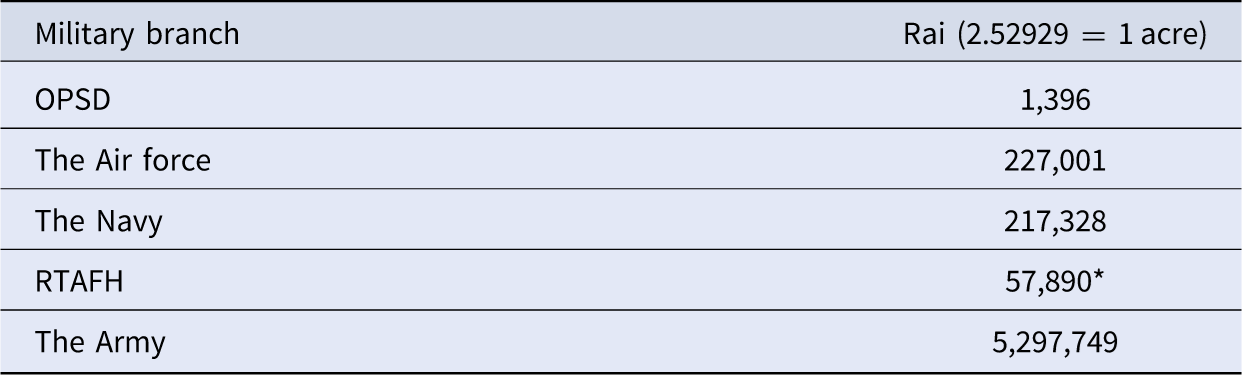
As shown in Table 4, the armed forces occupy 5.8 million rai of Treasury-owned land, accounting for 45.5% of the Treasury’s total holdings. Within this estate, the Army is the “dominant lord” among the branches. When all categories of state land are consolidated, the Army’s total territory reaches a staggering 5,981,100 rai (approximately 956,976 hectares) (Royal Thai Army 2024, May 30). This control over the geographical basis of feudal power provides the Army with the necessary territorial assets to operate the highest number of commercial ventures among the armed services. In contrast, the RTAFH and OPSD possess the smallest shares of land. This disparity further reinforces the decentralized and factional nature of the institution, as a notable gap exists between the service branches and the central administrative bodies. While the OPSD and RTAFH are theoretically responsible for coordination and oversight, they hold only a fraction of state land. Furthermore, the immense territorial control is partitioned into localized sub-fiefs controlled by regional commanders. By holding nearly half of the Treasury’s land, the military, the Army in particular, operates as a land-holding aristocracy. This control allows individual units to enter into commercial ventures, such as golf courses and resorts. This land serves as the physical foundation for the military’s economic exceptionalism, providing the resources necessary to sustain internal loyalty and institutional autonomy far beyond the reach of civilian auditors.
Treasury-owned land under military control

Table 4. Long description
A table titled ‘Treasury-owned land under military control’ with six rows and two columns. The columns are labeled ‘Military branch’ and ‘Rai (2.52929 = 1 acre)’. The row labels and values are as follows: OPSD, 1,396; The Air force, 227,001; The Navy, 217,328; RTAFH, 57,890; The Army, 5,297,749. The Army holds the largest amount of land, while OPSD holds the smallest.
Source: Office of Permanent Secretary for Defense (2024, May 15); Royal Thai Air Force (2024, June 24); Royal Thai Army (2024, May 23); Royal Thai Armed Forces Headquarters (2024, May 23); Royal Thai Navy (2024, June 5).
* The figure of the RTAFH includes land under authorities of treasury and other agency.
The military owns many golf courses occupying a significant area. The Air Force’s eleven golf courses cover a total area of 3,122 rai and the Navy’s eight golf courses a total area of 3,002 rai (Secretariat of the House of Representatives 2025, pp. 93–99). There are 107 military camps in 60 provinces and 69 of them are located in urban areas (Naknoi and Chambers, Reference Naknoi, Chambers, Chambers and Pathmanandforthcoming). Many of the courses are located near these urban areas. Many provinces have more than one military golf course. Bangkok has one Air Force course, one Army course, and another Air Force course straddling the boundary between Bangkok and Pathum Thani province. The Air Force and the Army each has one course in Chiang Mai. The armed forces claim these venues provide officers with access to affordable facilities for maintaining good health. In reality, the benefits are more complex. The courses are also visible markers of the military’s special status, instruments for patronage and networking, and places where generals are treated like feudal lords, attended by a large entourage with free service from conscripts.
The privilege the military enjoys is highlighted when comparing its golf courses to public parks. The Air Force’s 680-rai Dhupatemiya Course, about five kilometers from Don Mueang International Airport, is larger than Bangkok’s biggest public park, the 500-rai Rama IX Park. While the Dhupatemiya Course serves an average of 100 people a day, Rama IX Park received 4,835 visitors on a typical weekday and 8,260 visitors on a holiday in 2019 (Thairath 2019). An Air Force officer pays only 100 baht (about US$ 3) per round at the Dhupatemiya course, whereas outsiders are charged between 300 and 1,000 baht (US$ 9–30). In 2023, the Dhupatemiya Club generated a profit of just 11 million baht for the Air Force’s internal welfare fund. However, the estimated land value of the 680-rai plot is approximately 11.15 billion baht (at 16.4 million baht per rai) (Krungthep Thurakij 2024). This means the profit generated is less than 0.01% of the land’s value. This luxurious empire, enjoyed by a small number of officers, comes at a huge cost to the country. This argument can be applied to military hotels, resorts, and recreation centers as well.
The People’s Party called for the Air Force to return the land of the Dhupatemiya Course to the Treasury for use as a public park and facilities because there are no public parks in Pathum Thani province. The Air Force countered with arguments about military security, stating that the golf course is under a flight approach area for aircraft and is reserved for military security operations (House of Representatives 2024).
The Air Force also has the Kantarat golf course nearby, sited in a space of 335 rai between two parallel runways of Don Mueang International Airport. In 2023, it provided the Air Force with a profit of 5 million baht, which went toward its internal welfare fund. The People’s Party demanded that the land be transferred to the Airports of Thailand (AOT), which operates Don Mueang Airport, so that AOT could improve the airport’s safety standards and increase flight traffic. The Air Force demanded compensation of 3,000 million baht, which was too high for AOT to accommodate (Thansettakij 2024).
The military’s control over golf courses is an expressive aspect of its neo-feudal character. These courses are visible expressions of privilege. The staggering inefficiency of this use of land reflects a pre-modern mindset where land is used for status and recreation rather than for economic productivity or the national interest. The military’s refusal to return land to the central Treasury, and their excessive demand for compensation, mirrors the ability of European feudal lords to hold onto their fiefdoms, and use them inefficiently, in defiance of the central state or advancing capitalism. By cloaking these private luxuries in the language of military security, the armed forces preserve their role as a landlord whose territorial holdings and social privileges remain untouchable by law or public need.
The Eastern Economic Corridor
The Navy has occupied a large area of land in the coastal area of Thailand’s eastern region. The total area is 214,607 rai (84,848 acres) in Chonburi and Rayong provinces. The coast is popular among tourists and the region has become the country’s industrial development zone since the mid-1980s. In 2018, the coup-installed government launched an extension of this development zone known as the Eastern Economic Corridor (EEC). This project offers a case study of a business venture prosecuted by a single branch of the military. It also illustrates the persistence of neo-feudal rent-seeking behavior.
Since the early Cold War period, the Navy has profited from a concession to supply electricity to over 56,000 households in Chonburi’s Sattahip District. It does not generate electricity but maintains control over the local power grid and serves as a commercial middleman by buying power from the Provincial Electricity Authority to resell for profit (see Table 5). It justifies this monopoly role on grounds of guaranteeing energy security for a military zone. However, the area has long ceased to be primarily a military zone and is now full of residential homes, shops, restaurants, hotels, resorts, condominiums, shopping malls, and water parks. The Navy’s record in supplying energy is reportedly quite poor, as there have been frequent complaints from residents about power outages caused by exploding transformers, broken or burning power lines, and slow service improvements (For example, the Royal Thai Navy 2026). Without competition, the Navy has no incentive to improve its services.
Revenues from the Navy’s electricity business in Sattahip District in baht

Table 5. Long description
A table with five rows and four columns detailing the Navy’s electricity business revenues in Sattahip District. The columns are labeled Year, Income, Expense, and Profit. The years listed are 2018, 2019, 2020, 2021, and 2022. Row 1: Year 2018, Income 1,637,135,320.53, Expense 1,439,359,771.49, Profit 197,775,549.04. Row 2: Year 2019, Income 1,791,102,053.45, Expense 1,616,484,630.30, Profit 174,617,423.15. Row 3: Year 2020, Income 1,723,413,218.13, Expense 1,545,731,718.23, Profit 180,681,499.90. Row 4: Year 2021, Income 1,636,277,766.09, Expense 1,447,499,195.27, Profit 188,778,570.82. Row 5: Year 2022, Income 1,884,835,506.49, Expense 1,746,876,641.22, Profit 137,958,865.27. The table shows the income, expense, and profit in baht for each year.
Source: Royal Thai Navy (2024, February 13).
A new lucrative opportunity for the Navy emerged after the coup in 2014. In 2018, General Prayuth Chan-ocha’s government launched the EEC along with a project to develop the Eastern Aviation City beside the U-Tapao military airport. Significant investment was needed to develop infrastructure and public utilities across Rayong, Chonburi, and Chachoengsao provinces, including U-Tapao Airport. This project brought the Navy a new revenue stream from land rents and a share of the profits from electricity and water sales in the EEC, starting in 2018. The Navy claimed that the revenue was needed to provide internal welfare to alleviate negative effects on soldiers living in the area, although the Navy already has housing for its personnel within its naval base. While the Navy is benefiting from this new business, the financial burden of the area’s development falls on taxpayers. The government has granted budgets for the U-Tapao Airport expansion project while some revenue from the airport goes to the Navy’s internal welfare funds (Budget Bureau 2026, pp. 916–918). The Navy’s neo-feudal conduct enables the accumulation of wealth from public resources.
Land disputes with civilian
Agriculture remains one of Thailand’s most vital economic sectors. However, a perpetual challenge facing the industry is that almost 3-in-10 of farmers are landless (Policy Watch Reference Watch2025). Small-scale farmers pay high rental fees to landlords or face allegations of encroaching on protected forest lands. The concentration of massive landholdings by the military has led to numerous disputes with farmers. The military uses its political influence to assert authority over these territories and protect its private fiefdoms.
Among the various branches of the armed forces, the Army has the most disputed territory. Apart from the Treasury-owned land, the Army occupies 615,028 rai owned by the Forestry Department. According to its own data, 1,203,618 rai of land under its control has been encroached upon by civilians (Royal Thai Army, 2024, May 30). In reality, the farmers had often occupied this land before it was declared as a reserved forest or national park and thus off-limits for human occupation. Therefore, when the Army stakes a claim to protect reserved forest and national parks, it wanted to take back its controlled land too. Most of these disputes are concentrated in the Northeast, the poorest region. The most significant escalation in disputes between the military and small-scale farmers occurred immediately following the May 22, 2014, coup by the NCPO. Within less than a month of taking power, junta leader General Prayuth issued orders targeting the “encroachment and destruction” of natural resources. Thousands of families were forcibly uprooted from forest lands. Then, in August 2014, the junta announced a master plan to reclaim forest land nationwide, aiming to increase Thailand’s forest coverage by approximately 26 million rai (Pawakapan Reference Pawakapan2021, p. 1).
Within the first six months of this policy, over 2,000 people were charged with various offenses, ranging from forest destruction and the sale of prohibited forest products to encroaching on public land. A significant portion of the land seized from small farmers had previously been occupied by the Army, and the Army wanted it back. The speed of these operations was highlighted in a press conference on September 7, 2014, by Colonel Sommai Busaba, Chief of Staff of the 2nd Army Region’s Operations Division. He claimed that within a three-month period, the military successfully “reclaimed” extensive forest tracts belonging to the Second Army Region, resulting in the seizure of fifteen plots totaling more than 50,000 rai. The unit set an ambitious target to reclaim at least one million more rai of land (Krungthep Thurakij 2014). While the Army was the driving force behind the reclamations, the Treasury Department and the Forest Department, as the official custodians of the disputed land, were required to serve as plaintiffs in the criminal cases against the farmers. In most of these cases, the villagers were found guilty, sentenced to imprisonment, and ordered to pay fines to the state (I-law 2019).
The Army’s Nongwuaso Model in Udon Thani province is an intriguing case that demonstrates the military’s calculated and strategic approach to managing land it occupies when faced with civilian pressure. It is part of a larger trend where military landholdings overlap significantly with civilian areas (Naknoi and Chambers Reference Naknoi, Chambers, Chambers and Pathmanandforthcoming). This initiative emerged shortly after the Pheu Thai-led elected government took office and began facing intense public criticism. The backlash followed Prime Minister Srettha Thavisin’s announcement that his government had no policy to reform the military, but rather sought to “develop the country alongside the military,” a move seen by many as Pheu Thai Party abandoning the reform agenda in order to please the military. As criticism mounted, the Srettha government felt compelled to demonstrate that the military was proactively improving itself. Consequently, on October 31, 2023, Srettha held a press conference at the Internal Security Operations Command headquarters to launch the Nongwuaso Project. Srettha and several generals announced that the Army would take 9,276 rai of land under its control in Udon Thani Province and “deliver it to the people” by December 25, 2023, as a model for other military-controlled areas (Workpoint Today 2023).
However, the reality on the ground was far more complex. A group of 1,458 villagers had been embroiled in a long-standing dispute with the Army over 18,515 rai of land. The 9,276 rai designated for the project represents only half of the disputed area and a mere 3.5 percent of the total land occupied by the military in Udon Thani. Crucially, the Army continued to classify the villagers claiming rights to this land as “encroachers,” while the villagers maintain they settled on the land long before it was declared state property, with many possessing formal title deeds. The Nongwuaso Model lacks a formal process for the verification of rights. It explicitly excludes any grant of land ownership to the villagers; instead, it requires them to become “tenants” and pay rent to the state (Matichon 2024). In fact, it serves as a practical example of how the military, bolstered by the civilian government, manages public pressure by rebranding its occupancy as a formal rental scheme, thereby maintaining its authority over the land without conceding its rights.
Conscript as subject
Manpower was a precious resource for the political and economic power of the sakdina system. The king and nobles had control of manpower that provided them with free labor as well as flows of resources and money. The more manpower they acquired, the more powerful and prosperous they were. In the military, this model has survived to the present day. In Thailand, the army chief is the most powerful noble. According to Global Fire Power, the military personnel of Thailand totaled about 585,850 in 2025, of which 457,300 were under the Army (Global Fire Power 2025). Under the country’s compulsory military service laws, each year between 2013 and 2023, the armed forces recruited between 93,480 and 104,734 new conscripts (The Standard 2021). The majority of them are from lower-income backgrounds. Thai military business has enjoyed a supply of free labor.
The military always claims that low-ranking soldiers are the primary beneficiaries of military business through welfare schemes. However, only permanent personnel benefit from these schemes, not conscripts. Unit commanders often take advantage of conscripts. For example, in their first month, a conscript has to forfeit 6,200 baht from their monthly salary of 10,990 baht (app. US$ 343) to cover expenses, including life insurance premiums, workout uniforms, camouflage training uniforms, backpacks, ATK test kits, urine specimen cups, face masks, septic tank pumping fees, and cleaning supplies (Thairath 2024). This is the fate of commoners at the very bottom of the neo-feudal organization.
The use of conscripts as household servants is long known to be a common practice in the armed forces, which faces increasing criticism from the public but persists. The media regularly broadcast reports and clips showing conscripts doing menial household chores, hand-washing laundry for officers’ families, and taking care of the fighting cocks at a farm run by a unit commander and situated inside a military camp (Bangkok Post 2023).
Conscripts are also used for various jobs in military-run businesses, such as waiters in restaurants and clubs, maintenance staff on business premises, attendants at gas stations inside military camps, farmhands, and salespeople for farm products. Conscripts may also be put to work in the market economy and required to deliver part of their income to a superior. Recently, a conscript was reported to be working as a Grab rider and being forced to deliver 90 percent of his income to his commander, who insisted that the soldier earn at least 3,000 baht a day (Bangkok Post 2025). This pre-modern culture of forced labor within the modern armed forces was even codified in a 1912 ministerial defense law that allowed military officers to assign conscripts to serve them and their families, specifically for household chores. The law also permitted the officers to punish the conscripts as they saw fit (Ministerial Defense Law 1912). Although such practices are now illegal, they continue to the present day.
Many conscripts do not believe that their service is an honorable and proud duty. As one former conscript once told Amnesty International (2020), “We are just toy to them.” This sentiment is evident every year during the conscription lottery, when the media reports on scenes of raw emotion. Those who draw a black card and are spared from service jump and cheer with overwhelming joy. In stark contrast, those who draw the red card weep uncontrollably, and some even faint. Many young men tell the media straightforwardly that they did not want to lose out on career opportunities. What is most astonishing is the military’s indifference to these public displays. The armed forces seem completely unfazed by the fact that many young Thai men feel no pride in serving the nation. Instead of addressing the core issues, they often treat these painful moments as a joke.
Conclusion
This article is based upon data that became available because of the emergence of a political movement and political party committed to reform of the military. The data are far from complete. Indeed, one of the key findings is about the extent to which data is being suppressed. The evidence presented here demonstrates that the business operations of the Thai armed forces are not merely symptoms of “bad governance” or corruption; they are the institutionalized expressions of a deeply entrenched neo-feudal culture. This system is sustained by two interconnected structural pillars: the existence of autonomous fiefdoms and the systematic absence of external oversight.
The first pillar, the fiefdom structure, is manifested in the fragmentation of the Army, Navy, Air Force, RTAFH, and OPSD into self-governing economic entities. This decentralized architecture ensures that political primacy is inextricably linked to economic authority; the Army, as the “dominant lord,” commands the lion’s share of resources, while the coordinating bodies remain marginalized. This fragmentation serves as an obstacle to transparency because no single civilian or military authority can maintain a comprehensive view of the military’s total financial status. These fiefdoms remain effectively immune to external scrutiny. Within these fiefdoms, the logic of entitlement systematically supersedes professional duty, incentivizing military leaders to defend a system where a modern office is treated as a guaranteed grant of benefit.
The second pillar, institutionalized opacity, is the shroud that protects these fiefdoms. By invoking “national security” to justify everything from media monopolies to luxury golf courses, the military masks a system where the privatization of profit is subsidized by the state. This pillar ensures that “off-budget” funds remain in the darkness, allowing for a pattern of economic exceptionalism where systemic regulatory violations and elite leisure spending are reclassified as operational costs. This opacity does more than hide wealth; it preserves a social hierarchy that does not recognize basic human equality. The dehumanization of conscripts as a source of unpaid, coercive labor shows that the military perceives itself as an aristocratic caste rather than a brotherhood of arms, directing loyalty toward a pre-modern social order rather than the constitution or the people.
The fiefdom structure and lack of oversight allow a sustained culture of rent-seeking behavior. Rather than creating new economic value, the military exploits its control over state assets, specifically land and infrastructure, to extract wealth from the private sector and civilian government. This is most evident in the Sattahip District and the EEC, where the Navy acts as a commercial middleman for electricity; in the Lumpinee Boxing Stadium, where the Army collects fees from private combat sports companies; and in the leasing of state-owned television and radio frequencies to private entertainment companies. By reclassifying these private gains as “internal welfare” or “national security” requirements, the military ensures a steady flow of “tribute” from the modern economy into its own institutional coffers, further entrenching its status as a land-holding aristocracy. The case of Channel 5 epitomizes impunity, where documented legal violations are reclassified as “carelessness” to avoid legal action. This ensures that military leaders remain shielded from the rule of law, reinforcing the station’s role as a protected, autonomous fiefdom beyond civilian control.
The expansive commercial footprint of the Thai military is a structural manifestation of the state’s deeply embedded patrimonial character. By transforming public assets, such as state-allocated land, business for internal welfare, and off-budget revenue streams, into proprietary commercial domains, the military operates less like a centralized corporate conglomerate and more like an interconnected network of neo-feudal fiefdoms. Within this framework, economic extraction is fundamentally decoupled from market optimization. The control over provincial welfare funds and commercial enterprises allows individual generals and factional high commands to enjoy public resources. These assets are subsequently deployed to finance loyalty, lubricate internal patronage networks, and secure the officer corps’ economic autonomy.
Ultimately, the Thai military remains a self-sustaining entity that systematically diverts public wealth for private and institutional gain. The expansive bureaucratic structure, which dedicates several hundreds of commissioned officers to managing commercial ventures, diverts professional attention, inflates the officer corps, and perpetuates a political economy of impunity. As long as this neo-feudal economic structure remains intact, the transition to a professional defense institution will be stalled. Meaningful military reform, therefore, requires more than a budget audit; it demands the dismantling of the very system that allows a modern uniform to cloak a pre-modern fiefdom.
Acknowledgments
This research was supported by a Distinguished Visiting Fellowship from the Institute for Advanced Studies on Asia, University of Tokyo, and a research grant from the Faculty of Political Science, Chulalongkorn University (RPOL_68_04). I am deeply grateful to both institutions, especially Professor Jin Sato and Associate Professor Pattajit Tangsinmunkong. I owe a special debt of gratitude to Dr. Chris Baker and Dr. Michael Montesano for their profound intellectual generosity; their meticulous feedback and insightful suggestions were indispensable in shaping the final manuscript. Finally, I am thankful to Professor Thongchai Winichukul for his helpful feedback as well as the valuable comments from the three anonymous reviewers, which helped improve this paper.
Competing interests
The author declares no competing interests.


 Open access

