



1 Introduction
Let
 $d\geq 2$
be an integer and
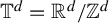 $\mathbb {T}^d=\mathbb {R}^d/\mathbb {Z}^d$
the torus of dimension d. We study a random walk
 $(x_n)_{n\geq 0}$
on
 $\mathbb {T}^d$
given by
 $$ \begin{align*} \text{ for all } n\geq 0,\quad x_n = g_n\cdots g_1x_0, \end{align*} $$
where
 $(g_n)_{n\geq 1}$
is a sequence of independent identically distributed random variables with law
 $\mu $
on
 $ {\mathrm {GL}}_d(\mathbb {Z})$
. Let
 $\Gamma $
denote the group generated by the support of
 $\mu $
, and G be the Zariski closure of
 $\Gamma $
in
 $ {\mathrm {GL}}_d(\mathbb {R})$
. In [Reference Bourgain, Furman, Lindenstrauss and Mozes12], Bourgain et al showed that if G acts strongly irreducibly and proximally on
 $\mathbb {R}^d$
, then the random walk
 $(x_n)_{n\geq 0}$
equidistributes in law to the Haar probability measure
 $ {\mathrm {m}}_{\mathbb {T}^d}$
as soon as
 $x_0$
is irrational, that is,
 $$ \begin{align*} \text{ for all } x_0\not\in\mathbb{Q}^d/\mathbb{Z}^d, \quad \mu^{*n}*\delta_{x_0} \rightharpoonup^*_{n\to+\infty} {\mathrm{m}}_{\mathbb{T}^d}. \end{align*} $$
Moreover, this result is quantitative: an explicit rate of convergence is obtained in terms of the distance from
 $x_0$
to rational points of small denominator. Following their strategy, we showed in [Reference He and de Saxcé25] that their theorem is still valid without the proximality assumption, as long as the action of G on
 $\mathbb {R}^d$
is strongly irreducible. However, the theory developed by Benoist and Quint in their series of articles [Reference Benoist and Quint4–Reference Benoist and Quint7] made it clear that when studying random walks on homogeneous spaces, it is most natural to only assume that the acting algebraic group G is semisimple. Indeed, under this assumption, [Reference Benoist and Quint6, Theorem 1.1] gives a full classification of stationary measures, which in turn implies the very general equidistribution results of [Reference Benoist and Quint7]. It is therefore desirable to obtain quantitative convergence results similar to those of [Reference Bourgain, Furman, Lindenstrauss and Mozes12] or [Reference He and de Saxcé25] in this more general setting, and this is the goal of the present article.
Of course, without the irreducibility assumption, there can exist some proper closed
 $\Gamma $
-invariant subsets of
 $\mathbb {T}^d$
, and the random walk may not equidistribute to the Haar measure, even if the starting point
 $x_0$
is irrational. So, to state our main result, we need to set up some notation. Let
 $G^\circ $
denote the identity component of G for the Zariski topology. The subalgebra of
 ${\mathcal {M}}_d(\mathbb {R})$
generated by
 $G^\circ $
is denoted by E. Since G is semisimple, we may write
 $ \mathbb {R}^d = V_0\oplus V_1 \oplus \cdots \oplus V_r, $
where for
 $i = 0,\dotsc ,r$
,
 $V_i$
is a maximal sum of simple G-modules having the same top Lyapunov exponent for the action of
 $\mu $
. Reordering the subspaces
 $V_i$
, we may assume in addition that
 $$ \begin{align*} \unicode{x3bb}_1(\mu,V_1)>\cdots > \unicode{x3bb}_1(\mu,V_r)>\unicode{x3bb}_1(\mu,V_0) = 0. \end{align*} $$
The space
 $V_0$
will play a special role in our analysis of the random walk behavior. By a result of Furstenberg, the image of G in
 $ {\mathrm {GL}}(V_0)$
is compact and, for that reason, we shall say that
 $V_0$
is the sum of all compact factors of G in
 $\mathbb {R}^d$
. We define a quasi-norm on
 $\mathbb {R}^d$
by
 $$ \begin{align*} \lvert v\rvert = \max_{0\leq i\leq r} \lVert v_i\rVert^{{1}/{\unicode{x3bb}_1(\mu,V_i)}}, \end{align*} $$
where
 $v = v_0+\dotsc +v_r$
is the decomposition of v according to the direct sum
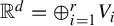 $\mathbb {R}^d = \oplus _{i=1}^r V_i$
. By convention, we set
 $\tfrac 10=+\infty $
and
 $$ \begin{align*} \lVert v_0\rVert^{+\infty} = \begin{cases} 0 & \text{if } \lVert v_0\rVert \leq 1,\\ +\infty &\text{otherwise.}\end{cases} \end{align*} $$
This quasi-norm induces a quasi-distance on
 $\mathbb {R}^d$
given by
 $\tilde {d}(x,y)=\lvert x-y\rvert $
, which projects to a quasi-distance on
 $\mathbb {T}^d$
, still denoted by
 $\tilde {d}$
. A finite measure
 $\mu $
on
 $ {\mathrm {GL}}_d(\mathbb {Z})$
is said to have a finite exponential moment if there exists
 $\tau>0$
such that
 $$ \begin{align*} \int\lVert g\rVert^\tau\,{d}\mu(g) < +\infty, \end{align*} $$
where
 $\lVert \cdot \rVert $
denotes a norm on the space
 $M_d(\mathbb {R})$
of
 $d\times d$
matrices; this definition does not depend on the choice of the norm. Our goal is the following theorem.
Theorem 1.1. (Equidistribution of semisimple linear random walks on
 $\mathbb {T}^d$
)

Let
 $\mu $
be a probability measure on
 $ {\mathrm {GL}}_d(\mathbb {Z})$
having a finite exponential moment. Denote by
 $G \subset {\mathrm {GL}}_d(\mathbb {R})$
the algebraic group generated by
 $\mu $
, by
 $G^\circ $
its identity component, and let E be the subalgebra of
 ${\mathcal {M}}_d(\mathbb {R})$
generated by
 $G^\circ $
. As above, we write
 $V_0$
for the sum of all compact factors of G in
 $\mathbb {R}^d$
. If the algebraic group G is semisimple, then for every
 $\unicode{x3bb} \in (0,1)$
, there exists
 $C=C(\mu ,\unicode{x3bb} )\geq 0$
such that the following holds.
Given
 $x_0\in \mathbb {T}^d$
, assume that for some
 $t\in (0,\tfrac 12)$
,
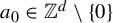 $a_0\in \mathbb {Z}^d \setminus \{0\}$
, and
 $n \geq C\log ({\lVert a_0\rVert }/{t})$
,
 $$ \begin{align*} \lvert\widehat{(\mu^{*n}*\delta_{x_0})}(a_0)\rvert \geq t. \end{align*} $$
Then, there exists
 $\gamma \in G/G^\circ $
such that, denoting
 $ W_0 = (a_0\gamma E)^\perp $
, one has
 $$ \begin{align*} \tilde{d}\bigg(x_0-\frac{p}{q}-v, W_0 \bigg) \leq e^{-n\unicode{x3bb}} \end{align*} $$
for some
 $v\in V_0$
,
 $p \in \mathbb {Z}^d$
, and
 $q\in \mathbb {Z} \setminus \{0\}$
such that
 $ \max (\lVert v\rVert , \lvert q\rvert ) \leq ({\lVert a_0\rVert }/{t})^C. $
In the above, of course,
 ${p}/{q}$
, v, and
 $W_0$
are identified with their projection to the torus
 $\mathbb {T}^d$
. A slightly more precise version of Theorem 1.1 is stated below as Theorem 6.1.
Remark 1.2. If G is connected, that is,
 $G=G^\circ $
, then
 $W_0=(a_0E)^\perp $
is entirely determined by
 $a_0$
. Existence of a large Fourier coefficient
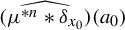 $\widehat {(\mu ^{*n}*\delta _{x_0})}(a_0)$
implies that the starting point of the random walk is close to a rational translate of an invariant closed subset of the form
 $W_0+ {\mathrm {B}}_{V_0}(0,R) \ \mod \mathbb {Z}^d$
, where
 $ {\mathrm {B}}_{V_0}(0,R)$
denotes the centered closed ball of radius R in V with respect to some G-invariant Euclidean norm on V and R is controlled in terms of
 $\lVert a_0\rVert $
and
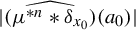 $\lvert \widehat {(\mu ^{*n}*\delta _{x_0})}(a_0)\rvert $
.
Example 1.3. (Reducible random walk)
Fix a probability measure
 $\mu _0$
on
 $ {\mathrm {SL}}_2(\mathbb {Z})$
such that
 $ {\mathrm {supp}}\ \mu _0$
generates
 $ {\mathrm {SL}}_2(\mathbb {Z})$
, and let
 $\mu =\mu _0\otimes \mu _0$
. Using the block diagonal embedding
 $ {\mathrm {SL}}_2\times {\mathrm {SL}}_2\hookrightarrow {\mathrm {SL}}_4$
, we view
 $\mu $
as a probability measure on
 $ {\mathrm {SL}}_4(\mathbb {Z})$
. In that setting,
 $E=M_2(\mathbb {R})\times M_2(\mathbb {R})$
and
 $V_0=\{0\}$
.
Assume as in the theorem that
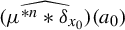 $\widehat {(\mu ^{*n}*\delta _{x_0})}(a_0)$
is large. Write
 $a_0=(a_1,a_2,a_3,a_4)$
.
-
• If
$(a_1,a_2)$
and
$(a_3,a_4)$
are both non-zero, then
$a_0E=\mathbb {R}^4$
and therefore
$W_0=\{0\}$
. Thus, the starting point
$x_0$
must be close to a rational point with small denominator. -
• If
$(a_1,a_2) = 0$
and
$(a_3,a_4) \neq 0$
, then
$a_0 E = \{0\} \oplus \mathbb {R}^2$
so that
$W_0 = \mathbb {R}^2 \oplus \{0\}$
. The theorem only allows us to conclude that
$x_0$
is close to a rational translate of the invariant subtorus
$\mathbb {T}^2\times \{0\} = W_0 \ \mod \mathbb {Z}^4$
. In particular, we can conclude nothing about the first two coordinates of
$x_0$
. Indeed, if one starts from a point
$x_0$
whose third and fourth coordinates are zero, then the random walk is trapped in the proper invariant subset
$\mathbb {T}^2\times \{0\}$
. For every frequency of the form
$a_0=(0,0,a_3,a_4)$
and for all n, one has
$\widehat {(\mu ^{*n}*\delta _{x_0})}(a_0)=1$
.








Example 1.4. (Compact factors and satellite measures)
Consider the quadratic form
 $Q(x,y,z)=x^2+y^2-\sqrt {2}z^2$
on
 $\mathbb {R}^3$
, and
 $ {\mathrm {SO}}_Q\subset {\mathrm {SL}}_3$
its special orthogonal group:
 $$ \begin{align*} {\mathrm{SO}}_Q = \{g\in{\mathrm{SL}}_3 |^t\!gJ_Qg = J_Q\}, \quad\mbox{where } J_Q = \mathrm{diag}(1,1,-\sqrt{2}). \end{align*} $$
If g is an element of the group
 $\Gamma = {\mathrm {SO}}_Q(\mathbb {Z}[\sqrt {2}])$
of elements of
 $ {\mathrm {SO}}_Q$
with entries in the ring
 $\mathbb {Z}[\sqrt {2}]$
, one can write
 $g=A+\sqrt {2}B$
, with
 $A,B$
in
 $M_3(\mathbb {Z})$
. The map
 $$ \begin{align*} g=A+\sqrt{2}B \mapsto \begin{pmatrix} A & 2B\\ B & A\end{pmatrix} \end{align*} $$
embeds
 $\Gamma $
into
 $ {\mathrm {SL}}_6(\mathbb {Z})$
. Let
 $\mu $
be a probability measure on
 $ {\mathrm {SL}}_6(\mathbb {Z})$
whose support generates the group
 $\Gamma $
.
Since
 $(\kern -2pt\begin {smallmatrix} A & 2B\\ B & A\end {smallmatrix}\kern -2pt)$
is conjugate to
 $\mathrm {diag}(A+\sqrt {2}B,A-\sqrt {2}B)$
,
 $\Gamma $
preserves a direct sum decomposition
 $\mathbb {R}^6=\mathbb {R}^3\oplus \mathbb {R}^3$
. The group
 $\Gamma $
acts on the second factor as a subgroup of
 $ {\mathrm {SO}}_{\bar {Q}}$
, where
 $\bar {Q}(x,y,z)=x^2+y^2+\sqrt {2}z^2$
is positive definite, so there is a non-trivial compact factor
 $V_0\simeq \mathbb {R}^3$
. Note that
 $V_0$
embeds densely in
 $\mathbb {T}^6$
.
However, one can check that in that setting, E is conjugate under
 $(\kern -2pt\begin {smallmatrix}\sqrt {2}I_3 & -\sqrt {2}I_3\\ I_3 & I_3\end {smallmatrix}\kern -2pt)$
to the block diagonal subalgebra
 $M_3(\mathbb {R})\times M_3(\mathbb {R})$
. If
 $a_0\in \mathbb {Z}^6\setminus \{0\}$
, both projections of
 $a_0$
to the
 $\mathbb {R}^3$
factors are non-zero (note that the direct sum decomposition is not defined over
 $\mathbb {Q}$
) and, therefore, one always has
 $a_0E=\mathbb {R}^6$
, whence
 $W_0=\{0\}$
.
Existence of a large Fourier coefficient
 $\widehat {(\mu ^{*n}*\delta _{x_0})}(a_0)$
implies that up to a rational translation with small denominator, the starting point
 $x_0$
is close to the image in
 $\mathbb {T}^6$
of a ball of controlled radius in
 $V_0$
. Note that if the starting point
 $x_0$
lies on the embedded leaf
 $V_0$
, then the random walk equidistributes with respect to (the image in
 $\mathbb {T}^6$
of) the uniform probability measure on the sphere containing
 $x_0$
for the quadratic form
 $x^2+y^2+\sqrt {2}z^2$
on
 $V_0$
.
If the sequence
 $(\mu ^{*n}*\delta _{x_0})$
does not converge to the Haar measure
 $ {\mathrm {m}}_{\mathbb {T}^d}$
in the weak-
 $*$
topology, then, by Weyl’s equidistribution criterion, there are
 $a_0\in \mathbb {Z}^d \setminus \{0\}$
and
 $t> 0$
such that
 $\lvert \widehat {(\mu ^{*n}*\delta _{x_0})}(a_0)\rvert \geq t$
for an unbounded sequence of
 $n \in \mathbb {N}$
. Letting n go to infinity along this sequence, we deduce the following qualitative statement from the above theorem.
Corollary 1.5. (Qualitative statement)
Let
 $\mu $
be a probability measure on
 $ {\mathrm {GL}}_d(\mathbb {Z})$
having a finite exponential moment. Denote by
 $G \subset {\mathrm {GL}}_d(\mathbb {R})$
the algebraic group generated by
 $\mu $
. Assume that G is semisimple. Then, for any point
 $x_0\in \mathbb {T}^d$
, either
 $$ \begin{align*} \mu^{*n}*\delta_{x_0} \rightharpoonup^* {\mathrm{m}}_{\mathbb{T}^d} \end{align*} $$
or
 $$ \begin{align*} x_0 \in \mathbb{Q}^d + V_0 + W_0 \ \mod \mathbb{Z}^d, \end{align*} $$
where
 $V_0$
denotes the sum of all compact factors of G in
 $\mathbb {R}^d$
and
 $W_0$
is a proper rational subspace of
 $\mathbb {R}^d$
invariant under the action of the identity component
 $G^\circ $
of G.
As a consequence, we recover the classification of orbit closures due to Guivarc’h and Starkov [Reference Guivarc’h and Starkov22] and Muchnik [Reference Muchnik34].
Corollary 1.6. (Classification of orbit closures)
Let
 $\Gamma \subset {\mathrm {GL}}_d(\mathbb {Z})$
be a subgroup whose Zariski closure G is semisimple. Let
 $x_0 \in \mathbb {T}^d$
. Then, the orbit closure
 $\overline {\Gamma x}$
is either the whole
 $\mathbb {T}^d$
or contained in a
 $\Gamma $
-invariant closed subset of the form
 $$ \begin{align*}\frac{1}{q}\mathbb{Z}^d + {\mathrm{B}}_{V_0}(0,R) + \bigcup_{\gamma \in G/G^\circ} \gamma W_0 \ \mod \mathbb{Z}^d,\end{align*} $$
where q is a non-zero integer,
 $ {\mathrm {B}}_{V_0}(0,R)$
is a ball in
 $V_0$
, and the sum of all compact factors of G in
 $\mathbb {R}^d$
and
 $W_0$
is a proper rational subspace invariant under the action of the identity component
 $G^\circ $
of G.
The qualitative statement could also be reformulated more simply as follows.
Corollary 1.7. (Equidistribution)
Let
 $\mu $
be a probability measure on
 $ {\mathrm {GL}}_d(\mathbb {Z})$
having a finite exponential moment. Denote by
 $\Gamma \subset {\mathrm {GL}}_d(\mathbb {Z})$
the subgroup generated by
 $\mu $
. Assume that the Zariski closure of
 $\Gamma $
is semisimple. Then, for any
 $x_0\in \mathbb {T}^d$
, either
 $\mu ^{*n}*\delta _{x_0} \rightharpoonup ^* {\mathrm {m}}_{\mathbb {T}^d}$
or
 $x_0$
is contained in a proper
 $\Gamma $
-invariant closed subset.
A particularly simple case of the above results is when the group
 $\Gamma $
acts strongly irreducibly on
 $\mathbb {Q}^d$
, that is, when
 $\Gamma $
preserves no non-trivial finite union of proper subspaces of
 $\mathbb {Q}^d$
. Then, for any
 $a_0\in \mathbb {Z}^d \setminus \{0\}$
and any
 $\gamma \in G$
, one must have
 $a_0\gamma E=(\mathbb {R}^d)^*$
, so we obtain a simpler equidistribution statement.
Corollary 1.8. (Equidistribution of
$\mathbb {Q}^d$
-irreducible random walks)

Assume that G is semisimple and acts strongly irreducibly on
 $\mathbb {Q}^d$
. Then, for every
 $\unicode{x3bb} \in (0,1)$
, there exist
 $C=C(\mu ,\unicode{x3bb} )\geq 0$
such that the following holds.
Given
 $x_0\in \mathbb {T}^d$
, assume that for some
 $t\in (0,\tfrac 12)$
,
 $a_0\in \mathbb {Z}^d$
, and
 $n \geq C\log ({\lVert a_0\rVert }/{t})$
,
 $$ \begin{align*} \lvert\widehat{(\mu^{*n}*\delta_{x_0})}(a_0)\rvert \geq t. \end{align*} $$
Then, there exists
 $v \in V_0$
,
 $p \in \mathbb {Z}^d$
and
 $q\in \mathbb {Z} \setminus \{0\}$
such that
 $ \max (\lVert v\rVert , \lvert q\rvert ) \leq ({\lVert a_0\rVert }/{t})^C $
and
 $$ \begin{align*} \tilde{d}\bigg(x_0-\frac{p}{q}-v, 0\bigg) \leq e^{-n\unicode{x3bb}}. \end{align*} $$
In particular, if
 $x_0$
does not lie on a rational translate of the
 $V_0$
leaf in
 $\mathbb {T}^d$
, then
 $\mu ^{*n}*\delta _{x_0}$
converges to
 $ {\mathrm {m}}_{\mathbb {T}^d}$
.
It was observed by Benoist and Quint [Reference Benoist and Quint6, Corollary 1.4] that if G is semisimple without compact factors and acts irreducibly on
 $\mathbb {Q}^d$
, then
 $ {\mathrm {m}}_{\mathbb {T}^d}$
is the only atom-free
 $\mu $
-stationary probability measure on
 $\mathbb {T}^d$
. By the results of [Reference Benoist and Quint7], this implies that the Cesàro averages
 $({1}/{n})\sum _{k=0}^{n-1}\mu ^{*k}*\delta _{x_0}$
converge to
 $ {\mathrm {m}}_{\mathbb {T}^d}$
. The above corollary immediately shows that convergence also holds without the averaging process. When
 $\mu $
is a symmetric probability measure on
 $ {\mathrm {SL}}_d(\mathbb {Z})$
, a general result of Bénard [Reference Bénard2, Theorem 1] implies this qualitative statement, but without the symmetry assumption, the result seems to be new.
Corollary 1.9. Assume that G is semisimple without compact factors and acts strongly irreducibly on
 $\mathbb {Q}^d$
. Then, for every
 $x_0$
irrational in
 $\mathbb {T}^d$
, the sequence of measures
 $(\mu ^{*n}*\delta _{x_0})_{n\geq 0}$
converges in law to
 $ {\mathrm {m}}_{\mathbb {T}^d}$
.
One motivation to carry out the rather technical proof presented here is its application to the spectral gap property for subgroups of algebraic groups, modulo arbitrary integers. Indeed, following a strategy of Bourgain and Varjú [Reference Bourgain and Varjú16], one can use Theorem 1.1 to answer a question of Salehi Golsefidy and Varjú [Reference Salehi Golsefidy and Varjú35, Question 2]. A particular case of the problem was studied in [Reference He and de Saxcé26], and we hope to generalize those results in a forthcoming paper.
1.1 Outline of the proof
The paper is entirely devoted to the proof of Theorem 1.1, for which we use the strategy introduced in [Reference Bourgain, Furman, Lindenstrauss and Mozes12] and, more precisely, the variant used in [Reference He and de Saxcé25] to avoid the proximality assumption. Section 2 deals with discretized algebraic combinatorics in semisimple algebras: we prove some Fourier decay estimate for multiplicative convolutions of measures satisfying natural non-concentration conditions, Theorem 2.2, generalizing results of Bourgain [Reference Bourgain11] for the real line. The main input for our proof is a sum-product theorem for representations of real Lie groups [Reference He and de Saxcé24, Theorem 1.1], which easily implies the discretized sum-product theorem in semisimple algebras; then we use some
 $L^2$
-flattening lemma similar to that used by Bourgain and Gamburd in their work on the spectral gap property.
After that, to apply the combinatorial results of the previous section to the random walk, we need to check that the measure
 $\mu ^{*n}$
appropriately rescaled is not concentrated near proper affine subspaces of E, nor near singular elements; this is done in §3. Just as in [Reference He and de Saxcé25], the argument ultimately relies on the spectral gap property modulo primes obtained by Salehi Golsefidy and Varjú [Reference Salehi Golsefidy and Varjú35]. However, because the rescaling automorphism is no longer a homothety, the proof involves a detailed analysis of the behavior of the random walk with respect to a quasi-norm on the algebra E. To help the reader understand the main ideas of the proof without having to go through all the technical details, we start with the simpler case where E is simple; even in that case, the argument is different and simpler than that presented in [Reference He and de Saxcé25], where similar estimates are needed.
In §4, we prove Theorem 4.3, an important Fourier decay estimate for the law of the random walk. This simply follows from a combination of the two previous sections when the group G is connected, but becomes more complicated without this assumption. We follow the argument used in [Reference He, Lakrec and Lindenstrauss28, Appendix B], with minor modifications.
Section 5 makes the link between the random walk on G and the random walk on
 $\mathbb {T}^d$
. The Fourier decay obtained in the previous section shows that if
 $\mu ^{*n}*\delta _{x_0}$
has one large Fourier coefficient, then reducing slightly the value of n, the measure
 $\mu ^{*n}*\delta _{x_0}$
has many large Fourier coefficients. Using a quantitative version of Wiener’s lemma, one infers a first ‘granulation statement’:
 $\mu ^{*n}*\delta _{x_0}$
is concentrated near a finite set of well-separated points in
 $\mathbb {T}^d$
.
To conclude the proof of Theorem 1.1, we run backwards the random walk, starting from the granulation estimate mentioned above. The argument uses, in particular, the diophantine properties of the random walk, and the exponential instability of closed invariant subsets, obtained using a drift function, as in [Reference Eskin and Margulis19] or [Reference Benoist and Quint6]. This is the content of §6.
1.2 Concluding remarks
Affine random walks. After some first results of Boyer [Reference Boyer17], it was explained in [Reference He, Lakrec and Lindenstrauss27] how to obtain quantitative equidistribution of affine random walks on the torus, under the assumption that the action on
 $\mathbb {R}^d$
is strongly irreducible. The arguments in that paper could be adapted to our setting.
More general homogeneous spaces. Benoist and Quint [Reference Benoist and Quint4, Reference Benoist and Quint6, Reference Benoist and Quint7] have obtained equidistribution results that are valid in the much more general setting of homogeneous spaces of Lie groups. One drawback is that their convergence theorems are not quantitative, and only concern the Cesàro averages
 $({1}/{n})\sum _{k=0}^{n-1}\mu ^{*n}*\delta _{x_0}$
.
On this subject, the first author has obtained, in collaboration with Lakrec and Lindenstrauss, some partial results for affine random walks on nilmanifolds [Reference He, Lakrec and Lindenstrauss28]; these spaces may be seen as the simplest generalization of tori, but the analysis already becomes much more intricate. Very recently, in collaboration with Bénard [Reference Bénard and He3], using a new approach avoiding Fourier analysis, the first author has also been able to obtain results for random walks on finite-volume spaces of the form
 $G/\Lambda $
, where G is
 $ {\mathrm {SO}}(2,1)$
or
 $ {\mathrm {SO}}(3,1)$
, and
 $\Lambda $
a lattice in G.
In a slightly different direction, Kim [Reference Kim29] studied effective equidistribution of expanding translates in the space of affine lattices. Also in a different direction, Lindenstrauss and Mohammadi [Reference Lindenstrauss and Mohammadi32], Yang [Reference Yang40], and Lindenstrauss, Mohammadi, and Wang [Reference Lindenstrauss, Mohammadi and Wang33] have studied effective density and equidistribution in some homogeneous spaces. Although these equidistribution results do not deal with random walks, some of the techniques used there are similar enough to ours to be mentioned here.
1.3 Notation
Here is a list of notation we use.
-
•
$f \ll g$
,
$g \gg f$
,
$f = O(g)$
, there exists a constant
$C> 0$
such that
$f \leq C g$
. -
•
$f \asymp g$
if
$f \ll g$
and
$g \ll f$
. -
•
$ {\mathrm {B}}(x,r)$
, the ball of center x and radius r. -
•
$ {\mathrm {B}}_V(\boldsymbol {\,\cdot \,},\boldsymbol {\,\cdot \,})$
, ball in the ambient space V. -
•
$H^\circ $
, the identity component with respect to the Zariski topology of the algebraic group H. -
•
$V^*$
, the space of linear forms on a linear space V. -
•
$\unicode{x3bb} _1(\mu ,V)$
, the top Lyapunov exponent associated to the random walk on a Euclidean space V defined by a probability measure
$\mu $
supported on a group acting linearly on V. -
•
$\mu *\nu $
, multiplicative convolution. -
•
$\mu ^{*k} = \mu * \dotsm * \mu $
, multiplicative convolution power. -
•
$\mu \boxplus \nu $
, additive convolution. -
•
$\mu ^{\boxplus k} = \mu \boxplus \dotsb \boxplus \mu $
, additive convolution power. -
•
$\mu \boxminus \nu $
, the image measure of
$\mu \otimes \nu $
under the map
$(x,y) \mapsto x - y$
. -
•
if
$x \in A$
, otherwise. -
•
$\#A$
, cardinality of a finite set A. -
•
$\lvert A\rvert $
, Lebesgue measure for subsets A of an Euclidean space or a torus. -
•
, a quasi-norm. -
•
$\tilde {d}(\boldsymbol {\,\cdot \,},\boldsymbol {\,\cdot \,})$
, a quasi-distance, usually associated to a quasi-norm. -
•
$\tilde { {\mathrm {B}}}(\boldsymbol {\,\cdot \,},\boldsymbol {\,\cdot \,})$
, ball with respect to
$\tilde {d}$
. -
•
$\mathbb {P}[\boldsymbol {\,\cdot \,}]$
and
$\mathbb {P}[\boldsymbol {\,\cdot \,}\mid \boldsymbol {\,\cdot \,}]$
, probability and conditional probability. -
•
$f_*\mu $
, image measure of
$\mu $
under the map f. -
•
${\mathcal {M}}_d(\mathbb {R})$
, the space of
$d \times d$
real matrices. -
•
$\mathcal {P}(X)$
, the space of Borel probability measure on a topological space. -
•
$\langle \boldsymbol {\,\cdot \,},\boldsymbol {\,\cdot \,}\rangle $
, according to the context, the natural pairing
$V^* \times V \to \mathbb {R}$
or the natural pairing
$\mathbb {Z}^d \times \mathbb {T}^d \to \mathbb {T}$
.






 if

 otherwise.


 , a quasi-norm.


2 Sum-product,
$L^2$
-flattening, and Fourier decay

In this section, we study multiplicative convolutions of measures on a semisimple associative algebra E. Our goal is to derive Theorem 2.2 below, which shows that under some natural non-concentration assumptions, such multiplicative convolutions admit a polynomial Fourier decay. This generalizes results of Bourgain [Reference Bourgain11] for
 $E=\mathbb {R}$
, of Li [Reference Li31] for
 $E=\mathbb {R}\oplus \cdots \oplus \mathbb {R}$
, and of He and de Saxcé [Reference He and de Saxcé25] for a simple algebra E.
Let E be a normed real algebra of finite dimension. The determinant
 $\det _E(a)$
of an element
 $a\in E$
is simply defined as the determinant of the multiplication map
 $E\to E$
,
 $x\mapsto ax$
. Given
 $\rho>0$
, we let
 $$ \begin{align*} S_E(\rho) = \{ x\in E \,\vert\, \lvert\det\nolimits_E(x)\rvert \leq\rho \}. \end{align*} $$
If
 $W\subset E$
is any subset, we let
 $W^{(\rho )}$
denote the
 $\rho $
-neighborhood of W, defined by
 $$ \begin{align*} W^{(\rho)} = \{ x\in E \,\vert \text{ there exists } w\in W:\, \lVert x-w\rVert<\rho \}. \end{align*} $$
The following definition summarizes the non-concentration conditions we shall need to prove some Fourier decay for multiplicative convolutions.
Definition 2.1. (Non-concentration conditions)
Let
 $\varepsilon> 0$
,
 $\kappa> 0$
,
 $\tau> 0$
be parameters. We say a measure
 $\eta $
on E satisfies
 $ {\mathrm {NC}}_0(\varepsilon ,\kappa ,\tau )$
at scale
 $\delta> 0$
if:
-
(i)
$ {\mathrm {supp}}\ \eta \subset {\mathrm {B}}(0,\delta ^{-\varepsilon })$
; -
(ii) for every
$x \in E$
,
$\eta (x + S_E(\delta ^{\varepsilon })) \leq \delta ^{\tau }$
; -
(iii) for every
$\rho \in [\delta ,1]$
and every proper affine subspace
$W \subset E$
,
$\eta (W^{(\rho )}) \leq \delta ^{-\varepsilon } \rho ^\kappa $
.





We say that a measure
 $\eta $
on E satisfies
 $ {\mathrm {NC}}(\varepsilon ,\kappa ,\tau )$
at scale
 $\delta> 0$
if it can be written as a sum of measures
 $$ \begin{align*} \eta = \eta_0 + \eta_1 \quad\mbox{with } \begin{cases} \eta_0\ \mbox{satisfying}\ {\mathrm{NC}}_0(\varepsilon,\kappa,\tau),\\ \eta_1(E) \leq \delta^{\tau}. \end{cases} \end{align*} $$
Given a finite measure
 $\mu $
on E, its Fourier transform
 $\hat {\mu }$
is the function on the dual space
 $E^*$
given by the expression
 $$ \begin{align*} \text{ for all } \xi \in E^*,\quad \hat{\mu}(\xi) = \int_E e^{2i\pi\langle\xi,x\rangle}\,{d}\mu(x). \end{align*} $$
If
 $\nu $
is another finite measure on E, the multiplicative convolution
 $\mu *\nu $
is defined as the image measure of
 $\mu \otimes \nu $
on
 $E\times E$
under the map
 $(x,y)\mapsto xy$
. It should not be confused with the additive convolution
 $\mu \boxplus \nu $
, which is the image of
 $\mu \otimes \nu $
under the map
 $(x,y)\mapsto x+y$
.
Theorem 2.2. (Fourier decay of multiplicative convolutions)
Let E be a normed finite-dimensional semisimple algebra over
 $\mathbb {R}$
. Given
 $\kappa> 0$
, there exists
 $s = s(E,\kappa ) \in \mathbb {N}$
and
 $\varepsilon = \varepsilon (E,\kappa )> 0$
such that for any parameter
 $\tau \in {(0, \varepsilon \kappa )}$
, the following holds for any scale
 $\delta> 0$
sufficiently small.
If
 $\eta _1, \dotsc , \eta _s$
are probability measures on E satisfying
 $ {\mathrm {NC}}(\varepsilon ,\kappa ,\tau )$
at scale
 $\delta $
, then for all
 $\xi \in E^*$
with
 $\delta ^{-1 + \varepsilon } \leq \lVert \xi \rVert \leq \delta ^{-1 - \varepsilon }$
,
 $$ \begin{align*} \lvert(\eta_1 * \dotsm * \eta_s)^{\wedge}(\xi)\rvert \leq \delta^{\varepsilon \tau}. \end{align*} $$
For
 $E = \mathbb {R}$
, this is due to Bourgain [Reference Bourgain11, Lemma 8.43]. For algebras of the form
 $E = \mathbb {R} \oplus \dotsb \oplus \mathbb {R}$
, this is due to Li [Reference Li31, Theorem 1.1]. We shall first prove this theorem when all
 $\eta _i$
are equal, that is,
 $\eta _1 = \cdots = \eta _s = \eta $
, and then deduce the general statement from this particular case following the argument in [Reference He, Lakrec and Lindenstrauss27, Proof of Theorem B.3]. Alternatively, one could adapt the first part of the proof to handle directly the general case, but this would make notation cumbersome.
The proof we give for Theorem 2.2 follows a strategy originating in the work of Bourgain, Glibichuk, and Konyagin [Reference Bourgain, Glibichuk and Konyagin15] on exponential sums in finite fields: one deduces the bound on the exponential sum from a combinatorial ‘sum-product’ statement, using an
 $L^2$
-flattening statement. In our case, the combinatorial input is a discretized sum-product theorem in semisimple algebras, which follows from a general sum-product statement for representations of real Lie groups obtained in [Reference He and de Saxcé24, Theorem 2.3].
2.1 Sum-product in semisimple algebras
Sum-product estimates go back to the work of Erdős and Szemerédi [Reference Erdős, Szemerédi, Erdős, Alpár, Halász and Sárközy18] who showed that there exists some positive constant
 $\varepsilon $
such that for any subset A of integers,
 $$ \begin{align*} \lvert A+A\rvert + \lvert AA\rvert \geq \lvert A\rvert^{1+\varepsilon}, \end{align*} $$
where
 $A+A$
and
 $AA$
denote respectively the sum-set and the product-set of A, defined by
 $ A+A = \{a+b\ ;\ a,b\in A\} $
and
 $ AA = \{ab\ ;\ a,b\in A\} $
. In the following, we consider a normed semisimple algebra E of finite dimension over
 $\mathbb {R}$
, and our goal is to prove a similar statement for subsets
 $A\subset E$
, with the cardinality replaced by the covering number
 $\mathcal {N}(A,\delta )$
of A at small scale
 $\delta>0$
. Recall that by definition,
 $\mathcal {N}(A,\delta )$
is the minimal cardinality of a cover of A by balls of radius
 $\delta $
in E. To ensure that the covering number of A at scale
 $\delta $
grows under addition or multiplication, one of course has to assume that A is not essentially equal to a ball in some subalgebra of E. We make a stronger assumption and require that A is not concentrated near any proper affine subspace of E.
Definition 2.3. (Affine non-concentration)
Let V be a Euclidean space, and
 $\varepsilon ,\kappa> 0$
two parameters. We say a subset
 $A \subset V$
satisfies
 $ {\mathrm {ANC}}(\varepsilon ,\kappa )$
at scale
 $\delta $
if:
-
(i)
$A \subset {\mathrm {B}}(0,\delta ^{-\varepsilon })$
and -
(ii) for every
$\rho \geq \delta $
and every proper affine subspace
$W \subset V$
,
$\mathcal {N}(A\cap W^{(\rho )},\delta ) \leq \delta ^{-\varepsilon } \rho ^\kappa \mathcal {N}(A,\delta )$
.



Essentially, we want to show that if E is a semisimple algebra, then for every
 $\kappa>0$
, there exists
 $\varepsilon>0$
such that for any set
 $A\subset {\mathrm {B}}_E(0,1)$
satisfying
 $ {\mathrm {ANC}}(\varepsilon ,\kappa )$
and
 $\delta ^{-\kappa }\leq \mathcal {N}(A,\delta )\leq \delta ^{-\dim E+\kappa }$
, one has
 $\mathcal {N}(A+A,\delta )+\mathcal {N}(AAA,\delta )\geq \delta ^{-\varepsilon }\mathcal {N}(A,\delta )$
. We shall prove a slightly more technical growth statement, involving the tensor algebra
 $E\otimes E^{\mathrm {op}}$
, where
 $E^{\mathrm {op}}$
denotes the algebra with the same linear structure as E but with multiplication
 $(a,b) \mapsto ba$
. Note that the algebra
 $E \otimes E^{\mathrm {op}}$
acts naturally on E by
 $$ \begin{align*} \text{ for all } a,x \in E, \text{ for all } b\in E^{\mathrm{op}}, \quad (a\otimes b)x = axb. \end{align*} $$
Theorem 2.4. (Sum-product in semisimple algebras)
Let E be a finite-dimensional real semisimple algebra. Given
 $\kappa> 0$
, there exists
 $\varepsilon = \varepsilon (E,\kappa )$
such that the following holds for all
 $\delta> 0$
sufficiently small.
-
(i) Let A be a subset of E satisfying
$ {\mathrm {ANC}}(\varepsilon ,\kappa )$
at scale
$\delta $
and -
(ii)
$\delta ^{-\kappa } \leq \mathcal {N}(A,\delta ) \leq \delta ^{- \dim E + \kappa }$
. -
(iii) Let
$B \subset E \otimes E^{\mathrm {op}}$
be a subset satisfying
$ {\mathrm {ANC}}(\varepsilon ,\kappa )$
at scale
$\delta $
.


Then, there exists
 $f \in B$
such that
 $$ \begin{align*} \mathcal{N}(A + A,\delta) + \mathcal{N}(A + fA,\delta) \geq \delta^{-\varepsilon} \mathcal{N}(A,\delta). \end{align*} $$
The theorem above is almost equivalent to the fact that one can obtain from A a small ball in E using a bounded number of sums and products. This is the content of the proposition below, which we obtain as a simple application of [Reference He and de Saxcé24, Theorem 2.3]. For a subset A in an algebra E and
 $s\in \mathbb {N}^*$
, we let
 $\langle A\rangle _s$
denote the set of elements in E that can be obtained as sums of at most s products of at most s elements of A or
 $-A$
.
Proposition 2.5. (Bounded generation in semisimple algebras)
Let E be a finite- dimensional real semisimple algebra. Given
 $\kappa> 0$
and
 $\varepsilon _0>0$
, there exists
 $\varepsilon = \varepsilon (E,\kappa ,\varepsilon _0)> 0$
and
 $s = s(E,\kappa ,\varepsilon _0) \geq 1$
such that the following holds for all
 $\delta> 0$
sufficiently small. If
 $A \subset {\mathrm {B}}(0,\delta ^{-\varepsilon })$
satisfies
 $ {\mathrm {ANC}}(\varepsilon ,\kappa )$
at scale
 $\delta $
in E, then
 $$ \begin{align*}{\mathrm{B}}(0,\delta^{\varepsilon_0}) \subset \langle A\rangle_s + {\mathrm{B}}(0,\delta).\end{align*} $$
Proof. We consider the group
 $G=E^\times $
of invertible elements in E and its action by multiplication on
 $V=E$
. By semisimplicity, we may decompose E into a sum of non-trivial irreducible representations
 $E=\oplus _iV_i$
. Let
 $\pi _i\colon G\to {\mathrm {GL}}(V_i)$
denote the representation of G on
 $V_i$
. By [Reference He and de Saxcé24, Theorem 2.3], there is a neighborhood U of the identity in G and constants
 $\varepsilon = \varepsilon (E,\kappa ,\varepsilon _0)> 0$
and
 $s = s(E,\kappa ,\varepsilon ) \geq 1$
such that the following holds for all
 $\delta> 0$
sufficiently small. Let
 $A_0$
be a subset of U and
 $A_1$
a subset of
 $ {\mathrm {B}}_V(0,1)$
. Assume:
-
(i) for all
$i = 1,\dotsc ,k$
, for all
$\rho \geq \delta $
,
$\mathcal {N}(\pi _i(A_0),\rho ) \geq \delta ^\varepsilon \rho ^{-\kappa }$
; -
(ii) for any linear subspace
$W \subset V$
which is not G-invariant, there is
$a \in A_0$
such that
$d(a, {\mathrm {Stab}}_G(W)^\circ ) \geq \delta ^\varepsilon $
; -
(iii) for any proper G-invariant linear subspace
$W \subset V$
, there is
$a \in A_1$
such that
$d(a,W) \geq \delta ^\varepsilon $
.


Then,
 $$ \begin{align*} {\mathrm{B}}_V(0,\delta^{\varepsilon_0}) \subset \langle A_0,A_1\rangle_s + {\mathrm{B}}(0,\delta). \end{align*} $$
Here,
 $\langle A_0,A_1\rangle _s$
denotes the set of elements in V that can be obtained as sums of at most s products of at most s elements of
 $A_0$
and elements of
 $A_1 \cup (-A_1)$
. In the argument below, we apply this result with
 $\varepsilon $
replaced by
 $O(\varepsilon /\kappa )$
.
Our set A is not necessarily contained in the neighborhood U, but we may cover A by translates of U in E, and then, by the pigeonhole principle, there is
 $a \in A$
such that
 $A_0 = (A - a) \cap U$
satisfies
 $$ \begin{align*} \mathcal{N}(A_0,\delta) \gg_U \delta^{O(\varepsilon)} \mathcal{N}(A,\delta). \end{align*} $$
This set
 $A_0$
satisfies
 $ {\mathrm {ANC}}(O(\varepsilon ),\kappa )$
at scale
 $\delta $
. This non-concentration condition applied to affine subspaces parallel to
 $\oplus _{j\neq i}V_j$
shows that the first condition above is verified. Moreover, if
 $W\subset E$
is not G-invariant, then the algebra generated by
 $ {\mathrm {Stab}}_G(W)$
is a proper subalgebra of E. In particular, it is included in a proper affine subspace of E, and by
 $ {\mathrm {ANC}}(O(\varepsilon ),\kappa )$
, there must exist a in
 $A_0$
such that
 $d(a, {\mathrm {Stab}}_G(W))\geq \delta ^{O(\varepsilon /\kappa )}$
; so the second condition is also satisfied. To conclude, take
 $A_1=A_0$
, which satisfies the third condition with
 $\varepsilon $
replaced by
 $O(\varepsilon /\kappa )$
.
In short, Theorem 2.4 will follow from Proposition 2.5 applied to the set B in the tensor algebra
 $E\otimes E^{\mathrm {op}}$
, and from the Plünnecke–Ruzsa inequality.
Proof of Theorem 2.4
For
 $K \geq 1$
, define
 $$ \begin{align*} R_\delta(A,K) = \{ f \in E\otimes E^{\mathrm{op}} \,\vert\, \mathcal{N}(A + f A, \delta) \leq K \mathcal{N}(A,\delta) \}. \end{align*} $$
Let us show that
 $R_\delta (A,K)$
is almost stable under addition and multiplication. By Ruzsa’s covering lemma, if
 $f\in R_\delta (A,K)$
, there exists a set
 $X_f$
such that
 $\mathcal {N}(X_f,\delta )=O(K)$
and
 $$ \begin{align*} fA \subset A-A + X_f. \end{align*} $$
Therefore, for
 $f_1,f_2$
in
 $\mathbb {R}_\delta (A,K)$
, one has
 $$ \begin{align*} A+(f_1+f_2)A \subset A+f_1A+f_2A \subset 3A-2A + X_{f_1} + X_{f_2}. \end{align*} $$
With the Plünnecke–Ruzsa inequality, this yields
 $\mathcal {N}(A+(f_1+f_2)A,\delta )\leq K^{O(1)}\mathcal {N}(A,\delta )$
, that is,
 $f_1+f_2$
is in
 $R_\delta (A,K^{O(1)})$
. Similarly,
 $f_1f_2\in R_\delta (A,K^{O(1)})$
. By induction, this implies that for
 $s\in \mathbb {N}$
,
 $$ \begin{align*} \langle R_\delta(A,K)\rangle_s + {\mathrm{B}}_{E\otimes E^{\mathrm{op}}}(0,\delta) \subset R_\delta(A,K^{O_s(1)}). \end{align*} $$
Now assume for a contradiction that
 $B \cup \{1\} \subset R_\delta (A,\delta ^{-\varepsilon })$
. Since E is a semisimple algebra,
 $E \otimes E^{\mathrm {op}}$
is also one. Thus, by Proposition 2.5 applied to the set
 $B\subset E \otimes E^{\mathrm {op}}$
, for any
 $\varepsilon _0> 0$
, there is
 $s=s(E,\kappa ,\varepsilon _0) \geq 1$
such that
 $$ \begin{align*} {\mathrm{B}}_{E\otimes E^{\mathrm{op}}}(0,\delta^{\varepsilon_0}) \subset \langle B\rangle_s + {\mathrm{B}}(0,\delta) \end{align*} $$
and therefore,
 $$ \begin{align*} {\mathrm{B}}_{E\otimes E^{\mathrm{op}}}(0,\delta^{\varepsilon_0}) \subset \langle B\rangle_s + {\mathrm{B}}(0,\delta) \subset R_\delta(A,\delta^{-O_s(\varepsilon)}). \end{align*} $$
In particular,
 $\delta ^{\varepsilon _0} \in R_\delta (A,\delta ^{-O_s(\varepsilon )})$
. This certainly implies
 $\delta ^{-\varepsilon _0} \in R_\delta (A,\delta ^{-O_s(\varepsilon _0 + \varepsilon )})$
and then, using once more stability of
 $R_\delta (A,K)$
under product,
 $$ \begin{align*} {\mathrm{B}}_{E\otimes E^{\mathrm{op}}}(0,1) \subset R_\delta(A,\delta^{-O_s(\varepsilon_0 + \varepsilon)}). \end{align*} $$
If
 $\varepsilon _0$
and
 $\varepsilon $
are chosen small enough, this contradicts Lemma 2.6 below.
We are left to show the next lemma, stating that if A has
 $ {\mathrm {ANC}}(\varepsilon ,\kappa )$
at scale
 $\delta $
, then
 $ {\mathrm {B}}_{E\otimes E^{\mathrm {op}}}(0,1)$
is not contained in
 $R_\delta (A,\delta ^{-\varepsilon })$
.
Lemma 2.6. Let
 $E= E_1 \oplus \cdots \oplus E_r$
be a finite-dimensional real semisimple algebra decomposed as a direct sum of minimal two-sided ideals. Write
 $\pi _j \colon E \to E_j$
for the corresponding projections.
Given
 $\kappa> 0$
, there exists
 $\varepsilon = \varepsilon (E,\kappa )> 0$
such that the following holds for all
 $\delta>0$
sufficiently small. Let
 $A \subset {\mathrm {B}}(0,\delta ^{-\varepsilon })$
be a subset of E. Assume:
-
(i)
$\mathcal {N}(A,\delta ) \leq \delta ^{-\dim E + \kappa }$
; -
(ii) for each
$j = 1,\dotsc , r$
,
$\max _{x\in E_j} \mathcal {N}( A \cap \pi _j^{-1}( {\mathrm {B}}_{E_j}(x,\rho )),\delta ) \leq \rho ^\kappa \mathcal {N}(A,\delta )$
, where
$\rho =\delta ^{{\kappa }/({\kappa +\dim E})}$
.



Then, there exists
 $f \in {\mathrm {B}}_{E\otimes E^{\mathrm {op}}}(0,1)$
such that
 $$ \begin{align*} \mathcal{N}(A + fA, \delta)> \delta^{-\varepsilon} \mathcal{N}(A,\delta). \end{align*} $$
Proof. The image of
 $E \otimes E^{\mathrm {op}}$
in
 $ {\mathrm {End}}(E)$
is equal to the image of
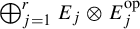 $\bigoplus _{j = 1}^r E_j \otimes E_j^{\mathrm {op}}$
. Let
 $f_j$
,
 $j=1,\ldots ,r$
be a family of jointly independent random elements of
 $ {\mathrm {B}}_{E_j\otimes E_j^{\mathrm {op}}}(0,1)$
distributed according to the Lebesgue measure on
 $E_j \otimes E_j^{\mathrm {op}}$
, and set
 $$ \begin{align*} f = f_1 + \cdots + f_r \end{align*} $$
regarded as a random element of
 $ {\mathrm {End}}(E)$
. In the following argument, probabilities and expectations are taken with respect to these random variables. For each j, since the algebra
 $E_j$
is simple, the action of
 $E_j \otimes E_j^{\mathrm {op}}$
on
 $E_j$
is irreducible. Hence,
 $E_j \otimes E_j^{\mathrm {op}}(y) = E_j$
for any non-zero
 $y \in E_j$
and consequently,
 $$ \begin{align} \text{ for all } \delta> 0, \text{ for all } x, y \in E_j,\quad \mathbb{P}[ \lVert f_j(y) - x\rVert \leq \delta] \ll \delta^{\dim E_j} \lVert y\rVert^{-\dim E_j}. \end{align} $$
Consider the map
 $$ \begin{align*} \begin{array}{llcl} \varphi \colon & A \times A & \to & E\\ & (x,y) & \mapsto & x + fy \end{array} \end{align*} $$
The energy of the map
 $\varphi $
at scale
 $\delta> 0$
is defined as
 $$ \begin{align*} \mathcal{E}_\delta(\varphi,A\times A) = \mathcal{N}( \{ (a,a',b,b') \in A \times A\times A\times A\ \,\vert\, \lVert\varphi(a,b) - \varphi(a',b')\rVert \leq \delta \}, \delta). \end{align*} $$
By the Cauchy–Schwarz inequality—see also [Reference He23, Lemma 12(i)],
 $$ \begin{align*} \mathcal{N}(\varphi(A\times A),\delta) = \mathcal{N}(A + fA,\delta) \geq \frac{\mathcal{N}(A,\delta)^4}{\mathcal{E}_\delta(\varphi,A \times A)}. \end{align*} $$
Taking expectations and applying Jensen’s inequality, we find
 $$ \begin{align} \mathbb{E}[\mathcal{N}(A + fA,\delta) ] \geq \frac{\mathcal{N}(A,\delta)^4}{\mathbb{E}[\mathcal{E}_\delta(\varphi,A \times A) ]}, \end{align} $$
so it suffices to bound
 $\mathbb {E}[\mathcal {E}_\delta (\varphi ,A \times A) ]$
from above.
For that, let
 $\tilde {A}$
be a maximal
 $\delta $
-separated subset of A. By [Reference He23, Lemma 12(ii)],
 $$ \begin{align*} \mathbb{E}[\mathcal{E}_\delta(\varphi,A \times A)] \leq \sum_{x,y,x',y' \in \tilde{A}} \mathbb{P}[ f(y'-y) \in {\mathrm{B}}(x - x',5\delta)]. \end{align*} $$
Let
 $\rho = \delta ^{{\kappa }/({\dim E+ \kappa })}$
. We split the sum into two parts according to whether
 $$ \begin{align*} \text{for all } j = 1,\dotsc, r,\quad \lVert\pi_j(y' - y)\rVert \geq \rho. \end{align*} $$
If this is the case, then equation (2.1) implies
 $$ \begin{align*} \mathbb{P}[ f(y'-y) \in {\mathrm{B}}(x - x',5\delta)] \ll \delta^{\dim E} \rho^{-\dim E}. \end{align*} $$
Otherwise, there is
 $j \in \{1,\dotsc ,r\}$
such that
 $\pi _j(y') \in {\mathrm {B}}(\pi _j(y),\rho )$
. For fixed y, the number of such
 $y'$
in
 $\tilde {A}$
is
 $$ \begin{align*} \# (\tilde{A} \cap \pi_j^{-1}({\mathrm{B}}(\pi_j(y),\rho))) \ll \mathcal{N}( A \cap \pi_j^{-1}({\mathrm{B}}(\pi_j(y),\rho)),\delta) \leq \rho^\kappa \mathcal{N}(A,\delta). \end{align*} $$
Moreover, for fixed
 $y,y'$
, and x, we have
 $$ \begin{align*} \sum_{x' \in \tilde{A}} \mathbb{P}[ f(y'-y) \in {\mathrm{B}}(x - x',5\delta)] \ll 1 \end{align*} $$
because the balls
 $ {\mathrm {B}}(x',5\delta )$
have overlap multiplicity at most
 $O(1)$
. Putting these considerations together, we obtain
 $$ \begin{align*} \mathbb{E}[\mathcal{E}_\delta(\varphi,A \times A)] &\ll \delta^{\dim E} \rho^{-\dim E} \mathcal{N}(A,\delta)^4 + \rho^\kappa \mathcal{N}(A,\delta)^3 \\ &\leq ( \delta^{\kappa} \rho^{-\dim E} + \rho^\kappa ) \mathcal{N}(A,\delta)^3\\ &\ll \delta^{{\kappa^2}/({\dim E+ \kappa})} \mathcal{N}(A,\delta)^3. \end{align*} $$
Combined with equation (2.2), this finishes the proof of the lemma.
2.2
$L^2$
-flattening

Our goal is now to translate the sum-product theorem obtained above in terms of measures on the semisimple algebra E. The result we obtain is an
 $L^2$
-flattening lemma for additive and multiplicative convolutions of measures on E. Statements of this form already appear implicitly in the work of Bourgain [Reference Bourgain10, Reference Bourgain11] on the Erdős–Volkmann ring conjecture, and were later much popularized by their application to the spectral gap problem by Bourgain and Gamburd [Reference Bourgain and Gamburd13, Reference Bourgain and Gamburd14]. They are usually derived from the analogous combinatorial growth statement, via a decomposition of the measures into dyadic level sets, combined with an application of the Balog–Szemerédi–Gowers lemma.
Before we can state our result, we give a non-concentration condition for measures on E, analogous to that given for subsets in the previous paragraph.
Definition 2.7. (Affine non-concentration for measures)
Let V be a Euclidean space, and
 $\varepsilon ,\kappa> 0$
two parameters. We say that a measure
 $\eta $
on V satisfies
 $ {\mathrm {ANC}}(\varepsilon ,\kappa )$
at scale
 $\delta $
if:
-
(i)
$ {\mathrm {supp}}\ \eta \subset {\mathrm {B}}(0,\delta ^{-\varepsilon })$
; -
(ii) for every
$\rho \geq \delta $
and every proper affine subspace
$W \subset V$
,
$\eta (W^{(\rho )}) \leq \delta ^{-\varepsilon } \rho ^\kappa $
.



In this paper, measures are often studied at some fixed small positive scale
 $\delta $
. For that reason, it is convenient to define the regularized measure
 $\eta _\delta $
of a measure
 $\eta $
on E at scale
 $\delta $
by
 $$ \begin{align*} \eta_\delta = \eta\boxplus P_\delta, \end{align*} $$
where  is the normalized indicator function of the ball of radius
 $\delta $
centered at
 $0$
. The measure
 $\eta _\delta $
will be identified with its density with respect to the Lebesgue measure on E, and we write
 $$ \begin{align*} \lVert\eta\rVert_{2,\delta} = \lVert\eta_\delta\rVert_2. \end{align*} $$
Proposition 2.8. (
$L^2$
-flattening)

Let E be finite-dimensional semisimple algebra over
 $\mathbb {R}$
. Given
 $\kappa> 0$
, there exists
 $\varepsilon = \varepsilon (E,\kappa )$
such that the following holds for all
 $\delta> 0$
sufficiently small. Let
 $\eta $
be a probability measure on E satisfying:
-
(i)
$\eta $
is supported on
$E \setminus S_E(\delta ^\varepsilon )$
; -
(ii)
$\eta $
satisfies
$ {\mathrm {ANC}}(\varepsilon ,\kappa )$
at scale
$\delta $
on E; -
(iii)
$\delta ^{-\kappa + \varepsilon } \leq \lVert \eta \rVert _{2,\delta }^2 \leq \delta ^{- \dim E + \kappa - \varepsilon }$
.



Then,
 $$ \begin{align*} \lVert\eta * \eta * \eta \boxminus \eta * \eta * \eta\rVert_{2,\delta} \leq \delta^{\varepsilon} \lVert\eta\rVert_{2,\delta}. \end{align*} $$
We wish to deduce this proposition from Theorem 2.4. A first useful observation is that the non-concentration condition for measures is closely related to non-concentration for subsets.
Lemma 2.9. Given a Euclidean space V, and parameters
 $\epsilon> 0$
and
 $\kappa> 0$
, the following holds for all
 $\delta> 0$
sufficiently small.
-
(i) If
$A \subset V$
has
$ {\mathrm {ANC}}(\varepsilon ,\kappa )$
at scale
$\delta $
, then there is a measure supported on A which has
$ {\mathrm {ANC}}(2\varepsilon ,\kappa )$
at scale
$\delta $
. -
(ii) Let
$\eta $
be a probability measure on V satisfying
$ {\mathrm {ANC}}(\varepsilon ,\kappa )$
at scale
$\delta $
. If
$A \subset V$
is a subset such that
$\eta (A) \geq \delta ^\varepsilon $
, then there is a subset
$A' \subset A$
which satisfies
$ {\mathrm {ANC}}(6\varepsilon ,\kappa )$
at scale
$\delta $
.


Proof. For the first item, let
 $\tilde {A}$
be a maximal
 $\delta $
-separated subset of A. The normalized counting measure on
 $\tilde {A}$
satisfies the desired property. The second item is slightly more subtle. Since the normalized restriction of
 $\eta $
to A satisfies
 $ {\mathrm {ANC}}(2\varepsilon ,\kappa )$
, we may assume without loss of generality that
 $A = {\mathrm {supp}}\ \eta $
. Let
 $i_{\min }$
be the largest integer such that
 $2^{i_{\min }} \leq \delta ^{2\varepsilon \dim V}$
. For every integer
 $i \geq i_{\min }$
, set
 $$ \begin{align*} A_{i,0} = \bigg\{ a \in A \mid 2^{i-1} < \frac{\eta({\mathrm{B}}(a,2\delta))}{\lvert{\mathrm{B}}(0,\delta)\rvert} \leq 2^i \bigg\} \end{align*} $$
and then
 $$ \begin{align*} A_{-,0} = A \setminus \bigcup_{i \geq i_{\min}} A_{i,0}. \end{align*} $$
Next, for every
 $i \geq i_{\min }$
, set
 $A_i = A_{i,0}^{(\delta )}$
and also
 $A_- = A_{-,0}^{(\delta )}$
. By this construction,

and

Note that
 $A_i$
is empty whenever
 $i \geq -({\log \lvert {\mathrm {B}}(0,\delta )\rvert }/{\log 2}) + 1$
. Thus, integrating equation (2.3) and recalling
 $ {\mathrm {supp}}\ \eta \subset B(0,\delta ^{-\varepsilon })$
from
 $ {\mathrm {ANC}}(\varepsilon ,\kappa )$
for
 $\eta $
, we obtain some
 $i \geq i_{\min }$
such that
 $ 2^i \lvert A_i\rvert \geq \delta ^\varepsilon. $
Fix this i and set
 $A'=A_{i,0}$
. If W is a proper affine subspace in V and
 $\rho \geq \delta $
, we can bound using equation (2.4) and
 $ {\mathrm {ANC}}(\varepsilon ,\kappa )$
for
 $\eta $
,

and using the above lower bound on
 $2^i\lvert A_i\rvert $
, we get
 $$ \begin{align*} \mathcal{N}(A'\cap W^{(\rho)},\delta) & \ll \delta^{-\dim V} \lvert A_i\rvert \delta^{-2\varepsilon}\rho^\kappa\\ & \ll \delta^{-2\varepsilon} \rho^\kappa \mathcal{N}(A_i,\delta). \end{align*} $$
This shows that
 $A'$
satisfies
 $ {\mathrm {ANC}}(3\varepsilon ,\kappa )$
at scale
 $\delta $
.
The next lemma is similar in spirit to the previous one. Roughly speaking, given measures
 $\eta $
on V and
 $\mu $
on
 $ {\mathrm {GL}}(V)$
such that the convolution
 $\mu *\eta \boxminus \mu *\eta $
has large
 $L^2$
-norm at scale
 $\delta $
, we construct related subsets
 $A\subset V$
and
 $B\subset {\mathrm {GL}}(V)$
such that
 $A-BA$
is not much larger than A. This is the central part of the proof of Proposition 2.8; it relies on the Balog–Szemerédi–Gowers lemma.
Lemma 2.10. Let V be a Euclidean space and
 $\mu $
a probability measure on
 $ {\mathrm {GL}}(V)$
such that
 $$ \begin{align*} \text{ for all } g \in {\mathrm {supp}}\ \mu,\quad \lVert g\rVert + \lVert g^{-1}\rVert \leq \delta^{-\varepsilon}. \end{align*} $$
Let
 $\eta $
be a probability measure on
 $ {\mathrm {B}}_V(0,\delta ^{-\varepsilon })$
such that
 $$ \begin{align*} \lVert\mu*\eta \boxminus \mu*\eta\rVert_{2,\delta}> \delta^{\varepsilon} \lVert\eta\rVert_{2,\delta}. \end{align*} $$
Then, there exist a subset
 $A \subset {\mathrm {B}}_V(0,\delta ^{-O(\varepsilon )})$
and an element
 $g_1 \in {\mathrm {supp}}\ \mu $
such that
 $$ \begin{align*} \delta^{-\dim V + O(\varepsilon)} \lVert\eta\rVert_{2,\delta}^{-2} \leq \mathcal{N}(A,\delta) \leq \delta^{-\dim V - O(\varepsilon)} \lVert\eta\rVert_{2,\delta}^{-2} \end{align*} $$
and
 $$ \begin{align*} \mu( \{ g \in {\mathrm{GL}}(V) \,\vert\, \mathcal{N}(A - gg_1^{-1}A,\delta) \leq \delta^{-O(\varepsilon)}\mathcal{N}(A,\delta) \} ) \geq \delta^{O(\varepsilon)}. \end{align*} $$
If moreover
 $\eta $
satisfies
 $ {\mathrm {ANC}}(\varepsilon ,\kappa )$
in V at scale
 $\delta $
for some
 $\kappa> 0$
, then A satisfies
 $ {\mathrm {ANC}}(O(\varepsilon ),\kappa )$
.
Proof. We use the following rough comparison notation: for positive quantities f and g, we write
 $f \lesssim g$
for
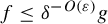 $f \leq \delta ^{-O(\varepsilon )} g$
, and
 $f \sim g$
for
 $f \lesssim g$
and
 $g \lesssim f$
.
We have
 $$ \begin{align*} \lVert\mu*\eta_\delta \boxminus \mu*\eta_\delta\rVert_2 \gtrsim \lVert\mu*\eta \boxminus \mu*\eta\rVert_{2,\delta} \gtrsim \lVert\eta_\delta\rVert_2. \end{align*} $$
As in the proof of Lemma 2.9, we can approximate
 $\eta _\delta $
using dyadic level sets: there are
 $\delta $
-discretized sets (a
 $\delta $
-discretized set is a union of balls of radius
 $\delta $
)
 $(A_i)_{i\geq 0}$
in
 $ {\mathrm {B}}_V(0,\delta ^{-\varepsilon })$
such that
 $A_i$
is empty for
 $i \gg \log (1/\delta)$
and

By the pigeonhole principle, there are
 $i,j\geq 0$
such that

In the last inequality, we used  and
 $\lvert \det g\rvert \sim 1$
for all
 $g \in {\mathrm {supp}}\ \mu $
. By the right-hand inequality in equation (2.5), we have
 $$ \begin{align*} 2^i\lvert A_i\rvert \lesssim 1 \quad \text{and} \quad 2^j\lvert A_j\rvert^{{1}/{2}} \lesssim \lVert\eta_\delta\rVert_2, \end{align*} $$
and similarly
 $$ \begin{align*} 2^j\lvert A_j\rvert \lesssim 1 \quad \text{and} \quad 2^i\lvert A_i\rvert^{{1}/{2}} \lesssim \lVert\eta_\delta\rVert_2. \end{align*} $$
By Young’s inequality and the estimate on
 $\det g$
, we have for all
 $g,g' \in {\mathrm {supp}}\ \mu $
,

Thus, by the pigeonhole principle again, there exists
 $g_0 \in {\mathrm {supp}}\ \mu $
and a set
 $B_0 \subset {\mathrm {supp}}\ \mu $
such that
 $\mu (B_0)\gtrsim 1$
and for all
 $g \in B_0$
,

By the above estimates, this implies

By the Balog–Szemerédi–Gowers lemma [Reference Tao37, Theorem 6.10], for each
 $g \in B_0$
, there are
 $\delta $
-discretized subsets
 $A_g \subset A_i$
and
 $A^{\prime }_g \subset A_j$
such that
 $$ \begin{align*} \lvert A_g\rvert \sim \lvert A_i\rvert,\quad \lvert A^{\prime}_g\rvert \sim \lvert A_j\rvert,\quad \text{ and}\quad \mathcal{N}(g_0A_g - gA^{\prime}_g,\delta)\lesssim \mathcal{N}(g_0A_g,\delta)^{{1}/{2}} \mathcal{N}(gA^{\prime}_g,\delta)^{{1}/{2}}. \end{align*} $$
Set
 $X=A_i\times A_j$
and
 $X_g=A_g\times A^{\prime }_g\subset X$
, and write

This shows that there exists
 $g_1$
and
 $B_1\subset B_0$
such that
 $\mu (B_1)\gtrsim 1$
for all g in
 $B_1$
,
 $\lvert X_{g_1}\cap X_{g}\rvert \gtrsim \lvert X\rvert $
. Equivalently,
 $$ \begin{align*} \text{ for all } g \in B_1,\quad \lvert A_{g_1} \cap A_g\rvert \sim \lvert A_{g_1}\rvert \sim \lvert A_g\rvert \text{ and } \lvert A^{\prime}_{g_1} \cap A^{\prime}_g\rvert \sim \lvert A^{\prime}_{g_1}\rvert \sim \lvert A^{\prime}_g\rvert. \end{align*} $$
For subsets
 $A,A' \in V$
, write
 $A \approx A'$
if
 $\mathcal {N}(A-A',\delta ) \lesssim \mathcal {N}(A,\delta )^{1/2} \mathcal {N}(A',\delta )^{1/2}$
. Ruzsa’s triangle inequality [Reference Tao and Vu38, Lemma 2.6] is still valid for covering numbers at scale
 $\delta $
, so if
 $A\approx A'$
and
 $A'\approx A"$
, then
 $A\approx A"$
, and moreover, if
 $A\approx A'$
for some sets A and
 $A'$
, then
 $A\approx A$
and
 $A'\approx A'$
.
The above shows that for every
 $g\in B_0$
,
 $g_0A_g\approx gA_g'$
. This implies
 $g_0A_g\approx g_0A_g$
, and since g is
 $\delta ^{-\varepsilon }$
-Lipschitz,
 $A_g\approx A_g$
. Therefore, for
 $g_1\in B_0$
and
 $g\in B_1$
as above, we find
 $A_{g_1}\approx A_{g_1}\cap A_g\approx A_g$
. Similarly,
 $A^{\prime }_{g_1}\approx A^{\prime }_g$
. Finally,
 $$ \begin{align*} g_0A_{g_1} \approx g_0A_g \approx gA^{\prime}_g \approx gA^{\prime}_{g_1} \approx g g_1^{-1}g_0A_{g_1}, \end{align*} $$
showing that
 $A = g_0 A_{g_1}$
has all the desired properties.
For the last assertion, note that
 $\eta (A_i)\gtrsim 1$
. By the proof of Lemma 2.9(ii),
 $A_i$
satisfies
 $ {\mathrm {ANC}}(O(\varepsilon ),\kappa )$
, and hence so do
 $A_{g_1}$
and A. Note also that
 $$ \begin{align*} \mathcal{N}(A,\delta)\sim \mathcal{N}(A_{g_1},\delta)\sim \mathcal{N}(A_i,\delta) \sim \delta^{-\dim V}\lvert A_i\rvert \sim \delta^{-\dim V}\lVert\eta\rVert_{2,\delta}^2.\\[-39pt] \end{align*} $$
To prove Proposition 2.8, we use the above lemma for the action of
 $E\otimes E^{\mathrm {op}}$
on E, and then apply the sum-product theorem in E.
Proof of Proposition 2.8
Let
 $\mu $
be the image measure of
 $\eta \otimes \eta $
in
 $ {\mathrm {GL}}(E)$
, so that
 $\mu * \eta \boxminus \mu * \eta = \eta * \eta * \eta \boxminus \eta * \eta * \eta $
. We argue by contradiction as follows. Assuming
 $$ \begin{align*} \lVert\mu*\eta \boxminus \mu*\eta\rVert_{2,\delta}> \delta^{\varepsilon} \lVert\eta\rVert_{2,\delta}, \end{align*} $$
we shall construct sets
 $A,B$
satisfying all assumptions of Theorem 2.4, with
 $\kappa $
and
 $\varepsilon $
replaced by
 $\kappa /2$
and
 $O(\varepsilon )$
but violating its conclusion. By Lemma 2.10, there is a subset
 $A \subset E$
satisfying
 $ {\mathrm {ANC}}(O(\varepsilon ),\kappa )$
at scale
 $\delta $
and an element
 $g_1 \in {\mathrm {supp}}\ \mu $
such that
 $$ \begin{align*} \delta^{-\kappa + O(\varepsilon)}\leq \mathcal{N}(A,\delta) \leq \delta^{- \dim E + \kappa - O(\varepsilon)} \end{align*} $$
and
 $$ \begin{align*} \mu( \{ g \in {\mathrm{GL}}(V) \,\vert\, \mathcal{N}(A - gg_1^{-1}A,\delta) \leq \delta^{-O(\varepsilon)}\mathcal{N}(A,\delta) \} ) \geq \delta^{O(\varepsilon)}. \end{align*} $$
By definition of
 $\mu $
, we may write
 $g_1=a_1\otimes b_1$
, and the above inequality becomes
 $$ \begin{align} (\eta * a_1^{-1})\otimes (b_1^{-1} *\eta)( \{ (a,b) \in E \times E \,\vert\, \mathcal{N}(A - aAb,\delta) \leq \delta^{-O(\varepsilon)}\mathcal{N}(A,\delta) \} ) \geq \delta^{O(\varepsilon)}. \end{align} $$
Since
 $a_1,b_1 \not \in S_E(\delta ^\varepsilon )$
, the measures
 $\eta * a_1^{-1}$
and
 $b_1^{-1} *\eta $
satisfy
 $ {\mathrm {ANC}}(O(\varepsilon ),\kappa )$
at scale
 $\delta $
. Moreover, Lemma 2.11 below shows that
 $(\eta * a_1^{-1})\ \dot \otimes\ (b_1^{-1} *\eta )$
satisfies
 $ {\mathrm {ANC}}(O(\varepsilon ),{\kappa }/{2})$
. By Lemma 2.9(ii), there exists a subset
 $B\subset {\mathrm {supp}}\ ((\eta * a_1^{-1})\ \dot \otimes\ (b_1^{-1} *\eta ))$
satisfying
 $ {\mathrm {ANC}}(O(\varepsilon ),{\kappa }/{2})$
. Equation (2.6) shows that
 $\mathcal {N}(A+fA,\delta )\leq \delta ^{-O(\varepsilon )}\mathcal {N}(A,\delta )$
for all f in B. Since
 $\eta $
is supported on
 $E\setminus S_E(\delta ^\varepsilon )$
, one also has
 $\mathcal {N}(fA,\delta )\geq \delta ^{O(\varepsilon )}\mathcal {N}(A,\delta )$
, and so by Plünnecke’s inequality, one also has
 $\mathcal {N}(A+A,\delta )\leq \delta ^{-O(\varepsilon )}\mathcal {N}(A,\delta )$
and, in turn,
 $$ \begin{align*} \mathcal{N}(A+A,\delta) + \mathcal{N}(A+fA,\delta) \leq \delta^{-O(\varepsilon)}\mathcal{N}(A,\delta). \end{align*} $$
Thus, A and B violate the conclusion of Theorem 2.4 with parameters
 $\kappa /2$
and
 $O(\varepsilon )$
. This yields the desired contradiction, provided
 $\varepsilon $
is chosen small enough.
Lemma 2.11. Let
 $V_1$
and
 $V_2$
be finite-dimensional linear spaces. For each
 $i = 1,2$
, let
 $\eta _i$
be a measure on
 $V_i$
and denote by
 $\eta _1\ \dot \otimes\ \eta _2$
the image measure of
 $\eta _1 \otimes \eta _2$
by the natural bilinear map
 $V_1 \times V_2 \to V_1 \otimes V_2$
.
Given two parameters
 $\varepsilon ,\kappa> 0$
, the following holds for
 $\delta> 0$
sufficiently small. If
 $\eta _1$
and
 $\eta _2$
both satisfy
 $ {\mathrm {ANC}}(\varepsilon ,\kappa )$
at scale
 $\delta $
, then
 $\eta _1\ \dot \otimes\ \eta _2$
satisfies
 $ {\mathrm {ANC}}(2\varepsilon ,{\kappa }/{2})$
in
 $V_1 \otimes V_2$
at scale
 $\delta $
.
Proof. Let
 $v_1$
and
 $v_2$
be independent random variables taking values respectively in
 $V_1$
and
 $V_2$
, and distributed according to
 $\eta _1$
and
 $\eta _2$
. To establish
 $ {\mathrm {ANC}}(2\varepsilon ,{\kappa }/{2})$
for
 $\eta _1\ \dot \otimes\ \eta _2$
, it is enough to show that for any linear form
 $\varphi \in (V_1 \otimes V_2)^*$
with
 $\lVert \varphi \rVert = 1$
, any
 $t \in \mathbb {R}$
, and any
 $\rho \geq \delta $
, we have
 $$ \begin{align} \mathbb{P}[\lvert\varphi(v_1 \otimes v_2) - t\rvert < \rho] \ll \delta^{-\varepsilon}\rho^{\kappa/2}. \end{align} $$
Note that
 $(V_1 \otimes V_2)^* = V_1^* \otimes V_2^*$
. Hence, letting
 $(\psi _1,\dotsc ,\psi _d)$
be a orthonormal basis of
 $V_1^*$
, we can write
 $\varphi \in (V_1 \otimes V_2)^*$
as
 $$ \begin{align*}\varphi = \psi_1 \otimes \varphi_1 + \cdots + \psi_d \otimes \varphi_d,\end{align*} $$
where
 $\varphi _1, \dotsc , \varphi _d \in V_2^*$
are uniquely determined. Moreover,
 $$ \begin{align} 1 = \lVert\varphi\rVert^2 = \lVert\varphi_1\rVert^2 + \cdots + \lVert\varphi_d\rVert^2. \end{align} $$
On the one hand, when
 $v_2$
is fixed, the map
 $$ \begin{align*} v_1 \mapsto \varphi(v_1 \otimes v_2) = \sum_{i=1}^d \psi_i(v_1) \varphi_i(v_2) \end{align*} $$
is the linear form
 $ \sum _{i=1}^d \varphi _i(v_2) \psi _i \in V_1^*$
, which has norm
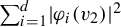 $\sum _{i=1}^d \lvert \varphi _i(v_2)\rvert ^2$
. Thus, by independence of
 $v_1$
and
 $v_2$
and property
 $ {\mathrm {ANC}}(\varepsilon ,\kappa )$
for
 $\eta _1$
, we can estimate the conditional probability
 $$ \begin{align} \mathbb{P}\bigg[ \lvert\varphi(v_1 \otimes v_2) - t\rvert < \rho \,\bigg\vert\, \sum_{i=1}^d \lvert\varphi_i(v_2)\rvert^2 \geq \rho^{1/2}\bigg] \leq \delta^{-\varepsilon}\rho^{\kappa/2}. \end{align} $$
On the other hand, by property
 $ {\mathrm {ANC}}(\varepsilon ,\kappa )$
for
 $\eta _2$
, for each
 $i = 1,\dotsc ,d$
,
 $$ \begin{align*} \mathbb{P}[\lvert\varphi_i(v_2)\rvert \leq \rho^{1/2}\lVert\varphi_i\rVert] \leq \delta^{-\varepsilon} \rho^{\kappa/2}. \end{align*} $$
Hence, recalling equation (2.8),
 $$ \begin{align} \mathbb{P}\bigg[\sum_{i=1}^d \lvert\varphi_i(v_2)\rvert^2 < \rho\bigg] \leq d\delta^{-\varepsilon} \rho^{\kappa/2}. \end{align} $$
Inequalities (2.9) and (2.10) together imply equation (2.7) and finish the proof of the lemma.
2.3 Fourier decay
To prove Theorem 2.2, we apply the
 $L^2$
-flattening Proposition 2.8 repeatedly. The measures we obtain are images of tensor powers
 $\eta ^k$
under polynomial maps
 $E^k \to E$
, and we need to compare their Fourier decay to that of simple multiplicative convolutions of
 $\eta $
. This is the content of the next lemma. This technique will also be useful to weaken slightly the assumptions of Theorem 2.2, see Corollary 2.14 below.
Lemma 2.12. Let E be any real associative algebra and let
 $\eta $
be a measure on E with
 $\eta (E) \leq 1$
. Let
 $\mu = \eta * \eta * \eta \boxminus \eta * \eta * \eta $
, then for any integer
 $m \geq 1$
,
 $$ \begin{align*} \text{ for all } \xi \in E^*,\quad \lvert\widehat{\eta^{*3m}}(\xi)\rvert^{2^m} \leq \widehat{\mu^{*m}}(\xi). \end{align*} $$
Proof. By [Reference He, Lakrec and Lindenstrauss28, Lemma B.6], if
 $\eta $
,
 $\eta '$
,
 $\eta "$
are probability measures on E, then the Fourier transform of
 $\eta * (\eta ' \boxminus \eta ') * \eta "$
takes non-negative real values and moreover,
 $$ \begin{align*} \text{ for all } \xi \in E^*,\quad \lvert(\eta * \eta' * \eta")^{\wedge}(\xi)\rvert^{2} \leq (\eta * (\eta' \boxminus \eta') * \eta")^{\wedge}(\xi). \end{align*} $$
By a simple scaling argument, we see that the same holds when
 $\eta $
,
 $\eta '$
,
 $\eta "$
are finite measures with total mass
 $\eta (E), \eta '(E), \eta "(E) \leq 1$
. Using this inequality m times with measure
 $\eta '=\eta ^{*3}$
, so that
 $\mu =\eta '\boxminus \eta '$
, we get
 $$ \begin{align*} \widehat{\mu^{*m}}(\xi) \geq \lvert\widehat{\mu^{*(m-1)}*\eta^{*3}}(\xi)\rvert^2 \geq \cdots \geq \lvert\widehat{\eta^{*3m}}(\xi)\rvert^{2^m}.\\[-37pt] \end{align*} $$
We shall also need a lemma on Fourier decay for multiplicative convolutions of measures with small
 $L^2$
-norm. In the case where
 $E=\mathbb {R}$
, such bounds originate in the work of Falconer [Reference Falconer20] on projection theorems, and appear explicitly in [Reference Bourgain11, Theorem 7]. The result below is taken from [Reference He and de Saxcé25, Lemma 2.9].
Lemma 2.13. Let E be a finite-dimensional real associative algebra with unit. The following holds for any parameters
 $\kappa> 0$
and
 $\varepsilon> 0$
, and any scale
 $\delta> 0$
small enough. Let
 $\eta $
and
 $\nu $
be probability measures on E. Assume:
-
(i)
$\lVert \eta \rVert _{2,\delta }^2 \leq \delta ^{-\kappa }$
; -
(ii)
$ {\mathrm {supp}}\ \eta \subset {\mathrm {B}}(0,\delta ^{-\varepsilon })$
and
$ {\mathrm {supp}}\ \nu \subset {\mathrm {B}}(0,\delta ^{-\varepsilon })$
; -
(iii) for every proper affine subspace
$W \subset E$
,
$\nu (W^{(\delta )}) \leq \delta ^{2\kappa }$
.


Then, for
 $\xi \in E^*$
with
 $\delta ^{-1+\varepsilon } \leq \lVert \xi \rVert \leq \delta ^{-1-\varepsilon }$
,
 $$ \begin{align*} \lvert\widehat{\eta * \nu}(\xi)\rvert \leq \delta^{{\kappa}/({\dim E + 3}) - O(\varepsilon)}. \end{align*} $$
We can finally derive Theorem 2.2.
Proof of Theorem 2.2
First case:
 $\eta _1=\cdots =\eta _s=\eta $
.
For a measure
 $\eta $
satisfying
 $ {\mathrm {NC}}(\varepsilon ,\kappa ,\tau )$
at scale
 $\delta $
, we write
 $ {\mathrm {ess}}(\eta )$
to denote the essential part of
 $\eta $
, defined as a measure on E satisfying:
-
(i)
$ {\mathrm {ess}}(\eta ) \leq \eta $
and
$ {\mathrm {ess}}(\eta )(E) \geq \eta (E) - 3 \delta ^\tau $
; -
(ii)
$ {\mathrm {ess}}(\eta )$
is supported on
$ {\mathrm {B}}(0,\delta ^{-\varepsilon }) \setminus S_E(\delta ^\varepsilon )$
; -
(iii)
$ {\mathrm {ess}}(\eta )$
satisfies
$ {\mathrm {ANC}}(\varepsilon ,\kappa )$
at scale
$\delta $
.




The second and third conditions from
 $ {\mathrm {NC}}_0$
are invariant under translation, so that if
 $\mu $
is a measure satisfying
 $ {\mathrm {NC}}_0(\varepsilon ,\kappa ,\tau )$
and
 $\nu $
any measure supported on
 $ {\mathrm {B}}_E(0,\delta ^{-\varepsilon })$
, then
 $\mu \boxplus \nu $
always satisfies
 $ {\mathrm {NC}}_0(2\varepsilon ,\kappa ,\tau )$
. Therefore, if
 $\eta $
and
 $\eta '$
satisfy
 $ {\mathrm {NC}}(\varepsilon ,\kappa ,\tau )$
at scale
 $\delta $
, then
 $\eta \boxplus \eta '$
satisfy
 $ {\mathrm {NC}}(O(\varepsilon ),\kappa ,{\tau }/{2})$
at scale
 $\delta $
, with essential part
 $ {\mathrm {ess}}(\eta \boxplus \eta ')= {\mathrm {ess}}(\eta )\boxplus {\mathrm {ess}}(\eta ')$
. Similarly,
 $\eta \boxminus \eta '$
and
 $\eta * \eta '$
satisfy
 $ {\mathrm {NC}}(O(\varepsilon ),\kappa ,{\tau }/{2})$
. We may therefore define inductively
 $\eta _0 = {\mathrm {ess}}(\eta )$
, and for
 $k \geq 0$
,
 $$ \begin{align*} \eta_{k+1} = {\mathrm{ess}}( \eta_k^{*3} \boxminus \eta_k^{*3} ), \end{align*} $$
to get, for each
 $k \geq 0$
:
-
(i)
$\eta _k(E) \geq 1 - \delta ^{{\tau }/{O_k(1)}}$
; -
(ii)
$\eta _k$
is supported on
$ {\mathrm {B}}(0,\delta ^{-O_k(\varepsilon )}) \setminus S_E(\delta ^{O_k(\varepsilon )})$
; -
(iii)
$\eta _k$
satisfies
$ {\mathrm {ANC}}(O_k(\varepsilon ),\kappa )$
at scale
$\delta $
.



Note that
 $ {\mathrm {ANC}}(O_k(\varepsilon ),\kappa )$
implies
 $$ \begin{align*} \lVert\eta_k\rVert_{2,\delta}^2 \leq \delta^{- \dim E + \kappa - O_k(\varepsilon)}. \end{align*} $$
Set
 $\kappa '={\kappa }/{3}$
. By Proposition 2.8 applied with
 $\kappa '$
instead of
 $\kappa $
, there exists
 $\varepsilon _1 = \varepsilon _1(E,\kappa ')$
such that, provided
 $\varepsilon>0$
is small enough, we have for each
 $0 \leq k \leq \lceil( {\dim E})/{\varepsilon _1} \rceil $
, either
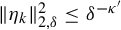 $\lVert \eta _k\rVert ^2_{2,\delta } \leq \delta ^{-\kappa '}$
or
 $$ \begin{align*}\lVert\eta_{k+1}\rVert_{2,\delta}^2 \leq \delta^{\varepsilon_1} \lVert\eta_k\rVert_{2,\delta}^2.\end{align*} $$
Hence, there exists
 $s \leq \lceil( {\dim E})/{\varepsilon _1} \rceil $
such that
 $$ \begin{align*} \lVert\eta_s\rVert^2_{2,\delta} \leq \delta^{-\kappa'}. \end{align*} $$
By Lemma 2.13 applied with
 $\kappa '$
instead of
 $\kappa $
, for
 $\xi \in E^*$
with
 $\delta ^{-1 + \varepsilon } \leq \lVert \xi \rVert \leq \delta ^{-1 - \varepsilon }$
,
 $$ \begin{align*} \lvert\widehat{\eta_s^{*2}}(\xi)\rvert \leq \delta^{{\kappa'}/{O(1)} -O(\varepsilon)} \leq \delta^{{\kappa'}/{O(1)}} \leq \delta^{\tau}, \end{align*} $$
provided
 $\varepsilon $
is chosen sufficiently small. Now, a first application of Lemma 2.12 to
 $\mu =\eta _{s-1}^{*3}\boxminus \eta _{s-1}^{*3}$
with
 $m=2$
yields
 $$ \begin{align*} \widehat{\eta_s^{*2}}(\xi)+\delta^{{\tau}/{O_s(1)}} \geq \widehat{\mu^{*2}}(\xi) \geq \lvert\widehat{\eta_{s-1}^{*2\cdot 3}}(\xi)\rvert^{2^2}. \end{align*} $$
A second application of the same lemma to
 $\mu _1=\eta _{s-2}^{*3}\boxminus \eta _{s-2}^{*3}$
with
 $m=2\cdot 3$
gives
 $$ \begin{align*} \widehat{\eta_{s-1}^{*2\cdot 3}}(\xi) + \delta^{{\tau}/{O_s(1)}} \geq \widehat{\mu_1^{*2\cdot 3}}(\xi) \geq \lvert\widehat{\eta_{s-2}^{*2\cdot 3^2}}(\xi)\rvert^{2^{2\cdot 3}} \end{align*} $$
and repeating this process s times, we finally obtain
 $$ \begin{align*} \lvert\widehat{\eta_0^{*2 \cdot 3^s}}(\xi)\rvert^{O_s(1)} \leq \lvert\widehat{\eta_s^{*2}}(\xi)\rvert + \delta^{{\tau}/{O_s(1)}} \leq \delta^\tau + \delta^{{\tau}/{O_s(1)}} \leq \delta^{{\tau}/{O_s(1)}}. \end{align*} $$
This allows to conclude
 $$ \begin{align*} \lvert\widehat{\eta^{*2 \cdot 3^s}}(\xi)\rvert \leq \lvert\widehat{\eta_0^{*2 \cdot 3^s}}(\xi)\rvert + O_s(\delta^\tau) \leq \delta^{\varepsilon \tau}, \end{align*} $$
provided
 $\varepsilon $
is sufficiently small. This proves the theorem, with parameter
 $s(E,\kappa )=2\cdot 3^s$
.
General case. To deduce the general case from the previous one, we follow [Reference He, Lakrec and Lindenstrauss28, Proof of Theorem B.3]. In short, one applies the previous case to the measures
 $$ \begin{align*} \eta_\unicode{x3bb} = \unicode{x3bb}_1(\eta_1\boxminus\eta_1) + \cdots + \unicode{x3bb}_s(\eta_s\boxminus\eta_s), \end{align*} $$
where
 $\unicode{x3bb} =(\unicode{x3bb} _1,\ldots ,\unicode{x3bb} _s)$
in
 $\mathbb {R}_+^s$
is such that
 $\unicode{x3bb} _1+\cdots +\unicode{x3bb} _s\leq 1$
. The Fourier decay for
 $\eta _1*\cdots *\eta _s$
can be deduced from that of
 $\eta _\unicode{x3bb} *\cdots *\eta _\unicode{x3bb} $
for every
 $\unicode{x3bb} $
using the fact that Fourier coefficients of
 $\eta _\unicode{x3bb} *\cdots *\eta _\unicode{x3bb} $
can be written as polynomials in
 $\unicode{x3bb} $
whose coefficients are essentially Fourier coefficients of
 $\eta _1*\cdots *\eta _s$
. The reader is referred to [Reference He, Lakrec and Lindenstrauss28] for details.
We conclude this section by showing that the conclusion of Theorem 2.2 still holds if the non-concentration assumption is only satisfied for some additive convolution of the measures
 $\eta _i$
,
 $i=1,\ldots ,s$
. This will be useful when we study Fourier decay of random walks on linear groups.
Corollary 2.14. Let E be a normed finite-dimensional semisimple algebra over
 $\mathbb {R}$
. Given
 $D\in \mathbb {N}^*$
and
 $\kappa> 0$
, there exists
 $s = s(E,\kappa ) \in \mathbb {N}$
and
 $\varepsilon = \varepsilon (E,\kappa ,D)> 0$
such that for any parameter
 $\tau \in {(0, \varepsilon \kappa )}$
, the following holds for any scale
 $\delta> 0$
sufficiently small.
If
 $\eta _i$
,
 $i=1,\ldots ,s$
are probability measures on E such that each
 $\eta _i^{\boxplus D}$
satisfies
 $ {\mathrm {NC}}(\varepsilon ,\kappa ,\tau )$
at scale
 $\delta $
, then for all
 $\xi \in E^*$
with
 $\delta ^{-1 + \varepsilon } \leq \lVert \xi \rVert \leq \delta ^{-1 - \varepsilon }$
,
 $$ \begin{align*} \lvert(\eta_1 * \dotsm * \eta_s)^{\wedge}(\xi)\rvert \leq \delta^{\varepsilon \tau}. \end{align*} $$
Proof. Let
 $\xi \in E^*$
with
 $\delta ^{-1+\varepsilon }\leq \lVert \xi \rVert \leq \delta ^{-1-\varepsilon }$
. Since all the measures
 $\eta _i^{\boxplus D}\boxminus \eta _i^{\boxplus D}$
,
 $i=1,\ldots ,s$
satisfy
 $ {\mathrm {NC}}(\varepsilon ,\kappa ,\tau )$
at scale
 $\delta $
, Theorem 2.2 shows that
 $$ \begin{align*} \lvert((\eta_1^{\boxplus D}\boxminus\eta_1^{\boxplus D}) * \dotsm * (\eta_s^{\boxplus D}\boxminus\eta_s^{\boxplus D}))^{\wedge}(\xi)\rvert \leq \delta^{\varepsilon \tau}. \end{align*} $$
Applying [Reference He, Lakrec and Lindenstrauss28, Lemma B.6] repeatedly s times, we see that
 $$ \begin{align*} & \lvert((\eta_1^{\boxplus D}\boxminus\eta_1^{\boxplus D}) * \dotsm * (\eta_s^{\boxplus D}\boxminus\eta_s^{\boxplus D}))^{\wedge}(\xi)\rvert\\ & \quad \geq \lvert((\eta_1^{\boxplus D}\boxminus\eta_1^{\boxplus D}) * \dotsm * (\eta_{s-1}^{\boxplus D}\boxminus\eta_{s-1}^{\boxplus D})*\eta_s)^{\wedge}(\xi)\rvert^{2D}\\ & \quad \geq \cdots\\ & \quad \geq \lvert(\eta_1 * \dotsm * \eta_s)^{\wedge}(\xi)\rvert^{(2D)^s} \end{align*} $$
so that
 $$ \begin{align*} \lvert(\eta_1 * \dotsm * \eta_s)^{\wedge}(\xi)\rvert \leq \delta^{{\varepsilon \tau}/{(2D)^s}}.\\[-37pt] \end{align*} $$
3 Non-concentration for random walks on semisimple groups
In this section, we consider a probability measure
 $\mu $
on
 $ {\mathrm {SL}}_d(\mathbb {Z})$
and we prove some non-concentration property for the law of the associated random walk, viewed as a measure on the algebra generated by
 $\mu $
. Let
 $\Gamma $
be the group generated by the support of
 $\mu $
and G be the Zariski closure of
 $\Gamma $
in
 $ {\mathrm {SL}}_d(\mathbb {R})$
. We assume that G is semisimple and Zariski connected.
Let E denote the
 $\mathbb {R}$
-linear span of G in
 ${\mathcal {M}}_d(\mathbb {R})$
, which is also the subalgebra generated by G in
 ${\mathcal {M}}_d(\mathbb {R})$
. Since G is semisimple, one may decompose E into a direct sum of irreducible G-modules. This gives a decomposition of E into minimal left ideals, so that by the fundamental theorem of semisimple rings [Reference Van der Waerden39, §117], E is a semisimple algebra. Let
 $$ \begin{align} E = E_1 \oplus \cdots \oplus E_r \end{align} $$
be the decomposition of E into simple factors, that is, into minimal two-sided ideals. For
 $j = 1,\dotsc ,r$
, let
 $\pi _j \colon E \to E_j$
denote the corresponding projections. Consider the top Lyapunov exponent associated to
 $\mu $
on each of the factors
 $E_j$
, defined by
 $$ \begin{align*} \unicode{x3bb}_1(\mu,E_j) = \lim_{n \to +\infty} \frac{1}{n} \int \log \lVert\pi_j(g)\rVert \,{d} \mu^{*n}(g). \end{align*} $$
To study the law at time n of the random walk, we shall use the rescaling automorphism
 $\varphi _n\colon E\to E$
defined by
 $$ \begin{align} \varphi_n(g) = \sum_{j=1}^r e^{-n \unicode{x3bb}_1(\mu,E_j)} \pi_j(g). \end{align} $$
Recall that by Furstenberg’s theorem [Reference Furstenberg21] on the positivity of the Lyapunov exponent, one has
 $\unicode{x3bb} _1(\mu ,E_j)\geq 0$
with equality if and only if
 $\pi _j(G)$
is compact. After reordering the factors, we may assume that
 $\unicode{x3bb} _1(\mu ,E_j)> 0$
if and only if
 $j \leq s$
for some integer
 $s \leq r$
. Let
 $E' = E_1 \oplus \cdots \oplus E_s$
and
 $\pi ' \colon E \to E'$
the corresponding projection. Finally, for
 $n\geq 1$
, we define
 $$ \begin{align*} \mu_{n} = (\pi' \circ \varphi_n)_*(\mu^{*n}). \end{align*} $$
The goal of this section is as follows.
Proposition 3.1. (Non-concentration)
Let
 $\mu $
be a probability measure on
 $ {\mathrm {SL}}_d(\mathbb {Z})$
having a finite exponential moment. Let G denote the algebraic group generated by
 $\mu $
. Assume that G is semisimple and Zariski connected, and denote by
 $E\subset {\mathcal {M}}_d(\mathbb {R})$
the algebra generated by G. Writing
 $D = \dim E$
, there exists
 $\kappa = \kappa (\mu )> 0$
such that for any
 $\varepsilon> 0$
, there exists
 $\tau> 0$
such that
 $\mu _{n}^{\boxplus D}$
satisfies
 $ {\mathrm {NC}}(\varepsilon ,\kappa ,\tau )$
at scale
 $e^{-n}$
in
 $E'$
for all n sufficiently large.
The readers can easily convince themselves that
 $\mu _n$
does not satisfy
 $ {\mathrm {NC}}(\varepsilon ,\kappa ,\tau )$
, especially the non-concentration condition near singular matrices. Hence, taking an additive convolution power is necessary.
3.1 Non-concentration near affine subspaces
In this subsection, we show that if
 $\mu $
is a probability measure on
 $ {\mathrm {SL}}_d(\mathbb {Z})$
generating a connected semisimple algebraic group G, the law at time n of the random walk associated to
 $\mu $
is not concentrated near proper affine subspaces of the algebra generated by
 $\mu $
.
We introduce a quasi-norm adapted to the random walk on the algebra E generated by
 $\mu $
. Given an element g in E, we write
 $g=\sum _{i=1}^r g_i$
according to the direct sum decomposition in equation (3.1) and set

Note that
 $\lvert g\rvert =0$
if and only if g lies in the sum
 $$ \begin{align*} E_0:=E_{s+1}\oplus\cdots\oplus E_r \end{align*} $$
of all compact factors. We denote by
 $\tilde {d}$
the quasi-distance on E given by
 . For instance, if W is any affine subspace of E, we write

Our goal is the following proposition.
Proposition 3.2. (Affine non-concentration on E)
Let
 $\mu $
be a probability measure on
 $ {\mathrm {SL}}_d(\mathbb {Z})$
having a finite exponential moment. Let G denote the algebraic group generated by
 $\mu $
. Assume that G is semisimple and Zariski connected, and denote by
 $E\subset {\mathcal {M}}_d(\mathbb {R})$
the algebra generated by G.
There exists
 $\kappa =\kappa (\mu )>0$
such that for every
 $n \geq 0$
and
 $\rho \geq e^{-n}$
, for every affine hyperplane
 $W \subset E$
such that
 $W-W\supset E_0$
,

where
 $J_W = \{ 1 \leq j \leq r \,\vert \, V_j \not \subset W - W \}$
.
Remark 3.3. In general, it is not possible to replace the minimum  by
 . This can be seen for example by taking
 $G=G_1\times G_1$
and
 $\mu =\mu _1\otimes \mu _1$
; in other words, the random walk is the direct product of two independent copies of a random walk on
 $G_1$
. By the central limit theorem for random matrix products [Reference Bougerol and Lacroix9, Theorem 5.1, p. 121], the probability to obtain at time n an element
 $g=(g_1,g_2)$
such that
 $\lVert g_1\rVert \leq e^{-\sqrt {n}}\lVert g_2\rVert $
has a positive limit c. Therefore, for large n,
 $$ \begin{align*} \mu^{*n}(\{ g=(g_1,g_2) \in G \,\vert\, \lVert g_1\rVert < e^{-\sqrt{n}}\lVert g\rVert \} ) \geq \frac{c}{2}, \end{align*} $$
and taking
 $W=\{0\}\times {\mathrm {Span}}_{\mathbb {R}}(G_1)$
, we find

3.1.1 The case of a simple algebra
For clarity, we first explain the proof of Proposition 3.2 when the algebra E generated by G is simple. In that case, the quasi-norm is a norm on E and  . The key result in the proof is the following proposition, which we shall later apply to the irreducible action of
 $G\times G$
on E.
Proposition 3.4. Let
 $\mu $
be a probability measure on
 $ {\mathrm {SL}}_d(\mathbb {Z})$
with a finite exponential moment. Assume that the algebraic group G generated by
 $\mu $
is Zariski connected and acts irreducibly on
 $V=\mathbb {R}^d$
. There exists
 $\kappa =\kappa (\mu )$
such that for every
 $v\in V$
and any affine hyperplane
 $W \subset V$
,
 $$ \begin{align*} \mu^{*n}(\{ g\in G \,\vert\, d(gv,W)\leq\rho\lVert gv\rVert \}) \ll \rho^\kappa. \end{align*} $$
Proof.
First step: escape from affine subvarieties. We claim that there exists
 $c>0$
such that for every affine map f on E that is not identically zero on G,
 $$ \begin{align*} \mu^{*n}(\{ g\in G \,\vert\, f(g)=0 \}) \ll e^{-cn}. \end{align*} $$
Indeed, by [Reference Benoist and Quint4, Lemme 8.5], the group G is semisimple. So the desired inequality is a particular case of [Reference He and de Saxcé25, Proposition 3.7], whose proof is a combination of the spectral gap property modulo prime integers [Reference Salehi Golsefidy and Varjú35] and the Lang–Weil estimates on the number of points on algebraic varieties in finite fields.
Second step: a small neighborhood via a Diophantine property. Let us show that there exist
 $C,c>0$
such that for every non-zero polynomial map f of degree at most
 $1$
on G,
 $$ \begin{align*} \mu^{*n}(\{ g\in G \,\vert\, \lvert f(g)\rvert\leq e^{-Cn}\lVert f\rVert \}) \ll e^{-cn}. \end{align*} $$
In the above, a polynomial map f on G is simply the restriction to G of a polynomial map on E; it is said to have degree at most D if it is the restriction of a polynomial map on E of degree at most D. We endow the finite-dimensional space of polynomial maps of degree at most
 $1$
with a fixed norm
 $\lVert \cdot \rVert $
, say
 $\lVert f\rVert =\sup _{g\in G\cap B_E(1,1)}\lvert f(g)\rvert $
. By the large deviation principle (see Theorem 3.15 below), there exists
 $c>0$
such that for all n large enough,
 $\mu ^{*n}(\{g\in G\ |\ \lVert g\rVert>e^{2n\unicode{x3bb} _1(\mu ,V)}\})\leq e^{-cn}$
. Therefore, to prove the desired inequality, it suffices to show that for
 $C\geq 0$
large enough, the subset
 $A_n \subset {\mathcal {M}}_d(\mathbb {Z})$
defined as
 $$ \begin{align*} A_n=\{ g\in \Gamma \,\vert\, \lvert f(g)\rvert\leq e^{-Cn}\lVert f\rVert \text{ and } \lVert g\rVert\leq e^{2n\unicode{x3bb}_1(\mu,V)} \} \end{align*} $$
is included in
 $G\cap \ker \psi $
for some affine map
 $\psi :E\to \mathbb {R}$
not identically zero on G.
Suppose for a contradiction that this is not the case. Letting
 $k=\dim \mathbb {R}_{\leq 1}[G]$
be the dimension of the space of polynomial maps on G of degree at most
 $1$
, we may choose
 $g_1,\ldots ,g_k$
in
 $A_n$
such that the linear map
 $$ \begin{align*} \begin{array}{lccc} L \colon & \mathbb{R}_{\leq 1}[G] & \to & \mathbb{R}^k\\ & \psi & \mapsto & (\psi(g_1),\ldots,\psi(g_k)) \end{array} \end{align*} $$
is bijective. Since it has integer coefficients and norm at most
 $e^{C_0n}$
, we get
 $\lVert L^{-1}\rVert \leq e^{C_1n}$
. In particular,
 $\lVert f\rVert \leq e^{C_1n}\lVert Lf\rVert =e^{C_1n}\max _{1\leq i\leq k}\lvert f(g_i)\rvert \leq e^{C_1n}e^{-Cn}\lVert f\rVert $
, which is the desired contradiction if
 $C>C_1$
.
Third step: distance to proper subspaces. We claim that there exist
 $C,c>0$
such that for every
 $v\in V$
and every affine hyperplane
 $W \subset V$
,
 $$ \begin{align*} \mu^{*n}(\{g\in G\ |\ d(gv,W)\leq e^{-Cn}\lVert v\rVert\}) \ll e^{-cn}. \end{align*} $$
Indeed, let
 $\varphi _W:V\to \mathbb {R}$
be an affine map such that
 $\ker \varphi _W=W$
, and consider the affine map on G given by
 $$ \begin{align*} f_{v,W}(g)=\frac{\varphi_W(gv)}{\lVert\varphi_W\rVert}. \end{align*} $$
Note that
 $\lvert f_{v,W}(g)\rvert \asymp d(gv,W)$
. Let
 $B= {\mathrm {B}}_{G}(1,1)$
denote the unit ball centered at the identity in G. Note that
 $\lVert v\rVert \asymp \lVert f_{v,W}\rVert = \sup _{g\in B} \lvert f_{v,W}(g)\rvert $
within constants independent of v and W. Indeed, otherwise, we may find
 $v_n$
and
 $W_n$
such that
 $\sup _{g\in B} d(gv_n,W_n)\to 0$
. Extracting subsequences if necessary, we may assume that
 $v_n\to v$
and
 $W_n\to W$
; then for every
 $g\in B$
,
 $d(gv,W)=\lim d(gv_n,W_n)=0$
. This implies that
 $G\cdot v\subset W$
and contradicts the assumption that G acts irreducibly on V. The desired inequality therefore follows from the previous step.
Fourth step: scaling. First, observe that increasing C slightly, we can assume that for every
 $v\in V$
and every affine hyperplane
 $W \subset V$
,
 $$ \begin{align*} \mu^{*n}(\{ g\in G \,\vert\, d(gv,W)\leq e^{-Cn}\lVert gv\rVert \}) \ll e^{-cn}. \end{align*} $$
Indeed, by the large deviation estimate,
 $$ \begin{align*} \mu^{*n}(\{ g\in G \,\vert\, \lVert gv\rVert \leq e^{2\unicode{x3bb}_1 n}\lVert v\rVert \}) \geq 1-e^{-cn}, \end{align*} $$
where
 $\unicode{x3bb} _1 = \unicode{x3bb} _1(\mu ,V)$
is the top Lyapunov exponent of
 $\mu $
. To conclude, let
 $\kappa =c/C$
, where
 $C,c>0$
are the constants obtained above. Choose
 $m\in \mathbb {N}^*$
such that
 $\rho =e^{-Cm}$
and write
 $$ \begin{align*} & \mu^{*n}(\{ g\in G \,\vert\, d(gv,W)\leq\rho\lVert gv\rVert \})\\ & \quad = \int \mu^{*m}(\{ g\in G \,\vert\, d(gg_1v,W)\leq e^{-Cm}\lVert gg_1v\rVert \}) \,{d}\mu^{*(n-m)}(g_1)\\ & \quad \leq e^{-cm} = \rho^\kappa.\\[-2.9pc] \end{align*} $$
Proof of Proposition 3.2, case where E is simple
For
 $x\in E$
, let
 $L_x:E\to E$
and
 $R_x:E\to E$
denote the left and right multiplication by x, respectively. Given a probability measure
 $\mu $
on G, we define a probability measure
 $\bar {\mu }$
on
 $ {\mathrm {GL}}(E)$
by
 $$ \begin{align*} \bar{\mu} = \tfrac{1}{2}L_*\mu + \tfrac{1}{2}R_*\mu. \end{align*} $$
The group generated by
 $\bar {\mu }$
is isomorphic to
 $G\times G$
and acts irreducibly on E. Moreover, in an appropriate basis, the elements of
 $ {\mathrm {supp}}\ \bar {\mu }$
have integer coefficients, so we may apply Proposition 3.4 to
 $\bar {\mu }$
, with vector
 $v=1_{E}$
, the unit of E. Note that if
 $\bar {g}$
is a random element distributed according to
 $\bar {\mu }^{*n}$
, then
 $\bar {g}\cdot 1_{E}$
has law
 $\mu ^{*n}$
, and therefore we find, uniformly over all affine hyperplanes
 $W \subset E$
,
 $$ \begin{align*} \mu^{*n}(\{ g\in G \,\vert\, d(g,W)\leq\rho\lVert g\rVert \}) \ll \rho^\kappa, \end{align*} $$
which is exactly the content of Proposition 3.2 in the case where E is simple.
3.1.2 General case
The proof of Proposition 3.2 in the general case follows the same strategy as in the simple case, but the argument becomes slightly more technical, because the norm on E is replaced by a quasi-norm, and E contains proper ideals.
To state the appropriate generalization of Proposition 3.4, we consider a probability measure
 $\mu $
on
 $ {\mathrm {SL}}_d(\mathbb {Z})$
with some finite exponential moment, and let G be the algebraic group generated by
 $\mu $
. We assume that G is Zariski connected and that the space
 $V=\mathbb {R}^d$
can be decomposed into a sum of irreducible representations of G:
 $$ \begin{align*} V = V_1 \oplus \cdots \oplus V_r. \end{align*} $$
We denote by
 $\pi _j\colon V\to V_j$
,
 $j=1,\ldots ,r$
the corresponding projections. To define a quasi-norm on V, we fix
 $\alpha = (\alpha _1,\dotsc ,\alpha _s)$
an s-tuple of positive real numbers, where s is some fixed integer
 $1\leq s\leq r$
, and set

For example,  if and only if
 $v \in V_0:=V_{s+1} \oplus \cdots \oplus V_r$
. The quasi-distance associated to
 on V is given by

It satisfies a weak form of the triangle inequality:
 $$ \begin{align*} \text{ for all } u,v,w \in V,\quad \tilde{d}(u,w) \ll_\alpha \tilde{d}(u,v) + \tilde{d}(v,w). \end{align*} $$
Given a subset
 $W \subset V$
and
 $v\in V$
, we define the distance from v to W by
 $$ \begin{align*} \tilde{d}(v,W) = \inf_{w \in W} \tilde{d}(v,w). \end{align*} $$
Remark 3.5. In all our applications, we shall take s so that
 $V_0 = V_{s+1}\oplus \cdots \oplus V_r$
is the sum of all compact factors and
 $$ \begin{align*} \alpha_j = \frac{1}{\unicode{x3bb}_1(\mu,V_j)} \quad\text{for } j=1,\dotsc,s \end{align*} $$
to obtain a quasi-norm adapted to the random walk associated to
 $\mu $
, same as that defined in the introduction. However, the proof works in the more general setting of any choice of s and
 $\alpha $
.
In the remainder of this subsection, s and
 $\alpha $
are fixed and the implied constants in all Landau and Vinogradov notation may depend on d and
 $\alpha $
.
Proposition 3.6. Assume that G is Zariski connected and that the linear span of G in
 $ {\mathrm {End}}(V)$
contains
 $\pi _j$
for
 $j = 1, \dotsc , s$
. Then, there exists
 $\kappa = \kappa (\mu ,\alpha )> 0$
such that for any
 $v \in V$
and any affine hyperplane
 $W \subset V$
with
 $V_0 \subset W - W$
,

where
 $J_W = \{ 1 \leq j \leq r \,\vert \, V_j \not \subset W - W \}$
.
Remark 3.7. The requirement that the linear span of G contain
 $\pi _j$
,
 $j=1,\ldots ,s$
is here to exclude examples such as
 $V=V_1\oplus V_1$
, with G acting irreducibly on
 $V_1$
. Indeed, in that case, the diagonal subspace
 $W=\{(v_1,v_1)\ ;\ v_1\in V_1\}$
is stable under G, so the proposition cannot hold.
In the proof, we will use Lemmas 3.8 and 3.9, whose proofs will be given right after.
Proof.
First and second step: spectral gap and Diophantine property. Arguing exactly as in the proof of Proposition 3.4, we obtain that there exist
 $C,c>0$
such that for every polynomial map f of degree at most
 $1$
on G,
 $$ \begin{align*} \mu^{*n}(\{ g\in G \,\vert\, \lvert f(g)\rvert\leq e^{-Cn}\lVert f\rVert \}) \ll e^{-cn}. \end{align*} $$
As before, the norm on polynomial maps of degree at most
 $1$
is defined by
 $\lVert f\rVert =\sup _{g\in B_G(1,1)}\lvert f(g)\rvert $
.
Third step: distance to proper subspaces. We claim that there exist
 $C_1,c>0$
such that for every
 $v\in V$
and every affine hyperplane W such that
 $W-W\supset V_0$
,

To prove this, Lemma 3.8 below reveals that it is enough to show that if B is some large ball in G, then
 $$ \begin{align*} \mu^{*n}(\{ g\in G \,\vert\, \tilde{d}(gv,W)\leq e^{-C_1n}\sup_{h \in B} \tilde{d}(hv,W) \}) \ll e^{-cn}. \end{align*} $$
Now, let
 $\varphi _W \colon V \to \mathbb {R}$
be an affine map such that
 $\ker \varphi _W = W$
, and denote by
 $l_W$
the linear part of
 $\varphi _W$
; by Lemma 3.9 below, the distance to W for the quasi-norm is given by
 $$ \begin{align*} \text{ for all } v\in V,\quad \tilde{d}(v,W) \asymp \min_{i : l_W(u_i) \neq 0} \left\lvert\frac{\varphi_W(v)}{l_W(u_i)}\right\rvert^{\alpha_{j(i)}}, \end{align*} $$
where
 $(u_i)_{1\leq i\leq d}$
is an orthonormal basis compatible with the quasi-norm and
 $u_i\in V_{j(i)}$
for
 $i=1,\ldots ,d$
. Therefore, if g satisfies
 $\tilde {d}(gv,W)\leq e^{-C_1n}\sup _{h \in B} \tilde {d}(hv,W)$
, there must exist i such that
 $$ \begin{align*} \left\lvert\frac{\varphi_W(gv)}{l_W(u_i)}\right\rvert^{\alpha_{j(i)}} \ll_\alpha e^{-C_1n}\sup_{h \in B}\left\lvert\frac{\varphi_W(hv)}{l_W(u_i)}\right\rvert^{\alpha_{j(i)}}, \end{align*} $$
whence
 $$ \begin{align*} \lvert\varphi_W(gv)\rvert \ll_\alpha e^{-{C_1n}/{\alpha_{j(i)}}}\sup_{h\in B}\lvert\varphi_W(hv)\rvert. \end{align*} $$
If
 $({C_1}/{\alpha _{j(i)}})>C$
, the previous step applied to the affine map
 $f\colon g\mapsto \varphi _W(gv)$
shows that the
 $\mu ^{*n}$
-measure of such points is bounded above by
 $e^{-cn}$
, so the desired statement is proved.
Fourth step: scaling. Note that there are
 $C_2 = C_2(\mu ,\alpha )> 1$
and
 $c = c(\mu )> 0$
such that for any vector
 $v \in V$
and any affine hyperplane
 $W \subset V$
with
 $V_0 \subset W - W$
,

This readily follows from the previous step and from the fact that, by the exponential moment assumption, there are
 $C_3 = C_3(\mu )> 1$
and
 $c = c(\mu )> 0$
such that
 $$ \begin{align*} \mu^{*n}( \{ g\in G \,\vert\, \lVert g\rVert \geq e^{C_3n} \}) \ll e^{-cn}. \end{align*} $$
Noting that for any
 $j = 1,\dotsc ,s$
,
 , we obtain equation (3.3) by taking
 $C_2 = C_1 + (\max _{1\leq j\leq s} \alpha _j) C_3$
.
Finally, given
 $e^{-n}\leq \rho \leq 1$
, set
 $m = \lfloor( {-\log \rho })/{C_2}\rfloor $
. Writing
 $\mu ^{*n} = \mu ^{*m} * \mu ^{*(n-m)}$
and using the fact that equation (3.3) holds uniformly in v, we find

This finishes the proof of Proposition 3.6.
We are left to show the two technical lemmas on quasi-norms and distances to hyperplanes that we used in the proof.
Lemma 3.8. Assume that the linear span of G in
 $ {\mathrm {End}}(V)$
contains
 $\pi _j$
for
 $j = 1, \dotsc , s$
. Then, there exists a ball
 $B\subset G$
such that for any affine hyperplane
 $W \subset V$
with
 $V_0 \subset W- W$
and any
 $v\in V$
,

Proof. In the particular case where
 $r = 1$
(irreducible case), one may assume that the quasi-norm is equal to the Euclidean norm. So the desired inequality with
 $B= {\mathrm {B}}_G(1,1)$
has already been proved in the third step of the proof of Proposition 3.4.
For the general case, first observe that by working in the quotient space
 $V/V_0$
, we may assume that
 $V_0 = \{0\}$
, that is,
 $V = V_1 \oplus \cdots \oplus V_s$
. Then, assume for a contradiction that for arbitrarily large R and arbitrarily small
 $c> 0$
, there exist
 $v\in V$
and
 $W \subset V$
such that

Fix
 $j\in \{1,\ldots ,s\}$
. Let us construct a basis of
 $V_j$
such that
 $$ \begin{align*} \lVert v_{j,1} \wedge \dotsm \wedge v_{j,\dim V_j}\rVert \gg \lVert\pi_j(v)\rVert^{\dim V_j} \end{align*} $$
and
 $$ \begin{align} \text{ for all } i=1,\ldots,\dim V_j,\quad v_{j,i} \in {\mathrm{B}}_G(1,1) \pi_j(v) - \pi_j(v). \end{align} $$
For that, we proceed iteratively. Assuming
 $v_{j,1},\ldots ,v_{j,i}$
have been constructed, we know from the irreducible case applied in
 $V_j$
with vector
 $v=\pi _j(v)$
and subspace
 $W=\pi _j(v)+ {\mathrm {Span}}(v_{j,1},\ldots ,v_{j,i})$
that there exists g in
 $ {\mathrm {B}}_G(1,1)$
such that
 $d(g\pi _j(v)-\pi _j(v), {\mathrm {Span}}(v_{j,k};k\leq i))\gg \lVert \pi _j(v)\rVert $
. So, we set
 $v_{j,i+1}=g\pi _j(v)-\pi _j(v)$
. By construction, the vectors
 $v_{j,i}$
,
 $i\geq 1$
are linearly independent, and in the end, we get a basis for
 $V_j$
with the desired property. Concatenate these bases to get a basis
 $(u_1,\dotsc , u_d)$
of V, which has the property that
 $$ \begin{align} \lVert u_1 \wedge \dotsm \wedge u_d\rVert \gg \prod_{j=1}^{s} \lVert\pi_j(v)\rVert^{\dim V_j}. \end{align} $$
Let
 $W_0 = W - W$
denote the direction of W. By assumption, for
 $j=1,\ldots ,s$
, there exist constants
 $\beta _{j,k} \in \mathbb {R}$
and elements
 $g_k$
in G such that
 $$ \begin{align*} \pi_j = \sum_k \beta_{j,k}g_k. \end{align*} $$
Set R large enough so that for all k,
 $ {\mathrm {B}}_G(1,1)g_k \subset {\mathrm {B}}_G(1,R)$
. Fix
 $i\in \{1,\ldots ,d\}$
. From equation (3.5), we may write
 $u_i=g\pi _j(v)-\pi _j(v)$
for some
 $g\in {\mathrm {B}}_G(1,1)$
, so
 $$ \begin{align*} u_i = \sum_k \beta_{j,k}(gg_k-g_k)v \end{align*} $$
and equation (3.4) allows us to bound

For each
 $i= 1,\dotsc ,d$
, let
 $w_i\in W_0$
be such that

where the involved constant depends on the numbers
 $\beta _{j,k}$
. Using the assumption that
 $\bigoplus _{j \not \in J_W} V_j \subset W_0$
, after adjusting
 $w_i$
, we can moreover ensure that
 $$ \begin{align*}w_i - u_i \in \bigoplus_{j \in J_W} V_j.\end{align*} $$
We can bound
 $$ \begin{align} \lVert w_1 \wedge \dotsm \wedge w_d -u_1 \wedge \dotsm \wedge u_{d}\rVert \ll c^{\min_j({1}/{\alpha_j})}\prod_{j=1}^s\lVert\pi_j(v)\rVert^{\dim V_j}. \end{align} $$
Indeed, developing the first wedge product using
 $w_i = u_i + (w_i - u_i)$
, and then decomposing each vector along
 $V_1 \oplus \cdots \oplus V_s$
and further developing the sum, we can express
 $w_1 \wedge \dotsm \wedge w_d -u_1 \wedge \dotsm \wedge u_{d}$
as a sum of wedge products of d vectors of the following types:
-
(i) (first type)
$\pi _j(w_i-u_i)$
with
$j \in J_W$
or -
(ii) (second type)
$\pi _j(u_i)$
with
$1 \leq j \leq s$
.


In each wedge product, the first type appears at least once and the product is zero unless
 $\pi _j$
appears exactly
 $\dim V_j$
times. We can bound vectors of the first type by
 $$ \begin{align*}\lVert\pi_j(w_i-u_i)\rVert \leq \tilde{d}(w_i,u_i)^{{1}/{\alpha_j}} \ll c^{{1}/{\alpha_j}} \lVert\pi_j(v)\rVert\end{align*} $$
and vectors of the second type by
 $$ \begin{align*}\lVert\pi_j(u_i)\rVert \ll \lVert\pi_j(v)\rVert.\end{align*} $$
This proves equation (3.7).
To conclude, we choose c be to small enough so that equation (3.7) combined with equation (3.6) implies
 $w_1 \wedge \dotsm \wedge w_d \neq 0$
, contradicting the condition that
 $W_0$
is a proper linear subspace of V.
The second lemma is an elementary computation using the definition of the quasi-norm. It is instructive to convince oneself with a picture that the lemma holds when the quasi-norm is simply the Euclidean norm on
 $\mathbb {R}^d$
.
Lemma 3.9. Let
 $(u_i)_{1\leq i \leq d}$
be a union of orthonormal bases of each of the
 $V_j$
,
 $j=1,\ldots ,r$
. For
 $i = 1,\dotsc ,d$
, denote by
 $j(i)$
the unique integer such that
 $u_i \in V_{j(i)}$
.
Let
 $v \in V$
and let
 $W \subset V$
be an affine hyperplane with
 $V_0\subset W - W$
. Let
 $\varphi _W \colon V \to ~\mathbb {R}$
be an affine map such that
 $$ \begin{align*}W = \{ v \in V \,\vert\, \varphi_W(v) = 0 \}.\end{align*} $$
Let
 $l_W \colon V \to \mathbb {R}$
denote the linear part of
 $\varphi _W$
. We have for any
 $v \in V$
,
 $$ \begin{align*} \tilde{d}(v,W) \asymp \min_{i : l_W(u_i) \neq 0} \left\lvert\frac{\varphi_W(v)}{l_W(u_i)}\right\rvert^{\alpha_{j(i)}}.\end{align*} $$
Proof. Note that
 $l_W(u_i) \neq 0$
implies that
 $j(i) \in J_W$
and
 $J_W \subset \{1,\dotsc ,s\}$
because
 $V_0 \subset W - W$
. It follows that
 $\alpha _{j(i)}$
is defined and positive.
For any
 $i \in \{1,\dotsc , d\}$
with
 $l_W(u_i) \neq 0$
, we have
 $v - ({\varphi _W(v)}/{l_W(u_i)})u_i \in W$
. Hence,
 $$ \begin{align*}\tilde{d}(v,W) \leq \left\lvert\frac{\varphi_W(v)}{l_W(u_i)}\right\rvert^{\alpha_{j(i)}}.\end{align*} $$
Let
 $u \in V$
be such that
 $v - u \in W$
. Write
 $u = \sum _{i = 1}^d x_i u_i$
. Then,
 $$ \begin{align*}\varphi_W(v) = \varphi_W(v-u) + l_W(u) = \sum_{i = 1}^d x_i l_W(u_i).\end{align*} $$
It follows that there exists i with
 $l_W(u_i) \neq 0$
and such that
 $$ \begin{align*}\lvert x_i\rvert \geq \frac{1}{d} \left\lvert\frac{\varphi_W(v)}{l_W(u_i)}\right\rvert\!.\end{align*} $$
This allows to conclude since

To conclude, we explain how to obtain Proposition 3.2 from Proposition 3.6. The argument is essentially the same as that used in the particular case where E is simple.
Proof of Proposition 3.2, general case
For
 $x\in E$
, let
 $L_x:E\to E$
and
 $R_x:E\to E$
denote the left and right multiplication by x, respectively. Then, define
 $$ \begin{align*} \begin{array}{ll} L \colon &\kern-5pt E \to {\mathrm{End}}\ E\\ &\kern-5pt x \ \mapsto L_x \end{array} \quad\mbox{and}\quad \begin{array}{ll} R \colon &\kern-5pt E \to {\mathrm{End}}\ E\\ &\kern-5pt x \ \mapsto R_x \end{array}\!. \end{align*} $$
Given a probability measure
 $\mu $
on G, we define a probability measure
 $\bar {\mu }$
on
 $ {\mathrm {GL}}(E)$
by
 $$ \begin{align*} \bar{\mu} = \tfrac{1}{2}L_*\mu + \tfrac{1}{2}R_*\mu. \end{align*} $$
The group
 $\bar {G}$
generated by
 $\bar {\mu }$
is isomorphic to
 $G\times G$
and the decomposition of E into irreducible
 $\bar {G}$
-submodules is simply the decomposition into simple ideals
 $E=\oplus _j E_j$
. By definition, the algebra generated by G contains the unit
 $1_{E_j}$
of
 $E_j$
for each j. It follows that the linear span of
 $\bar {G}$
contains all projections
 $\pi _j \colon E\to E_j$
. Moreover, in an appropriate basis, the elements of
 $ {\mathrm {supp}}\ \bar {\mu }$
have integer coefficients, so we may apply Proposition 3.6 to
 $\bar {\mu }$
, with vector
 $v=1_{E}$
. Note that if
 $\bar {g}$
is a random element distributed according to
 $\bar {\mu }^{*n}$
, then
 $\bar {g}\cdot 1_{E}$
has law
 $\mu ^{*n}$
and, therefore, we obtain
 $\kappa>0$
such that uniformly over all affine hyperplanes
 $W \subset E$
with
 $W-W\supset E_0$
,

3.2 Non-concentration at singular matrices
As in the previous paragraph,
 $\mu $
denotes a probability measure on
 $ {\mathrm {SL}}_d(\mathbb {Z})$
. We assume that the algebraic group G generated by
 $\mu $
is semisimple and connected, and let E be the algebra generated by G in
 ${\mathcal {M}}_d(\mathbb {R})$
. Recall that for
 $x\in E$
, we defined
 $\det _E(x)$
to be the determinant of the map
 $E \to E$
,
 $y \mapsto xy$
. Note that
 $\det _E$
is a homogeneous polynomial function on E of degree equal to
 $D=\dim E$
. Recall also that
 $$ \begin{align*} \mu_n = (\pi'\circ\varphi_n)_*(\mu^{*n}), \end{align*} $$
where
 $\pi ' \colon E \to E'$
is the projection to the direct sum
 $E'= E_1 \oplus \cdots \oplus E_s$
of all simple ideals with non-zero Lyapunov exponent, and
 $\varphi _n \colon E \to E$
is the scaling map defined in equation (3.2). As before, we write
 $\pi _j:E\to E_j$
,
 $j=1,\ldots ,s$
for the projection to the simple factors.
Lemma 3.10. Given
 $\omega> 0$
, there exists
 $c = c(\mu ,\omega )> 0$
such that the following holds:
 $$ \begin{align*}\text{ for all } n \geq 0, \text{ for all } y \in E',\quad \mu_n^{\boxplus D}(\{ x \in E' \,\vert\, \lvert\det\nolimits_{E'}(x-y)\rvert \leq e^{-\omega n} \} ) \ll e^{-c n}.\end{align*} $$
Note that for all x in
 $E'$
,
 $ \det \nolimits _{E'}(x) = \prod _{j= 1}^s \det \nolimits _{E_j}(\pi _j(x))$
, and hence for every
 $n \geq 0$
and every
 $x\in E$
,
 $$ \begin{align*} \det\nolimits_{E'}(\pi'\circ \varphi_n(x)) = \prod_{j= 1}^s e^{- (\dim E_j) \unicode{x3bb}_1(\mu,E_j) n} \det\nolimits_{E_j}(\pi_j(x)). \end{align*} $$
This immediately reduces the proof of Lemma 3.10 to the following.
Lemma 3.11. Given
 $\omega> 0$
, there exists
 $c = c(\mu ,\omega )> 0$
such that the following holds for every
 $j = 1,\dotsc ,s$
, all
 $n \geq 0$
, and all
 $y \in E_j$
,
 $$ \begin{align*}(\mu^{*n})^{\boxplus D}(\{ x \in E \,\vert\, \lvert\det\nolimits_{E_j}(\pi_j(x) - y)\rvert \leq e^{(\dim E_j) \unicode{x3bb}_1(\mu,E_j) n -\omega n} \} ) \ll e^{-c n}.\end{align*} $$
The idea is to apply [Reference He and de Saxcé25, Proposition 3.2], where the case where E is simple was treated. However, upon projecting to a simple factor, the random walk might no longer be defined with integer coefficients: simple factors of E are only defined over a number field. So we cannot apply [Reference He and de Saxcé25, Proposition 3.2] as it is stated. Nevertheless, we can remark that, in the proof of [Reference He and de Saxcé25, Proposition 3.2], [Reference He and de Saxcé25, Lemma 3.13] holds more generally for the projected random walk from E to each
 $E_j$
and then the rest of the proof of [Reference He and de Saxcé25, Proposition 3.2] for a projected random walk is identical.
Here is the detailed proof. We need two ingredients from [Reference He and de Saxcé25]. For a probability measure
 $\mu $
on a semisimple Lie group G and a finite-dimensional linear representation
 $(\rho ,V)$
of G over
 $\mathbb {R}$
, recall that
 $$ \begin{align*}\unicode{x3bb}_1(\mu,V) = \lim_{n \to +\infty} \frac{1}{n} \int_G \log \lVert\rho(g)\rVert \,{d} \mu^{*n}(g)\end{align*} $$
denotes the top Lyapunov exponent associated to the random walk induced on V. By semisimplicity, V is a sum of irreducible sub-representations. The sum of irreducible sub-representations of the same top Lyapunov exponent is a sum of isotypical components. For
 $\unicode{x3bb} \in \mathbb {R}$
, we will denote by
 $p_\unicode{x3bb} \colon V \to V$
the G-equivariant projection onto
 $$ \begin{align*} \sum_{\substack{V' \subset V, \text{ irreducible}\\ \unicode{x3bb}_1(\mu ,V') \geq \unicode{x3bb}}} V'. \end{align*} $$
We also write
 $\mathbb {R}[G]_{\leq D}$
for the set of polynomial maps of degree at most D on G, that is, restrictions to G of polynomial maps of degree at most D on E. We fix a norm on
 $\mathbb {R}[G]_{\leq D}$
, for instance,
 $\lVert f\rVert =\sup _{g\in {\mathrm {B}}_G(1,1)}\lvert f(g)\rvert $
. The following is [Reference He and de Saxcé25, Proposition 3.17].
Proposition 3.12. Let
 $\mu $
be a probability measure on
 $ {\mathrm {SL}}_d(\mathbb {Z})$
having a finite exponential moment. Let G denote the Zariski closure of the subgroup generated by
 $ {\mathrm {supp}}\ (\mu )$
in
 $ {\mathrm {SL}}_d(\mathbb {R})$
. Assume that G is semisimple and Zariski connected. Given
 $D \geq 1$
,
 $\unicode{x3bb} \geq 0$
, and
 $\omega> 0$
, there is
 $c = c(\mu ,D,\unicode{x3bb} ,\omega )> 0$
such that the following holds for every
 $f \in \mathbb {R}[G]_{\leq D}$
:
 $$ \begin{align*}\text{ for all } n \geq 0,\quad \mu^{*n}( \{ g \in G \,\vert\, \lvert f(g)\rvert \leq e^{(\unicode{x3bb} - \omega)n} \lVert p_\unicode{x3bb}(f)\rVert \} ) \ll e^{-cn}.\end{align*} $$
Here,
 $p_\unicode{x3bb} \colon \mathbb {R}[G]_{\leq D} \to \mathbb {R}[G]_{\leq D}$
is defined as above.
The following is [Reference He and de Saxcé25, Lemma 3.18]. For
 $k \geq 1$
and a measure
 $\mu $
on G,
 $\mu ^{\otimes k} = \mu \otimes \dotsm \otimes \mu $
denotes the product measure on
 $G^k = G \times \dotsm \times G$
. Again,
 $\mathbb {R}[G^k]_{\leq D}$
denotes the space of restrictions to
 $G^k$
of polynomial functions of degree at most D on
 $E^k$
.
Lemma 3.13. Let V be a Euclidean space. Let
 $\mu $
be a Borel probability measure on
 $ {\mathrm {SL}}(V)$
having a finite exponential moment. Let G denote the Zariski closure of the subgroup generated by
 $ {\mathrm {supp}}\ (\mu )$
in
 $ {\mathrm {SL}}_d(\mathbb {R})$
. Assume that G is Zariski connected, is not compact, and acts irreducibly on V.
Let E denote the
 $\mathbb {R}$
-span of G in
 $ {\mathrm {End}}(V)$
and
 $k\geq \dim E$
an integer. Let
 $D\geq 1$
be an integer and
 $f \in \mathbb {R}[E]_{\leq D}$
be such that its homogeneous part
 $f_D$
of degree D does not vanish on E. Define
 $F \in \mathbb {R}[G^k]_{\leq D}$
to be the polynomial function
 $$ \begin{align*} \text{ for all } (x_1,\dotsc,x_k) \in G^k,\quad F(x_1,\dotsc,x_k) = f(x_1 + \cdots + x_k). \end{align*} $$
Then, we have
 $$ \begin{align*} p_{D\unicode{x3bb}_1(\mu,V)}(F) \neq 0, \end{align*} $$
where
 $p_{D\unicode{x3bb} _1(\mu ,V)} \colon \mathbb {R}[G^k]_{\leq D} \to \mathbb {R}[G^k]_{\leq D}$
denotes the projection to the sum of irreducible
 $G^k$
-subrepresentations
 $M \subset \mathbb {R}[G^k]_{\leq D}$
with
 $\unicode{x3bb} _1(\mu ^{\otimes k},M) \geq D\unicode{x3bb} _1(\mu ,V)$
.
Remark 3.14. The conclusion of the above lemma can be improved to
 $$ \begin{align*} \lVert p_{D\unicode{x3bb}_1(\mu,V)}(F)\rVert_{\mathbb{R}[G^k]_{\leq D}} \gg_{\mu,D,k} \lVert f_D\rVert_{\mathbb{R}[E]_{\leq D}}. \end{align*} $$
Indeed, it is enough to check it when
 $f=f_D$
is homogeneous, and then one may assume
 $\lVert f_D\rVert _{\mathbb {R}[E]_{\leq D}}=1$
. The left-hand side is a positive continuous function of
 $f_D$
, so it admits a uniform positive lower bound on the unit sphere
 $\lVert f_D\rVert _{\mathbb {R}[E]_{\leq D}}=1$
. This shows the desired lower bound.
Proof of Lemma 3.11
Fix
 $j \in \{ 1,\dotsc ,s\}$
. Remember that
 $E_j$
is a simple algebra over
 $\mathbb {R}$
. Using Wedderburn’s structure theorem, we can find a real vector space
 $V_j$
and an irreducible faithful linear representation
 $E_j \to {\mathrm {End}}(V_j)$
. It is easy to see that
 $\unicode{x3bb} _1(\mu ,E_j) = \unicode{x3bb} _1({\pi _j}_*\mu , V_j)$
. The Zariski closure of the subgroup generated by
 $ {\mathrm {supp}}\ ({\pi _j}_*\mu )$
is precisely
 $\pi _j(G)$
. It spans
 $E_j$
, is Zariski connected, acts irreducibly on
 $V_j$
, and is not compact. Thus, we may apply Lemma 3.13 to
 ${\pi _j}_*\mu $
with
 $D=D_j$
and
 $k=D$
.
Let
 $y \in E_j$
and consider the polynomial function
 $f \in \mathbb {R}[E_j]$
,
 $f(x) = \det _{E_j}(x-y)$
. The degree of f is
 $D_j = \dim E_j$
and its degree
 $D_j$
homogeneous part is
 $\det _{E_j}$
. Recall
 $D = \dim E$
. Consider
 $F \in \mathbb {R}[\pi _j(G)^D]_{\leq D_j}$
defined as
 $$ \begin{align*}\text{ for all } x_1,\dotsc,x_D \in \pi_j(G),\quad F(x_1,\dotsc,x_D) = f(x_1 + \cdots + x_D).\end{align*} $$
By Lemma 3.13 and the remark that follows it,
 $$ \begin{align*} \lVert p_{D_j\unicode{x3bb}_1(\mu,E_j)}(F)\rVert_{\mathbb{R}[\pi_j(G)^D]_{\leq D_j}} \gg \lVert\det\nolimits_{E_j}\rVert_{\mathbb{R}[E_j]_{\leq D_j}} \gg_E 1. \end{align*} $$
The linear map
 $\Theta _j \colon \mathbb {R}[\pi _j(G)^D] \to \mathbb {R}[G^D]$
obtained by precomposing
 $(\pi _j, \dotsc , \pi _j)$
is injective and sends irreducible
 $\pi _j(G)^D$
-subrepresentations to irreducible
 $G^D$
-sub- representations. Moreover, for any irreducible
 $\pi _j(G)^D$
-subrepresentation
 $M \subset \mathbb {R}[\pi _j(G)^D]$
, we have
 $$ \begin{align*}\unicode{x3bb}_1(({\pi_j}_*\mu)^{\otimes D},M) = \unicode{x3bb}_1(\mu^{\otimes D}, \Theta_j(M) ).\end{align*} $$
It follows that
 $$ \begin{align*}\lVert p_{D_j\unicode{x3bb}_1(\mu,E_j)}(F\circ(\pi_j, \dotsc, \pi_j))\rVert_{\mathbb{R}[G^D]_{\leq D_j}} \gg_E 1.\end{align*} $$
Then, we obtain Lemma 3.11 by applying Proposition 3.12 to the measure
 $\mu ^{\otimes D}$
and the polynomial function
 $F\circ (\pi _j, \dotsc , \pi _j) \in \mathbb {R}[G^D]_{\leq D_j}$
.
3.3 Proof of Proposition 3.1
To obtain the required non-concentration properties for the measure
 $\mu _n$
, we shall use the basic large deviation estimates for matrix products that have already been used in the proof of Proposition 3.6. The statement below is taken from Boyer [Reference Boyer17, Theorem A.5], which generalizes previous results of Le Page [Reference Le Page30] and Bougerol [Reference Bougerol and Lacroix9, Theorem V.6.2].
Theorem 3.15. (Large deviation estimates)
Let
 $\mu $
be a Borel probability measure on
 $ {\mathrm {GL}}_d(\mathbb {R})$
having a finite exponential moment. For any
 $\omega> 0$
, there is
 $c = c(\mu ,\omega )> 0$
such that the following hold.
-
(i) For all
$n \geq 1$
,
$$ \begin{align*}\mu^{*n} \bigg(\bigg\{ g \in \Gamma \mid \bigg\lvert\frac{1}{n}\log \lVert g\rVert - \unicode{x3bb}_1(\mu,\mathbb{R}^d)\bigg\rvert \geq \omega \bigg\} \bigg) \ll_\omega e^{-cn}.\end{align*} $$
-
(ii) Assume further that the group generated by
$ {\mathrm {supp}}\ (\mu )$
acts irreducibly on
$\mathbb {R}^d$
. For all
$n \geq 1$
and all
$v \in \mathbb {R}^d \setminus \{0\}$
,
$$ \begin{align*}\mu^{*n} \bigg(\bigg\{ g \in \Gamma \mid \bigg\lvert\frac{1}{n}\log \frac{\lVert gv\rVert}{\lVert v\rVert} - \unicode{x3bb}_1(\mu,\mathbb{R}^d)\bigg\rvert \geq \omega \bigg\} \bigg) \ll_\omega e^{-cn}.\end{align*} $$


To prove Proposition 3.1, we shall only need the first item; the second item will be used later in §6.
Proof of Proposition 3.1
Note that condition
 $ {\mathrm {NC}}(\varepsilon ,\kappa ,\tau )$
was defined for algebras endowed with a norm and not with a quasi-norm. However, for some constants
 $\alpha ,\beta>0$
, we have, for every
 $v\in E'$
,

So, if some measure satisfies condition
 $ {\mathrm {NC}}(\varepsilon ,\kappa ,\tau )$
for the quasi-norm
 on
 $E'$
, then it satisfies
 $ {\mathrm {NC}}(\alpha \varepsilon ,{\kappa }/{\beta },\tau )$
for the usual norm
 $\lVert \cdot \rVert $
on
 $E'$
. It is therefore sufficient to check the non-concentration properties of
 $\mu _n$
for the quasi-distance
 $\tilde {d}$
.
For that, let
 $\varepsilon>0$
be some small parameter. By Theorem 3.15(i) applied to each
 ${\pi _j}_*\mu $
, there exists
 $\tau = \tau (\mu ,\varepsilon )> 0$
such that

Let
 $\nu _0$
be the restriction of
 $\mu _n$
to such g and write
 $$ \begin{align*} \mu_n = \nu_0 + \nu_1 \end{align*} $$
so that
 $\nu _1(E)\leq e^{-\tau n}$
. By Proposition 3.2, there exists
 $\kappa = \kappa (\mu )> 0$
such that for any affine hyperplane
 $W \subset E$
with
 $E_0 \subset W - W$
,

By definition of
 $\varphi _n$
and of the quasi-norm
 $\lvert \cdot \rvert $
on E, we have
 $ \lvert \varphi _n(g)\rvert = e^{-n} \lvert g\rvert $
for every
 $g\in G$
and therefore, for every affine hyperplane
 $W \subset E'$
,

By definition of
 $\nu _0$
, this implies
 $$ \begin{align} \text{ for all } \rho \geq e^{-n},\quad \nu_0( \{ g \in E' \,\vert\, \tilde{d}(g,W) < \rho e^{-\varepsilon n} \} ) \ll \rho^\kappa \end{align} $$
and this inequality is still valid for any convolution
 $\nu _0\boxplus \eta $
, where
 $\eta $
is a finite measure with
 $\eta (E)\leq 1$
. However, Lemma 3.10 shows that for some
 $\tau _1>0$
,
 $$ \begin{align} \text{ for all } y \in E',\quad \mu_n^{\boxplus D}(\{ x \in E' \,\vert\, \lvert\det\nolimits_{E'}(x-y)\rvert \leq e^{-\varepsilon n} \} ) \ll e^{-\tau_1 n}. \end{align} $$
Let
 $\eta _0$
be the restriction of
 $\nu _0\boxplus \mu _n^{\boxplus (D-1)}$
to
 $ {\mathrm {B}}_{E'}(0,e^{2\varepsilon n})$
, and write
 $$ \begin{align*} \mu_n^{\boxplus D} = \eta_0 + \eta_1. \end{align*} $$
By Theorem 3.15(i), we have
 $\eta _1(E')\leq e^{\tau n}$
for some
 $\tau _2=\tau _2(\varepsilon )>0$
, and by equations (3.8) and (3.9), the measure
 $\eta _0$
satisfies
 $ {\mathrm {NC}}_0(2\varepsilon ,{\kappa }/{2},\tau )$
with
 $\tau =\min (\tau _1,\tau _2)$
.
4 Fourier spectrum of the random walk
Let
 $\mu $
be a probability measure on
 $ {\mathrm {GL}}_d(\mathbb {Z})$
. Denote by
 $\Gamma \subset {\mathrm {GL}}_d(\mathbb {Z})$
the subgroup generated by
 $ {\mathrm {supp}}\ (\mu )$
and
 $G \subset {\mathrm {GL}}_d(\mathbb {R})$
the Zariski closure of
 $\Gamma $
in
 $ {\mathrm {GL}}_d(\mathbb {R})$
. Under the assumption that
 $\mu $
has a finite exponential moment and that G is semisimple, we want to show some Fourier decay property for the measure
 $\mu ^{*n}$
on the algebra E generated by G.
4.1 Connected case
The result we need about Fourier decay for random walks is particularly transparent and easy to prove when the algebraic group G generated by
 $\mu $
is Zariski connected. So we first explain this particular case. Recall that
 $\varphi _n\colon E\to E$
is the rescaling automorphism given by equation (3.2), that
 $\pi '\colon E\to E'$
denotes the projection to the direct sum of all non-compact factors in E, and that for any integer
 $n\geq 1$
, we let
 $$ \begin{align*} \mu_n = (\pi'\circ\varphi_n)_*(\mu^{*n}) \end{align*} $$
be the image of
 $\mu ^{*n}$
after rescaling and projection to
 $E'$
. The proof of the Fourier decay for
 $\mu _n$
will be a consequence of the results of §2 for multiplicative convolutions on semisimple algebras and of the multiplicative structure of
 $\mu _n$
simply expressed as
 $$ \begin{align*} \text{ for all } m,n,\quad \mu_{n+m} = \mu_m*\mu_n. \end{align*} $$
We will denote by
 ${E'}^*$
the space of linear forms on
 $E'$
over the real numbers.
Theorem 4.1. (Fourier decay for random walks in
$E'$
)

Assume that G is semisimple and Zariski connected, and that
 $\mu $
has a finite exponential moment. Then, there exists
 $\alpha _0 = \alpha _0(\mu )> 0$
such that for every
 $\alpha _1 \in (0,\alpha _0)$
, there exists
 $c_0 = c_0(\mu , \alpha _1)> 0$
such that for all n sufficiently large, for all
 $\xi \in {E'}^*$
with
 $$ \begin{align*} e^{\alpha_1 n} \leq \lVert\xi\rVert \leq e^{\alpha_0 n}, \end{align*} $$
the following estimate on the Fourier transform of
 $\mu ^{*n}$
holds:
 $$ \begin{align*} \left\lvert\widehat{\mu_n}(\xi)\right\rvert \leq e^{-c_0n}. \end{align*} $$
We let
 $E'$
act on
 ${E'}^*$
on the right by
 $$ \begin{align*}\text{ for all } \xi \in {E'}^*,\; \text{ for all } x,y \in E',\quad (\xi \cdot x)(y) = \xi(xy).\end{align*} $$
Moreover, we let E act on
 ${E'}^*$
via
 $\pi '$
.
Proof. Let
 $D=\dim E'$
,
 $\varepsilon =\varepsilon (E',\kappa ,D)$
, and
 $s=s(E',\kappa )$
be the quantities given by Corollary 2.14. By Proposition 3.1, given
 $\alpha _1\in (0,1)$
, there exists
 $\kappa>0$
such that for any
 $\varepsilon>0$
, there exists
 $\tau>0$
such that
 $\mu _n^{\boxplus D}$
satisfies
 $ {\mathrm {NC}}({\alpha _1\varepsilon }/{2},\kappa ,\tau )$
at scale
 $e^{-n}$
in
 $E'$
for all n sufficiently large. This formally implies that
 $\mu _n^{\boxplus D}$
satisfies
 $ {\mathrm {NC}}(\varepsilon ,\kappa ,\tau )$
at all scales
 $\delta \in [e^{-n},e^{-{\alpha _1n}/{2}}]$
.
Without loss of generality, we may of course assume that
 $\tau \in (0,\varepsilon \kappa )$
. Let
 $\xi \in {E'}^*$
be such that
 $e^{{\alpha _1 n}/{2}}\leq \lVert \xi \rVert \leq e^{n}$
. Taking
 $\delta =\lVert \xi \rVert ^{-1}$
, we have
 $\delta \in [e^{-n},e^{-{\alpha _1 n}/{2}}]$
so
 $\mu _n^{\boxplus D}$
satisfies
 $ {\mathrm {NC}}(\varepsilon ,\kappa ,\tau )$
at scale
 $\delta $
. Therefore, Corollary 2.14 shows that
 $\mu _{sn}=\mu _n*\cdots *\mu _n$
satisfies
 $$ \begin{align*} \lvert\widehat{\mu_{sn}}(\xi)\rvert \leq e^{-\varepsilon\tau n}. \end{align*} $$
This shows the desired property if
 $n\in s\mathbb {Z}$
. In general, take
 $\alpha _0={1}/{4s}$
. For n large and
 $\xi \in {E'}^*$
such that
 $e^{\alpha _1n}\leq \lVert \xi \rVert \leq e^{\alpha _0n}$
, write
 $n=sm+r$
, with
 $0\leq r<s$
and
 $$ \begin{align*} \widehat{\mu_n}(\xi) = \int_G \widehat{\mu_{sm}}(\xi \cdot x)\,{d}\mu_r(x). \end{align*} $$
Then, observe from the exponential moment assumption that outside of a set of
 $\mu _r$
-measure at most
 $e^{-cn}$
, one has
 $e^{-{\alpha _1 n}/{2}}\lVert \xi \rVert \leq \lVert \xi \cdot x\rVert \leq e^{{n}/{2s}}\lVert \xi \rVert $
and so
 $$ \begin{align*} e^{{\alpha_1m}/{2}} \leq e^{{\alpha_1n}/{2}}\leq\lVert\xi \cdot x\rVert\leq e^{{n}/{2s}}e^{{n}/{4s}} \leq e^{m}. \end{align*} $$
For such
 $\xi \cdot x$
, we may bound
 $$ \begin{align*} \left\lvert\widehat{\mu_{sm}}(\xi \cdot x)\right\rvert \leq e^{-\varepsilon\tau m} \leq e^{-{\varepsilon\tau n}/{2s}}, \end{align*} $$
whence
 $$ \begin{align*} \lvert\widehat{\mu_n}(\xi)\rvert \leq e^{-{\varepsilon\tau n}/{2s}} + e^{-cn} \leq e^{-c_0n} \end{align*} $$
with
 $c_0=\min ({c}/{2},{\varepsilon \tau }/{4s})$
.
4.2 Disconnected case
As before,
 $\mu $
denotes a probability measure on
 $ {\mathrm {GL}}_d(\mathbb {Z})$
, and G the algebraic group generated by
 $\mu $
. We still assume that
 $\mu $
has a finite exponential moment and that G is semisimple but no longer that it is Zariski connected. The identity component
 $G^\circ $
is then a finite index subgroup in G. We now write
 $\bar {E}$
for the subalgebra generated by G in
 ${\mathcal {M}}_d(\mathbb {R})$
. As before, we decompose
 $$ \begin{align*} \bar{E} = \bar{E}_1 \oplus \cdots \oplus \bar{E}_r \end{align*} $$
into simple ideals. The rescaling automorphism
 $\varphi _n\colon \bar {E}\to \bar {E}$
is now defined by
 $$ \begin{align} \varphi_n(g) = \sum_{j=1}^r e^{-n \unicode{x3bb}_1(\mu,\bar{E}_j)} \pi_j(g), \end{align} $$
where
 $\unicode{x3bb} _1(\mu ,\bar {E}_j)$
denotes the top Lyapunov exponent associated to
 $\mu $
on each of the factors
 $\bar {E}_j$
. Also, we assume that
 $\unicode{x3bb} _1(\mu ,\bar {E}_j) = 0$
if and only if
 $j> s$
and denote by
 $\pi ' \colon \bar {E} \to \bar {E}'=\bar {E}_1\oplus \cdots \oplus \bar {E}_s$
the projection to the non-compact factors.
Example 4.2. When G is not Zariski connected, we shall write
 $\bar {E}$
for the algebra generated by G, and let E denote the algebra generated by the identity component
 $G^\circ $
of G. Let
 $a_0=(\kern -2pt\begin {smallmatrix}1 & 1\\ 0 & 1\end {smallmatrix}\kern -2pt)$
,
 $a_1=(\kern -2pt\begin {smallmatrix} 1 & 0\\ 1 & 1\end {smallmatrix}\kern -2pt)$
, and
 $w=(\kern -2pt\begin {smallmatrix}0 & 1\\-1 & 0\end {smallmatrix}\kern -2pt)$
. Then, define by blocks
 $ A_0=(\kern -2pt\begin {smallmatrix} w & 0\\ 0 & a_0 \end {smallmatrix}\kern -2pt) $
and
 $ A_1=(\kern -2pt\begin {smallmatrix} w & 0\\ 0 & a_1 \end {smallmatrix}\kern -2pt) $
in
 $ {\mathrm {SL}}_4(\mathbb {Z})$
and set
 $$ \begin{align*} \mu = \tfrac{1}{4}(\delta_{A_0}+\delta_{A_1}+\delta_{A_0^{-1}}+\delta_{A_1^{-1}}). \end{align*} $$
One has
 $G\simeq (\mathbb {Z}/4\mathbb {Z})\times {\mathrm {SL}}_2(\mathbb {R})$
and
 $\bar {E}\simeq {\mathbb {C}}\times M_2(\mathbb {R})$
. However, the algebra generated by
 $G^\circ $
is
 $E\simeq \mathbb {R}\times M_2(\mathbb {R})$
if one identifies
 ${\mathbb {C}}\simeq \{(\kern -2pt\begin {smallmatrix}a & b\\-b & a\end {smallmatrix}\kern -2pt); a,b\in \mathbb {R}\}$
and
 $\mathbb {R}\simeq \mathbb {R} 1$
. The law
 $\mu ^{*n}$
of the random walk at time n is supported by E if n is even, and by
 $A_0E\simeq i\mathbb {R}\times M_2(\mathbb {R})$
if n is odd. It is always supported on a proper subspace of
 $\bar {E}$
.
To overcome this issue, we shall use the algebra
 $E\subset \bar {E}$
generated by the identity component
 $G^\circ $
in G. The group
 $G^\circ $
has finite index in G and we let
 $$ \begin{align*} F= G/G^\circ. \end{align*} $$
With a slight abuse of notation, we identify F with a set of representatives in G and write G as a disjoint union
 $$ \begin{align*} G = \bigsqcup_{\gamma\in F} \gamma G^\circ. \end{align*} $$
Any measure
 $\nu $
on G can then be decomposed uniquely in the form
 $$ \begin{align*} \nu = \sum_{\gamma\in F} \gamma_*\nu_\gamma, \end{align*} $$
where each
 $\nu _\gamma $
is a measure on E. Finally, we let
 $E'=\pi '(E)$
, and for
 $n\geq 1$
and
 $\gamma \in F$
,
 $$ \begin{align*} \mu_{n,\gamma} = (\pi' \circ \varphi_n)_*[(\mu^{*n})_\gamma]. \end{align*} $$
Fourier decay for (integer coefficient) random walks on non-connected semisimple groups can be stated as follows.
Theorem 4.3. (Fourier decay for random walks in
$E'$
)

Let
 $\mu $
, G,
 $G^\circ $
, and F be as above. Then, there exists
 $\alpha _0 = \alpha _0(\mu )> 0$
such that for every
 $\alpha _1 \in (0,\alpha _0)$
, there exists
 $c_0 = c_0(\mu , \alpha _1)> 0$
such that for all n sufficiently large, all
 $\gamma \in F$
, and
 $\xi \in {E'}^*$
with
 $$ \begin{align*} e^{\alpha_1 n} \leq \lVert\xi\rVert \leq e^{\alpha_0 n}, \end{align*} $$
the following estimate on the Fourier transform of
 $\mu ^{*n}$
holds:
 $$ \begin{align*} \left\lvert\widehat{\mu_{n,\gamma}}(\xi)\right\rvert \leq e^{-c_0 n}. \end{align*} $$
One can show that the above theorem is still valid under the assumption that the measure
 $\mu $
is supported on the group
 $ {\mathrm {GL}}_d(\overline {\mathbb {Q}})$
of matrices with algebraic coefficients. It seems a difficult problem to prove the same statement without any such assumption on the support of
 $\mu $
.
4.3 Induced random walk on the identity component
To prove Theorem 4.3, we shall use the induced random walk on
 $G^\circ $
, whose definition is given below. Since by definition
 $G^\circ $
is connected, this will allow us to use the results of §3. The drawback is that we can no longer use the simple identity
 $\mu _{sn}=\mu _n*\cdots *\mu _n$
; so we shall have to write
 $\mu _{sn}$
as a weighted sum of convolutions related to the induced measure
 $\mu ^\circ $
on the identity component, which makes the argument more technical. The argument is identical to that given in [Reference He, Lakrec and Lindenstrauss28, Appendix B], but we include it for completeness.
Let
 $(g_n)_{n \geq 1}$
be a sequence of independent random variables distributed according to
 $\mu $
. Consider the return times to
 $G^\circ $
,
 $$ \begin{align*} \tau(1) = \inf \{ n \geq 1 \mid g_n \dotsm g_1 \in G^\circ \} \end{align*} $$
and recursively for
 $m \geq 2$
,
 $$ \begin{align*} \tau(m) = \inf \{ n> \tau(m-1) \mid g_n \dotsm g_1 \in G^\circ \}. \end{align*} $$
Those are the return times of a Markov chain on the finite space
 $G/G^\circ $
, so that for every
 $m \geq 1$
,
 $\tau (m)$
is almost surely finite. In fact, by Kac’s formula [Reference Benoist and Quint8, Lemma 5.4],
 $$ \begin{align*} \mathbb{E}[\tau(1)] = [G:G^\circ]. \end{align*} $$
The random variables
 $(g_{\tau (m)}\cdots g_{\tau (m-1)+1})_{m\geq 0}$
are independent and identically distributed with law
 $\mu ^\circ $
, the law of
 $g_{\tau (1)} \dotsm g_1$
. Note that
 $\mu ^\circ $
is a probability measure on
 $G^\circ $
and has the following properties [Reference Aoun1, Lemmas 4.40 and 4.42].
Lemma 4.4. Let
 $\mu $
be a probability measure on a real algebraic group G and
 $\mu ^\circ $
the induced measure on the identity component
 $G^\circ $
. Let
 $T=[G:G^\circ ]$
. If
 $\mu $
admits some finite exponential moment, then:
-
(i) the measure
$\mu ^\circ $
has some finite exponential moment; -
(ii) for every
$\omega> 0$
, there exists
$c = c(\mu ,\omega )> 0$
such that for all m sufficiently large,
$ \mathbb {P}[ \lvert \tau (m) - T m\rvert \geq \omega m] \leq e^{-cm}. $


To prove Theorem 4.3, we shall need to relate the random walk defined by
 $\mu $
and that defined by
 $\mu ^\circ $
. For that, we introduce, for
 $m \geq 1$
and
 $l \geq 1$
, the law
 $\nu _l$
of the random variable
 $$ \begin{align*} g_{\tau(m)} \dotsm g_1 \quad \text{conditional to the event} \quad \tau(m) = l. \end{align*} $$
Naturally,
 $\nu _l$
is also the law of the variable
 $g_l \dotsm g_1$
conditional to
 $\tau (m)=l$
. On the one hand, we may relate the measures
 $\nu _l$
to
 $(\mu ^\circ )^{*m}$
with the formula
 $$ \begin{align} (\mu^\circ)^{*m} = \sum_{l \in \mathbb{N}} p_l \nu_l, \end{align} $$
where
 $p_l = \mathbb {P}[\tau (m) = l]$
. Here, we are hiding the dependency of
 $\nu _l$
and
 $p_l$
on m to make notation less cumbersome.
On the other hand, writing
 $l_1 + \dotsb + l_s + k = n$
for some natural integers
 $n,s$
and
 $l_1,\ldots ,l_s$
, we have
 $$ \begin{align} \mu^{*n} = \sum_{l_1 + \dotsb + l_s + k = n} p_{l_1} \dotsm p_{l_s} \mu^{*k} * \nu_{l_s} * \dotsm * \nu_{l_1} + ((\mathbb{P}[\tau(sm)> n])), \end{align} $$
where the notation
 $((t))$
for some positive quantity t means some unspecified positive measure of total mass at most t. These two formulas will allow us to use the non-concentration properties of
 $(\mu ^\circ )^{*m}$
to prove some Fourier decay estimate for
 $\mu ^{*n}$
.
Before we derive Theorem 4.3, we note that the scaling automorphism
 $\varphi _m^\circ $
on E associated to
 $\mu ^\circ $
is simply given by
 $\varphi _n^\circ =\varphi _{mT}$
, where
 $T=[G:G^\circ ]$
. This readily follows from the fact that if
 $\bar {E}_i$
is any simple ideal in
 $\bar {E}$
and V any
 $G^\circ $
-irreducible submodule of
 $\bar {E}_i$
, then
 $\unicode{x3bb} _1(\mu ^\circ ,V) = T\unicode{x3bb} _1(\mu ,\bar {E}_i)$
.
Proof of Theorem 4.3
Let
 $\alpha _1> 0$
be a given small number. Since the algebraic group generated by
 $\mu ^\circ $
is connected, Proposition 3.1 applies to the induced random walk on
 $G^\circ $
. We let
 $\kappa = \kappa (\mu ^\circ )> 0$
be the constant given by that proposition. Let
 $D=\dim E$
,
 $s = s(E,\kappa ) \geq 1$
, and
 $\varepsilon = \varepsilon (E,\kappa ,D)> 0$
be the constants given by Corollary 2.14.
Given
 $\alpha _1>0$
, Proposition 3.1 shows that for all m large enough, the measure
 $$ \begin{align*} (\pi'\circ \varphi_{mT})_*( ((\mu^\circ)^{*m})^{\boxplus D} \boxminus ((\mu^\circ)^{*m})^{\boxplus D} ) \end{align*} $$
satisfies
 $ {\mathrm {NC}}({\alpha _1\varepsilon }/{2},\kappa ,\tau )$
in
 $E'$
at scale
 $e^{-m}$
for some
 $\tau> 0$
. This implies that the same measure satisfies
 $ {\mathrm {NC}}({\varepsilon }/{2},\kappa ,\tau )$
in
 $E'$
at all scales
 $\delta \in {[e^{-m},e^{-\alpha _1 m}]}$
. Without loss of generality, we may assume that
 $\tau < \kappa \varepsilon /2$
and
 $\tau < \varepsilon /2$
.
Let
 $\omega = \omega (\mu ,\alpha _1)$
be a constant whose value is to be determined later. Fix
 $n \geq 1$
large and set
 $m = \lfloor (1-2\omega ) {n}/{Ts} \rfloor $
, where
 $T=[G:G^\circ ]$
. Everything below is true for n sufficiently large (larger than some
 $n_0$
depending on
 $\mu $
and
 $\alpha _1$
). The letter c denotes a small positive constant, whose value may vary from one line to the other, depending on
 $\mu $
and
 $\alpha _1$
but independent of n.
By Lemma 4.4, we have
 $$ \begin{align*}\mathbb{P}[\tau(sm)> n - \omega n] \leq e^{-cn}\end{align*} $$
and
 $$ \begin{align*}\mathbb{P}[\tau(sm) < n - 3 \omega n ] \leq e^{-cn}.\end{align*} $$
Put
 $$ \begin{align*}\mathcal{L} = \{ l \in \mathbb{N} \mid p_l \geq e^{-({\alpha_1\tau}/{2D})m} \}.\end{align*} $$
We can bound
 $$ \begin{align*} \sum_{(l_1,\dotsc,l_s) \not\in \mathcal{L}^s} p_{l_1} \dotsm p_{l_s} \leq sn e^{-({\alpha_1\tau}/{2D})m} \leq e^{-cn}. \end{align*} $$
Thus, equation (4.3) becomes
 $$ \begin{align*} \mu^{*n} = \sum_{\substack{l_1,\dotsc,l_s \in \mathcal{L}, \omega n \leq k \leq 3 \omega n \\ l_1 + \dotsb + l_s + k = n}} p_{l_1} \dotsm p_{l_s} \mu^{*k} * \nu_{l_s} * \dotsm * \nu_{l_1} + ((e^{-cn})). \end{align*} $$
Let
 $\gamma \in F$
. To finish the proof of the theorem, it suffices to establish an upper bound of the form
 $e^{-cn}$
for the quantity
 $$ \begin{align*} I_{l_1,\dotsc,l_s,k}(\xi) :=& \int_{\gamma G^\circ} e(\xi \circ \pi' \circ \varphi_n(\gamma^{-1}g)) \,{d} ( \mu^{*k} * \nu_{l_s} * \dotsm * \nu_{l_1} ) (g)\\ =& \iint_{g \in \gamma G^\circ} e(\xi \circ \pi' ( \varphi_{n-smT}(\gamma^{-1}g) \varphi_{smT}(h))) \,{d} \mu^{*k}(g) \,{d}(\nu_{l_s} * \dotsm * \nu_{l_1})(h)\\ =& \int_{\gamma G^\circ} ( (\pi'\circ\varphi_{smT})_*(\nu_{l_s} * \dotsm * \nu_{l_1}) )^\wedge ( \xi \cdot \varphi_{n-smT} (\gamma^{-1}g) ) \,{d} \mu^{*k}(g) \end{align*} $$
uniformly for all
 $l_1,\dotsc ,l_s \in \mathcal {L}$
and
 $\omega n \leq k \leq 3 \omega n$
with
 $l_1 + \dotsb + l_s + k = n$
.
First, we claim that uniformly for all
 $l\in \mathcal {L}$
, the measure
 $$ \begin{align*} (\pi' \circ \varphi_{mT})_* (\nu_l^{\boxplus D} \boxminus \nu_l^{\boxplus D}) \end{align*} $$
satisfies
 $ {\mathrm {NC}}(\varepsilon ,\kappa ,\tau /2)$
in
 $E'$
at all scales
 $\delta \in {[e^{-m},e^{-2\alpha _1 m}]}$
, provided that
 $m \geq 1$
is large enough. Indeed, developing
 $((\mu ^\circ )^{*m})^{\boxplus D} \boxminus ((\mu ^\circ )^{*m})^{\boxplus D}$
using equation (4.2), we see that for any
 $l\geq 1$
,
 $$ \begin{align*} ((\mu^\circ)^{*m})^{\boxplus D} \boxminus ((\mu^\circ)^{*m})^{\boxplus D} = p_l^{2D} (\nu_l^{\boxplus D} \boxminus \nu_l^{\boxplus D}) + ((1)). \end{align*} $$
Observe that given two measures
 $\eta ,\eta '$
such that
 $\eta =\delta ^\sigma \eta '+((1))$
, if
 $\eta $
satisfies
 $ {\mathrm {NC}}(\varepsilon ,\kappa ,\tau )$
, then
 $\eta '$
satisfies
 $ {\mathrm {NC}}(\varepsilon +\sigma ,\kappa ,\tau -\sigma )$
. Therefore, the inequality
 $p_l^{2D} \geq e^{-\alpha _1 \tau m}$
for
 $l \in \mathcal {L}$
together with the fact that the left-hand side rescaled by
 $\pi ' \circ \varphi _{mT}$
satisfies
 $ {\mathrm {NC}}({\varepsilon }/{2},\kappa ,\tau )$
in
 $E'$
at all scales
 $\delta \in {[e^{-m},e^{-\alpha _1 m}]}$
show our claim. By Corollary 2.14, this implies, for all
 $\zeta \in (E')^*$
such that
 $e^{2\alpha _1 m}\leq \lVert \zeta \rVert \leq e^{m}$
,
 $$ \begin{align*} \lvert ( (\pi'\circ\varphi_{smT})_*(\nu_{l_s} * \dotsm * \nu_{l_1}) )^\wedge(\zeta) \rvert \leq e^{- ({\alpha_1 \varepsilon \tau}/{(2D)^s}) m} \leq e^{-cn}. \end{align*} $$
Note that for any
 $g \in \gamma G^\circ $
,
 $$ \begin{align} \lVert\xi\rVert \lVert g^{-1}\rVert^{-1} \ll \lVert\xi \cdot \varphi_{n-smT} (\gamma^{-1}g) \rVert \ll \lVert\xi\rVert \lVert\varphi_{n-smT}\rVert \lVert g\rVert. \end{align} $$
On the one hand, we have
 $0 \leq n-smT \leq 3\omega n$
. Hence, there exists a constant
 $C = C(\mu ) \geq 1$
such that
 $$ \begin{align*} \lVert\varphi_{n-smT}\rVert \leq e^{C\omega n}. \end{align*} $$
On the other hand, using the assumption that
 $\mu $
has a finite exponential moment and Markov’s inequality, we can find a constant
 $C = C(\mu ) \geq 1$
such that for any
 $k \geq 1$
, the
 $\mu ^{*k}$
-measure of the set of
 $g \in \Gamma $
such that
 $$ \begin{align} \lVert g\rVert \leq e^{Ck} \quad \text{and}\quad \lVert g^{-1}\rVert \leq e^{Ck} \end{align} $$
is at least
 $1 - e^{-k}$
.
Set
 $\alpha _0 = {1}/{4Ts}$
and let
 $\xi \in (E')^*$
be such that
 $e^{\alpha _1 n} \leq \lVert \xi \rVert \leq e^{\alpha _0 n}$
. Using
 $k \leq 3 \omega n$
, we have, for any
 $g \in {\mathrm {supp}}\ (\mu ^{*k})$
satisfying equation (4.5),
 $$ \begin{align*} e^{(\alpha_1 - 4C\omega)n} \leq \lVert\xi \cdot \varphi_{n-smT} (\gamma^{-1}g)\rVert \leq e^{(\alpha_0 + 5C\omega)n}. \end{align*} $$
With the choice
 $\omega = \min \{{\alpha _1}/{8C}, {1}/{20CTs}\}$
, we can guarantee that this implies
 $$ \begin{align*} e^{\alpha_1 m} \leq e^{\alpha_1 n/2} \leq \lVert\xi \cdot \varphi_{n-smT} (\gamma^{-1}g) \rVert \leq e^m. \end{align*} $$
Putting everything together, we obtain
 $$ \begin{align*}\lvert I_{l_1,\dotsc,l_s,k}(\xi)\rvert \leq e^{-cn} + e^{-k} \leq e^{-c n} +e^{-\omega n}\end{align*} $$
for all
 $l_1,\dotsc ,l_s \in \mathcal {L}$
,
 $\omega n \leq k \leq 3 \omega n$
with
 $l_1 + \dotsb + l_s + k = n$
. This concludes the proof of the theorem.
5 From Fourier decay to granular structure
As in the previous section,
 $\mu $
denotes a probability measure on
 $ {\mathrm {GL}}_d(\mathbb {Z})$
and we study the random walk associated to
 $\mu $
on
 $\mathbb {T}^d$
, with starting distribution
 $\nu \in \mathcal {P}(\mathbb {T}^d)$
. The law of the walk at time n is
 $\nu _n=\mu ^{*n}*\nu $
. The goal of this section is to show that if
 $\nu _n$
has a large Fourier coefficient, then the starting distribution
 $\nu $
must have some strong concentration property.
5.1 Concentration statement for the random walk
To state the main proposition of this section, we need to set up some notation. As before, G denotes the algebraic subgroup generated by
 $\mu $
,
 $E\subset {\mathcal {M}}_d(\mathbb {R})$
denotes the algebra generated by the identity component
 $G^\circ $
of G, F denotes the finite group
 $G/G^\circ $
and
 $T = \# F$
.
Changing notation slightly, we now consider a decomposition of E,
 $$ \begin{align*} E = E_0\oplus E_1\oplus\cdots\oplus E_r, \end{align*} $$
into maximal sums of minimal ideals with the same Lyapunov exponent for the action of
 $\mu ^\circ $
. We assume that the summands are ordered so that
 $$ \begin{align*} \unicode{x3bb}_1(\mu^\circ,E_1)> \cdots > \unicode{x3bb}_1(\mu^\circ,E_r) > 0 = \unicode{x3bb}_1(\mu^\circ,E_0). \end{align*} $$
Here,
 $E_0$
is eventually trivial.
The group G acts naturally on the space
 $V = \mathbb {R}^d$
and for
 $1 \leq j \leq r$
, we let
 $V_i$
be the sum of all simple
 $G^\circ $
-submodules
 $W \subset V$
such that
 $\unicode{x3bb} _1(\mu ^\circ ,W) = \unicode{x3bb} _1(\mu ^\circ ,E_i)$
. Equivalently,
 $V_i$
is also the sum of all simple G-submodules
 $W \subset V$
such that
 $\unicode{x3bb} _1(\mu ,W) = ({1}/{T})\unicode{x3bb} _1(\mu ^\circ ,E_i)$
. We have
 $$ \begin{align*}V=V_0\oplus V_1 \oplus \cdots \oplus V_r. \end{align*} $$
Let
 $\pi _i \colon V \to V_i$
denote the corresponding projection. Define a quasi-norm on V by

where by convention,
 $$ \begin{align*}\lVert\pi_0(v)\rVert^{{1}/{0}} = \lVert\pi_0(v)\rVert^{+\infty} = \begin{cases} 0 & \mbox{if } \lVert\pi_0(v)\rVert\leq 1,\\ +\infty & \mbox{otherwise}. \end{cases} \end{align*} $$
This induces a quasi distance on
 $\mathbb {T}^d$
. For
 $x, y \in \mathbb {T}^d$
, define

Neighborhoods of subsets of
 $\mathbb {T}^d$
with respect to this quasi-distance will be denoted by
 $ {\tilde{\mathrm{N}}\mathrm{bd}}(\boldsymbol {\,\cdot \,},\boldsymbol {\,\cdot \,})$
. Finally, for a rational subspace
 $W \subset V$
, we let
 $W \;\mathrm {mod}\; \mathbb {Z}^d$
denote its projection in
 $\mathbb {T}^d$
, which is a subtorus.
Proposition 5.1. Let
 $\mu $
be a probability measure on
 $ {\mathrm {GL}}_d(\mathbb {Z})$
with some finite exponential moment and
 $\nu $
be a Borel probability measure on
 $\mathbb {T}^d$
. If the algebraic group G generated by
 $\mu $
is semisimple, then there exist
 $C=C(\mu )\geq 0$
and
 $\tau> 0$
such that the following holds.
Assume that for some
 $t\in (0,\tfrac 12)$
,
 $$ \begin{align*} \lvert\widehat{\mu^{*n}*\nu}(a_0)\rvert \geq t \quad\text{for some } a_0 \in \mathbb{Z}^d \text{ and } n \geq C\log\frac{\lVert a_0\rVert}{t}. \end{align*} $$
Then, there exists
 $\gamma \in F$
such that, denoting
 $$ \begin{align*} W = (a_0\gamma E)^\perp, \end{align*} $$
there exists a finite subset
 $X \subset \mathbb {T}^d$
such that
 $$ \begin{align*} (X - X)\cap {\tilde{\mathrm{N}}\mathrm{bd}}(W \;\mathrm{mod}\; \mathbb{Z}^d,e^{-(1- 2 \tau)n}) = \{0\} \end{align*} $$
and
 $$ \begin{align*} \nu (X + {\tilde{\mathrm{N}}\mathrm{bd}}(W \;\mathrm{mod}\; \mathbb{Z}^d,e^{-(1-\tau)n}) ) \geq t^{O(1)}. \end{align*} $$
The proof of Proposition 5.1 is in two steps: first, using the results of §4, one shows that the inequality
 $\lvert \widehat {\mu ^{*n}*\nu }(a_0)\rvert \geq t$
implies that
 $\mu ^{*n}*\nu $
has many large Fourier coefficients (reducing slightly the value of n) and then, one applies a Fourier analysis lemma originating in the work of Bourgain et al [Reference Bourgain, Furman, Lindenstrauss and Mozes12, Proposition 7.5]. We start with the statement and proof of a general version of that lemma adapted to our needs.
5.2 A quantitative version of Wiener’s lemma
Wiener’s lemma in harmonic analysis states that a measure
 $\nu $
on the torus
 $\mathbb {T}^d$
is atom-free if and only if its Fourier series tends to zero in density, that is, given
 $t>0$
, the proportion of vectors
 $a\in \mathbb {Z}^d$
in a large ball
 $B(0,N)$
such that
 $\lvert \hat {\nu }(a)\rvert \geq t$
, tends to zero as N goes to infinity. In their paper [Reference Bourgain, Furman, Lindenstrauss and Mozes12], Bourgain et al observed that this statement could be made quantitative: if
 $B(0,N)$
contains a proportion at least
 $s>0$
of integer vectors satisfying
 $\lvert \hat {\nu }(a)\rvert \geq t$
, then there exists a ball
 $B= B(x,{1}/{N})$
of radius
 ${1}/{N}$
in
 $\mathbb {T}^d$
such that
 $\nu (B)\gg (st)^3$
, where the involved constant depends only on d. To later be able to use the quasi-norm adapted to a random walk, we need to generalize this statement. It turns out to be most convenient to formulate the lemma in terms of convex sets and polar pairs.
We will need to generalize slightly the notation
 $\mathcal {N}(\boldsymbol {\,\cdot \,},\delta )$
of covering number. Instead of covering a set by balls, we will use translates of a convex body. Recall that a convex body is a compact convex set in
 $\mathbb {R}^d$
, symmetric about
 $0$
, that is, such that
 $B=-B$
, and containing
 $0$
in its interior. Given a convex body
 $B \subset \mathbb {R}^d$
, and
 $A \subset V$
a bounded non-empty subset, we define the covering number of A by B by
 $$ \begin{align*} \mathcal{N}(A,B) = \min \bigg\{ N \geq 1 \,\bigg\vert \text{ there exists } x_1, \dotsc,x_N \in V,\, A \subset \bigcup_{i=1}^N (x_i+B) \bigg\}. \end{align*} $$
We shall also say that A is B-separated if
 $(A - A)\cap B = \{0\}$
. Let us briefly list some useful properties of covering numbers. These may be used without explicit mention in the rest of the paper; the elementary proofs are left to the reader. Notice that if
 $\lVert \cdot \rVert $
is the norm on V for which B is the unit ball, then
 $\mathcal {N}(\cdot ,B)$
is simply the covering number at scale
 $1$
for the distance associated to the norm.
-
• Let
$f \colon V \to W$
be a linear map to another Euclidean space W. Then, for any set
$A\subset V$
and any convex body
$B\subset W$
, (5.1)with equality if f is a linear isomorphism.
$$ \begin{align} \mathcal{N}(f(A),f(B)) \leq \mathcal{N}(A,B) \end{align} $$
-
• Let
$B' \subset V$
be another convex body, then
$$ \begin{align*}\mathcal{N}(A,B') \leq \mathcal{N}(A,B) \mathcal{N}(B,B').\end{align*} $$
-
• The previous point combined with John’s ellipsoid theorem [Reference Schmidt36, Theorem 2A, p. 87] shows that for any convex body B, there is an ellipsoid E such that for all non-empty subsets
$A \subset V$
, where the implied constant in the
$$ \begin{align*} \mathcal{N}(A,B) \asymp \mathcal{N}(A,E), \end{align*} $$
$\asymp $
notation depends only on
$\dim V$
. In particular, within constants depending only on
$$ \begin{align*} \mathcal{N}(A,2B) \asymp \mathcal{N}(A,B) \end{align*} $$
$\dim V$
.
-
• In A, maximal B-separated subsets have cardinality at least
$N(A,B)$
. -
• If B is symmetric and A is
$2B$
-separated, then
$\mathcal {N}(A,B) \geq \# A$
. -
• For any set
$A\subset V$
and any convex body
$B\subset W$
, where the implied constant depends only on
$$ \begin{align*} \mathcal{N}(A,2B) \asymp \mathcal{N}(A,B), \end{align*} $$
$\dim V$
.
-
• Let
$f \colon V \to W$
be a surjective linear map between Euclidean spaces. Let
$B,C \subset V$
be convex bodies and let
$A \subset C$
be a subset of C. We have (5.2)where the implied constant in the
$$ \begin{align} \frac{\mathcal{N}(f(A),f(B))}{\mathcal{N}(f(C),f(B))} \gg \frac{\mathcal{N}(A,B)}{\mathcal{N}(C,B)}, \end{align} $$
$\gg $
notation depends only on
$\dim V$
.


Let
 $\mathbb {R}^d$
be endowed with the usual scalar product. Given a convex body
 $C \subset \mathbb {R}^d$
, its polar set
 $C^*$
is defined by
 $$ \begin{align*} C^* = \{ x \in \mathbb{R}^d \,\vert\, \text{ for all } y\in C,\ \langle x,y\rangle \leq 1 \}. \end{align*} $$
If
 $C\supset B(0,2)$
, then
 $C^*\subset B(0,\tfrac 12)$
and we naturally identify
 $C^*$
with its projection to
 $\mathbb {T}^d$
. The quantitative version of Wiener’s lemma that we need is given by the proposition below.
Proposition 5.2. Let
 $\nu $
be a probability measure on
 $\mathbb {T}^d$
and write for
 $t> 0$
 $$ \begin{align*}A_t= \{ a \in \mathbb{Z}^d \,\vert\, \lvert\hat\nu(a)\rvert \geq t \}.\end{align*} $$
Assume that for some convex bodies
 $ B\subset C\subset \mathbb {R}^d$
containing
 $B(0,1)$
, we have, for some
 $c_0 \in \mathbb {Z}^d$
and some
 $s> 0$
,
 $$ \begin{align} \mathcal{N}(A_t\cap (c_0+C), B) \geq s\cdot \frac{\lvert C\rvert}{\lvert B\rvert}. \end{align} $$
Then, there exists a
 $B^*$
-separated subset
 $X \subset \mathbb {T}^d$
such that
 $$ \begin{align*}\nu(X + C^*) \gg_d s^{3/2}t^6.\end{align*} $$
Proof. The implied constants in the Vinogradov notation in this proof depend only on d. We shall need two auxiliary functions: the first one corresponds to the pair of convex sets
 $(C,C^*)$
, the second to
 $(B,B^*)$
.
-
(1) There exists a smooth function
$\psi \colon \mathbb {T}^d \to \mathbb {R}_{\geq 0}$
such that:-
(a)
$\int _{\mathbb {T}^d} \psi = 1$
; -
(b)
; -
(c)
.
-
-
(2) There exists a smooth function
$\varphi \colon \mathbb {T}^d \to \mathbb {R}_{\geq 0}$
such that:-
(i)
; -
(ii)
$\widehat \varphi $
is real and positive and .
-


 ;
 .

 ;

 .
One obtains
 $\psi $
by taking any smooth symmetric bump function supported on
 $({1}/{16})C^*$
with integral
 $\int \psi =1$
. The third property follows from the fact that for every
 $\xi \in 2C \cap \mathbb {Z}^d$
and
 $x\in ({1}/{16})C^*$
, one has
 $\langle \xi ,x\rangle \leq \tfrac 18$
and hence
 $\Re ( e(\langle \xi ,x\rangle ) ) \geq \tfrac 12$
. The function
 $\varphi $
can be given explicitly by the formula
 $ \varphi (x) =\lvert ({1}/{\lvert B\rvert })\sum _{a\in (1/8)B\cap \mathbb {Z}^d} e(\langle a,x\rangle )\rvert ^2 $
for all x in
 $\mathbb {T}^d$
. The second item is immediate by definition of
 $\varphi $
, and the first one follows from the fact that by Minkowski’s first theorem on convex bodies, one has
 $\#(\tfrac 18B\cap \mathbb {Z}^d)\gg \lvert B\rvert $
.
Pick a maximal
 $2B$
-separated subset
 $A' \subset A_t \cap (c_0+ C)$
such that all coefficients
 $\hat \nu (a)$
,
 $a \in A'$
fall in the same quadrant of
 ${\mathbb {C}}$
. One still has
 $\# A' \gg \mathcal {N}(A_t\cap (c_0 + C), B)$
and moreover,
 $$ \begin{align*} \bigg\lvert\!\sum_{a \in A'} \hat\nu(a)\bigg\rvert \geq \frac{t \# A'}{\sqrt{2}}. \end{align*} $$
By the Cauchy–Schwarz inequality,
 $$ \begin{align*} \sum_{a, b \in A'} \hat\nu(a -b) = \int_{\mathbb{T}^d} \kern-1pt\bigg\lvert\! \sum_{a\in A'}e(\langle a,x\rangle)\bigg\rvert^2 \,{d} \nu(x) \geq \bigg\lvert\!\int_{\mathbb{T}^d} \sum_{a\in A'}e(\langle a,x\rangle) \,{d} \nu(x)\bigg\rvert^2 \gg t^2 (\# A')^2. \end{align*} $$
Hence, there exists a translate A of
 $A'$
such that
 $A \subset A' - A' \subset 2C$
and
 $$ \begin{align*} \bigg\lvert\!\sum_{a\in A} \hat\nu(a)\bigg\rvert \gg t^2 \# A \end{align*} $$
and
 $$ \begin{align} \# A = \#A' \gg s\cdot\frac{\lvert C\rvert}{\lvert B\rvert}. \end{align} $$
Consider the function
 $f \colon \mathbb {T}^d \to \mathbb {R}$
defined by
 $$ \begin{align*} \text{ for all } x \in \mathbb{T}^d,\quad f(x) = \sum_{a\in A} e(\langle a,x\rangle). \end{align*} $$
First, using the definition of f, the properties of
 $\varphi $
and the fact that A is
 $2B$
-separated, one has, for any
 $y \in \mathbb {T}^d$
,

However, from the properties of
 $\psi $
and those of A,
 $$ \begin{align*} \bigg\lvert\!\int_{\mathbb{T}^d} f \,{d}(\nu\boxplus\psi)\bigg\rvert = \bigg\lvert\!\sum_{a \in A} \hat\nu(a) \hat\psi(a)\bigg\rvert \gg \bigg\lvert\!\sum_{a \in A} \hat\nu(a)\bigg\rvert \gg t^2 \# A. \end{align*} $$
Let
 $(y_i)_{i\in I}$
be a maximal family of
 $(4B^*)$
-separated points in
 $\mathbb {T}^d$
. Then, the translates
 $(y_i + B^*)_{i\in I}$
are disjoint and have a total volume
 $\gg 1$
. By Fubini’s theorem,
 $$ \begin{align*} \int \,{d} x \sum_{i \in I} \int_{x + y_i + B^*} f \,{d} (\nu\boxplus\psi) = \sum_{i \in I}\lvert y_i+B^*\rvert \int_{\mathbb{T}^d} f \,{d} (\nu\boxplus\psi). \end{align*} $$
Hence, translating all
 $y_i$
by some
 $x\in \mathbb {T}^d$
if necessary, we may assume that
 $$ \begin{align} \sum_{i \in I} \bigg\lvert\!\int_{y_i + B^*} f \,{d} (\nu\boxplus\psi)\bigg\rvert \gg t^2 \# A. \end{align} $$
By the Cauchy–Schwarz inequality, for each
 $i \in I$
,
 $$ \begin{align*} \bigg\lvert\!\int_{y_i + B^*} f \,{d} (\nu\boxplus\psi)\bigg\rvert & \leq \sqrt{\int_{y_i+B^*} \lvert f\rvert^2} \sqrt{\int_{y_i+B^*} (\nu\boxplus\psi)^2}\\ &\ll \sqrt{\frac{\# A}{\lvert B\rvert}} \sqrt{(\nu\boxplus\psi)(y_i+B^*) \max_{y_i +B^*}\nu\boxplus\psi}\\ &\ll \nu(y_i+B^* + C^*) \sqrt{\frac{h_i \# A \lvert C\rvert}{\lvert B\rvert}}, \end{align*} $$
where
 $h_i = ({\lvert C^*\rvert \max _{y_i+B^*}\nu \boxplus \psi })/({\nu (y_i+B^* + C^*)})$
. Recalling equations (5.4) and (5.5), we obtain some constant
 $L=L(d)>1$
depending only on d such that
 $$ \begin{align*} \sum_{i \in I} \nu(y_i+B^* + C^*) h_i^{1/2} \geq \frac{s^{1/2}t^2}{L}. \end{align*} $$
Furthermore, since for every x in
 $\mathbb {T}^d$
, one has
 $(\nu \boxplus \psi )(x) \ll ({\nu (x+C^*)}/{\lvert C^*\rvert })$
, so
 $$ \begin{align*} h_i = \frac{\lvert C^*\rvert\max_{y_i+B^*}\nu\boxplus\psi}{\nu(y_i+B^* + C^*)} \ll \frac{\max_{x\in y_i+B^*}\nu(x+C^*)}{\nu(y_i+B^*+C^*)} \leq 1 \end{align*} $$
and therefore, increasing the value of L if necessary, we may assume that
 $$ \begin{align*} \text{ for all } i,\quad h_i \leq L. \end{align*} $$
Finally,
 $(y_i)_{i \in I}$
is
 $4B^*$
-separated so
 $$ \begin{align*} \sum_{i \in I} \nu(y_i+B^* + C^*) \leq \sum_{i \in I} \nu(y_i+2\cdot B^*) \leq 1 \end{align*} $$
and we may set
 $J = \{ i \in I \,\vert \, h_i \geq ({st^4}/{4L^2}) \}$
to find
 $$ \begin{align*} \sum_{i \in J} \nu(y_i + B^* + C^*) \geq \frac{s^{1/2}t^2}{2L^{3/2}}. \end{align*} $$
For each
 $i \in J$
, fix
 $x_i \in y_i+B^*$
such that
 $$ \begin{align*} (\nu \boxplus \psi)(x_i)= \max_{y_i + B^*} \nu \boxplus \psi \end{align*} $$
and let
 $$ \begin{align*} X = \{x_i\ ;\ i\in J\}. \end{align*} $$
Since the family
 $(y_i)_{i\in I}$
is
 $4B^*$
-separated, the set X is
 $B^*$
-separated. For the second property, note that for each i in J,
 $$ \begin{align*} \nu(x_i + C^*) \geq \lvert C^*\rvert (\nu \boxplus \psi)(x_i) = h_i \nu(y_i+B^*+C^*) \gg st^4 \nu(y_i+B^*+C^*), \end{align*} $$
so that
 $$ \begin{align*} \nu(X+C^*) = \sum_{i \in J} \nu(x_i+C^*) \gg st^4 \sum_{i \in J}\nu(y_i+B^*+C^*) \gg s^{3/2}t^6.\\[-44pt] \end{align*} $$
5.3 Proof of Proposition 5.1
To prove Proposition 5.1, we follow the same pattern as in [Reference He and de Saxcé25]. The only difference here is that we need to find the correct polar pairs
 $(B,B^*)$
and
 $(C,C^*)$
to apply Proposition 5.2. Before we start the proof, we record two elementary lemmas from [Reference He and de Saxcé25].
Lemma 5.3. ([Reference He and de Saxcé25, Lemma 4.3] Additive structure of large Fourier coefficients)
Let
 $\mu $
be a Borel probability measure on
 $ {\mathrm {SL}}_d(\mathbb {Z})$
and
 $\nu $
a Borel probability measure on
 $\mathbb {T}^d$
. If
 $$ \begin{align*} \lvert\widehat{\mu * \nu}(a_0)\rvert \geq t_0> 0,\end{align*} $$
then for any integer
 $k \geq 1$
, the set
 $$ \begin{align*}A = \{ g \in {\mathcal{M}}_d(\mathbb{Z}) \mid \lvert\hat{\nu}(a_0g)\rvert \geq t_0^{2k}/2 \}\end{align*} $$
satisfies
 $$ \begin{align*}(\mu^{\boxplus k} \boxminus \mu^{\boxplus k}) (A) \geq \frac{t_0^{2k}}{2}.\end{align*} $$
Lemma 5.4. ([Reference He and de Saxcé25, Lemma 4.4] Regularity from Fourier decay)
Given
 $D \geq 1$
and
 $\alpha> 0$
sufficiently small, there exist constants
 $c = c(D,\alpha )> 0$
and
 $C_1 = C_1(D,\alpha )> 0$
such that the following holds for all
 $0 < \delta < c t$
. Let
 $\eta $
be a Borel measure on
 $\mathbb {R}^D$
, of total mass
 $\mu (\mathbb {R}^D) \leq 1$
. Let A be a subset of
 $\mathbb {R}^D$
. Assume:
-
(i)
$ {\mathrm {supp}}\ (\eta ) \subset B(0, \delta ^{-\alpha })$
; -
(ii) for all
$\xi \in \mathbb {R}^D$
with
$\delta ^{-\alpha } \leq \lVert \xi \rVert \leq \delta ^{-1- \alpha }$
,
$\lvert \hat \eta (\xi )\rvert \leq \lVert \xi \rVert ^{-C_1}$
; -
(iii)
$\eta (A) \geq t$
.


Then, there exists
 $a \in \mathbb {R}^D$
such that
 $$ \begin{align*}\mathcal{N}(A \cap B(a, \delta^\beta), \delta) \geq c t^{D + 1} \bigg( \frac{\delta^\beta}{\delta} \bigg)^D,\end{align*} $$
where
 $\beta = (2D + 1) \alpha $
.
We are ready to prove the main proposition of this section.
Proof of Proposition 5.1
We shall use Lemma 5.4 with
 $D = \dim E'$
and
 $$ \begin{align*} \alpha \leq \frac{\min_{1\leq i\leq r}\unicode{x3bb}_1(\mu,V_i)}{3(2D+1)\max_i\unicode{x3bb}_1(\mu,V_i)} \quad\mbox{so}\quad \beta \leq \frac{\min_{1\leq i\leq r}\unicode{x3bb}_1(\mu,V_i)}{3\max_{1\leq i\leq r}\unicode{x3bb}_1(\mu,V_i)}. \end{align*} $$
Let
 $C_1=C_1(D,\alpha )$
be as in the lemma. Take
 $\alpha _0 = \alpha _0(\mu )$
as in Theorem 4.3 with the additional condition that
 $$ \begin{align*} \alpha_0\beta <\min_{1\leq i\leq r}\unicode{x3bb}_1(\mu,V_i), \end{align*} $$
and set
 $\alpha _1 = {\alpha \alpha _0}/{2}$
and
 $c_0=c_0(\mu , \alpha _1)$
as in Theorem 4.3. Set also
 $k_0= \lceil {\alpha _0 C_1}/{c_0}\rceil $
and
 $k = Tk_0$
, where
 $T=\# F$
.
Assume
 $$ \begin{align*} \lvert\widehat{\mu^{*n}*\nu}(a_0)\rvert \geq t. \end{align*} $$
By Lemma 5.3, there is a subset
 $A \subset {\mathcal {M}}_d(\mathbb {Z})$
such that
 $$ \begin{align*} \text{ for all } g \in A,\quad \lvert\hat\nu(a_0 g)\rvert \geq \frac{t^{2k}}{2} \end{align*} $$
and
 $$ \begin{align*}((\mu^{*n})^{\boxplus k} \boxminus (\mu^{*n})^{\boxplus k}) (A) \geq \frac{t^{2k}}{2}.\end{align*} $$
Note that
 $\mu ^{*n}$
is supported on
 $\bigcup _{\gamma \in F} \gamma E$
. We can cover
 $\mu ^{*n}$
by its restrictions
 $(\mu ^{*n})_{| \gamma E}$
to each subspace
 $\gamma E$
. Thanks to the choice of k and the commutativity of additive convolutions, there exists
 $\gamma \in F$
such that
 $$ \begin{align*} \left((\mu^{*n})_{| \gamma E}\right)^{\boxplus k_0} \boxplus (\text{a probability measure}) (A) \geq \frac{t^{2k}}{2T^{2k}}. \end{align*} $$
Hence, for some
 $x_1 \in {\mathcal {M}}_d(\mathbb {Z})$
, we have
 $$ \begin{align*} \left((\mu^{*n})_{| \gamma E}\right)^{\boxplus k_0}(x_1 + A) \geq \frac{t^{2k}}{2T^{2k}}. \end{align*} $$
Let
 $\eta '$
be the pushforward of
 $((\mu ^{*n})_{| \gamma E})^{\boxplus k_0}$
under the map
 $ g \mapsto (\pi '\circ \varphi _{n})(\gamma ^{-1}g) $
and let
 $$ \begin{align*} A' = (\pi'\circ \varphi_{n}) (E\cap\gamma^{-1}(x_1+A)) \subset E' \end{align*} $$
so that
 $$ \begin{align} \eta'(A') \gg t^{2k}. \end{align} $$
Lemma 5.4 will be used at scale
 $\delta = e^{-{\alpha _0 n}/{2}}$
. By the definition of
 $\mu _{n,\gamma }$
in §4, we have
 $\eta ' = \mu _{n,\gamma }^{\boxplus k_0}$
. By Theorem 4.3, for all
 $\xi \in E^{\prime *}$
with
 $\delta ^{-\alpha }=e^{\alpha _1 n} \leq \lVert \xi \rVert \leq e^{\alpha _0 n} = \delta ^{-2}$
, we have
 $$ \begin{align*} \lvert\widehat{\eta'}(\xi)\rvert \leq e^{-k_0c_0 n} \leq \lVert\xi\rVert^{-C_1}.\end{align*} $$
In view of the large deviation principle for
 $\mu ^{*n}$
, we may replace
 $\eta '$
by its restriction to
 $B(0,\delta ^{-\alpha })$
while maintaining equation (5.6) and the conclusion of Theorem 4.3. Thus, by Lemma 5.4 applied to
 $\eta '$
and
 $A'$
, there exists
 $x_2 \in {\mathrm {B}}_{E'}(0, \delta ^{-\alpha })$
such that
 $$ \begin{align} \mathcal{N}(A'\cap B(x_2,\delta^{\beta}),\delta) \gg t^{O(1)} \delta^{-D(1-\beta)}. \end{align} $$
Now define convex bodies in E by
 $$ \begin{align*} C_0 = \varphi_{-n}({\mathrm{B}}_{E'}(0,\delta^{\beta})\times {\mathrm{B}}_{E_0}(0,R)) \quad\mbox{and}\quad B_0 = \varphi_{-n}({\mathrm{B}}_{E'}(0,\delta)\times {\mathrm{B}}_{E_0}(0,R)), \end{align*} $$
where
 $R = O_\mu (k)$
is a constant large enough so that
 $\gamma ^{-1}A \subset E' \times {\mathrm {B}}_{E_0}(0,R)$
. Note that
 $C_0\supset B_0$
and, since we took
 $\alpha _0\beta <\min _{1\leq i\leq r}\unicode{x3bb} _1(\mu ,V_i)$
,
 $$ \begin{align*} B_0\supset{\mathrm{B}}_E(0,1). \end{align*} $$
Then, inequality (5.7) implies that for some
 $x_3$
in E,
 $$ \begin{align*} \mathcal{N}(\gamma^{-1}A\cap (C_0 +x_3),B_0) \gg t^{O(1)}\delta^{-D(1-\beta)} \asymp t^{O(1)}\cdot\frac{\lvert C_0\rvert}{\lvert B_0\rvert}. \end{align*} $$
Indeed, with
 $$ \begin{align*} \begin{array}{llll} f_1 \colon & E & \to & E'\\ & x & \mapsto & \pi'\circ\varphi_{n}(\gamma^{-1}x_1+x) \end{array} \end{align*} $$
one has
 $f_1(\gamma ^{-1}A) \supset A'$
,
 $\pi '\circ \varphi _{n}(B_0) = {\mathrm {B}}_{E'}(0,\delta )$
, and taking
 $x_3 \in E'$
such that
 $\pi '\circ \varphi _n(\gamma ^{-1}x_1+x_3)=x_2$
,
 $f_1(C_0 + x_3) = {\mathrm {B}}_{E'}(x_2,\delta ^{\beta })$
. The choice of R guarantees that
 $f_1(\gamma ^{-1}A \cap (C_0 + x_3)) = f_1(\gamma ^{-1}A) \cap f_1(C_0 + x_3)$
. One concludes using the inequality (5.1) on
 $f_1$
.
Now let
 $$ \begin{align*} C_1 = a_0\gamma C_0 \quad\mbox{and}\quad B_1 = a_0\gamma B_0, \end{align*} $$
and apply equation (5.2) to
 $f\colon x\mapsto a_0\gamma x$
to obtain, with
 $c_0=a_0\gamma x_3$
,
 $$ \begin{align*} \frac{\mathcal{N}(a_0 A\cap(C_1+c_0),B_1)}{\mathcal{N}(C_1,B_1)} \gg \frac{\mathcal{N}(\gamma^{-1}A\cap(C_0+x_3),B_0)}{\mathcal{N}(C_0,B_0)} \gg t^{O(1)}, \end{align*} $$
whence
 $$ \begin{align*} \mathcal{N}(a_0 A\cap(C_1+c_0),B_1)\geq t^{O(1)} \frac{\lvert C_1\rvert_{a_0\gamma E}}{\lvert B_1\rvert_{a_0\gamma E}}. \end{align*} $$
Since
 $C_1\subset B_1$
and
 $B_1$
contains a ball of radius
 $1$
in
 $a_0\gamma E$
, we may set
 $$ \begin{align*} C = C_1 + {\mathrm{B}}_{\mathbb{R}^d}(0,2) \quad\mbox{and}\quad B = B_1 + {\mathrm{B}}_{\mathbb{R}^d}(0,2) \end{align*} $$
to get convex bodies in
 $\mathbb {R}^d$
containing
 $ {\mathrm {B}}_{\mathbb {R}^d}(0,2)$
such that
 $$ \begin{align*} \mathcal{N}(a_0 A\cap(C+c_0),B)\geq t^{O(1)} \frac{\lvert C\rvert}{\lvert B\rvert}. \end{align*} $$
Since
 $\hat \nu (a_0g)\geq t^{O(1)}$
for every
 $g\in A$
, Proposition 5.2 shows that there exists a
 $B^*$
-separated subset
 $X\subset \mathbb {T}^d$
such that
 $$ \begin{align*} \nu(X+C^*) \geq t^{O(1)}. \end{align*} $$
To conclude, it remains to describe the sets
 $B^*$
and
 $C^*$
. For that, first consider a decomposition of the space of linear forms on
 $\mathbb {R}^d$
into irreducible components under the right action of
 $G^\circ $
 $$ \begin{align*} (\mathbb{R}^d)^* = V' = V^{(1)}\oplus\cdots\oplus V^{(r)} \end{align*} $$
and write
 $p_i$
,
 $i=1,\ldots ,k$
for the corresponding projections. Since
 $a_0\gamma $
is an integer vector, and each
 $V^{(i)}$
is defined over a number field, there exists a constant
 $C> 0$
such that for each i such that
 $p_i(a_0\gamma )\neq 0$
, one has
 $$ \begin{align*} \lVert a_0\rVert^{-C} \ll \lVert p_i(a_0\gamma)\rVert \ll \lVert a_0\rVert. \end{align*} $$
Therefore, for any
 $\varepsilon>0$
, we may choose
 $C_\varepsilon \geq 0$
such that
 $n\geq C_\varepsilon \log ({\lVert a_0\rVert }/{t})$
implies, for
 $i=1,\ldots ,k$
,
 $$ \begin{align*} p_i(a_0\gamma)=0 \quad\mbox{or}\quad e^{-\varepsilon n} \leq \lVert p_i(a_0\gamma)\rVert \leq e^{\varepsilon n}. \end{align*} $$
Thus, if
 $p_i(a_0\gamma )\neq 0$
and
 $\unicode{x3bb} _1(\mu ,V^{(i)})\neq 0$
, then
 $$ \begin{align*} p_i(a_0\gamma) B_0 \subset {\mathrm{B}}_{V^{(i)}}(0, e^{(\unicode{x3bb}_1(\mu,V^{(i)})+\varepsilon) n}\delta) \end{align*} $$
and
 $$ \begin{align*} p_i(a_0\gamma) C_0 \supset {\mathrm{B}}_{V^{(i)}}(0, e^{(\unicode{x3bb}_1(\mu,V^{(i)})-\varepsilon) n}\delta^{\beta}). \end{align*} $$
Now consider the decomposition of
 $V=\mathbb {R}^d$
according to Lyapunov exponents
 $$ \begin{align*} V = V_0\oplus V_1\oplus\cdots\oplus V_r, \end{align*} $$
where for
 $i=0,\ldots ,r$
,
 $V_i$
is the sum of all irreducible G-submodules of V with Lyapunov exponent
 $\unicode{x3bb} _1(\mu ,E_i)$
. Since
 $W = (a_0\gamma E)^\perp $
is a submodule, it can be written
 $$ \begin{align*} W = W_0\oplus\cdots\oplus W_r, \quad\mbox{where}\quad W_i=W\cap V_i,\quad i=0,\ldots,r. \end{align*} $$
An elementary computation based on the above observations shows that for some compact subset
 $A_0\subset V_0$
containing
 $ {\mathrm {B}}_{V_0}(0,\tfrac 12)$
(we identify subsets of
 $ {\mathrm {B}}_V(0,\tfrac 12)$
with their projections in
 $\mathbb {T}^d$
),
 $$ \begin{align*} B^* \supset A_0 \times \prod_{1\leq i\leq r} \bigg\{ v_i\in V_i \,\vert\, d(v_i,W_i)\leq e^{-(\unicode{x3bb}_1(\mu,V_i)+\varepsilon)n}\delta^{-1}\ \mbox{and}\ \lVert v_i\rVert\leq\frac{1}{2} \bigg\} \end{align*} $$
and
 $$ \begin{align*} C^* \subset A_0 \times \prod_{1\leq i\leq r} \bigg\{ v_i\in V_i \,\vert\, d(v_i,W_i)\leq e^{-(\unicode{x3bb}_1(\mu,V_i)-\varepsilon)n}\delta^{-\beta}\ \mbox{and}\ \lVert v_i\rVert\leq\frac{1}{2} \bigg\}. \end{align*} $$
Recalling
 $\delta =e^{-{\alpha _0 n}/{2}}$
and setting
 $\tau =({\alpha _0}/{5\max _i\unicode{x3bb} _1(\mu ,V_i)})>0$
, we may choose
 $\varepsilon>0$
small enough so that
 $$ \begin{align*} e^{-(\unicode{x3bb}_1(\mu,V_i)+\varepsilon)n}\delta^{-1} = e^{-(\unicode{x3bb}_1(\mu,V_i)+\varepsilon-{\alpha_0}/{2})n} \geq e^{-(1-2\tau)\unicode{x3bb}_1(\mu,V_i)n} \end{align*} $$
and
 $$ \begin{align*} e^{-(\unicode{x3bb}_1(\mu,V_i)-\varepsilon)n}\delta^{-\beta} = e^{-(\unicode{x3bb}_1(\mu,V_i)-\varepsilon-{\beta\alpha_0}/{2})n} \leq e^{-(1-\tau)\unicode{x3bb}_1(\mu,V_i)n}. \end{align*} $$
Finally, since
 $A_0$
can be covered by a bounded number of translates of
 $ {\mathrm {B}}_{V_0}(0,\tfrac 12)$
, we may assume
 $A_0\subset {\mathrm {B}}_{V_0}(0,\tfrac 12)$
, and then
 $B^*\supset {\tilde{\mathrm{N}}\mathrm{bd}}(W \;\mathrm {mod}\; \mathbb {Z}^d,e^{-(1- 2 \tau )n})$
, while
 $C^*\subset {\tilde{\mathrm{N}}\mathrm{bd}}(W \;\mathrm {mod}\; \mathbb {Z}^d,e^{-(1- \tau )n})$
.
For some technical reason, we shall have to work on a union of tori
 $\mathbb {T}^d \times F$
, where
 $\Gamma $
acts diagonally. For a measure
 $\nu $
on
 $\mathbb {T}^d \times F$
and
 $a \in \mathbb {Z}^d$
, we write
 $\widehat {\mu ^{*n}*\nu }(a,1)$
for the Fourier coefficient at frequency a of the restriction of
 $\nu $
to
 $\mathbb {T}^d \times \{1\}$
viewed as a measure on
 $\mathbb {T}^d$
.
A more careful look at the proof gives us the following slightly more precise version of Proposition 5.1.
Corollary 5.5. Let
 $\mu $
be a probability measure on
 $ {\mathrm {GL}}_d(\mathbb {Z})$
with finite exponential moment. Assume the algebraic group G generated by
 $\mu $
is semisimple and write
 $F = G/G^\circ $
. Let
 $\nu $
be a Borel probability measure on
 $\mathbb {T}^d \times F$
. Then, there exist
 $C = C(\mu )\geq 0$
and
 $\tau> 0$
such that the following holds.
Assume that for some
 $t\in (0,\tfrac 12)$
,
 $$ \begin{align*} \lvert\widehat{\mu^{*n}*\nu}(a_0,1)\rvert \geq t \quad\text{for some } a_0 \in \mathbb{Z}^d \text{ and } n \geq C\log\frac{\lVert a_0\rVert}{t}. \end{align*} $$
Then, there exists
 $\gamma \in F$
such that, denoting
 $$ \begin{align*} W = (a_0\gamma E)^\perp, \end{align*} $$
there exists a finite subset
 $X \subset \mathbb {T}^d \times \{\gamma ^{-1}\}$
such that
 $$ \begin{align*} (X - X)\cap {\tilde{\mathrm{N}}\mathrm{bd}}(W \;\mathrm{mod}\; \mathbb{Z}^d,e^{-(1- 2 \tau)n}) = \{0\} \end{align*} $$
and
 $$ \begin{align*} \nu (X + {\tilde{\mathrm{N}}\mathrm{bd}}(W \;\mathrm{mod}\; \mathbb{Z}^d,e^{-(1-\tau)n}) ) \geq t^{O(1)}. \end{align*} $$
Here, of course, the addition on
 $\mathbb {T}^d \times \{\gamma ^{-1}\}$
is defined for the torus coordinate.
Proof sketch
Decomposing the measure
 $(\mu ^{*n}*\nu )_{\mathbb {T}^d\times 1}$
as
 $$ \begin{align*} (\mu^{*n}*\nu)_{|\mathbb{T}^d\times\{1\}} = \sum_{\gamma\in F} \mu^{*n}_{|\gamma G^\circ}*\nu_{|\mathbb{T}^d\times\{\gamma^{-1}\}}, \end{align*} $$
we find that for some
 $\gamma $
, one has, up to a constant depending only on
 $[G:G^\circ ]$
,
 $$ \begin{align*} \lvert(\mu^{*n}_{|\gamma G^\circ}*\nu_{|\mathbb{T}^d\times\{\gamma^{-1}\}})^\wedge(a_0)\rvert \gg t. \end{align*} $$
Let
 $k=\dim E'$
. Lemma 5.3 shows that there exists a set
 $A\subset {\mathcal {M}}_d(\mathbb {Z})$
such that
 $$ \begin{align*} \text{ for all } g\in A,\quad \lvert\widehat{\nu_{|\mathbb{T}^d\times\{\gamma^{-1}\}}}(a_0g)\rvert \gg t^{2k} \end{align*} $$
and
 $$ \begin{align*} ((\mu^{*n}_{|\gamma G^\circ})^{\boxplus k} \boxminus (\mu^{*n}_{|\gamma G^\circ})^{\boxplus k})(A) \gg t^{2k}. \end{align*} $$
Reasoning as in the proof of Proposition 5.1, we deduce that
 $\nu _{|\mathbb {T}^d\times \{\gamma ^{-1}\}}$
has many large Fourier coefficients in
 $a_0\gamma E$
and, therefore, must be concentrated around a finite subset of well-separated translates of neighborhoods of
 $W=(a_0\gamma E)^\perp $
.
6 Concentration and instability of the random walk
In this section, we finally prove the main result of the paper. We consider a probability measure
 $\mu $
on
 $ {\mathrm {GL}}_d(\mathbb {Z})$
and the associated random walk on the torus
 $\mathbb {T}^d$
, starting from a point
 $x_0\in \mathbb {T}^d$
. Letting
 $\Gamma $
be the group generated by
 $ {\mathrm {supp}}\ \mu $
and G the Zariski closure of
 $\Gamma $
, we assume that G is semisimple as an algebraic group, and we show—in a quantitative way—that if the law
 $\mu ^{*n}*\delta _{x_0}$
of the random walk is not exponentially close to the Haar measure on
 $\mathbb {T}^d$
, then the starting point
 $x_0$
is exponentially close to a proper closed invariant subset.
However, let us first introduce a new space on which it is convenient to study the random walk, especially to overcome issues related to being Zariski disconnected. As before,
 $G^\circ $
denotes the identity component of G, and
 $F=G/G^\circ $
. The subalgebra of
 ${\mathcal {M}}_d(\mathbb {R})$
generated by
 $G^\circ $
is denoted by E. To keep track of the coset modulo
 $G^\circ $
, we let
 $$ \begin{align*} Y_0 = \mathbb{T}^d \times F \end{align*} $$
and let
 $\Gamma $
act on
 $Y_0$
diagonally.
Let
 $W_0$
be a rational
 $G^\circ $
-invariant subspace of
 $V = \mathbb {R}^d$
. We can define a factor of
 $Y_0\to Y$
by
 $$ \begin{align*} Y = \bigsqcup_{\gamma \in F} V/ (\gamma W_0+\mathbb{Z}^d) \times \{\gamma\}. \end{align*} $$
The action of
 $\Gamma $
on Y is defined in the obvious way. This way, the natural projection
 $Y_0 \to Y$
is
 $\Gamma $
-equivariant.
Let
 $V_0$
denote the sum of all compact factors of G in
 $V=\mathbb {R}^d$
, that is, the sum of irreducible subrepresentations
 $W \subset V$
such that
 $\unicode{x3bb} _1(\mu ,W)=0$
. Given
 $a_0\in \mathbb {Z}^d$
for which the random walk
 $\mu ^{*n}*\delta _{x_0}$
has large Fourier at
 $a_0$
, we shall set
 $$ \begin{align*} W_0 = V_0 + (a_0E)^\perp \end{align*} $$
and study the random walk on the space Y associated to this
 $W_0$
.
In the introduction, we defined the quasi-distance adapted to the random walk on
 $V=\mathbb {R}^d$
and on
 $\mathbb {T}^d$
. Similarly, we can define a quasi-distance on each of the tori
 $V/ (\mathbb {Z}^d + \gamma W_0)$
in Y. Together, these quasi-distances define a quasi-distance on Y by the formula
 $$ \begin{align*} \tilde{d}( (x_1,\gamma_1), (x_2,\gamma_2) )= \begin{cases} \tilde{d}(x_1,x_2) & \text{if } \gamma_1 = \gamma_2,\\ +\infty &\text{otherwise.}\end{cases} \end{align*} $$
Below, we will state a slightly more precise version of Theorem 1.1. We fix a G-invariant Euclidean norm on
 $V_0$
and write
 $ {\mathrm {B}}_{V_0}(0,R)$
for the closed ball in
 $V_0$
with radius
 $R> 0$
with respect to this norm. Given some parameter
 $Q> 0$
, we note that
 $$ \begin{align*} {\mathrm{B}}_{V_0}(0,Q)+\bigcup_{q\leq Q} \frac{1}{q} \mathbb{Z}^d \subset V=\mathbb{R}^d \end{align*} $$
is
 $\Gamma $
-invariant. As a consequence, the set
 $$ \begin{align*} Z_{Q} =\bigsqcup_{\gamma \in F} \bigg({\mathrm{B}}_{V_0}(0,Q)+\bigcup_{q\leq Q} \frac{1}{q} \mathbb{Z}^d \;\mathrm{mod}\; (\gamma W_0 + \mathbb{Z}^d)\bigg)\times \{\gamma\} \end{align*} $$
is a
 $\Gamma $
-invariant closed subset of Y.
Theorem 6.1. Assume that
 $\mu $
has a finite exponential moment and the algebraic group G is semisimple. Then, for every
 $\unicode{x3bb} \in (0,1)$
, there exist
 $C=C(\mu ,\unicode{x3bb} )\geq 0$
such that the following holds.
Given
 $a_0 \in \mathbb {Z}^d$
, let
 $W_0=V_0+(a_0E)^\perp $
and Y be defined as above. For any
 $x_0\in \mathbb {T}^d$
, if
 $$ \begin{align} \lvert(\widehat{\mu^{*n}*\delta_{x_0}})(a_0)\rvert \geq t \quad \text{for some } t\in\bigg(0,\frac{1}{2}\bigg) \text{ and } n \geq C\log\frac{\lVert a_0\rVert}{t}, \end{align} $$
then there is
 $\gamma _0 \in F$
such that writing
 $y_0 = (x_0 \ \mod \gamma _0 W_0, \gamma _0) \in Y$
, we have
 $$ \begin{align*} \tilde{d}(y_0,Z_Q) \leq e^{-\unicode{x3bb} n} \quad \text{ for some } Q \leq \left(\frac{\lVert a_0\rVert}{t}\right)^C.\end{align*} $$
To obtain Theorem 1.1 from this theorem, it suffices to lift
 $y_0$
and
 $Z_Q$
to
 $Y_0=\mathbb {T}^d\times F$
and then project to
 $\mathbb {T}^d$
.
We proceed to the proof of Theorem 6.1. We fix the meaning of
 $a_0 \in \mathbb {Z}^d$
,
 $W_0 \subset V$
,
 $x_0 \in \mathbb {T}^d$
as in the statement. By the pigeonhole principle, equation (6.1) implies that there is
 $\gamma _0 \in F$
such that
 $$ \begin{align} \lvert\widehat{\mu^{*n}*\delta_{(x_0,\gamma_0)}}(a_0,1)\rvert \geq \frac{t}{\# F}, \end{align} $$
where the notation
 $\widehat {\mu ^{*n}*\delta _{(x_0,\gamma _0)}}(a_0,1)$
is defined in the paragraph preceding Corollary 5.5. This choice of
 $\gamma _0$
determines
 $y_0 \in Y$
. We fix this
 $y_0$
for the rest of the proof.
6.1 Bootstrapping concentration
To prove Theorem 6.1, we start from the granulation estimate obtained in the previous section as Proposition 5.1. The first step is then to run backwards the random walk to increase the concentration.
Proposition 6.2. (High concentration)
Assume equation (6.1). Given
 $\eta>0$
, there exists
 $n_1\asymp _\eta \log ({\lVert a_0\rVert }/{t})$
and
 $\rho>0$
with
 $\lvert \log \rho \rvert \asymp n_1$
such that for some
 $y\in Y$
,
 $$ \begin{align*} \mu^{*(n-n_1)}*\delta_{y_0}(\tilde{\mathrm{B}}(y,\rho)) \geq \rho^\eta. \end{align*} $$
Proof. Using equation (6.2) and Corollary 5.5, and observing that
 $(a_0\gamma E)^\perp = \gamma ^{-1} (a_0E)^\perp $
, we obtain that for
 $n_0\geq \log ({\lVert a_0\rVert }/{t})$
, there exists an
 $e^{-(1-2\tau )n_0}$
-separated subset
 $X_0$
contained in a single torus in Y such that
 $$ \begin{align*} \mu^{*(n-n_0)}*\delta_{y_0}( {\tilde{\mathrm{N}}\mathrm{bd}}(X_0,e^{-(1-\tau)n_0} ) ) \geq t^{C_0}. \end{align*} $$
Increasing
 $C_0$
if necessary, we may also assume that
 $\#X_0\leq e^{C_0n_0}$
. Fix some large
 $k\in \mathbb {N}$
and then
 $\varepsilon>0$
such that
 $ 2k\varepsilon <1. $
Starting with
 $$ \begin{align*} m_0=\bigg\lfloor\frac{\tau n_0}{2d}\bigg\rfloor,\quad r_0=e^{-(1-2\tau)n_0}, \quad\text{and}\quad \rho_0=e^{-(1-\tau)n_0}, \end{align*} $$
we apply Lemma 6.3 below k times successively. This yields integers
 $m_i$
and scales
 $r_i>\rho _i$
, defined inductively by
 $$ \begin{align*} \begin{cases} r_{i+1} = e^{-m_i(1+\varepsilon)}r_i,\\\rho_{i+1} = e^{-m_i(1-\varepsilon)}\rho_i,\\m_{i+1} = \lfloor m_i(1-{2\varepsilon}/{d})\rfloor,\\ \end{cases} \end{align*} $$
and at each step, an
 $r_i$
-separated set
 $X_i$
such that
 $\#X_i\leq \#X_0$
and
 $$ \begin{align*} \mu^{*(n-n_0-m_0-\dotsb-m_i)}*\delta_{y_0}( {\tilde{\mathrm{N}}\mathrm{bd}}(X_i,\rho_i)) \geq \left(\frac{t^{C_0}}{2}\right)^{d^i}. \end{align*} $$
Notice that by induction on i, one always has
 $e^{(d+1)m_i}\rho _i\leq r_i$
, so that Lemma 6.3 may indeed be applied. Moreover, choosing
 $n_0\asymp \log ({\lVert a_0\rVert }/{t})$
large enough (the involved constant will depend on k,
 $\tau $
,
 $C_0$
, etc.), we may ensure that all
 $m_i$
are large enough so that the error term
 $e^{-cm_i}$
from that lemma is always small compared with
 $({t^{C_0}}/{2})^{d^i}$
. Set
 $n_1=n_0+m_0+\cdots +m_k$
and
 $\rho =\rho _k$
. One has
 $\#X_k\leq \#X_0$
and
 $$ \begin{align*} \mu^{*(n-n_1)}*\delta_{y_0}( {\tilde{\mathrm{N}}\mathrm{bd}}(X_k,\rho)) \geq \left(\frac{t^{C_0}}{2}\right)^{d^k} \end{align*} $$
so that for some
 $y\in X_k$
,
 $$ \begin{align*} \mu^{*(n-n_1)}*\delta_{y_0}(\tilde{\mathrm{B}}(y,\rho)) \geq \frac{1}{\#X_0}\bigg(\frac{t^{C_0}}{2}\bigg)^{d^k} \geq e^{-C_0n_0}\bigg(\frac{t^{C_0}}{2}\bigg)^{d^k}. \end{align*} $$
Now, since
 $ m_0+\cdots +m_k \geq ({km_0}/{3}), $
we may choose k large enough so that
 $m_0+\cdots +m_k\geq ({3C_0n_0}/{\eta })$
, and then
 $n_0\asymp \log ({\lVert a_0\rVert }/{t})$
large enough to ensure that
 $$ \begin{align*} \rho= \rho_k \leq e^{-(1-\varepsilon)(m_0+\cdots+m_k)} \leq e^{-{2C_0n_0}{\eta}} \leq e^{-{C_0n_0}/{\eta}} \left(\frac{t^{C_0}}{2}\right)^{{d^k}/{\eta}}. \end{align*} $$
The proposition follows.
After using Corollary 5.5, we can now forget how
 $W_0$
is constructed from
 $a_0$
. All that we need is that
 $W_0$
is a
 $G^\circ $
-invariant rational subspace containing
 $V_0$
.
We now prove the lemma that was used in the above proof. The notion of r-separated sets in Y are with respect to the quasi-distance on Y.
Lemma 6.3. For any
 $\varepsilon> 0$
, there exist
 $c> 0$
and
 $m_0\in \mathbb {N}$
depending only on
 $\mu $
and
 $\varepsilon $
such that the following holds for any Borel probability measure
 $\nu $
on Y and any
 $m\geq m_0$
.
Let
 $r> 0$
and
 $\rho> 0$
be such that
 $e^{(d+1)m}\rho < r$
. Set
 $$ \begin{align*} r_1=e^{-m(1+\varepsilon)}r \quad\text{and}\quad \rho_1=e^{-m(1-\varepsilon)}\rho. \end{align*} $$
If X is an r-separated subset contained in a single torus in Y, then there is an
 $r_1$
-separated subset
 $X_1 \subset Y$
, contained in a single torus, with cardinality
 $\# X_1 \leq \# X$
and such that
 $$ \begin{align*} \nu({\tilde{\mathrm{N}}\mathrm{bd}}(X_1,\rho_1)) \geq (\mu^{*m}*\nu)({\tilde{\mathrm{N}}\mathrm{bd}}(X,\rho))^{d} - e^{-c m}. \end{align*} $$
Proof. In this proof, we write
 $X^{(\rho )}$
for
 $ {\tilde{\mathrm{N}}\mathrm{bd}}(X,\rho )$
. By Jensen’s inequality and the definition of
 $\mu ^{*m}*\nu $
(see [Reference Bourgain, Furman, Lindenstrauss and Mozes12, Lemma 7.6] for details),
 $$ \begin{align*} (\mu^{*m}*\nu)(X^{(\rho)})^d \leq \sum_{g_1,\ldots,g_d\in\Gamma} \mu^{*m}(g_1)\cdots\mu^{*m}(g_d) \nu(g_1^{-1}X^{(\rho)}\cap\cdots\cap g_d^{-1}X^{(\rho)}). \end{align*} $$
This implies that the set of d-tuples
 $(g_i)_{1\leq i\leq d}$
such that
 $$ \begin{align} \nu(g_1^{-1}X^{(\rho)}\cap\cdots\cap g_d^{-1}X^{(\rho)})\geq (\mu^{*m}*\nu)(X^{(\rho)})^d-e^{-c m} \end{align} $$
has
 $(\mu ^{*m})^{\otimes d}$
-measure at least
 $e^{-c m}$
. Using the fact that the large deviation estimates Theorem 3.15(i) and (ii) are valid under the only assumption that the action is irreducible, one readily checks that [Reference He and de Saxcé25, Lemma 5.5] and its proof are also valid under this assumption. Applying this lemma in each irreducible subrepresentation of
 $\mathbb {R}^d$
, one obtains that if c is chosen small enough, there must exist
 $g_1,\dotsc ,g_d \in \Gamma $
satisfying equation (6.3) and moreover,

and (using the large deviation estimates again and the fact that
 $-\unicode{x3bb} _{\dim W}(\mu ,W) \leq (\dim W - 1) \unicode{x3bb} _1(\mu ,W)$
for any G-invariant
 $W \subset V$
)

We fix such elements
 $g_1,\ldots ,g_d$
for the rest of the proof.
Since X is contained in a single torus, all the
 $g_i$
terms are contained in the same class in
 $G/G^\circ $
.
We claim that the set
 $g_1^{-1}X^{(\rho )}\cap \cdots \cap g_d^{-1}X^{(\rho )}$
is included in a union of at most
 $\#X$
balls of radius
 $\rho _1=e^{-(1-\varepsilon )m}\rho $
. Indeed, from equation (6.5) and the fact that
 $e^{(d+1)m}\rho <r$
, we find, for a given
 $x\in X$
and
 $i\geq 1$
, that the set
 $g_1^{-1}\tilde {\mathrm {B}}(x,\rho )$
meets at most one component
 $g_i^{-1}\tilde {\mathrm {B}}(y,\rho )$
,
 $y\in X$
. Therefore, there are at most
 $\#X$
non-empty intersections
 $g_1^{-1}\tilde {\mathrm {B}}(x_1,\rho )\cap \dotsb \cap g_d^{-1}\tilde {\mathrm {B}}(x_d,\rho )$
for
 $x_1,\dotsc ,x_d\in X$
.
If
 $x,y$
lie inside such an intersection, then, for each i,
 $\tilde {d}(g_ix, g_iy) \leq \rho $
. Then, equations (6.4) and (6.5) imply that
 $\tilde {d}(x,y)\leq e^{-(1-\varepsilon )m}\rho =\rho _1$
. Thus, each intersection
 $g_1^{-1}\tilde {\mathrm {B}}(x_1,\rho )\cap \cdots \cap g_d^{-1}\tilde {\mathrm {B}}(x_d,\rho )$
is included in a ball of radius
 $\rho _1$
.
Finally, using equation (6.5), we see that these
 $\rho _1$
-balls are separated by at least
 $r_1=e^{-(1+\varepsilon )m} r$
. Moreover, they are contained in the same torus in Y because the
 $g_i$
terms are in the same
 $G^\circ $
coset. This finishes the proof of the proposition.
6.2 A diophantine property
From the high concentration property obtained in the previous paragraph, we want to infer that
 $\mu ^{*(n-n_1)}*\delta _{y_0}$
is concentrated near a proper
 $\Gamma $
-invariant subset. The argument relies on a Diophantine property of the random walk, coming from the fact that
 $\mu $
is supported on
 $ {\mathrm {GL}}_d(\mathbb {Z})$
.
Proposition 6.4. (Concentration near a closed invariant subset)
Given
 $\beta>0$
, there exists
 $C>0$
such that the following holds.
Assume equation (6.1). Then, there exist
 $n_1\in \mathbb {N}^*$
such that
 $({1}/{C})\log ({\lVert a_0\rVert }/{t})\leq n_1\leq C\log ({\lVert a_0\rVert }/{t})$
and
 $\rho \in [e^{-Cn_1},e^{-{n_1}/{C}}]$
and
 $Q\leq \rho ^{-\beta }$
such that
 $$ \begin{align*} \mu^{*(n-n_1)}*\delta_{y_0}({\tilde{\mathrm{N}}\mathrm{bd}}(Z_{Q},\rho)) \geq \rho^\beta. \end{align*} $$
This proposition is an immediate consequence of Proposition 6.2 and of a Diophantine property of the random walk, given by the following lemma.
Lemma 6.5. (Diophantine property)
For every
 $\beta>0$
, there exist constants C and
 $\eta>0$
depending on
 $\mu $
and
 $\beta $
such that for any
 $y_0,y\in Y$
, if for
 $n\geq C\lvert \log \rho \rvert $
, one has
 $$ \begin{align*} (\mu^{*n} * \delta_{y_0})(\tilde{\mathrm{B}}(y,\rho)) \geq \rho^\eta, \end{align*} $$
then
 $\tilde {d}(y, Z_{Q}) \leq \rho ^{1-\beta }$
for some
 $Q \leq \rho ^{-\beta }$
.
Proof. Consider the action of G on
 $V_F =\bigsqcup _{\gamma \in F} V/\gamma W_0\times \{\gamma \}$
. Since
 $V/W_0$
contains no
 $G^\circ $
-invariant vector, for every non-zero
 $(v_1,v_2)$
in
 $V_F\times V_F$
, the set
 $\{ g \,\vert \, g v_1 = v_2 \}$
is a linear subvariety in G of dimension less than
 $\dim G$
. Using the spectral gap property modulo prime numbers [Reference Salehi Golsefidy and Varjú35] (or applying the first step of the proof of Proposition 3.4), we obtain that for m large enough, for some
 $c_0$
independent of
 $(v_1,v_2)$
,
 $$ \begin{align} \mu^{\otimes m}(\{ (g_1,\ldots,g_m) \,\vert\, g_m\dotsm g_1 v_1 = v_2 \}) \leq e^{-c_0m}. \end{align} $$
Fix m such that
 $$ \begin{align*} e^{-{c_0m}/{2}}\geq \rho^\eta> e^{-c_0m}. \end{align*} $$
If C is large enough, the condition
 $n\geq C\lvert \log \rho \rvert $
ensures that
 $n\geq m$
. From the assumed inequality, it follows that there exists some
 $y_1\in Y$
such that
 $$ \begin{align*} (\mu^{*m} * \delta_{y_1})(\tilde{\mathrm{B}}(y,\rho)) \geq \rho^\eta, \end{align*} $$
which implies that the set
 $$ \begin{align*} A_m = \{ (g_1,\ldots,g_m)\in({\mathrm {supp}}\ \mu)^{m} \,\vert\, \} {\tilde{d}(g_m\cdots g_1y_1,y)\leq \rho} \end{align*} $$
satisfies
 $$ \begin{align*} \mu^{\otimes m}(A_m)\geq \rho^\eta> e^{-c_0m}. \end{align*} $$
Using the finite exponential moment of
 $\mu $
and reducing the set
 $A_m$
, we can assume further that for all
 $(g_i) \in A_m$
,
 $\lVert g_m \dotsm g_1\rVert \leq e^{C_0 m}$
for some
 $C_0 = C_0(\mu )$
. Since all matrices have integer coefficients, the set
 $$ \begin{align*} A^{\prime}_m = \{g_m\cdots g_1\ ;\ (g_1,\ldots,g_m)\in A_m\} \end{align*} $$
is then finite.
Write
 $y_1=(x_1,\gamma _1)$
and
 $y=(x,\gamma )$
. Recalling equation (6.6) above, one infers that the linear map
 $$ \begin{align*} \begin{array}{llll} \theta\colon & V/\gamma_1W_0\times V/\gamma W_0 & \to & (V/\gamma W_0)^{A_m'}\\ & (v_1,v_2) & \mapsto & (g v_1 - v_2)_{g\in A_m'} \end{array} \end{align*} $$
is injective. Moreover, in the canonical bases, its matrix has coefficients in
 $\mathbb {Z}$
bounded by
 $e^{C_0m}$
, so its inverse has coefficients in
 $\frac {1}{Q}\mathbb {Z}$
for some
 $Q\leq e^{C_1m}$
, and bounded by
 $e^{C_1m}$
. Therefore, any solution
 $(v_1,v_2)$
in
 $V/\gamma _1W_0\times V/\gamma W_0$
to
 $$ \begin{align*} \text{ for all } (g_1,\ldots,g_m)\in A_m,\quad g_m\cdots g_1 v_1 - v_2 \in \tilde{\mathrm{B}}(0,\rho)+\mathbb{Z}^d \;\mathrm{mod}\; \gamma W_0\\ \end{align*} $$
can be written, for some
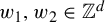 $w_1,w_2\in \mathbb {Z}^d$
and
 $u_1,u_2$
in
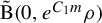 $\tilde {\mathrm {B}}(0,e^{C_1 m}\rho )$
, as
 $$ \begin{align*} v_1 = \frac{1}{Q} w_1 + u_1 \;\mathrm{mod}\; \gamma_1 W_0 \quad \text{and} \quad v_2 = \frac{1}{Q} w_2 + u_2 \;\mathrm{mod}\; \gamma W_0. \end{align*} $$
This applies, in particular, to representatives of
 $(x_1,x)$
in
 $V/\gamma _1W_0\times V/\gamma W_0$
. It follows that
 $$ \begin{align*} \tilde{d}(y,Z_{e^{C_1m}}) \leq e^{C_1 m}\rho. \end{align*} $$
If
 $\eta>0$
is chosen so small that
 $({2C_1}/{c_0})\eta <\beta $
, one has
 $$ \begin{align*} e^{C_1m} = e^{({2C_1}/{c_0})({c_0m}/{2})} \leq \rho^{-({2C_1}/{c_0})\eta} \leq \rho^{-\beta}, \end{align*} $$
so the lemma is proved.
6.3 Instability of closed invariant subsets
To conclude the proof of Theorem 6.1, we use a variant of the argument given in [Reference He, Lakrec and Lindenstrauss27, §3]. It is based on Foster’s exponential recurrence criterion, applied to a well-chosen function associated to a closed invariant subset. This technique has been used extensively in homogeneous dynamics since the work of Eskin and Margulis [Reference Eskin and Margulis19], in particular, by Benoist and Quint for their study of stationary measures [Reference Benoist and Quint4–Reference Benoist and Quint7].
Lemma 6.6. (Margulis inequality)
For every
 $\unicode{x3bb} \in (0,1)$
, there exist constants
 $C,\alpha>0$
depending only on
 $\mu $
such that the following holds. For
 $Q\geq 2$
, define a function
 $\varphi _Q\colon Y\to \mathbb {R}\cup \{+\infty \}$
by
 $$ \begin{align*} \varphi_Q(y) = \begin{cases} \tilde{d}(y,Z_{Q})^{-\alpha} & \mbox{if}\ \tilde{d}(y,Z_{Q})>0,\\ +\infty & \mbox{otherwise}. \end{cases} \end{align*} $$
For all
 $y \in Y$
and all integers
 $n \geq 1$
,
 $$ \begin{align*} \int \varphi_Q(gy) \,{d} \mu^{*n} (g) \leq e^{-\unicode{x3bb}\alpha n} \varphi_Q(y) + Q^C. \end{align*} $$
The proof of such inequalities is an application of Furstenberg’s law of large numbers [Reference Benoist and Quint8, Theorem 4.28], using also the exponential moment assumption on
 $\mu $
. Since it is rather standard, we leave it to the reader, and turn to the proof of Theorem 6.1.
Proof of Theorem 6.1
Let
 $C,\alpha>0$
be the parameters given by Lemma 6.6 applied with
 $\unicode{x3bb} '=({1+\unicode{x3bb} })/{2}$
instead of
 $\unicode{x3bb} $
. Then, set
 $\beta ={\alpha }/({C+2})$
.
Proposition 6.4 shows that for some
 $n_1\asymp _\beta \log ({\lVert a_0\rVert }/{t})$
and some
 $\rho \in [e^{-C_1n_1},e^{-c_1n_1}]$
, there exist
 $Q\leq \rho ^{-\beta }$
such that
 $$ \begin{align*} \mu^{*(n-n_1)}*\delta_{y_0}({\tilde{\mathrm{N}}\mathrm{bd}}(Z_{Q},\rho)) \geq \rho^\beta. \end{align*} $$
Applying Lemma 6.6 yields
 $$ \begin{align*} \rho^{-\alpha+\beta} & \leq \int \varphi_Q(gy_0) \,{d} \mu^{*(n-n_1)} (g)\\ & \leq e^{-\unicode{x3bb}'\alpha (n-n_1)} \varphi_Q(y_0) + Q^C. \end{align*} $$
Note that
 $Q^C\leq \rho ^{-C\beta }\leq \tfrac 12\rho ^{-\alpha +\beta }$
and therefore
 $$ \begin{align*} \varphi_Q(y_0) = \tilde{d}(y_0,Z_{Q})^{-\alpha} \gg e^{\unicode{x3bb}'\alpha (n-n_1)}\rho^{-\alpha+\beta} \gg e^{\unicode{x3bb}'\alpha n} e^{-C_1\alpha(1-{1}/({C+2}))n_1}. \end{align*} $$
Since
 $n_1\asymp \log ({\lVert a_0\rVert }/{t})$
and
 $\unicode{x3bb} '=\unicode{x3bb} +({1-\unicode{x3bb} })/{2}$
, taking
 $n\gg ({1}/({1-\unicode{x3bb} }))\log ({\lVert a_0\rVert }/{t})$
yields
 $$ \begin{align*} \tilde{d}(y_0,Z_{Q}) \leq e^{-\unicode{x3bb} n} \end{align*} $$
and the theorem is proved.
Acknowledgements
It is a pleasure to thank Yves Benoist and Elon Lindenstrauss for several useful discussions, in particular, on the existence of satellite measures in the presence of compact factors. The authors are also grateful to the anonymous referee for numerous corrections and helpful comments. While this research was conducted, W.H. was supported by ERC 2020 grant HomDyn (grant no. 833423), KIAS Individual Grant (no. MG080401) and the National Natural Science Foundation of China (No. 12288201).



