Introduction
Decisions on care services, such as day care, home care, and residential care, involve and affect many people with dementia and their families all over the world (Schneider et al., Reference Schneider2002; Knapp et al., Reference Knapp2007). During recent decades, there has been a growing recognition that people cannot be assumed incapable of making such decisions solely on the basis of a dementia diagnosis (Goldsmith, Reference Goldsmith1996; Kitwood, Reference Kitwood1997; Wilkinson, Reference Wilkinson2001; Bartlett and O’Connor, Reference Bartlett and O’Connor2010). Additionally, legislative changes have been made that strengthen the right for people with dementia to participate in decisions about care services (Tyrrell et al., Reference Tyrrell, Genin and Myslinski2006; Smebye et al., Reference Smebye, Kirkevold and Engedal2012).
For example, the Mental Capacity Act 2005, which came into force in 2007 in England and Wales, seeks to empower people as long as they maintain capacity and protect them when they lack capacity to make a certain decision (Boyle, Reference Boyle2008). According to the act, “a person's capacity must be assessed specifically in terms of their capacity to make a particular decision at the time it needs to be made” (Department for Constitutional Affairs, 2007, p. 40). This stands in contrast to how people, prior to the act, were often judged as lacking decision-making capacity simply because of the presence of a certain diagnosis, such as dementia (Boyle, Reference Boyle2008).
Sweden has strengthened formal rights of people with dementia in recent decades, also illustrating that these changes may take different forms. In Sweden, existing forms of proxies do not have the right to intrude on any adult citizen's right to self-determination about whether she or he should receive care services such as residential care (Klemme Nielsen, Reference Klemme Nielsen, Broström and Johansson2012). Thus, in contrast to the situation in England and Wales, the challenges in allowing the person with cognitive disability the greatest possible freedom concerning decisions on care services – while at the same time preventing harm to the individual or others (Wilkinson, Reference Wilkinson2001) – are not acknowledged in Swedish legislation. Instead, they are transmitted to practice in full (Klemme Nielsen, Reference Klemme Nielsen, Broström and Johansson2012).
Reforms that clarify the rights of people with dementia to take part in care decisions have also been undertaken on the international level. According to The United Nations Convention on the Rights of People with Disabilities (CRPD), adopted by the United Nations in 2006, “persons with disabilities enjoy legal capacity on an equal basis with others in all aspects of life.” The convention also states that all “parties shall take appropriate measures to provide access by persons with disabilities to the support they may require in exercising their legal capacity” (Article 12). As people with dementia, by the definition used in CRDP, are people with disabilities, the rights in the convention are applicable to them (Smith and Sullivan, Reference Smith and Sullivan2012).
These changes on a discursive and formal level concerning capabilities and rights for people with dementia to participate in decisions on their own care raise questions about the related decision-making practices, and indicate the importance of summarizing current knowledge in this area. Formal and discursive changes might not easily transfer into action, and given the challenges embedded in enhancing the rights of people with dementia to participate in decisions about their own care, an important question is thus whether these changes may be traced in how decisions are currently made and experienced.
Thus, summarized knowledge is needed on how decisions on care services for people with dementia are currently made and experienced in different parts of the world, and within varying forms of legislative frameworks. Such knowledge may provide an important basis for future legislative and organizational developments in the area of care decisions and dementia. Knowledge of how decisions on care services for people with dementia are made and experienced by the parties concerned is also vital in order to provide relevant support to people with dementia and their families. These decisions are considered to be “a milestone both in the progress of the dementia and in the relationship between the person, the family, and the professionals involved” (McDonald, Reference McDonald2010, p. 1233).
Aim
The aim of this review and synthesis was to advance understandings of how decisions on care services for people with dementia are currently made and experienced by those involved. A particular focus was placed on the ways in which people with dementia are involved in these decisions.
Thus, the research questions were:
-
• In what ways are people with dementia currently involved in decisions on care services (such as home care, day care, and residential care)?
-
• What are the meanings and consequences of these ways of involvement, for people with dementia as well as for other parties potentially taking part in the process (e.g. family members, professionals)?
Methods
Search strategy
A systematic review (see Finfgeld, Reference Finfgeld2003; Saini and Shlonski, Reference Saini and Shlonsky2012) was conducted. We searched CINAHL, PsycINFO, ASSIA, Social Services Abstracts, Science Direct, Academic Search Premier using the terms “dement*” or “Alzheimer*” and “deci*” “autonomy,” “self determ,*” “self-determ*” (titles and abstracts; all possible combinations). Additionally, we searched PubMed using the MeSh terms “dementia” and “Alzheimer disease” and “personal autonomy” or “decision making.”
Study inclusion
For inclusion in the review, a publication had to meet the general criteria of being published between 2005 and 2013 in a peer-reviewed journal, and be written in English. A starting point of 2005 was deemed appropriate, as the purpose of this review was to cover contemporary ways of making decisions about care services.
Studies also had to meet more specific criteria; they had to:
-
• be empirical studies,
-
• deal with decisions on care services for people with dementia.
Studies excluded were those dealing exclusively with:
-
• capacity assessments,
-
• caregivers’ or family members’ motives and reasons for placing a relative with dementia in residential care, medical care or treatment, or
-
• people with learning disabilities who had acquired dementia.
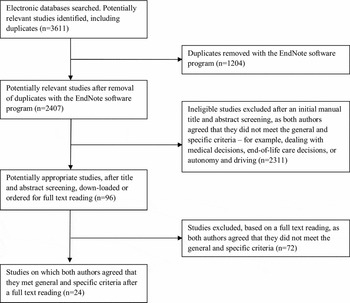
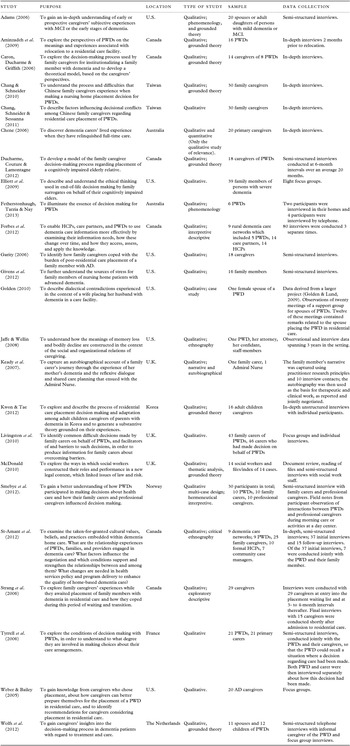
The screening process (see Figure 1) resulted in 24 pertinent studies, all qualitative (see Table 1 for included studies). The last step of identifying these studies was full-text screening of 96 articles. As part of this process, uncertainties about the appropriateness of 28 of the 96 articles were solved by discussion and re-reading of the articles. Of these 28 articles, both authors agreed to exclude 20 articles. These excluded 20 publications were about medical decisions (e.g. Chrisp et al., Reference Chrisp, Tabberer and Thomas2013), surrogate decision makers’ beliefs and values, (e.g. Lopez and Guarino, Reference Lopez and Guarino2011), transitions from one care residence to another (e.g. Horttana et al., Reference Horttana, Fahlström and Ahlström2011), healthcare practitioners’ attitudes about advocacy services (e.g. Luke et al., Reference Luke, Redley, Clare and Holland2008), factors or reasons for institutionalizing a person with dementia (e.g. Cairns, Reference Cairns2012), or training programs or preparation for future care for family caregivers (e.g. Mak and Sorensen, Reference Mak and Sörensen2012). The complete list of studies excluded following a full text reading may be obtained from the authors.
Presentation of the screening process.

Presentation of included studies

Abbreviation Key: MCI: Mild Cognitive Impairment; PWD: Person with Dementia; GCP: Health Care Practitioner; AD: Alzheimer's Disease
Synthesis
The 24 included studies were analyzed in accordance with an integrative approach to qualitative synthesis, which means that findings from qualitative studies are summarized in order to develop conceptual descriptions of phenomena across studies (Saini and Shlonski, Reference Saini and Shlonsky2012). We read the publications several times and extracted all findings (interview quotes and empirical descriptions) relevant to our research questions. These data were then coded, grouped, and compared, looking for congruencies and similarities in an iterative process. As a result, three themes were generated that covered all forms of involvement of people with dementia in decisions on care services represented in the extracted data: (a) excluded, (b) prior preferences taken into account and, (c) current preferences respected. The presence of each way of involvement among the findings of each individual study was systematically checked and noted. So were meanings and consequences for those concerned in each way of involvement, as well as other dimensions in the articles that we considered relevant or striking. Examples of such dimensions are information about the formal context and underlying assumptions about how these decisions are normally made, and by whom.
In the next sections, we will first communicate some general observations concerning the content and focus of the included articles. After that, we will describe sequentially the three overarching ways of involvement of people with dementia in decisions on care services that our analysis generated.
The included studies
While the object of the review encompassed decisions on various types of care services, the majority (17) of the included 24 studies dealt exclusively with decisions on relocation to some form of residential care. Three articles explicitly focused on the perspectives of people with dementia (Tyrell et al., Reference Tyrrell, Genin and Myslinski2006; Aminzadeh et al., Reference Aminzadeh, Dalziel, Molnar and Garcia2009; Fetherstonhaugh et al., Reference Fetherstonhaugh, Tarzia and Nay2013), and four (Jaffe and Wellin, Reference Jaffe and Wellin2008; Forbes et al., Reference Forbes2012; Smebye et al., Reference Smebye, Kirkevold and Engedal2012; St-Amant et al., Reference St-Amant2012) aimed at capturing the perspectives of several parties, including people with dementia. One article (McDonald, Reference McDonald2010) focused on the roles and performance of social workers. The remaining 16 articles aimed at capturing the perspectives of caregivers or family members.
The 24 studies were conducted in nine different countries. A striking observation made while going through the publications was that only four (Tyrrell et al., Reference Tyrrell, Genin and Myslinski2006; Livingston et al., 2010; McDonald, Reference McDonald2010; St-Amant et al., Reference St-Amant2012) described the legal framework in the country concerned. Another two studies (Smebye et al., Reference Smebye, Kirkevold and Engedal2012; Wolfs et al., Reference Wolfs2012) encompassed general contextual statements such as “The Western ideal of autonomy in health matters has led to many countries passing laws giving patients the right to participate in deciding about their treatment and care” (Smebye et al., Reference Smebye, Kirkevold and Engedal2012, p. 242). The rest (18 studies) demonstrated a complete lack of legal context, or seemed to be based on the assumption that this aspect was known to the reader and/or also applied in other parts of the world. An implicit point of departure in several (10) of these studies seemed to be that people with dementia are, invariably, placed in residential care by family members. This is despite the fact that placing people with dementia in residential care is in some countries a legally regulated option only under certain circumstances (e.g. if the person is considered to be at risk) (Livingston et al., Reference Livingston2010; McDonald, Reference McDonald2010; St-Amant et al., Reference St-Amant2012). In other countries (e.g. Sweden), no such options exist (Klemme Nielsen, Reference Klemme Nielsen, Broström and Johansson2012; see also Tyrell et al., Reference Tyrrell, Genin and Myslinski2006). The apparent lack of legal context in most of the articles might be related to a pure focus on the informal decision-making done within a family. Thus, in most of the studies, decisions on care services were dealt with solely as a family matter, without involvement of professional “gate keepers” and without formal regulations. Whether such phenomena actually exist in the country in question remains unknown. As illustrated in other included studies (e.g. McDonald, Reference McDonald2010), these informal decisions may only be one part of a process of decisions that is partly carried out within a formal and organizational context, in which professionals such as social workers are important parties.
Three of the studies (Chang and Schneider, Reference Chang and Schneider2010; Chang et al., Reference Chang, Schneider and Sessanna2011; Kwon and Tae, Reference Kwon and Tae2012), all conducted in Eastern Asia (Taiwan and Korea), do not acknowledge any (potential) legal and organizational context, but place the study within the context of conflicting cultural ideals. Caring for an older relative at home, according to these publications, is considered normal and proper within traditional ideals of filial piety. However, due to major changes and new ideals in modern society, an increasing number of people with dementia are placed in residential care by their families. Because of clashing cultural ideals, according to the publications in question, these family members might experience the process of placing an older relative in residential care “. . .quite differently than the caregivers from other cultural backgrounds” (Kwon and Tae, Reference Kwon and Tae2012, p. 144).
Ways of involvement
Having reported some general observations and findings concerning the content and focus of the included articles, we will now present our synthesis of findings on the involvement of people with dementia in decisions on care services. We will present sequentially the three identified ways that people with dementia were involved in decisions on relocation to residential care. These themes are: (a) excluded, (b) prior preferences taken into account and, (c) current preferences respected. Meanings and consequences will also be described for each way of involvement for the parties concerned (the person with dementia, family members/caregivers, professionals) as identified during the analysis.
Excluded
The most frequently illustrated way that people with dementia were involved in decisions on their future care, was that they were excluded from these decisions. This form of (non-) involvement appeared more or less explicitly in all but one of the articles. The exception is Adams’ (Reference Adams2006) study, which also stands out by focusing on (caregivers of) people in the early stages of dementia.
In the 23 studies examined, two levels of exclusion were identified. The first level meant that the person with dementia was not told about the decision before implementation. Thus, the person with dementia was given no chance to voice her/his own viewpoints on the matter. This level was identified in five studies (Chene, Reference Chene2006; Aminzadeh et al., Reference Aminzadeh, Dalziel, Molnar and Garcia2009; Ducharme et al., Reference Ducharme, Couture and Lamontagne2012; Smebye et al., Reference Smebye, Kirkevold and Engedal2012; St-Amant et al., Reference St-Amant2012). In four of these studies, family members were presented as the decision-makers. In one study, (St-Amant et al., Reference St-Amant2012), it was a case of formally appointed surrogate decision-makers who refrained from acknowledging the wishes of the individuals with dementia as expressed earlier in the illness trajectory. They refrained even though this, according to the study in question, meant violation of a legally stipulated procedure. The studies also reveal that this level of (complete) exclusion of people with dementia occurred despite, or even because of, family members knowing that the decision was against the older relative's will (see Ducharme et al., Reference Ducharme, Couture and Lamontagne2012).
The second level of exclusion was identified in three studies (Chene, Reference Chene2006; Livingston et al., Reference Livingston2010; Chang et al., Reference Chang, Schneider and Sessanna2011). This level implies that the involved individuals with dementia were told about the decision made by someone else before implementation, and thus given a chance to present their viewpoints. However, the decision was carried through even though the person with dementia explicitly objected. Four studies (Weber and Bailey, Reference Weber and Bailey2005; Aminzadeh et al., Reference Aminzadeh, Dalziel, Molnar and Garcia2009; Elliott et al., Reference Elliott, Gessert and Peden-McAlpine2009; Golden, Reference Golden2010; Forbes et al., Reference Forbes2012) present examples of how people with dementia are deceived into entering residential care and day care by being told that they are moving, or going somewhere else. Participating caregivers in Weber's and Bailey's (Reference Weber and Bailey2005) focus groups refer to this phenomena as “therapeutic fibbing,” which includes “. . .telling the patient that the move was temporary, stating that the patient was going to a resort or school, or telling the individual being placed that they were going there for medical tests or other health-related activities” (p. 28). Other strategies, presented in four studies (Keady et al., Reference Keady, Ashcroft-Simpson, Halligan and Williams2007; Jaffe and Wellin, Reference Jaffe and Wellin2008; Livingston et al., Reference Livingston2010; Wolfs et al., Reference Wolfs2012), were to introduce services a little at a time or in various ways persuade the individual to accept relocation to residential care or home care. The latter includes enlisting the doctor's medical authority. On the one hand, these strategies seem slightly more inclusive than deliberately deceiving the person with dementia, but on the other hand they also seem more time-consuming and may, according to Jaffe and Wellin (Reference Jaffe and Wellin2008), encompass almost a year of “bargaining and negotiation” (p. 131).
Meanings and consequences for the parties involved
What then are the meanings and consequences for the parties involved in decisions on care services that are made without consent, or against the explicit will of the person with dementia? As the majority of the studies included in our review focused exclusively on the perspective of family caregivers, they provide a rich basis for answering the question from this perspective. The coherent picture provided is that deciding on relocation to residential care, without consent of the person with dementia in question, may cause considerable difficulties for family caregivers such as feelings of failure, betrayal, and guilt. On the other hand, family caregivers participating in these studies also “. . .recognized that it was the only way to ensure their family member's safety and wellbeing” (Forbes et al., Reference Forbes2012, p. 8; see also Garity, Reference Garity2006). They also “. . .mentioned that their guilt over placement was decreased by knowing that their family member needed 24-h care” (Garity, Reference Garity2006, p. 45). These studies also reveal that other family members or professionals, by supporting the decision, may alleviate guilt by “giving permission.” They may also help to re-conceptualize “. . .care homes as providing safety, either for the caregiver or the person with dementia, particularly if homecare services were refused” (Livingston et al., Reference Livingston2010, p. 5) by the person with dementia. Furthermore, in one study, exclusion of a person with dementia by not informing her or him about the decision is presented as potentially beneficial as it “. . .allowed the caregiver to attenuate his/her own negative feelings about placement and to avoid emotional reactions on the part of the person with dementia” (Ducharme et al., Reference Ducharme, Couture and Lamontagne2012, p. 207). To inform the person with dementia about the decision on relocation, in cases when this was the route chosen, stands out as a difficult and painful experience for caregivers (e.g. Chang et al., Reference Chang, Schneider and Sessanna2011).
The studies do not provide much insight into the meanings and consequences for an individual with dementia of having to accept care services without consent or against one's will. One exception is the study by Aminzadeh et al. (Reference Aminzadeh, Dalziel, Molnar and Garcia2009), which set out to explore the perspectives of persons with dementia on relocation to a residential care facility. Summing up, Aminzadeh et al. (Reference Aminzadeh, Dalziel, Molnar and Garcia2009) state that perceiving the process as dominated by caregivers, for the people with dementia, resulted “. . .in a perception of further loss of agency, autonomy, choice, and control, which may have, in turn, contributed to the uncertainties and the overall more negative responses of these individuals to relocation” (p. 491). Similarly, Fetherstonhaugh et al. (Reference Fetherstonhaugh, Tarzia and Nay2013) conclude: “Being ignored made the participants feel insignificant, as though their identity as a person was under threat, and that they were nothing more than a ‘piece of wood’ (Participant 5) who should ‘just go home and disappear’ (Participant 4)” (p. 148).
Prior preferences taken into account
Another overarching way that people with dementia were involved in decisions on their future care touched upon in two of the included publications (Elliott et al., Reference Elliott, Gessert and Peden-McAlpine2009; Forbes et al., Reference Forbes2012), was that their prior preferences were taken into account.
One manner of considering prior preferences that was identified in these two studies implies that the fact that the person with dementia in early stages of the trajectory or “. . .prior to the onset of dependency” (Elliot et al., Reference Elliott, Gessert and Peden-McAlpine2009, p. 254) had delegated her/his decision-making authority to a surrogate decision-maker was respected (see also Forbes et al., Reference Forbes2012). Thus, it was this person, previously chosen or accepted by the person with dementia to decide on her/his behalf in the future, who made the decision on care services or relocation. Another identified way in which previous preferences were taken into account was that specific wishes of the person with dementia as known by family members “. . .were incorporated in the decision, using statements that had been communicated before the elder's loss of capacity. Sometimes this was based in Advance Directive planning; other times, important conversations offered guidelines” (Elliot et al., 2009, p. 255).
Meanings and consequences for the parties involved
None of the studies tell us anything about the meanings and consequences of delegating one's decision-making authority to another person, or making a decision on relocation or care services based on preferences that one has expressed before or earlier in the trajectory of dementia. However, Elliot's study (2009) shows that delegation of decision-making authority may be positive for the person who is asked to fill the role as a surrogate decision-maker. As expressed by a participant in the study: “It's an honour to be chosen to do that role, you know, cause it means he thinks enough of me to trust me to do it” (p. 254). Furthermore, Forbes et al. (Reference Forbes2012) show that care partners/family caregivers and healthcare professionals preferred this way of dealing with the transfer of decision-making authority to another person before waiting until the person with dementia has been declared incompetent of making decisions. That is, they preferred that this transfer “. . .was completed while the PWD (person with dementia, author's comment) could still participate in this process” (Forbes et al., Reference Forbes2012, p. 7).
On the other hand, as illustrated in St-Amant et al.'s (Reference St-Amant2012) study, despite surrogate decision-makers being formally obliged to consult (other) family members, this is not always done in practice. It makes those (other) family members feel removed and excluded from the decision-making process, once their relative has been declared incompetent. Concerning meanings and consequences of incorporating specific wishes of the person with dementia that had been communicated earlier in the illness trajectory in the decision, this might also, according to Elliot et al.'s study (Reference Elliott, Gessert and Peden-McAlpine2009), cause certain problems in the family as not everyone necessarily agrees on this being the “right” way.
Current preferences respected
The third identified way of involvement of people with dementia in decisions on care services was that their current preferences were respected. This way of involvement was recognized in altogether eight articles (Adams, Reference Adams2006; Caron et al., Reference Caron, Ducharme and Griffith2006; Tyrrell et al., Reference Tyrrell, Genin and Myslinski2006; Elliot et al., 2009; McDonald, Reference McDonald2010; Ducharme et al., Reference Ducharme, Couture and Lamontagne2012; Smebye et al., Reference Smebye, Kirkevold and Engedal2012; Wolfs et al., Reference Wolfs2012). These studies provide illustrations of decisions made in agreement by family caregivers and people with dementia, such as people with dementia being “. . .‘open’ to the idea of being placed, having realized that his/her living environment was no longer adequate” (e.g. Ducharme et al., Reference Ducharme, Couture and Lamontagne2012). Concerning people in the very early stages of dementia (Elliot et al., Reference Elliott, Gessert and Peden-McAlpine2009), there are also examples of decisions “. . .made closely involving the elder's autonomous wishes” (p. 256). Furthermore, several examples are provided of family caregivers and professionals who chose to respect the current wishes of the person with dementia not to accept care services, even if they themselves had a diverging opinion.
We also identified examples of professionals basing their (formal) decisions about care services on the wishes of the person with dementia, in cases when this meant acting against the explicit preferences of family caregivers. McDonald's (Reference McDonald2010) study in the United Kingdom shows that the social worker's decisions sometimes respected the will of the person with dementia, even though it did not match the will and expectations of the family caregiver or other (self-appointed) representative who had contacted the social worker. The social workers justified these decisions by using the Mental Capacity Act 2005 and the legal test of capacity to argue for the rights of the people concerned. According to McDonald's study, it was not unusual that family members sought to block these assessments by arguing that the diagnosis of dementia as such was evidence of lack of capacity to make the decision. Caron et al.'s (Reference Caron, Ducharme and Griffith2006) study provides examples of doctors making decisions corresponding to the will of people with dementia, but diverging from the wishes expressed by family caregivers. One such example presented concerns a man with dementia who was allowed by a doctor to return home from a short-term geriatric unit, despite the fact that the family caregivers had told the same doctor that they strongly believed that the best solution for the care of their older relative would be residential care.
Meanings and consequences for the parties involved
The studies in question provide only a few examples of meanings or consequences for the parties involved of respecting the present preferences of the persons with dementia. According to the study carried out by Caron et al. (Reference Caron, Ducharme and Griffith2006), a family caregiver, experiencing that one's evaluations of the care situation are disregarded by healthcare professionals while the preferences of the person with dementia are acknowledged, may result in frustration with the situation. Frustration may also be the result of a family caregiver taking the preferences of the person with dementia into account, while at the same time perceiving that the person with dementia overestimates her/his own ability and does not see the need to move to an environment that offers more services. Similarly, Ducharme et al. (Reference Ducharme, Couture and Lamontagne2012) found that a consequence of including the person with dementia in the decision by acknowledging her/his reluctance toward relocation was that the family caregiver kept the person at home, while at the same time recognizing placement as the best option under the circumstances.
Discussion
In the sections above, we have illustrated three overarching ways in which people with dementia are involved in decisions on care services or relocation to residential care, as identified in recent empirical research. These are: excluded, prior preferences taken into account, and current preferences respected. We have also described identified meanings and consequences of each way of involvement for the parties concerned. Because of the scope of the included studies, the synthesis presented deals primarily with the involvement of people with dementia in the informal part of the decision-making, carried out within a family.
What then does our study tell us about how decisions on care services are currently made and experienced in practice, and about the involvement of people with dementia in these decisions?
First, as the publications analyzed included few empirically grounded examples of people with dementia having more than a minimal say in decisions about their future care, they tell more about the exclusion of people with dementia from care decisions than about their active involvement. The family caregivers’ experiences of excluding the person with dementia from these decisions are most often characterized by feelings of guilt and betrayal. Challenging assumptions in the studies conducted in East Asia, these feelings seem to be shared by caregivers in countries all over the world. They may, however, be alleviated by professionals confirming that the decision made is the right one, as well as by recognizing that the decision, although not appreciated by the person with dementia, is in her/his best interests. Taking the perspective of people with dementia, feelings of marginalization seem to characterize exclusion from the decisions in question. Such sentiments also seem to characterize the experiences of some family caregivers whose wishes and preferences are not acknowledged, in cases when a surrogate decision-maker is formally appointed at the time of “lost capacity.” On the other hand, the person appointed appreciates being trusted. Concerning taking the current preferences of the persons with dementia into account, the included studies only provide examples of negative consequences for family caregivers in terms of feelings of frustration. Thus, this review does not really provide any answers on how to include the preferences of the person with dementia, without this being at the expense of the well-being of caregivers. Nor does it provide knowledge on what it might mean to people with dementia that their preferences are respected.
Instead, the informal decision-making concerning care services for people with dementia emerges as complex, with no clear “winners,” but many “losers.” If the results of the few studies including the organizational context of these decisions are added, an even more complex decision-making process emerges. Additionally, as illustrated by these latter studies, the formal decision makers’ decisions do not necessarily correspond to the informal decisions made by family members. Thus, despite being both complex and protracted, informal decisions may not necessarily, and not everywhere, end up in implementation of care services.
Notably, none of the studies actually provide examples of people with dementia initiating the decision-making process by expressing a need or wish for services or relocation. Instead, the studies almost exclusively illustrate whether – and how – people with dementia were given an opportunity to react on decisions made by others, as well as on the potential impact of these reactions. However, this might not mirror what is actually going on in the world outside the publications in question. Instead, the few illustrations of active participation of people with dementia might be related to the dominant focus on family caregivers’ perspectives in the articles. Furthermore, a surprising amount of the studies included seem to be based on a taken-for-granted assumption that these decisions are normally made without participation of the individual with dementia, and without taking her/his opinions and remaining abilities into account. Thus, this review confirms that dementia is still largely perceived and investigated as a burden of care for caregivers. It also suggests that the preconditions for, and meanings of, being an agent with dementia who is able to do things for her/himself and invokes rights as a member of a community – are still under-researched and under-theorized (Bartlett and O’Connor, Reference Bartlett and O’Connor2010). Thus, while there might be a growing recognition that people cannot be assumed incapable of making decisions about their own care solely on the basis of a dementia diagnosis (see e.g. Kitwood, Reference Kitwood1997; Wilkinson, Reference Wilkinson2001; Bartlett and O’Connor, Reference Bartlett and O’Connor2010) and their formal rights to participate in the decisions have been strengthened during recent decades (see e.g. Boyle, Reference Boyle2008; Smith and Sullivan, Reference Smith and Sullivan2012), our work suggests that these changes have not had a major impact on research in the area.
Conclusions
A conclusion that can be drawn from our review is that recent research on care decisions for people with dementia does not provide a complete picture of how these decisions are currently made in practice. Specifically, the involvement of people with dementia in these decisions does not seem to be sufficiently and adequately addressed.
Hence, this review raises important implications for future research in the area of decisions on care services for people with dementia. It emphasizes the need for updated studies and publications directed to an international audience on formal and discursive changes concerning capabilities and rights of people with dementia. One example of such a change is the clarification of the legal status of people with disabilities – and people with dementia (Smith and Sullivan, Reference Smith and Sullivan2012) – in CRPD in 2006. Another example is that scholars have stated for years now that persons with dementia have the ability to voice their feelings and preferences, even in late stages of the disease (see Goldsmith, Reference Goldsmith1996; Kitwood, Reference Kitwood1997).
Thus, we would like to argue that people with dementia being placed in residential care by family caregivers is outdated, as an uncriticized or taken-for-granted point of departure in a research project, even though this might be what is actually going on “out there.” Such taken-for-granted assumptions appear as particularly striking in the context of other dementia scholars (in some cases in the same country) currently arguing that “. . .it is not enough to simply include people in decisions about their care; we must also convey to the person that their inclusion matters” (Bartlett and O’Connor, Reference Bartlett and O’Connor2010, p. 43).
We would also like to suggest that even if a study aims at capturing the perspectives of caregivers, as a scholar, knowing and informing the reader about the (potential) legal and organizational context of the decisions in question is vital for future knowledge production in the area. Additionally, as the studies identified have similar designs that are based mainly on qualitative interviews, research on decisions on care services for people with dementia would probably benefit from the complementary use of other methods and empirical materials.
Conflict of interest
None.
Description of authors’ roles:
Both authors co-operated in the formulation of research questions, designing the review, and conducting the identification of relevant studies. A. Taghizadeh Larsson was responsible for the analysis and writing the paper. J. H. Österholm was responsible for conducting the literature search, assisting with the analysis, and writing and producing tables and figures.
Acknowledgments
The authors are grateful to Anna Pettersson, librarian at Linköping University, for her support in the literature search phase and to Professor Lars-Christer Hydén, Linkoping University, for his constructive comments on this paper. The research reported in this study was funded by a generous grant from the Swedish Riksbankens Jubileumsfond (M10–0187:1).