Homogenisation of milk is an essential step in the manufacture of yoghurt that increases gel firmness and reduces syneresis (Lucey, Reference Lucey2004). The applied pressure disrupts milk fat globules into smaller particles (<2 µm), whose surface is covered by casein micelles when colliding (Michalski et al. Reference Michalski, Cariou, Michel and Garnier2002a). Changes in milk formulation are often carried out to reduce or eliminate fat. Therefore incorporation of dairy fat replacers, such as microparticulated whey protein (MWP), is a common practice, where lack of fat results in texture defects and syneresis (Sandoval-Castilla et al. Reference Sandoval-Castilla, Lobato-Calleros, Aguirre-Mandujano and Vernon-Carter2004). MWP are protein aggregates obtained by applying heating and intensive shearing to whey protein concentrate (Spiegel & Huss, Reference Spiegel and Huss2002). Depending on the processing parameters used, e.g. temperature, shearing force, lactose content, these aggregates may have several chemical and physical characteristics (Spiegel, Reference Spiegel1999). Addition of dairy fat replacers will result in milk with an altered whey protein-to-casein ratio which is expected to behave differently upon homogenisation. However, no literature studies exist on the intermolecular interactions occurring during homogenisation of milk whose composition has been altered using MWP.
Following homogenisation, the thermal treatment of milk at temperatures between 80–95 °C for 5–15 min is carried out to destroy pathogens and enzymes, and to achieve desirable texture properties in yoghurt (Vasbinder et al. Reference Vasbinder, Alting and de Kruif2003; Lucey, Reference Lucey2004). When milk is heated above 65 °C, the major whey proteins in milk, β-lactoglobulin (β-lg), α-lactalbumin (α-lac) and bovine serum albumin (BSA) undergo an initial opening of the protein conformation (reversible process) followed by aggregation (irreversible process) (Dannenberg & Kessler, Reference Dannenberg and Kessler1988; Oldfield et al. Reference Oldfield, Taylor and Singh2005). The loss of protein conformation leaves hydrophobic domains and free thiol (-SH) groups of the proteins exposed and accessible for intermolecular attractive interactions with other proteins (Schokker et al. Reference Schokker, Singh, Pinder and Creamer2000; Guyomarc'h et al. Reference Guyomarc'h, Law and Dalgleish2003). Heat-induced complexes are formed amongst whey proteins themselves, or between whey proteins and caseins via a series of reactions, in which the free thiol group of β-lactoglobulin plays a major role (Anema & McKenna, Reference Anema and McKenna1996; Relkin, Reference Relkin1996; Anema & Li, Reference Anema and Li2003; Famelart et al. Reference Famelart, Tomazewski, Piot and Pezennec2004).
The following decrease of pH occurring during fermentation of yoghurt milk will cause the hairy polyelectrolyte layer of κ-casein on the micellar surface to collapse as it reaches the isoelectric point. Simultaneously, the heat induced complexes will act as bridges between casein micelles and lead to aggregation (de Kruif, Reference de Kruif1999; Vasbinder et al. Reference Vasbinder, van de Velde and de Kruif2004; Alexander & Dalgleish, Reference Alexander and Dalgleish2005).
The hypothesis of this research was that the surface characteristics of the whey protein microparticles (MWP) added to milk as fat replacers affect the intermolecular interactions occurring between milk proteins during homogenisation and heating, and thus, the nature and quantity of the formed complexes. Therefore, the main objective of this research was to elucidate how different characteristics of whey protein microparticles (MWP) added into non- or low-fat milk systems result in different intermolecular interactions occurring with other milk proteins upon homogenisation and heating.
Materials and methods
Raw materials
Milk ultrafiltration (UF) permeate was prepared from skimmed milk (Arla Foods, Slagelse, Denmark) using a polysulfone GR61PP membrane (Alfa Laval, Nakskov, Denmark) with a cut-off of 20 kDa to remove whey proteins.
As source of native whey protein, β-lactoglobulin (95%, w/w) was prepared at pilot plant scale by fractionation according to Tolkach & Kulozik (Reference Tolkach and Kulozik2005). Micellar casein (MCI80) was used as casein source (Arla Foods Ingredients, Nr. Vium, Videbæk, Denmark).
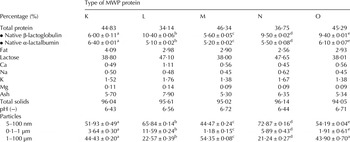
Five spray-dried microparticulated whey proteins (MWP) denoted K, L, M, N and O (Arla Food Ingredients) were used as fat replacers in the milk systems. Variations in their processing resulted in different chemical composition and particle size distribution, as shown in Table 1. Due to confidentiality, information regarding processing of the MWP will not be further described. Adjustment of fat was done by addition of cream (38% fat, 2·1% protein, Arla Foods).
Chemical composition of the MWP

Native protein content and particle size values are means of triplicate determinations ±standard deviation. Significant differences were determined for the results of native protein and particle size distribution. Values within a row not sharing superscript are significantly different (P < 0·05).
Milk model systems
Four model systems (System 1–4) of increasing complexity were prepared by mixing milk UF permeate (to maintain a similar ionic environment to milk), MWP, β-lactoglobulin, micellar casein and cream. The most simplified model (System 1) contained MWP (1·53%, w/v total protein) and UF permeate. Native whey protein (1·02%, w/v β-lactoglobulin) was added to this to make up System 2. Micellar casein (2·45%, w/v) was added to System 2 to create a model of non-fat milk (System 3) and finally a low-fat milk model (System 4) was made by addition of 0·5%, w/v milk fat to System 3. The four systems were prepared for each type of MWP and stored overnight at 4°C to allow hydration of the powders. Afterwards, each of the systems was homogenised and heated to explore the role of each ingredient on aggregate formation. The experiment was repeated three times.
Homogenisation and heating of milk
Milk systems were preheated to 63 °C and subjected to one-pass homogenisation at 15 MPa through a lab scale high pressure homogeniser (EmulsiFlex-C5 from Avestin, Inc., Ottawa, ON, Canada). The samples were transferred into stainless-steel tubes with a large surface area-to-volume ratio (inner diameter 3 mm, length of 258 mm) that ensured rapid heating and cooling rates. Three heat treatments (85 °C for 15 min, 90 °C for 5 min and 95 °C for 2 min) were applied to each milk system using a water bath. These heat conditions are commonly applied to skim milk to manufacture set and stirred yoghurts because they ensure denaturation of more than 90% of β-lactoglobulin (Kessler, Reference Kessler and Kessler2002b). After heating, the samples were cooled down and stored at 4 °C until analyses were performed. Samples for HPLC and SDS-PAGE were transferred into Eppendorf tubes, frozen and kept at −21 °C until analyses were carried out.
Determination of the degree of whey protein denaturation by RP-HPLC analysis
The degree of denaturation of native β-lactoglobulin and α-lactalbumin was determined by RP-HPLC as described by Tolkach & Kulozik (Reference Tolkach and Kulozik2005). Non heated milk samples were diluted with MilliQ water and the pH of heated and non-heated samples was adjusted to 4·6 with 1 m HCl to separate denatured whey proteins and caseins. Samples were centrifuged at 3000 g for 10 min. The supernatant was filtered through a 0·45 µm membrane filter (Frisenette ApS, Knebel, Denmark) and injected into a Zorbas 300SB-C18 reverse phase HPLC column (Agilent Technologies, Hørsholm, Denmark). Standard solutions were prepared at 1 mg/ml of α-lactalbumin and β-lactoglobulin (Sigma-Aldrich Chemie GmbH, Steinheim, Germany) and their total protein content was determined by Kjeldahl (IDF Standard 20B, 1993). Peak areas were normalised to the area of standards and denaturation degree of whey proteins calculated by comparison of the non- and heated samples.
Accessibility of thiol groups in the milk
The amount of accessible thiol groups at the surface of the aggregates of each model system was determined using 2-nitro-5-mercaptobenzoic acid (DTNB) (Merck, Darmstadt, Germany). Samples were diluted to 1 mg/ml protein in milk permeate and 0·4 ml of this solution was added to 1·2 ml 0·05 m Tris/HCl buffer (pH 7·0) followed by addition of 0·4 ml of 1 mg/ml DTNB solution prepared in the same buffer to give a final concentration of 0·2 mg/ml protein. The remaining diluted sample was centrifuged at 3000 g for 10 min in order to obtain particles of <1 µm. Samples were prepared in the same way as for the non-centrifuged fraction. The absorbance was measured at 412 nm, 15 min after addition of DTNB, with Tris/HCl buffer and DTNB as a blank. Experiments were performed in triplicate and the number of thiol groups was calculated using a molar extinction coefficient for DTNB of 13 600 m −1/cm.
Sodium dodecyl sulfate polyacrylamide gel electrophoresis of milk model systems
Samples were analysed by gel electrophoresis using NuPAGE Novex 10% Bis-tris gels according to the manufacturer's instructions (Invitrogen, Naerum, Denmark). Dilution of samples to 3 mg/ml was done using Tris buffer and 1% SDS (pH 8·0). Non-reduced samples (0·03 mg/ml) were prepared by mixing 1·6 µl of sample, 4 µl LDS sample buffer and 10·4 µl MilliQ water. Reduced samples (0·03 mg/ml) were prepared by mixing 1·6 µl sample, 1·6 µl of DTT in a stable liquid form, 4 µl LDS sample buffer and 8·8 µl MilliQ water. Samples were heated at 100 °C for 10 min, centrifuged and aliquots of 12 µl loaded to the gel. 3 µl of Precision Plus Protein Standard All Blue marker (Bio-Rad, Herlev, Denmark), α-lactalbumin (Sigma L6010, Sigma-Aldrich Chemie GmbH) and a mixture of β-lactoglobulin A (Sigma L7880, Sigma-Aldrich Chemie GmbH) and β-lactoglobulin B (Sigma L8005, Sigma-Aldrich Chemie GmbH) were also added as standards.
Stained protein bands were manually selected using Phoretix 1D software (version 2003·02) after background substraction. The pixel intensity of selected bands was determined as the peak height of the selected band in the lane profile as described by Jongberg et al. (Reference Jongberg, Lund, Waterhouse and Skibsted2011).
Measurement of ζ- potential
The electrophoretic mobility was determined at 20 °C on milk model systems diluted to 0·1 mg protein/ml in milk ultrafiltration permeate with a ZetaSizer 3000HS (Malvern Instruments Ltd., Malvern, UK). Calculation of the ζ- potential was carried out with the Henry equation using the Smoluchowski approximation (Gaucheron, Reference Gaucheron2005). Each sample was measured five times.
Darkfield microscopy
A drop of sample was placed on a microscope slide and images were taken using a camera (DFK31F03, The Imaging Source GmbH, Bremen, Germany) incorporated on a Nikon TE Eclipse 2000-U microscope (Nikon Instruments, Glostrup, Denmark) using a 20 X objective (Nikon ELWD, numerical aperture 0·45) coupled with a Darkfield condenser (Nikon TI-DF).
Statistical analysis
The results of the particle size distribution and denaturation of whey protein in the MWP, as well as the results of the free thiol groups and ζ- potential of the milk model systems, were subjected to one-way ANOVA and Least Significance Difference (LSD) as post-hoc test (PROC GLM, SAS version 9.1).
Results and discussion
Exposure of reactive thiol groups during homogenisation and heat treatment of milk
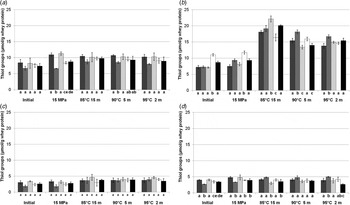
When homogenisation pressures were applied to MWP solutions (System 1, Fig. 1a), the breakdown of particles resulted in exposure of –SH groups in microparticles with low initial content of native β-lactoglobulin, i.e. K, M (Table 1). On the contrary, no change in availability of –SH groups was shown when the content of native β-lactoglobulin was higher, i.e. L and N, which was expected since the pressure applied was not high enough to induce denaturation of β-lactoglobulin molecules. Further heating of MWP solutions (Fig. 1a) served to unfold β-lactoglobulin molecules, thus increasing the exposure of–SH groups, in MWP with high initial content of native β-lactoglobulin i.e. L and N. Besides, heating may have promoted the formation of disulphide bonds between –SH groups of previously disrupted particles, i.e. K, M, and O, and available thiol groups from other whey proteins. For all milk systems, particles smaller than 1 µm (centrifuged samples) did not show any available –SH groups, and therefore, results are not presented.
Concentration of accessible thiol groups (μmol/g whey protein) determined for each type of MWP: type K ( ), type L (
 ), type M (
 ), type N (
 ) and type O (
 ); and for each non-centrifuged milk model system 1 (A), system 2 (B), system 3 (C) and system 4 (D). The accessibility of SH-groups was measured at each processing step: on the initial solution, after homogenisation at 15 MPa, and finally after heat treatment at either 85 °C 15 min, 90 °C 5 min or 95 °C 2 min. Values are means of triplicate experiments and their corresponding standard deviation is indicated by vertical bars. Different letters (a-e) on each processing step denote a statistical difference (P < 0·05) between MWP types.

Incorporation of native β-lactoglobulin in the solution (System 2, Fig. 1b) showed no significant differences in the initial amount of free thiol groups. Further homogenisation slightly increased the available –SH groups for all MWP. The following heating step resulted in unfolding of the native β-lactoglobulin, as reflected in the higher amount of reactive –SH groups for all MWP and heat treatments. Milk systems with MWP types L, M and O showed the highest level of –SH groups exposure after heating (Fig. 1b). This is related to the higher levels of calcium and lactose present in those MWP (Table 1), which are responsible for the reduction of heat stability and thus higher exposure of –SH groups (Kessler, Reference Kessler and Kessler2002a). During heating, lysine residues from the whey proteins will attach covalently to lactose following Maillard reactions (Czerwenka et al. Reference Czerwenka, Maier, Pittner and Lindner2006; Losito et al. Reference Losito, Carbonara, Monaci and Palmisano2007). This results in an improved heat stability of the proteins, which in turn may lead to hydrophobic and insoluble forms of the proteins being formed (Spiegel, Reference Spiegel1999; Mulsow et al. Reference Mulsow, Jacob and Henle2009). This is expected to promote further interactions with caseins during acidification of the milk for yoghurt manufacture.
Addition of casein micelles in the solution created a non-fat milk model system (System 3, Fig. 1c). After homogenisation, no increase in –SH groups was shown, opposed to what was seen for Systems 1 and 2. The disruption of MWP may have prompted the interaction of free –SH groups of the whey proteins with casein micelles. The mechanism would be analogous to the interaction of homogenised fat globules in which their surface devoid of milk fat globule membrane (MFGM) becomes covered by casein micelles. The adsorption of casein micelles onto the surface of the newly formed microparticles provided increased stability to the milk model systems due to steric repulsion of the polyelectrolyte hair of the κ-caseins. Further heating of the non-fat milk system exposed the free -SH groups of β-lactoglobulin and/or the minor BSA fraction present either in the milk serum, in disrupted microparticles or on the partly casein-coated microparticles formed after homogenisation. Irrespective of the MWP added, the number of thiol groups available remained fairly constant when a temperature of 85, 90 or 95 °C was used. This was confirmed by RP-HPLC where it was seen a similar denaturation degree of whey proteins in all heat treatments (results not shown).
Addition of 0·5% (w/v) fat to create a low-fat milk model system (System 4) resulted in an initial slightly higher amount of –SH groups. Further homogenisation is likely to have led to adsorption of casein micelles onto fat globules, rather than onto microparticles, as it was shown by a higher amount of free –SH groups in System 4 compared to milk System 3, where fat was not present. Therefore, reactive -SH groups from MWP K and M and to a minor extent for protein types L, N and O, were not covered by casein micelles to the same extent as in System 3 (Fig. 1c). Heating of the low-fat milk system resulted in a decrease in the amount of –SH available groups of proteins K and M, which could be due to polymeric aggregates, formed via disulphide/thiol exchange reactions. On the contrary, protein L showed an increased amount of –SH available groups. The availability of –SH groups for proteins type N and O did not change markedly.
Type of bonds involved in the formed aggregates
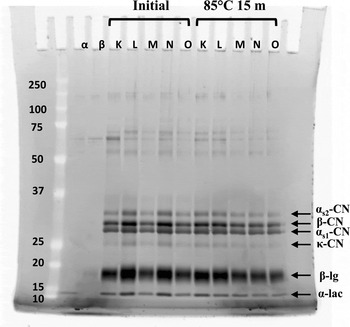
SDS-PAGE analysis of the milk model systems was performed at reducing and non-reducing conditions in order to establish the nature of the interactions occurring amongst proteins upon heating. Non-reducing conditions show covalent aggregates, since non-covalently linked aggregates dissociate into monomers with SDS treatment (Zuniga et al. Reference Zuniga, Tolkach, Kulozik and Aguilera2010). Gels under reducing conditions show only individual proteins resulting from the dissociation of S-S bound aggregates by DTT. As an example, Fig. 2 shows the SDS-PAGE gel of the non-fat milk model system (System 3) prior and after heat treatment at 85 °C for 15 min under reducing conditions.
SDS-PAGE of milk model system 3 at reducing conditions before and after heat treatment at 85C for15 min. The first lane corresponds to the molecular weight marker with its corresponding kDa for each band.

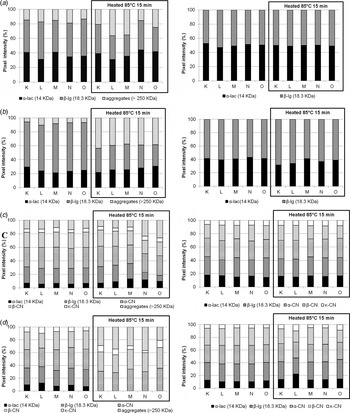
Since no significant differences were shown between heat treatments (results not shown), determination of the integrated optical density for protein bands of interest was carried out only on gels from milk model systems heated at 85 °C for 15 min and their corresponding initial solutions (Fig. 3).
Pixel intensity of the milk model systems before and after heating at 85 C for 15 min, at non-reducing (left) and reducing conditions (right) for each milk model system: system 1 (A), system 2 (B), system 3 (C) and system 4 (D).

Results from unheated MWP solutions (System 1, Fig. 3a) indicated that whey proteins in the MWP were held predominantly by covalent bonds. This was evidenced by the presence of aggregates with MW higher than 250 kDa that could not enter the gel and that were dissociated by DTT into β-lactoglobulin monomers and α-lactalbumin. Thiol groups exposed during homogenisation (Fig. 1a) were likely to have prompted disulphide bonding between whey proteins during heating, resulting in polymerisation of MWP type L, M and to a minor degree O with β-lactoglobulin and α-lactalbumin (Fig. 3a). On the contrary, MWP types K and N maintained the same degree of polymerisation (same pixel intensity of the protein aggregates that did not enter the gel).
When native β-lactoglobulin was added to the MWP solutions (System 2, Fig. 3b) heating resulted in aggregates, linked by disulphide bonds and with a MW higher than 250 kDa that were further dissociated upon treatment with DTT. These covalently linked aggregates were formed primarily due to the free –SH groups that became available upon heating of the added β-lactoglobulin in milk system 2 (Fig. 1b).
Addition of micellar casein into the model system (System 3, Fig. 3c) to form a non-fat milk model resulted in formation of other type of complexes. The hydrophobic interactions that contribute to the integrity of the casein micelles (Holt et al. Reference Holt, Davies and Law1986) became disrupted by the use of SDS. This released individual casein (CN) molecules: αs-CN, β-CN and κ-CN (Fig. 3). Upon heating, whey proteins included in the MWP reacted mainly with the individual, cysteine containing caseins, αs-CN and κ-CN via exchange thiol/disulphide reactions, as can be observed by the fractions obtained after reduction with DTT of the high MW complexes that did not enter the gel. This was especially seen in MWP types N and O that formed the highest percentage of high molecular aggregates. These insoluble covalent aggregates were partly formed as a result of the reaction of protein lysine residues with lactose present in high levels in these MWP (Table 1) (Losito et al. Reference Losito, Carbonara, Monaci and Palmisano2007).
The incorporation of 0·5% w/v fat to create a low-fat milk model (System 4, Fig. 3d) led to formation of complexes larger than 250 KDa when heating was applied, independently of the type of MWP. The amount of these heat induced complexes was higher than in milk with no fat (System 3). Apparently, the aggregates were mainly formed between β-lactoglobulin and α-lactalbumin present in the MWP and the milk system, since their presence was not detectable in the gel after heating the milk solutions. After DTT treatment, it was shown that the formed aggregates were stabilised via -SH/SS interchange reactions, since the intensity bands for the non- and heated solutions were similar.
From the SDS-PAGE results, it was seen that heat induced complexes were mainly formed due to covalent interactions. The composition and characteristics of these aggregates depended on the reactive interface created during homogenisation on the surface of MWP and/or fat globules. Besides, the type of MWP and the presence or not of fat had an effect on the type of aggregates.
Surface charge of aggregates in the milk systems
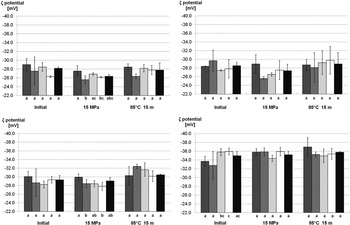
The study of the surface charge (ζ- potential) of the heat-induced aggregates formed in each milk model system (Fig. 4) may help to predict their behaviour upon further acidification. This is due to their importance for interaction of casein micelles and their consequent flocculation during the acidification step in yoghurt manufacture (Tuinier & de Kruif, Reference Tuinier and de Kruif2002).
Values of ζ- potential determined for each type of MWP: type K ( ), type L (
 ), type M (
 ), type N (
 ) and type O (
 ); and each milk model system: system 1 (A), system 2 (B), system 3 (C) and system 4 (D). The ζ- potential was measured at each processing step: on the initial solution, after homogenisation at 15 MPa, and finally after heat treatment. Only the results from heating at 85 °C 15 min are depicted, since no significant differences were found amongst different heat treatments. Values are means of triplicate experiments and their corresponding standard deviation is indicated by vertical bars. Different letters (a-c) on each processing step denote a statistical difference (P < 0·05) between MWP types.

In a pH range of 6·7–6·9 at 20 °C, ζ- potential values of the initial whey protein microparticles varied between −26 to −29 mV (Fig. 4a). When subjected to homogenisation pressures of 15 MPa, newly small particles with a less negative ζ- potential were created in all MWP, except for type N, which remained the same. Adsorption of other proteins onto newly formed particles' surfaces are likely to have left fewer negative groups exposed, as observed for casein coated homogenised fat globules depleted of MFGM (Michalski et al. Reference Michalski, Michel, Sainmont and Briard2002b). Further heating of MWP caused an increase in the particles' net surface charge.
Inclusion of β-lactoglobulin in the solution (System 2) did not cause major changes with respect to the surface charge of the particles. Soluble MWP/β-lactoglobulin protein complexes formed during heating had a slightly less negatively charged surface than complexes formed only between MWP (System 1).
Milk solutions became more stable, i.e. had a more negative ζ- potential value and reduced visually observed sedimentation, when casein micelles were added (System 3, Fig. 4c). Homogenisation disrupted the microparticles and left exposed a large surface area. This is expected to have promoted the adsorption of casein micelles, individual caseins and/or whey proteins. Further thermal treatment of the milk solutions resulted in denaturation of whey proteins present in the serum or at the surface of coated microparticles. As a result, aggregates were formed amongst denatured whey proteins as well as with κ-casein, which was reflected in an increased negative charge (up to −32 mV) of complexes.
Addition of fat to the milk system (System 4, Fig. 4d) resulted in even lower surface net charge of the final heated induced aggregates (up to −37·0 mV). Upon homogenisation fat globules and microparticles disrupted into smaller particles. The presence of fat introduced two possible scenarios for adsorption phenomenon. In the first scenario, homogenised fat globules are covered by whey nanoparticles, casein micelles and/or denatured whey proteins. In the second scenario, casein micelles and/or denatured whey proteins are adsorbed onto the homogenised microparticles (0·01–10 µm). Although both mechanisms are expected to have occurred simultaneously, depending on the surface characteristics of the microparticles, e.g. hydrophobicity, one of these outlined scenarios would predominate over the other. Polymerisation of the protein coated microparticles and/or fat globules during heating led to more stable aggregates with a larger number of negative groups on the surface.
Addition of fat or not to the system (i.e. Systems 3 and 4) depicted the impact of fat globules on the surface net charge of the heat induced aggregates. Independently of the MWP used, the pI of the heat-induced aggregates will increase upon fat addition (higher net charge of the aggregates) and therefore an increased gelation time can be expected. Removal of milk fat will considerably decrease the gelation time, since the net charge of the aggregates is considerably lower. Not very pronounced differences were found in the surface net charge of the aggregates formed by the five MWP. Nevertheless, protein type K, O and N yielded heat-induced complexes with the highest net charge, when no fat was added.
Microstructure of the milk model systems
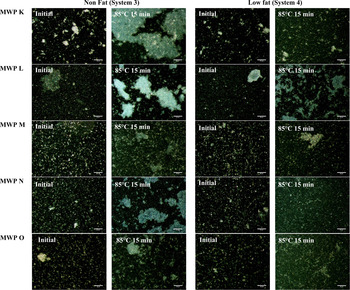
Darkfield microscopy images of heat-induced aggregates formed in non- and low-fat milk (System 3 and 4) manufactured with each MWP, both before and after heating at 85 °C for 15 min are illustrated in Fig. 5.
Darkfield images of the milk model samples of System 3 and System 4 for initial and heated at 85 °C for 15 min. Scale bar is 30 µm.

In non-fat systems (System 3), MWP type K, L and N showed a tendency to form large and dense aggregates that could flocculate up to sizes larger than 100 µm. In proteins M and O, heat-induced aggregates were shown to be mostly smaller, although some large aggregates were also present in the milk serum (60–80 µm). The different interactions seen amongst proteins would have resulted in free complexes in the milk serum (as in proteins M and O), whereas proteins K, L and N may have formed aggregates attached to the κ-casein part protruding from the casein micelles (Fig. 5). These larger aggregates are likely to have been also produced due to the higher lactose level present in the composition of MWP types K, L and N (Table 1). The presence of lactose will form heat induced whey protein aggregates with a higher specific volume due to its interaction with lysine residues during unfolding of the whey proteins (Kessler, Reference Kessler and Kessler2002a).
Upon addition of fat (System 4), the microstructure of milk changed due to the different intermolecular interactions that took place amongst proteins (Fig. 5). Smaller aggregates were formed during heating, especially in proteins N and O, which may relate to a more efficient disruption of microparticles during homogenisation which avoids further flocculation. Likewise, milk with proteins K and M showed high concentration of small and medium-sized aggregates, whereas milk with MWP L had a more dispersed morphology of medium-sized (30–80 µm) particles (Fig. 5). It can be speculated that a high concentration of very small aggregates, like in protein type N or O, may emulate fat globules better, once casein-coated whey protein complexes start to flocculate. In addition, it is expected that this type of high concentrated small aggregates will create a gel with good water binding capacity, if they were part of an acidified gel system, such as yoghurt.
The balance of covalent and, to a minor extent, non-covalent interactions occurring in the formation of heat-induced aggregates was seen to influence the size and location of the complexes in the milk. However, in order to establish a more direct link between the sizes of the heat induced complexes and the type of intermolecular bonds involved in their formation, further experiments are required. This would involve individual characterisation of the aggregates separating them in different fractions.
Conclusions
Controlling the formulation of milk intended for non- or low- fat yoghurt manufacture was shown to be important to create different protein aggregates that are likely to influence texture and sensory perception. Hence, the surface reactivity of added microparticles changed substantially upon homogenisation when fat globules were present or not. Preferential adsorption of casein micelles onto fat globules, rather than onto microparticles, was seen during homogenisation of low-fat milk, independently of the type of MWP. Further heating led to the formation of protein aggregates formed mainly by covalent interactions between whey proteins, κ-caseins and fat globules. Primary aggregates may have been created via non-covalent interactions. However, this mechanism has not been fully elucidated yet. Heat-induced complexes had diverse characteristics and morphologies depending on the type of MWP and the presence or not of fat. Some types of MWP formed small aggregates that emulate better fat globules in low-fat milk, whereas other MWP types were more efficient in creating small aggregates in the absence of fat. Besides, gelation times may be reduced in non-fat yoghurts with MWP, since the net charge of the aggregates was considerably lower than those in low-fat milk. Hence, protein aggregates with different characteristics may be produced for different yoghurt applications (low- or non-fat yoghurt) by proper selection of the microparticles and their processing conditions. Further research is needed to study how the morphology of the aggregates, their size and structure can improve the functional properties of MWP in low-fat yoghurt systems or other dairy applications (emulsions).
Study supported by the Danish Dairy Research Foundation and the Danish Ministry for Food, Agriculture and Fisheries. Arla Food Ingredients (Nr. Vium, Denmark) is thanked for providing the MWP. The technical assistance of Pia Skjødt Pedersen (University of Copenhagen), Marianna Yanez (Lund University) and Morten Christensen (University of Southern Denmark) is gratefully acknowledged.