Introduction
The tea (Camellia sinensis (L.) Kuntze) industry is the backbone of the agroeconomy of many tea-producing regions of the world including the North Bengal region stretching over Darjeeling Himalaya and its foothills and the adjoining plains in North-East (NE) India. This region accounts for about 25.31% of the total tea production in India (http://www.teaboard.gov.in; accessed on 12 December 2013). The tea mosquito bug (Helopeltis theivora Waterhouse (Heteroptera: Miridae)) is one of the most devastating sucking pests of tea (Rattan, Reference Rattan, Wilson and Clifford1992; Muraleedharan, Reference Muraleedharan and Pimentel2007) and is a menace to the tea plantations (Roy et al., Reference Roy, Mukhopadhyay and Gurusubramanian2010). About 80% of tea plantations in India are infested by H. theivora (Bora et al., Reference Bora, Sarmah, Rahaman and Gurusubramanian2007). Synthetic insecticides such as cyclodienes, organophosphates, pyrethroids and imidacloprid are mostly used to control this bug (Gurusubramanian et al., Reference Gurusubramanian, Rahman, Sarmah, Ray and Bora2008).
Unfortunately, continuous and ‘no threshold’ use of insecticides has led to some undesirable effects in relation to environmental contamination, health hazards and pest resistance. Most of the insecticides leave residues in made tea and their persistence in the environment adversely affects wildlife, aquatic biota and other non-target organisms such as insect pollinators, natural enemies of pests and decomposers of the region (Das et al., Reference Das, Sarker and Mukhopadhyay2005; Bishnu et al., Reference Bishnu, Chakrabarti, Chakraborty and Saha2009; Bhutia et al., Reference Bhutia, Rai and Pal2013). Above all, insecticide stress and selection have led to the development of high tolerance or resistance in many pests. Of late, there are reports of development of insecticide resistance in some metapopulations of H. theivora in sub-Himalayan Terai and the Dooars areas of North Bengal (Roy et al., Reference Roy, Mukhopadhyay and Gurusubramanian2010) and in other important insect pests (Scharf et al., Reference Scharf, Neal and Bennett1998; Komagata et al., Reference Komagata, Kasai and Tomita2010) as a consequence of repeated spraying of few selected insecticides.
Use of biocontrol agents is an alternative or supplement to synthetic insecticide applications. Conscious deployment of beneficial organisms, called natural enemies, for the management of pests is the method of ‘biocontrol’ in a classical sense.
Spiders are the major components of predatory arthropods in natural agroecosystems (Van Hook, Reference Van Hook1971; Nyffeler and Sunderland, Reference Nyffeler and Sunderland2003) and can be effective biocontrol agents (Symondson et al., Reference Symondson, Sunderland and Greenstone2002). Spiders are generalist predators and are often more efficient at pest control than other specialist predators (Stiling and Cornelissen, Reference Stiling and Cornelissen2005). Their conservation has been found to effectively reduce crop damage by active predation on the concerned insect pests of agroecosystems such as rice, cotton, grapes and soybean (Oraze and Grigarick, Reference Oraze and Grigarick1989; Carter and Rypstra, Reference Carter and Rypstra1995; Marc et al., Reference Marc, Canard and Ysnel1999). Introduction, inoculation and augmentative release of natural enemies are some of the effective strategies for managing pest species in many instances (Gurr et al., Reference Gurr, Barlow, Memmot, Wratten, Greathead, Gurr and Wratten2000). Single-species study provides important insights into the biocontrol potential of the predator species in man-managed agroecosystems (Hoefler et al., Reference Hoefler, Chen and Jakob2006). The lynx spider Oxyopes javanus has been found to be associated with the tea agroecosystem, more so in organic plantations, feeding on nymphs and adults of the tea mosquito bug, H. theivora (Das et al., Reference Das, Roy and Mukhopadhyay2010).
The present study investigated the predation potential and efficacy of the O. javanus spider against one of its most common prey species, H. theivora, a notorious pest responsible for causing severe damage to tea crop in NE India, including the foothills and plains of Darjeeling Terai and the Dooars areas.
Materials and methods
Both adult male and female O. javanus from a similar cohort were collected from tea plantations of the Terai–Dooars region of Darjeeling foothills and plains during the summer months of August–October 2012/2013. They were then acclimatized to the laboratory conditions (temperature 28 ± 2 °C and relative humidity 80 ± 5%) before carrying out experiments on them.
Functional response: effect of prey density on predation
Tea twigs (two to three leaves and a bud) were kept in an experimental arena (large plastic container) with sufficient space (10,000 cm3) for free movement and activities of both prey and predator. Adult H. theivora ranging in number from 1 to 15 per experimental arena were introduced and allowed 5–7 min to settle down, followed by the release of one spider (O. javanus), either male or female, into each arena. The numbers of live H. theivora were counted in the arena after 24 h to determine the number of H. theivora predated by the spider. The experiment was repeated five times. Controls were maintained with similar parameters, but with no spider predator.
Aggregative response: effect of predator (spider, Oxyopes javanus) density on predation
The experimental setup was similar to the one used for the functional response study. Adequate numbers (40) of adult H. theivora were provided to both male and female O. javanus. After the introduction of H. theivora into the arena, O. javanus ranging in number from 1 to 6 (only male or only female) per arena were released. The number of live H. theivora in the arena was counted after 24 h to ensure that the cause of death was due to cooperative predation of O. javanus. The experiment was repeated five times.
Prey handling and consumption time
The time required for the spider, O. javanus, to capture, kill and consume prey is defined as ‘prey handling time’ (T H), which was calculated using Holling's disc equation (Holling, Reference Holling1959) described in the ‘Data analyses’ section. The prey consumption time, i.e. the period between successful attack and abandonment of the carcass by the spider predator, was recorded using a stop watch. For recording the prey consumption time, the experiment was carried out by introducing one H. theivora per arena per O. javanus in a setup similar to that described in the ‘Functional response and Aggregative response’ sections. The experiment was repeated five times.
Data analyses
To determine whether the mean predation potential of an individual male and female spider is statistically significantly different, independent sample t test was performed using the SPSS statistical software, version 16 (SPSS Incorporation, Chicago, USA).
The type of functional response was determined by fitting the data into Holling's disc equation:
 $$\begin{eqnarray} N _{A} = \frac { aT _{T} N _{O}}{(1 + aT _{H} N _{O})}, \end{eqnarray}$$
where N A is the number of prey killed per spider predator, N O is the number of prey provided to the predator, T T is the total time available for predation, which is equal to 1 day, T H is the prey handling time in days and a is the searching efficiency of the predator (Holling, Reference Holling1959). The searching efficiency (a) was calculated using a linear regression technique (Daniel, Reference Daniel1987), where the reciprocal of N A was regressed on the reciprocal of N O. The reciprocal of the slope is the prey searching efficiency (a) and the intercept is the prey handling time (T H). The effectiveness of predation is determined by the ratio of a to T H.
Results
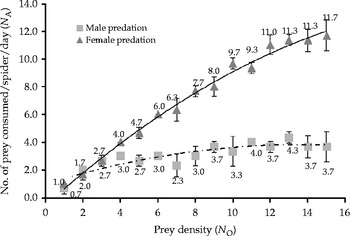
With an increase in the number of prey (H. theivora) per container, the predation rate of both male and female O. javanus increased. Female O. javanus (N =5) exhibited per capita predation of 11.67 (SD = 1.53) when compared with male O. javanus (N= 5), which exhibited per capita predation of 3.67 (SD=1.52) on adult H. theivora when sufficient numbers of prey were available. The independent sample t test showed a highly significant difference in mean per capita predation across the sexes in the spider predator at P= 0.001 (t(8) = 6.41), demonstrating that females have significantly greater predation potential than males. Females may exhibit a higher predation rate to meet the requirements of their enhanced investment on reproduction (Givens, Reference Givens1978; Walker and Rypstra, Reference Walker and Rypstra2002). They may also do so to maintain their larger body size, which demands a high growth and maintenance cost. The proportion of prey consumption was highest, which reached up to 100% at a lower prey density in both the sexes, indicating that the predator (O. javanus) has the potential to eliminate smaller populations of the prey (H. theivora).
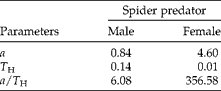
In the present study, both male and female O. javanus exhibited ‘type II’ form of functional response (Holling, Reference Holling1959). In type II response, prey consumption increases at a decreasing rate, usually because of a reduction in capture rate attributed to the handling time (Holling, Reference Holling1959; Rypstra, Reference Rypstra1995; Marc et al., Reference Marc, Canard and Ysnel1999), and with the increase in prey density beyond a certain threshold, the predation rate becomes stable or asymptote (Holling, Reference Holling1965). The predation rate of male O. javanus became almost constant beyond the prey density of nine insects per arena. On the other hand, the predation rate of female O. javanus continued to increase until the prey (H. theivora) density reached up to 12 insects (H. theivora) per arena, after which the predation rate attained a stable phase (Fig. 1). Type II responses are common in spiders (Rypstra, Reference Rypstra1995; Marc et al., Reference Marc, Canard and Ysnel1999). The searching efficiency of females was comparatively higher than that of males. The difference in predation effectiveness across the sexes was of the magnitude of about 59-fold, with female spider predators being more efficient (Table 1).
Predation efficacy of Oxyopes javanus (male and female) with variable density of adult Helopeltis theivora (error bar indicates SE).

Functional responses of the lynx spider Oxyopes javanus to the adult tea mosquito bug, Helopeltis theivora

a, predation efficiency; T H, handling time (days); a/T H, effectiveness of predation.
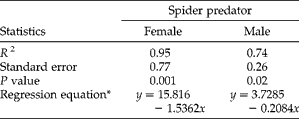
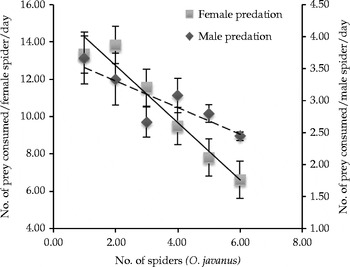
The effect of increasing density of spiders on predation rate is defined herein as ‘aggregative response’. The aggregative response study showed that at a lower density, O. javanus fed cooperatively on H. theivora. However, with an increase in density, the average per capita predation rate of O. javanus decreased in both the sexes, which is a common phenomenon for most prey–predator interactions. With an increase in the number of O. javanus predating on the same number of prey, their propensity (expressed as prey consumed per individual spider (female and male)) decreased (Table 2 and Fig. 2). This indicates the existence of some interference and competition among the spider predators, more so among females than among males as indicated by the gradient of the slope of the trend lines in Fig. 2.
Regression of spider density (Oxyopes javanus) on predation efficiency

* Regression of spider number versus predation efficiency.
Predation efficacy of Oxyopes javanus (female and male) with an increase in its density (error bar indicates SE).

The prey handling time was found to be 0.138 day for male O. javanus and 0.012 day for female O. javanus with a difference of about 11-fold (Table 1). The prey consumption time was 0.033 ± 0.001 day and 0.0044 ± 0.0004 day (mean ± SE), respectively, for male and female O. javanus. When provided with H. theivora as prey, it appeared that females could appropriate the available prey resources better than males.
Discussion and conclusions
For applying predators as biocontrol agents, the predator–prey relationship has to be well understood. The lynx (hunting) spider O. javanus is predominantly found in the canopy (top tier or table) of tea bushes sharing the same habitat with the tea mosquito bug, H. theivora. The bug feeds on tender leaves, inserts eggs into leaf tissue and internodes for incubation, and completes its life cycle in the tea bush canopy. Most hunting spiders prey upon the insects that they encounter during their ‘active period’ (Riechert and Lawrence, Reference Riechert and Lawrence1997; Marc et al., Reference Marc, Canard and Ysnel1999). From the activities and foraging behaviour of O. javanus, it appears that their ‘active period’ is around dusk and dawn, which coincides with the feeding period of H. theivora, thus enabling the effectiveness of O. javanus against the bug. Spiders generally feed on prey that is 50–80% of their body size (Nyffeler et al., Reference Nyffeler, Sterling and Dean1994; Marc et al., Reference Marc, Canard and Ysnel1999). Given the body size of O. javanus, one can easily assess that the body size of the prey (H. theivora) is well within the aforesaid range, thus making it a suitable prey for the spider predator.
For a predator to be an efficient biocontrol agent, it should not only reduce the pest population below economic threshold levels and keep them there, but also maintain its own population at stable levels in the agroecosystem (Pedigo, Reference Pedigo2002). Stability in a predator–prey system is achieved by ‘density-dependent’ responses of the predator to the prey population. The predation rate should increase with the increase in the prey (pest) density (density dependence). The functional responses determine the density-dependent control of the prey population by the predator (Riechert and Lockley, Reference Riechert and Lockley1984; Morin, Reference Morin2011). In the present study, O. javanus was found to be capable of increasing its predation rate with an increase in the prey number (Fig. 1). Moreover, sex-based observations on predation clearly suggest the superiority of female spiders over male spiders as biocontrol agents against the tea mosquito bug. Thus, this spider species can be deemed as an avid natural enemy of the sucking pest, H. theivora, of tea.
In some cases, due to the absence of inter-guild feeding activity and other interferences, applying a single predator species against a pest can be more effective when compared with the use of multi-species (Spiller, Reference Spiller1986). Other studies, however, have documented that assemblage of many spider species is more effective at reducing prey densities than a single species of spider (Greenstone, Reference Greenstone1999; Sunderland, Reference Sunderland1999). Introduction of two or more biocontrol agents has been found to elevate the mortality of a pest by 12.97% and to decrease pest abundance by 27.17% (Stiling and Cornelissen, Reference Stiling and Cornelissen2005). At decreasing prey densities, however, competition between spider species may become predominant and limit their effectiveness (Marshall and Rypstra, Reference Marshall and Rypstra1999). Competition and intra-guild predation, i.e. predation on members of the same tropic level and cannibalism, are the prominent limiting factors for aggregative responses of spiders (Riechert and Lockley, Reference Riechert and Lockley1984; Marc et al., Reference Marc, Canard and Ysnel1999). Some spiders reduce their own density through intra-cohort cannibalism (Riechert and Lawrence, Reference Riechert and Lawrence1997; Wise and Chen, Reference Wise and Chen1999). Such self-limiting tendencies may result in depressed aggregative response and lead to an upsurge of pest population (Fagan and Hurd, Reference Fagan and Hurd1991). In the present study, no such cannibalism was recorded among O. javanus.
Specialist predators may drive the pest (prey) to local extinction and then die off themselves, setting the stage for secondary pest outbreak. Generalist predators subsist on alternative prey when the pest density is low (Stiling and Cornelissen, Reference Stiling and Cornelissen2005; Symondson et al., Reference Symondson, Sunderland and Greenstone2002). The population of H. theivora also fluctuates with the change in seasons in the tea plantation areas of Terai and the Dooars region of North Bengal and reaches the lowest density during winter (December through February) (Mukhopadhyay and Roy, Reference Mukhopadhyay, Roy, Ramamurthy, Gupta and Puri2009). In such a period of insufficient prey abundance, O. javanus, being a generalist predator, can thrive well on other alternative prey. The effect of generalist biocontrol agents on non-target species is negligible when compared with the effect on the pest species (Stiling and Cornelissen, Reference Stiling and Cornelissen2005). Thus, it is highly obvious that O. javanus holds a great potential as a biocontrol agent for managing the population abundance of H. theivora in tea plantations of NE India, including the North Bengal region.
Generally, spiders are more sensitive to some insecticides, belonging to the synthetic pyrethroid (cypermethrin and deltamethrin) and organophosphate classes, compared with many pests (Yardim and Edwards, Reference Yardim and Edwards1998; Marc et al., Reference Marc, Canard and Ysnel1999). Depression of the spider population as a consequence of frequent application of synthetic insecticides can result in an outbreak of pest population (Holland et al., Reference Holland, Winder and Perry2000; Tanaka et al., Reference Tanaka, Endo and Kazano2000). Tea plantations of Terai and the Dooars areas of the North Bengal region are frequently treated with synthetic insecticides belonging to the aforesaid classes for managing pests (Gurusubramanian et al., Reference Gurusubramanian, Rahman, Sarmah, Ray and Bora2008), leading to a decrease in the diversity and density of spiders and other natural enemies of pests (Das et al., Reference Das, Sarker and Mukhopadhyay2005), which can be a cause for the present state of outbreaks and the severity of H. theivora infestation in the tea plantations of the region.
Nine species of spiders are reported in the tea plantations of the North Bengal region (Ray Chaudhuri, Reference Ray Chaudhuri2011). Conserving, augmenting and finally integrating them (especially O. javanus), along with other pest management practices, may help in keeping a check on the populations of not only H. theivora but also other soft-bodied tea pests. This would reduce insecticide load in the tea plantations and the cost of tea production. Conservation of spiders can be accomplished by reducing anthropogenic interferences and unnecessary routine use of synthetic insecticides. Crops with no or less insecticide exposure support greater density and diversity of spiders than those with repeated spraying of insecticides (Yardim and Edwards, Reference Yardim and Edwards1998; Marc et al., Reference Marc, Canard and Ysnel1999; Holland et al., Reference Holland, Winder and Perry2000). Spider diversity and density are higher in organic fields than in conventional fields (Marc et al., Reference Marc, Canard and Ysnel1999). Avoiding spraying of insecticides during the active period of spiders can help to conserve them (Riechert and Lockley, Reference Riechert and Lockley1984). The risk associated with spiders being used as biocontrol agents is minimal (Stiling and Cornelissen, Reference Stiling and Cornelissen2005), and so their conservation and augmentation should be encouraged, especially in the bio-organically managed tea plantations of sub-Himalayan foothills and plains of Darjeeling and NE India for sustainable production of tea.
Acknowledgements
The authors thank the Head, DST–FIST and UGC–SAP supported Department of Zoology, University of North Bengal, for providing necessary laboratory facilities and help for carrying out the research. They also thank Professor Dinendra Ray Chaudhuri, Department of Zoology, Calcutta University, Kolkata, for identifying the spider species and inspiring to undertake such a study. They thank two unknown reviewers for their constructive criticism and suggestions. They also thank their laboratory mates Ms Sangita K. Subba, Mr Ritesh Biswa, Ms Anjali Km. Prasad, Mr Mrinal Ray and Ms Jayashree Saren for their ungrudging help and Mr Tinku Roy for helping to maintain the insect and spider cultures.