The development and use of evaluative expressions is an integral part of narrative development. Through the use of evaluative devices such as expressions referring to emotional and mental states, the narrators not only provide information about narrated events, but may also indicate the perceived significance of the narrated events to themselves and others. According to Labov and Waletzky (Reference Labov, Waletzky and Helms1967), a narrative includes not only sequences of narrative clauses about what happened, but there may also be individual clauses or clusters of evaluative clauses about why the events may have occurred. The narrative clauses serve a referential function, outlining the plot and conveying information about the characters, settings, and events in the story. The evaluative clauses, on the other hand, serve an evaluative function, conveying information about the narrators' mental worlds such as their attitudes toward events, their interpretations of the protagonists' motives and reactions to events, as well as inferences about mental states such as feelings, thoughts, and intentions of story characters. The use of the evaluative devices allows the narrator to take the narrative out of its referential context and suspend the sequentiality of events while focusing on a particular mental state, or on an outcome of behaviors and actions from an evaluative perspective.
There is a rich body of literature that documents how monolingual English-speaking children develop their ability to provide evaluative comments in oral narratives (Berman, Reference Berman1997). These studies first demonstrate that the frequency of and variety in evaluative devices increases with age. The oral narratives of personal experience produced by four- and five-year-old American English-speaking children contained little evaluation of the story events, and only at age six did children start to provide slightly more frequent mention of why and how events took place (Peterson & McCabe, Reference Peterson and McCabe1983). Even nine-year-olds show a different narrative profile when compared to adult narrators in terms of quantity of evaluative devices (Bamberg & Damrad-Frye, Reference Bamberg and Damrad-Frye1991; Reilly, Losh, Bellugi & Wulfeck, Reference Reilly, Losh, Bellugi and Wulfeck2004). Secondly, these studies suggest that the children may not use evaluative devices for the same purposes as adults. For example, nine-year-olds are not yet in full command of the adult form–function relationships of particular evaluative devices (Bamberg & Damrad-Frye, Reference Bamberg and Damrad-Frye1991). Last but not least, the development of the ability to use evaluative devices to index a global hierarchical perspective from which the narrative gains its overall coherence is a protracted process (Bamberg & Damrad-Frye, Reference Bamberg and Damrad-Frye1991; Eaton, Collis & Lewis, Reference Eaton, Collis and Lewis1999). There seems to be an initial focus on evaluating locally specific events, when young English-speaking American children pay special attention to local aspects of events or persons in the narrative (e.g., facial expressions of the story characters or an immediately preceding event). In contrast, adult narrators are more capable of formulating evaluations from a global perspective taking into account the eventual outcome and the overall plot structure of the story.
In short, studies have shown clear developmental changes in monolingual English-speaking children's ability to produce evaluative clauses that function to make a coherent and engaging story. In comparison, however, few studies have been carried out to document the developmental trends in the use of evaluative devices in narratives by bilingual children in general, and children learning English as a second language (L2) in particular. Several studies have examined the use of evaluative devices in narratives in a second language to address whether child second language acquisition will reveal patterns that are similar to or different from child first language acquisition. However, these studies have produced mixed results. Some studies suggest that the strategies used in children's development of evaluative expressions to fulfill various discourse functions are universal, and do not depend on their linguistic background or on whether they are acquiring a particular language as an L1 or L2 (McCabe & Bliss, Reference McCabe and Bliss2004/2005; Pearson, Reference Pearson, Oller and Eilers2002). Other studies that examined the use of evaluative devices in bilingual narratives, by contrast, seem to suggest evidence for unique patterns in the development and use of evaluative devices in bilingual children as compared to their monolingual peers. Shrubshall (Reference Shrubshall1997), for example, found that monolingual English-speaking children produced more highly evaluated and more episodically structured narratives than their Portuguese–English bilingual peers whose home language was not English, and the “monolingual advantage” persisted into pre-adolescence and the bilingual children still had a long way to go to improve the more sophisticated features of narrative in English. Yet other studies find both similarities and differences between bilingual and monolingual groups. The study of van Beijsterveldt and van Hell (Reference van Beijsterveldt and van Hell2009) on the use of evaluative devices in written narratives in Dutch is particularly revealing in this respect. These authors compared the use of evaluative expressions in the narratives written by four groups of children from a bimodal bilingual perspective: deaf children who are proficient in Sign Language of the Netherlands (SLN), deaf children who are low-proficient in SLN but are able to use oral Dutch, hearing children who speak Dutch only, and hearing children who speak both Turkish and Dutch regularly. Results indicated that proficiently signing deaf children used considerably more evaluative devices in their written narratives than low-proficiency signing deaf children, hearing bilingual and hearing monolingual children. The proficiently signing deaf children seem to have used their knowledge of SLN to convey evaluation in their written narratives in Dutch. Interestingly, however, the researchers did not find any significant difference in the use of evaluative devices between the hearing bilingual children and hearing monolingual children. This study seems to suggest that similarities and differences in the use of evaluative devices in Dutch between monolinguals and bilinguals may depend on the particular combinations of languages involved (i.e., SLN and Dutch versus Turkish and Dutch in this case).
Based on these considerations, the present study explored the development and use of evaluation in the narratives of Chinese–English bilingual children and adults. The specific goals set out for the present study were (i) to examine the types of evaluative devices Chinese-speaking children and adults use in their construction of English oral narratives, (ii) to show how the use of these devices changes with development, (iii) to identify the possible influence of the first language on the use of evaluative devices in the second language, and (iv) to gain insight into narrative development in child second language acquisition via an analysis of the similarities and differences in the usage of evaluative devices between monolingual and bilingual populations.
Method
Participants
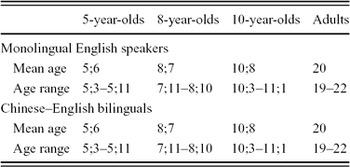
Eighty Chinese–English bilingual speakers who came from Chinese-speaking families residing in the United States and 80 monolingual English-speaking children and adults participated in this study. There were 35 males and 45 females in the bilingual group, whereas there were 28 males and 52 girls in the monolingual group. They included 20 speakers from each of the following four age groups: five-year-olds, eight-year-olds, ten-year-olds, and young adults (college students at American universities). The participants were recruited from kindergartens, elementary or middle schools, and universities. They had neither received speech or language services in the past nor were they receiving such services at the time of the data collection. All children were given parental permission to participate. Consent forms were obtained from the young adults. Table 1 provides the mean ages and the age range of the participants.
Participant information.

The Chinese–English bilingual speakers came from Chinese-speaking families residing in the United States. All participants had been exposed to Mandarin Chinese from birth. The maintenance of the Chinese language and culture is highly valued and promoted at the home of these participants. Their parents, who are from mainland China, communicate with their children in Mandarin Chinese, and have enrolled them in community-based Chinese schools to learn to read and write in Chinese. All participants were exposed to English primarily through television programs and library story times before the age of three. At the age of four, the bilingual children were enrolled in state-funded Pre-K program, and from then on they had increasing opportunity for English input and output, both in school and in the neighborhood. Based on parental or self ratings of oral proficiency in Chinese and English using a five-point scale (0 = no proficiency, 4 = native-like proficiency), all participants were reported to have native-like proficiency in Chinese, and all but the five-year-olds were reported to have native-like proficiency in English.
Materials
Spoken narratives were elicited from children and adults using the picture book Frog, where are you? (Mayer, Reference Mayer1969). This book has been used by researchers around the world to study first and/or second language acquisition in both typically and atypically developing populations. The book consists of 24 pictures (with no accompanying text) portraying a series of complicated events involving several animate referents. There are three main characters: a boy, his dog, and his pet frog. The frog escapes one night, and on their way to search for him, the boy and the dog have several adventurous encounters with four secondary characters: a ground squirrel, an owl, some bees, and a deer. Eventually, the boy and the dog find their frog with a mate and some baby frogs, and return home with one of the baby frogs in the boy's hand. The pictured events afford numerous opportunities for the narrator to infer or attribute emotions and mental states to characters (e.g., fear, joy, surprise, desire, thoughts), relationships between characters (e.g., friendship, animosity), as well as motivations and causal explanations for the characters' actions. Thus it provides a rich context for the study of evaluative devices in bilingual narrative development.
Procedure
The participants were seen individually, either at home or at school, by a Chinese–English bilingual researcher who informed them that they would tell a story in English and/or Chinese based on some pictures. The researcher then asked the participants to go over the picture book page-by-page from the beginning to the end to familiarize themselves with the story. The participants were instructed to examine the pictures as long as they wanted before beginning. When the participants were ready, the researcher then asked the participant to return to the first page and to tell the story from beginning to end. The bilingual participants told the story in both English and Chinese with roughly half a month interval between tellings. Approximately half of the participants in each age group told the story first in English and then in Chinese, and the other half told the story first in Chinese and then in English. In an attempt to minimize interviewer control over participant narrations, only minimal instructions, such as “This is a story about a boy and a dog”, or verbal prompting, such as “What's next?” or “What about the boy?” were given (Berman & Slobin, Reference Berman and Slobin1994, pp. 22–25).
Transcription
Each oral narrative was audiorecorded using a portable Marantz PMD660 solid-state recorder. The stories were then transcribed according to the conventions of the Child Language Data Exchange System, or CHILDES (MacWhinney, Reference MacWhinney2000). The CHILDES system consists of a transcription protocol (CHAT) and a series of language analysis programs (CLAN). The recorded narrative texts were transcribed verbatim in clauses following the guidelines given by Berman and Slobin (Reference Berman and Slobin1994, pp. 655–664). Initial transcription of the English and Chinese recording was completed by a native speaker of English and a native speaker of Chinese, respectively. To assess inter-rater agreement, the first author reviewed all the audiotaped samples for correspondence to the transcript. Those clauses where there was any disagreement were reviewed and then transcribed and segmented jointly until agreement was reached. Word-by-word agreement was determined to be 100%.
Coding and analysis
Narrative analysis focused on evaluative clauses, types of evaluative devices, and evaluative perspectives. Following Easton et al. (Reference Eaton, Collis and Lewis1999), our first analysis focuses on the proportion of evaluative clauses in each narrative. Every clause in each transcript is categorized as either a narrative clause or an evaluative clause. A clause is categorized as evaluative, if it provides comments that are not directly evident within the picture book, but rather represent the narrator's interpretation of events. The proportion of evaluative clauses is the total number of evaluative clauses divided by the total number of clauses in each transcript.
Following Bamberg and Damrad-Frye (Reference Bamberg and Damrad-Frye1991), five categories of evaluative devices were analyzed: (i) frames of mind, which include references to story character's mental and emotional states and behaviors (e.g., happy, sad, angry); (ii) character speech, which tends to attribute an intentional state to a story character (e.g., the boy called out the window, “Froggie, are you there?”; (iii) hedges used as distancing devices (e.g., probably, looks like, kind of); (iv) references to negative states and actions (e.g., when the boy woke up, he found his frog was no longer there); and (v) causal connectors (e.g., because, so). An evaluative clause may include one or more evaluative devices (The boy was kind of upset).
Evaluative expressions in a narrative reflect the narrator's perspective on the characters and events. Bamberg and Damrad-Frye (Reference Bamberg and Damrad-Frye1991) suggest that young children make limited use of evaluative devices because they are less able to adopt a global perspective on the narrated events. Following Bamberg and Damrad-Frye (Reference Bamberg and Damrad-Frye1991) and Eaton et al. (Reference Eaton, Collis and Lewis1999) we conducted a third analysis of evaluative perspective on four situations that include events in pictures 1–3, events in picture 7, and events in picture 24 from Frog, where are you?. In picture 1, the boy is sitting on a stool, regarding with a smile a frog in a large glass jar. In picture 3, the boy is leaning over the foot of the bed gazing at the empty jar with a distressed look on his face. In picture 7, the boy is holding his pet dog with a stern face, probably because the dog falls down from the window to the ground and smashes a jar as portrayed in the previous picture. And finally in picture 24, the boy has found his pet frog with another big frog and several little frogs. He is holding a little frog in one hand, and has the other hand raised in a wave as if saying good bye to the other frogs. Narrations of these situations were categorized into the following three types: (i) a local evaluative perspective when the narration was based on local situational and/or facial cues; (ii) a global evaluative perspective when the narration was based upon eventual story outcome and ignored or overruled the immediate facial expression; and (iii) no mention. Take picture 7, for example. A ten-year-old monolingual child told the story this way: The boy and the dog looked out the winder, and the dog fell out. The boy was very angry. Then they went into the woods to look for the frog. Here the child referred to “anger” in this situation, and left it as such. This is an example of evaluations from a local perspective, because it is restricted to a purely local outcome. A narrator may evaluate the situation from a global perspective if he or she chooses to focus on the overall plot-structure as well as the communicative need to make this structure explicit, and thus to overrule the immediate facial expression. This may be illustrated by the way a bilingual adult chose to talk about the same situation: The dog accidentally fell out of the window and broke the jar that he kept his frog in. The boy went outside and was very happy to find out that the dog was OK. The dog seemed to be happy too since they were outside.
A trained research assistant coded all of the data and a second independent assistant recoded 20% of the transcripts for reliability. Both coders were blind to the objectives of the study and uninformed of the identity of the participants. For the classification of evaluative devices into the five types, kappas ranged from .83 to .94, and for the classification of evaluative perspectives, kappa = .93. Disagreements were resolved by discussion among the coders and the first author.
Results
In the following analyses, ANOVAs were used to evaluate the effects of the following factors on the development and use of evaluative expressions: group (monolingual group with English as L1 versus bilingual group with English as L2), and age within group. All statistical analyses were run at an alpha level of .05 unless specified otherwise.
The production of evaluative clauses
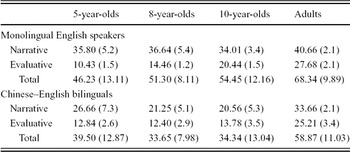
Table 2 presents the mean number of clauses as a function of group and age. It shows that the stories varied greatly in length (as measured by the total number of clauses). Both age (F(3,152) = 2.1, p < .001) and group (F(1,152) = 4.9, p < .001) have a significant effect on the story length. In particular, the stories produced by the monolingual speakers were longer than bilingual speakers at each age level. In both the monolingual and bilingual groups, the stories produced by the adult group were generally longer than those produced by the children. There is one difference between the bilingual and monolingual groups in terms of story length: whereas the eight- and ten-year-olds produced longer stories than the five-year-olds for the monolingual groups, the bilingual five-year-olds actually produced longer stories than the older bilingual children. This variation in story length suggests that story length (in terms of number of clauses) by itself may not be a good indicator of narrative proficiency of the bilingual group.
Mean number of narrative and evaluative clauses as a function of age and group.

The mean proportions of evaluative clauses were entered for an Age (4) × Group (2) ANOVA. The analysis revealed an overall significant effect of age (F(3,152) = 4.45, p < .005). Both monolingual and bilingual children produced more evaluative clauses in their frog stories as they grew older. There was also an overall significant effect of group on the frequency of evaluative clauses (F(1,152) = 8.54, p < .004), with higher proportions of evaluative clauses in the bilinguals (M = 0.38) than in monolinguals (M = 0.31). These effects were qualified by an interaction of Age × Group (F(3,152) = 3.91, p < .01). Post-hoc tests indicated that the bilinguals used significantly higher proportions of evaluative clauses in the frog stories than monolingual speakers at age five (F(1,38) = 8.88, p < .005), at age eight (F(1,38) = 9.01, p < .005), at age ten (F(1,38) = 8.97, p < .005), but not in adulthood (F(1,38) = 3.02, p < .09). There was a progressively reduced difference in the proportion of evaluative clauses in the frog stories produced by monolinguals and bilinguals: 10% at five years, 9% at eight years, 5% at ten years, and 1% in the adult group.
Types of evaluative devices
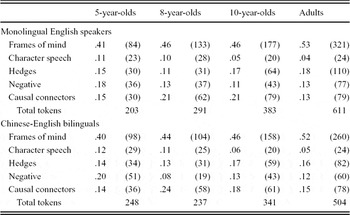
Table 3 reports the frequency and proportion scores of the five types of evaluative devices (relative to each other, not relative to story length) produced by the different groups of subjects.
Mean proportions of evaluative devices (relative to total number of evaluative devices) produced per age groups and language status (tokens in parentheses).

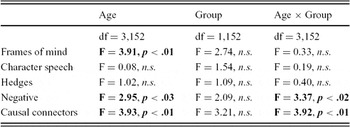
For each of the five categories of evaluative devices, the proportion scores were analyzed within an Age (4) × Group (2) analysis of variance. For ease of presentation, details of the statistical results are reported in Table 4.
ANOVA of each category of evaluative devices by age and group (significant values are in boldface to indicate patterns).

Table 4 shows that the main effect of age was significant for the following three categories only: frames of mind, negatives, and causal connectors. The main effect of age for the latter two categories was modified by an age by group interaction. Post-hoc comparisons were performed to gain insight into the developmental trends in these three categories. Adults used significantly higher overall mean use of frames of mind than the five-year-old children for both the monolingual group (M = 0.53 versus M = 0.41, p < .01) and the bilingual group (M = 0.52 versus M = 0.40, p < .01). For the category of negative, a significant difference was found between the five-year-old children and the eight-year-old children for the bilingual group (M = 0.2 versus M = 0.08, p < .005), but not for the monolingual group. Similarly, for the category of causal connectors, there was a significant difference between the five-year-old children and the eight-year-old children for the bilingual group (M = 0.14 versus M = 0.24, p < .008), but not for the monolingual group. No other comparisons were significantly different.
As Table 4 also shows, there was no effect for group. This result confirms an initial observation of Table 3 that suggests the distribution of the five categories of evaluative devices is largely similar between the monolingual and bilingual groups.
The development of a global evaluative perspective on a narrative
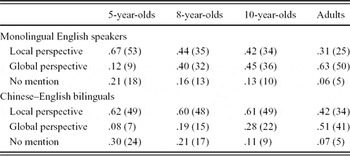
In order to see whether the monolingual speakers and the bilingual speakers were similar in how they formulated their evaluative perspectives, and in particular their development of the ability to adopt a global evaluative perspective on a narrative, the narratives were coded for their references to the “frame of mind” of the primary story character, i.e., the boy in four of the scenes in the picture book. The narrators have three options with these scenes: to describe them from a local perspective, to describe them from a global perspective, or to choose not to mention them. The total score, all types combined, was four for each narrator. Table 5 presents the proportions of each of the three categories of narrations. The results show that for these scenes, evaluations from a local perspective are very common for both monolingual and bilingual speakers, particularly the young children. Overall, evaluations from a local perspective account for 46% of narrations produced by the monolingual speakers, and 56% of narrations produced by bilingual speakers.
Mean proportions of the three categories of evaluations (i.e., from a local perspective, from a global perspective, no mention) by age and by group (tokens in parentheses).

An Age (4) × Group (2) ANOVA was conducted to investigate whether bilingual and monolingual speakers differ in their tendency, as well as the developmental patterns, to evaluate the three scenes from a global perspective. The analysis revealed an overall significant effect of age (F(3,152) = 6.99, p < .0002). As children grow older, they tend to provide more evaluations from a global perspective for the four situations. The analysis also revealed an overall significant effect of group on the frequency of evaluations from a global perspective (F(1,152) = 14.46, p < .0002), with higher proportions of evaluations from a global perspective in the monolinguals (M = 32, SD = 13.17) than in the bilinguals (M = 21.3, SD = 8.77). There was also a significant interaction between age and group (F(3,152) = 5.18, p < .002). Post-hoc tests showed that the bilinguals provided significantly fewer evaluations from a global perspective than monolingual speakers at age eight (F(1,38) = 14.1, p < .0006), at age ten (F(1,38) = 13.66, p < .0007), at adulthood (F(1,38) = 13.44, p < .0007), but not at age five (F(1,38) = 3.02, p < .09).
Discussion
The study represents the first investigation of Chinese–English bilingual children's development and use of evaluative expressions in oral narratives. As a number of researchers point out, research on bilingual children's oral narrative development is only in the initial stages, and there is still an urgent need for additional research (Chen & Pan, Reference Chen and Pan2009; Fiestas & Peña, Reference Fiestas and Peña2004; Gutiérrez-Clellen, Reference Gutiérrez-Clellen2002, Reference Gutiérrez-Clellen and Goldstein2004; Uccelli & Páez, Reference Uccelli and Páez2007). By examining how American-born Chinese-speaking bilingual children learn to produce evaluative comments in oral narratives in English in comparison with their monolingual English-speaking peers, the present study contributes to a growing body of knowledge on bilingual narrative development in two respects. On the one hand, the results of this study indicate a clear age-related increase in two aspects of evaluations in both monolingual and bilingual speakers. As they grow older, both bilingual and monolingual speakers produce a greater number of evaluative clauses in their stories, and they adopt an increasingly more global perspective of the story's character's frame of mind. This finding is consistent with previous studies which have indicated that the development of narrative skills is a gradual process that continues throughout adolescence and into adulthood (Berman & Slobin, Reference Berman and Slobin1994). More importantly, the finding suggests that both monolingual and bilingual children are guided by similar, probably universal, strategies in their development and use of linguistic devices for evaluative functions. If this interpretation is correct, then the results provide further support for the view that bilingual and monolingual children, regardless of the languages they are exposed to, rely on largely similar strategies for global discourse production in the process of constructing their narrations (Berman, Reference Berman, Verhoeven and Strömqvist2001). The universal patterns may partly result from the determining role of general cognitive processes that guide monolingual and bilingual children's gradual development of evaluation in narrative production. In other words, developmental differences in such cognitive abilities are not to be expected between children acquiring different languages (Rozendaal & Baker, Reference Rozendaal and Baker2008), nor should they be expected between monolingual children and bilingual children. These language-universal strategies may form part of a discourse grammar that provides all language users with “mental processing instructions” (Givón, Reference Givón1990, p. 914) for the construction of narrative discourse.
On the other hand, this study also reveals two important differences between monolingual and bilingual groups in their development and use of evaluative expressions in the English narratives. First, our Chinese–English bilingual children produced more evaluative clauses (relative to story length) than the monolingual English-speaking children. This difference is interesting considering the fact that the bilingual children were exposed to English two or three years later than the monolingual children. We suggest this may be an instance of bilingual bootstrapping in the sense that “something that has been acquired in language A fulfills a booster function for language B” (Gawlitzek-Maiwald & Tracy, Reference Gawlitzek-Maiwald and Tracy1996, p. 903). Chinese, the more developed language, is performing a facilitative role in boosting the development and use of evaluative expressions in the less developed language, English. In comparison to their American peers, monolingual Chinese-speaking children have been found to make more reference to the feeling states of story characters (Wang & Leichtman, Reference Wang and Leichtman2000), and include more affective elements (Domino & Hannah, Reference Domino and Hannah1987) in their narratives. Thus, it is likely that the way that our bilingual children evaluate the characters and events within a narrative format in the second language is shaped to some extent by their cultural practice in the first language. The other difference between monolingual and bilingual groups relates to the ability to integrate evaluative comments into global hierarchical relationships between the events portrayed in the picture book. While we see a gradual increase in the ability in both groups of speakers, results show the bilingual speakers, particularly the younger children, have more of a tendency to adopt a local perspective of the story character's frame of mind. This difference in the relative frequency of evaluations from a global perspective observed in the present study between monolingual and bilingual speakers is puzzling and may have more than one interpretation. We present one interpretation here that relates to the possible influence of the cultural values and accordingly the narrative cultural conventions associated with the first language of bilingual speakers. Narrative production is a cultural activity. Children growing up in different communities learn to organize their narrative experiences in ways that respond to their community's cultural expectations. According to Wang and Leitchtman (Reference Wang and Leichtman2000), Americans and Chinese differ with respect to their thinking and reasoning patterns. Americans generally attend to the internal attributes of a person or object, analyze individual components in isolation and succession, and decontextualize a behavior from its environment while making dispositional judgments. In contrast, the situational context plays a significant role in how Chinese people think and reason, and they tend to focus on relations between a person or an object and the environment as the antecedent of a behavior. This cultural variation may have led Chinese young children to be more sensitive to others' emotional states and make references to the feeling states of story characters and other people's emotions in their stories than their American peers. Wang and Leichtman (Reference Wang and Leichtman2000) also found that six-year-old Chinese children's narratives showed greater concreteness than Americans' as reflected in the description of more contextual information and situational details. As a result, our bilingual children may have been trained by the culture associated with their first language to focus on situational details as is portrayed in the pictures (e.g., the facial cues of the story character), and not to decontextualize the local situational cues in order to incorporate a global perspective as the monolingual children would do. If this is true, cultural values need to be considered in order to better understand differences in monolingual and bilingual narrative development.
Narrative is an instrument for making meaning that dominates much of life in one's culture, and a child's improvement in narrative skill is closely related to the child's social life (Bruner, Reference Bruner1990). Bilingual children may be influenced by the ways in which they are socialized to use the first language in cultural ways, when they are telling a story in a second language. These and other factors (e.g., the observation that each language trains its speakers to pay different kinds of attention to events and experience when talking about them) affect not only the development of evaluative expressions in narrative discourse but other aspects of narrative development as well (see e.g., Berman & Slobin, Reference Berman and Slobin1994). The development and use of evaluative expressions is a complex process which requires children to go beyond analyzing the formal properties at the sentence level to internalize the intricate system of form–function relations at the discourse level. Such a process is more complex and intricate than in monolingual children because bilingual children are experiencing the interaction of two developing systems. Partly for this reason, narratives produced by bilingual speakers may be unique, and fall in between those produced by their monolingual peers in each of the languages.
Notably, further research is needed to elucidate the influence of cultural values and practices on the development and use of evaluative expressions in the narratives of bilingual children. Although the present study contributes to a deeper understanding of the complexities involved in bilingual narrative development through examining bilingual speakers exposed to a pair of typologically and culturally distinct languages, i.e., English and Chinese, it is exploratory in nature and is not a bidirectional study. Whereas most research in bilingual development assumes the relationship between two languages to be unidirectional, an increasing number of studies have suggested the possibility of a bidirectional relationship in some linguistic domains (e.g., Brown & Gullberg, Reference Brown and Gullberg2008, Reference Brown and Gullberg2010; Gu, Reference Gu2010; Jarvis & Pavlenko, Reference Jarvis and Pavlenko2008). We are currently examining the narratives in Chinese collected from the same bilingual participants in comparison with their Chinese-speaking monolingual peers. If parallel influences of English on Chinese and Chinese on English were found, we would have another case of bidirectional crosslinguistic influence. There is also a need to examine a variety of typological and culturally distinct pairs of language combinations. Crosslinguistic and crosscultural differences in the production of evaluative expressions in narratives are likely to be a continuum rather than a neat dichotomy. For example, Küntay and Nakamura (Reference Küntay, Nakamura, Strömqvist and Verhoeven2004) analyzed the use of evaluative devices in frog stories of Turkish and Japanese speakers. They found that children in these cultures avoided making explicit reference to psychological or mental states of the characters. This contrasts sharply with the practice of English- and Hebrew-speaking children (Berman & Slobin, Reference Berman and Slobin1994). Thus, there seems to be a continuum with respect to the tendency to make explicit reference to the mental states of story characters: Chinese-speaking children the most frequent, Turkish- and Japanese-speaking children the least frequent, and English- and Hebrew-speaking children sitting in between. If this were indeed the case, one would predict that the patterns in the use of evaluative expressions in narratives would differ between different groups of bilingual speakers such as Chinese–English bilinguals on the one hand and Turkish–English bilinguals on the other. Explorations along this direction would place us in a more solid foundation to evaluate the uniqueness of bilingual narrative production, as well as the role of cultural values and practices on the acquisition and use of evaluative expressions in narratives of bilingual speakers.