1. Introduction
The end-Permian mass extinction (252 Ma) was the most devastating extinction event in Earth's history (Erwin, Reference Ewrin1993, Reference Ewrin1994) with nearly 96% of the marine species and some 70% of the terrestrial vertebrate genera becoming extinct (Bowring et al. Reference Bowring, Ewrin, Jin, Martin, Davidek and Wang1998; Benton, Reference Benton2005; Sahney & Benton, Reference Sahney and Benton2008). After the end-Permian mass extinction, the biosphere began to recover slowly in the drastically unstable environment during Early Triassic time. The organisms rapidly evolved during Middle Triassic time when the marine ecosystem became stable (Payne et al. Reference Payne, Lehrmann, Wei, Orchard, Schrag and Knoll2004; Jiang et al. Reference Jiang, Motani, Li, Hao, Sun, Sun and Schmitz2005). The fauna in Panxian County, Guizhou Province is the physical marker of a rapid radiation of the biosphere during Middle Triassic time (Jiang et al. Reference Jiang, Motani, Li, Hao, Sun, Sun and Schmitz2005).
Many amazing marine reptile fossils have recently been discovered in Panxian County, Guizhou Province, SW China. Among these are the unusual archosaurian Qianosuchus mixtus (Li et al. Reference Li, Wu, Cheng, Sato and Wang2006), the mixosaurid ichthyosaurian Phalarodon cf. P. fraasi (Jiang et al. Reference Jiang, Schmitz, Motani, Hao and Sun2007), the sauropterygians Placodus inexpectatus (Jiang et al. Reference Jiang, Motani, Hao, Rieppel, Sun, Schmitz and Sun2008a ) and the Wumengosaurus delicatomandibularis (Jiang et al. Reference Jiang, Rieppel, Motani, Hao, Sun, Schmitz and Sun2008b ). In particular, there occur some important species never before reported from the eastern Tethyan province such as the oldest mixosaurid ichthyosaur Mixosaurus panxianensis (Jiang et al. Reference Jiang, Schmitz, Hao and Sun2006c ), the oldest lariosaurs Lariosaurus hongguoensis (Jiang et al. Reference Jiang, Maisch, Hao, Sun and Sun2006a ), the Nothosaurus yangjuanensis (Jiang et al. Reference Jiang, Maisch, Hao, Sun and Sun2006b ) and the fully aquatic protorosaur Dinocephalosaurus orientalis (Li, Rieppel & Labarbera, Reference Li, Rieppel and Labarbera2004). The bizarre creature Dinocephalosaurus orientalis (which means ‘terrible headed lizard from the Orient’) was found in 2002 (Li, Reference Li2003). It is the first reported fully marine member of the protorosaurids, different from the giraffe-necked protorosaurid reptile Tanystropheus which was discovered in the Monte San Giorgio Grenzbitumenzone Fauna (Besano Formation, Anisian–Ladinian boundary, northern Italy, the representative fauna in the western Tethyan Fauna province). The Grenzbitumenzone Fauna is located on the southern shores of Lake Lugano in the Alps which contains reptiles, fishes, bivalves, ammonites, echinoderms and crustaceans (Bürgin et al. Reference Bürgin, Rieppel, Sander and Tschanz1989; Sander, Reference Sander1989). Similarly, in the marine limestone beds of the Guanling Formation, there are well-preserved completely articulated skeletons of fishes and invertebrates including brachiopods, cephalopods, bivalves and some as yet undescribed taxa (Hao et al. Reference Hao, Sun, Jiang and Sun2006).
This well-preserved assemblage of fossils provides new insights into their origin, evolution and migration. Despite the importance of this fossil assemblage, its geological age has not been precisely determined. Palaeontologists focusing on the age of the fossil assemblage have so far only considered the conodont evidence. As a useful tool, conodonts have played an effective role in defining the age of marine reptile fauna (Sun, Hao & Jiang, Reference Sun, Hao and Jiang2003; Sun et al. Reference Sun, Sun, Hao and Jiang2006). However, their precise correlation with the global Triassic time scale has been problematic, mainly due to an uncalibrated biostratigraphy (Li, Rieppel & Labarbera, Reference Li, Rieppel and Labarbera2004; Sun et al. Reference Sun, Sun, Hao and Jiang2006). The age of this sequence therefore still requires independent isotopic age control. U–Pb isotopic dating of zircon, using the sensitive high-resolution ion microprobe (SHRIMP) II ion microscope of volcanic tuff layers intercalated within fossil-bearing marine sediments provides one of the best means of geochronologic control. We selected zircon grains from volcanic tuff layers of the upper Guanling Formation and applied the SHRIMP dating method to obtain a reliable radiometric age.
2. Geological setting and sampling
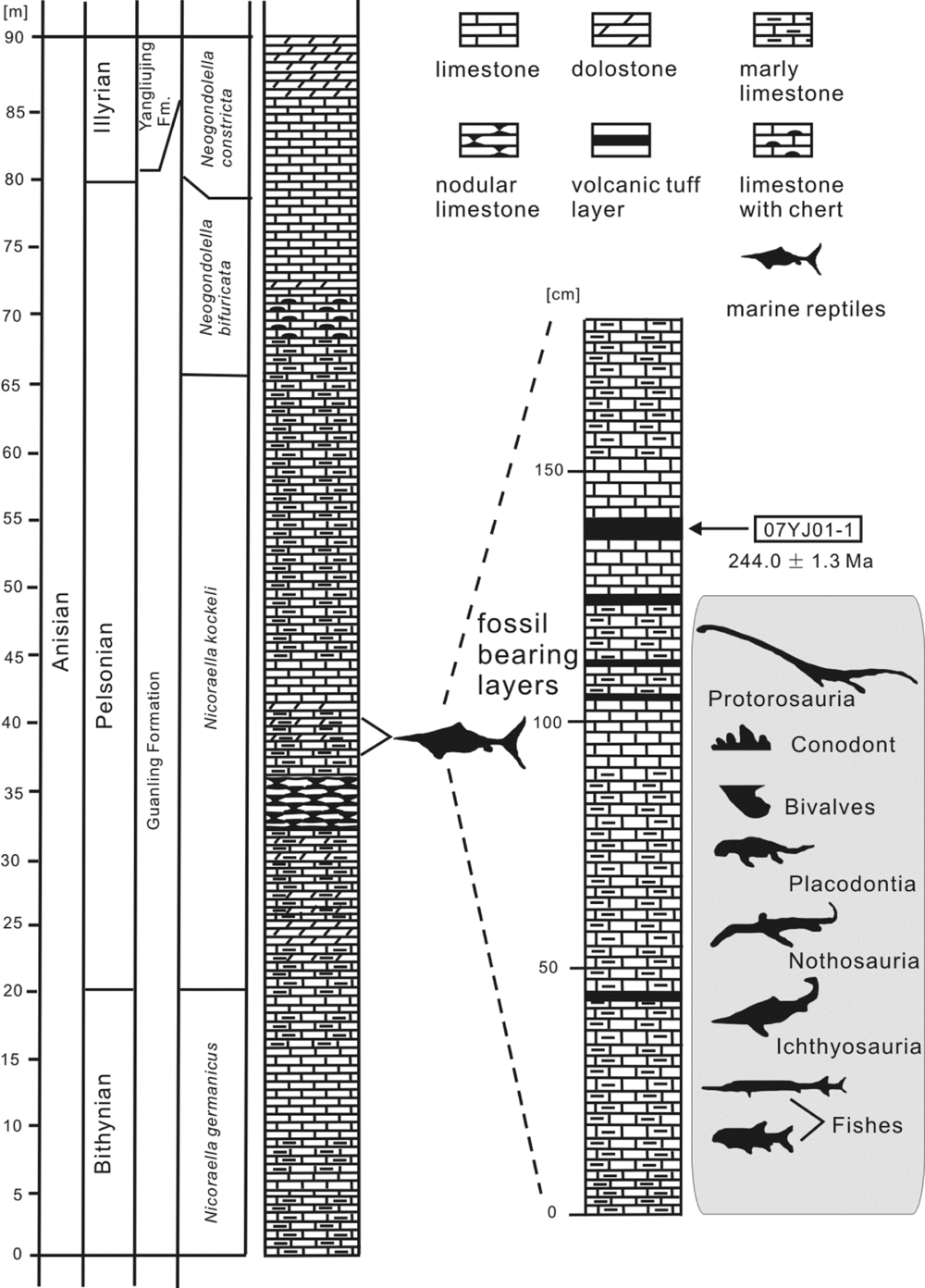
The marine reptile fossils from the upper part of the Guanling Formation are found in a small region surrounding the village of Yangjuan, located nearly 60 km SE of the city of Panxian, Guizhou Province (Fig. S1, available at http://journals.cambridge.org/geo). The upper member of the Guanling Formation, with a thickness of c. 80 m, forms the lower section and consists of alternating thinly bedded bituminous limestone, marly limestone, dolostone, nodular limestone and limestone with chert (Fig. 1). Its sedimentary environment is interpreted as shallow marine and partly hypersaline (Wang et al. Reference Wang, Bachmann, Hagdorn, Sander, Chen, Cheng, Meng and Xu2008).
Stratigraphic section of the Middle Triassic Upper Guanling Formation at Yangjuan village. Vertebrate-bearing beds and index fossils of the section are indicated. Arrow shows stratigraphic location of dated tuff sample 07YJ01–1 (the stratigraphic section was modified and updated from Hao et al. Reference Hao, Sun, Jiang and Sun2006; Sun et al. Reference Sun, Sun, Hao and Jiang2006).

Based on the character of the conodont assemblages, four conodont biozones were recognized in the upper member of the Guanling Formation, namely: the Nicoraella germanicus zone; Nicoraella kockeli zone; Paragondolella bifurcate zone; and Neogondolella constricta zone (Sun et al. Reference Sun, Sun, Hao and Jiang2006). All marine reptile fossils in this area were excavated from a horizon of c. 3 m thickness, enlarged on the right in Figure 1. The fossil assemblage has been interpreted as being of Middle Triassic age and Anisian stage, corresponding to the Nicoraella kockeli zone. The strata containing the fauna is stratigraphically continuous and contains five volcanic tuff beds (each c. 3–5 cm in thickness) which are intercalated within the sediments. The genera of marine reptiles discovered in these strata are Protorsauria, Placodontia, Nothosauria, Ichthyosauria and some undescribed taxa. Motani et al. (Reference Motani, Jiang, Tintori, Sun, Hao, Boyd, Frlog, Schmitz, Shin and Sun2008) suggested that most of these fossils occurred at three different levels. The Lariosaurus, Placodus, Phalarodon and undescribed Ichthyosaur occurred in the Lower Reptile Horizons, the Mixosaurus, Nothosaurus and Qianosuchus were found in the Middle Reptile Horizons and the Mixosaurus, Dinocephalosaurus and undescribed Pachypleurosaur were unearthed in the Upper Reptile Horizons.
We focus on the middle–upper part of the Guanling Formation. Sample 07YJ01–1 (N25°31′27″, E104°53′56″) was collected from the uppermost and thickest volcanic tuff layer in the fossil-bearing strata (Fig. 1). Given the proximity of the tuff to the fossiliferous layer, dating of this tuff is the most effective means to resolve the age of the fossils of the upper Guanling Formation (Stockar, Baumgartner & Condon, Reference Stockar, Baumgartner and Condon2012). Zircon is considered to be the only suitable mineral for isotopic dating in these tuffs (Mundil et al. Reference Mundil, Ludwig, Metcalfe and Renne2004).
3. Analytical method and results
Sample 07YJ01–1 was processed by conventional heavy liquid and magnetic separation techniques and purified by hand-picking under a binocular microscope. Zircons were mounted together with a fragment of zircon standard SL13 (U = 238 ppm; Williams et al. 1998) and grains of the standard zircon Temora 1 (417 Ma; Black et al. Reference Black, Kamo, Allen, Aleinikoff, Davis, Korsch and Foudoulis2003). The internal structure of the unknown zircons was examined using cathodoluminescence (CL) imaging prior to isotopic analyses.
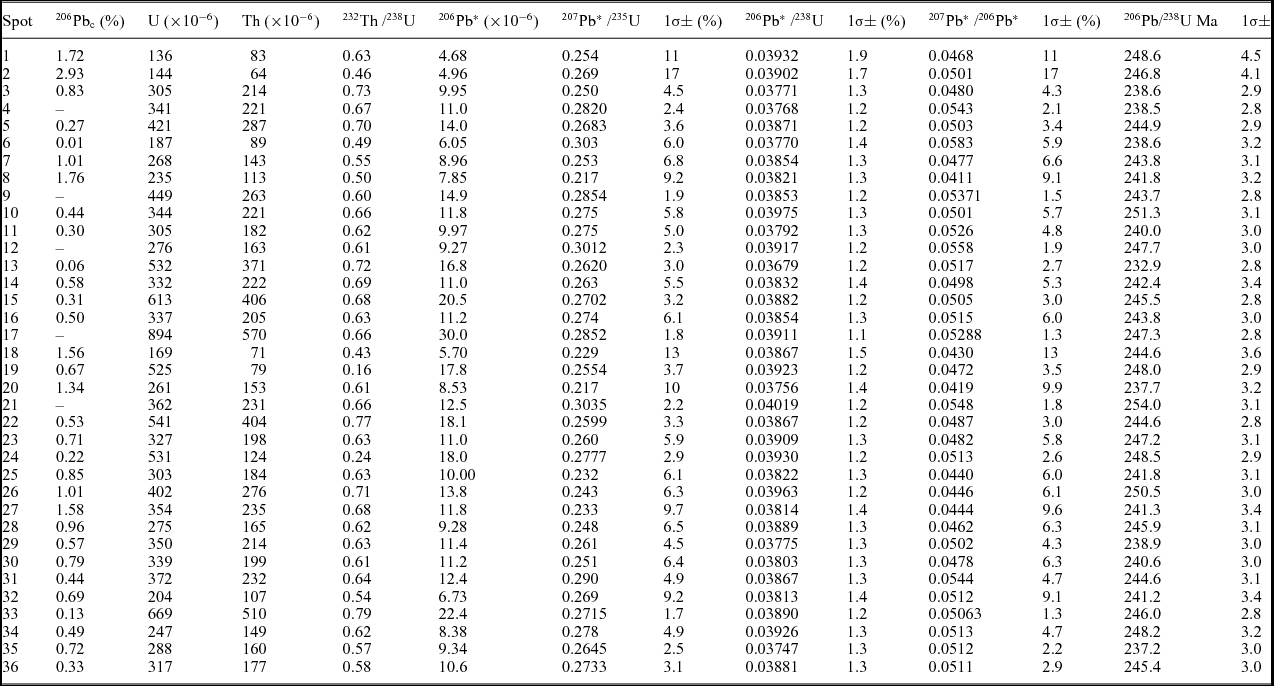
Measurements of U, Th and Pb isotopes were performed using the SHRIMP II ion microprobe at Curtin University, Perth, Australia through the Remote Operation System at the Beijing SHRIMP Center, Chinese Academy of Geological Sciences. Detailed operating and analytical procedures were similar to those described by Williams (Reference Williams, McKibben, Shanks and Ridley1998). Uranium concentrations were determined by normalizing to zircon SL13 (Williams, Reference Williams, McKibben, Shanks and Ridley1998). U–Pb ratios were corrected for bias associated with sputtering by using a power law relationship between [206Pb/238U]–[238U16O/238U] (Claoué-Long et al. Reference Claoué-Long, Compston, Roberts, Fanning, Berggren, Kent, Aubry and Hardenbol1995) and normalizing to the Temora 1 reference zircon (417 Ma; Black et al. Reference Black, Kamo, Allen, Aleinikoff, Davis, Korsch and Foudoulis2003). Measured compositions were corrected for common Pb using the non-radiogenic 204Pb. Uncertainties for each individual analysis are reported at the 1σ level; weighted mean ages of pooled analyses are quoted at the 95% confidence interval. Data reduction was carried out using Isoplot 3.0 (Ludwig, Reference Ludwig2003). The analytical data are presented in Table 1.
SHRIMP U–Pb zircon analyses

Errors are 1σ; Pbc and Pb* indicate the common and radiogenic portions, respectively.
Error in standard calibration was 0.24% (not included in above errors but required when comparing data from different mounts).
Common Pb corrected using measured 204Pb.
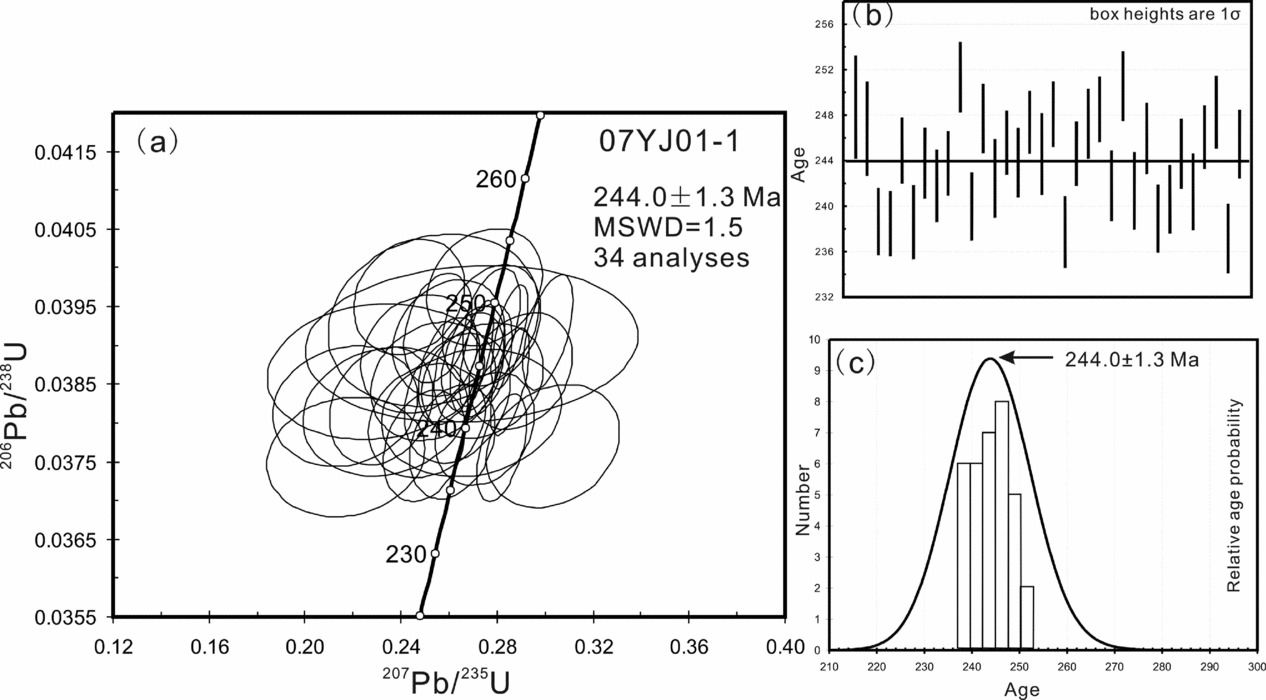
Zircons from sample 07YJ01–1 are mostly euhedral, prismatic, transparent and colourless, range from 100 to 250 μm in length, and have length to width ratios between 1:1 and 3:1 (Fig. S2, available at http://journals.cambridge.org/geo). Most zircon grains have concentric oscillatory zoning under CL, and some have inherited cores (Fig. S2, available at http://journals.cambridge.org/geo). U concentrations range from 136 to 894 ppm, Th from 64 to 570 ppm and Th/U ratios vary between 0.16 and 0.79, evidently of igneous origin (>0.1). With the exception of spot 13 (232.9±2.8 Ma, the minimum age) and spot 21 (254.0±3.1 Ma, the maximum age), 34 of the 36 spots analysed have indistinguishable 207Pb/235U and 206Pb/238U isotopic ratios within analytical uncertainties (Table 1) and plot as a coherent group close to concordia (Fig. 2a). They provide a weighted mean 206Pb/238U age of 244.0±1.3 Ma (1σ, MSWD = 1.5) (Fig. 2b) that is interpreted as reflecting the zircon crystallization age of sample 07YJ01–1 and the best estimate of the depositional age of the tuff layer intercalated within the Guanling Formation. U–Pb isotopic results (Table 1) are presented in a relative age probability diagram (the peak is 244.0±1.3 Ma; Fig. 2c).
Zircon dating results. (a) Concordia plot for zircon grains from sample 07YJ01–1. (b) Corresponding distribution of weighted averages of 206Pb/238U ages. (c) Age probability diagram for analysed zircons from the volcanic tuffs sample (see Table 1 for details).

4. Discussion and conclusions
Li, Rieppel & Labarbera (Reference Li, Rieppel and Labarbera2004) reported that the aquatic long-necked protorosaur Dinocephalosaurus orientalis lived some 230 Ma ago. Our zircon age of 244.0±1.3 Ma (1σ) for the tuff layer in the upper part of the Guanling Formation provides an absolute age constraint on the Triassic marine reptile fauna. It demonstrates that the age of the fauna is Middle Triassic, Anisian stage, at least 14 Ma earlier than the age of c. 230 Ma based on conodont evidence (Li, Rieppel & Labarbera, Reference Li, Rieppel and Labarbera2004; Sun et al. Reference Sun, Sun, Hao and Jiang2006).
During Middle Triassic time, many marine reptiles inhabited shallow epicontinental seas and intraplatform basins along the margins of Pangea (Li, Rieppel & Labarbera, Reference Li, Rieppel and Labarbera2004; Li et al. Reference Li, Wu, Cheng, Sato and Wang2006). The Panxian fauna in the eastern Tethys province and the Grenzbitumenzone Fauna (Monte San Giorgio, northern Italy) in the western Tethys province are the two typical faunas of this period. The diversity of vertebrate faunal assemblages recorded in the Grenzbitumenzone fauna has long been recognized. Monte San Giorgio provides the principal point of reference, relevant to new discoveries of marine Triassic remains throughout the world. Dating of zircon grains contained in a layer of volcanic ash has established a time interval of c. 4 Ma (239–243 Ma; Stockar, Baumgartner & Condon, Reference Stockar, Baumgartner and Condon2012). Many palaeontological studies have shown that the marine reptiles of the two faunas have apparent affinities (Rieppel Reference Rieppel1999; Hao et al. Reference Hao, Sun, Jiang and Sun2006; Jiang et al. Reference Jiang, Motani, Hao, Rieppel, Sun, Schmitz and Sun2008a ). Our new age permits a better comparison of the Panxian Fauna with the Monte San Giorgio Grenzbitumenzone Fauna (Rieppel, Reference Rieppel1999; Stockar, Baumgartner & Condon, Reference Stockar, Baumgartner and Condon2012). It is obvious from our results that the Panxian Fauna is slightly older than the Grenzbitumenzone Fauna (Hao et al. Reference Hao, Sun, Jiang and Sun2006; Stockar, Baumgartner & Condon, Reference Stockar, Baumgartner and Condon2012), or nearly contemporaneous, which indicates that there is an important relationship in the evolution of marine reptiles between the eastern and western Tethys fauna (Rieppel, Reference Rieppel1999; Li, Reference Li2003).
The Middle Triassic marine reptile fauna has received considerable attention in recent years. These fossils provide important clues to the modes of origin as well as subsequent radiation and diversification of marine reptiles. The new age data, in combination with the revised Middle Triassic time scale, provides a picture of relatively rapid evolution of early marine reptiles during Middle Triassic time, some 8 Ma after the end-Permian mass extinction, and the evolution occurred essentially contemporaneously throughout SW China and Europe. More systematic and high-quality geochronological data from the eastern Tethys and other Triassic marine-reptile-bearing successions are required to unravel the global patterns in the evolution of Triassic marine reptiles.
Supplementary material
To view supplementary material for this article, please visit http://dx.doi.org/10.1017/S001675681400003X
Acknowledgement
This study was supported by the Geological Survey Project of Geological Survey of China (No. 1212011121066) and the Natural Science Foundation Project (No. 41073014). We thank Dirk Frei and an anonymous reviewer for their useful criticisms and comments which led to the improvement of the manuscript and Alfred Kroner, Mainz, Germany for his help with language. We also thank Andy Whitham and Susie Bloor for editorial handling.