In his lecture delivered at Yale University on 6 March 1921, Percy Grainger offered his comprehensive assessment of ‘Nordic Characteristics in Music’.Footnote 1 Throughout the address, he traces various racial and national characteristics in music while promoting the values of cosmopolitanism. The interplay of these values raises numerous ideological questions. For instance, why did Grainger employ folk music as an endorsement of cosmopolitanism and not, as many artists throughout the nineteenth century were accustomed to, utilize it as a marker of nationalism? What was it he thought Scandinavian cultures possessed that others did not? Moreover, how did these factors work together as a way of contesting traditional models of progress in art while creating new hybrid identities?Footnote 2
Central to his discussion is the work of Edvard Grieg, who he frequently promoted as an icon of cosmopolitan ideals.Footnote 3 Yet a neglected variable in Grainger’s equation is his discussion of the American composer Edward MacDowell. Grainger introduces MacDowell first by manner of their mutual fascination with Nordic culture, and second by way of his reliance on primitive traits as a means to unlocking universal qualities in music. He explains:
We see that MacDowell turns to the primitive Indian, to the primitive Negro rather than to cultured man, or to the traditions of the culture of the past, such as some of the things that inspire Debussy. Four Little Poems [op. 32 (1887)] has the following titles: The eagle. The brook. Moonshine. Winter. Not a trace of man or civilisation or culture, nothing but virgin nature. Note that in the titles so far taken … MacDowell chooses ‘Winter’ and ‘In Autumn’; rather than summer and spring. Typically Nordic in all these traits.Footnote 4
Grainger subsequently draws a parallel between MacDowell’s compositions and those of Grieg due to the ‘influence of scenes where man’s hand has played no part but of the reaction of man’s emotionality to wholly non-human nature’.Footnote 5 This relationship has seldom been recognized in the scholarly literature. However, in this article, I will argue that Grainger’s transatlantic system of referents was integral to the development of his shifting definitions of cosmopolitanism as well as the practical means through which he transmitted these ideas. The critical focus is not the issue of mutual influence but rather a degree of intertextuality associated with their artistic network.Footnote 6 In this manner, I aim to shed light on the broader cultural dialogue that sustained their cosmopolitan imaginationsFootnote 7 while providing for both a diachronic and synchronic comparison of the way they negotiated the boundaries of individual, national and global identities. This comparative analysis will also serve to elucidate the extent to which their cosmopolitan imaginations overshadowed national idealism at the end of the long nineteenth century in the service of a style more rigorous than commonly acknowledged.Footnote 8
The Condition of Modernity: Early Experiences of Displacement as Cultivation for Cosmopolitanism
Despite the generation that separated their lives, the careers of Grainger and MacDowell overlapped in many similar ways. At the most fundamental level, each musician left his birthplace at an early age to receive formal education in Europe; each experienced the powerful waves of national romanticism in his youth; and each assimilated Nordic cultures as part of a broader transatlantic identity.Footnote 9 Not only that, but both composers actively expanded their cultural networks by fostering lasting relationships with poets, playwrights and authors across Europe and America. These networks were pivotal for developing a cross-cultural imagination that Leonora Saavedra, in her discussion of the Mexican composer Carlos Chávez, refers to as a ‘cultural field, a social formation that includes cultural brokers and adjudicators of artistic prestige’.Footnote 10 Saavedra’s notion, predicated upon the work of Pierre Bourdieu, provides an important framework for explaining the conditions that Grainger and MacDowell earlier faced. In particular, her analysis of peripheral responses ‘inflected by international relations of asymmetrical cultural and political power’ is equally applicable to their understanding of difference.Footnote 11
Moreover, one of the most prevalent similarities to emerge from an exploration of this cultural field is the issue of displacement.Footnote 12 In the case of MacDowell, his early childhood in America was juxtaposed by his short-lived education at the Paris Conservatory from 1877–78.Footnote 13 This career trajectory was not uncommon for many American musicians at the time, and he later extended his stay in Europe with subsequent studies at the Hoch Conservatory in Germany from 1878–80 before accepting a teaching position at Darmstadt Conservatory in 1881. After a series of transatlantic trips, MacDowell returned to the United States in 1888 (though he would continue to travel abroad in the following years). The result of these multi-national experiences has been described by E. Douglas Bomberger as the establishment of a ‘firmly held belief in an international musical style’ because ‘he believed that music had evolved beyond the particularism of national styles to a higher state of universal artistic consumption that transcended simple nationalism’.Footnote 14 In short, MacDowell’s early experiences primed him to adopt an ambivalent aesthetic position that favoured distance from his subjects, which stood in contradiction to the nationalist project in America of closely identifying with folk cultures.
For Grainger, growing up in Australia, a comparable development yielded analogous responses. After early music studies with his mother, Grainger travelled to Germany to begin his studies at the Hoch Conservatory in 1895, where he expanded his cultural field of influences through relationships with various British and Scandinavian artists.Footnote 15 This network was further enlarged following his relocation to London in 1901.Footnote 16 His stay in England was interjected by numerous tours across the globe, including trips to Australasia, South Africa, Denmark, Norway and New Zealand. After more than a decade of residing in Britain, at the outbreak of war in 1914 Grainger travelled with his mother to the United States, where he would become a naturalized citizen amidst frequent domestic and international tours.
The consequences of these numerous travels on the young, impressionable Grainger were longstanding. He developed a yearning for global cultures and folk music, which both he and MacDowell satiated through the study of Native American and African-American music. In addition, Grainger channelled his experiences of displacement into a musical style that could reflect a broader aesthetic appeal. This quality is evidenced in his essay on ‘Nordic Characteristics in Music’, wherein he outlines his motivations:
But why, as a cosmopolitan artist, then, do I value local and racial traits so highly? Because I value artistic variety highly, because originality and individuality are needful to the vigorous art life of the whole world, because I wish the artists of the future to have an immense artistic palette to paint with, rather than a narrow and impoverished palette.Footnote 17
Here and throughout his frequent writings, Grainger celebrates the same process of assimilation that Germans paradoxically practised at the end of the eighteenth century. As I will explore in greater detail, a comparable form of cosmopolitanism first emerged in Germany through the deliberate interpenetration of world cultures.Footnote 18 The creative possibilities afforded by this type of cultural mixing would stimulate Grainger’s appetite for developing a modernist style that could transcend particularity of place without resorting to the circulating procedures of abstractionism. As a result, he underwent a dualistic (if not multiplistic) split in his artistic persona that would linger throughout the rest of his career. Saavedra notes that similar experiences for Chávez in Mexico and America fostered a ‘creative imagination [that] existed simultaneously in both countries’.Footnote 19 No less can be said for Grainger, whose familiarity with global folk music, combined with his recurrent travels and relocations, invigorated his cosmopolitan imagination as it concurrently divided his allegiances.Footnote 20
Furthermore, while the purpose of this study is not to deconstruct the many definitions that modernism came to represent at the end of the long nineteenth century, I wish to invoke a particular concept established by Sarah Collins and Simon Perry in which musical meaning is generated by a ‘stance of critical critique rather than stylistic radicalism’.Footnote 21 For each of the artists in this study, this level of critique was made possible chiefly because of their experience of displacement. By cultivating distance from his subjects, Grainger – along with his complex system of cultural cohorts – developed strategies for mediating the influences that spanned past and present, local and universal.Footnote 22 In this respect, he stands closest to MacDowell in his method of turning to the past for a system of rootedness while also looking to the future to establish fresh means of innovation. Where others found incoherence and irrelevance, Grainger and MacDowell located synthesis and new meaning. However, analysing this expressive space requires one to close the gap between score and society in the same way that these composers understood these forces to interact. But what would such a musical language look like, and how could it possess the power to bring identities as far apart as America and Scandinavia into closer proximity?Footnote 23 It is to a response to these questions that I now turn.
Locating Cosmopolitanism: A Diachronic Comparison of Responses to Cultural Hegemony
In a 2013 musicological colloquy entitled ‘Cosmopolitanism in the Age of Nationalism, 1848–1914’, Dana Gooley outlines a pervasive problem in prevailing historical accounts of the nineteenth century:
When we invoke the concept of the ‘national’, we do so with exceptional critical awareness. Yet this transformation has barely generated any critical revaluation of the ‘cosmopolitan’. … But a lack of discourses from the period does not mean that cosmopolitanism did not exist. Many of its practices and social formations survived from the past, perhaps more so in music than in other strata of culture. Yet they had lost the discursive articulation and ideological validation they had previously enjoyed. For many writers in the later part of the century, cosmopolitanism could be understood only negatively, as an absence of roots, folk spirit, developed subjectivity, or the capacity to transmit authentic feeling – to name only those qualities Wagner claimed to be fatally lacking in Mendelssohn and Meyerbeer.Footnote 24
His appraisal equally applies to the case of Grainger and MacDowell, for they commonly faced audiences that viewed cosmopolitanism as a failed alternative to nationalism. The apparent antagonism between nationalism and cosmopolitanism was therefore the residue of a fabricated philosophy of exclusion made pliable by a host of ulterior motives. By contrast, those composers who were exposed to a high degree of cultural and geographical displacement were inclined to adopt less exclusive forms of cohesiveness.
It is not a coincidence then that America served as the common breeding ground for both MacDowell’s and Grainger’s practical pursuit of a cosmopolitan musical language. Gooley’s analysis is therefore helpful in contextualizing the problems faced by Grainger’s contemporary, the American composer and critic Daniel Gregory Mason, who observed in 1918:
That type of musical aesthetic which insists much on the importance of the racial and national differences dividing human kind into groups … is constantly challenging our American music to disavow what it calls a featureless cosmopolitanism, and to achieve individuality by idealizing some primitive popular strain, whether of the Indians, of the negroes, of the British colonizers, or of our contemporary “rag-time”. In so doing, it usually accepts uncritically certain assumptions. It is apt to assume, for instance, that interpretative truth is assured by geographical propinquity … It often mistakes the conception of the average for that of the ideal type, and supposes that the man in the street represents the best taste of America. Above all, it condemns any attempt at universalizing artistic utterance as ‘featureless cosmopolitanism’ or ‘flabby eclecticism’, and suggests that the musician who speaks, not a dialect but a language understood over the civilized world … has ‘lost contact’, as the phrases goes, ‘with the soil’.Footnote 25
Mason’s statements call attention to the polarizing tendencies of individualism and collectivism between which Grainger and MacDowell were caught. At the same time, his criticism is illustrative of the case studies described by Collins and Perry, which reveal how artists who sought alternative expressions of modernism did so by adopting a level of critical awareness that nationalism could not. Taken together, these sources substantiate the composers’ motivations for deviating from popular nationalist narratives and establishing a new point of reference.
Gooley’s investigation also points to an added problem in the study of cosmopolitanism: where can it be located? In answer to this inquiry, he posits several possibilities: practices, compositional technique and style, repertoire and institutions, and even the lives of musicians.Footnote 26 While each of these individual points of entry may provide fruitful results, my focus in this case is the interaction of these spheres as the prime agent of denotation. Precedent for this type of analysis can be found in the work of Joseph E. Morgan, who offers an important theoretical and historical framework in his recent volume, Carl Maria von Weber: Oberon and Cosmopolitanism in the Early German Romantic. Morgan convincingly illustrates how figures such as Hegel, Schlegel, Goethe, Humboldt and Herder shaped Weber’s cosmopolitan aesthetic at the start of the nineteenth century. He also demonstrates how the initial compatibility between cosmopolitanism and nationalism was later manipulated for more sinister purposes after mid-century. Weber maintained a strategy that favoured synthesis – always with the goal of adopting ‘what seems best’ as a way of contesting exclusive claims of ownership.Footnote 27 Yet the reception of many of his works reveals how the deliberate act of appealing to topics from the past in order to encourage ‘the viewer to consciously apply it to their own life’ was frequently misconstrued as an endorsement of nationalism.Footnote 28 Regarding the debate within Germany, Morgan explains:
Cosmopolitan nationalism is best understood as a species of German nationalism which emphasizes cosmopolitanism as both its trait and function. From this perspective, Germany’s shared cultural value consists in the idea that the Germans’ specific talent was to adopt, adapt and improve foreign practices and ideas. Furthermore … proponents of this perspective saw their nationalism’s function as a procedural means to the universal. What would be adapted by Germany would then be returned to the world in improved form.Footnote 29
Furthermore, as evidence that cosmopolitanism was not simply an ideology but also a concrete, procedural-based approach to creating a heterogeneous musical language, Morgan traces the genesis of Weber’s style back to Abbé Georg Joseph Vogler. Vogler’s specific contribution to this process is the belief that he ‘improved these [folk] themes by creating a more intrinsic setting’.Footnote 30 He recounts a series of concerts on 29 and 31 March 1806 in which Vogler delivered a programme of his own arrangements of melodies, which he had collected from various regions. Morgan describes the pieces performed on this occasion as ‘music travel literature that displays Vogler’s ability to translate foreign folk themes’ and concludes, ‘the point is that the composer and reviewer alike emphasize the setting of these themes. This is where the originality of the piece lay’.Footnote 31 Thus, the novelty of musical material was not determined by its point of origin, but by the artist’s method of application.
Morgan also illustrates how works such as Vogler’s Polymelos served as a practical model to later composers.Footnote 32 In so doing, he argues that Weber’s cosmopolitanism can be located within the very fabric of his harmonic language, and that compositional procedures – especially chromatic transformations – enabled the composer to enshrine his social philosophy in music.Footnote 33 For instance, the relative deformation provided by a modulation to mediant or submediant keys led to the production of structural contrasts in works such as ‘Wiedersehn’, op. 30, no. 1 (1804) and ‘Rhapsodien’, op. 23, no. 2 (1809). The symbolism provided by such transformations also surfaced in his mature works, such as Der Kampf und Seig (1815) and Der Freischütz (1821). By avoiding a ‘classical’ development of these chromatic progressions, synthesizing different styles (including elements from both Italian and French opera), juxtaposing structural diatonic and chromatic sections,Footnote 34 and expanding expressive context through his extended harmonic vocabulary, Weber formulated an aesthetic that functioned to shift the frame of reference beyond Germany while universalizing the resonance of personal experience.
Moreover, Morgan reveals how, for the older Weber, translating these cultural products to new audiences also required a level of displacement, because rising national sentiments within Germany fuelled emergent waves of provincialism. While Vogler could enjoy a relative alignment between the composer’s intentions and critics’ reception, Wagner later claimed Weber for nationalistic purposes inside of Germany. As a result, ‘this repackaging allowed Weber’s reception to maintain a privileged position within the emerging canon of insularist German national composers, this despite the fact that this perspective was at odds with Weber’s own musical aesthetics and identity’.Footnote 35 This meant that London, not Germany, became the focal point of a very different type of critical reception. With the frequent production of continental operas throughout London, English audiences were better predisposed to ‘recognize his [Weber’s] ideal for a cosmopolitan synthesis in opera, and would be better suited … to recognize this ideal in its expression in Oberon’.Footnote 36
Rethinking Weber’s identity in this way also challenges us to reconsider the role of cosmopolitan artists across the long nineteenth century. Consequently, several important connections can be drawn between the examples of Vogler/Weber at the beginning of the epoch and Grainger/MacDowell at the end of it. First, many artists who rejected the closed system of nationalism rekindled the search for hybrid universalism. MacDowell speaks to this notion when he rebukes the efforts of other nationalist composers:
A man is generally something different from the clothes he wears or the business he is occupied with; but when we do see a man identified with his clothes we think but little of him. And so it is with music. So-called Russian, Bohemian, or any other purely national music has no place in art, for its characteristics may be duplicated by anyone who takes the fancy to do so.Footnote 37
Grainger similarly stated as late as 1933,
I firmly believe that music will someday become a ‘universal language’. But it will not become so as long as our musical vision is limited to the output of four European countries between 1700 and 1900. The first step in the right direction is to view the music of all peoples and periods without prejudice of any kind, and to strive to put the world’s known and available best music into circulation.Footnote 38
While both artists argued for new modes of inclusion, MacDowell (even more than Grainger) struggled to escape the title of ‘national artist’ despite such outspoken claims. Bomberger summarizes MacDowell’s position best when he notes, ‘MacDowell had no desire to be viewed as a promise of future greatness, nor did he wish to be lumped together with composers he did not respect. Above all he wanted to be judged as an individual rather than as a representative of his nation’.Footnote 39 Thus, reframing the definitions of centre and periphery became the central focus of their appeal during a period when Weber’s efforts had been lost to competing narratives.
Second, both composers also believed that local markers such as folk music could become universal signifiers. From this perspective, cosmopolitanism could be viewed as an alternative to inward-looking claims of ownership because it challenged hegemonic forms of modernism at the dawn of the twentieth century. Grainger speaks to this relationship in his 1916 essay for Etude magazine when he notes:
I cannot refrain from adding that, attracted though I am to ‘modernism’ in music, I am still more compellingly attracted towards ‘universalism’ in music. Just as I revere European art music, not as the music of all humanity, but as a highly interesting and instructive expression of merely a portion of humanity, so I revere ‘modern’ music, ‘futurist’ music, not necessarily as a competitor with the music of the past and future ages, but primarily as a momentary manifestation … in the fact that it is truly vocal of our particular age and place. In my case, the appeal of all new music is very greatly further enhanced by my consciousness of its close blood-relationship with all the achievements of the past, and of the portent it holds for as yet unimaginable styles to come.Footnote 40
The breakdown of widely accepted temporal boundaries also entailed the disintegration of established cultures borders, of which Weber’s Oberon was a prime example. Perhaps not surprisingly then, Grainger cited the English pianist Harold Bauer as one of the many artists who exemplified the mediating powers of cosmopolitanism:
My first, & my lasting, impressions of Harold Bauer, are of a cosmopolitan musician whose great gifts have been shaped by the many-sidedness, the universality, the normalness, the tolerance, the progressives of English musical thought … In my eyes, Harold Bauer has always stood for what is wise in music – as contrasted with what is merely brilliant or smart-alecky. All his transcriptions & editions of Bach & other early music show this wisdom – this penetration into the living conditions of music in that period.Footnote 41
Bauer’s sensitivity, according to Grainger, stemmed from ‘a combination of foreign origins with English influence’, and it was Bauer’s ability to dissociate himself from certain forms of English nationalism that led to a more successful degree of universality in music.Footnote 42
However, breaking down some borders often meant building new ones, especially in the case of Grainger who, while promoting artists like Bauer for their broad appeal, also employed the term cosmopolitanism to mask a set of ulterior motives.Footnote 43 This orienting principle sought to diminish difference by promoting a universal circulation of Nordic cultures. Thus, instead of consistently fostering a hybrid sensibility predicated upon a style that could achieve an equal alignment of world cultures, Grainger often disseminated a select hierarchy in which Scandinavian cultures regularly earned a place at the top. Graham Barwell has noted how, even ‘after his 1909 tour of New Zealand, Grainger referred to Polynesia as “a new Scandinavia” or a “2nd Old-Scandinavia”’.Footnote 44 The symbiosis of these cultures across time and space was important for Grainger to uphold even when it was logically impossible to do so, for it contributed to a consciously constructed sense of (racial) belonging that he wanted to promote.Footnote 45 While MacDowell maintained to a lesser extent his own sense of hierarchy, Grainger’s ideas during this period would grow more devious, eventually overshadowing any hint of utopian universalism in his work after the 1930s. In sum, the line between continuity and discontinuity (historically, culturally and symbolically) was always a subjective one for these figures. This fact should serve as a critical reminder that cosmopolitanism – like universalism – was always bounded by the limits of the composer’s imagination.
The third point of comparison between Grainger and MacDowell is their similar approach to musical style, which derived its primary power of signification from the context of the harmonic setting.Footnote 46 One of the principle legacies to which Grainger and MacDowell contributed was the belief that score and society maintained a reflexive relationship. As I will illustrate below, this creed led to many similarities in their compositional methods, including the procedure chromatic juxtapositioning: a technique by which folk-song could become the foundation for a more widespread appeal. Therefore, as with Vogler and Weber, folk music could be a powerful tool for disarming hegemonic threats. As evidence, Grainger dissolved the categorical binaries on which national narratives rested after he claimed,
When Delius, Stravinsky, Herman Sandby or I use folk-song material in our works, I am convinced we [modern composers] do so, not so much because of our close affinity with primitive music, but, on the contrary, because we relish enormously the dramatic clash of the archaic non-harmonic folk tune with our own overflowing harmonic exuberance.Footnote 47
Similarly, Richard Crawford highlights MacDowell’s ambivalent attitudes when he notes:
even as the Woodland Sketches were inspired by the American landscape, they were written in the ‘universal’, or at least international, idiom of post-Wagnerian tonality. MacDowell avoided mentioning his own music in the historical lectures he gave at Columbia … But they too reflect his belief, had he appeared earlier on the historical scene, he would have lacked the tonal vocabulary to write music with the expressive realism and ‘truth’ he achieved in ‘To a Wild Rose’ … [T]he harmonic vocabulary of Wagner and others had added to the older resources of melody ‘the shadow languages of speech, namely, gesture and facial expression’. This combination allowed a far more nuanced, complex, and evocative kind of musical communication than ever before. For, just as the ‘shadow languages of speech may distort or even absolutely reverse the meanings of the spoken word’, he wrote, so could ‘tone colour and harmony change the meaning of a musical phrase’.Footnote 48
Grainger and MacDowell turned to an unlikely source to help resolve these issues. Both figures looked to Nordic cultures, and to the work of Edvard Grieg in particular, for a more immediate model of cosmopolitan aesthetics.Footnote 49 Plagued by these similar challenges and united in the pursuit of analogous solutions, a synchronic analysis of their works will serve to illustrate how folk music became a conduit for developing distinct brands of cosmopolitanism.
Living in America, Looking to Norway: A Synchronic Comparison of Musical Approaches
While it may seem out of place to mention the role of a Scandinavian composer in the context of a style that Grainger principally developed on American soil, he frequently looked to Norway to locate a model for constructing a cosmopolitan aesthetic. According to Grainger, peripheral cultures – especially American, British and Scandinavian ethnicities – maintained a causal link. Unlike hegemonic powers that were dominated by specific patterns of ideology, the underrepresentation of these artists enabled them to develop a broader notion of cosmopolitanism. Grainger affirmed these challenges in his lecture:
What do Continental musicians think of all this jigging of ours? At home they don’t hear it at all, probably because they don’t like it when they do hear it. When they do hear it, I think they think we have gone stark staring mad … That is because they lack the cultural insight, the racial insight, the historic background to sense its raison d’être … We must, as Grieg put it: ‘raise the folk song to the niveau of art music’. We must go further, and ‘raise our racial art to the niveau of cosmopolitan art’.Footnote 50
More recently, Nikos Papastergiadis has explored this issue in great length in his study Cosmopolitanism and Culture, wherein he argues
These [cosmopolitan] methodologies [of representing difference] stand in stark relief to those executed in the mainstream debates on cultural identity. Social scientists and political commentators who have been stuck in the residentialist mindset have been reluctant to acknowledge the cosmopolitanism that is in our midst. They assume that culture has to be fixed to be real. They do not have the tools to count the ways in which transnational mixtures shape our everyday life. As a consequence they do not tell the whole story of who we are … The etymological links between the real, the royal and the estate are not coincidental. They reflect the residentialist association between power and place.Footnote 51
Indeed, a primary function of Grainger’s cosmopolitan imagination is to resist cultural rigidity and generate new modes of affiliation. By creating a dialogue between cultures and not simply within established borders, Grainger sought to attain a type of hybridity that, as Papastergiadis has described in the domain of visual arts, can be ascribed three levels of cultural transformation:
At the first level, hybridity refers to the visible effects of difference within identity as a consequence of the incorporation of foreign elements. This is also where most debates on hybridity end … Recognition of the second level refers to the process by which cultural differences are either naturalized or neutralized within the body of the host culture … The third level of hybridity is linked to aesthetic processes and can be thematized through early modernist techniques.Footnote 52
It is significant that Grainger refers to Grieg precisely when he seeks to argue for the realignment of cultural borders, for each of the three levels that Papastergiadis describes obtain in Grainger’s use of Grieg as surrogate for a cosmopolitan identity. The first level of transformation can be traced back to Grainger’s personal encounters with Grieg in London in 1906.Footnote 53 Engaging with Grieg outside Scandinavia meant that his works could be received without the pressures of national propriety, which is manifested in Grainger’s long-standing praise: ‘Grieg’s musical affinities and preferences show how innately cosmopolitan was the very fibre of his tonal life’.Footnote 54 From these early stages in his career, Grainger labels Grieg as both a representative of Nordic culture and a cosmopolitan. This conflation was consequential to Grainger’s extended use of Nordic elements in his music and has been well documented in the scholarly literature.Footnote 55 This ideological equation by which ‘cosmopolitan’ becomes synonymous for ‘Nordic’ would linger as a significant theme throughout Grainger’s career as he continually vacillated between inclusive and exclusive definitions. At times Grainger seems to argue for greater plurality in art. His promotion of Polynesian cultures and even African-American artists, for instance, serves as evidence of the more utopian shadings of his philosophy.Footnote 56 At other times, the centripetal forces of Scandinavia identity were too strong for Grainger to even acknowledge the legitimate presence of other cultures in his art.Footnote 57
For these reasons, Grieg represented more than just a sympathetic ear to the younger Grainger. In the decades that followed their gatherings, Grainger turned again and again to Grieg’s oeuvre as a resource for artistic and personal expression. For example, in ‘Nordic Characteristics in Music’, Grainger produces the second level of cultural transformation ‘by which cultural differences are either naturalized or neutralized within the body of the host culture’ when he begins to identify with the Nordic ‘race’ on a more intimate level. Indeed, the difference between self and other are all but erased by Grainger’s cosmopolitan imagination:
There are, in my estimation (and I talk as a cosmopolitan musician, from first to last) no greater composers and musicians alive than the best of our Nordics (Americans, British, Scandinavians). The best of our men can not only confidently face comparison with the best contemporary creators in all other lands but also comparison with the best compositional output of all time. The goods are there. It is our business to deliver them, deliver them to the whole world. Let us see that our Nordic characteristics … [that] have now entered conscious, cultured, studious, complex stages are delivered to the world at large.Footnote 58
Grainger’s call to action employs the first person point of view (‘our Nordic characteristics’). In doing so, these statements designate the manner by which Grainger transformed his own identity and represent what Delanty terms ‘the cosmopolitan moment’, which ‘occurs when cultures or collective identities interact and undergo transformation as a result. Without the transformative moment it is meaningless to speak of cosmopolitanism’.Footnote 59
For the young, impressionable composer and pianist, this association with Grieg provided both the necessary endorsement for a burgeoning concert career and also a piece in a larger puzzle by which he could fuse his multiple allegiances and construct an identity for himself through his art. Because membership in the Nordic community could never be a biological reality for Grainger, arguing for the values of cosmopolitanism occupied an important level of significance. By appealing to a specific roster of musicians from America to Scandinavia, Grainger thereby attributes cosmopolitanism with the homogenizing powers of unification that, as David A. Hollinger has illustrated in more recent debates, reveals both the inherent tension between cosmopolitanism and universalism as well as the agency of the individual to voluntarily enrol in the larger community.Footnote 60 According to Hollinger,
cosmopolitanism shares with universalism a suspicion of enclosures, but the cosmopolitan understands the necessity of enclosures in their capacity as contingent and provisionally bounded domains in which people can form intimate and sustaining relationships . . . Cosmopolitanism urges each individual and collective unit to absorb as much varied experience as it can while retaining its capacity to achieve self-definition and to advance its own aims effectively. In this view, cosmopolitanism and universalism, while often united against common enemies are now best distinguished.Footnote 61
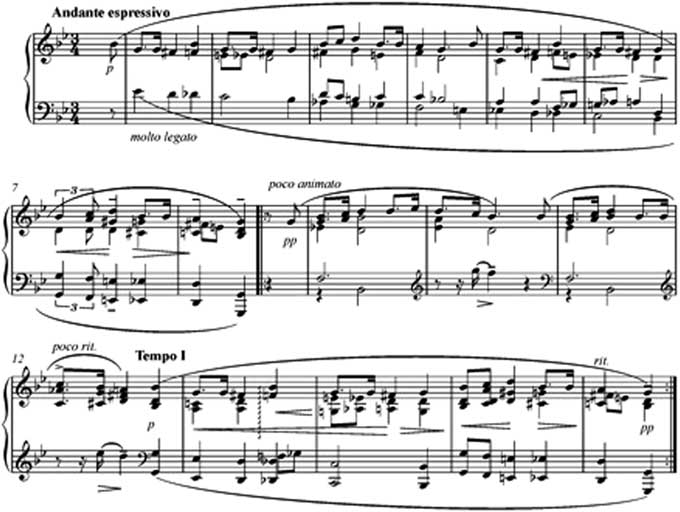
Therefore, conceiving an artistic procedure that could serve as a metaphor for the identity he sought to fabricate became a prominent occupation for Grainger. When faced with the reality that his own heritage would exclude him from building an intimate level of equivalence with Nordic cultures, he became increasingly obsessed with other forms of attachment. It is no surprise then that he credited Grieg as the primary influence in achieving the third level of cultural transformation, which is characterized by aesthetic processes that ‘can be thematized through early modernist techniques’. One of the procedures to which Grainger frequently alluded was the combination of folk melodies with chromatic procedures – a process I term chromatic juxtapositioning.Footnote 62 Grieg’s ‘unnatural harmonization’ was a source of constant fascination for Grainger because it served ‘to shed new light upon old subjects, to open new doors for an escape from suffering platitudes’.Footnote 63 In the same way that Morgan illustrates Weber’s earlier discursive use of harmony, so too did Grainger endow the setting of various folk (or folk-like) themes with more semantic weight than the melodies themselves. For example, in his analysis of the theme from Grieg’s Ballade, op. 24, Grainger attributes ‘unnatural harmonization’ with the ability ‘to clothe the melody within its first presentation’.Footnote 64 Example 1 illustrates the passage to which Grainger referred. In this excerpt, Grainger specifically highlights how the folk melody in the soprano voice is juxtaposed by a chromatic harmonization that undermines its folk-like simplicity and thus its rhetorical significance as a work of singular national propriety.
Grieg, ‘Ballade’, op. 24. Copyright 1992. G. Henle Verlag. Used with Permission.

Grainger’s musical analysis was complemented by his awareness of the biased reception that plagued Grieg’s work. In his published essay of 1915, ‘The Impress of Personality in Unwritten Music’, he offers a section entitled, ‘Primitive music is too complex for untrained modern ears’, in which he claims:
The case of Grieg is typical. For over thirty years his popularity has been almost universally accredited to ‘national’ traits supposed to have been drawn by him from Norwegian folk-songs; but few indeed, at home or abroad, can have taken the trouble to study these elements in their native purity, or they would have discovered for themselves what has been left to Grieg’s greatest and most sympathetic biographer, Mr. Henry T. Finck, to point out often and ably: how much more the Norwegian genius owed the unique originality of his music to the strength of his own personal inventiveness than to any particular external or ‘national’ source whatever. They would also have been in a position to more fully realize the generosity with which Grieg threw the richness of his strong personality into the task of making the wonders of the peasant music accessible in such ‘avowed’ arrangements as Opp. 30, 66, 72. In these volumes (still strangely unknown) we find some of the most inspired examples of his harmonic daring.Footnote 65
According to Grainger, nationalism was not intrinsic to defining a collective identity but only an external mantle that was used to promote a restrictive (and often manipulative) ideology. Yet audiences remained resolute in observing only the most superficial aspects of Grieg’s style – his use of folk-song – while ignoring its cosmopolitan aesthetic. Thus, just as Weber procured a cosmopolitan style by merging folk material with chromatic procedures, so too did Grieg focus on the malleability of folk sources despite the ulterior narratives postulated by his critics.
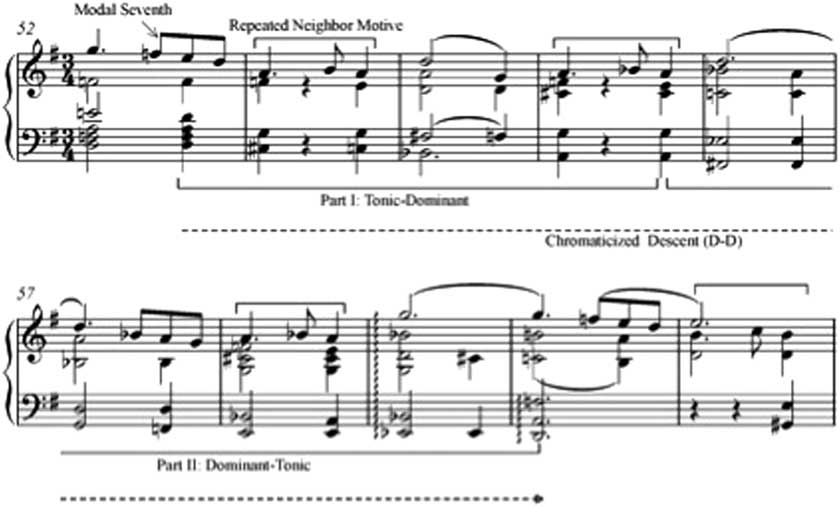
Grainger’s close affinity with Grieg’s works, combined with his awareness of their problematic reception, contributed to the development of a transformative process in his own music. His setting of the English tune, ‘My Robin is to the Greenwood Gone’ (Ex. 2), composed nearly four decades after Grieg’s Ballade, demonstrates the lasting influence of Grieg’s chromatic juxtapositioning. First, he places the folk tune in the soprano voice as if to customarily highlight its presence. Second, the primary motive is frequent repeated (as in bars 53, 55 and 58) in order to emphasize its folk-like character. Third, Grainger combines diatonic and modal elements in the melodic line, especially through the use of the flatted-seventh scale degree, which conveys a subtle degree of tonal ambiguity. Fourth, the piano accompaniment permits for the interaction of these diatonic, modal and chromatic elements as it creates a more eclectic pitch space than the melody readily suggests. Further similarities to Grieg’s setting can be found in the bass line, where Grainger similarly employs a chromaticized descent spanning an octave. This technique provides for harmonic variation against the melodic repetitions. Moreover, the entire passage eschews harmonic stability by thwarting the possibility of an authentic cadence through the use of striking dissonances on the first beat of each measure.
Grainger, ‘My Robin is to the Greenwood Gone’, bars 52–61. Copyright 1912. London: Schott & Co. Used with Permission.
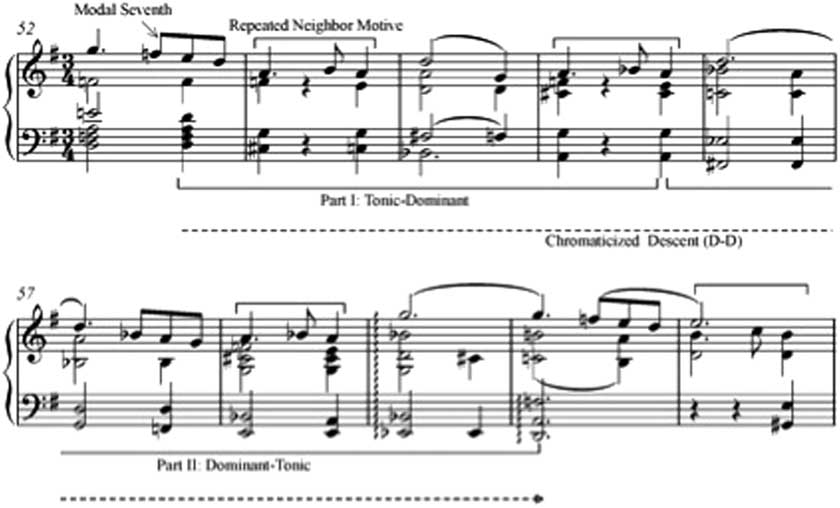
The significance of this ‘unnatural harmonization’ is the same as in the case of Grieg. Even though nineteenth-century audiences frequently associated the presence of folk melody as an endorsement of national identity, ‘My Robin is to the Greenwood Gone’ does not attempt to create a sense of nostalgia in any romantic sense. Rather, Grainger embraces the juxtaposition of the modern and the archaic so that the loss of any singular English identity afforded by such treatment is countered by the gain of a broader appeal, which does not mark any particular location. Thus, Grainger forged his own category of cosmopolitan modernism by framing his aesthetic philosophy as a both/and symbiosis and not an either/or debate. By employing the settings of folk tunes as catalysts for cosmopolitan signification, he does not attempt to replace one national voice for another.Footnote 66 Instead, Grainger crafted a style that could stand in more than one place, in more than one epoch, for more than one audience.
However, the loss of difference that chromatic juxtapositioning enabled across the temporal and stylistic domains went hand-in-hand with the renewal of difference in other spheres. This paradox underscores Grainger’s own hypocrisy when it came to self-identification in art. After all, while he endeavoured to flatten out history by conflating folk and modern elements (which I address more fully in the conclusion below), Grainger also maintained a strong propensity to build new racial-based theories of belonging.Footnote 67 This meant that the fluidity of his definitions of cosmopolitanism was counterbalanced by the rigidity of his imposed racial hierarchies in the decades that followed his early meetings with Grieg. Notwithstanding these incongruences, chromatic juxtapositioning served as a device that could enable Grainger to be as precise or vague as he wanted to be when it came to crafting his own identity. And, while his cosmopolitan style frequently endeavoured to cast a broad web of affiliation across cultural domains, it also had the collateral effect of issuing a heightened distinction between Nordic culture and the rest of the world. It is a paradox of which Grainger was acutely aware but unwilling to resolve.
Harnessing a ‘Restless Spirit of Change’: Grainger, MacDowell and the Pursuit of Hybridity
As I suggested at the beginning of this article, the case of Grainger and MacDowell is not one of direct influence, but of similar circumstance. And while I have traced the similar conditions that predisposed Grainger and MacDowell to developing a cosmopolitan approach in art, a lingering question remains: to what extent did MacDowell endeavour to formulate hybrid procedures in his art? The analyses of Bomberger and Crawford illustrate how MacDowell achieves the first two levels of hybridity: incorporating foreign elements and neutralizing difference. However, few studies have sought to uncover a similar aesthetic process that joined these musicians at the third deeper level of hybridity. To this end, Delanty has argued that cosmopolitan processes
are world-constituting or constructivist ones. Such processes take the form of translations between things that are different. The space of cosmopolitanism is the space of such translations. It is the nature of such translations that the very terms of translation are altered in the process of translation and something new is created but which also contains the elements of what has gone before it … The research object for critical cosmopolitan sociology concerns precisely this space, the discursive space of translations, dialogue and exchange. But more attention needs to be given to the empirical manifestations of cosmopolitanism.Footnote 68
In this final section, I will illustrate how MacDowell was, to quote Papastergiadis, ‘driven by the dual desire of connection and separation’ with the goal of reengaging ‘the sphere of possibilities that are permitted or excluded by boundaries’.Footnote 69 By surveying a collection of his lesser-known Eight Songs, op. 47 (1893), I will illustrate how the aesthetic procedures of chromatic juxtapositioning also obtained in MacDowell’s oeuvre as empirical manifestations of hybridity.
In order to assess the degree to which MacDowell inhabited the same discursive space as Grainger, one may first compare the qualities against which they similarly fought. For instance, when it came to advancing a modernist agenda, the quality of newness became shrouded in suspicion. Grainger was cautious to (re)produce certain effects for the sake of novelty alone. He explains his reasoning in ‘Modern and Universal Impulses in Music’:
What is novel to-day becomes normal to-morrow through familiarity, and immediately some new twist, some fresh distortion is instinctively desired … At any given moment certain things seem permissible and desirable to a composer in his own compositions, others not. Yet with each new work he will probably find himself drifting farther and farther away from his original premises, until, in the fullness of time, he finds himself including in his habits of composition tricks and attributes that once would have shocked him … And the more naturally gifted the man, the greater the likelihood that he will say with Walt Whitman: ‘I resist anything better than my own diversity’. The whole course of so-called ‘musical progress’ along such paths, is not an amelioration from worse to better or a deterioration from better to worse, but simply a continual and restless spirit of change.Footnote 70
MacDowell, while arguing against synthetic forms of diversity, similarly claimed, ‘Masquerading in the so-called nationalism of Negro clothes cut in bohemia will not help us’.Footnote 71 His obvious reference to Dvořák’s approach is typical, for the composer became the target of MacDowell’s rebuke throughout his career. For instance, in response to Dvořák’s Symphony in E minor, MacDowell claims
Dvorak’s new Symphony is to be played here Saturday, an American Symphony with such a Kefloozlum Bohemian title as he puts to it will be a novelty. Now if he will only give lessons in his kind of American language (to match the symphony) the thing will be complete. I suppose he calls his carbuncle ‘a gin blossom’ – There only remains for him to go into politics right now – He might compose music to the ‘Tammany Ring’ just as Wagner did for the ‘Nibelungen Ring’. I suppose he calls his bank account ‘From the new world’ too. If I ever meet him I am going to practice my ‘Czech’ on him. This would be less painful than his ‘American’.Footnote 72
The sarcasm that MacDowell employs in his criticism calls attention to a significant problem that challenged both the composer and his artistic circles. Simply put, MacDowell was caught between a creative dependence on continental characteristics, which American audiences had come to expect, and the call to produce something ‘new’, which his publisher (Schmidt) and organizations such as the Manuscript Society of New York had come to demand.Footnote 73 From MacDowell’s point of view, this problem could only be overcome by turning to a type of diversity that, as evidenced in Grainger’s quotation of Whitman, represented a more immanent approach and not an external mapping of identity.
Their shared objection to superficial novelties also yielded a mutual opposition to linear concepts of progress that dominated German-based ideologies. Grainger elucidates this point when he draws an important parallel between music and literature while again referencing the work of Grieg:
In literature, prose has not ousted poetry, or vice versa, and I see no reason why ‘beatless’ music and our present metrical music should not prosper side by side on equally fraternal terms. As a rule the genuine innovator is seldom blind to the charm of older forms, nor even to their possibilities in his own art works. Who has expressed himself oftener or more trenchantly in diatonic and even triadic mediums than that chromatic giant Wagner? Grieg, the most chromatic Scandinavian of his generation, was also the one to whom the totally non-chromatic folk-scales of Norway provided the most inspiration. In the present-day popular music of various countries we note a preference for pentatonic melody side by side with an equally marked liking for certain chromatic chord-progressions in the accompaniment.Footnote 74
Grainger’s observations resonate strongly with Weber’s primary conviction outlined above; namely, novelty of musical material was not determined by its place or period of origin, but by the particular method of application. Similarly, MacDowell promoted a circular teleology in his art. Works such as his ‘Sechs kleine Stücke von J.S. Bach’ (1890) reveal his penchant for exploiting the ‘charm of older forms’ through the combination of chromatic and diatonic elements. As Bomberger has observed, ‘MacDowell did not hold the works of past composers to be inviolable texts. Rather, he viewed them as frameworks from one time and place that could be updated to reflect contemporary tastes and techniques’.Footnote 75 Consequently, ‘newness’ for Grainger and MacDowell was not governed by temporality but by contextuality.
It is their mutual scepticism toward novelty and linear historicism that principally fuelled a parallel pursuit of hybridity by which displacement functioned differently than it did for nationalists like Dvořák. Indeed, it was a reflective level of displacement that permitted MacDowell to ‘travel’ across space and time to ancient Norwegian and Celtic shores in his celebrated piano sonatas. But MacDowell’s cosmopolitan approach represented a distinct – albeit misunderstood – departure from Dvořák’s style of folkloric nationalism. More recently, Papastergiadis has called attention to the reasons for misattribution surrounding cosmopolitan artists:
Displacement can lead to either confusion or insight. Hybridity refers not only to the ambivalent consequences of mixture but also to the shift in the mode of consciousness. By mixing things that were previously kept apart there is both a stimulus for the emergence of something new and a shift in position that can offer a perspective for seeing newness as it emerges.Footnote 76
McDowell similarly recognized the challenges faced by artists who seek to employ the level of ambivalence that hybridity entails. The construction of this aesthetic requires a methodology that can merge elements as disparate as Wagner’s chromaticism with traditional folk-songs, but that does so by encouraging the listener to experience the music in a new way. Bomberger notes how, even in the works perceived as MacDowell’s most nationalistic such as his ‘Indian’ Suite,
MacDowell was less interested in the particulars of Indian culture than in its universal implications, just as he had earlier been fascinated with the ideal of medieval chivalry but unimpressed by the ruins of medieval castles. This is a reflection of his lifelong interest in reading as stimulation to the imagination, and it is also another example of the introvert’s desire to keep the world at arm’s length. Direct contact – whether with exotic music, overgrown ruins, or the politics of a musical career – was distasteful to him.Footnote 77
Thus critical distance, in contradistinction to Grainger’s forms of fabricated attachment, became an essential facet of evoking cosmopolitanism for MacDowell.
Consequently, the cosmopolitan consciousness that linked Grieg and Grainger across time and space also established an important nexus with MacDowell, who similarly manifested the ‘ambivalent consequences of mixture’ at the level of the musical score itself. His efforts came to embrace a conscious rejection of abstractionism in favour of recontextualizing regional elements thereby – to quote Grainger – shedding ‘new light upon old subjects’ and opening ‘new doors for an escape from suffering platitudes’. And whereas recent commentators have begun to investigate the type of newness MacDowell sought to uncover in his celebrated piano sonatas and symphonic works, relatively few have explored the degree to which MacDowell revealed a cosmopolitan condition in his lesser-known works. In particular, MacDowell’s Eight Songs, op. 47 are illustrative of the manner in which hybridity obtains at multiple levels of his conceptual framework, including his heterogeneous selection of authors, the combination of different musical styles throughout the collection, and the use of chromatic juxtapositioning at the phrase level to shift the frame of reference beyond the nation.
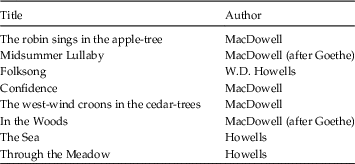
Table 1 illustrates the title/author pairings for each song in the collection, which entails selections of original poetry, arrangements of Goethe’s texts, and the work of William Dean Howells. The inclusion of Howells’ poetry is particularly notable because MacDowell shared his belief (along with the American writer Hamlin GarlandFootnote 78 ) that an over-reliance on European models was degrading American art. According to Neil Leonard, ‘Howells and his associate had sought to break with the European tradition, and MacDowell, in his efforts to do so, found inspiration in their work and often thought as they did’.Footnote 79 The idea of reaching the universal through the local thereby connects MacDowell to Grainger at the most fundamental level. Yet at the same time, MacDowell did not shy away from the opportunity to harvest the elements of European traditions alongside his American contemporaries. As a result, MacDowell encourages the listener to experience a degree of newness that is generated not only by the obvious use of original texts, but also through a distinct combination of literary sources past and present.
MacDowell, Eight Songs, op. 47

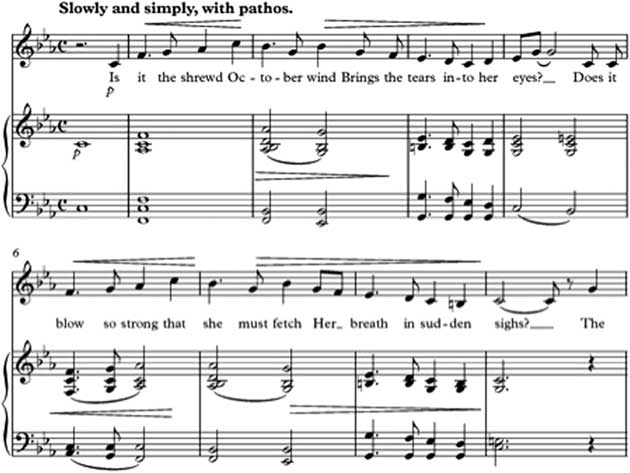
The same variety that MacDowell applied to his choice of texts also manifests in the stylistic juxtapositions that proliferate throughout the collection. For instance, Example 3 illustrates the opening of the third work, ‘Folksong’, in which MacDowell employs a transparent vernacular style. This straightforwardness is conveyed through the use of a diatonic melody, simple harmonic accompaniment and symmetrical phrasing. In addition to the supportive role of the piano, the relative stepwise motion in the melody combined with the composer’s indication ‘Slowly and simply, with pathos’ contributes to the declamatory nature of the song.
‘Folksong’, bars 1–9, from Eight Songs, op. 47 (Leipzig: Breitkopf und Härtel, 1893). Work is in the public domain.

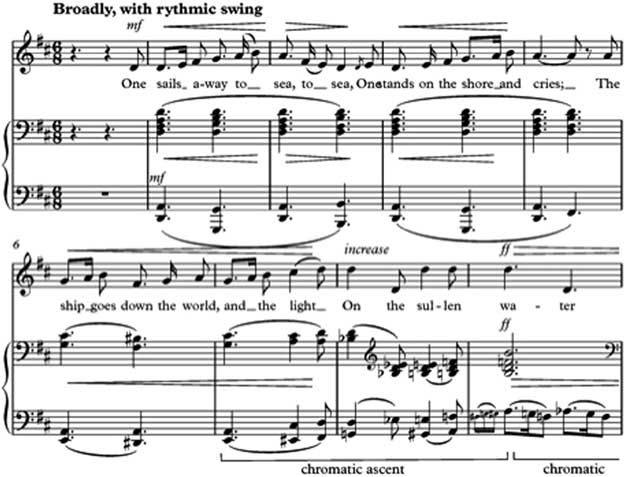
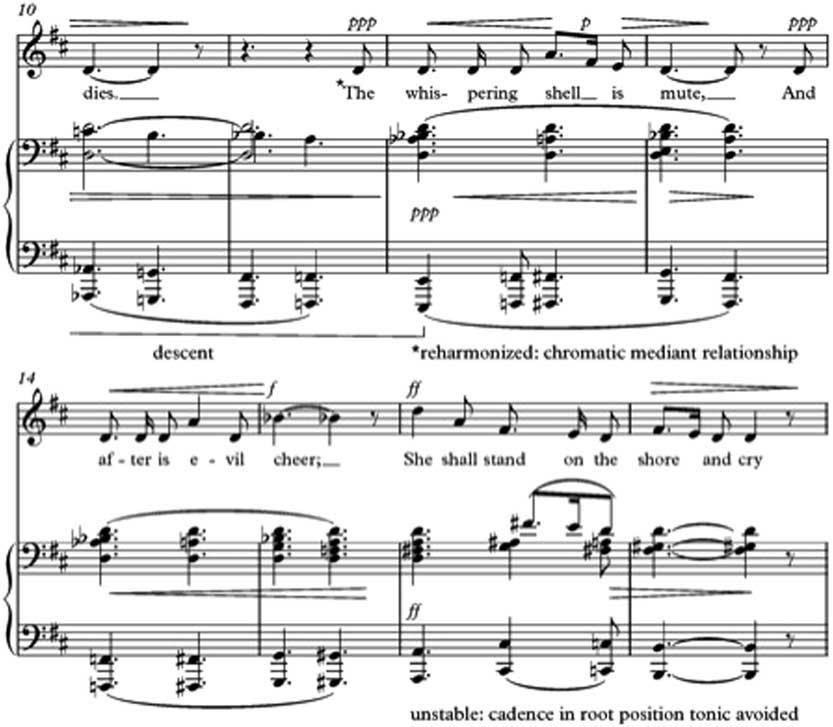
The simplicity of the folk-based appeal presented by this work is contrasted by a very different setting of Howells’ poetry in ‘The Sea’ (Ex. 4). In this song, the first four-bar phrase begins as simply as ‘Folksong’ with a diatonic melody that is cast in a lilting  time signature. This first subphrase also introduces a similar supportive role of the piano, which outlines the bright tonic of D major and reinforces the regular harmonic rhythm. However, beginning in bar 6, MacDowell employs chromatic juxtapositioning between the voice and piano in order to – as Grainger highlighted in Grieg’s Ballade – ‘clothe the melody’. The chromatic ascent in the bass leads to the first climax at bar 9, where the octave D in the voice is undermined by a diminished-seventh chord on B. As a result, the power of signification is transferred from the voice to the piano as tonal stability is thwarted and the tension is prolonged through a chromatic descent in the bass through bar 11. By bar 12, the piano accompaniment redirects the tonal centre even further aloft with a modulation to the chromatic mediant B♭. Even though the harmonization in bars 12–15 contains an inner pedal on D, the potential harmonic stability of this device is eschewed by a return to chromatic voice leading. MacDowell utilizes this passage to recall the D major–G major undulations of the opening phrases, but this time with a mode shift to G minor. The effect is one of greater instability, for the second principle climax on the downbeat of bar 16 – also on the tonic D – is made unstable by its arrival in second inversion. Moreover, the juxtaposition of B and D in bars 15 and 16 respectively only further incapacitates the tonic from serving as a satisfying resolution of the underlying tensions.
‘The Sea’, bars 1–17, from Eight Songs, op. 47 (Leipzig: Breitkopf und Härtel, 1893). Work is in the public domain.

‘The Sea’, bars 1–17, from Eight Songs, op. 47 (Leipzig: Breitkopf und Härtel, 1893). Work is in the public domain.

In passages such as the opening bars of ‘The Sea’, MacDowell reveals the inherent malleability of the text, accompaniment and style. When heard alongside more placid works such as ‘Folksong’, the eclectic combination of these elements is rendered more apparent by the use of chromatic juxtapositioning. This device, which Grainger also developed in part from his close reading of Grieg, similarly provided a strategy for MacDowell to resist the isolating tendencies of folk music and national affiliation thereby offering ‘a perspective for seeing newness as it emerges’.Footnote 80 Indeed, works such as ‘The Sea’ were stimulus for Grainger to include MacDowell in the list of ‘progressive’ composers ‘to take the hints that Grieg had thrown out’.Footnote 81 At the same time, the use of harmony as a primary catalyst for achieving a cosmopolitan transformation points to the fact that what is most novel in their approach is not any particular element of the score, but the context afforded by the interaction of these components. In this manner, chromatic juxtapositioning at the end of the nineteenth century operates in a demonstrably similar fashion to Weber’s employment of it nearly a century earlier. It is also significant that cosmopolitanism should materialize at time periods when national inclinations are most pronounced, for it is precisely when calls to articulate difference are at their strongest that new modes of hybridity often emerge.Footnote 82
Notwithstanding these correspondences, examining MacDowell’s works alongside those of Grainger permit one to see how their similar approach was not merely a return to eighteenth-century idealism, but also a practical solution to the problems afforded by overlapping agendas of modernism, novelty and cosmopolitanism. James Clifford has articulated this ‘variety of actually existing practical stances’ when he coins the term discrepant cosmopolitanisms, noting how ‘such a perspective opens up a more complex, humane understanding of hybrid realities’.Footnote 83 To this end Clifford has argued:
A focus on discrepant cosmopolitanisms also allows us to hold on to the idea that whereas something like economic and political equality are crucial political goals, something like cultural similarity is not. It gives us a way of perceiving, and valuing, different forms of encounter, negotiation, and multiple affiliation rather than simply different ‘cultures’ or ‘identities’ … [which] presupposes encounters between worldly historical actors willing to link up aspects of their complex, different experiences.Footnote 84
MacDowell’s process of engaging and disengaging from propriety sources is akin to Clifford’s notion of discrepant cosmopolitanism. In isolation, works such as ‘Folksong’ seem to sanction a nationalist style. However, when read in context with songs like ‘The Sea’, these scores demand reappraisal for their ability to engage American poetry, landscape and folk-like simplicity while avoiding the ‘utter nonsense’ of creating an American school. The result is a composite style that could negotiate established relationships between the folk influences of the past, the chromatic language of the nineteenth century, and a burgeoning modernist style of the early twentieth century while preserving the complexities of ‘complex, different experiences’ afforded by their interaction. As Daniel Gregory Mason argued, removing levels of ideology does not render the works ‘empty’ in terms of their power to signify identity. On the contrary, the pursuit of unity in diversity, the use of a polysemic musical language and the willingness to mediate different forms of encounter all facilitated the construction of a practical analogue for the cosmopolitan worldview he developed alongside Grainger.
Conclusion: Cosmopolitanism and the End of Anachronisms?
This empirical examination has shed light on the cultural field that Grainger and his colleagues occupied, which amplifies the role of cosmopolitanism beyond its perceived parochial status. I have illustrated the extent to which figures as diverse as Grainger, MacDowell, Grieg and Weber relied on a cosmopolitan imagination in order to forge a connection between their experiences of ‘the local’ in relation to ‘the universal’. This process, as cultural theorist Kwame Appiah has observed, stands apart from other means of identification because it reflects ‘elective affinities rather than state-imposed obligation’.Footnote 85 By focusing upon the particular aspect of harmonic contextuality, an important link emerges between different forms of discrepant cosmopolitanisms. At its core, the use of chromatic juxtapositioning reveals a mode of hybridity that is activated by a cultural dialogue, which flourished on both sides of the Atlantic and across the long nineteenth century. Thus, while Grainger and MacDowell frequently sought to distance themselves from European artistic models, their cosmopolitan imagination ironically brought properties of time and space into closer proximity.
Yet of all the consequences of cosmopolitanism that I have traced throughout this study, perhaps the most significant outcome is the way in which these artists transformed conceptions of progress at the dawn of modernism. Ironically, they embraced a complex process that can be likened to the practice that Thomas Mann referred to as the ‘synchronicity of the non-synchronous’.Footnote 86 Grainger confirmed this notion when he deemed musical ‘progress’ the product of ‘a continual and restless spirit of change’.Footnote 87 Instead of taking up the traditional mantle of evolution in art, he adopted a non-linear model that stimulated deeper forms of salience where many others assumed a degree of non-correspondence, such as Grieg’s chromatic and ‘non-chromatic’ folk scales. Paradoxically, ‘the dramatic clash of the archaic non-harmonic folk tune with our own overflowing harmonic exuberance’ to which Grainger referred calls into question the presence of historical anachronisms just as Weber challenged their existence in his Oberon before the rise of nationalism. From this standpoint, if there is no formal progression of time, then there can be no true anachronisms. Grainger thereby invites the listener to hear the correlation between elements past and present, primitive and modern, simple and complex as a testament to the circulating condition of cosmopolitanism. This dynamic effect demonstrates that Grainger’s notion of hybridity during this period was, as Georgina Born and David Hesmondhalgh have observed, ‘a practical and creative means of cultural rearticulation and resurgence from the margins’.Footnote 88
But this cosmopolitan stance would not be so substantial were it not for the overlapping topologies that animated its presence in America. This geographic dimension has been elucidated in Saavedra’s investigation, which has demonstrated that a turn to cosmopolitanism provided for a creative imagination that could exist simultaneously in more than one country. Likewise, I have argued that the cosmopolitan condition evoked by the representative works in this study emerges within the cracks of porous categories of identity, and that this process has endowed artists with the autonomy to toggle between identities across both synchronic and diachronic dimensions. This process also resulted in an alternative function of folk music: to serve as a collection of resources for assembling a modernist style. Grainger – like Grieg and MacDowell – achieved this transformation by viewing the past not simply as a model to be imitated, but as a reservoir for creating new modes of hybridity amidst the deliberate consciousness of difference.