Implications
Eutherian mammals’ milk or colostrum usually contains small amounts of oligosaccharides and lactose, the dominant carbohydrate. Lactose acts as a main energy source for neonates, whereas milk oligosaccharides are believed to act as prebiotics that stimulate the growth of beneficial microorganisms in the infant colon and as receptor analogues that inhibit the attachment of pathogenic microorganisms to colonic epithelial cells. In contrast to most eutherians, oligosaccharides predominate over lactose in monotreme and marsupial milk. In this paper, we propose a hypothesis that describes how lactose and milk oligosaccharides have evolved during the evolution of the three subclasses of mammals from their common ancestor.
Introduction
Extant mammals consist of monotremes (Prototheria), marsupials (Metatheria) and placentals (Eutheria). A unique characteristic of monotremes is their oviparous mode of reproduction: their young are hatched from eggs instead of emerging from a uterus. One of the major differences between marsupials and eutherians lies in their patterns of reproduction. In marsupials, gestation is usually short compared with eutherians of similar size and, as a result, marsupials at birth are very altricial, that is, small and mostly undeveloped.
Although the three infraclasses of mammals are very different in their mode of reproduction, they have in common the fact that their young are suckled on milk and that this milk is produced from mammary glands. Mammalian milk/colostrum contains fat, protein, carbohydrate, vitamins and minerals. The concentration of carbohydrate varies from a trace to over 10%, depending on the species; in eutherian mammals, this carbohydrate usually consists of lactose (Gal(β1 → 4)Glc) as a main component in addition to small amounts of many varieties of milk oligosaccharides, nearly all of which have a lactose unit at the reducing end. The synthesis of these oligosaccharides within the lactating mammary glands is catalysed by a number of specific glycosyltransferases using lactose as the acceptor. In contrast to eutherians, the dominant carbohydrate in the milk of monotremes and marsupials is a variety of oligosaccharides. This paper is concerned with the evolutionary origin of milk oligosaccharides and of their precursor, lactose, with a special emphasis on human milk oligosaccharides (HMOs) and their biological significance.
Hypothesis
Biosynthesis of lactose: molecular evolution of α-lactalbumin (α-LA) from lysozyme: monotreme α-LAs
The disaccharide lactose is found in the milk of almost all mammals in either free or bound forms. It is generally accepted that, among natural sources, lactose occurs only in mammalian milk and in mammary glands. Lactose is synthesized within lactating mammary glands from uridine diphosphate galactose (UDP-Gal; donor) and glucose (acceptor) by a transgalactosylation catalysed by lactose synthase. This enzyme is a complex of β4-galactosyltransferase I and α-LA, one of the whey proteins. Other tissues do not contain α-LA but do contain the β4-galactosyltransferase, which transfers galactose (Gal) from UDP-Gal to non-reducing N-acetylglucosamine (GlcNAc) residues in glycoconjugates to synthesize N-acetyllactosamine (Gal(β1 → 4)GlcNAc) units. The presence of α-LA changes the acceptor of β4-galactosyltransferase from GlcNAc to glucose (Glc); thus, the expression of α-LA within the mammary gland is the key to the presence of lactose in milk. Furthermore, the rate at which lactose is synthesized is controlled by α-LA.
It has been discovered that the amino acid sequence of α-LA is similar to that of C-type lysozyme, which cleaves the bond in peptidoglycans of bacterial cell walls and that is present in many tissues of vertebrates and in insects. As α-LA is found only in mammals, it must have evolved from lysozyme, the older protein. It is generally believed that this evolution was the result of duplication of the lysozyme gene.
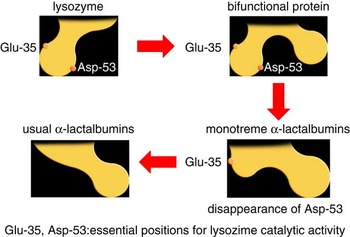
Hayssen and Blackburn (Reference Hayssen and Blackburn1985) suggested that the evolution of α-LA from lysozyme could have occurred via an intermediate form that possessed both functions, the duplicated gene coding for a bifunctional protein. Its amino acid sequence would thus have contained regions essential for both the new function of α-LA and the old function of lysozyme. Although such a bifunctional protein has never been detected, amino acid sequence data of α-LAs isolated from the milk of monotremes (platypus and echidna) support the above hypothesis (Shaw et al., Reference Shaw, Messer, Scrivener, Nicholas and Griffiths1993; Messer et al., Reference Messer, Griffiths, Rismiller and Shaw1997). Based on the comparison of amino acid sequences of platypus and echidna α-LAs and of bovine lysozyme, the following features deserved attention. (i) The monotreme α-LAs have a glutamate residue at position 35, which corresponds to one of two residues that are essential for lysozyme catalytic activity. (ii) Both α-LAs have three residues that are almost always found in lysozymes but never in any other α-LA: these are asparagine at 44, alanine at 109 and tryptophan at 113. The equivalent positions in lysozymes are believed to be involved in the binding of lysozyme to its substrate. Although neither of the monotreme α-LAs was found to be a bifunctional protein, they can be thought of as proteins that have undergone relatively little change, compared with the α-LAs of other species, during their evolution from lysozyme (see Figure 1). The retention of the above-mentioned features supports the hypothesis that α-LA evolved from lysozyme, an event that enabled the mammary glands of mammals to acquire the ability to synthesize lactose and oligosaccharides during lactation.
Molecular evolution from lysozyme to α-lactalbumin.

Milk oligosaccharides of monotremes: marsupials and eutherians
Milk oligosaccharides predominate over lactose in monotremes and marsupials. Living monotremes comprise only three species: platypus, short-beaked echidna and long-beaked echidna. Messer and Kerry (Reference Messer and Kerry1973), using gel filtration on Sephadex G-15 (GE Healthcare, Uppsala, Sweden), separated fucosyllactose, difucosyllactose and sialyllactose, and lactose as a minor component, from the carbohydrate fraction of short-beaked echidna milk. They also isolated difucosyllactose and fucosylated higher oligosaccharides from platypus milk. Most of the platypus higher oligosaccharides were subsequently found to contain lacto-N-neotetraose (LNnT; Gal(β1 → 4)GlcNAc(β1 → 3)Gal(β1 → 4)Glc) or lacto-N-neohexaose (LNnH; Gal(β1 → 4)GlcNAc(β1 → 3)[Gal(β1 → 4)GlcNAc(β1 → 6)]Gal(β1 → 4)Glc as core units and Lewis x (Gal(β1 → 4)[Fuc(α1 → 3)]GlcNAc) or Lewis y (Fuc(α1 → 2)Gal(β1 → 4)[Fuc(α1 → 3)]GlcNAc) in the adjacent unit (Amano et al., Reference Amano, Messer and Kobata1985).
There are altogether approximately 250 species of living marsupials. Detailed structural studies on their milk oligosaccharides have been carried out mainly on those of the tammar wallaby (Messer et al., Reference Messer, Trifonoff, Stern, Collins and Bradbury1980 and Reference Messer, Trifonoff, Collins and Bradbury1982), but those of other marsupials appear to be very similar. The milk oligosaccharides of the tammar wallaby can be classified into two series: a major unbranched series, which can be expressed as [Gal(β1 → 3)]n = 1∼5Gal(β1 → 4)Glc, and a minor series of branched saccharides containing GlcNAc. Oligosaccharides of this type, other than Gal(β1 → 3)Gal(β1 → 4)Glc and Gal(β1 → 3)[Gal(β1 → 4)GlcNAc(β1 → 6)]Gal(β1 → 4)Glc (lacto-N-novopentaose I), have not been found in the milk or colostrum of any other species (Messer and Urashima, Reference Messer and Urashima2002).
In contrast to the milk of monotremes and marsupials, that of most of the Eutheria contains lactose as the dominant saccharide in addition to small amounts of oligosaccharides. To date, oligosaccharides of 21 eutherian species have been studied (Urashima et al., Reference Urashima, Asakuma and Messer2007).
There is heterogeneity and homogeneity in the structures of eutherian milk oligosaccharides (Urashima et al., Reference Urashima, Saito, Nakamura and Messer2001 and Reference Urashima, Asakuma and Messer2007). These oligosaccharides contain lactose, LNnT, LNnH or para lacto-N-neohexaose (Gal(β1 → 4)GlcNAc(β1 → 3)Gal(β1 → 4)GlcNAc(β1 → 3)Gal(β1 → 4)Glc) as core units and Lewis x (bears, elephants, chimpanzee, bonobo, orangutan), H antigen (Fuc(α1 → 2)Gal; seals, mink, coati, bonobo), α-Gal epitope (Gal(α1 → 3)Gal(β1 → 4)GlcNAc; bears, elephants, mink, coati), A antigen (GalNAc(α1 → 3)[Fuc(α1 → 2)]Gal; polar bear, minke whale, lion, bonobo, leopard) or B antigen (Gal(α1 → 3)[Fuc(α1 → 2)]Gal; Japanese black bear, gorilla, hyena) in the adjacent unit. Most of the acidic milk oligosaccharides contain N-acetylneuraminic acid (Neu5Ac) and/or N-glycolylneuraminic acid (Neu5Gc). Sialyl oligosaccharides of the milk or colostrum of many species (human, horse, seals, Asian elephant, bears, dolphin and whales, hyena, capuchin and siamang) contain only Neu5Ac, and no Neu5Gc. In some species (cow, goat, giant anteater, great apes), Neu5Ac containing oligosaccharides predominate over those containing Neu5Gc, whereas in a few species (sheep, lion, leopard) Neu5Gc containing oligosaccharides predominate over those containing Neu5Ac. The milk or colostrum of a few species contains acidic oligosaccharides containing either sulphate (dog, rat, human, bearded seal) or phosphate (horse, cow).
Although the milk or colostrum of most eutherians contains lactose as a dominant saccharide, and their young utilize this disaccharide as an energy source, in the milk of most species of Canoidea (bears, seals, giant panda, mink, coati but not including dog), oligosaccharides predominate over lactose. It is noteworthy that bear and seal milk contains a huge amount of fat and much less carbohydrate.
As mentioned above, platypus milk oligosaccharides include LNnT and LNnH, as do some eutherian milk oligosaccharides. In addition, they have Lewis x or y structures in the adjacent units similar to some eutherian milk oligosaccharides. On the other hand, the major series of tammar wallaby milk oligosaccharides consists of β(1 → 3) linked Gal residues, ranging from tri- to at least octa-saccharides. Remarkably, fucosyl oligosaccharides could not be detected in the milk of tammar and other marsupial. In these respects, therefore, eutherian milk oligosaccharides are more similar to those of monotremes than to those of marsupials and it is evident that the unique oligosaccharides found in the milk of tammar wallabies and other marsupials evolved after their divergence from eutherians.
Gastrointestinal digestion of milk oligosaccharides and lactose
As mentioned, the milk of most eutherian mammals contains free lactose as a dominant saccharide. When the young consume their mother's milk, the lactose is split into galactose and glucose by intestinal lactase (neutral β-galactosidase), which is located in the membrane of the microvilli of the brush border of the small intestine, and these monosaccharides are transported into the enterocytes by a specific mechanism. The glucose enters the circulation and is used as an energy source, whereas most of the galactose is converted to glucose in the liver to be used as an energy source as well. Much less is known about the exact fate of eutherian milk oligosaccharides. Human milk oligosaccharides (HMOs) are resistant to enzymatic hydrolysis by brush border intestinal lactase (Engfer et al., Reference Engfer, Stahl, Finke, Sawatzki and Daniel2000) and the majority appears to survive passage through the small intestine and to enter the colon, where they are subjected to fermentation by colonic bacteria (Brand-Miller et al., Reference Brand-Miller, McVeagh, McNeil and Messer1998).
With regard to marsupials, histochemical studies with specific stains for neutral and acid β-galactosidases have shown that intestinal lactase is completely absent from the brush border of the villi of the small intestine of the suckling tammar wallaby (Messer et al., Reference Messer, Crisp and Czolij1989). Instead, a very active acid β-galactosidase is present intracellularly, probably located in lysosomes and supranuclear vacuoles. This β-galactosidase is able to digest both lactose and the β(1 → 3)-linked galactosides that are found in tammar wallaby milk, in contrast to the neutral brush border lactase of eutherians, which only splits free lactose. In addition, several acid glycosidases including N-acetylglucosaminidase, α-l-fucosidase and neuraminidase could readily be detected in tammar wallaby small intestine (Walcott and Messer, Reference Walcott and Messer1980). To be digested, the tammar milk oligosaccharides must presumably first be transported into the enterocytes, where they can then be hydrolysed to their constituent monosaccharides by the acid glycosidases (Walcott and Messer, Reference Walcott and Messer1980).
With respect to monotremes, it has been shown that small intestinal neutral lactase activity was entirely absent but, as in marsupials, various acid glycosidases including β-galactosidase, α-l-fucosidase and neuraminidase could be detected in the small intestine of the suckling echidna. These results were consistent with the concept that the oligosaccharides of echidna milk (mainly sialyl and fucosyllactoses) are digested by lysosomal enzymes contained within the enterocytes of the small intestine (Stewart et al., Reference Stewart, Messer, Walcott, Gadiel and Griffiths1983).
Biological significance and evolution of milk oligosaccharides and lactose
HMOs appear to act as prebiotics, stimulating the growth of beneficial microorganisms such as bifidobacteria within the infant colon (Gyorgy et al., Reference Gyorgy, Kuhn, Rose and Zilliken1954). The metabolic activity of these organisms reduces the colonic pH, which has the effect of inhibiting the proliferation of pathogenic organisms such as Shigella flexneri and Escherichia coli (Gopal and Gill, Reference Gopal and Gill2000). In addition, because HMOs are similar in structure to glycoconjugates on the surface of gastrointestinal cells, they are likely to act as soluble receptor analogues; they compete with pathogenic bacteria, bacterial toxins and viruses for attachment to gastrointestinal receptor sites and thus inhibit their actions (Newburg et al., Reference Newburg, Pickering, McCluer and Cleary1990; Cravioto et al., Reference Cravioto, Fello, Villanfan, Ruiz, del Vedovo and Neeser1991; Cervantes et al., Reference Cervantes, Newburg and Ruiz-Palacios1995). It seems very likely that the role of anti-infection factors is shared by the milk oligosaccharides of non-human species (Martin et al., Reference Martin, Martin-Sosa and Hueso2002).
Based on considerations of the biological significance of milk oligosaccharides and of lactose, we propose the following hypothesis for the sequence of events involved in their evolution. The protolacteal secretions of the primitive mammary glands of the common ancestor of mammals probably contained fat and protein but no carbohydrates, except for low concentrations of glucose derived from the maternal circulation. We assume that they contained C-type lysozyme, the precursor of α-LA. When α-LA first appeared, its concentration would have been low and therefore lactose was synthesized at a relatively slow rate. We also assume that these primitive glands contained most of the glycosyltransferases that are found in the mammary glands of mammals today, and these enzymes would have catalysed the synthesis of oligosaccharides from almost all the available lactose. Early mammalian milk would therefore have contained higher concentrations of oligosaccharides than of lactose. We suggest that initially these oligosaccharides were biologically significant mainly as anti-microbial defense factors, along with other defense factors present in milk such as antibodies, lactoferrin and lysozyme. This scenario is consistent with the hypothesis that mammary glands and milk production evolved as the part of the innate immune system (Vorbach et al., Reference Vorbach, Capecci and Penninger2006) and that the anti-microbial role of milk components evolved before their nutritional function (Blackburn et al., Reference Blackburn, Hayssen and Muphy1989).
As the α-LA content of the evolving mammary glands increased, so did the concentration of milk oligosaccharides, which began to serve a nutritive function as energy sources in addition to their protective function. It is apparent that these two roles of milk oligosaccharides have been preserved in monotremes and marsupials. In most eutherians, however, the milk usually contains more lactose than oligosaccharides, presumably because the synthesis of lactose is faster than that of oligosaccharides, so that lactose accumulates and can be used as an energy source for the young in preference to milk oligosaccharides. Thus, in eutherians, the physiological roles of milk sugars diverged, with lactose as an important energy source and milk oligosaccharides as anti-infection factors. It is important to note that the utilization of lactose as a significant energy source depended on the prior evolution or co-evolution of brush border small intestinal lactase, which provides an efficient mechanism for its digestion. This mechanism did not evolve in monotremes and macropod marsupials; instead, the small intestinal enterocytes of the neonates of these species are able to digest milk oligosaccharides intracellularly. This ability appears to be almost entirely absent in the enterocytes of human neonates; other eutherians have not been investigated as yet in this regard.
Structures and colonic metabolism of HMO: the bifidus factor
Among eutherian milk oligosaccharides, those of humans are exceptional in their variety, complexity and high concentration. Human milk contains approximately 7% of carbohydrate, which is composed of 80% lactose and 20% HMO. The existence of 200 varieties of HMOs has been suggested by mass spectrometry (Ninonuevo et al., Reference Ninonuevo, Park, Yin, Zhang, Ward, Clowers, German, Freeman, Killeen, Grimm and Lebrilla2006), of which 115 structures have been characterized to date; these are classified into 13, depending on their core structures (Kobata, Reference Kobata2010; Urashima et al., Reference Urashima, Kitaoka, Terabayashi, Fukuda, Ohnishi and Kobata2011). It has been shown that Fuc(α1 → 2)Gal(β1 → 4)Glc (2’ → FL), Fuc(α1 → 2)Gal(β1 → 3)GlcNAc(β1 → 3)Gal(β1 → 4)Glc (LNFPI), Fuc(α1 → 2)Gal(β1 → 3)[Fuc(α1 → 4)]GlcNAc(β1 → 3)Gal(β1 → 4)Glc (LNDFHI) and Gal(β1 → 3)GlcNAc(β1 → 3)Gal(β1 → 4)Glc (lacto-N-tetraose (LNT)) constitute from one-quarter to one-third of the total HMOs (Asakuma et al., Reference Asakuma, Nakamura, Kimura, Watanabe, Akahori, Ohbaysahi, Arai, Sanai and Urashima2008).
The HMOs are classified into two groups, designated as types I and II. Type I contains Gal(β1 → 3)GlcNAc (LNB), whereas type II contains Gal(β1 → 4)GlcNAc (N-acetyllactosamine). In human milk, the type I oligosaccharides such as LNT, LNFPI and LNDFHI predominate over type II such as LNnT. In our studies of the milk or the colostrum of a large variety of non-human species, we found that in nearly all of these, only type II oligosaccharides are present. In a few species, type I oligosaccharides were found but in these type II predominated over type I. These results suggested that the predominance of type I oligosaccharides in milk is a human-specific feature, and we therefore studied the milk oligosaccharides of several species of apes, these being closely related to Homo sapiens. We found that the type II oligosaccharides predominate over the type I in the milk or colostrum of chimpanzee, bonobo and orangutan, and that only type II oligosaccharides were present in gorilla and siamang milk or colostrum (Urashima et al., Reference Urashima, Odaka, Asakuma, Uemura, Goto, Senda, Saito, Fukuda, Messer and Oftedal2009).
The unique predominance of type I oligosaccharides in human milk may have biological and evolutionary significance. As mentioned above, it is assumed that HMOs act as prebiotics that stimulate the growth of beneficial microorganisms such as bifidobacteria and/or as receptor analogues that inhibit the adhesion of pathogenic microorganisms to the infant's colonic mucosa. The question of which HMOs are utilized by different strains of bifidobacteria had for many years remained in doubt, but recently, the metabolic pathways in several strains have been clarified on the basis of their genomic data. One of these pathways is that found in Bifidobacterium longum subsp. infantis ATCC15697, in which HMOs are first transported into the cell by the action of a transporter, after which they are degraded successively from their non-reducing ends by several glycosidases (Sela et al., Reference Sela, Chapman, Adeuya, Kim, Chen, Whitehead, Lapidus, Rokhsar, Lebrilla, German, Price, Richardson and Mills2008). Both types I and t II HMOs are digested in this pathway. Another pathway, which is specific to type I HMO, is that found in the B. bifidum JCM1254 strain; in this, HMOs are degraded into LNB by the extracellular actions of sialidase, fucosidase and lacto-N-biosidase; the LNB is then transported into the cell and converted into galactose-1-phosphate and N-acetylglucosamine by a lacto-N-biose phosphorylase (Kitaoka et al., Reference Kitaoka, Tian and Nishimoto2005; Wada et al., Reference Wada, Ando, Kiyohara, Ashida, Kitaoka, Yamagichi, Kumagai, Katayama and Yamamoto2008). It is possible that other bifidobacterial strains such as B. breve and B. longum subsp. longum utilize the LNB produced by B. bifidum.
It has recently been shown that the concentration of LNT (type I) in the faeces of breast-fed infants is much smaller than that in breast milk, unlike that of fucosyllactose and LNnT (type II). In addition, Gal(β1 → 4)GlcNAc(β1 → 6)Gal(β1 → 4)Glc (type II) and Gal(β1 → 4)[Fuc(α1 → 3)]GlcNAc(β1 → 6)Gal(β1 → 4)Glc (type II) were found in the faeces, although these are not present in human milk (Albrecht et al., Reference Albrecht, Schols, van den Heuvel, Voragen and Gruppen2010). These results suggest that LNT is preferentially digested and that LNB, released from Gal(β1 → 3)GlcNAc(β1 → 3)[Gal(β1 → 4)GlcNAc(β1 → 6)]Gal(β1 → 4)Glc (LNH) or Gal(β1 → 3)GlcNAc(β1 → 3){Gal(β1 → 4)[Fuc(α1 → 3)]GlcNAc(β1 → 6)}Gal(β1 → 4)Glc (monofucosyl LNH) by the action of lacto-N-biosidase, is utilized by bifidobacteria during the passage of HMO through the gastrointestinal tract when the infant consumes breast milk, so that the above type II saccharides remain in the faeces. Evidently, the type I HMOs are preferentially utilized by the infant's colonic bifidobacteria.
We propose the following hypothesis relating to the evolutionary significance of the type I HMO predominance in human milk. It would seem that this predominance emerged after divergence of the human and ape lineages from their common ancestor. As a result of bipedalism and the development of larger brains in Homo sapiens, human neonates became altricial relative to the neonates of apes. As immature infants have lower resistance to infection by pathogenic organisms, they have a greater need for anti-infection components in their mother's milk. One of these components is the type I HMOs, which, because they contain LNB (which can probably be regarded as the long sought-after ‘bifidus factor’), are more effective than the type II in stimulating the growth of beneficial microorganisms, such as B. bifidum. In other words, the acquisition of the mechanism for the biosynthesis of predominantly type I oligosaccharides during evolution of the human mammary gland promoted the growth of specific anti-pathogenic bifidobacteria in the infant colon, which aided the survival of the human infant and may have given humans a selective advantage.