During the first astronomy lesson shared by the two protagonists of Thomas Hardy's Two on a Tower (1882), Lady Viviette Constantine and Swithin St Cleeve share a decidedly gloomy interpretation of human insignificance in the face of a vast universe:
“We are now traversing distances beside which the immense line stretching from the earth to the sun is but an invisible point,” said the youth. “When, just now, we had reached a planet whose remoteness is a hundred times the remoteness of the sun from the earth, we were only a two thousandth part of the journey to the spot at which we have optically arrived now.”
“Oh, pray don't; it overpowers me!” she replied, not without seriousness. “It makes me feel that it is not worth while to live; it quite annihilates me.”
“If it annihilates your ladyship to roam over these yawning spaces just once, think how it must annihilate me to be, as it were, in constant suspension amid them night after night.” (28-29; ch. 4)
The pair describe a feeling of annihilation, an obliteration of self in relation to cosmic distances, and as readers of Hardy's novel will know, his star-crossed lovers receive no mercy or solace from the motions of the heavens by the book's conclusion. Two on a Tower offers a darkly pessimistic vision of human affairs in an unforgiving universe, and the notion of gazing into the void of the night sky seems an act of self-punishment when, as Swithin claims, “the actual sky is a horror,” filled with the “impersonal monsters . . . immensities . . . monsters of magnitude without known shape” (29; ch. 4). The only solace such a view offers is that of diminishing the banal problems and worries of daily life.
Though many Victorian intellectuals may have sympathized with the cynical worldview evoked by this passage in Hardy's novel, nineteenth-century astronomers like Mary Somerville offered a strikingly different story. The ability to contemplate a perspective from distant stars and the depths of space – what contemporary philosopher Thomas Nagel calls the “view from nowhere” – becomes for Somerville less cause for dismay and more reason to celebrate the mathematical faculties of the human mind. In Somerville's hands, the imaginative ability to traverse the line to and from a distant point in space becomes an essential component of calculating vast astronomical distances using a visual phenomenon known as parallax: the apparent displacement of an object due to an observer's position. As Anna Henchman has argued in The Starry Sky Within (2014), parallax was among many productive metaphors and perspectives that nineteenth-century astronomy offered literary writers for representing subjective and multiple points of view in their narratives.
While much productive work, including Henchman's, has traced the move of scientific metaphors and images to literature, this essay casts its glance in the opposite direction, identifying poetry's importance for astronomers seeking to explain physical phenomena to their audiences. In Mary Somerville's case, Lord Byron's closet drama Cain (1821) offered an unlikely source for her discussion of stellar parallax in her most widely influential text, On the Connexion of the Physical Sciences (1834). Somerville's discussion of parallactic distance in Connexion reveals an important instance of how astronomy and mathematics could foster a renewed trust in the laws of the universe and the human capacity for observing these laws. Mary Somerville's discussion of stellar parallax in On the Connexion of the Physical Sciences also demonstrates the emergence of parallax as a vital physical metaphor that would appear within both scientific and literary texts throughout the nineteenth century, including Tennyson's poetry and George Eliot's essays and fiction.Footnote 1
Astronomer and mathematician Mary Fairfax Grieg Somerville (1780-1872) was a woman at the center of nineteenth-century European science, writing books that sold widely and were read by a varied audience of both laypersons and professional men of science. Her most ambitious work was Connexion, an early version of what today would be called a scientific textbook. It was a work that stood apart from other scientific texts at the time in its wide, synoptic view of all of the known physical sciences and its transmission of this knowledge without including difficult mathematical expressions in its prose, or really, any math at all. Somerville explained science verbally, albeit in later editions with frequent diagrams appended to the end of the volume. Within the pages of this otherwise dry and technical book of physical science appear passages of amplified rhetoric and expansive prose. These passages direct a reader to a far more positive frame of mind in which to view the celestial heavens and the universal laws binding the action of planets and stars than Hardy's Two on a Tower would later suggest. In Connexion, the study of astronomy possesses an intimately spiritual – and aesthetic – value. Its activities and implications become pleasurable for the practitioner. Further – and unexplored by Somerville scholars to date – Connexion’s explanation of the universe's massive scale and vast distances contains within it an implicit rebuttal of Lord Byron's closet drama, Cain (Reference Byron1821), a play that, like Hardy's Tower, offers no consolation to an observer of the cosmic abyss.
A re-estimation of Somerville's contributions to Victorian intellectual life, not just its science, is long overdue. Historians of Victorian science have noted Somerville's importance to the professional and popular world of science, and literary scholars have highlighted Somerville's Personal Recollections (1873), her posthumously published memoir, because of its reflections on the progress of a self-educated girl from eastern Scotland to become an accepted presence within the foremost scientific circles of London and Europe.Footnote 2 Yet the importance of her scientific works to Victorian culture requires further discussion beyond the field of the history of science. In this essay, I examine why a woman dubbed the “queen of science” would have found Byron's play relevant to the instruction of astronomy.Footnote 3 Cain’s significance only becomes fully visible within the pages of Somerville's manuscript notebooks, and these manuscripts likewise enrich our understanding of Somerville's published works, demonstrating how Cain offered Somerville both an analogy for explaining an astronomical concept – parallax – and an epistemology against which she could argue in the pages of Connexion.
Somerville's History and Criticism
“My life has been domestic and quiet,” writes Somerville at the outset of her Personal Recollections (1873), “I have no events to record that could interest the public. My only motive in writing it, is to show my country women that self education is possible under the most unfavourable and even discouraging circumstances” (1). And yet, far from having “no events . . . that could interest the public,” Mary Somerville's life as a mathematician, astronomer, and scientific writer is remarkable for the impact she had on Victorian science. Born on December 26, 1780 in Jedbergh, Scotland to Lieutenant William George Fairfax and his second wife, Margaret Charters, Mary Fairfax grew up in the port town of Burntisland, Fife. She mainly taught herself from the family library, apart from one year at boarding school. She read copies of Euclid's Elements of Geometry and Bonnycastle's Algebra her younger brother's tutor brought back for her from Edinburgh, but when her father learned of her studies, he tried to forbid her from continuing (McMillan 41–42).Footnote 4 In 1804, she married a cousin, Samuel Greig, who became commissioner for the Russian navy and the Russian vice-consul for Britain in London and with whom she had two sons. Grieg discouraged her studies, but upon his death in 1807, she returned to Burntisland and began her endeavors in mathematics and science anew as an independent woman. She remarried in 1812, this time to another cousin, army doctor William Somerville (1807-1814), and the pair had two daughters. William Somerville, a Fellow of the Royal Society and member of the Linnaean Society, encouraged his wife's pursuits and together they were welcomed into scientific society throughout Scotland, London, and continental Europe (Patterson, Cultivation of Science 1–17). The Somervilles moved to Italy in 1838 for William's health, and aside from visits, they never took residence in Britain again. William Somerville passed away in 1860, and Mary died in Naples on November 29, 1872.
Despite the accolades she received during her life, Somerville belittled her own accomplishments in science, stating, “I was conscious that I had never made a discovery myself, that I had no originality. I have perseverance and intelligence but no genius” (McMillan 145). Yet she did, in fact, contribute to the field of astronomy, publishing two articles on sunlight and magnetism in the Philosophical Transactions of the Royal Society (Brock 257). When her hypotheses were later shown to be incorrect, Somerville continued to experiment and publish (Brock 258). She did not begin a career in scientific writing until she was forty-seven, when Lord Henry Brougham approached her about translating Pierre-Simon Laplace's Mécanique céleste, which she worked on for three years and published in 1831 as The Mechanism of the Heavens. Somerville then turned to writing original expositions of science, publishing On the Connexion of the Physical Sciences in 1834, Physical Geography in 1848, and On Molecular and Microscopic Science in 1869. By late in the nineteenth century, Mary Somerville's star was waning in terms of her books’ sales. The increasing professionalization and disciplinary specialization of science meant that synoptic overviews of current developments within the various branches of physical science and natural history were less feasible. When tasked with editing the tenth and last edition of On the Connexion of the Physical Sciences after Somerville's death in 1872, Arabella Buckley (Charles Lyell's professional secretary for eleven years until his death) feared she could not do it justice: each branch of the physical sciences had progressed and deepened beyond any single individual's knowledge. Yet Somerville's reputation lingered. Her honors had been varied and numerous throughout her career: Polar explorer William Parry named an island after her on his first voyage to the arctic in 1819. Whewell intimated the term “scientist” could describe Somerville when he reviewed Connexion in 1834, early in her career and just months after he likely coined the term at the 1833 meeting of the BAAS in Cambridge.Footnote 5 Her most solid recognition came in the form of a government pension awarded by King William IV, when Sir Robert Peel placed her on the Civil List in 1835 for her work as a popularizer of science. The same year, the Royal Astronomical Society unanimously elected Somerville and Caroline Herschel as honorary members (Patterson 155).
Somerville's Connexion and Parallax
On the Connexion of the Physical Sciences appeared during a cultural moment in Britain that saw a burgeoning market for self-improvement literature, including scientific studies. Between 1829 and 1846, Dionysus Lardner published Lardner's Cabinet Cyclopedia, volumes ranging from history to arts and manufacture to natural philosophy. Two of John Herschel's books, for instance, Preliminary Discourse on Natural Philosophy (1831) and A Treaty on Astronomy (1833) appeared in the series, as did books by Sir David Brewster on optics and John Phillips on geology. Other series of treatises devoted to the spirit of mass education included Brougham's Library of Useful Knowledge, published by the SDUK; Brewster's Edinburgh Encyclopedia; and the Encyclopedia Metropolitana (Patterson, “Mary Somerville” 330 n.121). All of these books – including Connexion – can be categorized as similarly technical books accommodated for a popular audience, simplifying scientific jargon, chemical notation, and mathematical relations into descriptive prose. Somerville's book was just as complex in its contents, if not occasionally more so, despite its overt address to female readers, and it attracted a diverse audience of both specialists and amateurs. For a scientific text, it became a commercial and critical success, if not exactly a sensation. The first edition of 2,000 copies immediately sold out, and sales of nine later editions between 1835 and 1877 totaled 15,000 (Patterson 193; Neeley 42).Footnote 6
The book was remarkably popular because it explained up-to-date scientific developments with words, not equations, thereby opening a path to scientific knowledge to readers outside the academy's walls who lacked an education in higher math. Likewise, the book's prestige drew professional men of science into its audience and helped advance British science by filling gaps with discussions of Continental discoveries. Additionally, Somerville's continued updates to Connexion meant it contained what was state-of-the-art science, and she drew together the reports of various professional “gentlemen of science,” helping to form consensus via a process similar to the referee procedure common today (Neeley 114). Connexion is, at its core, an extended “literature review” in which Somerville summarizes and brings together the research and findings of many men of science, including Newton, Laplace, William and John Herschel, Faraday, Young, Biot, Fresnel, Humboldt, and many others, both British and European, as well as explorers like James Cook and Edward Parry. Certainly Connexion gathers together a vast international conversation about science. But the privileging of “originality” in scientific fields has not abated in the years since Somerville was writing, and it has diminished her reputation as a result.
Connexion likely strikes today's reader as a dry, esoteric book: its prose is predominantly technical and unembellished. However, in select moments – especially those when Somerville alludes to the universal laws connecting each of the sciences she describes within the volume – Somerville shifts to an elevated discursive register. In her introduction to Connexion, Somerville writes, “the heavens afford the most sublime subject of study which can be derived from science” (3). Beginning her study of the physical sciences with astronomy, Somerville adheres to a longstanding tradition for encyclopedic reviews, from Pliny to John Ray. Astronomy holds within it the principles that cover the rest of physical science, and the magnitudes of its objects are massive. It is appropriate, then, for Somerville to treat her high subject in the manner of Longinus's sublime: a lofty subject requires grand, elevated discourse. In Connexion's second edition, Somerville explains how astronomy combines
the sciences of number and quantity, of rest and motion. In it we perceive the operation of a force which is mixed up with everything that exists in the heavens or on earth; which pervades every atom, rules the motion of animate and inanimate beings, and is as sensible in the descent of a rain drop as in the falls of Niagara; in the weight of the air, as in the periods of the moon. (1)
Here Somerville's prose differs distinctly from the expository text that constitutes the majority of the book. In terms of rhetorical discourse, it is far more epideictic than forensic. With its dense use of figures in a short space, it prompts readerly affect, inspiring her reader to undertake an imagined journey through the universe. Rhetorically, Somerville's use of antithetical phrasing creates a syntactical tension that mimics the vast gulf between human and divine. Somerville's syntax not only contrasts but also links “rest and motion”; “in the heavens or on the earth”; “the descent of a rain drop” and “the falls of Niagara”; “weight of the air” and “periods of the moon.” Each parallel phrase amplifies the one preceding it. In two of these – the antitheses of heavens and earth, rain drops and Niagara – the contrast is one of scale: the actions of both the very large and the very small, Somerville argues, are governed by the same laws.
Somerville's next line employs the figure of climax or gradatio (elements are arranged in increasing importance), including a progressive anadiplosis (a repetition of the last word of the previous phrase or clause), to take her reader's thoughts from a planetary plane to a solar and divine sphere:
Gravitation not only binds satellites to their planet, and planets to the sun, but it connects sun with sun throughout the wide extent of creation, and is the cause of the disturbances, as well as the order of nature: since every tremour it excites in any one planet is immediately transmitted to the farthest limits of the system, in oscillations, which correspond in their periods with the cause producing them, like sympathetic notes in music, or vibrations from the deep tones of an organ. (1-2)
From satellite to planet, planet to sun, and sun to cosmos, Somerville's construction shows gravitational force's ubiquity within a linking rhetorical figure of increasing magnitude. Readers might hear in her construction an echo, too, of Kepler's theory of the “harmony of the spheres” when she shifts to an auditory metaphor of oscillating vibrations of sound waves in music. Despite the practical content of most of the volume, many such expressive syntactical figures punctuate Somerville's prose. The greatest frisson for Somerville's novice readers may have come from this aesthetic and affective tension between human and divine perspective, and nowhere in Connexion does this tension appear more vividly than in Somerville's chapter on parallax. In this same chapter, too, Somerville also quotes Byron's Cain.
Parallax became a striking metaphor in nineteenth-century physical science in the same way relativity and uncertainty came to prominence in the early twentieth. In the figurative sense, parallax suggests a visuality inflected by the Newtonian physics and Euclidean geometry of the Enlightenment, that is, one far more uniform and regular than the relativistic and quantum physics that characterize metaphors emerging from the work of Albert Einstein and Werner Heisenberg. George Eliot uses parallax as a metaphor, for instance, in her Westminster Review essay, “Silly Novels by Lady Novelists” (1856), while Tennyson echoes Somerville's diction in his own literary use of parallax in In Memoriam (Henchman 85–120).Footnote 7 Because astronomical parallax requires the observer or student to imagine vast, seemingly incomprehensible distances, it often evokes the kind of fear and despair epitomized in Cain. And it is here, in her discussion of parallax, that we find Somerville's most marked refusal to accept the kind of skepticism expressed by Byron, and, later in the century, by Hardy.
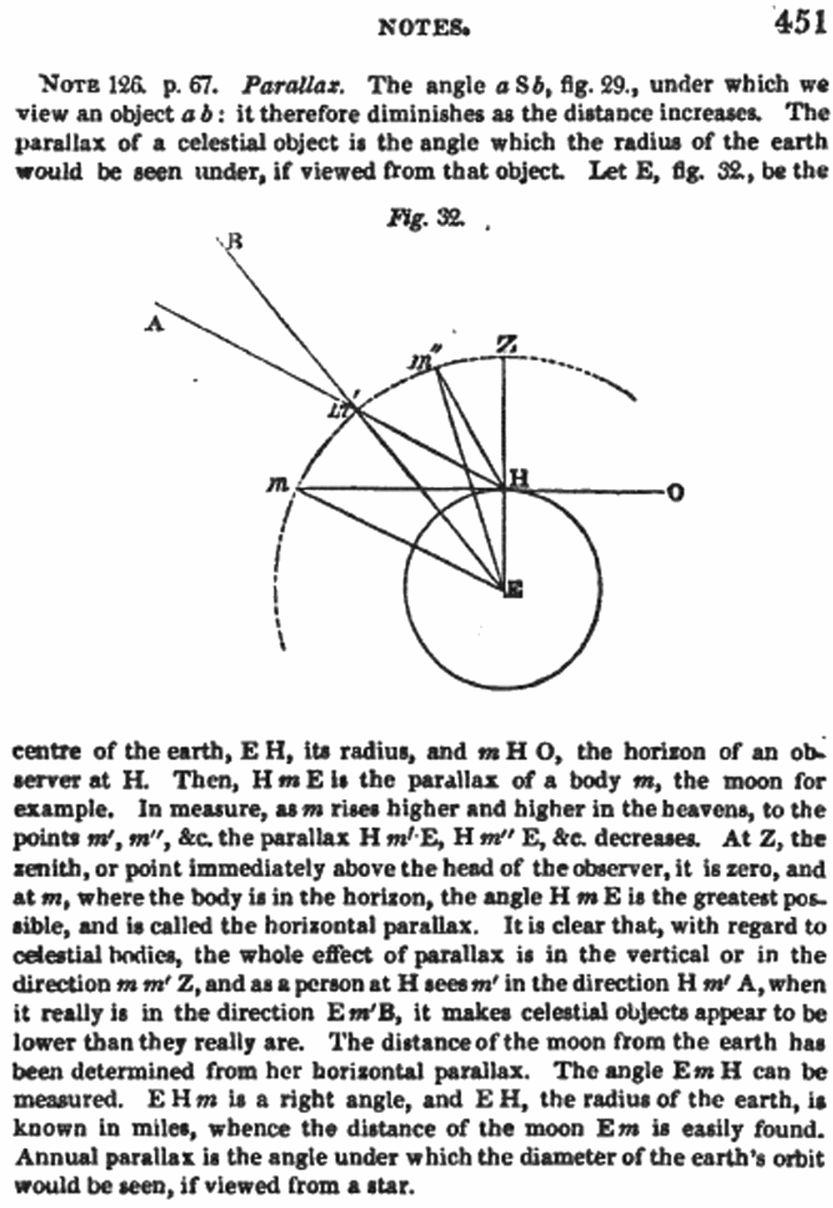
Stated most simply, parallax is a visual effect in which there is an apparent difference in an object's position when viewed along two different lines of sight. Imagine, for example, how the backgrounds might differ if two friends positioned a great distance apart took a photograph of a third companion from their locations. Mary Somerville's definition of parallax in Connexion, though, is far more precise. The following passage opens Connexion’s eighth chapter:
The parallax of a celestial body is the angle under which the radius of the earth would be seen, if viewed from the centre of that body; it affords the means of ascertaining the distances of the sun, moon, and planets. When the moon is in the horizon at the instant of rising or setting, suppose lines to be drawn from her centre to the spectator and to the centre of the earth; these would form a right-angled triangle with the terrestrial radius, which is of a known length; and as the parallax or angle at the moon can be measured, all the angles and one side are given; whence the distance of the moon from the centre of the earth may be computed. (61-62)
Noteworthy about the difference between my rudimentary but more common example and Somerville's is the position of the observer in the two descriptions. My explanation would suggest that an astronomical parallax concerns the relative position of a stellar body according to two independent observers, and to an extent, this is true. But parallax is really the angle drawn from the perspective of the celestial body to the earth, not the angle originating at the position of the earth-bound astronomer. The imagined point of observation lies within or from the stellar object, so that the imagined gaze is directed at the earth, and the angle described is that between one line drawn from the stellar object to the center of the earth and another drawn to an observer on the earth's surface (Figure 10). Such a perspective exemplifies a trope common throughout Connexion, a view from the heavens, as it were, that Kathryn Neeley terms Somerville's “cosmic platform” (8).
Mary Somerville, diagram for the second edition of On the Connexion of the Physical Sciences (London: John Murray, 1835).

Parallax offers the student of astronomy a specific example of Longinus's elevated subject. But so too can it evoke the Burkean sublime and prompt the reader to imagine a terrifying, vertiginous perspective of the universe: an individual poised at the outermost reaches of space. In her chapter on parallax, Somerville writes about an imagined view from the planet Uranus's position, as well as from that of the nearest fixed star (identified in later editions as Alpha Centauri):
SituateFootnote 8 on the verge of the system, the sun must appear to it not much larger than Venus does to us. The earth cannot even be visible as a telescopic object to a body so remote. Yet man, the inhabitant of the earth, soars beyond the vast dimensions of the system to which his planet belongs, and assumes the diameter of its orbit as the base of a triangle whose apex extends to the stars. . .. If a fixed star had a parallax of one second, its distance from the sun would be 20500000000000 of miles. At such a distance not only the terrestrial orbit shrinks to a point, but the whole solar system seen in the focus of the most powerful telescope, might be covered by the thickness of a spider's thread. (65)
In Somerville's prose, abstract geometric calculations elevate the human mind to imagined vistas across the heavens; taken to the remote location of a star, that same mind might contemplate human insignificance, evoked in the image of a thin, seemingly fragile spider's thread. The expansion and contraction apparent within Somerville's imagery – the millions of miles in distance to planets and stars versus the millionth of a meter across a spider's thread (diameter=1µm) – prompt an affective response for a reader: the awe of the Burkean sublime. The passage continues by reminding readers that our perception of distant galaxies and their relative distances from each other might be skewed, not just in terms of our far off view – a spatial displacement – but a temporal one, too:
In the milky way and the other starry nebulae, some of the stars that seem to us to be close to others, may be far behind them in the boundless depth of space; nay, may be rationally supposed to be situate many thousand times farther off; light would therefore require thousands of years to come to the earth from those myriads of suns, of which our own is but “the dim and remote companion.” (66)
“Dim and remote companion” is a line from Act II, scene 2 of Cain, and with that allusion, Somerville betrays a larger conversation in which human beings contemplate their place in the universe. And yet, while she uses Byron as a touchstone for explaining parallax in Connexion itself, her manuscript notebook suggests even more explicitly that there is more to gain via a study of astronomy or microscopy than the kind of despair Cain professes or the terror which Burke suggests always accompanies a contemplation of the infinite (54). In copying out particular lines from Cain, Somerville records in her notebook a vivid poetic example of the fears of the vast or infinite her own book on astronomy and physical would aim to put to rest.
Somerville's Manuscripts
Over a dozen quotations from Byron's Cain, copied in Somerville's hand, occupy three striking, consecutive pages in a small, brown, undated notebook hardly more than four by six inches in size (Somerville Collection Dep c. 352, fol. 5).Footnote 9 Judging from Elizabeth Chambers Patterson's arrangement of cataloguing Somerville's papers in the archive at Oxford's Bodleian Library, this notebook dates most likely to Somerville's composition of The Mechanism of the Heavens and On the Connexion of the Physical Sciences. Kathryn A. Neeley notes the presence of these quotations with just a single tantalizing remark:
In one of the notebooks, the left-hand page contains a summary of a statement from William Herschel, indicating the number of stars that passed across the view through his telescope in an hour. Below this passage is a quotation from Byron concerning human insignificance in the grand scheme of nature. On the opposite page, there are extensive quotations from Byron's Cain (1905), which refer to the ‘beautiful, unnumbered, and endearing’ suns ‘not dazzling, and yet drawing us to them.’ Although the poetry itself does not, the images and sentiment conveyed by the poetry find their way into Somerville's text. Science, poetry, and philosophy are interwoven into a coherent and inspiring account. In note form, the account seems chaotic, even schizophrenic; in finished form, it is enormously rich. (7; emphasis mine)
Neeley's praise of Somerville's finished prose is fitting, highlighting the implications and vibrancy of Somerville's writing when it rises into an elevated poetic register. Yet I suggest an alternate interpretation of the quotations’ significance: one line of Byron's verse does appear in Connexion, and while Somerville uses some of the same cosmic imagery, her sentiment differs markedly from Byron's.
Somerville used loose paper and notebooks to work out equations and calculations, and into her notebooks she also copied passages from work by scientific colleagues like Faraday, Herschel, and Whewell, as well as quotations from many nonscientific acquaintances. In this regard her notebooks often served as scientific commonplace books. She did not uniformly attribute her sources, which makes tracing those sources a challenge. Nor did she consistently date her entries, so I rely here on those moments when she does date a notebook, the content that appears as published text, and Patterson's original cataloguing work.
In the small brown notebook described above, Somerville recorded a variety of notes from well-known scientific figures of her day, including correspondents like Laplace, Sir John Leslie, and William Herschel. Byron is the notable poetic anomaly. The quotes begin immediately below this passage describing Herschel's observation of stars through a telescope pointed out from his window: “Herschel mentioned that 116,000 stars passed through the field of his telescope, which subtended an ∠ of 15°, in a quarter of an hour. If we compute from such a narrow gaze, the whole celestial vault must display within the range of telescopic vision, more than 5 Billion of fixed stars” (Somerville Collection c.352,2).
To follow this data-filled passage with lines of Romantic poetry at first seems an odd juxtaposition, and the pages immediately following these poetic quotations turn again to astronomical topics. The Byron pages are surrounded by quotes from experts in physical science and astronomy.Footnote 10 Yet for Somerville, the connection between astronomical wonder and Byron's dramatic lines wasn't unusual, not least because one of Cain’s settings is the depths of space. The quotations’ placement following Leslie's passage on light and Herschel's observation of the night sky suggest they made Somerville think of Byron's plays, not the reverse. Byron's play becomes one among many of Somerville's sources for her astronomical writing. Given the widespread practice of including poetic lines in books within a variety of genres across the nineteenth century, it is possible Somerville was just keeping a list of potential choices for future use. But later pages in the same notebook indicate Somerville's use of Cain within the prose of Connexion was not simply decorative.
The striking common thread among all of the copied Byron quotations is their expression of humankind's limited ability to observe or comprehend the vast reaches of the universe. By contrast, Connexion opposes Byron's Romantic poetic constructions by showing how scientific analysis – even without recourse to mathematics, the unifying language of science – can begin to bridge the gulf of incomprehensibility within the sublime. Somerville's notes have an internal logic to them less chaotic than Neeley suggests. Somerville incorporates Byron's visual aesthetic, but not his moral one. She does not import Byron's sentiment into her work; to the contrary, she uses it as a framework against which to argue.
Somerville's selected quotations indicate a debate within her own work that was aesthetic as well as scientific. The Cain quotations all evoke the Burkean sublime, a sense of terrible fascination with the immensity of the universe and the individual human's relative insignificance in the presence of such seeming infinity, as well as the calming reassurances of earthly nature's smaller beauties. But Somerville's response does not resemble the terrible awe suggested by Byron or Burke; her response has more in common with Kant's “mathematical sublime”: a delight in human reason and imagination.Footnote 11 Hers is an admiration not only for wonders of the universe, but also for the imaginative leaps the human mind can take to the vast depths of space, its ability to comprehend the motions and gravitational relations between astronomic bodies, to measure them, and to understand how the same laws govern the action of planets as well as the motion of matter on earth. To Somerville's way of thinking, even if human beings fall short of fully comprehending the causes of these natural laws, this is not cause for dismay. In short, Somerville delights in the pleasures of reason, and her lyrical prose aims to kindle that delight in others. Somerville's elevated passages in Connexion stand in marked contrast to Cain's distress in the poetic lines Somerville copies into the notebook.
Byron's Abyss
Cain: A Mystery (1821) retells the Genesis story of Adam and Eve's family after their expulsion from Eden and before Cain's killing of Abel. Selecting Cain as his play's protagonist and anti-hero, Byron portrays Cain's distress about his mortality and his temptation by Lucifer, who takes him on a journey both to a remote space beyond the stars and to Hades, a realm of death where Cain sees creatures that had preceded man on the earth. Lucifer argues that mortality was not a good part of God's plan and that the sum of human knowledge ultimately concludes with understanding how very insignificant man is in relation to the universe. Returning to his family, Cain tries to tear down the altar where the family made sacrifices to God. When Abel stands between Cain and the altar, the latter strikes him down. In contrast to the Old Testament's description, Byron's telling suggests the first fratricide was motivated not by Cain's jealousy but rather by his despair and rage.
Byron's play follows Milton's example in Paradise Lost of rewriting Biblical tales of an antediluvian “fall.” Importantly, though, Byron chooses to depict his fratricidal Cain's lack of spiritual faith or religious conviction within the context of early nineteenth-century natural history. Lucifer provides a history of the earth in Act II that follows Georges Cuvier's catastrophic theory of geology propounded in the “Preliminary Discourse” to his Researches on Quadruped Fossil Bones (1812).Footnote 12 Byron provides in his Preface a short note for the scientific theories with which the play engages, alluding to
the notion of Cuvier, that the world had been destroyed several times before the creation of man. This speculation, derived from the different strata and the bones of enormous and unknown animals found in them, is not contrary to the Mosaic account, but rather confirms it; as no human bones have yet been discovered in those strata, although those of many known animals are found near the remains of the unknown. (337-38)
Cuvier's theory suggested that the earth went through catastrophic periods that extinguished all planetary life, offering an explanation for gaps in the fossil record. Geology was one of the most active fields of natural philosophy in Britain in the first decades of the nineteenth century. Byron admits, though, that he takes some poetic license within the explanations Lucifer offers Cain. The discovery of fossils of extinct animals in the geological record prompted Cuvier to propose his theory, and in the play, part of Cain's crisis comes from seeing “pre-Adamites,” rational creatures who had previously inhabited the earth, in Hades.
All of the passages Somerville copies into her notebook from Byron's writings contemplate the heavens. She copies, for instance, a line from the final speech of the eponymous protagonist of Marino Fallero, Doge of Venice: An Historical Tragedy in Five Acts: “And thou who kindlest and quenchest Suns.” The Cain lines all come from Act II, when Lucifer takes Cain to the farthest reaches of the universe: from “the Abyss of Space” to Hades itself, here not an underworld but a seeming realm beyond the stars, a place no sunlight reaches. Their placement in the notebook is significant: the copied passages track Somerville's sources for her own explanations of astronomical physics. Together they suggest that Byron's plays served as analogies that could help Somerville translate astronomy – parallax, in particular – for her own readers. Yet Somerville prompts her readers not to bemoan mortal limitations; instead, she suggests comprehension of universal laws is a facet of human reason worth celebrating.
The quotations Somerville copies into her notebook point to human limitations in contrast to an immortal omniscience, perfection, and immortality. The lengthiest quotation Somerville selects derives from one of Cain's dialogues with Lucifer in “The Abyss of Space”:
Cain's adjectives contrast human finite abilities with divine, infinite phenomena: “unimaginable ether,” “interminable air,” “unbounded revelry,” and “endless expansion.” All these concepts pain his thoughts, making him feel “intoxicated with eternity.” His tone in this apostrophe to the fluid ether, which he compares to terrestrial “limpid streams,” is somber, and both his pentameter and diction echo the opening lines of Keats's “Ode to a Nightingale,” particularly Cain's aching, intoxicated soul (though Byron's blank verse and regular enjambments suggest less structure, less solace than Keats's rhymed and largely end-stopped lines). Mortal man, both poets suggest, cannot contemplate the infinite without paining their senses.
This passage from Cain points to a larger intertextual conversation taking place both in Somerville's commonplace book and in her printed volumes. Works like Connexion engage with thinking beyond the scientists Somerville names, and her scientific thought comes into sharper focus as it engages with literary – here poetic – texts. This larger framework becomes especially clear in a striking passage, likely composed by Somerville herself, pages later in the same notebook where the Cain quotations appear:
Pleasure in scientific pursuits astronomy does not merely consist in the beauty of the phenomena but in the order and design of the system, the harmony of its parts, the skill and efficiency of its contrivances, and in the means by which man has ascertained truths and arrived at results which seemed for ever placed beyond his grasp. From the efforts of produced
Some of the phenomena
The means by which (Somerville Collection Dep c. 352, fol. 5)Footnote 13
Both the strikethroughs and the replacement of “scientific pursuits” with “astronomy” suggest that this is not simply a transcription error from a secondary source. (Somerville does not often make sustained copying errors.) Were it a translation, it is unusual for Somerville to leave the thought incomplete. The phrases themselves suggest multiple efforts at drafting an original sentence to follow the first sentence's line of thought. In emphasizing the “pleasure” one might derive from analysis – “the means by which man has ascertained truths and arrived at results which seemed forever placed beyond his grasp” – these lines seem in conversation with Byron about apprehending the sublime. But Somerville acknowledges what Byron, in Cain's voice, leaves unsaid: apart from apprehension at the universe's vast size, there is also a feeling of aesthetic pleasure – of appreciation – at the “harmony of its parts” and a satisfaction at having discerned “truths” and “results” via geometric and mathematical analysis. The pleasure of astronomy is not merely one of appreciating beauty; it is also the enjoyment of comprehending invisible, calculable laws and of using one's power of reason to do so.
Interestingly, too, the lines of text Somerville has struck out are immediately followed on the page by a passage from an anonymously authored text, The Friend, or, Advocate of Truth, which was published in Philadelphia in 1830. Rather than completing her thought, Somerville instead copies another writer's statement on the same topic:
He is led to the conception of a power and completeness of a power and Intelligence adequate to the production and maintenance of that he sees in nature, – a power & Intelligence to [omitted: which] he not only sees no actual limit to the instances in which they are manifested, but finds on the contrary that the farther he enquires and the wider his sphere of observation extends, they continually open upon him in increasing abundance; and that as the study of one prepares him to understand and apprehend another refinement follows on refinement, wonder on wonder, till his faculties become bewildered in admiration, and his intellect falls back on itself in utter hopelessness of arriving at an end. (Somerville Collection Dep c. 352, fol. 5)
Here, much like Cain's “intoxicated with eternity” speech, the theme is the bewilderment of the human mind as it tries to trace the workings of a “superior” intelligence. In fact, Somerville misses or omits a segment of text found in the printed volume: after “Intelligence” the original phrase next reads, “superior to his own.” In this passage, the writer suggests that human minds are destined to be thwarted by the fact that questions only bring about more questions: “the farther he enquires and the wider his sphere of observation extends, they continually open upon him in increasing abundance.” Faced with “wonder on wonder,” the student or observer fails “in utter hopelessness” of reaching an ultimate answer.
Somerville's notebook suggests she believes the opposite to be true. Rather than picking up on the thread of “hopelessness” from the preceding quotation, her next entry is an unattributed passage focusing on the delights of scientific study, even if knowledge is finite:
One of the pleasures is to investigate the causes from their observed effects to determine the connection between these causes and thus to arrive at general laws, but in seeking the origin of these laws he is led to a boundary which he cannot pass and is compelled to confess that the sum of human knowledge is to know mortal nature's nothingness and to acknowledge the goodness of refer the glory to Him who has granted such powers to man as clearly to perceive truths which must have been clearly known to the divine Intelligence from all eternity. (Somerville Collection Dep c. 352, fol. 5; emphasis mine)
Once again, the lines contain strikethroughs that are not simply corrections but revisions, suggesting they are Somerville's own prose. The fourth line of this passage echoes Lucifer's lines copied earlier in the notebook: “And this should be the human sum/ Of knowledge, to know mortal nature's nothingness” (408). But Somerville does not let Byron's Lucifer have the last word. If this passage about the pleasures of investigation is Somerville's, her lines counter the notion that knowledge only consists of “mortal nature's nothingness”; rather, the pleasure she highlights is that of investigating causes by observing their effects – an empirical epistemology – and determining “connections” that lead to “general laws.” Somerville halts at the idea of trying to decipher or pursue “the origin of these laws,” affirming instead a religious faith and celebrating the gift of human reason.
Somerville's Sublime
Connexion itself concludes with a recap of her volume's contents in the book's penultimate paragraph: from terrestrial dynamics to their corresponding action in celestial bodies, from gravitational attraction to fluid dynamics to barometric pressure, from sound and light to chemical action and heat, electricity and magnetism. At the close of the paragraph, she writes, “Innumerable instances might be given in illustration of the immediate connexion of the physical sciences, most of which are united still more closely by the common bond of analysis, which is daily extending its empire, and will ultimately embrace almost every subject in nature in its formulae” (413). Somerville's optimism is clear: analysis (a combination of physical science and mathematics) should rule the day. The connotations of Somerville's statement on quantitative reason's ubiquity should be weighed alongside the paragraph to follow, which closes the book as a whole and revisits Somerville's sense that the practice of science and analysis was less about dominating nature and more about a closer existence with the divine: a far more personal ambition. Somerville concludes,
These formulae, emblematic of Omniscience, condense into a few symbols the immutable laws of the universe. This mighty instrument of human power itself originates in the primitive constitution of the human mind, and rests upon a few fundamental axioms, which have eternally existed in Him who implanted them in the breast of man when He created him after His own image. (413–14)
Somerville's concluding portrait of science is intimate: analytical reasoning exists in the human heart or mind because it was placed there by a divine creator. There is a harmony in her understanding of reason and scientific inquiry because it does not pit science against religion. Again, Somerville's stance toward science is a rejection of Cain's worries in Byron's drama: her conclusion refutes the idea that “this should be the human sum/ Of knowledge, to know mortal nature's nothingness.” Connexion asserts the opposite: understanding an order and a divinity in the universe leads one to discover a divinity within.
In Byron's play, Cain's soul “aches” when he contemplates an infinite universe, especially in contrast to his own limitations and his family's exile from Paradise. Somerville's Connexion seeks to replace that ache with the intellectual pleasures of physical science, turning both ontological and epistemological crises into intellectual delight. Yet her volume pained the senses of the book's readers, the very women who were the addressed audience of Connexion. About the “Preliminary Dissertation,” Somerville's friend, the Irish writer Maria Edgeworth, wrote to Somerville at the end of May, 1832:
For my part, I was long in the state of the boa constrictor after a full meal – and am but just recovering the powers of motion. My mind was so distended by the magnitude, the immensity, of what you put into it! I am afraid that if you had been aware how ignorant I was you would not have sent me this dissertation, because you would have felt that you were throwing away much that I could not understand, and that could be better bestowed on scientific friends capable of judging of what they admire. I can only assure you that you have enlarged my conception of the sublimity of the universe, beyond any ideas I had ever before been enabled to form. (McMillan 163)
Edgeworth's intellectual indigestion – emphasized in her own use of the discourse of the sublime – resonates with other apparent physiological effects readers might anticipate. Almost a decade later, on June 23, 1840, young Mary Ann Evans wrote to her friend Maria Lewis, “I am ashamed to send you so many ill-clothed nothings. My excuse shall be a state of head that calls for four leeches before I can attack Mrs. Somerville's Connection of the Physical Sciences” (Eliot and Haight I: 56). Even to the intelligent Evans – not yet the novelist George Eliot – Connexion's small size belied the quantity and complexity of knowledge it contained. Surely Evans was not the only reader to approach the volume with some trepidation or an application of leeches to treat a headache before opening its pages: precise details of planetary rotation and precession, conic sections and parallaxes, barometric pressure and wave refraction likely tax even the most able of nonspecialist readers.
Connexion, then, was not an easy book for a reader with some scientific background, let alone a novice, to comprehend, despite its stated object in Somerville's dedication. The British Magazine remarked, “Probably our own language does not afford another summary at once so brief, so able, and so accurate, of the leading doctrines now prevalent in the various departments of physical science. It must require unwearied industry to pursue, and a very powerful intellect to grasp and master, so many difficult and abstruse subjects” (“Connection” 469). The Edinburgh Review praised its “condensed and perspicuous view of the general principles and leading facts of physical science,” but voiced “some doubt whether it is sufficiently popular to initiate our fair countrywomen into knowledge of the laws of the material universe” (“Art. VIII” 155–56). That doubt was something Somerville would have hoped to avoid. In 1837 MP Charles Buller would argue in front of Parliament that Somerville's £300 per annum pension was a “waste of money” because he rejected the very idea her works had “enlarged the bounds of science” (qtd. in Brock 255–56). Buller's assertion speaks to a wider assumption about nineteenth-century women's writing and their intended audiences. In Somerville's case, Buller presumes her work should have been simpler in tone and style, and his criticism implies that Somerville continued to speak within the community of practicing men of science, rather than exclusively for readers outside those circles. Somerville found herself up against competing notions of what her book – as a so-called popular text – “should” do, according to reviewers and Parliamentarians, and what she herself aimed to accomplish.
Like many of her scientific successors, Somerville celebrates not only the spiritual quest but also the aesthetic appeal of the universe's majesty and the simplicity of laws that bind its functions together. Connections among the various sciences reveal an order and elegance within natural law. It is no wonder Somerville's diction and syntax evoke a sublime that initially seems similar to Byron's. The discourse of the sublime – from Longinus to Kant and Burke – readily lends itself to Somerville's work because of the universe's size and the vast distances at play when calculating distant stars’ positions. Further, the aesthetic of simple laws undergirding the immense and the minute has an appeal of its own. Yet Somerville's sublime always culminates in analysis and its utility in discerning these basic principles, illuminating a majestic world. In Connexion, Somerville subtly distills the sublime notions of Longinus, Kant, and Burke within the crucible of nineteenth-century physical science. Her sublime – a sublime evident to her careful readers – is one that underlies much of Victorian physics and mathematics.
Even though Thomas Hardy would go on to dispute this consolatory view of human significance in the scheme of a vast universe, the importance of Somerville's Connexion in framing his response in Two on a Tower is clear. Just as Somerville juxtaposed her argument against the ethos of Byron's poetry, Hardy framed his against Somerville's prose. Just above the dialogue between Swithin and Lady Constantine quoted at the outset of this essay, Hardy's preceding paragraph uncannily echoes Somerville's passage on the imagined view from Uranus and then Alpha Centauri in her parallax chapter. Hardy writes:
Then, by means of the instrument at hand, they traveled together from the earth to Uranus, and the mysterious outskirts of the solar system; from the solar system to a star in the Swan, the nearest fixed star in the northern sky; from the star in the Swan to remoter stars; thence to the remotest visible; till the ghastly chasm which they had bridged by a fragile line of sight was realized by Lady Constantine. (28; ch. 4)
Somerville's solar system in the width of a spider's thread here becomes a “ghastly chasm . . . bridged by a fragile line of sight.” Somerville presents this sort of mental travel as “soaring,” an ascension to heights, but Hardy's characters instead feel a plummeting annihilation, just as Byron's Cain laments, “Alas! I seem / Nothing” (408). Examined by themselves, Byron's Cain and Hardy's Two on a Tower would seem to offer the same fatalistic view of the universe in the dawning and waning decades of the nineteenth century. But between them, both linking and resisting their pessimism, lay Mary Somerville's Connexion.