INTRODUCTION
Most natural forests in tropical areas have been transformed into other land uses (FAO 2003, Sánchez-Azofeifa et al. Reference SÁNCHEZ-AZOFEIFA, HARRIS and SKOLE2001, Schelhas & Greenberg Reference SCHELHAS and GREENBERG1996). The loss of forest causes the reduction, fragmentation or even local extinction of plant populations (Fahrig Reference FAHRIG2003) and creates a fragmented landscape of varying land uses, from forest remnants to pastoral and agricultural lands. In fragmented landscapes, dispersal capabilities of plants may influence their colonization success (Malanson & Armstrong Reference MALANSON and ARMSTRONG1996) and the genetic connectivity among forest remnants (Bacles et al. Reference BACLES, LOWE and ENNOS2006).
A large proportion of the high plant diversity of neotropical areas is taken up by vascular epiphytes (Gentry & Dodson Reference GENTRY and DODSON1987), but their ecology in human-modified landscapes has received less research attention than their ground-rooted counterparts (but see Hietz Reference HIETZ2005, Solis-Montero et al. Reference SOLIS-MONTERO, FLORES-PALACIOS and CRUZ-ANGÓN2005, Wolf Reference WOLF2005). Given the inherent dependency of epiphytes on their host trees, the transformation of natural forests is expected to have a direct impact on this life form. There is evidence that in human-altered habitats, the structure and diversity of epiphyte communities differ from undisturbed forests (Barthlott et al. Reference BARTHLOTT, SCHMIT-NEUERBURG, NIEDER and ENGWALD2001, Cascante-Marín et al. Reference CASCANTE-MARÍN, WOLF, OOSTERMEIJER, DE NIJS, SANAHUJA and DURÁN-APUY2006a, Dunn Reference DUNN2000, Flores-Palacios & García-Franco Reference FLORES-PALACIOS and GARCÍA-FRANCO2004, Reference FLORES-PALACIOS and GARCÍA-FRANCO2008; Krömer & Gradstein Reference KRÖMER and GRADSTEIN2003, Wolf Reference WOLF2005).
Changes in epiphytic plant communities between human-altered and non-altered forest habitats are commonly attributed to microclimatic conditions and factors related to seed dispersal. Light and moisture are important for epiphyte establishment (Benzing Reference BENZING1990, Castro-Hernández et al. Reference CASTRO-HERNÁNDEZ, WOLF, GARCÍA-FRANCO and GONZÁLEZ-ESPINOSA1999, Pittendrigh Reference PITTENDRIGH1948) and at forest edges and isolated trees in pastures; plants are likely to experience conditions of higher light availability, desiccation, air temperature and exposure to winds compared with undisturbed forest interiors (Lovejoy et al. Reference LOVEJOY, BIERREGAARD, RYLANDS, MALCOLM, QUINTELA, HARPER, BROWN, POWELL, POWELL, SCHUBART, HAYS and Soulé1986, Murcia Reference MURCIA1995, Saunders et al. Reference SAUNDERS, HOBBS and MARGULES1991). Consequently, microclimatic changes in the canopy might explain why epiphyte communities in fragmented landscapes comprise more drought-tolerant species (Flores-Palacios & García-Franco Reference FLORES-PALACIOS and GARCÍA-FRANCO2004, Reference FLORES-PALACIOS and GARCÍA-FRANCO2008; Wolf Reference WOLF2005).
Seed dispersal, on the other hand, may also play an important role in the composition of plant communities (sensu Hubbell Reference HUBBELL2001, Hurtt & Pacala Reference HURTT and PACALA1995, Turnbull et al. Reference TURNBULL, CRAWLEY and REES2000). As to epiphytes, several correlative studies have proposed that dispersal-limitation rather than species adaptations to microclimatic conditions explain community structure (van Dunné Reference VAN DUNNÉ2001, Wolf Reference WOLF1994, Yeaton & Gladstone Reference YEATON and GLADSTONE1982). In human-altered habitats, dispersal presumably explains the decrease in epiphyte richness on isolated pasture trees with increasing distance from the forest edge (Hietz-Seifert et al. Reference HIETZ-SEIFERT, HIETZ and GUEVARA1996). However, the degree to which dispersal versus niche specialization controls local community structure and relative species abundance is likely to represent a continuum (Hubbell Reference HUBBELL2001).
In this paper, we evaluated experimentally the role of dispersal in driving epiphyte community structure (i.e. the dispersal assembly perspective, sensu Hubbell Reference HUBBELL2001) in a fragmented landscape. We examined epiphytic bromeliad establishment in forests, forest edges and on pasture trees in a tropical montane area in Costa Rica. Different habitats were chosen to obtain a long gradient in microclimatic conditions (forest interior – pasture trees). Pasture trees, either remnants from the original forest or planted shade trees, represent an extreme case of forest reduction and are common elements in agricultural landscapes in the Neotropics (Guevara et al. Reference GUEVARA, MEAVE, MORENO-CASASOLA and LABORDE1992, Harvey & Haber Reference HARVEY and HABER1999). Moreover, our previous studies indicated that bromeliad densities that are presumably related to seed output differed greatly on this gradient of anthropogenic disturbance. In forest interiors, all bromeliad species occurred at lower densities (Cascante-Marín et al. Reference CASCANTE-MARÍN, WOLF, OOSTERMEIJER, DE NIJS, SANAHUJA and DURÁN-APUY2006a). First, we set a seed-trapping experiment to compare the influx of wind-borne seeds in each of the three forest habitats. Next, we examined the survival probability and growth of transplanted seedlings of selected species into the studied habitats. Seedling survival and growth were related to measured canopy microclimatic conditions in each habitat.
In particular, our paper addresses the following dispersal-assembly derived hypothesis: local species density in forest interiors, forest edges and pasture trees is correlated with seed influx and not with seedling survival and growth.
METHODS
Research area and experimental design
The San Luis River Valley is located on the Pacific slope of the Monteverde region in the Tilarán mountain range, Costa Rica (10° 17′N, 84° 48′W). The area extends from 950 to 1200 m asl and is classified as humid premontane forest according to Holdridge's life-zone system (Haber Reference HABER, Nadkarni and Wheelwright2000). The rainy season occurs from May to November and comprises 80% of the annual precipitation (mean: 3300 mm); temperature ranges from 17–25 °C (data from the Ecolodge San Luis and Research Station, 1050 m). Clearing of the natural forest for dairy activities in the Monteverde area dates back to 1950 and in the last three decades there has been an increase in coffee plantations (Griffith et al. Reference GRIFFITH, PECK, STUCKEY, Nadkarni and Wheelwright2000), which has created a fragmented landscape on the mountain slopes formed by forest patches intermingled with pastures, where isolated trees are common (Harvey & Haber Reference HARVEY and HABER1999). The epiphytic bromeliad community is composed of twelve species of Catopsis (2), Guzmania (2), Racinaea (1), Tillandsia (5) and Werauhia (2) (Cascante-Marín et al. Reference CASCANTE-MARÍN, WOLF, OOSTERMEIJER, DE NIJS, SANAHUJA and DURÁN-APUY2006a).
We studied three different habitat types, all situated within an area of c. 1 km2: (1) forest interiors that were part of mature forest or slightly disturbed forest remnants (> 10 ha), (2) forest edges adjacent to pastures or roads, and (3) pasture trees, either remnant trees from the original forest or planted trees. We selected three forest-interior sites in each of three forests (two near the Ecolodge, 960–1050 m; and one at the Conservationist League's Reserve, 1100–1150 m). Within each site, we defined two sampling areas that did not include natural gaps and were separated by at least 200 m. At each site, we arbitrarily selected five canopy trees, separated at least by 10 m and up to 100 m from one another. Forest edges (six sites) were separated > 200 m and up to c. 1.0 km and were part of forests with similar structure and physiognomy. At each edge, five canopy trees growing no more than 5 m into the forest were arbitrarily selected over the full length of the edge. The distance between trees within an edge varied between 7.5 and 100 m. Because of landscape heterogeneity, the edges differed in their orientation and exposure to wind currents. The pasture trees (12) were dispersed over six pasture areas surrounding the studied forest interiors. We used rope-climbing techniques to access the tree-crowns (Mitchell et al. Reference MITCHELL, SECOY and JACKSON2002).
Seed-dispersal experiment
We employed seed traps to investigate the influx of wind-borne bromeliad seeds into the forest canopy of the studied habitats. The traps consisted of a 0.60 × 0.60-m (0.36 m2) frame constructed from PVC tubes (1.2 cm in diameter), covered by a piece of synthetic car-carpeting material, dark grey and 3 mm thick (ARIB 1004), that was affixed to the frame with polyethylene strings. The carpet material proved to have a suitable degree of seed adhesion and retention in earlier experiments. We utilized 72 traps and placed a single trap per host tree: 30 in forest interiors, 30 in forest edges and 12 in pasture trees. The traps were tied to main branches or trunks in the lower and middle part of the crown of canopy trees and in a vertical position facing the predominant wind direction to increase the probability of catching seeds; at forest edges the traps were located facing the border. We avoided (1) the presence of nearby leaves or big branches directly in front of the trap that might represent an obstacle to seeds, and (2) the presence of a fruiting bromeliad directly in front of, or close to the trap. For all traps, we recorded the number of fruiting bromeliads in their vicinity (max. 10 m in all directions). In order to minimize seed loss due to predation, detachment by wind or washing away by sporadic rains, we monitored the traps and collected the caught seeds every 2 wk during March and April 2003. The later period represents the dispersal peak of wind-dispersed bromeliads (Cascante-Marín et al. Reference CASCANTE-MARÍN, OOSTERMEIJER, WOLF and DEN NIJS2005, Reference CASCANTE-MARÍN, DE JONG, BORG, OOSTERMEIJER, WOLF and DE NIJS2006b; pers. obs.) and coincides with the driest period in the study site (mean precipitation: March 63 mm and April 67 mm; data from the Ecolodge San Luis and Research Station). With the help of a reference collection, we identified the seeds to generic level on the basis of coma shape and length, and size, colour and shape of the seed. Species could not be identified with certainty.
Seedling survival and growth
The effect of the fragmented habitat on seedling survival and growth was tested with a transplantation experiment that lasted 1 y, from the mid-dry season of 2003 (March) to the next dry season (March 2004). We selected the three dominant species for this experiment (in decreasing order): Guzmania monostachia (L.) Rusby ex Mez, Catopsis nutans (Sw.) Griseb. and Tillandsia fasciculata Sw. (Cascante-Marín et al. Reference CASCANTE-MARÍN, WOLF, OOSTERMEIJER, DE NIJS, SANAHUJA and DURÁN-APUY2006a). These bromeliads have a wide range of geographic distribution, from southern Florida to northern South America and some Caribbean islands (Smith & Downs Reference SMITH and DOWNS1977). Tillandsia fasciculata is a CAM species with thick leaves covered by a dense trichome layer, G. monostachia is a facultative C3-CAM species, and C. nutans is a C3 species possessing thinner leaves and a moderate trichome layer (Benzing & Renfrow Reference BENZING and RENFROW1971, Martin Reference MARTIN1994, Medina Reference MEDINA1974).
A sample of established seedlings of each species (hereafter referred by their generic name) was collected from secondary vegetation patches, trees in living fences and pasture trees within the study site. The low abundance of seedlings inside the forest canopy precluded an appropriate sampling from that habitat. A previous study on seed germination and early establishment provided the expertise for confident identification of species in the field (Cascante-Marín et al. Reference CASCANTE-MARÍN, WOLF, OOSTERMEIJER and DEN NIJS2008). Seedlings were kept in Petri dishes on wet tissue paper (average of 10 d) before being placed in the field. During that period, a small fraction (2–5%) of the collected plants died. Twenty seedlings per species were affixed using a small droplet of non-toxic White Craft® glue to pieces (19 × 19 cm) of synthetic carpet-type material identical to the one used for the seed traps. Seedlings were distributed over eight rows and separated by 1 cm, with their positions systematically alternated among species to avoid position-related effects; the edge rows were at least 2 cm from the carpet's margin. The combination of row and column number was used to identify each plant for further monitoring.
In total, 3660 seedlings (1220 per species) were distributed among 61 pieces of carpet: 24 in forest interior (four carpets per site), 25 in forest edges and 12 among pasture trees. We placed one carpet per tree and utilized the same trees selected for the above-mentioned seed dispersal experiment. The carpets were firmly attached in a vertical position, using polyethylene strings and following the bark surface's contour, to main branches and the trunk inside the tree-crown. Those areas of the phorophyte are equivalent to zone III (mostly) and zone IV of the classification system of Johansson (Reference JOHANSSON1975). In our study site, epiphytic bromeliads tend to establish more frequently in those zones of the host trees (Cascante-Marín et al. Reference CASCANTE-MARÍN, WOLF, OOSTERMEIJER, DE NIJS, SANAHUJA and DURÁN-APUY2006a).
The number of surviving seedlings was monitored once a month and at every census, we recorded seedlings as (1) living (all the leaves green), (2) drying (some leaves dried out but the inner leaves of the rosette still green), (3) dead (all the leaves dried and shrivelled) and (4) missing (disappeared in between censuses). Seedling size (length of the longest leaf from the rosette base to the leaf tip) and number of leaves were measured in a subsample (N = 720 per species). Mean seedling sizes were Guzmania: 10.4 ± 0.1 (SE) mm, Catopsis: 8.9 ± 0.1 mm and Tillandsia: 8.9 ± 0.1 mm. At the end of the experimental period, we determined the vegetative growth of surviving seedlings from which the initial size was recorded and the number of developed leaves.
Microclimatic differences among forest types
We measured the microclimatic variables of air temperature and relative humidity in the canopy of the forest habitats using data loggers (StowAway® series; Onset Computer Company, MA, USA). A plastic non-transparent casing was designed to protect the devices from direct exposure to sunlight and rainfall, with the bottom open to allow wind entrance. The data loggers were affixed in pairs (temperature and relative humidity) next to the pieces of carpet that carried the seedling transplants; nine pairs of data loggers in forest interiors, nine in forest edges and six in pasture trees. Data were obtained during four non-consecutive census rounds of 4 d each at the end of the dry season (23 March–25 April) and during two more rounds at the beginning of the rainy season of 2004 (16–27 May). The devices were programmed to start at the same time at each round, recording measurements at 10-min intervals. Between census rounds, we rotated the loggers among trees within the same forest habitat to include a higher variation and to negate any bias in the equipment's readings. Climatic conditions during the onset of the rainy season seemed to affect several loggers, which measured anomalous values of temperature or relative humidity. When detected, unreliable data loggers were discarded and by the last round 12 temperature and nine relative humidity loggers remained.
Statistical data analysis
Analysis of seed dispersal was based on the total number of seeds caught per trap. Since our data are counts and are highly skewed (i.e. many traps received relatively few seeds), it is most appropriate to use a generalized linear model that follows a Poisson distribution and a log-likelihood function (McCullagh & Nelder Reference McCULLAGH and NELDER1989). To account for the variability among groups and over-dispersion in the dataset, we used a generalization of the Poisson model, the negative binomial model that includes a disturbance term. Our model for the probability of seed dispersal included forest habitat and genus as main factors; the number of fruiting plants near each trap was included as an offset variable (McCullagh & Nelder Reference McCULLAGH and NELDER1989), given the positive relationship between the latter variable and the number of seeds per trap (Spearman rank correlation test: rs = 0.21, t (285, 0.05) = 8.64, P < 0.0001). The variable number of fruiting plants was log10-transformed after adding 0.5 to the original value. In order to reduce over-dispersion, the covariance matrix was multiplied by a scaling factor, i.e. Pearson's chi-square value divided by the degrees of freedom (Stokes et al. Reference STOKES, DAVIS and KOCH2000). A preliminary inspection of the data indicated that forest interiors and the genus Werauhia both had the lowest number of seeds; hence they were selected in the model as reference values for habitat type and genus, respectively. The model parameters were estimated by means of maximum likelihood methods (proc genmod, SAS 8.02). We further tested for differences in the abundance of fruiting plants among forest habitats and genera with a Type III Analysis of Variance (GLM module, STATISTICA 5.1); the data were transformed using log10 (x + 0.5) to increase normality and reduce heteroscedasticity.
Seedling survival was tested by means of two complementary methods. Firstly, survival over time was described by using the Kaplan–Meier product-limit function, S(t) (Klein & Moeschberger Reference KLEIN and MOESCHBERGER1997). The function S(t) measures the survival probability at time t and is calculated as follows:  , where dj is the number of individuals that failed in time t and nj is the number of individuals that entered in that time. The date of planting represents time = 0. Our survival data are right-censored because several seedlings were alive at the end of the experiment and interval-censored as survival time is known only to occur between the monitoring intervals. Since the Kaplan–Meier product-limit function cannot calculate interval-censored data, we used the end-point of each interval. Then, for each genus, we compared the survival curves among forest habitats with the Log-rank test, a non-parametric method that follows a chi-square distribution, with n-1 degrees of freedom, where n = number of curves being compared (Survival Analysis module, STATISTICA 5.1). Secondly, we examined the survival probability at the end of the experimental period by using logistic regression methods with a log-likelihood function (McCullagh & Nelder Reference McCULLAGH and NELDER1989). The logistic model included the variables habitat and genus as main factors. A preliminary inspection of the data indicated that forest interior and the genus Tillandsia had the highest number of surviving seedlings; thus they were selected as reference values in the model for habitat and genus, respectively (proc genmod, SAS 8.02). The statistical significance of the model parameter estimates was evaluated with a Wald's chi-square test. We used the Hosmer and Lemeshow's Goodness-of-Fit Test to assess the fit of the logistic model to the data. We estimated the ‘odds ratios’ between the model's reference category and the respective categories of the significant parameters and the 95% CI. When the odds ratio CI includes the value 1, it indicates that a category may add information to the overall logistic model but does not make a strong contribution to distinguish between categories.
To examine the effect of the fragmented habitat on seedling growth, we calculated the proportional size increment or relative growth of each plant at the end of the experimental period as: (final size – initial size) / initial size. Differences in relative growth were evaluated with an analysis of covariance with habitat and genera as main effects, initial seedling size as covariate and the interaction term between main effects (GLM module, STATISTICA 5.1). We used the initial size as covariate because it was inversely correlated to relative growth (Pearson's correlation test: r2 = 0.18, t(496, 0.05) = –10.6, P < 0.001). Comparisons between species within and among forest habitats were carried out with Contrast Analyses. The analysis of differences in the number of leaves per plant followed the statistical design previously described for plant size. The final number of leaves per plant was independent of the initial number, but was positively correlated to relative growth (Pearson's correlation test: r 2 = 0.16, t(496, 0.05) = 9.85, P < 0.001); thus we included the latter as a covariate in the analysis.
Microclimatic differences among the studied forest habitats were analysed by using a Factorial Analysis of Variance with forest habitat and season (end of the dry season vs. beginning of the rainy season) as fixed factors. We used contrast analyses to compare forest habitats at each season. The response variable was the mean daily fluctuation, that is, the difference between the average maximum and minimum daily values of temperature and relative humidity. Each data logger was considered as a replicate.
RESULTS
Seed dispersal
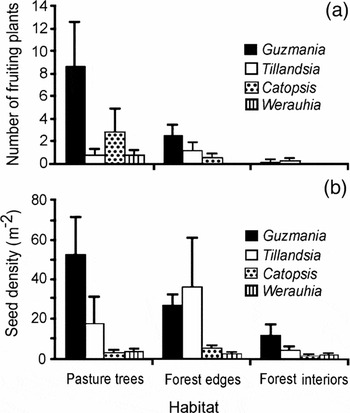
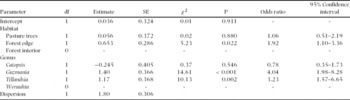
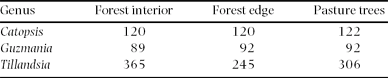
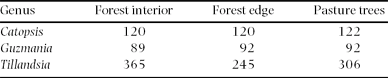
The availability of seed sources (i.e. fruiting plants) differed among the studied forest habitats. Forest interiors had the lowest number of fruiting plants, which increased at forest edges and was highest in pasture trees (F2, 276 = 18.5, P < 0.001). The most abundant genus was Guzmania, followed by Catopsis and Tillandsia (F3, 276 = 9.50, P < 0.001; Figure 1a). Inside the forest, we did not find fruiting individuals of Catopsis or Werauhia around the traps. During the 2-mo trapping period, the 72 seed traps caught 1285 seeds. Seed influx (i.e. the number of trapped seeds) into each forest habitat followed a pattern similar to that of fruiting plant abundance (Figure 1b). The negative binomial model, which controlled for the abundance of fruiting plants, showed that at forest edges the likelihood of capturing air-borne bromeliad seeds was significantly higher (Table 1). The odds ratio indicated that traps in that habitat had 1.9 times higher probabilities of receiving seeds than those in pasture trees and forest interiors, both of which had similar capture probabilities. The most common seeds on traps were those of Guzmania and Tillandsia (Table 1), which were four and three times more likely to attach to the traps than seeds of Catopsis and Werauhia, respectively (Table 1, Figure 1b). Ninety-three per cent of the traps received at least one seed, but the number of seeds per trap ranged from a single seed up to 299 seeds (mean = 18, SD = 39, CV = 217%). In general, the number of seeds of any given genus found on a single trap was low, in most cases it ranged from one to five (data not shown).
Seed dispersal variables of four epiphytic bromeliad genera in three montane forest habitats in a fragmented landscape in Costa Rica. Mean number of fruiting plants in the vicinity of the seed traps (10 m in all directions) (a) and mean density of trapped seeds (b). Data collected from March to April 2003. Vertical lines represent 1 SE.

Parameter estimates for the negative binomial model of seed dispersal of wind-borne epiphytic bromeliads into three montane forest habitats in a fragmented landscape, Costa Rica. The model includes the number of fruiting plants around traps as an offset variable. The covariance matrix was multiplied by a factor of Pearson's Chi-Square/df to reduce over-dispersion.

Seedling survival and growth
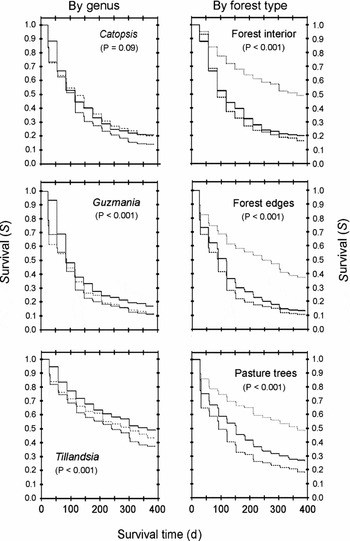
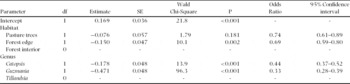
The forest interior habitat showed the highest survival probability for seedlings of Guzmania and Tillandsia along the experimental period, while Catopsis seedlings showed no differences among habitats (Figure 2). After 1-y, the logistic regression model indicated a higher survival probability of seedlings transplanted into forest interiors compared with forest edges and pasture trees (Table 2). Tillandsia seedlings survived better than those of Catopsis and Guzmania (Figure 2) and exhibited the highest median survival time (Table 3).
Kaplan-Meier survival functions of transplanted seedlings of epiphytic bromeliads into different montane forest habitats in a fragmented landscape in Costa Rica. Graphs on the left-side are genera by forest type (__ forest interior, . . . . forest edges, --- pasture trees) and graphs on the right-side are forest type by genera (__ Guzmania, . . . Tillandsia, --- Catopsis). Statistical values for the differences among curves after a Log-rank test are indicated.

Parameter estimates for the logistic regression model of survival probability (after 12 mo) of epiphytic bromeliad seedlings transplanted into three montane forest habitats in a fragmented landscape, Costa Rica. Hosmer and Lemeshow Goodness-of-Fit Test: chi-square value = 6.19, df = 7, P = 0.52.

Median survival time (d) after 12 mo of epiphytic bromeliad seedlings transplanted into three montane forest habitats in a fragmented landscape, Costa Rica.
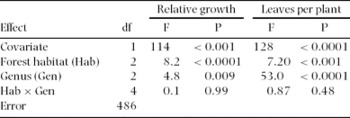
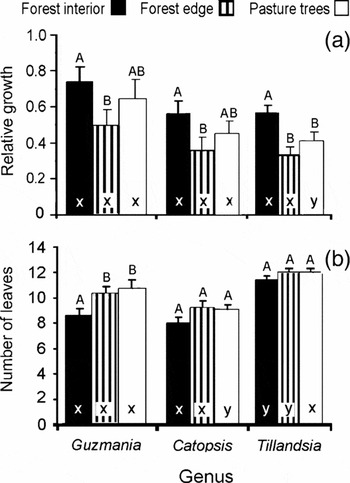
Seedling growth was higher inside the forest, intermediate on pasture trees and lowest at forest edges (Table 4, Figure 3a). Contrary to relative growth, the forest interior conditions did not seem to favour the production of more leaves (Table 4, Figure 3b). Leaf production was lower inside the forest but only statistically significant for Guzmania seedlings. Differences in growth and leaf production between genera were only significant in pasture trees, but since it might be the result of intrinsic differences in that trait, it is not further discussed.
Results for the Analyses of Covariance on growth parameters of epiphytic bromeliad seedlings transplanted into three montane forest habitats in a fragmented landscape, Costa Rica, during a 1-y period (March 2003 to March 2004).

Growth parameters for the transplantation experiment of epiphytic bromeliad seedlings into different montane forest habitats in a fragmented landscape in Costa Rica, from March 2003 to March 2004. Relative growth in size (a) and leaf production (b). Shown are LS means values with vertical lines representing 1 SE. Letters above bars show comparisons among genera at each habitat and letters inside the bars show comparisons among-habitat for each genus after contrast analyses.

Microclimatic differences among forest types
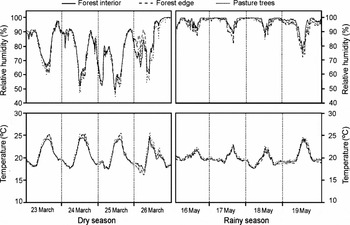
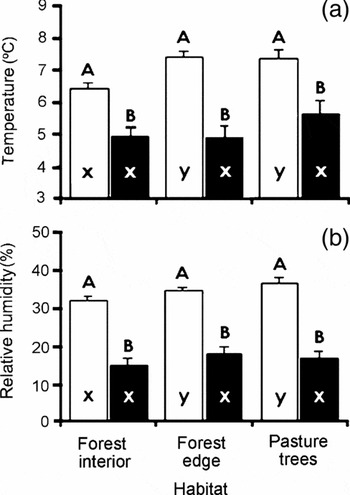
Temperature and relative humidity patterns were similar among habitats in both seasons and major changes in their daily values occurred at the transition from the dry to the rainy season (Figure 4). In the dry season, temperature was higher at forest edges and pasture trees and relative humidity was lower compared with forest interiors. Daily fluctuations in both climatic parameters were milder inside the forest in the dry season but no differences were recorded among habitats in the rainy season (Figure 5).
Daily cycles of air temperature and relative humidity at three montane forest habitats (interiors, edges and pasture trees) in a fragmented landscape in Costa Rica. Data are averaged values recorded at 10-min intervals during two 4-d periods at (1) the middle of the dry season (left) and (2) beginning of the rainy season 2003 (right).

Mean range of daily fluctuation in microclimatic conditions in the canopy of three montane forest habitats in a fragmented landscape in Costa Rica. Air temperature (a) and relative humidity (b). Data are for the end of the dry (white) and the beginning of the rainy season (black). Vertical lines are 1 SE. Letters above bars show comparisons between-seasons per habitat and letters inside the bars show comparisons among-habitats per season after contrast analyses. Sample sizes (temperature T, relative humidity RH) for the dry season and rainy season, respectively, are: forest interior = T 136/52, RH 132/36; forest edges = T 132/36, RH 128/36; pasture trees = T 84/36, RH 88/24).

DISCUSSION
We found that the number of dispersed seeds of epiphytic bromeliads was lower inside the studied forests and correlated with the limited presence of local seed sources in that habitat. Forest edges and pasture trees that contained more fruiting plants, received more seeds. Furthermore, the probability that a seed arrives at a specific site was positively influenced by the abundance of seed-dispersing plants in its vicinity. Despite that relationship, we cannot be certain that all seeds came from the nearest fruiting plants and the potential for long-distance dispersal events was demonstrated by seeds of Werauhia and Catopsis captured inside the forest interiors, where no reproductive individuals were encountered. Both the scarcity of seed sources and reduced seed rain inside the forest suggest that the epiphytic bromeliad community in that habitat is mostly dispersal-limited. Ackerman et al. (Reference ACKERMAN, SABAT and ZIMMERMAN1996) showed dispersal limitation in the epiphytic and wind-dispersed orchid Tolumnia variegata by introducing seed sources which increased seedling recruitment.
Seedling survival and growth of transplanted bromeliad seedlings was higher in forest interiors, but populations in that habitat were nevertheless smaller. The latter suggests that epiphytic bromeliad communities in forest interiors are apparently not limited by seedling establishment success, so there must be other reasons for the low population densities. Firstly, because we utilized established seedlings for our transplantation experiment, it might be argued that recruitment is limited by seed germination. However, germination experiments under field conditions demonstrated similar germination success among forest interiors and secondary forests (Cascante-Marín et al. Reference CASCANTE-MARÍN, WOLF, OOSTERMEIJER and DEN NIJS2008), which are similar in microclimatic conditions to our studied forest edges and pasture trees. Secondly, a higher predation risk by a wider range of organisms in forest interiors (e.g. herbivory, Winkler et al. Reference WINKLER, HÜLBER, MEHLTRETER, GARCÍA-FRANCO and HIETZ2005a) might contribute to the small population sizes of epiphytic bromeliads in that habitat. Thirdly, the more shaded conditions in the forest interior may slow the growth of epiphytic bromeliads in older stages of development and delay reproduction. It has been documented that bromeliad establishment is apparently related to canopy openness (Toledo-Aceves & Wolf Reference TOLEDO-ACEVES and WOLF2008, Winkler et al. Reference WINKLER, HÜLBER and HIETZ2005b), which coincides with the reportedly higher abundance of tillandsioid bromeliads in more exposed habitats, such as secondary forests and isolated trees (Barthlott et al. Reference BARTHLOTT, SCHMIT-NEUERBURG, NIEDER and ENGWALD2001, Cascante-Marín et al. Reference CASCANTE-MARÍN, WOLF, OOSTERMEIJER, DE NIJS, SANAHUJA and DURÁN-APUY2006a, Dunn Reference DUNN2000).
The differences in epiphytic bromeliad communities in the studied fragmented landscape may also be explained by differences in the availability of suitable substrates among habitats. Micro-site conditions related to chemical and physical properties of the host-tree bark surface influence epiphyte colonization (Bennett Reference BENNETT1986, Callaway et al. Reference CALLAWAY, REINHART, MOORE, MOORE and PENNINGS2002) and many orchid species require a mycorrhizal association during early establishment (Dressler Reference DRESSLER1990, Frei & Dodson Reference FREI and DODSON1972). Nonetheless, it seems unlikely that higher bromeliad abundance on pasture trees and forest edges relates to a more suitable array of substrates compared with forest interiors. We used a homogeneous artificial substrate (i.e. the carpet-type material); however, in our seedling transplantation experiment we cannot discern this potential influence.
The relatively more dynamic microclimatic conditions in the canopy of forest edges and pasture trees did not seem to cause higher seedling mortality, because plant desiccation was not frequently observed. Instead, seedling disappearance from the carpet in the three forest habitats was common. Some studies report dislodgement as the main cause of seedling mortality (Bennett Reference BENNETT1986, Cascante-Marín et al. Reference CASCANTE-MARÍN, WOLF, OOSTERMEIJER and DEN NIJS2008, Castro-Hernández et al. Reference CASTRO-HERNÁNDEZ, WOLF, GARCÍA-FRANCO and GONZÁLEZ-ESPINOSA1999), and that might occur in fragmented habitats. Pasture trees and forest edges are more prone to the effects of wind currents and the effect of occasional storms (Lovejoy et al. Reference LOVEJOY, BIERREGAARD, RYLANDS, MALCOLM, QUINTELA, HARPER, BROWN, POWELL, POWELL, SCHUBART, HAYS and Soulé1986, Murcia Reference MURCIA1995, Saunders et al. Reference SAUNDERS, HOBBS and MARGULES1991) may increase detachment of epiphytes as compared with the more protected conditions in forest interiors.
The microclimatic conditions in fragmented landscapes seem to favour the establishment of light-tolerant and drought-adapted species (Flores-Palacios & García-Franco Reference FLORES-PALACIOS and GARCÍA-FRANCO2004, Wolf Reference WOLF2005), thus epiphytic plants with morphological and physiological adaptations to tolerate more exposed conditions, such as G. monostachia and T. fasciculata, may have taken advantage and become the dominant species in present-day epiphyte communities in the studied fragmented landscape.
In summary, seed dispersal seems to be an important factor limiting the establishment and population expansion of epiphytic bromeliads in forest interiors. Nevertheless, further studies on growth and mortality of seedlings up to the flowering stage are needed. At forest edges and pasture trees, we hypothesize that higher light availability promotes growth and reproduction of epiphytic bromeliads, explaining the higher abundance of fruiting plants at those habitats compared with forest interiors. Differences in relative species abundance is likely the effect of intrinsic growth rate differences and reproductive success (i.e. the number of seeds produced) between species (Cascante-Marín et al. Reference CASCANTE-MARÍN, DE JONG, BORG, OOSTERMEIJER, WOLF and DE NIJS2006b).
ACKNOWLEDGEMENTS
We thank the staff of the Ecolodge San Luis and Research Station (UGA) for their logistic support, and the Conservation League of Monteverde and the families of the ‘Buen Amigo’ farm for allowing us to work in their properties. Adan Fuentes and Cristian Lobo provided invaluable field assistance. This is a project funded by WOTRO, the Netherlands (Grant W85–34), in collaboration with the National Museum of Costa Rica. Three anonymous reviewers provided helpful comments which improved the presentation of ideas in this paper.