Introduction
The genus Gyrocheilos W.T.Wang (Gesneriaceae) was described by Wang (Reference Wang1981) to accommodate three new species from southern China. A fourth species was added by Wang & Pan (Reference Wang and Pan1982). Möller et al. (Reference Möller, Forrest, Wei and Weber2011) found that the species of Gyrocheilos formed a monophyletic group sister to Didymocarpus cortusifolius (Hance) H.Lév.
The genus has not previously been recorded outside China but two collections are now known from Vietnam, one of them collected in 1931 and the other much more recently. The recent one was a living collection from Lang Son, grown on at the Royal Botanic Garden Edinburgh as accession 20130217A and vouchered as Möller MMOG322 (E). This plant is Gyrocheilos chorisepalum W.T.Wang.
The older one is Pételot s.n. which was collected in 1931 in what is now Tam Dao National Park. This is a formerly unknown species of Gyrocheilos which is described here.
The following key is adapted from Wang et al. (Reference Wang, Pan, Li, Weitzman and Skog1998), primarily by the inclusion of the new species.
Key to the species of Gyrocheilos
1a. Adaxial leaf blade surface with hairs of ± uniform length, either 0.1–0.2 mm long or around 0.7 mm long 2
1b. Adaxial leaf blade surface with hairs of 2 lengths, 0.2–0.5(–1.2) and 0.8–3 mm 3
2a. Leaf blade apex acute; adaxial leaf blade surface with hairs of 0.1–0.2 mm long; corolla c.11 mm long G. microtrichum
2b. Leaf blade apex rounded; adaxial leaf blade surface with hairs of around 0.7 mm long; corolla 15–15.5 mm long G. orbiculatum
3a. Peduncle 4–7 cm long; calyx sparsely pubescent outside from base to apex; pedicel pubescent; adaxial corolla lip deltoid; filaments c.1.5 mm long G. lasiocalyx
3b. Peduncle 7–34 cm long; calyx glabrous or sparsely pubescent outside near apex; pedicel glabrous; adaxial corolla lip semi-orbicular; filaments c.3 mm long 4
4a. Leaf blade 3–9.5 × 3–10 cm, apex rounded; petiole 3–8 cm long; stamens and staminodes adnate to corolla 2–2.5 mm above base G. chorisepalum
4b. Leaf blade 7–15.5 × 5.5–15.5 cm, apex acute to obtuse; petiole to 18 cm long; stamens and staminodes adnate to corolla 4–5 mm above base G. retrotrichum
Species Description
Gyrocheilos orbiculatum D.J.Middleton, sp. nov.
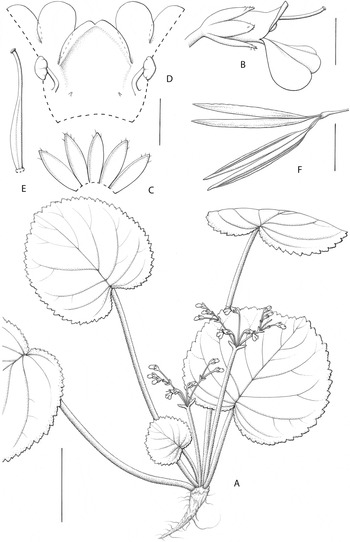
Differs from Gyrocheilos chorisepalum W.T.Wang in the longer petioles 8–18 cm long (3–8 cm long in G. chorisepalum) and the shorter hairs of uniform length, to 0.7 mm long on the adaxial leaf surface (of two different lengths, the longer ones to 3 mm long in G. chorisepalum). Differs from Gyrocheilos microtrichum W.T.Wang in the rounded leaf apices (acute in G. microtrichum), the longer (to 0.7 mm) hairs on the upper leaf surface (to 0.2 mm long in G. microtrichum) and the larger (15–15.5 mm) corolla (c.11 mm long in G. microtrichum). – Type: Vietnam, Vinh Phuc, Massif du Tam Dao, 1000–1400 m, iv 1931, Pételot s.n. (holo E; iso P(×3)). Fig. 1.
Gyrocheilos orbiculatum D.J.Middleton. A, habit; B, flower, side view; C, calyx opened out; D, corolla cross section; E, pistil; F, dehisced fruit. Scale bars: A = 6 cm; B–E = 5 mm; F = 1 cm. Drawn from Pételot s.n. (E) by Claire Banks.

Rosulate herb with thick rhizome at base. Petioles 8–18 cm long, with spreading to antrorsely appressed hairs to 1 mm long; blade orbicular, 8.5–15 × 7.4–12.1 cm, 0.8–1.1 times as long as wide, base cordate, apex rounded, margin irregularly serrate to crenate, 5–7 pairs of secondary veins, strongly ascending, sparsely pubescent all over above with hairs to 0.7 mm long, sparsely pubescent all over beneath but much more densely so on venation with hairs to 0.8 mm long. Inflorescence a lax cyme, 9–16 cm long, 5–15-flowered; peduncle 6–12.5 cm long, with short antrorsely appressed hairs; lowermost bracts ovate, 5.5–7 × 5.5–7 mm, bases clasping inflorescence axis, margins with short hairs, upper bracts c.5.5 × 4 mm, bases not clasping, tips with short hairs; pedicels 9–26 mm long, glabrous. Calyx divided to base, lobes elliptic, 4.5–5.2 × 1.7–2 mm, apices acute to shortly acuminate, glabrous except for small tuft of hairs at apex. Corolla red, 15–15.5 mm long, glabrous; tube 6–7 mm long, tubular; upper lip almost undivided, broadly triangular, 4–5 × 6–7 mm, recurved; lower lip 8–9 × 10 mm, 3-lobed, lobes oblong to elliptic, 6–6.7 × 3.4–4 mm. Stamens inserted c.3.2 mm from base of corolla; filaments c.3.5 mm long, slightly curved, glabrous; anthers c.1.5 × 2.7 mm, glabrous, cohering face to face, thecae confluent; staminodes minute. Disc annular, 0.5–0.6 mm long, margin crenulate. Ovary c.7 mm long, glabrous; style 5–7 mm long, glabrous. Capsules 18–30 mm long, c.3 mm wide, attenuate at each end with a stipe c.5 mm long at base.
Habitat. No habitat information is provided on the specimen except that it was collected at 1000–1400 m altitude.
Provisional IUCN conservation assessment. Data Deficient (DD). This species is only known from the type collection made in 1931. The higher altitude parts of Tam Dao National Park are still well preserved and it is likely the species still persists there but, without further exploration and additional collections, the status of this species is too poorly known to give it any other threat category.
Acknowledgements
I thank Claire Banks for the illustration and Michael Möller for alerting me to the Vietnamese Gyrocheilos chorisepalum in the Royal Botanic Garden Edinburgh greenhouse.