Despite advances in paediatric anaesthesia, intensive care, and myocardial protection during the past decade, postoperative low cardiac output remains the predominant cause of death of patients undergoing repair of obstructed totally anomalous pulmonary venous connection.Reference Hancock Friesen, Zurakowski and Thiagarajan1, Reference Michielon, Di Donato and Pasquini2 Recurrent episodes of pulmonary hypertensive crises, rapid development of pulmonary arterial and venous medial hypertrophy, and a small non-compliant left atrium have been variously implicated as the causative factors for the low output syndrome.Reference Mustard, Keith and Trusler3–Reference Mathew, Thilenius, Replogle and Arcilla5
It is postulated that a patent vertical vein may function as a temporary reservoir for pulmonary venous blood after repair of totally anomalous pulmonary venous connection, permit unloading of the volume in the small, non-compliant, left-sided cardiac chambers until they grow and adopt to increased flow.Reference Graham, Jarmakani and Canent6, Reference Caspi, Zalstein, Zuker and Appelbaum7 Not all investigators have accepted these findings, or utilized these techniques. In this report, we examine the effects of selective ligation of the patent vertical vein on postoperative haemodynamics, and describe our experience with a novel device permitting optimal management of the vertical vein in the perioperative period.
Patients and methods
Criterions for decision-making and selection of patients
In order to test the above-mentioned postulates, we embarked on a programme of not ligating the vertical vein in selected patients undergoing repair of isolated totally anomalous pulmonary venous connection. Our study included patients with supracardiac totally anomalous pulmonary venous connection with a discernible ascending vertical vein, and the following criterions were taken into consideration:
• Significant elevation of pulmonary arterial or left atrial pressures upon snaring or ligation of the vertical vein after achieving an adequate unrestrictive anastomosis was considered to be a useful clinical indicator of impaired left atrial compliance and/or disease-related/bypass-related pulmonary vasoreactivity. The vertical vein in such patients with obstructive totally anomalous pulmonary venous connection and pulmonary hypertension was left unligated if the pulmonary arterial pressure subsequent to bypass remained systemic or suprasystemic, and haemodynamics were unstable after weaning from bypass.
• All patients with non-obstructed totally anomalous pulmonary venous connection without pulmonary hypertension, and patients with obstructed totally anomalous pulmonary venous connection with moderate pulmonary hypertension subsequent to bypass, with systolic pulmonary arterial pressures from 31 to 50 millimetres of mercury, underwent ligation of the vertical vein.
• All patients with totally anomalous pulmonary venous connection and moderate pulmonary hypertension had an elective fenestration of the atrial septum for right ventricular decompression in the event of perioperative pulmonary hypertensive crisis.
In order to evaluate the functional cardiac state, these patients were assessed according to the score for cardiac heart developed by Ross and colleaguesReference Ross, Bollinger and Pinsky8 that included the amount of formula consumed per feed, the time of feeding, any history of diaphoresis or tachypnoea, growth parameters, respiratory and heart rates, respiratory pattern, perfusion, presence of oedema, diastolic filling sounds, and hepatomegaly. Using these measurements, we generated a score, and converted it into the following categories:
• 0 to 3 risk points was equal to absence of congestive heart failure;
• 3 to 6 risk points was equal to mild congestive heart failure;
• 7 to 9 risk points was equal to moderate congestive heart failure;
• 10 to 12 risk points was equal to severe congestive heart failure.
Characteristics of the patients
The patients were entered in the study after informed consent had been obtained from their parents or guardians. All patients had undergone surgery performed by the corresponding author, and hence there was uniformity in the surgical protocol. At All India Institute of Medical Sciences, New Delhi, India, we had performed rechannelling of totally anomalous pulmonary venous connection in a total of 62 patients between January, 1997, and June, 2006. The vertical vein was left patent in 29 patients, and ligated in 33 patients. Of the patients with the obstructed variety with unligated vertical vein, 11 continued to exhibit signs and symptoms of right heart failure due to a large left-to-right shunt between one and two weeks postoperatively. Postoperative echocardiograms showed unobstructed pulmonary venous return into the left atrium with a distended vertical vein and a large left-to-right shunt. The vertical vein was subsequently ligated via resternotomy in 4 patients, and left anterolateral thoracotomy in 2 patients, and by use of an adjustable ligature in 5 patients. The early and mid-term outcome of these 62 patients have been discussed in our previous publication.Reference Chowdhury, Subramaniam and Joshi9
Only the five patients undergoing ligation of the vertical vein with the adjustable ligature are included here for additional study. Their age at the time of operation were 2, 4, 3, 4 and 3 months respectively. Their weights were 3.2, 4.0, 3.6, 4.2 and 3.4 kilograms respectively. Cross-sectional echocardiography, with Doppler and colour flow mapping, showed the pulmonary venous confluence draining through a vertical vein to the brachiocephalic vein, and into the superior caval vein. Echocardiographically, the pulmonary venous drainage was considered obstructive at the junction between the vertical and brachiocephalic veins, with an acceleration of flow of more than 2 metres per second, monophasic and continuous Doppler flow pattern in the pulmonary venous confluence and vertical vein, and there were evidences of severe pulmonary arterial hypertension. Preoperatively, all patients had been haemodynamically stable. Diagnosis was established by echocardiography in all. There were no major associated cardiac anomalies.
Operative and postoperative management
The operations were performed with moderate hypothermic cardiopulmonary bypass using angled venous cannulas placed into the superior and inferior caval veins, and aortic cannulation. Cold hyperkalemic blood cardioplegia and topical hypothermia were used for myocardial protection. Both conventional on-pump, and immediate post-cardiopulmonary bypass ultrafiltration were used in all patients to reduce the total body water, and to remove inflammatory mediators from the circulation. After routine ligation of the arterial duct at the commencement of cardiopulmonary bypass, cooling was started. During the phase of cooling, the vertical vein was dissected extrapericardially and looped. The apex of the heart was lifted cephalad and to the right, with the right pleural cavity wide open. This allowed an excellent exposure.
Long transverse incisions were made on the common pulmonary venous chamber and the left atrium. A large anastomosis, from 2.5 to 3 centimetres, or as large as the calculated area of the orifice of the mitral valve, was made between these two chambers from outside, using a running 6-0 polypropylene suture (Ethicon Inc., Somerville, N.J). The atrial septal defect was closed either through a separate right atriotomy, or through the same left atrial incision. In three patients with a large atrial septal defect, simultaneous left atrial enlargement was achieved by rightward shifting of a redundant Dacron patch used for inter-atrial septation. This served not only to enhance the capacity of the left atrium, but also ensured an adequate-sized communication between the pulmonary veins and the left atrium. We maintained patency of the oval foramen, or created a calibrated fenestration in patients with obstructed supracardiac drainage and pulmonary arterial hypertension for decompression of the right-sided chambers in the event of pulmonary hypertensive crises. All five patients had such an elective fenestration.
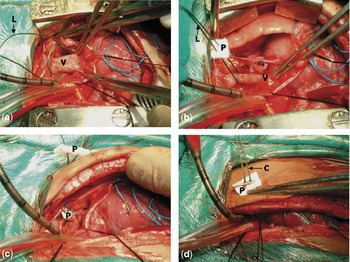
A right angle forceps was passed around the vertical vein between its junctions with the left upper pulmonary vein and the brachiocephalic vein, and was looped using No.4 SUTUPAK (Ivory Baided Silk, SW 218; Johnson and Johnson Inc, Somerville, NJ) suture (Fig. 1a–d). The right angle forceps was again passed in a similar fashion, and the suture was grasped by the tip of the forceps so that vertical vein was doubly looped. Both the ends of the thread were next passed through a 0.5 centimetre × 0.5 centimetre low porosity No. 1 Bard polytetrafluoroethylene pledget (Inpra Inc, A subsidiary of CR Bard, Tempe, Ariz, USA) which was anchored to the adventitia of the vertical vein with interrupted 6-0 polypropylene sutures to prevent subsequent distortion or occlusion of the left upper pulmonary and the brachiocephalic veins. Both arms of the silk suture were then brought out through the second left intercostal space away from the sternotomy incision perpendicular to the vertical vein, ensuring a vertical non-redundant straight lie without distorting the vertical vein. The two ends of the sutures were next passed through a 2×2 centimetre polytetrafluoroethylene pledget. and clipped together using a big ligaclip (LT 400, Ethicon Endosurgery, Inc, Cincinati, Ohio). Left atrial and pulmonary arterial pressures were monitored continuously after the operation.
(a–d) Operative view of an adjustable vertical vein ligature (L) demonstrating the silk suture doubly looped around the vertical vein (V) and passed through a polytetrafluoroethylene pledget (P). The sutures are then passed vertically through the second left intercostal space, subcutaneous tissue, skin and another polytetrafluoroethylene pledget (P). A clip (C) is applied over the polytetrafluoroethylene pledget and subsequent tightening is done by placing additional clips between the felt (P) and the first clip (C).

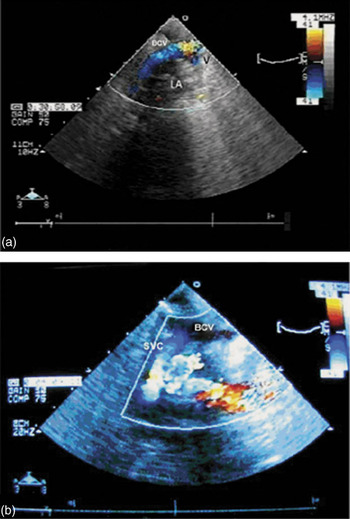
After weaning from bypass, upon snaring the vertical vein, the median left atrial pressure increased to 19.0 millimetres of mercury, and ranged from 18 to 21 millimetres of mercury, accompanied by an acute increase in pulmonary arterial pressures to suprasystemic levels in all patients. Loosening of the vertical vein resulted in decrease of the pressure to a ratio of 0.6, and decrease of the median left atrial pressure to 11 millimetres of mercury, with a range between 10 and 11 millimetres of mercury in all patients. This was associated with a significant increase in mean arterial blood pressure, and correction of metabolic acidosis (Table 1). The sternum was closed in all patients. Pulmonary hypertension was treated with hyperventilation, sedation, phenoxybenzamine, sildanefil, and inhaled nitric oxide at 10 to 15 parts per million, in varying combinations, for 72 to 96 hours. Postoperatively, the patients were haemodynamically stable on dobutamine in a dose of 7.5 micrograms per kilogram per minute, and milrinone in a dose of 50 microgram per kilogram intravenous bolus, followed by 0.375 to 0.75 microgram per kilogram per minute. They were sedated and paralysed during the first 24 to 48 hours. Postoperative echocardiography demonstrated an entirely satisfactory primary repair, with a large anastomosis, as large or larger than the area of the mitral valvar orifice, with no gradient between the pulmonary venous confluence and left atrium, and non-turbulent biphasic pulmonary venous flow at less than 1.2 metres per second. Serial echocardiography during episodes of pulmonary hypertensive crises demonstrated left-to-right shunting through the patent vertical vein in all, clearly documenting its role as a temporary vent (Fig. 2a, b).
Haemodynamic profile of 5 patients under study subsequent to weaning from bypass with an unligated and unsnared vertical vein.

(a) Two-dimensional echocardiogram (postoperative) with colour flow patterns of venous flow in the unligated vertical vein (V) showing left-to-right shunting from the left atrium (LA) to the brachiocephalic vein (BCV) via the patent vertical vein (V). (b) Demonstration of complete interruption of blood flow through the vertical vein after the adjustable ligature was tightened around the vertical vein without causing distortion of the brachiocephalic vein (BCV). SVC: Superior caval vein.

Although these patients were extubated between 48 and 96 hours after the operation with stable haemodynamics, they continued to have tachypnoea and right heart failure between one and two weeks postoperatively. At this point, we decided to tighten the adjustable ligature in increments. Tightening was achieved by placing additional clips outside between the polytetrafluoroethylene pledget and the previous clip, while monitoring the left atrial and pulmonary arterial pressures and arterial blood gases (Fig. 1a–d). Echocardiographic assessment was performed to assess the ventricular function, and the degree of tightening was assessed by reduction of left-to-right shunt through the vertical vein. All ligatures were tightened gradually over a period of 24 to 96 hours, maintaining stable haemodynamics with controlled pulmonary arterial pressure at subsystemic levels and normal blood gases.
On achieving complete interruption of blood flow through the vertical vein, the ends of the sutures was internalized by making a small skin incision under local anaesthesia at the exit points of two sutures. The subcutaneous plane was slightly opened up and the threads were secured using a ligaclip individually over each thread. Above this, the sutures were cut flush on the ligaclip to release portion of the ligatures outside the skin. The skin was then closed with two interrupted sutures.
Statistical analysis
Data were analyzed with STATA 9.0 (College Station, Tx, USA) and was expressed as the median and range. Wilcoxon signed rank test was used to assess the statistical significance of different variables with and without snaring of the vertical vein. The differences in median of variables were assessed since the numbers of observations were small.
Results
All patients survived the operation. The median duration of mechanical ventilation was 60 hours, and ranged from 48 to 96 hours. There were no late deaths. The patients have been followed up periodically for periods ranging from 2 to 107 months, with a mean follow-up of 55.4 months, and a standard deviation of 45.5 months. All patients showed no clinical evidence of heart failure, with scores from zero to 2, and none required anti-failure cardiac medications. Cross-sectional and Doppler echocardiography revealed normal biventricular function, and absence of flow through the atrial septal fenestration and the vertical vein (Fig. 2b). Follow-up computed tomographic angiocardiograms demonstrated absence of flow through the vertical vein, and ruled out distortion of the left upper pulmonary and left brachiocephalic veins.
Discussion
Reports addressing the issue of not ligating the vertical vein following repair of totally anomalous pulmonary venous connection, and related postoperative haemodynamics, are limited and conflicting.Reference Mustard, Keith and Trusler3, Reference Cope, Banks, McDaniel, Shockey, Nolan and Kron4, Reference Caspi, Zalstein, Zuker and Appelbaum7, Reference Chowdhury, Subramaniam and Joshi9–Reference Jegier, Charrette and Dobell12 Traditionally, ligation of the vertical vein at the time of rechannelling of totally anomalous pulmonary venous connection is recommended, thus preventing the perceived consequences of a residual left-to-right shunt.
Cope and co-workers, however, along with Caspi and co-workers, have suggested that ligation of the vertical vein is not a mandatory component of successful surgical correction of this anomaly.Reference Cope, Banks, McDaniel, Shockey, Nolan and Kron4, Reference Caspi, Zalstein, Zuker and Appelbaum7, Reference Caspi, Pettitt and Fontenot10 In selected patients with small left heart chambers, a patent vertical vein may be an advantage, allowing time for functional adaptation as well as serving as a temporary “pop-off” valve during episodes of pulmonary hypertensive crisis.Reference Cope, Banks, McDaniel, Shockey, Nolan and Kron4–Reference Caspi, Zalstein, Zuker and Appelbaum7, Reference Chowdhury, Subramaniam and Joshi9–Reference Shah, Shah, Shankargowda, Krishnan and Cherian11 In our earlier communication, we demonstrated that patients with obstructive totally anomalous pulmonary venous connection with systemic or suprasystemic pulmonary arterial hypertension subsequent to bypass, and treated with a protocol of not ligating the vertical vein, exhibited decreased episodes of pulmonary hypertensive crises and postoperative low output syndrome, lesser duration of ventilation and inotropic support, early normalization of haemodynamics, and decreased hospital mortality.Reference Chowdhury, Subramaniam and Joshi9
Reports of the characteristics of the volume of the left heart in obstructive totally anomalous pulmonary venous connection have varied considerably, from normal findings to the conclusion that left-sided chambers are smaller than normal, and that the left atrium lacks both normal compliance and any reservoir function.Reference Michielon, Di Donato and Pasquini2–Reference Graham, Jarmakani and Canent6 Analysis of the published series substantiates four anatomic and physiologic issues in a percentage of patients with obstructed totally anomalous pulmonary venous connection.Reference Michielon, Di Donato and Pasquini2–Reference Graham, Jarmakani and Canent6, Reference Hammon, Bender, Graham, Boucek, Smith and Erath13–Reference Haworth and Reid15 The issues are structurally smaller left-sided chambers, a non-compliant and dysfunctional left ventricle, transient increase in pulmonary vascular resistance, and increased pulmonary vascular resistance due to increased medial thickness of the pulmonary vasculature. Such abnormalities have been attributed to reduced atrial filling and chamber underloading due to a large left-to-right shunt, and decreased left ventricular diastolic pressure volume relation secondary to elevated right ventricular diastolic pressure or volume.Reference Michielon, Di Donato and Pasquini2–Reference Graham, Jarmakani and Canent6, Reference Hammon, Bender, Graham, Boucek, Smith and Erath13–Reference Haworth and Reid15 In order to allow the left heart to adopt and maintain adequate cardiac output, we have used a redundant dacron patch for interatrial septation, and have incorporated part of the vertical vein to achieve structural alignment and augmentation of the left atrial cavity. The two-patch technique of left atrial enlargement has been popularized by Corno and colleagues.Reference Corno, Giamberti, Carotti, Giannico, Marino and Marcelletti16 Subsequently, several investigators have demonstrated increased incidence of supraventricular arrhythmias due to the use of a transverse right atrial incision and division of the supraventricular crest.Reference Hancock Friesen, Zurakowski and Thiagarajan1–Reference Mustard, Keith and Trusler3 We have not used this technique.
One important finding of our investigation, given their age at the time of surgery, is the occurrence of suprasystemic pulmonary arterial pressures in our patients subsequent to weaning from bypass. All our patients are more than one month of age. This is in contrast to the situation in most Western countries, where more than half of patients nowadays undergo surgery before one month of age.Reference Hancock Friesen, Zurakowski and Thiagarajan1–Reference Cope, Banks, McDaniel, Shockey, Nolan and Kron4, Reference Caspi, Pettitt and Fontenot10–Reference Jegier, Charrette and Dobell12, Reference Corno, Giamberti, Carotti, Giannico, Marino and Marcelletti16–Reference Bando, Turrentine and Ensing18 In our earlier publication, we demonstrated that late referral and late presentation lead to the development of severe pulmonary hypertension, a prolonged period of malnutrition. and ultimately cardiac cachexia. These factors predispose them to pulmonary infection, sepsis, postoperative pulmonary haemorrhage, and unfavourable reactions to stresses such as cardiopulmonary bypass and postoperative events.Reference Choudhary, Bhan and Sharma19 Despite aggressive preoperative stabilization, improved diagnostic accuracy with echocardiography, improvement in myocardial protection and surgical techniques, introduction of phenoxybenzamine and nitric oxide in the management of pulmonary hypertensive crises, we reported worse outcomes for those with totally anomalous pulmonary venous connection when performing repair using the conventional strategy of routine ligation of a discernible ascending or descending vertical vein.Reference Choudhary, Bhan and Sharma19
Our second finding is the occurrence of suprasystemic pulmonary arterial pressures and unstable haemodynamics upon snaring the vertical vein after weaning from bypass. Release of the snare resulted in improved postoperative haemodynamics, early weaning from ventilatory support, and survival (Table 1). In the absence of any anastomotic stricture, this undesirable effect can be explained by decreased unloading of the pulmonary venous chamber due to non-compliant left-sided cardiac chambers. All of our patients had a patent vertical vein, and an additional atrial septal fenestration. Both appear to be desirable in patients with obstructive totally anomalous pulmonary venous connection and a small left ventricle. It is conceivable that leaving a patent oval foramen may also help to decompress the small left atrium after repair, and is likely to close on its own. During episodes of pulmonary hypertensive crises with limited right ventricular output, and an elevated central venous pressure, a fenestrated atrial septum permitted right-to-left shunting, increasing left ventricular preload and cardiac output, albeit at the expense of some degree of systemic desaturation. Thus, the unligated vertical vein, in conjunction with a calibrated atrial septal fenestration, resulted in equalization of left atrial and central venous pressures, and was the automatic choice to avert a dismal outcome in the perioperative period.
As yet, there are no specific criterions for selection of those in whom it is advantageous to maintain the patency of the vertical vein. The long-term fate of the unligated vein is unknown. Anecdotal reports document spontaneous involution of the anomalous vertical vein on one end of the spectrum, and a functioning conduit with a large left-to-right shunt and cardiac failure on the other end.Reference Mustard, Keith and Trusler3, Reference Cope, Banks, McDaniel, Shockey, Nolan and Kron4, Reference Caspi, Zalstein, Zuker and Appelbaum7, Reference Caspi, Pettitt and Fontenot10, Reference Shah, Shah, Shankargowda, Krishnan and Cherian11 As suggested by other investigators, the subset of patients with a persistent left-to-right shunt through an unligated vertical vein and congestive heart failure may be candidates for percutaneous embolization, or using a tourniquet to control the vein.Reference Cope, Banks, McDaniel, Shockey, Nolan and Kron4, Reference Caspi, Zalstein, Zuker and Appelbaum7 In our patients, the occurrence of congestive heart failure due to a large left-to-right shunt in the postoperative period was the indication for delayed surgical closure.
In the setting of the caveats discussed above, we decided to develop a strategy whereby the vertical vein can used as a temporary venous reservoir for pulmonary venous blood in the presence of small non-compliant left atrium and left ventricle, and a temporary “pop-off” valve in the event of pulmonary hypertensive crisis. Thereafter, the vein may be subjected to a gradual process of occlusion. Thus, there were three forces driving our decision-making for an adjustable ligature around the vertical vein:
• The desire gradually to tighten or loosen the ligature under optimal physiologic conditions, concomitant with the disappearance of disease or bypass-related pulmonary reactivity.
• The desire gradually to increase the afterload to the ventricle as tolerated by the patient without causing haemodynamic instability under optimal physiologic conditions.
• The desire to occlude the vertical vein in the event of a significant left-to-right shunt and right heart failure without re-opening the sternum or employing another thoracotomy.
An initial concern about the technique was the possibility of iatrogenic distortion of the left upper pulmonary and left brachiocephalic veins. To address these concerns, we have threaded the loop ligature through a polytetrafluoroethylene felt and secured it to the adventitia of the vertical vein, thus preventing its displacement, and brought both arms of the silk suture through the second left intercostal space away from the sternotomy incision, perpendicular to the vertical vein, ensuring a vertical straight lie, and avoiding subsequent distortion or occlusion of the left upper pulmonary and brachiocephalic veins. Postoperatively, we performed computed tomographic angiography on these patients at follow-up, and discovered no untoward findings.
We conclude that patency of the vertical vein in patients with obstructive totally anomalous pulmonary venous connection and pulmonary hypertension facilitates reduction of pulmonary arterial pressures, and contributes to a favourable outcome following surgery. Patients who have undergone this approach should be followed closely for a significant, persistent left-to-right shunt and right heart failure. Our described technique is simple, inexpensive, and allows easy tightening in increments with gradual increase of ventricular afterload, without the need for multiple reoperations. Further investigations on a larger number of patients, and a longer follow-up, are needed to confirm the early results.