





Introduction
Radiotherapy is one of the three principal modalities in cancer treatment, alongside surgery and systemic drug therapies, and approximately one in four people in the UK will require radiotherapy at some point in their lifetime. 1 Given its central role in oncology, it is essential that medical students acquire a foundational understanding of radiotherapy principles. Reference Dapper, Belka and Bock2 Traditionally, education in this area has relied on didactic teaching and clinical placements; however, comprehensive training is often hindered by limited placement availability, the complexity of radiotherapy concepts and concerns related to patient safety.
Despite radiotherapy’s central role in cancer treatment, undergraduate medical education often provides limited exposure to oncology, leaving many students underprepared. For example, first-year foundation doctors have reported feeling inadequately prepared regarding chemotherapy and radiotherapy, with approximately 75% indicating they would have welcomed more comprehensive teaching in these areas. Reference Cave, Woolf and Dacre3 This educational gap may hinder effective clinical practice and interdisciplinary collaboration, underscoring the need for innovative teaching approaches to better prepare future doctors. Medical students rarely have opportunities to engage directly with radiotherapy-specific environments, such as treatment planning departments, and/or to interact with related specialties like clinical physics and therapeutic radiography. Reference Walls, Houlihan and Mooney4 This limited exposure can hinder their understanding of radiotherapy’s technical and multidisciplinary nature.
Clinical virtual simulation is an increasingly popular technique used to augment learners’ understanding of real-world clinical scenarios. Virtual reality (VR)-based clinical simulation learning is becoming more prevalent in medical education, particularly in robotic surgery training. Reference Mergen, Meyerheim and Graf5 It has also shown value in teaching cardiopulmonary resuscitation and casualty triage in emergency medicine. Reference Creutzfeldt, Hedman and Felländer-Tsai6,Reference Ingrassia, Ragazzoni, Carenzo, Colombo, Ripoll Gallardo and Della Corte7 The virtual environment for radiotherapy training (VERT™) is a VR-based simulation platform developed primarily for therapeutic radiography education. Reference Flinton, Khine, Mannion, O’Sullivan and Cherry8 VERT™ combines high-resolution visualisations of the radiotherapy treatment environment with a physical hand-held pendant, allowing users to interact with virtual treatment machines and ancillary equipment. Reference Jimenez and Lewis9 It enables students to develop technical skills in a safe, immersive setting.
At the University of Liverpool, VERT™ is widely used in the training of therapeutic radiography students. More recently, VERT™ experience sessions have also been introduced for fourth-year medical students as preparation for their first clinical oncology placement.
Although VERT™ has been evaluated extensively in therapeutic radiography training, Reference Kirby10–Reference Rabus, Kirby, Nasole and Bridge12 its impact on medical student education has not been formally assessed. This preliminary study aims to evaluate the effectiveness of VERT™ in enhancing medical students’ knowledge, understanding and perceptions of radiotherapy prior to their clinical oncology placement. Using a pre- and post-questionnaire design, the study investigates changes in perceived knowledge, attitudes towards VERT™ as a learning tool and its potential role in improving students’ preparedness for clinical practice. The findings aim to inform the integration of VR-based learning into medical curricula and contribute to broader discussions about innovative approaches in medical education.
Methods
This study employed a quasi-experimental design to evaluate the effectiveness of a teaching intervention aimed at enhancing fourth-year medical students’ knowledge and understanding of radiotherapy and oncology. Participants completed a structured questionnaire both before and after the intervention to assess changes in knowledge, understanding and attitudes. The questionnaire included both Likert scale items and open-ended questions, allowing for quantitative and qualitative assessment of participants’ responses. This mixed-methods approach enabled a comprehensive evaluation of the intervention’s impact. Ethical approval for the study was granted by the university’s Human Research Ethics Committee.
Twenty-four students, enrolled in the Bachelor of Medicine and Bachelor of Surgery (MBChB) programme, participated in this preliminary study. All were in the fourth year of the five-year programme. No demographic data were collected. A recruitment notice was circulated by the medical education coordinator, and participation was voluntary. Students were informed they could withdraw from the study at any time prior to submitting their post-intervention questionnaire. A £36 gift card was provided to each participant upon completion.
The teaching intervention was delivered as a one-hour VERT™ experience session, repeated on two separate dates to accommodate timetabling. All 24 study participants attended one of these sessions as part of their scheduled teaching, alongside other peers who were not enrolled in the study. Each session began with an introductory PowerPoint presentation outlining the role of radiotherapy in cancer management and explaining key considerations in treatment planning and delivery. This was followed by a demonstration of immobilisation equipment commonly used in radiotherapy departments, offering insight into patient positioning and the importance of treatment accuracy and reproducibility. The session concluded with a 30-minute VERT™ demonstration, wholly demonstrator-led, though students were invited to interact with the system if they wished. The demonstration was delivered on a large, full-wall 2-D projection system, allowing participants to visualise and engage with radiotherapy concepts in a simulated treatment environment. By integrating didactic instruction, hands-on demonstration and immersive technology, the intervention aimed to improve participants’ understanding of core radiotherapy principles. Both sessions were delivered by the same facilitators—an advanced practitioner therapeutic radiographer and a university lecturer (also a trained therapeutic radiographer)—to ensure consistency in teaching and subject expertise across the intervention.
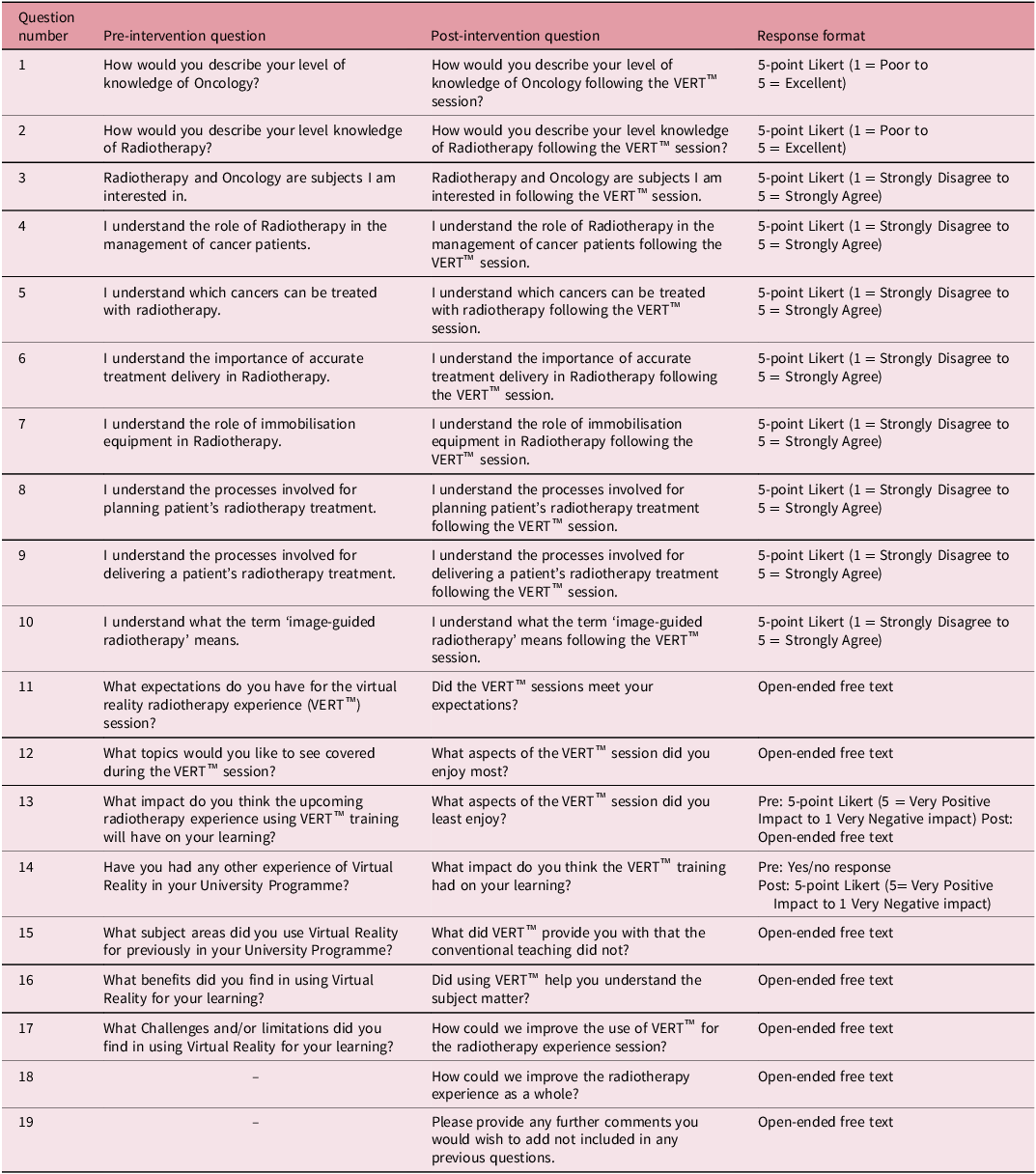
Data were collected using pre- and post-intervention questionnaires designed to assess changes in participants’ knowledge, understanding and perceptions of radiotherapy. Each questionnaire included Likert scale items to quantify attitudes and levels of understanding, alongside open-ended questions to capture qualitative insights. The pre- and post-session questionnaires were developed collaboratively by all authors, based on frameworks from previous VR-based educational evaluations. Reference Kirby10–Reference Rabus, Kirby, Nasole and Bridge12 Questions were designed to cover a broad range of radiotherapy concepts for participants with limited prior exposure, while including key clinical topics such as patient immobilisation and image-guided radiotherapy (IGRT). Table 1 outlines the questionnaire items used in both the pre- and post-intervention surveys, including question format (e.g. Likert scale, yes/no, or open-ended).
Pre- and post-intervention questionnaire items and their response formats

Table 1. Long description
A table with 19 rows and 3 columns comparing pre- and post-intervention questionnaire items and their response formats. The columns are labeled ‘Question number’, ‘Pre-intervention question’, ‘Post-intervention question’, and ‘Response format’. The table includes questions about knowledge of Oncology and Radiotherapy, interest in these subjects, understanding of radiotherapy roles, processes, and terms, expectations and impacts of virtual reality radiotherapy experience (VERT), and other related topics. Response formats include 5-point Likert scales and open-ended free text.
The pre-intervention questionnaire was distributed one week prior to the session, and participants were required to submit their responses by the day before their scheduled intervention as a condition of participation. The post-intervention questionnaire was distributed immediately after the session, with participants given up to one week to respond. Both questionnaires were administered online and completed anonymously.
A paired pre- and post-intervention design enabled direct comparison of individual participant responses. Both quantitative and qualitative methods were used to analyse the questionnaire data. Responses to the Likert scale items were examined using descriptive statistics, including percentage change, to assess shifts in participants’ knowledge, understanding and perceptions before and after the intervention. One participant did not complete the post-session Q10; so analyses for this item were based on 23 responses.
For statistical analysis, Likert scale responses were converted to numerical values ranging from 1 to 5. Across the questionnaire (See Table 1), positively framed questions used a scale where higher numerical values (4 and 5) were assigned to more favourable/positive responses—such as very good (VG) and excellent (E); agree (A) and strongly agree (SA); and positive impact (PI) and very positive impact (VPI), respectively. The pre- and post-intervention scores were compared using the non-parametric Wilcoxon signed-rank test (IBM SPSS version 31). p Values < 0·05 were considered to show a statistically significant difference between the pre- and post-data. For further analysis, cumulative responses were used (i.e. percentage of respondents answering VG or E; A or SA; PI or VPI), so that changes pre-to-post could be identified, together with those where answers changed by 2 or more Likert scale points. A small number of questions (notably Q13 and Q14) used a reversed scale for presentation in the questionnaire only; numerical values for analysis were still assigned as detailed in Table 1 above (i.e. 4 and 5 for PI and VPI, respectively). This approach allowed for meaningful comparison of pre- and post-intervention responses despite variation in response scales.
Thematic analysis was conducted on open-ended questionnaire responses collected both prior to and following the VERT™ sessions. The responses were carefully reviewed and coded, with themes identified through an iterative process to ensure clarity and coherence. Qualitative data were analysed by a member of the research team using thematic analysis. Another colleague, not involved in the study, independently reviewed the coding and themes and confirmed that they aligned with participant responses, supporting the credibility of the analysis. This analytic approach enabled the development of well-defined themes that capture the impact of the VERT™ intervention on students’ learning and engagement, as well as highlighting areas for potential enhancement.
Results
Quantitative results
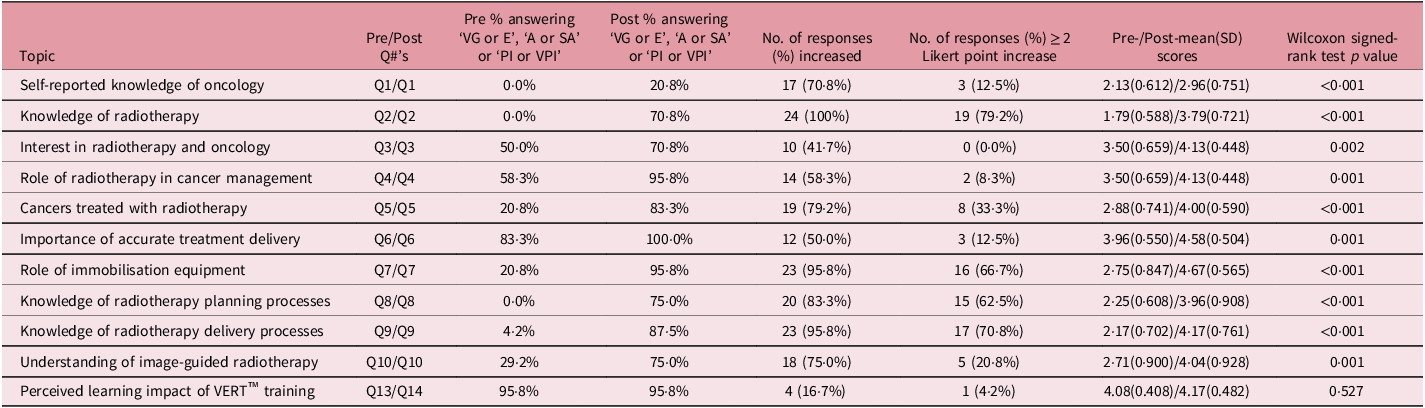
The full results can be seen in the bar chart in Figure 1 and in Table 2. Statistically significant improvements were observed in 10 out of 11 items. Among these, one of the most notable changes was observed in Q2 (p < 0·001), where 70·8% of participants rated their knowledge as ‘Very Good or Excellent’ post-intervention, compared to 0% pre-intervention (Table 2). Notably, 79·2% of participants increased their score by at least two Likert points, reflecting a substantial increase in perceived understanding. Similarly, Q9 (p < 0·001) demonstrated a statistically significant improvement, with the proportion of participants rating their understanding as ‘Agree or Strongly Agree’ increasing from 4·2% to 87·5% and 70·8% increasing their score by two or more points. Q7 (p < 0·001) also showed gains, with the proportion answering ‘Agree or Strongly Agree’ rising from 20·8% to 95·8% and 66·7% of participants improving by at least two points. The only item not reaching statistical significance was Q13/14 (p = 0·527), which related to pre- and post-intervention perceptions of impact; responses remained largely unchanged, indicating that the VERT™ session had not changed their perceptions of impact.
Bar chart showing pre- and post-intervention responses for all Likert-style survey questions. See Table 1 for further information on the scoring system used for the different questions.

Summary of pre- and post-intervention questionnaire response changes, mean Likert scores and Wilcoxon signed-rank test p value results

Table 2. Long description
A table with 11 rows and 7 columns comparing pre- and post-intervention questionnaire responses and scores. The columns are labeled as Topic, Pre/Post Q#’s, Pre % answering ‘VG or E’, ‘A or SA’ or ‘PI or VPI’, Post % answering ‘VG or E’, ‘A or SA’ or ‘PI or VPI’, No. of responses (%), No. of responses (%) ≥ 2 Likert point increase, Pre-/Post-mean (SD) scores, and Wilcoxon signed-rank test p value. Row 1: Self-reported knowledge of oncology, Q1/Q1, 0.0%, 20.8%, 17 (70.8%), 3 (12.5%), 2.13 (0.612)/2.96 (0.751), <0.001. Row 2: Knowledge of radiotherapy, Q2/Q2, 0.0%, 70.8%, 24 (100%), 19 (79.2%), 1.79 (0.588)/3.79 (0.721), <0.001. Row 3: Interest in radiotherapy and oncology, Q3/Q3, 50.0%, 70.8%, 10 (41.7%), 0 (0.0%), 3.50 (0.659)/4.13 (0.448), 0.002. Row 4: Role of radiotherapy in cancer management, Q4/Q4, 58.3%, 95.8%, 14 (58.3%), 2 (8.3%), 3.50 (0.659)/4.13 (0.448), 0.001. Row 5: Cancers treated with radiotherapy, Q5/Q5, 20.8%, 83.3%, 19 (79.2%), 8 (33.3%), 2.88 (0.741)/4.00 (0.590), <0.001. Row 6: Importance of accurate treatment delivery, Q6/Q6, 83.3%, 100.0%, 12 (50.0%), 3 (12.5%), 3.96 (0.550)/4.58 (0.504), 0.001. Row 7: Role of immobilisation equipment, Q7/Q7, 20.8%, 95.8%, 23 (95.8%), 16 (66.7%), 2.75 (0.847)/4.67 (0.565), <0.001. Row 8: Knowledge of radiotherapy planning processes, Q8/Q8, 0.0%, 75.0%, 20 (83.3%), 15 (62.5%), 2.25 (0.608)/3.96 (0.908), <0.001. Row 9: Knowledge of radiotherapy delivery processes, Q9/Q9, 4.2%, 87.5%, 23 (95.8%), 17 (70.8%), 2.17 (0.702)/4.17 (0.761), <0.001. Row 10: Understanding of image-guided radiotherapy, Q10/Q10, 29.2%, 75.0%, 18 (75.0%), 5 (20.8%), 2.71 (0.900)/4.04 (0.928), 0.001. Row 11: Perceived learning impact of VERT training, Q13/Q14, 95.8%, 95.8%, 4 (16.7%), 1 (4.2%), 4.08 (0.408)/4.17 (0.482), 0.527.
For further analysis, related questions were grouped into thematic categories. Based on content focus, Q1, Q2 and Q3 were grouped under ‘General Knowledge and Interest’; Q4, Q5, Q6, Q7 and Q10 under ‘Understanding of Radiotherapy Concepts and Equipment’; Q8 and Q9 under ‘Knowledge of Radiotherapy Planning and Delivery Processes’; and Q13 and Q14 under ‘Previous VR Experience and Perception of Impact’.
General knowledge and interest
Participants’ self-reported knowledge of oncology and radiotherapy, as well as their interest in these subjects, showed notable improvement following the intervention. Prior to the session, no participants rated their knowledge of oncology (Q1) or radiotherapy (Q2) as ‘Very Good or Excellent’. However, post-intervention, 20·8% of participants rated their oncology knowledge and 70·8% their radiotherapy knowledge, as ‘Very Good or Excellent’. Furthermore, 100% of participants self-reported an increase in radiotherapy knowledge, with 79·2% of respondents showing a shift of at least two Likert points. Interest in radiotherapy and oncology (Q3) also increased, from 50% (either agreeing or strongly agreeing) before intervention to 70·8% afterwards.
Understanding of radiotherapy concepts and equipment
The data demonstrated statistically significant improvement in participants’ understanding of key radiotherapy concepts following the VERT™ session. The percentage of participants agreeing or strongly agreeing with the statements in the questions increased substantially (50·0–95·8%) across all five questions. For example, those agreeing or strongly agreeing that they had an understanding of cancers treated with radiotherapy (Q5) increased from 20·8% of respondents pre-intervention to 83·3% post-intervention (p < 0·001), with 33.3% of participants changing their responses by two or more Likert points. Similarly, those agreeing or strongly agreeing that they understood the role of immobilisation equipment (Q7) changed from 20·8% to 95·8% (p < 0·001), with 66.7% increasing their scores by at least two points. Changes were also noted for the role of radiotherapy in cancer management (Q4: 58·3% to 95·8%, p = 0·001), importance of accurate treatment delivery (Q6: 83·3% to 100·0%, p = 0·001) and understanding of image-guided radiotherapy (Q10: 29·2% to 75·0%, p = 0·001).
Knowledge of radiotherapy planning and delivery processes
The intervention also showed improved perception of understanding for radiotherapy planning and delivery processes. For planning procedures (Q8), ‘Agree or Strongly Agree’ ratings increased from 0·0% to 75·0% of respondents (p < 0·001), with 62·5% improving by two or more Likert points. For treatment delivery processes (Q9), the proportion who agreed or strongly agreed that they understood the processes involved, increased from 4·2% to 87·5% (p < 0·001), with 70·8% improving by two or more points.
Previous VR experience and perception of impact
Prior to the session, 14 of the respondents (58·3%) indicated that they had some prior experience with VR within their university programme. Of these, the majority (13/14) had used it within simulated acute/emergency medicine settings for managing and treating patients. One could not recall what the VR session subject was. One also had further experience of VR for the clinical technique training in neurosurgery (using scalpels and diathermy). This latter use is perhaps the closest to that of VERT™ in our study; where one can also view pre-treatment planning internal imaging (CT, MR and PET images) as well as then on-treatment image guidance and simulated dose delivery from the chosen radiotherapy technique. This would nicely complement the majority of experiences of VR reported and be a good addition for those who hadn’t experienced any VR previously. From Q’s 13 and 14, there was no statistically significant difference (p = 0·527) between the responses before and after the session. Before the session, 95·8% of respondents (Q13) either very positively or positively thought the upcoming experience would be impactful; and 95·8% (Q14) confirmed very positively or positively the impact that the session had.
Qualitative results
Thematic analysis of open-ended questionnaire responses revealed key themes related to students’ expectations, learning experiences, attitudes and perceived benefits of VERT™ sessions, along with suggestions for improvement
Theme 1: expectations and perceptions of VERT™
Before the intervention, many participants were uncertain about what to expect, especially regarding the VR component and session content. Some expressed curiosity and excitement about using immersive VR to visualise radiotherapy processes. Several showed interest in understanding radiotherapy from the patient’s perspective: ‘…to see what the patient experience is and help us understand a bit better of the indications and risks with radiotherapy…’ (P15) After the session, over 75% expressed a feeling that VERT™ was useful, met or even exceeded their expectations; appreciating the clarity gained on treatment planning, equipment, and the radiotherapy process: ‘It allowed me to visualise the process and how it works that you can’t get from conventional teaching, and I find this really helpful and gives you a great understanding being able to see it. This session also showed us the radiotherapy masks and moulds and so we could understand what is used during radiotherapy.’ (P19) Some noted communication about the session’s scope could improve, as titles were unclear. Facilitators were praised, but many desired more interactive, hands-on VR experiences to boost engagement: ‘…more interaction with the VERT™ programme.’ (P12)
Theme 2: learning and understanding of radiotherapy concepts
Participants wanted to deepen their understanding of radiotherapy, including its mechanisms, treatment planning and clinical applications. Patient-centred perspectives were important, with interest in understanding the patient experience. Pre-intervention, VR’s immersive nature was valued for enabling safe, hands-on learning and decision-making in simulated scenarios. ‘I’m excited about participating in a Virtual Reality Radiotherapy Experience (VERT™) session as it promises to provide a hands-on understanding that goes beyond traditional lectures. I expect to immerse myself in a realistic environment, gaining insights into the practical aspects of radiotherapy procedures that aren’t fully covered in the classroom. This experience will allow me to visualize equipment, simulate patient interactions, and develop problem-solving skills in a risk-free virtual setting’. (P2) Post-intervention, VERT™ enhanced understanding, especially through hands-on simulations and exposure to practical tools like immobilisation masks. It was seen as a valuable complement to traditional teaching, aiding knowledge consolidation and confidence: ‘VERT™ provided me with a unique opportunity that conventional teaching couldn’t offer.’ (P2) Some noted limited impact due to insufficient exposure or VR unfamiliarity: ‘…I was expecting more of the virtual aspect such as VR Headsets.’ (P5)
Theme 3: attitudes towards VERT™ and suggestions for improvement
Prior VR experience varied, mostly from clinical simulation. Some reported limited team learning, technical issues, and concerns about VR realism and complexity. Some preferred in-person simulations due to cost and accessibility: ‘Ultimately it is expensive and not very accessible everywhere.’ (P15) Post-intervention, participants desired more interactive VERT™ simulations, practical examples, and patient perspectives. They suggested optimising session length and content to avoid overload. Opinions on VR varied, with calls for better assessment and feedback like quizzes. Despite challenges, participants appreciated the session and made constructive suggestions. Suggestions included longer sessions, more interactive and visual content, and clearer explanations: ‘More detail on the different types of radiotherapy administration.’ (P3)
Theme 4: attitudes and perceptions
Participants showed mixed attitudes—curiosity and excitement alongside uncertainty about session content. Pre-intervention, one participant said, ‘I anticipate that the virtual reality radiotherapy experience (VERT™) session will enhance engagement and understanding, providing an immersive and informative environment for individuals undergoing radiotherapy treatments.’ (P24) Post-intervention, many appreciated VERT™’s immersive, hands-on nature but some found the VR underwhelming due to limited interaction: ‘I thought it was more of a VR experience… we just watched one demo.’ (P6) Sessions were well received for content and atmosphere, with positive feedback on facilitators: ‘I enjoyed the interaction of the session from the tutors.’ (P7) Some felt sessions were rushed and wanted longer duration with more interactive content: ‘It felt a bit rushed during the actual VERT™.’ (P9) Concerns about VR realism and preference for in-person simulations were noted. Still, many recognised VERT™ as a valuable complement to teaching, enhancing confidence and understanding: ‘I gained valuable knowledge in the treatment of various tumours.’ (P2)
Discussion
The results of this preliminary study come from a sample size of just 24 students—so results, conclusions and generalisability must be considered in that light. However, the results begin to suggest that participation in the radiotherapy information session, which included a VERT™ component, was associated with improvements in medical students’ self-reported knowledge and understanding of radiotherapy concepts, planning, and delivery processes. Statistically significant changes were observed in 10 of 11 measured areas, with some items showing near-universal improvement post-intervention. For example, participants’ recognition of key radiotherapy principles such as immobilisation equipment and image-guided radiotherapy increased markedly, reflecting the value of immersive simulation in conveying complex technical information. Taken together, the quantitative and qualitative findings show areas of corroboration. Large changes were observed in Q1–Q3 (self-reported knowledge of oncology, knowledge of radiotherapy, and interest in radiotherapy and oncology), which corroborate Theme 1 of the qualitative analysis. In this theme, students described VERT as useful and helpful, meeting or exceeding expectations and providing clarity around radiotherapy processes, equipment, treatment planning, and associated risks (e.g. ‘gives you a great understanding being able to see it’) (P19). Large changes were observed in Q2, Q7, and Q9 (self-reported knowledge of radiotherapy, the role of immobilisation equipment, and radiotherapy delivery processes), which corroborate Theme 2 of the qualitative analysis. Students described VERT™ as enabling them to ‘visualise the process’ (P23) and providing hands-on learning with practical tools such as immobilisation masks. Trends in Q13 and Q14 (previous VR experience and perceived learning impact of VERT™ training) align with Themes 3 and 4 of the qualitative analysis. Some students reported that the VR experience was underwhelming, expressing concerns about realism and limited opportunities for interaction. These qualitative insights help explain why perceived learning changes were variable.
These findings align with prior research in therapeutic radiography education, where VERT™ has been shown to enhance learner engagement and knowledge retention. Reference Kirby10–Reference Rabus, Kirby, Nasole and Bridge12 Importantly, the observed improvements suggest that exposure to simulation-based teaching approaches, which include a VR component like VERT™, may help address gaps in undergraduate oncology education by offering different learning opportunities alongside traditional didactic methods. By enabling students to visualise radiotherapy processes, VERT™ may support conceptual understanding of complex treatments, which is relevant to the broader goal of preparing future clinicians for multidisciplinary cancer care.
The VERT™ session appeared to improve students’ perceived preparedness for their upcoming oncology placements, particularly by increasing their understanding of radiotherapy processes and equipment. Enhanced confidence in navigating radiotherapy environments may support more meaningful clinical engagement and interprofessional collaboration. By providing early, structured exposure to complex oncological practices, VERT™ may reduce feelings of unpreparedness often reported by junior doctors entering oncology placements. Reference Cave, Woolf and Dacre3 This aligns with General Medical Council guidance, which states that learners must have access to technology-enhanced and simulation-based learning opportunities within their training programme as required by their curriculum. 13 VR simulation is increasingly used in medical education to provide immersive, risk-free environments where learners can practice without time constraints and safely make mistakes. Scoping evidence highlights its versatility, allowing both simple and high-pressure scenarios to be rehearsed in a controlled setting. Reference Mergen, Graf and Meyerheim14 While high setup costs and reduced teacher interaction remain challenges, prices for capable hardware are falling, and multidisciplinary support can mitigate barriers. Reference Mergen, Graf and Meyerheim14
Our study is consistent with this broader evidence, with students reporting improvements in their perceived understanding of radiotherapy concepts and processes following exposure to the VERTTM system in this way. Notably, even low-cost simulators may offer value; Bing et al., Reference Bing, Brown, Cuevas, Sullivan and Parham15 for example, demonstrated that for surgical trainees in low-resource settings, basic VR tools improved anatomical understanding and confidence, especially where mentored learning could be limited. While broader evidence highlights cost and resource limitations of VR, our study echoed this: many students enjoyed the session and reported improved understanding, yet some suggested it could be enhanced through advanced technologies like head-mounted displays. Time, cost, and large class sizes were noted as key barriers to implementation.
Limitations and futures
This preliminary study is limited by its small sample size, single-institution design, and reliance on self-reported outcomes; its generalisability must therefore be considered within such limitations. Without a control group or long-term follow-up, it is difficult to assess retention or attribute improvements solely to the intervention. As the one-hour radiotherapy information session included multiple components, it is not possible to isolate the specific impact of VERT™ on participants’ post-session responses; however, the questionnaire items were specifically designed to assess aspects related to the VERT™ experience. Consequently, improvements observed may reflect the combined effects of all components rather than VERT™ alone. Future studies evaluating VERT™ should consider isolating its contribution to better understand its independent educational value. The pre- and post-session questionnaires were not piloted prior to deployment (although they were based on previous work Reference Kirby10–Reference Rabus, Kirby, Nasole and Bridge12 ), and formal assessments of reliability (e.g. internal consistency) or validity (construct or criterion) were not conducted. As a result, the accuracy with which the questionnaires measured participants’ knowledge, experience, and perceptions cannot be fully confirmed. This limitation may affect the interpretation of the results and the generalisability of findings. While a separate colleague independently reviewed the coding and confirmed alignment with participant responses, the primary qualitative analysis was conducted by a single researcher. As such, the findings may still reflect researcher perspectives. Prior familiarity with and interest in VR/VERT™, including its regular use within curricula and previous publications by the research team, could have influenced interpretation; this positionality should be considered when interpreting the results. The lack of immersive features (e.g. head-mounted displays) may have constrained engagement. Future studies should explore larger, multi-centre cohorts, incorporate objective assessments and compare VERT™ to other teaching methods. A control group (without the VERT experience) would be valuable—although that is not possible within our institution. Since its introduction, the VERT experience is now standard and considered valuable for all our 4th-year medical students. Our evidence here in this preliminary study would support this. But a control group could be explored with other similar institutions. Longitudinal evaluation during clinical placements could provide insight into knowledge retention. Additionally, enhanced interactivity and cost-benefit analysis would support wider curricular integration of VR-based learning in medical education.
Conclusions
These preliminary findings, albeit with a small, exploratory 24-student sample size, suggest VERT™ may be a useful adjunct in medical education, though further research is needed to evaluate its independent impact. Participants reported improved preparedness for oncology placements and greater confidence in navigating radiotherapy environments, highlighting the potential of immersive, technology-enhanced learning to fill gaps in traditional curricula. While limitations such as small sample size, single-institution design, and reliance on self-reported outcomes warrant caution, the results support the potential for the integration of VERT™ into medical education. Future research should evaluate long-term knowledge retention, compare VERT™ with alternative teaching methods, and explore scalable, cost-effective implementations to optimise experiential learning in oncology.
Acknowledgements
The authors wish to thank Jake Blease at Clatterbridge Cancer Centre for their help in co-ordinating the distribution and collection of all the questionnaires. We also extend thanks to the medical students and staff within the radiotherapy group and within the school for their help with this study.
Financial support
This work was supported by the Institute of Population Health, Institute Research Support (University of Liverpool), which provided funding for vouchers to facilitate participant involvement.
Competing interests
The author(s) declare none.


 Open access

