Implications
Crossbreeding of dairy cattle has become a topic of some considerable interest in response to concerns by dairy producers about declining fertility, health and survival with Holstein cows. By crossbreeding, producers aim to exploit favourable characteristics of ‘alternative’ breeds, remove the negative effects associated with inbreeding and capitalise on a phenomenon known as heterosis. Recent research results clearly illustrate greater fertility and survival with crossbred cows compared with pure Holstein or Holstein-Friesian cows, using a range of modern breeds, and within the context of both grass-based and high-input confinement production environments. Economic analyses indicate profitable performance owing to lower replacement cost and higher herd productivity.
Introduction
Reproductive performance is one of the most important determinants of production efficiency and genetic gain in most dairy production systems (Esselemont and Peeler, Reference Esslemont and Peeler1993).This is unequivocal, and long recognised, for seasonal grass-based milk production environments (Crosse et al., Reference Crosse, O’Farrell and Dillon1994; Olori et al., Reference Olori, Meuwissen and Veerkamp2002; Harris, Reference Harris2005) but also acknowledged where higher input, confinement-based systems are the norm (Hansen, Reference Hansen2000; Miglior et al., Reference Miglior, Muir and Van Doormaal2005). With seasonal pasture-based production systems, breeding and calving are restricted to a limited period of the year and the system is highly dependent on achieving a high pregnancy rate within a short-time interval following the start of breeding (Pryce et al., Reference Pryce, McNaughton and Burke2007). The principal characteristic of the system is that the entire herd is calved (including the heifers that calve at 2 years) over a short period of time, usually 10 to 14 weeks, at the beginning of the grass-growing season, so that the increasing feed demand of lactation coincides with the increasing pasture growth in Spring (Buckley et al., Reference Buckley, Holmes and Keane2005). Failure to become pregnant during the breeding season results in important economic losses (Veerkamp et al., Reference Veerkamp, Dillon, Kelly, Cromie and Groen2002; Holmes et al., Reference Holmes, Brookes, Garrick, Mackenzie, Parkinson and Wilson2007) as maximum profit is attained by minimising costs and increasing the proportion of grazed grass in the diet of the lactating dairy cow (Shalloo et al., Reference Shalloo, Dillon, Rath and Wallace2004). Non-pregnant cows are usually culled incurring high replacement cost.
In the United States, higher milk production, larger herd sizes, compromised cow health and higher levels of inbreeding may have contributed to the reproductive decline of Holstein cows (Lucy, Reference Lucy2001). Furthermore, dairy producers with Holstein cattle have observed a substantial decrease in the survival of cows (Hare et al., 2006), increased death rate of cows (Miller et al., 2008) and a sharp decline in cow fertility (Norman et al., 2009). From an economic standpoint, high culling rates in pure Holstein cows are of great concern to dairy producers (Weigel et al., 2003). The genetic correlation of cow fertility with milk yield for US Holsteins is 0.35 (VanRaden et al., Reference VanRaden, Sanders, Tooker, Miller, Norman, Kuhn and Wiggans2004). Days open has increased phenotypically about 40 days from 1960 to 2000 (Kuhn et al., Reference Kuhn, Hutchison and Wiggans2006). Washburn et al. (2002) reported an increase in days open from 124 days in 1976 to 168 days in 1999. In central California commercial dairy herds, Ettema and Santos (Reference Ettema and Santos2004) reported first-service conception rates of 25% to 42% in first lactation Holstein heifers. For survival, the mean productive herd life after the first calving for Holsteins decreased 4.6 months from 1980 to 1994 in the United States (Hare et al., 2006).
The current state of reproductive efficiency and consequent longevity in Ireland is well below optimum (Crosse et al., Reference Crosse, O’Farrell and Dillon1994). Six-week calving rate, at 58% (Irish Cattle Breeding Federation (ICBF), 2014), is less than 65% of target value (90%), whereas mean calving interval at 394 days, while improving, is equally inadequate; the culmination of intensive Holsteinisation since the early 1980s in a quest to increase production potential (Evans et al., Reference Evans, Dillon, Buckley, Berry, Wallace, Ducrocq and Garrick2006). A similar trend was evident in New Zealand (Harris and Kolver, Reference Harris and Kolver2001). Analysis of the New Zealand national database in 2001 and several comparative studies showed that, in general, North American-derived Holstein cows were heavier, produced more milk volume and protein yield, had lower concentrations of fat and protein, and had poorer fertility and survival than New Zealand Holstein-Friesian cows (Harris and Kolver, Reference Harris and Kolver2001).
With the exception of New Zealand, crossbreeding of dairy cattle has garnered limited acceptance worldwide. Swan and Kinghorn (Reference Swan and Kinghorn1992) attributed this fact to the notable merit of purebred Holstein strains for milk production, a view previously expressed by Willham and Pollak (Reference Willham and Pollak1985). The latter also highlighted the inadequate attention to performance components other than milk volume that influence the life-cycle efficiency of milk solids production at the time. Today, selection emphasis has changed (Miglior et al., Reference Miglior, Muir and Van Doormaal2005). However, although the term ‘high genetic merit’ should reflect total economic profitability, the inclusion of traits accounting for cow fertility and/or survival in many countries is still relatively token and likely to have marginal material impact. The greatest challenge still is to rectify the decline in reproductive efficiency and consequent economic wastage. Signs of genetic improvement for fertility and longevity are evident (Weigel, Reference Weigel2006; ICBF, 2014), but meaningful genetic improvement, in particular in countries where confinement systems are the norm and selection pressure to maximise milk production is still the major emphasis, will inevitably take many generations. Therefore, the possibility exists that crossbreeding may provide a more immediate solution for those lowly heritable traits such as fertility and survival. The objective of this paper is not to provide an exhaustive review; rather it is to review the performance outcomes reported from a selection of recent research studies and/or data analyses performed in Ireland, North America and New Zealand. Of particular interest is the impact of crossbreeding on fertility and survival.
What does crossbreeding offer?
The theoretical basis for crossbreeding in dairy cattle has been presented in detail by Willham and Pollak (Reference Willham and Pollak1985) and Swan and Kinghorn (Reference Swan and Kinghorn1992). It may be useful to briefly present, from a practical perspective, the fundamentals of a sound crossbreeding strategy. Crossbreeding is the mating of individuals from different lines, breeds or populations to generate offspring with better economic ability (Sørensen et al., Reference Sørensen, Norberg, Pedersen and Christensen2008). As a breeding strategy, it offers a potentially attractive avenue for farmers to improve economic efficiency by:
First, introducing favourable genes from another breed selected more strongly for traits of interest. In dairy cattle breeding generally, major use is made only of additive genetic variance within pedigree-isolated sub-populations or breeds (Willham and Pollak, Reference Willham and Pollak1985). However, the adoption of a crossbreeding policy provides the opportunity to make use of a greater range of genetic material and exploit complementarity, when more than one breed is involved (Swan and Kinghorn, Reference Swan and Kinghorn1992; Falconer and Mackey, Reference Falconer and Mackay1996; Lopez-Villalobos and Garrick, Reference Lopez-Villalobos and Garrick2006).
Second, Removal of the negative effects associated with inbreeding depression. Selection intensity (within breed), a contributing factor to level of inbreeding (Weigel, Reference Weigel2001), has intensified in-line with the progress in reproductive technologies. There is clear evidence that inbreeding negatively affects animal performance, in particular traits associated with fitness and survival (Falconer and Mackey, Reference Falconer and Mackay1996), and can result in considerable economic loss at farm level (Smith et al., Reference Smith, Cassell and Pearson1998; Croquet et al., Reference Croquet, Mayeres, Gillon, Vanderick and Gengler2006). The consistent increase in inbreeding levels may be a cause for concern if inbreeding continues to intensify within a number of straight-bred populations. A faster rate of increase in inbreeding levels is anticipated if selection for lowly heritable traits is persued owing to the increased emphasis on family information to identify genetically superior animals (McParland et al., Reference McParland, Kearney, Rath and Berry2007a and Reference McParland, Kearney, Rath and Berry2007b).
Third, capitalising on what is known as heterosis or hybrid vigour. Crossbred animals generally exhibit enhanced performance relative to the average of their parent breeds. The percentage increase differs markedly between traits, species, and the breeds or lines involved. Heterosis values for production traits are usually in the range of 0% to 10%, whereas heterosis for traits related to fertility is usually in the range of 5% to 25% (Swan and Kinghorn, Reference Swan and Kinghorn1992). Heterosis is usually attributed to genetic interactions within loci (dominance) and interactions between loci (epistasis). However, of practical (economic) significance is the multiplicative effect of a combination of traits (Kinghorn, Reference Kinghorn1982).
Does the theory stack up in practice?
There is evidence from a diverse range of environments around the world to demonstrate that crossbreeding can provide an effective means of counteracting the negative consequences (reduced reproductive efficiency/survival) of past selection programmes. Studies presenting the positive contribution of heterosis date back many decades (Gowen, Reference Gowen1920; Fohrman, Reference Fohrman1946; Laben et al., Reference Laben, Cupps, Meade and Regan1955; Touchberry, Reference Touchberry1992). Recent reviews on the subject include McAllister (Reference McAllister2002), Sørensen et al. (Reference Sørensen, Norberg, Pedersen and Christensen2008) and Freyer et al. (Reference Freyer, Konig, Fischer, Bergfeld and Cassell2008). More recent research conducted over the past decade is arguably most relevant, given the enormous strides in genetic gain for production potential, the associated decline in fertility and survival (Hoekstra et al., Reference Hoekstra, van der Lugt, van der Werf and Ouweltjes1994; Pryce and Veerkamp, Reference Pryce and Veerkamp2001; Evans et al., Reference Evans, Dillon, Buckley, Berry, Wallace, Ducrocq and Garrick2006), and the evolution of management systems over time.
Crossbreeding research in Ireland
Since 1996, studies evaluating the merits of a number of alternative dairy breeds and crossbreeds (with Holstein-Friesian) have been conducted at the Animal and Grassland Research and Innovation Centre, Teagasc, Moorepark, Fermoy, Co. Cork, Ireland. The aim of the research was to provide a greater insight into the potential value of crossbreeding in the context of Irish seasonal grass-based production, and to assist with the identification of a greater variety of high genetic merit (Economic Breeding Index; high profit) sires for use by Irish dairy farmers. Genetic differences exist between breeds because of their aetiology. In their country of origin, dairy cow breeds have evolved based on traits considered to be of economic importance such as milk production, health and fertility. During the late 1990s and early 2000s, the research at Moorepark evaluated the Montbeliarde and Normande, two dual-purpose breeds from France that have been selected simultaneously for milk and beef production, to add value to dairy enterprises in Ireland through improved beef merit, milk solids (fat plus protein) content, fertility and longevity. The original cows were imported from France as in-calf heifers, and as customary there, calved down older (at ∼2.5 years) than the Holstein-Friesian contemporaries in Ireland (∼2 years). Initial results were promising (Dillon et al., Reference Dillon, Buckley, O’Connor, Hegarty and Rath2003a and 2003Reference Dillon, Snijders, Buckley, Harris, O’Connor and Meeb), with both dual-purpose breeds producing milk containing high milk fat and protein content, and also exhibiting superior fertility and survival compared with imported Dutch Holstein and upgraded Irish Holstein-Friesian. Follow-up research by Walsh et al. (Reference Walsh, Buckley, Berry, Rath, Pierce, Byrne and Dillon2007 and 2008) incorporated crossbred cows (F1) sired by both French breeds as well as subsequent generations of the two pure breeds. Walsh et al. (Reference Walsh, Buckley, Pierce, Byrne, Patton and Dillon2008) questioned the suitability of these breeds and their crossbreeds to seasonal production systems, owing to small improvements in reproductive efficiency and the late maturing characteristics of the breeds. The fertility results published by Walsh et al. (Reference Walsh, Buckley, Pierce, Byrne, Patton and Dillon2008) were somewhat in contrast with the findings of Dillon et al. (Reference Dillon, Snijders, Buckley, Harris, O’Connor and Mee2003b), in that although final in-calf rates (after 13 weeks breeding) were favourable, and in line with the previous research, for the pure Montbeliarde (90%) and the Montbeliarde×Holstein-Friesian (90%) compared with the Holstein-Friesian (80%), pregnancy rate to first service did not differ between pure Montbeliarde (39%), Montbeliarde×Holstein-Friesian (46%) and Holstein-Friesian (46%). Survival analysis incorporating data up to five lactations indicated median survival of 1.9, 2.8, 2.9, 3.9, 3.8 and 3.2 lactations for Holstein-Friesian, Montbeliarde, Normande, Norwegian Red, Montbeliarde×Holstein-Friesian and Normande×Holstein-Friesian, respectively. Compared with Holstein-Friesian, the Norwegian Red (P<0.01), Montbeliarde×Holstein-Friesian (P<0.05) and Normande×Holstein-Friesian (P=0.086) were more likely to remain in the herd. The longevity of pure Montbeliarde and Normande, while numerically favourable, was not significantly different from Holstein-Friesian. The authors concluded that the lower survival of the Montbeliarde was partly because of an inability to maintain a 365-day calving interval, contributed to by a longer gestation length. Late maturity was another compounding factor. The lower fertility performance of the Holstein-Friesian was owing to a reduced ability to conceive during the breeding season. Of practical relevance is the fact that production potential of both crossbred genotypes in this study was comparable to the Holstein-Friesians. Lactation yield for both crossbred genotypes was 98% of that produced by the Holstein-Friesian cows. The subsequent research programme included the first ‘purebred’ Norwegian Reds to be evaluated in Ireland. Interest in Norwegian Red emerged to evaluate the performance of dairy cattle selected simultaneously for production and functionality, with longevity and udder health being the two critical areas of interest. The Norwegian Red dairy breed is well known for its broad selection goals. In Norway, the Total Merit Index philosophy has been implemented for almost 6 decades (Heringstad et al., Reference Heringstad, Klemetsdal and Ruane2000; Lindhe and Philipsson, Reference Lindhe and Philpsson2001). Walsh et al. (Reference Walsh, Buckley, Pierce, Byrne, Patton and Dillon2008) concluded that, of the three alternative breeds evaluated, the Norwegian Red was most suited to the seasonal grass-based system of milk production. Although the Norwegian Red produced slightly less milk (−3%) compared with Holstein-Friesian, the breed displayed many favourable traits, including superior reproductive efficiency, superior udder health and a moderate size. A propensity towards late maturity and increased lameness (the latter being a particular problem with Normande) deemed the Montbeliarde and Normande breeds less suited to intensive large-scale grass-based dairy production.
The positive outcomes of the study by Walsh et al. (Reference Walsh, Buckley, Berry, Rath, Pierce, Byrne and Dillon2007 and 2008) prompted a much larger on-farm study to evaluate more conclusively the Norwegian Red breed, and simultaneously the merits of crossbreeding with the Norwegian Red as a breeding strategy for Irish dairy farmers (Begley et al., Reference Begley, Pierce and Buckley2009). An important aim of this study was to generate data that could be used by the ICBF to provide breeding value estimates for the Norwegian Red breed in Ireland through an across-breed evaluation. The design was a contemporary comparison design, whereby both parent breeds as well as crossbreds would be present within each farm to provide data relevant to breed and heterosis estimation simultaneously. Norwegian Red semen from each of 10 proven artificially inseminated (AI) sires was distributed to 55 commercial dairy herds for the purpose of generating Norwegian Red crossbred female cows. In June 2004, 393 purebred Norwegian Red heifer calves were imported and distributed among 50 of the participating herds. These animals were sired by the same 10 proven Norwegian Red AI sires used to generate the Norwegian Red×Holstein-Friesian animals. Animal performance data, including detailed fertility records, subsequently became available from 46 of these herds. Preliminary results (lactations 1 and 2) presented by Begley et al. (Reference Begley, Pierce and Buckley2009) demonstrated a clear fertility advantage with both pure Norwegian Red and F1 crossbreds (Norwegian Red×Holstein-Friesian). Body condition score, a trait genetically associated with differences in reproductive efficiency (Berry et al., Reference Berry, Buckley, Dillon, Evans, Rath and Veerkamp2003), was recorded during May/early June 2006 to represent body condition at breeding, was higher (P<0.001) with the Norwegian Red at 3.03 compared with the Holstein-Friesian at 2.85. The BCS of that of the F1 (2.98) cows was similar to the Norwegian Red but higher (P<0.001) than the Holstein-Friesian. Findings for 2007 were similar.
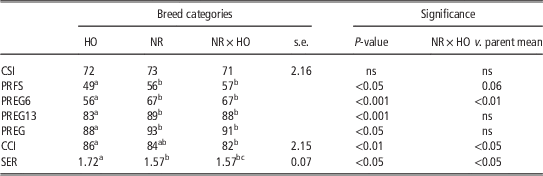
More recent analysis incorporating 3 years’ detailed fertility data (unpublished) is presented in Table 1. The results affirm the findings of Begley et al. (Reference Begley, Pierce and Buckley2009) and concur with the results of Walsh et al. (Reference Walsh, Buckley, Pierce, Byrne, Patton and Dillon2008) and Ferris et al. (Reference Ferris, Patterson and McKeague2004), the only other studies to compare the performance of Holstein-Friesian and ‘pure’ Norwegian Reds. The findings reflect the historic divergence in breeding goals between the two breeds, specifically, the inclusion of female fertility in the Norwegian Total Merit Index since the early 1970s. Of practical significance to Irish dairy farmers is the effective correction of inferior fertility in a single generation. This together with the finding that herd productivity was not compromised (+2% milk volume, +1.3% milk solids yield; fat plus protein) by crossing with Norwegian Red (Buckley and Shalloo, Reference Buckley and Shalloo2009), provides Irish dairy farmers with a viable option to improve profitability by reducing the cost associated with sub-optimal fertility/longevity.
Mean phenotypic performance of the Holstein (HO), Norwegian Red (NR) and NR×HO for a range of fertility traits, during parities 1 to 3

ns=significant difference>0.05; CSI=calving to service interval; CCI=calving to conception interval; SER=number of services; PRFS=pregnancy rate to first service; PREG6=percentage in-calf at 6 weeks; PREG13=percentage in-calf at 13 weeks; PREG=final pregnancy rate at end of breeding season.
a–cMeans within a row with different superscripts differ (P<0.05).
Concurrent with the study by Begley et al. (Reference Begley, Pierce and Buckley2009), a research study evaluating the merits of Jersey and Jersey×Holstein-Friesian crossbreds was conducted by Prendiville et al. (Reference Prendiville, Pierce and Buckley2009, Reference Prendiville, Lewis, Pierce and Buckley2010a, Reference Prendiville, Pierce and Buckley2010b, Reference Prendiville, Pierce, Delaby and Buckley2011a and 2011b). Jersey until then was not considered a suitable cross within the context of EU milk (fat) quotas owing to the negative impact of high milk fat content. A compounding negative being the much reduced male calf and cull cow values. However, impending abolition of quota, and expected drive for expansion and productivity meant that the alleged favourable performance of Jersey crossbreeding; productivity and efficiency of production (Penno, Reference Penno1998; Grainger and Goddard, Reference Grainger and Goddard2004) warranted evaluation under Irish conditions. Prendiville et al. (Reference Prendiville, Shalloo, Pierce and Buckley2011b) best summarises the production and reproduction performance and in addition an economic appraisal of the Holstein-Friesian, Jersey and Jersey×Holstein-Friesian cows based on 329 lactations over 3 years. A genotype effect was observed for the critical fertility traits. The proportion of cows pregnant to first service (+0.21; P<0.01), in-calf after 6 weeks’ breeding (+0.19; P<0.05) and in-calf after 13 weeks’ breeding (+0.08; P<0.05) were considerably higher for the Jersey×Holstein-Friesian compared with Holstein-Friesian (and pure Jersey cows). The economic analysis, a simulation incorporating the biological data from the study, determined the implications of the relative animal performance with regard to herd productivity and profitability (Prendiville et al., Reference Prendiville, Shalloo, Pierce and Buckley2011b). The impending removal of EU milk quotas will result in land becoming the most limiting resource in Ireland. The economic analyses show that with a fixed land base, and across three milk prices, a herd of Jersey×Holstein-Friesian cows is substantially more profitable than a herd of either of the parent breeds, owing to lower replacement cost and higher herd productivity (milk solids output). A study conducted at the Agri-Food and Biosciences Institute, Hillsborough, Northern Ireland (Vance et al., Reference Vance, Ferris, Elliott, Hartley and Kirkpatrick2013) comparing Jersey×Holstein with Holstein across three contrasting grass-based systems of production, determined that Jersey×Holstein cows consistently had fewer days to the first observed heat (−9 days; P<0.05), higher conception rate to first service (+23 percentage units; P<0.01) and higher pregnancy rate at the end of the breeding season (+16 percentage units; P<0.05). In this study, no difference in milk solids yield was observed between the two genotypes at modest levels of concentrate input.
A comprehensive analysis of data from the Irish National database (Buckley et al., Reference Buckley, Begley, Pabiou, Pierce and Evans2014) has provided specific breed and heterosis effects for the most prevalent dairy breeds and their crosses with Holstein. This analysis confirms the research findings, from the controlled smaller scale research studies, that fertility and survival are significantly improved with crossbred cows. The data included Holstein, British Friesian, New Zealand or Kiwi Friesian, Jersey, Norwegian Red and Montbeliarde genetics. Compared with Holstein, the breed effects for calving interval were: −5 days for Jersey (P<0.001), −8 days for Montbeliarde (P<0.001), −9 days for New Zealand Friesian (P<0.001), −11 days for Norwegian Red (P<0.001) and −12 days for British Friesian (P<0.001). Heterosis values for calving interval were also favourable (P<0.05) for crosses between Holstein and Jersey (−3.6 days), Montbeliarde (−6.1 days), New Zealand Friesian (−3.6 days), Norwegian Red (−2.7 days) and British Friesian (−1.1 days). Breed effects for survival were also significantly more favourable: +5.6%, +3.8%, +4.9% and +2.7% for Jersey, Montbeliarde, Norwegian Red and British Friesian, respectively, per lactation relative to Holstein. Heterosis values for survival (per lactation) were positive for all crosses, ranging from +0.5% for British Friesian×Holstein to +3.0% for New Zealand Friesian×Holstein. Heterosis values for the other three breeds and Holstein ranged between +1.0% and +1.6%. Taking both the breed and heterosis values into consideration, the analysis illustrates that, on average, 19%, 19% and 17% more F1 cows of Jersey×Holstein, Norwegian Red×Holstein and Montbeliarde×Holstein genetics, respectively, are surviving to the start of 6th lactation compared with pure Holstein cows. The analysis also indicates that these F1 crossbred cows have 8, 6 and 10 days, respectively, superior calving intervals. Analysis confirmed the predisposition of Holstein to produce higher milk volumes compared with all other breeds; however, of practical significance was the finding that most of the crossbreds (with Holstein) evaluated had the potential to produce similar or higher yields of milk solids per lactation. The findings are broadly consistent with values published previously using Irish data by Penasa et al. (Reference Penasa, Lopez-Villalobos, Evans, Cromie, Dal Zotto and Cassandro2010), Coffey et al. (2014) and Wall et al. (2005) with UK data, and Harris and Kolver (Reference Harris and Kolver2001) in New Zealand.
Lessons from New Zealand
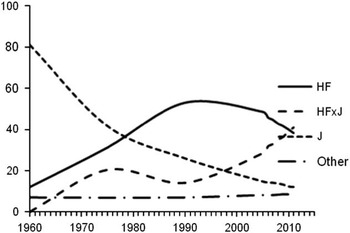
The dairy cow population has experienced three major breed changes since 1940 (Holmes et al., 2007). The Milking Shorthorn was the dominant breed in 1940 but by the 1960 ∼80% of the population of dairy cows in New Zealand were Jersey (Figure 1). Upgrading to Holstein-Friesian started in 1960 with the introduction of North American-derived Holstein genetics. The proportion of the Holstein-Friesian in the national herd peaked in the late 1980s and early 1990 (Harris and Kolver, Reference Harris and Kolver2001). Since 1990, farmers have adopted crossbreeding as a strategy in itself rather than as a method for changing from one breed to an alternative breed (Harris, Reference Harris2005). The proportion of crossbreed cows, commonly defined as animals with less than 14-sixteenths of single-breed ancestry, is for the first time in the 40% threshold, making crossbreds officially the dairy cow of choice (Livestock Improvement Corporation and DairyNZ (LIC and DairyNZ, 2013).
Trends in the breed composition of the national herd of New Zealand.

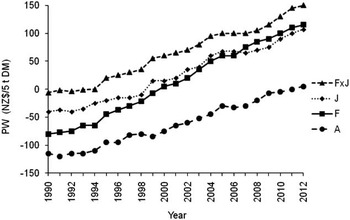
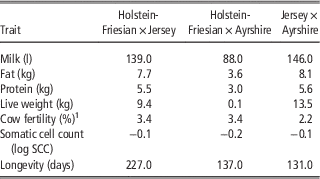
The popularity of crossbreeding in New Zealand is attributed to high productivity in pasture-based systems (Penno, 1998), superior reproductive performance (Auldist et al., 2007), longer survival (Harris et al., 2001) and consequential benefits in terms of profit (Lopez-Villalobos et al., 2000). The current genetic evaluation system demonstrates an economic advantage of crossbreds over purebreds (Figure 2) as a result of favourable heterosis for production traits, live weight, fertility, somatic cell count (SCC) and longevity (Table 2). The system of genetic evaluation of New Zealand dairy cattle is an across-breed system that allows the selection of dams to breed replacements on the basis of their breeding worth (BW) and also allows the culling of cows on the basis of their production worth (PW). The BW of a cow is calculated as:
 $$\eqalignno{ {\rm BW} =&{\rm Fat \ EBV}{\times}{\rm Fat \ EV} \cr & {\plus}{\rm Protein \ EBV}{\times}{\rm Protein \ EV} \cr & {\plus}{\rm Milk} \ {\rm EBV}{\times}{\rm Milk \ EV} \cr & {\plus}{\rm Liveweight \ EBV}{\times}{\rm Liveweight \ EV} \cr & {\plus}{\rm Somatic \ cell \ score \ EBV}{\times}{\rm Somatic \ cell \ score \ EV} \cr & {\plus}{\rm Fertility \ EBV}{\times}{\rm Fertility \ EV} \cr & {\plus}{\rm Longevity \ EBV}{\times}{\rm Longevity \ EV} $$
where estimated breeding values (EBV) for each cow are derived from an across-breed animal model considering all the genetic relationships between the animals included in a large pedigree file (Harris, Reference Harris1994). The economic values (EV) for each of these traits are derived from a farm model that includes incomes from milk, cull cows and surplus calf sales; costs associated with farm operations, and feed required for production, growth, and maintenance of cows and replacements (New Zealand Animal Evaluation Limited (NZAEL), 2014).
Trend in production worth in New Zealand dairy cattle. LIC and DairyNZ 2013.

Heterosis effects for traits of economic importance in New Zealand dairy cattle (Harris, Reference Harris2005)

1 Fertility defined as probability of a cow to have a calf born to artificial insemination during the calving period.
PW is another economic selection index that estimates the efficiency with which a cow converts feed into farm profit:
 $$\eqalignno{ {\rm PW} = \,&{\rm Fat \ EPV}{\times}{\rm Fat \ EV} \cr & {\plus}{\rm Protein \ EPV}{\times}{\rm Protein \ EV} \cr & {\plus}{\rm Milk \ EPV}{\times}{\rm Milk \ EV} \cr & {\plus}{\rm Liveweight \ EPV}{\times}{\rm Liveweight \ EV} $$
where estimated production values (EPV) for each cow are derived as the sum of EBV, plus permanent environment and heterosis effects. Therefore, crossbred cows in New Zealand express superiority for farm profit derived from the combination of selection and crossbreeding. Figure 2 clearly shows that the crossbred Friesian×Jersey cow population achieves similar rates of genetic gain for farm profit as the purebred Friesian and Jersey populations, but at the same time creates an additional gain derived by the economic heterosis, derived in itself from the cumulative heterosis effects of individual traits (Lopez-Villalobos and Garrick, Reference Lopez-Villalobos and Garrick2006).
Recently, 15% of bulls progeny-tested by AI companies in New Zealand are themselves crossbred, predominantly Holstein-Friesian×Jersey first-cross sires. Motivation for progeny testing crossbred sires includes the maintenance of high selection intensity on the cows used to breed bulls in the selection pathway, which accounts for around 34% of genetic improvement in dairy cattle in New Zealand (Lopez-Villalobos et al., Reference Lopez-Villalobos, Garrick, Blair and Holmes2000). Confining selection of dams of sires to straight-bred cows would reduce selection intensity on this pathway. The first intake of the crossbred sires graduated from progeny-testing schemes in the 2004 to 2005 dairy season. In November 2013, of the top 30 active AI sires ranked by BW, 6 were crossbreds and the average BW of the crossbred bulls were higher than the average BW of Friesian and Jersey bulls. The introduction of crossbred sires allows farmers the choice of using more complex crossbreeding strategies through the use of mate-selection tools that can maximise the heterosis and PW of future progeny (Lopez-Villalobos et al., Reference Lopez-Villalobos, Harris and Pryce2004).
Research findings in the United States
There are research studies documenting the role of crossbreeding in the US dairy industry, but many are quite old and outdated. Earlier studies on experimental herds indicated that crossbreds had superior fertility and longevity compared with Holsteins at the University of Illinois (Touchberry, Reference Touchberry1992) and Agriculture Canada (McAllister et al., 1994). Although, until recently, crossbreeding of dairy cattle in North America has been uncommon, it has become a current topic of great interest, developed in response to concerns dairy producers have about fertility, health and survival of lactating Holstein cows (Funk, 2006). The decline in fertility and survival of Holstein led the managers of seven large dairies in California to mate Holstein heifers and cows with semen of the Normande and Montbeliarde breeds, as well as the Swedish Red and Norwegian Red. Crossbred cows calved for the first time from June 2002 to January 2005, and some cows in the seven dairies continued to be Holstein, which permitted comparison of crossbred and Holstein cows (Heins et al. Reference Heins, Hansen and Seykora2006a, Reference Heins, Hansen and Seykora2006b and Reference Heins, Hansen and Seykora2006c). Cows were followed up throughout their lifetimes to compare fertility, survival and profitabilty.
The three crossbred groups were all superior to the Holsteins for fertility across the first five lactations. First-service conception rates were higher for the Scandinavian Red×Holstein crossbreds (+6%), and substantially higher (+10%) for Montbéliarde×Holstein crossbreds compared with Holsteins (23%). Furthermore, the crossbred cows had distinct advantages for days open. The Holsteins in the California dairies had average days open of 148 days across five lactations, and all of the crossbred groups had significantly (P<0.05) fewer days open than the Holsteins. The difference from the Holsteins ranged from 12 days for the Scandinavian Red×Holstein crossbreds to 20 days for Normande×Holstein crossbreds and 26 days for the Montbéliarde×Holstein crossbreds. The advantage for fertility of the crossbreds compared with Holsteins may have been partially because of the reduced calving difficulty and stillbirths observed for the crossbreds (Heins et al., Reference Heins, Hansen and Seykora2006c). Along with the advantages in fertility, crossbred cows in large California dairies had advantages for survival. All crossbred groups (Table 3) had higher percentages of cows that calved a second and third time than Holsteins (Heins et al., Reference Heins and Hansen2012a). The largest difference in survival was before the second calving. Of the Holsteins, 25% did not calve a second time, whereas only 10% to 14% of crossbreds did not calve a second time. Furthermore, only 29% of Holstein calved four times; however, 50% to 55% of crossbred cows calved a fourth time. The difference of crossbreds and Holsteins was statistically significant in all cases.
Results for European-sired crossbreds (Normande, Montbéliarde and Scandinavian Red sires) compared with Holsteins in high-input confinement dairies in the United StatesFootnote 1

SCS=somatic cell score.
1 Heins and Hansen (2012) and Heins et al. (2012a) facilitate.
Survival from calving to first observation of milk recording was compared for crossbreds v. pure Holsteins that were calved for the first time (Heins et al., Reference Heins and Hansen2012a). Death rate, culling rate and total removal rates reflect the actual percentage of cows that left the six dairies before the first observation for milk recording and up to the 305th day of lactation. Only 0.9% (10 of 1075) crossbred cows died before the first observation for milk recording; however, 3.6% (15 of 416) pure Holsteins died before the first observation for milk recording (Heins et al., Reference Heins and Hansen2012a). Furthermore, 1.7% (18 of 1075) crossbred cows compared with 5.3% (22 of 416) pure Holstein cows died during the first 305 days of first lactation (Heins et al., Reference Heins and Hansen2012a). More crossbreds remained in these dairies than pure Holsteins, with only 7.4% of the crossbred cows v. 15.9% of the pure Holsteins in these dairies removed (died or culled) by the 305th day of the first lactation (Heins et al., Reference Heins and Hansen2012a).
Crossbreeding of dairy cattle is being explored mostly for its potential to improve the fertility and survival of cows. Quite possibly, advantages for these functional traits will compensate substantially for any potential loss of production of crossbreds compared with Holsteins. Therefore, production and profitability must be evaluated when assessing alternative breeds of dairy cattle for use in crossbreeding. In the California study, all three crossbred genotypes had reduced 305-day fat plus protein production compared with the Holstein cows. The magnitude of the difference, however, was small for the Montbeliarde×Holstein and Scandinavian Red×Holstein cows. Notably, the results for production are reported on a 305-day projected basis, which does not necessarily reflect milk produced within a fixed interval of time, because cows that died or left the herd are projected to 305 days (Heins and Hansen, Reference Heins and Hansen2012). For profitability, Normande×Holstein cows had 26% greater lifetime profit per cow, but 6.7% less profit per day, than Holstein cows. On the contrary, Montbeliarde×Holstein and Scandinavian Red×Holstein cows had 50% to 44%, respectively, more lifetime profit per cow and 5.3% to 3.6%, respectively, more profit per day than Holstein cows.
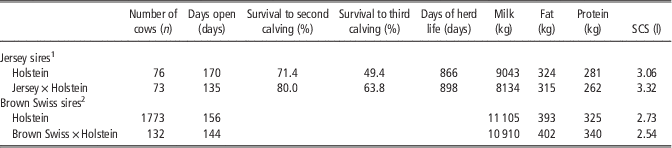
Crossbreeding was initiated in 2000 with two research herds of Holstein at the University of Minnesota, and the herds were the St. Paul campus herd and the herd at the West Central Research and Outreach Center at Morris. To evaluate fertility, survival and production, Holstein heifers and cows at the St. Paul and Morris dairies were bred to Jersey AI bulls. First-service conception rates between the Holsteins (41%) and Jersey×Holstein crossbreds (39%) were not different (Heins et al., Reference Heins, Hansen, Seykora, Johnson, Linn, Romano and Hazel2008). The 71 Holsteins had average days open of 170 days (Table 4) during the first lactation, and the Jersey×Holstein crossbreds had significantly fewer days open than Holsteins. The difference compared with the Holsteins was 35 days. These results agree with most other recent research on fertility of Holsteins v. F1 crossbreds involving Holstein (Heins et al., Reference Heins, Hansen and Seykora2006b; Heins and Hansen, Reference Heins and Hansen2012), which have typically reported 2 to 3 weeks fewer days open of crossbreds v. Holsteins. Survival from first to second calving did not differ significantly for Jersey×Holstein crossbreds (80%) and Holsteins (71%) cows. However, a higher percentage of Jersey×Holstein crossbreds than Holsteins cows did calve a second time within 14 months of first calving (61% v. 48%). A higher percentage of Jersey×Holstein crossbreds calved a third time (64% v. 49%; Heins et al., Reference Heins and Hansen2012b), and and a higher percentage of crossbred cows calved a third time within 14 months of second calving than Holstein cows (64% v. 40%).
Results for Jersey×HolsteinFootnote 1 and Brown Swiss×HolsteinFootnote 2 crossbreds compared with Holsteins in high-input confinement dairies in the United States

SCS=somatic cell score.
1 Heins et al. (Reference Heins, Hansen, Seykora, Hazel, Johnson and Linn2011 and Reference Heins, Hansen, Hazel, Seykora, Johnson and Linn2012b).
2 Dechow et al. (Reference Dechow, Rogers, Cooper, Phelps and Mosholder2007).
The fertility and survival advanatges of the Jersey×Holstein crossbreds may be overshadowed by the reduction in productivity compared with the Holsteins. The Holsteins produced 909 kg more milk in 305 days than the Jersey×Holsteins across the first three lactations. There was no difference in fat production; however, the Holsteins had on average more protein (+19) in 305 days than the Jersey×Holstein crossbreds. The Jersey×Holstein crossbreds (−3%) were significantly lower than the pure Holsteins for fat plus protein production (Heins et al., Reference Heins, Hansen, Seykora, Hazel, Johnson and Linn2011). In addition, although the Jersey×Holstein crossbred cows were much more likely to survive to second and third lactation than their Holsteins herdmates, in later lactations the Jersey×Holstein crossbreds tended to become extremely deep in the udder, develop higher SCC and leave the herd quickly at that stage of life (Heins et al., Reference Heins, Hansen, Seykora, Hazel, Johnson and Linn2011).
Researchers at Penn State University compared crossbred cows of Brown Swiss and Holstein v. Brown Swiss and Holstein cows for milk, fat, and protein production, somatic cell score and days open (Dechow et al., Reference Dechow, Rogers, Cooper, Phelps and Mosholder2007). Brown Swiss×Holstein cows had 17 fewer days open than Holstein cows during the first lactation (123 v. 130 days, respectively). Furthermore, Brown Swiss×Holstein cows had numerically, not significantly, fewer days open in the second (12 days) and third lactation (6 days), than Holstein cows. Heterosis estimates for days open were significantly higher for the first lactation (15%) compared with the second and third lactations. Brown Swiss×Holstein cows were not different from Holstein cows for daily milk production, mature equivalent milk and fat production, or somatic cell score. The Brown Swiss×Holstein cows had higher daily fat and protein production, as well as higher mature equivalent protein production compared with Holstein cows.
Recently, at the University of Minnesota dairy herds, F1 crossbreds, Montbeliarde×Holstein and three-way crossbreds, Montbeliarde×(Jersey×Holstein) were compared with Holstein cows for fertility, survival to subsequent calving, mortality and production, during their first five lactations (Hazel et al., Reference Hazel, Heins, Seykora and Hansen2014). Across the two University of Minnesota herds, the Montbeliarde×Holstein and Montbeliarde×(Jersey×Holstein) crossbred cows had 21% higher first-service conception rate, 41 fewer days open and 12% higher pregnancy rate compared with the Holstein cows. Furthermore, the Montbeliarde×Holstein (5%) and Montbeliarde×(Jersey×Holstein) (12%) crossbred cows had lower mortality rates than the Holstein cows (18%). Because of superior fertility and lower mortality rates, the Montbeliarde×Holstein and Montbeliarde×(Jersey×Holstein) crossbred cows, had greater survival to the second (+13%), third (+24%), fourth (+25%) and fifth (+17%) lactation compared with Holstein cows (Hazel et al., Reference Hazel, Heins, Seykora and Hansen2014).
Across-breed evaluations
As outlined, selection and mating systems across breeds can improve cow performance and produce more profit than selection within breed if the selection strategy is well planed and well managed. To assist with this, it is useful if an across-breed evaluation is in place that ensures that additive and non-additive breed differences are well estimated. Most genetic evaluations compare animals within breeds only. Exceptions for dairy cattle are the evaluations in New Zealand (Harris, Reference Harris1994), the Netherlands (Harbers, Reference Harbers1997), the United States (VanRaden et al., Reference VanRaden, Tooker, Cole, Wiggans and Megonigal2007) and Ireland (Wickham et al., Reference Wickham, Amer, Berry, Burke, Coughlan, Cromie, Kearney, McHugh, McParland and O’Connell2012). This system of genetic evaluation allows farmers to compare animals nationally and within herd, regardless of breed, and select the most profitable animals for the future. In addition, inclusion of data from crossbred animals can lead to more reliable evaluations of purebred relatives, more accurate comparisons of genetic merit among all potential mates and improved breeding programmes that identify the best gene combinations. Accurate acrossbreed genetic evaluations require a structure of the cow population comprising a significant proportion of crossbred cows and mixed-breed herds that provided extensive linkages between cows of different breeds and crosses in large contemporary groups. Recording templates must facilitate the recording of ancestry and performance of crossbred cows. As stated earlier, of practical significance is the multiplicative heterostic effects of a combination of traits that result in economic heterosis. In Ireland, it is estimated that economic heterosis can contribute in excess of €100 per lactation, calculated using heterosis fixed-effect estimates from national genetic evaluations (Evans, personal communication). Using heterosis values presented by Harris (Reference Harris2005) and EVs from NZAEL (2014), the economic heterosis value in New Zealand approximates NZ$96.
Where to after the first cross?
Performance of the first crosses will please even the most critical. First crosses tend to tick all the boxes: display full heterosis, productive and fertile. They also tend to be uniform in appearance (colour, size, etc.). For traits displaying a lot of heterosis, for example, fertility and longevity, subsequent generation performance may decline, depending to varying extents on the additive genetic contribution of the subsequent sires used. Heterosis is not fully passed on to the next generation, but it is not lost. The extent to which heterosis is expressed in later generations is dependent on the strategy taken after the first cross. Several schemes are available for creating replacement animals via crossbreeding (Cunningham and Syrstad, Reference Cunningham and Syrstad1987). The three most common are as follows:
-
∙ Two-way crossbreeding. This entails mating the F1 cow to a high genetic merit sire of one of the parent breeds used initially. In the short term, heterosis will be reduced but over time settles at 66.6%.
-
∙ Three-way crossing. Uses high genetic merit sires of three breeds. When the F1 cow is mated to a sire of a third breed, heterosis is maintained 100%. However, with the reintroduction of sires from the same three breeds again in subsequent generations heterosis averages 85.7%.
-
∙ Synthetic crossing. This involves the use of high genetic merit crossbred bulls. The simplest synthetic is one derived from two parent breeds. In the long term, a new (synthetic) breed is produced. Heterosis in this strategy is reduced to ∼50% in subsequent generations.
Concluding Remarks
Crossbreeding should be regarded as a mating system that complements genetic improvement within breeds. Continuous use of progeny-tested and highly ranked AI bulls is critical to genetic improvement, regardless of the mating system. Heterosis is a bonus that dairy producers can expect in addition to the positive effects of individual genes obtained by using superior AI bulls within breed. Some dairy producers might need to get beyond the notion that the level of milk production is the only measure of profitability of dairy cows.
The findings from the research presented clearly illustrates favourable animal performance benefits from crossbreeding, using a range of modern breeds, and within the context of both low-cost (grass-based) and high-input confinement production environments. Crossbreeding is clearly a very powerful means to improve the fertility and survival of commercial dairy herds and in doing so improves their long-term profitability and sustainability. A study by Kargo et al. (Reference Kargo, Madsen and Norberg2012) supports the notion that crossbreeding, as a mating system, is relevant for all management intensity levels. Evidence from New Zealand would concur that, despite increased additive genetic gain within the main purebred populations, it is the crossbred cows that continue to generate greatest profit (LIC and DairyNZ, 2013; Figure 2). In New Zealand, the proportion of dairy cows categorised as crossbred has reached an all-time high. For the first time, over 40% of dairy cows and 50% of replacement females are crossbred, making crossbreds officially the dairy cow of choice (LIC and DairyNZ, 2013). Elsewhere, a fear of the unknown, or perhaps a conservative bias or mindset, would appear to be restricting the growth of what might pragmatically be recognised as a prudent use of available genetic resources to maximise profitable dairy production. In Ireland, dairy crossbreds currently represent ∼8% of dairy births (Department of Agriculture, Food and the Marine, 2012). In the United States, the percentage of the national herd that was crossbred increased from 0.6% for cows born in 1990 to 3.0% for cows born in 2005 (Powell et al., Reference Powell, Norman and Hutchison2008). In 2012, 8.4% of the dairy cattle population in the United States was crossbred in Dairy Herd Improvement herds (Animal Improvement Programs Laboratory, 2012).
In summary, despite the very positive and consistent research findings, as stated by McAllister (Reference McAllister2002), the rather limited but current interest in crossbreeding in commercial US dairy industry is an interesting development. The sentiment is telling, and equally valid for most countries where positive results pertaining to crossbreeding in the dairy herd has been observed.
Acknowledgement
The authors express gratitude to Noel Byrne, Billy Curtin and staff at the Teagasc Ballydague Research Farm, Bill Hansen and co-workers at the St. Paul, Minnesota, dairy facility and Darin Huot, and co-workers at the West Central Research and Outreach Center (Morris, Minnesota) for their assistance in data collection and care of animals. The authors are especially grateful to the owners/managers of the 46 Irish and 7 California dairy herds, who willingly provided data from their cows. Without their cooperation, these studies would not have been possible. The authors also gratefully acknowledge the financial support in Ireland from the Dairy Levy Trust, the National Development Plan and the Research Stimulus Fund (RSF-06-353 and RSF-07-517). In North America, funds were provided by the American Jersey Cattle Club Research Foundation (Reynoldsburg, OH) and Coopex Montbéliarde (Roulans, France).