


INTRODUCTION
Political participation is costly and fraught with uncertain outcomes that often prevent it from occurring. Social rewards for engaging, though, like acceptance, reverence, or even friendship, can offset these challenges (Salisbury Reference Salisbury1969; Gerber, Green, and Larimer Reference Gerber, Green and Larimer2008; Sinclair Reference Sinclair2012). A growing literature has established that social norms—or the standards of groups that emerge out of social interactions (Cialdini and Trost Reference Cialdini, Trost, Gilbert, Fiske and Lindzey1998)—affect political participation, but few have considered how context may alter the content and enforcement of these norms. Instead, most assume a widespread sense of civic duty that incentivizes political participation similarly across groups. In contrast, I argue that disparate histories in access to the franchise and the segregated nature of American communities create race-specific social norms regarding political participation. These group-based norms often lead racial minorities to value participation more than Whites, especially participation that is grassroots in nature.
Drawing from multiple social science disciplines, I develop a framework that contextualizes social norms and anticipates racial variations in the social motivations that structure participation. I argue that historical limitations in access to the franchise have forced minority groups to place additional social weight on unconventional forms of participation including protests and political rallies. Furthermore, “the long march” to voting rights characterized most recently by the Civil Rights Movement has created a powerful pro-voting norm among Black Americans. These group-based variations in participatory social norms should be strongest, I argue, in segregated communities where group cohesion allows social information to be easily shared and where enforcement is most potent. When considering racial segregation and historical differences in access to democratic governance, it becomes clear that rather than a monolithic civic duty norm, Americans exist in a context-specific framework of social motivations—one that systematically varies by race and place, and often leads racial minorities to magnify the social value of political involvement.
I use a mixed-data, mixed-methods approach to test whether attitudes about political participation and social rewards for political involvement diverge by race. My analyses focus on differences across the three largest racial groups in the United States: Whites, Blacks, and Latinos.Footnote 1 Using an original, nationally representative survey of roughly 2000 respondents, I find that minority Americans are more likely to value unconventional political acts than Whites, believing these activities help people in need and improve their communities at significantly higher rates. Similarly, Black Americans place more symbolic weight on the act of voting than do other groups.
Next, I use an original survey experiment to show that beliefs about the value of participation translate into willingness to socially reward individuals engaged in these acts. I present roughly 1,200 Whites, 1,200 Blacks, and 750 Latinos with profiles of hypothetical community members involved in various political activities and ask them to judge these potential neighbors on likability and respectability. Consistent with the observational results, Blacks and Latinos on average provide more social incentives to be active in grassroots political activities like rallies than do Whites, and Black Americans consistently reward voters at comparatively higher rates than both groups.
I then merge my survey data with information from the 2009-2013 American Community Survey to test whether the social value of participating is tied to contextual factors. I find that social rewards are strongly moderated by context. Specifically, Black Americans’ willingness to reward political involvement significantly increases when they live in mostly co-racial neighborhoods. This finding suggests one pathway through which Black Americans have managed to overcome persistent voting costs, engaging at higher rates than expected according to both conventional and aggregate models of turnout (e.g., Wheaton Reference Wheaton2013; Verba, Schlozman, and Brady Reference Verba, Schlozman and Brady1995; Verba and Nie Reference Verba and Nie1972). While Latinos living in mostly Latino neighborhoods are no more likely to socially reward participators, those living in areas with large populations of noncitizens are, suggesting that existing rather than historical disenfranchisement may be the primary contextual dimension driving norm heterogeneity for Latinos.
Together, my results suggest that not only is political participation social, but that the communities in which norms are forged and enforced vary in the United States. Many dimensions of community difference likely exist but race remains a fundamental separator, altering social space, social relationships, and social experience. It is only when we consider race, place, and social norms, focusing on the social contexts in which concepts of civic duty are built, that we might fully understand why some people participate in politics while others do not.
RACE, PLACE, AND SOCIAL NORMS
Scholarship on political participation in the United States has a long history. Early theorists often argued that participation was natural, sown into the very fabric of the human spirit (Madison [1787] Reference Madison2004, 60–9), but twentieth-century work has since established that involvement in politics is in fact teeming with challenges that often prevent it from occurring (Downs Reference Downs1957; Olson Reference Olson1965; Salisbury Reference Salisbury1969). Specifically, participation takes time and money, among other resources, and political outcomes are often uncertain. Combined with the shared nature of the final good, people face the compelling option to free ride on the efforts of others. Viewed through this lens of collective action, participation becomes anything but inevitable.
A long research tradition in social psychology helps to explain how citizens might overcome these barriers to occasionally participate in politics. Scholars have found over the course of decades that group-based social norms can powerfully shape both attitudes and behaviors—even the seemingly irrational or costly (Cialdini and Trost Reference Cialdini, Trost, Gilbert, Fiske and Lindzey1998; Cialdini, Kallgren, and Reno Reference Cialdini, Kallgren and Reno1991; Crandall Reference Crandall1988; Asch Reference Asch1955; Sherif Reference Sherif1936). Social norms are the informal rules or standards of a group that develop through human interactions and help individuals build and maintain relationships. Although some norms simply describe behaviors, injunctive norms actually prescribe them, defining what is morally right or valued by a group (Tankard and Paluck Reference Tankard and Paluck2016). Scholars have shown that group members reward attitudes and behaviors that are believed to be prescriptively valuable while punishing deviation (Cialdini and Trost Reference Cialdini, Trost, Gilbert, Fiske and Lindzey1998). In leveraging social rewards and sanctions like inclusion, respect, and friendship, group members shape the behavior of those in their social space by fundamentally shaping motivation for action.
Over time, external norms can become internalized, transforming into personal norms that guide the actions of individuals even in the absence of observation (Schwartz Reference Schwartz and Berkowitz1977; Cialdini and Trost Reference Cialdini, Trost, Gilbert, Fiske and Lindzey1998; Hogg Reference Hogg and Delamater2003). Through this process, norms also serve a central role in building and managing self-concept. In the world of Bentham or Foucault, personal norms might be thought of as a cognitive panopticon, a constant monitoring system based in the principles of the outside world. But as social psychologist or political scientists, we might more directly conceive of them as moral beliefs or attitudes—individual concepts about what is valuable, good, and right.
Drawing from the work of social psychologists, political scientists have shown that social influence affects political behavior just as it does all other forms of human action (McClendon Reference McClendon2014; Rogers, Fox, and Gerber Reference Rogers, Fox, Gerber and Shafir2013; Panagopoulos Reference Panagopoulos2010; Gerber and Rogers Reference Gerber and Rogers2009). Gerber and colleagues (Reference Gerber, Green and Larimer2008), for instance, persuasively demonstrate that the threat of social observation increases turnout at rates far surpassing other messages. McKenzie (Reference McKenzie2004) has found that kinship groups strongly influence participatory choices. And Sinclair (Reference Sinclair2012) demonstrates that political giving to campaigns and candidates is a function of peer networks. Political behaviors, it seems, are fundamentally social behaviors, shaped not only by individual characteristics like resources and education (Verba, Schlozman, and Brady Reference Verba, Schlozman and Brady1995), but also by social information, the environment, and peer pressure.
To date, work on participatory social pressure largely assumes or asserts the presence of a positively valenced participatory norm among Americans. Scholars posit a widespread injunctive norm that values political involvement—often, this is called civic duty—and then layer on a measure of observation or pressure, demonstrating that with this social component comes an increase in political participation. Despite focusing primarily on White samples (Gerber, Green, and Larimer Reference Gerber, Green and Larimer2008),Footnote 2 or only one other racial group at a time (McKenzie Reference McKenzie2004), scholars typically interpret their findings as widely generalizable. Gerber, Green, and Larimer (Reference Gerber, Green and Larimer2008) provide a clear example of this. In their landmark study on norm enforcement, the authors write, “while people vary in terms of their willingness or eagerness to conform to norms of civic participation, the norm is widely accepted as an appropriate behavioral standard” (Gerber, Green, and Larimer Reference Gerber, Green and Larimer2008, 40).
This proposition assumes that citizens across the country experience their government the same way, yet this is decidedly not the case. Rather, since the founding of the republic, some groups have been allowed to participate in democratic self-governance while others have not (Takaki Reference Takaki2008; Keyssar Reference Keyssar2000). Race, in particular, has served as a salient dividing line in politics, defining inclusion and exclusion, overdetermining life chances, structuring access to resources, and moderating the reception of new citizens (Haney-Lopez Reference Haney-Lopez1997; Katznelson Reference Katznelson2005; Dawson Reference Dawson1994; Jiménez Reference Jiménez2010). Racial groups continue to face different constraints in access to the franchise and experience a fundamentally different “face-of-the-state” when interacting with bureaucrats and elected officials (Uggen, Shannon, and Manza Reference Uggen, Shannon and Manza2012; Lerman and Weaver Reference Lerman and Weaver2014; Butler and Broockman Reference Butler and Broockman2011).
Seeking political voice, American minorities through the centuries have turned to alternative means of political involvement, including contentious protest methods and grassroots organizing (Barreto et al. Reference Barreto, Manzano, Ramírez and Rim2009; Hogan Reference Hogan2007; McAdam Reference McAdam1988). With traditional avenues of participation closed, racial minorities have developed a unique toolset of participatory skills that has, in some cases, effectively changed the course of policy (Gillion Reference Gillion2013; Enos, Kaufman, and Sands Reference Enos, Kaufman and Sands2016). These struggles may lead minority Americans to assign additional value to protest methods, behaviors that have been uniquely important to the group in the past. This may be especially true for groups who continue to lack access to the franchise like Black communities that are disproportionately affected by felony disenfranchisement or Latino communities heavily populated by undocumented residents. Furthermore, groups who fought for access to the franchise may place additional symbolic weight on the act of voting that far exceeds its instrumental value, even exceeds the perceived value among Whites. As a result, what the “appropriate behavioral standard” is for political involvement may vary dramatically across communities with different historical relationships to participation, the tools of involvement, and governmental power.
This should be especially true in the context of the segregated social environments that persist in the United States today. Despite the work of activists over the past century to deconstruct American segregation, the nation’s macrostructures like schools, neighborhoods, and places of worship remain extensively segregated along the dimension of race (Logan and Stults Reference Logan and Stults2011; Logan, Stowell, and Oakley Reference Logan, Stowell and Oakley2002; Reardon, Yun, and McNulty Eitle Reference Reardon, Yun and Eitle2000; Dougherty Reference Dougherty2003). In fact, since the 1980s, the trend toward racial integration has largely stagnated or in some cases reversed (Reardon and Owens Reference Reardon and Owens2014; Logan Reference Logan and Stults2011).
Segregation encourages the development of group-based norms in two ways. First, segregation structures the micro-level relationships through which social norms emerge and are perpetuated (McPherson, Smith-Lovin, and Cook Reference McPherson, Smith-Lovin and Cook2001; Lawler, Ridgeway, and Markovsky Reference Lawler, Ridgeway and Markovsky1993). If social spaces of racial groups are distinct, the opportunity for norm divergence is present and members of socially separate groups may begin to develop unique norms in response to their experiences. Second, racially homogenous neighborhoods increase the ease of spreading information, levels of group cohesion, and willingness to trust and interact with neighbors (Oliver Reference Oliver2010; Larson and Lewis Reference Larson and Lewis2017; DeSante and Perry Reference DeSante and Perry2016). Trust, cohesion, and the spread of information each increase the enforcement power of norms; norms are most potent when individuals care about the opinions of other group members and when information about deviance or compliance can spread among connections.
The combination of distinct social spaces and divergent experiences with government create the opportunity for participatory norms to develop differently across racial groups. Rather than producing a monolithic civic duty norm, I argue that historical relationships to the franchise and the macrostructures of segregation create systematic variations in participatory norms. Specifically, I hypothesize that (1) racial minorities including Black Americans and Latinos will place more social value on contentious political acts than Whites, reflecting the historical and present-day usefulness of these nonelectoral techniques for minority groups. Furthermore, I expect that (2) neighborhood context will moderate the strength of norms. Specifically, I expect that Blacks living in co-racial neighborhoods or Latinos living in areas largely populated by naturalized or noncitizens will be most likely to incentivize nonelectoral political participation with social rewards.
In addition to contentious political acts, I expect that norms related to the value of voting will also vary across racial communities. Specifically, I expect that (3) Black Americans—a group with both a long and recent struggle to gain the franchise—will place special symbolic significance on the act of voting, rewarding voters more than Whites and maybe even more than Latinos. While many Latinos have ancestral ties to those who fought for the right to vote, many still lack the franchise due to citizenship status and, as a result, information or enforcement of voting norms may be weaker. Finally, I hypothesize that (4) norms of voting will be strongest in Black communities where clarity and enforcement of this unique social norm is easiest.
These hypotheses have critical implications for understanding who participates in the United States and how mobilization efforts should be designed. First, higher-than-average social rewards for engaging in minority communities may help to explain persistent aggregate-level patterns in political participation. Specifically, for decades scholars have found that when controlling for individual-level resources like income and education, Black Americans often outperform Whites in models of voting (Verba, Schlozman, and Brady Reference Verba, Schlozman and Brady1995; Wolfinger and Rosenstone Reference Wolfinger and Rosenstone1980; Uhlaner, Cain, and Kiewiet Reference Uhlaner, Cain and Kiewiet1989). In 2012, this pattern even appeared in the aggregate when Black voter turnout exceeded all other major racial groups despite persistent barriers like voter identification laws and lower-than-average resources (Wheaton Reference Wheaton2013). Scholars have shown that high Black turnout is most pronounced in neighborhoods dense with Black residents even when controlling for mobilization efforts (Barber and Imai Reference Barber and Imai2014; Fraga Reference Fraga2016). A theory of contextualized social norms suggests one explanation for these patterns: powerful pro-voting norms that are especially prevalent in Black neighborhoods provide Black Americans with incentives to vote that can counteract other costs.
Second, the hypotheses add to a growing literature that suggests predictors of political attitudes and behaviors among racial minorities may be different than for Whites (Masuoka and Junn Reference Masuoka and Junn2013; Barreto and Segura Reference Barreto and Segura2009; Dawson Reference Dawson1994). Rather than simply studying the behavior of majority Americans and generalizing these findings to minorities, I consider the way context alters the content and activation of political social norms.
THE VALUE OF PARTICIPATION VARIES BY RACE
I have argued that minority groups with distinct histories and ongoing experiences with exclusion from political power should see the purpose, value, and meaning of political participation differently than the dominant group. To test this theory, I begin by examining individual attitudes—or personal norms—about the value of political participation across racial groups. Drawing from ethnographic and historical work, I construct a set of questions to measure dimensions of potential difference in beliefs about the usefulness of political participation. Specifically, I examine individualistic versus communitarian approaches to political activity (Takaki Reference Takaki2008; Dawson Reference Dawson2001; Benmayor, Torruellas, and Juarbe Reference Benmayor, Torruellas, Juarbe, Flores and Benmayor1997; Flores and Benmayor Reference Benmayor, Torruellas, Juarbe, Flores and Benmayor1997), test whether participation is a way to express the Good Samaritan norm and care for others (Dawson Reference Dawson2001; Dawson Reference Dawson1994; Harris-Lacewell Reference Harris-Lacewell2004; Darley and Batson Reference Darley and Batson1973), and, finally, ask a more general question about political participation as tied to community membership. These questions unpack the broader concept of civic duty and consider whether prescriptive beliefs are tied to political participation for some groups more than others.
Reflecting my focus on both contentious and traditional forms of political participation, respondents were asked to evaluate two types of involvement: voting in presidential elections and attending political rallies. While voting requires legal enfranchisement and is both state sanctioned and state organized, political rallies are generally more grassroots in nature and are accessible to excluded political groups. For each act, respondents indicated whether they believed the act (a) makes their life better, (b) makes their community better, (c) helps people in need, and (d) indicates a good community member. These survey questions were fielded as part of an omnibus online study in August of 2014 to a nationally diverse sample of roughly 2,000 American adults. I used the online survey platform, Survey Sampling International, which draws from a preconstructed panel of respondents.Footnote 3
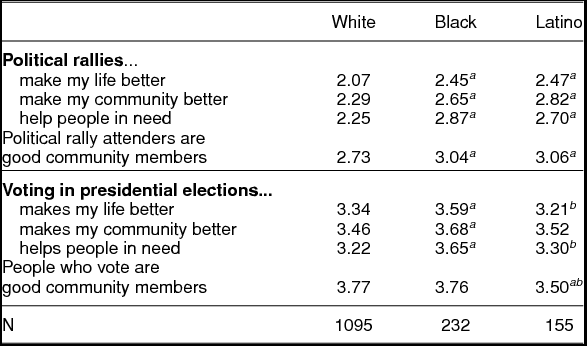
Table 1 displays the mean score of each question for the three racial groups.Footnote 4 Significant differences (p < 0.05) between the mean estimate for Whites and either Blacks or Latinos are reported with an a in Columns 2 and 3, respectively, and were calculated with a two-tailed t-test. Significant differences between the two minority group estimates are indicated with a b in Column 3.Footnote 5
Racial Variations in Beliefs About the Value of Political Actions

Notes: Question wording, ”Please indicate how much you believe each of the following statements to be true.” Response categories: 1 = Not at all, 2 = Not very, 3 = Somewhat, 4 = Very, 5 = Extremely. Columns show weighted means for each racial group. Significant differences (p < 0.05) determined through a two-tailed t-test between White and minority means are indicated with an a in the second and third columns if present; significant differences (p < 0.05) between Blacks and Latinos are indicated with a b in the third column if present.
Turning to political rallies first, I find that, on average, both minority racial groups value contentious, grassroots political participation more than Whites. This is true across all four measures. On average, Blacks and Latinos are significantly more likely to believe that political rallies make their lives better (0.38, p < 0.05; 0.40, p < 0.05, respectively), improve their communities (0.36, p < 0.05; 0.53, p < 0.05), and help people in need (0.62, p < 0.05; 0.45, p < 0.05). Furthermore, political rally attendance is more likely to be connected to the social trait of good community membership for both minority racial groups (0.31, p < 0.05; 0.33, p < 0.05).
These differences are quite substantive in size: a 0.53 shift in evaluating political rally attendance as a way to make communities better represents the equivalent of half a standard deviation change in the measure. The smallest reported difference, 0.31, still represents nearly a third of a standard deviation change in evaluations of political rally attenders as good community members. The results indicate that both Black Americans and Latinos, on average, see more value in contentious, grassroots political participation than do Whites, consistent with Hypothesis 1. On the other hand, there is no significant difference between Black and Latino evaluations of political rally attenders on these measures.
Similarly, I find that Black Americans are, on average, significantly more likely than Whites to see voting in presidential elections as valuable, in line with Hypothesis 3. Blacks are significantly more likely than Whites to believe that voting has a positive impact on their lives (0.25, p < 0.05) and community (0.22, p < 0.05). The size of the difference grows considerably when comparing the two groups on beliefs about whether voting is an effective way to help people in need. Here, Black Americans are nearly a half a point, or more than one-third of a standard deviation, more likely than their White counterparts to say that voting in presidential elections is a way to help others (0.43, p < 0.05). Blacks, however, are no more likely than Whites to see people who vote as good community members.
Among Latinos, the results are slightly different. There is no significant difference between Latinos and Whites in their beliefs about the ability of voting to improve their lives or communities. Furthermore, the two groups are similar in their beliefs about whether voting can help people in need. It is only on the measure of whether voters make for good community members that the two groups diverge: Latinos are significantly less likely than Whites to think voters are good people to have as part of their communities (−0.27, p < 0.05).
The results suggest that, on average, Americans of different racial groups perceive the value of political action differently. That is, rather than a monolithic civic duty norm, racial group membership moderates perceptions of political activity and the underlying construct of what civic participation means and why it matters. In particular, Black Americans are more likely than both Whites and Latinos to see voting as having a positive impact on their lives and communities and as a way to care for those most in need, consistent with Hypothesis 3. Both minority groups, however, are more likely than Whites to value political rallies, especially their ability to transform their communities for the better, consistent with Hypothesis 1.
This first section of findings focuses on individual-level prescriptive beliefs about the value of political action and how, on average, these beliefs vary across racial groups. Next, I turn to examining whether these personal norms carry with them social expectations, affecting the participatory social motivations that group members encounter.
SOCIAL REWARDS FOR PARTICIPATION VARY BY RACE
Injunctive social norms derive their power as behavioral motivators from the social rewards and sanctions community members levy against each other. The desire to be liked, respected, and accepted motivates community members to align their behaviors with the values of their community (Cialdini and Trost Reference Cialdini, Trost, Gilbert, Fiske and Lindzey1998). Defining what is good and right and attaching social benefits to these behaviors, injunctive social norms alter the incentive structure for action and, in turn, shape the behavior of individuals and communities. If prescriptive beliefs about participation vary across racial groups as the previous section suggests, do the social incentives to be active in different types of political behaviors vary as well?
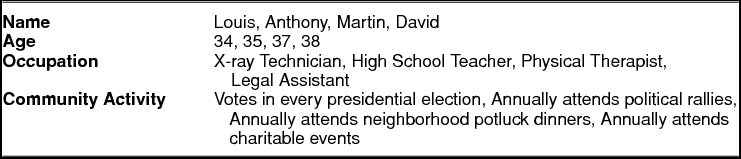
To test for this heterogeneity, I measured differences in social rewards for political activity by race using an original online experiment that included a large sample of Black, White, and Latino respondents. Drawing from a design utilized by Gerber and colleagues (Gerber et al. Reference Gerber, Huber, Doherty and Dowling2016), I administered a within-subjects experiment that asked respondents to evaluate four different hypothetical individuals who are “interested in moving to your community.”Footnote 6 Respondents viewed a table of information about each individual on separate survey pages, which included randomized entries about the individual’s name, age, occupation, and community involvement (see Table 2). Embedded in these tables were two political activity treatments—“votes in every presidential election” and “annually attends political rallies”—and a nonpolitical control—“annually attends neighborhood potlucks.”Footnote 7 Immediately following the table, respondents were asked to evaluate the individual on two measures of social desirability: likability and respectability. Both measures follow from previous experimental work (Gerber et al. Reference Gerber, Huber, Doherty and Dowling2016; Byron and Baldridge Reference Byron and Baldridge2007; Ridgeway and Correll Reference Ridgeway and Correll2006; Snyder and Haugen Reference Snyder and Haugen1994; Hamilton and Fallot Reference Hamilton and Fallot1974) and are designed to estimate the relative social incentives attached to political actions.
Randomly Assigned Values in Experiment

This experimental design allows me to examine differences in the social desirability of political acts across groups while controlling for potential differences in item functioning. For instance, by including a nonpolitical control (potluck), I am able to account for any average sociability shifts that exist across groups. Furthermore, by including information about age, name, and occupation, I decrease satisficing as the respondents are less able to determine the purpose of the study and increase external validity by forcing respondents to consider multiple characteristics as they would a real human being.Footnote 8
The experiment was administered on three omnibus surveys using the online platforms YouGov/Polimetrix and Latino Decisions between the months of April and October in 2014.Footnote 9 The first survey, conducted through YouGov/Polimetrix, yielded a nationally representative sample of 2,000 Americans drawn from an opt-in panel of U.S. adults.Footnote 10 To supplement the minority sample available in this pool, I joined this data with two racial minority-specific samples conducted through Latino Decisions and YouGov/Polimetrix. The resulting sample included 1,254 White respondents, 1,229 Black respondents, and 748 Latino respondents.Footnote 11
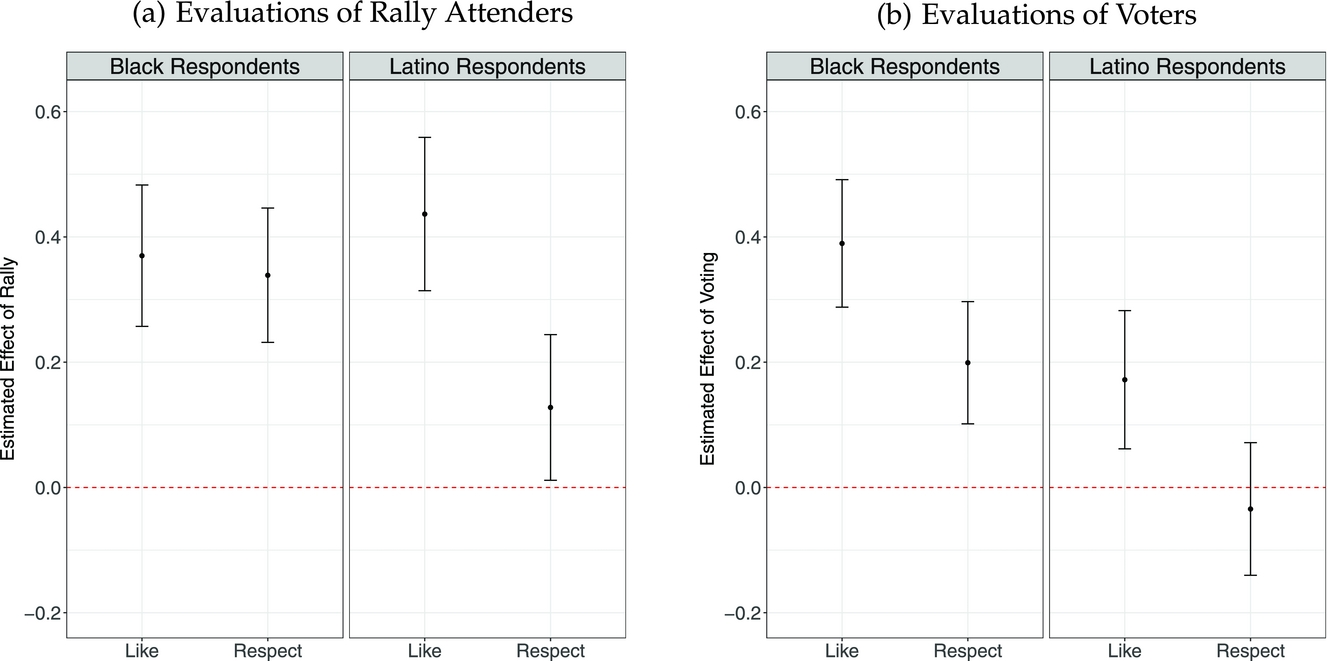
Figure 1 plots the effect of voting and rally attendance on likability and respectability among Black and Latino respondents compared to Whites. The point estimates are calculated using a difference-in-difference framework that provides an assessment of cross-racial heterogeneity:
 $$\begin{equation*}
DiD_{j} = (\bar{y}_{Tj}-\bar{y}_{Cj} | Minority) - (\bar{y}_{Tj}-\bar{y}_{Cj} | White)
\end{equation*}$$
Minority-White Differences in Social Rewards by Political Act

Movement away from the zero line represents the difference in the treatment effect for minority respondents compared to Whites. Each point estimate is displayed with a 95% confidence interval around it.Footnote 12
These point estimates test whether minority groups, on average, evaluate politically active individuals differently than Whites. I expect that minority Americans will reward grassroots political behavior like political rallies more than Whites, reflecting Hypothesis 1 and the results in the previous section. Furthermore, I expect that Black Americans will reward voters more positively than Whites consistent with Hypothesis 3. While Black Americans and Latinos are also largely segregated from each other and have distinct political histories, which may produce variation in evaluations between minority groups as well, I have less clear hypotheses about the direction of this variation, and so I focus my analyses on the minority-White comparisons.
The first panel (a) of Figure 1 shows evaluations of rally attenders minus the control for Blacks and Latinos compared to Whites. Consistent with Hypothesis 1, both minority groups evaluate political rally attenders as significantly more likable and respectable than their White counterparts. Specifically, the treatment effect among Blacks compared to Whites is a positive 0.37 difference in likability (p < 0.01) and a 0.34 difference in respectability (p < 0.01). Among Latinos, the treatment effect for rally attendance is nearly half a point more than White respondents (0.44, p < 0.01), the largest effect across groups and treatments. In terms of respectability, the effect of political rally attendance is 0.13 (p < 0.05) points more among Latinos than Whites. On both measures, I find that, on average, racial minorities provide more social rewards for participation in political rallies than do White Americans, consistent with Hypothesis 1.
Panel b of Figure 1 provides estimates for voter evaluations among minority respondents compared to Whites. Like the observational results presented in the previous section and consistent with Hypothesis 3, Black Americans, on average, socially value voters more than do their White counterparts. In particular, Blacks compared to Whites think voters are significantly more likable (0.39, p < 0.01) and respectable (0.20, p < 0.01). Like the observational results, the findings for Latinos are more mixed. Latinos also see voters as more likable than do White respondents, although by a smaller margin (0.17, p < 0.01). On the respectability measure, there is a negative (−0.03) although insignificant difference between Latino and White respondents.
A couple things can be gleaned from these findings. First, on average, minority Americans socially value those who are politically active at higher rates than do Whites. This is especially true for evaluations of political rally attenders. Both Latinos and Blacks are more generous across both social measures than are Whites in rewarding rally attenders. These results are reflective both of political reality—for instance, protests and rallies composed of largely racial minorities under the banners of Black Lives Matter and 2006 Immigration Reform—and with content differences found in the previous section. Recall that both Blacks and Latinos connected political rallies with more positive outcomes and characteristics compared to Whites, including the ability of political rallies to increase the quality of communities and help people in need. In both content and social rewards, these differences may reflect the accessible, grassroots nature of rallies, available as a political tool for those locked out of electoral settings or who maintain minority status in a majoritarian democracy.
Second, when it comes to voting, Black Americans provide more social rewards to voters than do Whites. This finding is consistent with a robust literature that points to turnout overperformance among Blacks in models of voting in both the aggregate (Wheaton Reference Wheaton2013) and after controlling for socioeconomic status (Anoll Reference Anoll2014; Verba, Schlozman, and Brady Reference Verba, Schlozman and Brady1995; Wolfinger and Rosenstone Reference Wolfinger and Rosenstone1980). By ascribing socially desirable characteristics to those who regularly vote, Blacks may add an additional layer of social incentives that encourages political action among group members. This set of incentives could change the calculus of political action individuals face: despite having lower resources than their White counterparts and facing higher costs for political activity, Blacks may encounter social incentives that prioritize and reward political action at a higher degree.
Latinos, on the other hand, provide either slightly more or the same amount of social incentives to vote as Whites, and fewer incentives than Blacks. These findings mirror the norms content results in the previous section, which found that Blacks were more likely than Whites to think voting makes their lives better, their communities better, and most importantly, helps people in need. There were no such differences between Latinos and Whites on these dimensions. Thus, while Blacks may overcome the costs of voting through providing an additional set of incentives in the form of social rewards and social pressure, Latinos who face mobilization challenges due to language heterogeneity, eligibility, and resources do not. Latinos and Whites provide the same level of social incentives for voting—but Latinos face more costly action. These results may help explain low Latino voter turnout compared to Whites and Blacks.
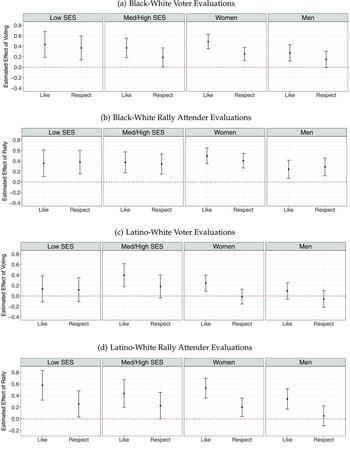
Together, these results suggest that the social value of political actions varies in substantively meaningful ways across racial communities. Some have argued, in addition, that further variation likely exists within groups. For instance, close analyses of voter turnout show that much of the unexplained variation across race happens among Blacks at low levels of socioeconomic status (Anoll Reference Anoll2014) and a recent study of voter turnout using validated data shows that “overperformance” happens largely among Black women (Ansolabehere and Hersh Reference Ansolabehere and Hersh2013). Recognizing these important dimensions of within-group difference, I provide in Figure 2 difference-in-difference estimates in likability and respectability evaluations for four different subgroups: respondents with low socioeconomic resources (defined as a yearly family income below $30,000 and no more than a high school education, or approximating the bottom third of the SES distribution in American society), respondents with medium or high socioeconomic resources (that is, more than $30,000 in yearly family income and at least some college), women, and men. Bars around the estimates represent 95% confidence intervals. While the experimental nature of the design allows us to rule out differences as simply the result of variations in usage of the scale across groups, the addition of these covariate analyses tests whether racial variation presented in Figure 1 is the product of income, education, or gender covariation.
Minority-White Subgroup Differences in Political Activity Evaluations

The results are largely consistent with the aggregate estimates presented in Figure 1. Generally, across subgroups and measures, minority Americans continue to evaluate those who are politically active more favorably than their White counterparts. This is true despite reduced sample size, which expands confidence intervals. Thus, when controlling for socioeconomic status and gender—two important predictors of political participation—Blacks and Latinos often see voters and overwhelmingly see political rally attenders in a more positive light than the majority racial group.
Despite this consistency, a few within-group trends are worth commenting on, considering extant literature on patterns in political participation. First, among low SES respondents, the Black-White gap in respectability of voters surges up to 0.37 (p < 0.01), while the gap between high SES Whites and Blacks lingers at 0.19 (p < 0.05). These relative differences mirror turnout trends across race and resources, which show that low SES Blacks often turnout at higher rates than low SES Whites, while the two groups look more similar at high levels of socioeconomic resources. This finding is especially important considering the relative distribution of each group, with many more Black Americans falling into the bottom tier of socioeconomic resources than among Whites.
Interesting differences equally consistent with national trends appear in evaluations across gender. Both Black women and Black men evaluate voters and political rally attenders more positively than their White counterparts (p < 0.01), but reflecting validated voting estimates (Ansolabehere and Hersh Reference Ansolabehere and Hersh2013), the strongest evaluation of voter and rally attender likability appears among Black women (0.49, p < 0.01; 0.50, p < 0.01, respectively). A similar, although less consistent trend is present among Latinos.
These results suggest that some important heterogeneity exists within racial subgroups, as is to be expected. Although race is an important and relevant category of distinction in the United States (Omi and Winant Reference Omi and Winant1994; Masuoka and Junn Reference Masuoka and Junn2013), racial groups are not homogenous bodies. However, by and large, subgroup differences reflect aggregate differences in their general interpretation: rather than a single social incentive structure for political action, Americans of different racial communities reward individuals differently when engaging in politics. I turn next to examining how segregation and social context may moderate these relationships.
SOCIAL CONTEXT MODERATES PARTICIPATORY REWARDS
The results so far indicate that individuals’ racial group membership affects views of political activity. I have argued that this heterogeneity is the product of contextual factors: disparate histories in access to the franchise and group segregation creates norm variance. Here, I more directly test whether contextual factors are related to the social value of political involvement.
Context should matter for shaping norm heterogeneity in two ways. First, norms are most potent in social spaces where there is group cohesion (Oliver Reference Oliver2010; Larson and Lewis Reference Larson and Lewis2017). In these spaces, members care more about the opinion of those around them and, as a result, are more willing to conform to group norms. Furthermore, an increased density in social connections and higher levels of trust aid in the flow of information and norm enforcement. Thus, spaces with large numbers of group members who share a salient identity are likely spaces with clearer, more widely enforced norms.
However, heterogeneity in participatory norms should only appear in contexts where group identity is clearly tied to divergent experiences with government. After all, it is these divergent experiences that create group-specific norms. Thus, three factors are important for the expectation that context shapes participatory norms: group cohesion, density of group members, and divergent experiences with government.
Considering these factors, I expect that the proportion of co-racial residents in Black respondents’ neighborhoods will be positively related to both social rewards for voting and political rally attendance. In these neighborhoods, group cohesion is high and divergent norms regarding political participation observed in the previous two sections should be intensified. Among Latinos, my expectations are slightly different. Many have argued that in the aggregate, Latinos are a more diverse and less cohesive group (Beltrán Reference Beltrán2010; Dávila Reference Dàvila2012), but that immigration serves as a unifying political dimension (Jiménez Reference Jiménez2010; Segura Reference Segura2006). Furthermore, Latinos as a group are less clearly tied to a historical narrative of exclusion (Takaki Reference Takaki2008), but foreignness continues to moderate experiences with political voice (Pantoja, Ramirez, and Segura Reference Pantoja, Ramirez and Segura2001; Michelson Reference Michelson2003). Thus, while a Latino context may matter less for participatory norm divergence due to both less group cohesion and less consistency in governmental experience, a social context filled with group members joined by their experiences with immigration may matter quite a lot.
To test if contextual variables moderate participatory social rewards, I merge my survey data on participator likability and respectability with zip code information from the 2009-2013 American Community Survey: 5-Year Data Set (Minnesota Population Center 2011).Footnote 13 I create three contextual measures to operationalize my hypotheses: the proportion of residents in Black and White respondents’ zip codes who are Black; the proportion of residents in Latino and White respondents’ zip codes who are Latino; and the proportion of residents in Latino and White respondents’ zip codes who are foreign-born (that is, are either naturalized or noncitizens).Footnote 14 The results in the previous section show that likability and respectability measures are directionally consistent, so for the sake of presentational simplicity, I merge these two measures into a mean social value score and standardize the variable from zero to one. A value of one represents an evaluation of extremely likable and respectable while a zero means the participator is seen as not at all likable or respectable. Because I am now looking at heterogeneity within group rather than across, I examine raw likability and respectability scores instead of those adjusted to the experimental potluck baseline.Footnote 15
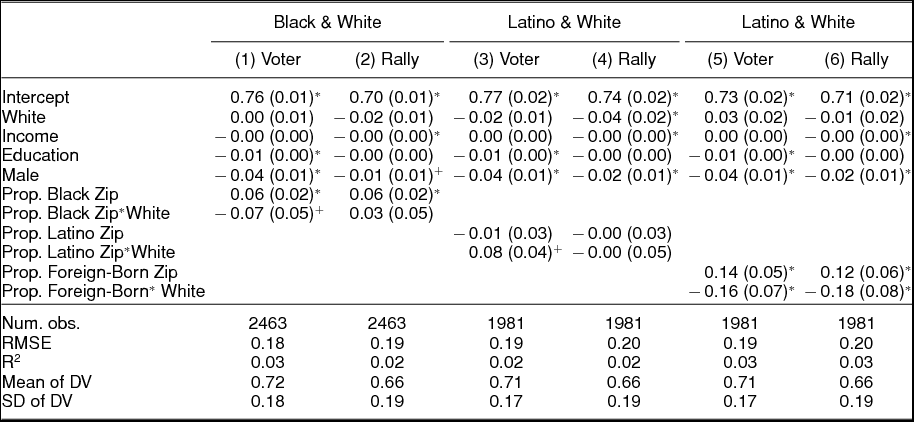
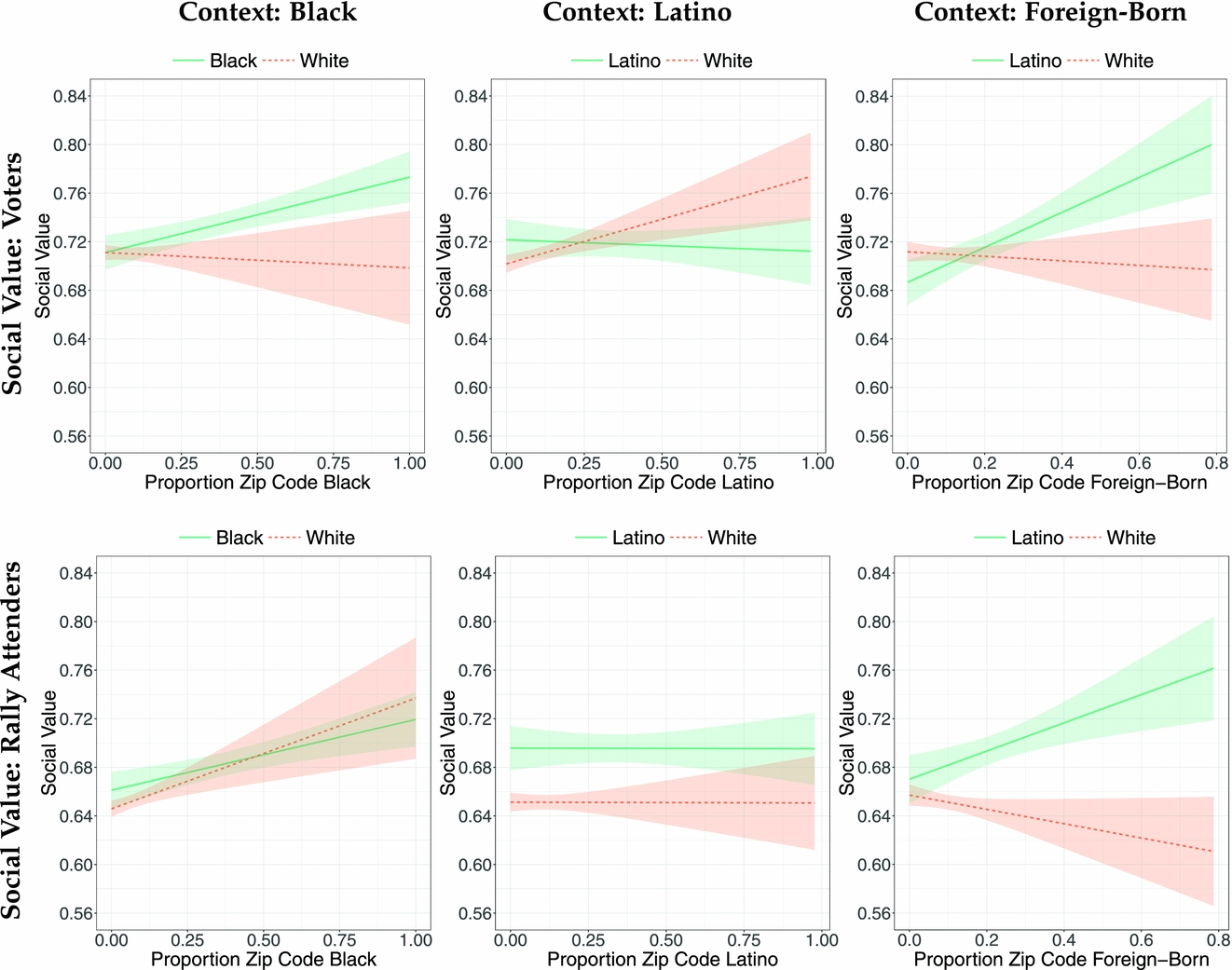
Table 3 presents linear regression results predicting the social value of voters and political rally attenders by respondent’s race, neighborhood characteristic, income, education, and gender. Models 1 and 2 show the relationship between the proportion of a respondent’s zip code that is composed of Black residents and the social evaluation of political participators among Black and White respondents. Models 3 and 4 show parallel analyses but for Latinos and Whites, using proportion Latino as the main independent variable. Finally, Models 5 and 6 show the relationship between citizenship composition of a neighborhood among Latino and White respondents. The reference category for each regression is the minority group. To aid in the interpretation of the interaction between racial group membership and social context, Figure 3 plots the relative predicted probabilities for the reference minority group and White respondents, holding other values at their mean category. Bands represent 80% confidence intervals.
Neighborhood Context Moderates the Social Value of Participation

Notes: OLS regression with weights predicting social value of voting and political rally attendance. Social value calculated by averaging likability and respectability scores and standardizing from 0–1. A value of 1 represents “extremely likable and respectable” and a value of 0 means “not at all likable and respectable.” Excluded category is minority respondents—either Black or Latino. Standard errors in parentheses, *p < 0.05, and +p < 0.10.
Moderating Effect of Neighborhood Context on Social Rewards

The results from Models 1 and 2 and Models 5 and 6 are striking in their emphasis on community-level factors over individual demographics. In fact, for each dependent variable in these models, the neighborhood characteristics are the largest predictors, trumping income and education across the board. Furthermore, in these models, Whites and the minority group are statistically indistinguishable at the intercept; in most cases, divergence only appears in attitudes among Whites and minorities when moderated by the characteristics of respondents’ social spaces. Specifically, shifting the proportion of a respondent’s zip code that is Black from zero to one produces a six-percentage-point increase in Black Americans’ evaluation of voters, but has no effect on White residents. This is the equivalent of a little more than a third of a point change in respectability and likability of voters on a seven-point scale. Individual income and education, on the other hand, have almost no predictive power.
A similar pattern appears in Model 2: changing the proportion of Black residents in a respondents’ neighborhood produces a six-percentage-point change in Black respondents’ evaluation of rally attenders, although in this case, White respondents are similarly affected.Footnote 16 Together, Models 1 and 2 show that, on average, social incentives to participate in both electoral and nonelectoral acts are stronger in Black neighborhoods. Because social motivations can help to overcome other costs associated with political participation, these results suggest a possible explanation for previous findings, which show that Black Americans living in mostly Black spaces tend to turn out at higher rates than their counterparts living in more diverse contexts (Barber and Imai Reference Barber and Imai2014; Fraga Reference Fraga2016).
Models 3 and 4 show a less persuasive case that the proportion of Latinos in respondents’ social spaces affects the social value of political action. Rather, there is no significant relationship between the social value of participators and the proportion of Latinos living in a zip code. Instead, the social characteristic that matters for creating strong social commitments to participation is the proportion of a neighborhood that is either naturalized or noncitizens. Models 5 and 6 show that changing the proportion of foreign-born citizens in Latino respondents’ neighborhoods from zero to one produces a fourteen-percentage-point increase in social evaluations of voters and a twelve-percentage-point increase in evaluations of rally attenders. This is equivalent to nearly a whole point change in the social evaluation of participators on a one to seven scale. Whites, on the other hand, are largely unaffected by this changing social context. Like the results presented for Black respondents, this analysis makes clear the powerful impact of community-level attributes but highlights that, for Latinos, the primary contextual variable that matters might be immigration status.
Together, these results point to the effect that community-level attributes have in shaping normative beliefs about political action. By focusing on individual-level characteristics such as resources or by examining normative pressure in the aggregate, scholars often ignore the very social nature of norms, which requires community to develop, spread, be enforced, and, eventually, have behavioral impacts. By placing normative evaluations in the context of communities and groups, it becomes clear that it is not only the race of an individual that creates differences in the social evaluations of political behaviors, but also, maybe more importantly, race interacted with the attributes of the communities in which people live. These systematic variations in the social reward system likely influence the actions of individuals embedded in communities of different types, shaping political behavioral outcomes in the aggregate.
DISCUSSION
As the demography of the United States has changed in recent years, a growing number of pundits—and the occasional academic (Huntington Reference Huntington2004)—have bemoaned the diversification of the country. Claiming racial minorities are lacking in values like patriotism, individualism, and work ethic, conservative pundits like Glenn Beck and Rush Limbaugh have posited “the total degradation of what used to be American culture” (Gardner, Thompson, and Rucker Reference Gardner, Thompson and Rucker2010; Limbaugh Reference Limbaugh2010). These claims are a modern manifestation of an enduring narrative in America, one which in its many forms has over time asserted deficiencies among non-Whites. Built on racialized beliefs about family values, crime, self-control, and laziness, this narrative has continually served as justification for democratic exclusion (Takaki Reference Takaki2008; Haney-Lopez Reference Haney-Lopez1997; U.S. Department of Labor 1965).
Contrary to these claims, I find that on many dimensions of civic participation, racial minorities are even more committed to the American ideal of self-governance, encouraging and rewarding political involvement at higher rates than Whites. Minority Americans are more likely than Whites to see political activities as a way to care for their community and help people in need, and more likely on average to provide social rewards to those active in politics. This is especially true for more grassroots political activities that may provide minority Americans with democratic voice when electoral opportunities are restricted. Those living in mostly Black neighborhoods or surrounded by large numbers of foreign-born residents are especially likely to believe that the politically active make good neighbors. My findings suggest that on the dimension of political participation, racial minorities often express an even stronger commitment to core democratic behaviors, consistent with other public opinion work on White versus minority values (Taylor et al. Reference Taylor, Lopez, Martínez and Velasco2012; Citrin et al. Reference Citrin, Lerman, Murakami and Pearson2007).
This commitment likely helps non-Whites overcome the inevitable costs and challenges involved in participating in politics. Despite reform attempts, barriers to Black and Latino political participation in the form of both unequal resources and institutional constraints remain a hallmark of the American political system (Uggen, Shannon, and Manza Reference Uggen, Shannon and Manza2012; Wilson Reference Wilson2011). Yet, racial minorities are often able to overcome these barriers to participate at unexpectedly high rates, sometimes even outperforming Whites (e.g. Wheaton Reference Wheaton2013; Verba, Schlozman, and Brady Reference Verba, Schlozman and Brady1995; Pantoja, Ramirez, and Segura Reference Pantoja, Ramirez and Segura2001). Strong social norms that value and reward participation may help explain these trends, speaking to, for instance, decades of “overperformance” in Black American political participation (Barber and Imai Reference Barber and Imai2014; Fraga Reference Fraga2016; Verba, Schlozman, and Brady Reference Verba, Schlozman and Brady1995; Wolfinger and Rosenstone Reference Wolfinger and Rosenstone1980).
Unlike previous work on participatory social norms, I highlight the group-based nature of norm development and enforcement. Race continues to moderate Americans’ experiences with government, and segregation emphasizes these differences, providing both reason and social space for norms to develop differently. Whether studying norms or other forms of political behavior, it is not uncommon for scholars to rely on mostly White samples, remove racial minorities through fixed effects in models, or ignore them entirely when interpreting results and generalizing claims (see Barreto and Segura Reference Barreto and Segura2009 and Masouka and Junn Reference Masuoka and Junn2013 for a discussion). But the assumption that political variables affect members of each racial group similarly is not tenable, especially in situations where social interactions are the foundation of a theory.
Does social pressure play as important a role in mobilizing minority Americans as it does Whites, considering this heterogeneity in norm development? More work should consider the relationship between social motivations and political involvement in non-White samples but initial evidence suggests the answer to this question is yes. Social psychologists find norms powerfully motivate behavior across societies and cultures but the content of norms and the appropriate reference groups for social pressure change with context (Tankard and Paluck Reference Tankard and Paluck2016; Fryer and Torelli Reference Fryer and Torelli2010; Paluck and Green Reference Paluck and Green2009). Structural features that continue to impose unequal costs on the participation of minority Americans, however, likely raise the amount of social rewards required to offset these costs. That is, racial minorities may have to socially motivate political involvement exponentially more than Whites to get the same level of group participation.
Understanding racial heterogeneity in political attitudes and behavior is increasingly important in the United States. Recent projections suggest that non-Whites are on track to become the majority of Americans around midcentury (Lofquist et al. Reference Lofquist, Lugaila, O’Connell and Feliz2012; Jones and Bullock Reference Jones and Bullock2012), yet aggregate trends in turnout among racial minorities remain notoriously difficult to explain. My findings suggest that to understand these national trends in political involvement, political scientists should consider how social incentives to participate are tied to race and place. While social motivations most certainly matter for overcoming the collective action problem, norms that guide these rewards are not uniform. Rather, the meaning of civic duty varies systematically across racial communities. Together, social norms and social context emerge as a structure for understanding participation in an increasingly diverse America.
SUPPLEMENTARY MATERIAL
To view supplementary material for this article, please visit https://doi.org/10.1017/S0003055418000175.
Replication materials can be found on Dataverse at: https://doi.org/10.7910/DVN/SJI4IA




Comments
No Comments have been published for this article.