INTRODUCTION
The Gulf of Mexico is a large marine ecosystem harbouring a great diversity of habitats (Kumpf et al., Reference Kumpf, Steidinger and Sherman1999), including oyster reefs, salt marshes, seagrass beds, estuaries, lagoons, mangroves, coral reefs, and soft and hard bottoms. Among these habitats, the coral reefs are remarkable for their complexity and high associated biodiversity. Coral reefs are common on the continental shelf throughout the Gulf of Mexico, although they also occur in deep water (Cordes et al., Reference Cordes, McGinley, Podowski, Becker, Lessard-Pilon, Viada and Fisher2008). According to Tunnell et al. (Reference Tunnell, Chavez and Withers2007a), the greatest coral reef area in the Gulf of Mexico is localized on the southern region. The main coral reefs are in the Florida Keys, north-western Cuba, the Campeche Bank, the Veracruz reef system and the Tuxpan reef system (Figure 1A).
Area of study in the Gulf of Mexico: (A) coral reefs in the southern Gulf of Mexico; (B) area of study in the Alacranes Reef; (C) sampling sites on Isla Pérez.

Regarding the above mentioned area, amphipods associated with coral reef environments have been reported for the Tuxpan reef system (McKinney, Reference McKinney1977), Florida Keys (Thomas, Reference Thomas1993), north-western Cuba (Ortiz & Lalana, Reference Ortiz and Lalana2010) and Veracruz reef system (Winfield & Ortiz, Reference Winfield, Ortiz and Hernández-Ortiz2011). There are three studies recording amphipods associated with the typical carbonated bottom habitats of the Campeche Bank (Ortiz, Reference Ortiz1979; Escobar-Briones & Jiménez-Guadarrama, Reference Escobar-Briones and Jiménez-Guadarrama2010; Paz-Ríos & Ardisson, Reference Paz-Ríos and Ardisson2013), but only one of these studies has sampled near coral reef environments (Escobar-Briones & Jiménez-Guadarrama, Reference Escobar-Briones and Jiménez-Guadarrama2010). In this last study amphipods were identified only to family level; hence, there is currently no checklist of amphipods to the species level associated with coral reef environments in the Campeche Bank.
The Alacranes Reef is the largest coral reef area within the Gulf of Mexico and it has been categorized as a National Park since 1994. Its benthic fauna has been studied and it is listed in the Park's management plan by the National Commission on Natural Protected Areas (CONANP, 2006) and in the checklist of the biota associated with the southern Gulf of Mexico coral reefs by Tunnell et al. (Reference Tunnell, Barrera, Beaver, Davidson, Gourley, Moretzsohn, Nañez-James, Pearce and Vega2007b). Nevertheless, these lists do not include several crustacean taxa, such as amphipods. The present study therefore provides the first checklist of amphipod species associated with the Alacranes Reef environment.
This study constitutes the first part of an ongoing investigation that explores the species diversity of amphipods on artificial and natural substrates in the Alacranes Reef. The present checklist is made up of species collected on man-made structures (artificial substrates). Man-made structures have been classified as artificial reefs as they offer an extra substrate for the settlement, colonization and development of fouling organisms (Seaman & Jensen, Reference Seaman, Jensen and Seaman2000; Lin & Shao, Reference Lin and Shao2002). The present study thereby contributes by documenting the species richness of fouling amphipods in the Alacranes Reef. Studies of fouling assemblages in the Gulf of Mexico have been mostly focused on the USA coastal area (Northern Gulf of Mexico), including but not limited to the following studies: Gunter & Geyer (Reference Gunter and Geyer1955); Pequegnat & Pequegnat (Reference Pequegnat and Pequegnat1968); Culpepper (Reference Culpepper1969); Lewbel et al. (Reference Lewbel, Howard and Gallaway1987); Martin & Bortone (Reference Martin and Bortone1997). Few publications on fouling assemblages exist for the southern Gulf of Mexico; macrofouling species have been documented in four studies to date: Pech et al. (Reference Pech, Ardisson and Bourget2002); Winfield et al. (Reference Winfield, Abarca-Arenas and Cházaro-Olvera2007, Reference Winfield, Cházaro-Olvera, Horta-Puga, Lozano-Aburto and Arenas-Fuentes2010, Reference Winfield, Cházaro-Olvera, Ortiz and Palomo-Aguayo2011).
To increase our knowledge about the Alacranes Reef biodiversity, the aim of the present study is to document the occurrence of fouling amphipods on man-made structures (wood docks and navigation buoys) by means of an annotated checklist. The identified species composition will also contribute to a species occurrence baseline to be used in future comparisons of species composition collected from natural substrates. In turn, this will lead to the possible identification of potential invasive species, similar to the study of Winfield et al. (Reference Winfield, Cházaro-Olvera, Ortiz and Palomo-Aguayo2011) for the Veracruz reef system.
MATERIALS AND METHODS
The Alacranes Reef forms part of North America's marine ecoregion 14 (southern Gulf of Mexico) situated in the Campeche/Yucatanean outer neritic region (Wilkinson et al., Reference Wilkinson, Wiken, Bezaury-Creel, Hourigan, Agardy, Herrmann, Janishevski, Madden, Morgan and Padilla2009) (Figure 1A). It is a platform reef with a semi-elliptic shape, covering an area larger than 650 km2 (Bonet, Reference Bonet1967; Jordán-Dahlgren & Rodríguez-Martínez, Reference Jordán-Dahlgren, Rodríguez-Martínez and Cortés2003) (Figure 1B).
Fouling amphipods were collected from six man-made structures: two wood docks (D) in Isla Pérez (the only permanently inhabited island in the Alacranes Reef) and four navigation buoys (B) near the same island (Table 1; Figure 1C). On each dock and buoy algae from an unmeasured area was recovered from the surface. The material was fixed in 90% alcohol in the field. To separate the species from the algae, the material was washed with freshwater and then preserved in 70% alcohol for sorting and identification in the laboratory. Species classification followed LeCroy et al. (Reference LeCroy, Gasca, Winfield, Ortiz, Escobar-Briones, Felder and Camp2009); members of the family Caprellidae were excluded. Specimens are deposited in the regional collection Crustáceos de Yucatán (YUC-CC-255-11), UNAM-Sisal. All species are recorded in an annotated checklist, with personal observations and/or figures. Species of taxonomic interest were illustrated to corroborate the species identity with a geographical extension or to document intraspecific morphological variation. The geographical range extension of species was recorded within two geographical scales: (i) the Mexican south-east sector; and (ii) the Gulf of Mexico. Species with geographical range extensions are indicated with a symbol (▸) preceding the name.
Sampled man-made structures in Alacranes Reef. (B) Navigation buoy; (D) wood dock.

RESULTS
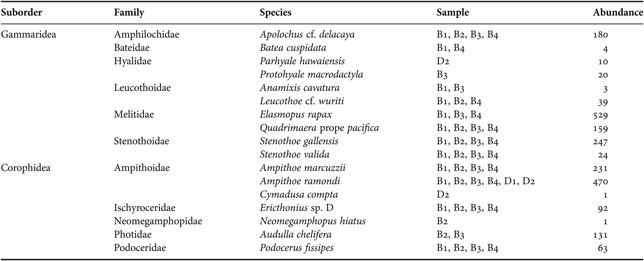
A total of 2204 individual amphipods were collected, counted and identified. Species composition is represented by two suborders, 11 families, 15 genera, and 17 species (Table 2). Two species are new records for the Gulf of Mexico (Podocerus fissipes Serejo, Reference Serejo1995 and Quadrimaera prope pacifica [Schellenberg, 1938]) and nine species are new records for the Mexican south-east sector (Ampithoe marcuzzii Ruffo, Reference Ruffo1954, Apolochus cf. delacaya [McKinney, 1978], Audulla chelifera Chevreux, Reference Chevreux1901, Cymadusa compta [Smith, 1873], Leucothoe cf. wuriti Thomas & Klebba, Reference Thomas and Klebba2007, Neomegamphopus hiatus Barnard & Thomas, Reference Barnard and Thomas1987, Parhyale hawaiensis [Dana, 1853], Stenothoe gallensis Walker, Reference Walker1904 and Stenothoe valida Dana, Reference Dana1853).
Species composition and abundance of fouling amphipods in Alacranes Reef. (B) Navigation buoy; (D) wood dock.

SYSTEMATICS
Order AMPHIPODA Latreille, Reference Latreille1816
Suborder GAMMARIDEA Latreille, Reference Latreille1802
Family AMPHILOCHIDAE Boeck, Reference Boeck1871
▸ Apolochus cf. delacaya (McKinney, Reference McKinney1978)
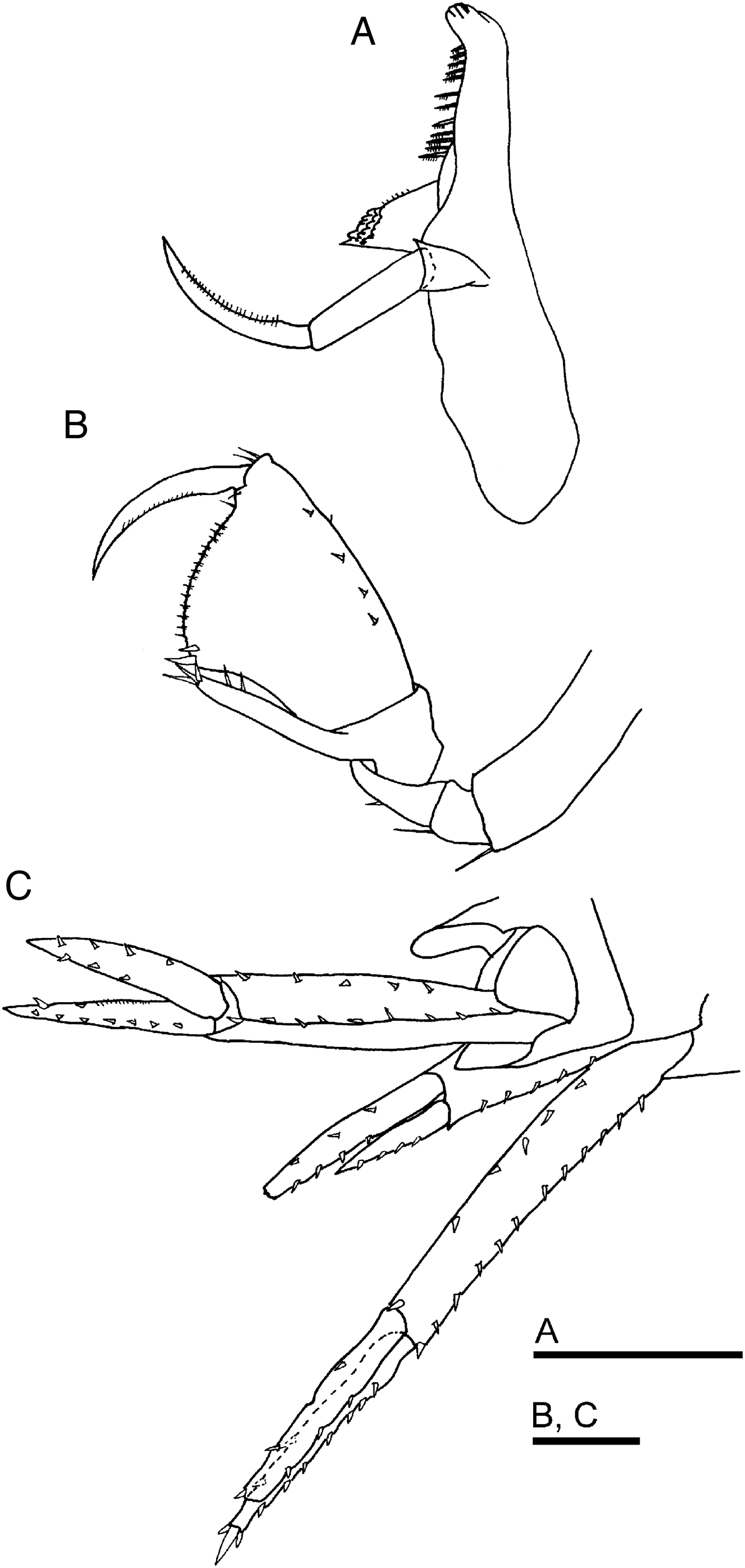
(Figure 2)
Apolochus cf. delacaya (McKinney, Reference McKinney1978), male: (A) mandible; (B) gnathopod 2; (C) uropods 1–3. Scale bars: A, 0.1 mm; B, C, 0.1 mm.

MATERIAL EXAMINED
90 females (29 ovigerous), 58 unsexed, B1, YUC-CC-255-11-2. 2 females (1 ovigerous), 4 unsexed, B2, YUC-CC-255-11-3. 3 females (2 ovigerous), B3, YUC-CC-255-11-4. 19 females (4 ovigerous), 4 unsexed, B4, YUC-CC-255-11-5.
DISTRIBUTION
General distribution: Gulf of Mexico (LeCroy et al., Reference LeCroy, Gasca, Winfield, Ortiz, Escobar-Briones, Felder and Camp2009). Gulf of Mexico records: Lobos Reef (McKinney, Reference McKinney1978); Florida Keys (Barnard & Thomas, Reference Barnard, Thomas and John1983).
HABITAT
Apolochus delacaya has been found in the groove and buttress of coral reefs in shallow waters (5 m) (McKinney, Reference McKinney1978). Material examined of Apolochus cf. delacaya was collected on macrofouling communities with Padina, Udotea and Ulva as dominant algae from buoys anchored in the subtidal zone.
REMARKS
This is the first record for the Mexican south-east sector. There are three other recorded Apolochus species in the Gulf of Mexico (LeCroy et al., Reference LeCroy, Gasca, Winfield, Ortiz, Escobar-Briones, Felder and Camp2009): Apolochus casahoya (McKinney, Reference McKinney1978), Apolochus neapolitanus (Della Valle, Reference Della Valle1893) and Apolochus pillaii (Barnard & Thomas, Reference Barnard, Thomas and John1983). Apolochus cf. delacaya is distinguished from A. casahoya and A. neapolitanus by having four submarginal spines on the anterolateral surface of the propodus of gnathopod 2 (1–2 in A. casahoya; without spines in A. neapolitanus). It differs from A. pillaii in having spines on the medial margin of uropod 1 outer ramus (without spines in A. pillaii).
Apolochus cf. delacaya from the Alacranes Reef is well aligned with the description of Apolochus delacaya from the Lobos Reef by McKinney (Reference McKinney1978), but differs in having spines on the medial margin of the peduncle of uropod 3 (without spines in A. delacaya).
Family BATEIDAE Stebbing, Reference Stebbing1906
Batea cuspidata (Shoemaker, Reference Shoemaker1926)
MATERIAL EXAMINED
3 females, B1, YUC-CC-255-11-7. 1 female, B4, YUC-CC-255-11-8.
DISTRIBUTION
General distribution: eastern Florida; Caribbean; Gulf of Mexico (LeCroy, Reference LeCroy2004; Coleman, Reference Coleman2010). Gulf of Mexico records: western Florida; Florida Keys (Ortiz, Reference Ortiz1991; LeCroy, Reference LeCroy2004); western Cuba (Varela et al., Reference Varela, Ortiz and Lalana2003); Bay of Campeche (Winfield et al., Reference Winfield, Escobar-Briones and Morrone2006); Campeche Bank (Paz-Ríos & Ardisson, Reference Paz-Ríos and Ardisson2013).
HABITAT
Found in Thalassia or Halodule grassbeds and among algae (Caulerpa and Halimeda) on sandy or muddy bottoms; depth range from 0 to 52 m (LeCroy, Reference LeCroy2004; Winfield et al., Reference Winfield, Escobar-Briones and Morrone2006; Coleman, Reference Coleman2010).
Family HYALIDAE Bulycheva, Reference Bulycheva1957
▸ Parhyale hawaiensis (Dana, Reference Dana1853)
MATERIAL EXAMINED
2 males, 5 females, 3 unsexed, D2, YUC-CC-255-11-18.
DISTRIBUTION
General distribution: cosmopolitan in tropical and warm temperate seas (Serejo, Reference Serejo, Schram and von Vaupel Klein1999; Bousfield & Hendrycks, Reference Bousfield and Hendrycks2002; LeCroy, Reference LeCroy2007). Gulf of Mexico records: western Florida (Shoemaker, Reference Shoemaker1956; LeCroy, Reference LeCroy2007); Barataria Bay area (Thomas, Reference Thomas1976); Galveston; Port Isabel (McKinney, Reference McKinney1977); Biloxi Bay (Pederson & Peterson, Reference Pederson and Peterson2002).
HABITAT
From the intertidal or shallow subtidal zone; in algae and other fouling growth on hard substrates (e.g. piers, jetties, oyster beds, bryozoans, mangroves and coral rock); this species has also been found in the root system of Spartina marshes and intertidally on wet sand under shells (LeCroy, Reference LeCroy2007).
Parhyale hawaiensis has recently been recorded in a continental water body called Cenote Aerolito on Cozumel Island by Trujillo-Pisanty et al. (Reference Trujillo-Pisanty, Chávez-Solís, Solís-Weiss and Hermoso-Salazár2010). The Yucatan Peninsula, Mexico, is a karstic zone with the main characteristic being cenotes. Cenotes (sinkholes) are the most peculiar aquatic ecosystem of the peninsula and are formed by dissolution of the carbonate rock in the karstic platform (Schmitter-Soto et al., Reference Schmitter-Soto, Comín, Escobar-Briones, Herrera-Silveira, Alcocer, Suárez-Morales, Elías-Gutiérrez, Díaz-Arce, Marín and Steinich2002). Most cenotes are classified as anchialine since they are characterized by a salinity gradient due to their connection with the sea (Mejía-Ortíz et al., Reference Mejía-Ortíz, Yañez and López-Mejía2006).
REMARKS
This is the first record for the Mexican south-east sector. Identified specimens were aligned with the descriptions and illustrations of Shoemaker (Reference Shoemaker1956) and Serejo (Reference Serejo, Schram and von Vaupel Klein1999) with one variation that appears to be developmental. The examined material has one and zero spines on the outer ramus of uropods 1–2, respectively (compared to two spines on each uropod). The largest specimen examined in this study was 3.6 mm, whereas the largest specimens examined by Shoemaker (Reference Shoemaker1956) and Serejo (Reference Serejo, Schram and von Vaupel Klein1999) were 12 mm and 10.2 mm, respectively.
Protohyale macrodactyla (Stebbing, Reference Stebbing1899)
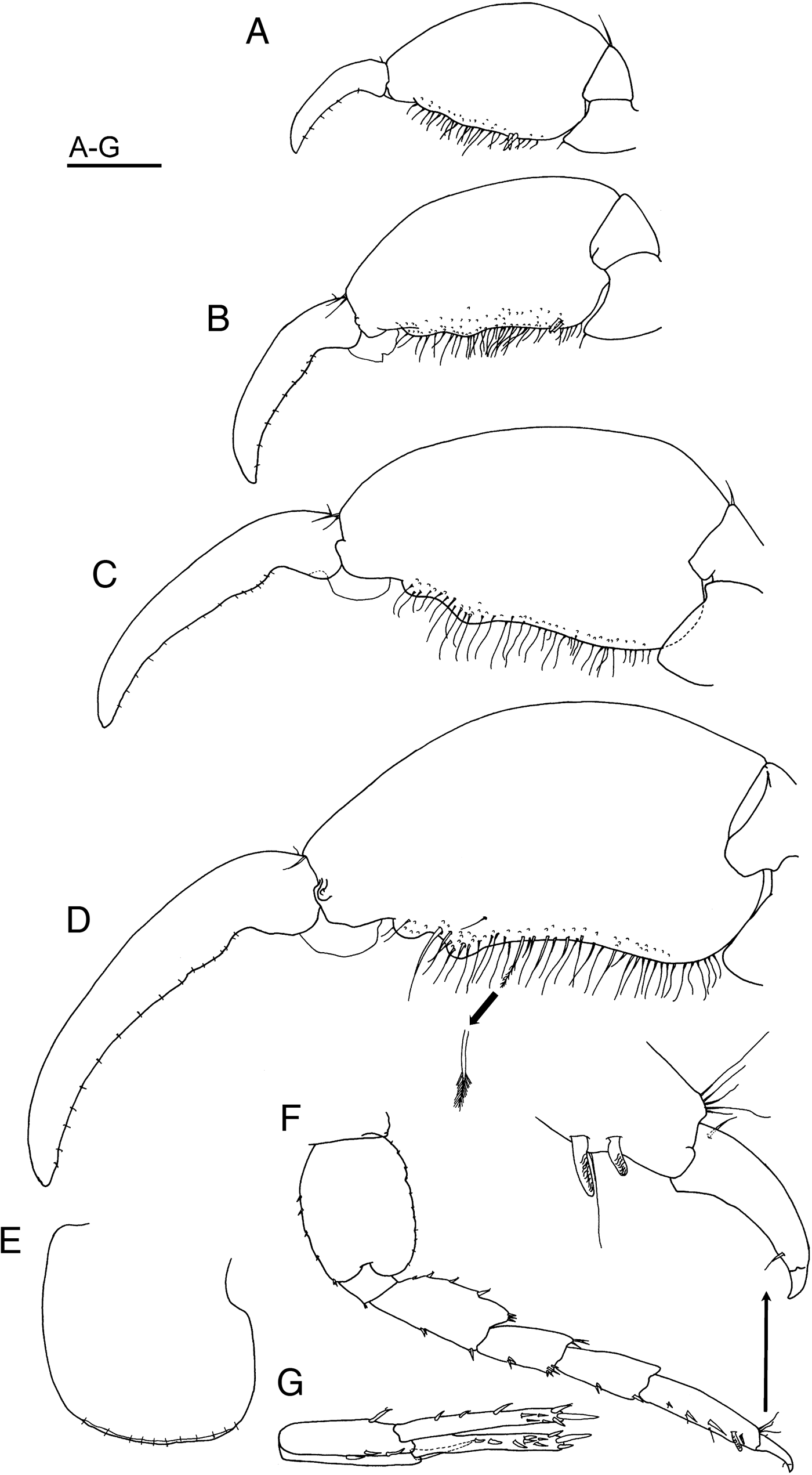
(Figure 3)
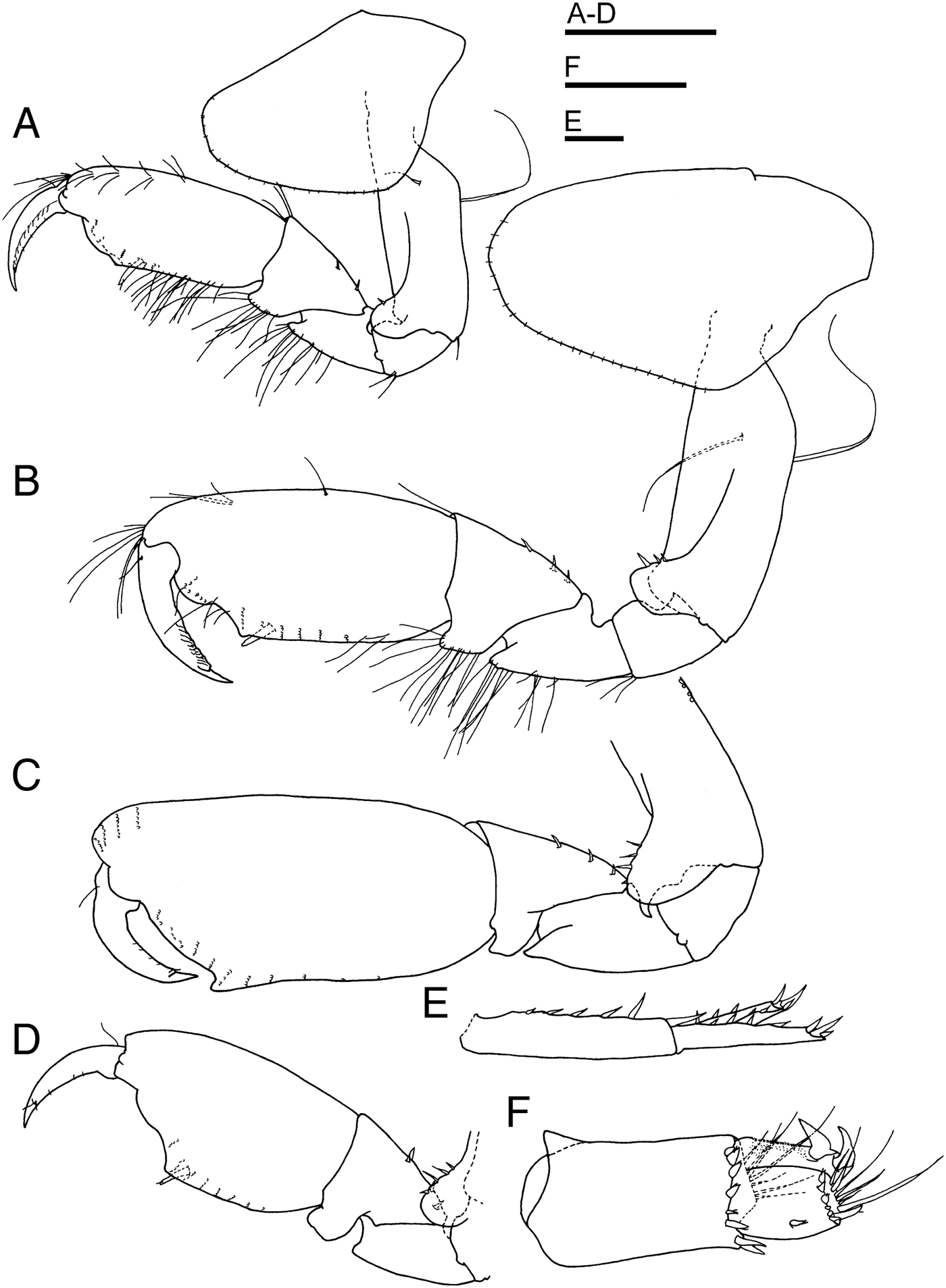
Protohyale macrodactyla (Stebbing, Reference Stebbing1899), male: (A) gnathopod 2 of juvenile 1; (B) gnathopod 2 of juvenile 2; (C) gnathopod 2 of adult 1; (D) gnathopod 2 of adult 2; (E) coxa 3 of adult 2; (F) pereopod 7 of adult 2; (G) uropod 1 of adult 2. Scale bar: A–G, 0.2 mm.

MATERIAL EXAMINED
7 males, 13 females (2 ovigerous), B3, YUC-CC-255-11-25.
DISTRIBUTION
General distribution: Caribbean; Gulf of Mexico; Brazil; Madagascar; western Africa (Serejo, Reference Serejo, Schram and von Vaupel Klein1999; Ortiz et al., Reference Ortiz, Martín and Díaz2007; LeCroy et al., Reference LeCroy, Gasca, Winfield, Ortiz, Escobar-Briones, Felder and Camp2009). Gulf of Mexico records: Laguna Yalahau (Oliva-Rivera & Jiménez-Cueto, Reference Oliva-Rivera and Jiménez-Cueto1997); Laguna Río Soto la Marina; Laguna Camaronera; Laguna Terminos (Cházaro-Olvera et al., Reference Cházaro-Olvera, Winfield, Ortiz and Álvarez2002).
HABITAT
From the low intertidal to shallow subtidal zone; free-swimming on algae and hard substrates (Bousfield & Hendrycks, Reference Bousfield and Hendrycks2002; LeCroy et al., Reference LeCroy, Gasca, Winfield, Ortiz, Escobar-Briones, Felder and Camp2009).
REMARKS
Serejo (Reference Serejo, Schram and von Vaupel Klein1999) redescribed this species with Brazilian specimens. Based on her observations and Schellenberg's (1939) conclusions, gnathopod 2 palm is nearly straight without visible swellings on the distal half, as Stebbing (Reference Stebbing1899) had described and illustrated. The material examined in the present study clearly shows that these swellings on the distal half of the gnathopod 2 palm depend on the developmental stage of specimens. Therefore, this characteristic is confirmed and should be considered part of the diagnosis for Protohyale macrodactyla. The largest specimen examined in this study was 5 mm, whereas the largest specimens examined by Stebbing (Reference Stebbing1899), Schellenberg (Reference Schellenberg1939) and Serejo (Reference Serejo, Schram and von Vaupel Klein1999) were 4 mm, 10 mm and 7.2 mm, respectively.
Family LEUCOTHOIDAE Dana, Reference Dana1852
Anamixis cavatura Thomas, Reference Thomas1997
MATERIAL EXAMINED
1 male, B1, YUC-CC-255-11-26. 2 unsexed, B3, YUC-CC-255-11-27.
DISTRIBUTION
General distribution: Gulf of Mexico; south-eastern Florida; Bahamas; Caribbean (Thomas, Reference Thomas1997; LeCroy, Reference LeCroy2007; White, Reference White2011a). Gulf of Mexico records: from the Mississippi Delta to Tampa (Pearse, Reference Pearse1912); Florida Keys (Shoemaker, Reference Shoemaker1933b; Thomas, Reference Thomas1997); western Cuba (Varela et al., Reference Varela, Ortiz and Lalana2003); Campeche Bank (Paz-Ríos & Ardisson, Reference Paz-Ríos and Ardisson2013).
HABITAT
Shallow subtidal (1–20.9 m), among sandy bottoms and coral rubble; endocommensal associates of asconoid sponges and colonial ascidians (White, Reference White2011a; Paz-Ríos & Ardisson, Reference Paz-Ríos and Ardisson2013).
▸ Leucothoe cf. wuriti Thomas & Klebba, Reference Thomas and Klebba2007
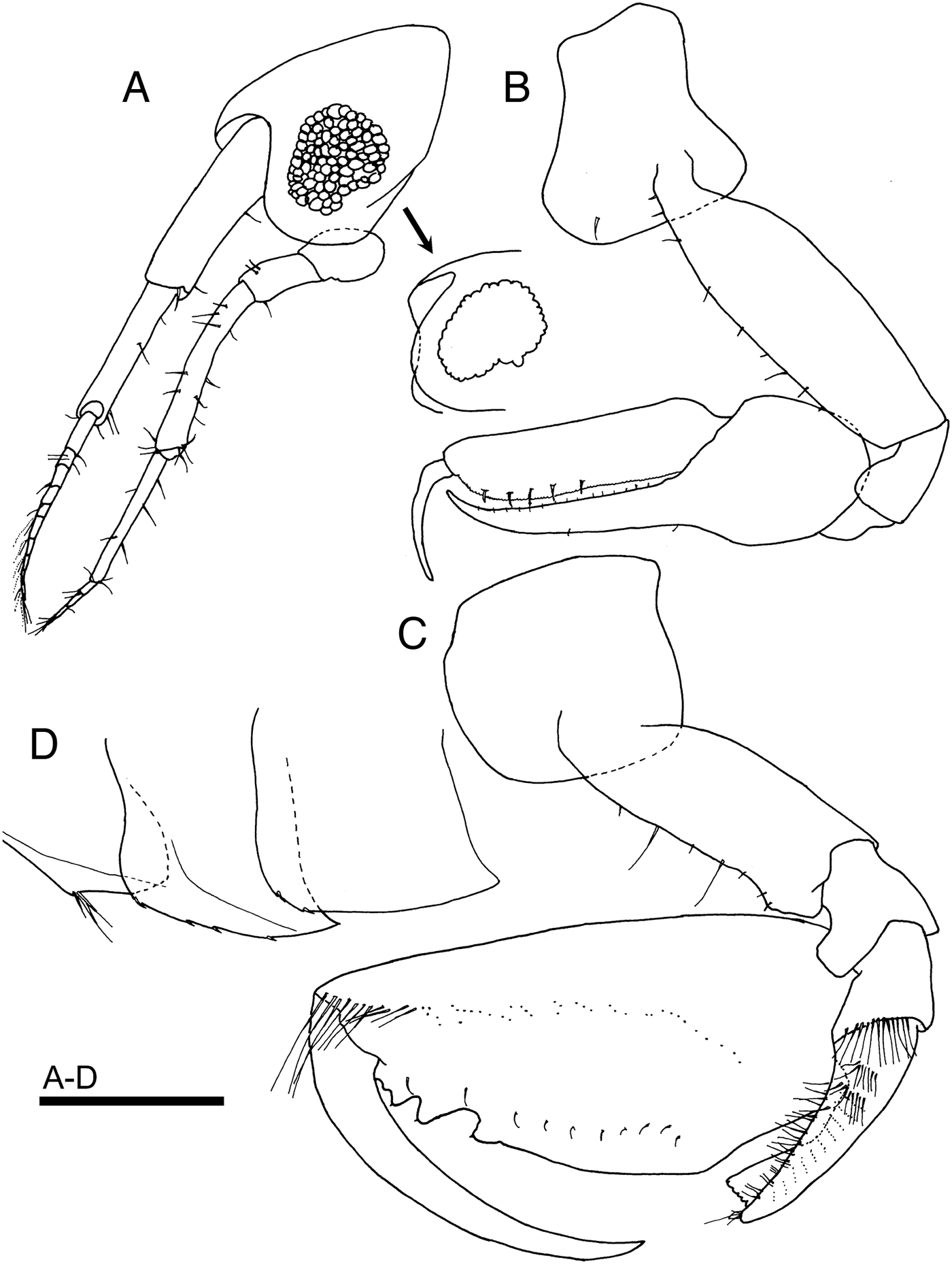
(Figure 4)
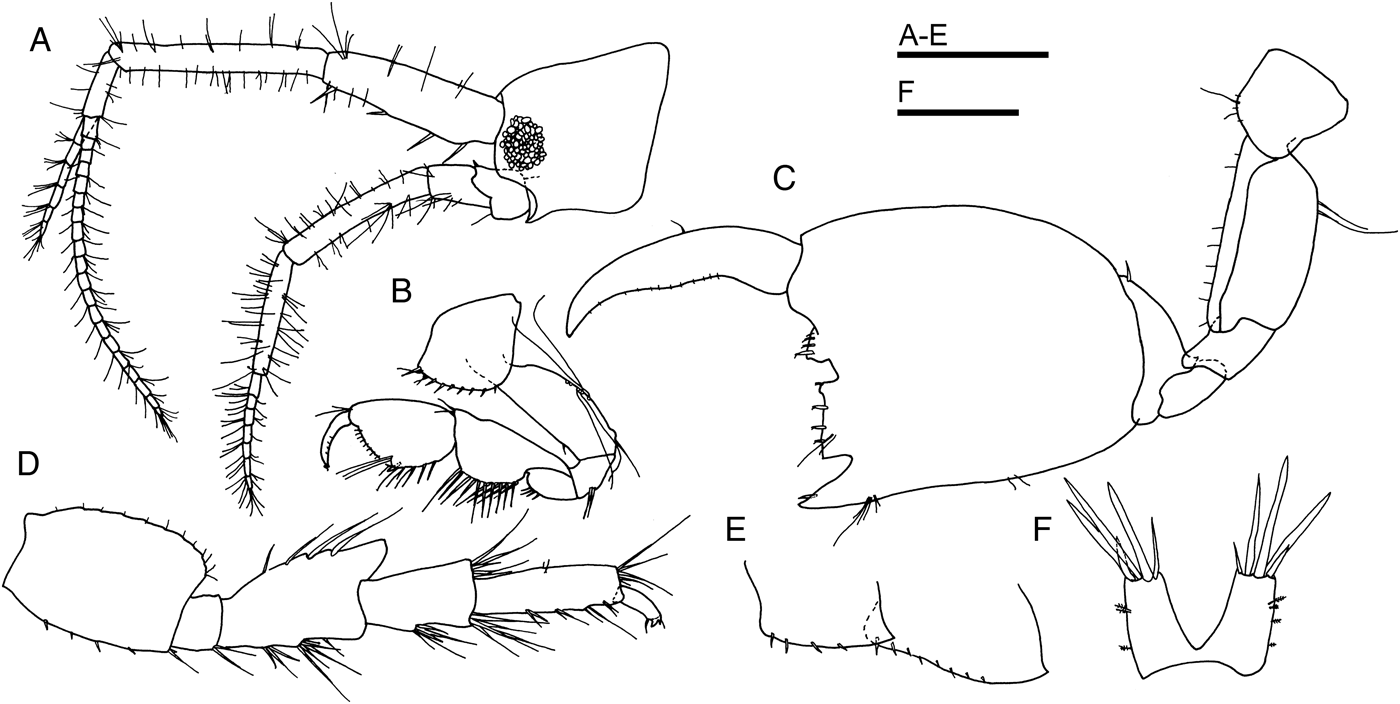
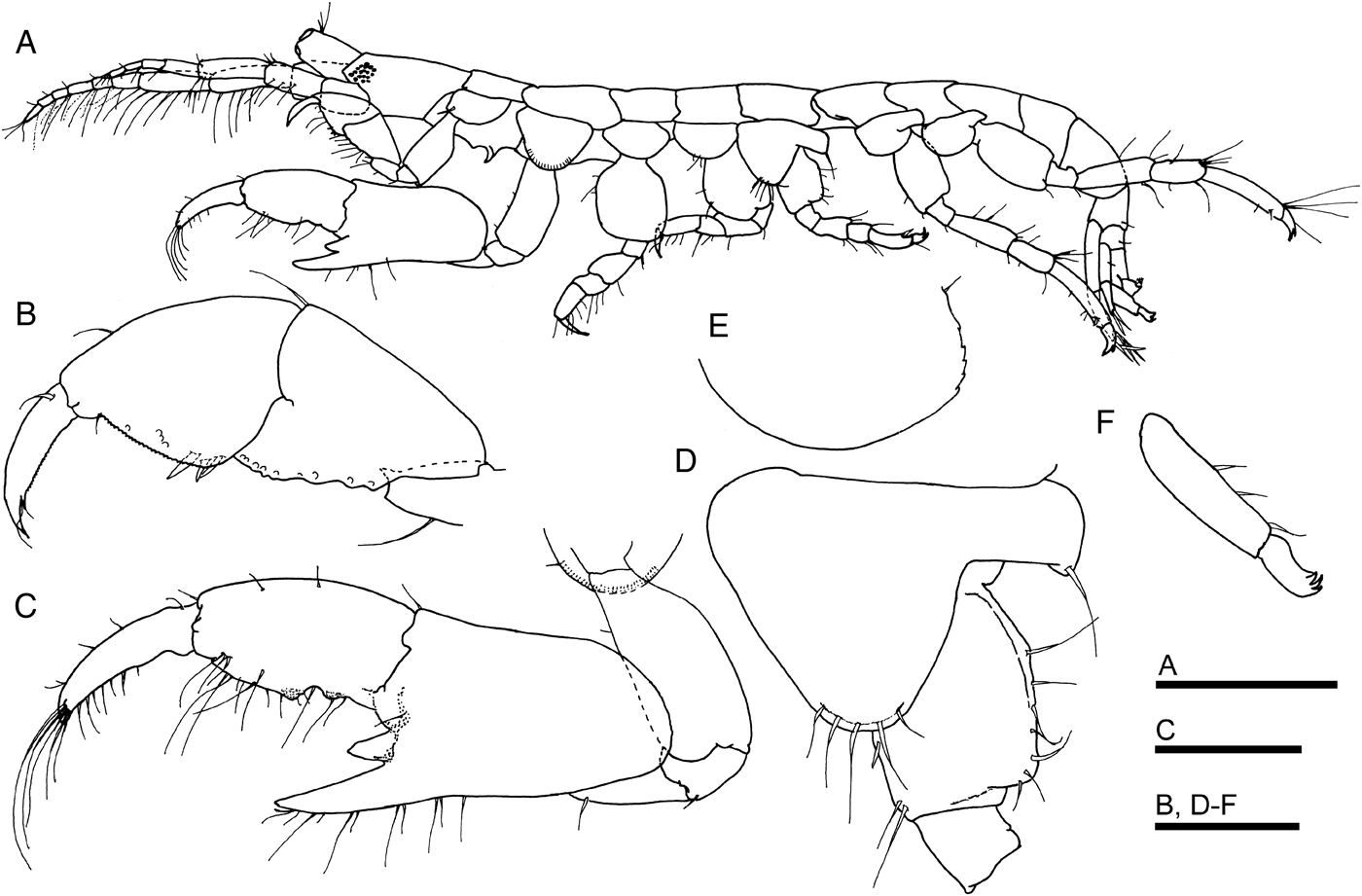
Leucothoe cf. wuriti Thomas & Klebba, Reference Thomas and Klebba2007, male: (A) head and antennae; (B) gnathopod 1; (C) gnathopod 2; (D) epimera 1–3. Scale bar: A–D, 0.5 mm.

MATERIAL EXAMINED
10 males, 13 females (1 ovigerous), B1, YUC-CC-255-11-32. 1 male, 3 females, B2, YUC-CC-255-11-33. 6 males, 5 females (1 ovigerous), 1 unsexed, B4, YUC-CC-255-11-34.
DISTRIBUTION
General distribution: Gulf of Mexico; south-eastern Florida; Caribbean (LeCroy, Reference LeCroy2011; White, Reference White2011a, Reference Whiteb). Gulf of Mexico records: Florida Keys (Thomas & Klebba, Reference Thomas and Klebba2007).
HABITAT
Leucothoe wuriti has been collected in the shallow subtidal (2–15 m) of coral reefs and mangrove lagoons as an endocommensal of ascidians (Thomas & Klebba, Reference Thomas and Klebba2007; White, Reference White2011b). Material examined of Leucothoe cf. wuriti was collected on macrofouling communities with Padina, Udotea and Ulva as dominant algae from buoys anchored in the subtidal zone.
REMARKS
This is the first record for the Mexican south-eastern sector. To date there are 11 recorded nominal species of leucothoids in the Gulf of Mexico (LeCroy et al., Reference LeCroy, Gasca, Winfield, Ortiz, Escobar-Briones, Felder and Camp2009; Winfield & Álvarez, Reference Winfield and Álvarez2009; Winfield et al., Reference Winfield, Ortiz and Cházaro-Olvera2009b; LeCroy, Reference LeCroy2011; White, Reference White2011a; Ortiz & Winfield, Reference Ortiz and Winfield2012): Leucothoe ashleyae Thomas & Klebba, Reference Thomas and Klebba2006, Leucothoe barana Thomas & Klebba, Reference Thomas and Klebba2007, Leucothoe flammosa Thomas & Klebba, Reference Thomas and Klebba2007, Leucothoe hendrickxi Winfield & Álvarez, Reference Winfield and Álvarez2009, Leucothoe hortapugai Winfield et al. Reference Winfield, Ortiz and Cházaro-Olvera2009b, Leucothoe kensleyi Thomas & Klebba, Reference Thomas and Klebba2006, Leucothoe laurensis Thomas & Ortiz, Reference Thomas and Ortiz1995, Leucothoe luquei Ortiz & Winfield, Reference Ortiz and Winfield2012; Leucothoe ortizi Winfield & Álvarez, Reference Winfield and Álvarez2009, Leucothoe ubouhu Thomas & Klebba, Reference Thomas and Klebba2007, and Leucothoe wuriti.
Due to the great leucothoid host diversity, specialized underwater collecting techniques are necessary in order to isolate commensal amphipods (Thomas & Klebba, Reference Thomas and Klebba2007). However, these authors also recognize that collections of leucothoid amphipods are often the result of incidental capture, as happened in the present study from fouling communities dominated by algae.
Leucothoe cf. wuriti from the Alacranes Reef is aligned with the description of Leucothoe wuriti in Thomas & Klebba (Reference Thomas and Klebba2007) and White (Reference White2011b), as well as the remarks in LeCroy (Reference LeCroy2011). However, it differs in having epimeron 1 with three ventral setae (2 in L. wuriti), and epimeron 3 with two ventral setae (bare in L. wuriti).
Family MELITIDAE Bousfield, Reference Bousfield1973
Elasmopus rapax (Costa, Reference Costa1853)
(Figure 5)
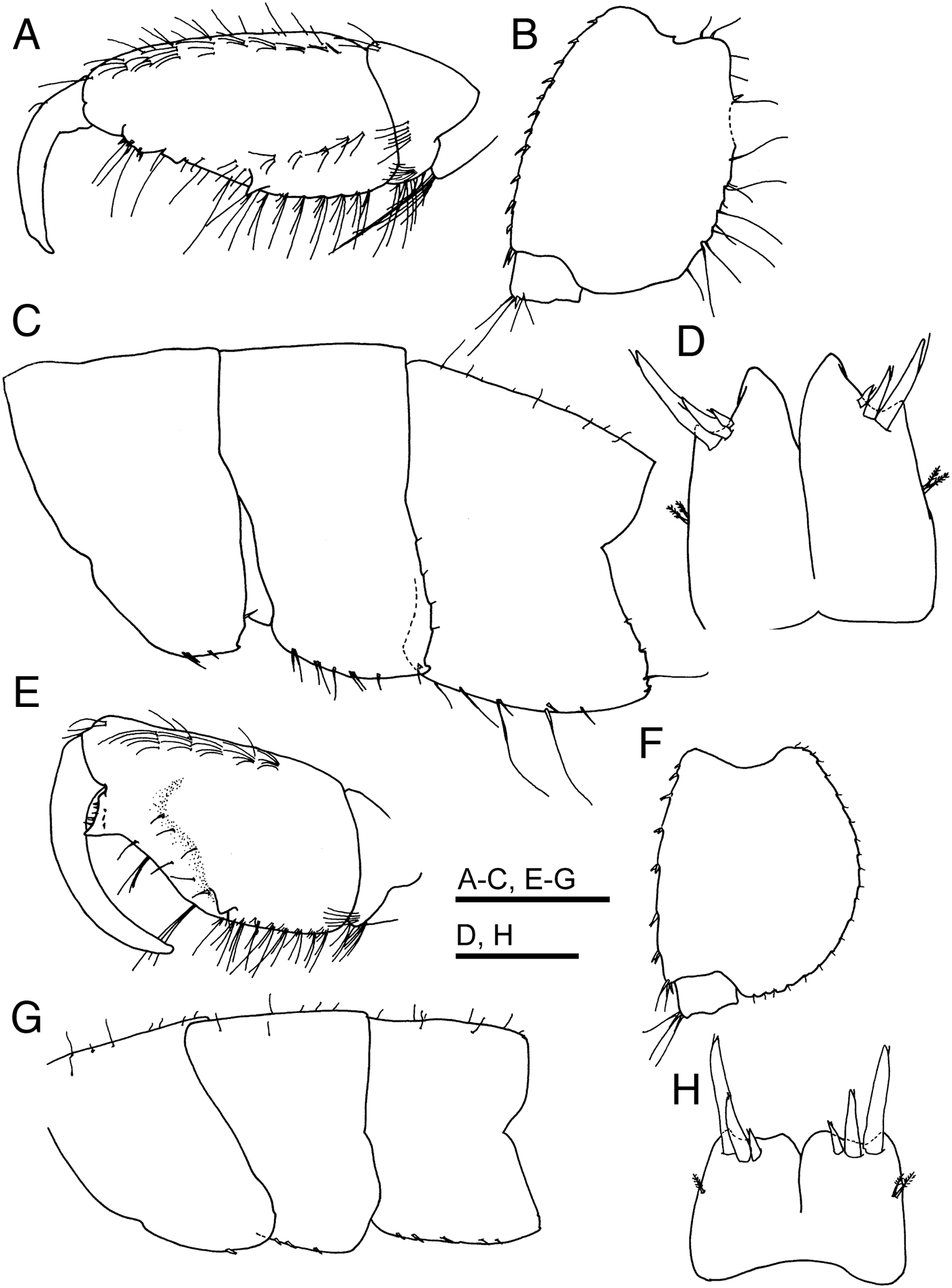
Elasmopus rapax (Costa, Reference Costa1853), male morphotype A: (A) gnathopod 2, inner side; (B) basis of pereopod 7; (C) epimera 1–3; (D) telson; male morphotype B: (E) gnathopod 2, inner side; (F) basis of pereopod 7; (G) epimera 1–3; (H) telson. Scale bars: A–C, E–G, 0.5 mm; D, H, 0.1 mm.

MATERIAL EXAMINED
128 males, 182 females (77 ovigerous), 10 unsexed, B1, YUC-CC-255-11-46. 48 males, 109 females (26 ovigerous), B3, YUC-CC-255-11-47. 14 males, 38 females (10 ovigerous), B4, YUC-CC-255-11-48.
DISTRIBUTION
General distribution: Mediterranean Sea; Red Sea; eastern Atlantic; western Atlantic; Indo-Pacific (Hughes & Lowry, Reference Hughes and Lowry2010). Gulf of Mexico records: Pigeon Key; Florida Bay (Pearse, Reference Pearse1912); Key West (Pearse, Reference Pearse1912; LeCroy, Reference LeCroy2000); Plantation Key (Shoemaker, Reference Shoemaker1933a); offshore Texas; Lobos Reef (McKinney, Reference McKinney1977); Yalahau lagoon (Oliva-Rivera & Jiménez-Cueto, Reference Oliva-Rivera and Jiménez-Cueto1997).
HABITAT
This species is found in a broad range of habitats (e.g. jetties, piers, rocks, dead coral, mangrove roots, algae, sponges; sand bottoms and mud bottoms); occasionally it is found on the carapace of the loggerhead sea turtle (LeCroy, Reference LeCroy2000).
REMARKS
McKinney (Reference McKinney1977) documented that specimens of Elasmopus rapax from the Caribbean and Gulf of Mexico are highly variable, particularly the juvenile forms. Karaman (Reference Karaman and Ruffo1982) noted the presence of two male morphotypes in the Mediterranean: morphotype A (with long setae on epimera 1–3, long posterior setae on the basis of peraeopods 5–7, and telson with very short robust setae) and morphotype B (with robust setae on epimera 1–3, very short posterior setae on the basis of peraeopods 5–7, and telson with long robust setae). LeCroy (Reference LeCroy2000) determined that the Karaman's (1982) morphotype A appears to be similar to E. rapax from the Gulf of Mexico. Recently, Hughes & Lowry (Reference Hughes and Lowry2010) redescribed E. rapax and considered morphotype B (with propodus palm of gnathopod 2 with two teeth) to be the juvenile male form in comparison to morphotype A (with propodus palm of gnathopod 2 with three teeth). They also pointed out that the great morphological variation of this species depends on the marine region it is collected from. In the examined material from the Alacranes Reef both morphotypes A and B are present. However, there is a variation in morphotype B, having a telson with short lobes and long robust setae. There is also a transitional form with the above mentioned characteristics for morphotype B, but with propodus palm of gnathopod 2 with three teeth as in morphotype A.
▸ Quadrimaera prope pacifica (Schellenberg, Reference Schellenberg1938)
(Figure 6)
Quadrimaera prope pacifica Schellenberg, Reference Schellenberg1938, male: (A) head; (B) gnathopod 1; (C) gnathopod 2; (D) pereopod 7; (E) epimera 2–3; (F) telson. Scale bars: A–E, 0.5 mm; F, 0.2 mm.

MATERIAL EXAMINED
28 males, 40 females (5 ovigerous), B1, YUC-CC-255-11-60. 14 males, 21 females (2 ovigerous), B2, YUC-CC-255-11-61. 19 males, 29 females (6 ovigerous), B3, YUC-CC-255-11-62. 3 males, 5 females, B4, YUC-CC-255-11-63.
DISTRIBUTION
General distribution: Caribbean (Krapp-Schickel & Ruffo, Reference Krapp-Schickel and Ruffo2000). Gulf of Mexico records: previously unreported.
HABITAT
Marine, epibenthic, from the intertidal to shallow subtidal zone (0–3 m), on rocky and sandy bottoms (Krapp-Schickel & Ruffo, Reference Krapp-Schickel and Ruffo2000).
REMARKS
This is the first record for the Gulf of Mexico. Krapp-Schickel & Ruffo (Reference Krapp-Schickel and Ruffo2000) described Quadrimaera prope pacifica (Caribbean), a species very close to Quadrimaera pacifica (Indo-Pacific). A redefinition of this species using topotypic material is required (type locality of Makin, Kiribati), due to the need for confirmation of a triangular spine on the inner margin of the dactylus of gnathopod 2 displayed on the original illustration by Schellenberg (Krapp-Schickel & Ruffo, Reference Krapp-Schickel and Ruffo2000; Ruffo et al., Reference Ruffo, Krapp and Gable2000; Krapp-Schickel, Reference Krapp-Schickel, Lowry and Myers2009).
Material examined in the present study is well aligned with the description of Q. prope pacifica except for the presence of six long setae (instead of 5) on the posterior margin of basis in gnathopod 1, and eight spines (instead of 7) on the ventral margin of epimeron 3. As Krapp-Schickel & Ruffo (Reference Krapp-Schickel and Ruffo2000) have noted, there is morphological variability in this species.
Family STENOTHOIDAE Boeck, Reference Boeck1871
▸ Stenothoe gallensis Walker, Reference Walker1904
(Figure 7)
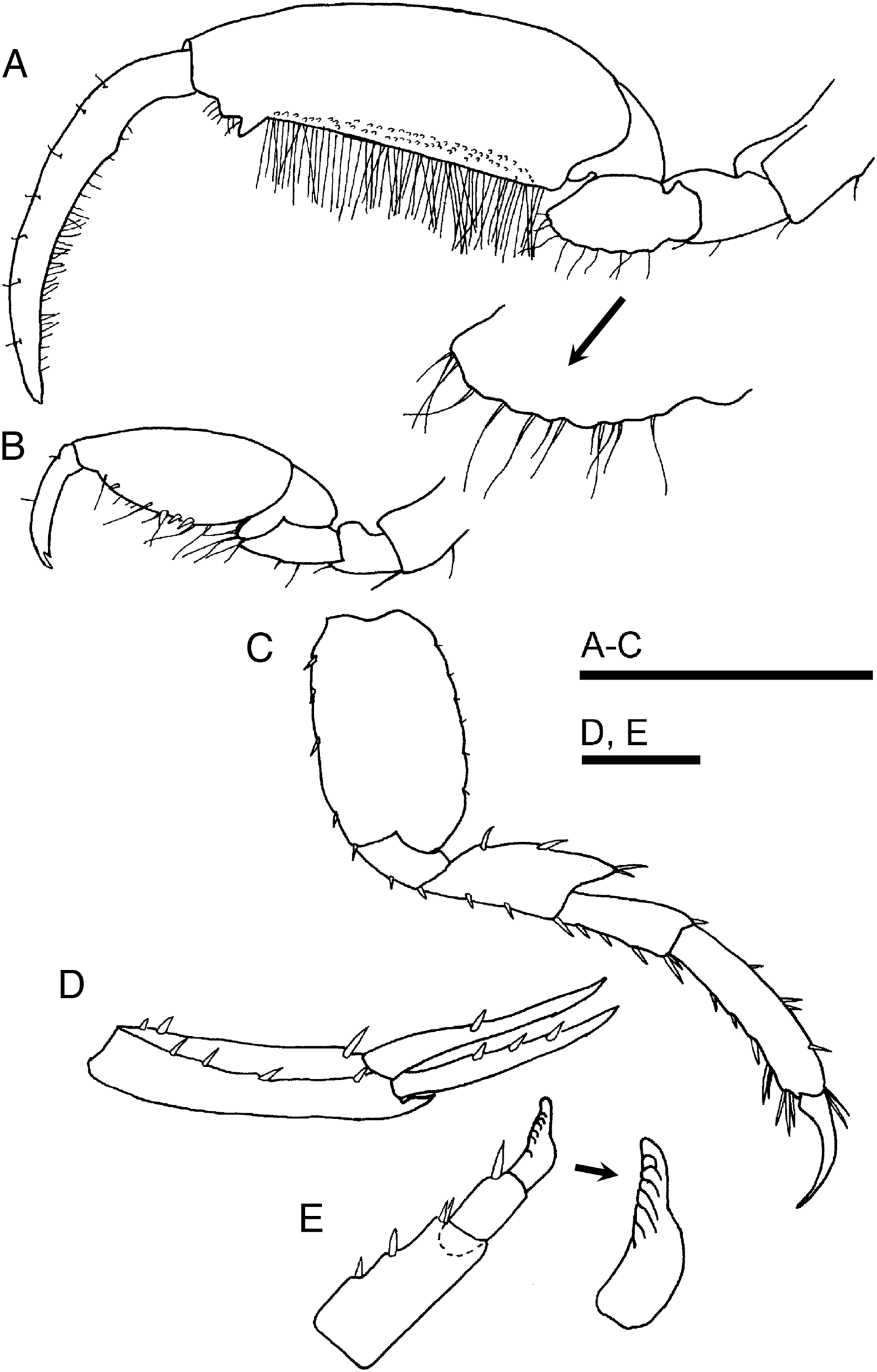
Stenothoe gallensis Walker, Reference Walker1904, male: (A) gnathopod 2; (C) pereopod 7; (D) uropod 1; (E) uropod 3; female: (B) gnathopod 2. Scale bars: A–C, 0.5 mm; D, E, 0.1 mm.

MATERIAL EXAMINED
5 males, 46 females (10 ovigerous), B1, YUC-CC-255-11-78. 2 males, 17 females (3 ovigerous), B2, YUC-CC-255-11-79. 4 males, 47 females (11 ovigerous), 2 unsexed, B3, YUC-CC-255-11-80. 9 males, 115 females, B4, YUC-CC-255-11-81.
DISTRIBUTION
General distribution: cosmopolitan in tropical and temperate seas (LeCroy, Reference LeCroy2011). Gulf of Mexico records: Panama City Beach (Culpepper, Reference Culpepper1969); Lobos Reef (McKinney, Reference McKinney1977); off Louisiana (Lewbel et al., Reference Lewbel, Howard and Gallaway1987); Florida Keys (Thomas, Reference Thomas1993); Sigsbee abyssal plain (Winfield et al., Reference Winfield, Escobar-Briones and Morrone2006); Veracruz reef system (Winfield et al., Reference Winfield, Abarca-Arenas and Cházaro-Olvera2007); Perdido Key (LeCroy, Reference LeCroy2011).
HABITAT
Marine, epibenthic from the low intertidal to shallow subtidal zone (0.5–44 m); hard and soft bottoms, roots of mangroves, algae, ascidians, bryozoans, hydroids, plankton (Fox & Bynum, Reference Fox and Bynum1975; Thomas, Reference Thomas1993; Ortiz et al., Reference Ortiz, Martín and Díaz2007; LeCroy, Reference LeCroy2011). This species is non-indigenous to the Gulf of Mexico, but is commonly found in fouling communities on pilings, floats, ship bottoms, buoys, rocks and mangrove prop roots (Fox & Bynum, Reference Fox and Bynum1975; LeCroy et al., Reference LeCroy, Gasca, Winfield, Ortiz, Escobar-Briones, Felder and Camp2009; LeCroy, Reference LeCroy2011).
REMARKS
This is the first record for the Mexican south-eastern sector. Stenothoe gallensis was recorded in the Sigsbee abyssal plain, south-western Gulf of Mexico, to 3635 m depth by Winfield et al. (Reference Winfield, Escobar-Briones and Morrone2006), but this record has been overlooked by two checklists of species in the region (LeCroy et al., Reference LeCroy, Gasca, Winfield, Ortiz, Escobar-Briones, Felder and Camp2009; LeCroy, Reference LeCroy2011), likely because that occurrence reports an atypical habitat for the species.
Material examined is aligned with the regional diagnosis by LeCroy (Reference LeCroy2011) for the Florida specimens. The main characteristics used to distinguish between males of S. gallensis from Stenothoe valida are on gnathopod 2 (merus, posterior margin crenulate; propodus, distal palmar tooth relatively small), merus of pereopod 7 (not broadly expanded with posterodistal lobe not reaching more than halfway to distal margin of carpus), uropod 1 (peduncle with distoventral spur) and uropod 3 (terminal article of ramus expanded proximally and dorsal margin with crenulations). The main characteristic used to distinguish between females of S. gallensis from S. valida is on gnathopod 2 (propodus, posterior margin without distal palmar teeth).
▸ Stenothoe valida Dana, Reference Dana1853
(Figure 8)
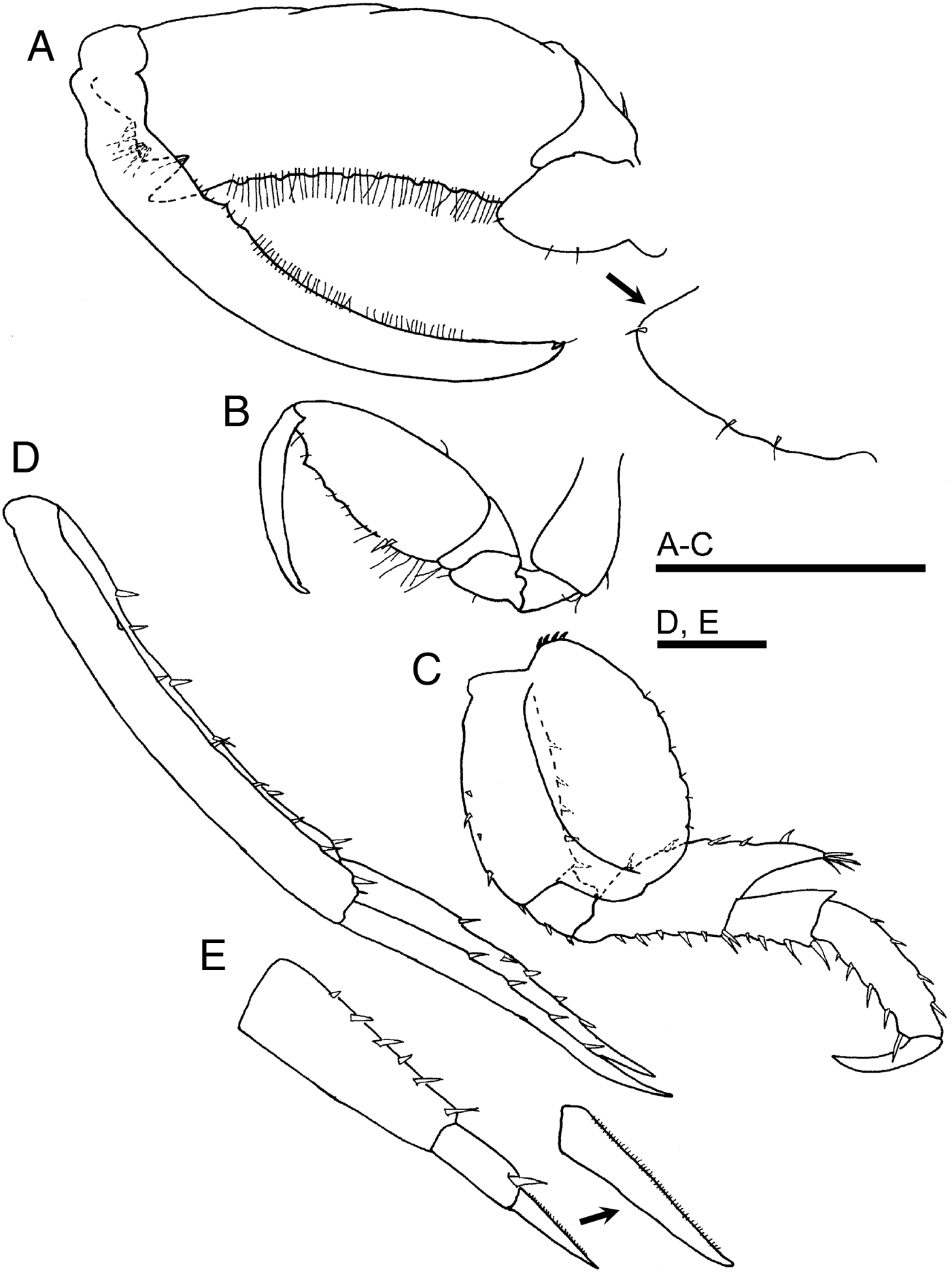
Stenothoe valida Dana, Reference Dana1853, male: (A) gnathopod 2; (C) pereopod 7; (D) uropod 1; (E) uropod 3; female: (B) gnathopod 2. Scale bars: A–C, 0.5 mm; D, E, 0.1 mm.

MATERIAL EXAMINED
1 male, 6 females (2 ovigerous), B1, YUC-CC-255-11-82. 3 males, 6 females, B2, YUC-CC-255-11-83. 2 males, 2 females, B3, YUC-CC-255-11-84. 1 male, 3 females, B4, YUC-CC-255-11-85.
DISTRIBUTION
General distribution: nearly cosmopolitan in tropical and warm temperate waters (LeCroy, Reference LeCroy2011). Gulf of Mexico records: Dry Tortugas (Pearse, Reference Pearse1932).
HABITAT
Marine, epibenthic, from the low intertidal to shallow subtidal zone (1–33 m); hard and soft bottoms, algae, Thalassia grassbeds, hydroids, empty shells of barnacle Megabalanus, sponges, commensal of hydrocoral Millepora complanata Lamarck, Reference Lamarck1816 (Pearse, Reference Pearse1932; Lewis, Reference Lewis1992; LeCroy, Reference LeCroy2011).
REMARKS
This is the first record for the Mexican south-eastern sector. Stenothoe valida is a species commonly found in fouling communities on pilings, ship bottoms and buoys (LeCroy, Reference LeCroy2011).
Material examined is aligned with the regional diagnosis by LeCroy (Reference LeCroy2011) for the Florida specimens. The main characteristics used to distinguish between males of S. valida from Stenothoe gallensis are on gnathopod 2 (merus, posterior margin entire, not crenulate; propodus, distal palmar tooth relatively large), merus of pereopod 7 (broadly expanded with posterodistal lobe reaching distal margin of carpus), uropod 1 (peduncle without distoventral spur), and uropod 3 (terminal article of ramus lanceolate, not expanded proximally and dorsal margin without crenulations). The main characteristic used to distinguish between females of S. valida from S. gallensis is on gnathopod 2 (propodus, posterior margin straight with 1–3 small distal palmar teeth).
Suborder COROPHIIDEA Leach, Reference Leach1814
Family AMPITHOIDAE Stebbing, Reference Stebbing1899
▸ Ampithoe marcuzzii Ruffo, Reference Ruffo1954
(Figure 9)
Ampithoe marcuzzii Ruffo, Reference Ruffo1954, male: (A) gnathopod 1 of juvenile; (B) gnathopod 1 of subadult; (C) gnathopod 2 of adult; (E) uropod 1 of adult; (F) uropod 3 of adult; female: (D) gnathopod 2. Scale bars: A–D, 0.5 mm; E, 0.2 mm; F, 0.2 mm.

MATERIAL EXAMINED
21 males, 75 females (17 ovigerous), 5 unsexed, B1, YUC-CC-255-11-98. 8 males, 29 females (8 ovigerous), B2, YUC-CC-255-11-99. 5 males, 31 females (6 ovigerous), B3, YUC-CC-255-11-100. 16 males, 41 females (15 ovigerous), B4, YUC-CC-255-11-101.
DISTRIBUTION
General distribution: eastern Florida; Gulf of Mexico; Caribbean (Ruffo, Reference Ruffo1954; Ortiz & Lemaitre, Reference Ortiz and Lemaitre1994; Ortiz & Lalana, Reference Ortiz and Lalana1996; LeCroy, Reference LeCroy2002; Martín & Díaz, Reference Martín and Díaz2003; Foster et al., Reference Foster, LeCroy, Heard, Vargas, Wehrtmann and Cortés2009). Gulf of Mexico records: Pigeon Key (LeCroy, Reference LeCroy2002).
HABITAT
From the intertidal zone to depths of 6 m; hard and soft bottoms, coral rubble, pilings, algae, grassbeds, ascidians, sponges, bryozoans and colonies of polychaetes (LeCroy, Reference LeCroy2002; Martín & Díaz, Reference Martín and Díaz2003).
REMARKS
This is the first record for the Mexican south-eastern sector. There is a very similar form from Florida described by LeCroy (Reference LeCroy2002) as Ampithoe cf. marcuzzii, which was listed as a Gulf of Mexico species by LeCroy et al. (Reference LeCroy, Gasca, Winfield, Ortiz, Escobar-Briones, Felder and Camp2009). LeCroy (Reference LeCroy2002) inferred that the discrepancy between the Florida and Caribbean material could be a developmental difference; the palmar angle of gnathopod 1 is somewhat more rounded and the spine on the ventral margin of the inner ramus of uropod 3 is not present in sub-adult males of A. cf. marcuzzii. The material examined is aligned with the original illustrations by Ruffo (Reference Ruffo1954); the adult males have a moderately sinuous palmar angle of gnathopod 1 and a spine on the ventral margin of the inner ramus of uropod 3.
Ampithoe ramondi Audouin, Reference Audouin1826
MATERIAL EXAMINED
51 males, 130 females (35 ovigerous), 7 unsexed, B1, YUC-CC-255-11-102. 14 males, 78 females (26 ovigerous), 10 unsexed, B2, YUC-CC-255-11-103. 18 males, 42 females (11 ovigerous), 3 unsexed, B3, YUC-CC-255-11-104. 25 males, 28 females (8 ovigerous), B4, YUC-CC-255-11-105. 1 ovigerous female, D1, YUC-CC-255-11-106. 5 males, 16 females, 42 unsexed, D2, YUC-CC-255-11-107.
DISTRIBUTION
General distribution: cosmopolitan in tropical and subtropical seas (LeCroy, Reference LeCroy2002). Gulf of Mexico records: Dry Tortugas (as Ampithoe divisura Shoemaker, Reference Shoemaker1933b); Lobos Reef (McKinney, Reference McKinney1977); Continental Shelf of Yucatan (Ortiz, Reference Ortiz1979); Florida Keys (Thomas, Reference Thomas1993); Laguna Río Soto la Marina (Cházaro-Olvera et al., Reference Cházaro-Olvera, Winfield, Ortiz and Álvarez2002); Cojímar Bay (Ortiz, Reference Ortiz2001); Veracruz reef system (Winfield et al., Reference Winfield, Abarca-Arenas and Cházaro-Olvera2007, Reference Winfield, Cházaro-Olvera, Horta-Puga, Lozano-Aburto and Arenas-Fuentes2010).
HABITAT
Fouling growth, algae, grassbeds, ascidians, sponges, bryozoans, sandy bottoms; associates of polychaete colonies, and plankton tows over Thalassia (Serejo, Reference Serejo1998; LeCroy, Reference LeCroy2002; Ortiz et al., Reference Ortiz, Martín and Díaz2007).
▸ Cymadusa compta (Smith, Reference Smith1873)
MATERIAL EXAMINED
1 female, D1, YUC-CC-255-11-108.
DISTRIBUTION
General distribution: Bermuda; east coast of the United States; Gulf of Mexico; Caribbean (Bousfield, Reference Bousfield1973; LeCroy, Reference LeCroy2002; Ortiz et al., Reference Ortiz, Martín and Díaz2007; LeCroy et al., Reference LeCroy, Gasca, Winfield, Ortiz, Escobar-Briones, Felder and Camp2009; Gable et al., Reference Gable, Lazo-Wasem and Baldinger2010; Ortiz & Lalana, Reference Ortiz and Lalana2010). Gulf of Mexico records: West Bay; Matagorda Bay; St Antonio Bay; Corpus Christi Bay; Port Aransas; St Luis Pass; Port Mansfield; Port Isabel; Laguna Madre (McKinney, Reference McKinney1977); Apalachicola Bay (Sheridan, Reference Sheridan1980); Laguna Terminos (Ledoyer, Reference Ledoyer1986; Corona et al., Reference Corona, Soto and Sánchez2000; Cházaro-Olvera et al., Reference Cházaro-Olvera, Winfield, Ortiz and Álvarez2002); Florida Keys (Thomas, Reference Thomas1993); Laguna Río Soto la Marina (Cházaro-Olvera et al., Reference Cházaro-Olvera, Winfield, Ortiz and Álvarez2002); St Andrew Bay (Foster et al., Reference Foster, Heard and Knott2004); Habana-Matanzas region (Ortiz & Lalana, Reference Ortiz and Lalana2010).
HABITAT
From the intertidal zone to depths of 10 m; in a wide range of salinities (5–33 ppt) on hard and soft bottoms, algae and grassbeds (LeCroy, Reference LeCroy2002; Ortiz et al., Reference Ortiz, Martín and Díaz2007).
REMARKS
This is the first record for the Mexican south-eastern sector. Cymadusa compta is one of the most widespread shallow-water amphipod species in the Gulf of Mexico (McKinney, Reference McKinney1977). Nevertheless, there are still regions in the southern sector where it has not been reported, denoting the scarce knowledge about the taxa in that sector.
Family ISCHYROCERIDAE Stebbing, Reference Stebbing1899
Ericthonius sp. D
(Figure 10)
Ericthonius sp. D, male: (A) habitus; (B) carpus, propodus and dactylus of gnathopod 1; (C) gnathopod 2; (D) coxa, basis and ischium of pereopod 5; (E) epimeron 3; (F) uropod 3. Scale bars: A, 0.5 mm; C, 0.2 mm; B, D–F, 0.1 mm.

MATERIAL EXAMINED
27 males, 28 females (2 ovigerous), B1, YUC-CC-255-11-118. 4 males, 7 females (1 ovigerous), B2, YUC-CC-255-11-119. 1 male, B3, YUC-CC-255-11-120. 14 males, 11 females, B4, YUC-CC-255-11-121.
DISTRIBUTION
General distribution: Gulf of Mexico. Gulf of Mexico records: this species has been collected so far only from the Alacranes Reef.
HABITAT
Members of the genus are tube-dwelling fouling species, often found on hard substrates like rocks, pilings, oil rings, mangroves and oyster shells; sandy bottoms, algae, grassbeds, sponges, hydroids (LeCroy, Reference LeCroy2007). Ericthonius is generally a shallow-water genus (1–10 m) (Bousfield, Reference Bousfield1973; Thomas, Reference Thomas1993), although it has been recorded in the Gulf of Mexico from the continental slope and abyssal plain to depths of 3690 m by Winfield et al. (Reference Winfield, Escobar-Briones and Morrone2006). Ericthonius sp. D was collected on macrofouling communities with Padina, Udotea and Ulva as dominant algae from buoys anchored in the subtidal zone.
REMARKS
This species forms part of Group 1 of Ericthonius according to Myers & McGrath (Reference Myers and McGrath1984) as having stridulating ridges on coxa 2 in males, coxa 2 widely separated from 1 and 3, and male gnathopod 2 carpus with two posterodistal teeth. There are three other species sharing these characteristics in the Atlantic: Ericthonius brasiliensis (Dana, Reference Dana1853), Ericthonius difformis Milne-Edwards, Reference Milne-Edwards1830 and Ericthonius punctatus (Bate, Reference Bate1857). Ericthonius sp. D differs (males) from these species in having short antennae (elongate in E. punctatus), lacking a posterior swelling on the basis of gnathopod 1 (with swelling in E. brasiliensis) and having a major accessory tooth on the carpus of gnathopod 2 (small or absent accessory tooth in E. difformis).
LeCroy (Reference LeCroy2007) described briefly three possible new species from Florida and the east coast of the United States: Ericthonius sp. A, B and C. Ericthonius sp. D differs from Ericthonius sp. A and C by a posterodistal margin not produced, lacking wing-shaped process on the basis of pereopod 5. It differs from Ericthonius sp. B in having small eyes. The material examined in the present study is still under examination because it is suspected to be an undescribed species. At the moment, it closely resembles the Indo-Pacific species Ericthonius parabrasiliensis Just, Reference Just, Lowry and Myers2009, but more observations are required prior to final identification.
Family NEOMEGAMPHOPIDAE Myers, Reference Myers1981
▸ Neomegamphopus hiatus Barnard & Thomas, Reference Barnard and Thomas1987
MATERIAL EXAMINED
1 male, B2, YUC-CC-255-11-122.
DISTRIBUTION
General distribution: eastern Florida; Gulf of Mexico; Caribbean (Barnard & Thomas, Reference Barnard and Thomas1987; LeCroy et al., Reference LeCroy, Gasca, Winfield, Ortiz, Escobar-Briones, Felder and Camp2009; LeCroy, Reference LeCroy2011). Gulf of Mexico records: Florida Keys; north-western Florida (Barnard & Thomas, Reference Barnard and Thomas1987; Thomas, Reference Thomas1993); Apalachee Bay (Munguia, Reference Munguia2004); St Joe Bay (Munguia et al., Reference Munguia, Mackie and Levitan2007).
HABITAT
Marine, epibenthic, from the low intertidal to shallow subtidal zone (1–49 m); sandy bottoms, coral rubble, algae (Halimeda), grassbeds (Syringodium and Thalassia), associates of pen shell (Atrina) living on grassbeds (Barnard & Thomas, Reference Barnard and Thomas1987; Munguia et al., Reference Munguia, Mackie and Levitan2007).
REMARKS
This is the first record for the Mexican south-eastern sector. For a long time, Neomegamphopus hiatus was the only reported species of neomegamphopid in the Gulf of Mexico. Recently, Paz-Ríos & Ardisson (Reference Paz-Ríos and Ardisson2013) recorded another Neomegamphopus species in the Gulf of Mexico (Yucatan continental shelf), Neomegamphopus kalanii Barnard & Thomas, Reference Barnard and Thomas1987. These species are separated (based on males) because antenna 1 of N. hiatus has an accessory flagellum longer than article 1 of primary flagellum (subequal in N. kalanii); carpus of gnathopod 1 almost as wide as long (longer than wide in N. kalanii), a gaping carpal tooth (not gaping in N. kalanii); propodus not expanded or lobate proximally (expanded or lobate proximally in N. kalanii) and an entire palm (beaded or minutely serrate in N. kalanii).
Family PHOTIDAE Boeck, Reference Boeck1871
▸ Audulla chelifera Chevreux, Reference Chevreux1901
MATERIAL EXAMINED
1 male, B2, YUC-CC-255-11-123. 61 males, 69 females (13 ovigerous), B3, YUC-CC-255-11-124.
DISTRIBUTION
General distribution: Bermuda; Gulf of Mexico; Caribbean; tropical Indo-Pacific (Thomas & Barnard, Reference Thomas and Barnard1987; Lazo-Wasem & Gable, Reference Lazo-Wasem and Gable1987; LeCroy, Reference LeCroy2000; Ortiz et al., Reference Ortiz, Martín and Díaz2007; LeCroy et al., Reference LeCroy, Gasca, Winfield, Ortiz, Escobar-Briones, Felder and Camp2009). Gulf of Mexico records: southern Florida Keys (LeCroy, Reference LeCroy2000).
HABITAT
Marine, epibenthic, on shallow waters (0–5 m) and high energy areas from coral reefs; algae (Halimeda, Caulerpa, Turbinaria, Ulva and Sargassum) (Thomas & Barnard, Reference Thomas and Barnard1987; LeCroy, Reference LeCroy2000; Ortiz et al., Reference Ortiz, Martín and Díaz2007).
REMARKS
This is the first record for the Mexican south-eastern sector. Audulla Chevreux, Reference Chevreux1901 is a monotypic genus. Its single species, Audulla chelifera, is characterized by a flattened flagellum (expanded and paddle-shaped) of the male antenna 2, and the chelate male gnathopod 2. Currently, it is reported in Gable et al. (Reference Gable, Lazo-Wasem and Baldinger2010) for Bermuda as Gammaropsis lina Lazo-Wasem & Gable (Reference Lazo-Wasem and Gable1987) with a redescribed type specimen from Kunkel (Reference Kunkel1910).
Family PODOCERIDAE Leach, Reference Leach1814
▸ Podocerus fissipes Serejo, Reference Serejo1995
(Figure 11)
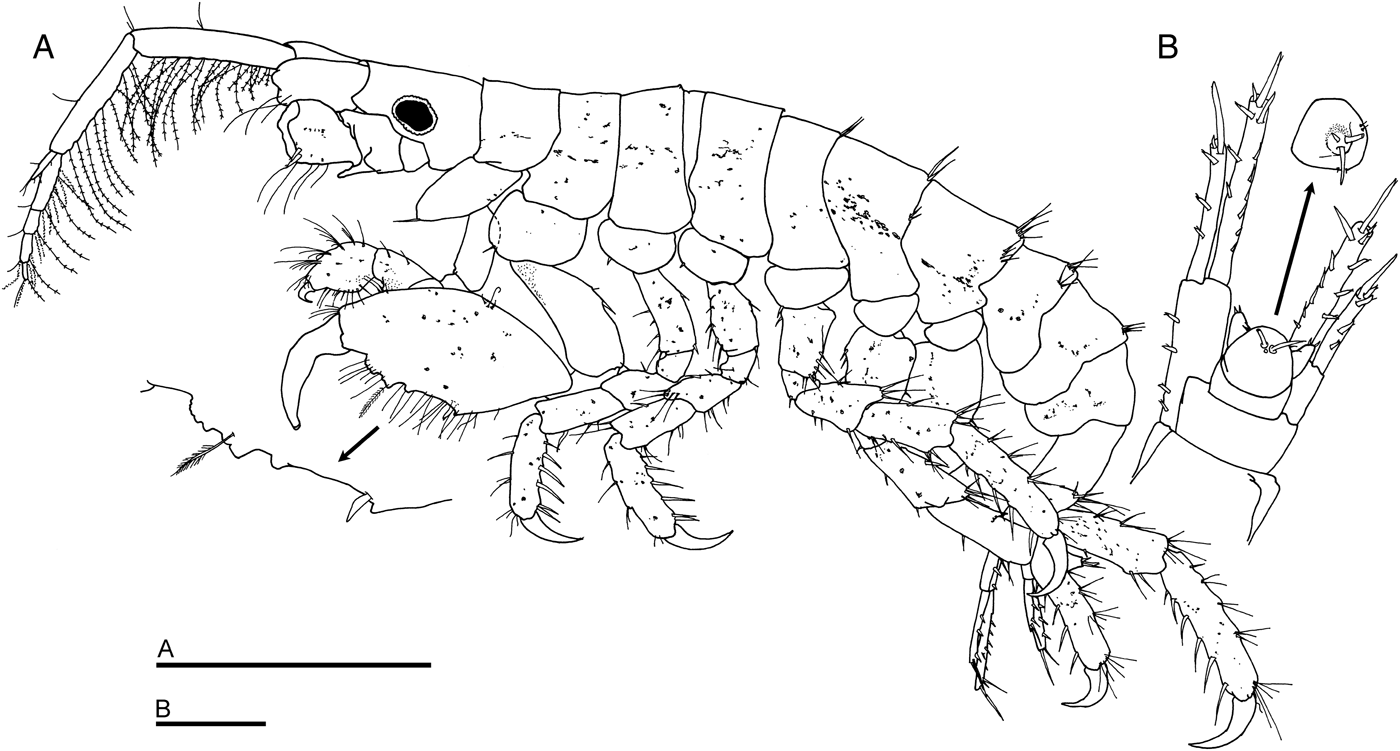
Podocerus fissipes Serejo, Reference Serejo1995, male: (A) habitus; (B) uropods 1–3. Scale bars: A, 1 mm; B, 0.2 mm.

MATERIAL EXAMINED
2 males, 17 females (1 ovigerous), B1, YUC-CC-255-11-125. 3 males, 2 females (1 ovigerous), B2, YUC-CC-255-11-126. 1 male, 1 female, B3, YUC-CC-255-11-127. 23 males, 14 females, B4, YUC-CC-255-11-128.
DISTRIBUTION
General distribution: south-eastern Florida; Caribbean; south-eastern Brazil; (Serejo, Reference Serejo1995; Baldinger & Gable, Reference Baldinger and Gable2002; LeCroy, Reference LeCroy2011). Gulf of Mexico records: previously unreported.
HABITAT
Podocerus fissipes is a marine epibenthic species in shallow waters (0–5 m); associated with the sponges Dysidea fragilis (Montagu, Reference Montagu1818) and Mycale microsigmatosa Arndt, Reference Arndt1927 in Brazil (Serejo, Reference Serejo1995, Reference Serejo1998; Ribeiro et al., Reference Ribeiro, Omena and Muricy2003).
The genus is frequently found in fouling communities on hard substrates, clinging to algae, barnacles, sponges, hydroids, gorgonians and other fouling growth in relatively high energy habitats (LeCroy, Reference LeCroy2011).
REMARKS
This is the first record for the Gulf of Mexico. Given the fouling lifestyle of members of this genus and artefacts caused by a lack of sampling, Podocerus fissipes may eventually be found in more localities in the north-western Atlantic (LeCroy, Reference LeCroy2011).
So far there are four recorded species of Podocerus in the Gulf of Mexico (including the new record in the present study): Podocerus brasiliensis (Dana, Reference Dana1853), Podocerus chelonophilus (Chevreux & Guerne, Reference Chevreux and de Guerne1888), P. fissipes and Podocerus kleidus Thomas & Barnard, Reference Thomas and Barnard1992. Podocerus fissipes is easily distinguished from the other Gulf of Mexico Podocerus species by the presence of long, stout, dorsal setae on pereonites 5–6 and pleonites 1–2; one small seta at anterodistal corner of coxal plates 1–4; and by the presence of two long apical spines on the telson. Only one adult male presented three apical spines on the telson.
DISCUSSION
Amphipods associated with coral reefs have been studied around the world. Currently the amphipod fauna of the Great Barrier Reef is the richest fauna yet known from any tropical reef area with 256 species (Lowry & Myers, Reference Lowry and Myers2009), as a result of an intensive sampling effort. On the other hand, in the tropical western Atlantic (mainly in the Caribbean and Gulf of Mexico) most of the species are known from sporadic records and/or new single species descriptions and coral reef species have not been the subject of detailed systematic study (Thomas, Reference Thomas1993; Baldinger, Reference Baldinger2000). Among studies which have reported coral reef species in the Mexican Atlantic are McKinney (Reference McKinney1977, Reference McKinney1978, Reference McKinney1979, Reference McKinney1980a, Reference McKinneyb), Oliva-Rivera (Reference Oliva-Rivera2003), Winfield & Escobar-Briones (Reference Winfield and Escobar-Briones2007), Winfield et al. (Reference Winfield, Abarca-Arenas and Cházaro-Olvera2007, Reference Winfield, Cházaro-Olvera, Horta-Puga, Lozano-Aburto and Arenas-Fuentes2010) and Winfield & Ortiz (Reference Winfield, Ortiz and Hernández-Ortiz2011).
The recorded amphipod species from the Mexican Gulf reefs have been from the Tuxpan–Veracruz reef system in the south-western sector. The present study is the first checklist of fouling amphipods associated with coral reef environments from the Campeche Bank in the south-eastern sector. Recent studies in the south-western sector have focused on the space–time variations of fouling assemblages on artificial panels established in the Veracruz reef system (Winfield et al., Reference Winfield, Abarca-Arenas and Cházaro-Olvera2007, Reference Winfield, Cházaro-Olvera, Horta-Puga, Lozano-Aburto and Arenas-Fuentes2010) and species descriptions (Winfield & Álvarez, Reference Winfield and Álvarez2009; Winfield & Ortiz, Reference Winfield and Ortiz2009, Reference Winfield and Ortiz2010; Winfield et al., Reference Winfield, Ortiz and Cházaro-Olvera2009a, Reference Winfield, Ortiz and Cházaro-Olverab). Regarding the studies of fouling assemblages, the accumulated species richness from artificial panels in Winfield et al. (Reference Winfield, Abarca-Arenas and Cházaro-Olvera2007, Reference Winfield, Cházaro-Olvera, Horta-Puga, Lozano-Aburto and Arenas-Fuentes2010) reached 23 nominal species of Gammaridea sensu lato, whereas the accumulated species richness from man-made structures (navigation buoys and wood docks) in the present study reached 16 nominal species of Gammaridea sensu lato. The difference between the species number from the present study and previous studies may be related to the sampling effort. There are three navigation buoys and eight mooring buoys in the present study area that were not sampled. More species are expected to be found if these buoys are sampled and if the regional weather seasonality is examined (cold fronts, rainy and dry seasons).
An updated checklist of the marine invasive amphipod species from Mexico (particularly from the Veracruz reef systems) was provided by Winfield et al. (Reference Winfield, Cházaro-Olvera, Ortiz and Palomo-Aguayo2011). This list includes 11 species, but as those authors suggested, this is likely a subestimation of the current number of invasive amphipods, considering the structural complexity and environmental heterogeneity of the different marine ecosystems and the importance of the traffic of national and international ships. For instance, three possible invasive species (Elasmopus rapax, Stenothoe gallensis and Stenothoe valida) are listed in the present study, supporting the possibility of subestimation. These species were qualified as strong candidates for introduced species in Hawaii by means of shipping (Barnard, Reference Barnard1970; Coles et al., Reference Coles, DeFelice, Eldredge and Carlton1999; Carlton & Eldredge, Reference Carlton and Eldredge2009). To date, these species have been characterized as invasive species in other coastal areas. Elasmopus rapax has been determined as an invasive species on the Australian coast (Hughes & Lowry, Reference Hughes and Lowry2010), S. gallensis as an invasive species on the Mediterranean coast (Streftaris et al., Reference Streftaris, Zenetos and Papathanassiou2005; Bakir et al., Reference Bakir, Sezgin and Katağan2010) and S. valida as a invasive species on the Californian coast (Carlton & Hodder, Reference Carlton and Hodder1995; Ruiz et al., Reference Ruiz, Fofonoff, Carlton, Wonham and Hines2000). However, before establishing an invasive status for these species in the Alacranes Reef, a detailed risk assessment that includes criteria (among others) of Chapman & Carlton (Reference Chapman and Carlton1991) for introduced species (e.g. type locality, distribution, habitat, natural history and dispersal mechanism) will be necessary.
ACKNOWLEDGEMENTS
We thank Jazmín Deneb Ortigosa (UNAM, Mexico) and Julio Canton Avila (Pronatura, Mexico) for their help with the sample collection from the Alacranes Reef; and we extend special thanks to the Oceanography Research Station in Progreso, Mexican Navy for the transportation logistics on several occasions to the Alacranes Reef. The authors also thank the anonymous referees who helped to improve the manuscript.