International Committee of the Red Cross in 2018 reported a rise in the number of disasters during the recent years; 3751 natural hazards have been recorded over the last 10 years. Only in 2018, more than 130 million people need assistance.1 According to the International Federation of Red Cross and Red Crescent Societies’ definition, a volunteer is “someone who works for a more humane and peaceful world by delivering services directly to vulnerable people and seeking to prevent and reduce vulnerability and exclusion.” Nearly 1 billion people around the world choose to be volunteers.2 It is estimated that more than 17 million humanitarian aid volunteers work in 189 countries.Reference Hazeldine and Baillie Smith3 In the immediate aftermath of a disaster, volunteers respond to the needs of the affected population through such activities as removing debris and bodies, attending to the injured, establishing shelters, supplying food and water, and providing sanitation in the short and long terms.2
Several issues, such as insufficient sleep and rest, observing the grief of the affected people, long and hard work, lack of safety and security in the field, violent behaviors, and unsuitable accommodation during the operations, render Disaster Relief Operations1 exhausting.2,Reference Hazeldine and Baillie Smith3 In recent years, the level of violence against volunteers has increased significantly.Reference Van Liempt, Vermetten, de Groen and Westenberg4 Exposure to such situations and stressful experiences can have various negative consequences, such as fatigue,Reference Stamm, Stamm, Hudnall and Higson-Smith5 sleep disorders and anxiety,Reference Stoddard, Harmer and Didomenico6 physical problems, fear, anger, depression, psychosomatic disorders, and posttraumatic syndrome disordersReference Ehrenreich and Elliot7 among aid workers. Failure on the part of humanitarian organizations to take appropriate measures against such negative effects is usually tantamount to staff loss.
Bolstering resiliency among volunteers can be regarded as one of the most important and effective ways of preventing the negative consequences of disaster relief operations.Reference Kleim and Westphal8,Reference Naturale, Pulido, Framingham and Teasley9 Resiliency has been defined as the capacity to minimize disruption, to recover, and to adapt to new circumstances.Reference Cutter, Barnes and Berry10 Furthermore, disaster resilience has been defined as the ability and capacity to encounter a crisis, to adapt to it, and to return to the previous state.Reference Kleim and Westphal8 Resiliency has been investigated at individual, family, community, and system levels.Reference Ainuddin and Routray11,Reference Arbon, Kristine and Lynette12 However, little attention has been paid to resiliency among the volunteers.
Determining what factors affect aid workers’ resiliency in disasters may assist workers and their respective organizations in preventing the challenges encountered in the field.Reference Brooks, Dunn and Sage13 Of course, not only should relief organizations deploy resilient volunteers in disaster fields, but they should also continuously seek to augment their resilience. The first step to achieving this objective is to identify the factors impacting on resilience among volunteers in disasters through literature reviews. Accordingly, in the present study, we aimed to identify various factors that have an effect on aid workers’ resiliency in disasters both natural and man-made disasters.
METHODS
Databases and Search Strategy
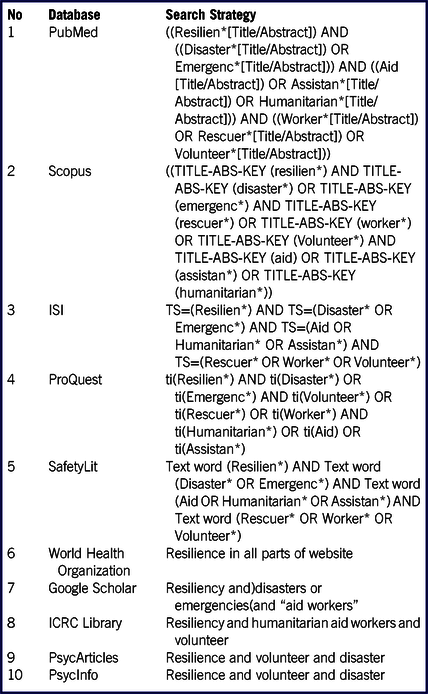
Systematic literature search of Web of Science, Scopus, MEDLINE (PubMed), ProQuest, Google Scholar, World Health Organization Library, International Committee of the Red Cross (ICRC) Library, PsycArticles, PsycInfo, and SafetyLit until September 29, 2018, was performed to identify studies addressing the resiliency in volunteers (Table 1). The search terms were selected by applying the Medical Subject Headings (MeSH). If a word did not exist in MeSH, expert opinion was sought and similar articles were investigated to find suitable terms. The main search terms were resiliency, disaster, emergency, aid, assistant, humanitarian, rescuer, volunteer, and worker. Searches were not limited to a specific region.
Selected Databases and Terms

Inclusion Criteria
All documents on volunteers’ resiliency published in the English language until September 29, 2018, were eligible for inclusion in this study.
Exclusion Criteria
Documents without abstracts and those addressing resiliency in hospitals, communities, schools, citizens, and patients were excluded from the current study.
Document Selection
The database search was conducted between May and September 2018 by 2 members of the research team (HGh, SS). All the retrieved documents were managed using EndNote, version 16. Duplicated documents were removed, and then the titles and abstracts of all the documents were perused. Documents that did not meet the inclusion criteria were excluded. If reading the titles and abstracts was not enough for decision-making, the full texts of the articles were read and any disagreement was resolved by consultation with a third member of the research team. In the last phase, the full texts of all the selected articles were read and analyzed.
Quality Appraisal
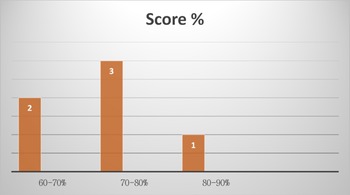
The present study was conducted based on the guidelines of the Preferred Reporting Items for Systematic Reviews and Meta-analyses (PRISMA)Reference Moher, Liberati, Tetzlaff and Altman14 on review and meta-analysis studies. The purpose of this study was to identify factors affecting the resiliency of volunteers in disasters with a view to suggesting interventions or recommendations, rather than appraising the quality of the papers. However, a quality appraisal of the selected texts was conducted in order to provide a summary of the quality of the existing systematic review papers. The evaluation of the selected studies was done using the Critical Appraisal Skills Program (CASP).15 Accordingly, all selected articles were of high quality.Reference Moher, Liberati, Tetzlaff and Altman14 For example, the result of critical appraisal of qualitative studies has been depicted in Figure 1 (Median score = 78%).
Quality Assessment of Selected Qualitative Studies.

RESULTS
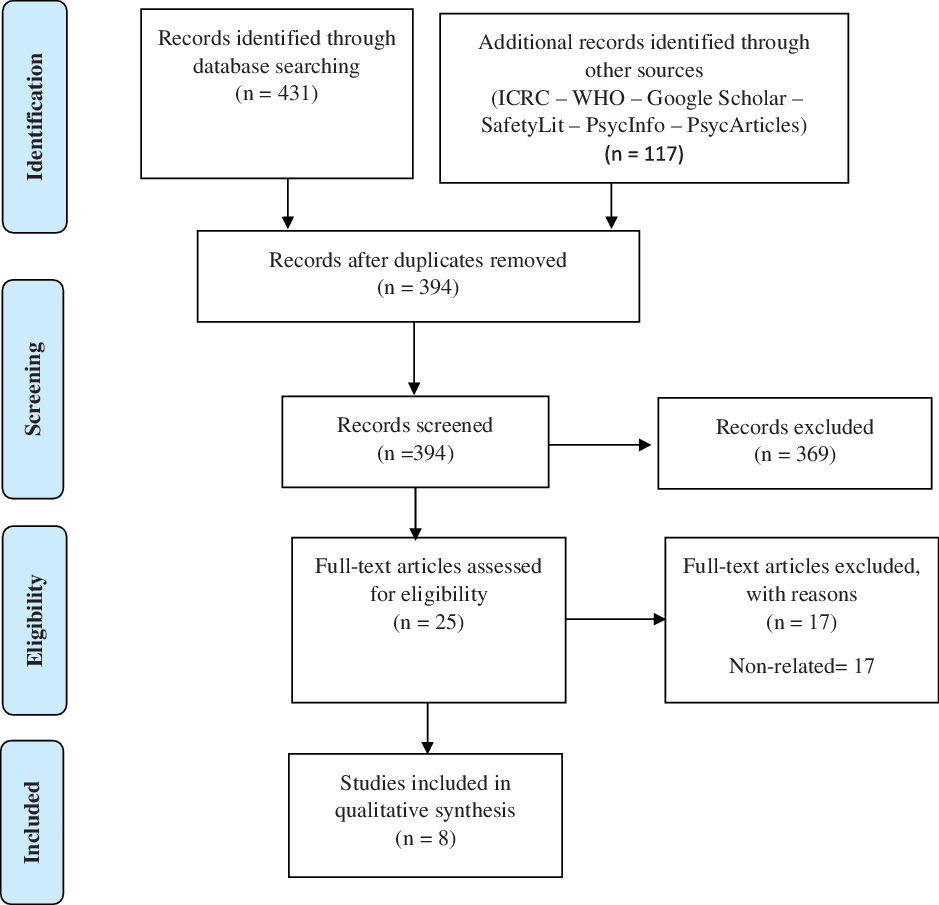
In the first phase, 548 documents were extracted from the International Scientific Indexing databases (31), Scopus (48), PubMed (13), ProQuest (339), Google Scholar (12), ICRC Library (3), SafetyLit (9), PsycArticles (39), and the Electronic Library of the World Health Organization (54). A total of 154 duplicated articles were removed, and thereafter the abstracts of the remaining 394 documents were read. In the next step, 369 documents were removed based on the exclusion criteria. The full texts of all the 17 remaining articles were read, and 8 documents on resiliency among volunteers in disasters were selected for the final analysis (Figure 2).
PRISMA Flow Diagram.

DESCRIPTIVE ANALYSIS OF DOCUMENTS
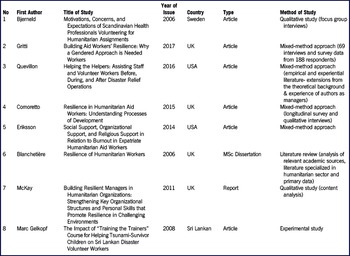
The results showed 2 relevant documents in 2006, and 1 in each of the years of 2008, 2011, 2014, 2015, 2016, and 2017 (Table 2). All the studies included in the final analysis were published in the year 2006 and onward; 50% of the studies have been done in UK and none of them in Asia. Six of the final documents analyzed were articles, 1 was a dissertation and 1 was a report. The results are reported in the following 2 sections of thematic and descriptive analyses.
Main Characteristics of the Final Documents

THEMATIC ANALYSIS
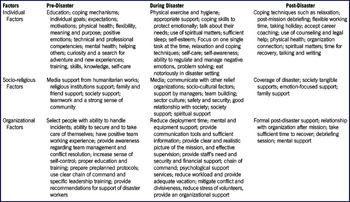
The factors influencing volunteers’ resiliency were classified into 2 sections of the affecting levels and the time (Table 3).
Categorization of Factors Affecting the Resiliency of Volunteers

Affecting Levels
Individual Factors
The review of the documents showed that various individual factors had a bearing on the resiliency of volunteers. Based on these findings, the ability to survive in disaster-affected fields and tolerate difficulties could be achieved by strengthening or creating individual factors of resiliency. These factors were categorized in 2 groups of inherent and acquired individual components.
Having the motivation, interest, and willingness to assist others were considered the individual factors generating high levels of resiliency in humanitarian aid volunteers.Reference Nickell, Crighton and Tracy16,Reference Blanchetière17 Benefiting from appropriate education, skill, and knowledge to attend the scene of the disaster was the other individual factor mentioned in the documents.Reference Bjerneld, Lindmark, McSpadden and Garrett18
Self-care was an important individual factor before, during, and after the mission. To boost self-care, volunteers should be taught special strategies such as sleeping and resting sufficiently, learning relaxation skills, eating nutrients in disaster settings, doing regular physical exercises, having positive thoughts, and allocating enough time to recovery.Reference Comoretto19,Reference Gelkopf, Ryan, Cotton and Berger20
Socio-religious Factors
Social support, which encompassed backing from family and friends, media, religion, and community, constituted the environmental factors influencing the resiliency of volunteers in disasters.Reference Nickell, Crighton and Tracy16
Organizational Factors
Humanitarian organizations should afford suitable conditions to their volunteers so that they can accomplish their operations with minimum difficulty and return to their normal lives after disasters. Accordingly, these organizations are expected to recruit and train individuals with specific abilities, furnish them with the necessary resources and equipment before, during, and after the mission,Reference Nickell, Crighton and Tracy16 and support them spiritually, materially, and communicatively after the fieldwork.Reference Dass-Brailsford21 Additionally, they should ensure the safety and security of their volunteers, as well as the necessary psychological services, to shield them from mental complications.Reference Comoretto19
Stage
Stage denotes the factors affecting volunteers pre-, during, and post-disasters. The abilities that must exist or be strengthened in the volunteer before a fieldwork are training,Reference Gritti22 coping strategies,Reference Blanchetière17 communication skills, teamwork,Reference Comoretto19 and physical and mental health.Reference Blanchetière17
A significant factor at the time of a disaster and in the field is the provision of sufficient food, equipment, sleep and rest, safety and security,Reference Nickell, Crighton and Tracy16,Reference Dass-Brailsford21 description of specific tasks, and team support for volunteers.Reference Gritti22
Among post-disaster measures contributing to bolstered resiliency among aid workers are follow-ups of the volunteers’ mental health status and delivery of continuous support via the community, organization, and media.Reference McKay23 What can also foster a feeling of helpfulness and thus willingness to continue aid work among volunteers is to render psychological assistance to them and make them feel appreciated by using their experiences.
DISCUSSION
The alarming rise in the number of disasters in the recent decades has, more than ever before, underscored the pivotal role of disaster resilience among aid workers, as is attested to by the attention given to it in copious scientific documents.Reference Quevillon, Gray and Erickson24,Reference Eriksson, Bjorck and Larson25 We investigated the factors influencing the resiliency of volunteers in disasters at 3 levels of individual, organizational, and socio-religious, as well as the 3 stages of pre-, during, and post-disasters.
Regarding the individual dimension, physical and mental health before and during the disaster play a very important role in individual resiliency. If volunteers don’t have good physical and mental health, they cannot cope with problems in the disaster field. The interest in volunteering is another individual factor that has been mentioned in other study populations such as nurses.Reference Sohrabizadeh and Sayfouri26 In the organizational dimension, various logistical and psychological supportive measures constitute the most important factors that merit special attention. The factor of considerable significance in the socio-religious dimension is community and media support. Social supports from community can help volunteers feel they are not alone in their challenging work. In addition, community members should respect humanitarian volunteers and make them feel welcome.
The results of our screening diagram showed that 8 documents included investigations of the factors affecting the resiliency of humanitarian aid workers. All the studies included in the final analysis were published in the year 2006 and onward, and over 50% of them were carried out over the last 4 years (2014–2017), which more or less represent an increase in the number of investigations relating to disasters.
Our thematic analysis of the findings showed that the factors impacting on the resilience of volunteers can be classified into 3 levels of individual, environmental, and socio-religious at the 3 stage points of pre-, during, and post-disasters. The individual characteristics of volunteers, which can influence their resiliency, may be classified into 2 groups of inherent and acquired individual components. Altruism and empathy, interest in humanitarian endeavors, and motivation to help others are the individual components that underpin the commencement and continuation of volunteer service.Reference Ghodsi, Khani Jazani, Sohrabizadeh and Kavousi27 On the other hand, there are other components that should be learned and strengthened by volunteers before they embark on the fieldwork; these factors include physical and mental health, adaptive skills, self-care, and individual and specialized training.
As mentioned, there are many components of resiliency such as organizational, individual, and socio-religious factors that should be taken into consideration because they are interrelated. For example, organizational support is related to less emotional exhaustion. Thus, supportive relationships and organizational policies and procedures can contribute to lower burnout in volunteers. Volunteers who received more support from organizational or socio-religious systems felt they were not alone in their challenging work, and thus they are less likely to develop individual disorders and problems in their missions.
Although some studies have reported the organizational components that have a significant bearing on resiliency among volunteers in disasters, their findings may not be comprehensive. The results of our study indicated that organizational factors affecting the resiliency of volunteers in disasters should be considered at the 3 stages of pre-, during, and post-mission. The recruitment of suitable volunteers for fieldwork and the provision of specialized training and organizational support compose the significant dimensions that should be taken into account by humanitarian organizations before starting a mission.Reference Gelkopf, Ryan, Cotton and Berger20,Reference Gritti22
Humanitarian organizations should support volunteers in various ways in order to enhance their resiliency and achieve better outcomes in the mission. Providing adequate safety and security, equipment,Reference Bjerneld, Lindmark, McSpadden and Garrett18 essential facilities and information, and psychological and communication support,Reference Dass-Brailsford21-Reference McKay23 as well as reducing work pressure and the duration of the presence of volunteers in the disaster scene are all of considerable significance with respect to resiliency among volunteers.Reference Brooks, Dunn and Sage13,Reference Dass-Brailsford21,Reference Ghodsi, Khani Jazani, Sohrabizadeh and Kavousi27
The results of the studies showed that, although the services delivered by humanitarian organizations were provided by volunteers during the fieldwork, the volunteers are often abandoned without any communication with their organizations until their next mission in disaster-affected fields. Following a mission, resilience among aid workers can be boosted through various material and spiritual supportive measures such as psychological debriefing.Reference Blanchetière17
Volunteers are always subject to various complications due to the nature of their voluntary work. Since most humanitarian organizations do not have official staff and rely on volunteers, they need to take sufficient heed of the factors having an impact on resiliency among their volunteer workers. For improving the resiliency of volunteers, humanitarian aid worker organizations need to understand their strengths and weaknesses and should be able to evaluate the effectiveness of their resilience strategies. To achieve this goal, the first step is to assess the current situation by using a tool.
Limitations
Lack of access to all potentially related documents, including those which have not published yet, was one of the limitations during the study. In addition, the inclusion of only English language articles led to missing some resources in other languages. Furthermore, despite all the various disasters having struck Asia, a continent with a large number of active volunteers, we could not find any study on the issue under consideration in the present study.
CONCLUSIONS
The findings of this review provide evidence that could be used by the administrators of humanitarian organizations involved in disaster setting. Effective preparedness of volunteers for disaster response can be achieved using the resiliency factors. If the resiliency of volunteers is not considered or strengthened, humanitarian organizations may not achieve their predetermined goals and disaster-affected people may not receive necessary services. Furthermore, volunteers may also suffer from numerous complications and may leave their voluntary work to care for their own physical and mental health. Thus, it is highly suggested that organizations active in humanitarian endeavors in disaster scenes explore the factors affecting resilience among their volunteers through various research methods. These organizations need to recruit volunteers with higher levels of resiliency so as to avert untoward consequences in their operations. Further research is needed to develop a valid and reliable tool for measuring resiliency among volunteers in disaster fields.
Conflict of Interest Statement
The authors have no conflicts of interest to declare.