Introduction
Mansonella ozzardi is a filarial nematode endemic as small foci in South America (Amazon Basin), in the isthmian portion of the North American continent (Yucatan, Panama) and in the West Indies (Haiti and the Lesser Antilles). Upon its discovery, M. ozzardi was the subject of some confusion. Indeed, Patrick Manson described it under two different names: Filaria demarquayi, for the microfilariae found in the inhabitants of Saint Vincent Island in the Lesser Antilles, and F. ozzardi, for those found among the Indians of Guyana in South America. With little research, due to the lack of serious pathogenic effects easily recognizable in humans, and the fact that the adult form was difficult to find, this filarial nematode has remained little known for a long time. In the decade 1974–1984, studies were carried out on this parasite and its vectors in Haiti (Ripert et al., Reference Ripert, Raccurt and Douyon1977; Raccurt et al., Reference Raccurt, Lowrie and McNeeley1980, Reference Raccurt, Lowrie, Boncy and Katz1982, Reference Raccurt, Boncy and McNeeley1983; Lowrie & Raccurt, Reference Lowrie and Raccurt1981, Reference Lowrie and Raccurt1984; Orihel et al., Reference Orihel, Lowrie, Eberhard, Raccurt, Kozek, Tidwell and Tidwell1981; Kozek & Raccurt, Reference Kozek and Raccurt1983; Kozek et al., Reference Kozek, Eberhard and Raccurt1983a; Lowrie et al., Reference Lowrie, Raccurt, Eberhard and Katz1983; Raccurt, Reference Raccurt1984; McNeeley et al., Reference McNeeley, Raccurt, Boncy and Lowrie1989). These studies have resulted in the definitive description of the adult form of the filarial nematode (Orihel & Eberhard, Reference Orihel and Eberhard1982), which allows for clarification of the taxonomic position of the species (Eberhard & Orihel, Reference Eberhard and Orihel1984), and the accumulation of morphological and biological information on this parasite, which is part of the Onchocercidae family (Raccurt, Reference Raccurt1984). Mansonella ozzardi is singular for two reasons. First, it has adapted to two families of haematophagous Diptera (Ceratopogonidae and Simuliidae), possible intermediate hosts or effective vectors, depending on the geographical regions. Second, the blood microfilariae are able to leave the vascular bed to migrate into the dermal interstitial fluid, so they can be detected by skin biopsy (Moraes, Reference Moraes1976) as well as by taking a venous or capillary blood sample (Nathan et al., Reference Nathan, Bartholomew and Tikasingh1978). Thus, M. ozzardi establishes a kind of link between the human Mansonella species with blood microfilariae, such as M. perstans in Africa and South America, and those with dermal microfilariae, such as M. streptocerca in Central Africa.
This article aims to highlight the knowledge gained on M. ozzardi and its vectors in Haiti over the past 40 years, to review the scientific literature, and to generate renewed interest among researchers, policy makers and donors on this filarial nematode, which is still very much neglected.
Historical review
At the end of the nineteenth century, Manson described a new species of filarial nematode under the name Filaria demarquayi in blood samples taken from inhabitants of St. Vincent in the Lesser Antilles (Manson, Reference Manson1897), and under the name F. ozzardi in blood samples taken from the Indians of Guyana by Ozzard (Manson, Reference Manson1897; Ozzard, Reference Ozzard1897). Daniels remarked that the microfilariae with tapered posterior extremities were very common among the Indians of this country. By performing autopsies, he thought he had discovered the adult forms (Daniels, Reference Daniels1898, Reference Daniels1899). However, these adult worms, supposedly belonging to the species F. ozzardi, were instead Wuchereria bancrofti (Leiper, Reference Leiper1913). The first adult specimens of this new species (five females) were found in 1899 during the autopsy of a Saint Lucian in the Lesser Antilles (Low, Reference Low1902). The genus Mansonella was created in 1929, because the morphological characteristics of the microfilariae and the incomplete description of the adult made it impossible to link this species to any other known genus at the time (Faust, Reference Faust1929). Due to the success of experimental infection of the monkey Erythrocebus patas with third-stage larvae from Haiti (Orihel et al., Reference Orihel, Lowrie, Eberhard, Raccurt, Kozek, Tidwell and Tidwell1981), the complete description of male and female adult worms was achieved for the first time almost a century after discovery of the microfilariae (Orihel & Eberhard, Reference Orihel and Eberhard1982), and the definitive taxonomic position of this nematode was finally established (Eberhard & Orihel, Reference Eberhard and Orihel1984).
Taxonomic position
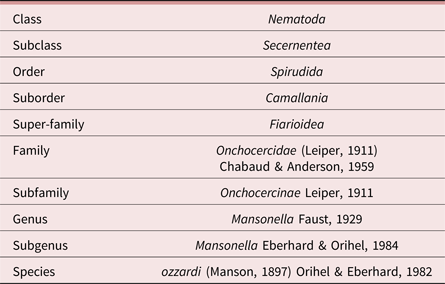
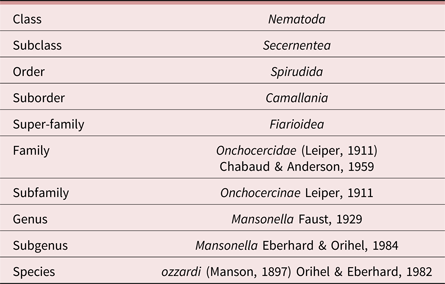
The last review of the genus Mansonella (Faust, Reference Faust1929), which includes low-pathogenic filariae that live in subcutaneous tissues and in muscular fascia of mammals, including humans, transmitted by Ceratopogonidae and/or Simuliidae, and which updates the classification of this group of parasites, makes it possible to classify this species definitively (Bain et al., Reference Bain, Mutafchier, Junker, Guerrero, Martin, Lefoulon and Uni2015) (table 1). Its scientific name is Mansonella (Mansonella) ozzardi (Manson, Reference Manson1897) Orihel & Eberhard, Reference Orihel and Eberhard1982.
Classification of Mansonella ozzardi.
Geographical distribution
While M. perstans is present both in the large forests of equatorial Africa and South America (Tavares da Silva et al., Reference Tavares da Silva, Crainey, Ribeiro da Silva, Suwa, Vicente, Fernandes de Medeiros, Pessoa and Luz2017), M. ozzardi is strictly a Neotropical filaria. In the New World, both filarial nematodes are found in sympatry across the Amazon, in western Guyana (Orihel, Reference Orihel1967), southern Colombia (Kozek & Raccurt, Reference Kozek and Raccurt1983) and Venezuela (Formica & Botto, Reference Formica and Botto1990). Since its discovery in Guyana and St. Vincent Island in the Caribbean, the presence of M. ozzardi has been reported in almost all Latin American countries, from southern Mexico to northern Argentina, and in 15 islands of the Caribbean archipelago (Sasa, Reference Sasa1976; Hawking, Reference Hawking1979).
A patchy geographical distribution is characteristic of M. ozzardi foci in the Amazon Basin as well in the Caribbean region. The environmental factors that limit the spread of M. ozzardi beyond well-characterized hotspots along major rivers in the Amazon Basin and in the coastal mangroves in Haiti remain largely undetermined. In fact, the actual distribution of the parasite in the Western Hemisphere is only partially understood because of the immensity of the territories, access difficulties, the relatively limited number of epidemiological surveys conducted, limited interest in this low or non-pathogenic parasite, as well as precarious and sometimes non-existent health infrastructures in some regions that remain undeserved. Moreover, geographical distribution deserves to be updated periodically due to the spontaneous or induced disappearance of certain foci and the emergence of other foci, as a result of migrations of infected populations. Three main endemic areas persist in the Neotropical region, where the source of infection is not always well known.
The South American continent
Mansonella ozzardi is located in the forest areas of the Amazon Basin (Shelley, Reference Shelley1975) and the Orinoco Basin (Medrano et al., Reference Medrano, Volcán and Godoy1992) where there are small foci scattered along the banks of the rivers. The countries include northern Brazil (Rachou, Reference Rachou1957; Batista et al., Reference Batista, Cerqueira and Moraes1960; Oliveira, Reference Oliveira1963; Lage, Reference Lage1964; Moraes et al., Reference Moraes, Almeida, Lovelace and Chaves1978, Reference Moraes, Shelley and Luna Dias1985; Adami et al., Reference Adami, Moraes, Lanfredi and Maia-Herzog2008, Reference Adami, Rodrigues, Alves, Moraes, Banic and Maia-Herzog2014; Medeiros et al., Reference Medeiros, Py-Daniel, Barbosa and Ogawa2008, Reference Medeiros, Py-Daniel, Barbosa and Izzo2009, Reference Medeiros, Py-Daniel and Barbosa2011, Reference Medeiros, Costa, Lima and Pessoa2014a, Reference Medeiros, Pessoa and Camargob, Reference Medeiros, Rodrigues, Katsuragawa, Costa and Pessoac; Martins et al., Reference Martins, Pessoa, de Medeiros, de Andrade and Medeiros2010; Basano et al., Reference Basano, Camargo, Vera, Velasques, Ogawa, Medeiros, Fontes and Camargo2011, Reference Basano, Fontes, Medeiros, Aranha Camargo, Souza Vera, Parente Araújo, Pires Parente, Mattos Ferreira, Barreto Crispim and Aranha Camargo2014, Reference Basano, Medeiros, Fontes, Vieira, Camargo, Vera, Ferreira and Camargo2016; Ta-Tang et al., Reference Ta-Tang, Luz, Merino, de Fuentes, López-Vélez, Almeida, Lanza, Abrahim and Rubio2016); the three Guianas – French Guiana (Floch & Abonnenc, Reference Floch and Abonnenc1950), Suriname (Bruijning, Reference Bruijning1957) and Guyana (Orihel, Reference Orihel1967; Nathan et al., Reference Nathan, Tikasingh and Munroe1982); Venezuela (Beaver et al., Reference Beaver, Neel and Orihel1976; Godoy et al., Reference Godoy, Volcan, Medrano, Teixeira and Matheus1980; Formica & Botto, Reference Formica and Botto1990; Medrano et al., Reference Medrano, Volcán and Godoy1992; Gómez & Guerrero, Reference Gómez and Guerrero2000); eastern Colombia (Marinkelle & German, Reference Marinkelle and German1970; Kozek et al., Reference Kozek, D'Alessandro, Silva and Navarette1982, Reference Kozek, Palma, Henao, García and Hoyos1983b, Reference Kozek, Palma, Valencia, Montalvo and Spain1984) and north-eastern Peru (Marcos et al., Reference Marcos, Arrospide, Recuenco, Cabezas, Weil and Fischer2012; Vargas-Herrera et al., Reference Vargas-Herrera, Arróspide-Velasco, Gutierrez-González, Celis-Salinas, Huamaní-Solano, Loza-Hermenegildo, Elgegren-Lao, Armas-Montes, BacaPérez and Cabezas2013; Vargas et al., Reference Vargas, Arróspide, Gutiérrez, Obregón, Valencia and Mormontoy2015).
Three other forest regions relate to this important geographical region: first, in the north, the area straddling north-western Colombia and eastern Panama with extensions to the Atlantic and Pacific coastal regions of Colombia. Information about this endemic area is dated (McCoy, Reference McCoy1933) and deserves to be verified and updated. Second, in the centre of Brazil, some foci have been reported along the Xingu River in the north of Mato Grosso (d'Andretta et al., Reference D'Andretta, Pio da Silva and Kameyna1969), but this region is not widely recognized as an endemic area. Third, in the south, the area straddling southern Bolivia and northern Argentina is still active (Shelley & Coscarón, Reference Shelley and Coscarón2001; Dantur Juri et al., Reference Dantur Juri, Veggiani Aybar, Ortega, Galante and Zaidenberg2013; Lima et al., Reference Lima, Veggiani Aybar, Dantur Juri and Ferreira2016; Veggiani Aybar, Reference Veggiani Aybar, Dantur Juri and Zaidenberg2016).
In these forest regions, the parasite infects predominantly Amerindian populations, which are established along streams in small, scattered communities that are difficult to access. The prevalence is usually very high.
The isthmian portion of the North American continent
The focus in the Yucatan peninsula in Mexico has been known since 1930 (Hoffman, Reference Hoffman1930) and carriers of microfilariae of M. ozzardi have also been reported in Panama among the Indians of the province of Darien, near the Colombian border (Petersen et al., Reference Petersen, Bawden, Wignall, Latorre, Johnson and Miranda1984). Mansonella ozzardi has also been reported in the three Mexican regions of Campeche, Yucatan and Quintana Roo (Mazzotti, Reference Mazzotti1942; Biagi, Reference Biagi1956; Biagi et al., Reference Biagi, Tay and de Biagi1958). No recent information relates to these Mexican foci: have they already disappeared? The presence of M. ozzardi was also reported in Guatemala by O'Connor in 1937 (in Brumpt, Reference Brumpt1949). An update of the situation in Mesoamerica is therefore necessary.
The Caribbean
Small foci have been reported over the past century in almost all of the Lesser Antilles, from the island of Viéques, east of Puerto Rico (Hoffman et al., Reference Hoffman, Marin and Burke1932) to the northern coast of Trinidad (Aschcroff, Reference Aschcroff1965; Nelson & Davies, Reference Nelson and Davies1976; Nathan et al., Reference Nathan, Tikasingh, Nelson, Santiago and Davies1979, Reference Nathan, Tikasingh and Munroe1982; Chadee et al., Reference Chadee, Rawlins, Doon and Baboolal1994). The latter source of contamination was successfully treated with ivermectin (Chadee et al., Reference Chadee, Tilluckdharry, Rawlins, Doon and Nathan1995; Gonzales et al., Reference Gonzalez, Chadee and Rawlins1999). In Guadeloupe, Le Dantec first reported the presence of M. ozzardi in Reference Le Dantec1924. In 1929, in the British Overseas Territories of the Caribbean, the endemic nature of the filaria was confirmed for the first time in St. Vincent (Cameron, Reference Cameron1929). Subsequently, M. ozzardi was found regularly in the French West Indies (St. Bartholomew, Guadeloupe, Désirade, Marie-Galante, Martinique) and in the Lesser Antilles (Antigua, Nevis, Dominica, Saint Lucia, Saint Vincent, Grenadine and St. Kitts) (Raccurt, Reference Raccurt1984). Additionally, the contamination of a blood donor from the USA returning from a cruise in these popular tourist destinations was reported in 1978 (Weller et al., Reference Weller, Simon, Parkhurst and Medrek1978).
The foci of the Lesser Antilles, particularly in the French departments (Guadeloupe and Martinique), seem to have disappeared spontaneously with the economic development of these islands. The last cases reported in Guadeloupe go back about 50 years (Courmes et al., Reference Courmes, Fauran and Lespinasse1968).
In the Greater Antilles, the parasite has never been reported in Puerto Rico, Cuba or Jamaica. Curiously, M. ozzardi has not been described in the Dominican Republic, which shares the island of Hispaniola with Haiti, where numerous foci of mansonelliasis occur (Raccurt, Reference Raccurt1984). It has been reported only in two lepers from the Turks Islands, an archipelago located north of Haiti (Stafford et al., Reference Stafford, Hill and de Montaigne1955). This disparity between the western part and the eastern part of the island of Hispaniola is paradoxical. Have there been any surveys of coastal populations to identify possible carriers of M. ozzardi microfilariae in the Dominican Republic? If M. ozzardi is truly absent in this country, it is most likely due to the Dominican Republic's much higher level of economic development than Haiti, and a more elaborate habitat. Studies are needed to answer these questions.
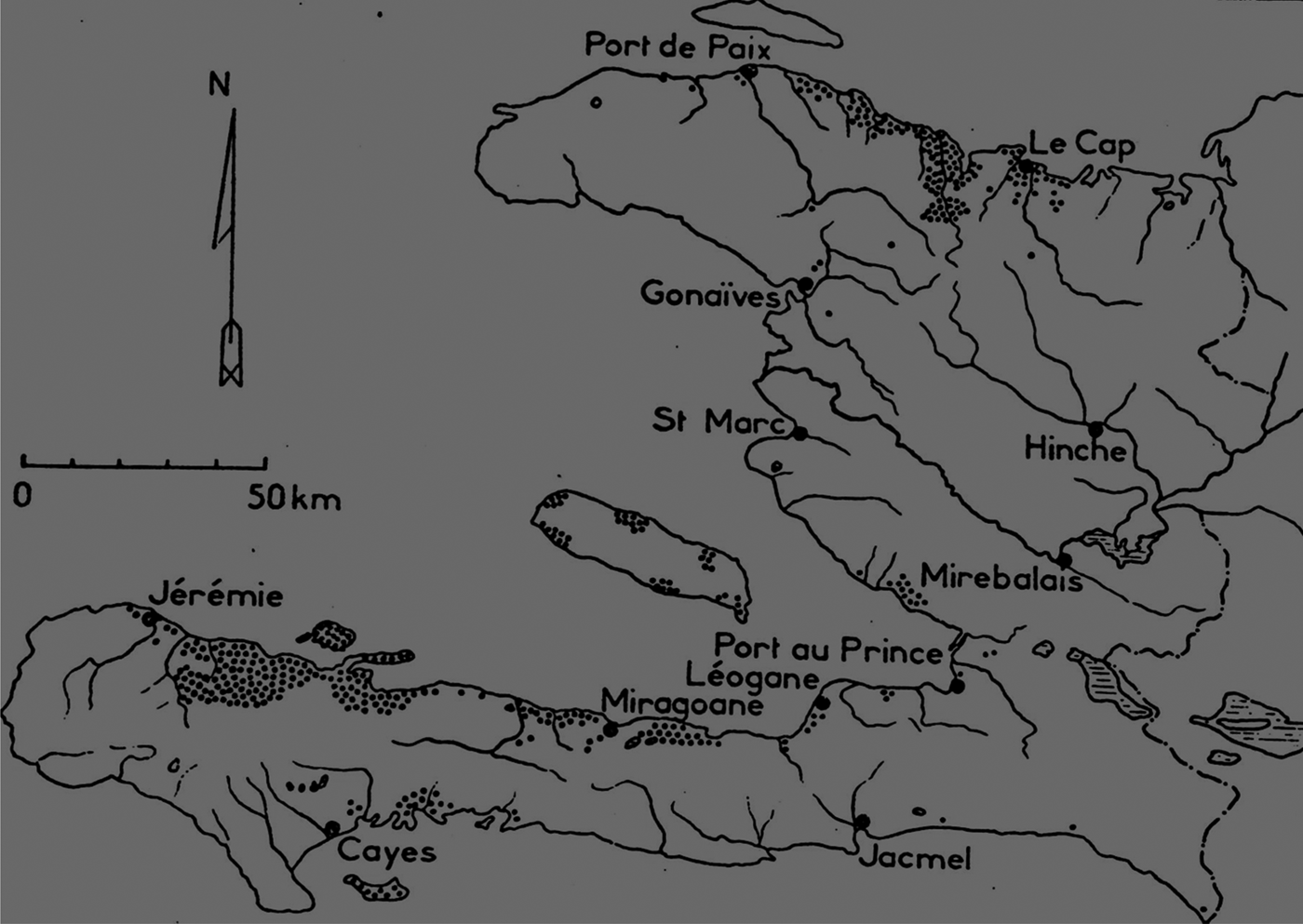
In Haiti, M. ozzardi was reported for the first time by the Rockefeller mission in 1920 (Raccurt, Reference Raccurt1999) and then in an article on lymphatic filariasis in Puerto Rico (Hoffman et al., Reference Hoffman, Marin and Burke1932). In Haiti, foci have been reported in coastal areas populated by mangroves (Ripert et al., Reference Ripert, Raccurt and Douyon1977; Raccurt et al., Reference Raccurt, Lowrie and McNeeley1980; Raccurt, Reference Raccurt1984), a situation that persists until today (Raccurt et al., Reference Raccurt, Brasseur and Boncy2014a, Reference Raccurt, Brasseur, Cicéron and Boncyb). A revision of blood smears collected in all parts of the country by the Service National d’Éradication de la Malaria (SNEM), and in the north of Haiti by the hospital ‘Le Bon Samaritain’ in Limbé, has been conducted (Ripert et al., Reference Ripert, Raccurt and Douyon1977). Five hundred and seven slides showed microfilariae with the specific morphological characteristics of M. ozzardi. All subjects with microfilariae came from localities on the coast, in a plain or valley close to the coastline.
In Haiti the two main areas of concentration are located in the northern part of the island (coastal area between Port-de-Paix and Cap Haïtien, and along the Limbé river valley) and in the south-west, where numerous cases are concentrated along the coast between Jérémie and Petit-Trou-de-Nippes, including the Baradères Peninsula and the Cayemittes Islands.
Small foci are observed on the peripheries of the island of La Gonâve; around Cabaret, Gressier, Leogane, in the Gulf of Gonâve; around Miragoâne, from Petit-Goâve to Anse-à-Veau, on the coast of Nippes; around Saint-Louis-du-Sud; and on the island, Île à Vache.
The two most important foci were found in marshy coastal areas where mangroves grow, climates particularly favourable to the proliferation of sandflies, which are intermediate hosts and vectors of the parasite in Haiti (Raccurt, Reference Raccurt1984). The endemic foci of mansonelliasis in Haiti are shown in fig. 1.
Distribution of foci of Mansonella ozzardi in Haiti, as determineted in 1973–1975 (from Ripert et al., Reference Ripert, Raccurt and Douyon1977).

Vectors of Mansonella ozzardi
Depending on the region, the vectors of M. ozzardi belong to two groups of Diptera (suborder Nematocera): Ceratopogonidae and Simuliidae. Currently, only Culicoides species are known to transmit M. ozzardi in the Caribbean islands, but both Simulium and Culicoides species are vectors in Central and South America. The morphological similarity of adult filariae found during autopsy of monkeys that had been infected experimentally with third-stage larvae from the Haitian strain of M. ozzardi transmitted by Culicoides species and the Colombian strain transmitted by Simulium species confirmed that it was indeed a single species of filaria (Orihel et al., Reference Orihel, Lowrie, Eberhard, Raccurt, Kozek, Tidwell and Tidwell1981). Similarly, the optical microscopy and electron microscopy studies of M. ozzardi microfilariae from Haiti and Colombia showed no significant difference in their respective morphology and ultrastructure (Kozek & Raccurt, Reference Kozek and Raccurt1983; Kozek et al., Reference Kozek, Eberhard and Raccurt1983a). We are therefore dealing with only one species of filaria transmitted by two groups of competent vectors belonging to two kinds of Diptera: the Ceratopogonidae and the Simuliidae.
In 1933, a member of the Ceratopogonidae, Culicoides furens, was first recognized as a vector of the parasite in St. Vincent, in the Caribbean (Buckley, Reference Buckley1933, Reference Buckley1934), while in the Amazon Basin, Simuliidae have been recognized as the competent vector of M. ozzardi (Cerqueira, Reference Cerqueira1959).
Culicoides furens is the main vector of M. ozzardi in the Yucatan peninsula in Mexico (Biagi et al., Reference Biagi, Tay and de Biagi1958) and in the Caribbean, especially in Haiti (Lowrie & Raccurt, Reference Lowrie and Raccurt1981; Raccurt, Reference Raccurt1984). Other sandflies ensure the transmission of the parasite, such as Culicoides phlebotomus in northern Trinidad, (Nelson & Davies, Reference Nelson and Davies1976; Nathan, Reference Nathan1978, Reference Nathan1980) or Culicoides barbosai in southern Haiti (Lowrie & Raccurt, Reference Lowrie and Raccurt1984).
In South America, Culicoides paraensis was first reported as a probable vector of M. ozzardi in the Tucumán province of northern Argentina (Romaña & Wigodzinsky, Reference Romaña and Wygodzinsky1950). Fifty years later, Shelley and Coscarón reported that, in the Jujuy province of Argentina, Culicoides lahillei was the primary vector, while C. paraensis and Simulium exiguum were secondary vectors (Shelley & Coscarón, Reference Shelley and Coscarón2001). Culicoides lahillei, Culicoides debilipalpis and C. paraensis were recently described as the primary vectors of M. ozzardi in north-western Argentina and south-western Bolivia (Veggiani Aybar et al., Reference Veggiani Aybar, Dantur Juri and Zaidenberg2016). Other species of biting midges have been identified as valid for larval maturation up to the third stage of M. ozzardi in South America: Culicoides guttatus in Suriname (Bruijning, Reference Bruijning1957) and Culicoides insinuatus in Colombia (Tidwell & Tidwell, Reference Tidwell and Tidwell1982).
Taxonomic studies of Simulium fauna in Amazonia have shown that the species of Simuliidae, intermediate hosts and vectors of M. ozzardi in this region, often belong to the amazonicum group (Shelley & Luna Dias, Reference Shelley and Luna Dias1980; Ramirez Perez & Peterson, Reference Ramirez Perez and Peterson1981; Tidwell et al., Reference Tidwell, Peterson, Ramirez Perez, Tidwell and Lacey1981a, Reference Tidwell, Tidwell and Petersonb; Shelley et al., Reference Shelley, Pinger and Moraes1982). Other species such as Simulium oyapockense have been implicated as the main vectors in the Amazon Basin of Brazil (Cerqueira, Reference Cerqueira1959), Simulium minusculum in Guyana (Nathan et al., Reference Nathan, Tikasingh and Munroe1982), Simulium sanguineum in Panama (Petersen et al., Reference Petersen, Bawden, Wignall, Latorre, Johnson and Miranda1984) and Simulium sanchezi in Venezuela (Yarzábal et al., Reference Yarzábal, Basáñez, Ramírez-Pérez, Ramírez, Botto and Yarzábal1985).
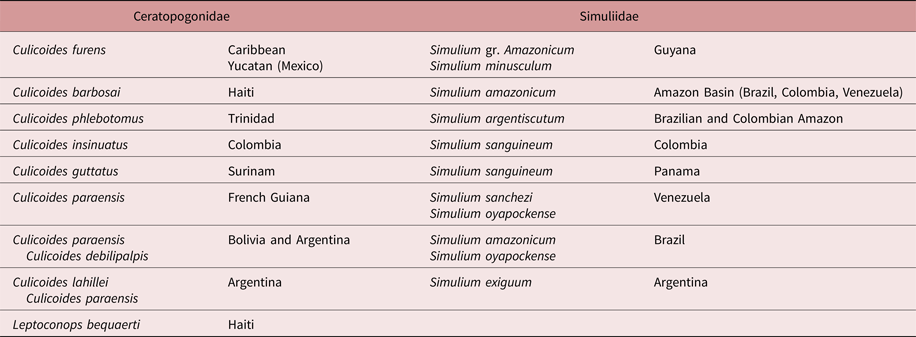
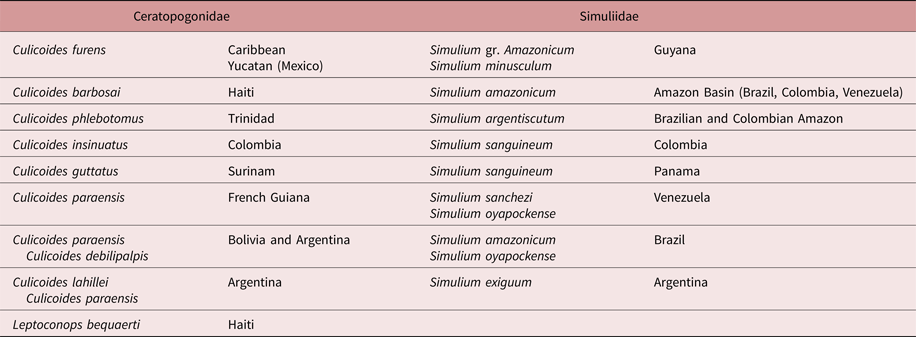
From the published data, we can list the currently known vectors according to the foci and manner in which M. ozzardi accomplishes larval development up to the infesting stage (table 2). Among the Ceratedopogonidae, seven species of Culcoides and one species of Leptoconops, L. bequaerti (Lowrie et al., Reference Lowrie, Raccurt, Eberhard and Katz1983) are currently recognized as vectors, and seven species among the Simuliidae.
Ceratopogonidae and Simuliidae species recognized as vectors of Mansonella ozzardi by geographic region.
Current situation of mansonelliasis in Haiti
A study was conducted in June–July 2013 in the town of Corail (Grande Anse) and the surrounding area (Raccurt et al., Reference Raccurt, Brasseur, Cicéron and Boncy2014b). Finger-prick blood samples were collected from 462 people: 76 showed the presence of M. ozzardi microfilariae, an overall prevalence of 16.5%. In 70% of infected subjects, microfilaraemia was fewer than 10 microfilariae (mf) per 20 μl of capillary blood. The highest microfilaraemia (227 mf/20 μl) was found in a 70-year-old woman. These results are comparable to those found 35 years ago in the Bayeux focus, located in the northern part of Haiti (Raccurt et al., Reference Raccurt, Lowrie and McNeeley1980). The site of Corail, where this infection is developed, is similar to that of the fishing village of Bayeux: the houses are constructed of materials that are permeable to the vectors breeding around and within the mangroves where two main vectors thrive: C. furens and C. barbosai.
Conclusion
In 45 years, the situation of mansonelliasis has remained stable in Haiti, where M. ozzardi persists in localized coastal foci. No action has been taken either to control filariasis by appropriate treatment or to combat culicoides proliferation during this time. The authorities have never paid attention to this non-pathogenic filariasis, while affected individuals complain of fever, headache and chronic pruritus (McNeeley et al., Reference McNeeley, Raccurt, Boncy and Lowrie1989). This situation is also explained by the fact that the economic situation in Haiti is very precarious and has not improved significantly over the past 50 years, especially in peripheral regions where poverty and illiteracy remain at very high levels. As already mentioned (Raccurt et al., Reference Raccurt, Brasseur and Boncy2014a), it would be useful to place this neglected tropical disease on the Ministry of Public Health's agenda, and to provide ivermectin for the health facilities to treat the inhabitants, fishermen or farmers, carriers of microfilariae and those who complain of chronic symptoms such as fever, headache and pruritus. Surveillance campaigns for M. ozzardi among exposed populations should also be conducted to better control this endemic disease. Moreover, in line with the current efforts to develop tourism in Haiti, it will be necessary to pay serious attention to this completely neglected filariasis. If tourists return home carrying the parasite after a stay in Haiti, this would undoubtedly have unfortunate consequences for the future of tourism in Haiti, not to mention the potential for new additional foci of this filariasis in other parts of the New World.
Financial support
This research received no specific grant from any funding agency, commercial or not-for-profit sectors.
Conflict of interest
None.